Presentation
SkillsWeek 10
Presentation Skills
Russell Rodrigo
Presentation Skills: Part 1
The Basics
Lesson Outline
 Understand the purpose of a presentation.
 Identify effective general presentation skills.
 Identify effective visual presentation skills.
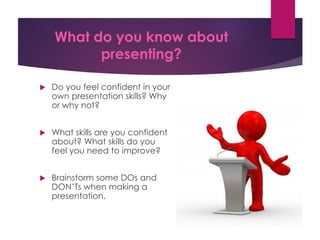
What do you know about
presenting?
 Do you feel confident in your
own presentation skills? Why
or why not?
 What skills are you confident
about? What skills do you
feel you need to improve?
 Brainstorm some DOs and
DON’Ts when making a
presentation.
Presentation Skills
 Watch the video and take notes on the
differences you notice between the first and
second presentations.
Presentation Skills
Presentation Skills
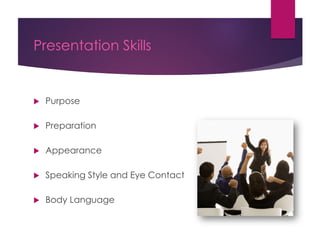
 Purpose
 Preparation
 Appearance
 Speaking Style and Eye Contact
 Body Language
Purpose
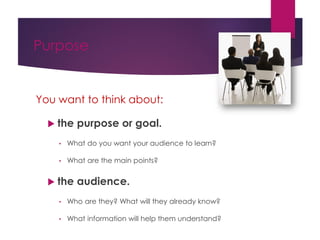
You want to think about:
 the purpose or goal.
• What do you want your audience to learn?
• What are the main points?
 the audience.
• Who are they? What will they already know?
• What information will help them understand?
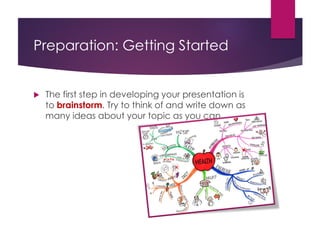
Preparation: Getting Started
 The first step in developing your presentation is
to brainstorm. Try to think of and write down as
many ideas about your topic as you can.
Preparation: Organization
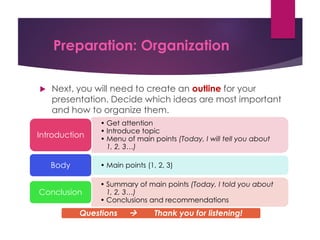
 Next, you will need to create an outline for your
presentation. Decide which ideas are most important
and how to organize them.
• Get attention
• Introduce topic
• Menu of main points (Today, I will tell you about
1, 2, 3…)

Introduction
• Main points (1, 2, 3)Body
• Summary of main points (Today, I told you about
1, 2, 3…)
• Conclusions and recommendations
Conclusion
Questions  Thank you for listening!
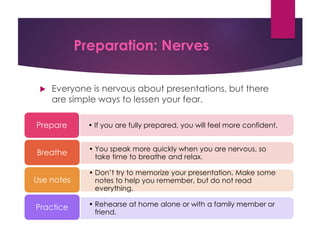
Preparation: Nerves
 Everyone is nervous about presentations, but there
are simple ways to lessen your fear.
• If you are fully prepared, you will feel more confident.Prepare
• You speak more quickly when you are nervous, so
take time to breathe and relax.
Breathe
• Don’t try to memorize your presentation. Make some
notes to help you remember, but do not read
everything.
Use notes
• Rehearse at home alone or with a family member or
friend.
Practice
Appearance
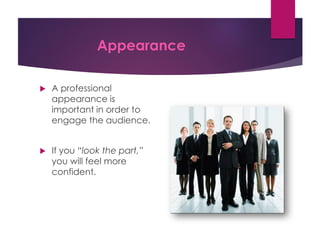
 A professional
appearance is
important in order to
engage the audience.
 If you “look the part,”
you will feel more
confident.
Speaking Style and Eye Contact
For an effective presentation, you want to:
• speak confidently.
• speak clearly.
• sound interested.
• maintain your energy.
• think about where you are speaking.
• make eye contact with the entire audience.
Body Language
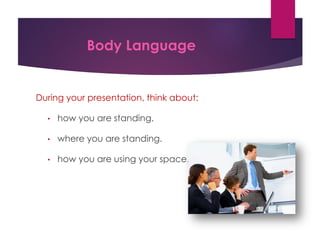
During your presentation, think about:
• how you are standing.
• where you are standing.
• how you are using your space.
Visual Information
 Using visual aid programs such as
PowerPoint can be a creative
way to make your presentation
more effective and interesting,
but it is important to know how to
use visuals effectively.
 Remember, visuals are used to
help make your presentation
clearer and more interesting.
However, visuals are NOT your
presentation—YOU are the
presentation!
Visual Information
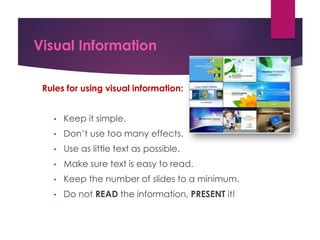
Rules for using visual information:
• Keep it simple.
• Don’t use too many effects.
• Use as little text as possible.
• Make sure text is easy to read.
• Keep the number of slides to a minimum.
• Do not READ the information, PRESENT it!
PRESENTATION SKILLS
Visual Information
Common
Mistakes
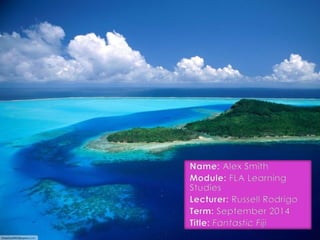
Name: Alex Smith
Module: FLA Learning Studies
Lecturer: Russell Rodrigo
Term: September 2014
Title: Fantastic Fiji
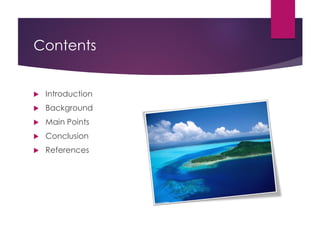
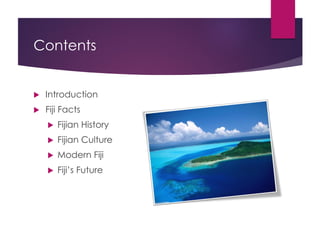
Contents
 Introduction
 Background
 Main Points
 Conclusion
 References
Contents
 Introduction
 Fiji Facts
 Fijian History
 Fijian Culture
 Modern Fiji
 Fiji’s Future
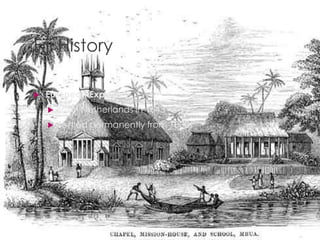
Fiji History
European Explorers
From Netherlands in
1643
Settled
permanently from
1800s
Fiji History
 European Explorers
 From Netherlands in 1643
 Settled permanently from 1800s
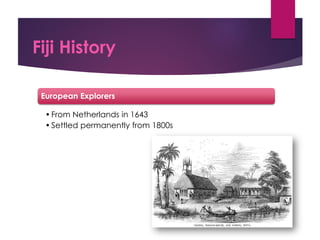
Fiji History
European Explorers
•From Netherlands in 1643
•Settled permanently from 1800s
Introduction
 Fiji /ˈfiːdʒiː/ ( listen) (Fijian: Viti; Fiji Hindi: फ़िजी), officially the Republic of Fiji[6] (Fijian:
Matanitu ko Viti; Fiji Hindi: फ़िजी गणराज्य[7] Fijī Gaṇarājya), is an island nation in
Melanesia in the South Pacific Ocean about 1,100 nautical miles (2,000 km;
1,300 mi) northeast of New Zealand's North Island. Its closest neighbours are
Vanuatu to the west, France's New Caledonia to the southwest, New Zealand's
Kermadec to the southeast, Tonga to the east, the Samoas, France's Wallis and
Futuna to the northeast and Tuvalu to the north.
 The majority of Fiji's islands were formed through volcanic activity started around
150 million years ago. Today, some geothermal activity still occurs on the islands
of Vanua Levu and Taveuni.[8] Fiji has been inhabited since the second
millennium BC. The country comprises an archipelago of more than 332 islands,
of which 110 are permanently inhabited, and more than 500 islets, amounting to
a total land area of circa 18,300 square kilometres (7,100 sq mi). The two major
islands, Viti Levu and Vanua Levu, account for 87% of the population of almost
850,000. The former contains Suva, the capital and largest city. Most of Fijians live
on Viti Levu's coasts, either in Suva or in smaller urban centres. Viti Levu's interior is
sparsely inhabited due to its terrain.[9]
Introduction
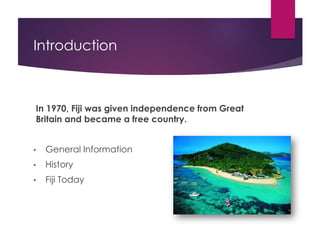
In 1970, Fiji was given independence from Great
Britain and became a free country.
• General Information
• History
• Fiji Today
Fiji Information
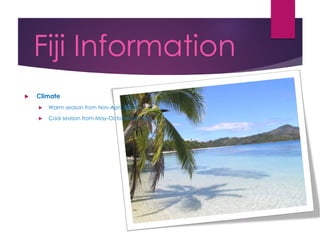
 Climate
 Warm season from Nov-April (26 °C)
 Cool season from May-October (22 °C)
Fiji Information
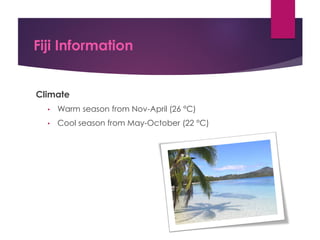
Climate
• Warm season from Nov-April (26 °C)
• Cool season from May-October (22 °C)
Fiji Today
People
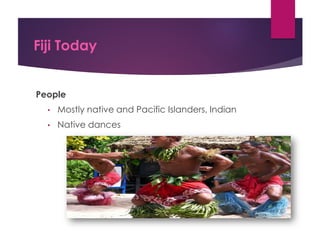
• Mostly native and Pacific Islanders, Indian
• Native dances
Fiji Today
People
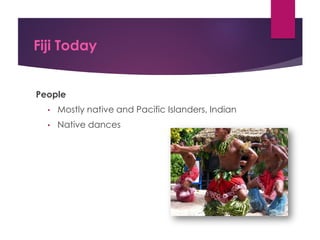
• Mostly native and Pacific Islanders, Indian
• Native dances
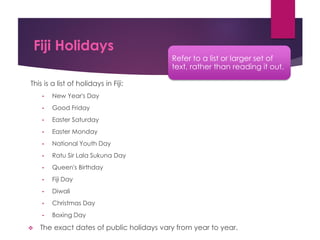
Fiji Holidays
This is a list of holidays in Fiji:
• New Year's Day
• Good Friday
• Easter Saturday
• Easter Monday
• National Youth Day
• Ratu Sir Lala Sukuna Day
• Queen's Birthday
• Fiji Day
• Diwali
• Christmas Day
• Boxing Day
 The exact dates of public holidays vary from year to year.
Refer to a list or larger set of
text, rather than reading it out.
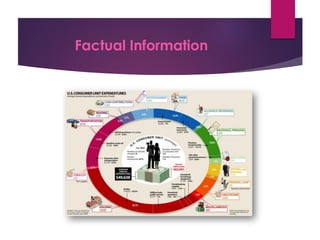
Factual Information
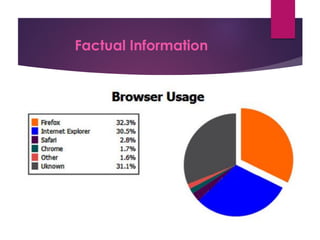
Factual Information
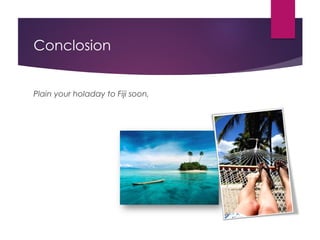
Conclosion
Plain your holaday to Fiji soon,
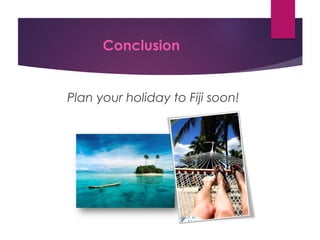
Conclusion
Plan your holiday to Fiji soon!
Using Multimedia
Using multimedia such as audio or video in
your presentation can add a lot to your
content, but be careful how you use it.
• Clearly introduce the clip before you
play it.
• Incorporate the clip into the actual
presentation. Do not stick it on at the
end.
• Do not talk over the clip. The audience
will not be able to hear either clearly.
Using a Video or Audio File
Lesson Review
 Understand the purpose of a presentation.
 Identify effective general presentation skills.
 Identify effective visual presentation skills.
Introduce Yourself
Prepare a 2-3 minute presentation introducing
yourself and your interests.
 Follow the basic presentation organization.
• Introduction (general information)
• Body (3 interests)
• Conclusion
 Apply the basic presentation skills we have
discussed so far.
Presentation Skills: Part 2
Effective
Elements
Lesson Outline
 Elements of effective presentations.
 Methods of stimulating interest in your topic
and getting the audience’s attention.
 How to effectively use signposting.
 How to effectively conclude and handle
questions.
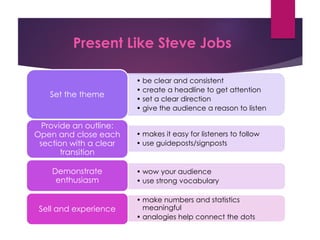
Present Like Steve Jobs
• be clear and consistent
• create a headline to get attention
• set a clear direction
• give the audience a reason to listen
Set the theme
• makes it easy for listeners to follow
• use guideposts/signposts
Provide an outline:
Open and close each
section with a clear
transition
• wow your audience
• use strong vocabulary
Demonstrate
enthusiasm
• make numbers and statistics
meaningful
• analogies help connect the dots
Sell and experience
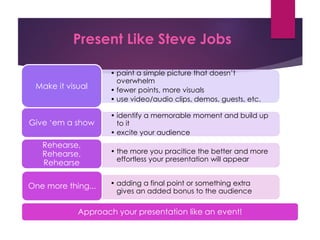
Present Like Steve Jobs
• paint a simple picture that doesn’t
overwhelm
• fewer points, more visuals
• use video/audio clips, demos, guests, etc.
Make it visual
• identify a memorable moment and build up
to it
• excite your audience
Give ‘em a show
• the more you pracitice the better and more
effortless your presentation will appear
Rehearse,
Rehearse,
Rehearse
• adding a final point or something extra
gives an added bonus to the audience
One more thing...
Approach your presentation like an event!
How to get attention
 Ask a question
 You can ask a rhetorical question or something that involves
everyone by getting them to think about the topic.
 Make sure the audience is prepared for your question.
 If you expect the audience to answer, keep the question
simple.
 How many of you in this room were late for work/class today?
 How many of you use English in your daily life?
 Are foreign companies good for our country?
How to get attention
 State an impressive fact
 Show a powerful photo or video
 Begin with a shocking, unusual, or impressive fact connected to
the theme of your presentation.
 A powerful or dramatic image can be used in place of or along
with the fact.
 It may surprise you to know…
 Every day, 10,000 cars use the causeway to and from Singapore.
 One billion cups of coffee are consumed in Malaysia every year.
How to get attention
 Tell a story
 Telling a personal story closely connected to the
theme of your presentation is a great way to begin.
People usually like to hear personal stories, which
are not too long or try to glorify the narrator too
much.
 "Dear colleagues, before I begin I would like to tell
you a short story about how our company got its
name. Don't worry, it's not too long.”
How to get attention
 Cite a quotation
 Quotations are much used for presentations and
they add a colorful touch to your personal style.
 Though they may be impressive, quotations do not
have much shock-value and could be forgotten
quickly, so they should be used along with other
methods of getting audience attention.
 “A short saying often contains much wisdom.” -
Sophocles
 “No culture can live, if it attempts to be exclusive.” -
Mahatma Gandhi
How to get attentionb
 Tell a joke
 Jokes are wonderful for relaxing the audience and
setting a cheerful mood. Relaxed audiences tend to
be more interactive. This might make the presenter’s
work somewhat easier.
 The joke must be appropriate. People have very
different senses of humor and you have to be very
careful with jokes. Think about your audience and
decide if using a joke is the best idea.
Don't marry the person you think you can live with; marry only
the individual you think you can't live without. -James C. Dobson
•Parents have an obligation to educate their
children about the realties and challenges of
marriage, and should allow them the freedom to
decide for themselves if marriage is suitable for
their future.
Thesis
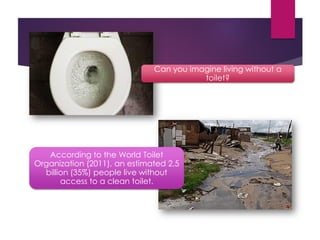
Can you imagine living without a
toilet?
According to the World Toilet
Organization (2011), an estimated 2.5
billion (35%) people live without
access to a clean toilet.
•People living in developed countries need to
accept greater responsibility for improving the
lives of those living in countries which are still
poor and developing.
Thesis
•Parents and educators must recognize
that an overemphasis on exams
causes unnecessary stress on students
and can seriously damage their
physical and mental health.
Thesis
Getting Attention: Practice
Brainstorm ways of getting attention for the topics below.
 Lectures should be reduced from 2 hours to only 1 hour.
 Malaysia should ban fast food chains in order to protect its traditional culture in the future.
 Online games are causing young people to become more violent.
 Higher taxes on soft drinks and fast food should be imposed to encourage healthy eating.
 Stay at home moms VS Working moms
 Gym industry has become popular due to people’s vanity
Emphasizing your point
Using signals to focus attention on what you are about to
say.
• Ok! This is the plan.
• This is what we have to do to achieve our goals.
Using strong words:
• Let’s be absolutely clear about this!
• It’s essential/imperative to..
Emphasizing your point
Using the full form instead of a contraction:
• This is not what we want. (instead of isn’t)
• We will succeed. (instead of we’ll)
Stress key words when speaking:
• It’s the price that’s important.
• What we want is more security.
• It is not only the cost that is a problem: It is
also the time.
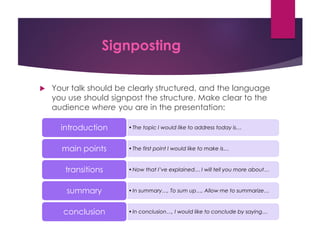
Signposting
 Your talk should be clearly structured, and the language
you use should signpost the structure. Make clear to the
audience where you are in the presentation:
•The topic I would like to address today is…introduction
•The first point I would like to make is…main points
•Now that I’ve explained… I will tell you more about…transitions
•In summary…, To sum up…, Allow me to summarize…summary
•In conclusion…, I would like to conclude by saying…conclusion
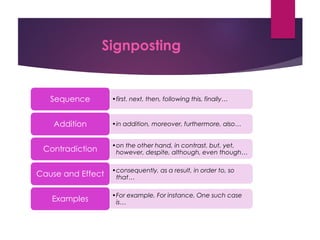
Signposting
•first, next, then, following this, finally…Sequence
•in addition, moreover, furthermore, also…Addition
•on the other hand, in contrast, but, yet,
however, despite, although, even though…Contradiction
•consequently, as a result, in order to, so
that…Cause and Effect
•For example, For instance, One such case
is…Examples
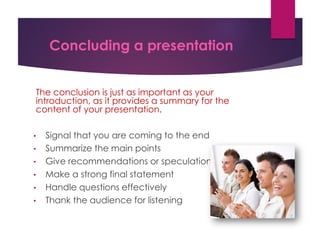
Concluding a presentation
The conclusion is just as important as your
introduction, as it provides a summary for the
content of your presentation.
• Signal that you are coming to the end
• Summarize the main points
• Give recommendations or speculations
• Make a strong final statement
• Handle questions effectively
• Thank the audience for listening
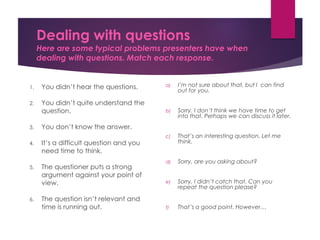
Dealing with questions
Here are some typical problems presenters have when
dealing with questions. Match each response.
1. You didn’t hear the questions.
2. You didn’t quite understand the
question.
3. You don’t know the answer.
4. It’s a difficult question and you
need time to think.
5. The questioner puts a strong
argument against your point of
view.
6. The question isn’t relevant and
time is running out.
a) I’m not sure about that, but I can find
out for you.
b) Sorry. I don’t think we have time to get
into that. Perhaps we can discuss it later.
c) That’s an interesting question. Let me
think.
d) Sorry, are you asking about?
e) Sorry, I didn’t catch that. Can you
repeat the question please?
f) That’s a good point. However…
Lesson Review
 Elements of effective presentations.
 Methods of stimulating interest in your topic
and getting the audience’s attention.
 How to effectively use signposting.
 How to effectively conclude and handle
questions.
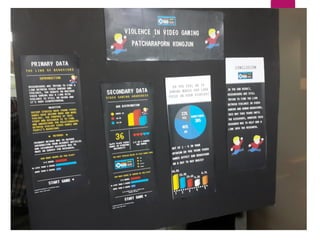
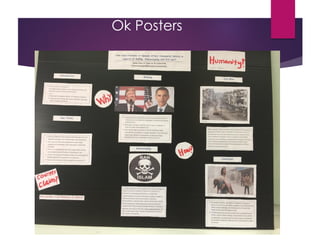
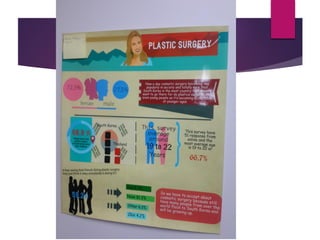
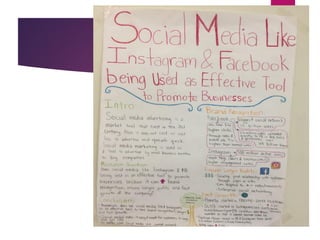
Posters
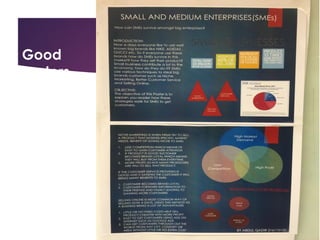
Good
Posters
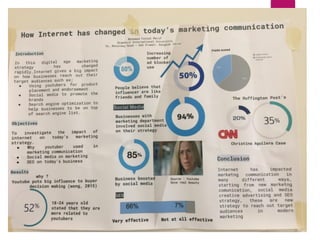
Ok Posters
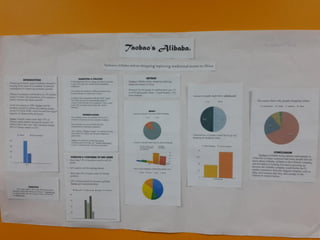
Bad
Examples
bad example
Week 10 Presentation Skills

Week 10 Presentation Skills

  • 1.
  • 2.
  • 3.
    Lesson Outline  Understandthe purpose of a presentation.  Identify effective general presentation skills.  Identify effective visual presentation skills.
  • 4.
    What do youknow about presenting?  Do you feel confident in your own presentation skills? Why or why not?  What skills are you confident about? What skills do you feel you need to improve?  Brainstorm some DOs and DON’Ts when making a presentation.
  • 5.
    Presentation Skills  Watchthe video and take notes on the differences you notice between the first and second presentations.
  • 6.
  • 7.
    Presentation Skills  Purpose Preparation  Appearance  Speaking Style and Eye Contact  Body Language
  • 8.
    Purpose You want tothink about:  the purpose or goal. • What do you want your audience to learn? • What are the main points?  the audience. • Who are they? What will they already know? • What information will help them understand?
  • 9.
    Preparation: Getting Started The first step in developing your presentation is to brainstorm. Try to think of and write down as many ideas about your topic as you can.
  • 10.
    Preparation: Organization  Next,you will need to create an outline for your presentation. Decide which ideas are most important and how to organize them. • Get attention • Introduce topic • Menu of main points (Today, I will tell you about 1, 2, 3…) Introduction • Main points (1, 2, 3)Body • Summary of main points (Today, I told you about 1, 2, 3…) • Conclusions and recommendations Conclusion Questions  Thank you for listening!
  • 11.
    Preparation: Nerves  Everyoneis nervous about presentations, but there are simple ways to lessen your fear. • If you are fully prepared, you will feel more confident.Prepare • You speak more quickly when you are nervous, so take time to breathe and relax. Breathe • Don’t try to memorize your presentation. Make some notes to help you remember, but do not read everything. Use notes • Rehearse at home alone or with a family member or friend. Practice
  • 12.
    Appearance  A professional appearanceis important in order to engage the audience.  If you “look the part,” you will feel more confident.
  • 13.
    Speaking Style andEye Contact For an effective presentation, you want to: • speak confidently. • speak clearly. • sound interested. • maintain your energy. • think about where you are speaking. • make eye contact with the entire audience.
  • 14.
    Body Language During yourpresentation, think about: • how you are standing. • where you are standing. • how you are using your space.
  • 15.
    Visual Information  Usingvisual aid programs such as PowerPoint can be a creative way to make your presentation more effective and interesting, but it is important to know how to use visuals effectively.  Remember, visuals are used to help make your presentation clearer and more interesting. However, visuals are NOT your presentation—YOU are the presentation!
  • 16.
    Visual Information Rules forusing visual information: • Keep it simple. • Don’t use too many effects. • Use as little text as possible. • Make sure text is easy to read. • Keep the number of slides to a minimum. • Do not READ the information, PRESENT it!
  • 17.
  • 18.
    Name: Alex Smith Module:FLA Learning Studies Lecturer: Russell Rodrigo Term: September 2014 Title: Fantastic Fiji
  • 20.
    Contents  Introduction  Background Main Points  Conclusion  References
  • 21.
    Contents  Introduction  FijiFacts  Fijian History  Fijian Culture  Modern Fiji  Fiji’s Future
  • 22.
    Fiji History European Explorers FromNetherlands in 1643 Settled permanently from 1800s
  • 23.
    Fiji History  EuropeanExplorers  From Netherlands in 1643  Settled permanently from 1800s
  • 24.
    Fiji History European Explorers •FromNetherlands in 1643 •Settled permanently from 1800s
  • 25.
    Introduction  Fiji /ˈfiːdʒiː/( listen) (Fijian: Viti; Fiji Hindi: फ़िजी), officially the Republic of Fiji[6] (Fijian: Matanitu ko Viti; Fiji Hindi: फ़िजी गणराज्य[7] Fijī Gaṇarājya), is an island nation in Melanesia in the South Pacific Ocean about 1,100 nautical miles (2,000 km; 1,300 mi) northeast of New Zealand's North Island. Its closest neighbours are Vanuatu to the west, France's New Caledonia to the southwest, New Zealand's Kermadec to the southeast, Tonga to the east, the Samoas, France's Wallis and Futuna to the northeast and Tuvalu to the north.  The majority of Fiji's islands were formed through volcanic activity started around 150 million years ago. Today, some geothermal activity still occurs on the islands of Vanua Levu and Taveuni.[8] Fiji has been inhabited since the second millennium BC. The country comprises an archipelago of more than 332 islands, of which 110 are permanently inhabited, and more than 500 islets, amounting to a total land area of circa 18,300 square kilometres (7,100 sq mi). The two major islands, Viti Levu and Vanua Levu, account for 87% of the population of almost 850,000. The former contains Suva, the capital and largest city. Most of Fijians live on Viti Levu's coasts, either in Suva or in smaller urban centres. Viti Levu's interior is sparsely inhabited due to its terrain.[9]
  • 26.
    Introduction In 1970, Fijiwas given independence from Great Britain and became a free country. • General Information • History • Fiji Today
  • 27.
    Fiji Information  Climate Warm season from Nov-April (26 °C)  Cool season from May-October (22 °C)
  • 28.
    Fiji Information Climate • Warmseason from Nov-April (26 °C) • Cool season from May-October (22 °C)
  • 29.
    Fiji Today People • Mostlynative and Pacific Islanders, Indian • Native dances
  • 30.
    Fiji Today People • Mostlynative and Pacific Islanders, Indian • Native dances
  • 31.
    Fiji Holidays This isa list of holidays in Fiji: • New Year's Day • Good Friday • Easter Saturday • Easter Monday • National Youth Day • Ratu Sir Lala Sukuna Day • Queen's Birthday • Fiji Day • Diwali • Christmas Day • Boxing Day  The exact dates of public holidays vary from year to year. Refer to a list or larger set of text, rather than reading it out.
  • 32.
  • 33.
  • 34.
  • 35.
  • 36.
    Using Multimedia Using multimediasuch as audio or video in your presentation can add a lot to your content, but be careful how you use it. • Clearly introduce the clip before you play it. • Incorporate the clip into the actual presentation. Do not stick it on at the end. • Do not talk over the clip. The audience will not be able to hear either clearly.
  • 37.
    Using a Videoor Audio File
  • 38.
    Lesson Review  Understandthe purpose of a presentation.  Identify effective general presentation skills.  Identify effective visual presentation skills.
  • 39.
    Introduce Yourself Prepare a2-3 minute presentation introducing yourself and your interests.  Follow the basic presentation organization. • Introduction (general information) • Body (3 interests) • Conclusion  Apply the basic presentation skills we have discussed so far.
  • 40.
    Presentation Skills: Part2 Effective Elements
  • 41.
    Lesson Outline  Elementsof effective presentations.  Methods of stimulating interest in your topic and getting the audience’s attention.  How to effectively use signposting.  How to effectively conclude and handle questions.
  • 42.
  • 43.
    Present Like SteveJobs • be clear and consistent • create a headline to get attention • set a clear direction • give the audience a reason to listen Set the theme • makes it easy for listeners to follow • use guideposts/signposts Provide an outline: Open and close each section with a clear transition • wow your audience • use strong vocabulary Demonstrate enthusiasm • make numbers and statistics meaningful • analogies help connect the dots Sell and experience
  • 44.
    Present Like SteveJobs • paint a simple picture that doesn’t overwhelm • fewer points, more visuals • use video/audio clips, demos, guests, etc. Make it visual • identify a memorable moment and build up to it • excite your audience Give ‘em a show • the more you pracitice the better and more effortless your presentation will appear Rehearse, Rehearse, Rehearse • adding a final point or something extra gives an added bonus to the audience One more thing... Approach your presentation like an event!
  • 45.
    How to getattention  Ask a question  You can ask a rhetorical question or something that involves everyone by getting them to think about the topic.  Make sure the audience is prepared for your question.  If you expect the audience to answer, keep the question simple.  How many of you in this room were late for work/class today?  How many of you use English in your daily life?  Are foreign companies good for our country?
  • 46.
    How to getattention  State an impressive fact  Show a powerful photo or video  Begin with a shocking, unusual, or impressive fact connected to the theme of your presentation.  A powerful or dramatic image can be used in place of or along with the fact.  It may surprise you to know…  Every day, 10,000 cars use the causeway to and from Singapore.  One billion cups of coffee are consumed in Malaysia every year.
  • 47.
    How to getattention  Tell a story  Telling a personal story closely connected to the theme of your presentation is a great way to begin. People usually like to hear personal stories, which are not too long or try to glorify the narrator too much.  "Dear colleagues, before I begin I would like to tell you a short story about how our company got its name. Don't worry, it's not too long.”
  • 48.
    How to getattention  Cite a quotation  Quotations are much used for presentations and they add a colorful touch to your personal style.  Though they may be impressive, quotations do not have much shock-value and could be forgotten quickly, so they should be used along with other methods of getting audience attention.  “A short saying often contains much wisdom.” - Sophocles  “No culture can live, if it attempts to be exclusive.” - Mahatma Gandhi
  • 49.
    How to getattentionb  Tell a joke  Jokes are wonderful for relaxing the audience and setting a cheerful mood. Relaxed audiences tend to be more interactive. This might make the presenter’s work somewhat easier.  The joke must be appropriate. People have very different senses of humor and you have to be very careful with jokes. Think about your audience and decide if using a joke is the best idea.
  • 50.
    Don't marry theperson you think you can live with; marry only the individual you think you can't live without. -James C. Dobson
  • 51.
    •Parents have anobligation to educate their children about the realties and challenges of marriage, and should allow them the freedom to decide for themselves if marriage is suitable for their future. Thesis
  • 52.
    Can you imagineliving without a toilet? According to the World Toilet Organization (2011), an estimated 2.5 billion (35%) people live without access to a clean toilet.
  • 53.
    •People living indeveloped countries need to accept greater responsibility for improving the lives of those living in countries which are still poor and developing. Thesis
  • 55.
    •Parents and educatorsmust recognize that an overemphasis on exams causes unnecessary stress on students and can seriously damage their physical and mental health. Thesis
  • 56.
    Getting Attention: Practice Brainstormways of getting attention for the topics below.  Lectures should be reduced from 2 hours to only 1 hour.  Malaysia should ban fast food chains in order to protect its traditional culture in the future.  Online games are causing young people to become more violent.  Higher taxes on soft drinks and fast food should be imposed to encourage healthy eating.  Stay at home moms VS Working moms  Gym industry has become popular due to people’s vanity
  • 57.
    Emphasizing your point Usingsignals to focus attention on what you are about to say. • Ok! This is the plan. • This is what we have to do to achieve our goals. Using strong words: • Let’s be absolutely clear about this! • It’s essential/imperative to..
  • 58.
    Emphasizing your point Usingthe full form instead of a contraction: • This is not what we want. (instead of isn’t) • We will succeed. (instead of we’ll) Stress key words when speaking: • It’s the price that’s important. • What we want is more security. • It is not only the cost that is a problem: It is also the time.
  • 59.
    Signposting  Your talkshould be clearly structured, and the language you use should signpost the structure. Make clear to the audience where you are in the presentation: •The topic I would like to address today is…introduction •The first point I would like to make is…main points •Now that I’ve explained… I will tell you more about…transitions •In summary…, To sum up…, Allow me to summarize…summary •In conclusion…, I would like to conclude by saying…conclusion
  • 60.
    Signposting •first, next, then,following this, finally…Sequence •in addition, moreover, furthermore, also…Addition •on the other hand, in contrast, but, yet, however, despite, although, even though…Contradiction •consequently, as a result, in order to, so that…Cause and Effect •For example, For instance, One such case is…Examples
  • 61.
    Concluding a presentation Theconclusion is just as important as your introduction, as it provides a summary for the content of your presentation. • Signal that you are coming to the end • Summarize the main points • Give recommendations or speculations • Make a strong final statement • Handle questions effectively • Thank the audience for listening
  • 62.
    Dealing with questions Hereare some typical problems presenters have when dealing with questions. Match each response. 1. You didn’t hear the questions. 2. You didn’t quite understand the question. 3. You don’t know the answer. 4. It’s a difficult question and you need time to think. 5. The questioner puts a strong argument against your point of view. 6. The question isn’t relevant and time is running out. a) I’m not sure about that, but I can find out for you. b) Sorry. I don’t think we have time to get into that. Perhaps we can discuss it later. c) That’s an interesting question. Let me think. d) Sorry, are you asking about? e) Sorry, I didn’t catch that. Can you repeat the question please? f) That’s a good point. However…
  • 63.
    Lesson Review  Elementsof effective presentations.  Methods of stimulating interest in your topic and getting the audience’s attention.  How to effectively use signposting.  How to effectively conclude and handle questions.
  • 64.
  • 65.
  • 69.
  • 71.
  • 72.