Media Convergence
An overview of media and culture
Emerging Technologies
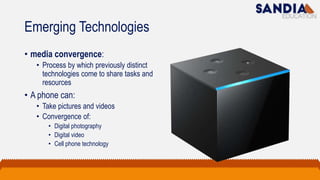
• media convergence:
• Process by which previously distinct
technologies come to share tasks and
resources
• A phone can:
• Take pictures and videos
• Convergence of:
• Digital photography
• Digital video
• Cell phone technology
Examples
Type of Media Convergence
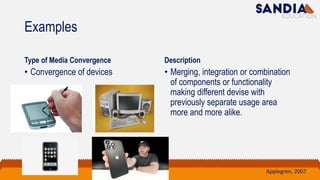
• Convergence of devices
Description
• Merging, integration or combination
of components or functionality
making different devise with
previously separate usage area
more and more alike.
Applegren, 2007
Examples
Type of Media Convergence
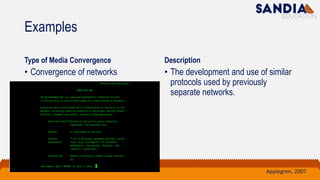
• Convergence of networks
Description
• The development and use of similar
protocols used by previously
separate networks.
Applegren, 2007
Examples
Type of Media Convergence
• Convergence of Services
Description
• Services which traditionally have
been associated with certain media
channel, now provide alternative
media channels.
Applegren, 2007
Examples
Type of Media Convergence
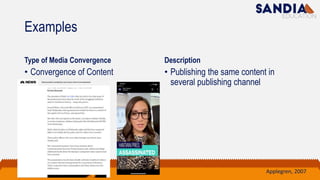
• Convergence of Content
Description
• Publishing the same content in
several publishing channel
Applegren, 2007
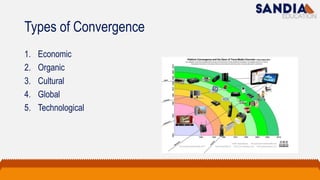
Types of Convergence
1. Economic
2. Organic
3. Cultural
4. Global
5. Technological
Economic
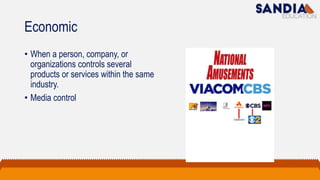
• When a person, company, or
organizations controls several
products or services within the same
industry.
• Media control
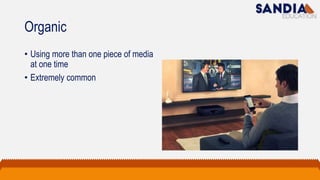
Organic
• Using more than one piece of media
at one time
• Extremely common
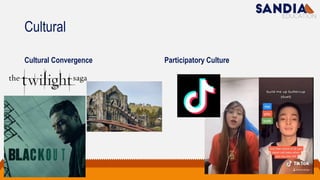
Cultural
Cultural Convergence Participatory Culture
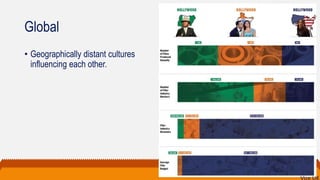
Global
• Geographically distant cultures
influencing each other.
Vice UK
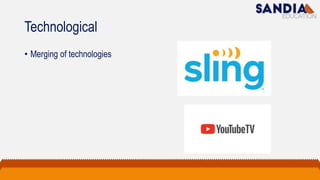
Technological
• Merging of technologies
Importance of Media in Convergence
• Transformative to the media industry
• Increased cross-media
• New media forms are being developed
• Increased online interaction.
Leverage Edu
Advantages of Convergence
• Greater audience engagement:
• Moment-based content
• Better targeting of audience
• Globalization
• Lowered costs of marketing
• Emerging technologies:
• 5G technology
• Cell Phones
• Gaming
• What’s next?
Leverage Edu
Disadvantages
• Generational gap
• Difficult to make predictions
• Difficult to asses consumer response and reactions
• Information overload
• Prone to cyber-attacks and malfunctioning.
Moving Forward
• We need to predict the future
• Will new technologies be as revolutionary we predict?
• Are these short-term gains?

Introduction to Media Convergence

  • 1.
    Media Convergence An overviewof media and culture
  • 2.
    Emerging Technologies • mediaconvergence: • Process by which previously distinct technologies come to share tasks and resources • A phone can: • Take pictures and videos • Convergence of: • Digital photography • Digital video • Cell phone technology
  • 3.
    Examples Type of MediaConvergence • Convergence of devices Description • Merging, integration or combination of components or functionality making different devise with previously separate usage area more and more alike. Applegren, 2007
  • 4.
    Examples Type of MediaConvergence • Convergence of networks Description • The development and use of similar protocols used by previously separate networks. Applegren, 2007
  • 5.
    Examples Type of MediaConvergence • Convergence of Services Description • Services which traditionally have been associated with certain media channel, now provide alternative media channels. Applegren, 2007
  • 6.
    Examples Type of MediaConvergence • Convergence of Content Description • Publishing the same content in several publishing channel Applegren, 2007
  • 7.
    Types of Convergence 1.Economic 2. Organic 3. Cultural 4. Global 5. Technological
  • 8.
    Economic • When aperson, company, or organizations controls several products or services within the same industry. • Media control
  • 9.
    Organic • Using morethan one piece of media at one time • Extremely common
  • 10.
  • 11.
    Global • Geographically distantcultures influencing each other. Vice UK
  • 12.
  • 13.
    Importance of Mediain Convergence • Transformative to the media industry • Increased cross-media • New media forms are being developed • Increased online interaction. Leverage Edu
  • 14.
    Advantages of Convergence •Greater audience engagement: • Moment-based content • Better targeting of audience • Globalization • Lowered costs of marketing • Emerging technologies: • 5G technology • Cell Phones • Gaming • What’s next? Leverage Edu
  • 15.
    Disadvantages • Generational gap •Difficult to make predictions • Difficult to asses consumer response and reactions • Information overload • Prone to cyber-attacks and malfunctioning.
  • 16.
    Moving Forward • Weneed to predict the future • Will new technologies be as revolutionary we predict? • Are these short-term gains?

Editor's Notes

  • #3 As new media’s emerge, existing technologies do not simply disappear. We still watch television, listen to radio, read newspapers, and become engrossed in movies. What has changed is that we can now consume these media through one device, like a phone or computer with the use of the internet. Such actions are enabled by media convergence, the process by which previously distinct technologies come to share tasks and resources. A cell phone that also takes pictures and video is an example of the convergence of digital photography, digital video, and cellular telephone technologies. An extreme, and currently nonexistent, example of technological convergence would be the so-called black box, which would combine all the functions of previously distinct technology and would be the device through which we’d receive all our news, information, entertainment, and social interaction.
  • #4 Example: The development of a smart phone with similar function to those of a PDA and handheld computers.
  • #5 Example: The emergence of the internet The Internet Protocol (IP) is the principal communications protocol in the Internet protocol suite for relaying datagrams across network boundaries. Its routing function enables internetworking, and essentially establishes the Internet.
  • #6 Example: The service broadcast TV available on the TV channels’ website as the service web TV.
  • #7 Example Multiple channel publishing of the same content in the printed newspaper and the online edition of the newspaper.
  • #8 Media convergence, sometimes referred to as technological convergence, is the merging of previously distinct media technologies and platforms through digitization and computer networking. This breaking down of silos has led to the integration of all media and had allowed immediate and global exchange of content of all kinds. convergence isn’t just limited to technology. Media theorist Henry Jenkins argues that convergence isn’t an end result (as is the hypothetical black box), but instead a process that changes how media is both consumed and produced. Jenkins breaks convergence down into five categories:
  • #9 Economic convergence occurs when a company controls several products or services within the same industry. For example, in the entertainment industry a single company may have interests across many kinds of media. For example Sumner Redstone owns National Amusements. National Amusements is involved in book publishing with Simon and Schuster, Podcasts with Cadence13, Television stations with WBBM-TV 2 Chicago, film with Paramount Pictures, Cable Television with MTV, and internet steaming with BET+. This by no means is an extensive list, but only exemplifies how diverse the holdings of Sumner Redstone are.
  • #10 The average American has access to more than ten connected devices in their household, and each of these devices is competing for our attention, which they eventually get, most of the time. Organic convergence or media stacking is what happens when someone is watching a television show online while exchanging text messages with a friend and also listening to music in the background.
  • #11 Cultural convergence has several aspects which all center around the idea of stories flowing across several kinds of media. For example, novels that become movies like twilight. Or podcast dramas that become tv series as is the case with the podcast Blackout.; even amusement park rides that become film franchises (Pirates of the Caribbean). Another great example is that The character Harry Potter exists in books, films, toys, and amusement park rides. A different aspect of cultural convergence is participatory culture—that is, the way media consumers are able to annotate, comment on, remix, and otherwise influence culture in unprecedented ways. The video-sharing website YouTube is a prime example of participatory culture. YouTube gives anyone with a video camera and an Internet connection the opportunity to communicate with people around the world and create and shape cultural trends.
  • #12 Global convergence is the process of geographically distant cultures influencing one another despite the distance that physically separates them. Nigeria’s cinema industry, nicknamed Nollywood, takes its cues from India’s Bollywood, which is in turn inspired by Hollywood in the United States. Tom and Jerry cartoons are popular on Arab satellite television channels. Successful American horror movies The Ring and The Grudge are remakes of Japanese hits. The advantage of global convergence is access to a wealth of cultural influence; its downside, some critics posit, is the threat of cultural imperialism, defined by Herbert Schiller as the way developing countries are “attracted, pressured, forced, and sometimes bribed into shaping social institutions to correspond to, or even promote, the values and structures of the dominating centre of the system (White, 2001).” Cultural imperialism can be a formal policy or can happen more subtly, as with the spread of outside influence through television, movies, and other cultural projects.
  • #13 Technological convergence is the merging of technologies such as the ability to watch TV shows online on sites like Hulu or to play video games on mobile phones like the Apple iPhone. When more and more different kinds of media are transformed into digital content, as Jenkins notes, “we expand the potential relationships between them and enable them to flow across platforms (Jenkins, 2001).”
  • #14 Wondering why media convergence is important? It is important because it blends together content, communication technologies and computer networks thus leading to the immediate transformation of many established industries, services as well as work practices and through all this, new forms of content are born. Here are the key points why Media Convergence is important: It transforms the modes of communication, news reporting, and journalism. For example, Media journalism. It led to cross-media since a huge amount of content is now being accessed through portable devices. For instance, news organizations no longer simply rely on print or AV transmission. Many new media forms are born like news portals, podcasts, news feeds, blogging, websites and mobile applications. The newly converged media platforms provide online access to the archives, and endless opportunities for users to comment on the story or provide links to relevant material.
  • #15 Media convergence has proved to be beneficial in the digital era which is filled with content seeking our attention continuously. Here are the most important advantages of Media Convergence: The instant availability of news and moment-based content is one of the top advantages of media convergence between traditional media and new media. The content producers can specifically target the best audience or group they are aiming towards by publishing customized content. With media convergence, the audience has also become the creator themselves. From memes to social media posts, media convergence has truly been beneficial to integrate audience on a global level. Another important benefit of media convergence that it has broadened the limitations of traditional media by blending it with new media, thus providing instant and latest content on an international level. With the media convergence between traditional media and new media, the cost of digital marketing has also become economical thus making this process beneficial and affordable.
  • #16 While the advantages of this form of convergence focus on content integration, faster access and international reach, disadvantages highlight the impact of convergence on consumers as well as technology.  Generational gap modern American culture is plugged in as never before, and today’s high school students have never known a world where the Internet didn’t exist. Such a cultural sea change causes a significant generation gap between those who grew up with new media and those who didn’t. A 2010 study by the Kaiser Family Foundation found that Americans aged 8 to 18 spend more than 7.5 hours with electronic devices each day—and, thanks to multitasking, they’re able to pack an average of 11 hours of media content into that 7.5 hours (Lewin, 2010). It is difficult to predict how media convergence and immersion are affecting culture, society, and individual brains.  Difficulty in assessing consumer responses and reactions scattered across diverse converged platforms. Audiences often feel overwhelmed with massive amounts of information overload. Prone to cyber-attacks and malfunctioning.