Presented by:
Rohit Kumar
Pragya
Sandhya Darmwal
Samarjit Ghosh
Harsheen Kaur Khanna
What is a Presentation?
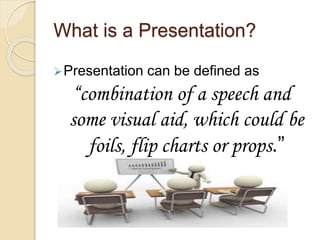
Presentation can be defined as
“combination of a speech and
some visual aid, which could be
foils, flip charts or props.”
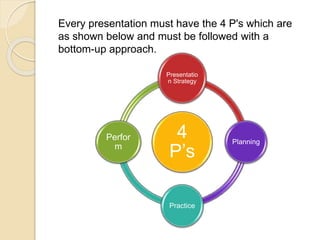
4
P’s
Presentatio
n Strategy
Planning
Practice
Perfor
m
Every presentation must have the 4 P's which are
as shown below and must be followed with a
bottom-up approach.
1st P- Presentation Strategy
 This is one of the most important stages
of every presentation. The first thing
every presenter must do is ask himself
the following: -
• Why am I doing this presentation ?
or
what is the objective of this
presentation?
• Who is my audience ?
 The first question will give you an answer that is
the theme and objective of the presentation. It
could be a call-to-action or an approval or a status
update. But essentially, your presentation should
have a single key idea and a thread that runs
throughout the presentation.
 The second question will answer the kind of
audience who is listening to and therein lays the
heart of the presentation. If you have a great
technical idea and your audience is senior
management, you better tune the presentation to
what they want to listen to. They are not interested
in your design or your code that implements the
idea.
 Be energetic and passionate about your subject
and collect as much data as you can to prove your
point and establish credibility with the audience.
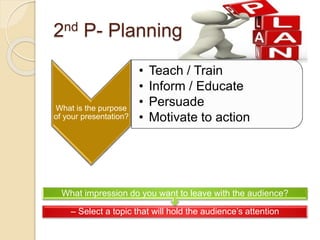
2nd P- Planning
What is the purpose
of your presentation?
• Teach / Train
• Inform / Educate
• Persuade
• Motivate to action
– Select a topic that will hold the audience’s attention
What impression do you want to leave with the audience?
 Research your topic thoroughly
 Organize your presentation:
 Introduction, body and conclusion –
Prepare a memorable introduction and
conclusion
 As a good presenter, please make
sure that visual aids are there just
to help you as a cue for your
information and also to provide
some information to the audience
for their reference.
 There are various ways to prepare your
visual aids, but here are a few tips that
you might want to keep in mind: -
1. If you have X minutes to deliver your
presentation, finish it off in X minutes
2. Use Pictures
3. KISS - keep it short and simple.
4. Use Opening-Body-Conclusion
approach to structure your information
3rd P- Practice
 Take time to run through your
presentation and your aids. You will be
amazed the amount of mistakes you will
capture and eliminate.
 Practice before an audience, coach,
mirror or video camera. The feedback is
very important from them and you can
tune the presentation accordingly.
 On the day of your presentation:
Properly groomed and appropriately
dressed
Arrive early to the location
Become familiar with the room, stage
and microphone
Meet and get to know the audience
prior to speaking
Visualize yourself speaking
successfully
Relax and breathe deeply
4th P- Perform
 Stand straight; take a deep breath, smile and
start.
 Enjoy every moment of your presentation.
After all, where will you get an audience
ready to listen? So make the best of it.
 Hold your audience’s attention
Articulate vivid, colorful and expressive words
Eye contact with the entire audience
Body language and hand gestures
Vocal variety
Dramatic pauses
 Involve the audience; don't just leave
them to listen. Take names, make
friends and use humor as and when
required.
 Remember - it's your presentation and
you are the presentation. So you own it
and control it.
 Presentation is effective only when the
presenter adds value to it and meets
the overall objective of the event.
 So the next time you have a
presentation to deliver, follow the Four
P's and I am sure that you have better
chances to make it an effective
presentation.
4 p’s of presentation

4 p’s of presentation

  • 1.
    Presented by: Rohit Kumar Pragya SandhyaDarmwal Samarjit Ghosh Harsheen Kaur Khanna
  • 2.
    What is aPresentation? Presentation can be defined as “combination of a speech and some visual aid, which could be foils, flip charts or props.”
  • 3.
    4 P’s Presentatio n Strategy Planning Practice Perfor m Every presentationmust have the 4 P's which are as shown below and must be followed with a bottom-up approach.
  • 4.
    1st P- PresentationStrategy  This is one of the most important stages of every presentation. The first thing every presenter must do is ask himself the following: - • Why am I doing this presentation ? or what is the objective of this presentation? • Who is my audience ?
  • 5.
     The firstquestion will give you an answer that is the theme and objective of the presentation. It could be a call-to-action or an approval or a status update. But essentially, your presentation should have a single key idea and a thread that runs throughout the presentation.  The second question will answer the kind of audience who is listening to and therein lays the heart of the presentation. If you have a great technical idea and your audience is senior management, you better tune the presentation to what they want to listen to. They are not interested in your design or your code that implements the idea.  Be energetic and passionate about your subject and collect as much data as you can to prove your point and establish credibility with the audience.
  • 6.
    2nd P- Planning Whatis the purpose of your presentation? • Teach / Train • Inform / Educate • Persuade • Motivate to action – Select a topic that will hold the audience’s attention What impression do you want to leave with the audience?
  • 7.
     Research yourtopic thoroughly  Organize your presentation:  Introduction, body and conclusion – Prepare a memorable introduction and conclusion  As a good presenter, please make sure that visual aids are there just to help you as a cue for your information and also to provide some information to the audience for their reference.
  • 8.
     There arevarious ways to prepare your visual aids, but here are a few tips that you might want to keep in mind: - 1. If you have X minutes to deliver your presentation, finish it off in X minutes 2. Use Pictures 3. KISS - keep it short and simple. 4. Use Opening-Body-Conclusion approach to structure your information
  • 9.
    3rd P- Practice Take time to run through your presentation and your aids. You will be amazed the amount of mistakes you will capture and eliminate.  Practice before an audience, coach, mirror or video camera. The feedback is very important from them and you can tune the presentation accordingly.
  • 11.
     On theday of your presentation: Properly groomed and appropriately dressed Arrive early to the location Become familiar with the room, stage and microphone Meet and get to know the audience prior to speaking Visualize yourself speaking successfully Relax and breathe deeply
  • 12.
    4th P- Perform Stand straight; take a deep breath, smile and start.  Enjoy every moment of your presentation. After all, where will you get an audience ready to listen? So make the best of it.  Hold your audience’s attention Articulate vivid, colorful and expressive words Eye contact with the entire audience Body language and hand gestures Vocal variety Dramatic pauses
  • 13.
     Involve theaudience; don't just leave them to listen. Take names, make friends and use humor as and when required.  Remember - it's your presentation and you are the presentation. So you own it and control it.
  • 14.
     Presentation iseffective only when the presenter adds value to it and meets the overall objective of the event.  So the next time you have a presentation to deliver, follow the Four P's and I am sure that you have better chances to make it an effective presentation.