How to succeed in difficult conversations
Objective
The objective of this module is to
• Identify difficult interpersonal
situations
• Learn how to initiate and close
conversations in difficult
situations
• Minimize destructive
conversations
• Develop precise questions to
conduct a skillful conversation.
• Engage in open and productive
conversations
Introduction
• Are you feeling overworked or under
appreciated?
• Does your boss seem to be asking too much of
you, seemingly oblivious to the amount of work
you already have on your plate?
• Do you have a colleague continually
undermining you?
• Do you have feedback you’d like to give but are
afraid to cause offence?
• Have you ever wished you had the courage to
speak up and engage in a difficult conversation
at work?
• Are you afraid of giving tough feedback to a
subordinate ?
• Is challenging your boss on a highly
controversial topic difficult?
• Can you approach your boss's boss when you
feel you are stuck?
Courageous
Conversations –
What, Why and How ?
www.theapprentiice.com
What is courageous conversation?
• Courageous conversation simply put is a
constructive and open discussion
between two or more people on difficult
topics and issues where stakes and
emotions run high
• Courageous conversations are held
• When ideas are met with
continuous resistance
• When there is a lack of follow-
through on commitments
• When uncomfortable situations
aren’t being addressed
• When problems remain unresolved
What stops us?
• Not knowing how to begin a
conversation
• Uncertainty of the outcome
• Fear of overly emotional
reaction
• Stakes are high
• Feel uncomfortable and
difficult
• Not confident of handling
others emotions
• Fear of damaging the
relationship
• Fear of punishment
Need for courageous conversation
• How severe is the situation that I am looking to
address?
• What are my possible risks?
• What are my possible gains?
• Who is my recipient?
• What is their personality like?
• How are they likely to respond?
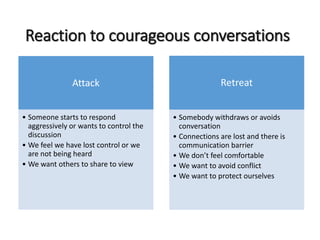
Reaction to courageous conversations
Attack
• Someone starts to respond
aggressively or wants to control the
discussion
• We feel we have lost control or we
are not being heard
• We want others to share to view
Retreat
• Somebody withdraws or avoids
conversation
• Connections are lost and there is
communication barrier
• We don’t feel comfortable
• We want to avoid conflict
• We want to protect ourselves
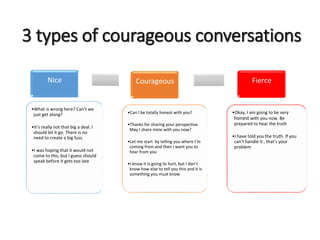
3 types of courageous conversations
Nice
•What is wrong here? Can’t we
just get along?
•It’s really not that big a deal. I
should let it go. There is no
need to create a big fuss.
•I was hoping that it would not
come to this, but I guess should
speak before it gets too late
Courageous
•Can I be totally honest with you?
•Thanks for sharing your perspective.
May I share mine with you now?
•Let me start by telling you where I’m
coming from and then I want you to
hear from you
•I know it is going to hurt, but I don’t
know how else to tell you this and it is
something you must know
Fierce
•Okay, I am going to be very
honest with you now. Be
prepared to hear the truth
•I have told you the truth. If you
can’t handle it , that’s your
problem
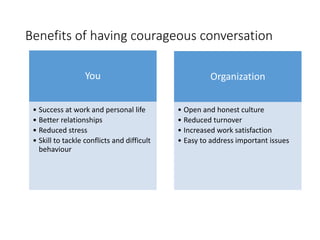
Benefits of having courageous conversation
You
• Success at work and personal life
• Better relationships
• Reduced stress
• Skill to tackle conflicts and difficult
behaviour
Organization
• Open and honest culture
• Reduced turnover
• Increased work satisfaction
• Easy to address important issues
Cost of Avoidance
What is cost of avoiding it ?
• Low team / personal
spirit
• Time is lost
• Increased conflict
• High stress level
• Missed opportunities
Process for
Courageous
Conversation
www.theapprentiice.com
Process
There is a process to having a
courageous conversation and
following it ensures Positive
impact and desired result:
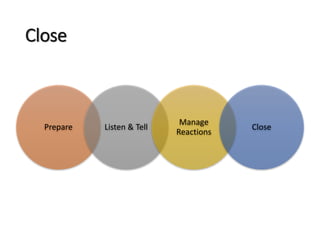
• Prepare
• Listen & Tell
• Manage Reactions
• Close
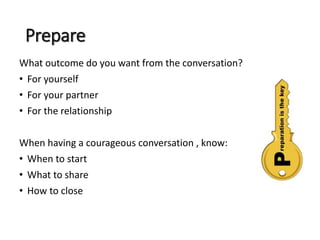
Prepare
What outcome do you want from the conversation?
• For yourself
• For your partner
• For the relationship
When having a courageous conversation , know:
• When to start
• What to share
• How to close
How do I
begin the
conversation?
Here are a few conversation openers:
• I have something I’d like to discuss with
you that I think will help us work
together more effectively.
• I’d like to talk about ____________
with you, but first I’d like to get your
point of view.
• I need your help with what just
happened. Do you have a few minutes
to talk?
• I need your help with something. Can
we talk about it (soon)? If the person
says, “Sure, let me get back to you,”
follow up with him.
How do I
begin the
conversation?
Here are a few conversation openers:
• I think we have different perceptions
about _____________________. I’d
like to hear your thinking on this.
• I’d like to talk about _______________.
I think we may have different ideas
about how to ___________________.
• I’d like to see if we might reach a better
understanding about ___________. I
really want to hear your feelings about
this and share my perspective as well.
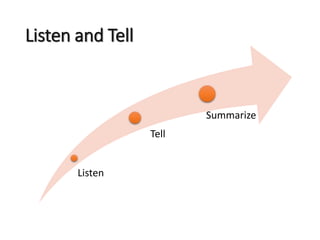
Listen and Tell
Listen
Tell
Summarize
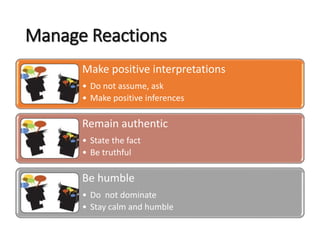
Manage Reactions
Make positive interpretations
• Do not assume, ask
• Make positive inferences
Remain authentic
• State the fact
• Be truthful
Be humble
• Do not dominate
• Stay calm and humble
Close
Prepare Listen & Tell
Manage
Reactions
Close
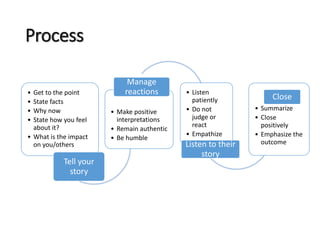
Process
• Get to the point
• State facts
• Why now
• State how you feel
about it?
• What is the impact
on you/others
Tell your
story
• Make positive
interpretations
• Remain authentic
• Be humble
Manage
reactions • Listen
patiently
• Do not
judge or
react
• Empathize
Listen to their
story
• Summarize
• Close
positively
• Emphasize the
outcome
Close
Tips to having
Courageous
Conversations
www.theapprentiice.com
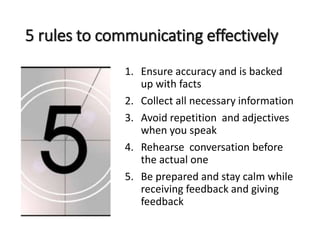
5 rules to communicating effectively
1. Ensure accuracy and is backed
up with facts
2. Collect all necessary information
3. Avoid repetition and adjectives
when you speak
4. Rehearse conversation before
the actual one
5. Be prepared and stay calm while
receiving feedback and giving
feedback
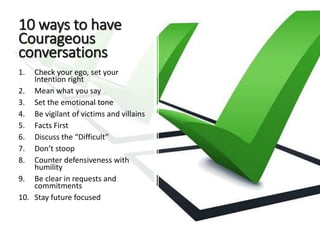
10 ways to have
Courageous
conversations
1. Check your ego, set your
Intention right
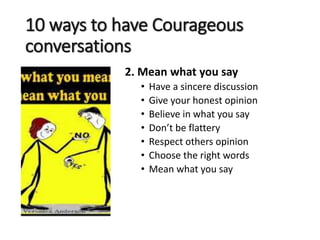
2. Mean what you say
3. Set the emotional tone
4. Be vigilant of victims and villains
5. Facts First
6. Discuss the “Difficult”
7. Don’t stoop
8. Counter defensiveness with
humility
9. Be clear in requests and
commitments
10. Stay future focused
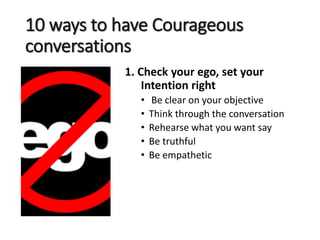
10 ways to have Courageous
conversations
1. Check your ego, set your
Intention right
• Be clear on your objective
• Think through the conversation
• Rehearse what you want say
• Be truthful
• Be empathetic
10 ways to have Courageous
conversations
2. Mean what you say
• Have a sincere discussion
• Give your honest opinion
• Believe in what you say
• Don’t be flattery
• Respect others opinion
• Choose the right words
• Mean what you say
10 ways to have Courageous
conversations
3. Set the emotional tone
• Rehearse what you what to say
• Stay calm
• Write down points you want to cover
• Manage your emotions before handling others
• If emotions run high, call off the conversation
10 ways to have Courageous
conversations
4. Be vigilant of victims and
villains
• Listen to others view point
• Build trust
• Watch out for negative reactions
and handle them
10 ways to have Courageous
conversations
5. Facts First
• Get your facts right
• Do not assume
• Listen to others opinion
• Use language that keeps
discussion open
10 ways to have Courageous
conversations
6. Discuss the “Difficult”
• Talk what is important
• Do not beat around the bush
• Do not avoid difficult
conversations
• Do not keep your thoughts to
yourself
• Speaking out helps reduce stress
10 ways to have Courageous
conversations
7. Don’t stoop
• Do not get angry at others
• Do not behave the way others do
• Be positive and stay calm
• Take control of your emotions
• When people behave wrong, do
not reciprocate
10 ways to have Courageous
conversations
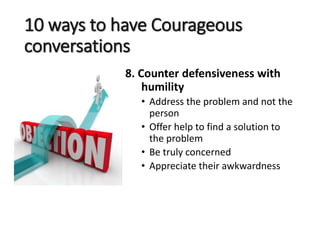
8. Counter defensiveness with
humility
• Address the problem and not the
person
• Offer help to find a solution to
the problem
• Be truly concerned
• Appreciate their awkwardness
10 ways to have Courageous
conversations
9. Be clear in requests and commitments
• Have clarity about the outcome you want
• Let others know what you want
• Make clear requests with specific actions
• Keep your commitments
• In case of non consensus, keep dialogue open
• Schedule another meeting to discuss and close
10 ways to have Courageous
conversations
10. Stay future focused
• Easy to blame and criticize others
• Difficult to be disciplined
• Focus on change required and not on the problem
• Practice before you preach
For a free online course on
this subject – enroll to our
Course :
COURAGEOUS
CONVERSATIONS
At www.theapprentiice.com
www.theapprentiice.com
Summary
• Understand, appreciate and
overcome gaps/challenges to
communicating effectively.
• Have a greater ability and
courage to engage in difficult
conversations.
• Manage yourself and your
communication more effectively
• Have greater self -awareness
• Have more tools and techniques
to have conversations
• Have an improved ability to give
and receive feedback.

How to succeed in Difficult Conversations

  • 1.
    How to succeedin difficult conversations
  • 2.
    Objective The objective ofthis module is to • Identify difficult interpersonal situations • Learn how to initiate and close conversations in difficult situations • Minimize destructive conversations • Develop precise questions to conduct a skillful conversation. • Engage in open and productive conversations
  • 3.
    Introduction • Are youfeeling overworked or under appreciated? • Does your boss seem to be asking too much of you, seemingly oblivious to the amount of work you already have on your plate? • Do you have a colleague continually undermining you? • Do you have feedback you’d like to give but are afraid to cause offence? • Have you ever wished you had the courage to speak up and engage in a difficult conversation at work? • Are you afraid of giving tough feedback to a subordinate ? • Is challenging your boss on a highly controversial topic difficult? • Can you approach your boss's boss when you feel you are stuck?
  • 4.
    Courageous Conversations – What, Whyand How ? www.theapprentiice.com
  • 5.
    What is courageousconversation? • Courageous conversation simply put is a constructive and open discussion between two or more people on difficult topics and issues where stakes and emotions run high • Courageous conversations are held • When ideas are met with continuous resistance • When there is a lack of follow- through on commitments • When uncomfortable situations aren’t being addressed • When problems remain unresolved
  • 6.
    What stops us? •Not knowing how to begin a conversation • Uncertainty of the outcome • Fear of overly emotional reaction • Stakes are high • Feel uncomfortable and difficult • Not confident of handling others emotions • Fear of damaging the relationship • Fear of punishment
  • 7.
    Need for courageousconversation • How severe is the situation that I am looking to address? • What are my possible risks? • What are my possible gains? • Who is my recipient? • What is their personality like? • How are they likely to respond?
  • 8.
    Reaction to courageousconversations Attack • Someone starts to respond aggressively or wants to control the discussion • We feel we have lost control or we are not being heard • We want others to share to view Retreat • Somebody withdraws or avoids conversation • Connections are lost and there is communication barrier • We don’t feel comfortable • We want to avoid conflict • We want to protect ourselves
  • 9.
    3 types ofcourageous conversations Nice •What is wrong here? Can’t we just get along? •It’s really not that big a deal. I should let it go. There is no need to create a big fuss. •I was hoping that it would not come to this, but I guess should speak before it gets too late Courageous •Can I be totally honest with you? •Thanks for sharing your perspective. May I share mine with you now? •Let me start by telling you where I’m coming from and then I want you to hear from you •I know it is going to hurt, but I don’t know how else to tell you this and it is something you must know Fierce •Okay, I am going to be very honest with you now. Be prepared to hear the truth •I have told you the truth. If you can’t handle it , that’s your problem
  • 10.
    Benefits of havingcourageous conversation You • Success at work and personal life • Better relationships • Reduced stress • Skill to tackle conflicts and difficult behaviour Organization • Open and honest culture • Reduced turnover • Increased work satisfaction • Easy to address important issues
  • 11.
    Cost of Avoidance Whatis cost of avoiding it ? • Low team / personal spirit • Time is lost • Increased conflict • High stress level • Missed opportunities
  • 12.
  • 13.
    Process There is aprocess to having a courageous conversation and following it ensures Positive impact and desired result: • Prepare • Listen & Tell • Manage Reactions • Close
  • 14.
    Prepare What outcome doyou want from the conversation? • For yourself • For your partner • For the relationship When having a courageous conversation , know: • When to start • What to share • How to close
  • 15.
    How do I beginthe conversation? Here are a few conversation openers: • I have something I’d like to discuss with you that I think will help us work together more effectively. • I’d like to talk about ____________ with you, but first I’d like to get your point of view. • I need your help with what just happened. Do you have a few minutes to talk? • I need your help with something. Can we talk about it (soon)? If the person says, “Sure, let me get back to you,” follow up with him.
  • 16.
    How do I beginthe conversation? Here are a few conversation openers: • I think we have different perceptions about _____________________. I’d like to hear your thinking on this. • I’d like to talk about _______________. I think we may have different ideas about how to ___________________. • I’d like to see if we might reach a better understanding about ___________. I really want to hear your feelings about this and share my perspective as well.
  • 17.
  • 18.
    Manage Reactions Make positiveinterpretations • Do not assume, ask • Make positive inferences Remain authentic • State the fact • Be truthful Be humble • Do not dominate • Stay calm and humble
  • 19.
    Close Prepare Listen &Tell Manage Reactions Close
  • 20.
    Process • Get tothe point • State facts • Why now • State how you feel about it? • What is the impact on you/others Tell your story • Make positive interpretations • Remain authentic • Be humble Manage reactions • Listen patiently • Do not judge or react • Empathize Listen to their story • Summarize • Close positively • Emphasize the outcome Close
  • 21.
  • 22.
    5 rules tocommunicating effectively 1. Ensure accuracy and is backed up with facts 2. Collect all necessary information 3. Avoid repetition and adjectives when you speak 4. Rehearse conversation before the actual one 5. Be prepared and stay calm while receiving feedback and giving feedback
  • 23.
    10 ways tohave Courageous conversations 1. Check your ego, set your Intention right 2. Mean what you say 3. Set the emotional tone 4. Be vigilant of victims and villains 5. Facts First 6. Discuss the “Difficult” 7. Don’t stoop 8. Counter defensiveness with humility 9. Be clear in requests and commitments 10. Stay future focused
  • 24.
    10 ways tohave Courageous conversations 1. Check your ego, set your Intention right • Be clear on your objective • Think through the conversation • Rehearse what you want say • Be truthful • Be empathetic
  • 25.
    10 ways tohave Courageous conversations 2. Mean what you say • Have a sincere discussion • Give your honest opinion • Believe in what you say • Don’t be flattery • Respect others opinion • Choose the right words • Mean what you say
  • 26.
    10 ways tohave Courageous conversations 3. Set the emotional tone • Rehearse what you what to say • Stay calm • Write down points you want to cover • Manage your emotions before handling others • If emotions run high, call off the conversation
  • 27.
    10 ways tohave Courageous conversations 4. Be vigilant of victims and villains • Listen to others view point • Build trust • Watch out for negative reactions and handle them
  • 28.
    10 ways tohave Courageous conversations 5. Facts First • Get your facts right • Do not assume • Listen to others opinion • Use language that keeps discussion open
  • 29.
    10 ways tohave Courageous conversations 6. Discuss the “Difficult” • Talk what is important • Do not beat around the bush • Do not avoid difficult conversations • Do not keep your thoughts to yourself • Speaking out helps reduce stress
  • 30.
    10 ways tohave Courageous conversations 7. Don’t stoop • Do not get angry at others • Do not behave the way others do • Be positive and stay calm • Take control of your emotions • When people behave wrong, do not reciprocate
  • 31.
    10 ways tohave Courageous conversations 8. Counter defensiveness with humility • Address the problem and not the person • Offer help to find a solution to the problem • Be truly concerned • Appreciate their awkwardness
  • 32.
    10 ways tohave Courageous conversations 9. Be clear in requests and commitments • Have clarity about the outcome you want • Let others know what you want • Make clear requests with specific actions • Keep your commitments • In case of non consensus, keep dialogue open • Schedule another meeting to discuss and close
  • 33.
    10 ways tohave Courageous conversations 10. Stay future focused • Easy to blame and criticize others • Difficult to be disciplined • Focus on change required and not on the problem • Practice before you preach
  • 34.
    For a freeonline course on this subject – enroll to our Course : COURAGEOUS CONVERSATIONS At www.theapprentiice.com www.theapprentiice.com
  • 35.
    Summary • Understand, appreciateand overcome gaps/challenges to communicating effectively. • Have a greater ability and courage to engage in difficult conversations. • Manage yourself and your communication more effectively • Have greater self -awareness • Have more tools and techniques to have conversations • Have an improved ability to give and receive feedback.

Editor's Notes

  • #11 Courageous conversations will help you learn how to tackle the challenges of conflict and difficult behaviour in the workplace, reducing their stress levels and creating a more positive working environment. While in organizations it will help your team to avoid and overcome these situations, resulting in a healthier, happier and more productive working environment and reduced turnover.
  • #14  Using a structured process, helps achieve clear agreements on behaviour changes and improved relationships. Developing the ability to effectively communicate in these challenging situations leads to greater satisfaction in relationships, team culture, performance, and results.
  • #15 .
  • #22 Let us learn ,Tips to having Courageous Conversations.
  • #23 Five golden rules to make sure that your message comes across, and in the clearest and most effective way: 1. Make sure everything you say is accurate and backed up by facts 2. Make sure to collect all information ahead of time 3. Avoid unnecessary repetitions and expanding with more and more adjectives. 4. Practice ahead of time, many times, as preparation for your meeting 5. Be prepared and calm to receive feedback from the recipient as well. They must have some feedback on you too, and as much as you want to be listened to and respected in what you are looking to convey, your recipient may have some feedback and perspective that you might not have thought of. Be prepared to not only convey messages but also to be an attentive recipient yourself.
  • #24 10 ways to have courageous conversations are : Check your ego, set your Intention right Mean what you say Set the emotional tone Be vigilant of victims and villains Facts First Discuss the “Difficult” Don’t stoop Counter defensiveness with humility Be clear in requests and commitments Stay future focused Let us look into each of the point in detail in next few slides.
  • #25 Check your ego, set your intention.  There’s a difference between speaking up and talking down to someone, making them feel smaller, stupid or small. Before entering into a courageous conversation, be very clear about why you are having it.  Speaking your mind is not fruitful unless it’s done thoughtfully and with a clearly defined rationale for why this is conversation is important.  The truth is that a message that comes from the heart, reaches the heart.
  • #26 Mean what you say.   Have a sincere discussion. Give your honest opinion . Believe in what you say . Don’t be flattery. Respect others opinion . Choose the right words . Mean what you say. Be candid in your feedback and honest in your opinion. Say what you sincerely believe needs to be said, even if you know others may not enjoy hearing it. People can intuitively tell when you are being sincere. They can also tell when you aren’t. Don’t sugar coat the truth in fake compliments and flattery.  Share what you want to say, and be sure to phrase it in a way that others know you respect their humanity, if not their opinion or actions.    Choose your words wisely and convey them correctly emphasizing on the right words.