EFFECTIVE
COMMUNICATION
Supervisory
Skills Series
WHY IS EFFECTIVE
COMMUNICATION
IMPORTANT?
“The art of communication
is the language of
leadership”
David Hume - philosopher, historian, economist, and essayist
Washington State University. (2006). Supervisory Training: The supervisor as communicator. Pullman, WA.
COMMUNICATION
DEFINED
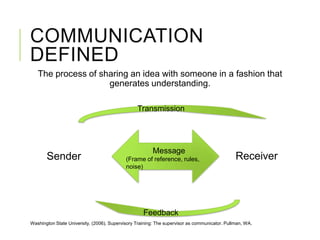
The process of sharing an idea with someone in a fashion that
generates understanding.
Sender Receiver
Message
(Frame of reference, rules,
noise)
Transmission
Feedback
Washington State University. (2006). Supervisory Training: The supervisor as communicator. Pullman, WA.
COMMUNICATION
BREAKDOWN
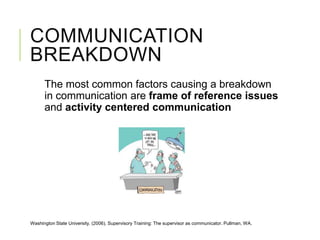
The most common factors causing a breakdown
in communication are frame of reference issues
and activity centered communication
Washington State University. (2006). Supervisory Training: The supervisor as communicator. Pullman, WA.
FRAME OF REFERENCE
“the cognitive and emotional viewpoint from
which an individual perceives and interprets
reality”
Common issues are
Cultural, Personal, & Situational
Washington State University. (2006). Supervisory Training: The supervisor as communicator. Pullman, WA.
FOCUS ON “OUTCOME”
Supervisors should ask the following
questions:
• What is my desired outcome with this communication?
• What is it I want employees to think, feel, and do after receiving this
message?
Give & Get Feedback!
Washington State University. (2006). Supervisory Training: The supervisor as communicator. Pullman, WA.
THREE CRITICAL
COMPONENTS OF
EFFECTIVE
COMMUNICATION
•A clearly stated message
•A common frame of reference
•A two-way exchange
Washington State University. (2006). Supervisory Training: The supervisor as communicator. Pullman, WA.
KEYS TO EFFECTIVE
COMMUNICATION
• Build trust
• Share knowledge
• Provide feedback
• Walk the talk
• “Sync” your communication types
• Active Listening
Washington State University. (2006). Supervisory Training: The supervisor as communicator. Pullman, WA.
WHAT IS YOUR
COMMUNICATION
STYLE UNDER
STRESS?
Style Under
Stress Test
WHAT IS A CRUCIAL
CONVERSATION?
A crucial conversation is defined as “a
discussion between two or more people
where
1) stakes are high
2) opinions vary
3) and emotions run strong.”
Patterson, K., Grenny, J., McMillan, R., & Switzler, A. (2002). Crucial Conversations: Tools for talking when stakes are high. New
York, NY: McGraw-Hill
HOW DO WE TYPICALLY
HANDLE CRUCIAL
CONVERSATIONS?
•We avoid them.
•We face them and handle them poorly.
•We face them and handle them well.
Patterson, K., Grenny, J., McMillan, R., & Switzler, A. (2002). Crucial Conversations: Tools for talking when stakes are high. New
York, NY: McGraw-Hill
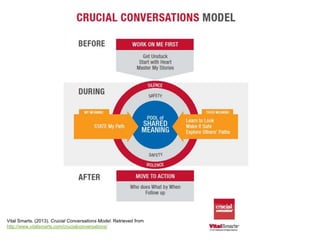
CRUCIAL
CONVERSATIONS
PROCESS
•Start with the heart
•Learn to look
•Make it safe
•Master your stories
•State YOUR path
•Explore other’s paths
•Move to actions
Patterson, K., Grenny, J., McMillan, R., & Switzler, A. (2002). Crucial Conversations: Tools for talking when stakes are high. New York,
NY: McGraw-Hill
START WITH THE HEART
•Work on “me” first
•Focus on what you really want
•Refuse the Sucker’s Choice
Patterson, K., Grenny, J., McMillan, R., & Switzler, A. (2002). Crucial Conversations: Tools for talking when stakes are high. New York,
NY: McGraw-Hill
LEARN TO LOOK
• Learn to look at content and conditions
• Look for when things become crucial
• Learn to watch for safety problems
• Look to see if others are moving toward silence or
violence
• Look for outbreaks of your Style Under Stress
Patterson, K., Grenny, J., McMillan, R., & Switzler, A. (2002). Crucial Conversations: Tools for talking when stakes are high. New
York, NY: McGraw-Hill
MAKE IT SAFE
1. Step out – remove yourself physically and emotionally
2. Decide which condition of safety is at risk
• Mutual Respect or Mutual Purpose
Mutual Respect
• Apologize when appropriate
• Contrast to fix misunderstanding
• Address others’ concerns that you don’t respect them or that you have malicious
purpose (the don’t part)
• Confirm your respect or clarifies your real purpose (the do part)
•Then you can move forward with your conversation
Patterson, K., Grenny, J., McMillan, R., & Switzler, A. (2002). Crucial Conversations: Tools for talking when stakes are high. New York,
NY: McGraw-Hill
MUTUAL PURPOSE -
CRIB
 Commit to seek Mutual Purpose
 Recognize the purpose behind the strategy
 Invent a Mutual Purpose
 Brainstorm new strategies
Patterson, K., Grenny, J., McMillan, R., & Switzler, A. (2002). Crucial Conversations: Tools for talking when stakes are
high. New York, NY: McGraw-Hill
MASTER YOUR OWN
STORIES
What story are you telling to yourself?
How can you be aware of your own bias?
Are strong emotions keeping you from getting to the real
issue?
Retrace your path (notice your behavior, identify your actual
feelings, analyze your narrative, check your own facts)
Tell the rest of the story (go back to the heart, look at what
you really want, and examine your own role in the problem)
Patterson, K., Grenny, J., McMillan, R., & Switzler, A. (2002). Crucial Conversations: Tools for talking when stakes are high. New
York, NY: McGraw-Hill
STATE YOUR PATH
• Share your facts
• Tell your story
• Ask for other’s paths
• Talk tentatively
• Encourage testing
Patterson, K., Grenny, J., McMillan, R., & Switzler, A. (2002). Crucial Conversations: Tools for talking when stakes are high. New York,
NY: McGraw-Hill
EXPLORE OTHER’S
PATHS
Listening when others are having difficulty
communicating.
•Ask
•Mirror
•Paraphrase
•Prime
•Agree
•Build
•Compare
Patterson, K., Grenny, J., McMillan, R., & Switzler, A. (2002). Crucial Conversations: Tools for talking when stakes are high. New
York, NY: McGraw-Hill
MOVE TO ACTION
Making decisions and planning for results
Decide how to decide
• Command – decisions made by one person
• Consult – input gathered, but a subset or supervisor decides
• Vote - Agreed upon percentage makes a decision
• Consensus – everyone must agree and support final decision
Finish clearly
 who, what and by when
 set follow-ups
Patterson, K., Grenny, J., McMillan, R., & Switzler, A. (2002). Crucial Conversations: Tools for talking when stakes are high. New
York, NY: McGraw-Hill
PRACTICE
Get together with you accountability partner and practice a
“crucial conversation.” Have your partner act as the other
person you need to have a difficult conversation with. Use the
principles we’ve learned today to guide your conversation.
OR
Discuss a crucial conversation you have had before and talk
about what didn’t work, how would you apply the principles
we’ve discussed to improve that conversation this time
around?
Vital Smarts. (2013). Crucial Conversations Model. Retrieved from
http://www.vitalsmarts.com/crucialconversations/
QUESTIONS
?

Effective Communication

  • 1.
  • 2.
    WHY IS EFFECTIVE COMMUNICATION IMPORTANT? “Theart of communication is the language of leadership” David Hume - philosopher, historian, economist, and essayist Washington State University. (2006). Supervisory Training: The supervisor as communicator. Pullman, WA.
  • 3.
    COMMUNICATION DEFINED The process ofsharing an idea with someone in a fashion that generates understanding. Sender Receiver Message (Frame of reference, rules, noise) Transmission Feedback Washington State University. (2006). Supervisory Training: The supervisor as communicator. Pullman, WA.
  • 4.
    COMMUNICATION BREAKDOWN The most commonfactors causing a breakdown in communication are frame of reference issues and activity centered communication Washington State University. (2006). Supervisory Training: The supervisor as communicator. Pullman, WA.
  • 5.
    FRAME OF REFERENCE “thecognitive and emotional viewpoint from which an individual perceives and interprets reality” Common issues are Cultural, Personal, & Situational Washington State University. (2006). Supervisory Training: The supervisor as communicator. Pullman, WA.
  • 6.
    FOCUS ON “OUTCOME” Supervisorsshould ask the following questions: • What is my desired outcome with this communication? • What is it I want employees to think, feel, and do after receiving this message? Give & Get Feedback! Washington State University. (2006). Supervisory Training: The supervisor as communicator. Pullman, WA.
  • 7.
    THREE CRITICAL COMPONENTS OF EFFECTIVE COMMUNICATION •Aclearly stated message •A common frame of reference •A two-way exchange Washington State University. (2006). Supervisory Training: The supervisor as communicator. Pullman, WA.
  • 8.
    KEYS TO EFFECTIVE COMMUNICATION •Build trust • Share knowledge • Provide feedback • Walk the talk • “Sync” your communication types • Active Listening Washington State University. (2006). Supervisory Training: The supervisor as communicator. Pullman, WA.
  • 9.
    WHAT IS YOUR COMMUNICATION STYLEUNDER STRESS? Style Under Stress Test
  • 10.
    WHAT IS ACRUCIAL CONVERSATION? A crucial conversation is defined as “a discussion between two or more people where 1) stakes are high 2) opinions vary 3) and emotions run strong.” Patterson, K., Grenny, J., McMillan, R., & Switzler, A. (2002). Crucial Conversations: Tools for talking when stakes are high. New York, NY: McGraw-Hill
  • 11.
    HOW DO WETYPICALLY HANDLE CRUCIAL CONVERSATIONS? •We avoid them. •We face them and handle them poorly. •We face them and handle them well. Patterson, K., Grenny, J., McMillan, R., & Switzler, A. (2002). Crucial Conversations: Tools for talking when stakes are high. New York, NY: McGraw-Hill
  • 12.
    CRUCIAL CONVERSATIONS PROCESS •Start with theheart •Learn to look •Make it safe •Master your stories •State YOUR path •Explore other’s paths •Move to actions Patterson, K., Grenny, J., McMillan, R., & Switzler, A. (2002). Crucial Conversations: Tools for talking when stakes are high. New York, NY: McGraw-Hill
  • 13.
    START WITH THEHEART •Work on “me” first •Focus on what you really want •Refuse the Sucker’s Choice Patterson, K., Grenny, J., McMillan, R., & Switzler, A. (2002). Crucial Conversations: Tools for talking when stakes are high. New York, NY: McGraw-Hill
  • 14.
    LEARN TO LOOK •Learn to look at content and conditions • Look for when things become crucial • Learn to watch for safety problems • Look to see if others are moving toward silence or violence • Look for outbreaks of your Style Under Stress Patterson, K., Grenny, J., McMillan, R., & Switzler, A. (2002). Crucial Conversations: Tools for talking when stakes are high. New York, NY: McGraw-Hill
  • 15.
    MAKE IT SAFE 1.Step out – remove yourself physically and emotionally 2. Decide which condition of safety is at risk • Mutual Respect or Mutual Purpose Mutual Respect • Apologize when appropriate • Contrast to fix misunderstanding • Address others’ concerns that you don’t respect them or that you have malicious purpose (the don’t part) • Confirm your respect or clarifies your real purpose (the do part) •Then you can move forward with your conversation Patterson, K., Grenny, J., McMillan, R., & Switzler, A. (2002). Crucial Conversations: Tools for talking when stakes are high. New York, NY: McGraw-Hill
  • 16.
    MUTUAL PURPOSE - CRIB Commit to seek Mutual Purpose  Recognize the purpose behind the strategy  Invent a Mutual Purpose  Brainstorm new strategies Patterson, K., Grenny, J., McMillan, R., & Switzler, A. (2002). Crucial Conversations: Tools for talking when stakes are high. New York, NY: McGraw-Hill
  • 17.
    MASTER YOUR OWN STORIES Whatstory are you telling to yourself? How can you be aware of your own bias? Are strong emotions keeping you from getting to the real issue? Retrace your path (notice your behavior, identify your actual feelings, analyze your narrative, check your own facts) Tell the rest of the story (go back to the heart, look at what you really want, and examine your own role in the problem) Patterson, K., Grenny, J., McMillan, R., & Switzler, A. (2002). Crucial Conversations: Tools for talking when stakes are high. New York, NY: McGraw-Hill
  • 18.
    STATE YOUR PATH •Share your facts • Tell your story • Ask for other’s paths • Talk tentatively • Encourage testing Patterson, K., Grenny, J., McMillan, R., & Switzler, A. (2002). Crucial Conversations: Tools for talking when stakes are high. New York, NY: McGraw-Hill
  • 19.
    EXPLORE OTHER’S PATHS Listening whenothers are having difficulty communicating. •Ask •Mirror •Paraphrase •Prime •Agree •Build •Compare Patterson, K., Grenny, J., McMillan, R., & Switzler, A. (2002). Crucial Conversations: Tools for talking when stakes are high. New York, NY: McGraw-Hill
  • 20.
    MOVE TO ACTION Makingdecisions and planning for results Decide how to decide • Command – decisions made by one person • Consult – input gathered, but a subset or supervisor decides • Vote - Agreed upon percentage makes a decision • Consensus – everyone must agree and support final decision Finish clearly  who, what and by when  set follow-ups Patterson, K., Grenny, J., McMillan, R., & Switzler, A. (2002). Crucial Conversations: Tools for talking when stakes are high. New York, NY: McGraw-Hill
  • 21.
    PRACTICE Get together withyou accountability partner and practice a “crucial conversation.” Have your partner act as the other person you need to have a difficult conversation with. Use the principles we’ve learned today to guide your conversation. OR Discuss a crucial conversation you have had before and talk about what didn’t work, how would you apply the principles we’ve discussed to improve that conversation this time around?
  • 22.
    Vital Smarts. (2013).Crucial Conversations Model. Retrieved from http://www.vitalsmarts.com/crucialconversations/
  • 23.

Editor's Notes

  • #5 How does communication breakdown?
  • #6 For communication to be effective….there must be overlapping frames of reference on the part of the sender and receiver.
  • #7 Supervisors need to focus on “what” they communicate and less on “how” they intend to communicate.Feedback is critical to ensuring understandingTake 5 minutes to write down some positive feedback for one or a few of your staff members. How do you give positive feed back in your area? Take these back with you and take time to
  • #9 Ensure verbal and non-verbal communication is in “sync”Effective listening is critical to effective communication
  • #10 Transition by talking about how this information just covered is about communication in the every day life of a supervisor. However, there are many times when communication becomes stressful. How do you handle situations that require “crucial conversations”? Pass out assessment of style under stress.