Communications  Interpersonal Communications
Interpersonal Communication Skills Agenda  Icebreaker Welcome and Overview Communication Process Types of Communication Verbal Non-verbal Listening Factors influencing Communication Parking Lot Discussion/Evaluation
Interpersonal Communication Skills Exercise 1 Pair participants with someone they don’t know, if possible Take five minutes to interview each other to learn enough to introduce your partner to the group Each person introduces their partner to the group
Interpersonal Communication Skills What is communication A process in which a person, through language,signs and symbols, conveys a message to another person Comprised of  Sender Message Channel Receiver Feedback Barriers
Interpersonal Communication Skills Sender Language and how you use it Credibility Knowledge of content, audience and context Experience, attitudes and values Message Written – words, sentences, paragraphs Oral – use of voice – tone and pitch Non-verbal – gestures, facial expressions, eye contact, environment (office set up)
Interpersonal Communication Skills Channel Verbal – face to face meetings, telephone, video Written – reports, letters Receiver Abilities Attitudes Experience Feedback Receiver responds in some way Sender can evaluate effectiveness of message
Interpersonal Communication Skills Barriers Inappropriate medium or channel Incorrect grammar, inflammatory words, words that conflict with body language Technical jargon Noise Can occur at any stage Can be interference from various sources – radio, chatter, etc.
Interpersonal Communication Skills Exercise 2 Discuss barriers to communication process Brainstorm and discuss some barriers in your workplace or volunteer group
Interpersonal Communication Skills Case study exercise 3 Exercise Identify strategies to deal with common communication problems
Types of Communication  Verbal Non-verbal Listening
Types of Communication Exercise 4  How we communicate Role Play
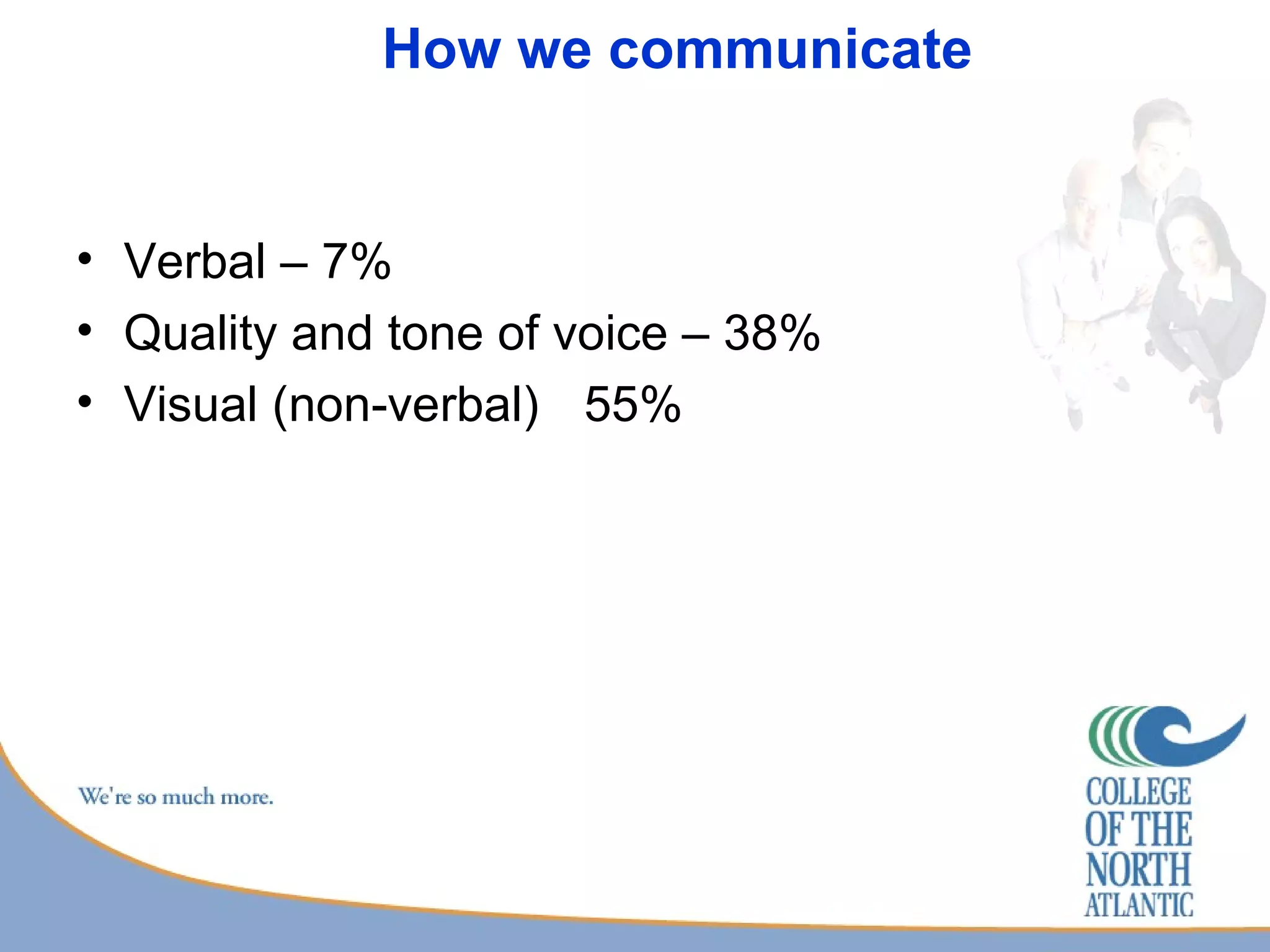
How we communicate   Verbal – 7% Quality and tone of voice – 38% Visual (non-verbal) 55%
Verbal Communication  Speech Rang e Pitch Volum e  Enunciatio n Pronunciatio n In fliction T one
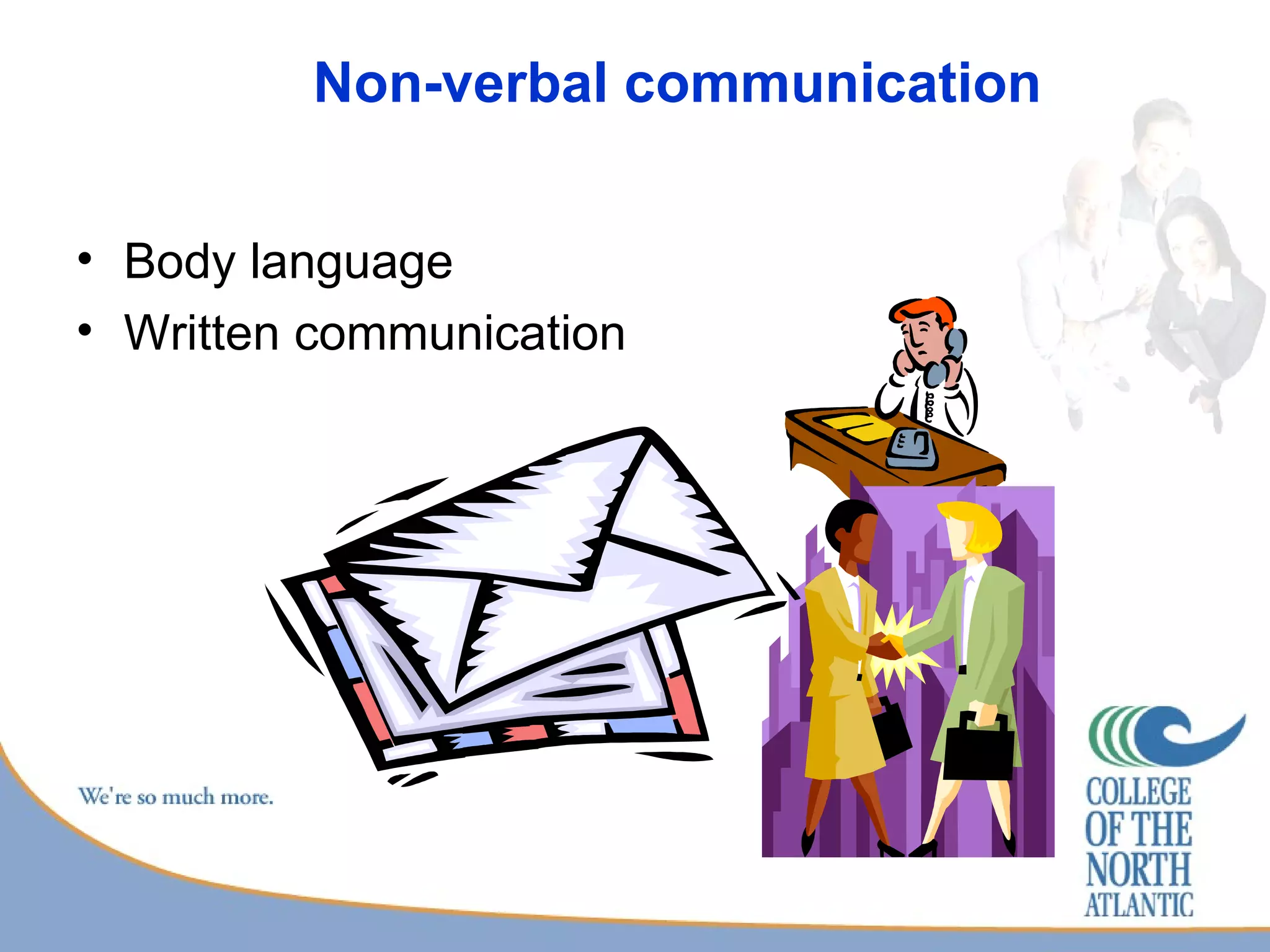
Non-verbal communication Body language Written communication
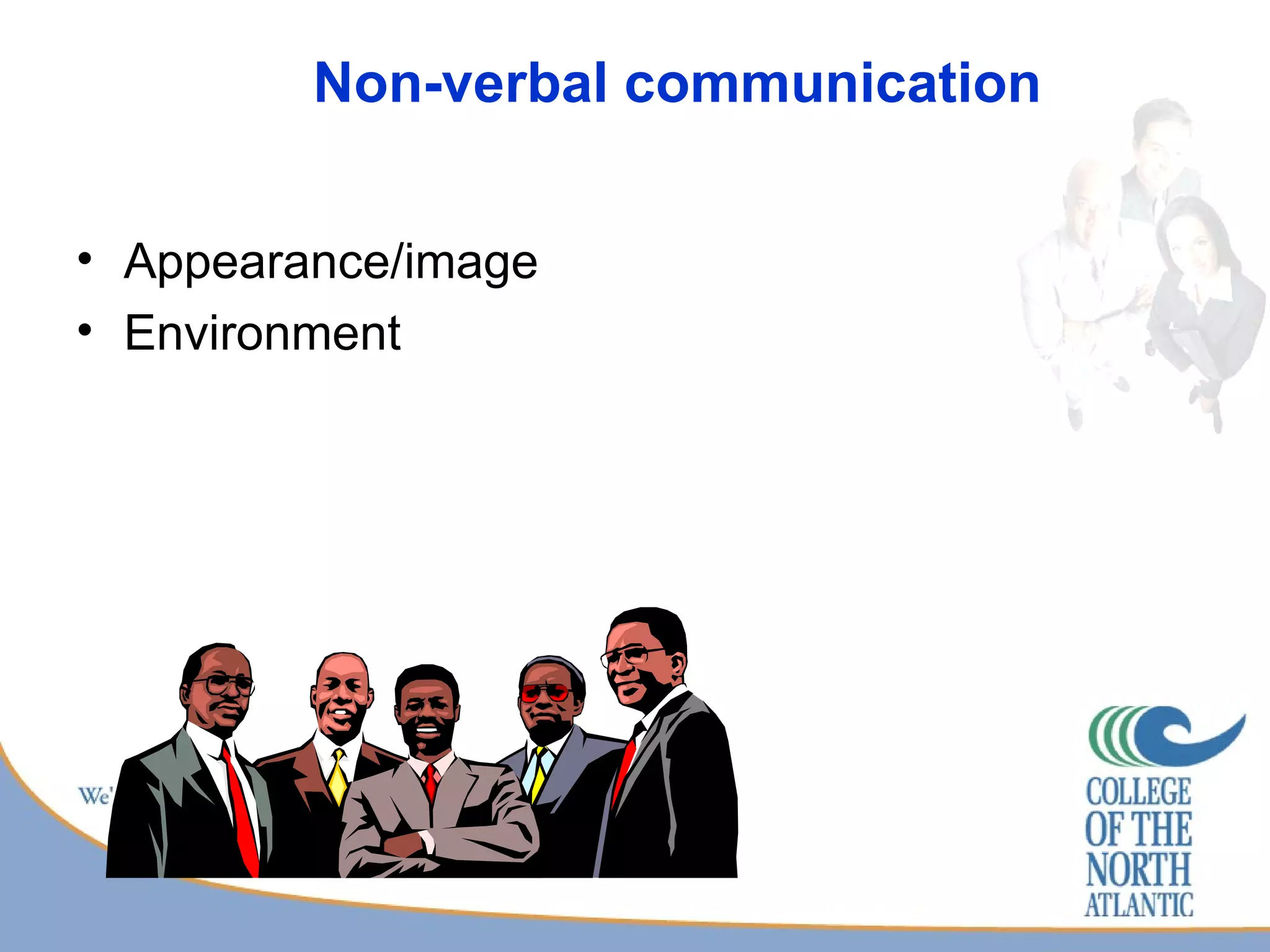
Non-verbal communication Appearance/image Environment
Interpreting Non-verbal Behaviour  Exercise 5 Discover what you know about non-verbal language Think about some non-verbal behaviours that have not been discussed
Listening Exercise 6 Complete the listening skills exercise Rate your listening skills
Types of Listening Pseudo      Listen to meet some other need Make people think you are interested Keep alert to see if you are being rejected Get some time before your next comment Pretend to be listening to be polite Natural to be pseudo listening some times
Types of Listening Active Listen without barriers (time, emotional) Listen to the entire message by focusing on verbal and non-verbal message Listen using your non-verbal communication skills Listen to the person without interrupting, judging or arguing Clarify and ask questions or paraphrase
Improving Listening through Feedback Paraphrasing Perception checking Describing behaviour Making “I” statements
Paraphrasing Tests your understanding of communicator’s message Allows communicator to clarify a misunderstanding Provides climate where communicator can feel understood Provides communicator with sense that what they are saying is important
Perception Checking Describe other's feelings or behavior Indicates to person that you want to understand their feelings State interpretation of behavior Ask if interpretations are accurate
Describing Behaviour  State what has been observed Does not judge behaviour Use it to indicate negative behaviour Provides non-threatening opening to further communication
Making “I” Statements Use when you want to explain your feelings Use to reduce level of tension in conflict situation
Making “I” Statements How to make an I statement -When (description of behaviour, not person),  -I feel (description of the feeling,  -because (tangible or real effect) or how about if (suggestion for change) pushes speaker to define what disturbs him/her
Paraphrasing  Exercise 7 Discuss some ways to provide feedback through paraphrasing Discuss the exercises in manual
Giving and Receiving Feedback Exercise 8 Assign groups Write your responses  Share responses with group  Select one response to share with large group
Ways We Communicate Public Speaking  Exercise 9 Discuss public speaking fears Discuss some strategies to improve public speaking fears
Ways We Communicate  Speeches Presentations Correspondence/office communication Telephone Voice mail Email Websites Blogs Others?
Email Practices Exercise 10 Discuss advantages and disadvantages of email
Factors Influencing Effective Communication Special needs/accessibility Environment/setting Literacy skills Cultural factors Email etiquette Tone Respect and appropriateness Gender neutrality Jargon Others
Communication Blockers Responses that can block effective communication Evaluation response Advise giving response Topping response Diagnosing, psychoanalytic response Prying-questioning response
Before moving on… Parking Lot  Summary Evaluation
Interpersonal Communications Questions? Thank you! See you tomorrow!

Inter Personal Communication Skills

  • 1.
  • 2.
    Interpersonal Communication SkillsAgenda Icebreaker Welcome and Overview Communication Process Types of Communication Verbal Non-verbal Listening Factors influencing Communication Parking Lot Discussion/Evaluation
  • 3.
    Interpersonal Communication SkillsExercise 1 Pair participants with someone they don’t know, if possible Take five minutes to interview each other to learn enough to introduce your partner to the group Each person introduces their partner to the group
  • 4.
    Interpersonal Communication SkillsWhat is communication A process in which a person, through language,signs and symbols, conveys a message to another person Comprised of Sender Message Channel Receiver Feedback Barriers
  • 5.
    Interpersonal Communication SkillsSender Language and how you use it Credibility Knowledge of content, audience and context Experience, attitudes and values Message Written – words, sentences, paragraphs Oral – use of voice – tone and pitch Non-verbal – gestures, facial expressions, eye contact, environment (office set up)
  • 6.
    Interpersonal Communication SkillsChannel Verbal – face to face meetings, telephone, video Written – reports, letters Receiver Abilities Attitudes Experience Feedback Receiver responds in some way Sender can evaluate effectiveness of message
  • 7.
    Interpersonal Communication SkillsBarriers Inappropriate medium or channel Incorrect grammar, inflammatory words, words that conflict with body language Technical jargon Noise Can occur at any stage Can be interference from various sources – radio, chatter, etc.
  • 8.
    Interpersonal Communication SkillsExercise 2 Discuss barriers to communication process Brainstorm and discuss some barriers in your workplace or volunteer group
  • 9.
    Interpersonal Communication SkillsCase study exercise 3 Exercise Identify strategies to deal with common communication problems
  • 10.
    Types of Communication Verbal Non-verbal Listening
  • 11.
    Types of CommunicationExercise 4 How we communicate Role Play
  • 12.
    How we communicate Verbal – 7% Quality and tone of voice – 38% Visual (non-verbal) 55%
  • 13.
    Verbal Communication Speech Rang e Pitch Volum e Enunciatio n Pronunciatio n In fliction T one
  • 14.
    Non-verbal communication Bodylanguage Written communication
  • 15.
  • 16.
    Interpreting Non-verbal Behaviour Exercise 5 Discover what you know about non-verbal language Think about some non-verbal behaviours that have not been discussed
  • 17.
    Listening Exercise 6Complete the listening skills exercise Rate your listening skills
  • 18.
    Types of ListeningPseudo     Listen to meet some other need Make people think you are interested Keep alert to see if you are being rejected Get some time before your next comment Pretend to be listening to be polite Natural to be pseudo listening some times
  • 19.
    Types of ListeningActive Listen without barriers (time, emotional) Listen to the entire message by focusing on verbal and non-verbal message Listen using your non-verbal communication skills Listen to the person without interrupting, judging or arguing Clarify and ask questions or paraphrase
  • 20.
    Improving Listening throughFeedback Paraphrasing Perception checking Describing behaviour Making “I” statements
  • 21.
    Paraphrasing Tests yourunderstanding of communicator’s message Allows communicator to clarify a misunderstanding Provides climate where communicator can feel understood Provides communicator with sense that what they are saying is important
  • 22.
    Perception Checking Describeother's feelings or behavior Indicates to person that you want to understand their feelings State interpretation of behavior Ask if interpretations are accurate
  • 23.
    Describing Behaviour State what has been observed Does not judge behaviour Use it to indicate negative behaviour Provides non-threatening opening to further communication
  • 24.
    Making “I” StatementsUse when you want to explain your feelings Use to reduce level of tension in conflict situation
  • 25.
    Making “I” StatementsHow to make an I statement -When (description of behaviour, not person), -I feel (description of the feeling, -because (tangible or real effect) or how about if (suggestion for change) pushes speaker to define what disturbs him/her
  • 26.
    Paraphrasing Exercise7 Discuss some ways to provide feedback through paraphrasing Discuss the exercises in manual
  • 27.
    Giving and ReceivingFeedback Exercise 8 Assign groups Write your responses Share responses with group Select one response to share with large group
  • 28.
    Ways We CommunicatePublic Speaking Exercise 9 Discuss public speaking fears Discuss some strategies to improve public speaking fears
  • 29.
    Ways We Communicate Speeches Presentations Correspondence/office communication Telephone Voice mail Email Websites Blogs Others?
  • 30.
    Email Practices Exercise10 Discuss advantages and disadvantages of email
  • 31.
    Factors Influencing EffectiveCommunication Special needs/accessibility Environment/setting Literacy skills Cultural factors Email etiquette Tone Respect and appropriateness Gender neutrality Jargon Others
  • 32.
    Communication Blockers Responsesthat can block effective communication Evaluation response Advise giving response Topping response Diagnosing, psychoanalytic response Prying-questioning response
  • 33.
    Before moving on…Parking Lot Summary Evaluation
  • 34.
    Interpersonal Communications Questions?Thank you! See you tomorrow!

Editor's Notes

  • #3 Welcome everyone to course Introduce yourself Get class to introduce themselves and state what they want from course Ice breaker (optional) - could use it as part of introductions Review agenda can write it on flipchart for easy view Discuss times assigned for each component Discuss coffee and lunch breaks Establish parking lot - for issues to discuss later Discuss ground rules - one person at a time, address issue and not person, etc. Depending on your participants, you may wish to vary times
  • #4 This exercise is designed to give participants an opportunity to practice communication skills by asking questions of a partner, and then interviewing their partner. Each person reports back to the group on what they learned about their partner. Discuss some differences in the types of information shared. For instance, someone may focus on telling about their personal life, other their professional life, others their travels, etc.
  • #5 What is communication? Communicating and communication are complex interactions with a variety of definitions. A short definition is that communication is a process in which a person, through language, signs and symbols, conveys a message to another person.   In order to understand the communication process, it is important to examine the basic elements and their impact on the message. The sender, message, channel, receiver, noise/distortion and feedback and each will now be reviewed and discussed.  
  • #6 Discuss each component and generate discussion
  • #7 Review and discuss
  • #8 Review and highlight that next exercise is to discuss barriers.
  • #11 Now turn to discussion on the types of communication which will build on what was already reviewed and discussed
  • #12 Start with a role play. Assign two members of group to act as customer and employee. This should be prearranged so that the two people can think about the exchange and use the various forms of communication The rest of the group observes the behaviour and are asked tg pay attention to the various types of communication
  • #13 Ask participants if they feel that these percentages were evident in the role play? Refer them to the communication log which they can use
  • #14 Speech Range – musicality of your voice – 7-11 notes - this is normal voice range - monotone is less than 7 notes - difficult to listen to Pitch - point within range where voice is placed for speaking - deeper voices easier to hear than high squeaky ones Volume - loudness or softness - depends on location Enunciation - clearness of your speech Pronunciation - how you pronounce your words - dialect important factor Infliction - change in pitch to emphasize Tone - convey a range of emotions
  • #15 Ask participants to list some types of body language – record on flip chart, and show these on flipchart Body language – position (slouching, arms folded) - orientation – face to face, side to side - eye contact (direct, downward) - gestures (pointing, swaying) - facial expressions (communicate emotions) - touch - personal space Written Communication - provides medium where verbal not possible - can provide opportunity to convey message - can be interpreted for meanings/impressions
  • #16 Appearance/Image - how we dress - how we present ourselves - how we network or act in public Environment - office set up - location of desk – does it have space between you and person - boardroom seating – who sits at front? - personal space
  • #17 OPTIONAL – depends on discussion generated in reviewing last two slides If using it, use questions to generate discussion and mimic some body language and ask what it means.
  • #19 Review and discuss
  • #20 Review and discuss
  • #22 Paraphrasing allows you to test whether you understood what you heard from another person. Review the points Provide and and ask for examples I don’t think this office is doing to do it for me. You want to move to another space? Yes, that is what I would like.  
  • #23 Perception checking is stating in your own words what you perceive the other person is feeling. Provide example and ask for examples Were you disappointed that your team wasn’t selected? You didn’t say anything in the meeting about the new policy – do you agree with it?
  • #24 Describing behaviour states only what has been observed and not what was said… Provide example and ask for examples Were you disappointed that your team wasn’t selected? You didn’t say anything in the meeting about the new policy – do you agree with it?
  • #26 When – separates person from problem I Feel – speaker is taking responsibility for his/her actions and clarifying feelings and indicating trust in the listener Because – pushes the speaker to look inside to define what bothers him/her about the situation Provide examples and ask for examples Your reaction may be: You make me so mad when you arrive late for the meeting Say: When you arrive late I feel frustrated because I find it difficult to continue the agenda when some matters have been discussed.
  • #29 Capture discussion on flipchart
  • #30 Review and discuss these – note that email exercise will follow so focus on the others
  • #31 This can be a great discussion topic as participants share email experiences. Can discuss the lack of formality (no hi, sign off, and use of chat line lingo such as yu, ttfn, etc)
  • #32 Review these and generate discussion on some others.
  • #33 This can be used as a discussion if time permits. Refer to the additional material for discussion points.