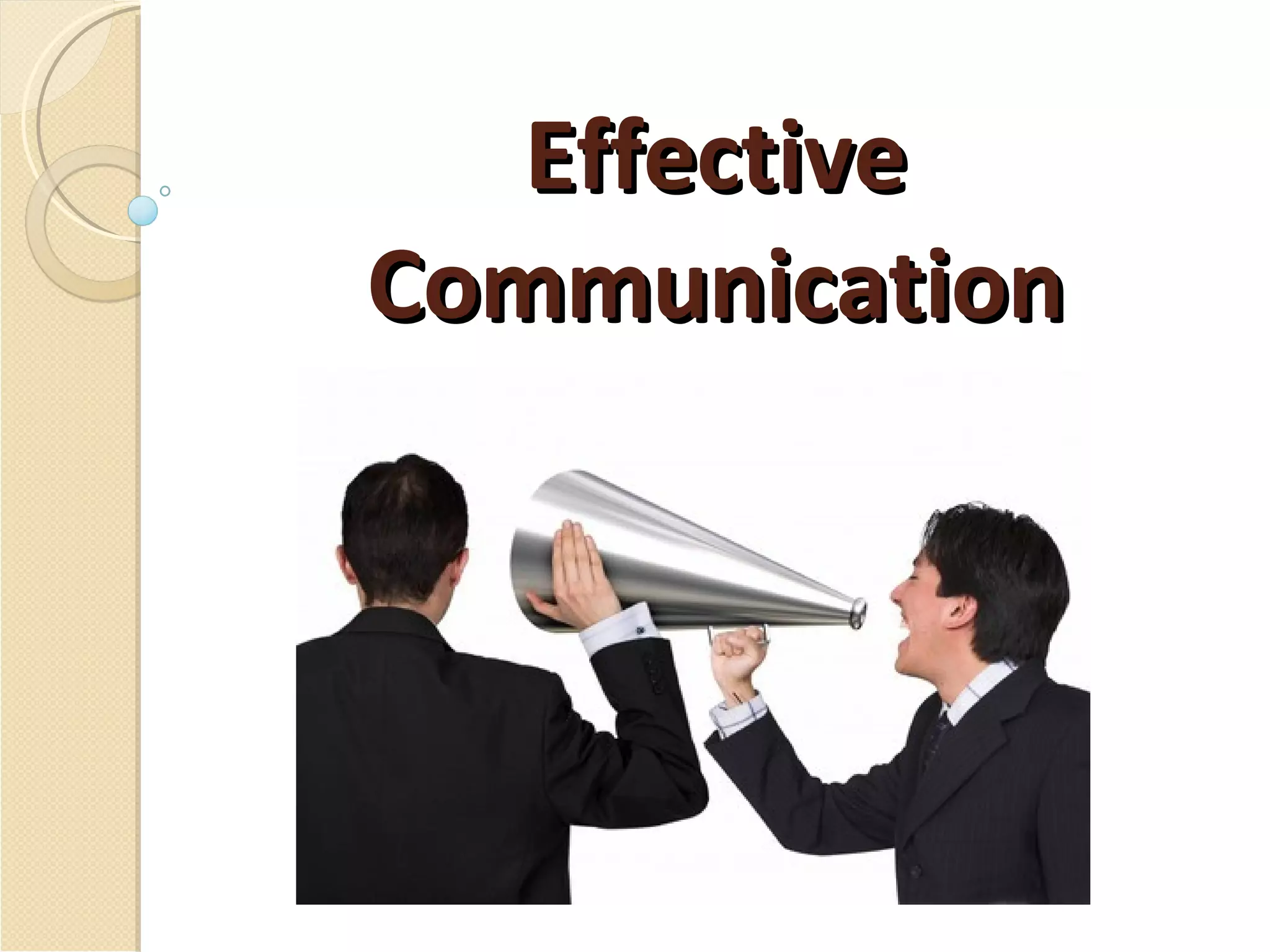
Effective Communication
Definition of Communication Clearly conveying and receiving messages to meet the needs of all parties involved.
Communication Barriers Lack of skills Strong emotions Indecision Environment
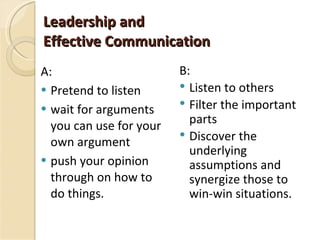
Leadership and  Effective Communication A:  Pretend to listen wait for arguments you can use for your own argument push your opinion through on how to do things. B:  Listen to others Filter the important parts Discover the underlying assumptions and synergize those to win-win situations.
Leadership and Effective Communication The choice is yours and only YOU are responsible for the consequences of your choice
Communication Styles Aggressive  Passive Assertive Assertive people are effective communicators.
Assertive people can… Express their own thoughts, feelings and needs clearly Make reasonable requests of other people (While accepting their right to say 'no') Stand up for their own rights Say 'no' to requests from others at times, without feeling guilty.
4 Steps in Communication Leveling Listening Validating ‘ I’ statement
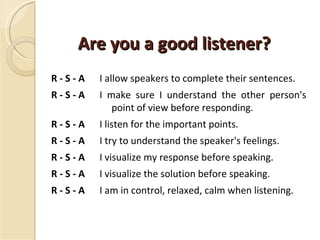
Are you a good listener? R - S - A I allow speakers to complete their sentences. R - S - A I make sure I understand the other person's point of view before responding. R - S - A I listen for the important points. R - S - A I try to understand the speaker's feelings. R - S - A I visualize my response before speaking. R - S - A I visualize the solution before speaking. R - S - A I am in control, relaxed, calm when listening.
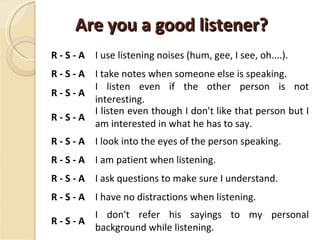
Are you a good listener? R - S - A I use listening noises (hum, gee, I see, oh....).  R - S - A I take notes when someone else is speaking. R - S - A I listen even if the other person is not interesting. R - S - A I listen even though I don't like that person but I am interested in what he has to say. R - S - A I look into the eyes of the person speaking. R - S - A I am patient when listening. R - S - A I ask questions to make sure I understand. R - S - A I have no distractions when listening. R - S - A I don't refer his sayings to my personal background while listening.
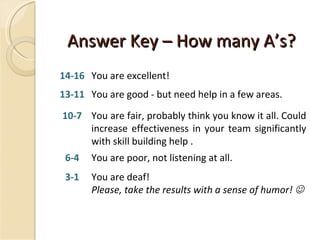
Answer Key – How many A’s? 14-16 You are excellent! 13-11 You are good - but need help in a few areas. 10-7 You are fair, probably think you know it all. Could increase effectiveness in your team significantly with skill building help . 6-4 You are poor, not listening at all. 3-1 You are deaf!  Please, take the results with a sense of humor!  
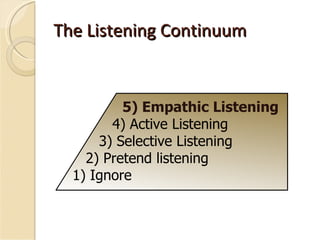
The Listening Continuum 5) Empathic Listening 4) Active Listening 3) Selective Listening 2) Pretend listening 1) Ignore
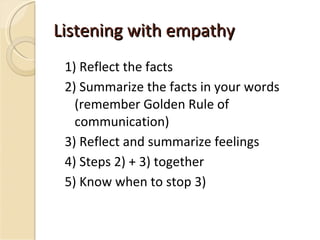
Listening with empathy 1) Reflect the facts 2) Summarize the facts in your words (remember Golden Rule of communication) 3) Reflect and summarize feelings 4) Steps 2) + 3) together 5) Know when to stop 3)
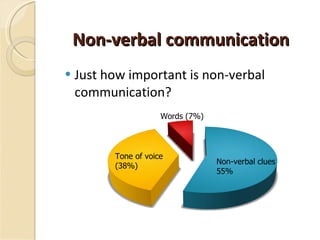
Non-verbal communication Just how important is non-verbal communication?  Non-verbal clues 55% Tone of voice (38%) Words (7%)
Non-verbal communication What you say is  not nearly as important as  how  you say it.
Non-verbal communication Understanding the non-verbal cues will help you find more effective way to communicate with others.
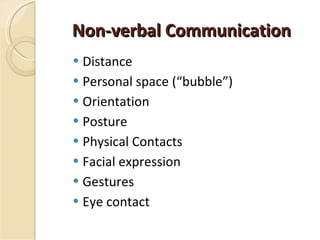
Non-verbal Communication Distance Personal space (“bubble”) Orientation Posture Physical Contacts Facial expression Gestures Eye contact
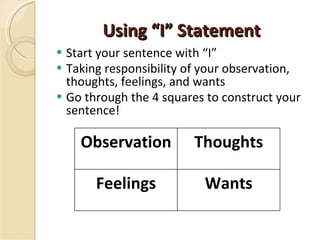
Using “I” Statement Start your sentence with “I” Taking responsibility of your observation, thoughts, feelings, and wants Go through the 4 squares to construct your sentence! Observation Thoughts Feelings Wants
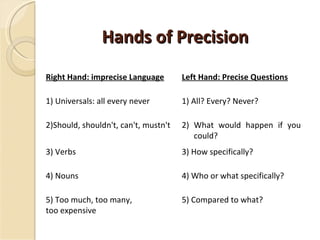
Hands of Precision Right Hand: imprecise Language Left Hand: Precise Questions 1) Universals: all every never 1) All? Every? Never? 2)Should, shouldn't, can't, mustn't 2) What would happen if you could? 3) Verbs 3) How specifically? 4) Nouns 4) Who or what specifically? 5) Too much, too many,  too expensive 5) Compared to what?
Communication vs.  Effective communication It is not important what  I  say, but what  YOU  understand
Communication vs.  Effective communication Effective communication always implies a feedback system. Making sure there is feedback is the responsibility of person A Person B needs to be aware that giving feedback really is in her hands, even though it is Person A's responsibility.
Pitfalls of Feedback You have TWO ears and ONE mouth...hence, you should listen TWICE as much as you speak!
Conclusion “ Think about it like a professional poker player: think about what the jackpot is. What is at stake in the long term?"  Jean Louis Van Doorne
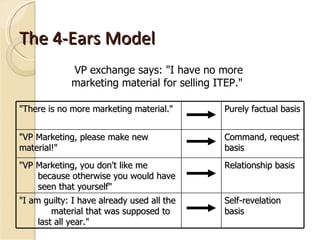
The 4-Ears Model VP exchange says: "I have no more marketing material for selling ITEP."  "There is no more marketing material."  Purely factual basis  "VP Marketing, please make new material!"  Command, request basis  "VP Marketing, you don't like me because otherwise you would have seen that yourself"  Relationship basis  "I am guilty: I have already used all the  material that was supposed to last all year."  Self-revelation basis
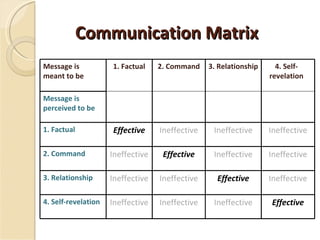
Communication Matrix Message is  meant to be  1. Factual 2. Command 3. Relationship 4. Self-revelation Message is perceived to be 1. Factual Effective Ineffective Ineffective Ineffective 2. Command  Ineffective Effective Ineffective Ineffective 3. Relationship Ineffective Ineffective Effective Ineffective 4. Self-revelation Ineffective Ineffective Ineffective Effective

Effective communication

  • 1.
  • 2.
    Definition of CommunicationClearly conveying and receiving messages to meet the needs of all parties involved.
  • 3.
    Communication Barriers Lackof skills Strong emotions Indecision Environment
  • 4.
    Leadership and Effective Communication A: Pretend to listen wait for arguments you can use for your own argument push your opinion through on how to do things. B: Listen to others Filter the important parts Discover the underlying assumptions and synergize those to win-win situations.
  • 5.
    Leadership and EffectiveCommunication The choice is yours and only YOU are responsible for the consequences of your choice
  • 6.
    Communication Styles Aggressive Passive Assertive Assertive people are effective communicators.
  • 7.
    Assertive people can…Express their own thoughts, feelings and needs clearly Make reasonable requests of other people (While accepting their right to say 'no') Stand up for their own rights Say 'no' to requests from others at times, without feeling guilty.
  • 8.
    4 Steps inCommunication Leveling Listening Validating ‘ I’ statement
  • 9.
    Are you agood listener? R - S - A I allow speakers to complete their sentences. R - S - A I make sure I understand the other person's point of view before responding. R - S - A I listen for the important points. R - S - A I try to understand the speaker's feelings. R - S - A I visualize my response before speaking. R - S - A I visualize the solution before speaking. R - S - A I am in control, relaxed, calm when listening.
  • 10.
    Are you agood listener? R - S - A I use listening noises (hum, gee, I see, oh....). R - S - A I take notes when someone else is speaking. R - S - A I listen even if the other person is not interesting. R - S - A I listen even though I don't like that person but I am interested in what he has to say. R - S - A I look into the eyes of the person speaking. R - S - A I am patient when listening. R - S - A I ask questions to make sure I understand. R - S - A I have no distractions when listening. R - S - A I don't refer his sayings to my personal background while listening.
  • 11.
    Answer Key –How many A’s? 14-16 You are excellent! 13-11 You are good - but need help in a few areas. 10-7 You are fair, probably think you know it all. Could increase effectiveness in your team significantly with skill building help . 6-4 You are poor, not listening at all. 3-1 You are deaf! Please, take the results with a sense of humor! 
  • 12.
    The Listening Continuum5) Empathic Listening 4) Active Listening 3) Selective Listening 2) Pretend listening 1) Ignore
  • 13.
    Listening with empathy1) Reflect the facts 2) Summarize the facts in your words (remember Golden Rule of communication) 3) Reflect and summarize feelings 4) Steps 2) + 3) together 5) Know when to stop 3)
  • 14.
    Non-verbal communication Justhow important is non-verbal communication? Non-verbal clues 55% Tone of voice (38%) Words (7%)
  • 15.
    Non-verbal communication Whatyou say is not nearly as important as how you say it.
  • 16.
    Non-verbal communication Understandingthe non-verbal cues will help you find more effective way to communicate with others.
  • 17.
    Non-verbal Communication DistancePersonal space (“bubble”) Orientation Posture Physical Contacts Facial expression Gestures Eye contact
  • 18.
    Using “I” StatementStart your sentence with “I” Taking responsibility of your observation, thoughts, feelings, and wants Go through the 4 squares to construct your sentence! Observation Thoughts Feelings Wants
  • 19.
    Hands of PrecisionRight Hand: imprecise Language Left Hand: Precise Questions 1) Universals: all every never 1) All? Every? Never? 2)Should, shouldn't, can't, mustn't 2) What would happen if you could? 3) Verbs 3) How specifically? 4) Nouns 4) Who or what specifically? 5) Too much, too many, too expensive 5) Compared to what?
  • 20.
    Communication vs. Effective communication It is not important what I say, but what YOU understand
  • 21.
    Communication vs. Effective communication Effective communication always implies a feedback system. Making sure there is feedback is the responsibility of person A Person B needs to be aware that giving feedback really is in her hands, even though it is Person A's responsibility.
  • 22.
    Pitfalls of FeedbackYou have TWO ears and ONE mouth...hence, you should listen TWICE as much as you speak!
  • 23.
    Conclusion “ Thinkabout it like a professional poker player: think about what the jackpot is. What is at stake in the long term?" Jean Louis Van Doorne
  • 24.
    The 4-Ears ModelVP exchange says: "I have no more marketing material for selling ITEP." "There is no more marketing material." Purely factual basis "VP Marketing, please make new material!" Command, request basis "VP Marketing, you don't like me because otherwise you would have seen that yourself" Relationship basis "I am guilty: I have already used all the material that was supposed to last all year." Self-revelation basis
  • 25.
    Communication Matrix Messageis meant to be 1. Factual 2. Command 3. Relationship 4. Self-revelation Message is perceived to be 1. Factual Effective Ineffective Ineffective Ineffective 2. Command Ineffective Effective Ineffective Ineffective 3. Relationship Ineffective Ineffective Effective Ineffective 4. Self-revelation Ineffective Ineffective Ineffective Effective

Editor's Notes

  • #4 Lack of skills: need to learn effective communication skills Strong emotions: interferes with rational judgment Indecision: uncertainty about our intentions Environment: direct cause stress, aggression
  • #7 Aggressive: forceful, hostile, you-statements, labeling – “bomb” Passive: Feelings/thoughts not expressed, feel “walked all over” by everyone: “closed bottle” Assertive: clearly expresses their needs/wants/feelings/thoughts.
  • #9 Leveling: everyone is on the same page; knowing all the facts/thoughts/feelings of the parties involved in the communication process Listening: “active listening”, paying close attention to what the other person is saying Validating: Acknowledging that you have listened & understood the other person’s thoughts/position; no need for complete agreement, but acceptance is important ‘ I’ statement: taking responsibility of your wants and feelings (compared to “you” statement, which could lead to defensiveness in the others)