Knowing ourselves
The big pictures Re-learning about yourselfHow to communicateLeadership styles
DISC TestDominance.Influence.Steadiness.Compliance
What is a DISC test?A DISC test measures four main traits, or 'factors', of behaviourDominance.Influence.Steadiness.ComplianceLet’s start! 
The results
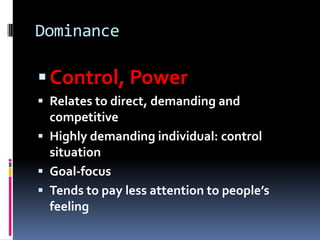
DominanceControl, PowerRelates to direct, demanding and competitive Highly demanding individual: control situationGoal-focusTends to pay less attention to people’s feeling
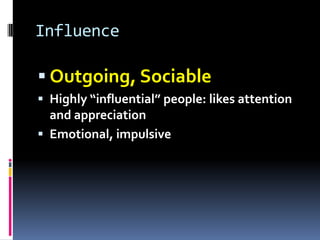
InfluenceOutgoing, SociableHighly “influential” people: likes attention and appreciationEmotional, impulsive
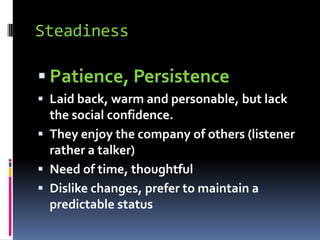
SteadinessPatience, PersistenceLaid back, warm and personable, but lack the social confidence.They enjoy the company of others (listener rather a talker)Need of time, thoughtfulDislike changes, prefer to maintain a predictable status
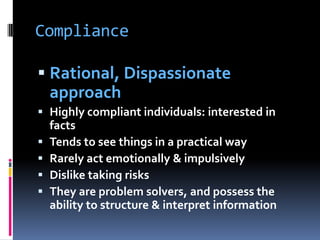
ComplianceRational, Dispassionate approachHighly compliant individuals: interested in factsTends to see things in a practical wayRarely act emotionally & impulsivelyDislike taking risksThey are problem solvers, and possess the ability to structure & interpret information
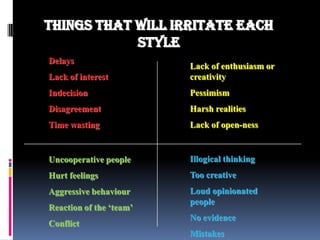
Things that will irritate each styleDelaysLack of interestIndecisionDisagreementTime wastingLack of enthusiasm or creativityPessimismHarsh realitiesLack of open-nessIllogical thinkingToo creativeLoud opinionated peopleNo evidenceMistakesUncooperative peopleHurt feelingsAggressive behaviourReaction of the ‘team’Conflict
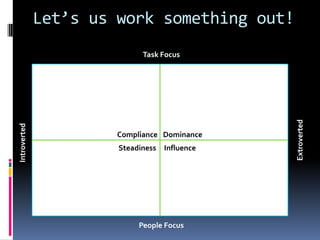
Let’s us work something out!Task FocusDominanceComplianceExtrovertedIntrovertedSteadinessInfluencePeople Focus
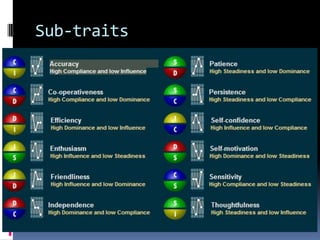
Sub-traits
Sub-traits
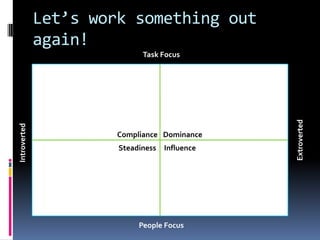
Let’s work something out again!Task FocusDominanceComplianceExtrovertedIntrovertedSteadinessInfluencePeople Focus
Communication
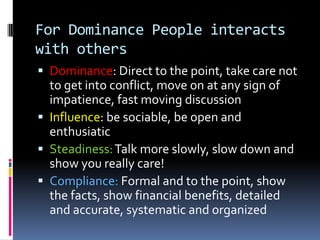
For Dominance People interacts with othersDominance: Direct to the point, take care not to get into conflict, move on at any sign of impatience, fast moving discussionInfluence: be sociable, be open and enthusiaticSteadiness: Talk more slowly, slow down and show you really care!Compliance: Formal and to the point, show the facts, show financial benefits, detailed and accurate, systematic and organized
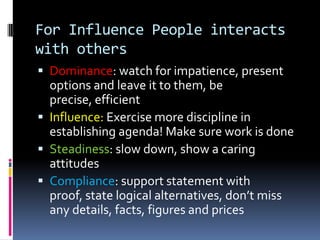
For Influence People interacts with othersDominance: watch for impatience, present options and leave it to them, be precise, efficientInfluence: Exercise more discipline in establishing agenda! Make sure work is doneSteadiness: slow down, show a caring attitudesCompliance: support statement with proof, state logical alternatives, don’t miss any details, facts, figures and prices
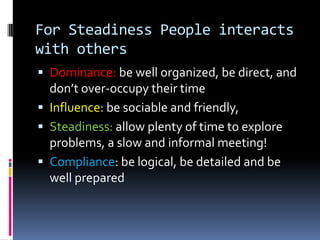
For Steadiness People interacts with othersDominance: be well organized, be direct, and don’t over-occupy their timeInfluence: be sociable and friendly, Steadiness: allow plenty of time to explore problems, a slow and informal meeting!Compliance: be logical, be detailed and be well prepared
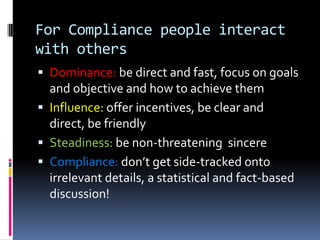
For Compliance people interact with othersDominance: be direct and fast, focus on goals and objective and how to achieve themInfluence: offer incentives, be clear and direct, be friendlySteadiness: be non-threatening  sincereCompliance: don’t get side-tracked onto irrelevant details, a statistical and fact-based discussion!
Leadership STYLE with DISC
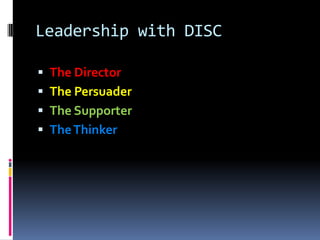
Leadership with DISCThe DirectorThe PersuaderThe SupporterThe Thinker
So why this session?
knowing yourself

knowing yourself

  • 1.
  • 3.
    The big picturesRe-learning about yourselfHow to communicateLeadership styles
  • 4.
  • 5.
    What is aDISC test?A DISC test measures four main traits, or 'factors', of behaviourDominance.Influence.Steadiness.ComplianceLet’s start! 
  • 6.
  • 7.
    DominanceControl, PowerRelates todirect, demanding and competitive Highly demanding individual: control situationGoal-focusTends to pay less attention to people’s feeling
  • 8.
    InfluenceOutgoing, SociableHighly “influential”people: likes attention and appreciationEmotional, impulsive
  • 9.
    SteadinessPatience, PersistenceLaid back,warm and personable, but lack the social confidence.They enjoy the company of others (listener rather a talker)Need of time, thoughtfulDislike changes, prefer to maintain a predictable status
  • 10.
    ComplianceRational, Dispassionate approachHighlycompliant individuals: interested in factsTends to see things in a practical wayRarely act emotionally & impulsivelyDislike taking risksThey are problem solvers, and possess the ability to structure & interpret information
  • 11.
    Things that willirritate each styleDelaysLack of interestIndecisionDisagreementTime wastingLack of enthusiasm or creativityPessimismHarsh realitiesLack of open-nessIllogical thinkingToo creativeLoud opinionated peopleNo evidenceMistakesUncooperative peopleHurt feelingsAggressive behaviourReaction of the ‘team’Conflict
  • 12.
    Let’s us worksomething out!Task FocusDominanceComplianceExtrovertedIntrovertedSteadinessInfluencePeople Focus
  • 13.
  • 14.
  • 15.
    Let’s work somethingout again!Task FocusDominanceComplianceExtrovertedIntrovertedSteadinessInfluencePeople Focus
  • 16.
  • 17.
    For Dominance Peopleinteracts with othersDominance: Direct to the point, take care not to get into conflict, move on at any sign of impatience, fast moving discussionInfluence: be sociable, be open and enthusiaticSteadiness: Talk more slowly, slow down and show you really care!Compliance: Formal and to the point, show the facts, show financial benefits, detailed and accurate, systematic and organized
  • 18.
    For Influence Peopleinteracts with othersDominance: watch for impatience, present options and leave it to them, be precise, efficientInfluence: Exercise more discipline in establishing agenda! Make sure work is doneSteadiness: slow down, show a caring attitudesCompliance: support statement with proof, state logical alternatives, don’t miss any details, facts, figures and prices
  • 19.
    For Steadiness Peopleinteracts with othersDominance: be well organized, be direct, and don’t over-occupy their timeInfluence: be sociable and friendly, Steadiness: allow plenty of time to explore problems, a slow and informal meeting!Compliance: be logical, be detailed and be well prepared
  • 20.
    For Compliance peopleinteract with othersDominance: be direct and fast, focus on goals and objective and how to achieve themInfluence: offer incentives, be clear and direct, be friendlySteadiness: be non-threatening sincereCompliance: don’t get side-tracked onto irrelevant details, a statistical and fact-based discussion!
  • 21.
  • 22.
    Leadership with DISCTheDirectorThe PersuaderThe SupporterThe Thinker
  • 23.
    So why thissession?