INTERNATIONAL JOURNAL OF ELECTRICAL ENGINEERING & 
International Journal of Electrical Engineering and Technology (IJEET), ISSN 0976 – 6545(Print), 
ISSN 0976 – 6553(Online) Volume 5, Issue 8, August (2014), pp. 01-12 © IAEME 
TECHNOLOGY (IJEET) 
ISSN 0976 – 6545(Print) 
ISSN 0976 – 6553(Online) 
Volume 5, Issue 8, August (2014), pp. 01-12 
© IAEME: www.iaeme.com/IJEET.asp 
Journal Impact Factor (2014): 6.8310 (Calculated by GISI) 
www.jifactor.com 
1 
 
IJEET 
© I A E M E 
INTEGRATION OF RENEWABLE RESOURCES FOR DC MICRO GRID 
APPLICATIONS 
1G. MAHESH KUMAR, 2Y. DAMODHARAM, 3VELAPPAGARI SEKHAR, 4S. SURESH 
1P.G Scholar, KEC, KUPPAM 
2M.TECH Assoc. professor, Dept of EEE, KEC, KUPPAM 
3M.E, LMISTE, LMSESI, AMIE, Asst.professor Dept of EEE, KEC, KUPPAM 
4M.TECH, Asst. Professor, C.R. Engineering College, TIRUPATHI 
ABSTRACT 
Now -a-days renewable sources are very useful for domestic applications. By observing these 
advantages an aggregated or accumulated model has to be proposed for an integration of renewable 
sources such as wind and solar power. The power which can be produced from the renewable 
sources will be coordinated to the ac grid or directly to dc consumers. In these operation BESS 
(battery energy storage system) is equipped with the system for maintaining the power balance. For 
obtaining the power balance the adaptive droop control technique has to be proposed and droop 
curves are evaluated. The droop characteristics are selected on the basis of the deviation between the 
optimized and real-time SOC of the BESS. 
Operational controls within the micro grid [such as cost have to be optimized at the same 
time it will satisfy the demand] are designed to support the integration of wind and solar power. By 
these process micro grid real time supply and demand will be maintain in symmetry. The simulation 
results are to be developed in MATLAB SIMULINK process for renewable power generation and 
fast charging load connected to the dc bus, droop control based responses. 
Index Terms: Distributed Energy Resources, Fast Charging, Droop Control, Electrical Vehicle, 
Micro Grid, Multilevel Energy Storage, Power Electronic Conversion, Emission Constraint. 
SECTION-1 
INTRODUCTION 
An electrical system that includes multiple loads and distributed energy resources that can be 
operated in parallel with in the border utility grid is called micro grid. Most countries generate 
electricity in large centralized facilities, such as fossil fuel (coal, gas powered), nuclear large solar 
power plants or hydro power plants. These plants have tremendous economies of scale, but usually
International Journal of Electrical Engineering and Technology (IJEET), ISSN 0976 
ISSN 0976 – 6553(Online) Volume 5, Issue 
transmit electricity long distances and can negatively affect the environment. Distributed generation 
allows collection of energy from many sources and may give lower environmental impacts and 
improved security of supply. Distributed generation reduces the amount of energy lost in transmitting 
electricity because the electricity is generated very near where it is used, 
building. This also reduces the size and number of power lines that must be constructed. Micro grid 
generation resources can include fuel cells, wind, solar, or other energy sources. 
The combination of wind and solar energy leads 
combination of battery energy storage system and supercapacitor technologies in turn can form 
multilevel energy storage. The battery energy storage system employs for balancing the supply and 
demand where as supercapacitor provides cache control to compensate for fast power fluctuations 
and smoothen the transients encountered by a battery with higher energy capacity. 
Micro grids or hybrid energy systems have been shown to be an effective structure for local 
interconnection of distributed renewable generation, loads and storage. With the ongoing and 
increasing demand for improved reliabili 
wonderful opportunity exists to capitalize on the benefits of DC micro g 
Throughout building interiors and exteriors, 
alternating current (AC) to be converted to direct current (DC) to be used by their 
components. HVAC, motor loads, pumps, lighting, information technology equip 
all of these systems require the renovation 
directly available DC power can increase energy efficiency by eliminating losses associated with this 
renovation, as well as increase reliability due to the 
Having a DC micro grid included 
extraordinary flexibility for the occupants. 
reconfigured and relocated according to changing needs of the space without rewiring 
Sustainability initiatives and zero net energy goals are driving the use of renewable energy 
sources, such as from solar photovoltaic, wind, and other alternate source systems. 
sources may be integrated for direct use by a micro grid system, eliminating the DC 
conversion losses. 
The paper presents in which process the usage of output power generated from the renewable 
sources through dc link and optimizatio 
to be maintained by a adaptive droop control that relates the dc link voltage to the power output of 
the renewable sources. The proposed operational optimization is further distinguished in that 
quantifies the uncertainty associated with renewable generation forecast, emission constraints and 
EV fast charging. 
SECTION-2 
LAYOUT OF THE DC MICRO GRID 
Fig 1: Outline 
8, August (2014), pp. 01-12 © IAEME 
2 
tion perhaps even in the same 
to reduced local storage 
acitor ection reliability and energy efficiency across all commercial buildings, a 
grids. 
several electrical systems rely on standard 
equipment, security, etc. 
of power from AC to DC for their operation. 
bility eradication of several transformer components. 
into the infrastructure of building interiors provides 
Electrical systems, such as lighting, can be easily 
igured optimization operation on the micro grid. The dc link voltage was shown 
Diagram of the DC Micro Grid 
– 6545(Print), 
requests. The 
ment, Having 
rewiring. 
These DC power 
DC-AC-DC 
n it
International Journal of Electrical Engineering and Technology (IJEET), ISSN 0976 
ISSN 0976 – 6553(Online) Volume 5, Issue 
8, August (2014), pp. 01-12 © IAEME 
The schematic of the dc micro grid with the arrangement of renewable sources, multilevel 
energy storage comprising Bess and super capacitor, ev fast charging, smart charging and grid 
interface. Through wind energy conversions systems, wind power can b 
be converted into dc through ac –dc converter. 
produced from pv panels and these power will be fed to the dc bus through dc 
Multilevel energy storage consist 
supply in balance condition and it will satisfy the demand, whereas super capacitor has much less 
energy capacity than the Bess. Rather it is aimed at compensating for fast fluctuations of power and 
so provides cache control. 
Thanks to the multilevel energy storage, the intermittent and volatile renewable power 
outputs can be managed, and a deterministic controlled power to the main grid is obtained by 
optimization. The multilevel energy storage mi 
In building integration, a vertical axis wind turbine may be installed on the rooftop. PV 
panels can be co-located on the rooftop and the facade of the building. Such or similar configurations 
benefit from a local availability of abundant wind and solar en 
realized for public access at the ground level. It is connected close to the LV 
reduce losses and voltage drop. EVs parked in the building are offered smart 
defined constraints. 
SECTION-3 
OVERVIEW OF THE OPTIMISED SCHEDULING APPROACH 
The step by step procedure of the optimised scheduling approach for the micro grid is shown 
below. 
Fig 2: Overview 
In first stage wind and solar power 
aggregated. The example of aggregated uncertainty data can be available from the wind and solar 
sources as shown in below table-1 
scheduling and these processes can be explained clearly by mathematical equations in below 
SECTION-4(a). 
In the next step the aggregated power generation data are used to assign hourly positive and 
negative energy reserves to the BESS for t 
BESS gives the energy stored that can be readily injected into the dc bus on demand. The negative 
energy reserve gives the part of the BESS to remain uncharged to capture excess power on demand. 
Energy reserve assessment is performed according to the aggregated renewable power generation 
forecast. In order to compensate for the uncertainty of the forecast, a method is devised to assess 
positive and negative energy reserves in SECTION 
3 
be produced in ac and it is can 
Rather dc is fed to the dc bus. Solar power will be 
dc-dc converter. 
consisting the battery energy storage system for maintaining the 
mitigates potential impacts on the main grid. 
al energy. The fast charging station 
LV–MV transformer to 
charging within user 
of optimised scheduling approach 
forecast, that means wind and solar power can be 
from these data power can be calculated f 
the micro grid operation. The positive energy reserve of the 
nergy ive SECTION-4(b). 
– 6545(Print), 
e ing tigates ergy. is 
user- 
for a day-a-head 
he
International Journal of Electrical Engineering and Technology (IJEET), ISSN 0976 – 6545(Print), 
ISSN 0976 – 6553(Online) Volume 5, Issue 8, August (2014), pp. 01-12 © IAEME 
4 
 
Finally, the emission constrained cost optimization is formulated to schedule the micro grid 
resources for the day-ahead dispatch. The optimized scheduling is formulated in SECTION-4(c). 
SECTION-4 
a) MICROGRID OVERVIEW OPERATION 
ANALYSIS 
In these section by using wind and solar power generation forecast uncertainty data a three 
state model has to be presented. In these three state model the individual states is k=3. From these, 
micro grid has two renewable sources with three states then by mathematical fourmale N=K2 which 
is equal to the nine combined states will be produced. In each combined state the power of the each 
state is summed up and the probability of a combined state is the product of the probabilities in 
individual states. Again the nine combined states should be reduced into aggregated states. To 
aggregate the combined states M aggregated states are defined. Here m=3 and denoted by m is 
shown in table-2. 
TABLE-1 
WIND AND SOLAR POWER FORECAST DATA 
Individual state State1 State2 State3 
Wind forecast probability 0.25 0.50 0.25 
Wind power(kw) 40 50 60 
Solar forecast probability 0.25 0.50 0.25 
Solar power(kw) 15 20 25 
TABLE-2 
COMBINED STATES OF WIND AND SOLAR POWER FORECAST 
Combine 
d state, n 
Counter, l Aggregated 
state, m 
Power output, 
p˜l,m(kw) 
Probability, pr˜l,m 
1 1 1 40+15=55 0.25*0.25=0.0625 
2 2 1 40+20=60 0.25*0.50=0.1250 
3 1 2 40+25=65 0.25*0.25=0.0625 
4 2 2 50+15=65 0.50*0.25=0.1250 
5 3 2 50+20=70 0.50*0.50=0.2500 
6 4 2 50+25=75 0.50*0.25=0.1250 
7 5 2 60+15=75 0.25*0.25=0.0625 
8 1 3 60+20=80 0.25*0.50=0.1250 
9 2 3 60+25=85 0.25*0.25=0.0625 
The aggregated state m covers number of combined states l than the probability of the 
aggregated state is obtained by the summation of the probabilities of these combined states and the 
power of each aggregated state is average weight of all power outputs. The mathematical fourmale 
for calculating the probability and power is given by
International Journal of Electrical Engineering and Technology (IJEET), ISSN 0976 
ISSN 0976 – 6553(Online) Volume 5, Issue 
8, August (2014), pp. 01-12 © IAEME 
The power and probability have to be calculated for 1 hour at state 1 
– 6545(Print), 
(1) 
(2) 
Likewise power and probability have to be calculated for 1 hour at state 2 and 3 
and also for 
remaining hours. The power data can be used for calculating reserve assessment operation 
Bess for the micro grid. 
b) BATTERY ENERGY STORAGE 
SYSTEM ALLOCATION PROCESS 
Based on the operation strategy 
in the 
Bess storage capacity is allocated. The depth of discharge, 
positive reserve, operational area, and negative reserve are allocated in the 
operational mode the Bess can be charged and dis 
operating in positive reserve and negative 
power generation and load demand. 
Bess. In normal 
discharged in the operation area. The 
Bess can be 
reserve in order der to compensate the uncertainties of the 
The positive reserve means the energy stored in the 
tive Bess that can be readily injected into the 
dc bus and the positive reserve can 
subtracted from energy of state 1 for all hours. 
renewable sources at that time dc bus go to unbalance. 
energy will be stored in the negat 
calculated by summation of energy obtained at sate 3 
hours. 
be calculated by the summation of energy obtained at state 2 
nergy is 
When excess of energy can be generated from 
the 
of 
ime So for balancing the energy some amount 
e negative reserve of the Bess. Finally the negative reserve can be 
c) FORMULATION OF OPTIMIZED SCHEDULING OF MICRO GRID 
By considering the below objective 
minimized in the interconnected mode and provide ups service in the autonomous mode. The 
objective function will be 
 
The first term in the objective function above expresses the energy cost, the second term 
defines the cost of EV smart charging, and the third term describes the emission cost. The 
5 
is subtracted from the energy of state 2 for all 
function, the operation cost of the micro grid can be 
(3)
International Journal of Electrical Engineering and Technology (IJEET), ISSN 0976 
ISSN 0976 – 6553(Online) Volume 5, Issue 
– 6545(Print), 
optimization program determines a solution that minimizes the operation cost of the dc microgrid. 
Thus, a monetary value is assigned to emission reduction by this approach. This objective function is 
subject to the constraints as follows. 
I. Power limitation of the grid interface introduces a boundary constraint to the optimization 
where PG− is the lower boundary of the grid power, and 
II. The BESS power has to be within the limits 
(4) 
(5) 
where PBESS− is the lower boundary of the outgoing power from the BESS to the dc bus, 
BESS power to the dc bus, and PBESS 
III. The availability of EV and charging power limits should be met 
Where PEVS is the EV charging power, 
TEVS gives the hours in which EVs are available for smart charging. 
IV. The power balance equation has to be va 
Where P˜A,2 is the average power forecast of 
state 2, and P˜EVF is the EV fast charging power forecast. 
PBESS is the 
(6) 
V. The objective function is also subject to a constraint of the SOC of the BESS. The constraint 
can be defined as 
VI. The total required EV smart charging energy for the day 
defined by an equality constraint 
Where TEVS is the time that EVs are available for smart charging by the micro grid, 
charging 
Power of EVs, and EC˜EVS-ch 
scheduling. 
8, August (2014), pp. 01-12 © IAEME 
6 
PG+ is the upper boundary of the grid power. 
BESS+ is the upper boundary of the BESS power. 
PEVS+ is the upper boundary of the EV charging power 
valid at all simulation time step 
s renewable energy sources wind and solar at 
day-ahead scheduling is to be met. This is 
hat is the total EV smart charging energy forecast for the day 
and 
(7) 
nergy aggregated 
(8) 
(9) 
PEVS is the smart 
day-ahead
International Journal of Electrical Engineering and Technology (IJEET), ISSN 0976 
ISSN 0976 – 6553(Online) Volume 5, Issue 
SECTION-5 
PROPOSED TECHNIQUE FOR BESS 
8, August (2014), pp. 01-12 © IAEME 
In these section real time operation of the microgrid in the interconnected and the autonomous 
mode is studied.In the interconnected mode of operation, an adaptive droop control is devised for the 
BESS. The adaptive droop characteristic of the 
BESS power electronic converter is selected on the 
basis of the deviation between the optimized and real 
section 4. Details of the method are provided in section 
BESS is responsible for keeping the voltage of the dc bus in a defined acceptable range for providing 
UPS service. The autonomous mode of operation of the microgrid is described in 
a) Dc voltage Droop control in interconnected mode 
In these mode, the devised droop controls of the 
dc bus voltage can be taken in x-axis and change in battery power will be taken in y 
of battery power PBESS is modified as a function of the dc 
The first droop curve, as shown in fig:3 
BESS is within the close range of the optimized SOC of the BESS from the schedu 
section 4(c). The acceptable real-time 
boundaries around the optimized SOC. If the real 
control of the BESS power electronic converte 
voltage. In this case, the upper boundary an 
response. 
In the voltage range between 
deviations of the dc bus. In the voltage range from 
droop control of the BESS reacts. Therefore, 
voltage deviation of the dc bus. Finally, in the voltage range from 
to VBC+, the droop curve is in a saturation area, 
constant. 
The second droop curve as shown in fig:4 is devised for a situation where the real 
of the BESS is lower than the optimized and scheduled SOC of the BESS. Therefore, the BESS 
contributes to stabilizing the dc bus voltage by charging at the same power as shown in fig:3. 
However, the upper boundary of the BESS droop response is reduced by the factor 
to  PBESS-D. This way, the SOC can come closer to the optimized and scheduled SOC. 
Fig 3: Droop control based responses to mitigate power 
7 
real-time SOC of the BESS, as calculated in 
5(a). In autonomous mode of 
sible section 
mode: 
Bess are depicted as shown in 
y-is 
voltage. 
is devised for a case where the real 
SOC is determined through definition of upper and lower 
real-time SOC is within these boundaries, the droop 
converter is selected as shown in fig:3 to support the dc 
and the lower boundary lead to a symmetrical droop 
VBm1− and VBm1+, battery storage does not react to the voltage 
VBm1− to VBm2− and also from VBm1 
PBESS modifies the power output PBESS 
VBm2− to VBC− and also from 
and thus the BESS contribution is at its maximum and 
es . sed deviations of dc microgrid in normal 
soc of the Bess 
– 6545(Print), 
operation, the 
5(b). 
figs 3-5. The 
-axis. The change 
real-time SOC of the 
scheduling calculated in 
n d Bm1+ to VBm2+, the 
BESS to mitigate the 
VBm2+ 
real-time SOC 
, and it is equal
International Journal of Electrical Engineering and Technology (IJEET), ISSN 0976 
ISSN 0976 – 6553(Online) Volume 5, Issue 
8, August (2014), pp. 01-12 © IAEME 
– 6545(Print), 
The third droop curve as shown in fig:5 is devised for a situation where the real 
real-time SOC of 
the BESS is higher than the optimized and scheduled SOC of the BESS. Therefore, the BESS 
contributes to stabilizing the dc bus voltage by discharging at the same 
However, lower boundary of the BESS droop response is modified by the factor 
− PBESS-D. 
Fig 4: Droop control based responses 
than the 
Fig 5: Droop control based responses 
than the scheduled soc 
in higher 
In real-time operation and interconnected mode, the SOC of the BESS is measured and 
compared against the optimized SOC of the BESS, and the proper droop will be selected as 
described above. 
b) Dc voltage droop control in autonomous mode 
In the autonomous mode, the 
less priority compared with the sup 
defined by the voltage-power droop as discussed. The 
8 
power as shown in fig:3. 
, and it is equal to 
to mitigate power deviations of dc microgrid in lower 
scheduled soc of the Bess 
to mitigate power deviations of dc microgrid i 
of the Bess 
mode: 
main grid is disconnected. Then the fast charging service has 
supply of other loads. The control of the Bess 
converter is also 
Bess so support the voltage of the dc bus 
bus.
International Journal of Electrical Engineering and Technology (IJEET), ISSN 0976 
ISSN 0976 – 6553(Online) Volume 5, Issue 
SECTION-6 
VERIFICATION BY SIMULATION 
The proposed operational method of the urban micro grid 
he in day-head scheduling and real 
time operation is verified by simulation. The simulation block for proposed method is shown below. 
Fig 6 
6: Dc microgrid simulation block 
Here the installation capacity for wind is 100kw and solar is 50kw and bus voltage capacity is 
provided for 390volts for proposed 
130kw will be produced. At the same time fast charging load will be connected to the dc bus with 
100kw.so for compensating the power fluctuations the 
the load demand. The results for generated power, 
bus voltage profile. 
i. GENERATED POWER 
operation. In this section around 17.00 pm generated power 
Fig 7: Renewable power generation with x 
The simulation results shown above for 
soc. 
The results for the case real time soc is lower 
battery will discharging the power. 
8, August (2014), pp. 01-12 © IAEME 
9 
Bess will be charged the power 
ults fast charging load, droop control resp 
x-axis time(s) and y-axis power(kw) 
the case real time soc is higher than the optimised 
than the optimised soc but 
– 6545(Print), 
up to satisfy 
responses and 
in these process
International Journal of Electrical Engineering and Technology (IJEET), ISSN 0976 – 6545(Print), 
ISSN 0976 – 6553(Online) Volume 5, Issue 8, August (2014), pp. 01-12 © IAEME 
10 
 
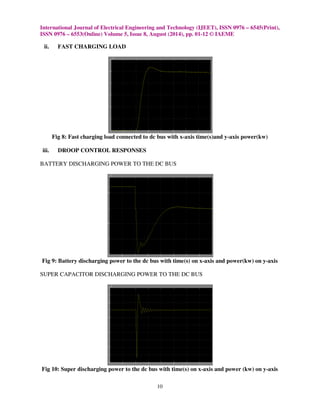
ii. FAST CHARGING LOAD 
Fig 8: Fast charging load connected to dc bus with x-axis time(s)and y-axis power(kw) 
iii. DROOP CONTROL RESPONSES 
BATTERY DISCHARGING POWER TO THE DC BUS 
Fig 9: Battery discharging power to the dc bus with time(s) on x-axis and power(kw) on y-axis 
SUPER CAPACITOR DISCHARGING POWER TO THE DC BUS 
Fig 10: Super discharging power to the dc bus with time(s) on x-axis and power (kw) on y-axis
International Journal of Electrical Engineering and Technology (IJEET), ISSN 0976 – 6545(Print), 
ISSN 0976 – 6553(Online) Volume 5, Issue 8, August (2014), pp. 01-12 © IAEME 
11 
 
iv. DC BUS VOLTAGE PROFILE 
Fig 11: Dc bus voltage with time(s) on x-axis and bus voltage(v) on y-axis 
CONCLUSION 
The renewable power which can be produced from the renewable resources can be integrated 
by the accumulated model. By this accumulated model the power for the individual time can be 
calculated. At particular time, the load will be connected to the dc bus. The renewable power will be 
served to the load through dc bus. If there is any uncertainty affiliated with the forecast of aggregated 
wind and pv based power generation was created and used to quantify the energy reserve of the 
battery energy storage system. The battery is parallel connected with the super capacitor to form 
multi level energy storage. The battery plays critical role for compensating the power fluctuations. 
The control proposed is here adaptive droop control in that the voltage-power droop curves are 
modified depending on the outcome of operational optimization. These voltage-power droop curves 
satisfy the load forecast uncertainties. The resulting energy system serves local stationary and ev 
based mobile consumers, and it is a good citizen within the main gird as it reduces emission by local 
usage of wind and solar energy. 
REFERENCES 
[1] F.Giraud and Z.M.Salameh, “Steady-State Performance of a Grid Connected Rooftop Hybrid 
Wind-Photovoltaic Power System with Battery Storage”, IEEE Trans. Energy Convers., 
vol.16, no.1, pp.1-7, Mar.2001. 
[2] B.S.Borowy and Z.M.Salameh, “Methodology for Optimally Sizing the Combination of 
Battery Bank and PV Array in a Wind/PV Hybrid System”, IEEE Trans. Energy Convers., 
vol.11, no.2, pp.367-375, Mar.1996. 
[3] A.L.Dimeas and N.D.Hatziargyriou, “Operation of a Multiagent System for Microgrid 
Control”, IEEE Trans. Power Syst., vol.20, no.3, pp.1447-1455, Mar.2005. 
[4] F.Katiraei and M.R.Iravani, “Power Management Strategies for a Micro Grid with Multiple 
Distributed Generation Units”, IEEETrans. PowerSyst”, vol.21, no.4, pp. 1821-1831, 
Nov. 2006. 
[5] A.G.Madureira and J.A.PecasLopes, “Coordinated Voltage Support in Distribution Networks 
with Distribution Generation and Microgrids”, IET Renew. Power Generat., vol.3, no.4, 
pp.439-454,Dev.2009.
International Journal of Electrical Engineering and Technology (IJEET), ISSN 0976 – 6545(Print), 
ISSN 0976 – 6553(Online) Volume 5, Issue 8, August (2014), pp. 01-12 © IAEME 
12 
 
[6] R.Majumder, B.Chaudhuri, A.Ghosh, R.Majumder, G.Ledwich and F.Zare, “Improvement of 
Stability and Load Sharing in an Autonomous Microgrid using Supplementary 
Droopcontrolloop”, IEEE Trans .PowerSyst., vol.25, no.2, pp.768-808, May 2010. 
[7] D.Westermann, S.Nicolai and P.Bretschneider, “Energy Management for Distribution 
Networks with Storage Systems-A Hierarchical Approach”, in proc.IEEE PES General 
Meeting, Convers.Del.Electr. Energy 21st Century, Pittsburgh, PA, USA, Jul.2008. 
[8] A.Chaouachi, R.M.Kamel, R.Andoulsi and K.Nagasaka, “Multi-Objective Intelligent Energy 
Management for a Microgrid”, IEEE Trans.Ind.Electron., vol.60, no.4, pp.1688-1699, 
Apr.2013. 
[9] Martin Kaltsvhmitt, Wolfgang Strechier and Reas Wiese, “Renewable Energy Technology, 
Economics and Environment”, ISBN 978-3-540-70947-3 Springer Berlin Heidelberg New 
York. 
[10] Dr.S.M.Ali, Prof. K.K.Rout and Bijayini Mohanty, “Application of Renewable Energy 
Sources for Effective Energy Management”, International Journal of Electrical Engineering 
 Technology (IJEET), Volume 1, Issue 1, 2010, pp. 18 - 31, ISSN Print : 0976-6545, 
ISSN Online: 0976-6553. 
AUTHOR’S DETAIL 
G. MAHESH KUMAR has received the B.Tech degree in EEE from Siddartha 
institute of science and technology, Puttur in the year of 2012. Present he is pursuing 
M.Tech in power electronics in Kuppam Engineering College. Kuppam. 
Y. DAMODHARAM has obtained his B.Tech in EEE from Kuppam Engineering 
College affiliated to JNTUH in the year 2006. He completed M.Tech in power system 
emphasis on High Voltage Engineering from JNTU Kakinada in the year 2010. 
Currently working as Associate Professor in Kuppam Engineering College in the 
Department of EEE. His area of research is renewable energy sources, high Voltage 
engineering, power systems technology. 
VELAPPAGARI SEKHAR has obtained his B.Tech in Siddhartha institute of 
engineering and technology, Puttur in the year 2008. He completed M.E in power 
system engineering from Velammal Engineering College, Chennai in the year 2010. 
Since 2012 he is a member in LMISTE, LMSESI and in 2014 he got membership in 
AMIE. He currently working as Assistant professor in Kuppam Engineering College 
with towards working as Ph.D at VIT. Vellore. His research includes the areas of interest in power 
system stability analysis  protection. 
S. SURESH has obtained his B.Tech and M.Tech in Kuppam Engineering College in 
the year 2010, 2014. Currently working as Assistant professor in C.R. Engineering 
College in the department of EEE. His research includes the areas of interest in power 
electronics.

Integration of renewable resources for dc micro grid applications

  • 1.
    INTERNATIONAL JOURNAL OFELECTRICAL ENGINEERING & International Journal of Electrical Engineering and Technology (IJEET), ISSN 0976 – 6545(Print), ISSN 0976 – 6553(Online) Volume 5, Issue 8, August (2014), pp. 01-12 © IAEME TECHNOLOGY (IJEET) ISSN 0976 – 6545(Print) ISSN 0976 – 6553(Online) Volume 5, Issue 8, August (2014), pp. 01-12 © IAEME: www.iaeme.com/IJEET.asp Journal Impact Factor (2014): 6.8310 (Calculated by GISI) www.jifactor.com 1 IJEET © I A E M E INTEGRATION OF RENEWABLE RESOURCES FOR DC MICRO GRID APPLICATIONS 1G. MAHESH KUMAR, 2Y. DAMODHARAM, 3VELAPPAGARI SEKHAR, 4S. SURESH 1P.G Scholar, KEC, KUPPAM 2M.TECH Assoc. professor, Dept of EEE, KEC, KUPPAM 3M.E, LMISTE, LMSESI, AMIE, Asst.professor Dept of EEE, KEC, KUPPAM 4M.TECH, Asst. Professor, C.R. Engineering College, TIRUPATHI ABSTRACT Now -a-days renewable sources are very useful for domestic applications. By observing these advantages an aggregated or accumulated model has to be proposed for an integration of renewable sources such as wind and solar power. The power which can be produced from the renewable sources will be coordinated to the ac grid or directly to dc consumers. In these operation BESS (battery energy storage system) is equipped with the system for maintaining the power balance. For obtaining the power balance the adaptive droop control technique has to be proposed and droop curves are evaluated. The droop characteristics are selected on the basis of the deviation between the optimized and real-time SOC of the BESS. Operational controls within the micro grid [such as cost have to be optimized at the same time it will satisfy the demand] are designed to support the integration of wind and solar power. By these process micro grid real time supply and demand will be maintain in symmetry. The simulation results are to be developed in MATLAB SIMULINK process for renewable power generation and fast charging load connected to the dc bus, droop control based responses. Index Terms: Distributed Energy Resources, Fast Charging, Droop Control, Electrical Vehicle, Micro Grid, Multilevel Energy Storage, Power Electronic Conversion, Emission Constraint. SECTION-1 INTRODUCTION An electrical system that includes multiple loads and distributed energy resources that can be operated in parallel with in the border utility grid is called micro grid. Most countries generate electricity in large centralized facilities, such as fossil fuel (coal, gas powered), nuclear large solar power plants or hydro power plants. These plants have tremendous economies of scale, but usually
  • 2.
    International Journal ofElectrical Engineering and Technology (IJEET), ISSN 0976 ISSN 0976 – 6553(Online) Volume 5, Issue transmit electricity long distances and can negatively affect the environment. Distributed generation allows collection of energy from many sources and may give lower environmental impacts and improved security of supply. Distributed generation reduces the amount of energy lost in transmitting electricity because the electricity is generated very near where it is used, building. This also reduces the size and number of power lines that must be constructed. Micro grid generation resources can include fuel cells, wind, solar, or other energy sources. The combination of wind and solar energy leads combination of battery energy storage system and supercapacitor technologies in turn can form multilevel energy storage. The battery energy storage system employs for balancing the supply and demand where as supercapacitor provides cache control to compensate for fast power fluctuations and smoothen the transients encountered by a battery with higher energy capacity. Micro grids or hybrid energy systems have been shown to be an effective structure for local interconnection of distributed renewable generation, loads and storage. With the ongoing and increasing demand for improved reliabili wonderful opportunity exists to capitalize on the benefits of DC micro g Throughout building interiors and exteriors, alternating current (AC) to be converted to direct current (DC) to be used by their components. HVAC, motor loads, pumps, lighting, information technology equip all of these systems require the renovation directly available DC power can increase energy efficiency by eliminating losses associated with this renovation, as well as increase reliability due to the Having a DC micro grid included extraordinary flexibility for the occupants. reconfigured and relocated according to changing needs of the space without rewiring Sustainability initiatives and zero net energy goals are driving the use of renewable energy sources, such as from solar photovoltaic, wind, and other alternate source systems. sources may be integrated for direct use by a micro grid system, eliminating the DC conversion losses. The paper presents in which process the usage of output power generated from the renewable sources through dc link and optimizatio to be maintained by a adaptive droop control that relates the dc link voltage to the power output of the renewable sources. The proposed operational optimization is further distinguished in that quantifies the uncertainty associated with renewable generation forecast, emission constraints and EV fast charging. SECTION-2 LAYOUT OF THE DC MICRO GRID Fig 1: Outline 8, August (2014), pp. 01-12 © IAEME 2 tion perhaps even in the same to reduced local storage acitor ection reliability and energy efficiency across all commercial buildings, a grids. several electrical systems rely on standard equipment, security, etc. of power from AC to DC for their operation. bility eradication of several transformer components. into the infrastructure of building interiors provides Electrical systems, such as lighting, can be easily igured optimization operation on the micro grid. The dc link voltage was shown Diagram of the DC Micro Grid – 6545(Print), requests. The ment, Having rewiring. These DC power DC-AC-DC n it
  • 3.
    International Journal ofElectrical Engineering and Technology (IJEET), ISSN 0976 ISSN 0976 – 6553(Online) Volume 5, Issue 8, August (2014), pp. 01-12 © IAEME The schematic of the dc micro grid with the arrangement of renewable sources, multilevel energy storage comprising Bess and super capacitor, ev fast charging, smart charging and grid interface. Through wind energy conversions systems, wind power can b be converted into dc through ac –dc converter. produced from pv panels and these power will be fed to the dc bus through dc Multilevel energy storage consist supply in balance condition and it will satisfy the demand, whereas super capacitor has much less energy capacity than the Bess. Rather it is aimed at compensating for fast fluctuations of power and so provides cache control. Thanks to the multilevel energy storage, the intermittent and volatile renewable power outputs can be managed, and a deterministic controlled power to the main grid is obtained by optimization. The multilevel energy storage mi In building integration, a vertical axis wind turbine may be installed on the rooftop. PV panels can be co-located on the rooftop and the facade of the building. Such or similar configurations benefit from a local availability of abundant wind and solar en realized for public access at the ground level. It is connected close to the LV reduce losses and voltage drop. EVs parked in the building are offered smart defined constraints. SECTION-3 OVERVIEW OF THE OPTIMISED SCHEDULING APPROACH The step by step procedure of the optimised scheduling approach for the micro grid is shown below. Fig 2: Overview In first stage wind and solar power aggregated. The example of aggregated uncertainty data can be available from the wind and solar sources as shown in below table-1 scheduling and these processes can be explained clearly by mathematical equations in below SECTION-4(a). In the next step the aggregated power generation data are used to assign hourly positive and negative energy reserves to the BESS for t BESS gives the energy stored that can be readily injected into the dc bus on demand. The negative energy reserve gives the part of the BESS to remain uncharged to capture excess power on demand. Energy reserve assessment is performed according to the aggregated renewable power generation forecast. In order to compensate for the uncertainty of the forecast, a method is devised to assess positive and negative energy reserves in SECTION 3 be produced in ac and it is can Rather dc is fed to the dc bus. Solar power will be dc-dc converter. consisting the battery energy storage system for maintaining the mitigates potential impacts on the main grid. al energy. The fast charging station LV–MV transformer to charging within user of optimised scheduling approach forecast, that means wind and solar power can be from these data power can be calculated f the micro grid operation. The positive energy reserve of the nergy ive SECTION-4(b). – 6545(Print), e ing tigates ergy. is user- for a day-a-head he
  • 4.
    International Journal ofElectrical Engineering and Technology (IJEET), ISSN 0976 – 6545(Print), ISSN 0976 – 6553(Online) Volume 5, Issue 8, August (2014), pp. 01-12 © IAEME 4 Finally, the emission constrained cost optimization is formulated to schedule the micro grid resources for the day-ahead dispatch. The optimized scheduling is formulated in SECTION-4(c). SECTION-4 a) MICROGRID OVERVIEW OPERATION ANALYSIS In these section by using wind and solar power generation forecast uncertainty data a three state model has to be presented. In these three state model the individual states is k=3. From these, micro grid has two renewable sources with three states then by mathematical fourmale N=K2 which is equal to the nine combined states will be produced. In each combined state the power of the each state is summed up and the probability of a combined state is the product of the probabilities in individual states. Again the nine combined states should be reduced into aggregated states. To aggregate the combined states M aggregated states are defined. Here m=3 and denoted by m is shown in table-2. TABLE-1 WIND AND SOLAR POWER FORECAST DATA Individual state State1 State2 State3 Wind forecast probability 0.25 0.50 0.25 Wind power(kw) 40 50 60 Solar forecast probability 0.25 0.50 0.25 Solar power(kw) 15 20 25 TABLE-2 COMBINED STATES OF WIND AND SOLAR POWER FORECAST Combine d state, n Counter, l Aggregated state, m Power output, p˜l,m(kw) Probability, pr˜l,m 1 1 1 40+15=55 0.25*0.25=0.0625 2 2 1 40+20=60 0.25*0.50=0.1250 3 1 2 40+25=65 0.25*0.25=0.0625 4 2 2 50+15=65 0.50*0.25=0.1250 5 3 2 50+20=70 0.50*0.50=0.2500 6 4 2 50+25=75 0.50*0.25=0.1250 7 5 2 60+15=75 0.25*0.25=0.0625 8 1 3 60+20=80 0.25*0.50=0.1250 9 2 3 60+25=85 0.25*0.25=0.0625 The aggregated state m covers number of combined states l than the probability of the aggregated state is obtained by the summation of the probabilities of these combined states and the power of each aggregated state is average weight of all power outputs. The mathematical fourmale for calculating the probability and power is given by
  • 5.
    International Journal ofElectrical Engineering and Technology (IJEET), ISSN 0976 ISSN 0976 – 6553(Online) Volume 5, Issue 8, August (2014), pp. 01-12 © IAEME The power and probability have to be calculated for 1 hour at state 1 – 6545(Print), (1) (2) Likewise power and probability have to be calculated for 1 hour at state 2 and 3 and also for remaining hours. The power data can be used for calculating reserve assessment operation Bess for the micro grid. b) BATTERY ENERGY STORAGE SYSTEM ALLOCATION PROCESS Based on the operation strategy in the Bess storage capacity is allocated. The depth of discharge, positive reserve, operational area, and negative reserve are allocated in the operational mode the Bess can be charged and dis operating in positive reserve and negative power generation and load demand. Bess. In normal discharged in the operation area. The Bess can be reserve in order der to compensate the uncertainties of the The positive reserve means the energy stored in the tive Bess that can be readily injected into the dc bus and the positive reserve can subtracted from energy of state 1 for all hours. renewable sources at that time dc bus go to unbalance. energy will be stored in the negat calculated by summation of energy obtained at sate 3 hours. be calculated by the summation of energy obtained at state 2 nergy is When excess of energy can be generated from the of ime So for balancing the energy some amount e negative reserve of the Bess. Finally the negative reserve can be c) FORMULATION OF OPTIMIZED SCHEDULING OF MICRO GRID By considering the below objective minimized in the interconnected mode and provide ups service in the autonomous mode. The objective function will be The first term in the objective function above expresses the energy cost, the second term defines the cost of EV smart charging, and the third term describes the emission cost. The 5 is subtracted from the energy of state 2 for all function, the operation cost of the micro grid can be (3)
  • 6.
    International Journal ofElectrical Engineering and Technology (IJEET), ISSN 0976 ISSN 0976 – 6553(Online) Volume 5, Issue – 6545(Print), optimization program determines a solution that minimizes the operation cost of the dc microgrid. Thus, a monetary value is assigned to emission reduction by this approach. This objective function is subject to the constraints as follows. I. Power limitation of the grid interface introduces a boundary constraint to the optimization where PG− is the lower boundary of the grid power, and II. The BESS power has to be within the limits (4) (5) where PBESS− is the lower boundary of the outgoing power from the BESS to the dc bus, BESS power to the dc bus, and PBESS III. The availability of EV and charging power limits should be met Where PEVS is the EV charging power, TEVS gives the hours in which EVs are available for smart charging. IV. The power balance equation has to be va Where P˜A,2 is the average power forecast of state 2, and P˜EVF is the EV fast charging power forecast. PBESS is the (6) V. The objective function is also subject to a constraint of the SOC of the BESS. The constraint can be defined as VI. The total required EV smart charging energy for the day defined by an equality constraint Where TEVS is the time that EVs are available for smart charging by the micro grid, charging Power of EVs, and EC˜EVS-ch scheduling. 8, August (2014), pp. 01-12 © IAEME 6 PG+ is the upper boundary of the grid power. BESS+ is the upper boundary of the BESS power. PEVS+ is the upper boundary of the EV charging power valid at all simulation time step s renewable energy sources wind and solar at day-ahead scheduling is to be met. This is hat is the total EV smart charging energy forecast for the day and (7) nergy aggregated (8) (9) PEVS is the smart day-ahead
  • 7.
    International Journal ofElectrical Engineering and Technology (IJEET), ISSN 0976 ISSN 0976 – 6553(Online) Volume 5, Issue SECTION-5 PROPOSED TECHNIQUE FOR BESS 8, August (2014), pp. 01-12 © IAEME In these section real time operation of the microgrid in the interconnected and the autonomous mode is studied.In the interconnected mode of operation, an adaptive droop control is devised for the BESS. The adaptive droop characteristic of the BESS power electronic converter is selected on the basis of the deviation between the optimized and real section 4. Details of the method are provided in section BESS is responsible for keeping the voltage of the dc bus in a defined acceptable range for providing UPS service. The autonomous mode of operation of the microgrid is described in a) Dc voltage Droop control in interconnected mode In these mode, the devised droop controls of the dc bus voltage can be taken in x-axis and change in battery power will be taken in y of battery power PBESS is modified as a function of the dc The first droop curve, as shown in fig:3 BESS is within the close range of the optimized SOC of the BESS from the schedu section 4(c). The acceptable real-time boundaries around the optimized SOC. If the real control of the BESS power electronic converte voltage. In this case, the upper boundary an response. In the voltage range between deviations of the dc bus. In the voltage range from droop control of the BESS reacts. Therefore, voltage deviation of the dc bus. Finally, in the voltage range from to VBC+, the droop curve is in a saturation area, constant. The second droop curve as shown in fig:4 is devised for a situation where the real of the BESS is lower than the optimized and scheduled SOC of the BESS. Therefore, the BESS contributes to stabilizing the dc bus voltage by charging at the same power as shown in fig:3. However, the upper boundary of the BESS droop response is reduced by the factor to PBESS-D. This way, the SOC can come closer to the optimized and scheduled SOC. Fig 3: Droop control based responses to mitigate power 7 real-time SOC of the BESS, as calculated in 5(a). In autonomous mode of sible section mode: Bess are depicted as shown in y-is voltage. is devised for a case where the real SOC is determined through definition of upper and lower real-time SOC is within these boundaries, the droop converter is selected as shown in fig:3 to support the dc and the lower boundary lead to a symmetrical droop VBm1− and VBm1+, battery storage does not react to the voltage VBm1− to VBm2− and also from VBm1 PBESS modifies the power output PBESS VBm2− to VBC− and also from and thus the BESS contribution is at its maximum and es . sed deviations of dc microgrid in normal soc of the Bess – 6545(Print), operation, the 5(b). figs 3-5. The -axis. The change real-time SOC of the scheduling calculated in n d Bm1+ to VBm2+, the BESS to mitigate the VBm2+ real-time SOC , and it is equal
  • 8.
    International Journal ofElectrical Engineering and Technology (IJEET), ISSN 0976 ISSN 0976 – 6553(Online) Volume 5, Issue 8, August (2014), pp. 01-12 © IAEME – 6545(Print), The third droop curve as shown in fig:5 is devised for a situation where the real real-time SOC of the BESS is higher than the optimized and scheduled SOC of the BESS. Therefore, the BESS contributes to stabilizing the dc bus voltage by discharging at the same However, lower boundary of the BESS droop response is modified by the factor − PBESS-D. Fig 4: Droop control based responses than the Fig 5: Droop control based responses than the scheduled soc in higher In real-time operation and interconnected mode, the SOC of the BESS is measured and compared against the optimized SOC of the BESS, and the proper droop will be selected as described above. b) Dc voltage droop control in autonomous mode In the autonomous mode, the less priority compared with the sup defined by the voltage-power droop as discussed. The 8 power as shown in fig:3. , and it is equal to to mitigate power deviations of dc microgrid in lower scheduled soc of the Bess to mitigate power deviations of dc microgrid i of the Bess mode: main grid is disconnected. Then the fast charging service has supply of other loads. The control of the Bess converter is also Bess so support the voltage of the dc bus bus.
  • 9.
    International Journal ofElectrical Engineering and Technology (IJEET), ISSN 0976 ISSN 0976 – 6553(Online) Volume 5, Issue SECTION-6 VERIFICATION BY SIMULATION The proposed operational method of the urban micro grid he in day-head scheduling and real time operation is verified by simulation. The simulation block for proposed method is shown below. Fig 6 6: Dc microgrid simulation block Here the installation capacity for wind is 100kw and solar is 50kw and bus voltage capacity is provided for 390volts for proposed 130kw will be produced. At the same time fast charging load will be connected to the dc bus with 100kw.so for compensating the power fluctuations the the load demand. The results for generated power, bus voltage profile. i. GENERATED POWER operation. In this section around 17.00 pm generated power Fig 7: Renewable power generation with x The simulation results shown above for soc. The results for the case real time soc is lower battery will discharging the power. 8, August (2014), pp. 01-12 © IAEME 9 Bess will be charged the power ults fast charging load, droop control resp x-axis time(s) and y-axis power(kw) the case real time soc is higher than the optimised than the optimised soc but – 6545(Print), up to satisfy responses and in these process
  • 10.
    International Journal ofElectrical Engineering and Technology (IJEET), ISSN 0976 – 6545(Print), ISSN 0976 – 6553(Online) Volume 5, Issue 8, August (2014), pp. 01-12 © IAEME 10 ii. FAST CHARGING LOAD Fig 8: Fast charging load connected to dc bus with x-axis time(s)and y-axis power(kw) iii. DROOP CONTROL RESPONSES BATTERY DISCHARGING POWER TO THE DC BUS Fig 9: Battery discharging power to the dc bus with time(s) on x-axis and power(kw) on y-axis SUPER CAPACITOR DISCHARGING POWER TO THE DC BUS Fig 10: Super discharging power to the dc bus with time(s) on x-axis and power (kw) on y-axis
  • 11.
    International Journal ofElectrical Engineering and Technology (IJEET), ISSN 0976 – 6545(Print), ISSN 0976 – 6553(Online) Volume 5, Issue 8, August (2014), pp. 01-12 © IAEME 11 iv. DC BUS VOLTAGE PROFILE Fig 11: Dc bus voltage with time(s) on x-axis and bus voltage(v) on y-axis CONCLUSION The renewable power which can be produced from the renewable resources can be integrated by the accumulated model. By this accumulated model the power for the individual time can be calculated. At particular time, the load will be connected to the dc bus. The renewable power will be served to the load through dc bus. If there is any uncertainty affiliated with the forecast of aggregated wind and pv based power generation was created and used to quantify the energy reserve of the battery energy storage system. The battery is parallel connected with the super capacitor to form multi level energy storage. The battery plays critical role for compensating the power fluctuations. The control proposed is here adaptive droop control in that the voltage-power droop curves are modified depending on the outcome of operational optimization. These voltage-power droop curves satisfy the load forecast uncertainties. The resulting energy system serves local stationary and ev based mobile consumers, and it is a good citizen within the main gird as it reduces emission by local usage of wind and solar energy. REFERENCES [1] F.Giraud and Z.M.Salameh, “Steady-State Performance of a Grid Connected Rooftop Hybrid Wind-Photovoltaic Power System with Battery Storage”, IEEE Trans. Energy Convers., vol.16, no.1, pp.1-7, Mar.2001. [2] B.S.Borowy and Z.M.Salameh, “Methodology for Optimally Sizing the Combination of Battery Bank and PV Array in a Wind/PV Hybrid System”, IEEE Trans. Energy Convers., vol.11, no.2, pp.367-375, Mar.1996. [3] A.L.Dimeas and N.D.Hatziargyriou, “Operation of a Multiagent System for Microgrid Control”, IEEE Trans. Power Syst., vol.20, no.3, pp.1447-1455, Mar.2005. [4] F.Katiraei and M.R.Iravani, “Power Management Strategies for a Micro Grid with Multiple Distributed Generation Units”, IEEETrans. PowerSyst”, vol.21, no.4, pp. 1821-1831, Nov. 2006. [5] A.G.Madureira and J.A.PecasLopes, “Coordinated Voltage Support in Distribution Networks with Distribution Generation and Microgrids”, IET Renew. Power Generat., vol.3, no.4, pp.439-454,Dev.2009.
  • 12.
    International Journal ofElectrical Engineering and Technology (IJEET), ISSN 0976 – 6545(Print), ISSN 0976 – 6553(Online) Volume 5, Issue 8, August (2014), pp. 01-12 © IAEME 12 [6] R.Majumder, B.Chaudhuri, A.Ghosh, R.Majumder, G.Ledwich and F.Zare, “Improvement of Stability and Load Sharing in an Autonomous Microgrid using Supplementary Droopcontrolloop”, IEEE Trans .PowerSyst., vol.25, no.2, pp.768-808, May 2010. [7] D.Westermann, S.Nicolai and P.Bretschneider, “Energy Management for Distribution Networks with Storage Systems-A Hierarchical Approach”, in proc.IEEE PES General Meeting, Convers.Del.Electr. Energy 21st Century, Pittsburgh, PA, USA, Jul.2008. [8] A.Chaouachi, R.M.Kamel, R.Andoulsi and K.Nagasaka, “Multi-Objective Intelligent Energy Management for a Microgrid”, IEEE Trans.Ind.Electron., vol.60, no.4, pp.1688-1699, Apr.2013. [9] Martin Kaltsvhmitt, Wolfgang Strechier and Reas Wiese, “Renewable Energy Technology, Economics and Environment”, ISBN 978-3-540-70947-3 Springer Berlin Heidelberg New York. [10] Dr.S.M.Ali, Prof. K.K.Rout and Bijayini Mohanty, “Application of Renewable Energy Sources for Effective Energy Management”, International Journal of Electrical Engineering Technology (IJEET), Volume 1, Issue 1, 2010, pp. 18 - 31, ISSN Print : 0976-6545, ISSN Online: 0976-6553. AUTHOR’S DETAIL G. MAHESH KUMAR has received the B.Tech degree in EEE from Siddartha institute of science and technology, Puttur in the year of 2012. Present he is pursuing M.Tech in power electronics in Kuppam Engineering College. Kuppam. Y. DAMODHARAM has obtained his B.Tech in EEE from Kuppam Engineering College affiliated to JNTUH in the year 2006. He completed M.Tech in power system emphasis on High Voltage Engineering from JNTU Kakinada in the year 2010. Currently working as Associate Professor in Kuppam Engineering College in the Department of EEE. His area of research is renewable energy sources, high Voltage engineering, power systems technology. VELAPPAGARI SEKHAR has obtained his B.Tech in Siddhartha institute of engineering and technology, Puttur in the year 2008. He completed M.E in power system engineering from Velammal Engineering College, Chennai in the year 2010. Since 2012 he is a member in LMISTE, LMSESI and in 2014 he got membership in AMIE. He currently working as Assistant professor in Kuppam Engineering College with towards working as Ph.D at VIT. Vellore. His research includes the areas of interest in power system stability analysis protection. S. SURESH has obtained his B.Tech and M.Tech in Kuppam Engineering College in the year 2010, 2014. Currently working as Assistant professor in C.R. Engineering College in the department of EEE. His research includes the areas of interest in power electronics.