Design and Analysis of PID and Fuzzy-PID Controller for
Voltage Control of DC Microgrid
Presented By : Dr. Francisco M. Gonzalez-Longatt
Deptt. Of Electrical Engg.
University of Loughborough, Loughborough, UK
Co-Author:
R. K. Chauhan and Dr. B. S. Rajpurohit
School of Computing & Electrical Engg
Indian Institute of Technology Mandi,
India
Dr. R. E. Hebner
Center for Electromechanics
University of Texas Austin,
USA
Dr. S. N. Singh
Deptt. of Electrical Engineering
Indian Institute of Technology Kanpur,
India
Stability issues are more prevalent in microgrids than in a
large electric grid because power and energy ratings are
much lower.
In dc systems there is no reactive power interactions,
which seems to suggest that there are no frequency stability
issues.
System control seems to be oriented to voltage stability.
There is a change in the power and load due to demand
variations. This change leads to create fluctuations in the
voltage level.
2
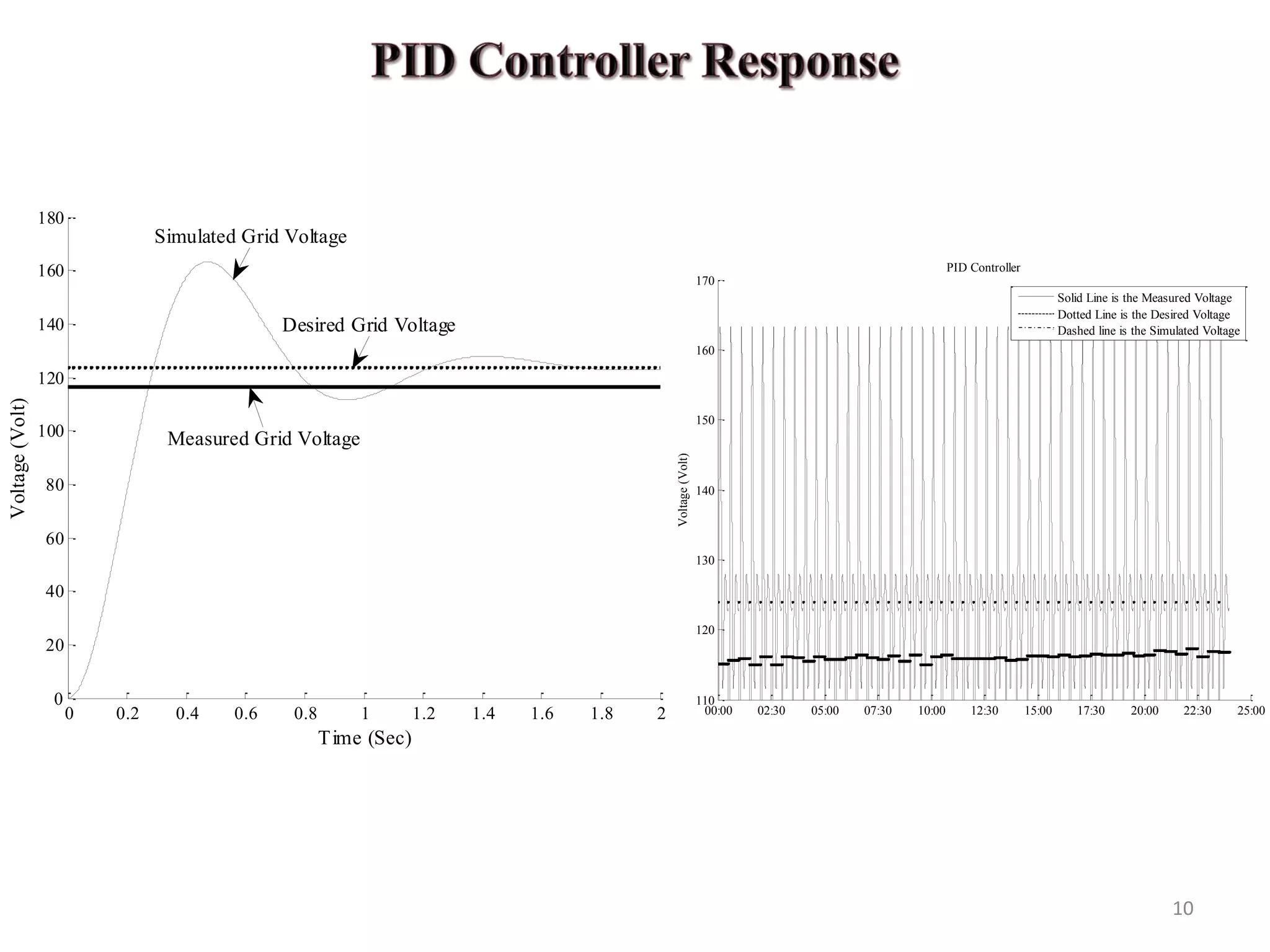
The objective is to keep the DC microgrid voltage at the
reference DC level (i.e. at 124V here).
A PID controller is designed for the DC microgrid voltage
control.
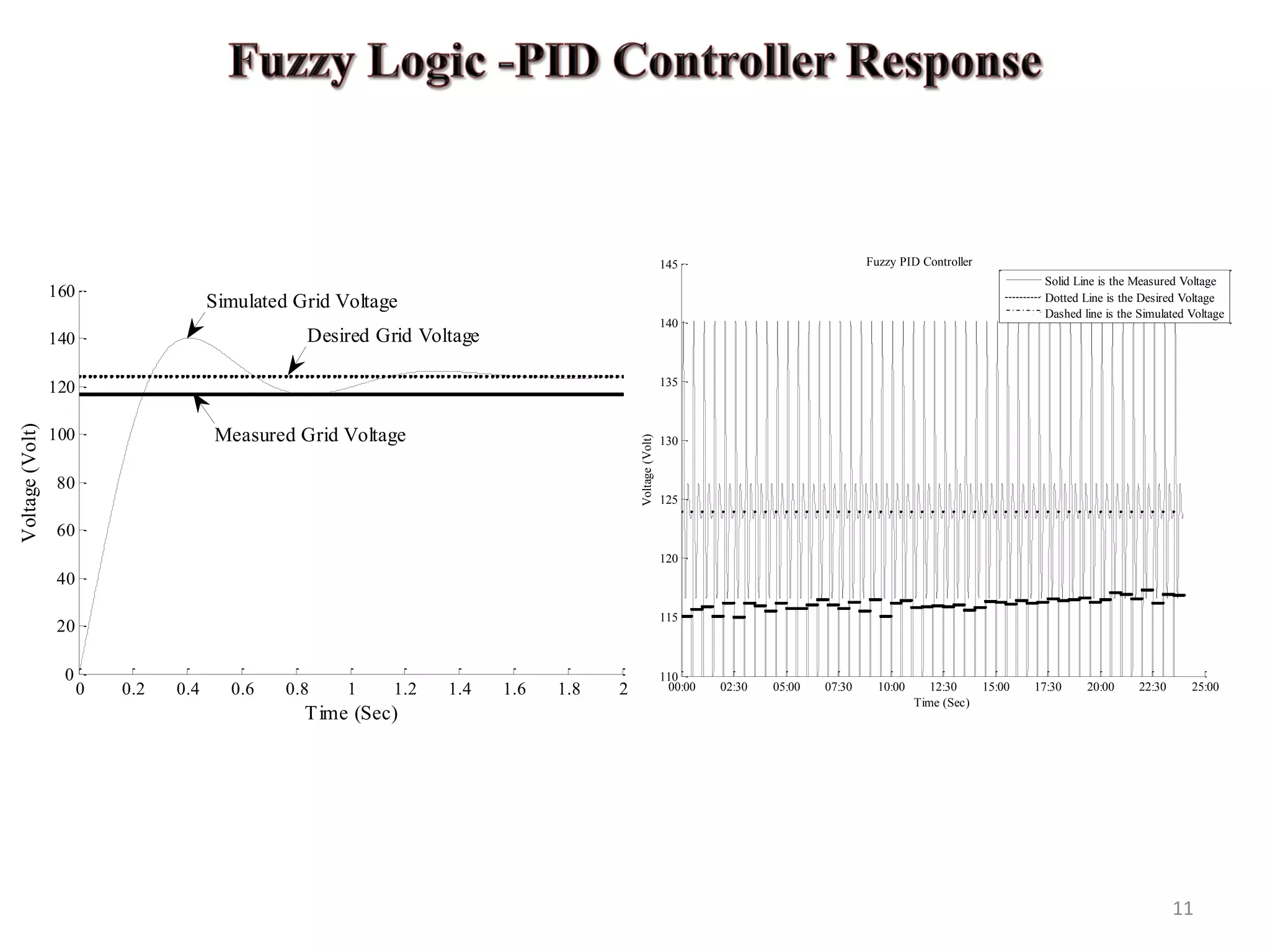
A fuzzy PID controller also designed which is taking the
advantage of PID experiences and Fuzzy knowledge.
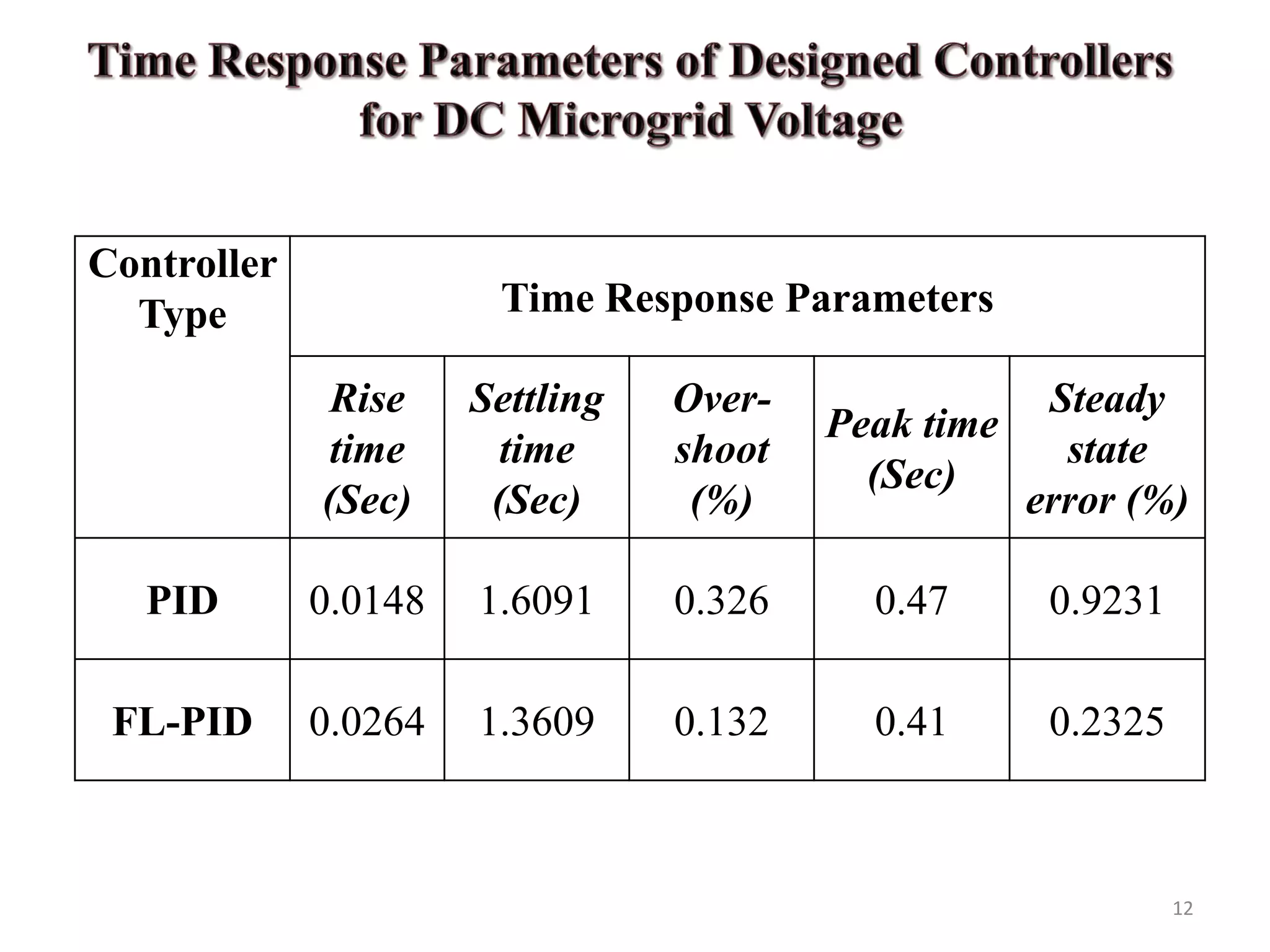
Both the controllers is compared based on the performance
parameters.
3
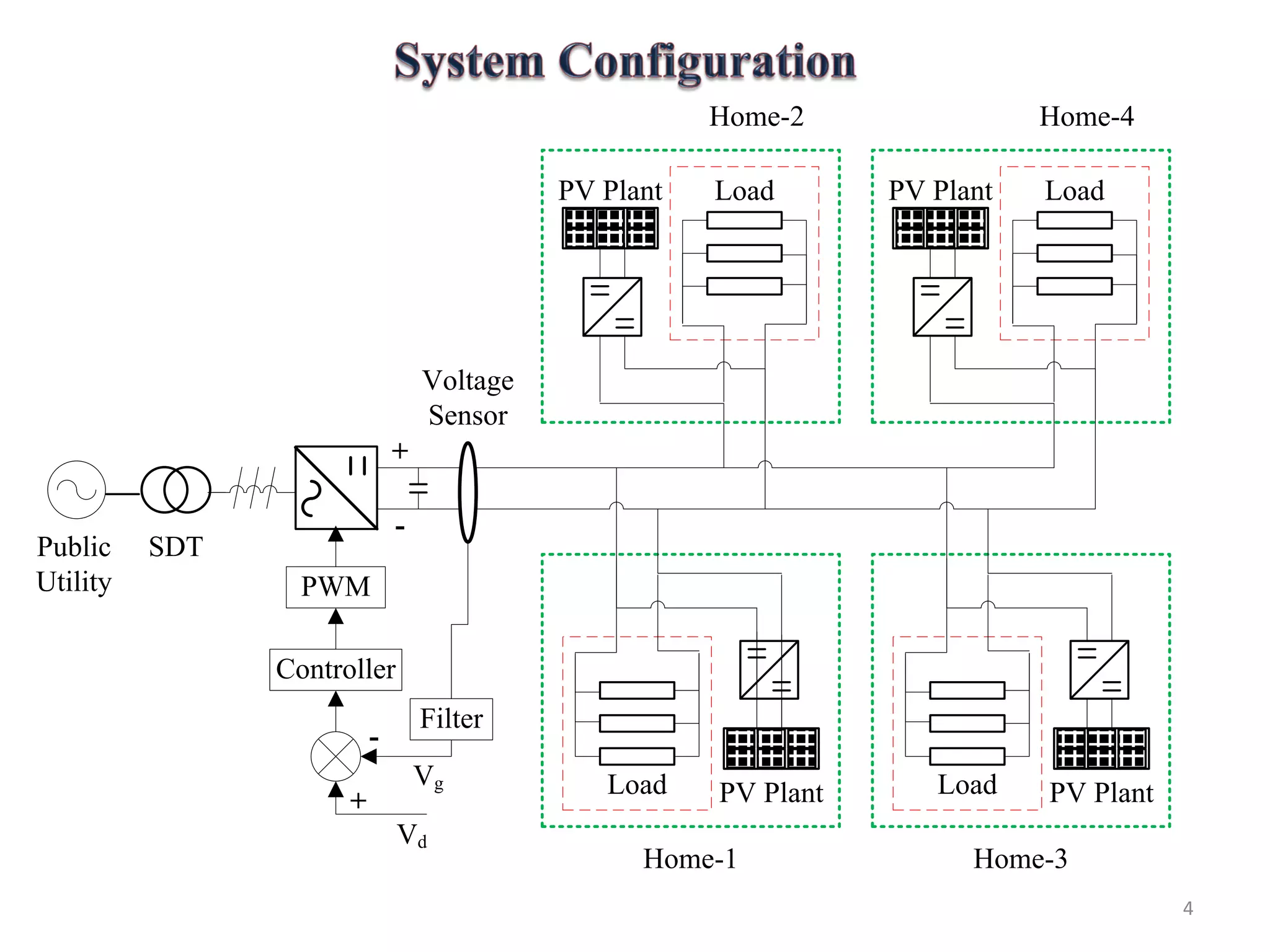
4
Public
Utility
SDT
Load
Home-2
PV Plant
+
-
Voltage
Sensor
Load
Home-4
PV Plant
Load
Home-1
PV Plant Load
Home-3
PV Plant
PWM
Controller
Filter
Vg
Vd
+
-
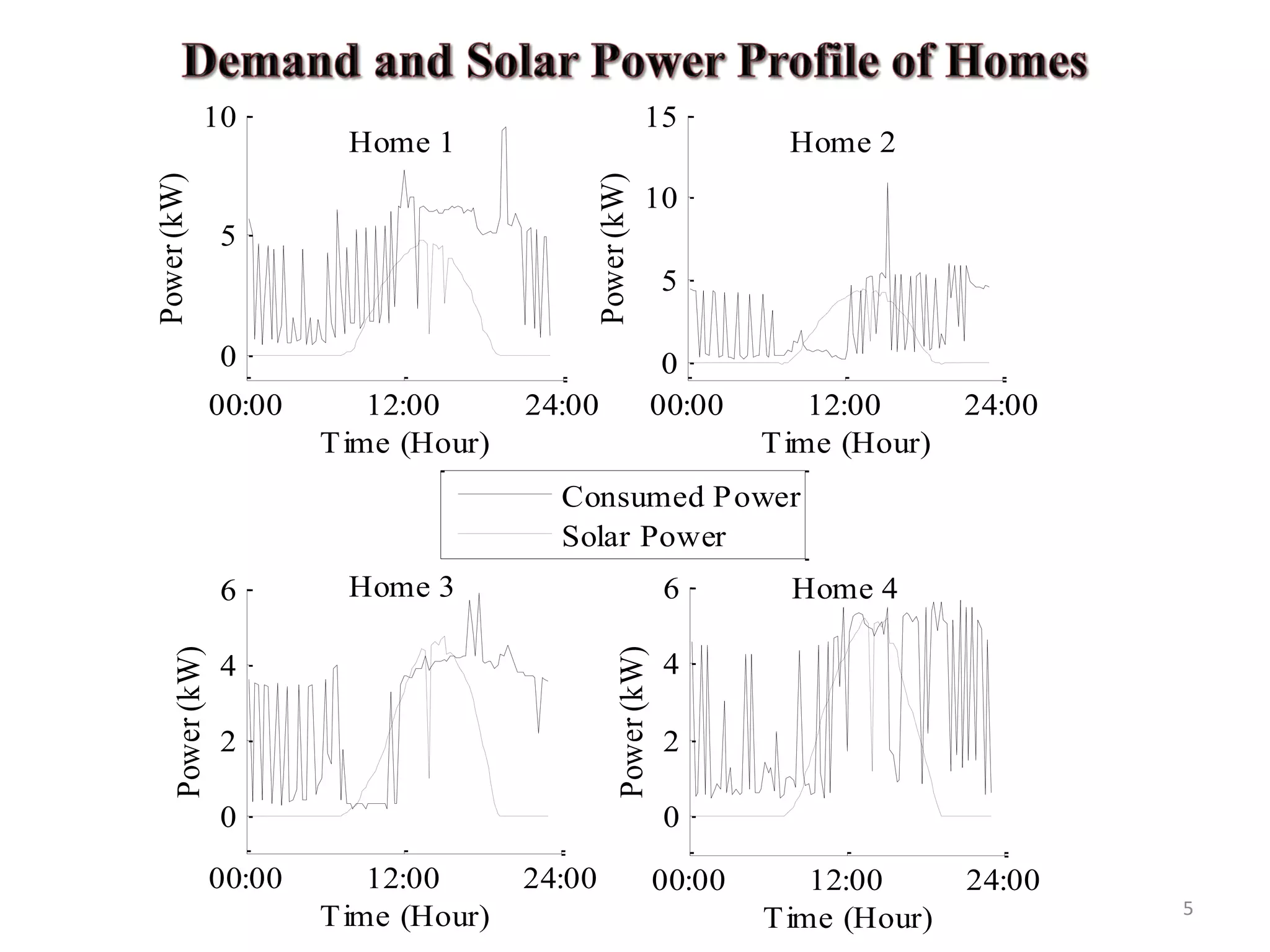
5
00:00 12:00 24:00
0
5
10
Time (Hour)
Power(kW)
Home 1
00:00 12:00 24:00
0
5
10
15
Time (Hour)
Power(kW)
Home 2
00:00 12:00 24:00
0
2
4
6
Time (Hour)
Power(kW)
Home 3
Consumed Power
Solar Power
00:00 12:00 24:00
0
2
4
6
Time (Hour)
Power(kW)
Home 4
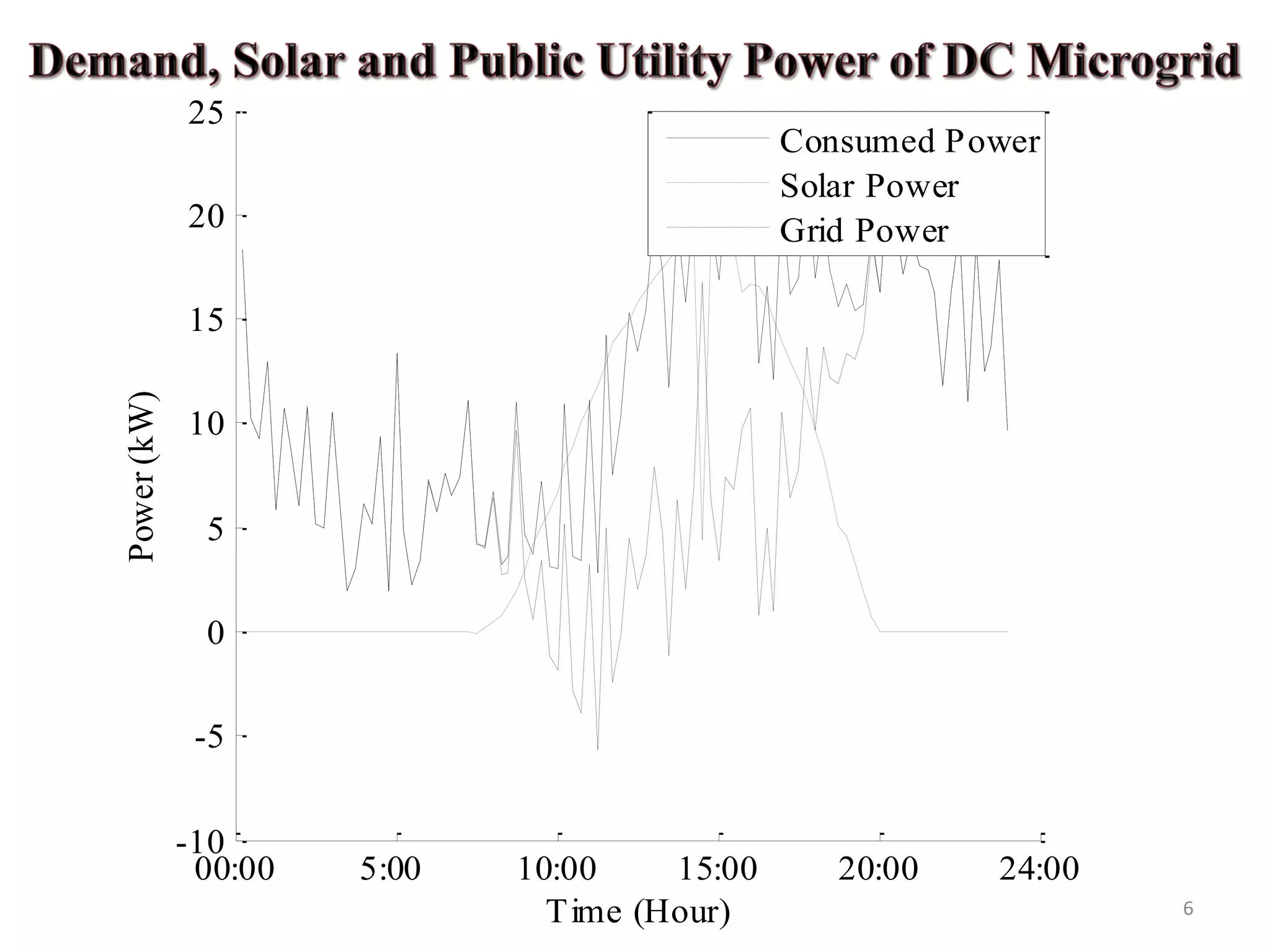
6
00:00 5:00 10:00 15:00 20:00 24:00
-10
-5
0
5
10
15
20
25
Time (Hour)
Power(kW) Consumed Power
Solar Power
Grid Power
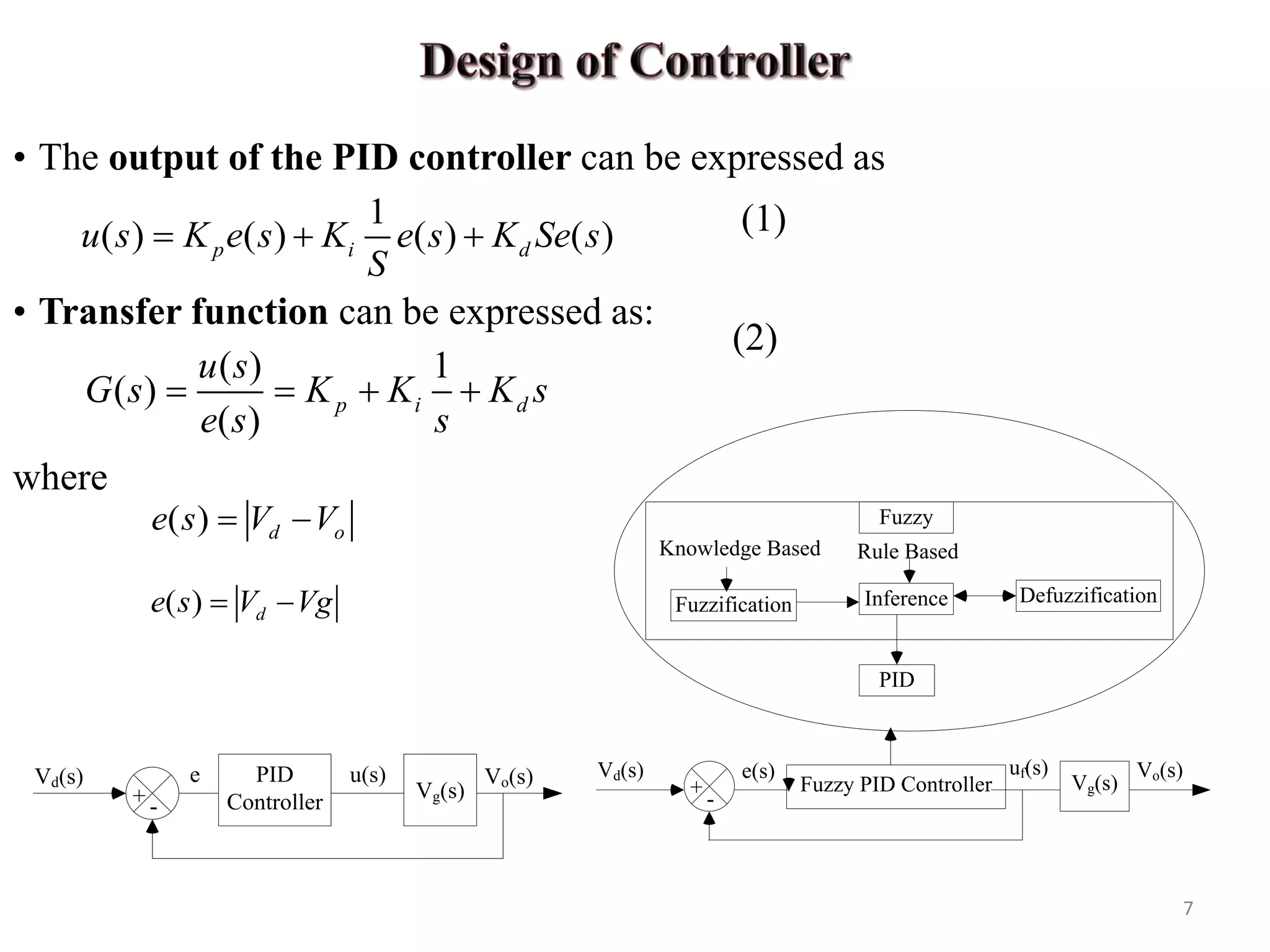
• The output of the PID controller can be expressed as
(1)
• Transfer function can be expressed as:
7
PID
Controller
e
Vg(s)
u(s)
+ -
Vo(s)Vd(s) Fuzzy PID Controller
e(s)
Vg(s)
uf(s)
+
-
Vo(s)Vd(s)
Fuzzification Inference Defuzzification
Fuzzy
Knowledge Based Rule Based
PID
1
( ) ( ) ( ) ( )p i du s K e s K e s K Se s
S
  
(2)
where
( ) 1
( )
( )
p i d
u s
G s K K K s
e s s
   
( ) de s V Vg 
( ) d oe s V V 
8
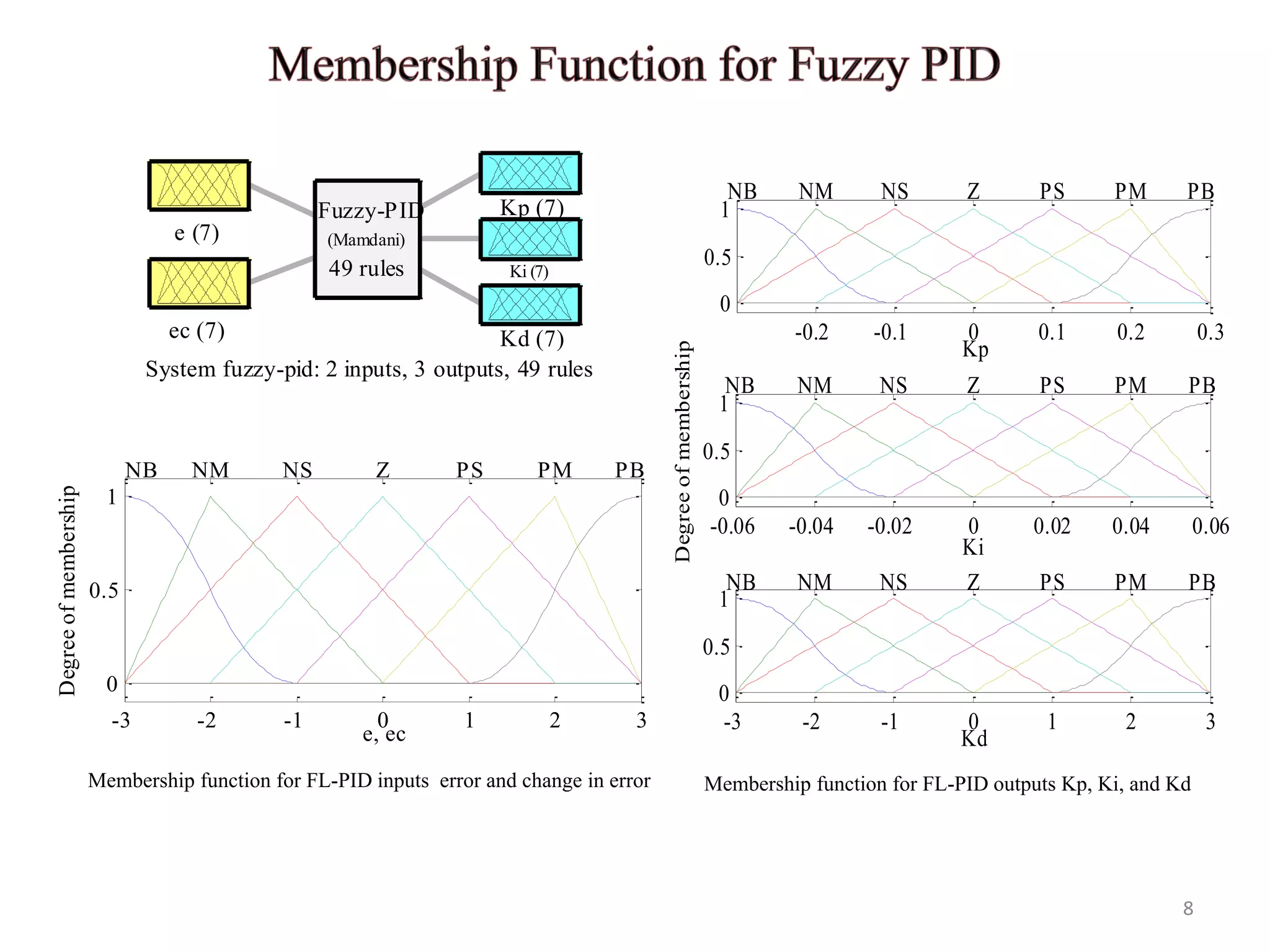
System fuzzy-pid: 2 inputs, 3 outputs, 49 rules
e (7)
ec (7)
Kp (7)
Ki (7)
Kd (7)
Fuzzy-PID
(Mamdani)
49 rules
-3 -2 -1 0 1 2 3
0
0.5
1
e, ec
Degreeofmembership
NB NM NS Z PS PM PB
Membership function for FL-PID inputs error and change in error
-0.2 -0.1 0 0.1 0.2 0.3
0
0.5
1
Kp
NB NM NS Z PS PM PB
-0.06 -0.04 -0.02 0 0.02 0.04 0.06
0
0.5
1
Ki
Degreeofmembership
NB NM NS Z PS PM PB
-3 -2 -1 0 1 2 3
0
0.5
1
Kd
NB NM NS Z PS PM PB
Membership function for FL-PID outputs Kp, Ki, and Kd
9
e
ec
NB NM NS Z PS PM PB
NB NB NB NB NM NM Z Z
NM NB NB NM NM NS Z Z
NS NM NM NS NS Z PS PS
Z NM NS NS Z PS PS PM
PS NS NS Z PS PS NM PM
PM Z Z PS PM PM PB PB
PB Z Z PS PM PB PB PB
e
ec
NB NM NS Z PS PM PB
NB PB PB PM PM PS PS Z
NM PB PB PM PM PS Z Z
NS PM PM PM PS Z NS NM
Z PM PS PS Z NS NM NM
PS PS PS Z NS NS NM NM
PM Z Z NS NM NM NM NB
PB Z NS NS NM NM NB NB
e
ec
NB NM NS Z PS PM PB
NB PS PS Z Z Z PB PB
NM NS NS NS NS Z PS PM
NS NB NB NM NS Z PS PM
Z NB NM NM NS Z PS PM
PS NB NM NS NS Z PS PS
PM NM NS NS NS Z PS PS
PB PS Z Z Z Z PB PS
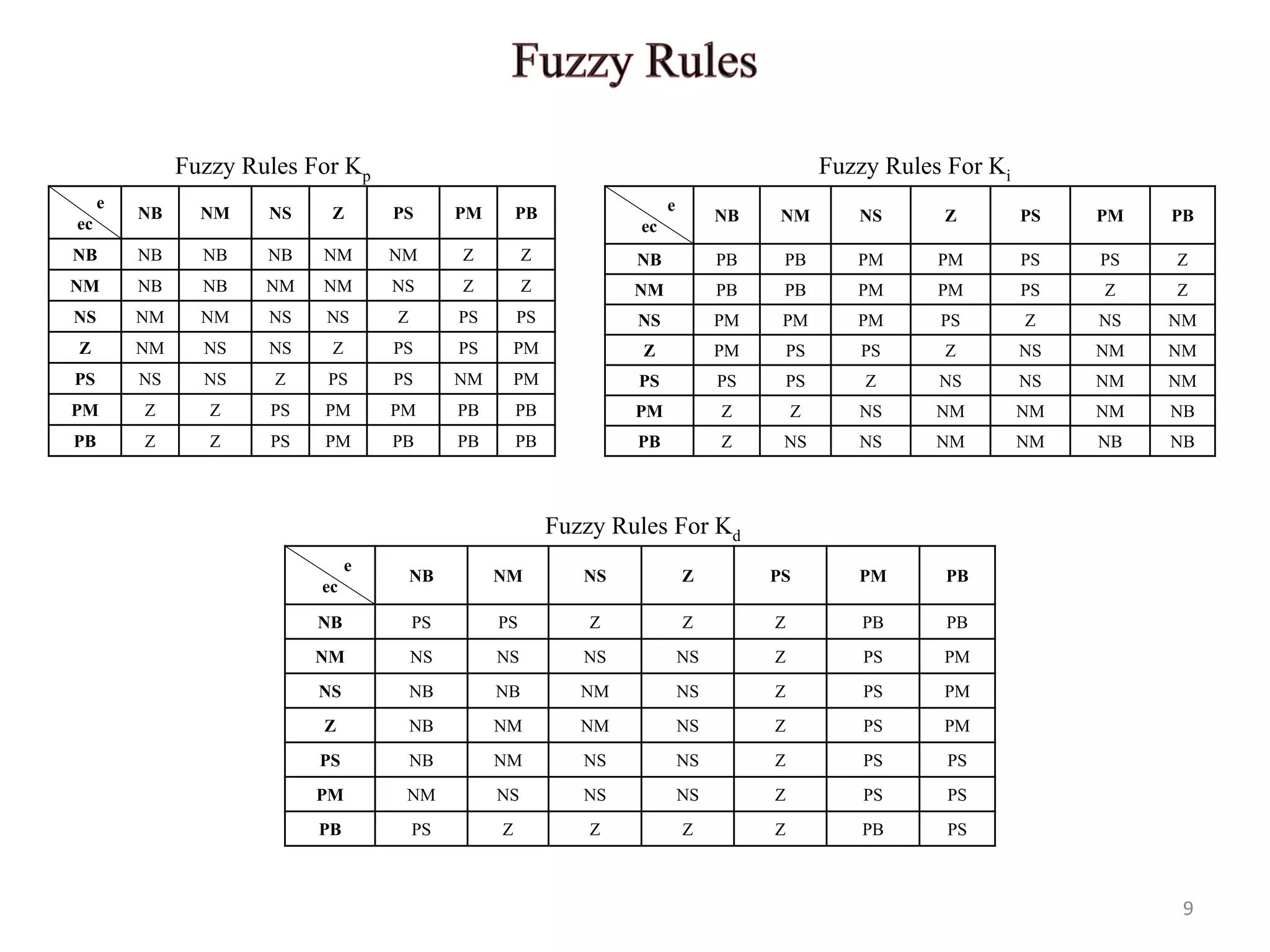
Fuzzy Rules For Kd
Fuzzy Rules For Kp Fuzzy Rules For Ki
10
0 0.2 0.4 0.6 0.8 1 1.2 1.4 1.6 1.8 2
0
20
40
60
80
100
120
140
160
180
Time (Sec)
Voltage(Volt)
Simulated Grid Voltage
Measured Grid Voltage
Desired Grid Voltage
00:00 02:30 05:00 07:30 10:00 12:30 15:00 17:30 20:00 22:30 25:00
110
120
130
140
150
160
170
Time (Hour)
PID Controller
Voltage(Volt)
Solid Line is the Measured Voltage
Dotted Line is the Desired Voltage
Dashed line is the Simulated Voltage
11
00:00 02:30 05:00 07:30 10:00 12:30 15:00 17:30 20:00 22:30 25:00
110
115
120
125
130
135
140
145
Time (Sec)
Fuzzy PID Controller
Voltage(Volt)
Solid Line is the Measured Voltage
Dotted Line is the Desired Voltage
Dashed line is the Simulated Voltage
0 0.2 0.4 0.6 0.8 1 1.2 1.4 1.6 1.8 2
0
20
40
60
80
100
120
140
160
Time (Sec)
Voltage(Volt)
Measured Grid Voltage
Simulated Grid Voltage
Desired Grid Voltage
12
Controller
Type Time Response Parameters
Rise
time
(Sec)
Settling
time
(Sec)
Over-
shoot
(%)
Peak time
(Sec)
Steady
state
error (%)
PID 0.0148 1.6091 0.326 0.47 0.9231
FL-PID 0.0264 1.3609 0.132 0.41 0.2325
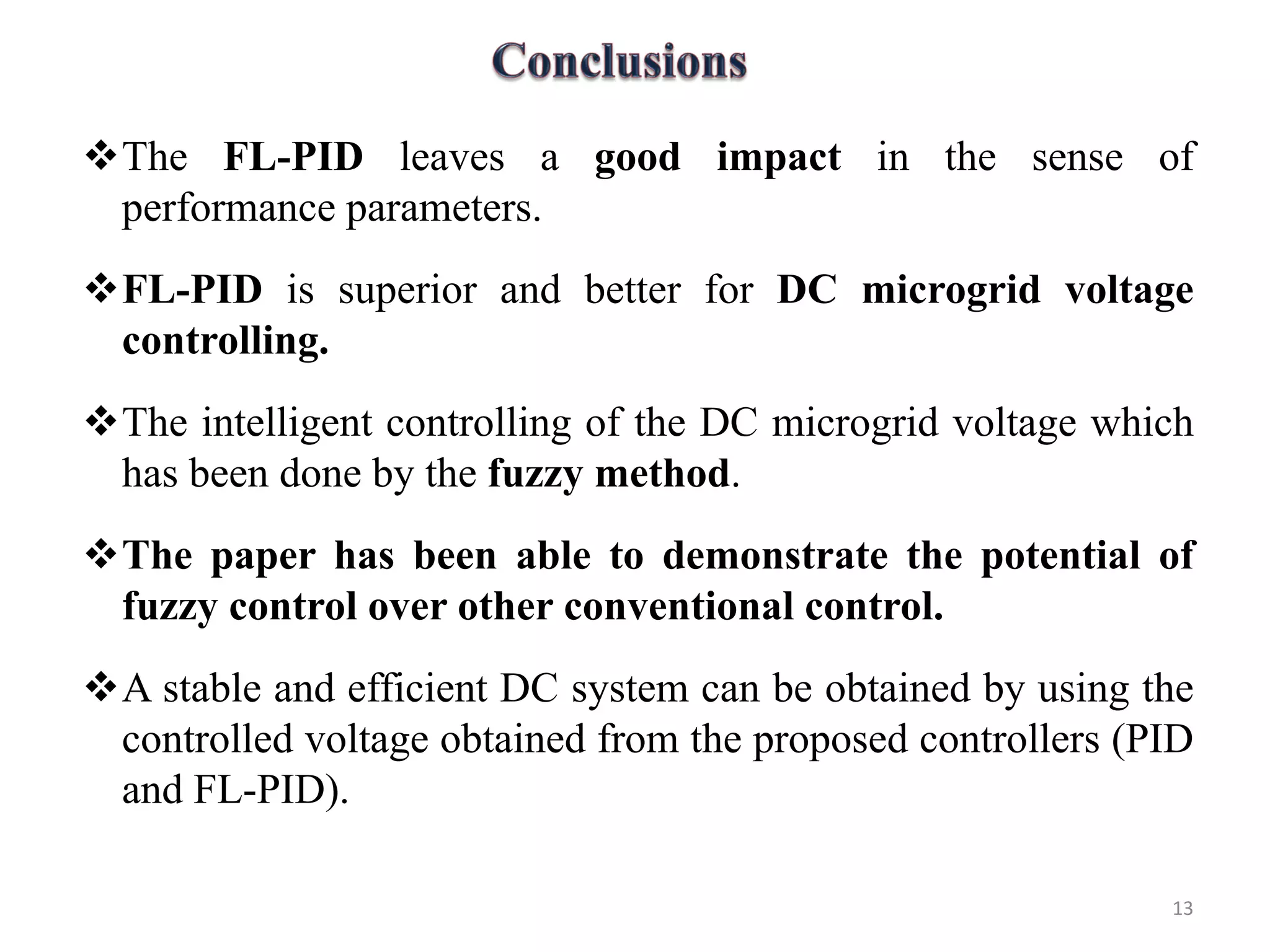
The FL-PID leaves a good impact in the sense of
performance parameters.
FL-PID is superior and better for DC microgrid voltage
controlling.
The intelligent controlling of the DC microgrid voltage which
has been done by the fuzzy method.
The paper has been able to demonstrate the potential of
fuzzy control over other conventional control.
A stable and efficient DC system can be obtained by using the
controlled voltage obtained from the proposed controllers (PID
and FL-PID).
13
• N. D. Hatziargyriou, H. Asano, H. R. Iravani, and C. Marnay, “Microgrids,” IEEE Power Energy Mag., vol.5, no.4,
pp.78–94, Jul. 2007.
• N. Pogaku, M. Prodanovic, and T. C. Green, “Modeling, analysis and testing of autonomous operation of an inverter-
based microgrid,” IEEE Trans. Power Electron, vol.22, no.2, pp.613–625, Mar. 2007.
• J. M. Carrasco, L. G. Franquelo, J. T. Bialasiewiez, E. Galvan, E Guisado, M. M. Prats, J. I. Leon, and N. M. Alfonso,
“Power-electronic systems for the grid integration of renewable energy sources: A survey,” IEEE Trans. Power
Electron, vol.53, no.4, pp.1002–1016, Jun. 2006.
• R. K. Chauhan, B. S. Rajpurohit, “DC Distribution System for energy efficient buildings,” in proc. 2014 IEEE 18th
National Power System Conference, India, Dec. 18-20, 2014, pp.1-6.
• J. C. Choi, H. Y. Jeong, D. J. Won, S. J. Ahn and S. I. Moon, “Cooperative voltage control of distributed generation and
grid connected converter in dc microgrid,” Renewable Energy and Power Quality Journal, no.2, Mar. 2013.
• Y. Ito, Y. Zhongqing, and H Akagi, “DC microgrid based distribution power generation system,” in proc. 2004 IEEE 4th
International Conference on Power Electronics and Motion Control, vol. 3, pp. 1740-1745.
• H. Kakigano, A. Nishino, and T. Ise, “Distribution voltage control for dc microgrid with fuzzy control and gain-
scheduling control,” in proc. 2011 IEEE 8th International Conference on Power Electronics and ECCE Asia, pp. 254-
263.
• B. Singh, A. Chandra, and K. Al-Haddad, “Computer-aided modeling and simulation of active power filters,” Elect.
Mach. and Power Syst., vol.27, no.11, pp.1227–1241, 1999.
• K. Chatterjee, B. G. Fernandes, and G. K. Dubey, “An instantaneous reactive volt-ampere compensator and harmonic
suppressor system,” IEEE Trans. Power Electron., vol. 14, no. 2, pp. 381–392, Mar. 1999.
• S. Jain, P. Agarwal, and H. O. Gupta, “Design simulation and experimental investigations on a shunt active power filter
for harmonics and reactive power compensation,” Elect. Power Compon. and Syst., vol. 32, no. 7, pp. 671–692, Jul.
2003.
• F. Blaabjerg, R. Teodorescu, M. Liserre, and A.V. Timbus, “Overview of control and grid synchronization for
distributed power generation systems,” IEEE Trans. Ind. Electron., vol. 55, no.3, pp. 1398–1411, Oct. 2006.
14
• S. Buso, L. Malesani, and P. Mattavelli, “Comparison of current control techniques for active power filter
applications”, IEEE Trans. Ind. Electron., vol.45, no.5, pp.722-729, Oct. 1998.
• M. Ho, and C. Lin, “PID controller design for robust performance,” IEEE Trans. Automatic Control, vol. 48, no. 8,
pp. 1404–1409, Aug. 2003.
• G. K. I. Mann, B. G. Hu, and R. G. Gosine, “Analysis of direct action fuzzy PID controllers structures,” IEEE
Trans. Syst. Man Cybern., vol. 29, no.3, pp.371–388, Jun. 1999.
• B. K. Bose, “Expert systems, fuzzy logic and neural network, applications in power electronics and motion
control,” in proc.1994 IEEE Piscataway, NJ: IEEE Press, ch. 11, pp. 1303 - 1323.
• V. S. C. Raviraj and P. C. Sen, “Comparative study of proportional integral, sliding mode, and fuzzy logic
controllers for power converters,” IEEE Trans. Ind. Appl., vol.33, no.2, pp. 518–524, Mar./Apr. 1997.
• C. C. Lee, “Fuzzy logic in control systems: fuzzy logic controller-part I”, IEEE Trans. Syst. Man. Cybern., vol.20,
no. 2, pp. 404-418, Mar/Apr 1990.
• K. Rajani and R. Pal Nikhil R., “A robust self-tuning scheme for PI and PD-type fuzzy controllers,” IEEE Trans.
Fuzzy Syst., vol.7, no.1, pp. 2-16, Feb. 1999.
• H. Baogang, G. K. I. Mann and R. G. Gosine, “New methodology for analytical and optimal design of fuzzy PID
controllers”, IEEE Trans. Fuzzy Syst., vol.7, no.5, pp.521-539, Oct. 1999.
• Z. W. Woo, H. Y. Chung and J. J. Lin, “A PID type fuzzy controller with self-tuning scaling factors,” Fuzzy Sets and
Syst., vol.115, no.2, pp. 321-326, Oct.2000.
• I. Pan, S. Das and A. Gupta, “Tuning of an optimal fuzzy PID controller with stochastic algorithms for networked
control systems with random time delay,” ISA Trans., vol.50, no.1, pp.28-36, Jan. 2011.
• D. Chen and L. Xu, “Autonomous dc voltage control of a dc microgrid with multiple slack terminals,” IEEE Trans.
power syst., vol.27, no.4, pp.1897-1905, Nov.2012.
15
Acknowledgement
The authors would like to acknowledge the financial
support received by
DST-UKIERI
16
Thanks!
17

Design and Analysis of PID and Fuzzy-PID Controller for Voltage Control of DC Microgrid , IGST Asia 2015

  • 1.
    Design and Analysisof PID and Fuzzy-PID Controller for Voltage Control of DC Microgrid Presented By : Dr. Francisco M. Gonzalez-Longatt Deptt. Of Electrical Engg. University of Loughborough, Loughborough, UK Co-Author: R. K. Chauhan and Dr. B. S. Rajpurohit School of Computing & Electrical Engg Indian Institute of Technology Mandi, India Dr. R. E. Hebner Center for Electromechanics University of Texas Austin, USA Dr. S. N. Singh Deptt. of Electrical Engineering Indian Institute of Technology Kanpur, India
  • 2.
    Stability issues aremore prevalent in microgrids than in a large electric grid because power and energy ratings are much lower. In dc systems there is no reactive power interactions, which seems to suggest that there are no frequency stability issues. System control seems to be oriented to voltage stability. There is a change in the power and load due to demand variations. This change leads to create fluctuations in the voltage level. 2
  • 3.
    The objective isto keep the DC microgrid voltage at the reference DC level (i.e. at 124V here). A PID controller is designed for the DC microgrid voltage control. A fuzzy PID controller also designed which is taking the advantage of PID experiences and Fuzzy knowledge. Both the controllers is compared based on the performance parameters. 3
  • 4.
  • 5.
    5 00:00 12:00 24:00 0 5 10 Time(Hour) Power(kW) Home 1 00:00 12:00 24:00 0 5 10 15 Time (Hour) Power(kW) Home 2 00:00 12:00 24:00 0 2 4 6 Time (Hour) Power(kW) Home 3 Consumed Power Solar Power 00:00 12:00 24:00 0 2 4 6 Time (Hour) Power(kW) Home 4
  • 6.
    6 00:00 5:00 10:0015:00 20:00 24:00 -10 -5 0 5 10 15 20 25 Time (Hour) Power(kW) Consumed Power Solar Power Grid Power
  • 7.
    • The outputof the PID controller can be expressed as (1) • Transfer function can be expressed as: 7 PID Controller e Vg(s) u(s) + - Vo(s)Vd(s) Fuzzy PID Controller e(s) Vg(s) uf(s) + - Vo(s)Vd(s) Fuzzification Inference Defuzzification Fuzzy Knowledge Based Rule Based PID 1 ( ) ( ) ( ) ( )p i du s K e s K e s K Se s S    (2) where ( ) 1 ( ) ( ) p i d u s G s K K K s e s s     ( ) de s V Vg  ( ) d oe s V V 
  • 8.
    8 System fuzzy-pid: 2inputs, 3 outputs, 49 rules e (7) ec (7) Kp (7) Ki (7) Kd (7) Fuzzy-PID (Mamdani) 49 rules -3 -2 -1 0 1 2 3 0 0.5 1 e, ec Degreeofmembership NB NM NS Z PS PM PB Membership function for FL-PID inputs error and change in error -0.2 -0.1 0 0.1 0.2 0.3 0 0.5 1 Kp NB NM NS Z PS PM PB -0.06 -0.04 -0.02 0 0.02 0.04 0.06 0 0.5 1 Ki Degreeofmembership NB NM NS Z PS PM PB -3 -2 -1 0 1 2 3 0 0.5 1 Kd NB NM NS Z PS PM PB Membership function for FL-PID outputs Kp, Ki, and Kd
  • 9.
    9 e ec NB NM NSZ PS PM PB NB NB NB NB NM NM Z Z NM NB NB NM NM NS Z Z NS NM NM NS NS Z PS PS Z NM NS NS Z PS PS PM PS NS NS Z PS PS NM PM PM Z Z PS PM PM PB PB PB Z Z PS PM PB PB PB e ec NB NM NS Z PS PM PB NB PB PB PM PM PS PS Z NM PB PB PM PM PS Z Z NS PM PM PM PS Z NS NM Z PM PS PS Z NS NM NM PS PS PS Z NS NS NM NM PM Z Z NS NM NM NM NB PB Z NS NS NM NM NB NB e ec NB NM NS Z PS PM PB NB PS PS Z Z Z PB PB NM NS NS NS NS Z PS PM NS NB NB NM NS Z PS PM Z NB NM NM NS Z PS PM PS NB NM NS NS Z PS PS PM NM NS NS NS Z PS PS PB PS Z Z Z Z PB PS Fuzzy Rules For Kd Fuzzy Rules For Kp Fuzzy Rules For Ki
  • 10.
    10 0 0.2 0.40.6 0.8 1 1.2 1.4 1.6 1.8 2 0 20 40 60 80 100 120 140 160 180 Time (Sec) Voltage(Volt) Simulated Grid Voltage Measured Grid Voltage Desired Grid Voltage 00:00 02:30 05:00 07:30 10:00 12:30 15:00 17:30 20:00 22:30 25:00 110 120 130 140 150 160 170 Time (Hour) PID Controller Voltage(Volt) Solid Line is the Measured Voltage Dotted Line is the Desired Voltage Dashed line is the Simulated Voltage
  • 11.
    11 00:00 02:30 05:0007:30 10:00 12:30 15:00 17:30 20:00 22:30 25:00 110 115 120 125 130 135 140 145 Time (Sec) Fuzzy PID Controller Voltage(Volt) Solid Line is the Measured Voltage Dotted Line is the Desired Voltage Dashed line is the Simulated Voltage 0 0.2 0.4 0.6 0.8 1 1.2 1.4 1.6 1.8 2 0 20 40 60 80 100 120 140 160 Time (Sec) Voltage(Volt) Measured Grid Voltage Simulated Grid Voltage Desired Grid Voltage
  • 12.
    12 Controller Type Time ResponseParameters Rise time (Sec) Settling time (Sec) Over- shoot (%) Peak time (Sec) Steady state error (%) PID 0.0148 1.6091 0.326 0.47 0.9231 FL-PID 0.0264 1.3609 0.132 0.41 0.2325
  • 13.
    The FL-PID leavesa good impact in the sense of performance parameters. FL-PID is superior and better for DC microgrid voltage controlling. The intelligent controlling of the DC microgrid voltage which has been done by the fuzzy method. The paper has been able to demonstrate the potential of fuzzy control over other conventional control. A stable and efficient DC system can be obtained by using the controlled voltage obtained from the proposed controllers (PID and FL-PID). 13
  • 14.
    • N. D.Hatziargyriou, H. Asano, H. R. Iravani, and C. Marnay, “Microgrids,” IEEE Power Energy Mag., vol.5, no.4, pp.78–94, Jul. 2007. • N. Pogaku, M. Prodanovic, and T. C. Green, “Modeling, analysis and testing of autonomous operation of an inverter- based microgrid,” IEEE Trans. Power Electron, vol.22, no.2, pp.613–625, Mar. 2007. • J. M. Carrasco, L. G. Franquelo, J. T. Bialasiewiez, E. Galvan, E Guisado, M. M. Prats, J. I. Leon, and N. M. Alfonso, “Power-electronic systems for the grid integration of renewable energy sources: A survey,” IEEE Trans. Power Electron, vol.53, no.4, pp.1002–1016, Jun. 2006. • R. K. Chauhan, B. S. Rajpurohit, “DC Distribution System for energy efficient buildings,” in proc. 2014 IEEE 18th National Power System Conference, India, Dec. 18-20, 2014, pp.1-6. • J. C. Choi, H. Y. Jeong, D. J. Won, S. J. Ahn and S. I. Moon, “Cooperative voltage control of distributed generation and grid connected converter in dc microgrid,” Renewable Energy and Power Quality Journal, no.2, Mar. 2013. • Y. Ito, Y. Zhongqing, and H Akagi, “DC microgrid based distribution power generation system,” in proc. 2004 IEEE 4th International Conference on Power Electronics and Motion Control, vol. 3, pp. 1740-1745. • H. Kakigano, A. Nishino, and T. Ise, “Distribution voltage control for dc microgrid with fuzzy control and gain- scheduling control,” in proc. 2011 IEEE 8th International Conference on Power Electronics and ECCE Asia, pp. 254- 263. • B. Singh, A. Chandra, and K. Al-Haddad, “Computer-aided modeling and simulation of active power filters,” Elect. Mach. and Power Syst., vol.27, no.11, pp.1227–1241, 1999. • K. Chatterjee, B. G. Fernandes, and G. K. Dubey, “An instantaneous reactive volt-ampere compensator and harmonic suppressor system,” IEEE Trans. Power Electron., vol. 14, no. 2, pp. 381–392, Mar. 1999. • S. Jain, P. Agarwal, and H. O. Gupta, “Design simulation and experimental investigations on a shunt active power filter for harmonics and reactive power compensation,” Elect. Power Compon. and Syst., vol. 32, no. 7, pp. 671–692, Jul. 2003. • F. Blaabjerg, R. Teodorescu, M. Liserre, and A.V. Timbus, “Overview of control and grid synchronization for distributed power generation systems,” IEEE Trans. Ind. Electron., vol. 55, no.3, pp. 1398–1411, Oct. 2006. 14
  • 15.
    • S. Buso,L. Malesani, and P. Mattavelli, “Comparison of current control techniques for active power filter applications”, IEEE Trans. Ind. Electron., vol.45, no.5, pp.722-729, Oct. 1998. • M. Ho, and C. Lin, “PID controller design for robust performance,” IEEE Trans. Automatic Control, vol. 48, no. 8, pp. 1404–1409, Aug. 2003. • G. K. I. Mann, B. G. Hu, and R. G. Gosine, “Analysis of direct action fuzzy PID controllers structures,” IEEE Trans. Syst. Man Cybern., vol. 29, no.3, pp.371–388, Jun. 1999. • B. K. Bose, “Expert systems, fuzzy logic and neural network, applications in power electronics and motion control,” in proc.1994 IEEE Piscataway, NJ: IEEE Press, ch. 11, pp. 1303 - 1323. • V. S. C. Raviraj and P. C. Sen, “Comparative study of proportional integral, sliding mode, and fuzzy logic controllers for power converters,” IEEE Trans. Ind. Appl., vol.33, no.2, pp. 518–524, Mar./Apr. 1997. • C. C. Lee, “Fuzzy logic in control systems: fuzzy logic controller-part I”, IEEE Trans. Syst. Man. Cybern., vol.20, no. 2, pp. 404-418, Mar/Apr 1990. • K. Rajani and R. Pal Nikhil R., “A robust self-tuning scheme for PI and PD-type fuzzy controllers,” IEEE Trans. Fuzzy Syst., vol.7, no.1, pp. 2-16, Feb. 1999. • H. Baogang, G. K. I. Mann and R. G. Gosine, “New methodology for analytical and optimal design of fuzzy PID controllers”, IEEE Trans. Fuzzy Syst., vol.7, no.5, pp.521-539, Oct. 1999. • Z. W. Woo, H. Y. Chung and J. J. Lin, “A PID type fuzzy controller with self-tuning scaling factors,” Fuzzy Sets and Syst., vol.115, no.2, pp. 321-326, Oct.2000. • I. Pan, S. Das and A. Gupta, “Tuning of an optimal fuzzy PID controller with stochastic algorithms for networked control systems with random time delay,” ISA Trans., vol.50, no.1, pp.28-36, Jan. 2011. • D. Chen and L. Xu, “Autonomous dc voltage control of a dc microgrid with multiple slack terminals,” IEEE Trans. power syst., vol.27, no.4, pp.1897-1905, Nov.2012. 15
  • 16.
    Acknowledgement The authors wouldlike to acknowledge the financial support received by DST-UKIERI 16
  • 17.