Muhammad Ashfaq Khan
COMSATS Institute of Information Technology, Islamabad
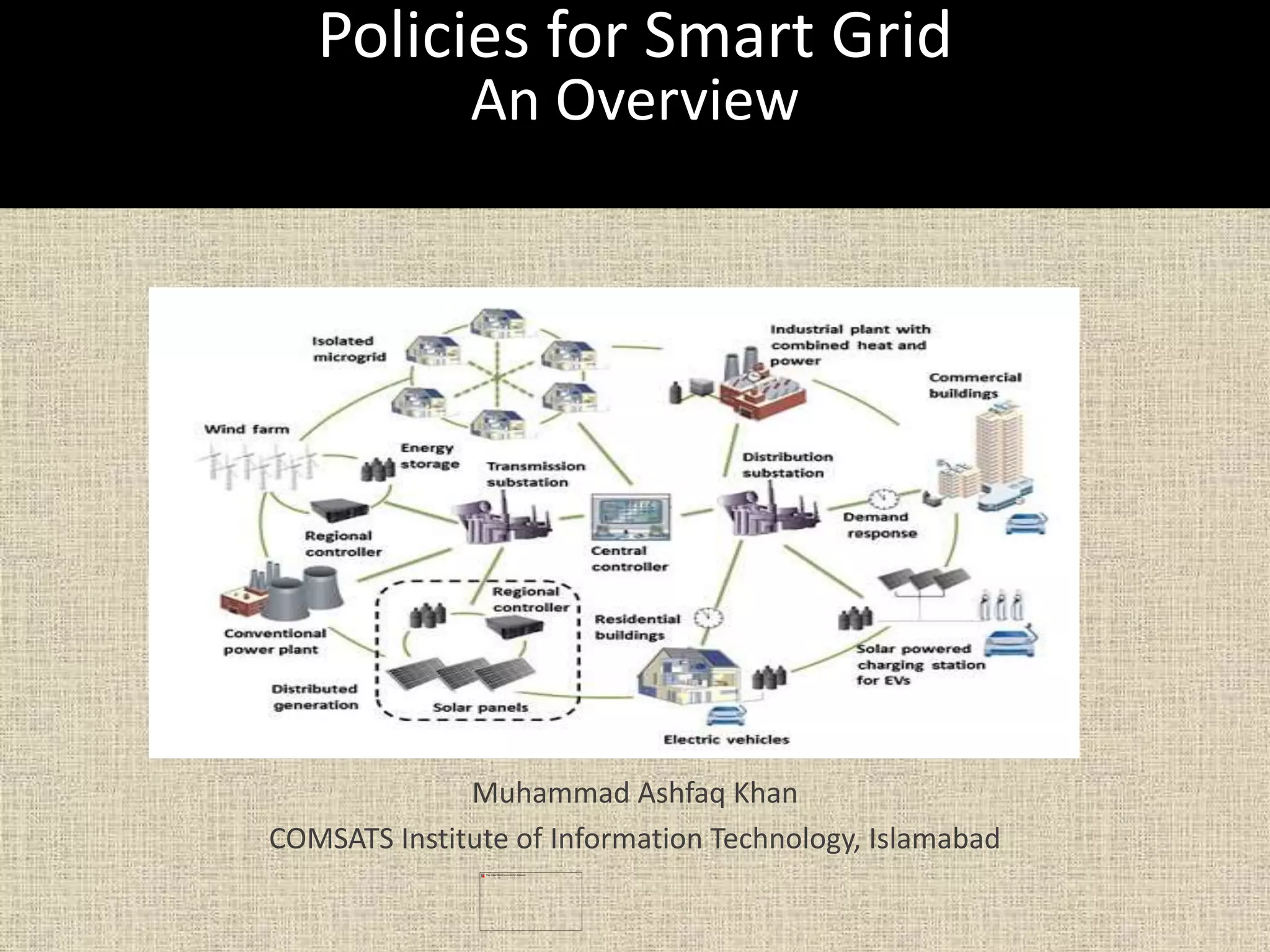
Policies for Smart Grid
An Overview
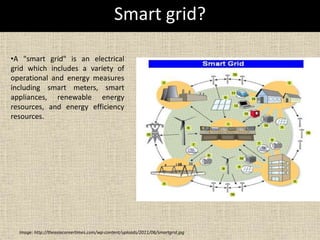
Smart grid?
Image: http://theasiacareertimes.com/wp-content/uploads/2011/06/smartgrid.jpg
•A "smart grid" is an electrical
grid which includes a variety of
operational and energy measures
including smart meters, smart
appliances, renewable energy
resources, and energy efficiency
resources.
Smart Grid Barriers
Access of Capital
Privacy and security concerns
Smart Grid Barriers
Access of Capital
Large upfront cost and lack of
access to capital is one of the
greatest challenges to the
deployment of smart grids
Like many other green technologies, too much initial investment are
required, yet the resulting benefits may not be fully realized for many
years. For example, the Electric Power Research Institute estimates
that smart grid investments needed in the United States would cost
the average residential customer $1000 to $1500; amortized over a 10
year period, this would cause the average residential electricity bill to
increase by 8–12%.
 On the one hand, the benefits could be three to six times larger than
these costs, such as lower meter reading costs, improved billing
processes, reduction of nontechnical losses, enhanced reliability,
improved power quality, increased national productivity, and
enhanced electricity service.
Smart Grid Barriers
Privacy and security concerns Many technologies that enable the
deployment of smart grids, such as smart
meters and sensors, can increase the
vulnerability of the grid to cyber attacks
The tension between protection of
consumer privacy and development of
smart grid also imposes challenges on
privacy protection rules.
As the number of
participants and
distributed
generators in the
electric system
increases, so does
the
complexity of
security issues
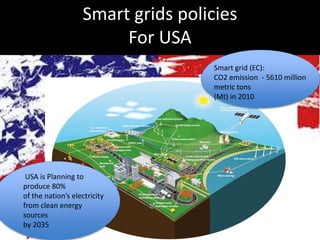
Smart grids policies
For USA
Smart grid (EC):
CO2 emission - 5610 million
metric tons
(Mt) in 2010
USA is Planning to
produce 80%
of the nation’s electricity
from clean energy
sources
by 2035
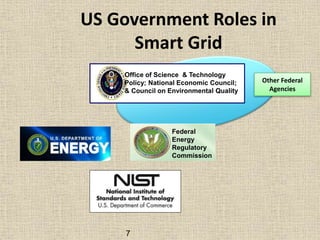
US Government Roles in
Smart Grid
7
Federal
Energy
Regulatory
Commission
Other Federal
Agencies
Office of Science & Technology
Policy; National Economic Council;
& Council on Environmental Quality
SMAR GRID Legislation and policy Context
The Energy Policy Act of 2005 is the first federal law
that specifically promotes the development of smart
meters. It directs utility regulators to consider
time-based pricing and other forms of demand
response for their states. Utilities are required to
provide each customer a time-based rate schedule
and a time-based meter upon customer request.
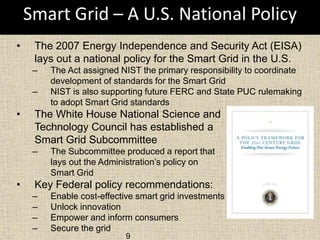
Smart Grid – A U.S. National Policy
• The 2007 Energy Independence and Security Act (EISA)
lays out a national policy for the Smart Grid in the U.S.
– The Act assigned NIST the primary responsibility to coordinate
development of standards for the Smart Grid
– NIST is also supporting future FERC and State PUC rulemaking
to adopt Smart Grid standards
• The White House National Science and
Technology Council has established a
Smart Grid Subcommittee
– The Subcommittee produced a report that
lays out the Administration’s policy on
Smart Grid
• Key Federal policy recommendations:
– Enable cost-effective smart grid investments
– Unlock innovation
– Empower and inform consumers
– Secure the grid
9
SMAR GRID Legislation and policy Context
The National Institute of Standards and Technology (NIST), a major standards
developing federal agency, is directed to develop a smart-grid interoperability
framework that provides protocols and standards for smart-grid technologies.
EISA established a federal smart-grid investment matching grant program to
reimburse 20% of qualifying smart-grid investments.
The next important legislative effort is the
American Recovery and Reinvestment Act of 2009. It accelerates the
development of smart-grid technologies by appropriating $4.5 billion for
electricity delivery and energy reliability modernization efforts. Utilities and
other investors can apply stimulus grants
to pay up to 50% of the qualifying smart-grid investments. To date, the Smart
Grid Investment Grant authorized under this Act has 99 recipients, with a total
public investment of $3.5 billion
11
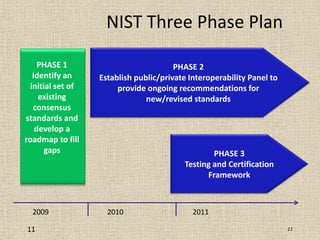
NIST Three Phase Plan
11
PHASE 1
Identify an
initial set of
existing
consensus
standards and
develop a
roadmap to fill
gaps PHASE 3
Testing and Certification
Framework
2009 2010
PHASE 2
Establish public/private Interoperability Panel to
provide ongoing recommendations for
new/revised standards
2011
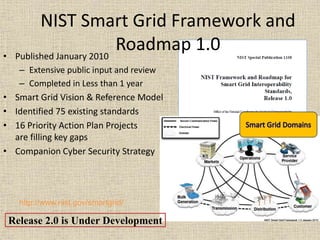
NIST Smart Grid Framework and
Roadmap 1.0• Published January 2010
– Extensive public input and review
– Completed in Less than 1 year
• Smart Grid Vision & Reference Model
• Identified 75 existing standards
• 16 Priority Action Plan Projects
are filling key gaps
• Companion Cyber Security Strategy
http://www.nist.gov/smartgrid/
Release 2.0 is Under Development
Net Metering
What is Net metering?
 Net metering allows customers to use a single
meter to measure both the in-flow and out-flow
of electricity,
 thus enabling them to install and interconnect
their own generators with utility grids.
Net Metering
Why Net metering is required?
customers can use the electricity generated
from their on-site facilities to offset their
electricity consumption and sell excess
generation to the utility typically at a retail price,
thereby encouraging the deployment of
customer-owned distributed energy systems. By
allowing utilities to buy back surplus electricity,
net metering helps overcome financial barriers
faced by distributed renewable facility owners.
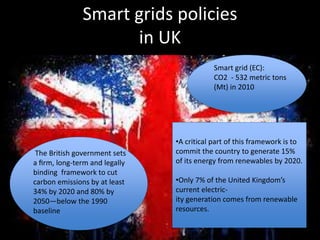
Smart grids policies
in UK
Smart grid (EC):
CO2 - 532 metric tons
(Mt) in 2010
The British government sets
a firm, long-term and legally
binding framework to cut
carbon emissions by at least
34% by 2020 and 80% by
2050—below the 1990
baseline
•A critical part of this framework is to
commit the country to generate 15%
of its energy from renewables by 2020.
•Only 7% of the United Kingdom’s
current electric-
ity generation comes from renewable
resources.
SMAR GRID policies for UK
To modernize and reduce the carbon footprint of
electric grids, one major initiative of the United Kingdom
is to encourage energy efficiency through
smart-meter deployment.
The British government expects full penetration of
smart meters by 2020, with a total financial investment
of £8.6 billion ($13.5 billion) and total benefits of £14.6
billion ($22.9 billion) over the next 20 years
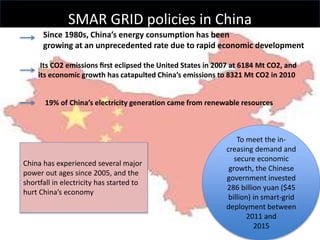
SMAR GRID policies in China
Since 1980s, China’s energy consumption has been
growing at an unprecedented rate due to rapid economic development
Its CO2 emissions first eclipsed the United States in 2007 at 6184 Mt CO2, and
its economic growth has catapulted China’s emissions to 8321 Mt CO2 in 2010
19% of China’s electricity generation came from renewable resources
China has experienced several major
power out ages since 2005, and the
shortfall in electricity has started to
hurt China’s economy
To meet the in-
creasing demand and
secure economic
growth, the Chinese
government invested
286 billion yuan ($45
billion) in smart-grid
deployment between
2011 and
2015
Smart Grid Policies in China
The Ministry of Science and Technology released the
‘Special Planning of 12th Five-Year Plan on Smart Grid
Major Science and Technology Industrialization Projects’ in
May, 2012. It identified nine key tasks, including large-
scale grid-connected intermittent renewable energy
technology, grid technology for supporting electric
vehicles, large-scale energy storage systems, intelligent
grid operation and control, intelligent transmission
technology and equipment, grid information and
communication technologies, flexible power transmission
technology and equipment, and smart grid integrated
comprehensive demonstrations.
Other reasons for the focus on trans-
mission might be the relatively
primitive structure at the distribution
ends, and the unique asset owner-ship
and management structure of utilities
and electric markets
Smart Grid Policies in China
State Grid Corporation of China (SGCC), the largest power company and
the major smart-grid policy implementer in China, provides services to
over one billion customers and covers 88% of the national territory
SGCC’s smart-grid development
plan is distinct in its focus on the
transmission, rather than the
distribution side, due to the fact
that major power generation
sources in China, such as coal and
hydropower are located in remote
areas
China is focusing on
innovation and export of
smart grid technologies to
build competitive
advantages of domestic
industries. Power shortage,
which comes along with
the 2011 nuclear incident
in Japan.
The electric power industry is
facing tremendous
opportunities and becoming
increasingly important in the
emerging low-carbon economy.
The costs required for the full
deployment of smart grids are
large. Currently, government is
still the key player in smart-grid
investments. This suggests the
need for a policy framework
that attracts private capital
investment, especially from
renewable project developers
and communication and
information technology
companies.
China, the largest developing country in the
world, sees smart grid as essential for renewable
deployment and strategic energy industries. It
also plans to close the power generation gap
between regions by constructing high-voltage
direct current transmission lines
Conclusion
The British regulators have
been very active not only in
the roll out of smart meters
and modernized distribution
networks, but they have also
supported innovative of low
carbon technologies
Thank you for your attention
Image: GEImage: GE
The End

Policies for smart grid

  • 1.
    Muhammad Ashfaq Khan COMSATSInstitute of Information Technology, Islamabad Policies for Smart Grid An Overview
  • 2.
    Smart grid? Image: http://theasiacareertimes.com/wp-content/uploads/2011/06/smartgrid.jpg •A"smart grid" is an electrical grid which includes a variety of operational and energy measures including smart meters, smart appliances, renewable energy resources, and energy efficiency resources.
  • 3.
    Smart Grid Barriers Accessof Capital Privacy and security concerns
  • 4.
    Smart Grid Barriers Accessof Capital Large upfront cost and lack of access to capital is one of the greatest challenges to the deployment of smart grids Like many other green technologies, too much initial investment are required, yet the resulting benefits may not be fully realized for many years. For example, the Electric Power Research Institute estimates that smart grid investments needed in the United States would cost the average residential customer $1000 to $1500; amortized over a 10 year period, this would cause the average residential electricity bill to increase by 8–12%.  On the one hand, the benefits could be three to six times larger than these costs, such as lower meter reading costs, improved billing processes, reduction of nontechnical losses, enhanced reliability, improved power quality, increased national productivity, and enhanced electricity service.
  • 5.
    Smart Grid Barriers Privacyand security concerns Many technologies that enable the deployment of smart grids, such as smart meters and sensors, can increase the vulnerability of the grid to cyber attacks The tension between protection of consumer privacy and development of smart grid also imposes challenges on privacy protection rules. As the number of participants and distributed generators in the electric system increases, so does the complexity of security issues
  • 6.
    Smart grids policies ForUSA Smart grid (EC): CO2 emission - 5610 million metric tons (Mt) in 2010 USA is Planning to produce 80% of the nation’s electricity from clean energy sources by 2035
  • 7.
    US Government Rolesin Smart Grid 7 Federal Energy Regulatory Commission Other Federal Agencies Office of Science & Technology Policy; National Economic Council; & Council on Environmental Quality
  • 8.
    SMAR GRID Legislationand policy Context The Energy Policy Act of 2005 is the first federal law that specifically promotes the development of smart meters. It directs utility regulators to consider time-based pricing and other forms of demand response for their states. Utilities are required to provide each customer a time-based rate schedule and a time-based meter upon customer request.
  • 9.
    Smart Grid –A U.S. National Policy • The 2007 Energy Independence and Security Act (EISA) lays out a national policy for the Smart Grid in the U.S. – The Act assigned NIST the primary responsibility to coordinate development of standards for the Smart Grid – NIST is also supporting future FERC and State PUC rulemaking to adopt Smart Grid standards • The White House National Science and Technology Council has established a Smart Grid Subcommittee – The Subcommittee produced a report that lays out the Administration’s policy on Smart Grid • Key Federal policy recommendations: – Enable cost-effective smart grid investments – Unlock innovation – Empower and inform consumers – Secure the grid 9
  • 10.
    SMAR GRID Legislationand policy Context The National Institute of Standards and Technology (NIST), a major standards developing federal agency, is directed to develop a smart-grid interoperability framework that provides protocols and standards for smart-grid technologies. EISA established a federal smart-grid investment matching grant program to reimburse 20% of qualifying smart-grid investments. The next important legislative effort is the American Recovery and Reinvestment Act of 2009. It accelerates the development of smart-grid technologies by appropriating $4.5 billion for electricity delivery and energy reliability modernization efforts. Utilities and other investors can apply stimulus grants to pay up to 50% of the qualifying smart-grid investments. To date, the Smart Grid Investment Grant authorized under this Act has 99 recipients, with a total public investment of $3.5 billion
  • 11.
    11 NIST Three PhasePlan 11 PHASE 1 Identify an initial set of existing consensus standards and develop a roadmap to fill gaps PHASE 3 Testing and Certification Framework 2009 2010 PHASE 2 Establish public/private Interoperability Panel to provide ongoing recommendations for new/revised standards 2011
  • 12.
    NIST Smart GridFramework and Roadmap 1.0• Published January 2010 – Extensive public input and review – Completed in Less than 1 year • Smart Grid Vision & Reference Model • Identified 75 existing standards • 16 Priority Action Plan Projects are filling key gaps • Companion Cyber Security Strategy http://www.nist.gov/smartgrid/ Release 2.0 is Under Development
  • 13.
    Net Metering What isNet metering?  Net metering allows customers to use a single meter to measure both the in-flow and out-flow of electricity,  thus enabling them to install and interconnect their own generators with utility grids.
  • 14.
    Net Metering Why Netmetering is required? customers can use the electricity generated from their on-site facilities to offset their electricity consumption and sell excess generation to the utility typically at a retail price, thereby encouraging the deployment of customer-owned distributed energy systems. By allowing utilities to buy back surplus electricity, net metering helps overcome financial barriers faced by distributed renewable facility owners.
  • 15.
    Smart grids policies inUK Smart grid (EC): CO2 - 532 metric tons (Mt) in 2010 The British government sets a firm, long-term and legally binding framework to cut carbon emissions by at least 34% by 2020 and 80% by 2050—below the 1990 baseline •A critical part of this framework is to commit the country to generate 15% of its energy from renewables by 2020. •Only 7% of the United Kingdom’s current electric- ity generation comes from renewable resources.
  • 16.
    SMAR GRID policiesfor UK To modernize and reduce the carbon footprint of electric grids, one major initiative of the United Kingdom is to encourage energy efficiency through smart-meter deployment. The British government expects full penetration of smart meters by 2020, with a total financial investment of £8.6 billion ($13.5 billion) and total benefits of £14.6 billion ($22.9 billion) over the next 20 years
  • 17.
    SMAR GRID policiesin China Since 1980s, China’s energy consumption has been growing at an unprecedented rate due to rapid economic development Its CO2 emissions first eclipsed the United States in 2007 at 6184 Mt CO2, and its economic growth has catapulted China’s emissions to 8321 Mt CO2 in 2010 19% of China’s electricity generation came from renewable resources China has experienced several major power out ages since 2005, and the shortfall in electricity has started to hurt China’s economy To meet the in- creasing demand and secure economic growth, the Chinese government invested 286 billion yuan ($45 billion) in smart-grid deployment between 2011 and 2015
  • 18.
    Smart Grid Policiesin China The Ministry of Science and Technology released the ‘Special Planning of 12th Five-Year Plan on Smart Grid Major Science and Technology Industrialization Projects’ in May, 2012. It identified nine key tasks, including large- scale grid-connected intermittent renewable energy technology, grid technology for supporting electric vehicles, large-scale energy storage systems, intelligent grid operation and control, intelligent transmission technology and equipment, grid information and communication technologies, flexible power transmission technology and equipment, and smart grid integrated comprehensive demonstrations.
  • 19.
    Other reasons forthe focus on trans- mission might be the relatively primitive structure at the distribution ends, and the unique asset owner-ship and management structure of utilities and electric markets Smart Grid Policies in China State Grid Corporation of China (SGCC), the largest power company and the major smart-grid policy implementer in China, provides services to over one billion customers and covers 88% of the national territory SGCC’s smart-grid development plan is distinct in its focus on the transmission, rather than the distribution side, due to the fact that major power generation sources in China, such as coal and hydropower are located in remote areas
  • 20.
    China is focusingon innovation and export of smart grid technologies to build competitive advantages of domestic industries. Power shortage, which comes along with the 2011 nuclear incident in Japan. The electric power industry is facing tremendous opportunities and becoming increasingly important in the emerging low-carbon economy. The costs required for the full deployment of smart grids are large. Currently, government is still the key player in smart-grid investments. This suggests the need for a policy framework that attracts private capital investment, especially from renewable project developers and communication and information technology companies. China, the largest developing country in the world, sees smart grid as essential for renewable deployment and strategic energy industries. It also plans to close the power generation gap between regions by constructing high-voltage direct current transmission lines Conclusion The British regulators have been very active not only in the roll out of smart meters and modernized distribution networks, but they have also supported innovative of low carbon technologies
  • 21.
    Thank you foryour attention Image: GEImage: GE The End