HOW
TO TELL
STORIES
WITH DATA
(REALLY)
edward segel
WHY
INTERACTIVE
VISUALIZATIONS
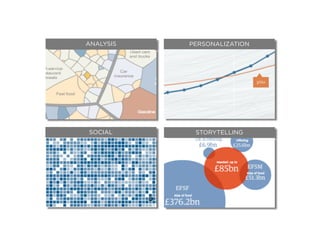
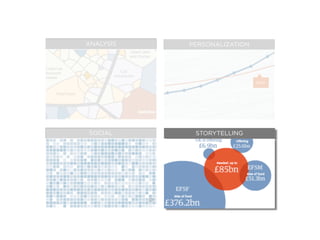
ANALYSIS   PERSONALIZATION


                             you


SOCIAL      STORYTELLING
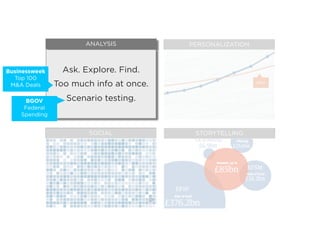
ANALYSIS          PERSONALIZATION


Businessweek     Ask. Explore. Find.
  Top 100
 M&A Deals     Too much info at once.                     you


      BGOV       Scenario testing.
     Federal
    Spending


                       SOCIAL            STORYTELLING
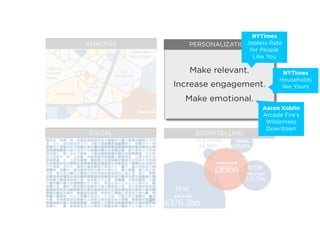
NYTimes
INFORMATIVE
  ANALYSIS                     Jobless Rate
                 PERSONALIZATION
                                 for People
                                  Like You

                 Make relevant.            NYTimes
                                          Households
              Increase engagement.         like Yours

                Make emotional.
                                     Aaron Koblin
                                     Arcade Fire’s
                                      Wilderness
                                      Downtown
  SOCIAL          STORYTELLING
INFORMATIVE
                         ANALYSIS       PERSONALIZATION


                                                          you


            Jeff Heer     SOCIAL          STORYTELLING
             Sensus


    Aaron Koblin        Sharing.
    Sheep, Cash,
      Bicycle      Collaborative.
              Real-Time sentiment.
 Stamen Design          NYTimes
MTV VMA Twitter    Reactions to Osama
ANALYSIS   PERSONALIZATION


                             you


SOCIAL      STORYTELLING
INFORMATIVE
  ANALYSIS    PERSONALIZATION


                                you


  SOCIAL       STORYTELLING
HOW
WE GOT
HERE
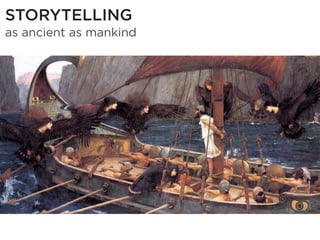
STORYTELLING
as ancient as mankind
STORYTELLING
Changes with technology


PEOPLE TELL STORIES
WORDS TELL STORIES
IMAGES TELL STORIES
COMICS TELL STORIES
MOVIES TELL STORIES
HOW CAN YOU TELL STORIES WITH

         DATA      ?
VISUALIZATION DESIGNERS ARE
 MELDING THE SKILLS OF COMPUTER
SCIENCE, STATISTICS, ARTISTIC DESIGN
        AND STORYTELLING.

        THE ECONOMIST // FEB 2010
PEOPLE HAVE BEGUN TO FORGET HOW
     POWERFUL HUMAN STORIES ARE,
EXCHANGING THEIR SENSE OF EMPATHY FOR
  A FETISHISTIC FASCINATION WITH DATA...
   THE HUMAN STUFF IS THE MAIN STUFF,
     AND THE DATA SHOULD ENRICH IT.

           JONATHAN HARRIS // 2008
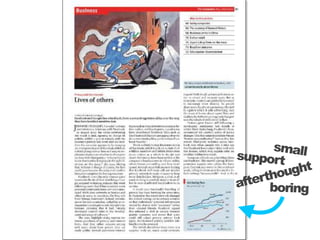
small
support
         ght
    rthou
afte boring
exciting!
     beautiful!       BUT
  technical!
                  [
                  what does
                  it mean?
center st
           age
standalone
      interactive
  guided
THE
NARRATIVE
FRAMEWORK
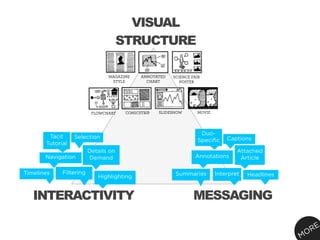
VISUAL
                                      STRUCTURE

                                MAGAZINE     ANNOTATED   SCIENCE FAIR
                                 STYLE         CHART        POSTER


                          FLOWCHART    COMICSTRIP   SLIDESHOW      MOVIE


                                                                     Duo-
        Tacit     Selection                                                    Captions
                                                                    Specific
       Tutorial
                         Details on                                                Attached
       Navigation        Demand                                   Annotations       Article

Timelines    Filtering                                    Summaries        Interpret   Headlines
                            Highlighting


   INTERACTIVITY                                                  MESSAGING

                                                                                                    O RE
                                                                                                   M
Genres + Interactivity + Messaging =

                     DESIGN SPACE
STORYTELLING        Author Driven           Reader Driven      ASK QUESTIONS
     CLARITY      strong ordering          weak ordering       EXPLORE
      SPEED      heavy messaging          light messaging      FIND
               limited interactivity      free interactivity


  martini                                                       drill-down
   glass                                                           story
                                  interactive
                                   slideshow
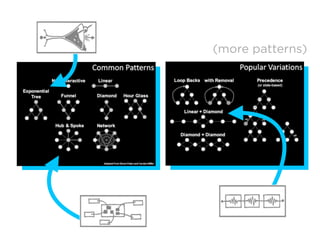
(more patterns)
THE
DESIGN
PRINCIPLES
Guide. Highlight. Interpret.

    VISUAL
               MESSAGING    INTERACTIVITY
  STRUCTURE
                   tell         engage
    support
                the story      the story
   the story
VISUAL
STRUCTURE
support the story
June 27, 2010


Choose your
visualization
type carefully.
Know your
options. Even
obscure ones.


“Cool” and “readability” are at odds.
Recognize the trade-off and
choose your audience.
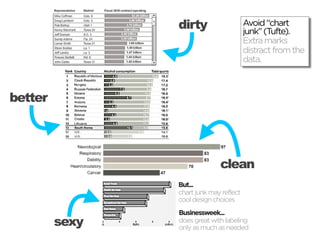
dirty                    Avoid “chart
                                         junk” (Tufte).
                                         Extra marks
                                         distract from the
                                         data.


better


                              clean
                But...
                chart junk may reflect
                cool design choices
                Businessweek...
         sexy   does great with labeling
                only as much as needed
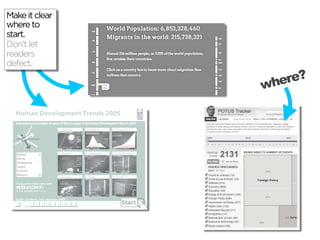
Make it clear
where to
start.
Don’t let
readers
defect.
                   re?
                whe
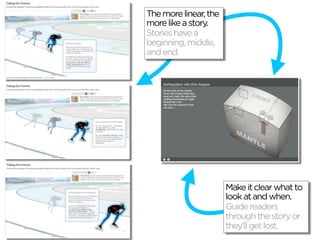
The more linear, the
more like a story.
Stories have a
beginning, middle,
and end.


                       Make it clear what to
                       look at and when.
                       Guide readers
                       through the story or
                       they’ll get lost.
Highlighting Techniques
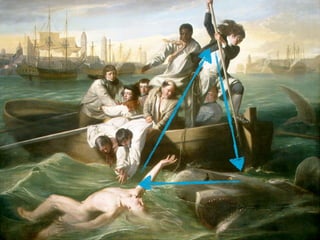
     Character Direction
      Feature Distinction
              Close-Ups
               Zooming
                Framing
                  Motion
                   Audio
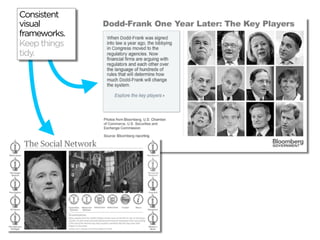
Consistent
visual
frameworks.
Keep things
tidy.
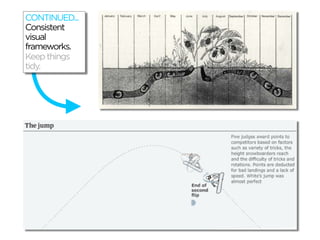
CONTINUED...
Consistent
visual
frameworks.
Keep things
tidy.
Use staging and
animation for
complicated transitions.
Stage big transitions to
avoid confusing readers


                       Transitions Guidance
                            Familiar Objects
                              Viewing Angle
                    Viewer (Camera) Motion
                          Continuity Editing
                          Object Continuity
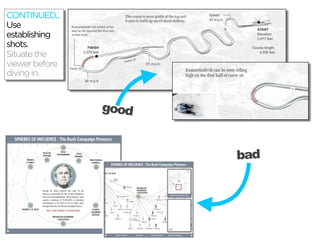
Use
establishing
shots.
Situate the
viewer
before
diving in.
CONTINUED...
Use
establishing
shots.
Situate the
viewer before
diving in.


                good


                       bad
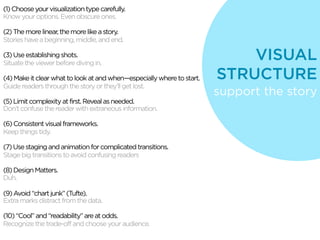
(1) Choose your visualization type carefully.
Know your options. Even obscure ones.

(2) The more linear, the more like a story.
Stories have a beginning, middle, and end.

(3) Use establishing shots.
Situate the viewer before diving in.
                                                                            VISUAL
(4) Make it clear what to look at and when—especially where to start.   STRUCTURE
Guide readers through the story or they’ll get lost.
                                                                        support the story
(5) Limit complexity at first. Reveal as needed.
Don’t confuse the reader with extraneous information.

(6) Consistent visual frameworks.
Keep things tidy.

(7) Use staging and animation for complicated transitions.
Stage big transitions to avoid confusing readers

(8) Design Matters.
Duh.

(9) Avoid “chart junk” (Tufte).
Extra marks distract from the data.

(10) “Cool” and “readability” are at odds.
Recognize the trade-off and choose your audience.
MESSAGING
 tells the story
headline                    Use headlines,
                  caption      captions, &
                             annotations.
                             Quickly draw
                              attention to
                                   what’s
                               important.


           tion
     annota

                                  ing)
                             (noth
Weave text into the graphic—not
                                 just at the beginning.
                                 T and graphics work better
                                  ext
                 solated
                                 together than apart.
                i

                                               integrat
                                                       ed


                  Aug 16, 2010


June 20, 2011
CONTINUED...
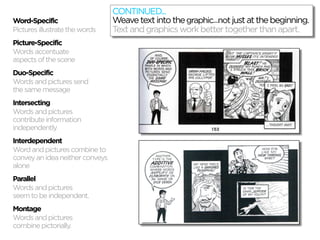
Word-Specific                    Weave text into the graphic—not just at the beginning.
Pictures illustrate the words    T and graphics work better together than apart.
                                  ext
Picture-Specific
Words accentuate
aspects of the scene
Duo-Specific
Words and pictures send
the same message
Intersecting
Words and pictures
contribute information
independently
Interdependent
Word and pictures combine to
convey an idea neither conveys
alone
Parallel
Words and pictures
seem to be independent.
Montage
Words and pictures
combine pictorially.
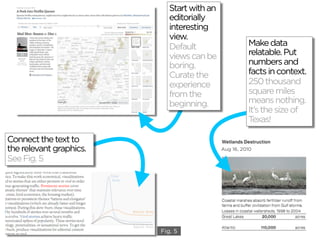
Start with an
                            editorially
                            interesting
                            view.
                            Default                   Make data
                            views can be              relatable. Put
                            boring.                   numbers and
                            Curate the                facts in context.
                            experience                250 thousand
                            from the                  square miles
                            beginning.                means nothing.
                                                      It’s the size of
                                                      T exas!

Connect the text to
the relevant graphics.                      Aug 16, 2010

See Fig. 5


                         Fig. 5
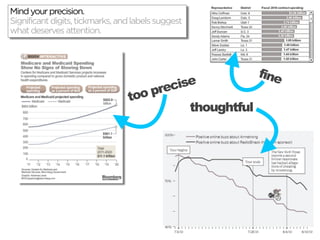
Mind your precision.
Significant digits, tickmarks, and labels suggest
what deserves attention.


                                                                   fine
                                     precise
                                 too
                                           thoughtful


                                                    Good: Lance Armstrong,
                                                    Popularity issue
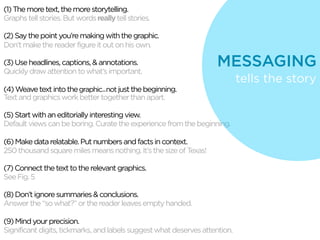
(1) The more text, the more storytelling.
Graphs tell stories. But words really tell stories.

(2) Say the point you’re making with the graphic.
Don’t make the reader figure it out on his own.

(3) Use headlines, captions, & annotations.
Quickly draw attention to what’s important.
                                                                    MESSAGING
                                                                             tells the story
(4) Weave text into the graphic—not just the beginning.
T and graphics work better together than apart.
 ext

(5) Start with an editorially interesting view.
Default views can be boring. Curate the experience from the beginning.

(6) Make data relatable. Put numbers and facts in context.
250 thousand square miles means nothing. It’s the size of Texas!

(7) Connect the text to the relevant graphics.
See Fig. 5

(8) Don’t ignore summaries & conclusions.
Answer the “so what?” or the reader leaves empty handed.

(9) Mind your precision.
Significant digits, tickmarks, and labels suggest what deserves attention.
INTERACTIVITY
 engage the story
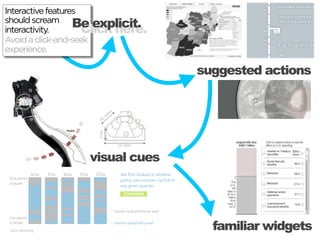
Interactive features
should scream Be explicit.
interactivity.       Click here.
Avoid a click-and-seek
experience.

                                   suggested actions


                   visual cues


                                     familiar widgets
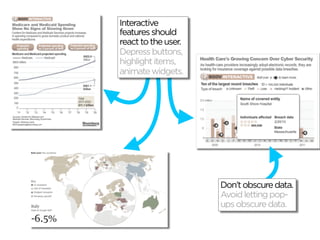
Interactive
features should
react to the user.
Depress buttons,
highlight items,
animate widgets.


                     Don’t obscure data.
                     Avoid letting pop-
                     ups obscure data.
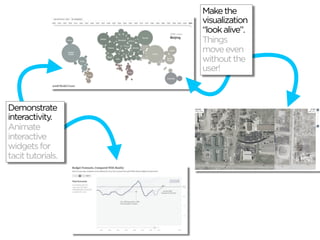
Make the
                   visualization
                   “look alive”.
                   Things
                   move even
                   without the
                   user!


Demonstrate
interactivity.
Animate
interactive
widgets for
tacit tutorials.
Include a
                   progress bar
                   and “back”
                   and “reset”
                   buttons
                   Linear
                   navigation is
                   important—
                   especially with
                   lots of
                   interactivity.

Restrict
interactivity to
key
dimensions.
The more
interactivity,
the less story.
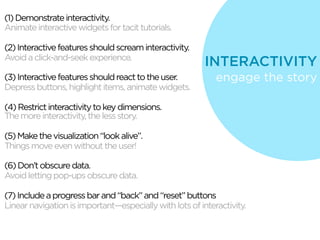
(1) Demonstrate interactivity.
Animate interactive widgets for tacit tutorials.

(2) Interactive features should scream interactivity.
Avoid a click-and-seek experience.
                                                         INTERACTIVITY
(3) Interactive features should react to the user.          engage the story
Depress buttons, highlight items, animate widgets.

(4) Restrict interactivity to key dimensions.
The more interactivity, the less story.

(5) Make the visualization “look alive”.
Things move even without the user!

(6) Don’t obscure data.
Avoid letting pop-ups obscure data.

(7) Include a progress bar and “back” and “reset” buttons
Linear navigation is important—especially with lots of interactivity.
Sound & Video   Mobile   Linking             Fluid


                               INTERACTIVE


THE
FUTURE
                                         ?
                                      Mixing
                                     DataVis &
                                   Infographics
DATA JOURNALISM IS NOT GRAPHICS AND
   VISUALISATIONS. IT'S ABOUT TELLING
  THE STORY IN THE BEST WAY POSSIBLE.
SOMETIMES THAT WILL BE A VISUALISATION
  OR A MAP...BUT SOMETIMES IT'S A NEWS
 STORY. SOMETIMES, JUST PUBLISHING THE
NUMBER IS ENOUGH. IF DATA JOURNALISM IS
 ABOUT ANYTHING, IT'S THE FLEXIBILITY TO
SEARCH FOR NEW WAYS OF STORYTELLING.

  SIMON ROGERS, THE GUARDIAN // 2011
New York Times
New York Times. The jobless rate for people like you.
http://www.nytimes.com/interactive/2009/11/06/business/economy/unemployment-lines.html

New York Times. How many households are like yours?                                                LINKS
http://www.nytimes.com/interactive/2011/06/19/nyregion/how-many-households-are-like-yours.html

New York Times. The Death of a Terrorist: a Turning Point?                                            1
http://www.nytimes.com/interactive/2011/05/03/us/20110503-osama-response.html

New York Times. Paths to the Top of the Home Run Charts.
http://www.nytimes.com/ref/sports/20070731_BONDS_GRAPHIC.html

New York Times. A Peek Into Netflix Queues.
http://www.nytimes.com/interactive/2010/01/10/nyregion/20100110-netflix-map.html

New York Times. A Map of Olympic Medals.
http://www.nytimes.com/interactive/2008/08/04/sports/olympics/20080804_MEDALCOUNT_MAP.html

New York Times. Aerial Photographs of Joplin Before and After the Tornado
http://www.nytimes.com/interactive/2011/05/25/us/joplin-aerial.html

New York TImes. How different groups spend their day.
http://www.nytimes.com/interactive/2009/07/31/business/20080801-metrics-graphic.html

New York Times. Taking the Corners.
http://www.nytimes.com/interactive/2010/02/20/sports/olympics/20100220-davis-graphic.html

New York Times. Alpine Skiing, From Technical Turns to Tucks and Speed
http://www.nytimes.com/interactive/2010/02/20/sports/olympics/downhill-overview.html

New York Times. Luge Crash at the Olympics.
http://www.nytimes.com/interactive/2010/02/12/sports/olympics/LUGEDEATH.html

New York Times. Budget forecasts compared to reality.
http://www.nytimes.com/interactive/2010/02/02/us/politics/20100201-budget-porcupine-graphic.html

New York Times. Fractions of a Second: An Olympic Musical.
http://www.nytimes.com/interactive/2010/02/26/sports/olympics/20100226-olysymphony.html

New York Times. How the Government Dealt with Past Recessions.
http://www.nytimes.com/interactive/2009/01/26/business/economy/20090126-recessions-graphic.html
The Guardian
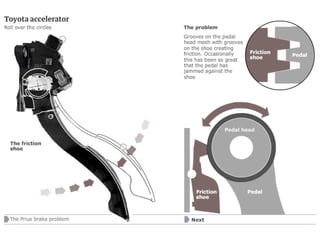
Guardian. Toyota's sticky accelerator problem.
http://www.guardian.co.uk/business/interactive/2010/feb/04/toyota-automotive-industry

Guardian. Shaun White's Double McTwist.
                                                                                                               LINKS
http://www.guardian.co.uk/sport/interactive/2010/feb/19/winterolympics2010-vancouver

Guardian. Earthquakes: Why they happen.
                                                                                                                 2
http://www.guardian.co.uk/world/interactive/2008/jan/23/earthquakes

Guardian. Oscars 2011: an interactive guide to this year's best picture nominees
http://www.guardian.co.uk/film/interactive/2011/feb/21/oscars-2011-best-picture-nominations-interactive-guide

Guardian. Inflation in the UK.
http://www.guardian.co.uk/business/interactive/2009/mar/24/rpi-inflation?intcmp=239

Guardian. The World’s Economy Turns the Corner.
http://www.guardian.co.uk/business/interactive/2010/jan/26/recession-gdp


Miscellaneous
Aaron Koblin. Personal website with work.
http://www.aaronkoblin.com/work.html

Jeff Heer. Seneus.
http://vis.stanford.edu/papers/senseus

Stamen. MTV Video Music Awards.
http://stamen.com/clients/mtv

Simon Rogers. Data journalism at the Guardian: what is it and how do we do it?
http://www.guardian.co.uk/news/datablog/2011/jul/28/data-journalism

GapMinder
http://www.gapminder.org

Gapminder. Human Development Trends 2005.
http://www.gapminder.org/downloads/human-development-trends-2005/

People Movin
http://peoplemov.in/

Visual Complexity. Football Drawings.
http://www.visualcomplexity.com/vc/project_details.cfm?id=452&index=452&domain

Dan Archer. Nisoor square shootings of 2007
http://www.cartoonmovement.com/icomic/11
BGOV
BGOV. Federal Programs on Debt-Limit Bubble
http://about.bgov.com/2011/07/12/august-invoices-show-u-s-treasury%E2%80%99s-limited-choices/

BGOV. Hospitals Wary of Data Breaches Seek Cyber Insurance From AIG                                                   LINKS
http://www.bgov.com/news_item/4D53U6teO2rko9nUq8XDoQ

BGOV. Medicare-Medicaid Costs $1.5 Trillion by 2020: Chart of the Day.                                                  3
http://www.bgov.com/news_item/XwqMzluxD58Dh0n6lvp8WA

BGOV. Kentucky Bourbon’s Seoul Appeal May Rise With Trade Agreement.
http://www.bgov.com/news_item/PtRA9_pVGxAHjVVsjZev_g

BGOV. Preparing Americans for Death Lets Hospices Neglect End of Life.
http://www.bgov.com/news_item/On7zzjnP-22zIl6mQUeigw

BGOV. Tea Party Debt Deal Opponents Gain From U.S. Awards.
http://www.bgov.com/news_item/JcPzqhvW8bn8LuuhhO8KNA

BGOV. August Invoices show Treasury’s Limited Choices.
http://about.bgov.com/2011/07/12/august-invoices-show-u-s-treasury%E2%80%99s-limited-choices/

BGOV. Dodd-Frank One Year Later: The Key Players
http://www.bgov.com/news_item/WMrg8I6JoxhifG-KDDpytg


Businessweek
Businessweek. The Credit Boom’s Best and Worst Deals.
http://images.businessweek.com/mz/10/34/1034mergers47.pdf?chan=magazine+channel_news+-+markets+%2B+finance

Businessweek. Amid doping furer, Lance Armstrong’s reputation heads downhill.
http://images.businessweek.com/mz/10/34/1034endorsments22.pdf?chan=magazine+channel_news+-+companies+%2B+industries

Bloomberg Interactive Insights. America tied up by debt record.
http://www.bloomberg.com/insight/america-tied-up-by-record-debt.html

Businessweek. How to save Greece.
http://www.businessweek.com/magazine/content/11_27/b4235000567802.htm

Businessweek. The Big Apple is Recovering its Shine.
http://images.businessweek.com/mz/10/34/1034therecovery11.pdf?chan=magazine+channel_news+-+global+economics

Businessweek. Problem? What Problem?
http://www.businessweek.com/magazine/content/11_26/b4234013596135.htm

Businessweek. Oil on Troubled Waters.
http://images.businessweek.com/mz/10/34/1034oilbp53.pdf
The Washington Post
Washington Post. Obama’s Calendar.
http://projects.washingtonpost.com/potus-tracker/

Washington Post. Spheres of Influence: The Bush Campaign Pioneers.
                                                                                     LINKS
http://www.washingtonpost.com/wp-srv/politics/pioneers/pioneers_spheres.html

Washington Post. On the Map: On the Map: Five Major North Korean Prison Camps
                                                                                       4
http://www.washingtonpost.com/wp-srv/special/world/north-korean-prison-camps-2009/

Edward segel interactive_storytelling

  • 1.
  • 2.
  • 3.
    ANALYSIS PERSONALIZATION you SOCIAL STORYTELLING
  • 4.
    ANALYSIS PERSONALIZATION Businessweek Ask. Explore. Find. Top 100 M&A Deals Too much info at once. you BGOV Scenario testing. Federal Spending SOCIAL STORYTELLING
  • 5.
    NYTimes INFORMATIVE ANALYSIS Jobless Rate PERSONALIZATION for People Like You Make relevant. NYTimes Households Increase engagement. like Yours Make emotional. Aaron Koblin Arcade Fire’s Wilderness Downtown SOCIAL STORYTELLING
  • 6.
    INFORMATIVE ANALYSIS PERSONALIZATION you Jeff Heer SOCIAL STORYTELLING Sensus Aaron Koblin Sharing. Sheep, Cash, Bicycle Collaborative. Real-Time sentiment. Stamen Design NYTimes MTV VMA Twitter Reactions to Osama
  • 7.
    ANALYSIS PERSONALIZATION you SOCIAL STORYTELLING
  • 8.
    INFORMATIVE ANALYSIS PERSONALIZATION you SOCIAL STORYTELLING
  • 9.
  • 10.
  • 11.
    STORYTELLING Changes with technology PEOPLETELL STORIES WORDS TELL STORIES IMAGES TELL STORIES COMICS TELL STORIES MOVIES TELL STORIES
  • 12.
    HOW CAN YOUTELL STORIES WITH DATA ?
  • 13.
    VISUALIZATION DESIGNERS ARE MELDING THE SKILLS OF COMPUTER SCIENCE, STATISTICS, ARTISTIC DESIGN AND STORYTELLING. THE ECONOMIST // FEB 2010
  • 14.
    PEOPLE HAVE BEGUNTO FORGET HOW POWERFUL HUMAN STORIES ARE, EXCHANGING THEIR SENSE OF EMPATHY FOR A FETISHISTIC FASCINATION WITH DATA... THE HUMAN STUFF IS THE MAIN STUFF, AND THE DATA SHOULD ENRICH IT. JONATHAN HARRIS // 2008
  • 15.
    small support ght rthou afte boring
  • 16.
    exciting! beautiful! BUT technical! [ what does it mean?
  • 17.
    center st age standalone interactive guided
  • 18.
  • 19.
    VISUAL STRUCTURE MAGAZINE ANNOTATED SCIENCE FAIR STYLE CHART POSTER FLOWCHART COMICSTRIP SLIDESHOW MOVIE Duo- Tacit Selection Captions Specific Tutorial Details on Attached Navigation Demand Annotations Article Timelines Filtering Summaries Interpret Headlines Highlighting INTERACTIVITY MESSAGING O RE M
  • 20.
    Genres + Interactivity+ Messaging = DESIGN SPACE STORYTELLING Author Driven Reader Driven ASK QUESTIONS CLARITY strong ordering weak ordering EXPLORE SPEED heavy messaging light messaging FIND limited interactivity free interactivity martini drill-down glass story interactive slideshow
  • 21.
  • 22.
  • 23.
    Guide. Highlight. Interpret. VISUAL MESSAGING INTERACTIVITY STRUCTURE tell engage support the story the story the story
  • 24.
  • 25.
    June 27, 2010 Chooseyour visualization type carefully. Know your options. Even obscure ones. “Cool” and “readability” are at odds. Recognize the trade-off and choose your audience.
  • 26.
    dirty Avoid “chart junk” (Tufte). Extra marks distract from the data. better clean But... chart junk may reflect cool design choices Businessweek... sexy does great with labeling only as much as needed
  • 27.
    Make it clear whereto start. Don’t let readers defect. re? whe
  • 28.
    The more linear,the more like a story. Stories have a beginning, middle, and end. Make it clear what to look at and when. Guide readers through the story or they’ll get lost.
  • 29.
    Highlighting Techniques Character Direction Feature Distinction Close-Ups Zooming Framing Motion Audio
  • 34.
  • 35.
  • 36.
    Use staging and animationfor complicated transitions. Stage big transitions to avoid confusing readers Transitions Guidance Familiar Objects Viewing Angle Viewer (Camera) Motion Continuity Editing Object Continuity
  • 37.
  • 38.
  • 39.
    (1) Choose yourvisualization type carefully. Know your options. Even obscure ones. (2) The more linear, the more like a story. Stories have a beginning, middle, and end. (3) Use establishing shots. Situate the viewer before diving in. VISUAL (4) Make it clear what to look at and when—especially where to start. STRUCTURE Guide readers through the story or they’ll get lost. support the story (5) Limit complexity at first. Reveal as needed. Don’t confuse the reader with extraneous information. (6) Consistent visual frameworks. Keep things tidy. (7) Use staging and animation for complicated transitions. Stage big transitions to avoid confusing readers (8) Design Matters. Duh. (9) Avoid “chart junk” (Tufte). Extra marks distract from the data. (10) “Cool” and “readability” are at odds. Recognize the trade-off and choose your audience.
  • 40.
  • 41.
    headline Use headlines, caption captions, & annotations. Quickly draw attention to what’s important. tion annota ing) (noth
  • 42.
    Weave text intothe graphic—not just at the beginning. T and graphics work better ext solated together than apart. i integrat ed Aug 16, 2010 June 20, 2011
  • 43.
    CONTINUED... Word-Specific Weave text into the graphic—not just at the beginning. Pictures illustrate the words T and graphics work better together than apart. ext Picture-Specific Words accentuate aspects of the scene Duo-Specific Words and pictures send the same message Intersecting Words and pictures contribute information independently Interdependent Word and pictures combine to convey an idea neither conveys alone Parallel Words and pictures seem to be independent. Montage Words and pictures combine pictorially.
  • 44.
    Start with an editorially interesting view. Default Make data views can be relatable. Put boring. numbers and Curate the facts in context. experience 250 thousand from the square miles beginning. means nothing. It’s the size of T exas! Connect the text to the relevant graphics. Aug 16, 2010 See Fig. 5 Fig. 5
  • 45.
    Mind your precision. Significantdigits, tickmarks, and labels suggest what deserves attention. fine precise too thoughtful Good: Lance Armstrong, Popularity issue
  • 46.
    (1) The moretext, the more storytelling. Graphs tell stories. But words really tell stories. (2) Say the point you’re making with the graphic. Don’t make the reader figure it out on his own. (3) Use headlines, captions, & annotations. Quickly draw attention to what’s important. MESSAGING tells the story (4) Weave text into the graphic—not just the beginning. T and graphics work better together than apart. ext (5) Start with an editorially interesting view. Default views can be boring. Curate the experience from the beginning. (6) Make data relatable. Put numbers and facts in context. 250 thousand square miles means nothing. It’s the size of Texas! (7) Connect the text to the relevant graphics. See Fig. 5 (8) Don’t ignore summaries & conclusions. Answer the “so what?” or the reader leaves empty handed. (9) Mind your precision. Significant digits, tickmarks, and labels suggest what deserves attention.
  • 47.
  • 48.
    Interactive features should screamBe explicit. interactivity. Click here. Avoid a click-and-seek experience. suggested actions visual cues familiar widgets
  • 49.
    Interactive features should react tothe user. Depress buttons, highlight items, animate widgets. Don’t obscure data. Avoid letting pop- ups obscure data.
  • 50.
    Make the visualization “look alive”. Things move even without the user! Demonstrate interactivity. Animate interactive widgets for tacit tutorials.
  • 51.
    Include a progress bar and “back” and “reset” buttons Linear navigation is important— especially with lots of interactivity. Restrict interactivity to key dimensions. The more interactivity, the less story.
  • 52.
    (1) Demonstrate interactivity. Animateinteractive widgets for tacit tutorials. (2) Interactive features should scream interactivity. Avoid a click-and-seek experience. INTERACTIVITY (3) Interactive features should react to the user. engage the story Depress buttons, highlight items, animate widgets. (4) Restrict interactivity to key dimensions. The more interactivity, the less story. (5) Make the visualization “look alive”. Things move even without the user! (6) Don’t obscure data. Avoid letting pop-ups obscure data. (7) Include a progress bar and “back” and “reset” buttons Linear navigation is important—especially with lots of interactivity.
  • 53.
    Sound & Video Mobile Linking Fluid INTERACTIVE THE FUTURE ? Mixing DataVis & Infographics
  • 54.
    DATA JOURNALISM ISNOT GRAPHICS AND VISUALISATIONS. IT'S ABOUT TELLING THE STORY IN THE BEST WAY POSSIBLE. SOMETIMES THAT WILL BE A VISUALISATION OR A MAP...BUT SOMETIMES IT'S A NEWS STORY. SOMETIMES, JUST PUBLISHING THE NUMBER IS ENOUGH. IF DATA JOURNALISM IS ABOUT ANYTHING, IT'S THE FLEXIBILITY TO SEARCH FOR NEW WAYS OF STORYTELLING. SIMON ROGERS, THE GUARDIAN // 2011
  • 55.
    New York Times NewYork Times. The jobless rate for people like you. http://www.nytimes.com/interactive/2009/11/06/business/economy/unemployment-lines.html New York Times. How many households are like yours? LINKS http://www.nytimes.com/interactive/2011/06/19/nyregion/how-many-households-are-like-yours.html New York Times. The Death of a Terrorist: a Turning Point? 1 http://www.nytimes.com/interactive/2011/05/03/us/20110503-osama-response.html New York Times. Paths to the Top of the Home Run Charts. http://www.nytimes.com/ref/sports/20070731_BONDS_GRAPHIC.html New York Times. A Peek Into Netflix Queues. http://www.nytimes.com/interactive/2010/01/10/nyregion/20100110-netflix-map.html New York Times. A Map of Olympic Medals. http://www.nytimes.com/interactive/2008/08/04/sports/olympics/20080804_MEDALCOUNT_MAP.html New York Times. Aerial Photographs of Joplin Before and After the Tornado http://www.nytimes.com/interactive/2011/05/25/us/joplin-aerial.html New York TImes. How different groups spend their day. http://www.nytimes.com/interactive/2009/07/31/business/20080801-metrics-graphic.html New York Times. Taking the Corners. http://www.nytimes.com/interactive/2010/02/20/sports/olympics/20100220-davis-graphic.html New York Times. Alpine Skiing, From Technical Turns to Tucks and Speed http://www.nytimes.com/interactive/2010/02/20/sports/olympics/downhill-overview.html New York Times. Luge Crash at the Olympics. http://www.nytimes.com/interactive/2010/02/12/sports/olympics/LUGEDEATH.html New York Times. Budget forecasts compared to reality. http://www.nytimes.com/interactive/2010/02/02/us/politics/20100201-budget-porcupine-graphic.html New York Times. Fractions of a Second: An Olympic Musical. http://www.nytimes.com/interactive/2010/02/26/sports/olympics/20100226-olysymphony.html New York Times. How the Government Dealt with Past Recessions. http://www.nytimes.com/interactive/2009/01/26/business/economy/20090126-recessions-graphic.html
  • 56.
    The Guardian Guardian. Toyota'ssticky accelerator problem. http://www.guardian.co.uk/business/interactive/2010/feb/04/toyota-automotive-industry Guardian. Shaun White's Double McTwist. LINKS http://www.guardian.co.uk/sport/interactive/2010/feb/19/winterolympics2010-vancouver Guardian. Earthquakes: Why they happen. 2 http://www.guardian.co.uk/world/interactive/2008/jan/23/earthquakes Guardian. Oscars 2011: an interactive guide to this year's best picture nominees http://www.guardian.co.uk/film/interactive/2011/feb/21/oscars-2011-best-picture-nominations-interactive-guide Guardian. Inflation in the UK. http://www.guardian.co.uk/business/interactive/2009/mar/24/rpi-inflation?intcmp=239 Guardian. The World’s Economy Turns the Corner. http://www.guardian.co.uk/business/interactive/2010/jan/26/recession-gdp Miscellaneous Aaron Koblin. Personal website with work. http://www.aaronkoblin.com/work.html Jeff Heer. Seneus. http://vis.stanford.edu/papers/senseus Stamen. MTV Video Music Awards. http://stamen.com/clients/mtv Simon Rogers. Data journalism at the Guardian: what is it and how do we do it? http://www.guardian.co.uk/news/datablog/2011/jul/28/data-journalism GapMinder http://www.gapminder.org Gapminder. Human Development Trends 2005. http://www.gapminder.org/downloads/human-development-trends-2005/ People Movin http://peoplemov.in/ Visual Complexity. Football Drawings. http://www.visualcomplexity.com/vc/project_details.cfm?id=452&index=452&domain Dan Archer. Nisoor square shootings of 2007 http://www.cartoonmovement.com/icomic/11
  • 57.
    BGOV BGOV. Federal Programson Debt-Limit Bubble http://about.bgov.com/2011/07/12/august-invoices-show-u-s-treasury%E2%80%99s-limited-choices/ BGOV. Hospitals Wary of Data Breaches Seek Cyber Insurance From AIG LINKS http://www.bgov.com/news_item/4D53U6teO2rko9nUq8XDoQ BGOV. Medicare-Medicaid Costs $1.5 Trillion by 2020: Chart of the Day. 3 http://www.bgov.com/news_item/XwqMzluxD58Dh0n6lvp8WA BGOV. Kentucky Bourbon’s Seoul Appeal May Rise With Trade Agreement. http://www.bgov.com/news_item/PtRA9_pVGxAHjVVsjZev_g BGOV. Preparing Americans for Death Lets Hospices Neglect End of Life. http://www.bgov.com/news_item/On7zzjnP-22zIl6mQUeigw BGOV. Tea Party Debt Deal Opponents Gain From U.S. Awards. http://www.bgov.com/news_item/JcPzqhvW8bn8LuuhhO8KNA BGOV. August Invoices show Treasury’s Limited Choices. http://about.bgov.com/2011/07/12/august-invoices-show-u-s-treasury%E2%80%99s-limited-choices/ BGOV. Dodd-Frank One Year Later: The Key Players http://www.bgov.com/news_item/WMrg8I6JoxhifG-KDDpytg Businessweek Businessweek. The Credit Boom’s Best and Worst Deals. http://images.businessweek.com/mz/10/34/1034mergers47.pdf?chan=magazine+channel_news+-+markets+%2B+finance Businessweek. Amid doping furer, Lance Armstrong’s reputation heads downhill. http://images.businessweek.com/mz/10/34/1034endorsments22.pdf?chan=magazine+channel_news+-+companies+%2B+industries Bloomberg Interactive Insights. America tied up by debt record. http://www.bloomberg.com/insight/america-tied-up-by-record-debt.html Businessweek. How to save Greece. http://www.businessweek.com/magazine/content/11_27/b4235000567802.htm Businessweek. The Big Apple is Recovering its Shine. http://images.businessweek.com/mz/10/34/1034therecovery11.pdf?chan=magazine+channel_news+-+global+economics Businessweek. Problem? What Problem? http://www.businessweek.com/magazine/content/11_26/b4234013596135.htm Businessweek. Oil on Troubled Waters. http://images.businessweek.com/mz/10/34/1034oilbp53.pdf
  • 58.
    The Washington Post WashingtonPost. Obama’s Calendar. http://projects.washingtonpost.com/potus-tracker/ Washington Post. Spheres of Influence: The Bush Campaign Pioneers. LINKS http://www.washingtonpost.com/wp-srv/politics/pioneers/pioneers_spheres.html Washington Post. On the Map: On the Map: Five Major North Korean Prison Camps 4 http://www.washingtonpost.com/wp-srv/special/world/north-korean-prison-camps-2009/