
INTENT & IMPACT
        Thoughts on Persuasion in Visualization


        presented by Interactive Things                                              1

I dubbed it impact and intent and it will be more an collection of thoughts and questions for
you to reflect on, discuss, seek answers than a complete theory.
Explore                       →   Ideate   →   Create       →     Publish


        presented by Interactive Things                                              2

One thing that strikes me is the amount of talk around the visual and functional qualities of
visualizations or the process of creating them, but I feel a lack of discussion around the
underlying motivation and the resulting outcome.

I think that visualization should be seen as a means to an end and not an end in it's own
right. Thus, this talk is focused on the things that happen before the exploration phase and
after the publication.
Talk - Action = Shit


        presented by Interactive Things                          3

The underlying thought is…
I am totally stealing this from Brendan Dawes.
INTENT & IMPACT
Have a clear understanding
why you do what you do.


presented by Interactive Things   4
01
                     Set your aim
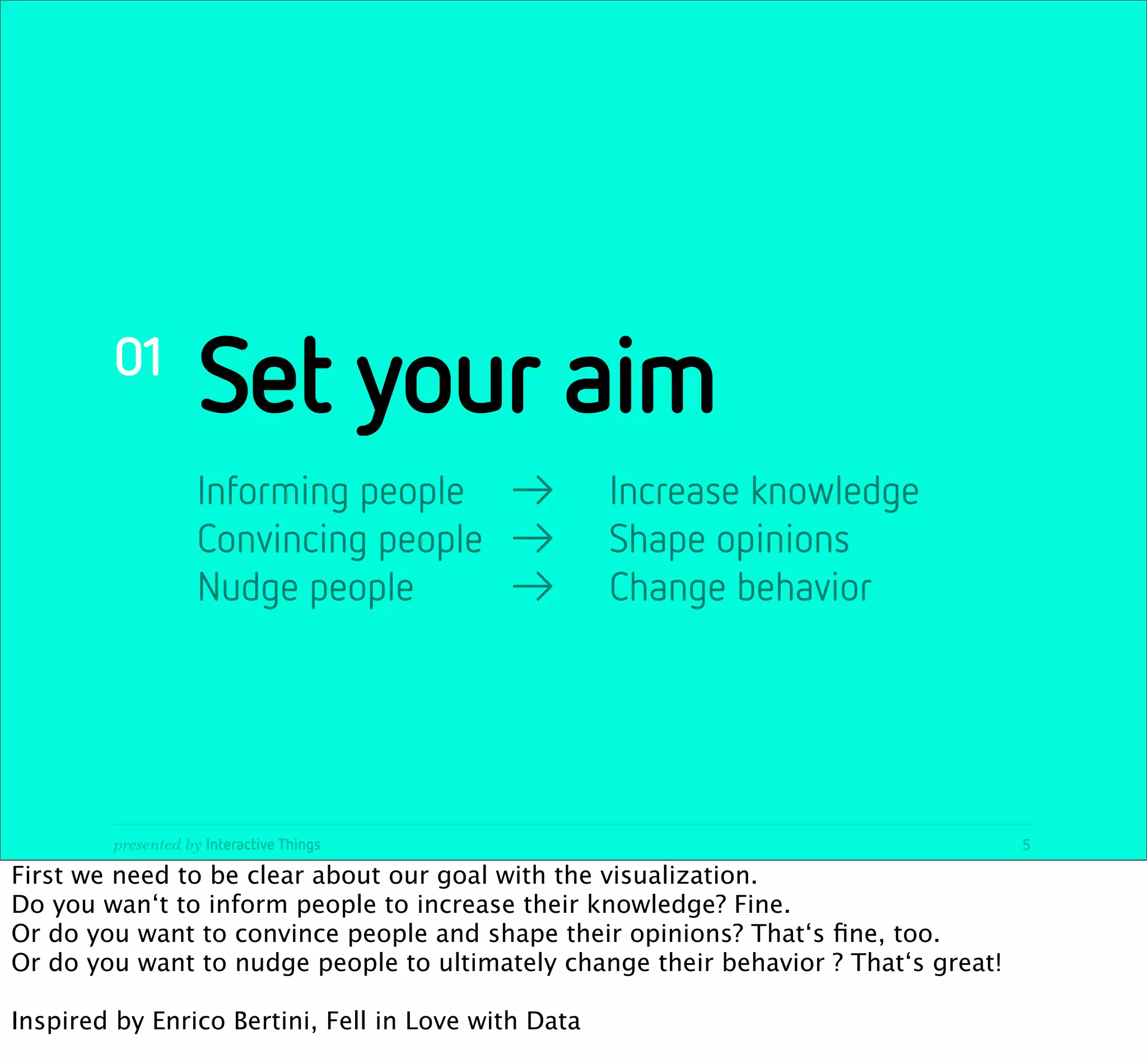
                     Informing people
 →
 Increase knowledge
                     Convincing people
 →
 Shape opinions
                     Nudge people
 
 →
 Change behavior


         presented by Interactive Things                                             5

First we need to be clear about our goal with the visualization.
Do you wan‘t to inform people to increase their knowledge? Fine.
Or do you want to convince people and shape their opinions? That‘s fine, too.
Or do you want to nudge people to ultimately change their behavior ? That‘s great!

Inspired by Enrico Bertini, Fell in Love with Data
Increasing Knowledge


       presented by Interactive Things              6

How do humans learn and increase their knowledge?
Sarah Slobin


 „               Something new, relevant, different,
                 informative and even entertaining
                 is a good place to start.
                                                                                          “


                                                                                      7

If you plan to inform and delight readers then something new, relevant, different, informative
and even entertaining is a good place to start.

Sarah Slobin, Visual Journalist for the Wall Street Journal, previously at NYT, Fortune, CNN
Money.
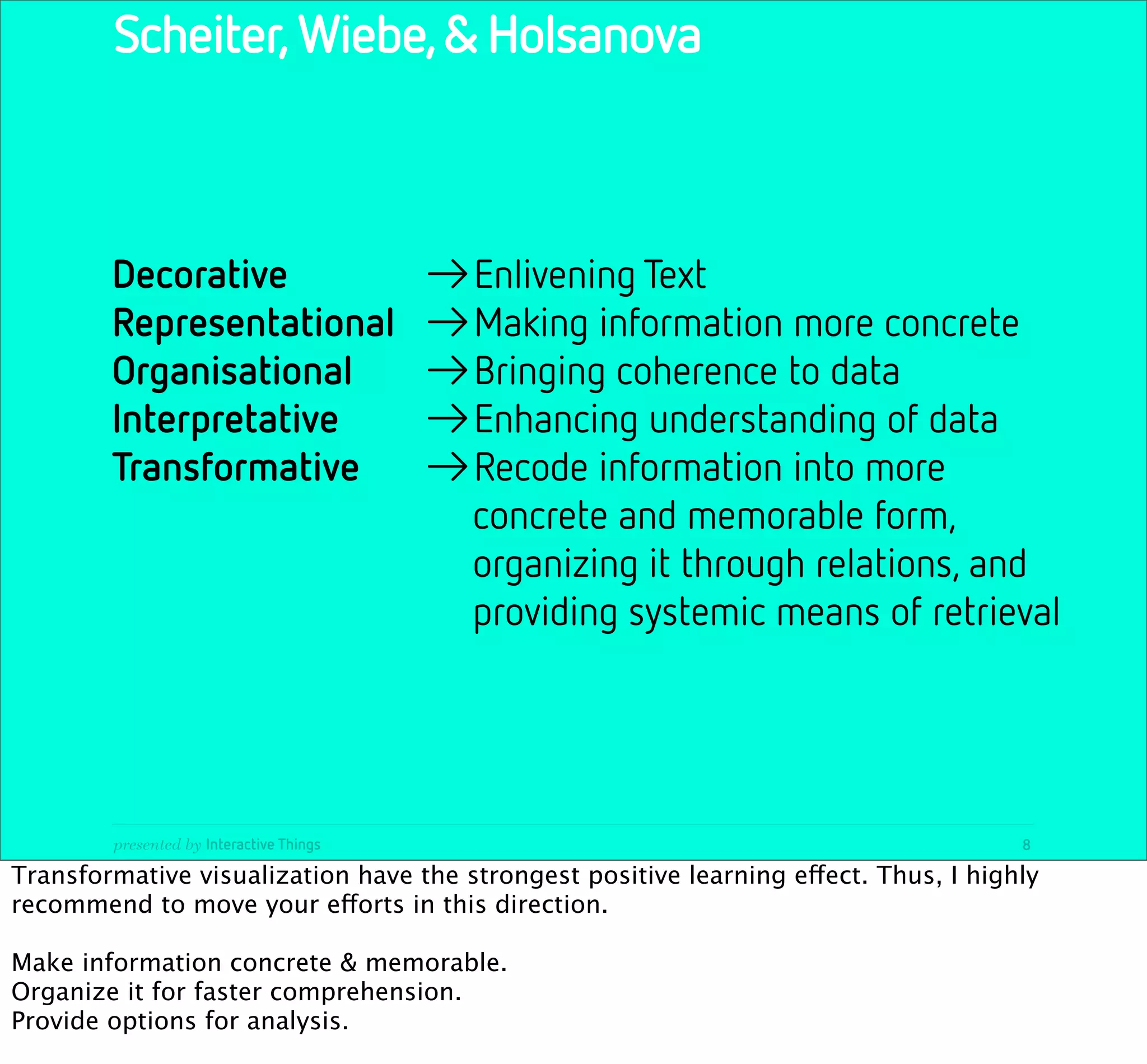
Scheiter, Wiebe, & Holsanova


        Decorative 
 
 
                  →Enlivening Text
        Representational
                 →Making information more concrete
        Organisational
 
                 →Bringing coherence to data
        Interpretative
 
                 →Enhancing understanding of data
        Transformative

                  →Recode information into more
                                           concrete and memorable form,
                                           organizing it through relations, and
                                           providing systemic means of retrieval


        presented by Interactive Things                                               8

Transformative visualization have the strongest positive learning effect. Thus, I highly
recommend to move your efforts in this direction.

Make information concrete & memorable.
Organize it for faster comprehension.
Provide options for analysis.
Shaping Opinions


        presented by Interactive Things              9

How do humans build up their opinions and beliefs?
Aristoteles


 „              In an ideal society opinions are the
                end result of informed discussions,
                readings, & listenings.
                                                                               “


                                                                              10

That‘s quite a romantic view on us as humans, but we know it better, right?
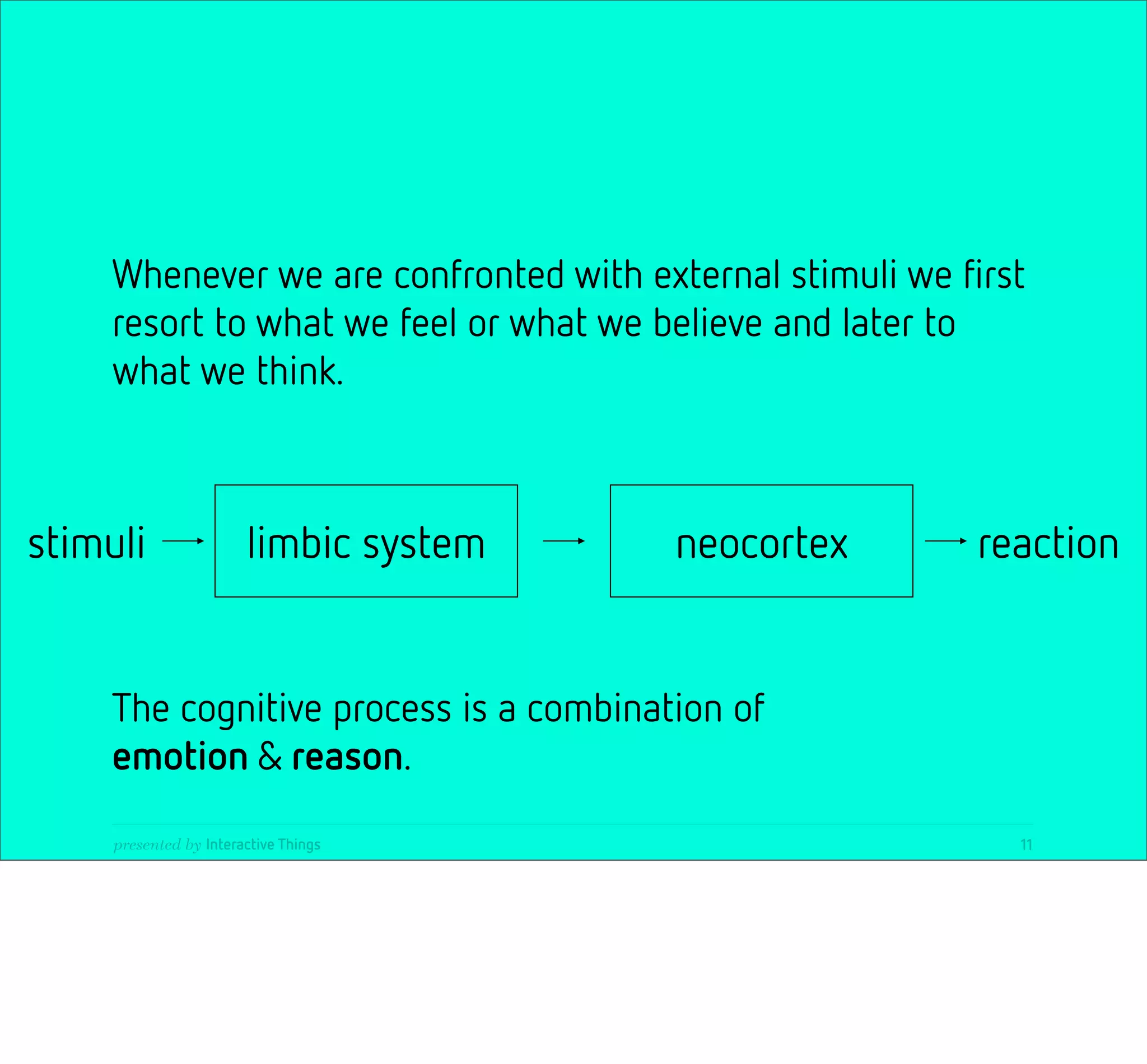
Whenever we are confronted with external stimuli we first
    resort to what we feel or what we believe and later to
    what we think.


stimuli                 limbic system   neocortex        reaction


    The cognitive process is a combination of
    emotion & reason.
     presented by Interactive Things                       11
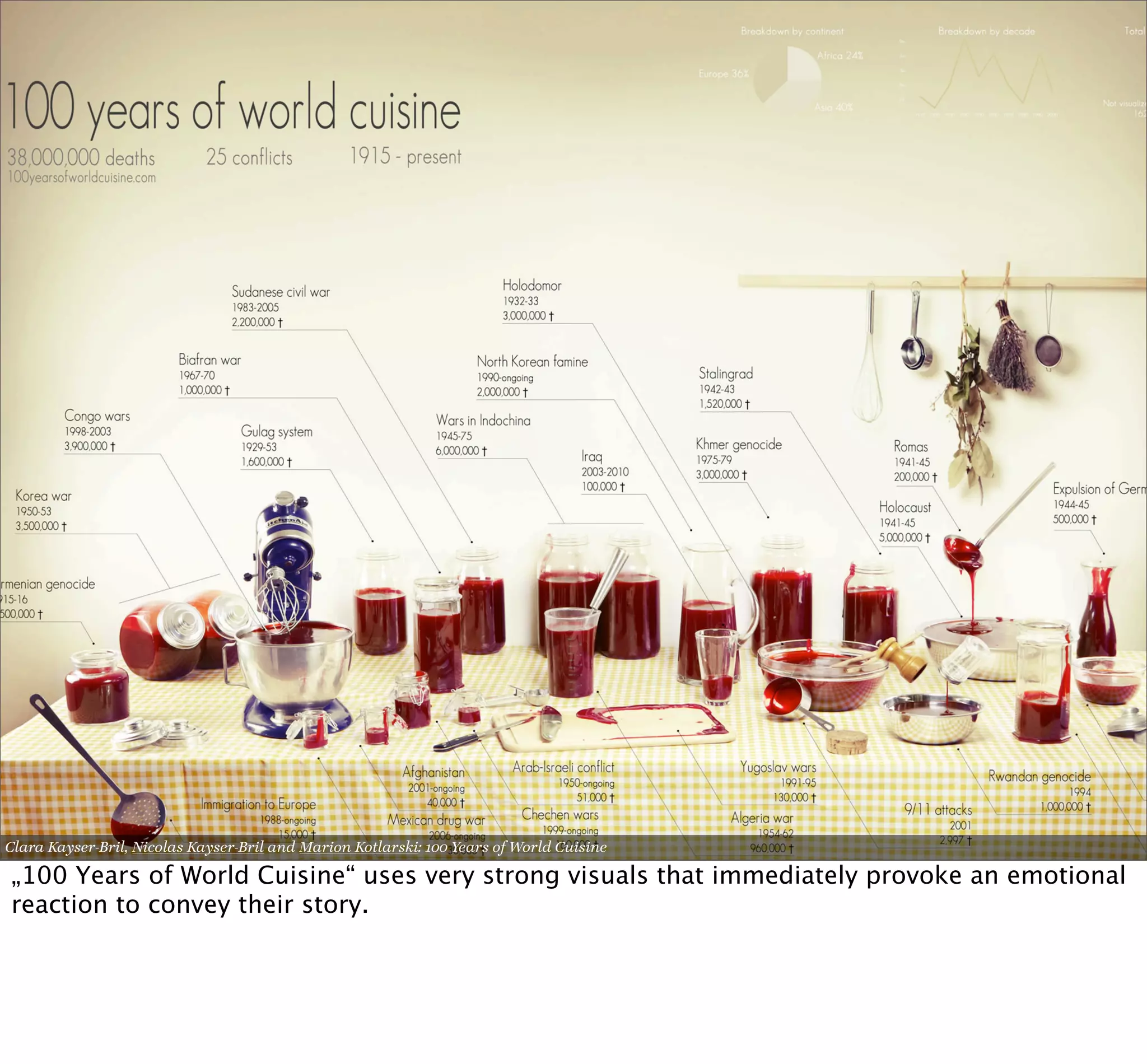
Clara Kayser-Bril, Nicolas Kayser-Bril and Marion Kotlarski: 100 Years of World Cuisine

„100 Years of World Cuisine“ uses very strong visuals that immediately provoke an emotional
reaction to convey their story.
Changing Behavior


        presented by Interactive Things                  13

What is necessary for humans to change their behavior?
Behavior Model
        According to B. J. Fogg is people's behavior a result of the
        convergence of three elements:

        Motivation, Ability, & Trigger


        presented by Interactive Things                                                14

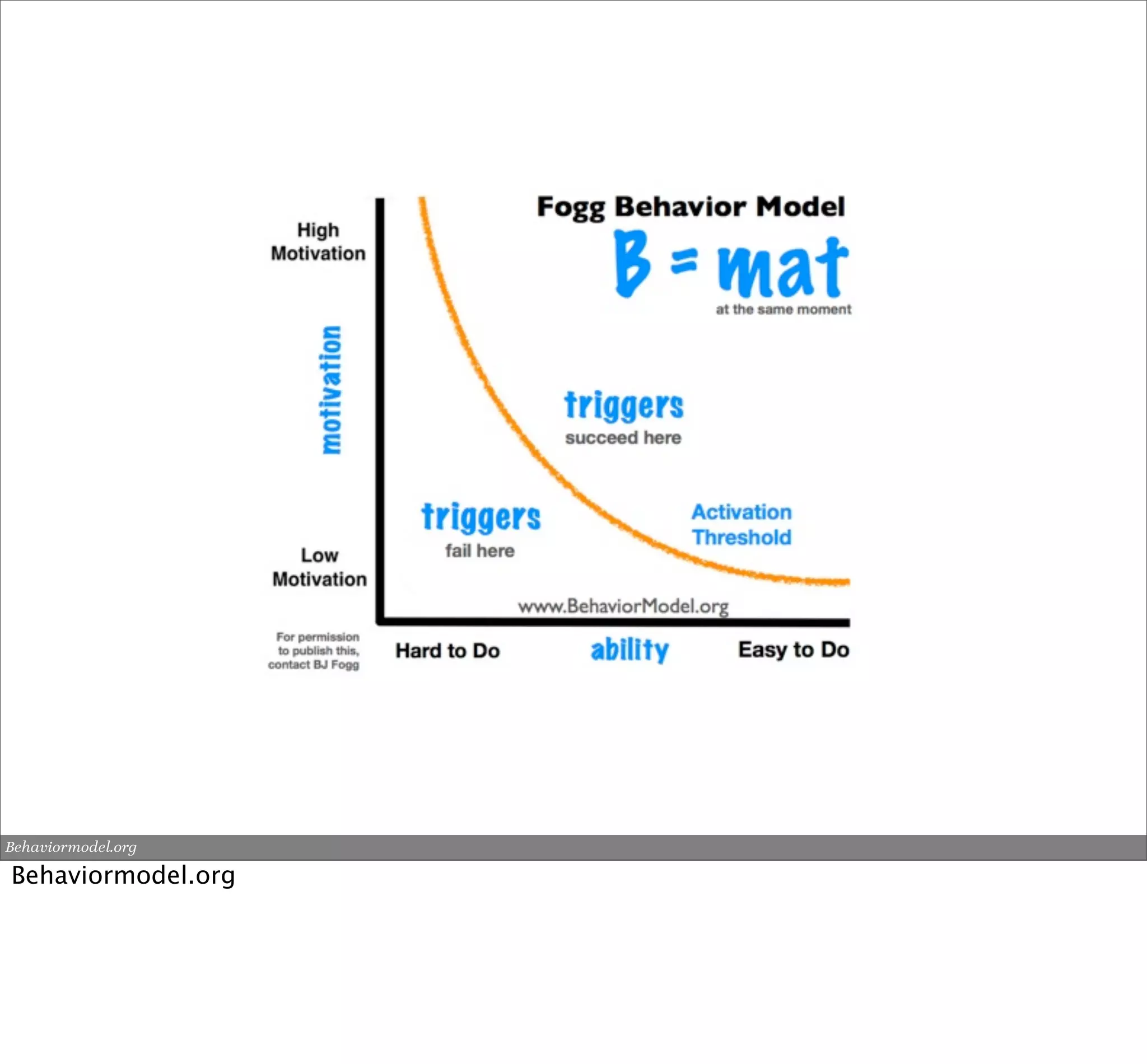
To do a certain task or even to change behavior someone must be motivated for that.
Furthermore, the users ability or the tasks simplicity either should be as easy as possible or it
should be perceived easy to do. Finally, the user must be triggered for action.
As designers and developers we need to make it simple for them to use. Thus, the ability
should be a problem.
So how can we motivate people?
And how can we include triggers for action at the right time?
Behaviormodel.org

Behaviormodel.org
Gamification
        Using game mechanics in non-gaming contexts to
        improve user engangement or even change user behavior.

        You know, stuff like rewards, leaderboards, competitions.


        presented by Interactive Things                                            16

There are many services that are sucessfully using game mechanics to increase user
engagement. So, it looks like a promising method that could be applied to visualization as
well.
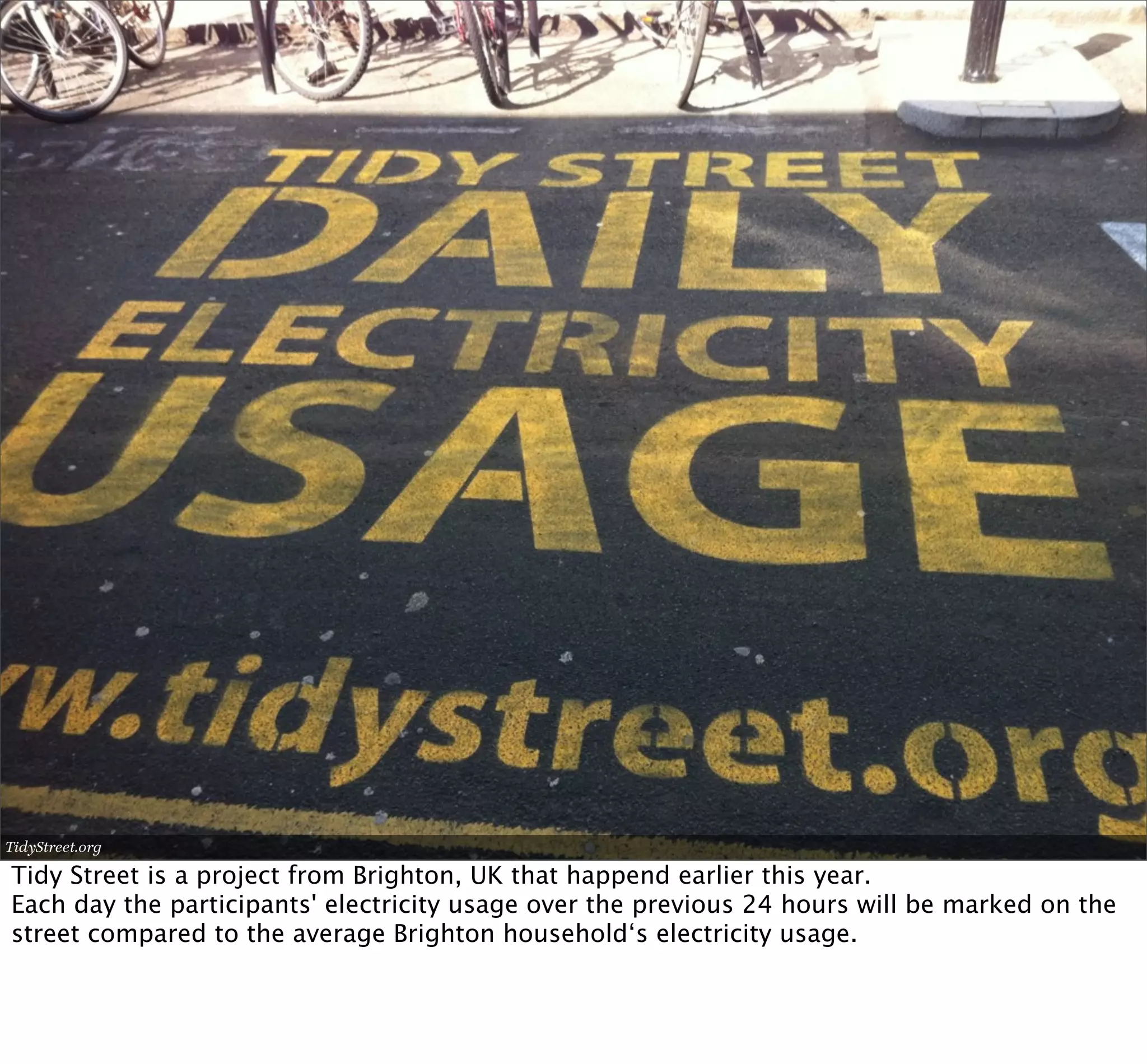
TidyStreet.org

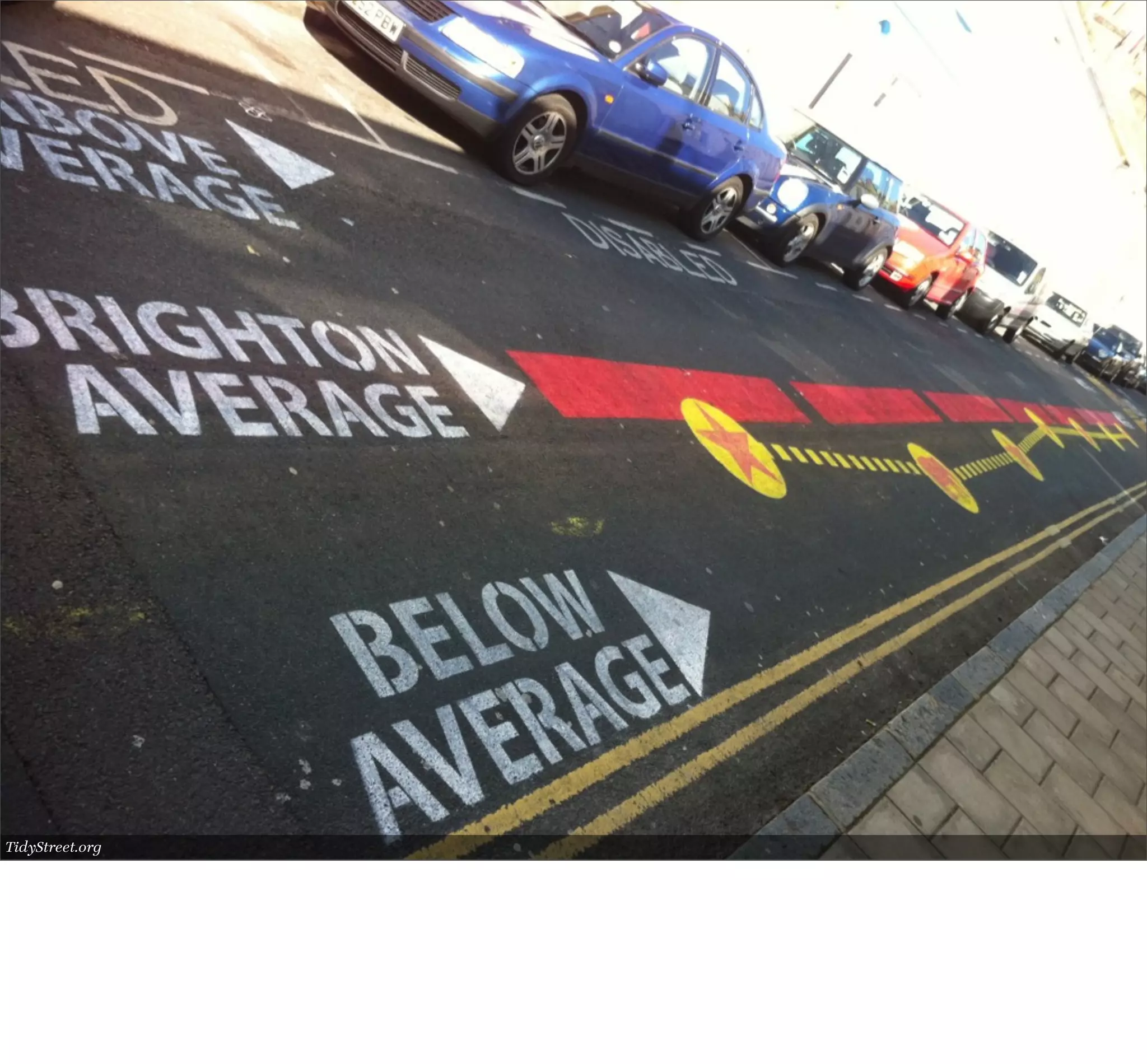
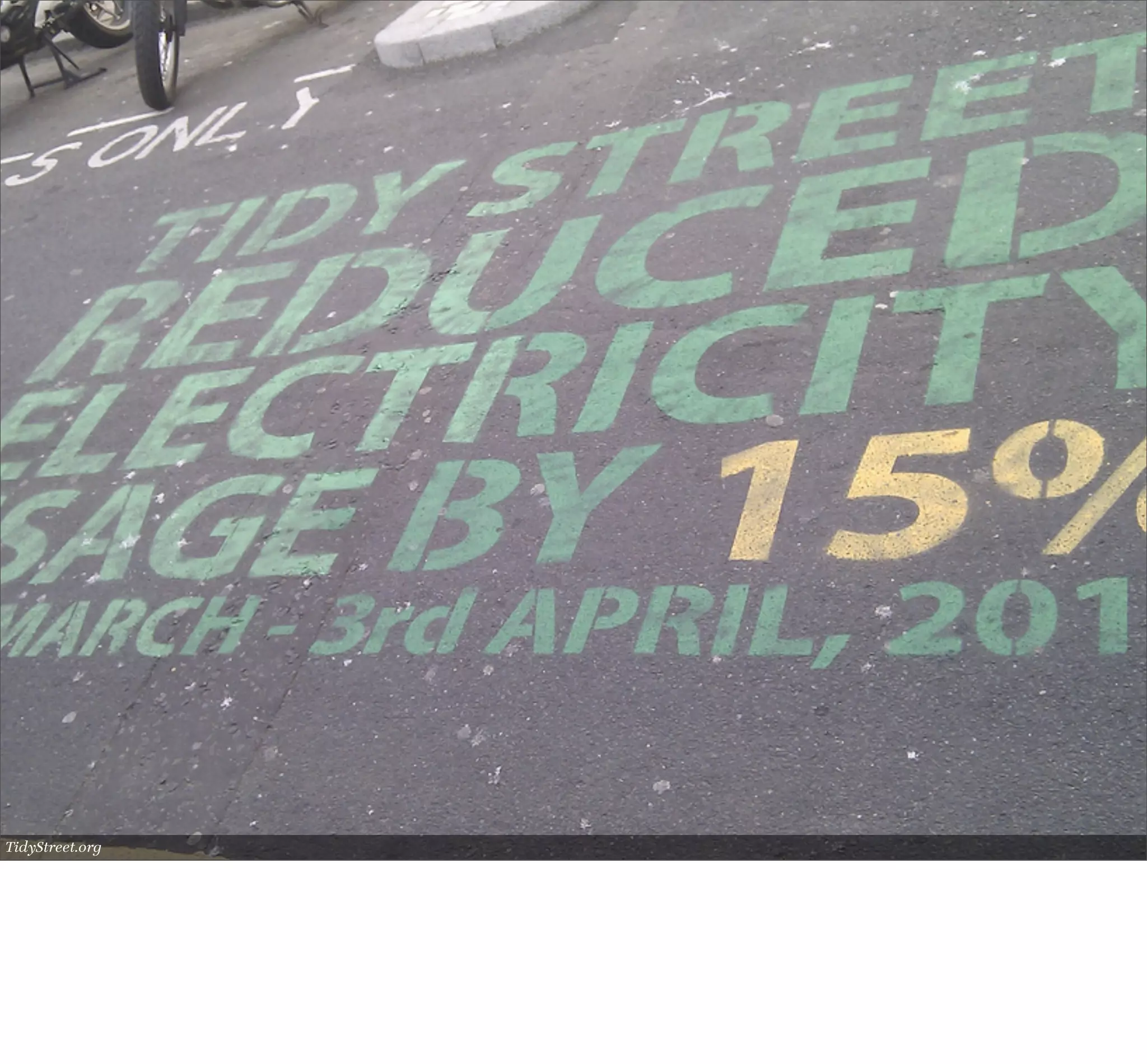
Tidy Street is a project from Brighton, UK that happend earlier this year.
Each day the participants' electricity usage over the previous 24 hours will be marked on the
street compared to the average Brighton household‘s electricity usage.
TidyStreet.org
TidyStreet.org
02
            Tell a story


presented by Interactive Things   20
Donald Norman


 „      Stories are important cognitive
        events, for they encapsulate, into                                                “
        one compact package,
        information, knowledge, context,
        & emotion.


                                                                                     21

Effectively designed transformational visualizations can assume this exact role, acting not
just as simple data representations but rather as layered, multidimensional, optical
allegories, perceptually aequivalent to stories.
Inspired by Carla Casilli.
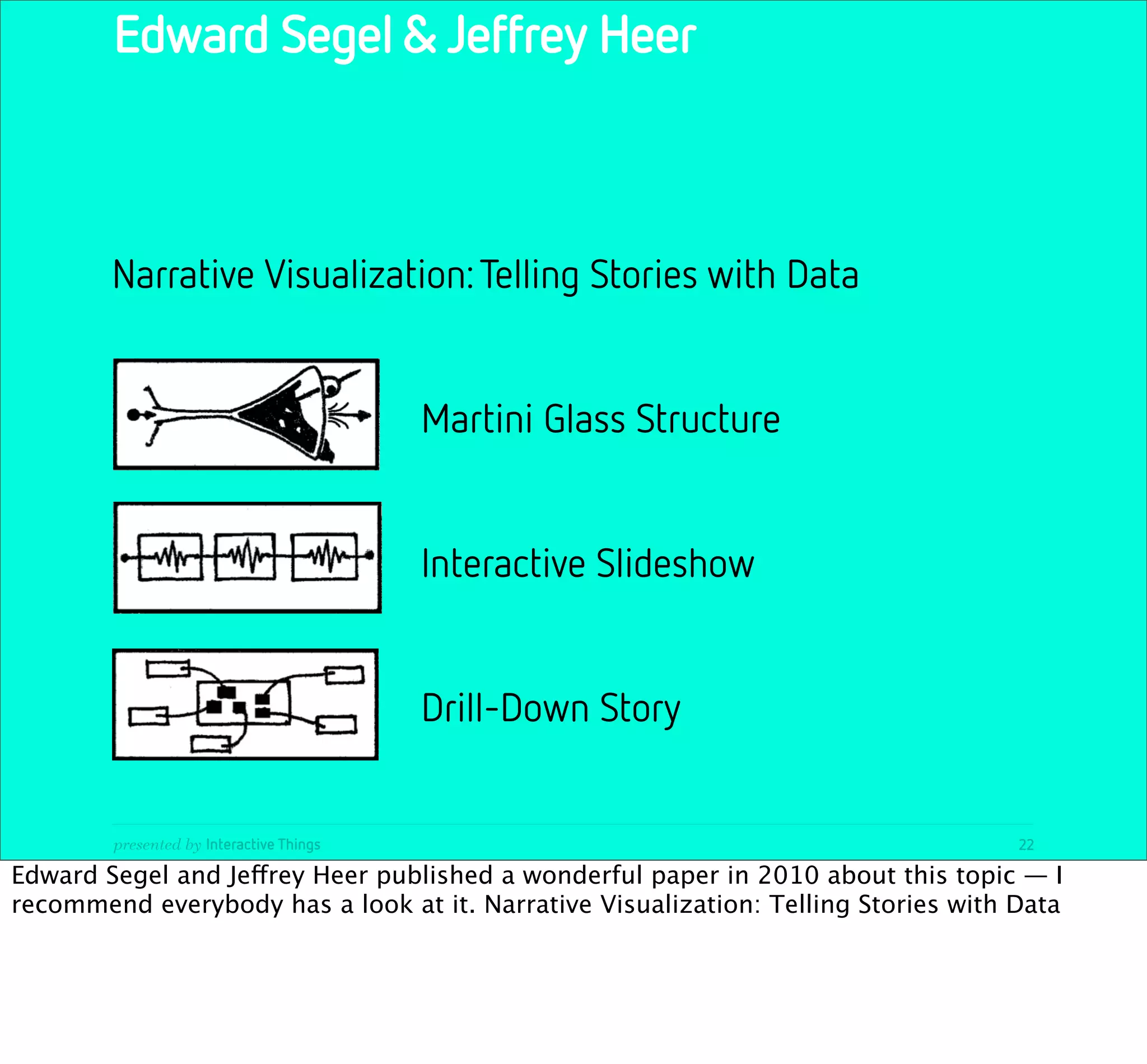
Edward Segel & Jeffrey Heer


        Narrative Visualization: Telling Stories with Data


                                          Martini Glass Structure


                                          Interactive Slideshow


                                          Drill-Down Story


        presented by Interactive Things                                             22

Edward Segel and Jeffrey Heer published a wonderful paper in 2010 about this topic — I
recommend everybody has a look at it. Narrative Visualization: Telling Stories with Data
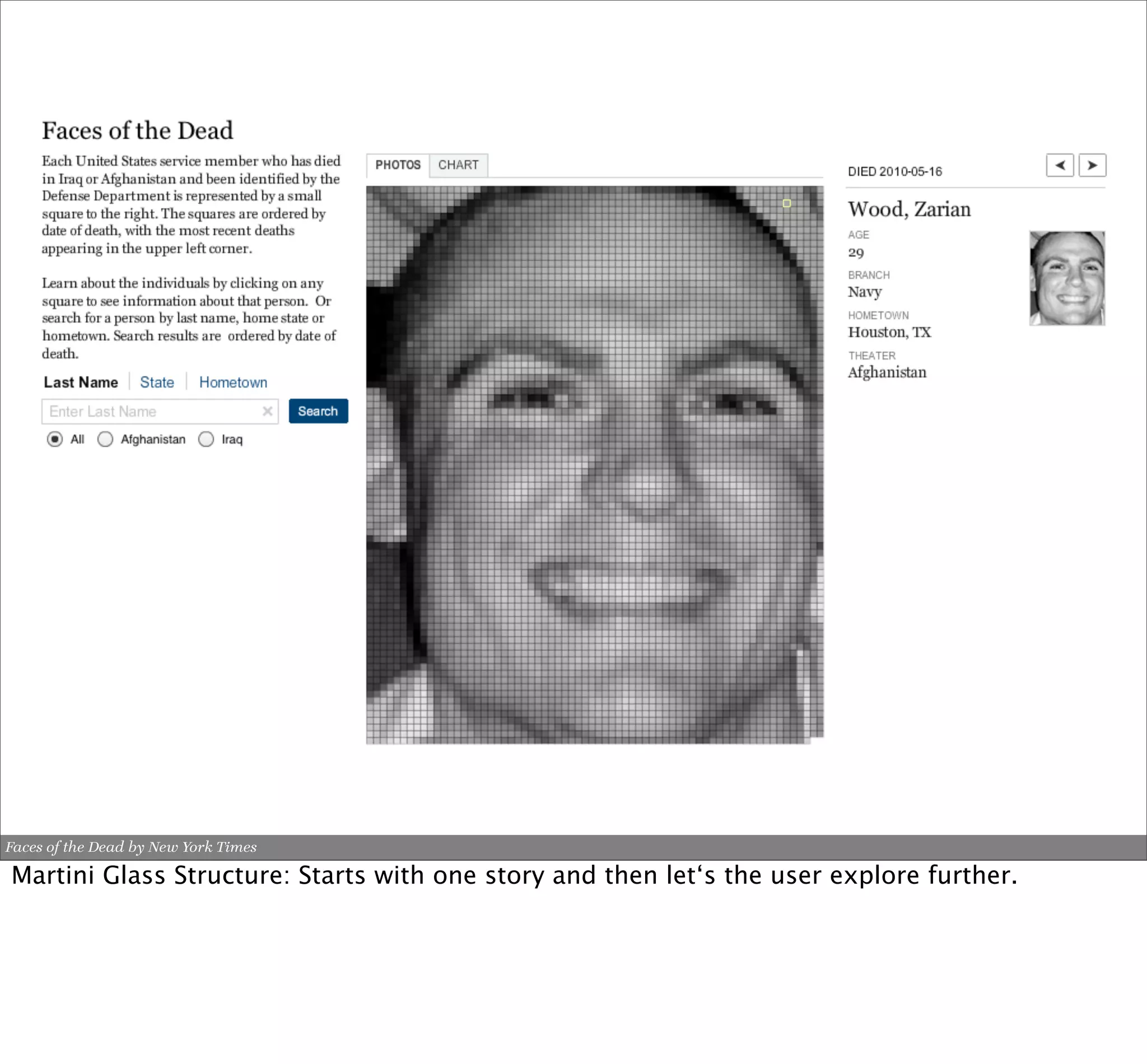
Faces of the Dead by New York Times

Martini Glass Structure: Starts with one story and then let‘s the user explore further.
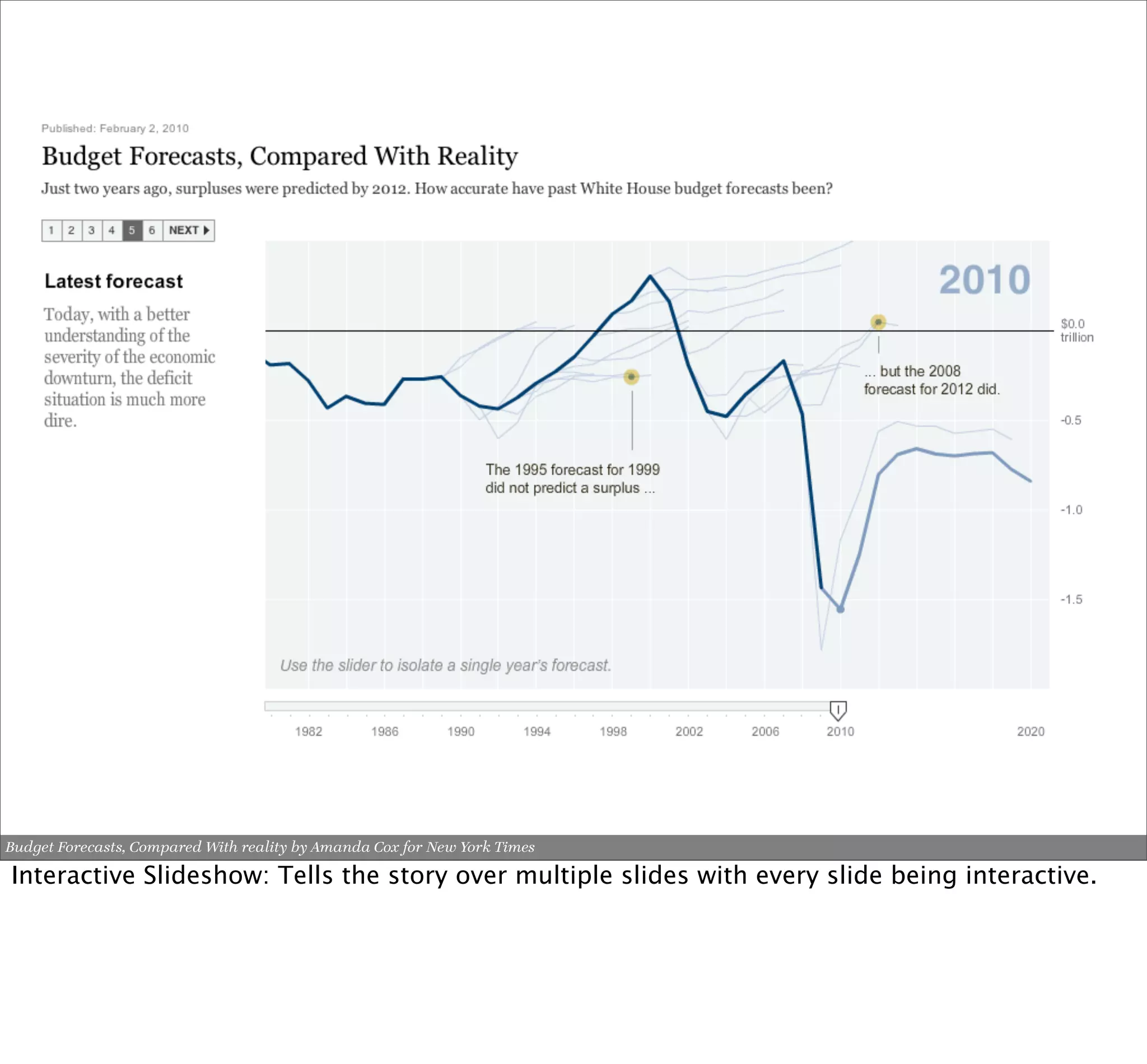
Budget Forecasts, Compared With reality by Amanda Cox for New York Times

Interactive Slideshow: Tells the story over multiple slides with every slide being interactive.
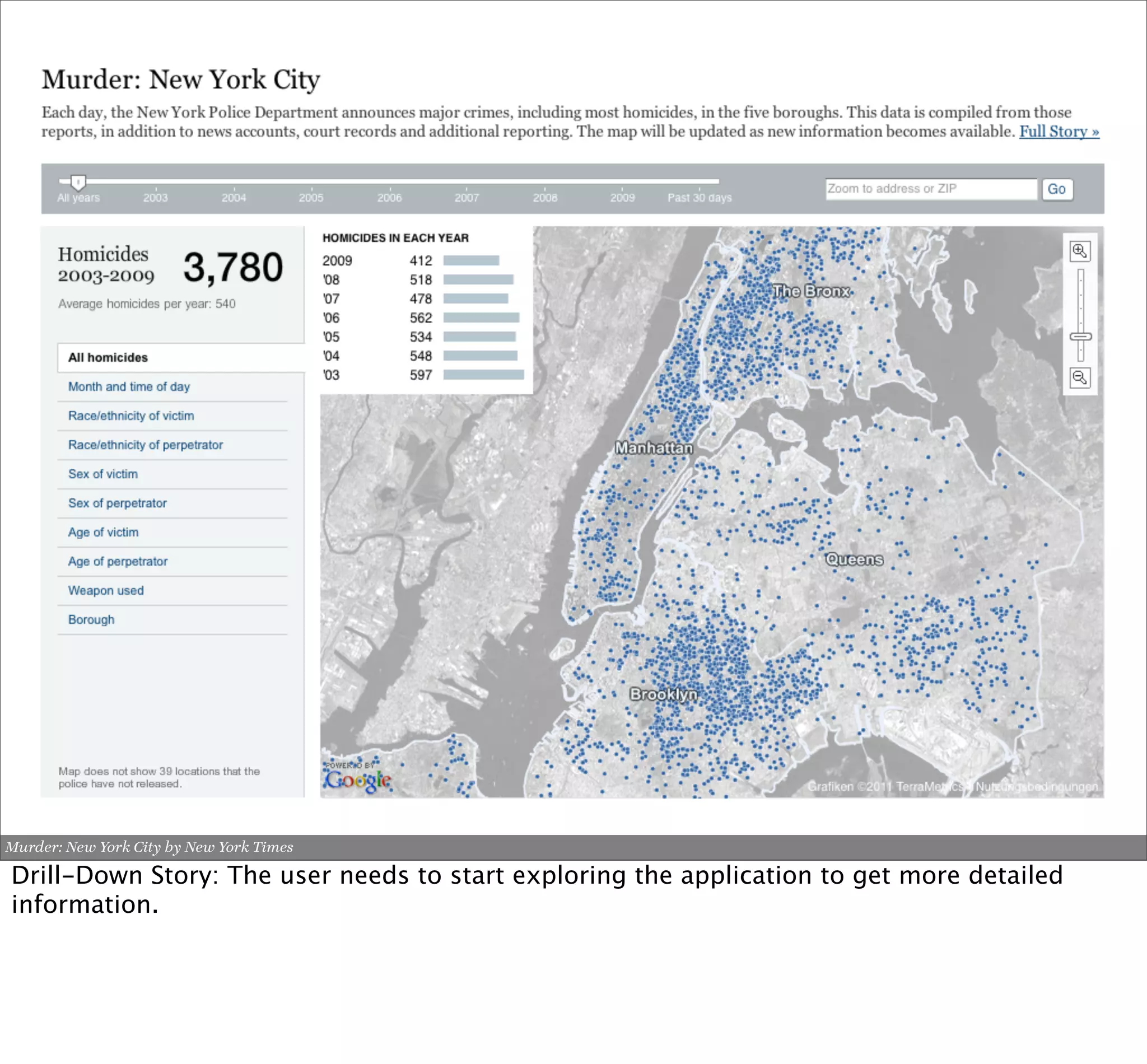
Murder: New York City by New York Times

Drill-Down Story: The user needs to start exploring the application to get more detailed
information.
03
            Make it personal


presented by Interactive Things   26
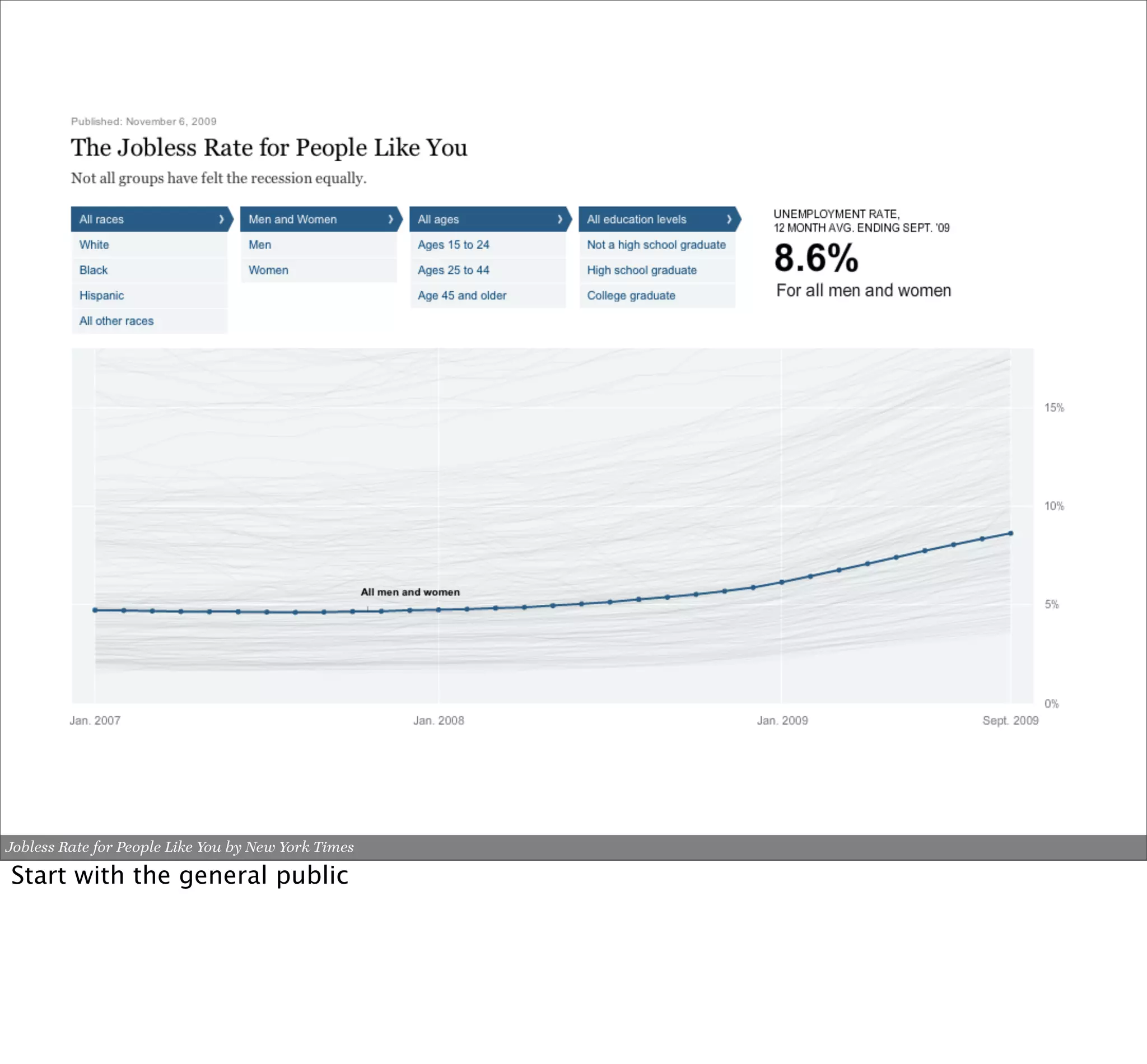
Jobless Rate for People Like You by New York Times

Start with the general public
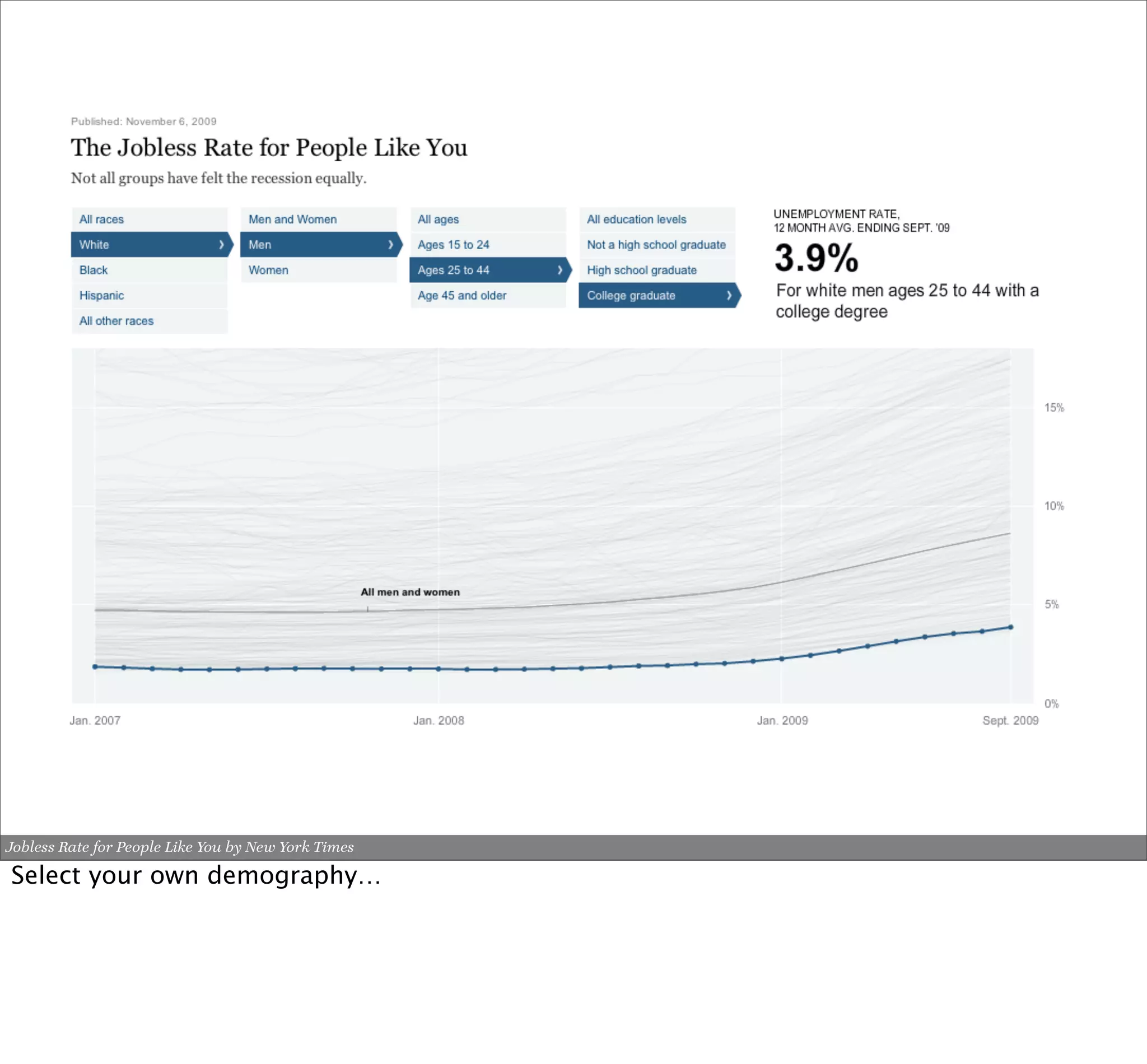
Jobless Rate for People Like You by New York Times

Select your own demography…
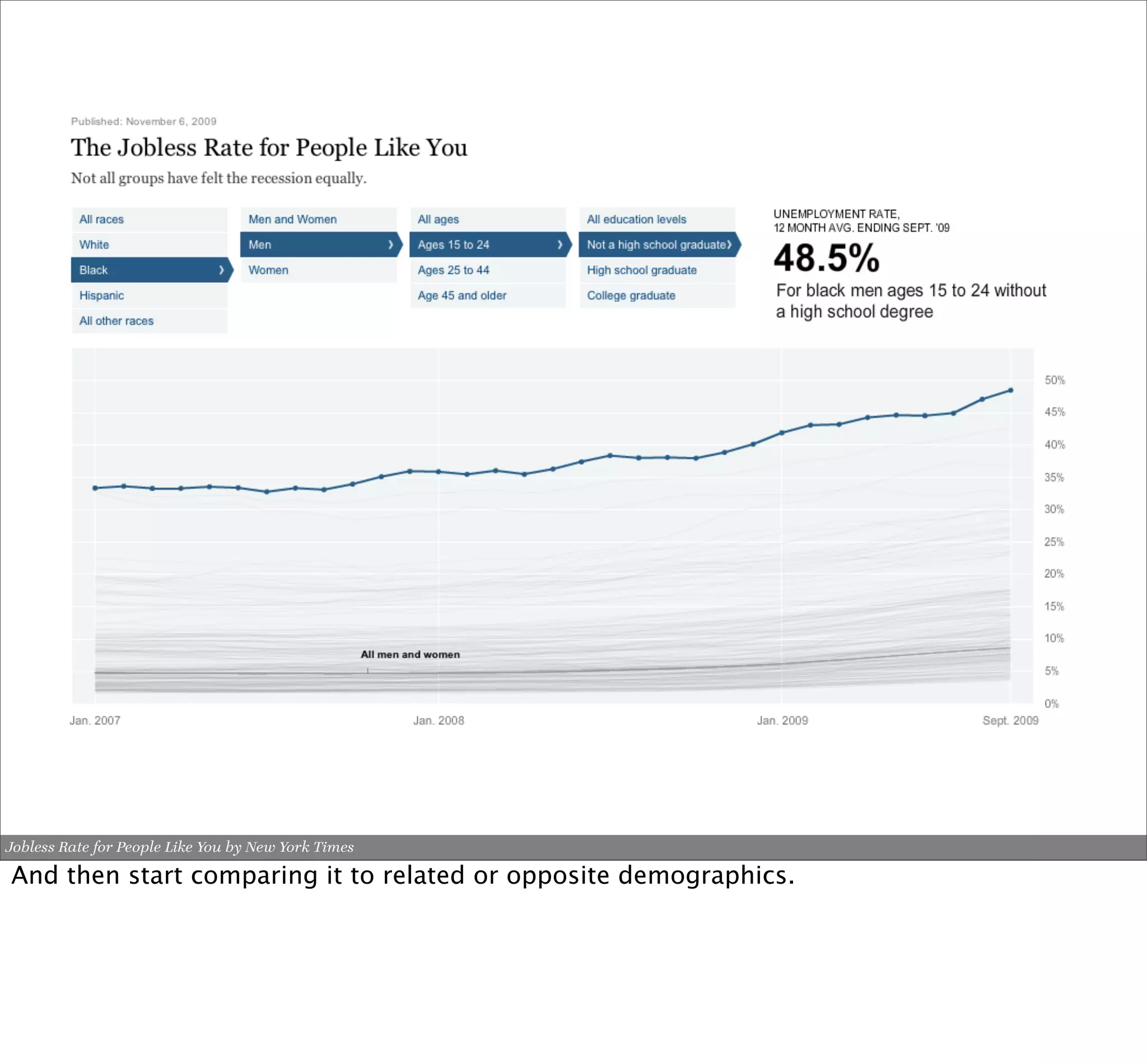
Jobless Rate for People Like You by New York Times

And then start comparing it to related or opposite demographics.
04
            Don‘t be evil
            The people trust you to act with fair
            spirit — please be aware of that.


presented by Interactive Things                     30
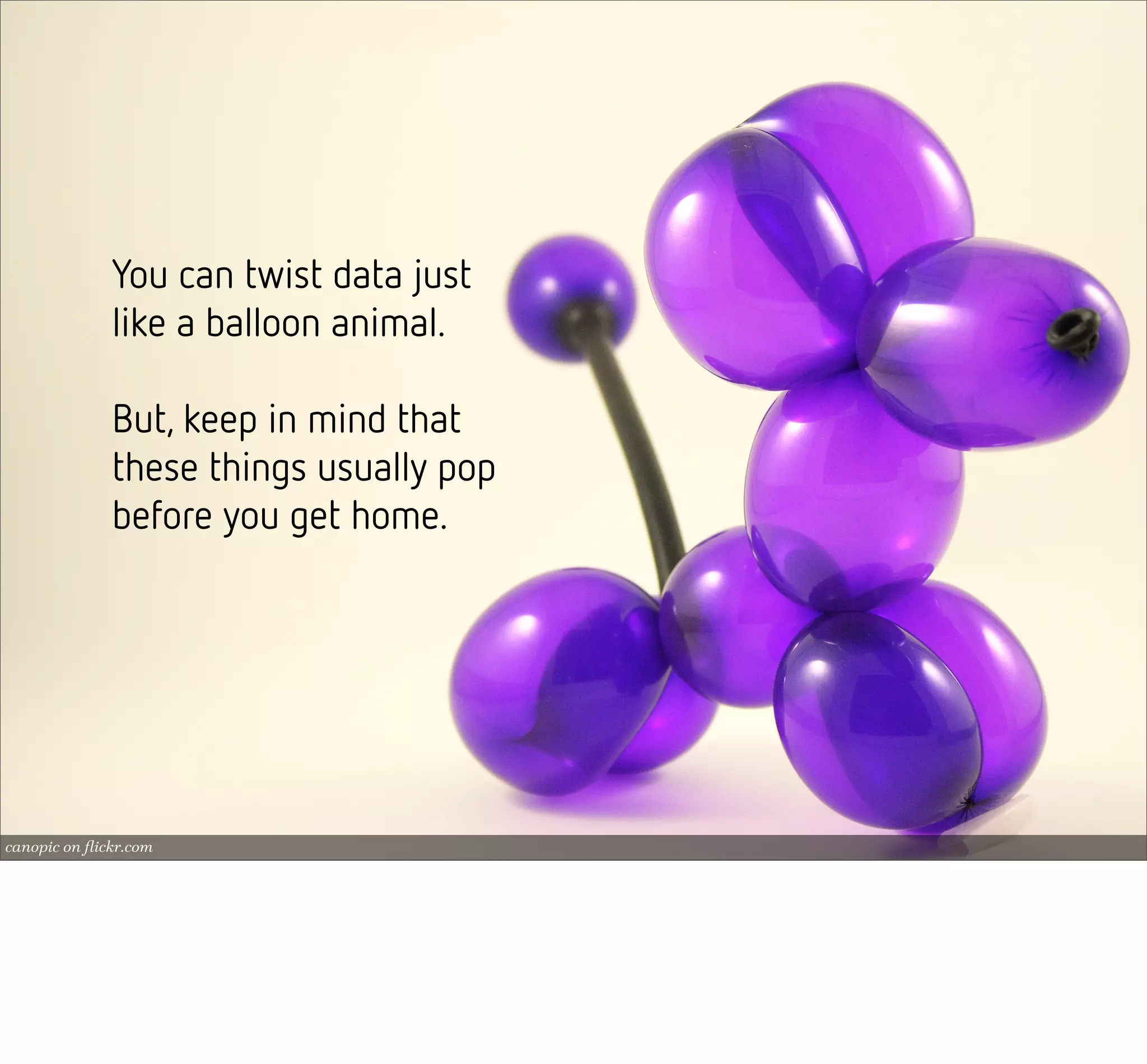
You can twist data just
              like a balloon animal.

              But, keep in mind that
              these things usually pop
              before you get home.


canopic on flickr.com
presented by Interactive Things   32
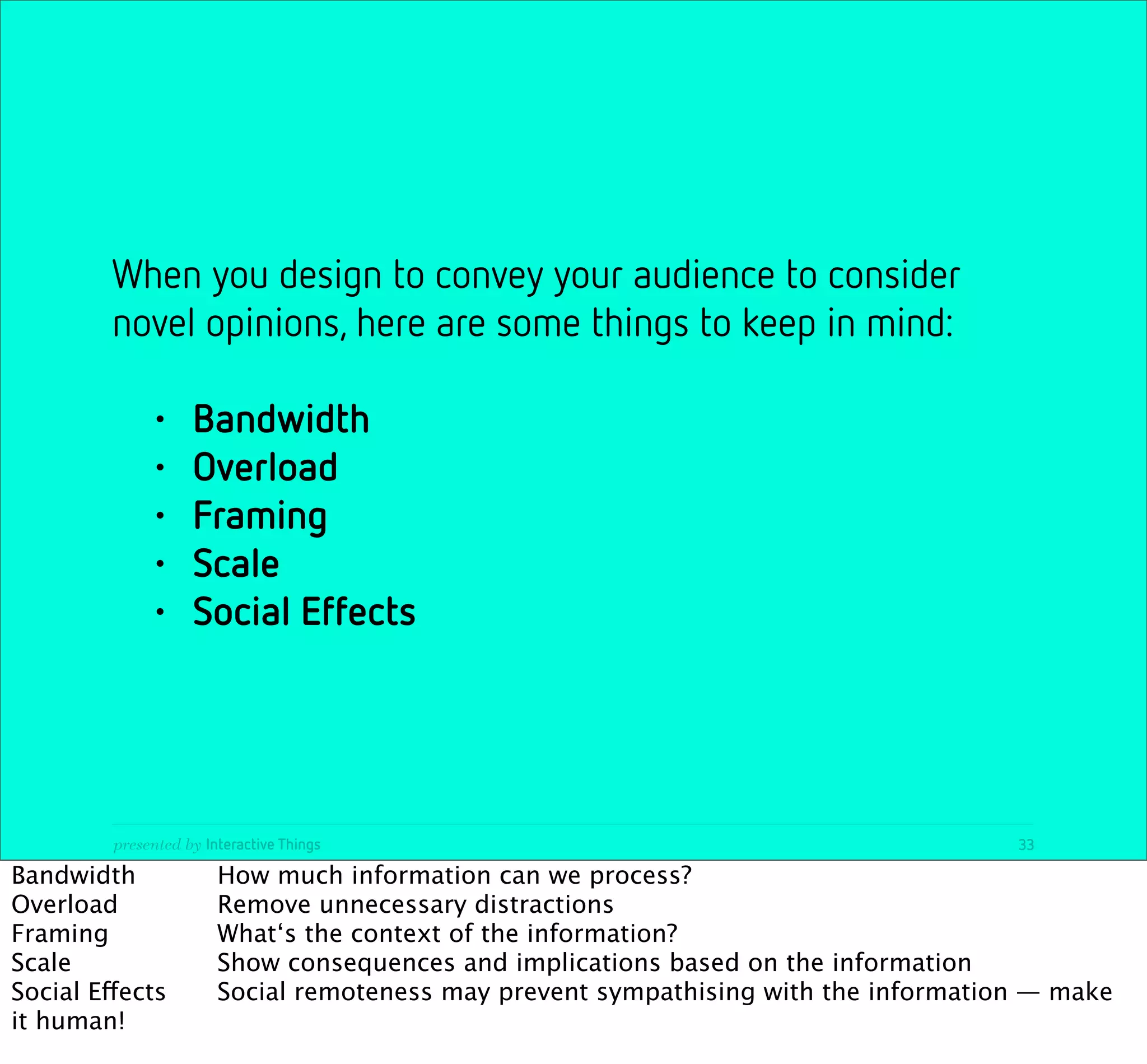
When you design to convey your audience to consider
         novel opinions, here are some things to keep in mind:

              •     Bandwidth
              •     Overload
              •     Framing
              •     Scale
              •     Social Effects


         presented by Interactive Things                                              33

Bandwidth
 
            How much information can we process?
Overload
     
         Remove unnecessary distractions
Framing

     
         What‘s the context of the information?
Scale
 
      
         Show consequences and implications based on the information
Social Effects
         Social remoteness may prevent sympathising with the information — make
it human!
INTENT & IMPACT
Have a clear vision for what you
want to achieve with your work.


presented by Interactive Things    34
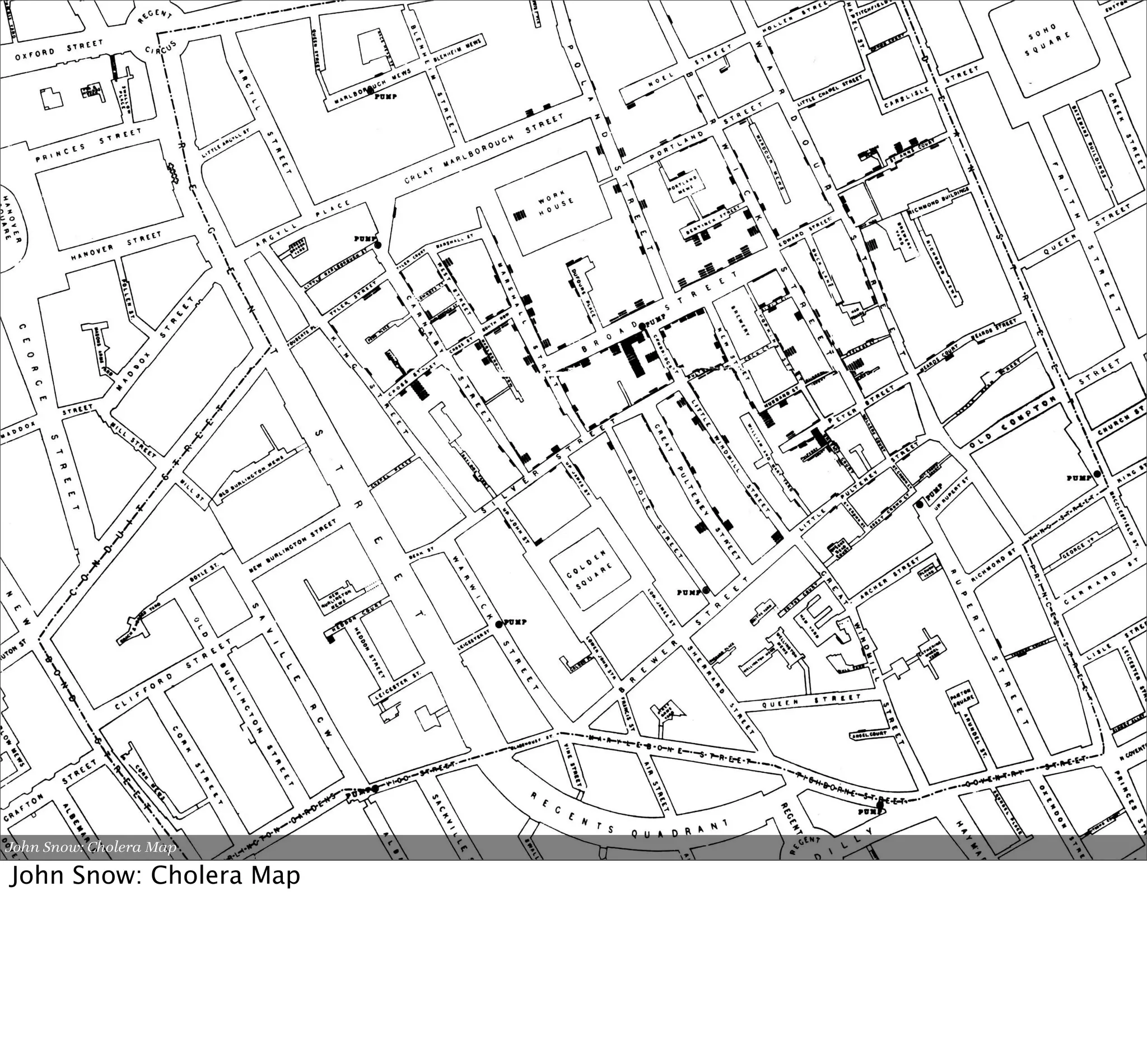
John Snow: Cholera Map

John Snow: Cholera Map
John Snow convinced Whitehead that the Broad Street
        pump was the source of the local infections. Whitehead
        then joined with Snow in tracking the contamination to a
        faulty cesspool and the outbreak’s index case


        presented by Interactive Things                            36

Henry Whitehead was a Church of England Cleric.
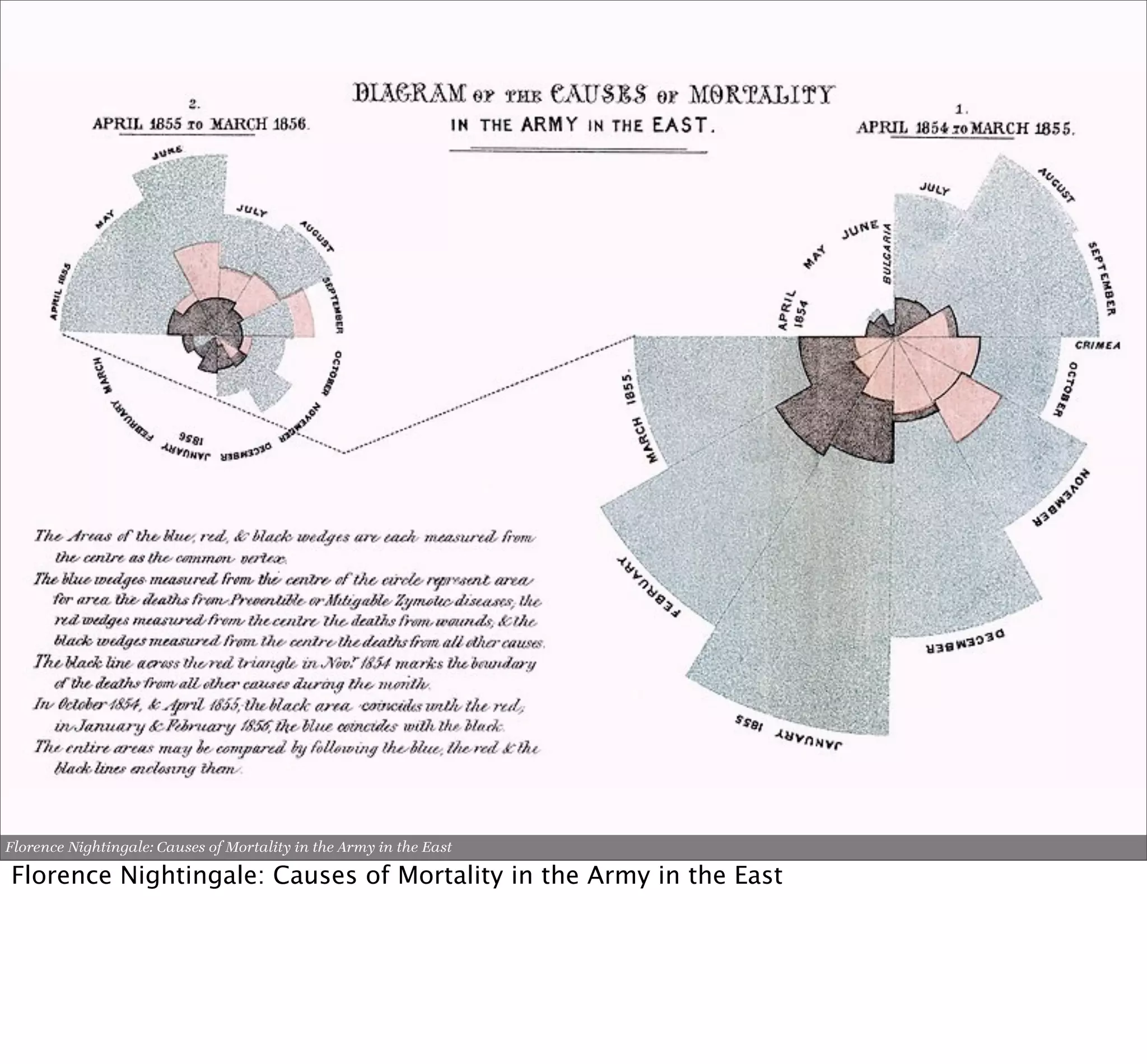
Florence Nightingale: Causes of Mortality in the Army in the East

Florence Nightingale: Causes of Mortality in the Army in the East
Florence Nightingale convinced military authorities,
Parliament and Queen Victoria to carry out her reforms.
Her insistence on good sanitation, fresh air and public
health saved thousands of lives, both for soldiers and
civilians, on battlefields and in hospitals.


presented by Interactive Things                           38
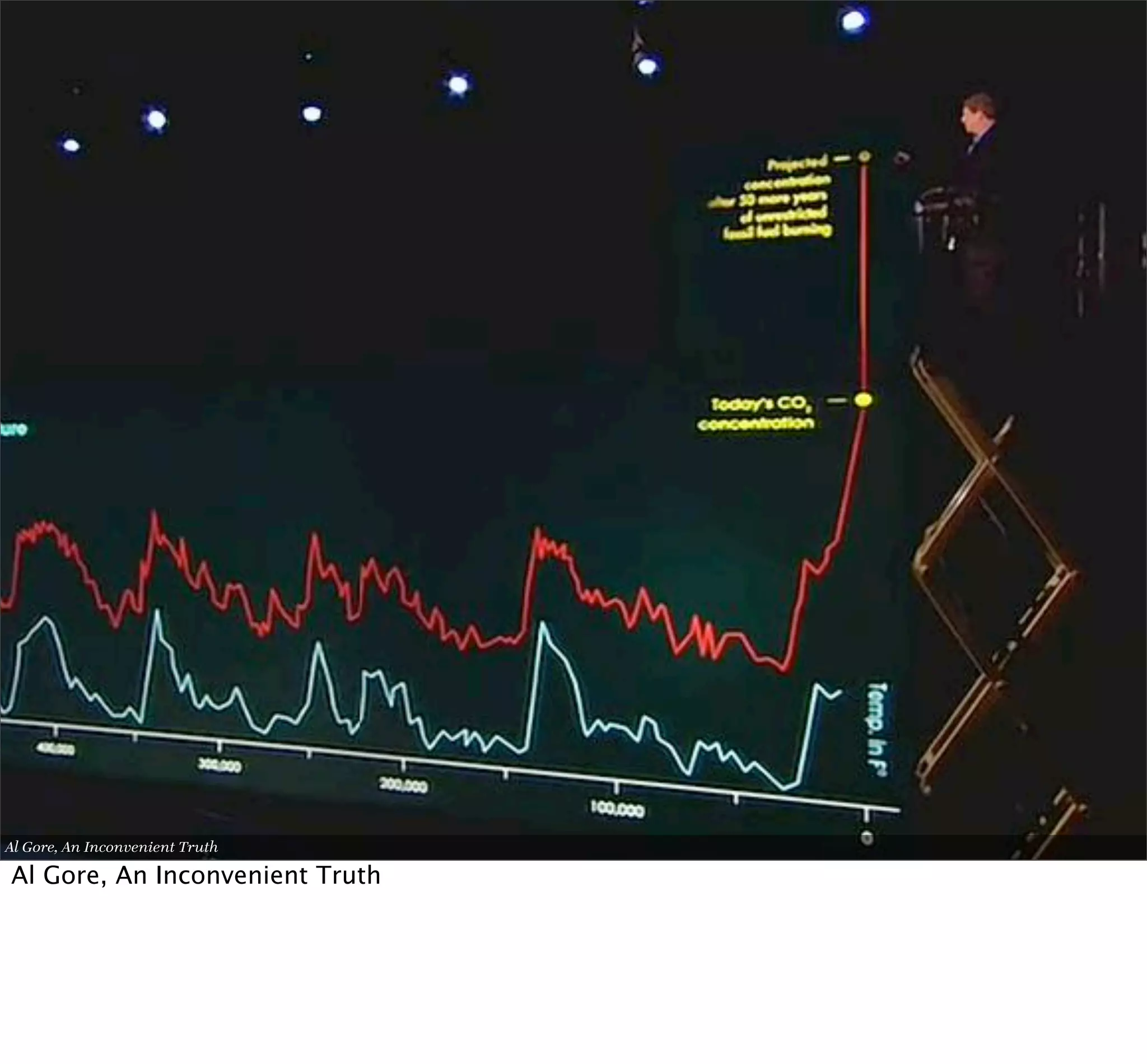
Al Gore, An Inconvenient Truth

Al Gore, An Inconvenient Truth
•     Over 106,000 tons of carbon were offset in the year
           following the film's release, which is equivalent to
           225 million car miles.

     •     4200+ tons of carbon were offset just by people
           swtiching to compact fluorescent light bulbs.

     •     Over 15 climate change bills have been introduced in
           Congress, with the historic Markey-Waxman Bill
           passing the House in June, 2009.

     •     Over 2600 people have been trained to give The
           Climate Project presentation and 4 million people on
           all seven continents have heard the presentation.


presented by Interactive Things                                  40
05
                    Plan
                    Plan the actions that you want people to
                    take after engaging with your work.


        presented by Interactive Things                                               41

Like, Share, Digg, Save are not impacting people's lives!
Include actionable items into your visualizations & interfaces and set up the infrstructure for
people to take action.
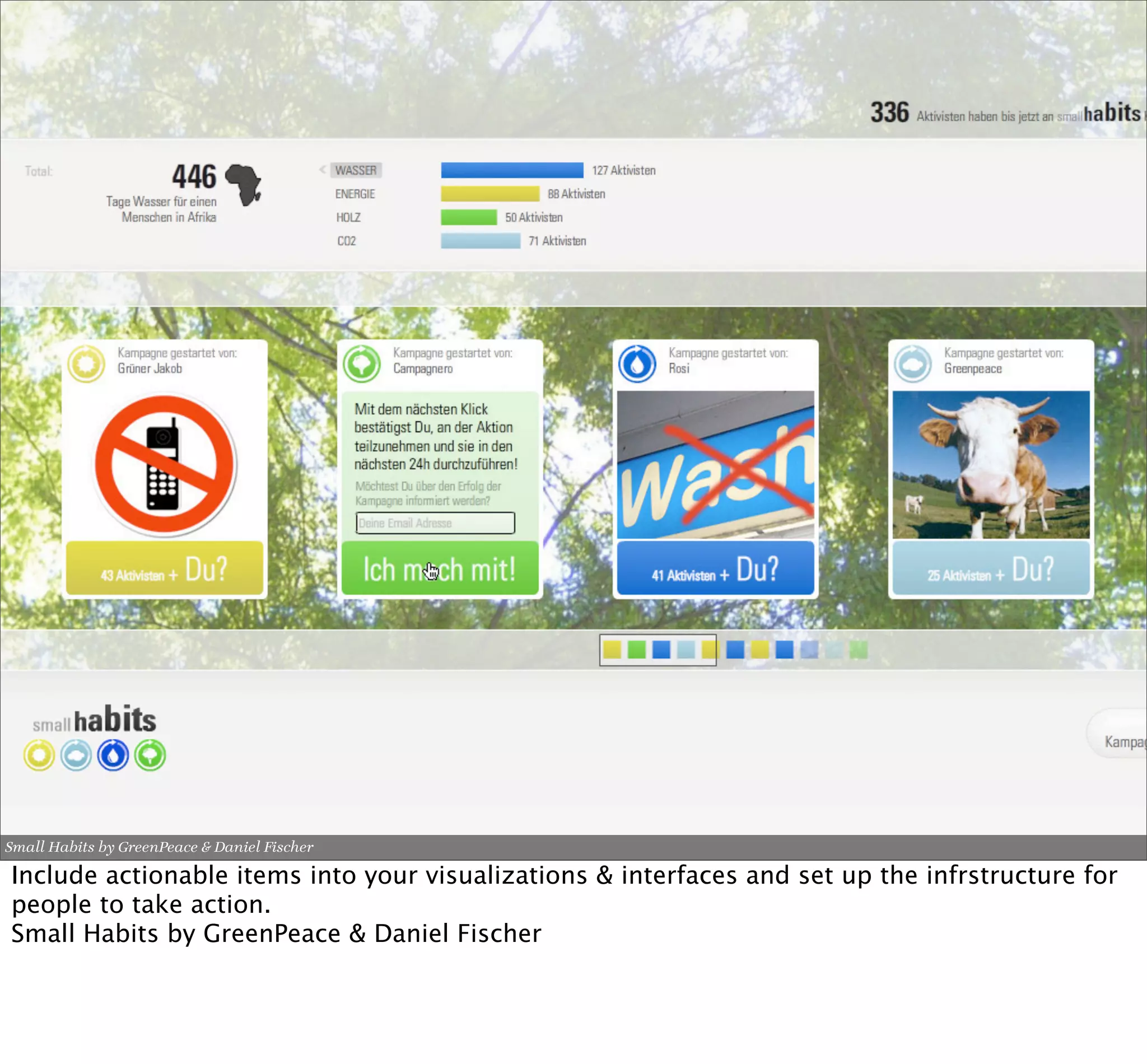
Small Habits by GreenPeace & Daniel Fischer

Include actionable items into your visualizations & interfaces and set up the infrstructure for
people to take action.
Small Habits by GreenPeace & Daniel Fischer
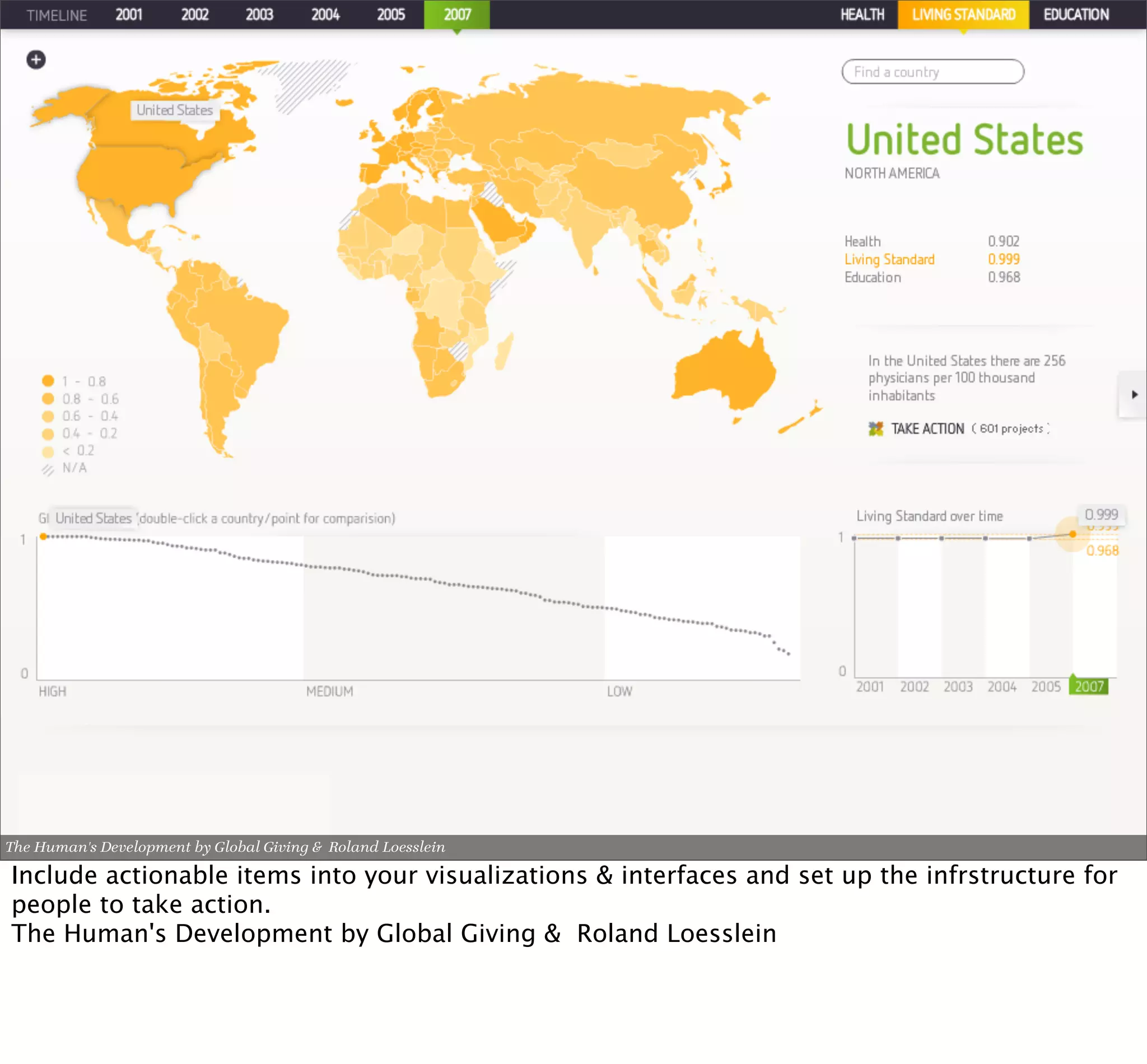
The Human's Development by Global Giving & Roland Loesslein

Include actionable items into your visualizations & interfaces and set up the infrstructure for
people to take action.
The Human's Development by Global Giving & Roland Loesslein
06
            Observe
            Observe the impact that your
            work has after you published it.


presented by Interactive Things                44
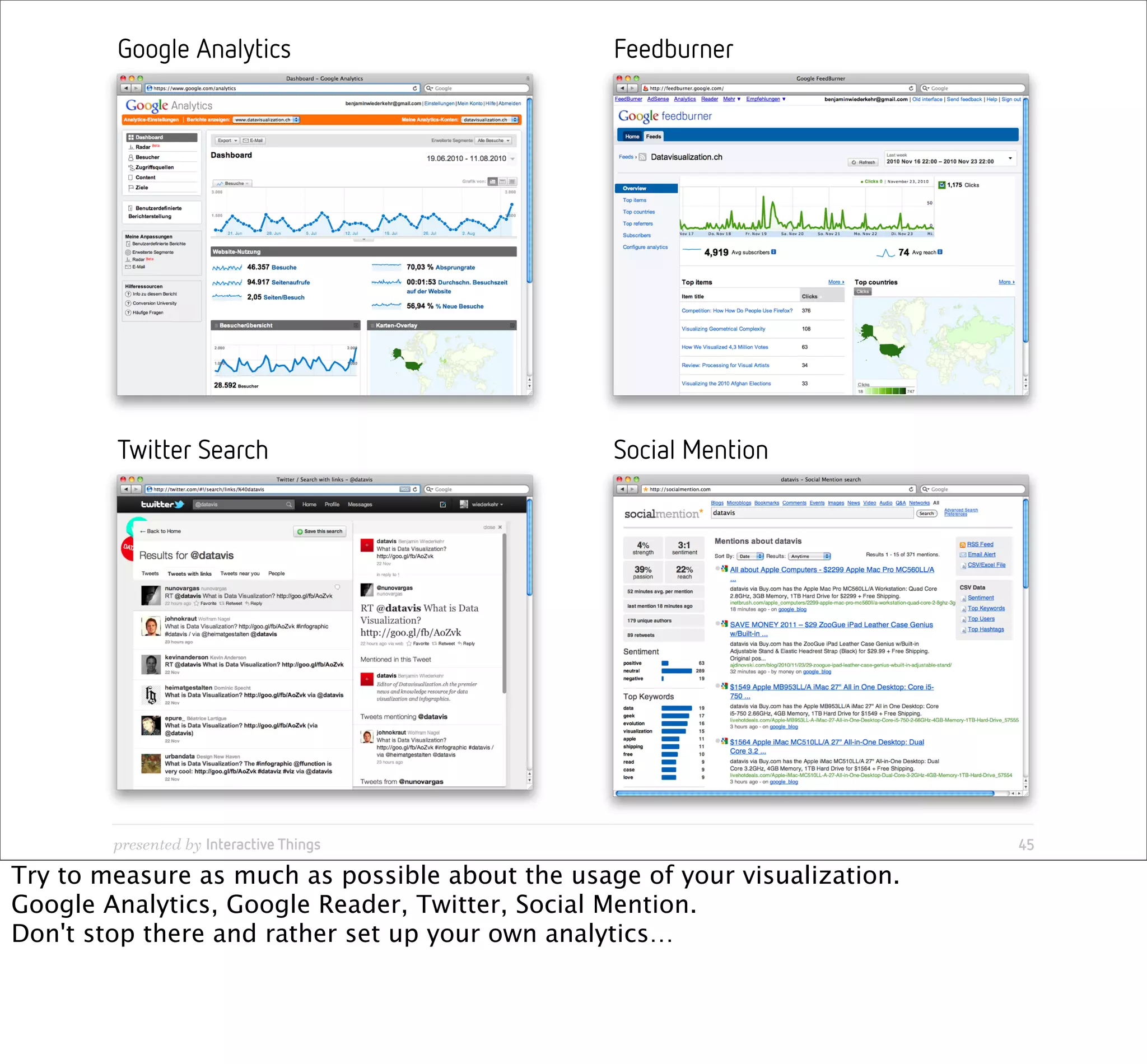
Google Analytics                         Feedburner


        Twitter Search                           Social Mention


        presented by Interactive Things                                     45

Try to measure as much as possible about the usage of your visualization.
Google Analytics, Google Reader, Twitter, Social Mention.
Don't stop there and rather set up your own analytics…
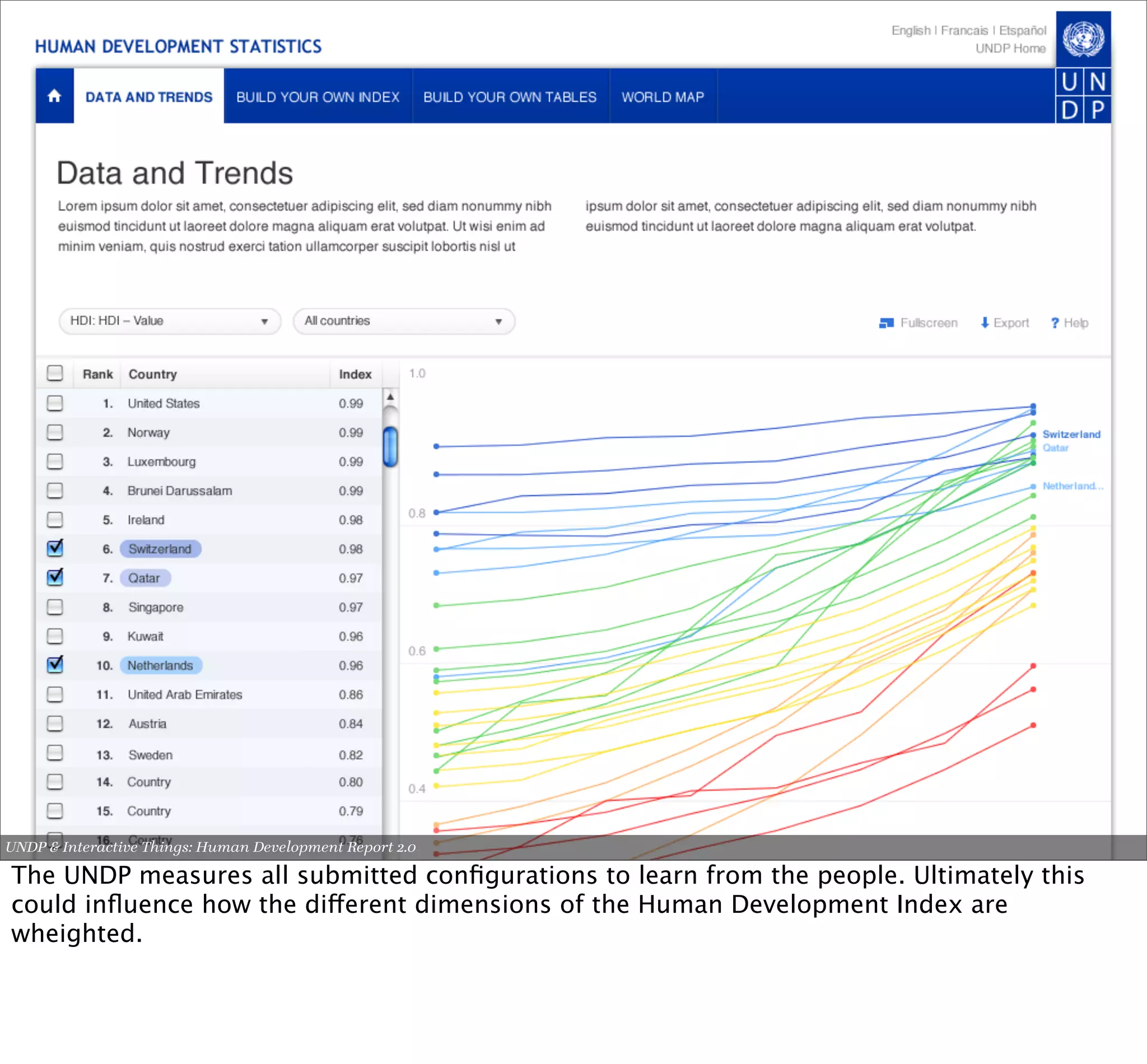
UNDP & Interactive Things: Human Development Report 2.0

The UNDP measures all submitted configurations to learn from the people. Ultimately this
could influence how the different dimensions of the Human Development Index are
wheighted.
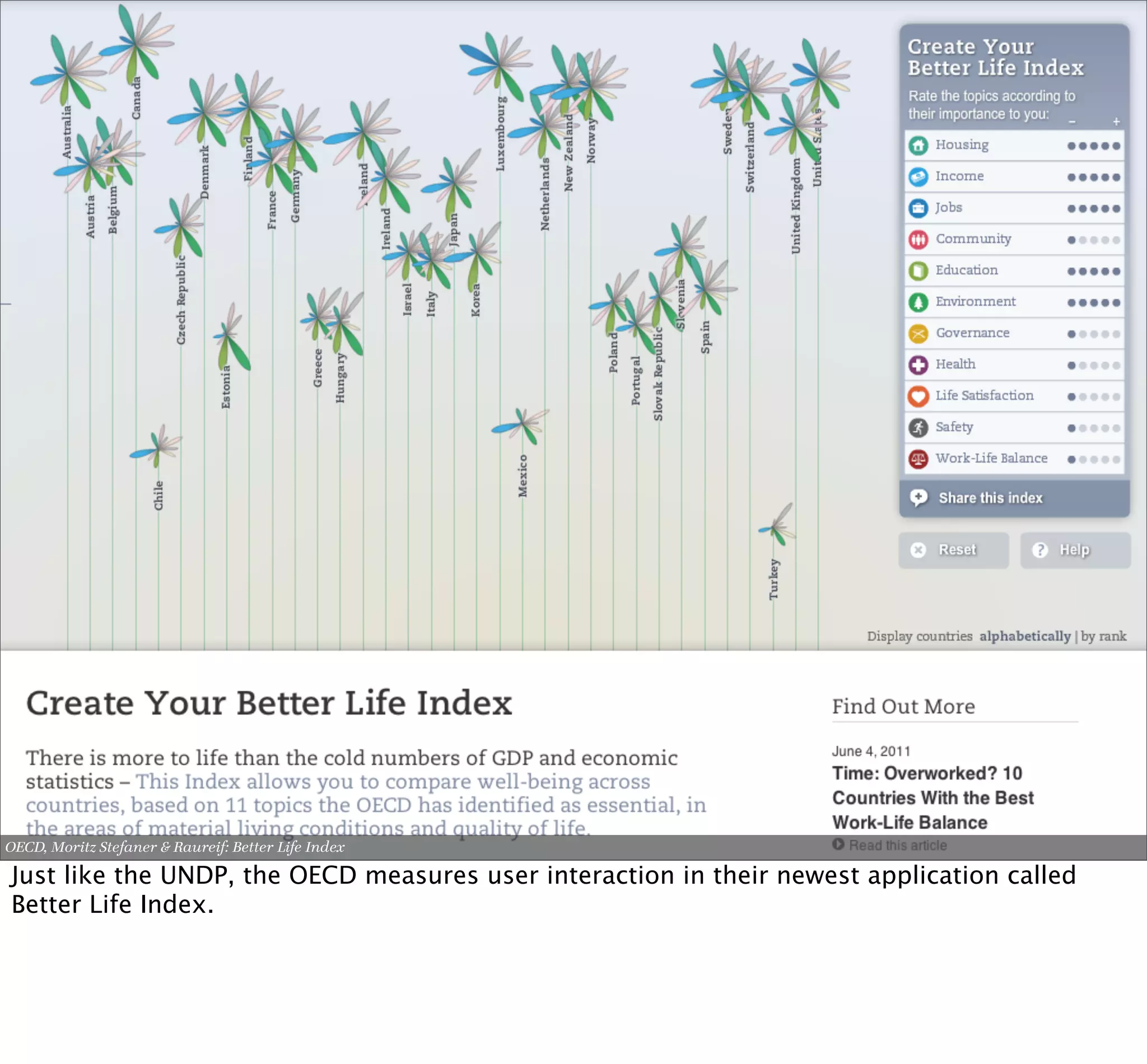
OECD, Moritz Stefaner & Raureif: Better Life Index

Just like the UNDP, the OECD measures user interaction in their newest application called
Better Life Index.
Recap


1.      Set your aim
2.      Tell a story
3.      Make it personal
4.      Don‘t be evil
5.      Plan for actions
6.      Observe your impact


presented by Interactive Things   48
THANKS!
If you have any questions, please get in touch.

Email                 benjamin@interactivethings.com
Twitter               @wiederkehr
Phone                 +41 76 533 33 72


presented by Interactive Things                        49

Intent & Impact: Thoughts on Persuasion in Visualization

  • 1.
    INTENT & IMPACT Thoughts on Persuasion in Visualization presented by Interactive Things 1 I dubbed it impact and intent and it will be more an collection of thoughts and questions for you to reflect on, discuss, seek answers than a complete theory.
  • 2.
    Explore → Ideate → Create → Publish presented by Interactive Things 2 One thing that strikes me is the amount of talk around the visual and functional qualities of visualizations or the process of creating them, but I feel a lack of discussion around the underlying motivation and the resulting outcome. I think that visualization should be seen as a means to an end and not an end in it's own right. Thus, this talk is focused on the things that happen before the exploration phase and after the publication.
  • 3.
    Talk - Action= Shit presented by Interactive Things 3 The underlying thought is… I am totally stealing this from Brendan Dawes.
  • 4.
    INTENT & IMPACT Havea clear understanding why you do what you do. presented by Interactive Things 4
  • 5.
    01 Set your aim Informing people → Increase knowledge Convincing people → Shape opinions Nudge people → Change behavior presented by Interactive Things 5 First we need to be clear about our goal with the visualization. Do you wan‘t to inform people to increase their knowledge? Fine. Or do you want to convince people and shape their opinions? That‘s fine, too. Or do you want to nudge people to ultimately change their behavior ? That‘s great! Inspired by Enrico Bertini, Fell in Love with Data
  • 6.
    Increasing Knowledge presented by Interactive Things 6 How do humans learn and increase their knowledge?
  • 7.
    Sarah Slobin „ Something new, relevant, different, informative and even entertaining is a good place to start. “ 7 If you plan to inform and delight readers then something new, relevant, different, informative and even entertaining is a good place to start. Sarah Slobin, Visual Journalist for the Wall Street Journal, previously at NYT, Fortune, CNN Money.
  • 8.
    Scheiter, Wiebe, &Holsanova Decorative →Enlivening Text Representational →Making information more concrete Organisational →Bringing coherence to data Interpretative →Enhancing understanding of data Transformative →Recode information into more concrete and memorable form, organizing it through relations, and providing systemic means of retrieval presented by Interactive Things 8 Transformative visualization have the strongest positive learning effect. Thus, I highly recommend to move your efforts in this direction. Make information concrete & memorable. Organize it for faster comprehension. Provide options for analysis.
  • 9.
    Shaping Opinions presented by Interactive Things 9 How do humans build up their opinions and beliefs?
  • 10.
    Aristoteles „ In an ideal society opinions are the end result of informed discussions, readings, & listenings. “ 10 That‘s quite a romantic view on us as humans, but we know it better, right?
  • 11.
    Whenever we areconfronted with external stimuli we first resort to what we feel or what we believe and later to what we think. stimuli limbic system neocortex reaction The cognitive process is a combination of emotion & reason. presented by Interactive Things 11
  • 12.
    Clara Kayser-Bril, NicolasKayser-Bril and Marion Kotlarski: 100 Years of World Cuisine „100 Years of World Cuisine“ uses very strong visuals that immediately provoke an emotional reaction to convey their story.
  • 13.
    Changing Behavior presented by Interactive Things 13 What is necessary for humans to change their behavior?
  • 14.
    Behavior Model According to B. J. Fogg is people's behavior a result of the convergence of three elements: Motivation, Ability, & Trigger presented by Interactive Things 14 To do a certain task or even to change behavior someone must be motivated for that. Furthermore, the users ability or the tasks simplicity either should be as easy as possible or it should be perceived easy to do. Finally, the user must be triggered for action. As designers and developers we need to make it simple for them to use. Thus, the ability should be a problem. So how can we motivate people? And how can we include triggers for action at the right time?
  • 15.
  • 16.
    Gamification Using game mechanics in non-gaming contexts to improve user engangement or even change user behavior. You know, stuff like rewards, leaderboards, competitions. presented by Interactive Things 16 There are many services that are sucessfully using game mechanics to increase user engagement. So, it looks like a promising method that could be applied to visualization as well.
  • 17.
    TidyStreet.org Tidy Street isa project from Brighton, UK that happend earlier this year. Each day the participants' electricity usage over the previous 24 hours will be marked on the street compared to the average Brighton household‘s electricity usage.
  • 18.
  • 19.
  • 20.
    02 Tell a story presented by Interactive Things 20
  • 21.
    Donald Norman „ Stories are important cognitive events, for they encapsulate, into “ one compact package, information, knowledge, context, & emotion. 21 Effectively designed transformational visualizations can assume this exact role, acting not just as simple data representations but rather as layered, multidimensional, optical allegories, perceptually aequivalent to stories. Inspired by Carla Casilli.
  • 22.
    Edward Segel &Jeffrey Heer Narrative Visualization: Telling Stories with Data Martini Glass Structure Interactive Slideshow Drill-Down Story presented by Interactive Things 22 Edward Segel and Jeffrey Heer published a wonderful paper in 2010 about this topic — I recommend everybody has a look at it. Narrative Visualization: Telling Stories with Data
  • 23.
    Faces of theDead by New York Times Martini Glass Structure: Starts with one story and then let‘s the user explore further.
  • 24.
    Budget Forecasts, ComparedWith reality by Amanda Cox for New York Times Interactive Slideshow: Tells the story over multiple slides with every slide being interactive.
  • 25.
    Murder: New YorkCity by New York Times Drill-Down Story: The user needs to start exploring the application to get more detailed information.
  • 26.
    03 Make it personal presented by Interactive Things 26
  • 27.
    Jobless Rate forPeople Like You by New York Times Start with the general public
  • 28.
    Jobless Rate forPeople Like You by New York Times Select your own demography…
  • 29.
    Jobless Rate forPeople Like You by New York Times And then start comparing it to related or opposite demographics.
  • 30.
    04 Don‘t be evil The people trust you to act with fair spirit — please be aware of that. presented by Interactive Things 30
  • 31.
    You can twistdata just like a balloon animal. But, keep in mind that these things usually pop before you get home. canopic on flickr.com
  • 32.
  • 33.
    When you designto convey your audience to consider novel opinions, here are some things to keep in mind: • Bandwidth • Overload • Framing • Scale • Social Effects presented by Interactive Things 33 Bandwidth How much information can we process? Overload Remove unnecessary distractions Framing What‘s the context of the information? Scale Show consequences and implications based on the information Social Effects Social remoteness may prevent sympathising with the information — make it human!
  • 34.
    INTENT & IMPACT Havea clear vision for what you want to achieve with your work. presented by Interactive Things 34
  • 35.
    John Snow: CholeraMap John Snow: Cholera Map
  • 36.
    John Snow convincedWhitehead that the Broad Street pump was the source of the local infections. Whitehead then joined with Snow in tracking the contamination to a faulty cesspool and the outbreak’s index case presented by Interactive Things 36 Henry Whitehead was a Church of England Cleric.
  • 37.
    Florence Nightingale: Causesof Mortality in the Army in the East Florence Nightingale: Causes of Mortality in the Army in the East
  • 38.
    Florence Nightingale convincedmilitary authorities, Parliament and Queen Victoria to carry out her reforms. Her insistence on good sanitation, fresh air and public health saved thousands of lives, both for soldiers and civilians, on battlefields and in hospitals. presented by Interactive Things 38
  • 39.
    Al Gore, AnInconvenient Truth Al Gore, An Inconvenient Truth
  • 40.
    Over 106,000 tons of carbon were offset in the year following the film's release, which is equivalent to 225 million car miles. • 4200+ tons of carbon were offset just by people swtiching to compact fluorescent light bulbs. • Over 15 climate change bills have been introduced in Congress, with the historic Markey-Waxman Bill passing the House in June, 2009. • Over 2600 people have been trained to give The Climate Project presentation and 4 million people on all seven continents have heard the presentation. presented by Interactive Things 40
  • 41.
    05 Plan Plan the actions that you want people to take after engaging with your work. presented by Interactive Things 41 Like, Share, Digg, Save are not impacting people's lives! Include actionable items into your visualizations & interfaces and set up the infrstructure for people to take action.
  • 42.
    Small Habits byGreenPeace & Daniel Fischer Include actionable items into your visualizations & interfaces and set up the infrstructure for people to take action. Small Habits by GreenPeace & Daniel Fischer
  • 43.
    The Human's Developmentby Global Giving & Roland Loesslein Include actionable items into your visualizations & interfaces and set up the infrstructure for people to take action. The Human's Development by Global Giving & Roland Loesslein
  • 44.
    06 Observe Observe the impact that your work has after you published it. presented by Interactive Things 44
  • 45.
    Google Analytics Feedburner Twitter Search Social Mention presented by Interactive Things 45 Try to measure as much as possible about the usage of your visualization. Google Analytics, Google Reader, Twitter, Social Mention. Don't stop there and rather set up your own analytics…
  • 46.
    UNDP & InteractiveThings: Human Development Report 2.0 The UNDP measures all submitted configurations to learn from the people. Ultimately this could influence how the different dimensions of the Human Development Index are wheighted.
  • 47.
    OECD, Moritz Stefaner& Raureif: Better Life Index Just like the UNDP, the OECD measures user interaction in their newest application called Better Life Index.
  • 48.
    Recap 1. Set your aim 2. Tell a story 3. Make it personal 4. Don‘t be evil 5. Plan for actions 6. Observe your impact presented by Interactive Things 48
  • 49.
    THANKS! If you haveany questions, please get in touch. Email benjamin@interactivethings.com Twitter @wiederkehr Phone +41 76 533 33 72 presented by Interactive Things 49