ECONOMETRICS I
Textbook: Damodar N. Gujarati, Basic Econometrics,
The McGraw-Hill Companies
5.5 HYPOTHESIS TESTING:
GENERAL COMMENTS
1. Confidence interval approach
2. Test of significance approach
Both these approaches predicate that the variable (statistic or estimator) under
consideration has some probability distribution and that hypothesis testing
involves making statements or assertions about the value(s) of the parameter(s)
of such distribution.
Hypothesis Testing: Confidence Interval
Approach (Two-Sided or Two-Tail Test)
To illustrate the confidence interval approach, once again we revert to our
wages-education example. From the regression results given in Eq. (3.6.1),
we know that the slope coefficient is 0.7240. Suppose we postulate that
Null Hypothesis: H0: β2 = 0.5 and
Alternative Hypothesis: H1: β2 = 0.5
Actually it is what is known as a two-sided hypothesis. Very often such a
two-sided alternative hypothesis reflects the fact that we do not have a
strong a priori or theoretical expectation about the direction in which the
alternative hypothesis should move from the null hypothesis.
Hypothesis Testing: Confidence Interval
Approach (Two-Sided or Two-Tail Test)
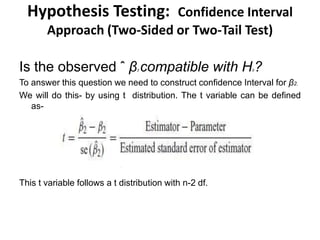
Is the observed ˆ β2 compatible with H0?
To answer this question we need to construct confidence Interval for β2.
We will do this- by using t distribution. The t variable can be defined
as-
This t variable follows a t distribution with n-2 df.
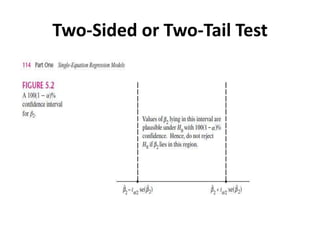
Two-Sided or Two-Tail Test
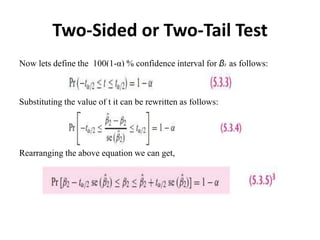
Now lets define the 100(1-α) % confidence interval for β2 as follows:
Substituting the value of t it can be rewritten as follows:
Rearranging the above equation we can get,
Hypothesis Testing: Confidence Interval
Approach (Two-Sided or Two-Tail Test)
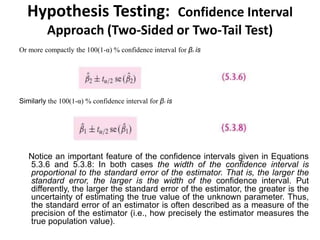
Or more compactly the 100(1-α) % confidence interval for β2 is
Similarly the 100(1-α) % confidence interval for β1 is
Notice an important feature of the confidence intervals given in Equations
5.3.6 and 5.3.8: In both cases the width of the confidence interval is
proportional to the standard error of the estimator. That is, the larger the
standard error, the larger is the width of the confidence interval. Put
differently, the larger the standard error of the estimator, the greater is the
uncertainty of estimating the true value of the unknown parameter. Thus,
the standard error of an estimator is often described as a measure of the
precision of the estimator (i.e., how precisely the estimator measures the
true population value).
Hypothesis Testing: Confidence Interval
Approach (Two-Sided or Two-Tail Test)
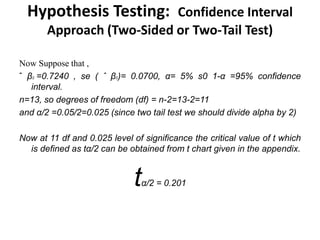
Now Suppose that ,
ˆ β2 =0.7240 , se ( ˆ β2)= 0.0700, α= 5% s0 1-α =95% confidence
interval.
n=13, so degrees of freedom (df) = n-2=13-2=11
and α/2 =0.05/2=0.025 (since two tail test we should divide alpha by 2)
Now at 11 df and 0.025 level of significance the critical value of t which
is defined as tα/2 can be obtained from t chart given in the appendix.
tα/2 = 0.201
Two-Sided or Two-Tail Test
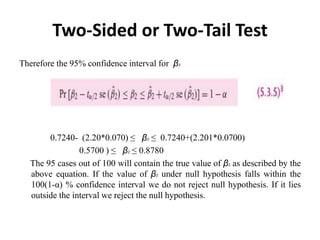
Therefore the 95% confidence interval for β2
0.7240- (2.20*0.070) ≤ β2 ≤ 0.7240+(2.201*0.0700)
0.5700 ) ≤ β2 ≤ 0.8780
The 95 cases out of 100 will contain the true value of β2 as described by the
above equation. If the value of β2 under null hypothesis falls within the
100(1-α) % confidence interval we do not reject null hypothesis. If it lies
outside the interval we reject the null hypothesis.
Two-Sided or Two-Tail Test
Hypothesis Testing: Confidence Interval
Approach (Two-Sided or Two-Tail Test)
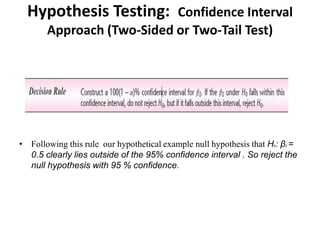
• Following this rule our hypothetical example null hypothesis that H0: β2 =
0.5 clearly lies outside of the 95% confidence interval . So reject the
null hypothesis with 95 % confidence.
One-Sided or One-Tail Test
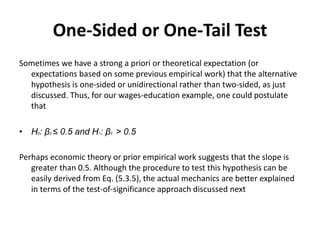
Sometimes we have a strong a priori or theoretical expectation (or
expectations based on some previous empirical work) that the alternative
hypothesis is one-sided or unidirectional rather than two-sided, as just
discussed. Thus, for our wages-education example, one could postulate
that
• H0: β2 ≤ 0.5 and H1: β2 > 0.5
Perhaps economic theory or prior empirical work suggests that the slope is
greater than 0.5. Although the procedure to test this hypothesis can be
easily derived from Eq. (5.3.5), the actual mechanics are better explained
in terms of the test-of-significance approach discussed next
Hypothesis Testing: The Test-of-
Significance Approach
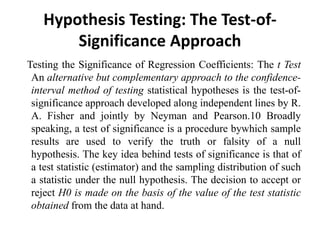
Testing the Significance of Regression Coefficients: The t Test
An alternative but complementary approach to the confidence-
interval method of testing statistical hypotheses is the test-of-
significance approach developed along independent lines by R.
A. Fisher and jointly by Neyman and Pearson.10 Broadly
speaking, a test of significance is a procedure bywhich sample
results are used to verify the truth or falsity of a null
hypothesis. The key idea behind tests of significance is that of
a test statistic (estimator) and the sampling distribution of such
a statistic under the null hypothesis. The decision to accept or
reject H0 is made on the basis of the value of the test statistic
obtained from the data at hand.
Hypothesis Testing: The Test-of-
Significance Approach
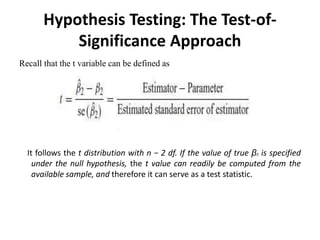
Recall that the t variable can be defined as
It follows the t distribution with n − 2 df. If the value of true β2 is specified
under the null hypothesis, the t value can readily be computed from the
available sample, and therefore it can serve as a test statistic.
Hypothesis Testing: The Test-of-
Significance Approach
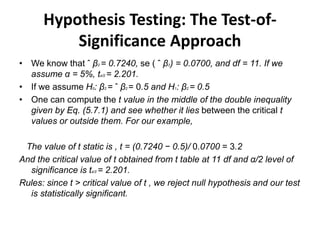
• We know that ˆ β2 = 0.7240, se ( ˆ β2) = 0.0700, and df = 11. If we
assume α = 5%, tα/2 = 2.201.
• If we assume H0: β2 = ˆ β2 = 0.5 and H1: β2 = 0.5
• One can compute the t value in the middle of the double inequality
given by Eq. (5.7.1) and see whether it lies between the critical t
values or outside them. For our example,
The value of t static is , t = (0.7240 − 0.5)/ 0.0700 = 3.2
And the critical value of t obtained from t table at 11 df and α/2 level of
significance is tα/2 = 2.201.
Rules: since t > critical value of t , we reject null hypothesis and our test
is statistically significant.
Hypothesis Testing: Confidence Interval VS
The Test-of-Significance Approach
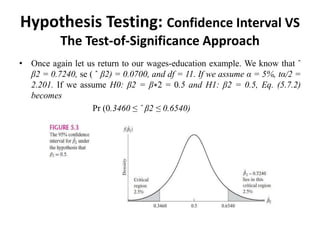
• Once again let us return to our wages-education example. We know that ˆ
β2 = 0.7240, se ( ˆ β2) = 0.0700, and df = 11. If we assume α = 5%, tα/2 =
2.201. If we assume H0: β2 = β∗2 = 0.5 and H1: β2 = 0.5, Eq. (5.7.2)
becomes
Pr (0.3460 ≤ ˆ β2 ≤ 0.6540)
Hypothesis Testing: Confidence Interval VS
The Test-of-Significance Approach
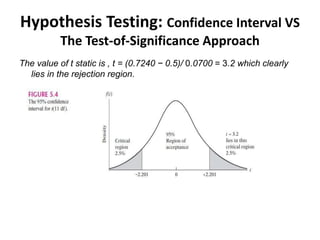
The value of t static is , t = (0.7240 − 0.5)/ 0.0700 = 3.2 which clearly
lies in the rejection region.
Hypothesis Testing: The Test-of-
Significance Approach
• Since we use the t distribution, the preceding testing procedure is called
appropriately the t test. In the language of significance tests, a statistic is
said to be statistically significant if the value of the test statistic lies in
the critical region. In this case the null hypothesis is rejected. By the
same token, a test is said to be statistically insignificant if the value of
the test statistic lies in the acceptance region. In this situation, the null
hypothesis is not rejected. In our example, the t test is significant and
hence we reject the null hypothesis.
Hypothesis Testing: The Test-of-Significance
Approach (One Tail Test)
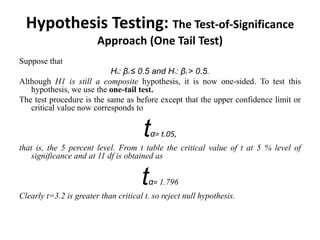
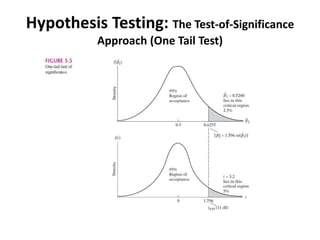
Suppose that
H0: β2 ≤ 0.5 and H1: β2 > 0.5.
Although H1 is still a composite hypothesis, it is now one-sided. To test this
hypothesis, we use the one-tail test.
The test procedure is the same as before except that the upper confidence limit or
critical value now corresponds to
tα= t.05,
that is, the 5 percent level. From t table the critical value of t at 5 % level of
significance and at 11 df is obtained as
tα= 1.796
Clearly t=3.2 is greater than critical t. so reject null hypothesis.
Hypothesis Testing: The Test-of-Significance
Approach (One Tail Test)
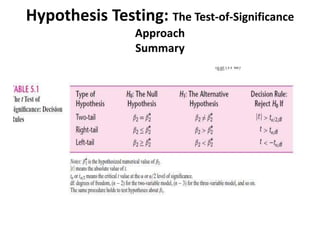
Hypothesis Testing: The Test-of-Significance
Approach
Summary
The “Zero” Null Hypothesis and the
“2-t” Rule of Thumb
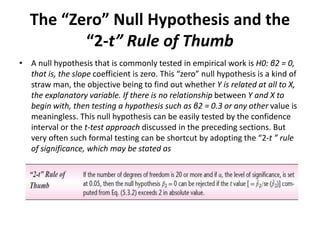
• A null hypothesis that is commonly tested in empirical work is H0: β2 = 0,
that is, the slope coefficient is zero. This “zero” null hypothesis is a kind of
straw man, the objective being to find out whether Y is related at all to X,
the explanatory variable. If there is no relationship between Y and X to
begin with, then testing a hypothesis such as β2 = 0.3 or any other value is
meaningless. This null hypothesis can be easily tested by the confidence
interval or the t-test approach discussed in the preceding sections. But
very often such formal testing can be shortcut by adopting the “2-t ” rule
of significance, which may be stated as
The “Zero” Null Hypothesis and the
“2-t” Rule of Thumb
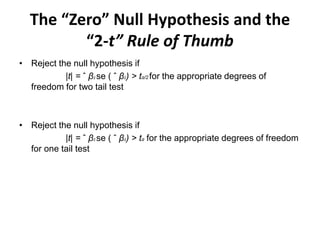
• Reject the null hypothesis if
|t| = ˆ β2 se ( ˆ β2) > tα/2 for the appropriate degrees of
freedom for two tail test
• Reject the null hypothesis if
|t| = ˆ β2 se ( ˆ β2) > tα for the appropriate degrees of freedom
for one tail test
Choosing α, the Level of Significance
It should be clear from the discussion so far that whether we reject or do not
reject the null hypothesis depends critically on α, the level of significance or
the probability of committing a Type I error—the probability of rejecting the
true hypothesis. If we try to reduce a Type I error, a Type II error increases, and
vice versa. That is, given the sample size, if we try to reduce the probability of
rejecting the true hypothesis, we at the same time increase the probability of
accepting the false hypothesis. So there is a trade-off involved between these
two types of errors given the sample size. Now the only way we can decide
about the trade-off is to find out the relative costs of the two types of errors.
Then, If the error of rejecting the null hypothesis which is in fact true (Error
Type I) is costly relative to the error of not rejecting the null hypothesis which
is in fact false (Error Type II), it will be rational to set the probability of the first
kind of error low. If, on the other hand, the cost of making Error Type I is low
relative to the cost of making Error Type II, it will pay to make the probability
of the first kind of error high (thus making the probability of the second type
of error low).
The Exact Level of Significance: The p
Value
The classical approach to hypothesis testing is its arbitrariness in selecting α. Once
a test statistic (e.g., the t statistic) is obtained in a given example, why not
simply go to the appropriate statistical table and find out the actual probability
of obtaining a value of the test statistic as much as or greater than that
obtained in the example?
This probability is called the p value (i.e., probability value), also known as the
observed or exact level of significance or the exact probability of committing
a Type I error. More technically, the p value is defined as the lowest
significance level at which a null hypothesis can be rejected.
To illustrate, let us return to our wages-education example. Given the null
hypothesis that the true coefficient of education is 0.5, we obtained a t value
of 3.2 in Eq. (5.7.4). What is the p value of obtaining a t value of as much as or
greater than 3.2? Looking up the t table given in Appendix D, we observe that
for 11 df the probability of obtaining such a t value must be smaller than
0.005 (one-tail) or 0.010 (two-tail).
Statistical Significance versus Practical
Significance
Read yourself from book
The Choice between Confidence-Interval and Test-of-
Significance Approaches to Hypothesis Testing
Read yourself from book
5.9 REGRESSION ANALYSIS AND ANALYSIS
OF VARIANCE
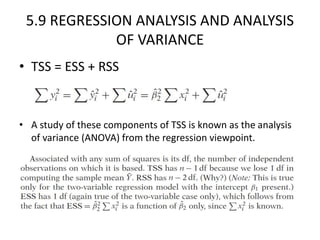
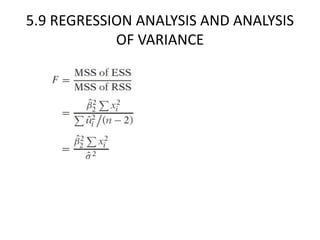
• TSS = ESS + RSS
• A study of these components of TSS is known as the analysis
of variance (ANOVA) from the regression viewpoint.
5.9 REGRESSION ANALYSIS AND ANALYSIS
OF VARIANCE
5.9 REGRESSION ANALYSIS AND ANALYSIS
OF VARIANCE
5.9 REGRESSION ANALYSIS AND ANALYSIS
OF VARIANCE
5.9 REGRESSION ANALYSIS AND ANALYSIS
OF VARIANCE
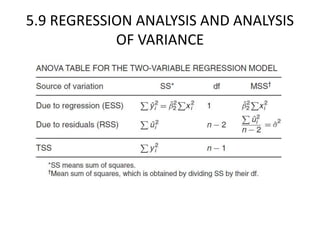
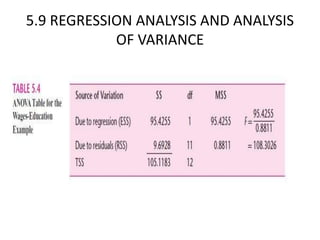
The computed F value is seen to be 108.3026. The p value of this F statistic
corresponding to 1 and 11 df cannot be obtained from the F table given in
Appendix D, but by using electronic statistical tables it can be shown that the p
value is 0.0000001, an extremely small probability indeed. If you decide to choose
the level-of significance approach to hypothesis testing and fix α at 0.01, or a 1
percent level, you can see that the computed F of 108.3026 is obviously significant
at this level. Therefore, if we reject the null hypothesis that β2 = 0, the probability
of committing a Type I error is very small. For all practical purposes, our sample
could not have come from a population with zero β2 value and we can conclude
with great confidence that X, education, does affect Y, average wages.
5.11 Reporting the Results of Regression
Analysis
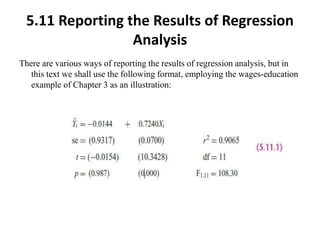
There are various ways of reporting the results of regression analysis, but in
this text we shall use the following format, employing the wages-education
example of Chapter 3 as an illustration:
5.11 Reporting the Results of Regression
Analysis
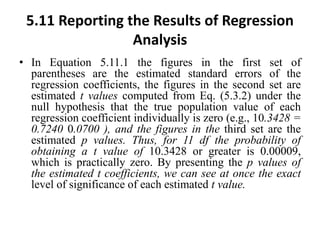
• In Equation 5.11.1 the figures in the first set of
parentheses are the estimated standard errors of the
regression coefficients, the figures in the second set are
estimated t values computed from Eq. (5.3.2) under the
null hypothesis that the true population value of each
regression coefficient individually is zero (e.g., 10.3428 =
0.7240 0.0700 ), and the figures in the third set are the
estimated p values. Thus, for 11 df the probability of
obtaining a t value of 10.3428 or greater is 0.00009,
which is practically zero. By presenting the p values of
the estimated t coefficients, we can see at once the exact
level of significance of each estimated t value.
5.11 Reporting the Results of Regression
Analysis
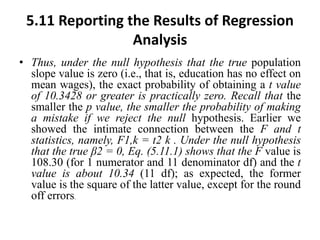
• Thus, under the null hypothesis that the true population
slope value is zero (i.e., that is, education has no effect on
mean wages), the exact probability of obtaining a t value
of 10.3428 or greater is practically zero. Recall that the
smaller the p value, the smaller the probability of making
a mistake if we reject the null hypothesis. Earlier we
showed the intimate connection between the F and t
statistics, namely, F1,k = t2 k . Under the null hypothesis
that the true β2 = 0, Eq. (5.11.1) shows that the F value is
108.30 (for 1 numerator and 11 denominator df) and the t
value is about 10.34 (11 df); as expected, the former
value is the square of the latter value, except for the round
off errors.
5.11 Reporting the Results of Regression
Analysis

Econometrics chapter 5-two-variable-regression-interval-estimation-

  • 1.
    ECONOMETRICS I Textbook: DamodarN. Gujarati, Basic Econometrics, The McGraw-Hill Companies
  • 2.
    5.5 HYPOTHESIS TESTING: GENERALCOMMENTS 1. Confidence interval approach 2. Test of significance approach Both these approaches predicate that the variable (statistic or estimator) under consideration has some probability distribution and that hypothesis testing involves making statements or assertions about the value(s) of the parameter(s) of such distribution.
  • 3.
    Hypothesis Testing: ConfidenceInterval Approach (Two-Sided or Two-Tail Test) To illustrate the confidence interval approach, once again we revert to our wages-education example. From the regression results given in Eq. (3.6.1), we know that the slope coefficient is 0.7240. Suppose we postulate that Null Hypothesis: H0: β2 = 0.5 and Alternative Hypothesis: H1: β2 = 0.5 Actually it is what is known as a two-sided hypothesis. Very often such a two-sided alternative hypothesis reflects the fact that we do not have a strong a priori or theoretical expectation about the direction in which the alternative hypothesis should move from the null hypothesis.
  • 4.
    Hypothesis Testing: ConfidenceInterval Approach (Two-Sided or Two-Tail Test) Is the observed ˆ β2 compatible with H0? To answer this question we need to construct confidence Interval for β2. We will do this- by using t distribution. The t variable can be defined as- This t variable follows a t distribution with n-2 df.
  • 5.
    Two-Sided or Two-TailTest Now lets define the 100(1-α) % confidence interval for β2 as follows: Substituting the value of t it can be rewritten as follows: Rearranging the above equation we can get,
  • 6.
    Hypothesis Testing: ConfidenceInterval Approach (Two-Sided or Two-Tail Test) Or more compactly the 100(1-α) % confidence interval for β2 is Similarly the 100(1-α) % confidence interval for β1 is Notice an important feature of the confidence intervals given in Equations 5.3.6 and 5.3.8: In both cases the width of the confidence interval is proportional to the standard error of the estimator. That is, the larger the standard error, the larger is the width of the confidence interval. Put differently, the larger the standard error of the estimator, the greater is the uncertainty of estimating the true value of the unknown parameter. Thus, the standard error of an estimator is often described as a measure of the precision of the estimator (i.e., how precisely the estimator measures the true population value).
  • 7.
    Hypothesis Testing: ConfidenceInterval Approach (Two-Sided or Two-Tail Test) Now Suppose that , ˆ β2 =0.7240 , se ( ˆ β2)= 0.0700, α= 5% s0 1-α =95% confidence interval. n=13, so degrees of freedom (df) = n-2=13-2=11 and α/2 =0.05/2=0.025 (since two tail test we should divide alpha by 2) Now at 11 df and 0.025 level of significance the critical value of t which is defined as tα/2 can be obtained from t chart given in the appendix. tα/2 = 0.201
  • 8.
    Two-Sided or Two-TailTest Therefore the 95% confidence interval for β2 0.7240- (2.20*0.070) ≤ β2 ≤ 0.7240+(2.201*0.0700) 0.5700 ) ≤ β2 ≤ 0.8780 The 95 cases out of 100 will contain the true value of β2 as described by the above equation. If the value of β2 under null hypothesis falls within the 100(1-α) % confidence interval we do not reject null hypothesis. If it lies outside the interval we reject the null hypothesis.
  • 9.
  • 10.
    Hypothesis Testing: ConfidenceInterval Approach (Two-Sided or Two-Tail Test) • Following this rule our hypothetical example null hypothesis that H0: β2 = 0.5 clearly lies outside of the 95% confidence interval . So reject the null hypothesis with 95 % confidence.
  • 11.
    One-Sided or One-TailTest Sometimes we have a strong a priori or theoretical expectation (or expectations based on some previous empirical work) that the alternative hypothesis is one-sided or unidirectional rather than two-sided, as just discussed. Thus, for our wages-education example, one could postulate that • H0: β2 ≤ 0.5 and H1: β2 > 0.5 Perhaps economic theory or prior empirical work suggests that the slope is greater than 0.5. Although the procedure to test this hypothesis can be easily derived from Eq. (5.3.5), the actual mechanics are better explained in terms of the test-of-significance approach discussed next
  • 12.
    Hypothesis Testing: TheTest-of- Significance Approach Testing the Significance of Regression Coefficients: The t Test An alternative but complementary approach to the confidence- interval method of testing statistical hypotheses is the test-of- significance approach developed along independent lines by R. A. Fisher and jointly by Neyman and Pearson.10 Broadly speaking, a test of significance is a procedure bywhich sample results are used to verify the truth or falsity of a null hypothesis. The key idea behind tests of significance is that of a test statistic (estimator) and the sampling distribution of such a statistic under the null hypothesis. The decision to accept or reject H0 is made on the basis of the value of the test statistic obtained from the data at hand.
  • 13.
    Hypothesis Testing: TheTest-of- Significance Approach Recall that the t variable can be defined as It follows the t distribution with n − 2 df. If the value of true β2 is specified under the null hypothesis, the t value can readily be computed from the available sample, and therefore it can serve as a test statistic.
  • 14.
    Hypothesis Testing: TheTest-of- Significance Approach • We know that ˆ β2 = 0.7240, se ( ˆ β2) = 0.0700, and df = 11. If we assume α = 5%, tα/2 = 2.201. • If we assume H0: β2 = ˆ β2 = 0.5 and H1: β2 = 0.5 • One can compute the t value in the middle of the double inequality given by Eq. (5.7.1) and see whether it lies between the critical t values or outside them. For our example, The value of t static is , t = (0.7240 − 0.5)/ 0.0700 = 3.2 And the critical value of t obtained from t table at 11 df and α/2 level of significance is tα/2 = 2.201. Rules: since t > critical value of t , we reject null hypothesis and our test is statistically significant.
  • 15.
    Hypothesis Testing: ConfidenceInterval VS The Test-of-Significance Approach • Once again let us return to our wages-education example. We know that ˆ β2 = 0.7240, se ( ˆ β2) = 0.0700, and df = 11. If we assume α = 5%, tα/2 = 2.201. If we assume H0: β2 = β∗2 = 0.5 and H1: β2 = 0.5, Eq. (5.7.2) becomes Pr (0.3460 ≤ ˆ β2 ≤ 0.6540)
  • 16.
    Hypothesis Testing: ConfidenceInterval VS The Test-of-Significance Approach The value of t static is , t = (0.7240 − 0.5)/ 0.0700 = 3.2 which clearly lies in the rejection region.
  • 17.
    Hypothesis Testing: TheTest-of- Significance Approach • Since we use the t distribution, the preceding testing procedure is called appropriately the t test. In the language of significance tests, a statistic is said to be statistically significant if the value of the test statistic lies in the critical region. In this case the null hypothesis is rejected. By the same token, a test is said to be statistically insignificant if the value of the test statistic lies in the acceptance region. In this situation, the null hypothesis is not rejected. In our example, the t test is significant and hence we reject the null hypothesis.
  • 18.
    Hypothesis Testing: TheTest-of-Significance Approach (One Tail Test) Suppose that H0: β2 ≤ 0.5 and H1: β2 > 0.5. Although H1 is still a composite hypothesis, it is now one-sided. To test this hypothesis, we use the one-tail test. The test procedure is the same as before except that the upper confidence limit or critical value now corresponds to tα= t.05, that is, the 5 percent level. From t table the critical value of t at 5 % level of significance and at 11 df is obtained as tα= 1.796 Clearly t=3.2 is greater than critical t. so reject null hypothesis.
  • 19.
    Hypothesis Testing: TheTest-of-Significance Approach (One Tail Test)
  • 20.
    Hypothesis Testing: TheTest-of-Significance Approach Summary
  • 21.
    The “Zero” NullHypothesis and the “2-t” Rule of Thumb • A null hypothesis that is commonly tested in empirical work is H0: β2 = 0, that is, the slope coefficient is zero. This “zero” null hypothesis is a kind of straw man, the objective being to find out whether Y is related at all to X, the explanatory variable. If there is no relationship between Y and X to begin with, then testing a hypothesis such as β2 = 0.3 or any other value is meaningless. This null hypothesis can be easily tested by the confidence interval or the t-test approach discussed in the preceding sections. But very often such formal testing can be shortcut by adopting the “2-t ” rule of significance, which may be stated as
  • 22.
    The “Zero” NullHypothesis and the “2-t” Rule of Thumb • Reject the null hypothesis if |t| = ˆ β2 se ( ˆ β2) > tα/2 for the appropriate degrees of freedom for two tail test • Reject the null hypothesis if |t| = ˆ β2 se ( ˆ β2) > tα for the appropriate degrees of freedom for one tail test
  • 23.
    Choosing α, theLevel of Significance It should be clear from the discussion so far that whether we reject or do not reject the null hypothesis depends critically on α, the level of significance or the probability of committing a Type I error—the probability of rejecting the true hypothesis. If we try to reduce a Type I error, a Type II error increases, and vice versa. That is, given the sample size, if we try to reduce the probability of rejecting the true hypothesis, we at the same time increase the probability of accepting the false hypothesis. So there is a trade-off involved between these two types of errors given the sample size. Now the only way we can decide about the trade-off is to find out the relative costs of the two types of errors. Then, If the error of rejecting the null hypothesis which is in fact true (Error Type I) is costly relative to the error of not rejecting the null hypothesis which is in fact false (Error Type II), it will be rational to set the probability of the first kind of error low. If, on the other hand, the cost of making Error Type I is low relative to the cost of making Error Type II, it will pay to make the probability of the first kind of error high (thus making the probability of the second type of error low).
  • 24.
    The Exact Levelof Significance: The p Value The classical approach to hypothesis testing is its arbitrariness in selecting α. Once a test statistic (e.g., the t statistic) is obtained in a given example, why not simply go to the appropriate statistical table and find out the actual probability of obtaining a value of the test statistic as much as or greater than that obtained in the example? This probability is called the p value (i.e., probability value), also known as the observed or exact level of significance or the exact probability of committing a Type I error. More technically, the p value is defined as the lowest significance level at which a null hypothesis can be rejected. To illustrate, let us return to our wages-education example. Given the null hypothesis that the true coefficient of education is 0.5, we obtained a t value of 3.2 in Eq. (5.7.4). What is the p value of obtaining a t value of as much as or greater than 3.2? Looking up the t table given in Appendix D, we observe that for 11 df the probability of obtaining such a t value must be smaller than 0.005 (one-tail) or 0.010 (two-tail).
  • 25.
    Statistical Significance versusPractical Significance Read yourself from book
  • 26.
    The Choice betweenConfidence-Interval and Test-of- Significance Approaches to Hypothesis Testing Read yourself from book
  • 27.
    5.9 REGRESSION ANALYSISAND ANALYSIS OF VARIANCE • TSS = ESS + RSS • A study of these components of TSS is known as the analysis of variance (ANOVA) from the regression viewpoint.
  • 28.
    5.9 REGRESSION ANALYSISAND ANALYSIS OF VARIANCE
  • 29.
    5.9 REGRESSION ANALYSISAND ANALYSIS OF VARIANCE
  • 30.
    5.9 REGRESSION ANALYSISAND ANALYSIS OF VARIANCE
  • 31.
    5.9 REGRESSION ANALYSISAND ANALYSIS OF VARIANCE The computed F value is seen to be 108.3026. The p value of this F statistic corresponding to 1 and 11 df cannot be obtained from the F table given in Appendix D, but by using electronic statistical tables it can be shown that the p value is 0.0000001, an extremely small probability indeed. If you decide to choose the level-of significance approach to hypothesis testing and fix α at 0.01, or a 1 percent level, you can see that the computed F of 108.3026 is obviously significant at this level. Therefore, if we reject the null hypothesis that β2 = 0, the probability of committing a Type I error is very small. For all practical purposes, our sample could not have come from a population with zero β2 value and we can conclude with great confidence that X, education, does affect Y, average wages.
  • 32.
    5.11 Reporting theResults of Regression Analysis There are various ways of reporting the results of regression analysis, but in this text we shall use the following format, employing the wages-education example of Chapter 3 as an illustration:
  • 33.
    5.11 Reporting theResults of Regression Analysis • In Equation 5.11.1 the figures in the first set of parentheses are the estimated standard errors of the regression coefficients, the figures in the second set are estimated t values computed from Eq. (5.3.2) under the null hypothesis that the true population value of each regression coefficient individually is zero (e.g., 10.3428 = 0.7240 0.0700 ), and the figures in the third set are the estimated p values. Thus, for 11 df the probability of obtaining a t value of 10.3428 or greater is 0.00009, which is practically zero. By presenting the p values of the estimated t coefficients, we can see at once the exact level of significance of each estimated t value.
  • 34.
    5.11 Reporting theResults of Regression Analysis • Thus, under the null hypothesis that the true population slope value is zero (i.e., that is, education has no effect on mean wages), the exact probability of obtaining a t value of 10.3428 or greater is practically zero. Recall that the smaller the p value, the smaller the probability of making a mistake if we reject the null hypothesis. Earlier we showed the intimate connection between the F and t statistics, namely, F1,k = t2 k . Under the null hypothesis that the true β2 = 0, Eq. (5.11.1) shows that the F value is 108.30 (for 1 numerator and 11 denominator df) and the t value is about 10.34 (11 df); as expected, the former value is the square of the latter value, except for the round off errors.
  • 35.
    5.11 Reporting theResults of Regression Analysis