Basic Econometrics
Introduction:
What is
Econometrics?
Introduction
What is Econometrics?
• Definition 1: Economic Measurement
•
• Definition 2: Application of the
mathematical statistics to economic
data in order to lend empirical support
to the economic mathematical models
and obtain numerical results (Gerhard
Tintner, 1968)
Introduction
What is Econometrics?
• Definition 3: The quantitative
analysis of actual economic
phenomena based on concurrent
development of theory and
observation, related by appropriate
methods of inference
• (P.A.Samuelson, T.C.Koopmans and
J.R.N.Stone, 1954)
Econometrics
Economic
Theory
Mathematical
Economics
Economic
Statistics
Mathematic
Statistics
Introduction
Why a separate discipline?
• Economic theory makes statements
that are mostly qualitative in nature,
while econometrics gives empirical
content to most economic theory
• Mathematical economics is to
express economic theory in mathematical
form without empirical verification of the
theory, while econometrics is mainly
interested in the later
Introduction
Why a separate discipline?
• Economic Statistics is mainly
concerned with collecting,
processing and presenting
economic data. It does not being
concerned with using the collected
data to test economic theories
• Mathematical statistics provides
many of tools for economic studies, but
econometrics supplies the later with many
special methods of quantitative analysis based
on economic data
Econometrics
Economic
Theory
Mathematical
Economics
Economic
Statistics
Mathematic
Statistics
Introduction
Methodology of
Econometrics
(1)Statement of theory or
hypothesis:
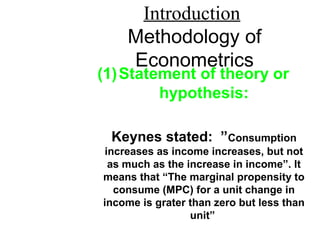
Keynes stated: ”Consumption
increases as income increases, but not
as much as the increase in income”. It
means that “The marginal propensity to
consume (MPC) for a unit change in
income is grater than zero but less than
unit”
Introduction
Methodology of
Econometrics
(2) Specification of the
mathematical model of the
theory
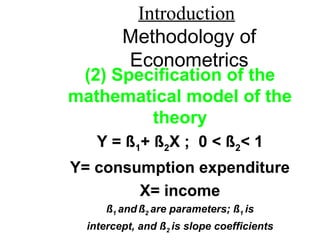
Y = ß1+ ß2X ; 0 < ß2< 1
Y= consumption expenditure
X= income
ß1 and ß2 are parameters; ß1 is
intercept, and ß2 is slope coefficients
Introduction
Methodology of
Econometrics
(3) Specification of the
econometric model of the
theory
Y = ß1+ ß2X + u ; 0 < ß2< 1;
Y = consumption
expenditure;
X = income;
ß1 and ß2 are parameters; ß1is
Introduction
Methodology of
Econometrics
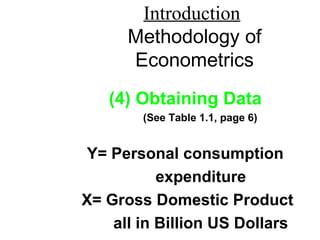
(4) Obtaining Data
(See Table 1.1, page 6)
Y= Personal consumption
expenditure
X= Gross Domestic Product
all in Billion US Dollars
Introduction
Methodology of
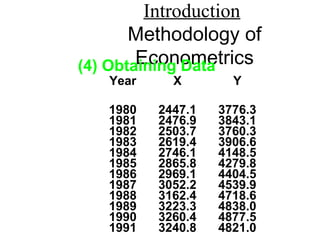
Econometrics(4) Obtaining Data
Year X Y
1980
1981
1982
1983
1984
1985
1986
1987
1988
1989
1990
1991
2447.1
2476.9
2503.7
2619.4
2746.1
2865.8
2969.1
3052.2
3162.4
3223.3
3260.4
3240.8
3776.3
3843.1
3760.3
3906.6
4148.5
4279.8
4404.5
4539.9
4718.6
4838.0
4877.5
4821.0
Introduction
Methodology of
Econometrics
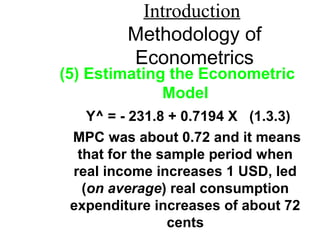
(5) Estimating the Econometric
Model
Y^ = - 231.8 + 0.7194 X (1.3.3)
MPC was about 0.72 and it means
that for the sample period when
real income increases 1 USD, led
(on average) real consumption
expenditure increases of about 72
cents
Introduction
Methodology of Econometrics
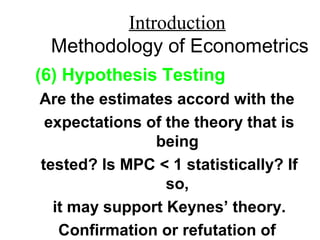
(6) Hypothesis Testing
Are the estimates accord with the
expectations of the theory that is
being
tested? Is MPC < 1 statistically? If
so,
it may support Keynes’ theory.
Confirmation or refutation of
Introduction
Methodology of
Econometrics
(7) Forecasting or Prediction
• With given future value(s) of X,
what is the future value(s) of Y?
• GDP=$6000Bill in 1994, what is
the forecast consumption
expenditure?
• Y^= - 231.8+0.7196(6000) = 4084.6
• Income Multiplier M = 1/(1 – MPC)
(=3.57). decrease (increase) of $1
Introduction
Methodology of
Econometrics
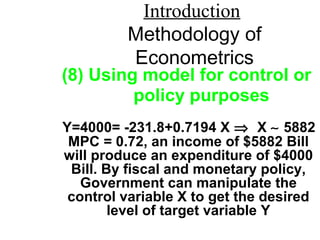
(8) Using model for control or
policy purposes
Y=4000= -231.8+0.7194 X ⇒ X ∼ 5882
MPC = 0.72, an income of $5882 Bill
will produce an expenditure of $4000
Bill. By fiscal and monetary policy,
Government can manipulate the
control variable X to get the desired
level of target variable Y
Introduction
Methodology of Econometrics
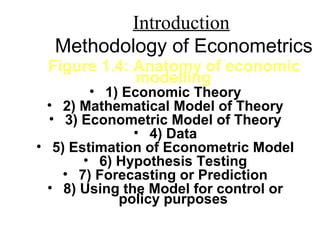
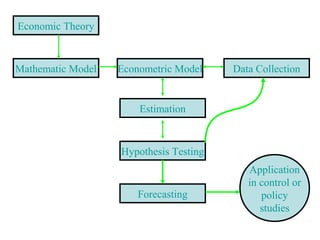
Figure 1.4: Anatomy of economic
modelling
• 1) Economic Theory
• 2) Mathematical Model of Theory
• 3) Econometric Model of Theory
• 4) Data
• 5) Estimation of Econometric Model
• 6) Hypothesis Testing
• 7) Forecasting or Prediction
• 8) Using the Model for control or
policy purposes
Economic Theory
Mathematic Model Econometric Model Data Collection
Estimation
Hypothesis Testing
Forecasting
Application
in control or
policy
studies

Basic econometrics lectues_1