2.1 Point Estimation
POINT ESTIMATIONPOINT ESTIMATE :-An estimate of a population parameter given by a 	   single number is called point estimatePOINT ESTIMATOR  :-A point estimator is a statistic for Estimating  the 	    population Parameter  ө and  will be denoted by ө*
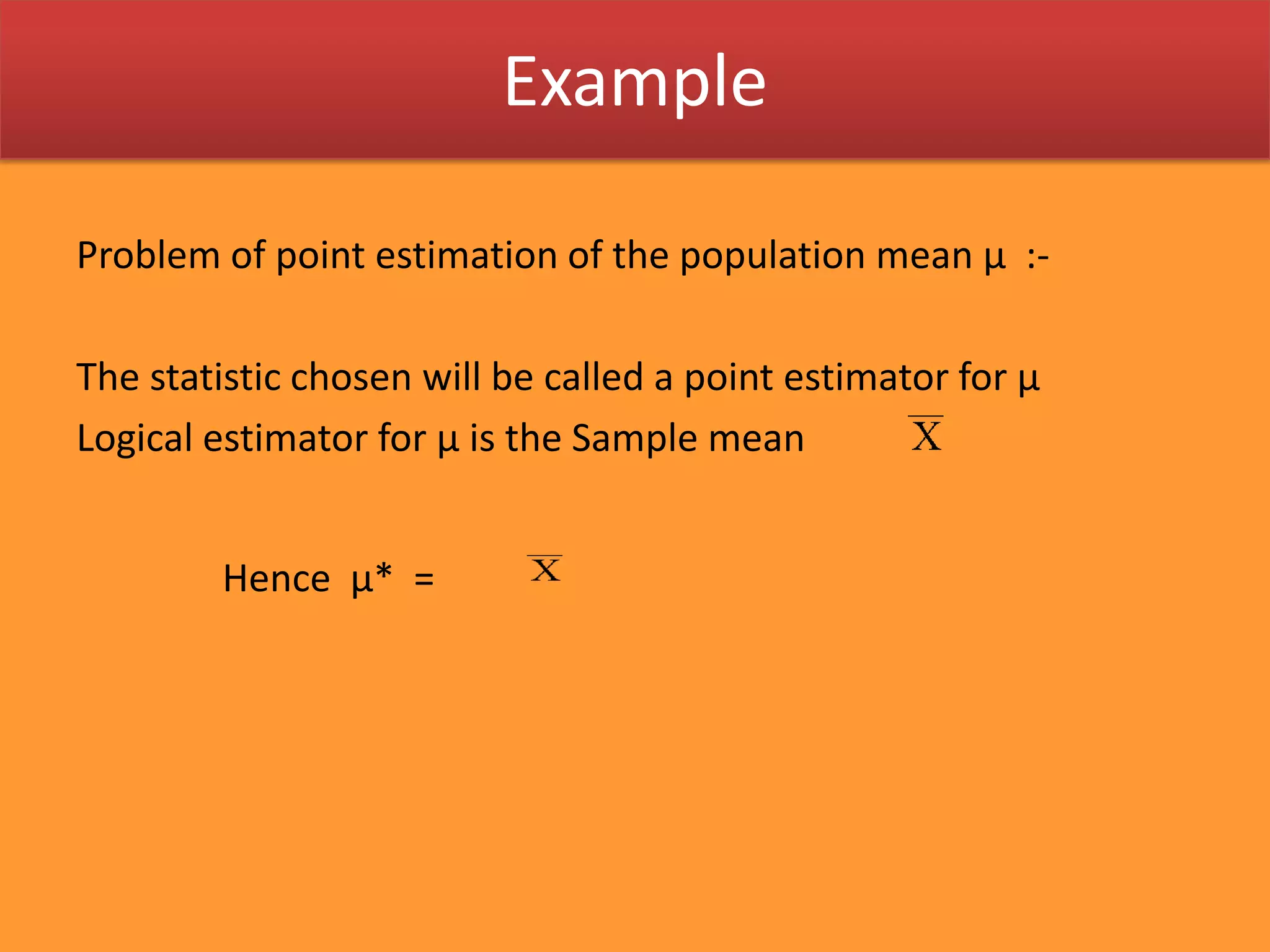
ExampleProblem of point estimation of the population mean µ :-The statistic chosen will be called a point estimator for µLogical estimator for µ is the Sample mean  Hence µ*  =
UNBIASED ESTIMATORUnbiased Estimator:-If the mean of sampling distribution of a Statistic equals     the corresponding Population Parameter,the Statistic is     called an Unbiased Estimator of the Parameter         i.e    E(ө*) =  өBiased  Estimator:-                If E(ө*)≠  ө    		      i.e  Estimator is not Unbiased.Bias Of Estimator      Bias of Estimator = E(ө*) - ө
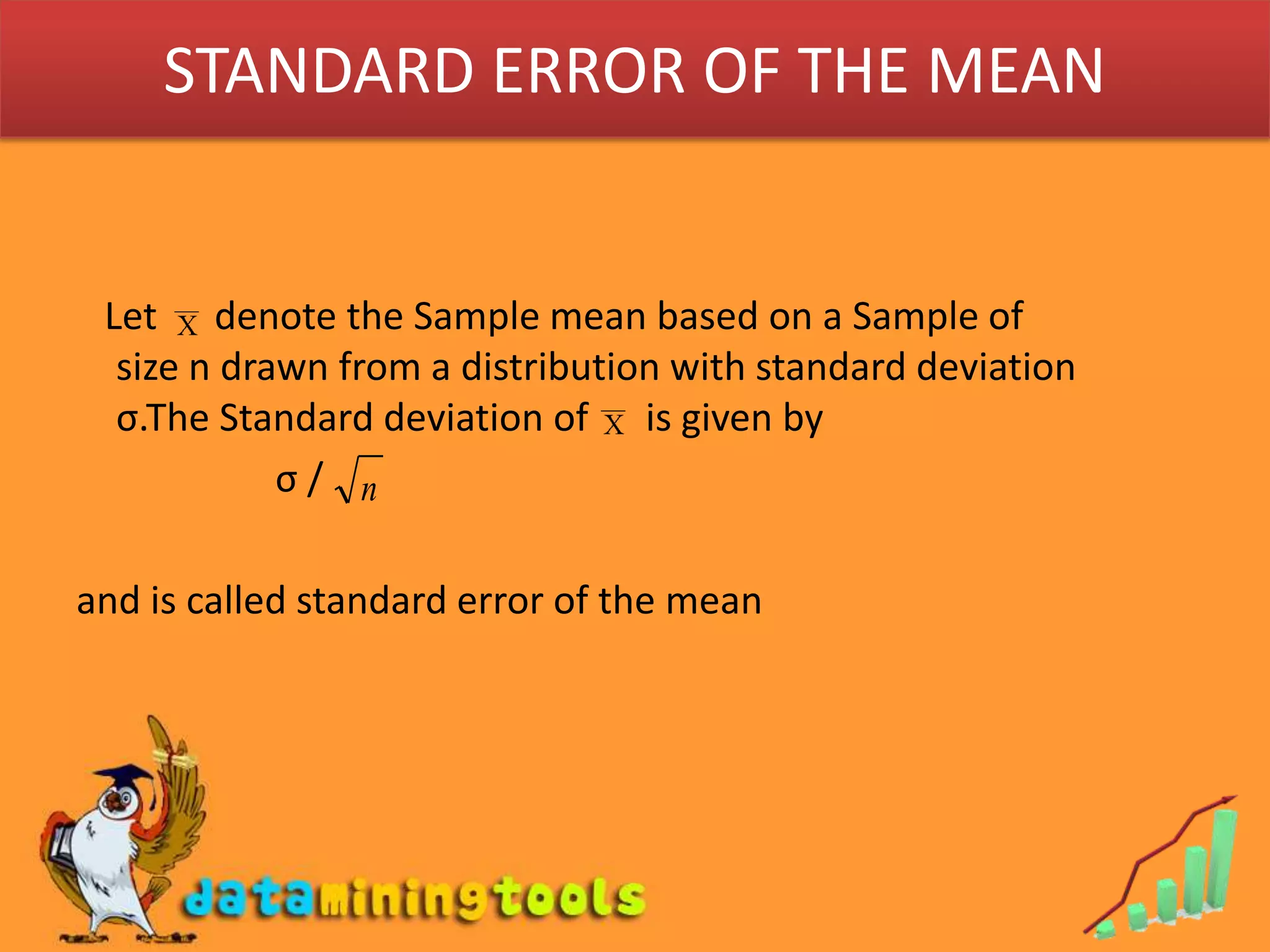
STANDARD ERROR OF THE MEAN   Let      denote the Sample mean based on a Sample of size n drawn from a distribution with standard deviation σ.The Standard deviation of      is given byσ /and is called standard error of the mean
METHODS FOR FINDINGS ESTIMATORS:-METHOD OF MAXIMUM LIKELIHOOD ESTIMATIONMETHOD OF MOMENTS
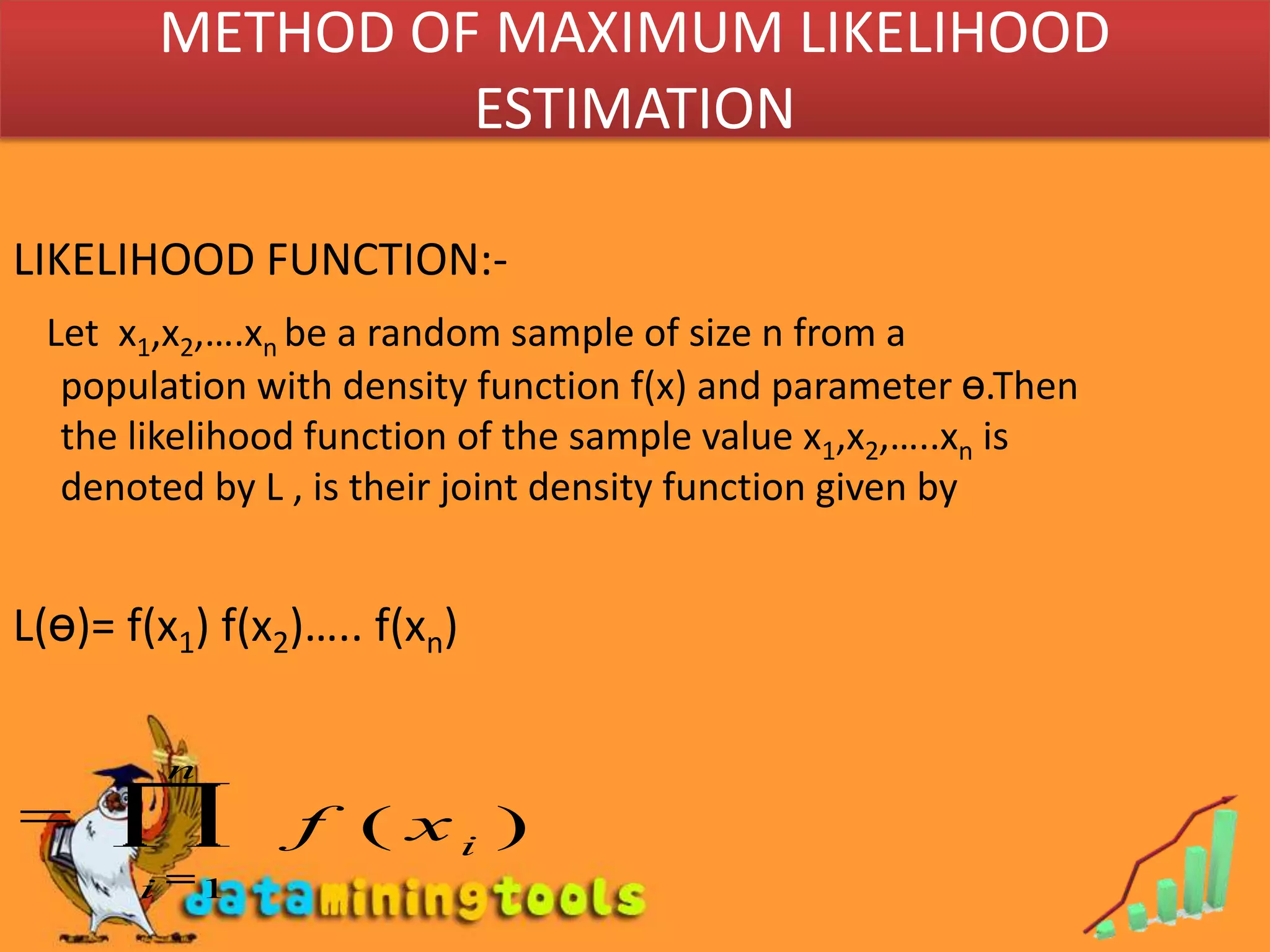
METHOD OF MAXIMUM LIKELIHOOD ESTIMATIONLIKELIHOOD FUNCTION:-Let  x1,x2,….xn be a random sample of size n from a population with density function f(x) and parameter ө.Then  the likelihood function of the sample value x1,x2,…..xn is denoted by L , is their joint density function given byL(ө)= f(x1) f(x2)….. f(xn)
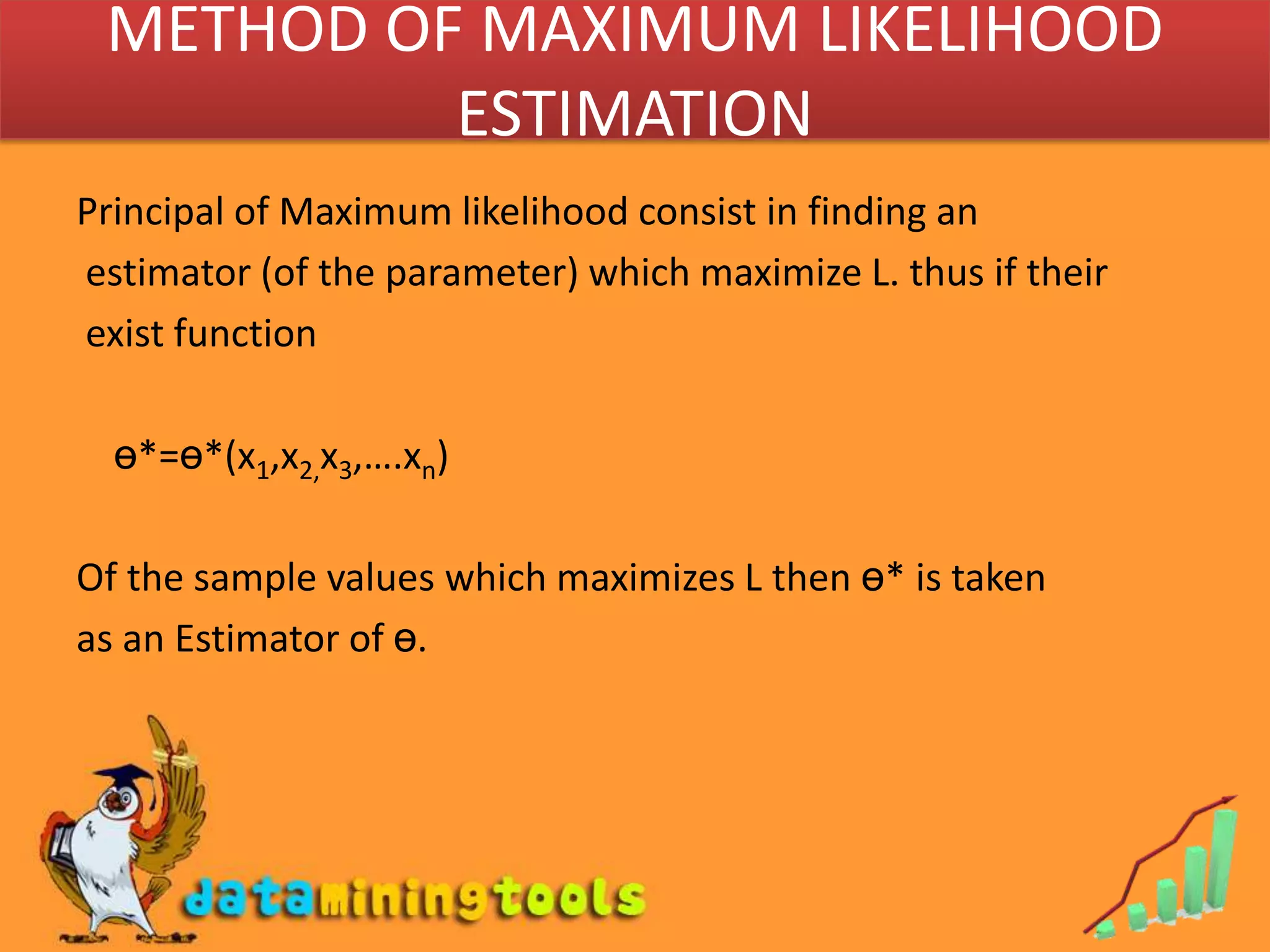
METHOD OF MAXIMUM LIKELIHOOD ESTIMATIONPrincipal of Maximum likelihood consist in finding an estimator (of the parameter) which maximize L. thus if their exist functionө*=ө*(x1,x2,x3,….xn)Of the sample values which maximizes L then ө* is taken as an Estimator of ө.
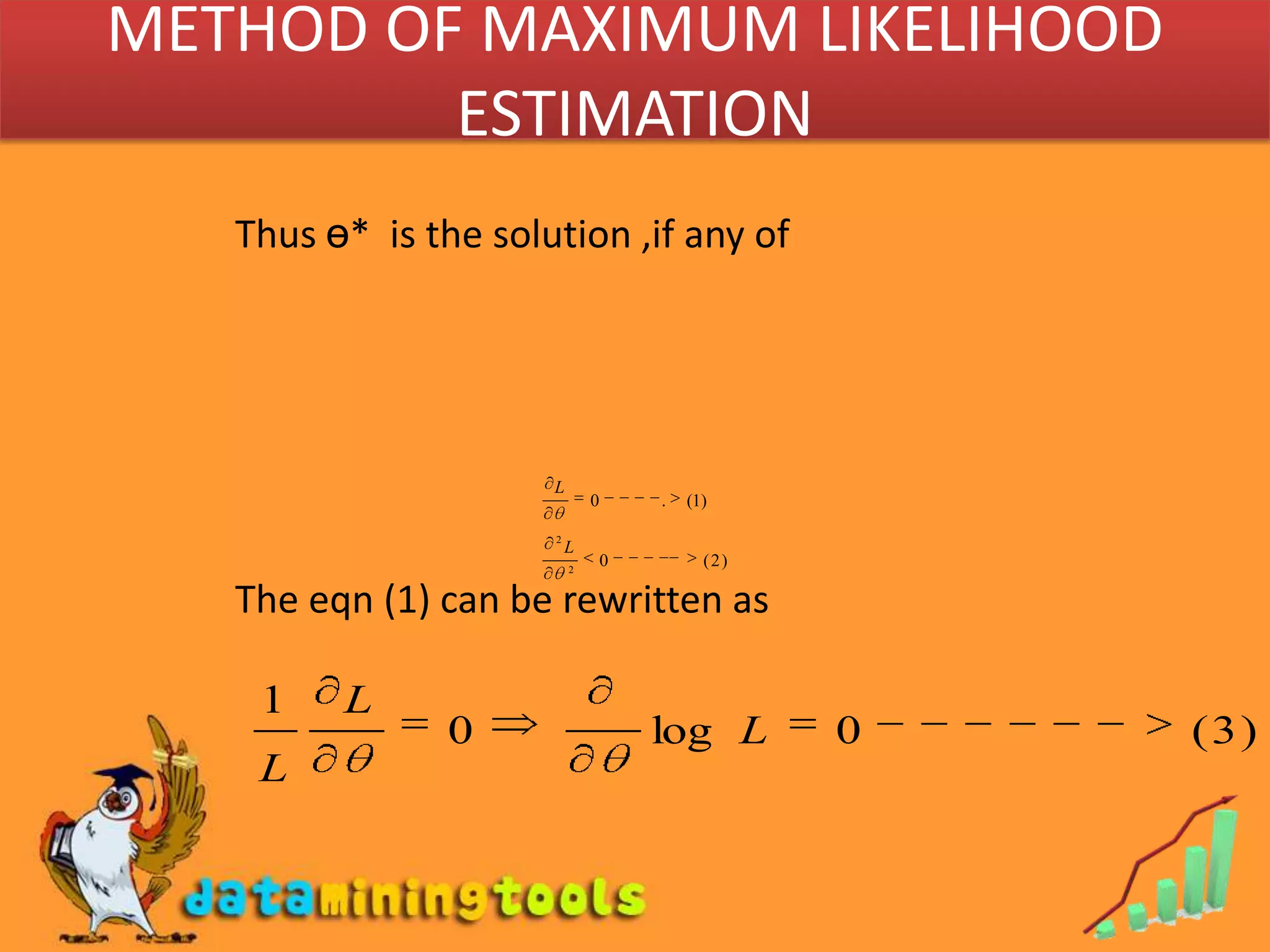
METHOD OF MAXIMUM LIKELIHOOD ESTIMATIONThus ө*  is the solution ,if any ofThe eqn (1) can be rewritten as
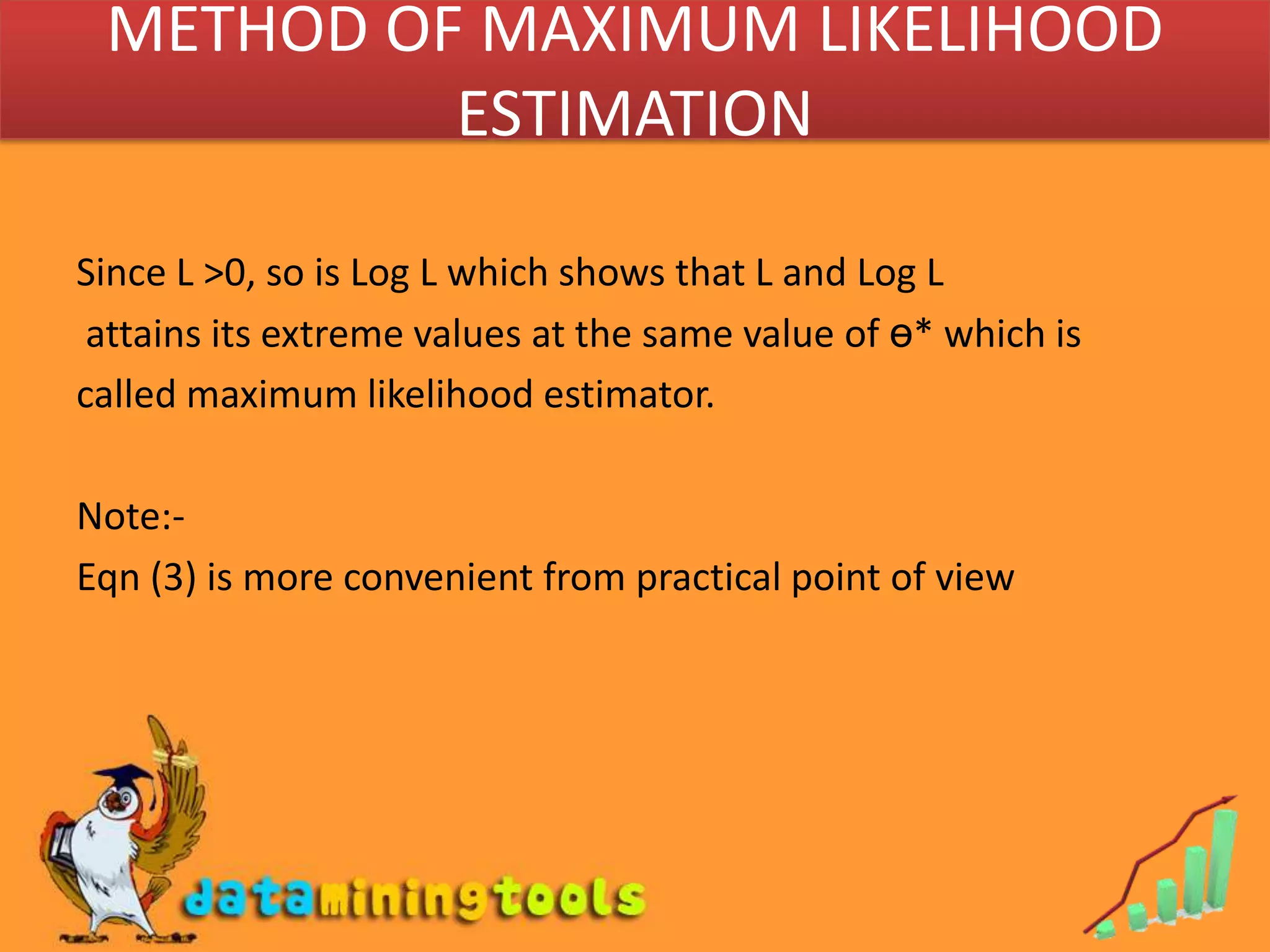
METHOD OF MAXIMUM LIKELIHOOD ESTIMATIONSince L >0, so is Log L which shows that L and Log L attains its extreme values at the same value of ө* which is called maximum likelihood estimator.Note:-Eqn (3) is more convenient from practical point of view
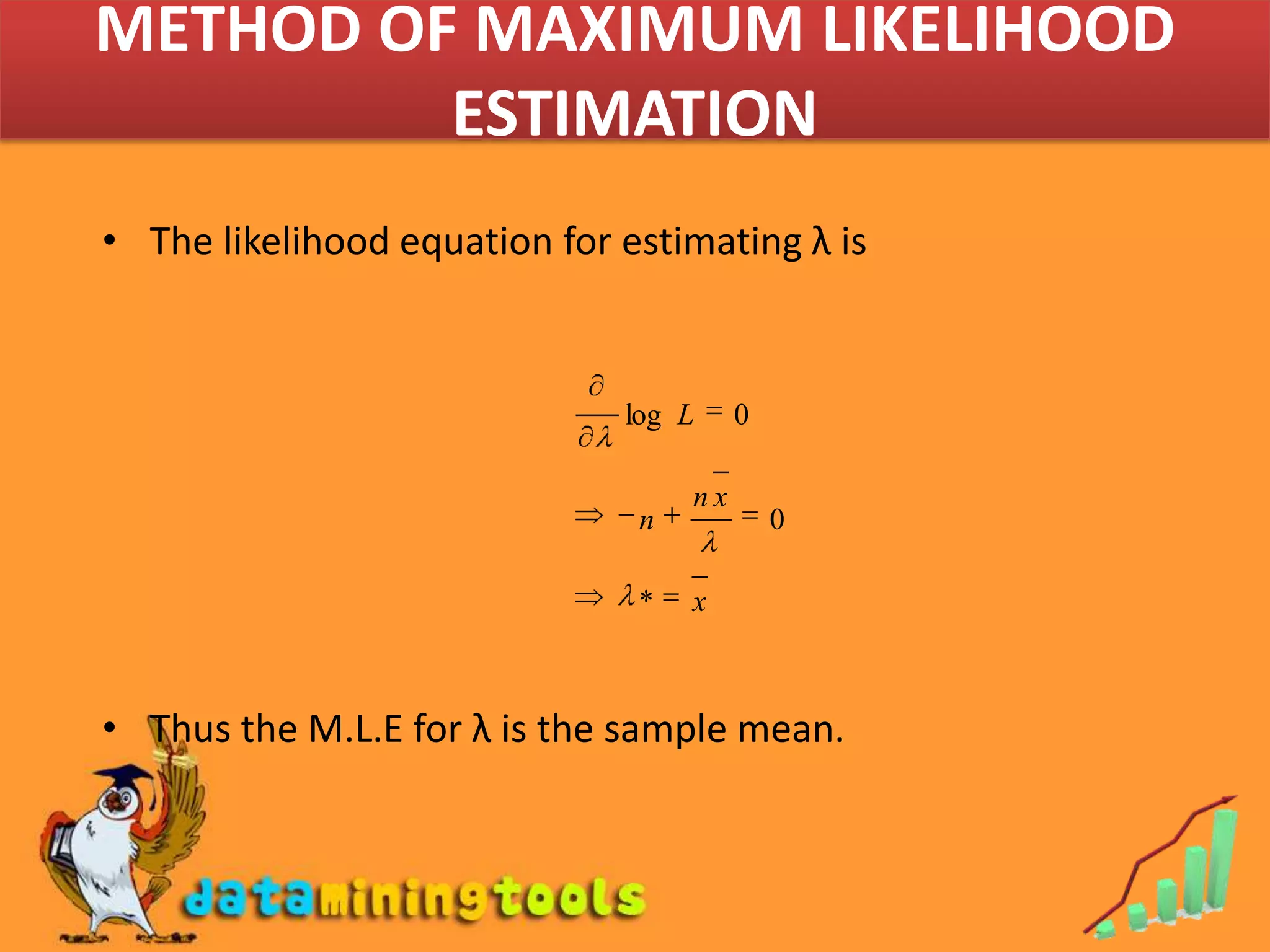
METHOD OF MAXIMUM LIKELIHOOD ESTIMATIONThe likelihood equation for estimating λisThus the M.L.E for λ is the sample mean.
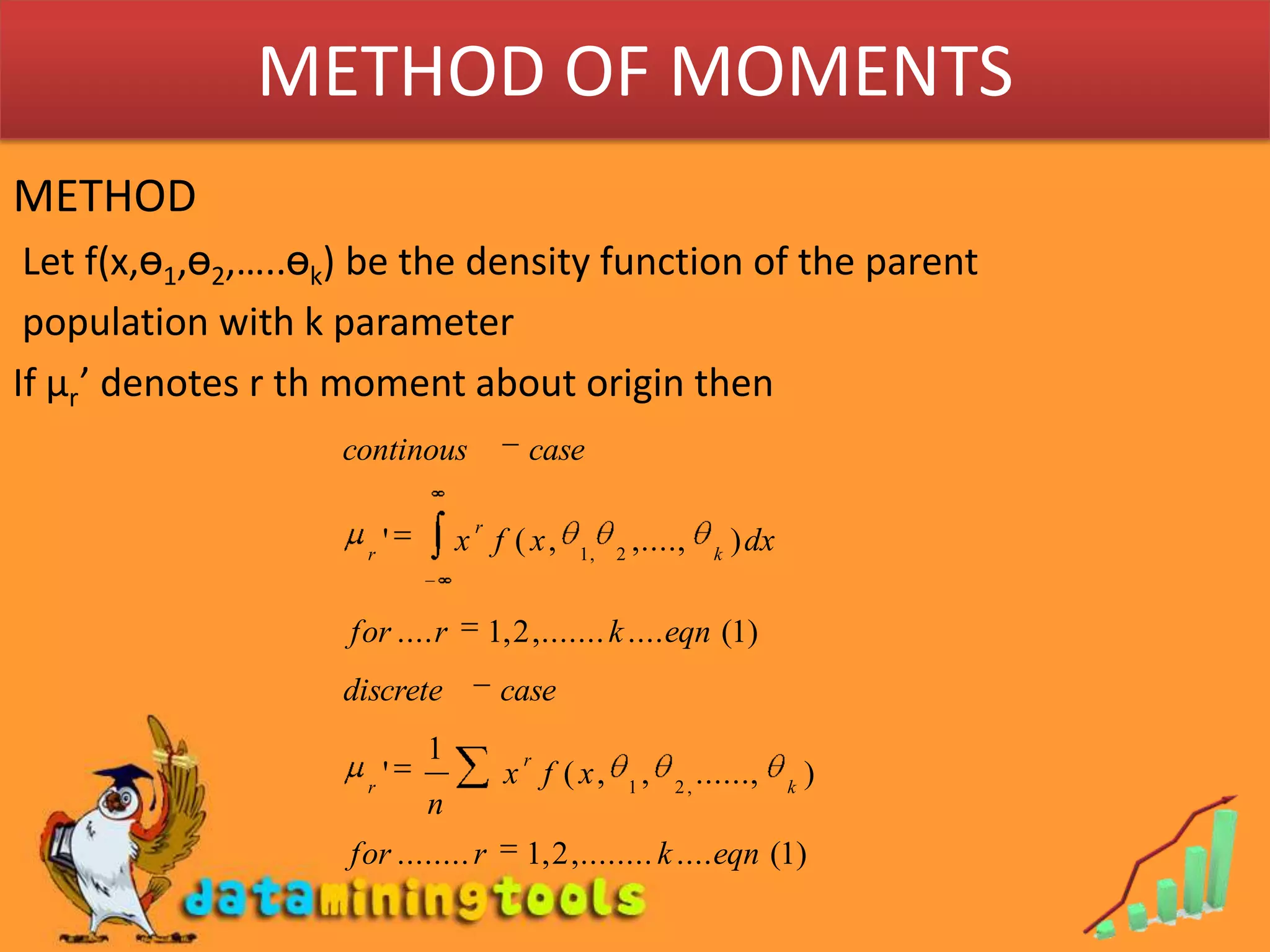
METHOD OF MOMENTSMETHOD Let f(x,ө1,ө2,…..өk) be the density function of the parent population with k parameterIf µr’ denotes r th moment about origin then
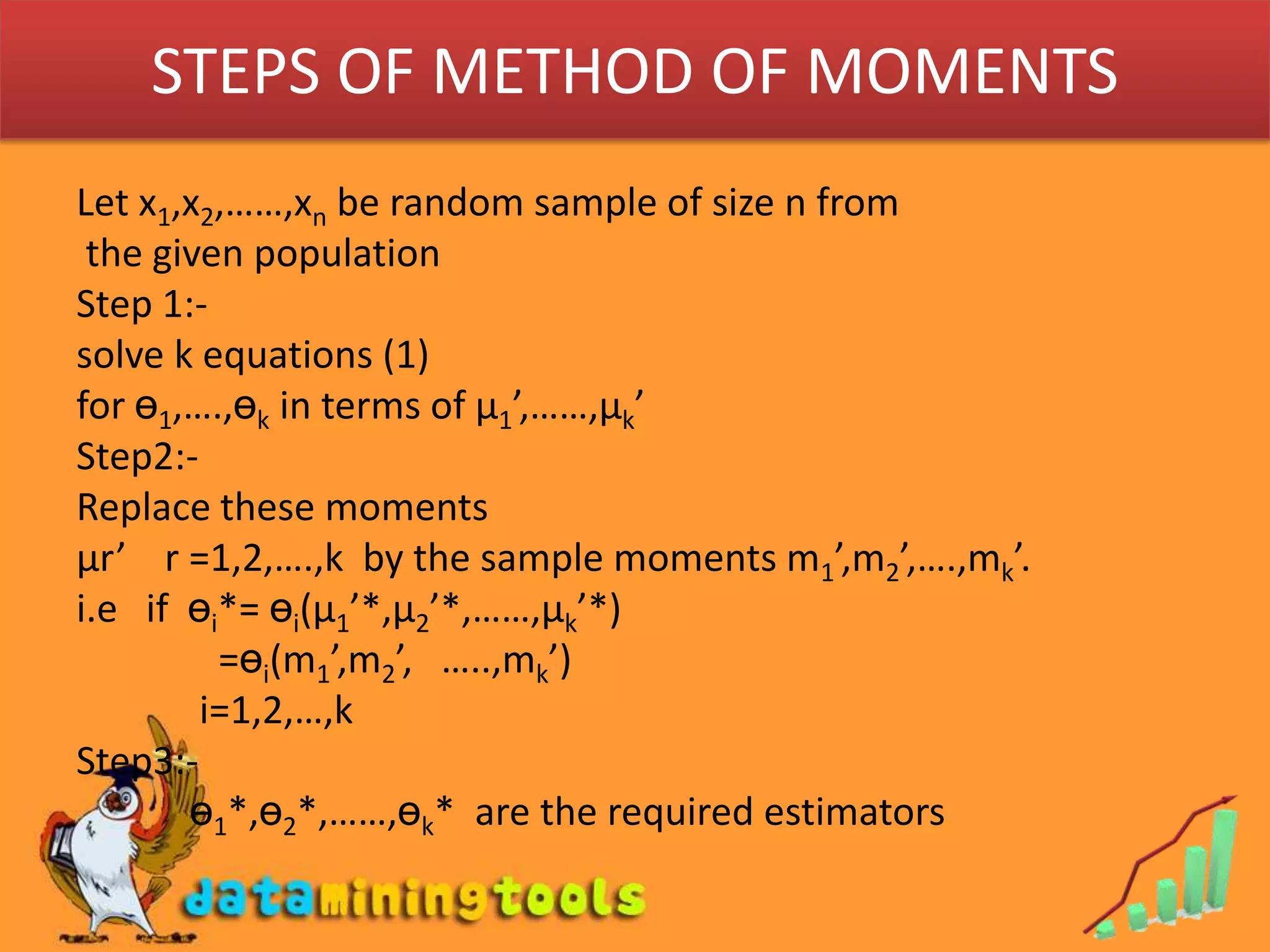
STEPS OF METHOD OF MOMENTSLet x1,x2,……,xn be random sample of size n from the given populationStep 1:-solve k equations (1)for ө1,….,өk in terms of µ1’,……,µk’Step2:-Replace these momentsµr’    r =1,2,….,k  by the sample moments m1’,m2’,….,mk’.i.e   if  өi*= өi(µ1’*,µ2’*,……,µk’*)               =өi(m1’,m2’,   …..,mk’)             i=1,2,…,kStep3:-ө1*,ө2*,……,өk*  are the required estimators
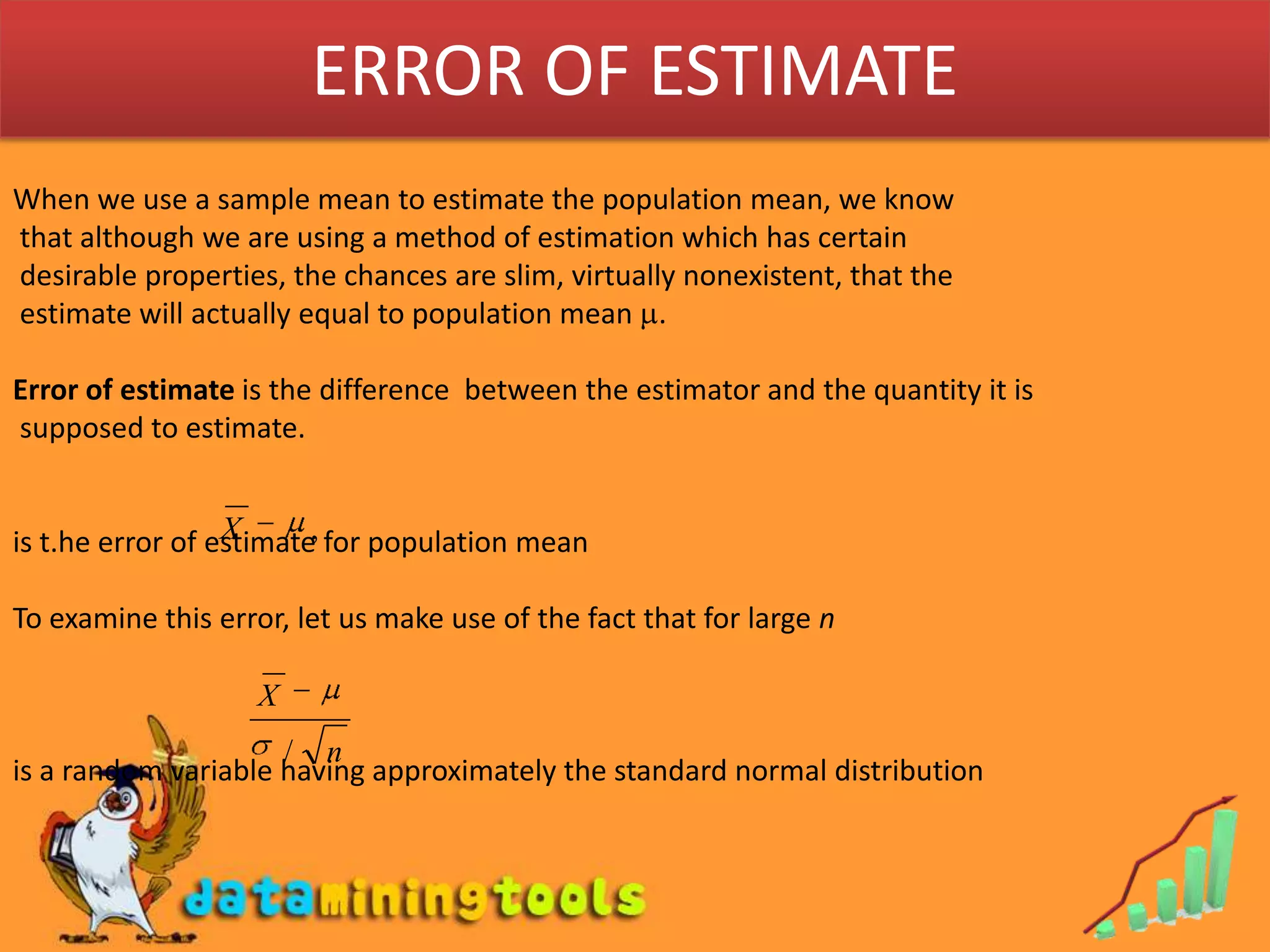
ERROR OF ESTIMATEWhen we use a sample mean to estimate the population mean, we know that although we are using a method of estimation which has certain desirable properties, the chances are slim, virtually nonexistent, that the estimate will actually equal to population mean .Error of estimate is the difference  between the estimator and the quantity it is supposed to estimate.is t.he error of estimate for population meanTo examine this error, let us make use of the fact that for large nis a random variable having approximately the standard normal distribution
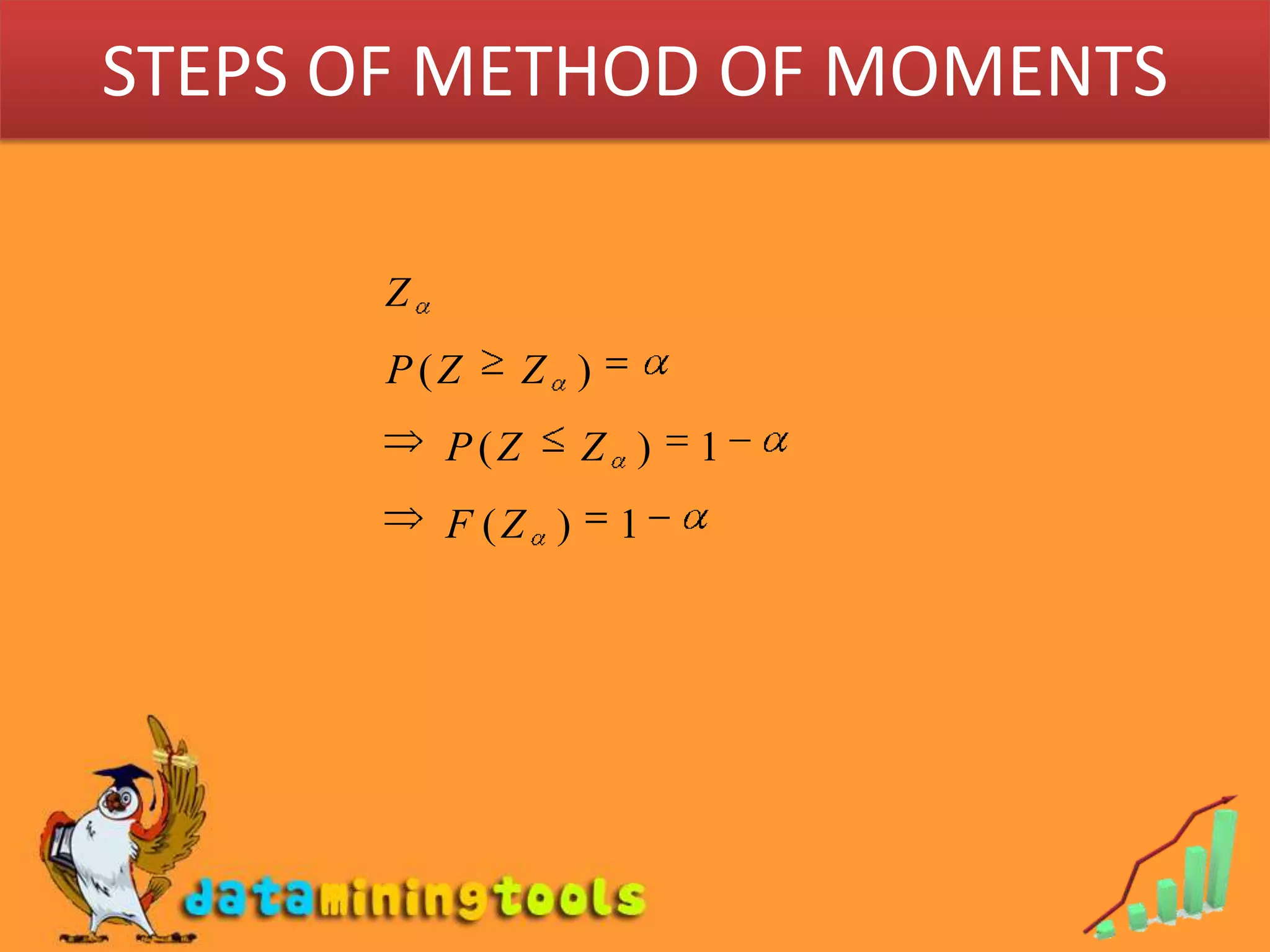
STEPS OF METHOD OF MOMENTS
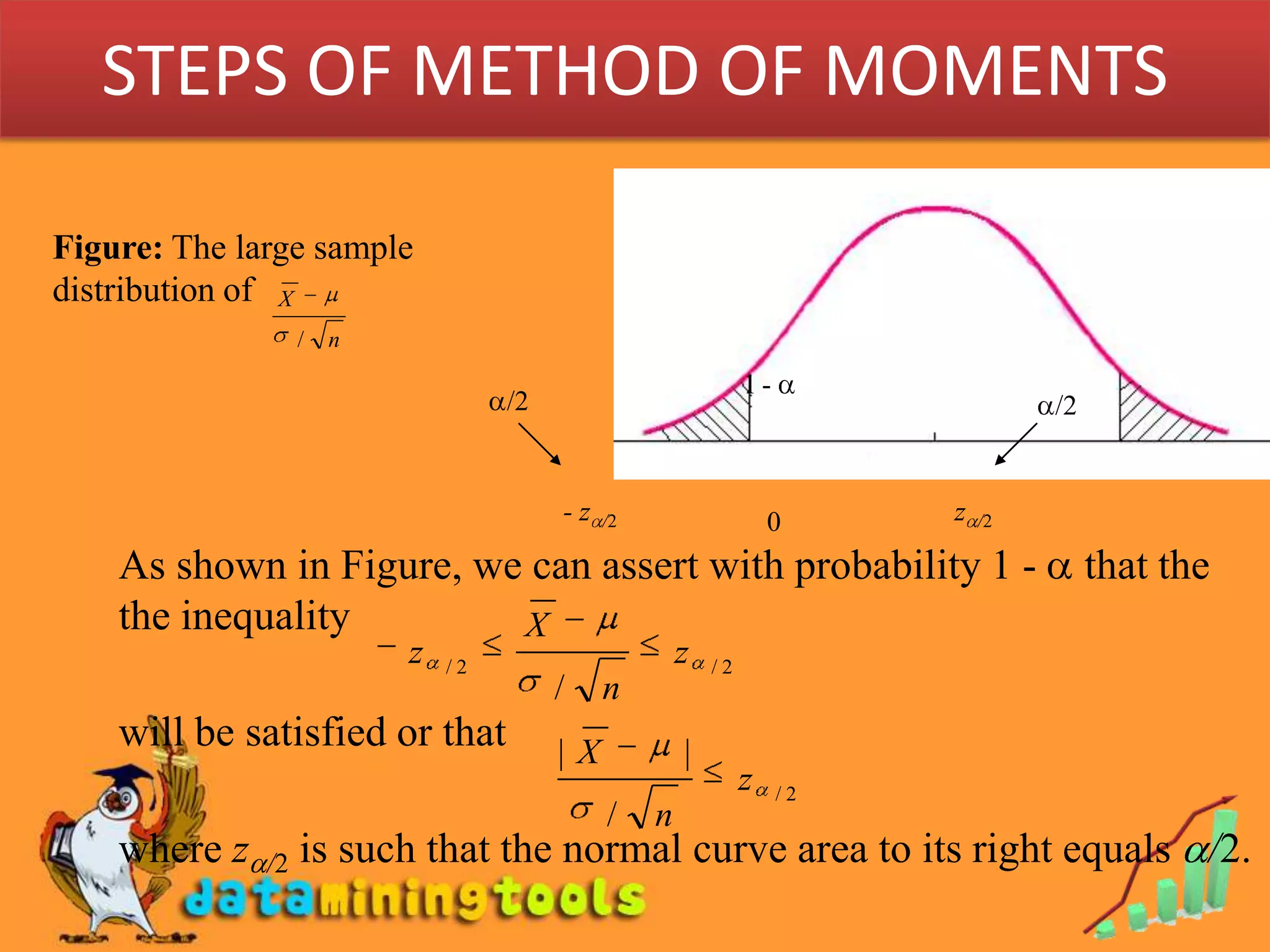
STEPS OF METHOD OF MOMENTSFigure: The large sample distribution of 1- /2/2z/2- z/20As shown in Figure, we can assert with probability 1 -  that thethe inequality will be satisfied or that where z/2 is such that the normal curve area to its right equals /2.
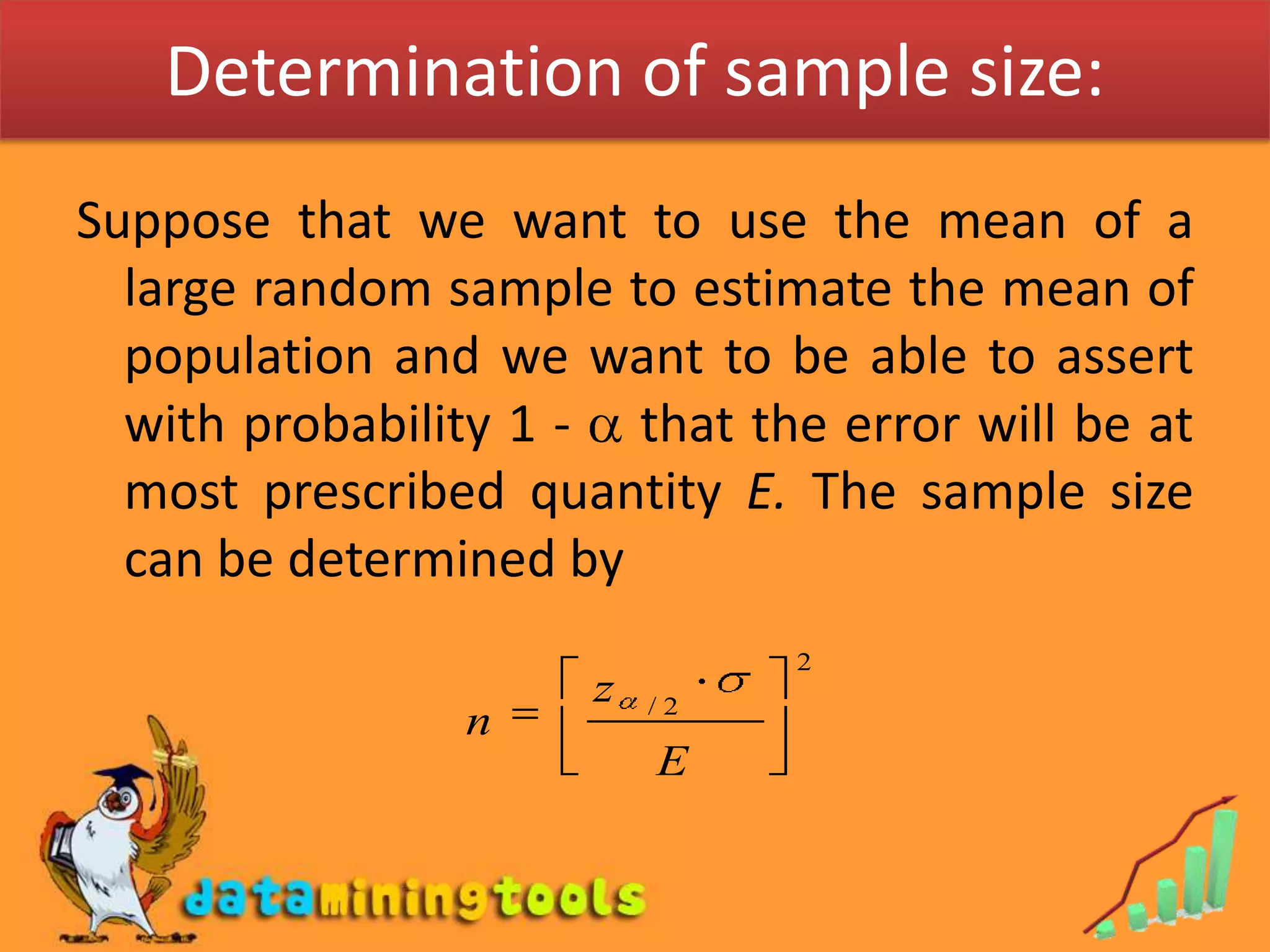
Determination of sample size:Suppose that we want to use the mean of a large random sample to estimate the mean of population and we want to be able to assert with probability 1 -  that the error will be at most prescribed quantity E. The sample size can be determined by

Point Estimation

  • 1.
  • 2.
    POINT ESTIMATIONPOINT ESTIMATE:-An estimate of a population parameter given by a single number is called point estimatePOINT ESTIMATOR :-A point estimator is a statistic for Estimating the population Parameter ө and will be denoted by ө*
  • 3.
    ExampleProblem of pointestimation of the population mean µ :-The statistic chosen will be called a point estimator for µLogical estimator for µ is the Sample mean Hence µ* =
  • 4.
    UNBIASED ESTIMATORUnbiased Estimator:-Ifthe mean of sampling distribution of a Statistic equals the corresponding Population Parameter,the Statistic is called an Unbiased Estimator of the Parameter i.e E(ө*) = өBiased Estimator:- If E(ө*)≠ ө i.e Estimator is not Unbiased.Bias Of Estimator Bias of Estimator = E(ө*) - ө
  • 5.
    STANDARD ERROR OFTHE MEAN Let denote the Sample mean based on a Sample of size n drawn from a distribution with standard deviation σ.The Standard deviation of is given byσ /and is called standard error of the mean
  • 6.
    METHODS FOR FINDINGSESTIMATORS:-METHOD OF MAXIMUM LIKELIHOOD ESTIMATIONMETHOD OF MOMENTS
  • 7.
    METHOD OF MAXIMUMLIKELIHOOD ESTIMATIONLIKELIHOOD FUNCTION:-Let x1,x2,….xn be a random sample of size n from a population with density function f(x) and parameter ө.Then the likelihood function of the sample value x1,x2,…..xn is denoted by L , is their joint density function given byL(ө)= f(x1) f(x2)….. f(xn)
  • 8.
    METHOD OF MAXIMUMLIKELIHOOD ESTIMATIONPrincipal of Maximum likelihood consist in finding an estimator (of the parameter) which maximize L. thus if their exist functionө*=ө*(x1,x2,x3,….xn)Of the sample values which maximizes L then ө* is taken as an Estimator of ө.
  • 9.
    METHOD OF MAXIMUMLIKELIHOOD ESTIMATIONThus ө* is the solution ,if any ofThe eqn (1) can be rewritten as
  • 10.
    METHOD OF MAXIMUMLIKELIHOOD ESTIMATIONSince L >0, so is Log L which shows that L and Log L attains its extreme values at the same value of ө* which is called maximum likelihood estimator.Note:-Eqn (3) is more convenient from practical point of view
  • 11.
    METHOD OF MAXIMUMLIKELIHOOD ESTIMATIONThe likelihood equation for estimating λisThus the M.L.E for λ is the sample mean.
  • 12.
    METHOD OF MOMENTSMETHODLet f(x,ө1,ө2,…..өk) be the density function of the parent population with k parameterIf µr’ denotes r th moment about origin then
  • 13.
    STEPS OF METHODOF MOMENTSLet x1,x2,……,xn be random sample of size n from the given populationStep 1:-solve k equations (1)for ө1,….,өk in terms of µ1’,……,µk’Step2:-Replace these momentsµr’ r =1,2,….,k by the sample moments m1’,m2’,….,mk’.i.e if өi*= өi(µ1’*,µ2’*,……,µk’*) =өi(m1’,m2’, …..,mk’) i=1,2,…,kStep3:-ө1*,ө2*,……,өk* are the required estimators
  • 14.
    ERROR OF ESTIMATEWhenwe use a sample mean to estimate the population mean, we know that although we are using a method of estimation which has certain desirable properties, the chances are slim, virtually nonexistent, that the estimate will actually equal to population mean .Error of estimate is the difference between the estimator and the quantity it is supposed to estimate.is t.he error of estimate for population meanTo examine this error, let us make use of the fact that for large nis a random variable having approximately the standard normal distribution
  • 15.
    STEPS OF METHODOF MOMENTS
  • 16.
    STEPS OF METHODOF MOMENTSFigure: The large sample distribution of 1- /2/2z/2- z/20As shown in Figure, we can assert with probability 1 -  that thethe inequality will be satisfied or that where z/2 is such that the normal curve area to its right equals /2.
  • 17.
    Determination of samplesize:Suppose that we want to use the mean of a large random sample to estimate the mean of population and we want to be able to assert with probability 1 -  that the error will be at most prescribed quantity E. The sample size can be determined by