Welcome
to the presentation
on
Hypothesis Testing
Presented by
Dr. Mohammed Nasir Uddin
Associate Professor
Department of ICT,
FST, BUP.
20 October 2023 MNU, Associate Professor,
Dept.of ICT, BUP.
2
TOPICS
Hypothesis
Classification
One & Two tailed Test
Applications
20 October 2023 MNU, Associate Professor,
Dept.of ICT, BUP.
3
Hypothesis
An assumption we make about a population
parameter. A statistical hypothesis test is a method
of making statistical decisions using experimental data.
Test of significance or test of a hypothesis
A significance test or test of a hypothesis is a
statistical procedure for reaching a decision.
20 October 2023 MNU, Associate Professor,
Dept.of ICT, BUP.
4
Null hypothesis
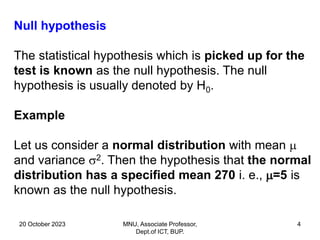
The statistical hypothesis which is picked up for the
test is known as the null hypothesis. The null
hypothesis is usually denoted by H0.
Example
Let us consider a normal distribution with mean 
and variance 2. Then the hypothesis that the normal
distribution has a specified mean 270 i. e., =5 is
known as the null hypothesis.
20 October 2023 MNU, Associate Professor,
Dept.of ICT, BUP.
5
Example
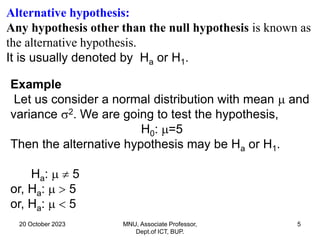
Let us consider a normal distribution with mean  and
variance 2. We are going to test the hypothesis,
H0: =5
Then the alternative hypothesis may be Ha or H1.
Ha:   5
or, Ha:   5
or, Ha:   5
Alternative hypothesis:
Any hypothesis other than the null hypothesis is known as
the alternative hypothesis.
It is usually denoted by Ha or H1.
20 October 2023 MNU, Associate Professor,
Dept.of ICT, BUP.
6
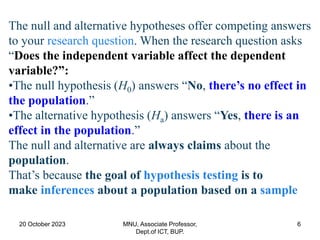
The null and alternative hypotheses offer competing answers
to your research question. When the research question asks
“Does the independent variable affect the dependent
variable?”:
•The null hypothesis (H0) answers “No, there’s no effect in
the population.”
•The alternative hypothesis (Ha) answers “Yes, there is an
effect in the population.”
The null and alternative are always claims about the
population.
That’s because the goal of hypothesis testing is to
make inferences about a population based on a sample
20 October 2023 MNU, Associate Professor,
Dept.of ICT, BUP.
7
Rejection Regions
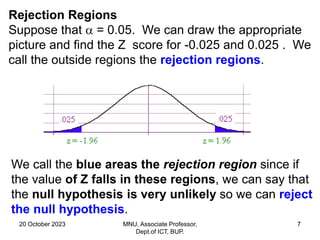
Suppose that  = 0.05. We can draw the appropriate
picture and find the Z score for -0.025 and 0.025 . We
call the outside regions the rejection regions.
We call the blue areas the rejection region since if
the value of Z falls in these regions, we can say that
the null hypothesis is very unlikely so we can reject
the null hypothesis.
20 October 2023 MNU, Associate Professor,
Dept.of ICT, BUP.
8
Example
50 smokers were questioned about the number of hours they
sleep each day. We want to test the hypothesis that the
smokers need less sleep than the general public which needs
an average of 7.7 hours of sleep. We follow the steps below:
a. Compute a rejection region for a significance level of
0.05.
b. If the sample mean is 7.5 and the standard deviation is 0.5,
what can you conclude?
20 October 2023 MNU, Associate Professor,
Dept.of ICT, BUP.
9
Solution
First, we write down the null and alternative hypotheses
H0: =7.7 H1: <7.7
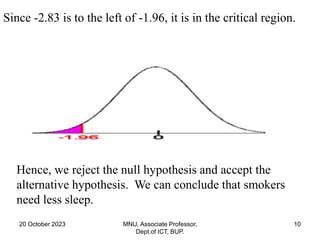
This is a left tailed test. The z-score that corresponds to 0.05 is
-1.96. The critical region is the area that lies to the left of -1.96.
If the z-value is less than -1.96 there we will reject the null
hypothesis and accept the alternative hypothesis.
If it is greater than -1.96, we will fail to reject the null
hypothesis and say that the test was not statistically
significant.
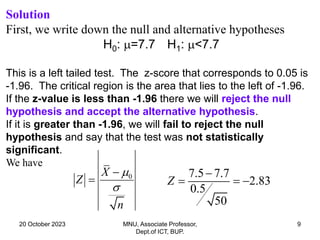
We have
7.5 7.7
2.83
0.5
50
Z

  
0
X
Z
n




20 October 2023 MNU, Associate Professor,
Dept.of ICT, BUP.
10
Hence, we reject the null hypothesis and accept the
alternative hypothesis. We can conclude that smokers
need less sleep.
Since -2.83 is to the left of -1.96, it is in the critical region.
20 October 2023 MNU, Associate Professor,
Dept.of ICT, BUP.
11
Test
A body of rules which leads to the decision regarding
acceptance or rejection of the hypothesis is called a test. The
statistic which is usually used to test the parameter of a
population is known as the test statistic.
The test may be classified as
One-tailed test
Two-tailed test
20 October 2023 MNU, Associate Professor,
Dept.of ICT, BUP.
12
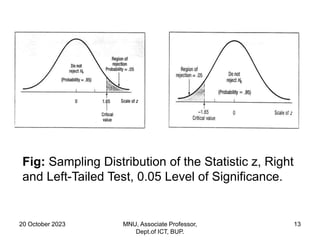
One-tailed test
A test for which the entire rejection region lies in only
two tails either in the right tail or in the left tail of the
sampling distribution of the test statistic is called one-
tailed.
If we are interested to test the hypothesis
H0:  = 0 vs Ha:   0 then we should use a right-
tailed test.
If we test H0:  = 0 vs Ha:   0 then we should use
the left tailed test.
20 October 2023 MNU, Associate Professor,
Dept.of ICT, BUP.
13
.
Fig: Sampling Distribution of the Statistic z, Right
and Left-Tailed Test, 0.05 Level of Significance.
20 October 2023 MNU, Associate Professor,
Dept.of ICT, BUP.
14
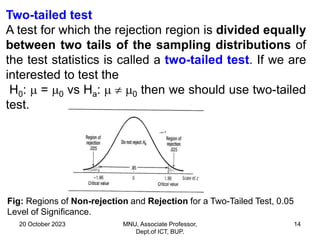
Two-tailed test
A test for which the rejection region is divided equally
between two tails of the sampling distributions of
the test statistics is called a two-tailed test. If we are
interested to test the
H0:  = 0 vs Ha:   0 then we should use two-tailed
test.
Fig: Regions of Non-rejection and Rejection for a Two-Tailed Test, 0.05
Level of Significance.
20 October 2023 MNU, Associate Professor,
Dept.of ICT, BUP.
15
Critical value
The value of the standard statistic ( Z or t ) is beyond
which we reject the null hypothesis.
The boundary between the acceptance and rejection
regions.
Error
When using probability to decide whether a statistical
test provides evidence for or against our predictions,
there is always a chance of driving the wrong conclusions.
Even when choosing a probability level of 95%, there is
always a 5% chance that one rejects the null hypothesis
when it was actually correct. This is called Type I error,
represented by the Greek letter, . The probability of a
type I error () is called the significance level.
20 October 2023 MNU, Associate Professor,
Dept.of ICT, BUP.
16
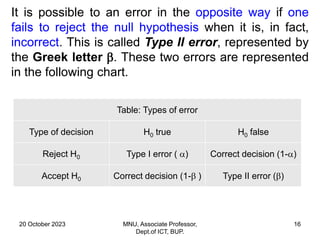
It is possible to an error in the opposite way if one
fails to reject the null hypothesis when it is, in fact,
incorrect. This is called Type II error, represented by
the Greek letter . These two errors are represented
in the following chart.
.
Table: Types of error
Type of decision H0 true H0 false
Reject H0 Type I error ( ) Correct decision (1-)
Accept H0 Correct decision (1- ) Type II error ()
20 October 2023 MNU, Associate Professor,
Dept.of ICT, BUP.
17
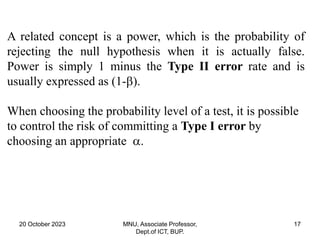
A related concept is a power, which is the probability of
rejecting the null hypothesis when it is actually false.
Power is simply 1 minus the Type II error rate and is
usually expressed as (1-).
When choosing the probability level of a test, it is possible
to control the risk of committing a Type I error by
choosing an appropriate .
20 October 2023 MNU, Associate Professor,
Dept.of ICT, BUP.
18
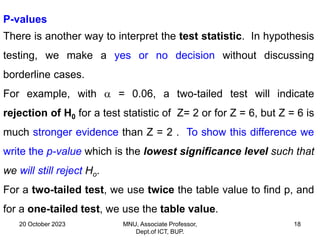
P-values
There is another way to interpret the test statistic. In hypothesis
testing, we make a yes or no decision without discussing
borderline cases.
For example, with  = 0.06, a two-tailed test will indicate
rejection of H0 for a test statistic of Z= 2 or for Z = 6, but Z = 6 is
much stronger evidence than Z = 2 . To show this difference we
write the p-value which is the lowest significance level such that
we will still reject Ho.
For a two-tailed test, we use twice the table value to find p, and
for a one-tailed test, we use the table value.
20 October 2023 MNU, Associate Professor,
Dept.of ICT, BUP.
19
Example
Suppose that we want to test the hypothesis with a
significance level of 0.05 that the climate has
changed since industrialization. Suppose that the
mean temperature throughout history is 50
degrees. During the last 40 years, the mean
temperature has been 51 degrees with a standard
deviation of 2 degrees. What can we conclude?
20 October 2023 MNU, Associate Professor,
Dept.of ICT, BUP.
20
Solution:
We have,
H0: =50 H1: ≠ 50
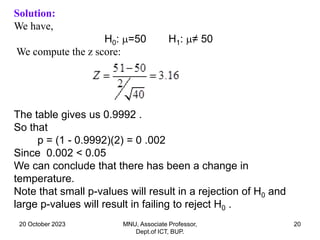
We compute the z score:
The table gives us 0.9992 .
So that
p = (1 - 0.9992)(2) = 0 .002
Since 0.002 < 0.05
We can conclude that there has been a change in
temperature.
Note that small p-values will result in a rejection of H0 and
large p-values will result in failing to reject H0 .
20 October 2023 MNU, Associate Professor,
Dept.of ICT, BUP.
21
Steps in Hypothesis Testing
Step 1
Identify the null hypothesis H0 and the alternate hypothesis HA .
Step 2
Choose . The value should be small, usually less than 10%. It
is important to consider the consequences of both types of
errors.
Step 3
Select the test statistic and determine its value from the sample
data. This value is called the observed value of the test
statistic. Remember that a t statistic is usually appropriate for a
small number of samples; for larger number of samples, a z
statistic can work well if data are normally distributed.
20 October 2023 MNU, Associate Professor,
Dept.of ICT, BUP.
22
Step 4
Compare the observed value of the statistic to the critical
value obtained for the chosen .
Step 5
Make a decision.
If the test statistic falls in the critical region: Reject H0 in favor of
HA .
If the test statistic does not fall in the critical region: Conclude
that there is not enough evidence to reject H0.
20 October 2023 MNU, Associate Professor,
Dept.of ICT, BUP.
23
Important tests of significance
The important tests of significance in statistics can
be classified broadly as
i. Normal test
ii. t test
iii. 2 Test
iv.F test
20 October 2023 MNU, Associate Professor,
Dept.of ICT, BUP.
24
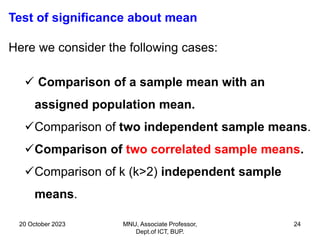
Test of significance about mean
Here we consider the following cases:
 Comparison of a sample mean with an
assigned population mean.
Comparison of two independent sample means.
Comparison of two correlated sample means.
Comparison of k (k>2) independent sample
means.
20 October 2023 MNU, Associate Professor,
Dept.of ICT, BUP.
25
Comparison of a sample mean with an assigned
population mean
Case 1:  is known or estimated from a large sample.
Case 2:  is unknown and the sample is small.
20 October 2023 MNU, Associate Professor,
Dept.of ICT, BUP.
26
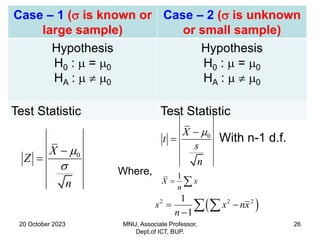
Case – 1 ( is known or
large sample)
Case – 2 ( is unknown
or small sample)
Hypothesis
H0 :  = 0
HA :   0
Hypothesis
H0 :  = 0
HA :   0
Test Statistic Test Statistic
0
X
Z
n




0
X
t
s
n


 With n-1 d.f.
Where, 1
X x
n
 
 
2 2 2
1
1
s x nx
n
 

 
20 October 2023 MNU, Associate Professor,
Dept.of ICT, BUP.
27
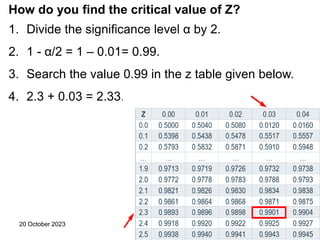
How do you find the critical value of Z?
1. Divide the significance level α by 2.
2. 1 - α/2 = 1 – 0.01= 0.99.
3. Search the value 0.99 in the z table given below.
4. 2.3 + 0.03 = 2.33.
20 October 2023 MNU, Associate Professor,
Dept.of ICT, BUP.
28
Common confidence levels and their critical
values (CV)
Confidence Level Two Sided CV One Sided CV
90% 1.64 1.28
95% 1.96 1.65
99% 2.58 2.33
20 October 2023 MNU, Associate Professor,
Dept.of ICT, BUP.
29
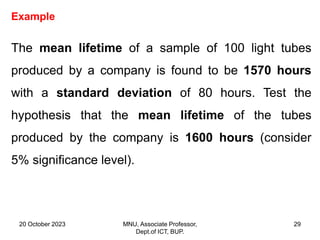
Example
The mean lifetime of a sample of 100 light tubes
produced by a company is found to be 1570 hours
with a standard deviation of 80 hours. Test the
hypothesis that the mean lifetime of the tubes
produced by the company is 1600 hours (consider
5% significance level).
20 October 2023 MNU, Associate Professor,
Dept.of ICT, BUP.
30
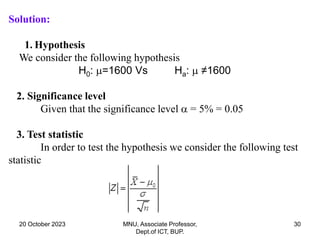
Solution:
1. Hypothesis
We consider the following hypothesis
H0: =1600 Vs Ha:  ≠1600
2. Significance level
Given that the significance level  = 5% = 0.05
3. Test statistic
In order to test the hypothesis we consider the following test
statistic
20 October 2023 MNU, Associate Professor,
Dept.of ICT, BUP.
31
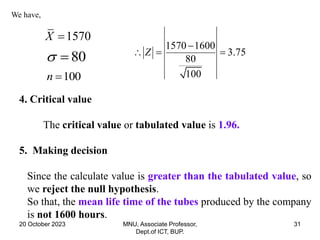
We have,
1570
X 
80
 
100
n 
1570 1600
3.75
80
100
Z

  
4. Critical value
The critical value or tabulated value is 1.96.
5. Making decision
Since the calculate value is greater than the tabulated value, so
we reject the null hypothesis.
So that, the mean life time of the tubes produced by the company
is not 1600 hours.
20 October 2023 MNU, Associate Professor,
Dept.of ICT, BUP.
32
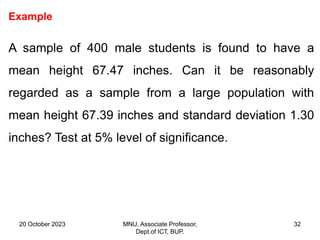
Example
A sample of 400 male students is found to have a
mean height 67.47 inches. Can it be reasonably
regarded as a sample from a large population with
mean height 67.39 inches and standard deviation 1.30
inches? Test at 5% level of significance.
20 October 2023 MNU, Associate Professor,
Dept.of ICT, BUP.
33
Example
Suppose that it is known from experience that the
standard deviation of the weight of 8 ounces packages
of cookies made by a certain bakery is 0.16 ounces.
To check its production is under control on a given day,
the true average of the packages is 8 ounces, they
select a random sample of 40 packages and find their
mean weight is 8.122 ounces. Test whether the
production is under control or not at 5% level of
significance.
20 October 2023 MNU, Associate Professor,
Dept.of ICT, BUP.
34
Case 2:  is unknown and the sample is small
Example
A random sample of 10 boys had the following I. Q’s:
70, 120, 110, 101, 88, 83, 95, 98, 107, 100
Do these data support the assumption of a population
mean I. Q. of 100?
20 October 2023 MNU, Associate Professor,
Dept.of ICT, BUP.
35
Example
Is the temperature required to damage a computer on
the average less than 110 degrees? Because of the
price of testing, twenty computers were tested to see
what minimum temperature will damage the
computer. The damaging temperature averaged 109
degrees with a standard deviation of 3 degrees. (Use
 = 0.05)
20 October 2023 MNU, Associate Professor,
Dept.of ICT, BUP.
36
Solution:
1. Hypothesis
We consider the following hypothesis
H0: =110 Vs Ha:  < 110
2. Significance level
Given that the significance level  = 5% = 0.05
3. Test statistic
In order to test the hypothesis we consider the following test
statistic
0
X
t
s
n



20 October 2023 MNU, Associate Professor,
Dept.of ICT, BUP.
37
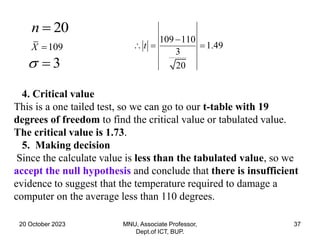
20
n 
109
X 
3
 
109 110
1.49
3
20
t

  
4. Critical value
This is a one tailed test, so we can go to our t-table with 19
degrees of freedom to find the critical value or tabulated value.
The critical value is 1.73.
5. Making decision
Since the calculate value is less than the tabulated value, so we
accept the null hypothesis and conclude that there is insufficient
evidence to suggest that the temperature required to damage a
computer on the average less than 110 degrees.
20 October 2023 MNU, Associate Professor,
Dept.of ICT, BUP.
38
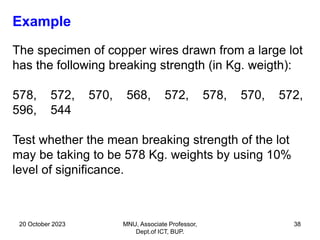
Example
The specimen of copper wires drawn from a large lot
has the following breaking strength (in Kg. weigth):
578, 572, 570, 568, 572, 578, 570, 572,
596, 544
Test whether the mean breaking strength of the lot
may be taking to be 578 Kg. weights by using 10%
level of significance.
20 October 2023 MNU, Associate Professor,
Dept.of ICT, BUP.
40
THANKS
FOR
PATIENCE HEARING

RM-10 Hypothesis testing.ppt

  • 1.
    Welcome to the presentation on HypothesisTesting Presented by Dr. Mohammed Nasir Uddin Associate Professor Department of ICT, FST, BUP.
  • 2.
    20 October 2023MNU, Associate Professor, Dept.of ICT, BUP. 2 TOPICS Hypothesis Classification One & Two tailed Test Applications
  • 3.
    20 October 2023MNU, Associate Professor, Dept.of ICT, BUP. 3 Hypothesis An assumption we make about a population parameter. A statistical hypothesis test is a method of making statistical decisions using experimental data. Test of significance or test of a hypothesis A significance test or test of a hypothesis is a statistical procedure for reaching a decision.
  • 4.
    20 October 2023MNU, Associate Professor, Dept.of ICT, BUP. 4 Null hypothesis The statistical hypothesis which is picked up for the test is known as the null hypothesis. The null hypothesis is usually denoted by H0. Example Let us consider a normal distribution with mean  and variance 2. Then the hypothesis that the normal distribution has a specified mean 270 i. e., =5 is known as the null hypothesis.
  • 5.
    20 October 2023MNU, Associate Professor, Dept.of ICT, BUP. 5 Example Let us consider a normal distribution with mean  and variance 2. We are going to test the hypothesis, H0: =5 Then the alternative hypothesis may be Ha or H1. Ha:   5 or, Ha:   5 or, Ha:   5 Alternative hypothesis: Any hypothesis other than the null hypothesis is known as the alternative hypothesis. It is usually denoted by Ha or H1.
  • 6.
    20 October 2023MNU, Associate Professor, Dept.of ICT, BUP. 6 The null and alternative hypotheses offer competing answers to your research question. When the research question asks “Does the independent variable affect the dependent variable?”: •The null hypothesis (H0) answers “No, there’s no effect in the population.” •The alternative hypothesis (Ha) answers “Yes, there is an effect in the population.” The null and alternative are always claims about the population. That’s because the goal of hypothesis testing is to make inferences about a population based on a sample
  • 7.
    20 October 2023MNU, Associate Professor, Dept.of ICT, BUP. 7 Rejection Regions Suppose that  = 0.05. We can draw the appropriate picture and find the Z score for -0.025 and 0.025 . We call the outside regions the rejection regions. We call the blue areas the rejection region since if the value of Z falls in these regions, we can say that the null hypothesis is very unlikely so we can reject the null hypothesis.
  • 8.
    20 October 2023MNU, Associate Professor, Dept.of ICT, BUP. 8 Example 50 smokers were questioned about the number of hours they sleep each day. We want to test the hypothesis that the smokers need less sleep than the general public which needs an average of 7.7 hours of sleep. We follow the steps below: a. Compute a rejection region for a significance level of 0.05. b. If the sample mean is 7.5 and the standard deviation is 0.5, what can you conclude?
  • 9.
    20 October 2023MNU, Associate Professor, Dept.of ICT, BUP. 9 Solution First, we write down the null and alternative hypotheses H0: =7.7 H1: <7.7 This is a left tailed test. The z-score that corresponds to 0.05 is -1.96. The critical region is the area that lies to the left of -1.96. If the z-value is less than -1.96 there we will reject the null hypothesis and accept the alternative hypothesis. If it is greater than -1.96, we will fail to reject the null hypothesis and say that the test was not statistically significant. We have 7.5 7.7 2.83 0.5 50 Z     0 X Z n    
  • 10.
    20 October 2023MNU, Associate Professor, Dept.of ICT, BUP. 10 Hence, we reject the null hypothesis and accept the alternative hypothesis. We can conclude that smokers need less sleep. Since -2.83 is to the left of -1.96, it is in the critical region.
  • 11.
    20 October 2023MNU, Associate Professor, Dept.of ICT, BUP. 11 Test A body of rules which leads to the decision regarding acceptance or rejection of the hypothesis is called a test. The statistic which is usually used to test the parameter of a population is known as the test statistic. The test may be classified as One-tailed test Two-tailed test
  • 12.
    20 October 2023MNU, Associate Professor, Dept.of ICT, BUP. 12 One-tailed test A test for which the entire rejection region lies in only two tails either in the right tail or in the left tail of the sampling distribution of the test statistic is called one- tailed. If we are interested to test the hypothesis H0:  = 0 vs Ha:   0 then we should use a right- tailed test. If we test H0:  = 0 vs Ha:   0 then we should use the left tailed test.
  • 13.
    20 October 2023MNU, Associate Professor, Dept.of ICT, BUP. 13 . Fig: Sampling Distribution of the Statistic z, Right and Left-Tailed Test, 0.05 Level of Significance.
  • 14.
    20 October 2023MNU, Associate Professor, Dept.of ICT, BUP. 14 Two-tailed test A test for which the rejection region is divided equally between two tails of the sampling distributions of the test statistics is called a two-tailed test. If we are interested to test the H0:  = 0 vs Ha:   0 then we should use two-tailed test. Fig: Regions of Non-rejection and Rejection for a Two-Tailed Test, 0.05 Level of Significance.
  • 15.
    20 October 2023MNU, Associate Professor, Dept.of ICT, BUP. 15 Critical value The value of the standard statistic ( Z or t ) is beyond which we reject the null hypothesis. The boundary between the acceptance and rejection regions. Error When using probability to decide whether a statistical test provides evidence for or against our predictions, there is always a chance of driving the wrong conclusions. Even when choosing a probability level of 95%, there is always a 5% chance that one rejects the null hypothesis when it was actually correct. This is called Type I error, represented by the Greek letter, . The probability of a type I error () is called the significance level.
  • 16.
    20 October 2023MNU, Associate Professor, Dept.of ICT, BUP. 16 It is possible to an error in the opposite way if one fails to reject the null hypothesis when it is, in fact, incorrect. This is called Type II error, represented by the Greek letter . These two errors are represented in the following chart. . Table: Types of error Type of decision H0 true H0 false Reject H0 Type I error ( ) Correct decision (1-) Accept H0 Correct decision (1- ) Type II error ()
  • 17.
    20 October 2023MNU, Associate Professor, Dept.of ICT, BUP. 17 A related concept is a power, which is the probability of rejecting the null hypothesis when it is actually false. Power is simply 1 minus the Type II error rate and is usually expressed as (1-). When choosing the probability level of a test, it is possible to control the risk of committing a Type I error by choosing an appropriate .
  • 18.
    20 October 2023MNU, Associate Professor, Dept.of ICT, BUP. 18 P-values There is another way to interpret the test statistic. In hypothesis testing, we make a yes or no decision without discussing borderline cases. For example, with  = 0.06, a two-tailed test will indicate rejection of H0 for a test statistic of Z= 2 or for Z = 6, but Z = 6 is much stronger evidence than Z = 2 . To show this difference we write the p-value which is the lowest significance level such that we will still reject Ho. For a two-tailed test, we use twice the table value to find p, and for a one-tailed test, we use the table value.
  • 19.
    20 October 2023MNU, Associate Professor, Dept.of ICT, BUP. 19 Example Suppose that we want to test the hypothesis with a significance level of 0.05 that the climate has changed since industrialization. Suppose that the mean temperature throughout history is 50 degrees. During the last 40 years, the mean temperature has been 51 degrees with a standard deviation of 2 degrees. What can we conclude?
  • 20.
    20 October 2023MNU, Associate Professor, Dept.of ICT, BUP. 20 Solution: We have, H0: =50 H1: ≠ 50 We compute the z score: The table gives us 0.9992 . So that p = (1 - 0.9992)(2) = 0 .002 Since 0.002 < 0.05 We can conclude that there has been a change in temperature. Note that small p-values will result in a rejection of H0 and large p-values will result in failing to reject H0 .
  • 21.
    20 October 2023MNU, Associate Professor, Dept.of ICT, BUP. 21 Steps in Hypothesis Testing Step 1 Identify the null hypothesis H0 and the alternate hypothesis HA . Step 2 Choose . The value should be small, usually less than 10%. It is important to consider the consequences of both types of errors. Step 3 Select the test statistic and determine its value from the sample data. This value is called the observed value of the test statistic. Remember that a t statistic is usually appropriate for a small number of samples; for larger number of samples, a z statistic can work well if data are normally distributed.
  • 22.
    20 October 2023MNU, Associate Professor, Dept.of ICT, BUP. 22 Step 4 Compare the observed value of the statistic to the critical value obtained for the chosen . Step 5 Make a decision. If the test statistic falls in the critical region: Reject H0 in favor of HA . If the test statistic does not fall in the critical region: Conclude that there is not enough evidence to reject H0.
  • 23.
    20 October 2023MNU, Associate Professor, Dept.of ICT, BUP. 23 Important tests of significance The important tests of significance in statistics can be classified broadly as i. Normal test ii. t test iii. 2 Test iv.F test
  • 24.
    20 October 2023MNU, Associate Professor, Dept.of ICT, BUP. 24 Test of significance about mean Here we consider the following cases:  Comparison of a sample mean with an assigned population mean. Comparison of two independent sample means. Comparison of two correlated sample means. Comparison of k (k>2) independent sample means.
  • 25.
    20 October 2023MNU, Associate Professor, Dept.of ICT, BUP. 25 Comparison of a sample mean with an assigned population mean Case 1:  is known or estimated from a large sample. Case 2:  is unknown and the sample is small.
  • 26.
    20 October 2023MNU, Associate Professor, Dept.of ICT, BUP. 26 Case – 1 ( is known or large sample) Case – 2 ( is unknown or small sample) Hypothesis H0 :  = 0 HA :   0 Hypothesis H0 :  = 0 HA :   0 Test Statistic Test Statistic 0 X Z n     0 X t s n    With n-1 d.f. Where, 1 X x n     2 2 2 1 1 s x nx n     
  • 27.
    20 October 2023MNU, Associate Professor, Dept.of ICT, BUP. 27 How do you find the critical value of Z? 1. Divide the significance level α by 2. 2. 1 - α/2 = 1 – 0.01= 0.99. 3. Search the value 0.99 in the z table given below. 4. 2.3 + 0.03 = 2.33.
  • 28.
    20 October 2023MNU, Associate Professor, Dept.of ICT, BUP. 28 Common confidence levels and their critical values (CV) Confidence Level Two Sided CV One Sided CV 90% 1.64 1.28 95% 1.96 1.65 99% 2.58 2.33
  • 29.
    20 October 2023MNU, Associate Professor, Dept.of ICT, BUP. 29 Example The mean lifetime of a sample of 100 light tubes produced by a company is found to be 1570 hours with a standard deviation of 80 hours. Test the hypothesis that the mean lifetime of the tubes produced by the company is 1600 hours (consider 5% significance level).
  • 30.
    20 October 2023MNU, Associate Professor, Dept.of ICT, BUP. 30 Solution: 1. Hypothesis We consider the following hypothesis H0: =1600 Vs Ha:  ≠1600 2. Significance level Given that the significance level  = 5% = 0.05 3. Test statistic In order to test the hypothesis we consider the following test statistic
  • 31.
    20 October 2023MNU, Associate Professor, Dept.of ICT, BUP. 31 We have, 1570 X  80   100 n  1570 1600 3.75 80 100 Z     4. Critical value The critical value or tabulated value is 1.96. 5. Making decision Since the calculate value is greater than the tabulated value, so we reject the null hypothesis. So that, the mean life time of the tubes produced by the company is not 1600 hours.
  • 32.
    20 October 2023MNU, Associate Professor, Dept.of ICT, BUP. 32 Example A sample of 400 male students is found to have a mean height 67.47 inches. Can it be reasonably regarded as a sample from a large population with mean height 67.39 inches and standard deviation 1.30 inches? Test at 5% level of significance.
  • 33.
    20 October 2023MNU, Associate Professor, Dept.of ICT, BUP. 33 Example Suppose that it is known from experience that the standard deviation of the weight of 8 ounces packages of cookies made by a certain bakery is 0.16 ounces. To check its production is under control on a given day, the true average of the packages is 8 ounces, they select a random sample of 40 packages and find their mean weight is 8.122 ounces. Test whether the production is under control or not at 5% level of significance.
  • 34.
    20 October 2023MNU, Associate Professor, Dept.of ICT, BUP. 34 Case 2:  is unknown and the sample is small Example A random sample of 10 boys had the following I. Q’s: 70, 120, 110, 101, 88, 83, 95, 98, 107, 100 Do these data support the assumption of a population mean I. Q. of 100?
  • 35.
    20 October 2023MNU, Associate Professor, Dept.of ICT, BUP. 35 Example Is the temperature required to damage a computer on the average less than 110 degrees? Because of the price of testing, twenty computers were tested to see what minimum temperature will damage the computer. The damaging temperature averaged 109 degrees with a standard deviation of 3 degrees. (Use  = 0.05)
  • 36.
    20 October 2023MNU, Associate Professor, Dept.of ICT, BUP. 36 Solution: 1. Hypothesis We consider the following hypothesis H0: =110 Vs Ha:  < 110 2. Significance level Given that the significance level  = 5% = 0.05 3. Test statistic In order to test the hypothesis we consider the following test statistic 0 X t s n   
  • 37.
    20 October 2023MNU, Associate Professor, Dept.of ICT, BUP. 37 20 n  109 X  3   109 110 1.49 3 20 t     4. Critical value This is a one tailed test, so we can go to our t-table with 19 degrees of freedom to find the critical value or tabulated value. The critical value is 1.73. 5. Making decision Since the calculate value is less than the tabulated value, so we accept the null hypothesis and conclude that there is insufficient evidence to suggest that the temperature required to damage a computer on the average less than 110 degrees.
  • 38.
    20 October 2023MNU, Associate Professor, Dept.of ICT, BUP. 38 Example The specimen of copper wires drawn from a large lot has the following breaking strength (in Kg. weigth): 578, 572, 570, 568, 572, 578, 570, 572, 596, 544 Test whether the mean breaking strength of the lot may be taking to be 578 Kg. weights by using 10% level of significance.
  • 40.
    20 October 2023MNU, Associate Professor, Dept.of ICT, BUP. 40 THANKS FOR PATIENCE HEARING