
Factor AnalysisBy:	Vineet JogalekarVinayak Potadar	 Sucheta S. Sirsikar
FACTOR ANALYSIS		A data reduction technique designed to represent a wide range of attributes on a smaller number of dimensions.
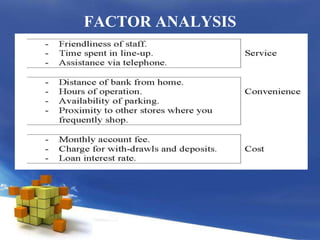
FACTOR ANALYSIS		For example, suppose that a bank asked a large number of questions about a given branch.  Consider how the following characteristics might be represented by just a few constructs (factors).
FACTOR ANALYSIS
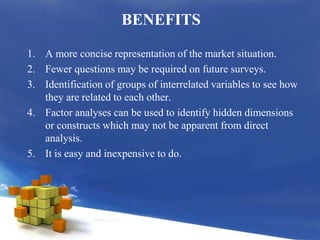
 BENEFITS A more concise representation of the market situation.Fewer questions may be required on future surveys.Identification of groups of interrelated variables to see how they are related to each other.Factor analyses can be used to identify hidden dimensions or constructs which may not be apparent from direct analysis.It is easy and inexpensive to do.
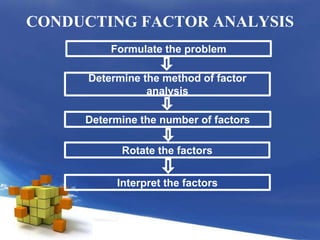
CONDUCTING FACTOR ANALYSISFormulate the problemDetermine the method of factor analysisDetermine the number of factorsRotate the factorsInterpret the factors
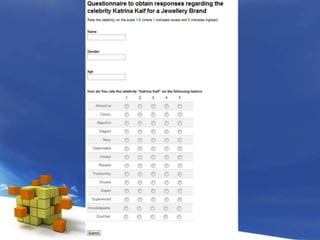
SPSS DATA
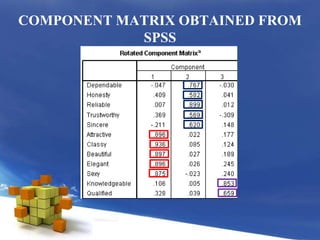
COMPONENT MATRIX OBTAINED FROM SPSS
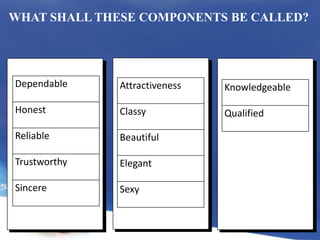
WHAT SHALL THESE COMPONENTS BE CALLED?
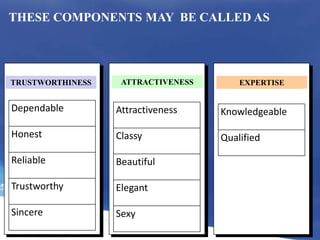
THESE COMPONENTS MAY  BE CALLED ASATTRACTIVENESSTRUSTWORTHINESSEXPERTISE
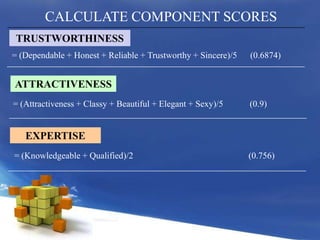
CALCULATE COMPONENT SCORESTRUSTWORTHINESS= (Dependable + Honest + Reliable + Trustworthy + Sincere)/5      (0.6874)ATTRACTIVENESS= (Attractiveness + Classy + Beautiful + Elegant + Sexy)/5            (0.9)EXPERTISE= (Knowledgeable + Qualified)/2                                                    (0.756)
APPLICATIONS IN MARKET RESEARCHUsed in market segmentation for identifying the underlying variables to group the customers.Identify the brand attributes that influence consumer choiceIdentify the characteristics of a certain type of customers (eg. price sensitive)
THANueries????"Q"THAN

factor analysis

  • 1.
  • 2.
    FACTOR ANALYSIS A datareduction technique designed to represent a wide range of attributes on a smaller number of dimensions.
  • 3.
    FACTOR ANALYSIS For example,suppose that a bank asked a large number of questions about a given branch. Consider how the following characteristics might be represented by just a few constructs (factors).
  • 4.
  • 5.
     BENEFITS A moreconcise representation of the market situation.Fewer questions may be required on future surveys.Identification of groups of interrelated variables to see how they are related to each other.Factor analyses can be used to identify hidden dimensions or constructs which may not be apparent from direct analysis.It is easy and inexpensive to do.
  • 6.
    CONDUCTING FACTOR ANALYSISFormulatethe problemDetermine the method of factor analysisDetermine the number of factorsRotate the factorsInterpret the factors
  • 8.
  • 9.
  • 10.
    WHAT SHALL THESECOMPONENTS BE CALLED?
  • 11.
    THESE COMPONENTS MAY BE CALLED ASATTRACTIVENESSTRUSTWORTHINESSEXPERTISE
  • 12.
    CALCULATE COMPONENT SCORESTRUSTWORTHINESS=(Dependable + Honest + Reliable + Trustworthy + Sincere)/5 (0.6874)ATTRACTIVENESS= (Attractiveness + Classy + Beautiful + Elegant + Sexy)/5 (0.9)EXPERTISE= (Knowledgeable + Qualified)/2 (0.756)
  • 13.
    APPLICATIONS IN MARKETRESEARCHUsed in market segmentation for identifying the underlying variables to group the customers.Identify the brand attributes that influence consumer choiceIdentify the characteristics of a certain type of customers (eg. price sensitive)
  • 14.

Editor's Notes

  • #6 5. PSPP, SAS,stata, statistica, spss,
  • #12 1 authentic, Reliable , credible, Honesty , principled, responsible, righteousness, true-blue, trustable2 appeal, charisma, charm, fascination ,glamour, magnetism,3 ability, cleverness , competence, ingeniousness, skillfulness