Exploratory factor analysis

                      Dr. M. Shakaib Akram


Note: Most of the material used in this lecture has been taken from “Discovering
                   Statistics Using SPP” by Andy Field, 3rd Ed

                                       .
What is factor analysis?
Factor analysis (and principal component analysis)
is a technique for identifying groups or clusters of
variables underlying a set of measures.

Those variables are called 'factors', or 'latent
variables' since they are not directly observable,
e.g., 'intelligence'.

A 'latent variable' is “a variable that cannot be
directly measured, but is assumed to be related to
several variables that can be measured.“ (Glossary,
p 736)
What is factor analysis used for?

Factor analysis has 3 main uses:

To understand the structure of a set of
variables, e.g., intelligence
To construct a questionnaire to measure
an underlying variable
To reduce a large data set to a more
manageable size
The most basic data basis
R-matrix

An R-matrix is simply a correlation matrix
with Pearson r-coefficients between pairs
of variables as the off-diagonal elements.
In factor analysis one tries to find latent
variables that underlie clusters of
correlations in such an R-matrix.
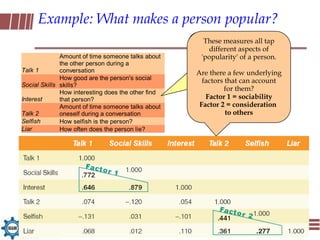
Example: What makes a person popular?
                                                       These measures all tap
                                                      These measures all tap
                                                         different aspects of
                                                        different aspects of
              Amount of time someone talks about     'popularity' of aaperson.
                                                      'popularity' of person.
              the other person during a
Talk 1        conversation
                                                    Are there aafew underlying
                                                    Are there few underlying
              How good are the person's social        factors that can account
Social Skills skills?                                factors that can account
              How interesting does the other find
                                                              for them?
                                                             for them?
Interest      that person?                             Factor 1 = sociability
              Amount of time someone talks about     Factor 2 = consideration
Talk 2        oneself during a conversation                   to others
Selfish       How selfish is the person?
Liar          How often does the person lie?
Graphical representations of factors

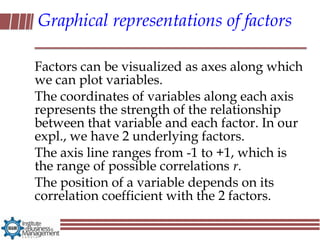
Factors can be visualized as axes along which
we can plot variables.
The coordinates of variables along each axis
represents the strength of the relationship
between that variable and each factor. In our
expl., we have 2 underlying factors.
The axis line ranges from -1 to +1, which is
the range of possible correlations r.
The position of a variable depends on its
correlation coefficient with the 2 factors.
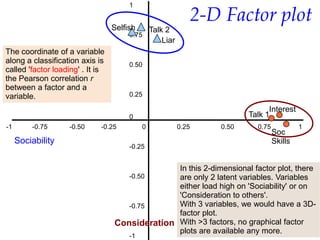
1


                                  Selfish
                                                              2-D Factor plot
                                                Talk 2
                                       0.75
                                                    Liar
The coordinate of a variable
along a classification axis is         0.50
called 'factor loading' . It is
the Pearson correlation r
between a factor and a
variable.                              0.25

                                                                               Interest
                                       0                                 Talk 1
-1       -0.75      -0.50    -0.25          0              0.25   0.50     0.75            1
                                                                                  Soc
     Sociability                                                                  Skills
                                       -0.25


                                                In this 2-dimensional factor plot, there
                                     -0.50      are only 2 latent variables. Variables
                                                either load high on 'Sociability' or on
                                                'Consideration to others'.
                                     -0.75      With 3 variables, we would have a 3D-
                                                factor plot.
                                  Consideration With >3 factors, no graphical factor
                                                plots are available any more.
                                       -1
Research example: The ‘SPSS-Anxiety Questionnaire' SAQ

One use of Factor Analysis is constructing
questionnaires.

With the SAQ, students' anxiety towards
SPSS shall be measured, using 23 questions.

The questionnaire can be used to predict individuals'
anxiety towards learning SPSS.
Furthermore, the factor structure behind 'anxiety to use
SPSS' shall be explored: which latent variables contribute to
anxiety about SPSS?
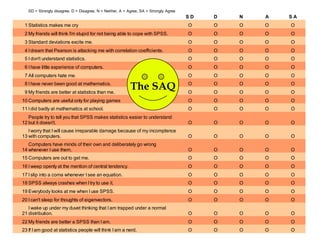
SD = Strongly disagree, D = Disagree, N = Neither, A = Agree, SA = Strongly Agree
                                                                                       SD   D   N   A   SA
 1 Statistics makes me cry                                                             O    O   O   O   O
 2 My friends will think I'm stupid for not being able to cope with SPSS.              O    O   O   O   O
 3 Standard deviations excite me.                                                      O    O   O   O   O
 4 I dream that Pearson is attacking me with correlation coefficients.                 O    O   O   O   O
 5 I don't understand statistics.                                                      O    O   O   O   O
 6 I have little experience of computers.                                              O    O   O   O   O
 7 All computers hate me.                                                              O    O   O   O   O
 8 I have never been good at mathematics.
 9 My friends are better at statistics than me.
                                                           The SAQ                     O
                                                                                       O
                                                                                            O
                                                                                            O
                                                                                                O
                                                                                                O
                                                                                                    O
                                                                                                    O
                                                                                                        O
                                                                                                        O
10 Computers are useful only for playing games                                         O    O   O   O   O
11 I did badly at mathematics at school.                                               O    O   O   O   O
   People try to tell you that SPSS makes statistics easier to understand
12 but it doesn't.                                                                     O    O   O   O   O
   I worry that I will cause irreparable damage because of my incomptence
13 with computers.                                                                     O    O   O   O   O
   Computers have minds of their own and deliberately go wrong
14 whenever I use them.                                                                O    O   O   O   O
15 Computers are out to get me.                                                        O    O   O   O   O
16 I weep openly at the mention of central tendency.                                   O    O   O   O   O
17 I slip into a coma whenever I see an equation.                                      O    O   O   O   O
18 SPSS always crashes when I try to use it.                                           O    O   O   O   O
19 Everybody looks at me when I use SPSS.                                              O    O   O   O   O
20 I can't sleep for thoughts of eigenvectors.                                         O    O   O   O   O
   I wake up under my duvet thinking that I am trapped under a normal
21 distribution.                                                                       O    O   O   O   O
22 My friends are better a SPSS than I am.                                             O    O   O   O   O
23 If I am good at statistics people will think I am a nerd.                           O    O   O   O   O
Initial considerations: sample size
The reliability of factor analysis relies on the sample size.
As a 'rule of thumb', there should be 10-15 subjects per
variable.

The stability of a factor solution depends on:
1. Absolute sample size
2. Magnitude of factor loading (>.6)
3. Communalities (>.6; the higher the better)

The KMO*-measure is the ratio of the squared correlation
between variables to the squared partial correlation
between variables. It ranges from 0-1. Values between .7
and .8 are good. They suggest a factor analysis.

*KMO: Kaiser-Meyer-Olkin measure of sampling adequacy
Data screening
   The variables in the questionnaire should intercorrelate if they
    measure the same thing. Questions that tap the same sub-
    variable, e.g., worry, intrusive thoughts, or physiological
    arousal, should be highly correlated.

   If there are questions that are not intercorrelated with others,
    they should not be entered into the factor analysis.

   If questions correlate too highly, extreme multi-collinearity or
    even singularity (perfectly correlated variables) result.

          Too low and too high intercorrelations should be avoided.

   Finally, variables should be roughly normally distributed.
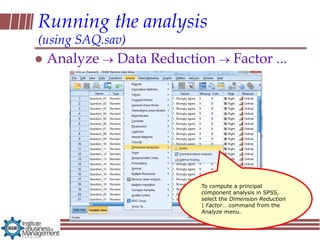
Running the analysis
(using SAQ.sav)
   Analyze   Data Reduction         Factor ...


                          To compute a principal
                          component analysis in SPSS,
                          select the Dimension Reduction
                          | Factor… command from the
                          Analyze menu.
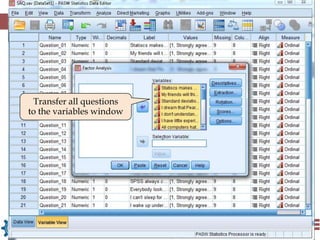
Transfer all questions
to the variables window
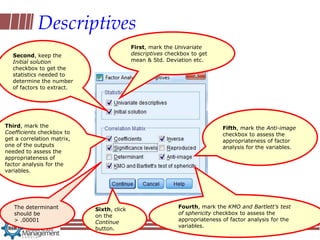
Descriptives
                                           First, mark the Univariate
   Second, keep the                        descriptives checkbox to get
   Initial solution                        mean & Std. Deviation etc.
   checkbox to get the
   statistics needed to
   determine the number
   of factors to extract.


Third, mark the                                                             Fifth, mark the Anti-image
Coefficients checkbox to                                                    checkbox to assess the
get a correlation matrix,                                                   appropriateness of factor
one of the outputs                                                          analysis for the variables.
needed to assess the
appropriateness of
factor analysis for the
variables.


   The determinant                                          Fourth, mark the KMO and Bartlett’s test
                            Sixth, click
   should be                                                of sphericity checkbox to assess the
                            on the
   > .00001                                                 appropriateness of factor analysis for the
                            Continue
                                                            variables.
                            button.
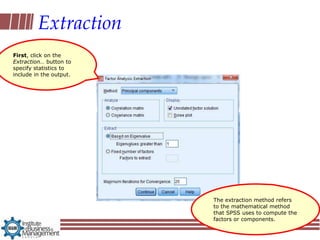
Extraction
First, click on the
Extraction… button to
specify statistics to
include in the output.


                         The extraction method refers
                         to the mathematical method
                         that SPSS uses to compute the
                         factors or components.
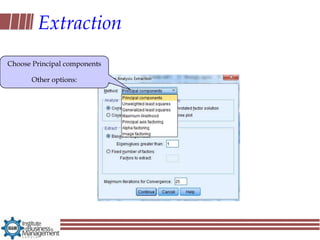
Extraction
Choose Principal components

      Other options:
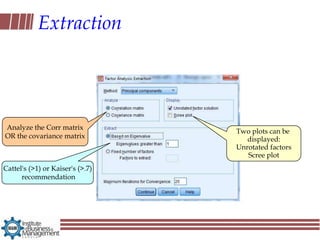
Extraction


Analyze the Corr matrix
                                  Two plots can be
OR the covariance matrix             displayed:
                                  Unrotated factors
                                     Scree plot
Cattel's (>1) or Kaiser's (>.7)
      recommendation
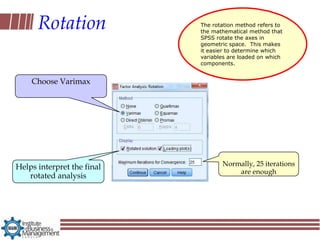
Rotation              The rotation method refers to
                            the mathematical method that
                            SPSS rotate the axes in
                            geometric space. This makes
                            it easier to determine which
                            variables are loaded on which
                            components.


    Choose Varimax


Helps interpret the final          Normally, 25 iterations
                                       are enough
   rotated analysis
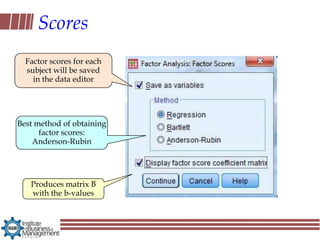
Scores
  Factor scores for each
  subject will be saved
    in the data editor


Best method of obtaining
      factor scores:
    Anderson-Rubin


   Produces matrix B
   with the b-values
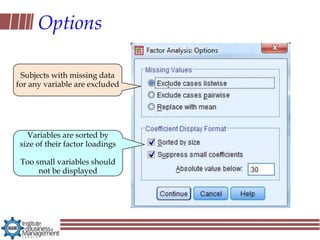
Options

 Subjects with missing data
for any variable are excluded


   Variables are sorted by
 size of their factor loadings

 Too small variables should
      not be displayed
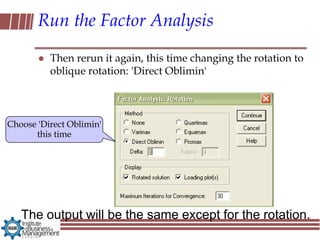
Run the Factor Analysis

          Then rerun it again, this time changing the rotation to
           oblique rotation: 'Direct Oblimin'


Choose 'Direct Oblimin'
      this time


   The output will be the same except for the rotation.
Interpreting output from SPSS

Preliminary   analysis:
  –data screening
  –assumption testing
  –sampling adequacy
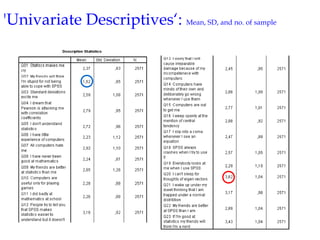
'Univariate Descriptives„: Mean, SD, and no. of sample
Correlation Matrix                                  Q01      Q02      Q03
                                                                               Correlation Matrixa

                                                                               Q04          Q05      Q19      Q20      Q21      Q22      Q23
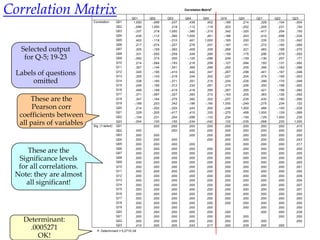
                           Correlation       Q01     1,000    -,099    -,337     ,436         ,402    -,189     ,214     ,329    -,104    -,004
                                             Q02     -,099    1,000     ,318    -,112        -,119     ,203    -,202    -,205     ,231     ,100
                                             Q03     -,337     ,318    1,000    -,380        -,310     ,342    -,325    -,417     ,204     ,150
                                             Q04      ,436    -,112    -,380    1,000         ,401    -,186     ,243     ,410    -,098    -,034
                                             Q05      ,402    -,119    -,310     ,401        1,000    -,165     ,200     ,335    -,133    -,042
                                             Q06      ,217    -,074    -,227      ,278        ,257    -,167     ,101     ,272    -,165    -,069
   Selected output                           Q07
                                             Q08
                                                      ,305    -,159    -,382      ,409        ,339    -,269     ,221     ,483    -,168    -,070

    for Q-5; 19-23
                                                      ,331    -,050    -,259      ,349        ,269    -,159     ,175     ,296    -,079    -,050
                                             Q09     -,092     ,315     ,300     -,125       -,096     ,249    -,159    -,136     ,257     ,171
                                             Q10      ,214    -,084    -,193      ,216        ,258    -,127     ,084     ,193    -,131    -,062
                                             Q11      ,357    -,144    -,351      ,369        ,298    -,200     ,255     ,346    -,162    -,086

 Labels of questions                         Q12
                                             Q13
                                                      ,345
                                                      ,355
                                                              -,195
                                                              -,143
                                                                       -,410
                                                                       -,318
                                                                                  ,442
                                                                                  ,344
                                                                                              ,347
                                                                                              ,302
                                                                                                      -,267
                                                                                                      -,227
                                                                                                                ,298
                                                                                                                ,204
                                                                                                                         ,441
                                                                                                                         ,374
                                                                                                                                 -,167
                                                                                                                                 -,195
                                                                                                                                          -,046
                                                                                                                                          -,053
      omitted                                Q14
                                             Q15
                                                      ,338
                                                      ,246
                                                              -,165
                                                              -,165
                                                                       -,371
                                                                       -,312
                                                                                  ,351
                                                                                  ,334
                                                                                              ,315
                                                                                              ,261
                                                                                                      -,254
                                                                                                      -,210
                                                                                                                ,226
                                                                                                                ,206
                                                                                                                         ,399
                                                                                                                         ,300
                                                                                                                                 -,170
                                                                                                                                 -,168
                                                                                                                                          -,048
                                                                                                                                          -,062
                                             Q16      ,499    -,168    -,419      ,416        ,395    -,267     ,265     ,421    -,156    -,082
                                             Q17      ,371    -,087    -,327      ,383        ,310    -,163     ,205     ,363    -,126    -,092
      These are the                          Q18
                                             Q19
                                                      ,347
                                                     -,189
                                                              -,164
                                                               ,203
                                                                       -,375
                                                                        ,342
                                                                                  ,382
                                                                                 -,186
                                                                                              ,322
                                                                                             -,165
                                                                                                      -,257
                                                                                                      1,000
                                                                                                                ,235
                                                                                                               -,249
                                                                                                                         ,430
                                                                                                                        -,275
                                                                                                                                 -,160
                                                                                                                                  ,234
                                                                                                                                          -,080
                                                                                                                                           ,122
       Pearson corr                          Q20      ,214    -,202    -,325      ,243        ,200    -,249    1,000     ,468    -,100    -,035

  coefficients between
                                             Q21      ,329    -,205    -,417      ,410        ,335    -,275     ,468    1,000    -,129    -,068
                                             Q22     -,104     ,231     ,204     -,098       -,133     ,234    -,100    -,129    1,000     ,230

  all pairs of variables   Sig. (1-tailed)
                                             Q23
                                             Q01
                                                     -,004     ,100
                                                               ,000
                                                                        ,150
                                                                        ,000
                                                                                 -,034
                                                                                  ,000
                                                                                             -,042
                                                                                              ,000
                                                                                                       ,122
                                                                                                       ,000
                                                                                                               -,035
                                                                                                                ,000
                                                                                                                        -,068
                                                                                                                         ,000
                                                                                                                                  ,230
                                                                                                                                  ,000
                                                                                                                                          1,000
                                                                                                                                           ,410
                                             Q02      ,000              ,000      ,000        ,000     ,000     ,000     ,000     ,000     ,000
                                             Q03      ,000     ,000               ,000        ,000     ,000     ,000     ,000     ,000     ,000
                                             Q04      ,000     ,000     ,000                  ,000     ,000     ,000     ,000     ,000     ,043
                                             Q05      ,000     ,000     ,000      ,000                 ,000     ,000     ,000     ,000     ,017

     These are the                           Q06
                                             Q07
                                                      ,000
                                                      ,000
                                                               ,000
                                                               ,000
                                                                        ,000
                                                                        ,000
                                                                                  ,000
                                                                                  ,000
                                                                                              ,000
                                                                                              ,000
                                                                                                       ,000
                                                                                                       ,000
                                                                                                                ,000
                                                                                                                ,000
                                                                                                                         ,000
                                                                                                                         ,000
                                                                                                                                  ,000
                                                                                                                                  ,000
                                                                                                                                           ,000
                                                                                                                                           ,000

  Significance levels                        Q08
                                             Q09
                                                      ,000
                                                      ,000
                                                               ,006
                                                               ,000
                                                                        ,000
                                                                        ,000
                                                                                  ,000
                                                                                  ,000
                                                                                              ,000
                                                                                              ,000
                                                                                                       ,000
                                                                                                       ,000
                                                                                                                ,000
                                                                                                                ,000
                                                                                                                         ,000
                                                                                                                         ,000
                                                                                                                                  ,000
                                                                                                                                  ,000
                                                                                                                                           ,005
                                                                                                                                           ,000
  for all correlations.                      Q10      ,000     ,000     ,000      ,000        ,000     ,000     ,000     ,000     ,000     ,001
                                             Q11
 Note: they are almost
                                                      ,000     ,000     ,000      ,000        ,000     ,000     ,000     ,000     ,000     ,000
                                             Q12      ,000     ,000     ,000      ,000        ,000     ,000     ,000     ,000     ,000     ,009

    all significant!                         Q13
                                             Q14
                                                      ,000
                                                      ,000
                                                               ,000
                                                               ,000
                                                                        ,000
                                                                        ,000
                                                                                  ,000
                                                                                  ,000
                                                                                              ,000
                                                                                              ,000
                                                                                                       ,000
                                                                                                       ,000
                                                                                                                ,000
                                                                                                                ,000
                                                                                                                         ,000
                                                                                                                         ,000
                                                                                                                                  ,000
                                                                                                                                  ,000
                                                                                                                                           ,004
                                                                                                                                           ,007
                                             Q15      ,000     ,000     ,000      ,000        ,000     ,000     ,000     ,000     ,000     ,001
                                             Q16      ,000     ,000     ,000      ,000        ,000     ,000     ,000     ,000     ,000     ,000
                                             Q17      ,000     ,000     ,000      ,000        ,000     ,000     ,000     ,000     ,000     ,000
                                             Q18      ,000     ,000     ,000      ,000        ,000     ,000     ,000     ,000     ,000     ,000
                                             Q19      ,000     ,000     ,000      ,000        ,000              ,000     ,000     ,000     ,000
                                             Q20      ,000     ,000     ,000      ,000        ,000     ,000              ,000     ,000     ,039
                                             Q21
   Determinant:
                                                      ,000     ,000     ,000      ,000        ,000     ,000     ,000              ,000     ,000
                                             Q22      ,000     ,000     ,000      ,000        ,000     ,000     ,000     ,000              ,000

     .0005271                                Q23      ,410
                             a. Determinant = 5,271E-04
                                                               ,000     ,000      ,043        ,017     ,000     ,039     ,000     ,000


       OK!
Scanning the Correlation Matrix                                               Correlation Matrixa

                                                   Q01      Q02      Q03      Q04          Q05      Q19      Q20      Q21      Q22      Q23
                          Correlation       Q01     1,000    -,099    -,337     ,436         ,402    -,189     ,214     ,329    -,104    -,004
                                            Q02     -,099    1,000     ,318    -,112        -,119     ,203    -,202    -,205     ,231     ,100
                                            Q03     -,337     ,318    1,000    -,380        -,310     ,342    -,325    -,417     ,204     ,150
                                            Q04      ,436    -,112    -,380    1,000         ,401    -,186     ,243     ,410    -,098    -,034
                                            Q05      ,402    -,119    -,310     ,401        1,000    -,165     ,200     ,335    -,133    -,042

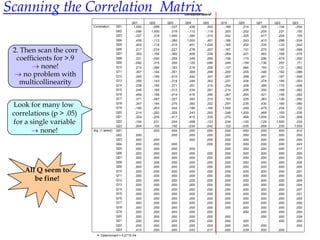
 2. Then scan the corr                      Q06
                                            Q07
                                                     ,217
                                                     ,305
                                                             -,074
                                                             -,159
                                                                      -,227
                                                                      -,382
                                                                                 ,278
                                                                                 ,409
                                                                                             ,257
                                                                                             ,339
                                                                                                     -,167
                                                                                                     -,269
                                                                                                               ,101
                                                                                                               ,221
                                                                                                                        ,272
                                                                                                                        ,483
                                                                                                                                -,165
                                                                                                                                -,168
                                                                                                                                         -,069
                                                                                                                                         -,070
  coefficients for >.9                      Q08
                                            Q09
                                                     ,331    -,050    -,259      ,349        ,269    -,159     ,175     ,296    -,079    -,050
                                                    -,092     ,315     ,300     -,125       -,096     ,249    -,159    -,136     ,257     ,171
           none!                            Q10      ,214    -,084    -,193      ,216        ,258    -,127     ,084     ,193    -,131    -,062

     no problem with
                                            Q11      ,357    -,144    -,351      ,369        ,298    -,200     ,255     ,346    -,162    -,086
                                            Q12      ,345    -,195    -,410      ,442        ,347    -,267     ,298     ,441    -,167    -,046

   multicollinearity                        Q13
                                            Q14
                                                     ,355
                                                     ,338
                                                             -,143
                                                             -,165
                                                                      -,318
                                                                      -,371
                                                                                 ,344
                                                                                 ,351
                                                                                             ,302
                                                                                             ,315
                                                                                                     -,227
                                                                                                     -,254
                                                                                                               ,204
                                                                                                               ,226
                                                                                                                        ,374
                                                                                                                        ,399
                                                                                                                                -,195
                                                                                                                                -,170
                                                                                                                                         -,053
                                                                                                                                         -,048
                                            Q15      ,246    -,165    -,312      ,334        ,261    -,210     ,206     ,300    -,168    -,062
                                            Q16      ,499    -,168    -,419      ,416        ,395    -,267     ,265     ,421    -,156    -,082
                                            Q17      ,371    -,087    -,327      ,383        ,310    -,163     ,205     ,363    -,126    -,092

 Look for many low                          Q18
                                            Q19
                                                     ,347
                                                    -,189
                                                             -,164
                                                              ,203
                                                                      -,375
                                                                       ,342
                                                                                 ,382
                                                                                -,186
                                                                                             ,322
                                                                                            -,165
                                                                                                     -,257
                                                                                                     1,000
                                                                                                               ,235
                                                                                                              -,249
                                                                                                                        ,430
                                                                                                                       -,275
                                                                                                                                -,160
                                                                                                                                 ,234
                                                                                                                                         -,080
                                                                                                                                          ,122

 correlations (p > .05)                     Q20
                                            Q21
                                                     ,214
                                                     ,329
                                                             -,202
                                                             -,205
                                                                      -,325
                                                                      -,417
                                                                                 ,243
                                                                                 ,410
                                                                                             ,200
                                                                                             ,335
                                                                                                     -,249
                                                                                                     -,275
                                                                                                              1,000
                                                                                                               ,468
                                                                                                                        ,468
                                                                                                                       1,000
                                                                                                                                -,100
                                                                                                                                -,129
                                                                                                                                         -,035
                                                                                                                                         -,068
 for a single variable                      Q22
                                            Q23
                                                    -,104
                                                    -,004
                                                              ,231
                                                              ,100
                                                                       ,204
                                                                       ,150
                                                                                -,098
                                                                                -,034
                                                                                            -,133
                                                                                            -,042
                                                                                                      ,234
                                                                                                      ,122
                                                                                                              -,100
                                                                                                              -,035
                                                                                                                       -,129
                                                                                                                       -,068
                                                                                                                                1,000
                                                                                                                                 ,230
                                                                                                                                          ,230
                                                                                                                                         1,000
          none!           Sig. (1-tailed)   Q01               ,000     ,000      ,000        ,000     ,000     ,000     ,000     ,000     ,410
                                            Q02      ,000              ,000      ,000        ,000     ,000     ,000     ,000     ,000     ,000
                                            Q03      ,000     ,000               ,000        ,000     ,000     ,000     ,000     ,000     ,000
                                            Q04      ,000     ,000     ,000                  ,000     ,000     ,000     ,000     ,000     ,043
                                            Q05      ,000     ,000     ,000      ,000                 ,000     ,000     ,000     ,000     ,017
                                            Q06      ,000     ,000     ,000      ,000        ,000     ,000     ,000     ,000     ,000     ,000
                                            Q07      ,000     ,000     ,000      ,000        ,000     ,000     ,000     ,000     ,000     ,000
                                            Q08      ,000     ,006     ,000      ,000        ,000     ,000     ,000     ,000     ,000     ,005
                                            Q09
     All Q seem to
                                                     ,000     ,000     ,000      ,000        ,000     ,000     ,000     ,000     ,000     ,000
                                            Q10      ,000     ,000     ,000      ,000        ,000     ,000     ,000     ,000     ,000     ,001

        be fine!
                                            Q11      ,000     ,000     ,000      ,000        ,000     ,000     ,000     ,000     ,000     ,000
                                            Q12      ,000     ,000     ,000      ,000        ,000     ,000     ,000     ,000     ,000     ,009
                                            Q13      ,000     ,000     ,000      ,000        ,000     ,000     ,000     ,000     ,000     ,004
                                            Q14      ,000     ,000     ,000      ,000        ,000     ,000     ,000     ,000     ,000     ,007
                                            Q15      ,000     ,000     ,000      ,000        ,000     ,000     ,000     ,000     ,000     ,001
                                            Q16      ,000     ,000     ,000      ,000        ,000     ,000     ,000     ,000     ,000     ,000
                                            Q17      ,000     ,000     ,000      ,000        ,000     ,000     ,000     ,000     ,000     ,000
                                            Q18      ,000     ,000     ,000      ,000        ,000     ,000     ,000     ,000     ,000     ,000
                                            Q19      ,000     ,000     ,000      ,000        ,000              ,000     ,000     ,000     ,000
                                            Q20      ,000     ,000     ,000      ,000        ,000     ,000              ,000     ,000     ,039
                                            Q21      ,000     ,000     ,000      ,000        ,000     ,000     ,000              ,000     ,000
                                            Q22      ,000     ,000     ,000      ,000        ,000     ,000     ,000     ,000              ,000
                                            Q23      ,410     ,000     ,000      ,043        ,017     ,000     ,039     ,000     ,000
                            a. Determinant = 5,271E-04
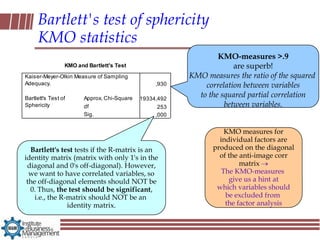
Bartlett's test of sphericity
     KMO statistics
                                                                 KMO-measures >.9
                 KMO and Bartlett's Test                              are superb!
Kaiser-Meyer-Olkin Measure of Sampling                   KMO measures the ratio of the squared
Adequacy.                                         ,930       correlation between variables
Bartlett's Test of      Approx. Chi-Square   19334,492
                                                           to the squared partial correlation
Sphericity              df                         253             between variables.
                        Sig.                      ,000


                                                                    KMO measures for
                                                                  individual factors are
  Bartlett's test tests if the R-matrix is an                   produced on the diagonal
identity matrix (matrix with only 1's in the                      of the anti-image corr
 diagonal and 0's off-diagonal). However,                                matrix
  we want to have correlated variables, so                         The KMO-measures
 the off-diagonal elements should NOT be                             give us a hint at
  0. Thus, the test should be significant,                       which variables should
    i.e., the R-matrix should NOT be an                             be excluded from
                identity matrix.                                    the factor analysis
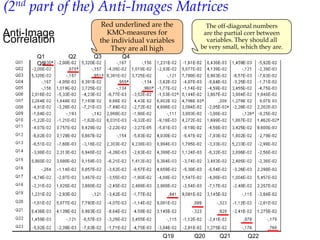
(2nd part of the) Anti-Images Matrices
                       Red underlined are the       The off-diagonal numbers
Anti-Image              KMO-measures for           are the partial corr between
Correlation           the individual variables      variables. They should all
                          They are all high       be very small, which they are.
       Q1       Q2   Q3      Q4
       Q5....


                                          Q19    Q20    Q21        Q22
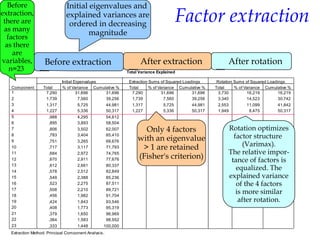
Before                      Initial eigenvalues and
extraction,
 there are
 as many
                               explained variances are
                                ordered in decreasing
                                                                                         Factor extraction
                                      magnitude
  factors
  as there
    are
variables,          Before extraction                                After extraction                         After rotation
   n=23                                                        Total Variance Explained

                             Initial Eigenvalues                Extraction Sums of Squared Loadings      Rotation Sums of Squared Loadings
   Component       Total     % of Variance Cumulative %         Total      % of Variance Cumulative %   Total     % of Variance Cumulative %
   1                7,290             31,696     31,696          7,290           31,696        31,696     3,730         16,219         16,219
   2                1,739              7,560     39,256          1,739             7,560       39,256     3,340         14,523         30,742
   3                 1,317           5,725            44,981     1,317           5,725        44,981     2,553         11,099         41,842
   4                 1,227           5,336            50,317     1,227           5,336        50,317     1,949          8,475         50,317
   5                  ,988           4,295            54,612
   6                  ,895           3,893            58,504
   7                  ,806           3,502            62,007          Only 4 factors                          Rotation optimizes
   8                  ,783           3,404            65,410
                                                                    with an eigenvalue                          factor structure
   9                  ,751           3,265            68,676
   10                 ,717           3,117            71,793         > 1 are retained                               (Varimax).
                                                                                                              The relative impor-
                                                                    (Fisher's criterion)
   11                 ,684           2,972            74,765
   12                 ,670           2,911            77,676                                                   tance of factors is
   13
   14
                      ,612
                      ,578
                                     2,661
                                     2,512
                                                      80,337
                                                      82,849
                                                                                                                 equalized. The
   15                 ,549           2,388            85,236                                                  explained variance
   16                 ,523           2,275            87,511                                                     of the 4 factors
   17
   18
                      ,508
                      ,456
                                     2,210
                                     1,982
                                                      89,721
                                                      91,704
                                                                                                                 is more similar
   19                 ,424           1,843            93,546                                                      after rotation.
   20                 ,408           1,773            95,319
   21                 ,379           1,650            96,969
   22                 ,364           1,583            98,552
   23                 ,333           1,448        100,000
   Extraction Method: Principal Component Analysis.
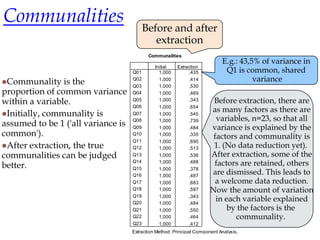
Communalities                             Before and after
                                             extraction
                                           Communalities
                                                                            E.g.: 43,5% of variance in
                                              Initial   Extraction
                                    Q01         1,000         ,435           Q1 is common, shared
Communality    is the              Q02         1,000        ,414                     variance
                                    Q03         1,000        ,530
proportion of common variance       Q04         1,000        ,469

within a variable.                  Q05         1,000        ,343       Before extraction, there are
                                    Q06         1,000        ,654
                                                                       as many factors as there are
Initially, communality is          Q07         1,000        ,545
                                                                         variables, n=23, so that all
assumed to be 1 ('all variance is   Q08
                                    Q09
                                                1,000
                                                1,000
                                                             ,739
                                                             ,484      variance is explained by the
common').                           Q10         1,000        ,335
                                                                        factors and communality is
                                    Q11         1,000        ,690
After extraction, the true         Q12         1,000        ,513       1. (No data reduction yet).
communalities can be judged         Q13         1,000        ,536      After extraction, some of the
better.
                                    Q14         1,000        ,488       factors are retained, others
                                    Q15         1,000        ,378
                                    Q16         1,000        ,487
                                                                       are dismissed. This leads to
                                    Q17         1,000        ,683        a welcome data reduction.
                                    Q18         1,000        ,597      Now the amount of variation
                                    Q19
                                    Q20
                                                1,000
                                                1,000
                                                             ,343
                                                             ,484
                                                                         in each variable explained
                                    Q21         1,000        ,550            by the factors is the
                                    Q22         1,000        ,464              communality.
                                    Q23         1,000        ,412
                                    Extraction Method: Principal Component Analysis.
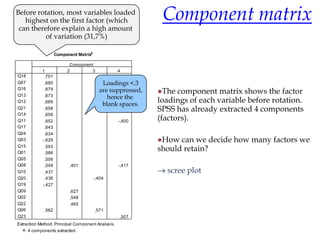
Before rotation, most variables loaded
   highest on the first factor (which                        Component matrix
 can therefore explain a high amount
          of variation (31,7%)

                    Component Matrixa

                          Component
            1            2         3               4
Q18          ,701
Q07          ,685                          Loadings <.3
                                          are suppressed,   The  component matrix shows the factor
Q16          ,679
Q13          ,673                            hence the
Q12          ,669
                                           blank spaces.
                                                            loadings of each variable before rotation.
Q21          ,658                                           SPSS has already extracted 4 components
Q14          ,656
Q11          ,652                                  -,400    (factors).
Q17          ,643
Q04          ,634
Q03         -,629                                           How  can we decide how many factors we
Q15
Q01
             ,593
             ,586
                                                            should retain?
Q05          ,556
Q08          ,549         ,401                     -,417
Q10          ,437                                             scree plot
Q20          ,436                       -,404
Q19         -,427
Q09                       ,627
Q02                       ,548
Q22                       ,465
Q06          ,562                       ,571
Q23                                                ,507
Extraction Method: Principal Component Analysis.
   a. 4 components extracted.
Scree plot


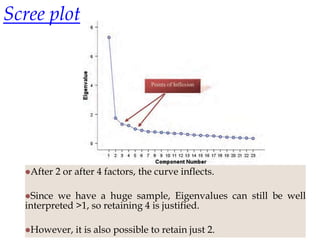
  After   2 or after 4 factors, the curve inflects.

  Since  we have a huge sample, Eigenvalues can still be well
  interpreted >1, so retaining 4 is justified.

  However,     it is also possible to retain just 2.
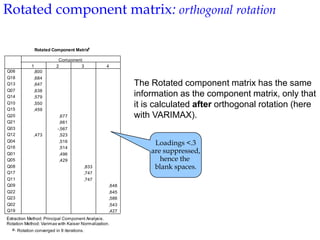
Rotated component matrix: orthogonal rotation

                                     a
             Rotated Component Matrix

                         Component
            1           2         3              4
Q06          ,800
Q18          ,684
Q13          ,647                                        The Rotated component matrix has the same
Q07          ,638
Q14          ,579                                        information as the component matrix, only that
Q10
Q15
             ,550
             ,459
                                                         it is calculated after orthogonal rotation (here
Q20                      ,677                            with VARIMAX).
Q21                      ,661
Q03                      -,567
Q12          ,473         ,523
Q04                      ,516
                                                              Loadings <.3
Q16                      ,514
Q01                      ,496
                                                             are suppressed,
Q05                      ,429                                   hence the
Q08                                   ,833                    blank spaces.
Q17                                   ,747
Q11                                   ,747
Q09                                               ,648
Q22                                               ,645
Q23                                               ,586
Q02                                               ,543
Q19                                               ,427
Extraction Method: Principal Component Analysis.
Rotation Method: Varimax with Kaiser Normalization.
   a. Rotation converged in 9 iterations.
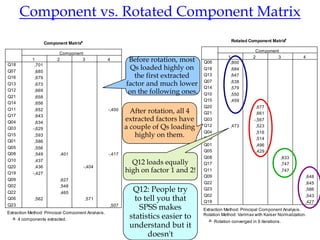
Component vs. Rotated Component Matrix
                                                                                                                          a
                                                                                                  Rotated Component Matrix
                    Component Matrixa
                                                                                                              Component
                          Component
            1            2         3               4        Before rotation, most    Q06
                                                                                                 1
                                                                                                  ,800
                                                                                                             2         3              4
Q18
Q07
             ,701
             ,685
                                                             Qs loaded highly on     Q18          ,684
Q16          ,679                                             the first extracted    Q13          ,647

Q13          ,673                                          factor and much lower     Q07
                                                                                     Q14
                                                                                                  ,638
                                                                                                  ,579
Q12          ,669                                           on the following ones.   Q10          ,550
Q21          ,658
                                                                                     Q15          ,459
Q14          ,656
                                                                                     Q20                      ,677
Q11          ,652                                  -,400     After rotation, all 4   Q21                      ,661
Q17          ,643
Q04          ,634
                                                           extracted factors have    Q03                      -,567
Q03         -,629                                          a couple of Qs loading    Q12          ,473         ,523
                                                                                     Q04
Q15          ,593                                              highly on them.       Q16
                                                                                                              ,516
                                                                                                              ,514
Q01          ,586
                                                                                     Q01                      ,496
Q05          ,556
                                                                                     Q05                      ,429
Q08          ,549         ,401                     -,417
                                                                                     Q08                                   ,833
Q10          ,437
                                                             Q12 loads equally       Q17                                   ,747
Q20          ,436                       -,404
Q19         -,427
                                                           high on factor 1 and 2!   Q11                                   ,747
                                                                                     Q09                                               ,648
Q09                       ,627
                                                                                     Q22                                               ,645
Q02
                                                             Q12: People try
                          ,548
                                                                                     Q23                                               ,586
Q22                       ,465
Q06          ,562                       ,571                  to tell you that       Q02
                                                                                     Q19
                                                                                                                                       ,543
                                                                                                                                       ,427
Q23                                                ,507
                                                               SPSS makes            Extraction Method: Principal Component Analysis.
Extraction Method: Principal Component Analysis.
   a. 4 components extracted.                               statistics easier to     Rotation Method: Varimax with Kaiser Normalization.
                                                                                        a. Rotation converged in 9 iterations.
                                                            understand but it
                                                                  doesn't
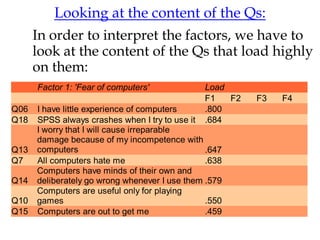
Looking at the content of the Qs:
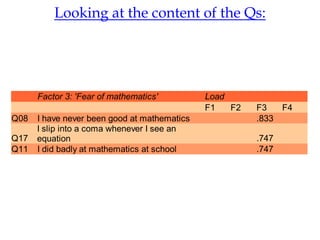
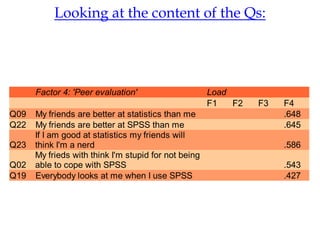
      In order to interpret the factors, we have to
      look at the content of the Qs that load highly
      on them:
      Factor 1: 'Fear of computers'            Load
                                               F1   F2   F3   F4
Q06   I have little experience of computers    .800
Q18   SPSS always crashes when I try to use it .684
      I worry that I will cause irreparable
      damage because of my incompetence with
Q13   computers                                 .647
Q7    All computers hate me                     .638
      Computers have minds of their own and
Q14   deliberately go wrong whenever I use them .579
      Computers are useful only for playing
Q10   games                                     .550
Q15   Computers are out to get me               .459
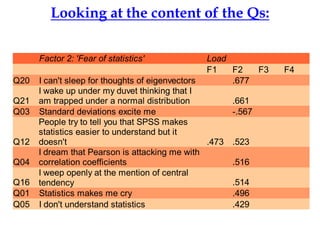
Looking at the content of the Qs:

      Factor 2: 'Fear of statistics'           Load
                                               F1   F2        F3   F4
Q20   I can't sleep for thoughts of eigenvectors    .677
      I wake up under my duvet thinking that I
Q21   am trapped under a normal distribution          .661
Q03   Standard deviations excite me                   -.567
      People try to tell you that SPSS makes
      statistics easier to understand but it
Q12   doesn't                                    .473 .523
      I dream that Pearson is attacking me with
Q04   correlation coefficients                        .516
      I weep openly at the mention of central
Q16   tendency                                        .514
Q01   Statistics makes me cry                         .496
Q05   I don't understand statistics                   .429
Looking at the content of the Qs:


      Factor 3: 'Fear of mathematics'         Load
                                              F1   F2   F3   F4
Q08   I have never been good at mathematics             .833
      I slip into a coma whenever I see an
Q17   equation                                          .747
Q11   I did badly at mathematics at school              .747
Looking at the content of the Qs:


      Factor 4: 'Peer evaluation'                     Load
                                                      F1   F2   F3   F4
Q09   My friends are better at statistics than me                    .648
Q22   My friends are better at SPSS than me                          .645
      If I am good at statistics my friends will
Q23   think I'm a nerd                                               .586
      My frieds with think I'm stupid for not being
Q02   able to cope with SPSS                                         .543
Q19   Everybody looks at me when I use SPSS                          .427
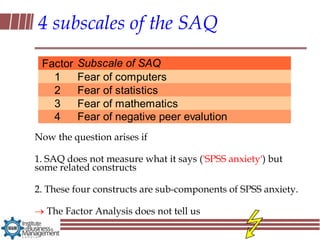
4 subscales of the SAQ
 Factor   Subscale of SAQ
   1      Fear of computers
   2      Fear of statistics
   3      Fear of mathematics
   4      Fear of negative peer evalution
Now the question arises if

1. SAQ does not measure what it says ('SPSS anxiety') but
some related constructs

2. These four constructs are sub-components of SPSS anxiety.

  The Factor Analysis does not tell us
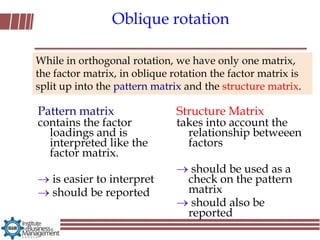
Oblique rotation

While in orthogonal rotation, we have only one matrix,
the factor matrix, in oblique rotation the factor matrix is
split up into the pattern matrix and the structure matrix.

Pattern matrix                 Structure Matrix
contains the factor            takes into account the
  loadings and is                relationship betweeen
  interpreted like the           factors
  factor matrix.
                                  should be used as a
   is easier to interpret        check on the pattern
   should be reported            matrix
                                  should also be
                                 reported
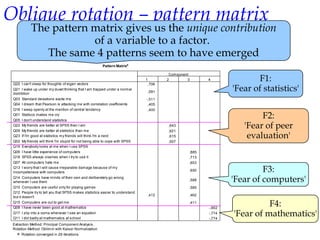
Oblique rotation – pattern matrix
            The pattern matrix gives us the unique contribution
                        of a variable to a factor.
               The same 4 patterns seem to have emerged
                                                           Pattern Matrixa


                                                                                                                        F1:
                                                                                          Component
                                                                              1          2        3      4
 Q20 I can't sleep for thoughts of eigen vectors                                  ,706
 Q21 I wake up under my duvet thinking that I am trapped under a normal
 distribtion
                                                                                  ,591                           'Fear of statistics'
 Q03 Standard deviations excite me                                            -,511
 Q04 I dream that Pearson is attacking me with correlation coefficients        ,405
 Q16 I weep openly at the mention of central tendency                             ,400
 Q01 Statiscs makes me cry
 Q05 I don't understand statistics
                                                                                                                         F2:
 Q22 My friends are better at SPSS than I am
 Q09 My friends are better at statistics than me
                                                                                         ,643
                                                                                         ,621
                                                                                                                    'Fear of peer
 Q23 If I'm good at statistics my friends will think I'm a nerd
 Q02 My friends will think I'm stupid for not being able to cope with SPSS
                                                                                         ,615                        evaluation'
                                                                                         ,507
 Q19 Everybody looks at me when I use SPSS
 Q06 I have little experience of computers                                                        ,885
 Q18 SPSS always crashes when I try to use it                                                     ,713
 Q07 All computers hate me                                                                        ,653
 Q13 I worry that I will cause irreparable damage because of my
 incompetenece with computers
                                                                                                  ,650                    F3:
 Q14 Computers have minds of their own and deliberately go wrong
 whenever I use them
                                                                                                  ,588           'Fear of computers'
 Q10 Computers are useful only for playing games                                                  ,585
 Q12 People try to tell you that SPSS makes statistics easier to understand
                                                                                  ,412            ,462
 but it doesn't
 Q15 Computers are out to get me
 Q08 I have never been good at mathematics
                                                                                                  ,411
                                                                                                         -,902
                                                                                                                           F4:
 Q17 I slip into a coma whenever I see an equation
 Q11 I did badly at mathematics at school
                                                                                                         -,774
                                                                                                         -,774
                                                                                                                 'Fear of mathematics'
 Extraction Method: Principal Component Analysis.
 Rotation Method: Oblimin with Kaiser Normalization.
    a. Rotation converged in 29 iterations.
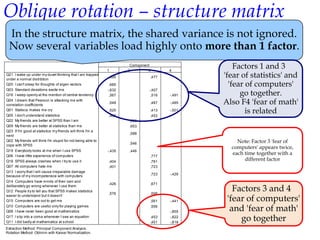
Oblique rotation – structure matrix
 In the structure matrix, the shared variance is not ignored.
 Now several variables load highly onto more than 1 factor.
                                              Structure Matrix


                                                                 1       2
                                                                          Component
                                                                                  3       4
                                                                                                      Factors 1 and 3
Q21 I wake up under my duvet thinking that I am trapped
under a normal distribtion
                                                                 ,695             ,477            'fear of statistics' and
Q20 I can't sleep for thoughts of eigen vectors                   ,685                              'fear of computers'
                                                                                                        go together.
Q03 Standard deviations excite me                                -,632            -,407
Q16 I weep openly at the mention of central tendency              ,567             ,516   -,491
Q04 I dream that Pearson is attacking me with
correlation coefficients
                                                                 ,548             ,487    -,485   Also F4 'fear of math'
Q01 Statiscs makes me cry
Q05 I don't understand statistics
                                                                 ,520
                                                                 ,462
                                                                                  ,413
                                                                                  ,453
                                                                                          -,501
                                                                                                          is related
Q22 My friends are better at SPSS than I am                              ,660
Q09 My friends are better at statistics than me                          ,653
Q23 If I'm good at statistics my friends will think I'm a
                                                                         ,588
nerd
Q02 My friends will think I'm stupid for not being able to
                                                                         ,546                         Note: Factor 3 'fear of
cope with SPSS
                                                                                                    computers' appears twice,
Q19 Everybody looks at me when I use SPSS                        -,435   ,446
Q06 I have little experience of computers                                         ,777
                                                                                                    each time together with a
Q18 SPSS always crashes when I try to use it                     ,404             ,761
                                                                                                         different factor
Q07 All computers hate me                                        ,401             ,723
Q13 I worry that I will cause irreparable damage
because of my incompetenece with computers                                        ,723    -,429

Q14 Computers have minds of their own and
                                                                 ,426             ,671
deliberately go wrong whenever I use them
Q12 People try to tell you that SPSS makes statistics
                                                                 ,576             ,606
                                                                                                     Factors 3 and 4
easier to understand but it doesn't
Q15 Computers are out to get me                                                   ,561    -,441    'fear of computers'
Q10 Computers are useful only for playing games
Q08 I have never been good at mathematics
                                                                                  ,556
                                                                                          -,855     and 'fear of math'
Q17 I slip into a coma whenever I see an equation
Q11 I did badly at mathematics at school
                                                                                  ,453
                                                                                  ,451
                                                                                          -,822
                                                                                          -,818
                                                                                                       go together
Extraction Method: Principal Component Analysis.
Rotation Method: Oblimin with Kaiser Normalization.
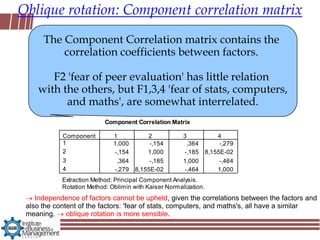
Oblique rotation: Component correlation matrix
      The Component Correlation matrix contains the
          correlation coefficients between factors.

       F2 'fear of peer evaluation' has little relation
    with the others, but F1,3,4 'fear of stats, computers,
          and maths', are somewhat interrelated.
                           Component Correlation Matrix

            Component         1           2            3              4
            1                 1,000        -,154        ,364           -,279
            2                 -,154       1,000        -,185      8,155E-02
            3                  ,364        -,185       1,000           -,464
            4                 -,279   8,155E-02        -,464          1,000
            Extraction Method: Principal Component Analysis.
            Rotation Method: Oblimin with Kaiser Normalization.
    Independence of factors cannot be upheld, given the correlations between the factors and
 also the content of the factors: 'fear of stats, computers, and maths's, all have a similar
 meaning.     oblique rotation is more sensible.
Factors – statistically and conceptually

The Factor Analysis has extracted 4 factors, 3 of which are correlated
with each other, one of which is rather independent. An oblique rotation
is more sensible given the interrelation between 3 factors.

How does that match the interpretation of the factors?

The three correlated factors

– fear of stats – fear of math – fear of computers

are also conceptually closely related whereas the
4th factor 'fear of negative peer evaluation', being socially based, is also
conceptually different.

Hence, the statistics and the meaning of the factors go along with each
other rather nicely.
Interim summary
SAQ   has 4 factors underlyingly, which we can identify as
fear of
– stats – maths – computers – peer evaluation

Oblique   rotation is to be preferred since three of the four
factors are inter-related, statistically as well as conceptually

The  use of Factor Analysis here is purely exploratory. It
helps you understand what factors are underlying large
data sets

Informed decisions may follow from such an exploratory
Factor Analysis, e.g., wrt working out a better
questionnaire.

Exploratory factor analysis

  • 1.
    Exploratory factor analysis Dr. M. Shakaib Akram Note: Most of the material used in this lecture has been taken from “Discovering Statistics Using SPP” by Andy Field, 3rd Ed .
  • 2.
    What is factoranalysis? Factor analysis (and principal component analysis) is a technique for identifying groups or clusters of variables underlying a set of measures. Those variables are called 'factors', or 'latent variables' since they are not directly observable, e.g., 'intelligence'. A 'latent variable' is “a variable that cannot be directly measured, but is assumed to be related to several variables that can be measured.“ (Glossary, p 736)
  • 3.
    What is factoranalysis used for? Factor analysis has 3 main uses: To understand the structure of a set of variables, e.g., intelligence To construct a questionnaire to measure an underlying variable To reduce a large data set to a more manageable size
  • 4.
    The most basicdata basis R-matrix An R-matrix is simply a correlation matrix with Pearson r-coefficients between pairs of variables as the off-diagonal elements. In factor analysis one tries to find latent variables that underlie clusters of correlations in such an R-matrix.
  • 5.
    Example: What makesa person popular? These measures all tap These measures all tap different aspects of different aspects of Amount of time someone talks about 'popularity' of aaperson. 'popularity' of person. the other person during a Talk 1 conversation Are there aafew underlying Are there few underlying How good are the person's social factors that can account Social Skills skills? factors that can account How interesting does the other find for them? for them? Interest that person? Factor 1 = sociability Amount of time someone talks about Factor 2 = consideration Talk 2 oneself during a conversation to others Selfish How selfish is the person? Liar How often does the person lie?
  • 6.
    Graphical representations offactors Factors can be visualized as axes along which we can plot variables. The coordinates of variables along each axis represents the strength of the relationship between that variable and each factor. In our expl., we have 2 underlying factors. The axis line ranges from -1 to +1, which is the range of possible correlations r. The position of a variable depends on its correlation coefficient with the 2 factors.
  • 7.
    1 Selfish 2-D Factor plot Talk 2 0.75 Liar The coordinate of a variable along a classification axis is 0.50 called 'factor loading' . It is the Pearson correlation r between a factor and a variable. 0.25 Interest 0 Talk 1 -1 -0.75 -0.50 -0.25 0 0.25 0.50 0.75 1 Soc Sociability Skills -0.25 In this 2-dimensional factor plot, there -0.50 are only 2 latent variables. Variables either load high on 'Sociability' or on 'Consideration to others'. -0.75 With 3 variables, we would have a 3D- factor plot. Consideration With >3 factors, no graphical factor plots are available any more. -1
  • 8.
    Research example: The‘SPSS-Anxiety Questionnaire' SAQ One use of Factor Analysis is constructing questionnaires. With the SAQ, students' anxiety towards SPSS shall be measured, using 23 questions. The questionnaire can be used to predict individuals' anxiety towards learning SPSS. Furthermore, the factor structure behind 'anxiety to use SPSS' shall be explored: which latent variables contribute to anxiety about SPSS?
  • 9.
    SD = Stronglydisagree, D = Disagree, N = Neither, A = Agree, SA = Strongly Agree SD D N A SA 1 Statistics makes me cry O O O O O 2 My friends will think I'm stupid for not being able to cope with SPSS. O O O O O 3 Standard deviations excite me. O O O O O 4 I dream that Pearson is attacking me with correlation coefficients. O O O O O 5 I don't understand statistics. O O O O O 6 I have little experience of computers. O O O O O 7 All computers hate me. O O O O O 8 I have never been good at mathematics. 9 My friends are better at statistics than me. The SAQ O O O O O O O O O O 10 Computers are useful only for playing games O O O O O 11 I did badly at mathematics at school. O O O O O People try to tell you that SPSS makes statistics easier to understand 12 but it doesn't. O O O O O I worry that I will cause irreparable damage because of my incomptence 13 with computers. O O O O O Computers have minds of their own and deliberately go wrong 14 whenever I use them. O O O O O 15 Computers are out to get me. O O O O O 16 I weep openly at the mention of central tendency. O O O O O 17 I slip into a coma whenever I see an equation. O O O O O 18 SPSS always crashes when I try to use it. O O O O O 19 Everybody looks at me when I use SPSS. O O O O O 20 I can't sleep for thoughts of eigenvectors. O O O O O I wake up under my duvet thinking that I am trapped under a normal 21 distribution. O O O O O 22 My friends are better a SPSS than I am. O O O O O 23 If I am good at statistics people will think I am a nerd. O O O O O
  • 10.
    Initial considerations: samplesize The reliability of factor analysis relies on the sample size. As a 'rule of thumb', there should be 10-15 subjects per variable. The stability of a factor solution depends on: 1. Absolute sample size 2. Magnitude of factor loading (>.6) 3. Communalities (>.6; the higher the better) The KMO*-measure is the ratio of the squared correlation between variables to the squared partial correlation between variables. It ranges from 0-1. Values between .7 and .8 are good. They suggest a factor analysis. *KMO: Kaiser-Meyer-Olkin measure of sampling adequacy
  • 11.
    Data screening  The variables in the questionnaire should intercorrelate if they measure the same thing. Questions that tap the same sub- variable, e.g., worry, intrusive thoughts, or physiological arousal, should be highly correlated.  If there are questions that are not intercorrelated with others, they should not be entered into the factor analysis.  If questions correlate too highly, extreme multi-collinearity or even singularity (perfectly correlated variables) result. Too low and too high intercorrelations should be avoided.  Finally, variables should be roughly normally distributed.
  • 12.
    Running the analysis (usingSAQ.sav)  Analyze Data Reduction Factor ... To compute a principal component analysis in SPSS, select the Dimension Reduction | Factor… command from the Analyze menu.
  • 13.
    Transfer all questions tothe variables window
  • 14.
    Descriptives First, mark the Univariate Second, keep the descriptives checkbox to get Initial solution mean & Std. Deviation etc. checkbox to get the statistics needed to determine the number of factors to extract. Third, mark the Fifth, mark the Anti-image Coefficients checkbox to checkbox to assess the get a correlation matrix, appropriateness of factor one of the outputs analysis for the variables. needed to assess the appropriateness of factor analysis for the variables. The determinant Fourth, mark the KMO and Bartlett’s test Sixth, click should be of sphericity checkbox to assess the on the > .00001 appropriateness of factor analysis for the Continue variables. button.
  • 15.
    Extraction First, click onthe Extraction… button to specify statistics to include in the output. The extraction method refers to the mathematical method that SPSS uses to compute the factors or components.
  • 16.
  • 17.
    Extraction Analyze the Corrmatrix Two plots can be OR the covariance matrix displayed: Unrotated factors Scree plot Cattel's (>1) or Kaiser's (>.7) recommendation
  • 18.
    Rotation The rotation method refers to the mathematical method that SPSS rotate the axes in geometric space. This makes it easier to determine which variables are loaded on which components. Choose Varimax Helps interpret the final Normally, 25 iterations are enough rotated analysis
  • 19.
    Scores Factorscores for each subject will be saved in the data editor Best method of obtaining factor scores: Anderson-Rubin Produces matrix B with the b-values
  • 20.
    Options Subjects withmissing data for any variable are excluded Variables are sorted by size of their factor loadings Too small variables should not be displayed
  • 21.
    Run the FactorAnalysis  Then rerun it again, this time changing the rotation to oblique rotation: 'Direct Oblimin' Choose 'Direct Oblimin' this time The output will be the same except for the rotation.
  • 22.
    Interpreting output fromSPSS Preliminary analysis: –data screening –assumption testing –sampling adequacy
  • 23.
  • 24.
    Correlation Matrix Q01 Q02 Q03 Correlation Matrixa Q04 Q05 Q19 Q20 Q21 Q22 Q23 Correlation Q01 1,000 -,099 -,337 ,436 ,402 -,189 ,214 ,329 -,104 -,004 Q02 -,099 1,000 ,318 -,112 -,119 ,203 -,202 -,205 ,231 ,100 Q03 -,337 ,318 1,000 -,380 -,310 ,342 -,325 -,417 ,204 ,150 Q04 ,436 -,112 -,380 1,000 ,401 -,186 ,243 ,410 -,098 -,034 Q05 ,402 -,119 -,310 ,401 1,000 -,165 ,200 ,335 -,133 -,042 Q06 ,217 -,074 -,227 ,278 ,257 -,167 ,101 ,272 -,165 -,069 Selected output Q07 Q08 ,305 -,159 -,382 ,409 ,339 -,269 ,221 ,483 -,168 -,070 for Q-5; 19-23 ,331 -,050 -,259 ,349 ,269 -,159 ,175 ,296 -,079 -,050 Q09 -,092 ,315 ,300 -,125 -,096 ,249 -,159 -,136 ,257 ,171 Q10 ,214 -,084 -,193 ,216 ,258 -,127 ,084 ,193 -,131 -,062 Q11 ,357 -,144 -,351 ,369 ,298 -,200 ,255 ,346 -,162 -,086 Labels of questions Q12 Q13 ,345 ,355 -,195 -,143 -,410 -,318 ,442 ,344 ,347 ,302 -,267 -,227 ,298 ,204 ,441 ,374 -,167 -,195 -,046 -,053 omitted Q14 Q15 ,338 ,246 -,165 -,165 -,371 -,312 ,351 ,334 ,315 ,261 -,254 -,210 ,226 ,206 ,399 ,300 -,170 -,168 -,048 -,062 Q16 ,499 -,168 -,419 ,416 ,395 -,267 ,265 ,421 -,156 -,082 Q17 ,371 -,087 -,327 ,383 ,310 -,163 ,205 ,363 -,126 -,092 These are the Q18 Q19 ,347 -,189 -,164 ,203 -,375 ,342 ,382 -,186 ,322 -,165 -,257 1,000 ,235 -,249 ,430 -,275 -,160 ,234 -,080 ,122 Pearson corr Q20 ,214 -,202 -,325 ,243 ,200 -,249 1,000 ,468 -,100 -,035 coefficients between Q21 ,329 -,205 -,417 ,410 ,335 -,275 ,468 1,000 -,129 -,068 Q22 -,104 ,231 ,204 -,098 -,133 ,234 -,100 -,129 1,000 ,230 all pairs of variables Sig. (1-tailed) Q23 Q01 -,004 ,100 ,000 ,150 ,000 -,034 ,000 -,042 ,000 ,122 ,000 -,035 ,000 -,068 ,000 ,230 ,000 1,000 ,410 Q02 ,000 ,000 ,000 ,000 ,000 ,000 ,000 ,000 ,000 Q03 ,000 ,000 ,000 ,000 ,000 ,000 ,000 ,000 ,000 Q04 ,000 ,000 ,000 ,000 ,000 ,000 ,000 ,000 ,043 Q05 ,000 ,000 ,000 ,000 ,000 ,000 ,000 ,000 ,017 These are the Q06 Q07 ,000 ,000 ,000 ,000 ,000 ,000 ,000 ,000 ,000 ,000 ,000 ,000 ,000 ,000 ,000 ,000 ,000 ,000 ,000 ,000 Significance levels Q08 Q09 ,000 ,000 ,006 ,000 ,000 ,000 ,000 ,000 ,000 ,000 ,000 ,000 ,000 ,000 ,000 ,000 ,000 ,000 ,005 ,000 for all correlations. Q10 ,000 ,000 ,000 ,000 ,000 ,000 ,000 ,000 ,000 ,001 Q11 Note: they are almost ,000 ,000 ,000 ,000 ,000 ,000 ,000 ,000 ,000 ,000 Q12 ,000 ,000 ,000 ,000 ,000 ,000 ,000 ,000 ,000 ,009 all significant! Q13 Q14 ,000 ,000 ,000 ,000 ,000 ,000 ,000 ,000 ,000 ,000 ,000 ,000 ,000 ,000 ,000 ,000 ,000 ,000 ,004 ,007 Q15 ,000 ,000 ,000 ,000 ,000 ,000 ,000 ,000 ,000 ,001 Q16 ,000 ,000 ,000 ,000 ,000 ,000 ,000 ,000 ,000 ,000 Q17 ,000 ,000 ,000 ,000 ,000 ,000 ,000 ,000 ,000 ,000 Q18 ,000 ,000 ,000 ,000 ,000 ,000 ,000 ,000 ,000 ,000 Q19 ,000 ,000 ,000 ,000 ,000 ,000 ,000 ,000 ,000 Q20 ,000 ,000 ,000 ,000 ,000 ,000 ,000 ,000 ,039 Q21 Determinant: ,000 ,000 ,000 ,000 ,000 ,000 ,000 ,000 ,000 Q22 ,000 ,000 ,000 ,000 ,000 ,000 ,000 ,000 ,000 .0005271 Q23 ,410 a. Determinant = 5,271E-04 ,000 ,000 ,043 ,017 ,000 ,039 ,000 ,000 OK!
  • 25.
    Scanning the CorrelationMatrix Correlation Matrixa Q01 Q02 Q03 Q04 Q05 Q19 Q20 Q21 Q22 Q23 Correlation Q01 1,000 -,099 -,337 ,436 ,402 -,189 ,214 ,329 -,104 -,004 Q02 -,099 1,000 ,318 -,112 -,119 ,203 -,202 -,205 ,231 ,100 Q03 -,337 ,318 1,000 -,380 -,310 ,342 -,325 -,417 ,204 ,150 Q04 ,436 -,112 -,380 1,000 ,401 -,186 ,243 ,410 -,098 -,034 Q05 ,402 -,119 -,310 ,401 1,000 -,165 ,200 ,335 -,133 -,042 2. Then scan the corr Q06 Q07 ,217 ,305 -,074 -,159 -,227 -,382 ,278 ,409 ,257 ,339 -,167 -,269 ,101 ,221 ,272 ,483 -,165 -,168 -,069 -,070 coefficients for >.9 Q08 Q09 ,331 -,050 -,259 ,349 ,269 -,159 ,175 ,296 -,079 -,050 -,092 ,315 ,300 -,125 -,096 ,249 -,159 -,136 ,257 ,171 none! Q10 ,214 -,084 -,193 ,216 ,258 -,127 ,084 ,193 -,131 -,062 no problem with Q11 ,357 -,144 -,351 ,369 ,298 -,200 ,255 ,346 -,162 -,086 Q12 ,345 -,195 -,410 ,442 ,347 -,267 ,298 ,441 -,167 -,046 multicollinearity Q13 Q14 ,355 ,338 -,143 -,165 -,318 -,371 ,344 ,351 ,302 ,315 -,227 -,254 ,204 ,226 ,374 ,399 -,195 -,170 -,053 -,048 Q15 ,246 -,165 -,312 ,334 ,261 -,210 ,206 ,300 -,168 -,062 Q16 ,499 -,168 -,419 ,416 ,395 -,267 ,265 ,421 -,156 -,082 Q17 ,371 -,087 -,327 ,383 ,310 -,163 ,205 ,363 -,126 -,092 Look for many low Q18 Q19 ,347 -,189 -,164 ,203 -,375 ,342 ,382 -,186 ,322 -,165 -,257 1,000 ,235 -,249 ,430 -,275 -,160 ,234 -,080 ,122 correlations (p > .05) Q20 Q21 ,214 ,329 -,202 -,205 -,325 -,417 ,243 ,410 ,200 ,335 -,249 -,275 1,000 ,468 ,468 1,000 -,100 -,129 -,035 -,068 for a single variable Q22 Q23 -,104 -,004 ,231 ,100 ,204 ,150 -,098 -,034 -,133 -,042 ,234 ,122 -,100 -,035 -,129 -,068 1,000 ,230 ,230 1,000 none! Sig. (1-tailed) Q01 ,000 ,000 ,000 ,000 ,000 ,000 ,000 ,000 ,410 Q02 ,000 ,000 ,000 ,000 ,000 ,000 ,000 ,000 ,000 Q03 ,000 ,000 ,000 ,000 ,000 ,000 ,000 ,000 ,000 Q04 ,000 ,000 ,000 ,000 ,000 ,000 ,000 ,000 ,043 Q05 ,000 ,000 ,000 ,000 ,000 ,000 ,000 ,000 ,017 Q06 ,000 ,000 ,000 ,000 ,000 ,000 ,000 ,000 ,000 ,000 Q07 ,000 ,000 ,000 ,000 ,000 ,000 ,000 ,000 ,000 ,000 Q08 ,000 ,006 ,000 ,000 ,000 ,000 ,000 ,000 ,000 ,005 Q09 All Q seem to ,000 ,000 ,000 ,000 ,000 ,000 ,000 ,000 ,000 ,000 Q10 ,000 ,000 ,000 ,000 ,000 ,000 ,000 ,000 ,000 ,001 be fine! Q11 ,000 ,000 ,000 ,000 ,000 ,000 ,000 ,000 ,000 ,000 Q12 ,000 ,000 ,000 ,000 ,000 ,000 ,000 ,000 ,000 ,009 Q13 ,000 ,000 ,000 ,000 ,000 ,000 ,000 ,000 ,000 ,004 Q14 ,000 ,000 ,000 ,000 ,000 ,000 ,000 ,000 ,000 ,007 Q15 ,000 ,000 ,000 ,000 ,000 ,000 ,000 ,000 ,000 ,001 Q16 ,000 ,000 ,000 ,000 ,000 ,000 ,000 ,000 ,000 ,000 Q17 ,000 ,000 ,000 ,000 ,000 ,000 ,000 ,000 ,000 ,000 Q18 ,000 ,000 ,000 ,000 ,000 ,000 ,000 ,000 ,000 ,000 Q19 ,000 ,000 ,000 ,000 ,000 ,000 ,000 ,000 ,000 Q20 ,000 ,000 ,000 ,000 ,000 ,000 ,000 ,000 ,039 Q21 ,000 ,000 ,000 ,000 ,000 ,000 ,000 ,000 ,000 Q22 ,000 ,000 ,000 ,000 ,000 ,000 ,000 ,000 ,000 Q23 ,410 ,000 ,000 ,043 ,017 ,000 ,039 ,000 ,000 a. Determinant = 5,271E-04
  • 26.
    Bartlett's test ofsphericity KMO statistics KMO-measures >.9 KMO and Bartlett's Test are superb! Kaiser-Meyer-Olkin Measure of Sampling KMO measures the ratio of the squared Adequacy. ,930 correlation between variables Bartlett's Test of Approx. Chi-Square 19334,492 to the squared partial correlation Sphericity df 253 between variables. Sig. ,000 KMO measures for individual factors are Bartlett's test tests if the R-matrix is an produced on the diagonal identity matrix (matrix with only 1's in the of the anti-image corr diagonal and 0's off-diagonal). However, matrix we want to have correlated variables, so The KMO-measures the off-diagonal elements should NOT be give us a hint at 0. Thus, the test should be significant, which variables should i.e., the R-matrix should NOT be an be excluded from identity matrix. the factor analysis
  • 27.
    (2nd part ofthe) Anti-Images Matrices Red underlined are the The off-diagonal numbers Anti-Image KMO-measures for are the partial corr between Correlation the individual variables variables. They should all They are all high be very small, which they are. Q1 Q2 Q3 Q4 Q5.... Q19 Q20 Q21 Q22
  • 28.
    Before Initial eigenvalues and extraction, there are as many explained variances are ordered in decreasing Factor extraction magnitude factors as there are variables, Before extraction After extraction After rotation n=23 Total Variance Explained Initial Eigenvalues Extraction Sums of Squared Loadings Rotation Sums of Squared Loadings Component Total % of Variance Cumulative % Total % of Variance Cumulative % Total % of Variance Cumulative % 1 7,290 31,696 31,696 7,290 31,696 31,696 3,730 16,219 16,219 2 1,739 7,560 39,256 1,739 7,560 39,256 3,340 14,523 30,742 3 1,317 5,725 44,981 1,317 5,725 44,981 2,553 11,099 41,842 4 1,227 5,336 50,317 1,227 5,336 50,317 1,949 8,475 50,317 5 ,988 4,295 54,612 6 ,895 3,893 58,504 7 ,806 3,502 62,007 Only 4 factors Rotation optimizes 8 ,783 3,404 65,410 with an eigenvalue factor structure 9 ,751 3,265 68,676 10 ,717 3,117 71,793 > 1 are retained (Varimax). The relative impor- (Fisher's criterion) 11 ,684 2,972 74,765 12 ,670 2,911 77,676 tance of factors is 13 14 ,612 ,578 2,661 2,512 80,337 82,849 equalized. The 15 ,549 2,388 85,236 explained variance 16 ,523 2,275 87,511 of the 4 factors 17 18 ,508 ,456 2,210 1,982 89,721 91,704 is more similar 19 ,424 1,843 93,546 after rotation. 20 ,408 1,773 95,319 21 ,379 1,650 96,969 22 ,364 1,583 98,552 23 ,333 1,448 100,000 Extraction Method: Principal Component Analysis.
  • 29.
    Communalities Before and after extraction Communalities E.g.: 43,5% of variance in Initial Extraction Q01 1,000 ,435 Q1 is common, shared Communality is the Q02 1,000 ,414 variance Q03 1,000 ,530 proportion of common variance Q04 1,000 ,469 within a variable. Q05 1,000 ,343 Before extraction, there are Q06 1,000 ,654 as many factors as there are Initially, communality is Q07 1,000 ,545 variables, n=23, so that all assumed to be 1 ('all variance is Q08 Q09 1,000 1,000 ,739 ,484 variance is explained by the common'). Q10 1,000 ,335 factors and communality is Q11 1,000 ,690 After extraction, the true Q12 1,000 ,513 1. (No data reduction yet). communalities can be judged Q13 1,000 ,536 After extraction, some of the better. Q14 1,000 ,488 factors are retained, others Q15 1,000 ,378 Q16 1,000 ,487 are dismissed. This leads to Q17 1,000 ,683 a welcome data reduction. Q18 1,000 ,597 Now the amount of variation Q19 Q20 1,000 1,000 ,343 ,484 in each variable explained Q21 1,000 ,550 by the factors is the Q22 1,000 ,464 communality. Q23 1,000 ,412 Extraction Method: Principal Component Analysis.
  • 30.
    Before rotation, mostvariables loaded highest on the first factor (which Component matrix can therefore explain a high amount of variation (31,7%) Component Matrixa Component 1 2 3 4 Q18 ,701 Q07 ,685 Loadings <.3 are suppressed, The component matrix shows the factor Q16 ,679 Q13 ,673 hence the Q12 ,669 blank spaces. loadings of each variable before rotation. Q21 ,658 SPSS has already extracted 4 components Q14 ,656 Q11 ,652 -,400 (factors). Q17 ,643 Q04 ,634 Q03 -,629 How can we decide how many factors we Q15 Q01 ,593 ,586 should retain? Q05 ,556 Q08 ,549 ,401 -,417 Q10 ,437 scree plot Q20 ,436 -,404 Q19 -,427 Q09 ,627 Q02 ,548 Q22 ,465 Q06 ,562 ,571 Q23 ,507 Extraction Method: Principal Component Analysis. a. 4 components extracted.
  • 31.
    Scree plot After 2 or after 4 factors, the curve inflects. Since we have a huge sample, Eigenvalues can still be well interpreted >1, so retaining 4 is justified. However, it is also possible to retain just 2.
  • 32.
    Rotated component matrix:orthogonal rotation a Rotated Component Matrix Component 1 2 3 4 Q06 ,800 Q18 ,684 Q13 ,647 The Rotated component matrix has the same Q07 ,638 Q14 ,579 information as the component matrix, only that Q10 Q15 ,550 ,459 it is calculated after orthogonal rotation (here Q20 ,677 with VARIMAX). Q21 ,661 Q03 -,567 Q12 ,473 ,523 Q04 ,516 Loadings <.3 Q16 ,514 Q01 ,496 are suppressed, Q05 ,429 hence the Q08 ,833 blank spaces. Q17 ,747 Q11 ,747 Q09 ,648 Q22 ,645 Q23 ,586 Q02 ,543 Q19 ,427 Extraction Method: Principal Component Analysis. Rotation Method: Varimax with Kaiser Normalization. a. Rotation converged in 9 iterations.
  • 33.
    Component vs. RotatedComponent Matrix a Rotated Component Matrix Component Matrixa Component Component 1 2 3 4 Before rotation, most Q06 1 ,800 2 3 4 Q18 Q07 ,701 ,685 Qs loaded highly on Q18 ,684 Q16 ,679 the first extracted Q13 ,647 Q13 ,673 factor and much lower Q07 Q14 ,638 ,579 Q12 ,669 on the following ones. Q10 ,550 Q21 ,658 Q15 ,459 Q14 ,656 Q20 ,677 Q11 ,652 -,400 After rotation, all 4 Q21 ,661 Q17 ,643 Q04 ,634 extracted factors have Q03 -,567 Q03 -,629 a couple of Qs loading Q12 ,473 ,523 Q04 Q15 ,593 highly on them. Q16 ,516 ,514 Q01 ,586 Q01 ,496 Q05 ,556 Q05 ,429 Q08 ,549 ,401 -,417 Q08 ,833 Q10 ,437 Q12 loads equally Q17 ,747 Q20 ,436 -,404 Q19 -,427 high on factor 1 and 2! Q11 ,747 Q09 ,648 Q09 ,627 Q22 ,645 Q02 Q12: People try ,548 Q23 ,586 Q22 ,465 Q06 ,562 ,571 to tell you that Q02 Q19 ,543 ,427 Q23 ,507 SPSS makes Extraction Method: Principal Component Analysis. Extraction Method: Principal Component Analysis. a. 4 components extracted. statistics easier to Rotation Method: Varimax with Kaiser Normalization. a. Rotation converged in 9 iterations. understand but it doesn't
  • 34.
    Looking at thecontent of the Qs: In order to interpret the factors, we have to look at the content of the Qs that load highly on them: Factor 1: 'Fear of computers' Load F1 F2 F3 F4 Q06 I have little experience of computers .800 Q18 SPSS always crashes when I try to use it .684 I worry that I will cause irreparable damage because of my incompetence with Q13 computers .647 Q7 All computers hate me .638 Computers have minds of their own and Q14 deliberately go wrong whenever I use them .579 Computers are useful only for playing Q10 games .550 Q15 Computers are out to get me .459
  • 35.
    Looking at thecontent of the Qs: Factor 2: 'Fear of statistics' Load F1 F2 F3 F4 Q20 I can't sleep for thoughts of eigenvectors .677 I wake up under my duvet thinking that I Q21 am trapped under a normal distribution .661 Q03 Standard deviations excite me -.567 People try to tell you that SPSS makes statistics easier to understand but it Q12 doesn't .473 .523 I dream that Pearson is attacking me with Q04 correlation coefficients .516 I weep openly at the mention of central Q16 tendency .514 Q01 Statistics makes me cry .496 Q05 I don't understand statistics .429
  • 36.
    Looking at thecontent of the Qs: Factor 3: 'Fear of mathematics' Load F1 F2 F3 F4 Q08 I have never been good at mathematics .833 I slip into a coma whenever I see an Q17 equation .747 Q11 I did badly at mathematics at school .747
  • 37.
    Looking at thecontent of the Qs: Factor 4: 'Peer evaluation' Load F1 F2 F3 F4 Q09 My friends are better at statistics than me .648 Q22 My friends are better at SPSS than me .645 If I am good at statistics my friends will Q23 think I'm a nerd .586 My frieds with think I'm stupid for not being Q02 able to cope with SPSS .543 Q19 Everybody looks at me when I use SPSS .427
  • 38.
    4 subscales ofthe SAQ Factor Subscale of SAQ 1 Fear of computers 2 Fear of statistics 3 Fear of mathematics 4 Fear of negative peer evalution Now the question arises if 1. SAQ does not measure what it says ('SPSS anxiety') but some related constructs 2. These four constructs are sub-components of SPSS anxiety. The Factor Analysis does not tell us
  • 39.
    Oblique rotation While inorthogonal rotation, we have only one matrix, the factor matrix, in oblique rotation the factor matrix is split up into the pattern matrix and the structure matrix. Pattern matrix Structure Matrix contains the factor takes into account the loadings and is relationship betweeen interpreted like the factors factor matrix. should be used as a is easier to interpret check on the pattern should be reported matrix should also be reported
  • 40.
    Oblique rotation –pattern matrix The pattern matrix gives us the unique contribution of a variable to a factor. The same 4 patterns seem to have emerged Pattern Matrixa F1: Component 1 2 3 4 Q20 I can't sleep for thoughts of eigen vectors ,706 Q21 I wake up under my duvet thinking that I am trapped under a normal distribtion ,591 'Fear of statistics' Q03 Standard deviations excite me -,511 Q04 I dream that Pearson is attacking me with correlation coefficients ,405 Q16 I weep openly at the mention of central tendency ,400 Q01 Statiscs makes me cry Q05 I don't understand statistics F2: Q22 My friends are better at SPSS than I am Q09 My friends are better at statistics than me ,643 ,621 'Fear of peer Q23 If I'm good at statistics my friends will think I'm a nerd Q02 My friends will think I'm stupid for not being able to cope with SPSS ,615 evaluation' ,507 Q19 Everybody looks at me when I use SPSS Q06 I have little experience of computers ,885 Q18 SPSS always crashes when I try to use it ,713 Q07 All computers hate me ,653 Q13 I worry that I will cause irreparable damage because of my incompetenece with computers ,650 F3: Q14 Computers have minds of their own and deliberately go wrong whenever I use them ,588 'Fear of computers' Q10 Computers are useful only for playing games ,585 Q12 People try to tell you that SPSS makes statistics easier to understand ,412 ,462 but it doesn't Q15 Computers are out to get me Q08 I have never been good at mathematics ,411 -,902 F4: Q17 I slip into a coma whenever I see an equation Q11 I did badly at mathematics at school -,774 -,774 'Fear of mathematics' Extraction Method: Principal Component Analysis. Rotation Method: Oblimin with Kaiser Normalization. a. Rotation converged in 29 iterations.
  • 41.
    Oblique rotation –structure matrix In the structure matrix, the shared variance is not ignored. Now several variables load highly onto more than 1 factor. Structure Matrix 1 2 Component 3 4 Factors 1 and 3 Q21 I wake up under my duvet thinking that I am trapped under a normal distribtion ,695 ,477 'fear of statistics' and Q20 I can't sleep for thoughts of eigen vectors ,685 'fear of computers' go together. Q03 Standard deviations excite me -,632 -,407 Q16 I weep openly at the mention of central tendency ,567 ,516 -,491 Q04 I dream that Pearson is attacking me with correlation coefficients ,548 ,487 -,485 Also F4 'fear of math' Q01 Statiscs makes me cry Q05 I don't understand statistics ,520 ,462 ,413 ,453 -,501 is related Q22 My friends are better at SPSS than I am ,660 Q09 My friends are better at statistics than me ,653 Q23 If I'm good at statistics my friends will think I'm a ,588 nerd Q02 My friends will think I'm stupid for not being able to ,546 Note: Factor 3 'fear of cope with SPSS computers' appears twice, Q19 Everybody looks at me when I use SPSS -,435 ,446 Q06 I have little experience of computers ,777 each time together with a Q18 SPSS always crashes when I try to use it ,404 ,761 different factor Q07 All computers hate me ,401 ,723 Q13 I worry that I will cause irreparable damage because of my incompetenece with computers ,723 -,429 Q14 Computers have minds of their own and ,426 ,671 deliberately go wrong whenever I use them Q12 People try to tell you that SPSS makes statistics ,576 ,606 Factors 3 and 4 easier to understand but it doesn't Q15 Computers are out to get me ,561 -,441 'fear of computers' Q10 Computers are useful only for playing games Q08 I have never been good at mathematics ,556 -,855 and 'fear of math' Q17 I slip into a coma whenever I see an equation Q11 I did badly at mathematics at school ,453 ,451 -,822 -,818 go together Extraction Method: Principal Component Analysis. Rotation Method: Oblimin with Kaiser Normalization.
  • 42.
    Oblique rotation: Componentcorrelation matrix The Component Correlation matrix contains the correlation coefficients between factors. F2 'fear of peer evaluation' has little relation with the others, but F1,3,4 'fear of stats, computers, and maths', are somewhat interrelated. Component Correlation Matrix Component 1 2 3 4 1 1,000 -,154 ,364 -,279 2 -,154 1,000 -,185 8,155E-02 3 ,364 -,185 1,000 -,464 4 -,279 8,155E-02 -,464 1,000 Extraction Method: Principal Component Analysis. Rotation Method: Oblimin with Kaiser Normalization. Independence of factors cannot be upheld, given the correlations between the factors and also the content of the factors: 'fear of stats, computers, and maths's, all have a similar meaning. oblique rotation is more sensible.
  • 43.
    Factors – statisticallyand conceptually The Factor Analysis has extracted 4 factors, 3 of which are correlated with each other, one of which is rather independent. An oblique rotation is more sensible given the interrelation between 3 factors. How does that match the interpretation of the factors? The three correlated factors – fear of stats – fear of math – fear of computers are also conceptually closely related whereas the 4th factor 'fear of negative peer evaluation', being socially based, is also conceptually different. Hence, the statistics and the meaning of the factors go along with each other rather nicely.
  • 44.
    Interim summary SAQ has 4 factors underlyingly, which we can identify as fear of – stats – maths – computers – peer evaluation Oblique rotation is to be preferred since three of the four factors are inter-related, statistically as well as conceptually The use of Factor Analysis here is purely exploratory. It helps you understand what factors are underlying large data sets Informed decisions may follow from such an exploratory Factor Analysis, e.g., wrt working out a better questionnaire.