Govt. college for Women 
University 
Madina town, Fsd
Unit Root Test
Contents 
1: What is unit root? 
2: How to check unit root? 
3: Types of unit root test 
4: Dickey fuller 
5: Augmented dickey fuller 
6: Phillip perron 
7: Testing Unit Root on E-views
Unit Root Test 
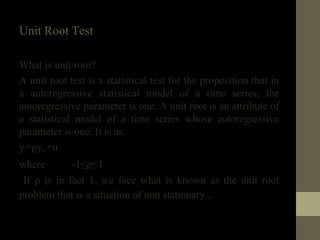
What is unit root? 
A unit root test is a statistical test for the proposition that in 
a autoregressive statistical model of a time series, the 
autoregressive parameter is one. A unit root is an attribute of 
a statistical model of a time series whose autoregressive 
parameter is one. It is as: 
yt=ρyt-1+ut 
where -1≤ρ≤1 
If ρ is in fact 1, we face what is known as the unit root 
problem that is a situation of non stationary .
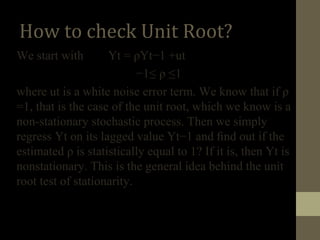
How to check Unit Root? 
We start with Yt = ρYt−1 +ut 
−1≤ ρ ≤1 
where ut is a white noise error term. We know that if ρ 
=1, that is the case of the unit root, which we know is a 
non-stationary stochastic process. Then we simply 
regress Yt on its lagged value Yt−1 and find out if the 
estimated ρ is statistically equal to 1? If it is, then Yt is 
nonstationary. This is the general idea behind the unit 
root test of stationarity.
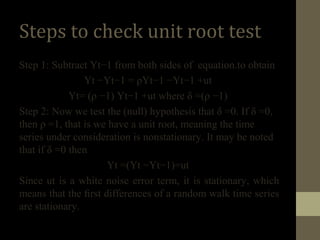
Steps to check unit root test 
Step 1: Subtract Yt−1 from both sides of equation.to obtain 
Yt −Yt−1 = ρYt−1 −Yt−1 +ut 
Yt= (ρ −1) Yt−1 +ut where δ =(ρ −1) 
Step 2: Now we test the (null) hypothesis that δ =0. If δ =0, 
then ρ =1, that is we have a unit root, meaning the time 
series under consideration is nonstationary. It may be noted 
that if δ =0 then 
Yt =(Yt −Yt−1)=ut 
Since ut is a white noise error term, it is stationary, which 
means that the first differences of a random walk time series 
are stationary.
Types of Unit Root Test 
There are three types of Unit root test 
1: Dickey fuller 
2: Augmented Dickey Fuller 
3: Phillip perron
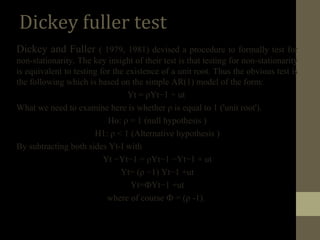
Dickey fuller test 
Dickey and Fuller ( 1979, 1981) devised a procedure to formally test for 
non-stationarity. The key insight of their test is that testing for non-stationarity 
is equivalent to testing for the existence of a unit root. Thus the obvious test is 
the following which is based on the simple AR(1) model of the form: 
Yt = ρYt−1 + ut 
What we need to examine here is whether ρ is equal to 1 ('unit root'). 
Ho: ρ = 1 (null hypothesis ) 
H1: ρ < 1 (Alternative hypothesis ) 
By subtracting both sides Yt-I with 
Yt −Yt−1 = ρYt−1 −Yt−1 + ut 
Yt= (ρ −1) Yt−1 +ut 
Yt=ФYt−1 +ut 
where of course Ф = (ρ -1).
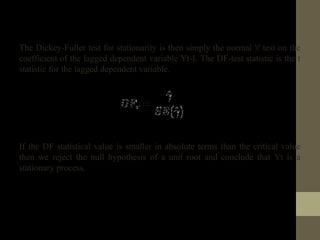
The Dickey-Fuller test for stationarity is then simply the normal 't' test on the 
coefficient of the lagged dependent variable Yt-I. The DF-test statistic is the t 
statistic for the lagged dependent variable. 
If the DF statistical value is smaller in absolute terms than the critical value 
then we reject the null hypothesis of a unit root and conclude that Yt is a 
stationary process.
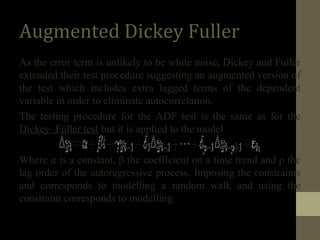
Augmented Dickey Fuller 
As the error term is unlikely to be white noise, Dickey and Fuller 
extended their test procedure suggesting an augmented version of 
the test which includes extra lagged terms of the dependent 
variable in order to eliminate autocorrelation. 
The testing procedure for the ADF test is the same as for the 
Dickey–Fuller test but it is applied to the model 
Where α is a constant, β the coefficient on a time trend and ρ the 
lag order of the autoregressive process. Imposing the constraints 
and corresponds to modelling a random walk and using the 
constraint corresponds to modelling.
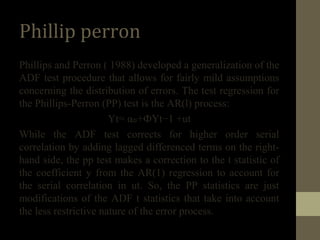
Phillip perron 
Phillips and Perron ( 1988) developed a generalization of the 
ADF test procedure that allows for fairly mild assumptions 
concerning the distribution of errors. The test regression for 
the Phillips-Perron (PP) test is the AR(l) process: 
Yt= αₒ+ФYt−1 +ut 
While the ADF test corrects for higher order serial 
correlation by adding lagged differenced terms on the right-hand 
side, the pp test makes a correction to the t statistic of 
the coefficient y from the AR(1) regression to account for 
the serial correlation in ut. So, the PP statistics are just 
modifications of the ADF t statistics that take into account 
the less restrictive nature of the error process.
Testing Unit root in e-views 
Step 1: Open the file in EViews by clicking File/Open/Workfile 
and then choosing the file name from the appropriate path. 
Step 2: Let's assume that we want to examine whether the series 
named GDP contains a unit root. Double click on the series 
named 'gdp' to open the series window and choose View/Unit 
Root Test .In the unit-root test dialog box that appears, choose 
the type of test (i.e. the' Augmented Dickey-Fuller test) by 
clicking on it. 
Step 3: We then have specify whether we want to test for a unit 
root in the level, first difference, or second difference of the 
series. We first start with the level.
Step 4: We also have to specify which model of the three ADF 
models we wish to use (i.e. whether to include a constant, a 
constant and linear trend, or neither in the test regression). 
Step 5: Finally, we have to specify the number of lagged 
dependent variables to be included in the model in order to 
correct for the presence of serial correlation . (For the PP test we 
specify the lag truncation to compute the Newey- West 
heteroskedasticity and autocorrelation (HAC) consistent estimate 
of the spectrum at zero frequency). 
Step 6: Having specified these options, click <OK>: to carry out 
the test. EViews reports the test statistic together with the 
estimated test regression. 
Step 7: We reject the null hypothesis of a unit root against the 
alternative if the ADF statistic is less than the critical value, and 
we conclude that the series is stationary.
References 
1: Applied Econometrics 
(Dimitrios Asterius and stephen) 
2: Basic econometrics 
(Damodar N. Gujarati) 
3:http://economics.about.com/od/economicsglossar 
y/g/unitroottest.htm 
4: http://en.wikipedia.org/wiki/Phillips%E2%80%93Perron_test.htm

Unit Root Test

  • 2.
    Govt. college forWomen University Madina town, Fsd
  • 3.
  • 4.
    Contents 1: Whatis unit root? 2: How to check unit root? 3: Types of unit root test 4: Dickey fuller 5: Augmented dickey fuller 6: Phillip perron 7: Testing Unit Root on E-views
  • 5.
    Unit Root Test What is unit root? A unit root test is a statistical test for the proposition that in a autoregressive statistical model of a time series, the autoregressive parameter is one. A unit root is an attribute of a statistical model of a time series whose autoregressive parameter is one. It is as: yt=ρyt-1+ut where -1≤ρ≤1 If ρ is in fact 1, we face what is known as the unit root problem that is a situation of non stationary .
  • 6.
    How to checkUnit Root? We start with Yt = ρYt−1 +ut −1≤ ρ ≤1 where ut is a white noise error term. We know that if ρ =1, that is the case of the unit root, which we know is a non-stationary stochastic process. Then we simply regress Yt on its lagged value Yt−1 and find out if the estimated ρ is statistically equal to 1? If it is, then Yt is nonstationary. This is the general idea behind the unit root test of stationarity.
  • 7.
    Steps to checkunit root test Step 1: Subtract Yt−1 from both sides of equation.to obtain Yt −Yt−1 = ρYt−1 −Yt−1 +ut Yt= (ρ −1) Yt−1 +ut where δ =(ρ −1) Step 2: Now we test the (null) hypothesis that δ =0. If δ =0, then ρ =1, that is we have a unit root, meaning the time series under consideration is nonstationary. It may be noted that if δ =0 then Yt =(Yt −Yt−1)=ut Since ut is a white noise error term, it is stationary, which means that the first differences of a random walk time series are stationary.
  • 8.
    Types of UnitRoot Test There are three types of Unit root test 1: Dickey fuller 2: Augmented Dickey Fuller 3: Phillip perron
  • 9.
    Dickey fuller test Dickey and Fuller ( 1979, 1981) devised a procedure to formally test for non-stationarity. The key insight of their test is that testing for non-stationarity is equivalent to testing for the existence of a unit root. Thus the obvious test is the following which is based on the simple AR(1) model of the form: Yt = ρYt−1 + ut What we need to examine here is whether ρ is equal to 1 ('unit root'). Ho: ρ = 1 (null hypothesis ) H1: ρ < 1 (Alternative hypothesis ) By subtracting both sides Yt-I with Yt −Yt−1 = ρYt−1 −Yt−1 + ut Yt= (ρ −1) Yt−1 +ut Yt=ФYt−1 +ut where of course Ф = (ρ -1).
  • 10.
    The Dickey-Fuller testfor stationarity is then simply the normal 't' test on the coefficient of the lagged dependent variable Yt-I. The DF-test statistic is the t statistic for the lagged dependent variable. If the DF statistical value is smaller in absolute terms than the critical value then we reject the null hypothesis of a unit root and conclude that Yt is a stationary process.
  • 11.
    Augmented Dickey Fuller As the error term is unlikely to be white noise, Dickey and Fuller extended their test procedure suggesting an augmented version of the test which includes extra lagged terms of the dependent variable in order to eliminate autocorrelation. The testing procedure for the ADF test is the same as for the Dickey–Fuller test but it is applied to the model Where α is a constant, β the coefficient on a time trend and ρ the lag order of the autoregressive process. Imposing the constraints and corresponds to modelling a random walk and using the constraint corresponds to modelling.
  • 12.
    Phillip perron Phillipsand Perron ( 1988) developed a generalization of the ADF test procedure that allows for fairly mild assumptions concerning the distribution of errors. The test regression for the Phillips-Perron (PP) test is the AR(l) process: Yt= αₒ+ФYt−1 +ut While the ADF test corrects for higher order serial correlation by adding lagged differenced terms on the right-hand side, the pp test makes a correction to the t statistic of the coefficient y from the AR(1) regression to account for the serial correlation in ut. So, the PP statistics are just modifications of the ADF t statistics that take into account the less restrictive nature of the error process.
  • 13.
    Testing Unit rootin e-views Step 1: Open the file in EViews by clicking File/Open/Workfile and then choosing the file name from the appropriate path. Step 2: Let's assume that we want to examine whether the series named GDP contains a unit root. Double click on the series named 'gdp' to open the series window and choose View/Unit Root Test .In the unit-root test dialog box that appears, choose the type of test (i.e. the' Augmented Dickey-Fuller test) by clicking on it. Step 3: We then have specify whether we want to test for a unit root in the level, first difference, or second difference of the series. We first start with the level.
  • 14.
    Step 4: Wealso have to specify which model of the three ADF models we wish to use (i.e. whether to include a constant, a constant and linear trend, or neither in the test regression). Step 5: Finally, we have to specify the number of lagged dependent variables to be included in the model in order to correct for the presence of serial correlation . (For the PP test we specify the lag truncation to compute the Newey- West heteroskedasticity and autocorrelation (HAC) consistent estimate of the spectrum at zero frequency). Step 6: Having specified these options, click <OK>: to carry out the test. EViews reports the test statistic together with the estimated test regression. Step 7: We reject the null hypothesis of a unit root against the alternative if the ADF statistic is less than the critical value, and we conclude that the series is stationary.
  • 15.
    References 1: AppliedEconometrics (Dimitrios Asterius and stephen) 2: Basic econometrics (Damodar N. Gujarati) 3:http://economics.about.com/od/economicsglossar y/g/unitroottest.htm 4: http://en.wikipedia.org/wiki/Phillips%E2%80%93Perron_test.htm