HETEROSCEDASTICITY
NATURE AND CONSEQUENCES
PRESENTED BY
MANEESH . P
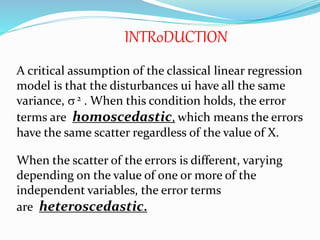
A critical assumption of the classical linear regression
model is that the disturbances ui have all the same
variance, 2 . When this condition holds, the error
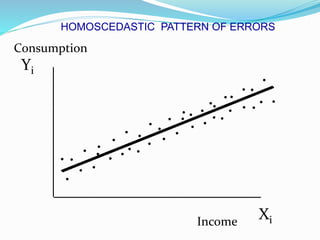
terms are homoscedastic, which means the errors
have the same scatter regardless of the value of X.
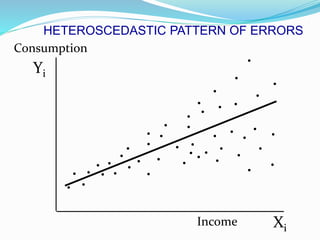
When the scatter of the errors is different, varying
depending on the value of one or more of the
independent variables, the error terms
are heteroscedastic.
INTRoDUCTION
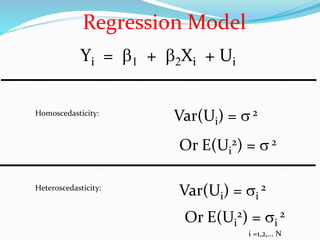
Yi = 1 + 2Xi + Ui
Regression Model
Var(Ui) = 2Homoscedasticity:
Heteroscedasticity:
Var(Ui) = i
2
Or E(Ui
2) = 2
Or E(Ui
2) = i
2
i =1,2,… N
One of the assumptions of the classical linear
regression (CLRM) is that the variance of ui, the
error term, is constant, or homoscedastic.
Reasons are many, including:
The presence of outliers in the data
Incorrect functional form of the regression model
Incorrect transformation of data
Mixing observations with different measures of scale
(such as mixing high-income households with low-
income households)
HETEROSCEDASTICITY
Heteroscedasticity is a systematic pattern in
the errors where the variances of the errors are
not constant.
Heteroscedasticity occurs when the variance
of the error terms differ across observations
HETEROSCEDASTICITY
Heteroscedasticity implies that the variances (i.e. - the
dispersion around the expected mean of zero) of the
residuals are not constant, but that they are different
for different observations. This causes a problem: if
the variances are unequal, then the relative reliability
of each observation (used in the regression analysis) is
unequal. The larger the variance, the lower should be
the importance (or weight) attached to that
observation.
MEANING
Suppose 100 students enroll in a typing class—some of which
have typing experience and some of which do not. After the
first class there would be a great deal of dispersion in the
number of typing mistakes. After the final class the dispersion
would be smaller . The error variance is non constant—it
falls as time increases..
EXAMPLE
Xi
Yi
.
.
.
.
.
.
.
..
.
.
.
.
.
.
.
.
. .
. .
.. .
.
. .
. .
. .
..
.
.
..
.
.
.
.
Income
Consumption
HOMOSCEDASTIC PATTERN OF ERRORS
Xi
Yi
.
.
.
. .
. .
..
.
.
.
.
.
.
.
.
.
.
.
.
.
.
.
.
.
.
.
.
.
.
.
.
.
.
.
.
.
...
.. .
.
.
Income
Consumption
HETEROSCEDASTIC PATTERN OF ERRORS
.
Xi
X1 X2
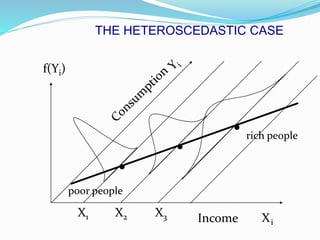
f(Yi)
X3
.
.
Income
rich people
poor people
THE HETEROSCEDASTIC CASE
ECON 7710, 2010
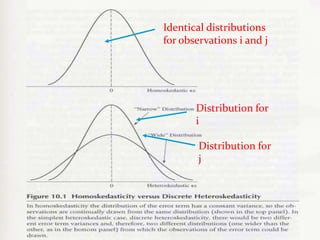
Identical distributions
for observations i and j
Distribution for
i
Distribution for
j
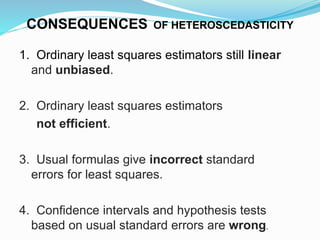
1. Ordinary least squares estimators still linear
and unbiased.
2. Ordinary least squares estimators
not efficient.
3. Usual formulas give incorrect standard
errors for least squares.
4. Confidence intervals and hypothesis tests
based on usual standard errors are wrong.
CONSEQUENCES OF HETEROSCEDASTICITY
CONSEQUENCES OF USING OLS IN THE
PRESENCE OF HETEROSCEDASTICITY
 OLS estimation still gives unbiased coefficient estimates, but they
are no longer BLUE.
 This implies that if we still use OLS in the presence of
heteroscedasticity, our standard errors could be inappropriate
and hence any inferences we make could be misleading.
The existence of heteroscedasticity in the error term of an equation
violates Classical Assumption V, and the estimation of the
equation with OLS has at least three consequences:
 Whether the standard errors calculated using the usual
formulae are too big or too small will depend upon the form
of the heteroscedasticity.
 In the presence of heteroscedasticity, the variances of OLS
estimators are not provided by the usual OLS formulas. But
if we persist in using the usual OLS formulas, the t and F tests
based on them can be highly mislead- ing, resulting in
erroneous conclusions
CONCLUSION
 With heteroscedasticity, this error term variance is
not constant
 One of the assumption of OLS regression is that
error terms have a constant variance across all value so f
independent variable
 More common in cross sectional data than time
series data
 Even if heteroscedasticity is present or suspected,
whatever conclusions we draw or inferences we make
may be very misleading.
Heteroscedasticity

Heteroscedasticity

  • 1.
  • 2.
    A critical assumptionof the classical linear regression model is that the disturbances ui have all the same variance, 2 . When this condition holds, the error terms are homoscedastic, which means the errors have the same scatter regardless of the value of X. When the scatter of the errors is different, varying depending on the value of one or more of the independent variables, the error terms are heteroscedastic. INTRoDUCTION
  • 3.
    Yi = 1+ 2Xi + Ui Regression Model Var(Ui) = 2Homoscedasticity: Heteroscedasticity: Var(Ui) = i 2 Or E(Ui 2) = 2 Or E(Ui 2) = i 2 i =1,2,… N
  • 4.
    One of theassumptions of the classical linear regression (CLRM) is that the variance of ui, the error term, is constant, or homoscedastic. Reasons are many, including: The presence of outliers in the data Incorrect functional form of the regression model Incorrect transformation of data Mixing observations with different measures of scale (such as mixing high-income households with low- income households) HETEROSCEDASTICITY
  • 5.
    Heteroscedasticity is asystematic pattern in the errors where the variances of the errors are not constant. Heteroscedasticity occurs when the variance of the error terms differ across observations HETEROSCEDASTICITY
  • 6.
    Heteroscedasticity implies thatthe variances (i.e. - the dispersion around the expected mean of zero) of the residuals are not constant, but that they are different for different observations. This causes a problem: if the variances are unequal, then the relative reliability of each observation (used in the regression analysis) is unequal. The larger the variance, the lower should be the importance (or weight) attached to that observation. MEANING
  • 7.
    Suppose 100 studentsenroll in a typing class—some of which have typing experience and some of which do not. After the first class there would be a great deal of dispersion in the number of typing mistakes. After the final class the dispersion would be smaller . The error variance is non constant—it falls as time increases.. EXAMPLE
  • 8.
    Xi Yi . . . . . . . .. . . . . . . . . . . . . ... . . . . . . . .. . . .. . . . . Income Consumption HOMOSCEDASTIC PATTERN OF ERRORS
  • 9.
    Xi Yi . . . . . . . .. . . . . . . . . . . . . . . . . . . . . . . . . . . . . . ... ... . . Income Consumption HETEROSCEDASTIC PATTERN OF ERRORS
  • 10.
    . Xi X1 X2 f(Yi) X3 . . Income rich people poorpeople THE HETEROSCEDASTIC CASE
  • 11.
    ECON 7710, 2010 Identicaldistributions for observations i and j Distribution for i Distribution for j
  • 12.
    1. Ordinary leastsquares estimators still linear and unbiased. 2. Ordinary least squares estimators not efficient. 3. Usual formulas give incorrect standard errors for least squares. 4. Confidence intervals and hypothesis tests based on usual standard errors are wrong. CONSEQUENCES OF HETEROSCEDASTICITY
  • 13.
    CONSEQUENCES OF USINGOLS IN THE PRESENCE OF HETEROSCEDASTICITY  OLS estimation still gives unbiased coefficient estimates, but they are no longer BLUE.  This implies that if we still use OLS in the presence of heteroscedasticity, our standard errors could be inappropriate and hence any inferences we make could be misleading. The existence of heteroscedasticity in the error term of an equation violates Classical Assumption V, and the estimation of the equation with OLS has at least three consequences:
  • 14.
     Whether thestandard errors calculated using the usual formulae are too big or too small will depend upon the form of the heteroscedasticity.  In the presence of heteroscedasticity, the variances of OLS estimators are not provided by the usual OLS formulas. But if we persist in using the usual OLS formulas, the t and F tests based on them can be highly mislead- ing, resulting in erroneous conclusions
  • 15.
    CONCLUSION  With heteroscedasticity,this error term variance is not constant  One of the assumption of OLS regression is that error terms have a constant variance across all value so f independent variable  More common in cross sectional data than time series data  Even if heteroscedasticity is present or suspected, whatever conclusions we draw or inferences we make may be very misleading.