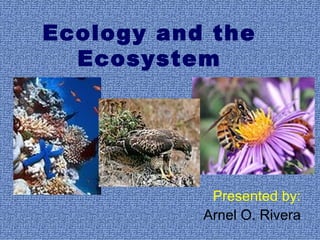
Ecology and the Ecosystem Presented by: Arnel O. Rivera
What is Ecology? The scientific study of the distributions, abundance, and relations of organisms and their interactions with each other in a common environment.  The study of the interactions between life and its physical environment; the relationship between animals and plants and how one species affect another. 
What is the Ecosystem It is the unique network of animal and plant species who depends on the other to sustain life.  The interactions between and among organisms at every stage of life and death can impact the system.  An ecosystem can be a small area or big as the ocean.
The whole world is one big ecosystem
Concepts about Ecology life processes explaining adaptations distribution and abundance of organisms the movement of materials and energy through living communities the successional development of ecosystems the abundance and distribution of biodiversity in context of the environment.
To structure the study of ecology into a manageable framework of understanding, the  biological world  is conceptually organized as a nested hierarchy of organization, ranging in scale from genes, to cells, to tissues, to organs, to organisms, to species and up to the level of the biosphere
Ecosystems are primarily researched at (but not restricted to) three key levels of organization, including  organisms, populations, and communities . Ecologists study ecosystems by sampling a certain number of individuals that are representative of a population.
Ecosystems consist of communities interacting with each other and the environment. In ecology, communities are created by the interaction of the populations of different species in an area.
What is Biodiversity?  Describes all varieties of life from genes to ecosystems and spans every level of biological organization Biodiversity includes  species diversity,ecosystem diversity, genetic diversity  and the complex processes operating at and among these respective levels.
What is Biodiversity? Preventing or prioritizing  species extinctions  is one way to preserve biodiversity. Conservation priorities and management techniques require different approaches and considerations to address the full ecological scope of biodiversity.
What is Biodiversity? An understanding of biodiversity has practical application for ecosystem-based conservation planners as they make ecologically responsible decisions in management recommendations to consultant firms, governments and industry.
Review and Summary The  ecosystem  is the interaction between living organisms (bacteria, animals and plants) and their physical environment (air, soil, water and climate).  Ecology  is the study of the interactions between life and its physical environment Biodiversity  refers to the variety of life forms living in a specific habitat.
Ecological niche The ecological niche (function) is a central concept in the ecology of organisms.  The niche is the set of biotic and abiotic conditions in which a species is able to persist and maintain stable population sizes  (Hutchinson,1957) . The ecological niche is divided into the  fundamental  and the  realized  niche.
The  fundamental niche  is the set of environmental conditions under which a species is able to survive. The  realized niche  is the set of environmental plus ecological conditions under which a species is able to survive.
Organisms have  functional traits  that are uniquely adapted to the ecological niche. A  trait  is a measurable property of an organism that strongly influences its performance. For example, the uniquely adapted nature of each species to their ecological niche means that they are able to competitively exclude other similarly adapted species from having an overlapping geographic range. This is called the  competitive exclusion principle .
Habitat Important to the concept of niche is  habitat . The habitat describes the environment over which a species is known to occur and the type of community that is formed as a result. For example, habitat might refer to an aquatic or terrestrial environment that can be further categorized as montane or alpine ecosystems.
Population It consists of individuals of the same species that live, interact and migrate through the same niche and habitat. A primary law of population ecology is the  Malthusian growth model  which states that: "...a population will grow (or decline) exponentially as long as the environment experienced by all individuals in the population remains constant."
Population An important concept in population ecology is  r/K-selection theory . It was introduced in 1967 in a book entitled  The Theory of Island Biogeography   and was one of the first predictive models to explain  life-history evolution . The premise behind this model is that  forces of natural selection change according to the density of the population .
Population When an island is first colonized, the density of individuals is low and the population size increases with reduced levels of competition and an abundance of available resources. Under such circumstances a population experiences density independent forces of natural selection.
Population When the population becomes crowded, it reaches the island's carrying capacity, and individuals compete more heavily for limited resources. Under crowded conditions the population experiences density-dependent forces of natural selection.

Ecology

  • 1.
    Ecology and theEcosystem Presented by: Arnel O. Rivera
  • 2.
    What is Ecology?The scientific study of the distributions, abundance, and relations of organisms and their interactions with each other in a common environment. The study of the interactions between life and its physical environment; the relationship between animals and plants and how one species affect another. 
  • 3.
    What is theEcosystem It is the unique network of animal and plant species who depends on the other to sustain life. The interactions between and among organisms at every stage of life and death can impact the system. An ecosystem can be a small area or big as the ocean.
  • 4.
    The whole worldis one big ecosystem
  • 5.
    Concepts about Ecologylife processes explaining adaptations distribution and abundance of organisms the movement of materials and energy through living communities the successional development of ecosystems the abundance and distribution of biodiversity in context of the environment.
  • 6.
    To structure thestudy of ecology into a manageable framework of understanding, the biological world is conceptually organized as a nested hierarchy of organization, ranging in scale from genes, to cells, to tissues, to organs, to organisms, to species and up to the level of the biosphere
  • 7.
    Ecosystems are primarilyresearched at (but not restricted to) three key levels of organization, including organisms, populations, and communities . Ecologists study ecosystems by sampling a certain number of individuals that are representative of a population.
  • 8.
    Ecosystems consist ofcommunities interacting with each other and the environment. In ecology, communities are created by the interaction of the populations of different species in an area.
  • 9.
    What is Biodiversity? Describes all varieties of life from genes to ecosystems and spans every level of biological organization Biodiversity includes  species diversity,ecosystem diversity, genetic diversity  and the complex processes operating at and among these respective levels.
  • 10.
    What is Biodiversity?Preventing or prioritizing  species extinctions  is one way to preserve biodiversity. Conservation priorities and management techniques require different approaches and considerations to address the full ecological scope of biodiversity.
  • 11.
    What is Biodiversity?An understanding of biodiversity has practical application for ecosystem-based conservation planners as they make ecologically responsible decisions in management recommendations to consultant firms, governments and industry.
  • 12.
    Review and SummaryThe ecosystem is the interaction between living organisms (bacteria, animals and plants) and their physical environment (air, soil, water and climate). Ecology is the study of the interactions between life and its physical environment Biodiversity refers to the variety of life forms living in a specific habitat.
  • 13.
    Ecological niche Theecological niche (function) is a central concept in the ecology of organisms. The niche is the set of biotic and abiotic conditions in which a species is able to persist and maintain stable population sizes (Hutchinson,1957) . The ecological niche is divided into the  fundamental  and the  realized  niche.
  • 14.
    The fundamentalniche is the set of environmental conditions under which a species is able to survive. The realized niche is the set of environmental plus ecological conditions under which a species is able to survive.
  • 15.
    Organisms have functional traits  that are uniquely adapted to the ecological niche. A  trait is a measurable property of an organism that strongly influences its performance. For example, the uniquely adapted nature of each species to their ecological niche means that they are able to competitively exclude other similarly adapted species from having an overlapping geographic range. This is called the competitive exclusion principle .
  • 16.
    Habitat Important tothe concept of niche is  habitat . The habitat describes the environment over which a species is known to occur and the type of community that is formed as a result. For example, habitat might refer to an aquatic or terrestrial environment that can be further categorized as montane or alpine ecosystems.
  • 17.
    Population It consistsof individuals of the same species that live, interact and migrate through the same niche and habitat. A primary law of population ecology is the  Malthusian growth model which states that: "...a population will grow (or decline) exponentially as long as the environment experienced by all individuals in the population remains constant."
  • 18.
    Population An importantconcept in population ecology is  r/K-selection theory . It was introduced in 1967 in a book entitled  The Theory of Island Biogeography   and was one of the first predictive models to explain  life-history evolution . The premise behind this model is that forces of natural selection change according to the density of the population .
  • 19.
    Population When anisland is first colonized, the density of individuals is low and the population size increases with reduced levels of competition and an abundance of available resources. Under such circumstances a population experiences density independent forces of natural selection.
  • 20.
    Population When thepopulation becomes crowded, it reaches the island's carrying capacity, and individuals compete more heavily for limited resources. Under crowded conditions the population experiences density-dependent forces of natural selection.