interactions of organisms with one another (biological environment) Includes the study of the ecosystem structure and function Patterns and causes of abundance and distribution of organisms in nature Ecology:  Study of relationships between organisms and their physical environment, including:
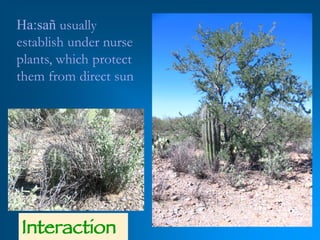
Interactions
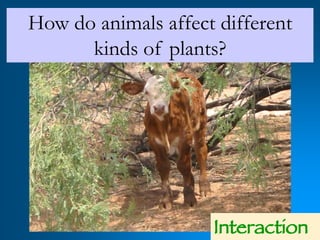
Interactions
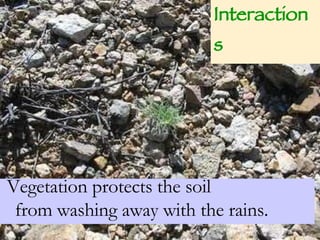
Vegetation protects the soil  from washing away with the rains. Interactions
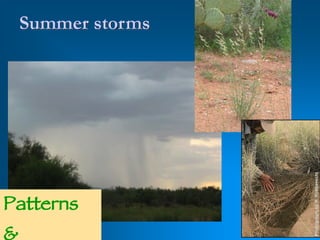
Patterns & abundance
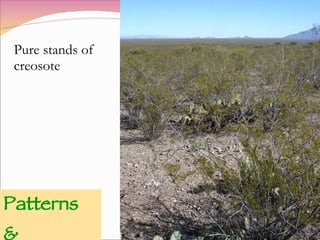
Pure stands of creosote Patterns & abundance
Ecologist vs. Environmentalist Is an ecologist an environmentalist? No, not necessarily An ecologist is a person (scientist, farmer, rancher) who studies how ecosystems work and the relationship between organisms and their environment An environmentalist is an individual interested in the environment (and may or may not be a scientist) Ecology is now considered a scientific discipline
History of Ecology Roots of ecology go back to prehistory times when people’s health & survival depended on the ability to understand the ecology of plants and animals with great accuracy
History of Ecology Ecology as a Western science Began with Greeks in 4 th  & 5 th  centuries B.C.E. Continued as modern science in 18 th  & 19 th  centuries as natural history (describing & cataloging organisms) In 1866 a German biologist coined the term “oecologist” formed from Greek words: Eco=“oikos”=house, environment Logy-”logos”=study of  The Ecological Society of America formed in the early 20 th  century
Ecology is an interdisciplinary science Ecology is considered a branch of biology but is in reality an interdisciplinary science which includes some of the following sciences Geology, geography, climatology, soil science, evolutionary biology, systematics, behavior, systematics, statistics, molecular biology & biochemistry Ecology is a “synthetic” science which looks at the whole rather than “reductionist” which looks at the parts
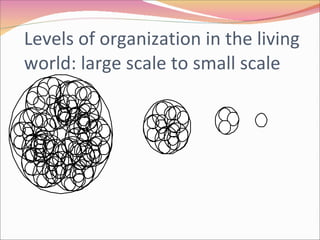
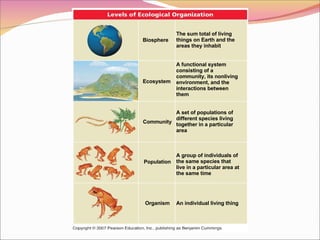
Levels of organization in the living world: large scale to small scale
Biosphere Ecosystem Community Population Organism The sum total of living things on Earth and the areas they inhabit A functional system consisting of a community, its nonliving environment, and the interactions between them A set of populations of different species living together in a particular area A group of individuals of the same species that live in a particular area at the same time An individual living thing
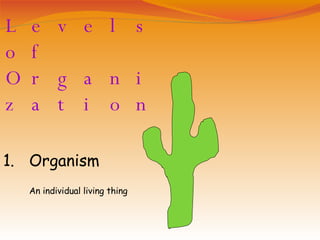
Levels of Organization Organism An individual living thing
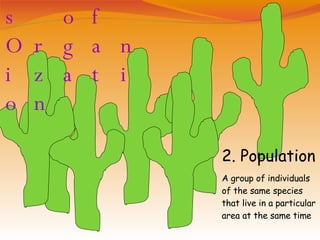
Levels of Organization 2. Population A group of individuals of the same species that live in a particular area at the same time
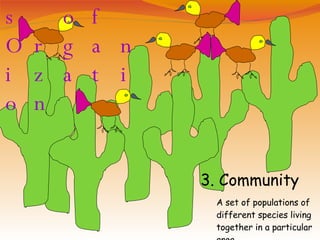
Levels of Organization 3. Community A set of populations of different species living together in a particular area
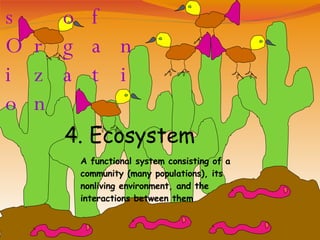
Levels of Organization 4. Ecosystem A functional system consisting of a community (many populations), its nonliving environment, and the interactions between them
Principles of Ecology Range of tolerance Habitat & niche Competitive exclusion principle Carrying capacity Population growth Biological succession
Principles of Ecology Range of tolerance The range of variability in a particular physical factor that an organism can withstand Habitat & niche Competitive exclusion principle Carrying capacity Population growth Biological succession
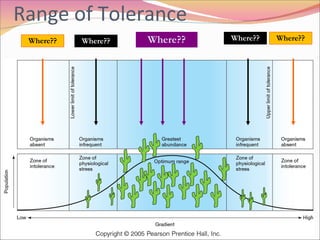
Range of Tolerance Where?? Where?? Where?? Where?? Where??
Range of Tolerance Limiting Factors All it takes is one single factor to be outside of the range of tolerance to limit population growth This factor is called the  limiting factor Ecology I:  Species, Populations, Communities and Ecosystems
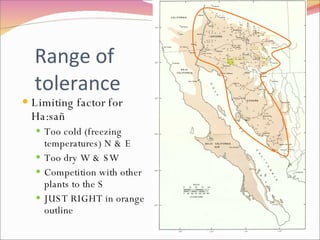
Range of tolerance Limiting factor for Ha:sañ Too cold (freezing temperatures) N & E Too dry W & SW Competition with other plants to the S JUST RIGHT in orange outline
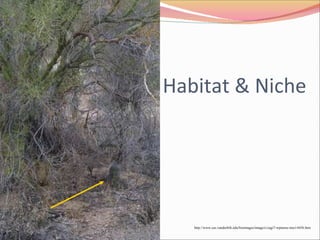
Principles of Ecology Law of tolerance Habitat & niche Habitat is where an organism lives Adequate food, water, shelter etc. for survival Niche is what role an organism plays within an ecosystem Competitive exclusion principle Carrying capacity Population growth Biological succession
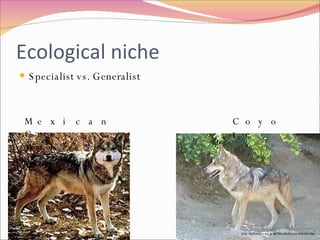
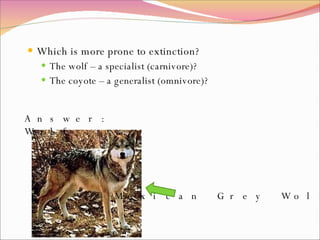
Niche Specialists versus Generalists Plants and animals with narrow tolerance ranges and/or specific dietary constraints, etc. =  Specialists Plants and animals with wide variety of habitats, foods, etc =  Generalists Ecology I:  Species, Populations, Communities and Ecosystems
Ecological niche Specialist vs. Generalist http://helios.bto.ed.ac.uk/bto/desbiome/coyote.htm Coyote Mexican Grey Wolf
Which is more prone to extinction? The wolf – a specialist (carnivore)? The coyote – a generalist (omnivore)? Mexican Grey Wolf Answer: Wolf
Habitat & Niche http://www.cas.vanderbilt.edu/bioimages/image/c/cagi7-wpnurse-tree14456.htm
Ecology I:  Species, Populations, Communities and Ecosystems
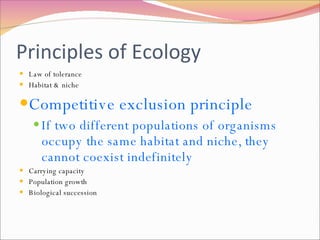
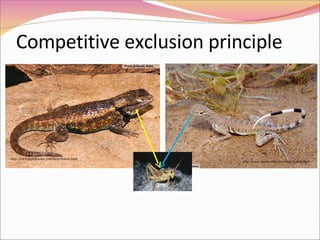
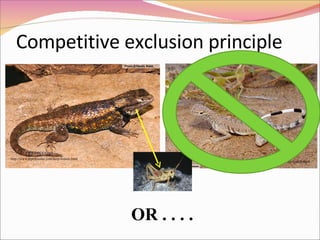
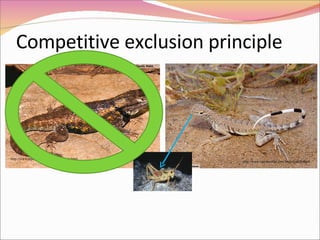
Principles of Ecology Law of tolerance Habitat & niche Competitive exclusion principle If two different populations of organisms occupy the same habitat and niche, they cannot coexist indefinitely Carrying capacity Population growth Biological succession
Competitive exclusion principle http://www.reptilesofaz.com/herp-lizards.html http://www.reptilesofaz.com/herp-lizards.html
Competitive exclusion principle OR . . . . http://www.reptilesofaz.com/herp-lizards.html http://www.reptilesofaz.com/herp-lizards.html
Competitive exclusion principle http://www.reptilesofaz.com/herp-lizards.html http://www.reptilesofaz.com/herp-lizards.html
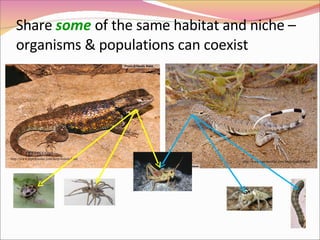
Share  some   of the same habitat and niche – organisms & populations can coexist http://www.reptilesofaz.com/herp-lizards.html http://www.reptilesofaz.com/herp-lizards.html
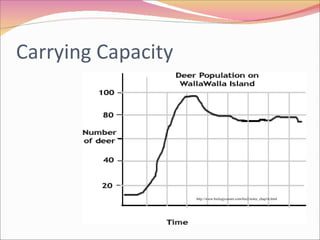
Principles of Ecology Law of tolerance Habitat & niche Competitive exclusion principle Carrying capacity The ability of a habitat to sustain a population of organisms indefinitely Population growth Biological succession
Carrying Capacity http://www.biologycorner.com/bio2/notes_chap16.html
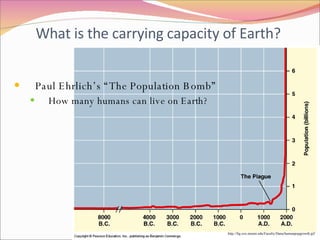
What is the carrying capacity of Earth?  Paul Ehrlich’s “The Population Bomb” How many humans can live on Earth? http://fig.cox.miami.edu/Faculty/Dana/humanpopgrowth.gif
Principles of Ecology Law of tolerance Habitat & niche Competitive exclusion principle Carrying capacity Population growth How fast a population of organisms grows in relation to the resources available to sustain that population Biological succession
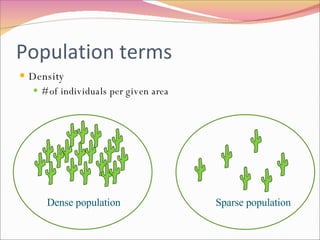
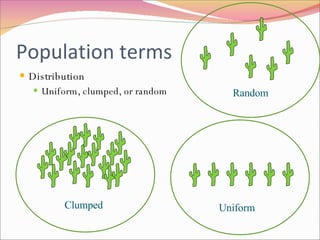
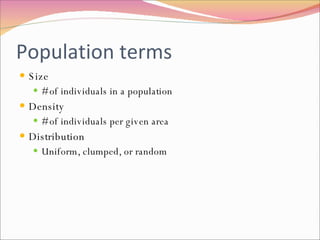
Population terms Size # of individuals in a population Density # of individuals per given area Distribution Uniform, clumped, or random
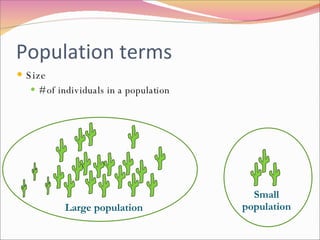
Population terms Size # of individuals in a population Large population Small population
Population terms Density # of individuals per given area Dense population Sparse population
Population terms Distribution Uniform, clumped, or random Clumped Uniform Random
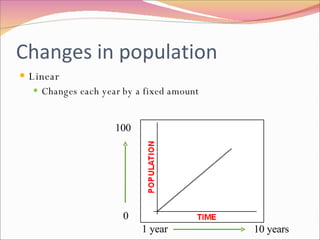
Changes in population Linear Changes each year by a fixed amount 0 100 1 year 10 years
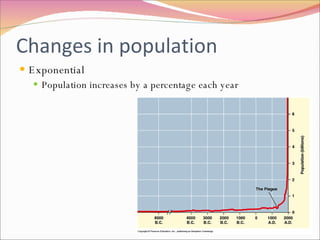
Changes in population Exponential Population increases by a percentage each year
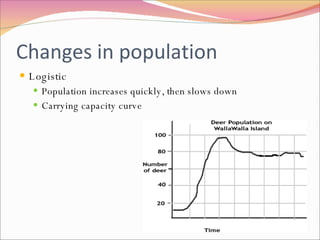
Changes in population Logistic Population increases quickly, then slows down Carrying capacity curve
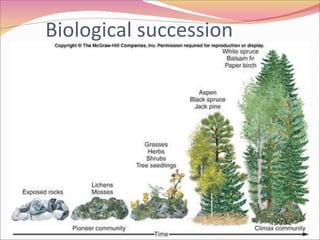
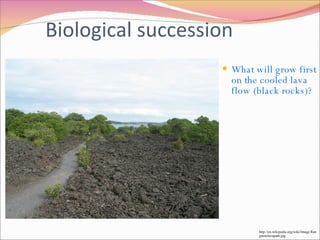
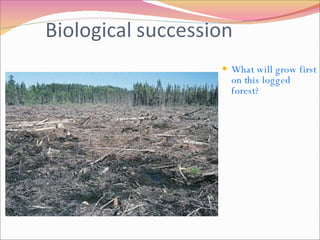
Principles of Ecology Law of tolerance Habitat & niche Competitive exclusion principle Carrying capacity Population growth Biological succession When one community of organisms is replaced by a different community of organisms in a relatively predictable way
Biological succession
What will grow first on the cooled lava flow (black rocks)? Biological succession http://en.wikipedia.org/wiki/Image:Rangitotolavapath.jpg
What will grow first on this logged forest?
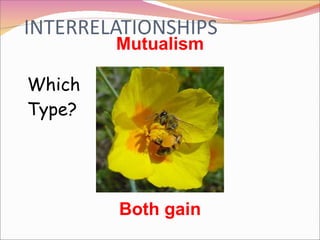
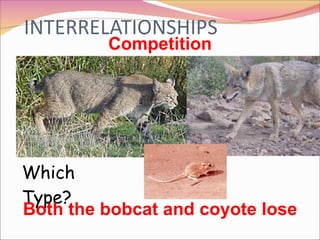
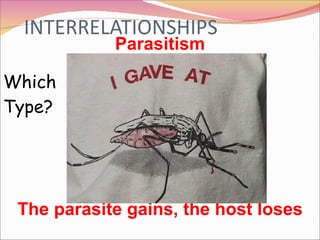
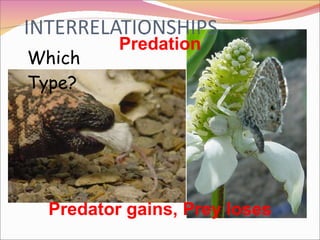
Interrelationships Mutualism : both gain Predation : predator gains, prey loses Parasitism : parasite gains, host loses Competition : both lose Commensalism :  one species benefits; the other is unaffected Biological environment & ecology = interrelationships
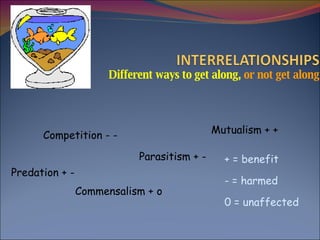
Different ways to get along,   or not get along Predation + - Competition - - Parasitism + - Commensalism + o Mutualism + + + = benefit = harmed 0 = unaffected
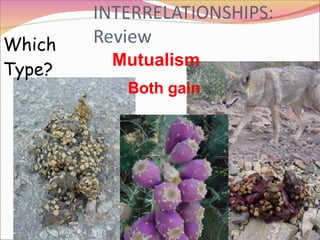
Mutualism Which Type? Both gain
Competition Which Type? Both the bobcat and coyote lose
Parasitism Which Type? The parasite gains, the host loses
Predation Which Type? Predator gains, Prey loses
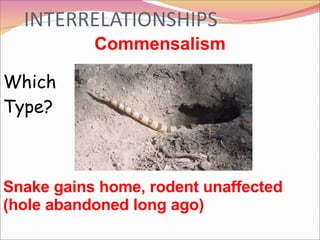
Commensalism Which Type? Snake gains home, rodent unaffected (hole abandoned long ago)
Mutualism Which Type? Both gain
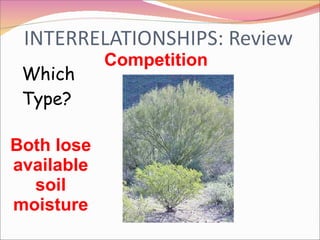
Competition Which Type? Both lose available soil moisture
Levels of organization in the living world Ecosystems : Ecosystems are the starting point to understand many ecological relationships.
Levels of organization in the living world Ecosystems : Includes physical factors such as climate, water, minerals and sunlight as well as biotic factors such as organisms Ecosystems are the fundamental operational unit of ecology
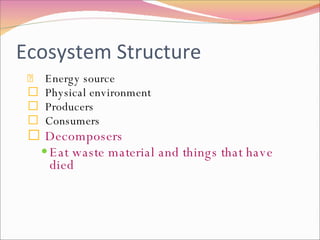
Structure of ecosystems Energy source Physical environment Producers Consumers Decomposers
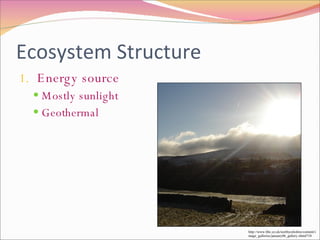
Ecosystem Structure Energy source Mostly sunlight Geothermal http://www.bbc.co.uk/northyorkshire/content/image_galleries/january06_gallery.shtml?18
Ecosystem Structure Energy source Physical environment Air, water, soil, climate etc.
Ecosystem Structure Energy source Physical environment Producers Make their own food Photosynthetic plants, algae & bacteria
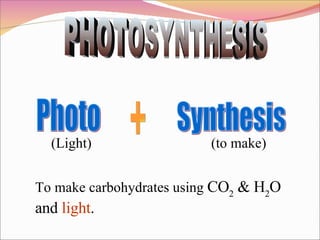
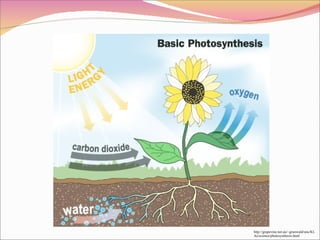
PHOTOSYNTHESIS Photo + Synthesis (Light) (to make) To make carbohydrates using  CO 2  & H 2 O and  light .
http://grapevine.net.au/~grunwald/une/KLAs/science/photosynthesis.html
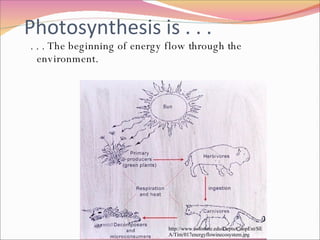
Photosynthesis is . . .  . . . The beginning of energy flow through the environment. http://www.colostate.edu/Depts/CoopExt/SEA/Tim/017energyflowinecosystem.jpg
Ecosystem Structure Energy source Physical environment Producers Consumers Eat other living things
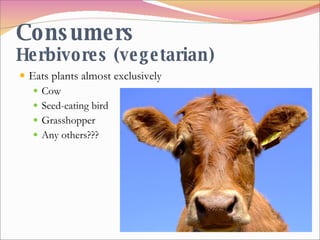
Consumers Herbivores (vegetarian) Eats plants almost exclusively Cow Seed-eating bird Grasshopper Any others???
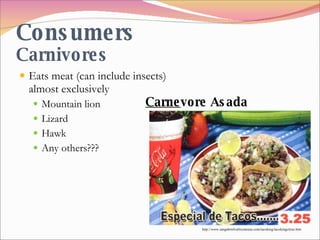
Consumers Carnivores Eats meat (can include insects) almost exclusively Mountain lion Lizard Hawk Any others??? http://www.sangabrielvalleymenus.com/tacoking/tacokingcitrus.htm Carne vore Asada
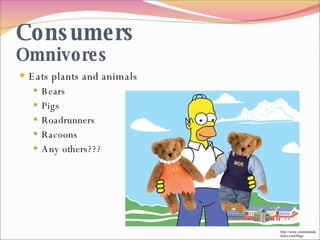
Eats plants and animals Bears Pigs Roadrunners Racoons Any others??? Consumers Omnivores http://www.custommadebears.com/blog/
Ecosystem Structure Energy source Physical environment Producers Consumers Decomposers Eat waste material and things that have died
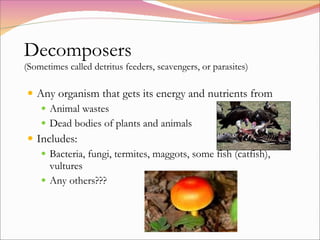
Decomposers (Sometimes called detritus feeders, scavengers, or parasites) Any organism that gets its energy and nutrients from Animal wastes Dead bodies of plants and animals Includes: Bacteria, fungi, termites, maggots, some fish (catfish), vultures Any others???
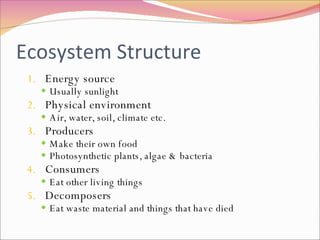
Ecosystem Structure Energy source Usually sunlight Physical environment Air, water, soil, climate etc. Producers Make their own food Photosynthetic plants, algae & bacteria Consumers Eat other living things Decomposers Eat waste material and things that have died
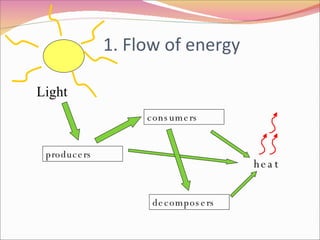
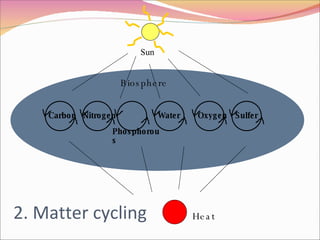
All ecosystem interactions depend on Flow of energy  Cycling of matter What does this mean? Ecosystem functions
1. Flow of energy producers decomposers consumers heat Light
2. Matter cycling Biosphere Heat Carbon Nitrogen Sulfer Phosphorous Oxygen Water Insert thermodynamics slides here Sun
Matter cycling in ecosystems Also called . . . . .? ? ? ? ?
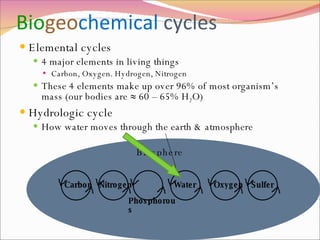
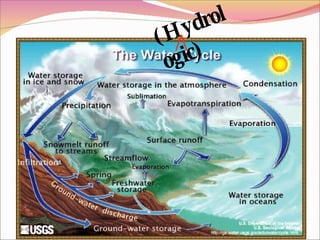
Bio geo chemical  cycles Elemental cycles 4 major elements in living things Carbon, Oxygen. Hydrogen, Nitrogen These 4 elements make up over 96% of most organism’s mass (our bodies are  ≈ 60 – 65% H 2 O) Hydrologic cycle How water moves through the earth & atmosphere Biosphere Carbon Nitrogen Sulfer Phosphorous Oxygen Water
(Hydrologic)
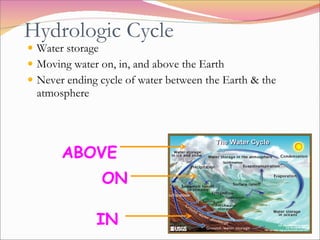
Hydrologic Cycle Water storage Moving water on, in, and above the Earth Never ending cycle of water between the Earth & the atmosphere ABOVE ON IN
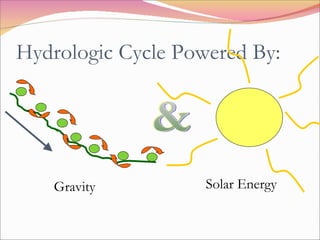
Hydrologic Cycle Powered By: Solar Energy Gravity &
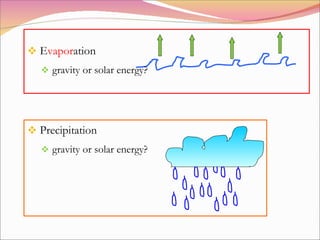
E vapor ation gravity or solar energy? Precipitation gravity or solar energy?
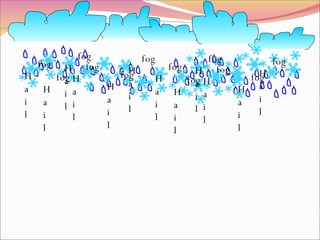
Hail Hail Hail Hail Hail Hail Hail Hail Hail Hail Hail Hail fog fog fog fog fog fog fog fog fog fog fog fog
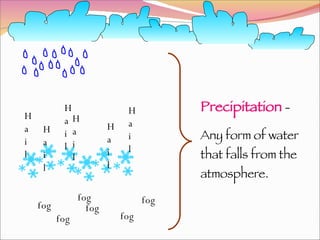
Precipitation  -  Any form of water that falls from the atmosphere. Hail Hail Hail Hail Hail Hail fog fog fog fog fog fog
Water appears in all 3 of its  phases  at different times during the hydrologic cycle Solid Ice, hail, snow, frost, glaciers, ice caps Liquid Rain, mist, dew, clouds  Gas Water vapor
Once on Earth, water does one of three things Stays on the surface & mixes with surface water (including ice & snow) Infiltrates into the ground Moves back into the atmosphere
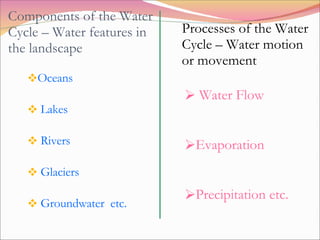
Components of the Water Cycle – Water features in the landscape Oceans Lakes Rivers Glaciers Groundwater  etc. Processes of the Water Cycle – Water motion or movement Water Flow Evaporation Precipitation etc.
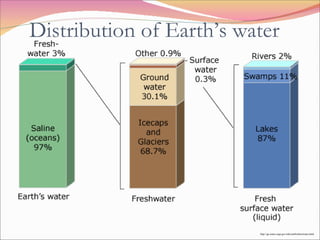
Distribution of Earth’s water http://ga.water.usgs.gov/edu/earthwherewater.html
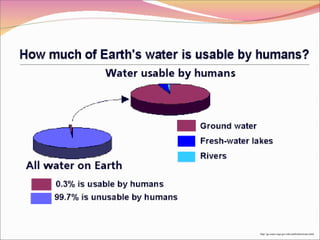
http://ga.water.usgs.gov/edu/earthwherewater.html
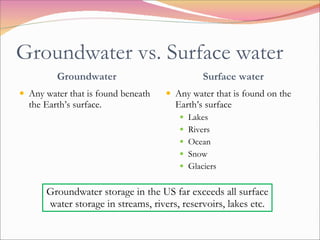
Groundwater vs. Surface water Groundwater Any water that is found beneath the Earth’s surface. Surface water Any water that is found on the Earth’s surface Lakes Rivers Ocean Snow Glaciers  Groundwater storage in the US far exceeds all surface water storage in streams, rivers, reservoirs, lakes etc.
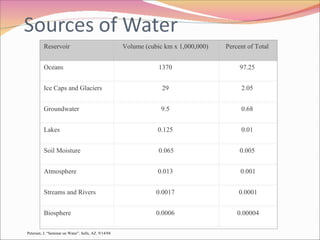
Petersen, J. “Seminar on Water”. Sells, AZ. 9/14/04 Reservoir Volume (cubic km x 1,000,000)  Percent of Total  Oceans 1370  97.25  Ice Caps and Glaciers 29  2.05  Groundwater  9.5  0.68  Lakes 0.125  0.01  Soil Moisture 0.065 0.005  Atmosphere 0.013  0.001 Streams and Rivers 0.0017  0.0001 Biosphere  0.0006  0.00004
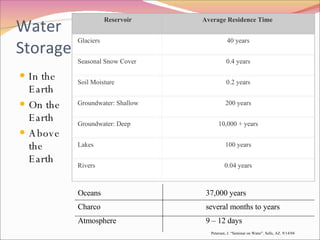
Water Storage In the Earth On the Earth Above the Earth Petersen, J. “Seminar on Water”. Sells, AZ. 9/14/04 Oceans 37,000 years Charco several months to years Atmosphere 9 – 12 days   Reservoir Average Residence Time    Glaciers   40 years    Seasonal Snow Cover   0.4 years    Soil Moisture   0.2 years    Groundwater: Shallow   200 years    Groundwater: Deep   10,000 + years    Lakes   100 years    Rivers   0.04 years
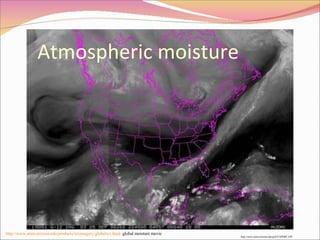
Atmospheric moisture http://www.atmo.arizona.edu/gifs/VAPORC.GIF http://www.atmo.arizona.edu/products/wximagery/globalwv.html   global moisture movie
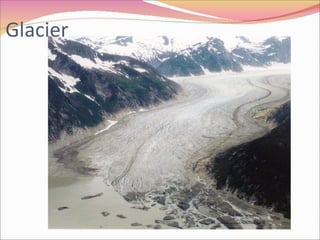
Glacier http://www.jimwegryn.com/Photos/Photos.htm
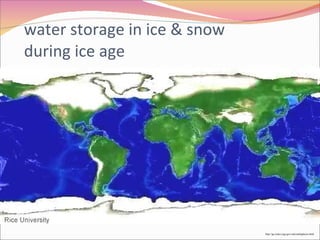
water storage in ice & snow during ice age http://ga.water.usgs.gov/edu/earthglacier.html
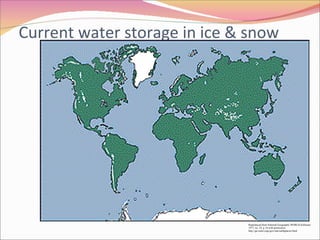
Current water storage in ice & snow Reproduced from National Geographic WORLD (February 1977, no. 18, p. 6) with permission  http://ga.water.usgs.gov/edu/earthglacier.html
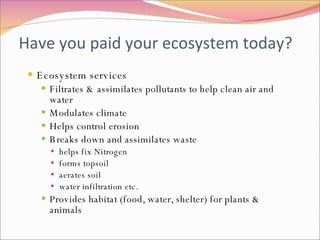
Have you paid your ecosystem today? Ecosystem services Filtrates & assimilates pollutants to help clean air and water Modulates climate Helps control erosion Breaks down and assimilates waste  helps fix Nitrogen forms topsoil aerates soil water infiltration etc. Provides habitat (food, water, shelter) for plants & animals

Wikibio100 2

  • 1.
    interactions of organismswith one another (biological environment) Includes the study of the ecosystem structure and function Patterns and causes of abundance and distribution of organisms in nature Ecology: Study of relationships between organisms and their physical environment, including:
  • 2.
  • 3.
  • 4.
    Vegetation protects thesoil from washing away with the rains. Interactions
  • 5.
  • 6.
    Pure stands ofcreosote Patterns & abundance
  • 7.
    Ecologist vs. EnvironmentalistIs an ecologist an environmentalist? No, not necessarily An ecologist is a person (scientist, farmer, rancher) who studies how ecosystems work and the relationship between organisms and their environment An environmentalist is an individual interested in the environment (and may or may not be a scientist) Ecology is now considered a scientific discipline
  • 8.
    History of EcologyRoots of ecology go back to prehistory times when people’s health & survival depended on the ability to understand the ecology of plants and animals with great accuracy
  • 9.
    History of EcologyEcology as a Western science Began with Greeks in 4 th & 5 th centuries B.C.E. Continued as modern science in 18 th & 19 th centuries as natural history (describing & cataloging organisms) In 1866 a German biologist coined the term “oecologist” formed from Greek words: Eco=“oikos”=house, environment Logy-”logos”=study of The Ecological Society of America formed in the early 20 th century
  • 10.
    Ecology is aninterdisciplinary science Ecology is considered a branch of biology but is in reality an interdisciplinary science which includes some of the following sciences Geology, geography, climatology, soil science, evolutionary biology, systematics, behavior, systematics, statistics, molecular biology & biochemistry Ecology is a “synthetic” science which looks at the whole rather than “reductionist” which looks at the parts
  • 11.
    Levels of organizationin the living world: large scale to small scale
  • 12.
    Biosphere Ecosystem CommunityPopulation Organism The sum total of living things on Earth and the areas they inhabit A functional system consisting of a community, its nonliving environment, and the interactions between them A set of populations of different species living together in a particular area A group of individuals of the same species that live in a particular area at the same time An individual living thing
  • 13.
    Levels of OrganizationOrganism An individual living thing
  • 14.
    Levels of Organization2. Population A group of individuals of the same species that live in a particular area at the same time
  • 15.
    Levels of Organization3. Community A set of populations of different species living together in a particular area
  • 16.
    Levels of Organization4. Ecosystem A functional system consisting of a community (many populations), its nonliving environment, and the interactions between them
  • 17.
    Principles of EcologyRange of tolerance Habitat & niche Competitive exclusion principle Carrying capacity Population growth Biological succession
  • 18.
    Principles of EcologyRange of tolerance The range of variability in a particular physical factor that an organism can withstand Habitat & niche Competitive exclusion principle Carrying capacity Population growth Biological succession
  • 19.
    Range of ToleranceWhere?? Where?? Where?? Where?? Where??
  • 20.
    Range of ToleranceLimiting Factors All it takes is one single factor to be outside of the range of tolerance to limit population growth This factor is called the limiting factor Ecology I: Species, Populations, Communities and Ecosystems
  • 21.
    Range of toleranceLimiting factor for Ha:sañ Too cold (freezing temperatures) N & E Too dry W & SW Competition with other plants to the S JUST RIGHT in orange outline
  • 22.
    Principles of EcologyLaw of tolerance Habitat & niche Habitat is where an organism lives Adequate food, water, shelter etc. for survival Niche is what role an organism plays within an ecosystem Competitive exclusion principle Carrying capacity Population growth Biological succession
  • 23.
    Niche Specialists versusGeneralists Plants and animals with narrow tolerance ranges and/or specific dietary constraints, etc. = Specialists Plants and animals with wide variety of habitats, foods, etc = Generalists Ecology I: Species, Populations, Communities and Ecosystems
  • 24.
    Ecological niche Specialistvs. Generalist http://helios.bto.ed.ac.uk/bto/desbiome/coyote.htm Coyote Mexican Grey Wolf
  • 25.
    Which is moreprone to extinction? The wolf – a specialist (carnivore)? The coyote – a generalist (omnivore)? Mexican Grey Wolf Answer: Wolf
  • 26.
    Habitat & Nichehttp://www.cas.vanderbilt.edu/bioimages/image/c/cagi7-wpnurse-tree14456.htm
  • 27.
    Ecology I: Species, Populations, Communities and Ecosystems
  • 28.
    Principles of EcologyLaw of tolerance Habitat & niche Competitive exclusion principle If two different populations of organisms occupy the same habitat and niche, they cannot coexist indefinitely Carrying capacity Population growth Biological succession
  • 29.
    Competitive exclusion principlehttp://www.reptilesofaz.com/herp-lizards.html http://www.reptilesofaz.com/herp-lizards.html
  • 30.
    Competitive exclusion principleOR . . . . http://www.reptilesofaz.com/herp-lizards.html http://www.reptilesofaz.com/herp-lizards.html
  • 31.
    Competitive exclusion principlehttp://www.reptilesofaz.com/herp-lizards.html http://www.reptilesofaz.com/herp-lizards.html
  • 32.
    Share some of the same habitat and niche – organisms & populations can coexist http://www.reptilesofaz.com/herp-lizards.html http://www.reptilesofaz.com/herp-lizards.html
  • 33.
    Principles of EcologyLaw of tolerance Habitat & niche Competitive exclusion principle Carrying capacity The ability of a habitat to sustain a population of organisms indefinitely Population growth Biological succession
  • 34.
  • 35.
    What is thecarrying capacity of Earth? Paul Ehrlich’s “The Population Bomb” How many humans can live on Earth? http://fig.cox.miami.edu/Faculty/Dana/humanpopgrowth.gif
  • 36.
    Principles of EcologyLaw of tolerance Habitat & niche Competitive exclusion principle Carrying capacity Population growth How fast a population of organisms grows in relation to the resources available to sustain that population Biological succession
  • 37.
    Population terms Size# of individuals in a population Density # of individuals per given area Distribution Uniform, clumped, or random
  • 38.
    Population terms Size# of individuals in a population Large population Small population
  • 39.
    Population terms Density# of individuals per given area Dense population Sparse population
  • 40.
    Population terms DistributionUniform, clumped, or random Clumped Uniform Random
  • 41.
    Changes in populationLinear Changes each year by a fixed amount 0 100 1 year 10 years
  • 42.
    Changes in populationExponential Population increases by a percentage each year
  • 43.
    Changes in populationLogistic Population increases quickly, then slows down Carrying capacity curve
  • 44.
    Principles of EcologyLaw of tolerance Habitat & niche Competitive exclusion principle Carrying capacity Population growth Biological succession When one community of organisms is replaced by a different community of organisms in a relatively predictable way
  • 45.
  • 46.
    What will growfirst on the cooled lava flow (black rocks)? Biological succession http://en.wikipedia.org/wiki/Image:Rangitotolavapath.jpg
  • 47.
    What will growfirst on this logged forest?
  • 48.
    Interrelationships Mutualism :both gain Predation : predator gains, prey loses Parasitism : parasite gains, host loses Competition : both lose Commensalism : one species benefits; the other is unaffected Biological environment & ecology = interrelationships
  • 49.
    Different ways toget along, or not get along Predation + - Competition - - Parasitism + - Commensalism + o Mutualism + + + = benefit = harmed 0 = unaffected
  • 50.
  • 51.
    Competition Which Type?Both the bobcat and coyote lose
  • 52.
    Parasitism Which Type?The parasite gains, the host loses
  • 53.
    Predation Which Type?Predator gains, Prey loses
  • 54.
    Commensalism Which Type?Snake gains home, rodent unaffected (hole abandoned long ago)
  • 55.
  • 56.
    Competition Which Type?Both lose available soil moisture
  • 57.
    Levels of organizationin the living world Ecosystems : Ecosystems are the starting point to understand many ecological relationships.
  • 58.
    Levels of organizationin the living world Ecosystems : Includes physical factors such as climate, water, minerals and sunlight as well as biotic factors such as organisms Ecosystems are the fundamental operational unit of ecology
  • 59.
    Structure of ecosystemsEnergy source Physical environment Producers Consumers Decomposers
  • 60.
    Ecosystem Structure Energysource Mostly sunlight Geothermal http://www.bbc.co.uk/northyorkshire/content/image_galleries/january06_gallery.shtml?18
  • 61.
    Ecosystem Structure Energysource Physical environment Air, water, soil, climate etc.
  • 62.
    Ecosystem Structure Energysource Physical environment Producers Make their own food Photosynthetic plants, algae & bacteria
  • 63.
    PHOTOSYNTHESIS Photo +Synthesis (Light) (to make) To make carbohydrates using CO 2 & H 2 O and light .
  • 64.
  • 65.
    Photosynthesis is .. . . . . The beginning of energy flow through the environment. http://www.colostate.edu/Depts/CoopExt/SEA/Tim/017energyflowinecosystem.jpg
  • 66.
    Ecosystem Structure Energysource Physical environment Producers Consumers Eat other living things
  • 67.
    Consumers Herbivores (vegetarian)Eats plants almost exclusively Cow Seed-eating bird Grasshopper Any others???
  • 68.
    Consumers Carnivores Eatsmeat (can include insects) almost exclusively Mountain lion Lizard Hawk Any others??? http://www.sangabrielvalleymenus.com/tacoking/tacokingcitrus.htm Carne vore Asada
  • 69.
    Eats plants andanimals Bears Pigs Roadrunners Racoons Any others??? Consumers Omnivores http://www.custommadebears.com/blog/
  • 70.
    Ecosystem Structure Energysource Physical environment Producers Consumers Decomposers Eat waste material and things that have died
  • 71.
    Decomposers (Sometimes calleddetritus feeders, scavengers, or parasites) Any organism that gets its energy and nutrients from Animal wastes Dead bodies of plants and animals Includes: Bacteria, fungi, termites, maggots, some fish (catfish), vultures Any others???
  • 72.
    Ecosystem Structure Energysource Usually sunlight Physical environment Air, water, soil, climate etc. Producers Make their own food Photosynthetic plants, algae & bacteria Consumers Eat other living things Decomposers Eat waste material and things that have died
  • 73.
    All ecosystem interactionsdepend on Flow of energy Cycling of matter What does this mean? Ecosystem functions
  • 74.
    1. Flow ofenergy producers decomposers consumers heat Light
  • 75.
    2. Matter cyclingBiosphere Heat Carbon Nitrogen Sulfer Phosphorous Oxygen Water Insert thermodynamics slides here Sun
  • 76.
    Matter cycling inecosystems Also called . . . . .? ? ? ? ?
  • 77.
    Bio geo chemical cycles Elemental cycles 4 major elements in living things Carbon, Oxygen. Hydrogen, Nitrogen These 4 elements make up over 96% of most organism’s mass (our bodies are ≈ 60 – 65% H 2 O) Hydrologic cycle How water moves through the earth & atmosphere Biosphere Carbon Nitrogen Sulfer Phosphorous Oxygen Water
  • 78.
  • 79.
    Hydrologic Cycle Waterstorage Moving water on, in, and above the Earth Never ending cycle of water between the Earth & the atmosphere ABOVE ON IN
  • 80.
    Hydrologic Cycle PoweredBy: Solar Energy Gravity &
  • 81.
    E vapor ationgravity or solar energy? Precipitation gravity or solar energy?
  • 82.
    Hail Hail HailHail Hail Hail Hail Hail Hail Hail Hail Hail fog fog fog fog fog fog fog fog fog fog fog fog
  • 83.
    Precipitation - Any form of water that falls from the atmosphere. Hail Hail Hail Hail Hail Hail fog fog fog fog fog fog
  • 84.
    Water appears inall 3 of its phases at different times during the hydrologic cycle Solid Ice, hail, snow, frost, glaciers, ice caps Liquid Rain, mist, dew, clouds Gas Water vapor
  • 85.
    Once on Earth,water does one of three things Stays on the surface & mixes with surface water (including ice & snow) Infiltrates into the ground Moves back into the atmosphere
  • 86.
    Components of theWater Cycle – Water features in the landscape Oceans Lakes Rivers Glaciers Groundwater etc. Processes of the Water Cycle – Water motion or movement Water Flow Evaporation Precipitation etc.
  • 87.
    Distribution of Earth’swater http://ga.water.usgs.gov/edu/earthwherewater.html
  • 88.
  • 89.
    Groundwater vs. Surfacewater Groundwater Any water that is found beneath the Earth’s surface. Surface water Any water that is found on the Earth’s surface Lakes Rivers Ocean Snow Glaciers Groundwater storage in the US far exceeds all surface water storage in streams, rivers, reservoirs, lakes etc.
  • 90.
    Petersen, J. “Seminaron Water”. Sells, AZ. 9/14/04 Reservoir Volume (cubic km x 1,000,000) Percent of Total Oceans 1370 97.25 Ice Caps and Glaciers 29 2.05 Groundwater 9.5 0.68 Lakes 0.125 0.01 Soil Moisture 0.065 0.005 Atmosphere 0.013 0.001 Streams and Rivers 0.0017 0.0001 Biosphere 0.0006 0.00004
  • 91.
    Water Storage Inthe Earth On the Earth Above the Earth Petersen, J. “Seminar on Water”. Sells, AZ. 9/14/04 Oceans 37,000 years Charco several months to years Atmosphere 9 – 12 days   Reservoir Average Residence Time   Glaciers   40 years   Seasonal Snow Cover   0.4 years   Soil Moisture   0.2 years   Groundwater: Shallow   200 years   Groundwater: Deep   10,000 + years   Lakes   100 years   Rivers   0.04 years
  • 92.
    Atmospheric moisture http://www.atmo.arizona.edu/gifs/VAPORC.GIFhttp://www.atmo.arizona.edu/products/wximagery/globalwv.html global moisture movie
  • 93.
  • 94.
    water storage inice & snow during ice age http://ga.water.usgs.gov/edu/earthglacier.html
  • 95.
    Current water storagein ice & snow Reproduced from National Geographic WORLD (February 1977, no. 18, p. 6) with permission http://ga.water.usgs.gov/edu/earthglacier.html
  • 96.
    Have you paidyour ecosystem today? Ecosystem services Filtrates & assimilates pollutants to help clean air and water Modulates climate Helps control erosion Breaks down and assimilates waste helps fix Nitrogen forms topsoil aerates soil water infiltration etc. Provides habitat (food, water, shelter) for plants & animals