• The nitrogen cycle is the set biogeochemical processes by which
  nitrogen undergoes chemical reactions, changes form, and moves
  through difference reservoirs on earth, including living organisms.

• Nitrogen is required for all organisms too live and grow because it is
  the essential component of DNA, RNA, and protein. However, most
  organisms cannot use atmospheric nitrogen, the largest reservoir.

• The five processes in the nitrogen cycle -- fixation, uptake,
  mineralization, nitrification and denitrification -- are all driven by
  microorganisms.

• Humans influence the global nitrogen cycle primarily through the
  use of nitrogen-based fertilizers.
• Nitrogen (N) is an essential component of DNA,
  RNA, and proteins, the building blocks of life. All
  organisms require nitrogen to live and grow.
  Although the majority of the air we breathe is N2,
  most of the nitrogen in the atmosphere is
  unavailable for use by organisms.
• This is because the strong triple bond between
  the N atoms in N2 molecules makes it relatively
  inert.
• In fact, in order for plants and animals to be
  able to use nitrogen, N2 gas must first be
  converted to more a chemically available form
  such as ammonium (NH4+), nitrate (NO3-), or
  organic nitrogen (e.g. urea - (NH2)2CO).
• The inert nature of N2 means that biologically
  available nitrogen is often in short supply in
  natural ecosystems, limiting plant growth and
  biomass accumulation.
• Nitrogen is an incredibly versatile element
  existing in both inorganic and organic forms as
  well as many different oxidation states. The
  movement of nitrogen between the atmosphere,
  biosphere and geosphere in different forms is
  described by the nitrogen cycle (Figure 1), one of
  the major biogeochemicalcycles. Similar to the
  carbon cycle, the nitrogen cycle consists of
  various storage pools of nitrogen and processes
  by which the pools exchange nitrogen (arrows)
  (see our The Carbon Cycle module for more
  information).
The nitrogen cycle. Yellow arrows indicate human sources of nitrogen to the
environment. Red arrows indicate microbial transformations of nitrogen. Blue arrows
indicate physical forces acting on nitrogen. And green arrows indicate natural, non-
microbial processes affecting the form and fate of nitrogen. Ecology & Ecosystem
Nitrogen cycle
• Five main processes cycle nitrogen through
  the biosphere, atmosphere, and geosphere:
  nitrogen fixation, nitrogen uptake (organismal
  growth), nitrogen mineralization (decay),
  nitrification, and denitrification.
  Microorganisms, particularly bacteria, play
  major roles in all of the principal nitrogen
  transformations
• . As microbial mediated processes, these
  nitrogen transformations tend to occur faster
  than geological processes like plate motion, a
  very slow, purely physical process that is a part
  of the carbon cycle. Instead, rates are affected
  by environmental factors that influence
  microbial activity, such as temperature,
  moisture, and resource availability
Nitrogen fixation

• N2 NH4+ Nitrogen fixation is the process wherein
  N2 is converted to ammonium, essential because
  it is the only way that organisms can attain
  nitrogen directly from the atmosphere. Certain
  bacteria, for example those among the genus
  Rhizobium, are the only organisms that fix
  nitrogen through metabolic processes. Nitrogen
  fixing bacteria often form symbiotic relationships
  with host plants. This symbiosis is well-known to
  occur in the legume family of plants (e.g. beans,
  peas, and clover).
• In this relationship, nitrogen fixing bacteria
  inhabit legume root nodules and receive
  carbohydrates and a favorable environment
  from their host plant in exchange for some of
  the nitrogen they fix. There are also nitrogen
  fixing bacteria that exist without plant hosts,
  known as free-living nitrogen fixers. In aquatic
  environments, blue-green algae (really a
  bacteria called cyanobacteria) is an important
  free-living nitrogen fixer.
• In addition to nitrogen fixing bacteria, high-
  energy natural events such as lightning, forest
  fires, and even hot lava flows can cause the
  fixation of smaller, but significant amounts of
  nitrogen (Figure 3). The high energy of these
  natural phenomena can break the triple bonds
  of N2 molecules, thereby making individual N
  atoms available for chemical transformation.
•
• Within the last century, humans have become
  as important a source of fixed nitrogen as all
  natural sources combined. Burning fossil fuels,
  using synthetic nitrogen fertilizers, and
  cultivation of legumes all fix nitrogen. Through
  these activities, humans have more than
  doubled the amount of fixed nitrogen that is
  pumped into the biosphere every year , the
  consequences of which are discussed below.
Nitrogen fixation
• Nitrogen uptake
• NH4+ Organic N The ammonia produced by
  nitrogen fixing bacteria is usually quickly
  incorporated into protein and other organic
  nitrogen compounds, either by a host plant, the
  bacteria itself, or another soil organism. When
  organisms nearer the top of the food chain (like
  us!) eat, we are using nitrogen that has been
  fixed initially by nitrogen fixing bacteria.
• Nitrogen mineralization
• Organic N NH4+ After nitrogen is incorporated
  into organic matter, it is often converted back
  into inorganic nitrogen by a process called
  nitrogen mineralization, otherwise known as
  decay. When organisms die, decomposers
  (such as bacteria and fungi) consume the
  organic matter and lead to the process of
  decomposition.
• During this process, a significant amount of
  the nitrogen contained within the dead
  organism is converted to ammonium. Once in
  the form of ammonium, nitrogen is available
  for use by plants or for further transformation
  into nitrate (NO3-) through the process called
  nitrification.
• Nitrification
• NH4+ NO3- Some of the ammonium produced by
  decomposition is converted to nitrate via a
  process called nitrification. The bacteria that
  carry out this reaction gain energy from it.
  Nitrification requires the presence of oxygen, so
  nitrification can happen only in oxygen-rich
  environments like circulating or flowing waters
  and the very surface layers of soils and
  sediments. The process of nitrification has some
  important consequences.
• Ammonium ions are positively charged and
  therefore stick (are sorbed) to negatively charged
  clay particles and soil organic matter. The positive
  charge prevents ammonium nitrogen from being
  washed out of the soil (or leached) by rainfall. In
  contrast, the negatively charged nitrate ion is not
  held by soil particles and so can be washed down
  the soil profile, leading to decreased soil fertility
  and nitrate enrichment of downstream surface
  and groundwaters.
• Denitrification
• NO3- N2+ N2O Through denitrification, oxidized
  forms of nitrogen such as nitrate and nitrite (NO2-
  ) are converted to dinitrogen (N2) and, to a lesser
  extent, nitrous oxide gas. Denitrification is an
  anaerobic process that is carried out by
  denitrifying bacteria, which convert nitrate to
  dinitrogen in the following sequence:
  NO3- NO2- NO N2O N2.
• Nitric oxide and nitrous oxide are both environmentally
  important gases. Nitric oxide (NO) contributes to smog,
  and nitrous oxide (N2O) is an important greenhouse
  gas, thereby contributing to global climate change.
• Once converted to dinitrogen, nitrogen is unlikely to be
  reconverted to a biologically available form because it
  is a gas and is rapidly lost to the atmosphere.
  Denitrification is the only nitrogen transformation that
  removes nitrogen from ecosystems (essentially
  irreversibly), and it roughly balances the amount of
  nitrogen fixed by the nitrogen fixers described above.
Human alteration of the N cycle and its environmental
                    consequences
• Early in the 20th century, a German scientist named Fritz Haber
  figured out how to short circuit the nitrogen cycle by fixing nitrogen
  chemically at high temperatures and pressures, creating fertilizers
  that could be added directly to soil. This technology has spread
  rapidly over the past century, and, along with the advent of new
  crop varieties, the use of synthetic nitrogen fertilizers has led to an
  enormous boom in agricultural productivity. This agricultural
  productivity has helped us to feed a rapidly growing world
  population, but the increase in nitrogen fixation has had some
  negative consequences as well. While the consequences are
  perhaps not as obvious as an increase in global temperatures or a
  hole in the ozone layer, they are just as serious and potentially
  harmful for humans and other organisms.
• Not all of the nitrogen fertilizer applied to agricultural fields stays to
  nourish crops. Some is washed off of agricultural fields by rain or
  irrigation water, where it leaches into surface or ground water and
  can accumulate. In groundwater that is used as a drinking water
  source, excess nitrogen can lead to cancer in humans and
  respiratory distress in infants. The U.S. Environmental Protection
  Agency has established a standard for nitrogen in drinking water of
  10 mg per liter nitrate-N. Unfortunately, many systems (particularly
  in agricultural areas) already exceed this level. By comparison,
  nitrate levels in waters that have not been altered by human
  activity are rarely greater than 1 mg/L. In surface waters, added
  nitrogen can lead to nutrient over-enrichment, particularly in
  coastal waters receiving the inflow from polluted rivers. This
  nutrient over-enrichment, also called eutrophication, has been
  blamed for in
• creased frequencies of coastal fish-kill events,
  increased frequencies of harmful algal blooms,
  and species shifts within coastal ecosystems.
• Reactive nitrogen (like NO3- and NH4+) present in
  surface waters and soils, can also enter the
  atmosphere as the smog-component nitric oxide
  (NO) and the greenhouse gas nitrous oxide (N2O).
  Eventually, this atmospheric nitrogen can be
  blown into nitrogen-sensitive terrestrial
  environments, causing long-term changes
For example, nitrogen oxides comprise a
  significant portion of the acidity in acid rain
  which has been blamed for forest death and
  decline in parts of Europe and the Northeast
  United States.
Increases in atmospheric nitrogen deposition
  have also been blamed for more subtle shifts
  in dominant species and ecosystem function
  in some forest and grassland ecosystems
• Currently, much research is devoted to
  understanding the effects of nitrogen enrichment
  in the air, groundwater, and surface water.
  Scientists are also exploring alternative
  agricultural practices that will sustain high
  productivity while decreasing the negative
  impacts caused by fertilizer use. These studies
  not only help us quantify how humans have
  altered the natural world, but increase our
  understanding of the processes involved in the
  nitrogen cycle as a whole.
• http://www.visionlearning.com/library/modul
  e_viewer.php?mid=98&mcid=&l= 13/10/10
• In 1958, atmospheric carbon dioxide at
  Mauna Loa was about 320 parts per million
  (ppm), and in 2010 it is about 385ppm.[3]
• Future CO2 emission can be calculated by the
  kaya identity
• The environmental sulphur cycle involves many physical, chemical
  and biological agents.
• As such, the figure indicates the relationships between sulphur, S,
  hydrogen sulphide, H2S, sulphur dioxide, SO2, and the sulphate ion,
  SO4--. In mineral form sulphur may be present as sulphides (e.g.
  pyrite, FeS2, chalcopyrite, FeS.CuS, pyrrhotite, FeS) and/or sulphates
  (e.g. gypsum, CaSO4.2H2O, barite, BaSO4). Sulphur in minerals may
  move through the cycle as a result of the oxidation of sulphides to
  sulphate and/or the dissolution of sulphates. For example,
  oxidation of pyrite to sulphuric acid may be immediately followed,
  in situ, by acid neutralization by calcium carbonate (calcite) to form
  calcium sulphate (gypsum). The reaction of hydrogen sulphide with
  dissolved metal ions may precipitate metallic sulphides which are
  chemically indistinguishable from naturally occurring sulphide
  minerals.
• At some mines, sulphur is added to the cycle as
  sulphur dioxide in processes such as the Inco/SO2
  process for cyanide destruction in the treatment
  of tailings. This added sulphur is oxidized to
  sulphate ion (Ingles & Scott, 1987), most of which
  remains free, but some of which combines with
  lime, CaO, in the tailings to form gypsum.
• For information on the sulphur cycle with respect
  to water quality monitoring see Canadian Council
  of Environment Ministers (1987).
• The Role of Micro-organisms in the Sulphur Cycle
• Micro-organisms (most frequently bacteria) are often
  integrally involved in the chemical alteration of minerals.
  Minerals, or intermediate products of their decomposition,
  may be directly or indirectly necessary to their metabolism.
  The dissolution of sulphide minerals under acidic conditions
  (ARD), the precipitation of minerals under anaerobic
  conditions, the adsorption of metals by bacteria or algae,
  and the formation and destruction of organometallic
  complexes are all examples of indirect micro-organism
  participation. Where minerals are available as soluble trace
  elements, serve as specific oxidizing substrates, or are
  electron donors/acceptors in oxidation-reduction reactions,
  they may be directly involved in cell metabolic activity.
•   There are three categories of oxidation-reduction reactions for minerals with micro-organisms:
•   Oxidation by autotrophic (cell carbon from carbon dioxide) or mixotrophic (cell carbon from carbon
    dioxide or organic matter) organisms. Energy derived from the oxidation reaction is utilized in cell
    synthesis.
•   Electron acceptance by minerals (reduction) for heterotrophic (cell carbon from organic matter)
    and mixotrophic bacteria. Chemical energy is used to create new cell material from an organic
    substrate.
•   Electron donation by minerals (oxidation) for bacterial or algal photosynthesis (reaction is fuelled
    by photon energy).
•   Natural Oxidation in the Sulphur Cycle
•   Oxidation of sulphur or sulphides for energy production is restricted to the bacterial genus
    Thiobacillus, the genus Thiomicrospira, and the genus Sulfolobus. These bacteria all produce
    sulphuric acid (i.e. hydrogen ions, H+, and sulphate ions, SO4-- ) as a metabolic product. Extensive
    reviews of these bacteria and their behaviour have been written by Brierley (1978) and Trudinger
    (1971).
•   It is these bacteria that are known to accelerate the generation of Acid Rock Drainage (ARD) from
    pyritic and pyrrhotitic rocks under suitable conditions. Evangelou & Zhang (1995) report that
    sulphide oxidation catalysed by bacteria may have reaction rates six orders of magnitude (i.e.
    1,000,000 times) greater than the same reactions in the absence of bacteria. Photomicrographs 1, 2
    and 3, from LeRoux, North & Wilson (1973), illustrate the shape and appearance of T. ferrooxidans:
    The bacteria develop flagella only if they are required for mobility in accessing energy sources.
•   http://technology.infomine.com/enviromine/ard/microorganisms/roleof.htm
Oxygen cycle
Almost all living things need oxygen. They use this oxygen during
           the process of creating energy in living cells.
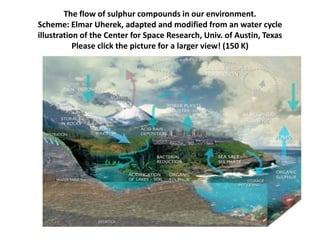
The flow of sulphur compounds in our environment.
Scheme: Elmar Uherek, adapted and modified from an water cycle
illustration of the Center for Space Research, Univ. of Austin, Texas
           Please click the picture for a larger view! (150 K)
• We find many sulphur compounds on Earth.
• These include sulphur dioxide, elemental sulphur, sulphuric acid, salts of
  sulphate or organic sulphur compounds such as dimethylsulphide and
  even amino acids in our body.
• All these chemical compounds do not last forever. They are transported by
  physical processes like wind or erosion by water, by geological events like
  volcano eruptions or by biological activity.
• They are also transformed by chemical reactions. But nothing is lost.
  Changes often take place in cycles. Such cycles can be chemical cycles in
  which a sulphur compound A reacts to form B, B to C, C to D and D to A
  again.
• At the same time there are spatial / geographical cycles. One example is
  when sulphur compounds move from the ocean to the atmosphere, are
  transported to the land, come down with the rain and are transported by
  rivers to the ocean again.
•
• Oxidation and reduction
• In chemical cycles, sulphur is usually oxidised in the air
  from organic sulphur or elemental sulphur to sulphur
  oxides like SO2 and SO3 ending up as sulphate in
  sulphate salts M(II)SO4, M(I)2SO4 or sulphuric acid
  H2SO4. The sulphate compounds dissolve very well in
  water and come down again with the rain, either as
  salts or as acid rain.
• In chemical cycles oxidized compounds must also be
  reduced again. This process does not take place in the
  atmosphere but on the ground and in the oceans and is
  carried out in complicated chemical reactions by
  bacteria. The most important products are elemental
  sulphur, hydrogen sulphide (H2S), which smells awful
  and is very unhealthy, and organic sulphur compounds.
• Sulphur compounds play a big role for our
  environment and the climate system. On the one
  hand they contribute to acid rain.
• But they are also important for the formation of
  clouds. Finally, a lot of sulphur is brought into the
  air by volcanic eruptions.
• If it was a strong eruption, the emitted particles
  can go up to the stratosphere (9 - 12 km of
  altitude) and cool down half our planet by 1-2°C.
  http://www.atmosphere.mpg.de/enid/Nr_6_Feb
  __2__6_acid_rain/C__The_sulphur_cycle_5i9.ht
  ml
Ecology ecosystem
Ecology ecosystem
Ecology ecosystem
Ecology ecosystem
Ecology ecosystem
Ecology ecosystem

Ecology ecosystem

  • 1.
    • The nitrogencycle is the set biogeochemical processes by which nitrogen undergoes chemical reactions, changes form, and moves through difference reservoirs on earth, including living organisms. • Nitrogen is required for all organisms too live and grow because it is the essential component of DNA, RNA, and protein. However, most organisms cannot use atmospheric nitrogen, the largest reservoir. • The five processes in the nitrogen cycle -- fixation, uptake, mineralization, nitrification and denitrification -- are all driven by microorganisms. • Humans influence the global nitrogen cycle primarily through the use of nitrogen-based fertilizers.
  • 2.
    • Nitrogen (N)is an essential component of DNA, RNA, and proteins, the building blocks of life. All organisms require nitrogen to live and grow. Although the majority of the air we breathe is N2, most of the nitrogen in the atmosphere is unavailable for use by organisms. • This is because the strong triple bond between the N atoms in N2 molecules makes it relatively inert.
  • 3.
    • In fact,in order for plants and animals to be able to use nitrogen, N2 gas must first be converted to more a chemically available form such as ammonium (NH4+), nitrate (NO3-), or organic nitrogen (e.g. urea - (NH2)2CO). • The inert nature of N2 means that biologically available nitrogen is often in short supply in natural ecosystems, limiting plant growth and biomass accumulation.
  • 4.
    • Nitrogen isan incredibly versatile element existing in both inorganic and organic forms as well as many different oxidation states. The movement of nitrogen between the atmosphere, biosphere and geosphere in different forms is described by the nitrogen cycle (Figure 1), one of the major biogeochemicalcycles. Similar to the carbon cycle, the nitrogen cycle consists of various storage pools of nitrogen and processes by which the pools exchange nitrogen (arrows) (see our The Carbon Cycle module for more information).
  • 5.
    The nitrogen cycle.Yellow arrows indicate human sources of nitrogen to the environment. Red arrows indicate microbial transformations of nitrogen. Blue arrows indicate physical forces acting on nitrogen. And green arrows indicate natural, non- microbial processes affecting the form and fate of nitrogen. Ecology & Ecosystem
  • 7.
  • 8.
    • Five mainprocesses cycle nitrogen through the biosphere, atmosphere, and geosphere: nitrogen fixation, nitrogen uptake (organismal growth), nitrogen mineralization (decay), nitrification, and denitrification. Microorganisms, particularly bacteria, play major roles in all of the principal nitrogen transformations
  • 9.
    • . Asmicrobial mediated processes, these nitrogen transformations tend to occur faster than geological processes like plate motion, a very slow, purely physical process that is a part of the carbon cycle. Instead, rates are affected by environmental factors that influence microbial activity, such as temperature, moisture, and resource availability
  • 10.
    Nitrogen fixation • N2NH4+ Nitrogen fixation is the process wherein N2 is converted to ammonium, essential because it is the only way that organisms can attain nitrogen directly from the atmosphere. Certain bacteria, for example those among the genus Rhizobium, are the only organisms that fix nitrogen through metabolic processes. Nitrogen fixing bacteria often form symbiotic relationships with host plants. This symbiosis is well-known to occur in the legume family of plants (e.g. beans, peas, and clover).
  • 11.
    • In thisrelationship, nitrogen fixing bacteria inhabit legume root nodules and receive carbohydrates and a favorable environment from their host plant in exchange for some of the nitrogen they fix. There are also nitrogen fixing bacteria that exist without plant hosts, known as free-living nitrogen fixers. In aquatic environments, blue-green algae (really a bacteria called cyanobacteria) is an important free-living nitrogen fixer.
  • 13.
    • In additionto nitrogen fixing bacteria, high- energy natural events such as lightning, forest fires, and even hot lava flows can cause the fixation of smaller, but significant amounts of nitrogen (Figure 3). The high energy of these natural phenomena can break the triple bonds of N2 molecules, thereby making individual N atoms available for chemical transformation. •
  • 14.
    • Within thelast century, humans have become as important a source of fixed nitrogen as all natural sources combined. Burning fossil fuels, using synthetic nitrogen fertilizers, and cultivation of legumes all fix nitrogen. Through these activities, humans have more than doubled the amount of fixed nitrogen that is pumped into the biosphere every year , the consequences of which are discussed below.
  • 15.
  • 16.
    • Nitrogen uptake •NH4+ Organic N The ammonia produced by nitrogen fixing bacteria is usually quickly incorporated into protein and other organic nitrogen compounds, either by a host plant, the bacteria itself, or another soil organism. When organisms nearer the top of the food chain (like us!) eat, we are using nitrogen that has been fixed initially by nitrogen fixing bacteria.
  • 17.
    • Nitrogen mineralization •Organic N NH4+ After nitrogen is incorporated into organic matter, it is often converted back into inorganic nitrogen by a process called nitrogen mineralization, otherwise known as decay. When organisms die, decomposers (such as bacteria and fungi) consume the organic matter and lead to the process of decomposition.
  • 18.
    • During thisprocess, a significant amount of the nitrogen contained within the dead organism is converted to ammonium. Once in the form of ammonium, nitrogen is available for use by plants or for further transformation into nitrate (NO3-) through the process called nitrification.
  • 19.
    • Nitrification • NH4+NO3- Some of the ammonium produced by decomposition is converted to nitrate via a process called nitrification. The bacteria that carry out this reaction gain energy from it. Nitrification requires the presence of oxygen, so nitrification can happen only in oxygen-rich environments like circulating or flowing waters and the very surface layers of soils and sediments. The process of nitrification has some important consequences.
  • 20.
    • Ammonium ionsare positively charged and therefore stick (are sorbed) to negatively charged clay particles and soil organic matter. The positive charge prevents ammonium nitrogen from being washed out of the soil (or leached) by rainfall. In contrast, the negatively charged nitrate ion is not held by soil particles and so can be washed down the soil profile, leading to decreased soil fertility and nitrate enrichment of downstream surface and groundwaters.
  • 21.
    • Denitrification • NO3-N2+ N2O Through denitrification, oxidized forms of nitrogen such as nitrate and nitrite (NO2- ) are converted to dinitrogen (N2) and, to a lesser extent, nitrous oxide gas. Denitrification is an anaerobic process that is carried out by denitrifying bacteria, which convert nitrate to dinitrogen in the following sequence: NO3- NO2- NO N2O N2.
  • 22.
    • Nitric oxideand nitrous oxide are both environmentally important gases. Nitric oxide (NO) contributes to smog, and nitrous oxide (N2O) is an important greenhouse gas, thereby contributing to global climate change. • Once converted to dinitrogen, nitrogen is unlikely to be reconverted to a biologically available form because it is a gas and is rapidly lost to the atmosphere. Denitrification is the only nitrogen transformation that removes nitrogen from ecosystems (essentially irreversibly), and it roughly balances the amount of nitrogen fixed by the nitrogen fixers described above.
  • 23.
    Human alteration ofthe N cycle and its environmental consequences • Early in the 20th century, a German scientist named Fritz Haber figured out how to short circuit the nitrogen cycle by fixing nitrogen chemically at high temperatures and pressures, creating fertilizers that could be added directly to soil. This technology has spread rapidly over the past century, and, along with the advent of new crop varieties, the use of synthetic nitrogen fertilizers has led to an enormous boom in agricultural productivity. This agricultural productivity has helped us to feed a rapidly growing world population, but the increase in nitrogen fixation has had some negative consequences as well. While the consequences are perhaps not as obvious as an increase in global temperatures or a hole in the ozone layer, they are just as serious and potentially harmful for humans and other organisms.
  • 24.
    • Not allof the nitrogen fertilizer applied to agricultural fields stays to nourish crops. Some is washed off of agricultural fields by rain or irrigation water, where it leaches into surface or ground water and can accumulate. In groundwater that is used as a drinking water source, excess nitrogen can lead to cancer in humans and respiratory distress in infants. The U.S. Environmental Protection Agency has established a standard for nitrogen in drinking water of 10 mg per liter nitrate-N. Unfortunately, many systems (particularly in agricultural areas) already exceed this level. By comparison, nitrate levels in waters that have not been altered by human activity are rarely greater than 1 mg/L. In surface waters, added nitrogen can lead to nutrient over-enrichment, particularly in coastal waters receiving the inflow from polluted rivers. This nutrient over-enrichment, also called eutrophication, has been blamed for in
  • 25.
    • creased frequenciesof coastal fish-kill events, increased frequencies of harmful algal blooms, and species shifts within coastal ecosystems. • Reactive nitrogen (like NO3- and NH4+) present in surface waters and soils, can also enter the atmosphere as the smog-component nitric oxide (NO) and the greenhouse gas nitrous oxide (N2O). Eventually, this atmospheric nitrogen can be blown into nitrogen-sensitive terrestrial environments, causing long-term changes
  • 26.
    For example, nitrogenoxides comprise a significant portion of the acidity in acid rain which has been blamed for forest death and decline in parts of Europe and the Northeast United States. Increases in atmospheric nitrogen deposition have also been blamed for more subtle shifts in dominant species and ecosystem function in some forest and grassland ecosystems
  • 27.
    • Currently, muchresearch is devoted to understanding the effects of nitrogen enrichment in the air, groundwater, and surface water. Scientists are also exploring alternative agricultural practices that will sustain high productivity while decreasing the negative impacts caused by fertilizer use. These studies not only help us quantify how humans have altered the natural world, but increase our understanding of the processes involved in the nitrogen cycle as a whole.
  • 28.
    • http://www.visionlearning.com/library/modul e_viewer.php?mid=98&mcid=&l= 13/10/10
  • 32.
    • In 1958,atmospheric carbon dioxide at Mauna Loa was about 320 parts per million (ppm), and in 2010 it is about 385ppm.[3] • Future CO2 emission can be calculated by the kaya identity
  • 36.
    • The environmentalsulphur cycle involves many physical, chemical and biological agents. • As such, the figure indicates the relationships between sulphur, S, hydrogen sulphide, H2S, sulphur dioxide, SO2, and the sulphate ion, SO4--. In mineral form sulphur may be present as sulphides (e.g. pyrite, FeS2, chalcopyrite, FeS.CuS, pyrrhotite, FeS) and/or sulphates (e.g. gypsum, CaSO4.2H2O, barite, BaSO4). Sulphur in minerals may move through the cycle as a result of the oxidation of sulphides to sulphate and/or the dissolution of sulphates. For example, oxidation of pyrite to sulphuric acid may be immediately followed, in situ, by acid neutralization by calcium carbonate (calcite) to form calcium sulphate (gypsum). The reaction of hydrogen sulphide with dissolved metal ions may precipitate metallic sulphides which are chemically indistinguishable from naturally occurring sulphide minerals.
  • 37.
    • At somemines, sulphur is added to the cycle as sulphur dioxide in processes such as the Inco/SO2 process for cyanide destruction in the treatment of tailings. This added sulphur is oxidized to sulphate ion (Ingles & Scott, 1987), most of which remains free, but some of which combines with lime, CaO, in the tailings to form gypsum. • For information on the sulphur cycle with respect to water quality monitoring see Canadian Council of Environment Ministers (1987).
  • 38.
    • The Roleof Micro-organisms in the Sulphur Cycle • Micro-organisms (most frequently bacteria) are often integrally involved in the chemical alteration of minerals. Minerals, or intermediate products of their decomposition, may be directly or indirectly necessary to their metabolism. The dissolution of sulphide minerals under acidic conditions (ARD), the precipitation of minerals under anaerobic conditions, the adsorption of metals by bacteria or algae, and the formation and destruction of organometallic complexes are all examples of indirect micro-organism participation. Where minerals are available as soluble trace elements, serve as specific oxidizing substrates, or are electron donors/acceptors in oxidation-reduction reactions, they may be directly involved in cell metabolic activity.
  • 39.
    There are three categories of oxidation-reduction reactions for minerals with micro-organisms: • Oxidation by autotrophic (cell carbon from carbon dioxide) or mixotrophic (cell carbon from carbon dioxide or organic matter) organisms. Energy derived from the oxidation reaction is utilized in cell synthesis. • Electron acceptance by minerals (reduction) for heterotrophic (cell carbon from organic matter) and mixotrophic bacteria. Chemical energy is used to create new cell material from an organic substrate. • Electron donation by minerals (oxidation) for bacterial or algal photosynthesis (reaction is fuelled by photon energy). • Natural Oxidation in the Sulphur Cycle • Oxidation of sulphur or sulphides for energy production is restricted to the bacterial genus Thiobacillus, the genus Thiomicrospira, and the genus Sulfolobus. These bacteria all produce sulphuric acid (i.e. hydrogen ions, H+, and sulphate ions, SO4-- ) as a metabolic product. Extensive reviews of these bacteria and their behaviour have been written by Brierley (1978) and Trudinger (1971). • It is these bacteria that are known to accelerate the generation of Acid Rock Drainage (ARD) from pyritic and pyrrhotitic rocks under suitable conditions. Evangelou & Zhang (1995) report that sulphide oxidation catalysed by bacteria may have reaction rates six orders of magnitude (i.e. 1,000,000 times) greater than the same reactions in the absence of bacteria. Photomicrographs 1, 2 and 3, from LeRoux, North & Wilson (1973), illustrate the shape and appearance of T. ferrooxidans: The bacteria develop flagella only if they are required for mobility in accessing energy sources. • http://technology.infomine.com/enviromine/ard/microorganisms/roleof.htm
  • 40.
  • 41.
    Almost all livingthings need oxygen. They use this oxygen during the process of creating energy in living cells.
  • 44.
    The flow ofsulphur compounds in our environment. Scheme: Elmar Uherek, adapted and modified from an water cycle illustration of the Center for Space Research, Univ. of Austin, Texas Please click the picture for a larger view! (150 K)
  • 45.
    • We findmany sulphur compounds on Earth. • These include sulphur dioxide, elemental sulphur, sulphuric acid, salts of sulphate or organic sulphur compounds such as dimethylsulphide and even amino acids in our body. • All these chemical compounds do not last forever. They are transported by physical processes like wind or erosion by water, by geological events like volcano eruptions or by biological activity. • They are also transformed by chemical reactions. But nothing is lost. Changes often take place in cycles. Such cycles can be chemical cycles in which a sulphur compound A reacts to form B, B to C, C to D and D to A again. • At the same time there are spatial / geographical cycles. One example is when sulphur compounds move from the ocean to the atmosphere, are transported to the land, come down with the rain and are transported by rivers to the ocean again. •
  • 46.
    • Oxidation andreduction • In chemical cycles, sulphur is usually oxidised in the air from organic sulphur or elemental sulphur to sulphur oxides like SO2 and SO3 ending up as sulphate in sulphate salts M(II)SO4, M(I)2SO4 or sulphuric acid H2SO4. The sulphate compounds dissolve very well in water and come down again with the rain, either as salts or as acid rain. • In chemical cycles oxidized compounds must also be reduced again. This process does not take place in the atmosphere but on the ground and in the oceans and is carried out in complicated chemical reactions by bacteria. The most important products are elemental sulphur, hydrogen sulphide (H2S), which smells awful and is very unhealthy, and organic sulphur compounds.
  • 48.
    • Sulphur compoundsplay a big role for our environment and the climate system. On the one hand they contribute to acid rain. • But they are also important for the formation of clouds. Finally, a lot of sulphur is brought into the air by volcanic eruptions. • If it was a strong eruption, the emitted particles can go up to the stratosphere (9 - 12 km of altitude) and cool down half our planet by 1-2°C. http://www.atmosphere.mpg.de/enid/Nr_6_Feb __2__6_acid_rain/C__The_sulphur_cycle_5i9.ht ml