5.1 Ecosystems Today’s Learning Objectives: Define the term  habitats  and give examples. Define the term  population  and give examples. Define the term  community  and give examples. Define the term  ecosystem  and give examples. Identify habitats, populations and communities  within a given ecosystem. Define the term  species  and give examples
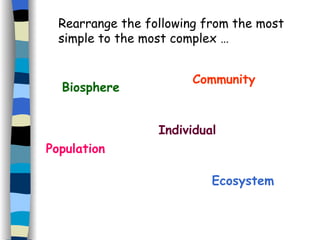
Rearrange the following from the most simple to the most complex … Biosphere Ecosystem Community Population Individual
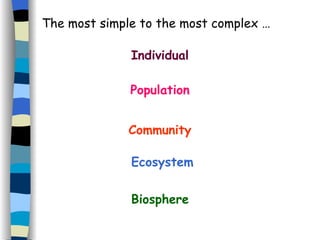
The most simple to the most complex … Community Population Individual Ecosystem Biosphere
Individual Individuals Individual Population Community
The smallest group is a  species .  A  species  is a group of living organisms which share the same general physical characteristics and  can mate to produce fertile young . All living organisms are divided into kingdoms e.g animal, plants, viruses etc.   Each kingdom is further divided into smaller groups containing fewer organisms.
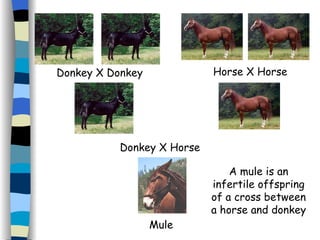
A mule is an infertile offspring of a cross between a horse and donkey Donkey X Donkey Donkey X Horse Mule Horse X Horse
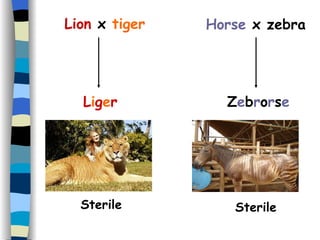
Lion  x  tiger Sterile Horse  x zebra Sterile L i g e r Z e b r o r s e
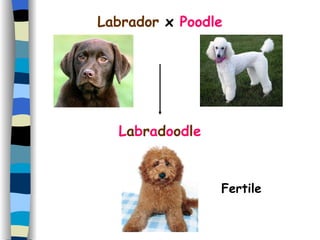
Fertile L a b r a d o o d l e Labrador  x  Poodle
5.2 Food Chains and Food Webs Today’s Learning Objectives: State the source of energy for a food chain. Explain what the arrows in a food chain indicate. Give examples of food chains. Explain what a food web shows. Construct a food chain or web from information  about feeding relationships in a community. Explain and apply the terms:  producer, primary  consumer, secondary consumer. Explain and apply the terms:  herbivore, carnivore,  decomposer, predator, prey. Explain the importance of decomposers.
Producers and Consumers All organisms in an ecosystem need food to survive  How an organism obtains food can be divided into two groups:  Producers  Consumers
Producers All green plants produce their own food  They use the sunlight's energy to synthesise food… PHOTOSYNTHESIS   This means that the  sun  is the source off all energy in a food chain
Consumers Organisms that eat other organisms are consumers  Herbivores  Consume  plant  material  Carnivores   Consume  animal  material  Omnivores   Consume  plant and animal  material
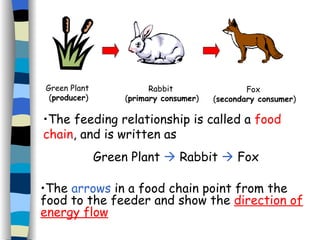
Food Chains Energy is transferred in the form of  chemical energy  in food from plants to animals and then to other animals  A producer can be eaten by a herbivore –  primary consumer   A herbivore can be in turn eaten by an animal –  secondary consumer
Green Plant  ( producer ) Rabbit  ( primary consumer ) Fox  ( secondary consumer ) The feeding relationship is called a  food chain , and is written as Green Plant    Rabbit    Fox The  arrows  in a food chain point from the food to the feeder and show the  direction of energy flow
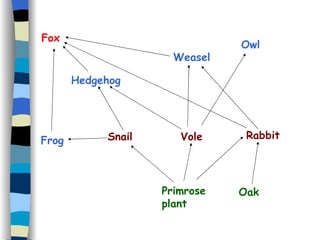
Fox Weasel Hedgehog Frog Snail Vole Rabbit Oak Primrose  plant Owl
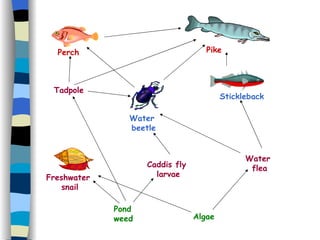
Tadpole Caddis fly  larvae Pond  weed Water  flea Algae Perch Pike Water  beetle Stickleback Freshwater  snail
5.3 Energy Flow in Food Chains Today’s Learning Objectives: State what a  pyramid of energy  shows and relate it  to a food chain. Describe and explain how the energy content at  each level in a pyramid of energy compares. State what a  pyramid of numbers  shows and relate  it to a food chain. State what a  pyramid of biomass  shows and relate  it to a food chain. Describe and explain how the biomass at each level  in a pyramid of numbers compares. Explain why a pyramid of numbers and a pyramid of  biomass for the same food chain may not have the  same shape.
Energy Loss Every time an organism eats another, energy is transferred from the food to the feeder.  Oak leaf    Caterpillar    Shrew    Badger  Not all of the energy available at each step of the food chain is passed on to the next step.  Energy is  lost.
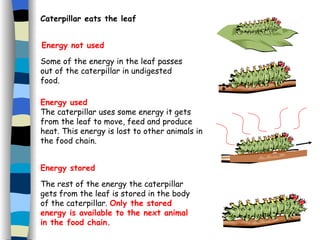
Caterpillar eats the leaf Energy not used  Some of the energy in the leaf passes out of the caterpillar in undigested food. Energy used  Energy used The caterpillar uses some energy it gets from the leaf to move, feed and produce heat. This energy is lost to other animals in the food chain. Energy stored  The rest of the energy the caterpillar gets from the leaf is stored in the body of the caterpillar.  Only the stored energy is available to the next animal in the food chain.
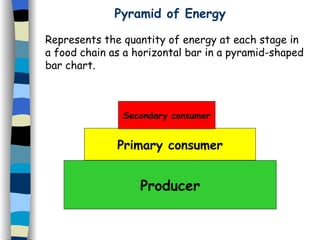
Producer Primary consumer Secondary consumer Pyramid of Energy Represents the quantity of energy at each stage in  a food chain as a horizontal bar in a pyramid-shaped  bar chart.
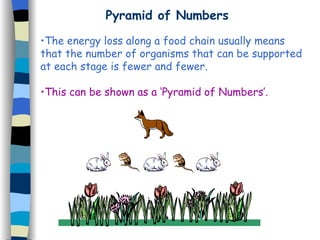
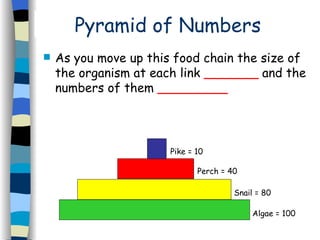
Pyramid of Numbers The energy loss along a food chain usually means that the number of organisms that can be supported at each stage is fewer and fewer. This can be shown as a ‘Pyramid of Numbers’.
Pyramid of Numbers As you move up this food chain the size of the organism at each link  _______  and the numbers of them  _________ Pike = 10 Perch = 40 Snail = 80 Algae = 100
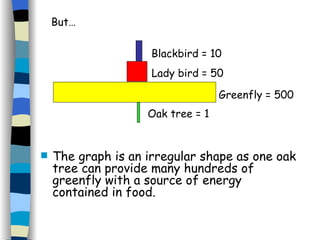
The graph is an irregular shape as one oak tree can provide many hundreds of greenfly with a source of energy contained in food. Blackbird = 10 Lady bird = 50 Greenfly = 500 Oak tree = 1 But…
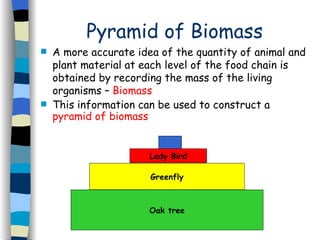
Pyramid of Biomass A more accurate idea of the quantity of animal and plant material at each level of the food chain is obtained by recording the mass of the living organisms –  Biomass  This information can be used to construct a  pyramid of biomass Oak tree Greenfly Lady Bird
5.4 Adaptation and Stability Today’s Learning Objectives: State the meaning of the term  niche. Recognise the description of a niche. State what influences the distribution of organisms  in an ecosystem. State the meaning of the term  adaptation . Match an adaptation to a habitat or niche from  given information. Describe what makes an ecosystem. Predict how a change in one population in a food web  may effect other populations in the web.
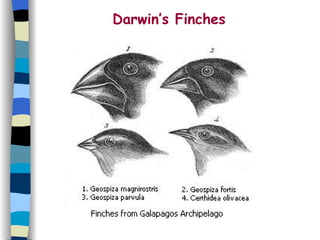
An adaptation is a feature of an organism  which enables it to survive successfully in  it’s habitat. Darwin's finches  (also known as the  Galápagos Finches ) are 13 or 14  different but closely related species of  finches Charles Darwin collected on the  Galápagos Islands in the 19 th  century. Each finch has a beak adapted to it’s  specific habitat and food.
Darwin’s Finches
5.5 Biodiversity Today’s Learning Objectives: Define the term  biodiversity . State the importance of biodiversity for  ecosystems. State the importance of biodiversity for humans. Give examples of human activities which cause  habitat destruction. Name ecosystems which could be affected by  deforestation. State what is meant by the biodiversity crisis. Describe how biodiversity is affected by pollution  and name some pollutants. Describe how biodiversity is affected by grazing.
Biodiversity  is the variety of species which exists in an ecosystem.   Maintaining  biodiversity  is important to humans for: Food Genetic Material Medicines Raw Materials Recreation
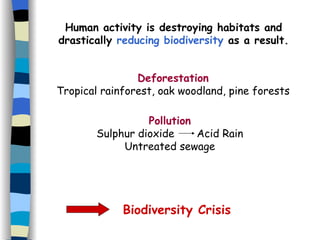
Human activity is destroying habitats and drastically  reducing biodiversity  as a result. Deforestation Tropical rainforest, oak woodland, pine forests Pollution Sulphur dioxide  Acid Rain Untreated sewage Biodiversity Crisis
5.6 Behavioural Adaptations in Animals Today’s Learning Objectives: Define the terms  environmental stimulus  and  behavioural response. Identify the behavioural response in a given  example. Explain the significance of a given behavioural  adaptation. State the condition of light and humidity which  woodlice prefer. State how reliability can be improved in a choice  chamber experiment.
All animals, no matter how simple, show  behavioural  adaptations. An  environmental stimulus  is a change in an organism’s  surroundings  to which the organism is sensitive. A  behavioural response  is a  reaction by an organism  to an environmental stimulus.
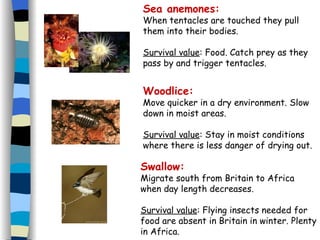
Sea anemones: When tentacles are touched they pull them into their bodies. Survival value : Food. Catch prey as they pass by and trigger tentacles. Woodlice: Move quicker in a dry environment. Slow down in moist areas. Survival value : Stay in moist conditions where there is less danger of drying out. Swallow: Migrate south from Britain to Africa when day length decreases. Survival value : Flying insects needed for food are absent in Britain in winter. Plenty in Africa.
5.7 Competition Today’s Learning Objectives: State the meaning of the term  competition . State the resources for which plants can compete. Describe some effects of competition on plants. State the resources for which animals can compete. Give an example of how two animal species living  together can avoid competition for food.
Competition  is the struggle between members of a community for the  same limited resources . Animals Plants Food Water Shelter Nesting Spaces Mates Nutrients Water Light (Root/leaf space)

5. Environmental Biology

  • 1.
    5.1 Ecosystems Today’sLearning Objectives: Define the term habitats and give examples. Define the term population and give examples. Define the term community and give examples. Define the term ecosystem and give examples. Identify habitats, populations and communities within a given ecosystem. Define the term species and give examples
  • 2.
    Rearrange the followingfrom the most simple to the most complex … Biosphere Ecosystem Community Population Individual
  • 3.
    The most simpleto the most complex … Community Population Individual Ecosystem Biosphere
  • 4.
  • 5.
    The smallest groupis a species . A species is a group of living organisms which share the same general physical characteristics and can mate to produce fertile young . All living organisms are divided into kingdoms e.g animal, plants, viruses etc. Each kingdom is further divided into smaller groups containing fewer organisms.
  • 6.
    A mule isan infertile offspring of a cross between a horse and donkey Donkey X Donkey Donkey X Horse Mule Horse X Horse
  • 7.
    Lion x tiger Sterile Horse x zebra Sterile L i g e r Z e b r o r s e
  • 8.
    Fertile L ab r a d o o d l e Labrador x Poodle
  • 9.
    5.2 Food Chainsand Food Webs Today’s Learning Objectives: State the source of energy for a food chain. Explain what the arrows in a food chain indicate. Give examples of food chains. Explain what a food web shows. Construct a food chain or web from information about feeding relationships in a community. Explain and apply the terms: producer, primary consumer, secondary consumer. Explain and apply the terms: herbivore, carnivore, decomposer, predator, prey. Explain the importance of decomposers.
  • 10.
    Producers and ConsumersAll organisms in an ecosystem need food to survive How an organism obtains food can be divided into two groups: Producers Consumers
  • 11.
    Producers All greenplants produce their own food They use the sunlight's energy to synthesise food… PHOTOSYNTHESIS This means that the sun is the source off all energy in a food chain
  • 12.
    Consumers Organisms thateat other organisms are consumers Herbivores Consume plant material Carnivores Consume animal material Omnivores Consume plant and animal material
  • 13.
    Food Chains Energyis transferred in the form of chemical energy in food from plants to animals and then to other animals A producer can be eaten by a herbivore – primary consumer A herbivore can be in turn eaten by an animal – secondary consumer
  • 14.
    Green Plant ( producer ) Rabbit ( primary consumer ) Fox ( secondary consumer ) The feeding relationship is called a food chain , and is written as Green Plant  Rabbit  Fox The arrows in a food chain point from the food to the feeder and show the direction of energy flow
  • 15.
    Fox Weasel HedgehogFrog Snail Vole Rabbit Oak Primrose plant Owl
  • 16.
    Tadpole Caddis fly larvae Pond weed Water flea Algae Perch Pike Water beetle Stickleback Freshwater snail
  • 17.
    5.3 Energy Flowin Food Chains Today’s Learning Objectives: State what a pyramid of energy shows and relate it to a food chain. Describe and explain how the energy content at each level in a pyramid of energy compares. State what a pyramid of numbers shows and relate it to a food chain. State what a pyramid of biomass shows and relate it to a food chain. Describe and explain how the biomass at each level in a pyramid of numbers compares. Explain why a pyramid of numbers and a pyramid of biomass for the same food chain may not have the same shape.
  • 18.
    Energy Loss Everytime an organism eats another, energy is transferred from the food to the feeder. Oak leaf  Caterpillar  Shrew  Badger Not all of the energy available at each step of the food chain is passed on to the next step. Energy is lost.
  • 19.
    Caterpillar eats theleaf Energy not used Some of the energy in the leaf passes out of the caterpillar in undigested food. Energy used Energy used The caterpillar uses some energy it gets from the leaf to move, feed and produce heat. This energy is lost to other animals in the food chain. Energy stored The rest of the energy the caterpillar gets from the leaf is stored in the body of the caterpillar. Only the stored energy is available to the next animal in the food chain.
  • 20.
    Producer Primary consumerSecondary consumer Pyramid of Energy Represents the quantity of energy at each stage in a food chain as a horizontal bar in a pyramid-shaped bar chart.
  • 21.
    Pyramid of NumbersThe energy loss along a food chain usually means that the number of organisms that can be supported at each stage is fewer and fewer. This can be shown as a ‘Pyramid of Numbers’.
  • 22.
    Pyramid of NumbersAs you move up this food chain the size of the organism at each link _______ and the numbers of them _________ Pike = 10 Perch = 40 Snail = 80 Algae = 100
  • 23.
    The graph isan irregular shape as one oak tree can provide many hundreds of greenfly with a source of energy contained in food. Blackbird = 10 Lady bird = 50 Greenfly = 500 Oak tree = 1 But…
  • 24.
    Pyramid of BiomassA more accurate idea of the quantity of animal and plant material at each level of the food chain is obtained by recording the mass of the living organisms – Biomass This information can be used to construct a pyramid of biomass Oak tree Greenfly Lady Bird
  • 25.
    5.4 Adaptation andStability Today’s Learning Objectives: State the meaning of the term niche. Recognise the description of a niche. State what influences the distribution of organisms in an ecosystem. State the meaning of the term adaptation . Match an adaptation to a habitat or niche from given information. Describe what makes an ecosystem. Predict how a change in one population in a food web may effect other populations in the web.
  • 26.
    An adaptation isa feature of an organism which enables it to survive successfully in it’s habitat. Darwin's finches (also known as the Galápagos Finches ) are 13 or 14 different but closely related species of finches Charles Darwin collected on the Galápagos Islands in the 19 th century. Each finch has a beak adapted to it’s specific habitat and food.
  • 27.
  • 28.
    5.5 Biodiversity Today’sLearning Objectives: Define the term biodiversity . State the importance of biodiversity for ecosystems. State the importance of biodiversity for humans. Give examples of human activities which cause habitat destruction. Name ecosystems which could be affected by deforestation. State what is meant by the biodiversity crisis. Describe how biodiversity is affected by pollution and name some pollutants. Describe how biodiversity is affected by grazing.
  • 29.
    Biodiversity isthe variety of species which exists in an ecosystem. Maintaining biodiversity is important to humans for: Food Genetic Material Medicines Raw Materials Recreation
  • 30.
    Human activity isdestroying habitats and drastically reducing biodiversity as a result. Deforestation Tropical rainforest, oak woodland, pine forests Pollution Sulphur dioxide Acid Rain Untreated sewage Biodiversity Crisis
  • 31.
    5.6 Behavioural Adaptationsin Animals Today’s Learning Objectives: Define the terms environmental stimulus and behavioural response. Identify the behavioural response in a given example. Explain the significance of a given behavioural adaptation. State the condition of light and humidity which woodlice prefer. State how reliability can be improved in a choice chamber experiment.
  • 32.
    All animals, nomatter how simple, show behavioural adaptations. An environmental stimulus is a change in an organism’s surroundings to which the organism is sensitive. A behavioural response is a reaction by an organism to an environmental stimulus.
  • 33.
    Sea anemones: Whententacles are touched they pull them into their bodies. Survival value : Food. Catch prey as they pass by and trigger tentacles. Woodlice: Move quicker in a dry environment. Slow down in moist areas. Survival value : Stay in moist conditions where there is less danger of drying out. Swallow: Migrate south from Britain to Africa when day length decreases. Survival value : Flying insects needed for food are absent in Britain in winter. Plenty in Africa.
  • 34.
    5.7 Competition Today’sLearning Objectives: State the meaning of the term competition . State the resources for which plants can compete. Describe some effects of competition on plants. State the resources for which animals can compete. Give an example of how two animal species living together can avoid competition for food.
  • 35.
    Competition isthe struggle between members of a community for the same limited resources . Animals Plants Food Water Shelter Nesting Spaces Mates Nutrients Water Light (Root/leaf space)