
S.S.A.S.I.T,
SURAT
GTU
Ecology
• Definition:- Ecology is derived from two Greek
“Logos”
Ecology= Oikos + Logos
words “Oikos” &
•
•
•
Oikos means house or dwelling place
Logos means study of
• Thus Ecology can be define as “Study of organisms with
respect to their house or dwelling place”.
2
Terminology Used in Ecology
Species: A Uniform interbreeding population spreading over•
time & space is known as species.
Community: A group of similar or dis-similar species species
condition.
Population: It is a group of similar community living together
•
living to gather under more or less similar environmental
•
under similar environmental condition.
Biome: The complex of several type of community, at different
environmental condition.
•
stages of succession living to gather under similar
• Vegetation: A collective growth of plants in space is known as
vegetation.
Habitat: The place where an organism live or the place where•
one would go to find a particular organism is known as habitat.
3
Terminology Used in Ecology
Factor: Any external force, substance, or condition that
affects the organism in any way is known as factor.
Standing state: The total amount of inorganic substances
•
•
i.e. minerals Such as phosphorous, sulfur, nitrogen,
hydrogen, etc. present at any given time in the environment
of an ecosystem is known as standing state.
Biomass: Biomass is the total amount of living material
present in terms of weight/ unit area.
•
4
Classification of Ecology
Ecology can be classified based upon its sub divisions
Based on Taxonomic affinities:
• Plant Ecology.
• Animal Ecology
•
•
as:
In early days of Ecology,
themselves in the study
botanist and zoologists engaged
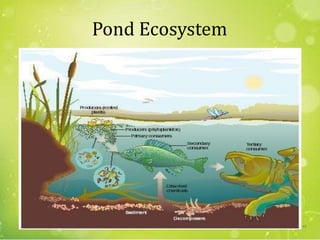
of ecology of plants & animals
respectively this led to the development of such sub-
divisions as a) Plant Ecology b) Animal Ecology
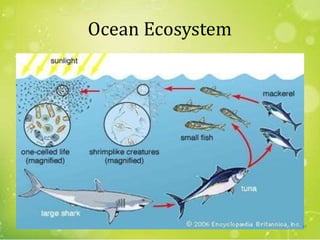
Based on Habitat Ecology : Some ecologist thought of the study
of habitats and their effect upon the organisms. They selected a
number of different habitat such as fresh water, grass land,
•
forest etc. this are then studied in detail for their possible
relationship with the kind of organisms present there such an
approach led to the development of habitat ecology.
5
• Based on level of Organization:- In this approach the
organisms involved in ecology are either studied individually or
in group accordingly they are classified as
Autecology & Synecology:
• Autecology: It is also known as ecology of individual
organisms.
• Synecology: It is also known as ecology of groups of
organisms.
•
6
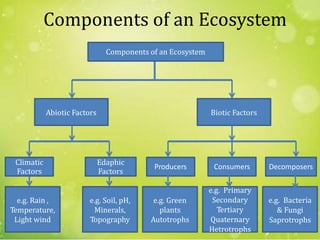
Components of an Ecosystem
e.g. Soil, pH,
Minerals,
Topography
e.g. Green
plants
Autotrophs
e.g. Primary
Secondary
Tertiary
Quaternary
Hetrotrophs
e.g. Bacteria
& Fungi
Saprotrophs
e.g. Rain ,
Temperature,
Light wind
DecomposersConsumersProducers
Edaphic
Factors
Climatic
Factors
Biotic FactorsAbiotic Factors
Components of an Ecosystem
7
Components of an Ecosystem
•
•
•
•
Each organisms has two main components
Abiotic
Biotic
Abiotic Component: The non living factor or the physical
abioticenvironment
components.
prevailing in an ecosystem forms
•
•
Abiotic component are mainly of two types,
(a) Climatic factors It includes, rain, temperature, light, wind,
humidity, etc.
(b) Edaphic factors (i.e. factors related to soil) : It includes soil,
pH, topography, minerals.
•
8
Components of an Ecosystem
• Biotic Components: The living organisms include, plants,
bioticanimals, and micro-organisms in an ecosystem forms
components.
Biotic Components are further classified into 3 main groups
Producers
Consumers
Decomposers or Reducers
Producer: The green plants have chrophyll with the help of
which they trap solar energy and change it into chemical energy
•
•
•
•
•
of carbohydrates using simple inorganic compound namely,
water and carbon dioxide. This process is known as
photosynthesis. The chemical energy stored by the producers is
utilized partly by the producers for their own growth and
survival and the remaining is stored in the plants for their future
use. 9
Components of an Ecosystem
• Consumers: The animals lack chrophyll and are unable to synthesis
their own food therefore they depend on the producers for their food.
They are known as heterotrophs (i.e. heteros= others, trophs= feeder)
The Consumers are of 4 types:
(a) Primary Consumer: ( Herbivores) i.e. Animal feeding on plants, e.g.
Rabbit, deer, goat etc.
(b) Secondary Consumers: The animal feeding on Herbivores are
called as secondary consumers or primary carnivores. e.g. Cats, foxes,
snakes.
(c) Tertiary Consumers: These are large carnivores which feed on
secondary consumers. e.g. Wolves
(d) Quaternary Consumers: They are also called omnivores these are
largest carnivores which feed on tertiary consumers and are not eaten
up by any other animals.
e.g. lion and Tiger.
•
•
•
•
•
•
10
Components of an Ecosystem
Decomposers: Bacteria & fungi belong to this category.
They break down the dead organic matter of producers &
•
consumers for their food and release to the environment the
simple inorganic and organic substance. These simple substances
are reused by the producers resulting in a cyclic exchange of
material between biotic & abiotic environment.
11
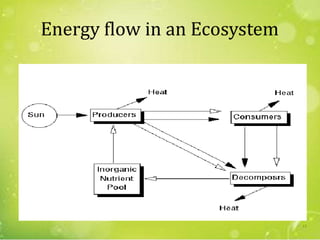
Energy flow in an Ecosystem
• Biological activities requires energy which ultimately comes from the
photosynthesis this energy is stored in plant tissue and then
transformed into heat energy during metabolic activities.
Thus in biological world the energy flows from the sun to plants and
and non-cyclic. This one way flow of energy is governed by laws of
thermodynamics which states that:
(a) Energy can neither be created nor be destroyed but may be
sun. Solar energy is transformed into chemical energy by a process of
•
then to all heterotrophic organisms The flow of energy is unidirectional
•
transformed from one form to another.
(b) During the energy transfer there is degradation of energy from a
dispersed form (heat).
No energy transformation is 100 % efficient, it is always accompanied
biological systems including ecosystems, must be supplied with energy
on a continuous Basis.
•
concentrated form (mechanical, chemical, or electrical etc.) to a
•
by some dispersion or loss of energy in the form heat. Therefore,
12
Energy flow in an Ecosystem
13
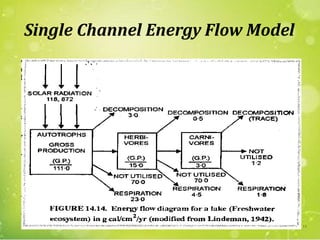
Single Channel Energy Flow Model
14
Models Of Energy Flow in Ecosystem
• Single Channel Energy Flow Model: The flow of energy takes
place in a unidirectional manner through a single channel of
by
to
go
producers to herbivores and
autotrophs does not revert
herbivores; and that which
carnivores. The energy captured
back to solar input but passes
passes to herbivores does not
back to autotrophs but passes to consumers. Due to one way
flow of energy, the entire system would collapse if primary
source of energy were cut off. At each tropic level there
progressive decrease in energy which is mainly due to
energy as heat in metabolic reactions and also some
energy is utilized at each tropic level
occurs
loss of
of the
15
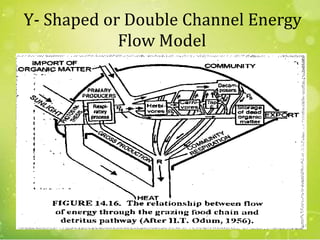
Y- Shaped or Double Channel Energy Flow
Model
• Y- shaped model shows a common boundary, light and heat flow
Decomposers are placed in separate box to partially separate the
grazing and detritus food chains. In terms of energy levels
decomposers are in fact a mixed group.
Y- shaped energy flow is more realistic and practical than the
as well as import , export and storage of organic matter .
•
single channel energy flow model because:
It conforms to the basic stratified structure of ecosystems
It separates the two chains i.e. grazing & detritus food chain in
•
•
both time and space.
Micro consumers (bacteria & fungi) and the macro consumers
models.
•
(animals) differ greatly in size- metabolism relations in two
16
Y- Shaped or Double Channel Energy
Flow Model
17
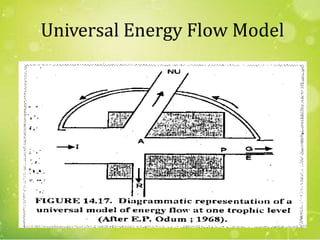
Universal Energy Flow Model
As the flow of energy takes place, there is gradual loss of energy at
each level there by resulting in less energy available at the next
tropic level as indicated by narrower pipes (energy flow) and
smaller boxes (stored energy in biomass). The loss of energy is
mainly the energy which is not utilized (U). This is the energy loss
in locomotion, excretion etc. or it the energy lost in respiration (CR)
which is for maintenance. The remaining energy is used for
production (P).
18
Universal Energy Flow Model
19
Ecological Pyramids
• The different species in a food chain are called tropic levels.
Each food chain has 3 main trophic level, producer, consumer,
and decomposers.
Thus Graphical representation of these trophic levels is called as
Ecological Pyramids. It was devised by an ecologist “ Charles
Elton” therefore this pyramid are also called Ecological pyramid
or Eltonian pyramids.
•
20
Types of Ecological Pyramids
•
•
•
•
Ecological pyramids are of three types:
Pyramid
Pyramid
Pyramid
of Number
of biomass
of Energy
21
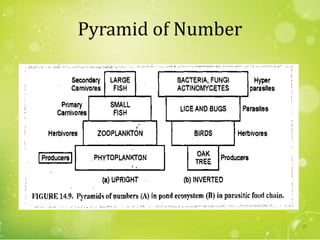
Pyramid of Number
They show the relationship between producers, herbivores, and•
carnivores at successive tropic levels in terms of their number.
In case of grassland ecosystem the producers are mainly grasses
decrease towards apex as primary consumers like mice, rabbit
are lesser in number than grasses, the secondary consumers like
lizard, snake, are even lesser in number than the grasses, finally
the top tertiary consumers like hawks are least in number. Thus
the shape of pyramid is upright. But in case of forest ecosystem
the pyramids is always inverted because the producers are
mainly large trees, are lesser in numbers, the herbivores fruit
eating birds are more in number than the producers, then there
is gradual decrease in number of secondary consumers thus
making pyramid upright again. Thus the pyramid of number
does not give a true picture of the food chain and are not very
functional.
•
and are always maximum in number this number then shows a
22
Pyramid of Number
23
Pyramid of Biomass
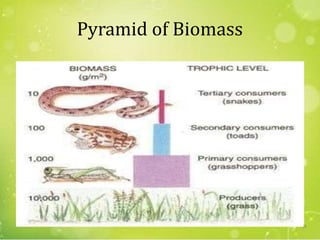
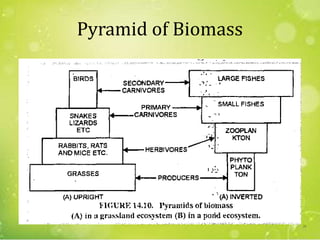
• The pyramid of biomass represents the relationship between
different tropic levels in terms of biomass.
There is generally gradual decrease in biomass of organisms at
successive levels from the producers to the top carnivores. Thus
pyramid of biomass is upright for grassland ecosystem.
However in case of a pond as the producers are algae, are least
in number and this value gradually shows an increase towards
the apex of pyramid thus making the pyramid inverted in shape.
•
•
24
Pyramid of Biomass
25
Pyramid of Biomass
26
Pyramid of Energy
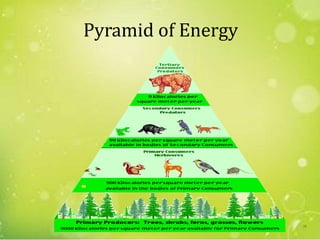
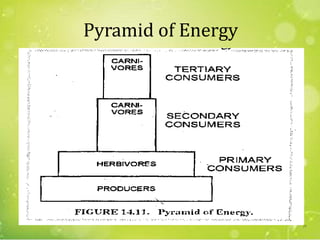
• Of the 3 types of ecological pyramid the energy pyramid gives
the best picture of overall nature of the ecosystem. In this type
pyramid the tropic level is decided depending upon the rate
which food is being produced.
In shape it is always upright as in most of the cases there
of
at
• is
always gradual decrease in the energy content at successive
trophic level from producers to various consumers.
27
Pyramid of Energy
28
Pyramid of Energy
29
Bio-Geo- Chemical Cycles
Nutrients, unlike energy are recycled in the ecosystem. The
Producers of an ecosystem take up several basic nutrients from
their non-living ecosystem. Materials are in limited quantity in
the earth’s system and to keep the system going continuously,
these materials get transformed into biomass of the producers.
Thus they are utilized by the consumer population and are
•
ultimately returned to the environment with the help of
reducers or decomposers. The unique method evolved in nature
is recycling materials continuously is by linking them in cycle
changes. This cyclic exchange of nutrient material between the
living organisms & their non-living environment is called Bio-
Geochemical cycle. As indicated by the name the nutrients are
circulated through life (bio) and through earth(geo) repeatedly
(cycle).
30
Hydrological Cycle
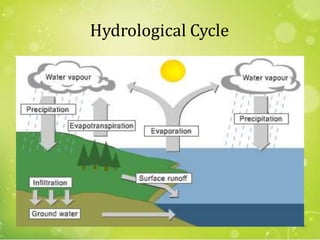
The natural flow of water through various components of environment•
resulting in the global circulation is called water cycle.
Steps in Hydrological Cycle:
Evaporation: Surface water is heated by sun and evaporates to become water
•
•
vapour, water vapour floats in the air.
Condensation: As water vapour rises into the air it gradually cools and•
condenses and become minute droplet of water.
Clouds: Tiny droplets of water together forms clouds.
Precipitation: The fall of water on earth surface in any form of water it may be
•
•
in the form of dew, drizzle, rain is known as precipitation.
Runoff: Precipitated rain water accumulates and flows on the surface and sub-
reaches to sea.
Percolation & infiltration: The process of stored water flowing under earth,
•
surface towards rivers, streams, and underground stores and ultimately
•
merge to the ground water source is called percolation and infiltration
Transpiration: The water which directly evaporates from leaves of plants is•
called Transpiration.
Completion of Cycle: All the water bodies continues its journey towards the
natural slope and meet the sea where the cycle starts again.
•
31
Hydrological Cycle
32
Carbon Cycle
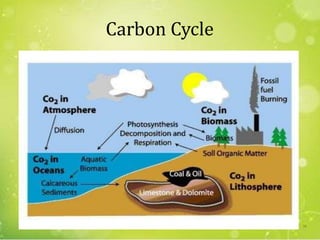
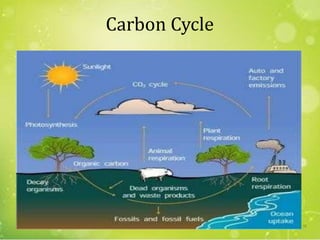
• Carbon dioxide gas is emitted from various natural and
anthropogenic sources such as , volcanic eruptions, burning
forests, decomposition of carbonates, factories & Automobile
exhausts, during respiration by humans and plants. The plants
consume carbon dioxide during the process of photosynthesis.
The major reservoir for carbon dioxide are in oceans, carbon
dioxide dissolves readily in water.
On land and in water, plants take up carbon dioxide and convert
•
•
it into carbohydrates
6CO2 + 6H20
The plants are eaten
during the process of photosynthesis.
•
•
C6 H12 O6 + 6 CO2
by animals and when plants & animals die
the carbon content in the organic matter again return to the soil
with the help of decomposers.
33
Carbon Cycle
34
Carbon Cycle
35
Phosphorus Cycle
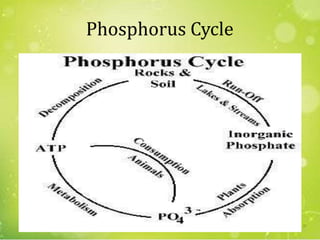
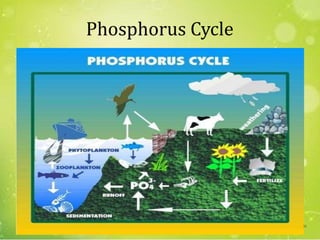
• The Phosphorus cycle is the simplest of all cycles. Phosphorus is
generally available in the soluble form i.e. phosphate (PO4 ). Which is a
phosphorous atom with 4 oxygen atoms. This heavy molecules never
makes into the atmosphere, they are always present in dissolved form
in water or in the rock. When phosphorous rock dissolves in water the
phosphate goes into the solution. Producer take this phosphorous up
and use it in various metabolic activities. Phosphate is considered to be
a important constituent of cell membrane, DNA, ATP.
Consumer obtain their phosphorus from plants they eat.
Animals also use phosphorous as a component of bones & teeth, shells.
When animal or plant die, phosphate returns to the soil or water by the
decomposers.
Nowadays the synthetic detergents & fertilizers have also become a
source of Phosphates in a water course. Thus excess of phosphates due
to these sources have resulted in a problem of Eutrophication.(i.e.
Excess of plant growth).
-3
•
•
•
36
Phosphorus Cycle
37
Phosphorus Cycle
38
Nitrogen Cycle
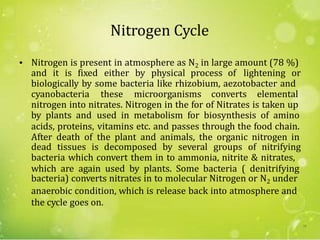
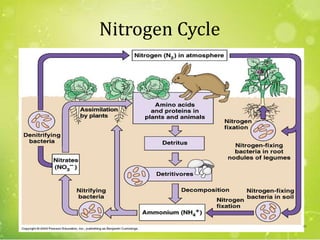
• Nitrogen is present in atmosphere as N2 in large amount (78 %)
and it is fixed either by physical process of lightening or
biologically by some bacteria like rhizobium, aezotobacter and
cyanobacteria these microorganisms converts elemental
nitrogen into nitrates. Nitrogen in the for of Nitrates is taken up
by plants and
acids, proteins,
After death of
used in metabolism for biosynthesis of amino
vitamins etc. and passes through the food chain.
the plant and animals, the organic nitrogen in
dead tissues is decomposed by several groups of nitrifying
bacteria which convert them in to ammonia, nitrite & nitrates,
which are again used by plants. Some bacteria ( denitrifying
bacteria) converts nitrates in to molecular Nitrogen or N2 under
anaerobic condition, which is release back into atmosphere and
the cycle goes on.
39
Nitrogen Cycle
40
Sulphur Cycle
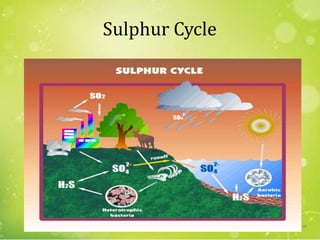
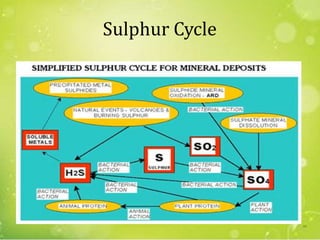
• Sulphur occurs both in free state as well as sulphides and
sulphates as PBs, ZnS, BaSO4, etc. Sulphur is very essential
element for the living organisms for synthesizing amino acids,
enzymes, co-factors and certain vitamins. The burning of fossil
fuels and volcanoes releases H2S and SO2 gas in atmosphere,
which ultimately returns to the soil as sulphuric acid along with
SO4
-2rain, forming sulphate compounds. Sulphur in the form of
is absorbed by plants. The elemental Sulphur converted to
sulphates SO4-2 is also released into the soil through weathering
of some sulphates containing rocks.
41
Sulphur Cycle
• SO4
-2The sulphates are utilized by plants and passes onto
heterotrophic organisms of food chain. After death the bodies of
plants and animals as well as their waste are decomposed by
microorganism releasing sulphur as organic sulphur bacteria.
SO4
-2The sulphate is again utilized by plants and cycle goes on.
42
Sulphur Cycle
43
Sulphur Cycle
44
Oxygen Cycle
• Atmosphere contains about 21 % of oxygen. Almost all
living organisms need oxygen. They use oxygen during the
process of creating energy or process of photosynthesis.
• Just as water moves from sky to earth and back into
hydrological cycle, oxygen is also cycled through the
environment. Plants mark the beginning of oxygen cycle.
Plant produce oxygen during the process of
photosynthesis. Animal form
cycle, they breath oxygen. So
are used up by animals.
the other half of the oxygen
the oxygen created in plants
• There is continuous exchange of O2 between the
atmosphere and all water surface on the earth. The total
amount of O2 in the biosphere is relatively constant, so that
the oxygen cycle may get stable. 45
Oxygen Cycle
46
Oxygen Cycle
47
Food Chain & Food Web
• Food Chain: In food chain each organism eats the smaller
organisms and is eaten by the larger one. All those organisms
which are interlinked with each other through food to gather
constitute the ecosystem.
The different levels in a food chain are called tropic levels, Each•
food chain has three main tropic levels:- Producer level,
Consumer level, and decomposer level.
If any of the intermediate stage of the food chain is removed, the
succeeding links of the food chain will be affected.
The arrangement in a food chain can be depicted as :
•
•
48
Types of Food Chains
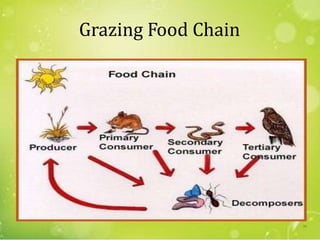
Grazing Food Chain: This type of food chain starts from living
green plants goes to grazing herbivores and onto carnivores.
Ecosystem with such type of food chain directly depends upon the
solar energy for their food requirements. Most of the ecosystem in
nature follow this type of food chain.
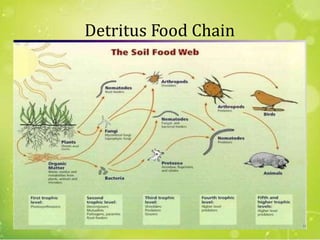
Detritus food Chain: This type of food chain goes from dead
organic matter onto microorganisms and then to the organisms
feeding on detritus and their predators. Such ecosystem are less
dependent on direct solar energy.
Parasitic Food Chain: This type of food chain starts from big hosts
and ends with parasitic organisms.
49
Grazing Food Chain
50
Detritus Food Chain
51
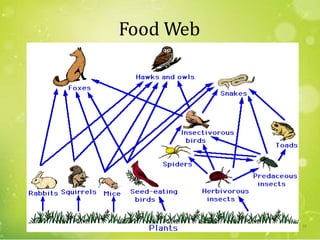
Food Web
• Food Web: The interconnected, interlocking pattern of food
chain is known as food web.
Under natural condition of the linear arrangement of food chain
hardly occurs and they remain interconnected with each other
through different types of organisms at different levels Such a
•
interconnected and interlocking pattern
as food web..
of food chain is known
52
Food Web
53
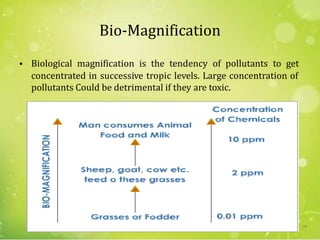
Bio-Magnification
• Biological magnification is the tendency of pollutants to get
concentrated in successive tropic levels. Large concentration of
pollutants Could be detrimental if they are toxic.
54
Major Ecosystems
• Earth is a vast ecosystem it is however difficult to
handle and thus for convenience we generally
into units of
study it
smaller
forest
by making
ecosystem.
ecosystem,
manmade
artificial subdivisions
(eg.
desert
Terrestrial
ecosystem,
ecosystem
grassland
as,
ecosystem,
ecosystem as cropland ecosystem, and
aquatic ecosystem as freshwater, marine, etc.)
An ecosystem thus be separated from each other but it
must be remembered that these units of ecosystem are
linked with each other forming an integrated system.
•
55
Classification of Ecosystem
ECOSYSTEM
ESTURIES
YSTEMECOSYSTEMECOSYSTEMECOSYSTEM
ARTIFICIAL
ECOSYSTEM
CROPLAND
ECOSYSTEM
NATURAL
ECOSYSTEM
ARTIF
ECOSYS
CR
ECOSYS
LAND
ECOSYSTEM
AQUATIC
FOREST GRASSLAND DESERT POND
ECOSYSTEM
OCEAN
ECOSYSTEM
ES
ECOS
ECOSYSTEM
56
Classification of Ecosystem
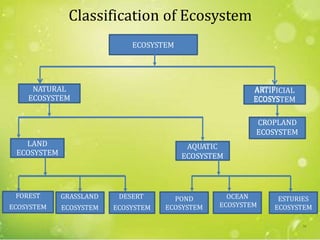
Different types of ecosystem of biosphere artificially categorized
follows:
Natural Ecosystems
Artificial ecosystems
Natural Ecosystems
• as
•
•
•
• These ecosystems operate by themselves under natural conditions
without any major interference by man. Based upon the particular kind
of habitat, these are further divided as:
Terrestrial as forest, grassland, desert etc.
Aquatic which may be further distinguished as
Freshwater which may be lotic (running water as springs, stream,
river) or lentic (standing water as lake, pond, pools, ditch, swamps,
etc.)
Marine Ecosystems: as an ocean or shallow ones like sea or estuary etc.
•
•
•
•
57
• Artificial Ecosystems: These are maintained by man where, by
addition of energy & planned manipulations natural balance is
disturbed regularly, for ex , croplands like maize, wheat, rice-fields
etc, where man tries to control the biotic community as well as
physico-chemical environment are artificial ecosystems.
58
Marine Ecosystems
• Pond Ecosystem: A Pond as a whole serves a good example of
freshwater ecosystem
Abiotic Components: The chief components are heat, light, pH of
water, CO2, oxygen, calcium, nitrogen, phosphates, etc.
Biotic Components: The various organization that constitute the
biotic component are as follows,
Producers: These are green plants, and some photosynthetic
bacteria. The producer fix radiant energy and convert it into
organic substances as carbohydrates, protein etc.
•
•
•
59
Pond Ecosystem
Producers are of following type
Macrophytes: these are large rooted plants, which include partly or completely
submerged hydrophytes, eg Hydrilla, Trapha, Typha.
Phytoplankton: These are minute floating or submerged lower plants eg algae.
Consumers: They are heterotrophs which depends for their nutrition on the organic
food manufactured by producers.
Primary Consumers:
•
•
•
•
•
– Benthos: These are animals associated with living plants ,detrivores and some
other microorganisms
Zooplanktons: These are chiefly rotifers, protozoans, they feed on phytoplankton–
• Secondary Consumers: They are the Carnivores which feed on herbivores, these are
chiefly insect and fish, most insects & water beetles, they feed on zooplanktons.
Tertiary Consumers: These are some large fish as game fish, turtles, which feed on small
fish and thus become tertiary consumers.
Decomposers: They are also known as micro-consumers. They decompose dead organic
matter of both producers and animal to simple form. Thus they play an important role in
the return of minerals again to the pond ecosystem, they are chiefly bacteria, & fungi.
•
•
60
Pond Ecosystem
61
Ocean Ecosystem
Ocean Ecosystem are more stable than pond ecosystem, they occupy
70 % of the earth surface.
Abiotic Components: Dissolved oxygen, light, temperature, minerals.
Biotic Components:
•
•
•
• Producers:
producers.
These are autotrophs and are also known Primary
They are mainly, some microscopic algae (phyto-
planlanktons) besides them there are mainly, seaweeds, as brown and
red algae also contribute to primary production.
Consumers: They are all heterotrophic macro consumers•
• Primary Consumer: The herbivores, that feed on producers are
shrimps, Molluscs, fish, etc.
Secondary Consumers: These are carnivores fish as Herring, Shad,
Mackerel, feeding on herbivores.
Tertiary Consumers: These includes, other carnivores fishes like, COD,
Halibut, Sea Turtle, Sharks etc.
Decomposers: The microbes active in the decay of dead organic matter
of producers, and animals are chiefly, bacteria and some fungi.
•
•
•
62
Ocean Ecosystem
63
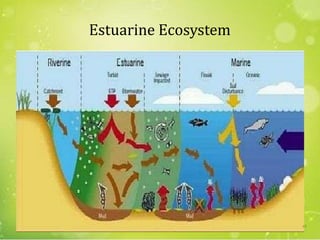
Estuarine Ecosystem
An estuary is a partially enclosed body of water along the coast where
oceans. This Ecosystems are considered as most fertile ecosystem.
Abiotic Components: Nutrients such as phosphorus and nitrogen,
•
fresh water from river and streams meet and mix with salt water from
•
temperature, light, salinity, pH.
• This ecosystem experience wide daily and seasonal fluctuations in
temperature and Salinity level because of variation in freshwater in flow.
Biotic Components:•
• Producers: Phyplanktons- these micro-organisms manufacture food by
besides them, mangroves, sea grass, weeds, and salt marshes.
photosynthesis and absorb nutrients such as phosphorous and nitrogen,
• Consumers: Primary consumers, Zooplanktons that feed on
Phytoplankton, besides them some small microorganisms that feed on
producers.
• Secondary Consumer: Include worms, shellfish, small fish, feeding on
Zooplanktons
Tertiary Consumer :Fishes, turtles, crabs, starfishes feeding on secondary•
consumers.
Decomposers: Fungi & Bacteria are the chief microbes active in decay of•
dead organic matter.
64
Estuarine Ecosystem
65
Riverine Ecosystem
• As Compared with lentic freshwater (Ponds & lakes), lotic
waters such as streams, and river have been less studied.
However, the various components of an riverine and stream
ecosystem can be arranged as follows.
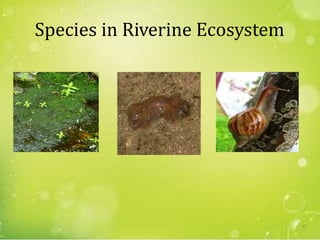
• Producers: The chief producers that remain permanently
attached to a firm substrata are green algae as Cladophora, and
aquatic mosses.
• Consumers: The consumers show certain features as permanent
sticky undersurface, streamline bodies, flattened bodies.. Thus a
variety of animal are found, which are fresh spongy and caddis-
fly larvae, snails, flat worms etc.
Decomposers: Various bacteria and fungi like actinomycetes are
attachment to firm substrata, presence of hooks & suckers,
•
present which acts as decomposers.
66
Species in Riverine Ecosystem
67
Land Ecosystem
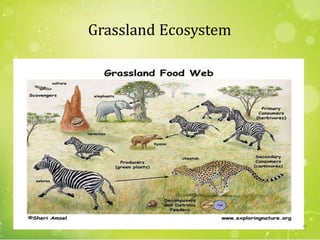
Grassland Ecosystem: Grassland occupy comparatively fewer area roughly 19•
% of the earth’s surface.
• Abiotic Components: These are nutrients present in soil, and aerial
environment, thus the elements like, phosphates, sulphates, water, carbon
dioxide, present in soil and in air. Moreover some trace elements are also
present.
Biotic Components:
Producers: They are mainly grasses as species of Cynadon, Desmodium,
•
•
besides them a few shrubs also contribute some primary production.
Consumers:
Primary Consumers: The herbivores feeding on grasses are grazing animals,
millipedes that feed on grasses.
Secondary Consumers: These are carnivores feeding on herbivores these
•
•
as cows, goats, rabbit, etc. besides them there are some insects as termites,
•
include, animals like, fox, jackals, snakes, frogs, birds.
Tertiary Consumers: Some times hawks, vultures, feeding on secondary•
consumer, thus occupy tertiary consumers.
Decomposers: The microbes active in the decay of dead organic matter of•
different form are fungi and some bacteria
68
Grassland Ecosystem
69
Forest Ecosystem
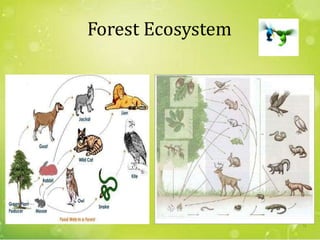
Forest Occupy roughly 40 % of the land. The different components of•
forest ecosystem are as follows:
• Abiotic Components: These are organic & inorganic substances
present in the soil and atmosphere. In addition to minerals present in
forest we find the dead organic debris, moreover light conditions are
different due to complex stratification in the plants.
Biotic Components:
Producers These are mainly trees that show much species and greater
and ground vegetation.
Consumers: Primary Consumers: These are herbivores that include
large elephants, dears, squirrels, etc.
•
•
degree of stratification. Besides trees there are also present shrubs,
•
animals feeding on tree leaves, ants, beetles, grass hoppers, etc., and
• Secondary Consumers: These are carnivores, like snakes, birds,
lizards, fox, etc. feeding on herbivores.
• Tertiary consumers: These are top carnivores like lion tiger, etc. that
eat carnivores of secondary level.
Decomposers: These are wide variety of micro organisms including,•
fungi, bacteria.
70
Forest Ecosystem
71
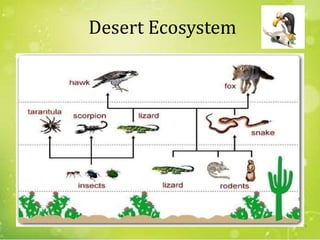
Desert Ecosystem
•
•
•
•
Desert occupy 17 % of land.
Abiotic components include, light, temperature, minerals.
Biotic Components:
Producers : These are shrubs, especially bushes, some grasses,
and few trees.
E.g. Cacti, Xerophytes, mosses
Consumers: The most common animals are reptiles, and insects,
there are some rodents, and birds, and above all ship of desert
camels, feed on tender plants.
Decomposers: These are very few as due to poor vegetation the
amount of dead organic matter is less. They are some fungi and
bacteria.
•
•
•
72
Desert Ecosystem
73
74

Ecology and ecosystems

  • 1.
  • 2.
    Ecology • Definition:- Ecologyis derived from two Greek “Logos” Ecology= Oikos + Logos words “Oikos” & • • • Oikos means house or dwelling place Logos means study of • Thus Ecology can be define as “Study of organisms with respect to their house or dwelling place”. 2
  • 3.
    Terminology Used inEcology Species: A Uniform interbreeding population spreading over• time & space is known as species. Community: A group of similar or dis-similar species species condition. Population: It is a group of similar community living together • living to gather under more or less similar environmental • under similar environmental condition. Biome: The complex of several type of community, at different environmental condition. • stages of succession living to gather under similar • Vegetation: A collective growth of plants in space is known as vegetation. Habitat: The place where an organism live or the place where• one would go to find a particular organism is known as habitat. 3
  • 4.
    Terminology Used inEcology Factor: Any external force, substance, or condition that affects the organism in any way is known as factor. Standing state: The total amount of inorganic substances • • i.e. minerals Such as phosphorous, sulfur, nitrogen, hydrogen, etc. present at any given time in the environment of an ecosystem is known as standing state. Biomass: Biomass is the total amount of living material present in terms of weight/ unit area. • 4
  • 5.
    Classification of Ecology Ecologycan be classified based upon its sub divisions Based on Taxonomic affinities: • Plant Ecology. • Animal Ecology • • as: In early days of Ecology, themselves in the study botanist and zoologists engaged of ecology of plants & animals respectively this led to the development of such sub- divisions as a) Plant Ecology b) Animal Ecology Based on Habitat Ecology : Some ecologist thought of the study of habitats and their effect upon the organisms. They selected a number of different habitat such as fresh water, grass land, • forest etc. this are then studied in detail for their possible relationship with the kind of organisms present there such an approach led to the development of habitat ecology. 5
  • 6.
    • Based onlevel of Organization:- In this approach the organisms involved in ecology are either studied individually or in group accordingly they are classified as Autecology & Synecology: • Autecology: It is also known as ecology of individual organisms. • Synecology: It is also known as ecology of groups of organisms. • 6
  • 7.
    Components of anEcosystem e.g. Soil, pH, Minerals, Topography e.g. Green plants Autotrophs e.g. Primary Secondary Tertiary Quaternary Hetrotrophs e.g. Bacteria & Fungi Saprotrophs e.g. Rain , Temperature, Light wind DecomposersConsumersProducers Edaphic Factors Climatic Factors Biotic FactorsAbiotic Factors Components of an Ecosystem 7
  • 8.
    Components of anEcosystem • • • • Each organisms has two main components Abiotic Biotic Abiotic Component: The non living factor or the physical abioticenvironment components. prevailing in an ecosystem forms • • Abiotic component are mainly of two types, (a) Climatic factors It includes, rain, temperature, light, wind, humidity, etc. (b) Edaphic factors (i.e. factors related to soil) : It includes soil, pH, topography, minerals. • 8
  • 9.
    Components of anEcosystem • Biotic Components: The living organisms include, plants, bioticanimals, and micro-organisms in an ecosystem forms components. Biotic Components are further classified into 3 main groups Producers Consumers Decomposers or Reducers Producer: The green plants have chrophyll with the help of which they trap solar energy and change it into chemical energy • • • • • of carbohydrates using simple inorganic compound namely, water and carbon dioxide. This process is known as photosynthesis. The chemical energy stored by the producers is utilized partly by the producers for their own growth and survival and the remaining is stored in the plants for their future use. 9
  • 10.
    Components of anEcosystem • Consumers: The animals lack chrophyll and are unable to synthesis their own food therefore they depend on the producers for their food. They are known as heterotrophs (i.e. heteros= others, trophs= feeder) The Consumers are of 4 types: (a) Primary Consumer: ( Herbivores) i.e. Animal feeding on plants, e.g. Rabbit, deer, goat etc. (b) Secondary Consumers: The animal feeding on Herbivores are called as secondary consumers or primary carnivores. e.g. Cats, foxes, snakes. (c) Tertiary Consumers: These are large carnivores which feed on secondary consumers. e.g. Wolves (d) Quaternary Consumers: They are also called omnivores these are largest carnivores which feed on tertiary consumers and are not eaten up by any other animals. e.g. lion and Tiger. • • • • • • 10
  • 11.
    Components of anEcosystem Decomposers: Bacteria & fungi belong to this category. They break down the dead organic matter of producers & • consumers for their food and release to the environment the simple inorganic and organic substance. These simple substances are reused by the producers resulting in a cyclic exchange of material between biotic & abiotic environment. 11
  • 12.
    Energy flow inan Ecosystem • Biological activities requires energy which ultimately comes from the photosynthesis this energy is stored in plant tissue and then transformed into heat energy during metabolic activities. Thus in biological world the energy flows from the sun to plants and and non-cyclic. This one way flow of energy is governed by laws of thermodynamics which states that: (a) Energy can neither be created nor be destroyed but may be sun. Solar energy is transformed into chemical energy by a process of • then to all heterotrophic organisms The flow of energy is unidirectional • transformed from one form to another. (b) During the energy transfer there is degradation of energy from a dispersed form (heat). No energy transformation is 100 % efficient, it is always accompanied biological systems including ecosystems, must be supplied with energy on a continuous Basis. • concentrated form (mechanical, chemical, or electrical etc.) to a • by some dispersion or loss of energy in the form heat. Therefore, 12
  • 13.
    Energy flow inan Ecosystem 13
  • 14.
    Single Channel EnergyFlow Model 14
  • 15.
    Models Of EnergyFlow in Ecosystem • Single Channel Energy Flow Model: The flow of energy takes place in a unidirectional manner through a single channel of by to go producers to herbivores and autotrophs does not revert herbivores; and that which carnivores. The energy captured back to solar input but passes passes to herbivores does not back to autotrophs but passes to consumers. Due to one way flow of energy, the entire system would collapse if primary source of energy were cut off. At each tropic level there progressive decrease in energy which is mainly due to energy as heat in metabolic reactions and also some energy is utilized at each tropic level occurs loss of of the 15
  • 16.
    Y- Shaped orDouble Channel Energy Flow Model • Y- shaped model shows a common boundary, light and heat flow Decomposers are placed in separate box to partially separate the grazing and detritus food chains. In terms of energy levels decomposers are in fact a mixed group. Y- shaped energy flow is more realistic and practical than the as well as import , export and storage of organic matter . • single channel energy flow model because: It conforms to the basic stratified structure of ecosystems It separates the two chains i.e. grazing & detritus food chain in • • both time and space. Micro consumers (bacteria & fungi) and the macro consumers models. • (animals) differ greatly in size- metabolism relations in two 16
  • 17.
    Y- Shaped orDouble Channel Energy Flow Model 17
  • 18.
    Universal Energy FlowModel As the flow of energy takes place, there is gradual loss of energy at each level there by resulting in less energy available at the next tropic level as indicated by narrower pipes (energy flow) and smaller boxes (stored energy in biomass). The loss of energy is mainly the energy which is not utilized (U). This is the energy loss in locomotion, excretion etc. or it the energy lost in respiration (CR) which is for maintenance. The remaining energy is used for production (P). 18
  • 19.
  • 20.
    Ecological Pyramids • Thedifferent species in a food chain are called tropic levels. Each food chain has 3 main trophic level, producer, consumer, and decomposers. Thus Graphical representation of these trophic levels is called as Ecological Pyramids. It was devised by an ecologist “ Charles Elton” therefore this pyramid are also called Ecological pyramid or Eltonian pyramids. • 20
  • 21.
    Types of EcologicalPyramids • • • • Ecological pyramids are of three types: Pyramid Pyramid Pyramid of Number of biomass of Energy 21
  • 22.
    Pyramid of Number Theyshow the relationship between producers, herbivores, and• carnivores at successive tropic levels in terms of their number. In case of grassland ecosystem the producers are mainly grasses decrease towards apex as primary consumers like mice, rabbit are lesser in number than grasses, the secondary consumers like lizard, snake, are even lesser in number than the grasses, finally the top tertiary consumers like hawks are least in number. Thus the shape of pyramid is upright. But in case of forest ecosystem the pyramids is always inverted because the producers are mainly large trees, are lesser in numbers, the herbivores fruit eating birds are more in number than the producers, then there is gradual decrease in number of secondary consumers thus making pyramid upright again. Thus the pyramid of number does not give a true picture of the food chain and are not very functional. • and are always maximum in number this number then shows a 22
  • 23.
  • 24.
    Pyramid of Biomass •The pyramid of biomass represents the relationship between different tropic levels in terms of biomass. There is generally gradual decrease in biomass of organisms at successive levels from the producers to the top carnivores. Thus pyramid of biomass is upright for grassland ecosystem. However in case of a pond as the producers are algae, are least in number and this value gradually shows an increase towards the apex of pyramid thus making the pyramid inverted in shape. • • 24
  • 25.
  • 26.
  • 27.
    Pyramid of Energy •Of the 3 types of ecological pyramid the energy pyramid gives the best picture of overall nature of the ecosystem. In this type pyramid the tropic level is decided depending upon the rate which food is being produced. In shape it is always upright as in most of the cases there of at • is always gradual decrease in the energy content at successive trophic level from producers to various consumers. 27
  • 28.
  • 29.
  • 30.
    Bio-Geo- Chemical Cycles Nutrients,unlike energy are recycled in the ecosystem. The Producers of an ecosystem take up several basic nutrients from their non-living ecosystem. Materials are in limited quantity in the earth’s system and to keep the system going continuously, these materials get transformed into biomass of the producers. Thus they are utilized by the consumer population and are • ultimately returned to the environment with the help of reducers or decomposers. The unique method evolved in nature is recycling materials continuously is by linking them in cycle changes. This cyclic exchange of nutrient material between the living organisms & their non-living environment is called Bio- Geochemical cycle. As indicated by the name the nutrients are circulated through life (bio) and through earth(geo) repeatedly (cycle). 30
  • 31.
    Hydrological Cycle The naturalflow of water through various components of environment• resulting in the global circulation is called water cycle. Steps in Hydrological Cycle: Evaporation: Surface water is heated by sun and evaporates to become water • • vapour, water vapour floats in the air. Condensation: As water vapour rises into the air it gradually cools and• condenses and become minute droplet of water. Clouds: Tiny droplets of water together forms clouds. Precipitation: The fall of water on earth surface in any form of water it may be • • in the form of dew, drizzle, rain is known as precipitation. Runoff: Precipitated rain water accumulates and flows on the surface and sub- reaches to sea. Percolation & infiltration: The process of stored water flowing under earth, • surface towards rivers, streams, and underground stores and ultimately • merge to the ground water source is called percolation and infiltration Transpiration: The water which directly evaporates from leaves of plants is• called Transpiration. Completion of Cycle: All the water bodies continues its journey towards the natural slope and meet the sea where the cycle starts again. • 31
  • 32.
  • 33.
    Carbon Cycle • Carbondioxide gas is emitted from various natural and anthropogenic sources such as , volcanic eruptions, burning forests, decomposition of carbonates, factories & Automobile exhausts, during respiration by humans and plants. The plants consume carbon dioxide during the process of photosynthesis. The major reservoir for carbon dioxide are in oceans, carbon dioxide dissolves readily in water. On land and in water, plants take up carbon dioxide and convert • • it into carbohydrates 6CO2 + 6H20 The plants are eaten during the process of photosynthesis. • • C6 H12 O6 + 6 CO2 by animals and when plants & animals die the carbon content in the organic matter again return to the soil with the help of decomposers. 33
  • 34.
  • 35.
  • 36.
    Phosphorus Cycle • ThePhosphorus cycle is the simplest of all cycles. Phosphorus is generally available in the soluble form i.e. phosphate (PO4 ). Which is a phosphorous atom with 4 oxygen atoms. This heavy molecules never makes into the atmosphere, they are always present in dissolved form in water or in the rock. When phosphorous rock dissolves in water the phosphate goes into the solution. Producer take this phosphorous up and use it in various metabolic activities. Phosphate is considered to be a important constituent of cell membrane, DNA, ATP. Consumer obtain their phosphorus from plants they eat. Animals also use phosphorous as a component of bones & teeth, shells. When animal or plant die, phosphate returns to the soil or water by the decomposers. Nowadays the synthetic detergents & fertilizers have also become a source of Phosphates in a water course. Thus excess of phosphates due to these sources have resulted in a problem of Eutrophication.(i.e. Excess of plant growth). -3 • • • 36
  • 37.
  • 38.
  • 39.
    Nitrogen Cycle • Nitrogenis present in atmosphere as N2 in large amount (78 %) and it is fixed either by physical process of lightening or biologically by some bacteria like rhizobium, aezotobacter and cyanobacteria these microorganisms converts elemental nitrogen into nitrates. Nitrogen in the for of Nitrates is taken up by plants and acids, proteins, After death of used in metabolism for biosynthesis of amino vitamins etc. and passes through the food chain. the plant and animals, the organic nitrogen in dead tissues is decomposed by several groups of nitrifying bacteria which convert them in to ammonia, nitrite & nitrates, which are again used by plants. Some bacteria ( denitrifying bacteria) converts nitrates in to molecular Nitrogen or N2 under anaerobic condition, which is release back into atmosphere and the cycle goes on. 39
  • 40.
  • 41.
    Sulphur Cycle • Sulphuroccurs both in free state as well as sulphides and sulphates as PBs, ZnS, BaSO4, etc. Sulphur is very essential element for the living organisms for synthesizing amino acids, enzymes, co-factors and certain vitamins. The burning of fossil fuels and volcanoes releases H2S and SO2 gas in atmosphere, which ultimately returns to the soil as sulphuric acid along with SO4 -2rain, forming sulphate compounds. Sulphur in the form of is absorbed by plants. The elemental Sulphur converted to sulphates SO4-2 is also released into the soil through weathering of some sulphates containing rocks. 41
  • 42.
    Sulphur Cycle • SO4 -2Thesulphates are utilized by plants and passes onto heterotrophic organisms of food chain. After death the bodies of plants and animals as well as their waste are decomposed by microorganism releasing sulphur as organic sulphur bacteria. SO4 -2The sulphate is again utilized by plants and cycle goes on. 42
  • 43.
  • 44.
  • 45.
    Oxygen Cycle • Atmospherecontains about 21 % of oxygen. Almost all living organisms need oxygen. They use oxygen during the process of creating energy or process of photosynthesis. • Just as water moves from sky to earth and back into hydrological cycle, oxygen is also cycled through the environment. Plants mark the beginning of oxygen cycle. Plant produce oxygen during the process of photosynthesis. Animal form cycle, they breath oxygen. So are used up by animals. the other half of the oxygen the oxygen created in plants • There is continuous exchange of O2 between the atmosphere and all water surface on the earth. The total amount of O2 in the biosphere is relatively constant, so that the oxygen cycle may get stable. 45
  • 46.
  • 47.
  • 48.
    Food Chain &Food Web • Food Chain: In food chain each organism eats the smaller organisms and is eaten by the larger one. All those organisms which are interlinked with each other through food to gather constitute the ecosystem. The different levels in a food chain are called tropic levels, Each• food chain has three main tropic levels:- Producer level, Consumer level, and decomposer level. If any of the intermediate stage of the food chain is removed, the succeeding links of the food chain will be affected. The arrangement in a food chain can be depicted as : • • 48
  • 49.
    Types of FoodChains Grazing Food Chain: This type of food chain starts from living green plants goes to grazing herbivores and onto carnivores. Ecosystem with such type of food chain directly depends upon the solar energy for their food requirements. Most of the ecosystem in nature follow this type of food chain. Detritus food Chain: This type of food chain goes from dead organic matter onto microorganisms and then to the organisms feeding on detritus and their predators. Such ecosystem are less dependent on direct solar energy. Parasitic Food Chain: This type of food chain starts from big hosts and ends with parasitic organisms. 49
  • 50.
  • 51.
  • 52.
    Food Web • FoodWeb: The interconnected, interlocking pattern of food chain is known as food web. Under natural condition of the linear arrangement of food chain hardly occurs and they remain interconnected with each other through different types of organisms at different levels Such a • interconnected and interlocking pattern as food web.. of food chain is known 52
  • 53.
  • 54.
    Bio-Magnification • Biological magnificationis the tendency of pollutants to get concentrated in successive tropic levels. Large concentration of pollutants Could be detrimental if they are toxic. 54
  • 55.
    Major Ecosystems • Earthis a vast ecosystem it is however difficult to handle and thus for convenience we generally into units of study it smaller forest by making ecosystem. ecosystem, manmade artificial subdivisions (eg. desert Terrestrial ecosystem, ecosystem grassland as, ecosystem, ecosystem as cropland ecosystem, and aquatic ecosystem as freshwater, marine, etc.) An ecosystem thus be separated from each other but it must be remembered that these units of ecosystem are linked with each other forming an integrated system. • 55
  • 56.
  • 57.
    Classification of Ecosystem Differenttypes of ecosystem of biosphere artificially categorized follows: Natural Ecosystems Artificial ecosystems Natural Ecosystems • as • • • • These ecosystems operate by themselves under natural conditions without any major interference by man. Based upon the particular kind of habitat, these are further divided as: Terrestrial as forest, grassland, desert etc. Aquatic which may be further distinguished as Freshwater which may be lotic (running water as springs, stream, river) or lentic (standing water as lake, pond, pools, ditch, swamps, etc.) Marine Ecosystems: as an ocean or shallow ones like sea or estuary etc. • • • • 57
  • 58.
    • Artificial Ecosystems:These are maintained by man where, by addition of energy & planned manipulations natural balance is disturbed regularly, for ex , croplands like maize, wheat, rice-fields etc, where man tries to control the biotic community as well as physico-chemical environment are artificial ecosystems. 58
  • 59.
    Marine Ecosystems • PondEcosystem: A Pond as a whole serves a good example of freshwater ecosystem Abiotic Components: The chief components are heat, light, pH of water, CO2, oxygen, calcium, nitrogen, phosphates, etc. Biotic Components: The various organization that constitute the biotic component are as follows, Producers: These are green plants, and some photosynthetic bacteria. The producer fix radiant energy and convert it into organic substances as carbohydrates, protein etc. • • • 59
  • 60.
    Pond Ecosystem Producers areof following type Macrophytes: these are large rooted plants, which include partly or completely submerged hydrophytes, eg Hydrilla, Trapha, Typha. Phytoplankton: These are minute floating or submerged lower plants eg algae. Consumers: They are heterotrophs which depends for their nutrition on the organic food manufactured by producers. Primary Consumers: • • • • • – Benthos: These are animals associated with living plants ,detrivores and some other microorganisms Zooplanktons: These are chiefly rotifers, protozoans, they feed on phytoplankton– • Secondary Consumers: They are the Carnivores which feed on herbivores, these are chiefly insect and fish, most insects & water beetles, they feed on zooplanktons. Tertiary Consumers: These are some large fish as game fish, turtles, which feed on small fish and thus become tertiary consumers. Decomposers: They are also known as micro-consumers. They decompose dead organic matter of both producers and animal to simple form. Thus they play an important role in the return of minerals again to the pond ecosystem, they are chiefly bacteria, & fungi. • • 60
  • 61.
  • 62.
    Ocean Ecosystem Ocean Ecosystemare more stable than pond ecosystem, they occupy 70 % of the earth surface. Abiotic Components: Dissolved oxygen, light, temperature, minerals. Biotic Components: • • • • Producers: producers. These are autotrophs and are also known Primary They are mainly, some microscopic algae (phyto- planlanktons) besides them there are mainly, seaweeds, as brown and red algae also contribute to primary production. Consumers: They are all heterotrophic macro consumers• • Primary Consumer: The herbivores, that feed on producers are shrimps, Molluscs, fish, etc. Secondary Consumers: These are carnivores fish as Herring, Shad, Mackerel, feeding on herbivores. Tertiary Consumers: These includes, other carnivores fishes like, COD, Halibut, Sea Turtle, Sharks etc. Decomposers: The microbes active in the decay of dead organic matter of producers, and animals are chiefly, bacteria and some fungi. • • • 62
  • 63.
  • 64.
    Estuarine Ecosystem An estuaryis a partially enclosed body of water along the coast where oceans. This Ecosystems are considered as most fertile ecosystem. Abiotic Components: Nutrients such as phosphorus and nitrogen, • fresh water from river and streams meet and mix with salt water from • temperature, light, salinity, pH. • This ecosystem experience wide daily and seasonal fluctuations in temperature and Salinity level because of variation in freshwater in flow. Biotic Components:• • Producers: Phyplanktons- these micro-organisms manufacture food by besides them, mangroves, sea grass, weeds, and salt marshes. photosynthesis and absorb nutrients such as phosphorous and nitrogen, • Consumers: Primary consumers, Zooplanktons that feed on Phytoplankton, besides them some small microorganisms that feed on producers. • Secondary Consumer: Include worms, shellfish, small fish, feeding on Zooplanktons Tertiary Consumer :Fishes, turtles, crabs, starfishes feeding on secondary• consumers. Decomposers: Fungi & Bacteria are the chief microbes active in decay of• dead organic matter. 64
  • 65.
  • 66.
    Riverine Ecosystem • AsCompared with lentic freshwater (Ponds & lakes), lotic waters such as streams, and river have been less studied. However, the various components of an riverine and stream ecosystem can be arranged as follows. • Producers: The chief producers that remain permanently attached to a firm substrata are green algae as Cladophora, and aquatic mosses. • Consumers: The consumers show certain features as permanent sticky undersurface, streamline bodies, flattened bodies.. Thus a variety of animal are found, which are fresh spongy and caddis- fly larvae, snails, flat worms etc. Decomposers: Various bacteria and fungi like actinomycetes are attachment to firm substrata, presence of hooks & suckers, • present which acts as decomposers. 66
  • 67.
    Species in RiverineEcosystem 67
  • 68.
    Land Ecosystem Grassland Ecosystem:Grassland occupy comparatively fewer area roughly 19• % of the earth’s surface. • Abiotic Components: These are nutrients present in soil, and aerial environment, thus the elements like, phosphates, sulphates, water, carbon dioxide, present in soil and in air. Moreover some trace elements are also present. Biotic Components: Producers: They are mainly grasses as species of Cynadon, Desmodium, • • besides them a few shrubs also contribute some primary production. Consumers: Primary Consumers: The herbivores feeding on grasses are grazing animals, millipedes that feed on grasses. Secondary Consumers: These are carnivores feeding on herbivores these • • as cows, goats, rabbit, etc. besides them there are some insects as termites, • include, animals like, fox, jackals, snakes, frogs, birds. Tertiary Consumers: Some times hawks, vultures, feeding on secondary• consumer, thus occupy tertiary consumers. Decomposers: The microbes active in the decay of dead organic matter of• different form are fungi and some bacteria 68
  • 69.
  • 70.
    Forest Ecosystem Forest Occupyroughly 40 % of the land. The different components of• forest ecosystem are as follows: • Abiotic Components: These are organic & inorganic substances present in the soil and atmosphere. In addition to minerals present in forest we find the dead organic debris, moreover light conditions are different due to complex stratification in the plants. Biotic Components: Producers These are mainly trees that show much species and greater and ground vegetation. Consumers: Primary Consumers: These are herbivores that include large elephants, dears, squirrels, etc. • • degree of stratification. Besides trees there are also present shrubs, • animals feeding on tree leaves, ants, beetles, grass hoppers, etc., and • Secondary Consumers: These are carnivores, like snakes, birds, lizards, fox, etc. feeding on herbivores. • Tertiary consumers: These are top carnivores like lion tiger, etc. that eat carnivores of secondary level. Decomposers: These are wide variety of micro organisms including,• fungi, bacteria. 70
  • 71.
  • 72.
    Desert Ecosystem • • • • Desert occupy17 % of land. Abiotic components include, light, temperature, minerals. Biotic Components: Producers : These are shrubs, especially bushes, some grasses, and few trees. E.g. Cacti, Xerophytes, mosses Consumers: The most common animals are reptiles, and insects, there are some rodents, and birds, and above all ship of desert camels, feed on tender plants. Decomposers: These are very few as due to poor vegetation the amount of dead organic matter is less. They are some fungi and bacteria. • • • 72
  • 73.
  • 74.