(eBook PDF) Essentials of Ecology 4th Edition by Michael Begon
(eBook PDF) Essentials of Ecology 4th Edition by Michael Begon
(eBook PDF) Essentials of Ecology 4th Edition by Michael Begon
(eBook PDF) Essentials of Ecology 4th Edition by Michael Begon
(eBook PDF) Essentials of Ecology 4th Edition by Michael Begon
1.
Read Anytime AnywhereEasy Ebook Downloads at ebookluna.com
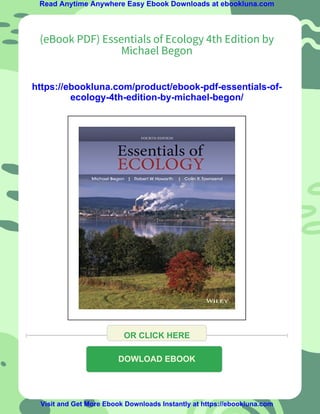
(eBook PDF) Essentials of Ecology 4th Edition by
Michael Begon
https://ebookluna.com/product/ebook-pdf-essentials-of-
ecology-4th-edition-by-michael-begon/
OR CLICK HERE
DOWLOAD EBOOK
Visit and Get More Ebook Downloads Instantly at https://ebookluna.com
2.
Instant digital products(PDF, ePub, MOBI) available
Download now and explore formats that suit you...
(eBook PDF) Ecology 3rd Edition by Michael L. Cain
https://ebookluna.com/product/ebook-pdf-ecology-3rd-edition-by-
michael-l-cain/
ebookluna.com
(eBook PDF) Essentials of Forensic Accounting by Michael
A. Crain
https://ebookluna.com/product/ebook-pdf-essentials-of-forensic-
accounting-by-michael-a-crain/
ebookluna.com
(eBook PDF) Ecology 4th Edition by William D. Bowman
https://ebookluna.com/product/ebook-pdf-ecology-4th-edition-by-
william-d-bowman/
ebookluna.com
Ecology 4th Edition (eBook PDF)
https://ebookluna.com/product/ecology-4th-edition-ebook-pdf/
ebookluna.com
3.
(eBook PDF) RetailingManagement 4th by Michael Levy
https://ebookluna.com/product/ebook-pdf-retailing-management-4th-by-
michael-levy/
ebookluna.com
(eBook PDF) Essentials of Biology 4th Edition by Sylvia
Mader
https://ebookluna.com/product/ebook-pdf-essentials-of-biology-4th-
edition-by-sylvia-mader/
ebookluna.com
(eBook PDF) Essentials of Psychology 4th Edition by
Kenneth S. Bordens
https://ebookluna.com/product/ebook-pdf-essentials-of-psychology-4th-
edition-by-kenneth-s-bordens/
ebookluna.com
(eBook PDF) Essentials of Economics 4th Edition by R.
Glenn Hubbard
https://ebookluna.com/product/ebook-pdf-essentials-of-economics-4th-
edition-by-r-glenn-hubbard/
ebookluna.com
(eBook PDF) Essentials of Economics 4th Edition By R.
Glenn Hubbard
https://ebookluna.com/product/ebook-pdf-essentials-of-economics-4th-
edition-by-r-glenn-hubbard-2/
ebookluna.com
6.
vi
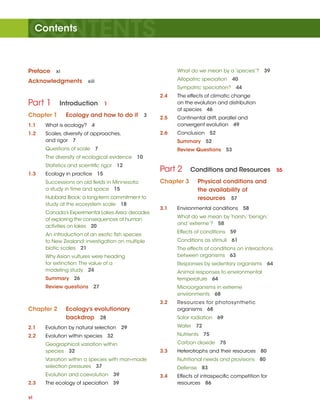
Contents
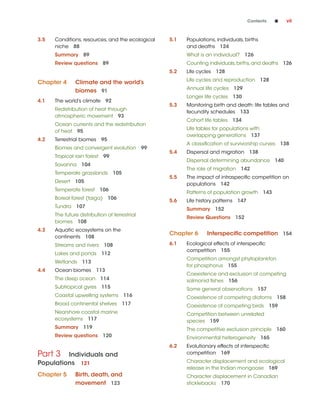
Preface xi
Acknowledgments xiii
Part1 Introduction 1
Chapter 1 Ecology and how to do it 3
1.1 What is ecology? 4
1.2 Scales, diversity of approaches,
and rigor 7
Questions of scale 7
The diversity of ecological evidence 10
Statistics and scientific rigor 12
1.3 Ecology in practice 15
Successions on old fields in Minnesota:
a study in time and space 15
Hubbard Brook: a long-term commitment to
study at the ecosystem scale 18
Canada’s Experimental Lakes Area: decades
of exploring the consequences of human
activities on lakes 20
An introduction of an exotic fish species
to New Zealand: investigation on multiple
biotic scales 21
Why Asian vultures were heading
for extinction:The value of a
modeling study 24
Summary 26
Review questions 27
Chapter 2 Ecology’s evolutionary
backdrop 28
2.1 Evolution by natural selection 29
2.2 Evolution within species 32
Geographical variation within
species 32
Variation within a species with
man-made
selection pressures 37
Evolution and coevolution 39
2.3 The ecology of speciation 39
What do we mean by a ‘species’? 39
Allopatric speciation 40
Sympatric speciation? 44
2.4 The effects of climatic change
on the evolution and distribution
of species 46
2.5 Continental drift, parallel and
convergent evolution 49
2.6 Conclusion 52
Summary 52
Review Questions 53
Part 2 Conditions and Resources 55
Chapter 3 Physical conditions and
the availability of
resources 57
3.1 Environmental conditions 58
What do we mean by ‘harsh,’‘benign,’
and ‘extreme’? 58
Effects of conditions 59
Conditions as stimuli 61
The effects of conditions on interactions
between organisms 63
Responses by sedentary organisms 64
Animal responses to environmental
temperature 64
Microorganisms in extreme
environments 68
3.2 Resources for photosynthetic
organisms 68
Solar radiation 69
Water 72
Nutrients 75
Carbon dioxide 75
3.3 Heterotrophs and their resources 80
Nutritional needs and provisions 80
Defense 83
3.4 Effects of intraspecific competition for
resources 86
7.
Contents ■ vii
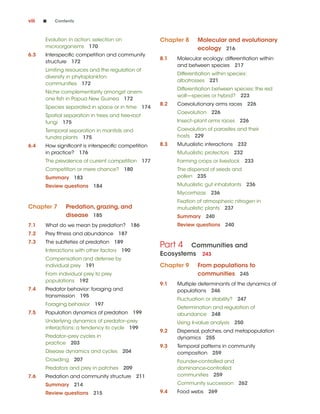
3.5 Conditions,resources, and the ecological
niche 88
Summary 89
Review questions 89
Chapter 4 Climate and the world’s
biomes 91
4.1 The world’s climate 92
Redistribution of heat through
atmospheric movement 93
Ocean currents and the redistribution
of heat 95
4.2 Terrestrial biomes 95
Biomes and convergent evolution 99
Tropical rain forest 99
Savanna 104
Temperate grasslands 105
Desert 105
Temperate forest 106
Boreal forest (taiga) 106
Tundra 107
The future distribution of terrestrial
biomes 108
4.3 Aquatic ecosystems on the
continents 108
Streams and rivers 108
Lakes and ponds 112
Wetlands 113
4.4 Ocean biomes 113
The deep ocean 114
Subtropical gyres 115
Coastal upwelling systems 116
Broad continental shelves 117
Nearshore coastal marine
ecosystems 117
Summary 119
Review questions 120
Part 3 Individuals and
Populations 121
Chapter 5 Birth, death, and
movement 123
5.1 Populations, individuals, births
and deaths 124
What is an individual? 126
Counting individuals,births,and deaths 126
5.2 Life cycles 128
Life cycles and reproduction 128
Annual life cycles 129
Longer life cycles 130
5.3 Monitoring birth and death: life tables and
fecundity schedules 133
Cohort life tables 134
Life tables for populations with
overlapping generations 137
A classification of survivorship curves 138
5.4 Dispersal and migration 138
Dispersal determining abundance 140
The role of migration 142
5.5 The impact of intraspecific competition on
populations 142
Patterns of population growth 143
5.6 Life history patterns 147
Summary 152
Review Questions 152
Chapter 6 Interspecific competition 154
6.1 Ecological effects of interspecific
competition 155
Competition amongst phytoplankton
for phosphorus 155
Coexistence and exclusion of competing
salmonid fishes 156
Some general observations 157
Coexistence of competing diatoms 158
Coexistence of competing birds 159
Competition between unrelated
species 159
The competitive exclusion principle 160
Environmental heterogeneity 165
6.2 Evolutionary effects of interspecific
competition 169
Character displacement and ecological
release in the Indian mongoose 169
Character displacement in Canadian
sticklebacks 170
8.
viii ■ Contents
Evolutionin action: selection on
microorganisms 170
6.3 Interspecific competition and community
structure 172
Limiting resources and the regulation of
diversity in phytoplankton
communities 172
Niche complementarity amongst anem-
one fish in Papua New Guinea 172
Species separated in space or in time 174
Spatial separation in trees and tree-root
fungi 175
Temporal separation in mantids and
tundra plants 175
6.4 How significant is interspecific competition
in practice? 176
The prevalence of current competition 177
Competition or mere chance? 180
Summary 183
Review questions 184
Chapter 7 Predation, grazing, and
disease 185
7.1 What do we mean by predation? 186
7.2 Prey fitness and abundance 187
7.3 The subtleties of predation 189
Interactions with other factors 190
Compensation and defense by
individual prey 191
From individual prey to prey
populations 192
7.4 Predator behavior: foraging and
transmission 195
Foraging behavior 197
7.5 Population dynamics of predation 199
Underlying dynamics of predator–prey
interactions: a tendency to cycle 199
Predator–prey cycles in
practice 203
Disease dynamics and cycles 204
Crowding 207
Predators and prey in patches 209
7.6 Predation and community structure 211
Summary 214
Review questions 215
Chapter 8 Molecular and evolutionary
ecology 216
8.1 Molecular ecology:
differentiation within
and between species 217
Differentiation within species:
albatrosses 221
Differentiation between species: the red
wolf—species or hybrid? 223
8.2 Coevolutionary arms races 226
Coevolution 226
Insect–plant arms races 226
Coevolution of parasites and their
hosts 229
8.3 Mutualistic interactions 232
Mutualistic protectors 232
Farming crops or livestock 233
The dispersal of seeds and
pollen 235
Mutualistic gut inhabitants 236
Mycorrhizas 236
Fixation of atmospheric nitrogen in
mutualistic plants 237
Summary 240
Review questions 240
Part 4 Communities and
Ecosystems 243
Chapter 9 From populations to
communities 245
9.1 Multiple determinants of the dynamics of
populations 246
Fluctuation or stability? 247
Determination and regulation of
abundance 248
Using k-value analysis 250
9.2 Dispersal, patches, and metapopulation
dynamics 255
9.3 Temporal patterns in community
composition 259
Founder-controlled and
dominance-controlled
communities 259
Community succession 262
9.4 Food webs 269
9.
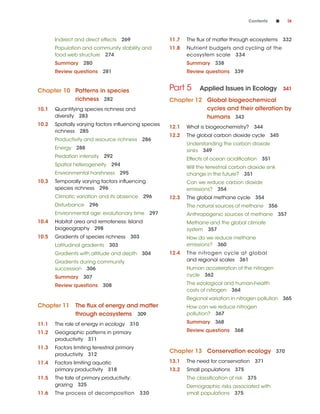
Contents ■ ix
Indirect anddirect effects 269
Population and community stability and
food web structure 274
Summary 280
Review questions 281
Chapter 10 Patterns in species
richness 282
10.1 Quantifying species richness and
diversity 283
10.2 Spatially varying factors influencing species
richness 285
Productivity and resource richness 286
Energy 288
Predation intensity 292
Spatial heterogeneity 294
Environmental harshness 295
10.3 Temporally varying factors influencing
species richness 296
Climatic variation and its absence 296
Disturbance 296
Environmental age: evolutionary time 297
10.4 Habitat area and
remoteness: Island
biogeography 298
10.5 Gradients of species richness 303
Latitudinal gradients 303
Gradients with altitude and depth 304
Gradients during community
succession 306
Summary 307
Review questions 308
Chapter 11 The flux of energy and matter
through ecosystems 309
11.1 The role of energy in ecology 310
11.2 Geographic patterns in
primary
productivity 311
11.3 Factors limiting
terrestrial primary
productivity 312
11.4 Factors limiting aquatic
primary productivity 318
11.5 The fate of primary
productivity:
grazing 325
11.6 The process of decomposition 330
11.7 The flux of matter through ecosystems 332
11.8 Nutrient budgets and cycling at the
ecosystem scale 334
Summary 338
Review questions 339
Part 5 Applied Issues in Ecology 341
Chapter 12 Global biogeochemical
cycles and their alteration by
humans 343
12.1 What is biogeochemistry? 344
12.2 The global carbon dioxide cycle 345
Understanding the carbon dioxide
sinks 349
Effects of ocean acidification 351
Will the terrestrial carbon dioxide sink
change in the future? 351
Can we reduce carbon dioxide
emissions? 354
12.3 The global methane cycle 354
The natural sources of methane 356
Anthropogenic sources of methane 357
Methane and the global climate
system 357
How do we reduce methane
emissions? 360
12.4 The nitrogen cycle at global
and regional scales 361
Human acceleration of the nitrogen
cycle 362
The ecological and human-health
costs of nitrogen 364
Regional variation in nitrogen pollution 365
How can we reduce nitrogen
pollution? 367
Summary 368
Review questions 368
Chapter 13 Conservation ecology 370
13.1 The need for conservation 371
13.2 Small populations 375
The classification of risk 375
Demographic risks associated with
small populations 375
10.
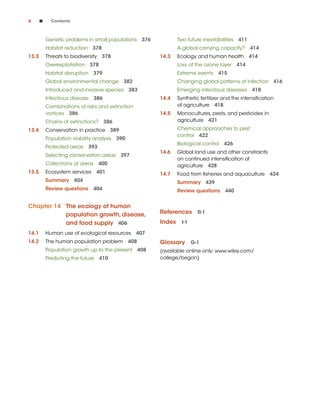
x ■ Contents
Geneticproblems in small populations 376
Habitat reduction 378
13.3 Threats to biodiversity 378
Overexploitation 378
Habitat disruption 379
Global environmental change 382
Introduced and invasive species 383
Infectious disease 386
Combinations of risks and extinction
vortices 386
Chains of extinctions? 386
13.4 Conservation in practice 389
Population viability analysis 390
Protected areas 393
Selecting conservation areas 397
Collections of areas 400
13.5 Ecosystem services 401
Summary 404
Review questions 404
Chapter 14 The ecology of human
population growth, disease,
and food supply 406
14.1 Human use of ecological resources 407
14.2 The human population problem 408
Population growth up to the present 408
Predicting the future 410
Two future inevitabilities 411
A global carrying capacity? 414
14.3 Ecology and human health 414
Loss of the ozone layer 414
Extreme events 415
Changing global patterns of infection 416
Emerging infectious diseases 418
14.4 Synthetic fertilizer and the intensification
of agriculture 418
14.5 Monocultures, pests, and pesticides in
agriculture 421
Chemical approaches to pest
control 422
Biological control 426
14.6 Global land use and other constraints
on
continued intensification of
agriculture 428
14.7 Food from fisheries and aquaculture 434
Summary 439
Review questions 440
References R-1
Index I-1
Glossary G-1
(available online only: www.wiley.com/
college/begon)
11.
xi
By writing thisbook we hope to share with you some
of our wonder at the complexity of nature, but we must
all also be aware that there is a darker side: the fear
that we are destroying our natural environments and
the services they provide. All of us need to be ecologi-
cally literate so that we can take part in political debate
and contribute to solving the ecological problems that
we carry with us in this new millennium. We hope our
book will contribute to this objective.
The genesis of this book can be found in the
more comprehensive treatment of ecology in our big
book Ecology: from Individuals to Ecosystems (Begon,
Townsend Harper, 4th edn, 2006). This is used as an
advanced university text around the world, but many of
our colleagues have called for a more succinct treatment
of the essence of the subject.Thus, we were spurred into
action to produce a distinctively different book, writ-
ten with clear objectives for a different audience—those
taking a semester-long beginners course in the essentials
of ecology. We hope that at least some readers will be
excited enough to go on to sample the big book and the
rich literature of ecology that it can lead into.
In this fourth edition of Essentials of Ecology
we have continued to make the text, including math-
ematical topics, accessible while updating the material
and expanding our coverage of ecosystem science and
biogeochemistry. The fourth edition extensively cov-
ers both terrestrial and aquatic ecology, and we have
strived to demonstrate how ecological principles apply
equally to both types of environments. While we have
expanded coverage on some topic areas in the fourth
edition, we worked hard to not expand the size of the
book. We want this text to be a readily accessible read.
Ecology is a vibrant subject and this is reflected
by our inclusion of literally hundreds of new studies.
Some readers will be engaged most by the fundamen-
tal principles of how ecological systems work. Others
will be impatient to focus on the ecological problems
caused by human activities. We place heavy emphasis
on both fundamental and applied aspects of ecology:
there is no clear boundary between the two. However,
we have chosen to deal first in a systematic way with
the fundamental side of the subject, and we have done
this for a particular reason. An understanding of the
scope of the problems facing us (the unsustainable
use of ecological resources, pollution, extinctions and
the erosion of natural biodiversity) and the means to
counter and solve these problems depend absolutely on
a proper grasp of ecological fundamentals.
The book is divided into five sections. In the
introduction we deal with two foundations for the sub-
ject that are often neglected in texts. Chapter 1 aims to
show not only what ecology is but also how ecologists
do it—how ecological understanding is achieved, what
we understand (and, just as important, what we do not
yet understand) and how our understanding helps us
predict and manage. We then introduce ‘Ecology’s evo-
lutionary backdrop’ and show that ecologists need a
full understanding of the evolutionary biologist’s disci-
pline in order to make sense of patterns and processes
in nature (Chapter 2).
What makes an environment habitable for par-
ticular species is that they can tolerate the physico-
chemical conditions there and find in it their essential
resources. In the second section we deal with condi-
tions and resources, both as they influence individual
species (Chapter 3) and in terms of their consequences
for the composition and distribution of multispecies
communities and ecosystems, for example in deserts,
rain forests, rivers, lakes and oceans (Chapter 4).
The third section (Chapters 5–8) deals system-
atically with the ecology of individual organisms
and populations, with chapters on ‘birth, death and
movement’ (Chapter 5), ‘interspecific competition’
(Chapter 6), and ‘predation, grazing, and disease’
(Chapter 7). This section also includes a chapter on
‘Molecular and evolutionary ecology’, added origi-
nally in the third edition and responding to the feelings
of some readers that, although evolutionary ideas per-
vade the book, there was still not sufficient evolution
for a book at this level.
In the fourth section (Chapters 9–11), we move
up the hierarchical scale of ecology to consider commu-
nities consisting of many populations, and ecosystems,
where we focus on the fluxes of energy and matter
between and within systems.
Finally, armed with knowledge and understand-
ing of the fundamentals, the book turns to the appli-
cation of ecological science to some of the major
environmental challenges of our time. Our goal in
these final chapters is not to provide encyclopedic
coverage to these environmental problems, but rather
to illustrate how ecology contributes to understand-
ing the problems, and can potentially help with their
Preface
12.
xii ■ Preface
solution.In Chapter 12, we focus on global biogeo-
chemical cycles, such as the global carbon dioxide
cycle and how this has been dramatically changed
by burning fossil fuels and other human activities.
In ‘conservation ecology’ (Chapter 13), we develop
an armory of approaches that may help us to save
endangered species from extinction and conserve
some of the biodiversity of nature for our descendants.
The final chapter, ‘the ecology of human population
growth, disease, and food supply,’ takes an ecological
approach to examining the issues of the population
problem, of human health, and of the sustainability of
agriculture and fisheries.
A number of pedagogical features have been
included to help you.
• Each chapter begins with a set of key concepts that
you should understand before proceeding to the
next chapter.
• Marginal headings provide signposts of where you
are on your journey through each chapter—these
will also be useful revision aids.
• Each chapter concludes with a summary and a set
of review questions, some of which are designated
challenge questions.
• You will also find three categories of boxed text:
• ‘Historical landmarks’ boxes emphasize some
landmarks in the development of ecology.
• ‘Quantitative aspects’ boxes set aside mathemati-
cal and quantitative aspects of ecology so they do
not unduly interfere with the flow of the text and
so you can consider them at leisure.
• ‘ECOncerns’ boxes highlight some of the applied
problems in ecology, particularly those where there
is a social or political dimension (as there often is).In
these,you will be challenged to consider some ethical
questions related to the knowledge you are gaining.
An important further feature of the book is the
companion web site, accessed through Wiley at www
.wiley.com/college/begon. This provides an easy-to-use
range of resources to aid study and enhance the content of
the book. Features include self-assessment multiple choice
questions for each chapter in the book, an interactive
tutorial to help students to understand the use of math-
ematical modeling in ecology, and high-quality images of
the figures in the book that teachers can use in preparing
their lectures or lessons, as well as access to a Glossary
of terms for use with this book and for ecology generally.
13.
xiii
It is apleasure to record our gratitude to the people
who helped with the planning and writing of this
book. Going back to the first edition, we thank Bob
Campbell and Simon Rallison for getting the origi-
nal enterprise off the ground and Nancy Whilton
and Irene Herlihy for ably managing the project; and
for the second edition, Nathan Brown (Blackwell,
US) and Rosie Hayden (Blackwell, UK) for making
it so easy for us to take this book from manuscript
into print. For the third edition, we especially thank
Nancy Whilton and Elizabeth Frank in Boston for
persuading us to pick up our pens again (not liter-
ally) and Rosie Hayden, again, and Jane Andrew and
Ward Cooper for seeing us through production. For
this fourth edition, we thank Rachel Falk (Wiley,
USA) for getting the ball rolling and for bringing
in one of us (RWH) as a new author, Elisa Adams
for her superb assistance with text editing, Chloe
Moffett, Elizabeth Baird, MaryAnn Price and Lisa
Torri (Precision Graphics) for their excellent over-
seeing of the final production, and the entire Wiley
team for their dedicated efforts and cheerful “can-
do” attitude.
We note with sadness the passing in 2009 of
our long-time mentor and collaborator John Harper,
author on the first three editions of this book. We owe
him a special debt of gratitude that extends far beyond
the past co-authorship of this book into all aspects of
our lives as ecologists. He is sorely missed.
Colin Townsend, the lead author on the first three
editions of Essentials of Ecology, has stepped from
the treadmill of revisions and let us take the lead on
this fourth edition. His imprint on the book remains
strong, and we gratefully acknowledge his tremendous
contribution to the series.
We are also grateful to the following colleagues
who provided insightful reviews of early drafts of
one or more chapters in this or earlier editions, or
who gave us important advice and leads: William
Ambrose (Bates College), Vickie Backus (Middlebury
College), James Cahill (University of Alberta), Liane
Cochrane-Stafira (Saint Xavier University), Mark Davis
(Macalester College), Tim Crews (The Land Institute),
Kevin Dixon (Arizona State University, West), Stephen
Ellner (Cornell University), Alex Flecker (Cornell
University), Bruce Grant (Widener University), Christy
Goodale (Cornell University), Don Hall (Michigan
State University), Jenny Hodgson, Greg Hurst (both
University of Liverpool),William Kirk (Keele University,
UK), Hans deKroon (University of Nijmegen), Zen
Lewis (University of Liverpool), Sara Lindsay (Scripps
Institute of Oceanography), James Maki (Marquette
University), George Middendorf (Howard Univer
sity), Paul Mitchell (Staffordshire University, UK),
Tim Mousseau (University of South Carolina), Katie
O’Reilly (University of Portland), Clayton Penniman
(Central Connecticut State University), Tom Price
(Univeristy of Liverpool), Jed Sparks (Cornell Univer
sity), Catherine Toft (UC Davis), David Tonkyn
(Clemson University), Saran Twombly (University of
Rhode Island), Jake Weltzin (University of Tennessee at
Knoxville), and Alan Wilmot (University of Derby, UK).
Last, and perhaps most, we are glad to thank our
wives and families for continuing to support us, listen
to us, and ignore us, precisely as required—thanks to
Linda, and to Roxanne and Marina.
Acknowledgments
Michael Begon, Liverpool, UK and
Robert Howarth, Ithaca, NY USA
4 ■ Part1 Introduction
1.1 WHAT IS ECOLOGY?
We could answer the question ‘What is ecology?’ by
examining various definitions that
have been proposed and choosing
one as the best (Box 1.1). But while
definitions have conciseness and precision, and they
the earliest
ecologists
E
cology today is a subject about which almost everyone has heard and most
people consider to be important—even when they are unsure about the
exact meaning of the term. There can be no doubt that it is important,but this
makes it all the more critical that we understand what ecology is and how to do it.
are good at preparing you for an examination, they are
not so good at capturing the flavor and excitement of
ecology. There is a lot to be gained by replacing that
single question about a definition with a series of more
provocative ones: ‘What do ecologists do?’ ‘What are
ecologists interested in?’ and ‘Where did ecology
emerge from in the first place?’
1.1
Definitions of ecology
Ecology (originally in German, Öekologie) was first defined in 1866 by Ernst Haeckel, an enthusiastic and
influential disciple of Charles Darwin.To him, ecology was ‘the comprehensive science of the relationship
of the organism to the environment.’ The spirit of this definition is very clear in an early discussion of bio-
logical subdisciplines by Burdon-Sanderson (1893),in which ecology is‘the science which concerns itself
with the external relations of plants and animals to each other and to the past and present conditions of
their existence,’to be contrasted with physiology (internal relations) and morphology (structure).
In the years after Haeckel,plant ecology and animal ecology drifted apart.Influential works defined
ecology as ‘those relations of plants, with their surroundings and with one another, which depend directly
upon differences of habitat among plants’ (Tansley, 1904), or as the science ‘chiefly concerned with what
may be called the sociology and economics of animals, rather than with the structural and other adapta-
tions possessed by them’(Elton,1927).The plant ecologists and animal ecologist,though,have long since
agreed that they belong together, and more recent definitions of ecology include all organisms, including
bacteria, archaea, algae, and fungi in addition to plants and animals. Most modern definitions stress the
relationships between and among organisms.For example,two textbooks from the 1970s defined ecology
as ‘the study of the natural environment, particularly the interrelationships between organisms and their
surroundings’(Ricklefs,1973) and as‘the scientific study of the interactions that determine the distribution
and abundance of organisms’(Krebs,1972).
Ecology certainly includes the investigation of organisms and their interactions,but to many ecolo-
gists,definitions that focus only on these interactions and on the distribution and abundance of organisms
are too narrow. Ecologists also examine the interaction between life and the physical environment, for
instance studying how organisms affect material fluxes in nature.The sequestration of carbon dioxide by a
forest would be one example of this.Beginning in the mid-20th century,the American ecologist E.P.Odum
(1953) pushed for a broader definition of ecology:‘the study of the structure and function of nature,which
Historical Landmarks
20.
Ecology and howto do it Chapter 1 ■ 5
Ecology can lay claim to being the oldest science,
as the most primitive humans must have been ecolo-
gists of sorts, driven by the need to understand where
and when their food and their (nonhuman) enemies
were to be found. The earliest agriculturalists needed to
be even more sophisticated, with knowledge of how
to manage their domesticated sources of food. These
early ecologists, then, were applied ecologists, seeking
to understand the distribution, abundance, and produc-
tivity of organisms in order to apply that knowledge for
their own benefit. Applied ecologists today still have
many of the same interests: how to optimize the rate at
which food is collected from natural environments in a
sustainable way; how domesticated plants and animals
can best be managed so as to maximize rates of return;
how food organisms can be protected from their own
natural enemies; and how to control the populations of
pathogens and parasites that live on us.
In the last century or so, how-
ever, since ecologists have been
self-conscious enough to give them-
selves a name, ecology has consistently covered not
only applied but also fundamental, ‘pure’ science.
A.G.Tansley was one of the founding fathers of ecology.
He was concerned especially to understand, for under-
standing’s sake, the processes responsible for determin-
ing the structure and composition of different plant
communities. When, in 1904, he wrote from Britain
about ‘The problems of ecology’ he was particularly
worried by a tendency for too much ecology to remain
at the descriptive and unsystematic stage (such as accu-
mulating descriptions of communities without know-
ing whether they were typical, temporary, or whatever),
too rarely moving on to experimental or systematically
planned, or what we might call a scientific analysis.
Tansley’s worries were echoed in the United States
by another of ecology’s founders, F. E. Clements, who in
1905 in his Research Methods in Ecology complained:
The bane of the recent development popularly
known as ecology has been a widespread feeling
that anyone can do ecological work, regardless of
a pure and applied
science
preparation. There is nothing . . . more erroneous
than this feeling.
On the other hand, the need for applied ecology
to be based on its pure counterpart was clear in the
introduction to Charles Elton’s (1927) Animal Ecology
(Figure 1.1):
Ecology is destined for a great future . . . The
tropical entomologist or mycologist or weed-
controller will only be fulfilling his functions
properly if he is first and foremost an ecologist.
In the intervening years, the coexistence of these
pure and applied threads has been maintained and
built upon. Many applied sciences such as forestry,
agronomy, and fisheries biology have contributed to
the development of ecology and have seen their own
includes the living world.’Many have thought this definition overly broad,as geologists and meteorologists
also study aspects of the structure and function of nature. In 1992, G. E. Likens stressed the need for the
definition of ecology to include ‘the interactions between organisms and the transformation and flux of
energy and matter.’We agree,and in this text define ecology as:
the scientific study of the distribution and abundance of organisms,the interactions that determine
that distribution and abundance, and the relationships between organisms and the transformation
and flux of energy and matter.
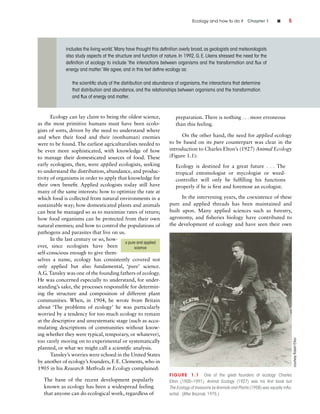
courtesy
Robert
Elton
FIGURE 1.1 One of the great founders of ecology: Charles
Elton (1900–1991). Animal Ecology (1927) was his first book but
The Ecology of Invasions by Animals and Plants (1958) was equally influ-
ential. (After Breznak,1975.)
245
246
John answered quickly,“I should like to be the Black
Ghost.”
Prince Conrad laughed at that, appreciatively. “Ah,” he
said, “but unfortunately you ’ave been misinformed.
That post is not open.”
“Neither,” John said pointedly, “is the throne of Alaria.”
Conrad laughed again. “Under similar circumstances, I
wish you all success—” he said, and would have said
more except that John broke into his speech.
“Good-bye to your Majesties,” he cried, and started for
the door, dragging me with him. We were through it
before I caught my breath.
“You’ll tear my sleeve off,” I protested. “Don’t slam that
door, this is a palace. What’s the matter, anyway? Where
are you going?”
“You don’t know where we’re going?” John laughed. “I
can’t drive a car with this arm.” He was piloting me
down long corridors and back and forth among servants
and guards who stared but did not interfere. “We’re
going to Katerina, of course, and you have to do the
driving. Come along.”
“Her father was right there,” I said, “and you ran off
without saying good-bye to him.”
“If I’m successful,” he grinned, “I’ll have plenty of time
to talk to him, and if I’m not it doesn’t matter. Anyway,
it would have been lèse majesté to stay there any
longer. Even you should have seen that.” We rushed
down more corridors, and then, just outside, we found
23.
247
the car standingin a row of others. John greeted it with
a low whoop of triumph.
“Step into it, old man, and step on it,” he urged. “Let’s
get there before it’s too late to make a call on a lady.”
And so, for the third time in three days we drove rather
wildly over the road between Herrovosca and the Pass. I
recognised as we saw them again, a hundred
unconsidered landmarks, a house of a deep pink, with
white-flowering vines growing over it, a pair of light bay
horses in a field, twin poplars beside a brook, long
strings of mushrooms and garlics hanging at the
windows of the peasants’ cottages, and always, across
the wide, fertile valley, the towering, dark jagged
mountains of the frontier, rocky, barren on their upper
surfaces, orange where the sun fell on them.
“Don’t drive like the tortoise,” John urged. “I’ve always
wanted to swashbuckle, and now is my chance. Step on
it.”
I stepped, and the little familiar landmarks hurtled by.
We thundered around corners, and past crossroads, and
the Providence that keeps watch over fools and lovers
protected us, so that presently we saw the customs
house, and turned off to the right, down the long, rutty
road that leads to Visichich manor.
“It’s only this morning we left here,” I reminisced. The
road was worse than I remembered, but it wasn’t
stopping us much.
“Honk the horn,” John ordered. “I think it is just over
that hill.”
24.
248
I honked thehorn, loud and long, and as I came in
sight of the manor wall, the gate opened to us.
“That’s an omen,” I said, and drove under the arch, and
up to the door of the old house. I was pretty much
excited myself, anticipating a warm welcome and all the
little pleasant attentions I had missed the last three
days.
It was a very old and beautiful stone doorway, and the
carving of the oak door was worn with long use. It
opened to us as we approached, and there stood
Katerina on the threshold, in her green velvet gown,
smiling ecstatically, her hair shining against the light like
an aureole, her eyes bright with pleasure.
“I rub my magic lamp and you appear,” said John.
“They signalled to me from the customs house,” she
answered. “I knew you must be coming here. Did you
forget something?”
He jumped out of the car, and caught her hand. “Never,”
he promised. “I couldn’t do that.”
Her voice trembled happily as she answered, “do you
know, I rather thought you would come?”
“You asked me in Vorgo,” he smiled. “You said the
affairs of this country might become mine if I chose. I
have chosen. That’s why I went away from here, and
why I came back.”
“The best of reasons,” she answered, teasingly,
“patriotism! But are you always so sudden in your
entrances and your exits?”
25.
249
“I’m too entrancedever to make another exit,” he said,
and together they went into the old house.
I muttered something about putting the car in the
garage, but there was no one to pay any attention to
me, so I stayed where I was.
I didn’t want to get out of the car without a shoe.
I had taken three days’ leave of my senses, and all it
had gotten me was a hole in my sock.
But of course with John it was different.
26.
Transcriber’s Notes
Copyright noticeprovided as in the original—this e-text
is public domain in the country of publication.
Silently corrected palpable typos; left non-standard
spellings and dialect unchanged.
In the text versions, delimited italics text in
_underscores_ (the HTML version reproduces the font
form of the printed book.)
27.
*** END OFTHE PROJECT GUTENBERG EBOOK THE BLACK GHOST
OF THE HIGHWAY ***
Updated editions will replace the previous one—the old editions will
be renamed.
Creating the works from print editions not protected by U.S.
copyright law means that no one owns a United States copyright in
these works, so the Foundation (and you!) can copy and distribute it
in the United States without permission and without paying
copyright royalties. Special rules, set forth in the General Terms of
Use part of this license, apply to copying and distributing Project
Gutenberg™ electronic works to protect the PROJECT GUTENBERG™
concept and trademark. Project Gutenberg is a registered trademark,
and may not be used if you charge for an eBook, except by following
the terms of the trademark license, including paying royalties for use
of the Project Gutenberg trademark. If you do not charge anything
for copies of this eBook, complying with the trademark license is
very easy. You may use this eBook for nearly any purpose such as
creation of derivative works, reports, performances and research.
Project Gutenberg eBooks may be modified and printed and given
away—you may do practically ANYTHING in the United States with
eBooks not protected by U.S. copyright law. Redistribution is subject
to the trademark license, especially commercial redistribution.
START: FULL LICENSE
PLEASE READ THISBEFORE YOU DISTRIBUTE OR USE THIS WORK
To protect the Project Gutenberg™ mission of promoting the free
distribution of electronic works, by using or distributing this work (or
any other work associated in any way with the phrase “Project
Gutenberg”), you agree to comply with all the terms of the Full
Project Gutenberg™ License available with this file or online at
www.gutenberg.org/license.
Section 1. General Terms of Use and
Redistributing Project Gutenberg™
electronic works
1.A. By reading or using any part of this Project Gutenberg™
electronic work, you indicate that you have read, understand, agree
to and accept all the terms of this license and intellectual property
(trademark/copyright) agreement. If you do not agree to abide by all
the terms of this agreement, you must cease using and return or
destroy all copies of Project Gutenberg™ electronic works in your
possession. If you paid a fee for obtaining a copy of or access to a
Project Gutenberg™ electronic work and you do not agree to be
bound by the terms of this agreement, you may obtain a refund
from the person or entity to whom you paid the fee as set forth in
paragraph 1.E.8.
1.B. “Project Gutenberg” is a registered trademark. It may only be
used on or associated in any way with an electronic work by people
who agree to be bound by the terms of this agreement. There are a
few things that you can do with most Project Gutenberg™ electronic
works even without complying with the full terms of this agreement.
See paragraph 1.C below. There are a lot of things you can do with
Project Gutenberg™ electronic works if you follow the terms of this
agreement and help preserve free future access to Project
Gutenberg™ electronic works. See paragraph 1.E below.
30.
1.C. The ProjectGutenberg Literary Archive Foundation (“the
Foundation” or PGLAF), owns a compilation copyright in the
collection of Project Gutenberg™ electronic works. Nearly all the
individual works in the collection are in the public domain in the
United States. If an individual work is unprotected by copyright law
in the United States and you are located in the United States, we do
not claim a right to prevent you from copying, distributing,
performing, displaying or creating derivative works based on the
work as long as all references to Project Gutenberg are removed. Of
course, we hope that you will support the Project Gutenberg™
mission of promoting free access to electronic works by freely
sharing Project Gutenberg™ works in compliance with the terms of
this agreement for keeping the Project Gutenberg™ name associated
with the work. You can easily comply with the terms of this
agreement by keeping this work in the same format with its attached
full Project Gutenberg™ License when you share it without charge
with others.
1.D. The copyright laws of the place where you are located also
govern what you can do with this work. Copyright laws in most
countries are in a constant state of change. If you are outside the
United States, check the laws of your country in addition to the
terms of this agreement before downloading, copying, displaying,
performing, distributing or creating derivative works based on this
work or any other Project Gutenberg™ work. The Foundation makes
no representations concerning the copyright status of any work in
any country other than the United States.
1.E. Unless you have removed all references to Project Gutenberg:
1.E.1. The following sentence, with active links to, or other
immediate access to, the full Project Gutenberg™ License must
appear prominently whenever any copy of a Project Gutenberg™
work (any work on which the phrase “Project Gutenberg” appears,
or with which the phrase “Project Gutenberg” is associated) is
accessed, displayed, performed, viewed, copied or distributed:
31.
This eBook isfor the use of anyone anywhere in
the United States and most other parts of the world
at no cost and with almost no restrictions
whatsoever. You may copy it, give it away or re-use
it under the terms of the Project Gutenberg License
included with this eBook or online at
www.gutenberg.org. If you are not located in the
United States, you will have to check the laws of
the country where you are located before using this
eBook.
1.E.2. If an individual Project Gutenberg™ electronic work is derived
from texts not protected by U.S. copyright law (does not contain a
notice indicating that it is posted with permission of the copyright
holder), the work can be copied and distributed to anyone in the
United States without paying any fees or charges. If you are
redistributing or providing access to a work with the phrase “Project
Gutenberg” associated with or appearing on the work, you must
comply either with the requirements of paragraphs 1.E.1 through
1.E.7 or obtain permission for the use of the work and the Project
Gutenberg™ trademark as set forth in paragraphs 1.E.8 or 1.E.9.
1.E.3. If an individual Project Gutenberg™ electronic work is posted
with the permission of the copyright holder, your use and distribution
must comply with both paragraphs 1.E.1 through 1.E.7 and any
additional terms imposed by the copyright holder. Additional terms
will be linked to the Project Gutenberg™ License for all works posted
with the permission of the copyright holder found at the beginning
of this work.
1.E.4. Do not unlink or detach or remove the full Project
Gutenberg™ License terms from this work, or any files containing a
part of this work or any other work associated with Project
Gutenberg™.
32.
1.E.5. Do notcopy, display, perform, distribute or redistribute this
electronic work, or any part of this electronic work, without
prominently displaying the sentence set forth in paragraph 1.E.1
with active links or immediate access to the full terms of the Project
Gutenberg™ License.
1.E.6. You may convert to and distribute this work in any binary,
compressed, marked up, nonproprietary or proprietary form,
including any word processing or hypertext form. However, if you
provide access to or distribute copies of a Project Gutenberg™ work
in a format other than “Plain Vanilla ASCII” or other format used in
the official version posted on the official Project Gutenberg™ website
(www.gutenberg.org), you must, at no additional cost, fee or
expense to the user, provide a copy, a means of exporting a copy, or
a means of obtaining a copy upon request, of the work in its original
“Plain Vanilla ASCII” or other form. Any alternate format must
include the full Project Gutenberg™ License as specified in
paragraph 1.E.1.
1.E.7. Do not charge a fee for access to, viewing, displaying,
performing, copying or distributing any Project Gutenberg™ works
unless you comply with paragraph 1.E.8 or 1.E.9.
1.E.8. You may charge a reasonable fee for copies of or providing
access to or distributing Project Gutenberg™ electronic works
provided that:
• You pay a royalty fee of 20% of the gross profits you
derive from the use of Project Gutenberg™ works
calculated using the method you already use to
calculate your applicable taxes. The fee is owed to the
owner of the Project Gutenberg™ trademark, but he has
agreed to donate royalties under this paragraph to the
Project Gutenberg Literary Archive Foundation. Royalty
payments must be paid within 60 days following each
date on which you prepare (or are legally required to
33.
prepare) your periodictax returns. Royalty payments
should be clearly marked as such and sent to the
Project Gutenberg Literary Archive Foundation at the
address specified in Section 4, “Information about
donations to the Project Gutenberg Literary Archive
Foundation.”
• You provide a full refund of any money paid by a user
who notifies you in writing (or by e-mail) within 30 days
of receipt that s/he does not agree to the terms of the
full Project Gutenberg™ License. You must require such
a user to return or destroy all copies of the works
possessed in a physical medium and discontinue all use
of and all access to other copies of Project Gutenberg™
works.
• You provide, in accordance with paragraph 1.F.3, a full
refund of any money paid for a work or a replacement
copy, if a defect in the electronic work is discovered and
reported to you within 90 days of receipt of the work.
• You comply with all other terms of this agreement for
free distribution of Project Gutenberg™ works.
1.E.9. If you wish to charge a fee or distribute a Project Gutenberg™
electronic work or group of works on different terms than are set
forth in this agreement, you must obtain permission in writing from
the Project Gutenberg Literary Archive Foundation, the manager of
the Project Gutenberg™ trademark. Contact the Foundation as set
forth in Section 3 below.
1.F.
1.F.1. Project Gutenberg volunteers and employees expend
considerable effort to identify, do copyright research on, transcribe
and proofread works not protected by U.S. copyright law in creating
the Project Gutenberg™ collection. Despite these efforts, Project
34.
Gutenberg™ electronic works,and the medium on which they may
be stored, may contain “Defects,” such as, but not limited to,
incomplete, inaccurate or corrupt data, transcription errors, a
copyright or other intellectual property infringement, a defective or
damaged disk or other medium, a computer virus, or computer
codes that damage or cannot be read by your equipment.
1.F.2. LIMITED WARRANTY, DISCLAIMER OF DAMAGES - Except for
the “Right of Replacement or Refund” described in paragraph 1.F.3,
the Project Gutenberg Literary Archive Foundation, the owner of the
Project Gutenberg™ trademark, and any other party distributing a
Project Gutenberg™ electronic work under this agreement, disclaim
all liability to you for damages, costs and expenses, including legal
fees. YOU AGREE THAT YOU HAVE NO REMEDIES FOR
NEGLIGENCE, STRICT LIABILITY, BREACH OF WARRANTY OR
BREACH OF CONTRACT EXCEPT THOSE PROVIDED IN PARAGRAPH
1.F.3. YOU AGREE THAT THE FOUNDATION, THE TRADEMARK
OWNER, AND ANY DISTRIBUTOR UNDER THIS AGREEMENT WILL
NOT BE LIABLE TO YOU FOR ACTUAL, DIRECT, INDIRECT,
CONSEQUENTIAL, PUNITIVE OR INCIDENTAL DAMAGES EVEN IF
YOU GIVE NOTICE OF THE POSSIBILITY OF SUCH DAMAGE.
1.F.3. LIMITED RIGHT OF REPLACEMENT OR REFUND - If you
discover a defect in this electronic work within 90 days of receiving
it, you can receive a refund of the money (if any) you paid for it by
sending a written explanation to the person you received the work
from. If you received the work on a physical medium, you must
return the medium with your written explanation. The person or
entity that provided you with the defective work may elect to provide
a replacement copy in lieu of a refund. If you received the work
electronically, the person or entity providing it to you may choose to
give you a second opportunity to receive the work electronically in
lieu of a refund. If the second copy is also defective, you may
demand a refund in writing without further opportunities to fix the
problem.
35.
1.F.4. Except forthe limited right of replacement or refund set forth
in paragraph 1.F.3, this work is provided to you ‘AS-IS’, WITH NO
OTHER WARRANTIES OF ANY KIND, EXPRESS OR IMPLIED,
INCLUDING BUT NOT LIMITED TO WARRANTIES OF
MERCHANTABILITY OR FITNESS FOR ANY PURPOSE.
1.F.5. Some states do not allow disclaimers of certain implied
warranties or the exclusion or limitation of certain types of damages.
If any disclaimer or limitation set forth in this agreement violates the
law of the state applicable to this agreement, the agreement shall be
interpreted to make the maximum disclaimer or limitation permitted
by the applicable state law. The invalidity or unenforceability of any
provision of this agreement shall not void the remaining provisions.
1.F.6. INDEMNITY - You agree to indemnify and hold the Foundation,
the trademark owner, any agent or employee of the Foundation,
anyone providing copies of Project Gutenberg™ electronic works in
accordance with this agreement, and any volunteers associated with
the production, promotion and distribution of Project Gutenberg™
electronic works, harmless from all liability, costs and expenses,
including legal fees, that arise directly or indirectly from any of the
following which you do or cause to occur: (a) distribution of this or
any Project Gutenberg™ work, (b) alteration, modification, or
additions or deletions to any Project Gutenberg™ work, and (c) any
Defect you cause.
Section 2. Information about the Mission
of Project Gutenberg™
Project Gutenberg™ is synonymous with the free distribution of
electronic works in formats readable by the widest variety of
computers including obsolete, old, middle-aged and new computers.
It exists because of the efforts of hundreds of volunteers and
donations from people in all walks of life.
36.
Volunteers and financialsupport to provide volunteers with the
assistance they need are critical to reaching Project Gutenberg™’s
goals and ensuring that the Project Gutenberg™ collection will
remain freely available for generations to come. In 2001, the Project
Gutenberg Literary Archive Foundation was created to provide a
secure and permanent future for Project Gutenberg™ and future
generations. To learn more about the Project Gutenberg Literary
Archive Foundation and how your efforts and donations can help,
see Sections 3 and 4 and the Foundation information page at
www.gutenberg.org.
Section 3. Information about the Project
Gutenberg Literary Archive Foundation
The Project Gutenberg Literary Archive Foundation is a non-profit
501(c)(3) educational corporation organized under the laws of the
state of Mississippi and granted tax exempt status by the Internal
Revenue Service. The Foundation’s EIN or federal tax identification
number is 64-6221541. Contributions to the Project Gutenberg
Literary Archive Foundation are tax deductible to the full extent
permitted by U.S. federal laws and your state’s laws.
The Foundation’s business office is located at 809 North 1500 West,
Salt Lake City, UT 84116, (801) 596-1887. Email contact links and up
to date contact information can be found at the Foundation’s website
and official page at www.gutenberg.org/contact
Section 4. Information about Donations to
the Project Gutenberg Literary Archive
Foundation
Project Gutenberg™ depends upon and cannot survive without
widespread public support and donations to carry out its mission of
increasing the number of public domain and licensed works that can
37.
be freely distributedin machine-readable form accessible by the
widest array of equipment including outdated equipment. Many
small donations ($1 to $5,000) are particularly important to
maintaining tax exempt status with the IRS.
The Foundation is committed to complying with the laws regulating
charities and charitable donations in all 50 states of the United
States. Compliance requirements are not uniform and it takes a
considerable effort, much paperwork and many fees to meet and
keep up with these requirements. We do not solicit donations in
locations where we have not received written confirmation of
compliance. To SEND DONATIONS or determine the status of
compliance for any particular state visit www.gutenberg.org/donate.
While we cannot and do not solicit contributions from states where
we have not met the solicitation requirements, we know of no
prohibition against accepting unsolicited donations from donors in
such states who approach us with offers to donate.
International donations are gratefully accepted, but we cannot make
any statements concerning tax treatment of donations received from
outside the United States. U.S. laws alone swamp our small staff.
Please check the Project Gutenberg web pages for current donation
methods and addresses. Donations are accepted in a number of
other ways including checks, online payments and credit card
donations. To donate, please visit: www.gutenberg.org/donate.
Section 5. General Information About
Project Gutenberg™ electronic works
Professor Michael S. Hart was the originator of the Project
Gutenberg™ concept of a library of electronic works that could be
freely shared with anyone. For forty years, he produced and
38.
distributed Project Gutenberg™eBooks with only a loose network of
volunteer support.
Project Gutenberg™ eBooks are often created from several printed
editions, all of which are confirmed as not protected by copyright in
the U.S. unless a copyright notice is included. Thus, we do not
necessarily keep eBooks in compliance with any particular paper
edition.
Most people start at our website which has the main PG search
facility: www.gutenberg.org.
This website includes information about Project Gutenberg™,
including how to make donations to the Project Gutenberg Literary
Archive Foundation, how to help produce our new eBooks, and how
to subscribe to our email newsletter to hear about new eBooks.
39.
Welcome to ourwebsite – the ideal destination for book lovers and
knowledge seekers. With a mission to inspire endlessly, we offer a
vast collection of books, ranging from classic literary works to
specialized publications, self-development books, and children's
literature. Each book is a new journey of discovery, expanding
knowledge and enriching the soul of the reade
Our website is not just a platform for buying books, but a bridge
connecting readers to the timeless values of culture and wisdom. With
an elegant, user-friendly interface and an intelligent search system,
we are committed to providing a quick and convenient shopping
experience. Additionally, our special promotions and home delivery
services ensure that you save time and fully enjoy the joy of reading.
Let us accompany you on the journey of exploring knowledge and
personal growth!
ebookluna.com
 Most read

 Most read