Research Methods
Data Collection Tools
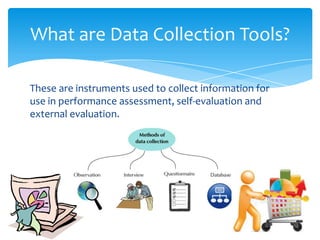
What are Data Collection Tools?
These are instruments used to collect information for
use in performance assessment, self-evaluation and
external evaluation.
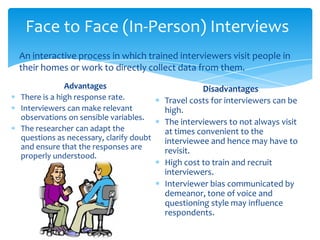
Face to Face (In-Person) Interviews
An interactive process in which trained interviewers visit people in
their homes or work to directly collect data from them.
Advantages
There is a high response rate.
Interviewers can make relevant
observations on sensible variables.
The researcher can adapt the
questions as necessary, clarify doubt
and ensure that the responses are
properly understood.

Disadvantages
Travel costs for interviewers can be
high.
The interviewers to not always visit
at times convenient to the
interviewee and hence may have to
revisit.
High cost to train and recruit
interviewers.
Interviewer bias communicated by
demeanor, tone of voice and
questioning style may influence
respondents.
Mail Surveys or Self-Administered
Questions
This involves posting out the data collection instrument to the
respondents which they are required to complete in privacy and return.
Advantages
It is relatively less expensive than
face to face interviews but costs
can increase if sample size is large.
It is convenient for distributing
large numbers of questionnaire in
a short time over large
geographical areas.
Respondents can complete
questionnaire at their
convenience and privacy.
Respondents can check personal
information if memory fails.
It avoids interview bias.

Disadvantages
Researcher will have to compile an up to date
mailing list of all persons to be included in the
survey.
Lower response rate than other methods of
data collection.
Ineffective if respondents are not literate.
Slow response rate even though reminder
letters and incentives can be used to speed up
rate of return.
Researcher cannot control condition of the
response.
Telephone Interviews
This involves trained interviewers calling persons to collect data.
Advantages
Possible coverage of wide
geographic area.
It is quicker and less expensive
than the face-to-face method.
Random digital dialing can be
used to make sampling easy.
High response rate possible.
Interviewer can control
questioning sequence.

Disadvantages
Only people with telephones can be
interviewed.
High costs involved for long distance
calls; may need several call backs.
Respondents can terminate interview
by hanging up the phone.
Anonymity is limited.
Computer Assisted Telephone
Interview (CATI)
This is similar to the telephone interview except that the responses are
immediately keyed into a computer to save time spent processing data.
Advantages
 The whole process is speeded
up because data is entered as
it is obtained.
 Data is entered directly and
the subsequent transaction of
data processing are
eliminated.

Disadvantages
 If the respondent changes an
earlier answer during the
interview it is difficult to make
alterations than with paper
questionnaire.
 Getting a questionnaire up and
running fault free on CATI
system takes time
The Internet (On-Line Surveys)
This involves posting the questionnaire to a website and
respondents complete in online.





Advantages
Working online is relatively
inexpensive
Responses can be collected
form a vast geographical area
Quick electronic capture of
data and easy compilation.
Anonymity is possible through
secure browsers and
encryption.






Disadvantages
Those with no internet access cant
participate.
Difficult to guarantee a representative
sample online.
Multiple responses from the same
person is hard to detect.
Difficult to use open-ended questions.
The following methods or data collection are available:
 The in-depth interview
 Observational Method
 Document Review
In Depth Interview
This entails the interviewer asking questions, listening
and recording responses of those interviewed. There
are three types of in depth interviews:
1. Informal conversational interview
2. Semi-structured interview
3. Standard open ended interview.
Advantages
It allows the researcher the
flexibility to ask questions in
any order.
The interviewer is able to
probe new information that
may immerge during
conversation
Large amount of detail is
generated.
Disadvantage
The flowing nature of
conversation often generates
less systematic data that is
difficult and time consuming to
analyze.

Advantages
The flexibility allows the
interviewer to pursue certain
responses in greater detail.
The pre-determined list makes
the interview more systematic
and focused.
Disadvantages
Can’t guarantee honesty of
participants.
Flexibility of interview may
lessen its reliability.
Open-ended questions are
difficult to analyze.
It is difficult to compare
answers.
Advantages
It minimizes variation in questions posed to respondents.
It ensures accuracy and consistency of questions asked.
Disadvantage
It does not allow flexibility in dealing with situational changes or
individual differences that the researcher might occur.
Observational Methods
This involves first hand identification, accurate description
and recording in a pre-determined phenomenon within the
target population.
There are two types of Observation:
1. Participant or Overt Observation
2. Direct or Covert Observation
Advantages
 It helps the researcher to
decide what questions to ask
the respondents.
 Researchers are better able to
appreciate and understand the
factors that influence
behaviours
Disadvantage
 When using the “participants
as observer format” the
researcher can lose objectivity
 Observer can become
distracted and loose focus of
the research.
Advantages
 Observation may sometimes
be the only assessment
method possible.
 There can be no plagiarism or
false reports.
 It is a great way to assess
practical.
Disadvantages
 The validity of the observation
will become compromised if
respondents change their
behaviour because they know
they are under observation.
 Small sample Size.
 It is time consuming.
Document Review
This includes historical documents, literature reviews and
personal documents (diaries and journals).
Advantages
Relatively inexpensive
Good source of background
information
Unobtrusive
Provides a “behind the scenes”
look at a program
that may not be directly
observable
May bring up issues not noted
by other means

Disadvantages
Information may be inapplicable,
disorganized,
Unavailable or out of date
Could be biased because of
selective survival of information
Information may be incomplete
or inaccurate
Can be time consuming to collect,
review, and analyze many
documents
Research methods

Research methods

  • 1.
  • 2.
    What are DataCollection Tools? These are instruments used to collect information for use in performance assessment, self-evaluation and external evaluation.
  • 3.
    Face to Face(In-Person) Interviews An interactive process in which trained interviewers visit people in their homes or work to directly collect data from them. Advantages There is a high response rate. Interviewers can make relevant observations on sensible variables. The researcher can adapt the questions as necessary, clarify doubt and ensure that the responses are properly understood. Disadvantages Travel costs for interviewers can be high. The interviewers to not always visit at times convenient to the interviewee and hence may have to revisit. High cost to train and recruit interviewers. Interviewer bias communicated by demeanor, tone of voice and questioning style may influence respondents.
  • 4.
    Mail Surveys orSelf-Administered Questions This involves posting out the data collection instrument to the respondents which they are required to complete in privacy and return. Advantages It is relatively less expensive than face to face interviews but costs can increase if sample size is large. It is convenient for distributing large numbers of questionnaire in a short time over large geographical areas. Respondents can complete questionnaire at their convenience and privacy. Respondents can check personal information if memory fails. It avoids interview bias. Disadvantages Researcher will have to compile an up to date mailing list of all persons to be included in the survey. Lower response rate than other methods of data collection. Ineffective if respondents are not literate. Slow response rate even though reminder letters and incentives can be used to speed up rate of return. Researcher cannot control condition of the response.
  • 5.
    Telephone Interviews This involvestrained interviewers calling persons to collect data. Advantages Possible coverage of wide geographic area. It is quicker and less expensive than the face-to-face method. Random digital dialing can be used to make sampling easy. High response rate possible. Interviewer can control questioning sequence. Disadvantages Only people with telephones can be interviewed. High costs involved for long distance calls; may need several call backs. Respondents can terminate interview by hanging up the phone. Anonymity is limited.
  • 6.
    Computer Assisted Telephone Interview(CATI) This is similar to the telephone interview except that the responses are immediately keyed into a computer to save time spent processing data. Advantages  The whole process is speeded up because data is entered as it is obtained.  Data is entered directly and the subsequent transaction of data processing are eliminated. Disadvantages  If the respondent changes an earlier answer during the interview it is difficult to make alterations than with paper questionnaire.  Getting a questionnaire up and running fault free on CATI system takes time
  • 7.
    The Internet (On-LineSurveys) This involves posting the questionnaire to a website and respondents complete in online.     Advantages Working online is relatively inexpensive Responses can be collected form a vast geographical area Quick electronic capture of data and easy compilation. Anonymity is possible through secure browsers and encryption.     Disadvantages Those with no internet access cant participate. Difficult to guarantee a representative sample online. Multiple responses from the same person is hard to detect. Difficult to use open-ended questions.
  • 8.
    The following methodsor data collection are available:  The in-depth interview  Observational Method  Document Review
  • 9.
    In Depth Interview Thisentails the interviewer asking questions, listening and recording responses of those interviewed. There are three types of in depth interviews: 1. Informal conversational interview 2. Semi-structured interview 3. Standard open ended interview.
  • 10.
    Advantages It allows theresearcher the flexibility to ask questions in any order. The interviewer is able to probe new information that may immerge during conversation Large amount of detail is generated. Disadvantage The flowing nature of conversation often generates less systematic data that is difficult and time consuming to analyze. Advantages The flexibility allows the interviewer to pursue certain responses in greater detail. The pre-determined list makes the interview more systematic and focused. Disadvantages Can’t guarantee honesty of participants. Flexibility of interview may lessen its reliability. Open-ended questions are difficult to analyze. It is difficult to compare answers.
  • 11.
    Advantages It minimizes variationin questions posed to respondents. It ensures accuracy and consistency of questions asked. Disadvantage It does not allow flexibility in dealing with situational changes or individual differences that the researcher might occur.
  • 12.
    Observational Methods This involvesfirst hand identification, accurate description and recording in a pre-determined phenomenon within the target population. There are two types of Observation: 1. Participant or Overt Observation 2. Direct or Covert Observation
  • 13.
    Advantages  It helpsthe researcher to decide what questions to ask the respondents.  Researchers are better able to appreciate and understand the factors that influence behaviours Disadvantage  When using the “participants as observer format” the researcher can lose objectivity  Observer can become distracted and loose focus of the research.
  • 14.
    Advantages  Observation maysometimes be the only assessment method possible.  There can be no plagiarism or false reports.  It is a great way to assess practical. Disadvantages  The validity of the observation will become compromised if respondents change their behaviour because they know they are under observation.  Small sample Size.  It is time consuming.
  • 15.
    Document Review This includeshistorical documents, literature reviews and personal documents (diaries and journals). Advantages Relatively inexpensive Good source of background information Unobtrusive Provides a “behind the scenes” look at a program that may not be directly observable May bring up issues not noted by other means Disadvantages Information may be inapplicable, disorganized, Unavailable or out of date Could be biased because of selective survival of information Information may be incomplete or inaccurate Can be time consuming to collect, review, and analyze many documents