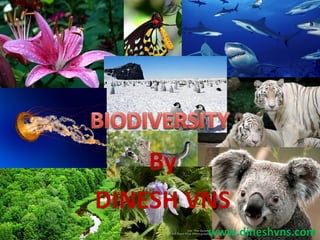
By
DINESH VNS
www.dineshvns.com
CONTENTS
1. Introduction
2. Concept of Biodiversity and its types
3. Distribution of Biodiversity
4. Biodiversity and balance of Nature
5. Benefits of Biodiversity
6. Threats to Biodiversity
7. Conservation of Biodiversity
8. Biodiversity of India
9. Conventions on Biodiversity
10. Current event on biodiversity
11.Conclusion

www.dineshvns.com
INTRODUCTION
The term Biodiversity was first coined by Walter G. Rosen in
1986.
The biosphere comprises of a complex collections of innumerable
organisms, known as the Biodiversity, which constitute the
vital life support for survival of human race.
Biological diversity, abbreviated as biodiversity, represent the
sum total of various life forms such as unicellular fungi,
protozoa, bacteria, and multi cellular organisms such as plants,
fishes, and mammals at various biological levels including
gens, habitats, and ecosystem .

www.dineshvns.com
Biodiversity
What does “Bio” means?

Bio =
www.dineshvns.com
Biodiversity
What
does
means?

“Diversity”

Diversity = Variety
www.dineshvns.com
CONCEPT AND TYPES OF
BIODIVERSITY
 Biodiversity is the variety of life forms on earth and the
essential interdependence of all living things.
 As defined in convention on Biological diversity singed at Rio
De Jenerio (Brazil) in 1992 by 154 countries, the Biodiversity
defined as “the variability among living organisms from all
sources including, inter alia, terrestrial, marine and other
aquatic eco-systems and the ecological complexes of which
the area part- this include diversity with in species, between
species and of ecosystem.”
 According to IUCN in 1998, “the variety and variability of
species of their population, the variety of species of their life
forms, the diversity of the complex association with species
with their interaction and their ecological process which
influences perform.”

www.dineshvns.com
There are three types of biodiversity
 Diversity of Species

 Diversity of Ecosystem

 Diversity of Genes

www.dineshvns.com
DISTRIBUTION OF BIODIVERSITY
 Flora and fauna diversity
depends on Climate
 Altitude
 Soils
 Presence of other species

Most of the biodiversity
concentrated in Tropical region.
 BIODIVERSITY HOTSPOTS:
 A region with high biodiversity
with most of spices being
Endemic.
 India have two Biodiversity
Hotspots- East Himalayan
Region and Western Ghat.

www.dineshvns.com
BENEFITS OF BIODIVERSITY
Consumptive value:
 Food/Drink
 Fuel
 Medicine
 Batter crop varieties
 Industrial Material
Non-Consumptive Value:
 Recreation
 Education and Research
 Traditional value
www.dineshvns.com
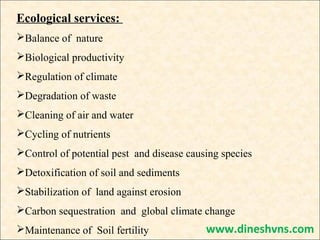
Ecological services:
Balance of nature
Biological productivity
Regulation of climate
Degradation of waste
Cleaning of air and water
Cycling of nutrients
Control of potential pest and disease causing species
Detoxification of soil and sediments
Stabilization of land against erosion
Carbon sequestration and global climate change
Maintenance of Soil fertility

www.dineshvns.com
THREATS TO BIODIVERSITY
Natural causes:
 Narrow geographical area
 Low population
 Low breeding rate
 Natural disasters
Anthropogenic causes:
 Habitat modification
 Overexploitation of selected
species
 Innovation by exotic species
www.dineshvns.com
 Pollution
 Hunting
 Global warming and
climate change
 Agriculture
 Domino effect

www.dineshvns.com
RECENT ISSUES ON BIODIVERSITY
 Some 75 per cent of the genetic diversity of crop
plants been lost in the past century.
 Some scientists estimate that as many as 3 species per hour are
going extinct and 20,000 extinctions occur each year.
 Roughly one-third of the world’s coral reef systems have been
destroyed or highly degraded.
 About 24 per cent of mammals and 12 per cent of bird species are
currently considered to be globally threatened.
 More than 50 per cent of the world’s wetlands have been drained,
and populations of inland water and wetland species have declined
by 50per cent between 1970 and 1999.

www.dineshvns.com
CONSERVATION OF BIODIVERSITY


•
•


Biodiversity inventories
Conserving Biodiversity in protected HabitatsIn situ conservation
Ex situ conservation
Seed Bank, Gene Bank, Pollen Bank, DNA
Bank

Gene Bank

zoo

Bandhavgarh National Park

www.dineshvns.com
 Restoration of Biodiversity
 Imparting Environmental Education
 Enacting, strengthening and enforcing Environmental
Legislation
 Population Control
 Reviewing the agriculture practice
 Controlling Urbanization
 Conservation through Biotechnology

www.dineshvns.com
www.dineshvns.com
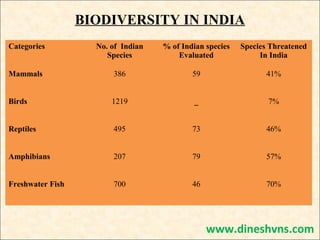
BIODIVERSITY IN INDIA
Categories

No. of Indian
Species

% of Indian species
Evaluated

Species Threatened
In India

Mammals

386

59

41%

Birds

1219

_

7%

Reptiles

495

73

46%

Amphibians

207

79

57%

Freshwater Fish

700

46

70%

www.dineshvns.com
BIODIVERSITY CONVENSIONS
 The first convention on biodiversity organized at Rio De
Janerio, capital of Brazil from June 5 to 16, 1992 named as
United Nation Conference On Environment and Development
(UNCED), batter known as Rio Summit to maintain ecological
balance and enrich biodiversity. The agreement on
biodiversity
signed by 150 countries including three
programmes To ensure conservation of biodiversity
 Sustainable use of biodiversity
 Rational and equitable share of profit to accrue from use of
genetic resources.
 The second convention organized at Johannesburg in 2002
called World Summit On Sustainable Development (WSSD)
where the Biodiversity and Sustainable Ecosystem
www.dineshvns.com
Management was the issue.
The International Conference held on Biodiversity in
Relation to Food & Human Security in a warming planet
15-17 February, 2010 in Chennai.
International Conference on Wildlife & Biodiversity
Conservation held on 3 to 5 June, 2010 at Dal lake,
Srinagar, Kashmir.
Indian Biodiversity Congress (IBC) & Indian Biodiversity
Expo(IBE) will be held on 27-31 December at
Thriuvananthapuram, Kerala.

www.dineshvns.com
2012 Hyderabad UN Convention on
Biodiversity

• The 2012 Hyderabad Conference of the Parties to the
UN Convention on Biological Diversity (CBD) is going on
from 01 October 2012 to 19 October 2012 in
Hyderabad, India.
• Environment Ministers and Forests Ministers of about
194 countries are attending the Conference,
International organisations like World Bank and ADB will
also be participating.
• Nearly 8,000 to 10,000 delegates will discuss issues
relating to bio-diversity and bio safety.
• The event is the largest conference ever to be held in
India.
www.dineshvns.com
CONCLUSION
Biodiversity is our life. If the Biodiversity got lost at
this rate then in near future, the survival of human
being will be threatened. So, it is our moral duty to
conserve Biodiversity as well our Environment. Longterm maintenance of species and their management
requires co-operative efforts across entire landscapes.
Biodiversity should be dealt with at scale of habitats or
ecosystems rather than at species level.

www.dineshvns.com
www.dineshvns.com

Biodiversity

  • 1.
  • 2.
    CONTENTS 1. Introduction 2. Conceptof Biodiversity and its types 3. Distribution of Biodiversity 4. Biodiversity and balance of Nature 5. Benefits of Biodiversity 6. Threats to Biodiversity 7. Conservation of Biodiversity 8. Biodiversity of India 9. Conventions on Biodiversity 10. Current event on biodiversity 11.Conclusion www.dineshvns.com
  • 3.
    INTRODUCTION The term Biodiversitywas first coined by Walter G. Rosen in 1986. The biosphere comprises of a complex collections of innumerable organisms, known as the Biodiversity, which constitute the vital life support for survival of human race. Biological diversity, abbreviated as biodiversity, represent the sum total of various life forms such as unicellular fungi, protozoa, bacteria, and multi cellular organisms such as plants, fishes, and mammals at various biological levels including gens, habitats, and ecosystem . www.dineshvns.com
  • 4.
    Biodiversity What does “Bio”means? Bio = www.dineshvns.com
  • 5.
  • 6.
    CONCEPT AND TYPESOF BIODIVERSITY  Biodiversity is the variety of life forms on earth and the essential interdependence of all living things.  As defined in convention on Biological diversity singed at Rio De Jenerio (Brazil) in 1992 by 154 countries, the Biodiversity defined as “the variability among living organisms from all sources including, inter alia, terrestrial, marine and other aquatic eco-systems and the ecological complexes of which the area part- this include diversity with in species, between species and of ecosystem.”  According to IUCN in 1998, “the variety and variability of species of their population, the variety of species of their life forms, the diversity of the complex association with species with their interaction and their ecological process which influences perform.” www.dineshvns.com
  • 7.
    There are threetypes of biodiversity  Diversity of Species  Diversity of Ecosystem  Diversity of Genes www.dineshvns.com
  • 8.
    DISTRIBUTION OF BIODIVERSITY Flora and fauna diversity depends on Climate  Altitude  Soils  Presence of other species  Most of the biodiversity concentrated in Tropical region.  BIODIVERSITY HOTSPOTS:  A region with high biodiversity with most of spices being Endemic.  India have two Biodiversity Hotspots- East Himalayan Region and Western Ghat. www.dineshvns.com
  • 9.
    BENEFITS OF BIODIVERSITY Consumptivevalue:  Food/Drink  Fuel  Medicine  Batter crop varieties  Industrial Material Non-Consumptive Value:  Recreation  Education and Research  Traditional value www.dineshvns.com
  • 10.
    Ecological services: Balance ofnature Biological productivity Regulation of climate Degradation of waste Cleaning of air and water Cycling of nutrients Control of potential pest and disease causing species Detoxification of soil and sediments Stabilization of land against erosion Carbon sequestration and global climate change Maintenance of Soil fertility www.dineshvns.com
  • 11.
    THREATS TO BIODIVERSITY Naturalcauses:  Narrow geographical area  Low population  Low breeding rate  Natural disasters Anthropogenic causes:  Habitat modification  Overexploitation of selected species  Innovation by exotic species www.dineshvns.com
  • 12.
     Pollution  Hunting Global warming and climate change  Agriculture  Domino effect www.dineshvns.com
  • 13.
    RECENT ISSUES ONBIODIVERSITY  Some 75 per cent of the genetic diversity of crop plants been lost in the past century.  Some scientists estimate that as many as 3 species per hour are going extinct and 20,000 extinctions occur each year.  Roughly one-third of the world’s coral reef systems have been destroyed or highly degraded.  About 24 per cent of mammals and 12 per cent of bird species are currently considered to be globally threatened.  More than 50 per cent of the world’s wetlands have been drained, and populations of inland water and wetland species have declined by 50per cent between 1970 and 1999. www.dineshvns.com
  • 14.
    CONSERVATION OF BIODIVERSITY   • •  Biodiversityinventories Conserving Biodiversity in protected HabitatsIn situ conservation Ex situ conservation Seed Bank, Gene Bank, Pollen Bank, DNA Bank Gene Bank zoo Bandhavgarh National Park www.dineshvns.com
  • 15.
     Restoration ofBiodiversity  Imparting Environmental Education  Enacting, strengthening and enforcing Environmental Legislation  Population Control  Reviewing the agriculture practice  Controlling Urbanization  Conservation through Biotechnology www.dineshvns.com
  • 16.
  • 17.
    BIODIVERSITY IN INDIA Categories No.of Indian Species % of Indian species Evaluated Species Threatened In India Mammals 386 59 41% Birds 1219 _ 7% Reptiles 495 73 46% Amphibians 207 79 57% Freshwater Fish 700 46 70% www.dineshvns.com
  • 18.
    BIODIVERSITY CONVENSIONS  Thefirst convention on biodiversity organized at Rio De Janerio, capital of Brazil from June 5 to 16, 1992 named as United Nation Conference On Environment and Development (UNCED), batter known as Rio Summit to maintain ecological balance and enrich biodiversity. The agreement on biodiversity signed by 150 countries including three programmes To ensure conservation of biodiversity  Sustainable use of biodiversity  Rational and equitable share of profit to accrue from use of genetic resources.  The second convention organized at Johannesburg in 2002 called World Summit On Sustainable Development (WSSD) where the Biodiversity and Sustainable Ecosystem www.dineshvns.com Management was the issue.
  • 19.
    The International Conferenceheld on Biodiversity in Relation to Food & Human Security in a warming planet 15-17 February, 2010 in Chennai. International Conference on Wildlife & Biodiversity Conservation held on 3 to 5 June, 2010 at Dal lake, Srinagar, Kashmir. Indian Biodiversity Congress (IBC) & Indian Biodiversity Expo(IBE) will be held on 27-31 December at Thriuvananthapuram, Kerala. www.dineshvns.com
  • 20.
    2012 Hyderabad UNConvention on Biodiversity • The 2012 Hyderabad Conference of the Parties to the UN Convention on Biological Diversity (CBD) is going on from 01 October 2012 to 19 October 2012 in Hyderabad, India. • Environment Ministers and Forests Ministers of about 194 countries are attending the Conference, International organisations like World Bank and ADB will also be participating. • Nearly 8,000 to 10,000 delegates will discuss issues relating to bio-diversity and bio safety. • The event is the largest conference ever to be held in India. www.dineshvns.com
  • 21.
    CONCLUSION Biodiversity is ourlife. If the Biodiversity got lost at this rate then in near future, the survival of human being will be threatened. So, it is our moral duty to conserve Biodiversity as well our Environment. Longterm maintenance of species and their management requires co-operative efforts across entire landscapes. Biodiversity should be dealt with at scale of habitats or ecosystems rather than at species level. www.dineshvns.com
  • 22.