1
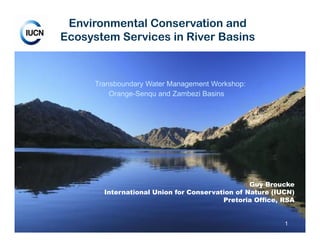
Guy Broucke
International Union for Conservation of Nature (IUCN)
Pretoria Office, RSA
Environmental Conservation and
Ecosystem Services in River Basins
Transboundary Water Management Workshop:
Orange-Senqu and Zambezi Basins
Integrated?
Sustainable?
Really?
2
Environment – a sector?
3
4
ECOSYSTEM
SERVICES?
5
6
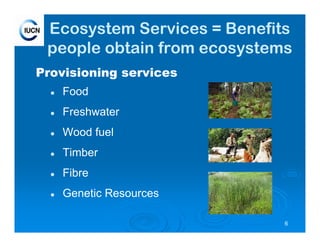
Ecosystem Services = Benefits
people obtain from ecosystems
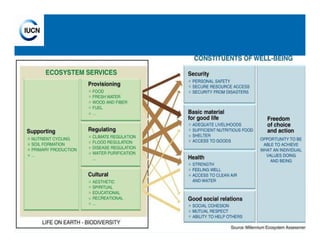
Provisioning services
Food
Freshwater
Wood fuel
Timber
Fibre
Genetic Resources
7
Ecosystem Services = Benefits
people obtain from ecosystems
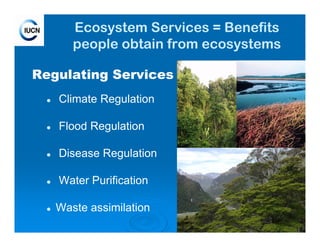
Regulating Services
Climate Regulation
Flood Regulation
Disease Regulation
Water Purification
Waste assimilation
8
Ecosystem Services = Benefits
people obtain from ecosystems
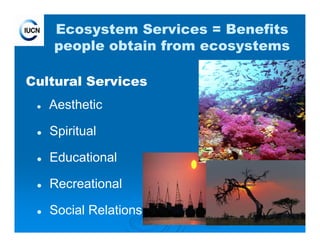
Cultural Services
Aesthetic
Spiritual
Educational
Recreational
Social Relations
10
ECOSYSTEMS APPROACH
MAINSTREAMING
ECOSYSTEM SERVICES?
11
What is Mainstreaming
Ecosystem Services?
Integrating or incorporating actions
related to conservation and sustainable
use of biodiversity into strategies relating
to production sectors, such as
agriculture, fisheries, forestry, tourism and
mining
Including biodiversity considerations in
poverty reduction plans and national
sustainable development plans
12
Mainstreaming Ecosystem Services
Requires an understanding and acceptance of
the importance of a healthy environment to well-
functioning production sectors
Requires mechanisms (e.g. inter-agency
taskforces; coordinating committees etc;), the
will and ability to identify win-win situations
Requires an extensive strategy of
communication, education and public
awareness
13
Ecosystem Approach =
Integrated Management Strategy
The ecosystem approach is a strategy for
the integrated management of land, water
and living resources that promotes
conservation and sustainable use in an
equitable way.
Thus, the application of the ecosystem
approach helps to reach a balance of the
three objectives of the CBD:
conservation;
sustainable use; and
the fair and equitable sharing of the benefits
arising out of the utilization of genetic resources
14
ECOSYSTEM
APPROACH
15
Principles of Ecosystem Approach
(CBD)
Principle 1:
The objectives of management of land, water and
living resources are a matter of societal choice
Principle 2:
Management should be decentralized to the
lowest appropriate level (subsidiarity)
Principle 3:
Ecosystem managers should consider the
external effects (actual or potential) of their
activities on adjacent and other ecosystems.
16
Principles of Ecosystem Approach
Principle 4:
Recognizing potential gains from management,
there is usually a need to understand and
manage the ecosystem in an economic
context. Any such ecosystem-management
programme should:
a) Reduce those market distortions that adversely affect biological
diversity;
b) Align incentives to promote biodiversity conservation and
sustainable use;
c) Internalize costs and benefits in the given ecosystem to the
extent feasible.
17
Principles of Ecosystem Approach
Principle 5:
Conservation of ecosystem structure and
functioning, in order to maintain ecosystem
services, should be a priority target of the
ecosystem approach
Principle 6:
Ecosystems must be managed within the limits of
their functioning
Principle 7:
The ecosystem approach should be undertaken
at the appropriate spatial and temporal scales
18
Principles of Ecosystem Approach
Principle 8:
Recognizing the varying temporal scales and lag-
effects that characterize ecosystem processes,
objectives for ecosystem management should be
set for the long term
Principle 9:
Management must recognize that change is
inevitable
Principle 10:
The ecosystem approach should seek the
appropriate balance between, and integration of,
conservation and use of biological diversity
19
Principles of Ecosystem Approach
Principle 11:
The ecosystem approach should consider all
forms of relevant information, including
scientific and indigenous and local knowledge,
innovations and practices
Principle 12:
The ecosystem approach should involve all
relevant sectors of society and scientific
disciplines
TOOLS
20
21
Drivers of Biodiversity Loss
Biodiversity Loss
Habitat
Change
Climate
Change
Invasive
Species
Over-
exploitation
Nutrients
& pollution
Economic
Demo-
graphic
Socio-
political
Cultural &
religious
Science &
Technology
Indirect drivers
Direct drivers
Example of recording sheet
for status of drivers of biodiversity loss
22
Habitat
Change
Climate
Change
Invasive
Species
Over-
exploitation
Nutrients
& pollution
23
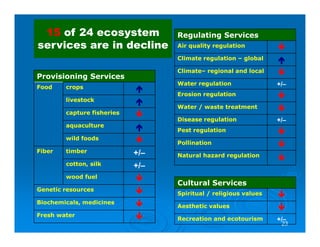
Provisioning Services
Food crops
livestock
capture fisheries
aquaculture
wild foods
Fiber timber +/–
cotton, silk +/–
wood fuel
Genetic resources
Biochemicals, medicines
Fresh water
Regulating Services
Air quality regulation
Climate regulation – global
Climate– regional and local
Water regulation +/–
Erosion regulation
Water / waste treatment
Disease regulation +/–
Pest regulation
Pollination
Natural hazard regulation
Cultural Services
Spiritual / religious values
Aesthetic values
Recreation and ecotourism +/–
15 of 24 ecosystem
services are in decline
24
Operational Objectives for
Ecosystem Approach Management
(1) Develop broad Stakeholder-Based
Governance system
(2) Conserve essential Parts of the ecosystem
(3) Conserve essential ecosystem Processes
Question, if (2) is done well, is (3) necessary?
25
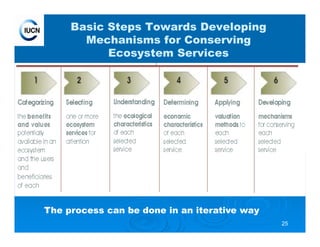
Basic Steps Towards Developing
Mechanisms for Conserving
Ecosystem Services
The process can be done in an iterative way
26
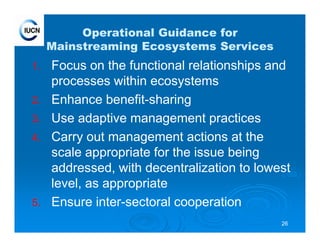
Operational Guidance for
Mainstreaming Ecosystems Services
1. Focus on the functional relationships and
processes within ecosystems
2. Enhance benefit-sharing
3. Use adaptive management practices
4. Carry out management actions at the
scale appropriate for the issue being
addressed, with decentralization to lowest
level, as appropriate
5. Ensure inter-sectoral cooperation
Integrated Water Resource
Management
Environmental Management Examples for
Water Basin Management
Maintaining environmental flows
Pollution control
Ecohydrology and phytoremediation
Habitat rehabilitation.
Conjunctive use of surface and
groundwater
Watershed management
Water demand management
Payment for ecosystem services
© IISD 2011
29
THANK YOU

Environmental Conservation and Ecosystem Services in River Basins

  • 1.
    1 Guy Broucke International Unionfor Conservation of Nature (IUCN) Pretoria Office, RSA Environmental Conservation and Ecosystem Services in River Basins Transboundary Water Management Workshop: Orange-Senqu and Zambezi Basins
  • 2.
  • 3.
  • 4.
  • 5.
  • 6.
    6 Ecosystem Services =Benefits people obtain from ecosystems Provisioning services Food Freshwater Wood fuel Timber Fibre Genetic Resources
  • 7.
    7 Ecosystem Services =Benefits people obtain from ecosystems Regulating Services Climate Regulation Flood Regulation Disease Regulation Water Purification Waste assimilation
  • 8.
    8 Ecosystem Services =Benefits people obtain from ecosystems Cultural Services Aesthetic Spiritual Educational Recreational Social Relations
  • 10.
  • 11.
    11 What is Mainstreaming EcosystemServices? Integrating or incorporating actions related to conservation and sustainable use of biodiversity into strategies relating to production sectors, such as agriculture, fisheries, forestry, tourism and mining Including biodiversity considerations in poverty reduction plans and national sustainable development plans
  • 12.
    12 Mainstreaming Ecosystem Services Requiresan understanding and acceptance of the importance of a healthy environment to well- functioning production sectors Requires mechanisms (e.g. inter-agency taskforces; coordinating committees etc;), the will and ability to identify win-win situations Requires an extensive strategy of communication, education and public awareness
  • 13.
    13 Ecosystem Approach = IntegratedManagement Strategy The ecosystem approach is a strategy for the integrated management of land, water and living resources that promotes conservation and sustainable use in an equitable way. Thus, the application of the ecosystem approach helps to reach a balance of the three objectives of the CBD: conservation; sustainable use; and the fair and equitable sharing of the benefits arising out of the utilization of genetic resources
  • 14.
  • 15.
    15 Principles of EcosystemApproach (CBD) Principle 1: The objectives of management of land, water and living resources are a matter of societal choice Principle 2: Management should be decentralized to the lowest appropriate level (subsidiarity) Principle 3: Ecosystem managers should consider the external effects (actual or potential) of their activities on adjacent and other ecosystems.
  • 16.
    16 Principles of EcosystemApproach Principle 4: Recognizing potential gains from management, there is usually a need to understand and manage the ecosystem in an economic context. Any such ecosystem-management programme should: a) Reduce those market distortions that adversely affect biological diversity; b) Align incentives to promote biodiversity conservation and sustainable use; c) Internalize costs and benefits in the given ecosystem to the extent feasible.
  • 17.
    17 Principles of EcosystemApproach Principle 5: Conservation of ecosystem structure and functioning, in order to maintain ecosystem services, should be a priority target of the ecosystem approach Principle 6: Ecosystems must be managed within the limits of their functioning Principle 7: The ecosystem approach should be undertaken at the appropriate spatial and temporal scales
  • 18.
    18 Principles of EcosystemApproach Principle 8: Recognizing the varying temporal scales and lag- effects that characterize ecosystem processes, objectives for ecosystem management should be set for the long term Principle 9: Management must recognize that change is inevitable Principle 10: The ecosystem approach should seek the appropriate balance between, and integration of, conservation and use of biological diversity
  • 19.
    19 Principles of EcosystemApproach Principle 11: The ecosystem approach should consider all forms of relevant information, including scientific and indigenous and local knowledge, innovations and practices Principle 12: The ecosystem approach should involve all relevant sectors of society and scientific disciplines
  • 20.
  • 21.
    21 Drivers of BiodiversityLoss Biodiversity Loss Habitat Change Climate Change Invasive Species Over- exploitation Nutrients & pollution Economic Demo- graphic Socio- political Cultural & religious Science & Technology Indirect drivers Direct drivers
  • 22.
    Example of recordingsheet for status of drivers of biodiversity loss 22 Habitat Change Climate Change Invasive Species Over- exploitation Nutrients & pollution
  • 23.
    23 Provisioning Services Food crops livestock capturefisheries aquaculture wild foods Fiber timber +/– cotton, silk +/– wood fuel Genetic resources Biochemicals, medicines Fresh water Regulating Services Air quality regulation Climate regulation – global Climate– regional and local Water regulation +/– Erosion regulation Water / waste treatment Disease regulation +/– Pest regulation Pollination Natural hazard regulation Cultural Services Spiritual / religious values Aesthetic values Recreation and ecotourism +/– 15 of 24 ecosystem services are in decline
  • 24.
    24 Operational Objectives for EcosystemApproach Management (1) Develop broad Stakeholder-Based Governance system (2) Conserve essential Parts of the ecosystem (3) Conserve essential ecosystem Processes Question, if (2) is done well, is (3) necessary?
  • 25.
    25 Basic Steps TowardsDeveloping Mechanisms for Conserving Ecosystem Services The process can be done in an iterative way
  • 26.
    26 Operational Guidance for MainstreamingEcosystems Services 1. Focus on the functional relationships and processes within ecosystems 2. Enhance benefit-sharing 3. Use adaptive management practices 4. Carry out management actions at the scale appropriate for the issue being addressed, with decentralization to lowest level, as appropriate 5. Ensure inter-sectoral cooperation
  • 27.
  • 28.
    Environmental Management Examplesfor Water Basin Management Maintaining environmental flows Pollution control Ecohydrology and phytoremediation Habitat rehabilitation. Conjunctive use of surface and groundwater Watershed management Water demand management Payment for ecosystem services © IISD 2011
  • 29.