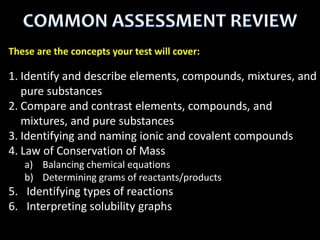
These are the concepts your test will cover: 
1. Identify and describe elements, compounds, mixtures, and 
pure substances 
2. Compare and contrast elements, compounds, and 
mixtures, and pure substances 
3. Identifying and naming ionic and covalent compounds 
4. Law of Conservation of Mass 
a) Balancing chemical equations 
b) Determining grams of reactants/products 
5. Identifying types of reactions 
6. Interpreting solubility graphs
These are the concepts your test will cover: 
1. Identify and describe elements, compounds, mixtures, and 
pure substances 
2. Compare and contrast elements, compounds, and 
mixtures, and pure substances 
3. Identifying and naming ionic and covalent compounds 
4. Law of Conservation of Mass 
a) Balancing chemical equations 
b) Determining grams of reactants/products 
5. Identifying types of reactions 
6. Interpreting solubility graphs
These are the concepts your test will cover: 
1. Identify and describe elements, compounds, mixtures, and 
pure substances 
2. Compare and contrast elements, compounds, and 
mixtures, and pure substances 
3. Identifying and naming ionic and covalent compounds 
4. Law of Conservation of Mass 
a) Balancing chemical equations 
b) Determining grams of reactants/products 
5. Identifying types of reactions 
6. Interpreting solubility graphs
These are the concepts your test will cover: 
1. Identify and describe elements, compounds, mixtures, and 
pure substances 
2. Compare and contrast elements, compounds, and 
mixtures, and pure substances 
3. Identifying and naming ionic and covalent compounds 
4. Law of Conservation of Mass 
a) Balancing chemical equations 
b) Determining grams of reactants/products 
5. Identifying types of reactions 
6. Interpreting solubility graphs
Elements
Elements, Compounds, Mixtures, Pure Substances 
1. _______ Air 
2. _______ Oxygen 
3. _______ Water 
4. _______ Salt 
5. _______ Salt water 
6. _______ Ammonia (NH3) 
7. _______ Hydrogen Peroxide (H2O2) 
8. _______ Soil 
9. _______ Soda 
10._______ Carbon Dioxide (CO2)
Naming Ionic and Covalent Compounds 
IONIC COVALENT 
• Metal + nonmetal (-ide) 
• No prefixes! 
• Use the “criss-cross” method 
to determine number of 
elements 
• Nonmetal + nonmetal (-ide) 
• Use prefixes to indicate 
number of elements 
• Mono- 
• Di- 
• Tri- 
• Tetra- 
• Penta-
Naming Ionic and Covalent Compounds 
How to determine 
charges for ions
Law of Conservation of Mass 
Balance this equation. 
Mg + HCl  MgCl2 + H2 
If 20g of magnesium react with 30g of hydrochloric acid 
and produce 46g of magnesium chloride, how much 
hydrogen gas was produced?

Ecm test review (accel)

  • 1.
    These are theconcepts your test will cover: 1. Identify and describe elements, compounds, mixtures, and pure substances 2. Compare and contrast elements, compounds, and mixtures, and pure substances 3. Identifying and naming ionic and covalent compounds 4. Law of Conservation of Mass a) Balancing chemical equations b) Determining grams of reactants/products 5. Identifying types of reactions 6. Interpreting solubility graphs
  • 2.
    These are theconcepts your test will cover: 1. Identify and describe elements, compounds, mixtures, and pure substances 2. Compare and contrast elements, compounds, and mixtures, and pure substances 3. Identifying and naming ionic and covalent compounds 4. Law of Conservation of Mass a) Balancing chemical equations b) Determining grams of reactants/products 5. Identifying types of reactions 6. Interpreting solubility graphs
  • 3.
    These are theconcepts your test will cover: 1. Identify and describe elements, compounds, mixtures, and pure substances 2. Compare and contrast elements, compounds, and mixtures, and pure substances 3. Identifying and naming ionic and covalent compounds 4. Law of Conservation of Mass a) Balancing chemical equations b) Determining grams of reactants/products 5. Identifying types of reactions 6. Interpreting solubility graphs
  • 4.
    These are theconcepts your test will cover: 1. Identify and describe elements, compounds, mixtures, and pure substances 2. Compare and contrast elements, compounds, and mixtures, and pure substances 3. Identifying and naming ionic and covalent compounds 4. Law of Conservation of Mass a) Balancing chemical equations b) Determining grams of reactants/products 5. Identifying types of reactions 6. Interpreting solubility graphs
  • 5.
  • 6.
    Elements, Compounds, Mixtures,Pure Substances 1. _______ Air 2. _______ Oxygen 3. _______ Water 4. _______ Salt 5. _______ Salt water 6. _______ Ammonia (NH3) 7. _______ Hydrogen Peroxide (H2O2) 8. _______ Soil 9. _______ Soda 10._______ Carbon Dioxide (CO2)
  • 7.
    Naming Ionic andCovalent Compounds IONIC COVALENT • Metal + nonmetal (-ide) • No prefixes! • Use the “criss-cross” method to determine number of elements • Nonmetal + nonmetal (-ide) • Use prefixes to indicate number of elements • Mono- • Di- • Tri- • Tetra- • Penta-
  • 8.
    Naming Ionic andCovalent Compounds How to determine charges for ions
  • 9.
    Law of Conservationof Mass Balance this equation. Mg + HCl  MgCl2 + H2 If 20g of magnesium react with 30g of hydrochloric acid and produce 46g of magnesium chloride, how much hydrogen gas was produced?