Newton’s First Law
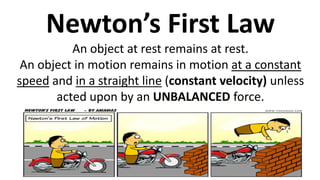
An object at rest remains at rest.
An object in motion remains in motion at a constant
speed and in a straight line (constant velocity) unless
acted upon by an UNBALANCED force.
Newton’s Second Law
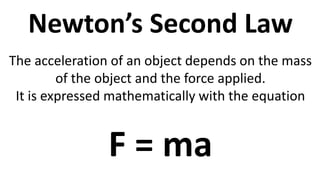
The acceleration of an object depends on the mass
of the object and the force applied.
It is expressed mathematically with the equation
F = ma
Newton’s Third Law
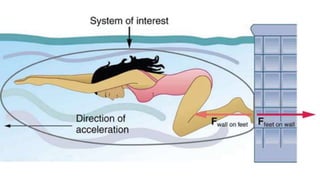
If an object A exerts a force on object B, then object B
must exert a force of equal magnitude and opposite
direction back on object A.
*Forces always occur in pairs. One object cannot exert a force
on another without experiencing a force itself. We sometimes
refer to this law loosely as action-reaction, where the force
exerted is the action and the force experienced as a
consequence is the reaction.
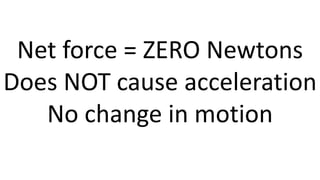
Net force = ZERO Newtons
Does NOT cause acceleration
No change in motion
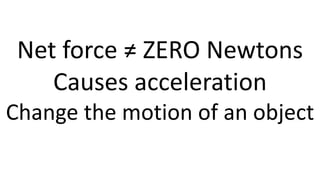
Net force ≠ ZERO Newtons
Causes acceleration
Change the motion of an object
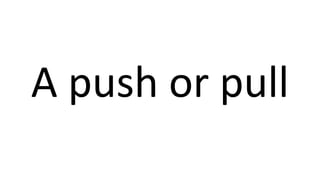
A push or pull
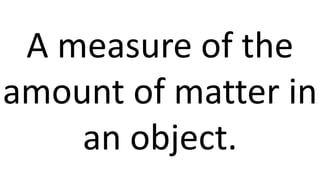
A measure of the
amount of matter in
an object.
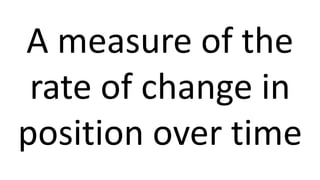
A measure of the
rate of change in
position over time
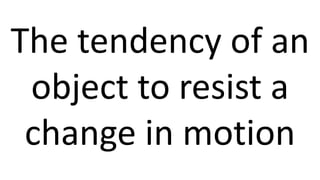
The tendency of an
object to resist a
change in motion
The force exerted
on object A by
object B.
The equal and opposite
force exerted on object
B by object A.
A change in velocity:
Speeding up
Slowing down
Turning
A car accelerates because the ground
pushes forward on the wheels in
reaction to the wheels pushing
backward on the ground. You can see
evidence of the wheels pushing
backward when tires spin on a gravel
road and throw rocks backward.
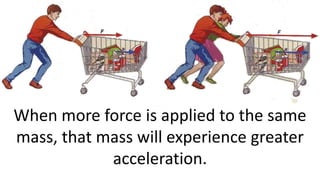
When more force is applied to the same
mass, that mass will experience greater
acceleration.
Bigger, more massive vehicles
require more force to acceleration
than smaller, less massive vehicles.
This is why smaller cars are
generally more fuel-efficient than
large trucks and SUVs.
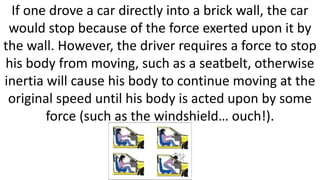
If one drove a car directly into a brick wall, the car
would stop because of the force exerted upon it by
the wall. However, the driver requires a force to stop
his body from moving, such as a seatbelt, otherwise
inertia will cause his body to continue moving at the
original speed until his body is acted upon by some
force (such as the windshield… ouch!).
When playing football, a player is
tackled and his head hits the
ground. The impact stops his skull,
but his brain continues to move
and hit the inside of his skull. His
brain is showing inertia.

Newtons laws fact sheet cards

  • 1.
    Newton’s First Law Anobject at rest remains at rest. An object in motion remains in motion at a constant speed and in a straight line (constant velocity) unless acted upon by an UNBALANCED force.
  • 2.
    Newton’s Second Law Theacceleration of an object depends on the mass of the object and the force applied. It is expressed mathematically with the equation F = ma
  • 3.
    Newton’s Third Law Ifan object A exerts a force on object B, then object B must exert a force of equal magnitude and opposite direction back on object A. *Forces always occur in pairs. One object cannot exert a force on another without experiencing a force itself. We sometimes refer to this law loosely as action-reaction, where the force exerted is the action and the force experienced as a consequence is the reaction.
  • 4.
    Net force =ZERO Newtons Does NOT cause acceleration No change in motion
  • 5.
    Net force ≠ZERO Newtons Causes acceleration Change the motion of an object
  • 6.
  • 7.
    A measure ofthe amount of matter in an object.
  • 8.
    A measure ofthe rate of change in position over time
  • 9.
    The tendency ofan object to resist a change in motion
  • 10.
    The force exerted onobject A by object B.
  • 11.
    The equal andopposite force exerted on object B by object A.
  • 12.
    A change invelocity: Speeding up Slowing down Turning
  • 14.
    A car acceleratesbecause the ground pushes forward on the wheels in reaction to the wheels pushing backward on the ground. You can see evidence of the wheels pushing backward when tires spin on a gravel road and throw rocks backward.
  • 15.
    When more forceis applied to the same mass, that mass will experience greater acceleration.
  • 16.
    Bigger, more massivevehicles require more force to acceleration than smaller, less massive vehicles. This is why smaller cars are generally more fuel-efficient than large trucks and SUVs.
  • 17.
    If one drovea car directly into a brick wall, the car would stop because of the force exerted upon it by the wall. However, the driver requires a force to stop his body from moving, such as a seatbelt, otherwise inertia will cause his body to continue moving at the original speed until his body is acted upon by some force (such as the windshield… ouch!).
  • 18.
    When playing football,a player is tackled and his head hits the ground. The impact stops his skull, but his brain continues to move and hit the inside of his skull. His brain is showing inertia.