Imagine cutting a gold bar in half.
Then cut in half again.
…and again.
…and again.
…and again.
…and again.
Speak up! Could you keep cutting that bar in half
forever? Why or why not?
How small could you cut up that gold and it still
be gold?
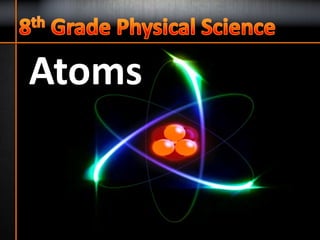
Atoms
An Atom Apart Reading/Highlighting Guide
1. According to the text, what are atoms?
2. What does the Greek word a’tomos mean?
3. What are atoms made of?
4. What decides the chemical element of an
atom?
5. What determines the chemical properties
of an atom?
• What is an atom?
• An atom is the smallest particle into which
an element can be divided and still be the
same substance.
• Atoms can combine to form molecules.
• What is an atom?
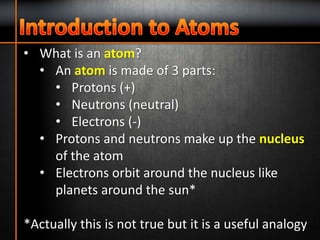
• An atom is made of 3 parts:
• Protons (+)
• Neutrons (neutral)
• Electrons (-)
• Protons and neutrons make up the nucleus
of the atom
• Electrons orbit around the nucleus like
planets around the sun*
*Actually this is not true but it is a useful analogy
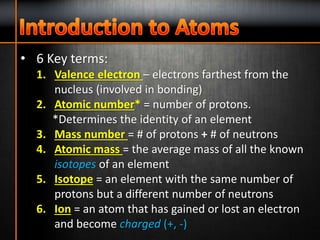
• 6 Key terms:
1. Valence electron – electrons farthest from the
nucleus (involved in bonding)
2. Atomic number* = number of protons.
*Determines the identity of an element
3. Mass number = # of protons + # of neutrons
4. Atomic mass = the average mass of all the known
isotopes of an element
5. Isotope = an element with the same number of
protons but a different number of neutrons
6. Ion = an atom that has gained or lost an electron
and become charged (+, -)
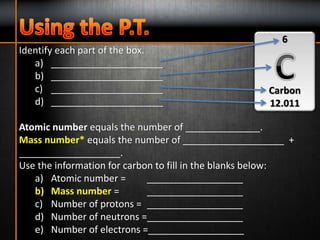
Identify each part of the box.
a) _____________________
b) _____________________
c) _____________________
d) _____________________
Atomic number equals the number of ______________.
Mass number* equals the number of ___________________ +
___________________.
Use the information for carbon to fill in the blanks below:
a) Atomic number = __________________
b) Mass number = __________________
c) Number of protons = __________________
d) Number of neutrons =__________________
e) Number of electrons =__________________
6
Carbon
12.011
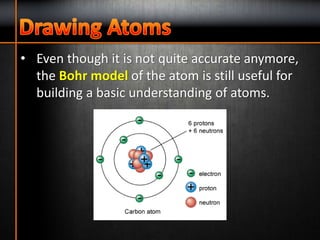
• Even though it is not quite accurate anymore,
the Bohr model of the atom is still useful for
building a basic understanding of atoms.
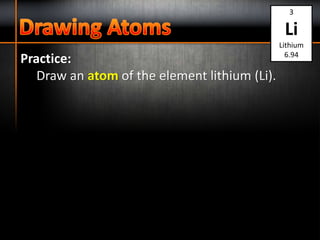
Practice:
Draw an atom of the element lithium (Li).
3
Li
Lithium
6.94
Divide your page as shown and draw an atom of each of the
following elements.
Helium atom Beryllium atom
Carbon atomBoron atom
Divide your page as shown and draw an atom of each of the
following elements.
Neon atom Magnesium atom
Chlorine atomSodium atom
Quick Check: Draw and label an atom of the
element nitrogen.
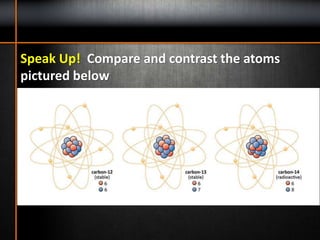
Speak Up! Compare and contrast the atoms
pictured below
• Cold calls…
1. What are the three subatomic particles in an atom? (Be
sure to include their charges!)
2. What 2 subatomic particles are in the nucleus of an atom?
3. Where are electrons found in an atom?
4. What determines the chemical element of an atom?
5. What is a valence electron?
6. What is the difference between atomic mass and mass
number?
7. What is the charge of the nucleus? Why?
8. What is the charge of the atom as a whole? Why?

Intro to atoms (edited for 2018)

  • 1.
    Imagine cutting agold bar in half. Then cut in half again. …and again. …and again. …and again. …and again. Speak up! Could you keep cutting that bar in half forever? Why or why not? How small could you cut up that gold and it still be gold?
  • 2.
  • 3.
    An Atom ApartReading/Highlighting Guide 1. According to the text, what are atoms? 2. What does the Greek word a’tomos mean? 3. What are atoms made of? 4. What decides the chemical element of an atom? 5. What determines the chemical properties of an atom?
  • 4.
    • What isan atom? • An atom is the smallest particle into which an element can be divided and still be the same substance. • Atoms can combine to form molecules.
  • 5.
    • What isan atom? • An atom is made of 3 parts: • Protons (+) • Neutrons (neutral) • Electrons (-) • Protons and neutrons make up the nucleus of the atom • Electrons orbit around the nucleus like planets around the sun* *Actually this is not true but it is a useful analogy
  • 6.
    • 6 Keyterms: 1. Valence electron – electrons farthest from the nucleus (involved in bonding) 2. Atomic number* = number of protons. *Determines the identity of an element 3. Mass number = # of protons + # of neutrons 4. Atomic mass = the average mass of all the known isotopes of an element 5. Isotope = an element with the same number of protons but a different number of neutrons 6. Ion = an atom that has gained or lost an electron and become charged (+, -)
  • 7.
    Identify each partof the box. a) _____________________ b) _____________________ c) _____________________ d) _____________________ Atomic number equals the number of ______________. Mass number* equals the number of ___________________ + ___________________. Use the information for carbon to fill in the blanks below: a) Atomic number = __________________ b) Mass number = __________________ c) Number of protons = __________________ d) Number of neutrons =__________________ e) Number of electrons =__________________ 6 Carbon 12.011
  • 8.
    • Even thoughit is not quite accurate anymore, the Bohr model of the atom is still useful for building a basic understanding of atoms.
  • 9.
    Practice: Draw an atomof the element lithium (Li). 3 Li Lithium 6.94
  • 10.
    Divide your pageas shown and draw an atom of each of the following elements. Helium atom Beryllium atom Carbon atomBoron atom
  • 11.
    Divide your pageas shown and draw an atom of each of the following elements. Neon atom Magnesium atom Chlorine atomSodium atom
  • 12.
    Quick Check: Drawand label an atom of the element nitrogen.
  • 13.
    Speak Up! Compareand contrast the atoms pictured below
  • 14.
    • Cold calls… 1.What are the three subatomic particles in an atom? (Be sure to include their charges!) 2. What 2 subatomic particles are in the nucleus of an atom? 3. Where are electrons found in an atom? 4. What determines the chemical element of an atom? 5. What is a valence electron? 6. What is the difference between atomic mass and mass number? 7. What is the charge of the nucleus? Why? 8. What is the charge of the atom as a whole? Why?

Editor's Notes

  • #10 Be sure to teach the Octet Rule (2-8-8) with these drawings…