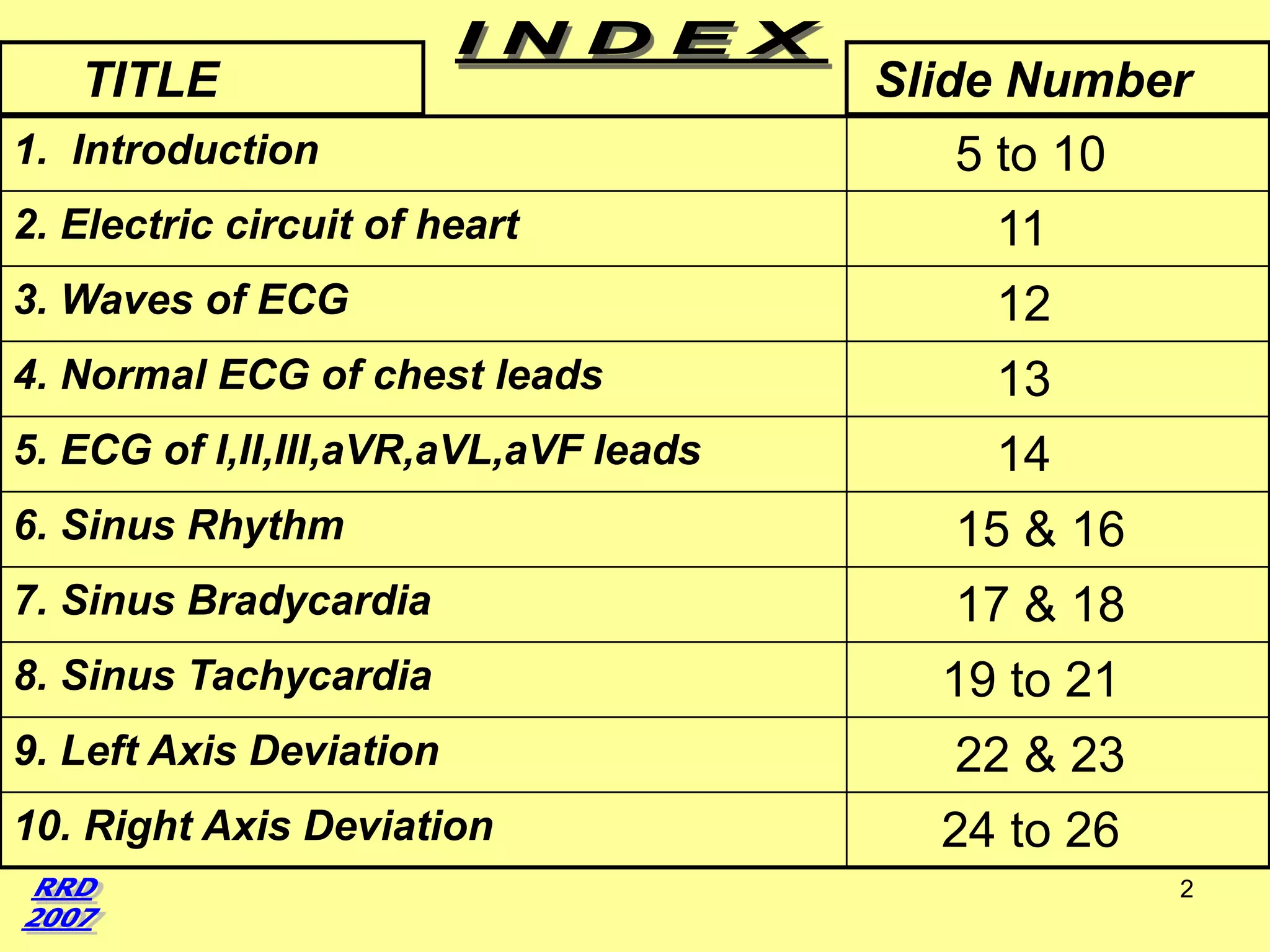
TITLE
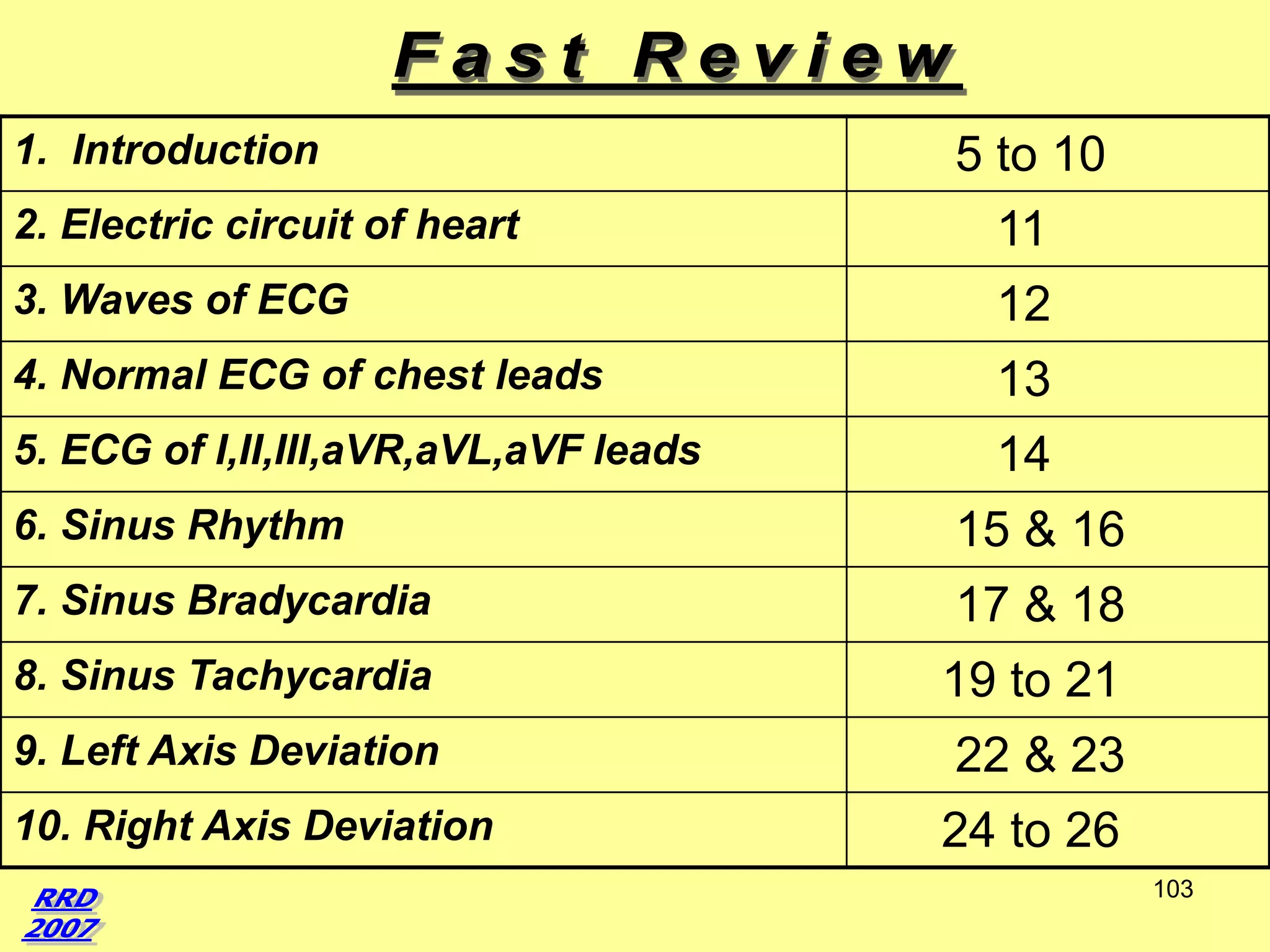
1. Introduction

Slide Number
5 to 10

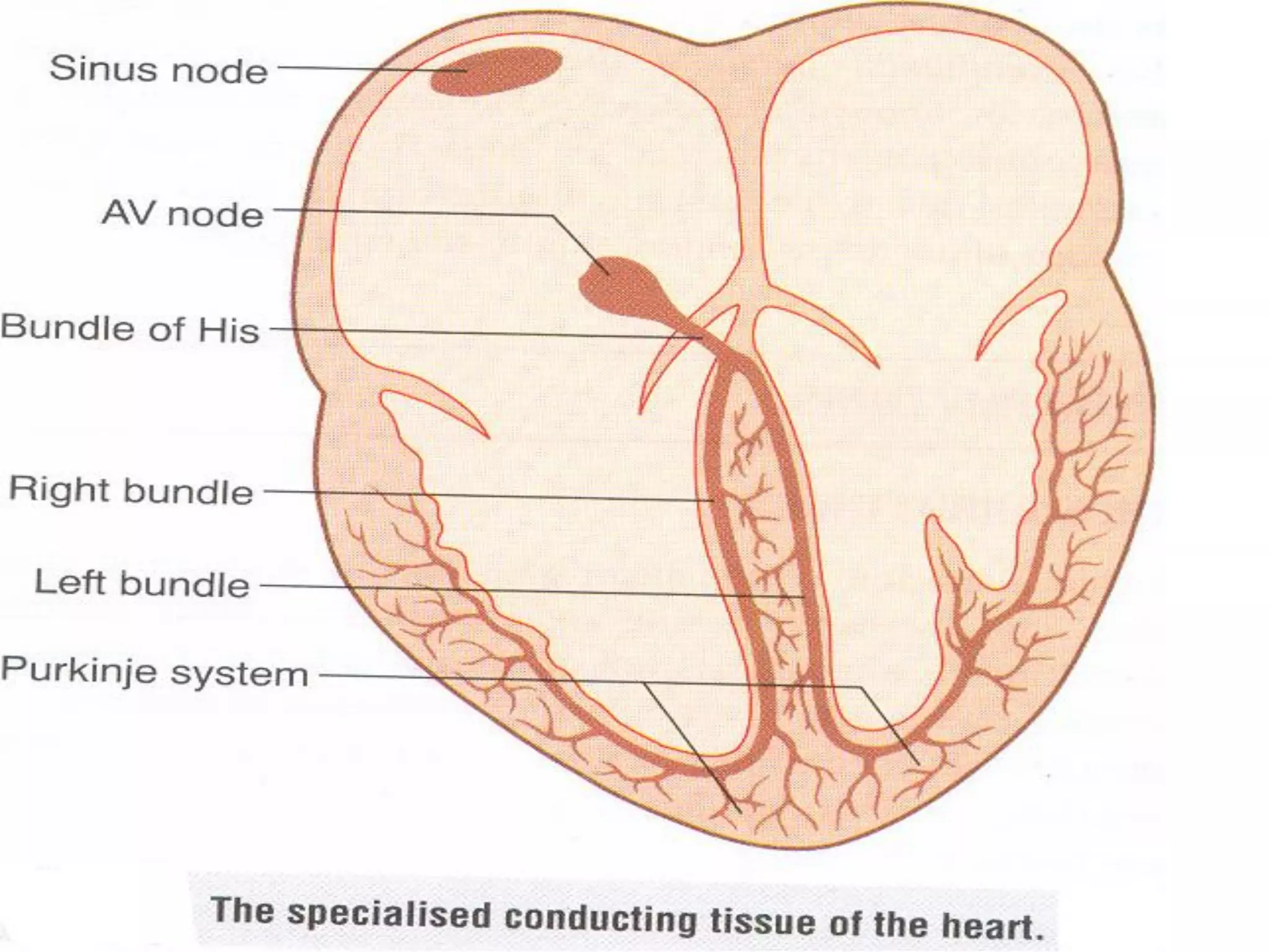
2. Electric circuit of heart

11

3. Waves of ECG

12

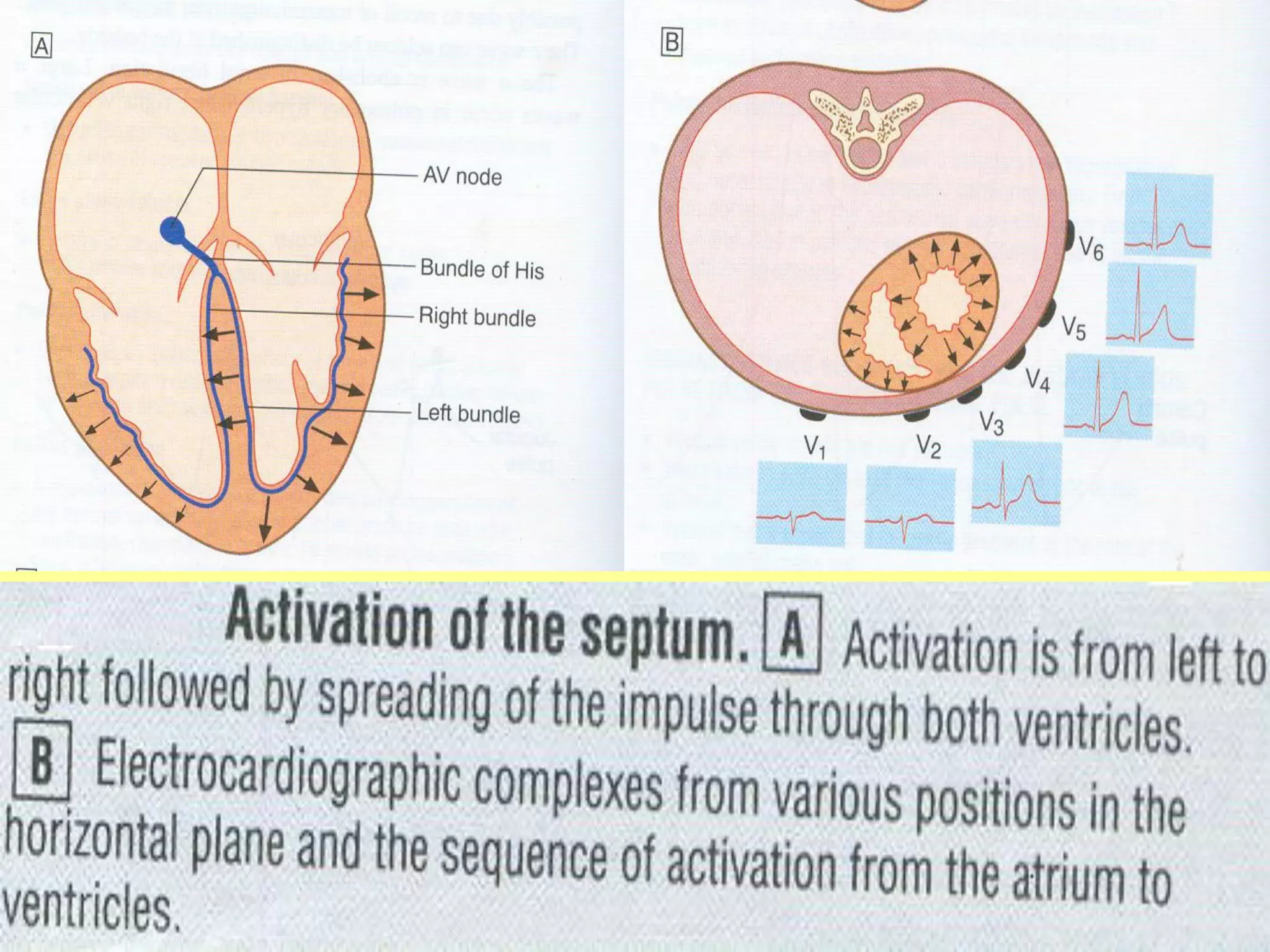
4. Normal ECG of chest leads

13

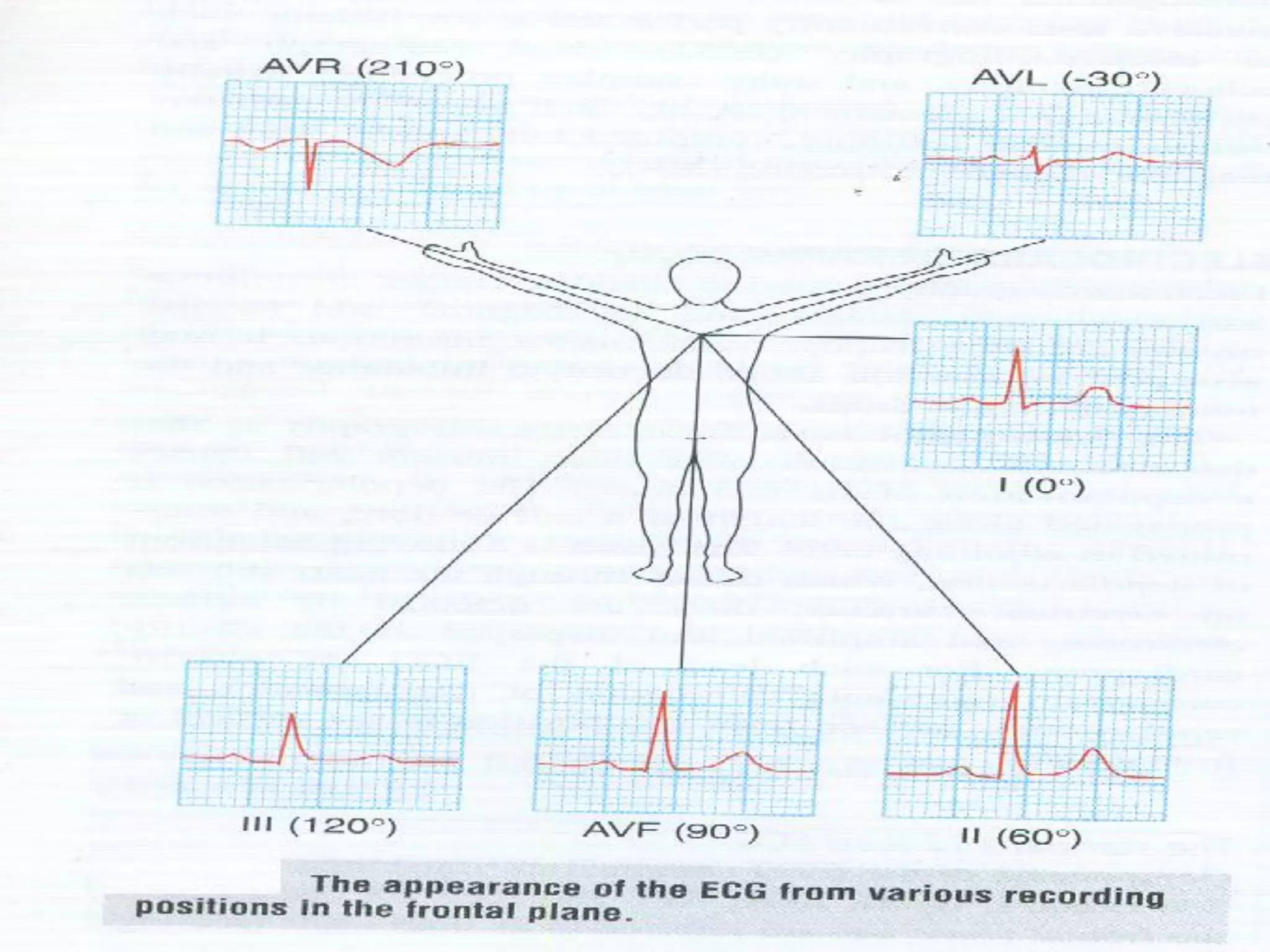
5. ECG of I,II,III,aVR,aVL,aVF leads

14

6. Sinus Rhythm

15 & 16

7. Sinus Bradycardia

17 & 18

8. Sinus Tachycardia

19 to 21

9. Left Axis Deviation

22 & 23

10. Right Axis Deviation

24 to 26
2
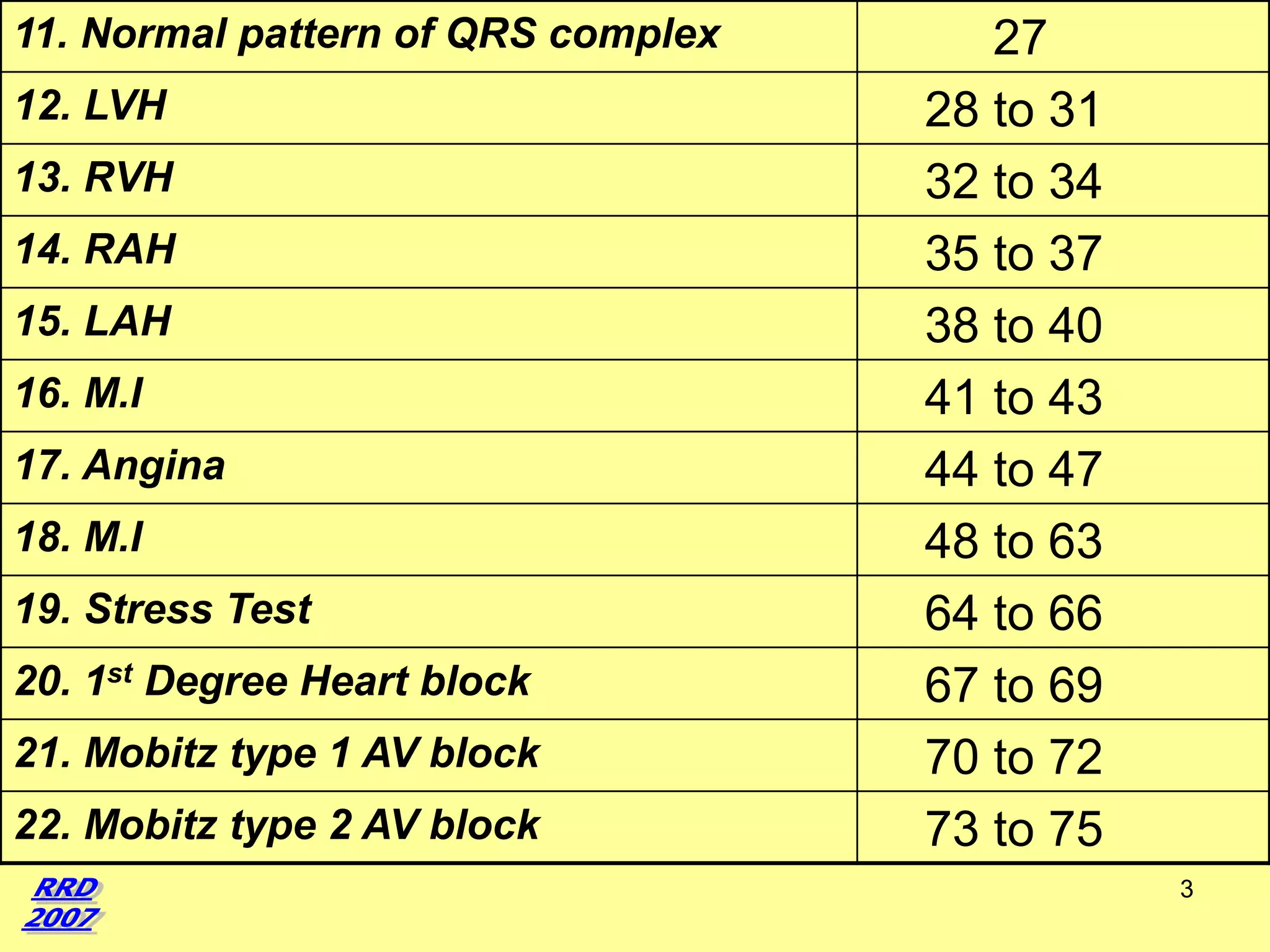
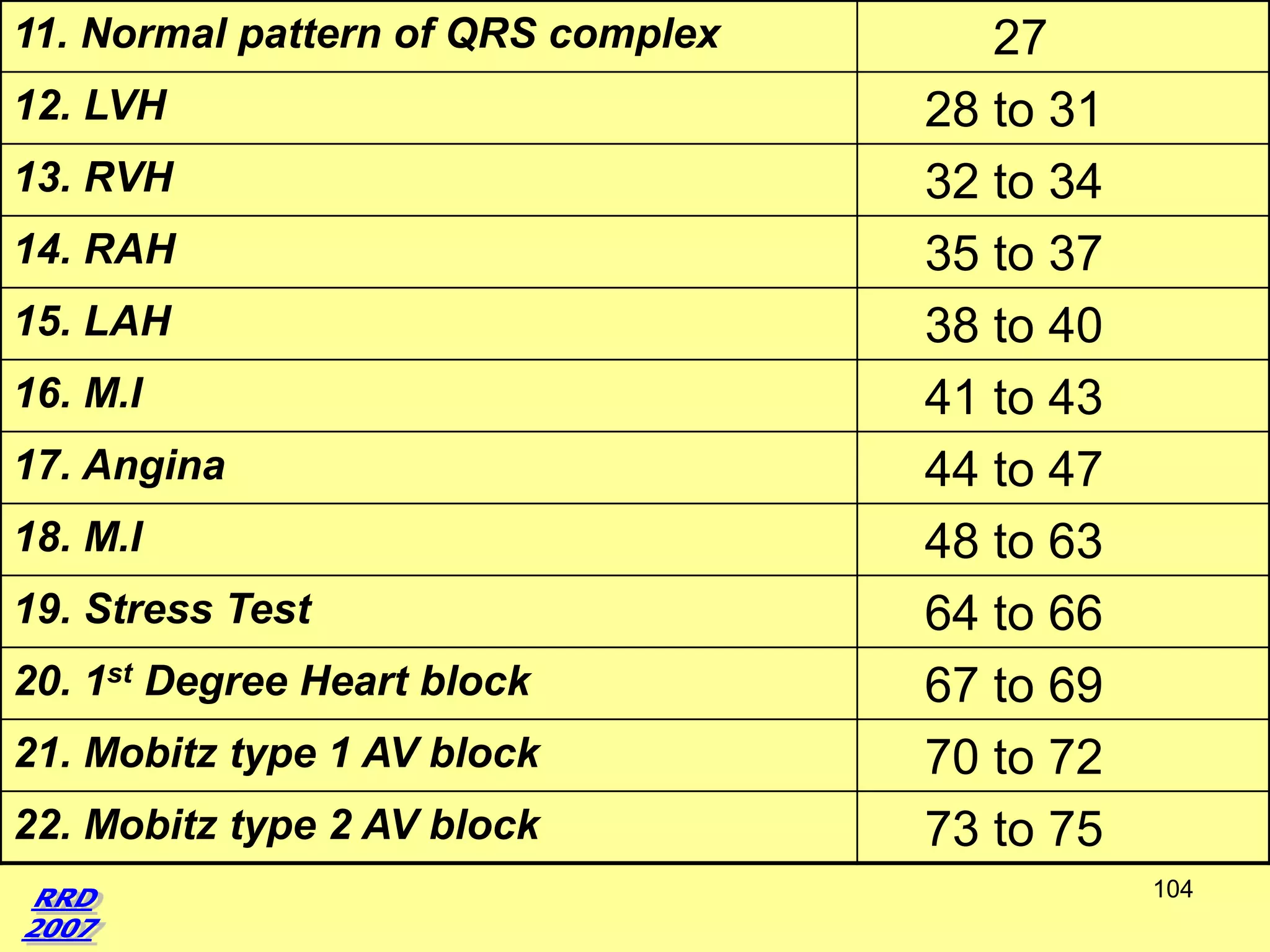
11. Normal pattern of QRS complex

12. LVH
13. RVH
14. RAH
15. LAH
16. M.I

17. Angina
18. M.I
19. Stress Test
20. 1st Degree Heart block
21. Mobitz type 1 AV block
22. Mobitz type 2 AV block

27
28 to 31
32 to 34
35 to 37
38 to 40
41 to 43
44 to 47
48 to 63
64 to 66
67 to 69
70 to 72
73 to 75
3
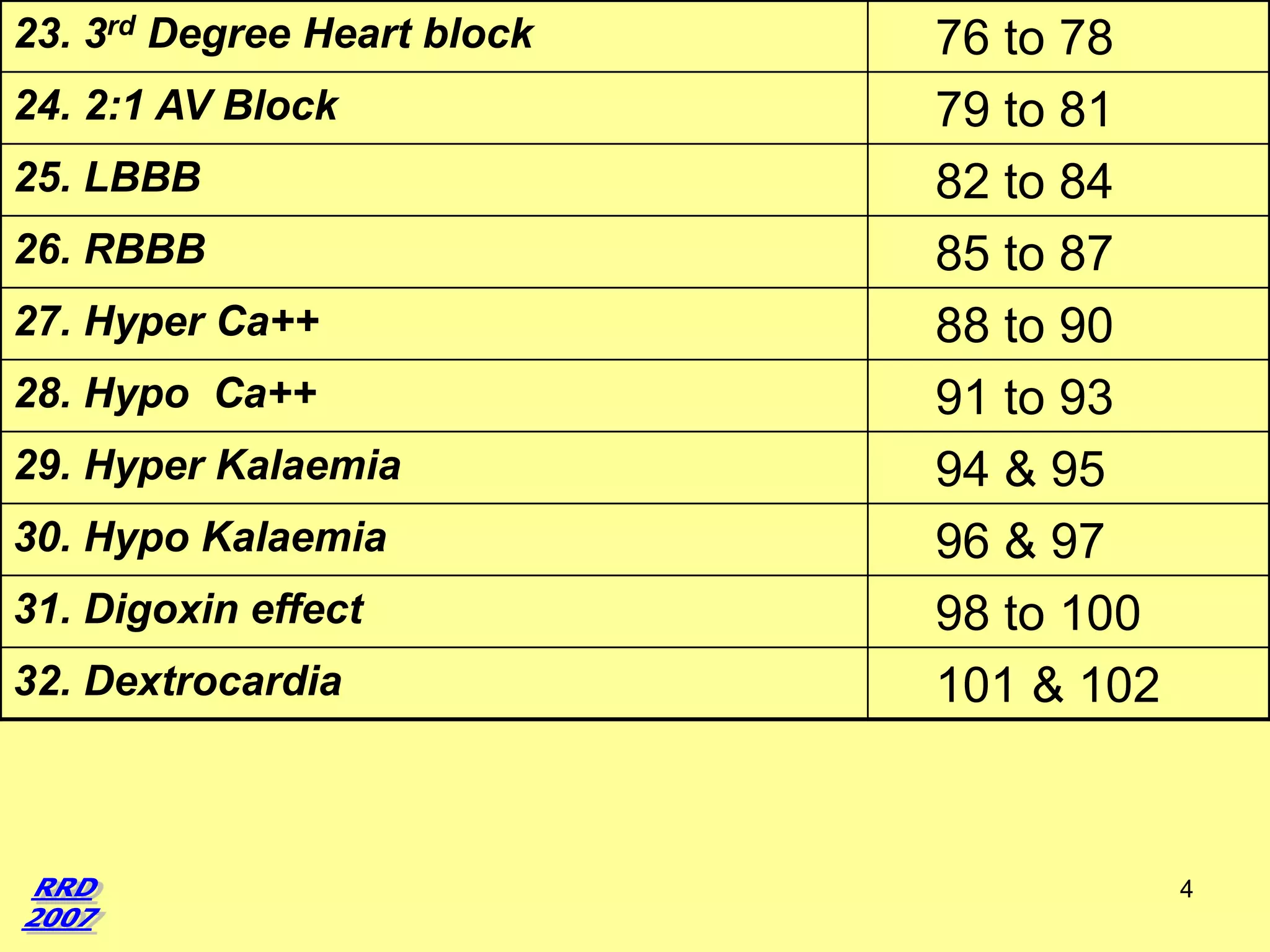
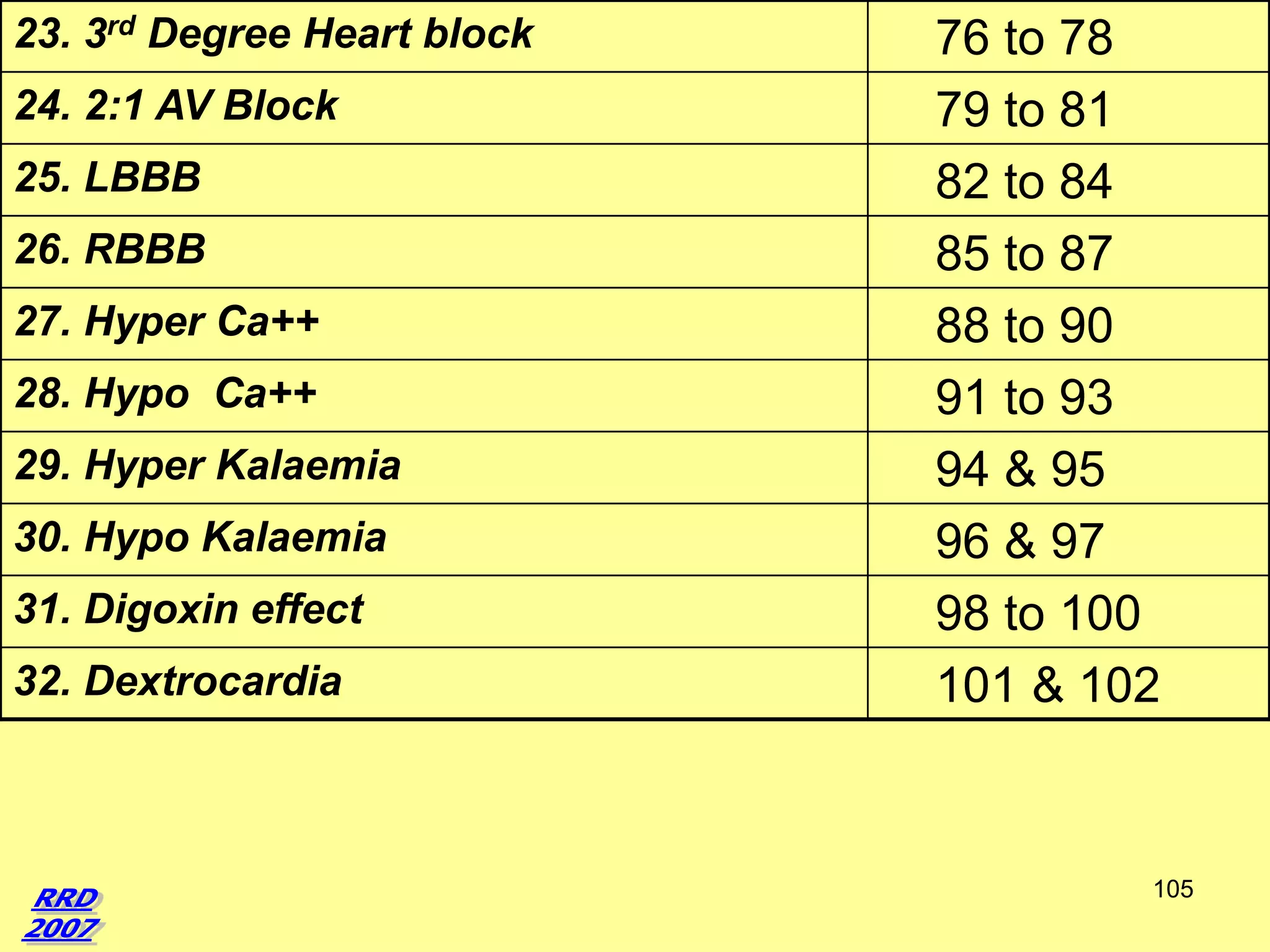
23. 3rd Degree Heart block

24. 2:1 AV Block
25. LBBB
26. RBBB
27. Hyper Ca++
28. Hypo Ca++

29. Hyper Kalaemia
30. Hypo Kalaemia
31. Digoxin effect
32. Dextrocardia

76 to 78
79 to 81
82 to 84
85 to 87
88 to 90
91 to 93
94 & 95
96 & 97
98 to 100
101 & 102

4
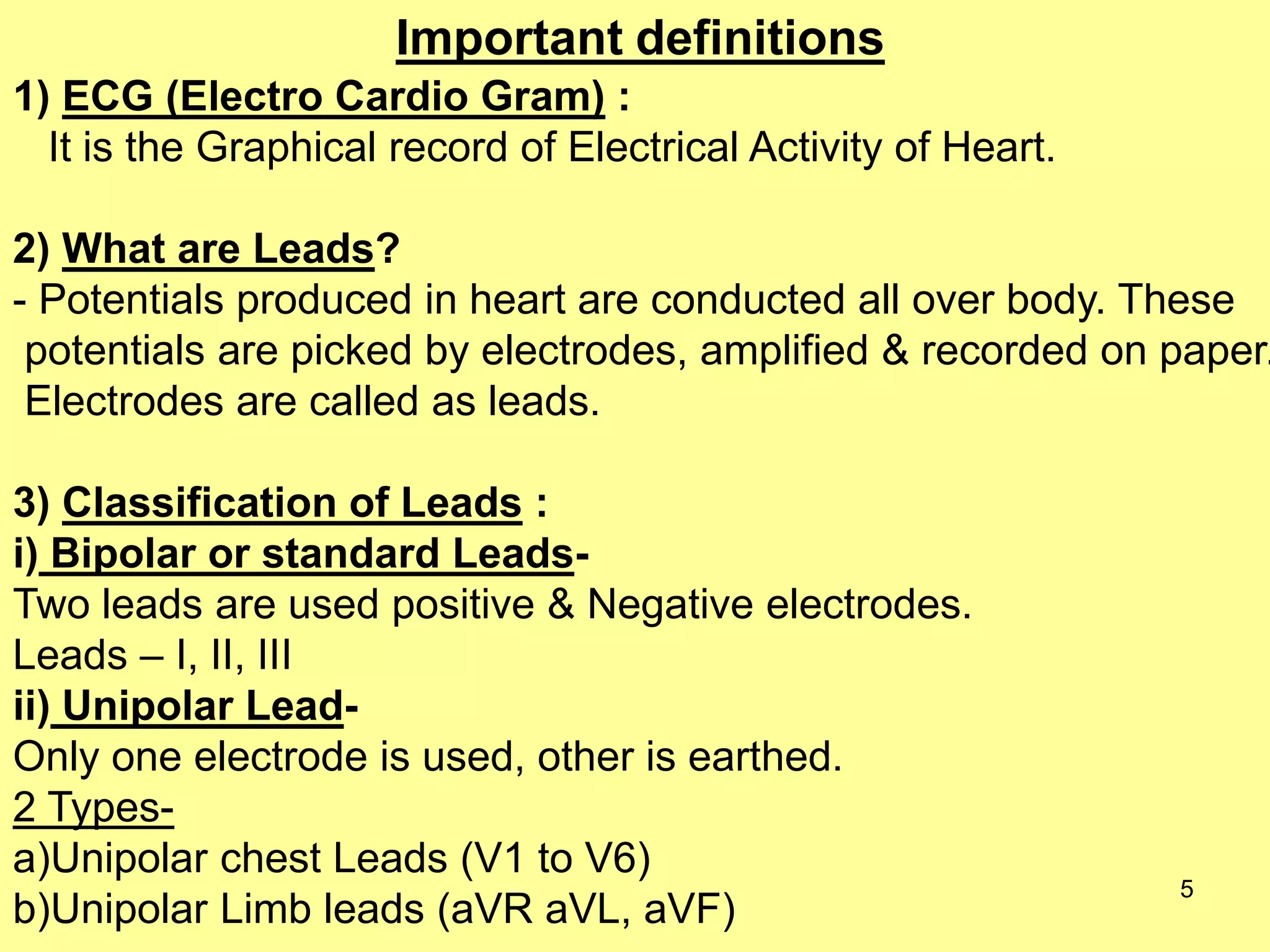
Important definitions
1) ECG (Electro Cardio Gram) :
It is the Graphical record of Electrical Activity of Heart.

2) What are Leads?
- Potentials produced in heart are conducted all over body. These
potentials are picked by electrodes, amplified & recorded on paper.
Electrodes are called as leads.

3) Classification of Leads :
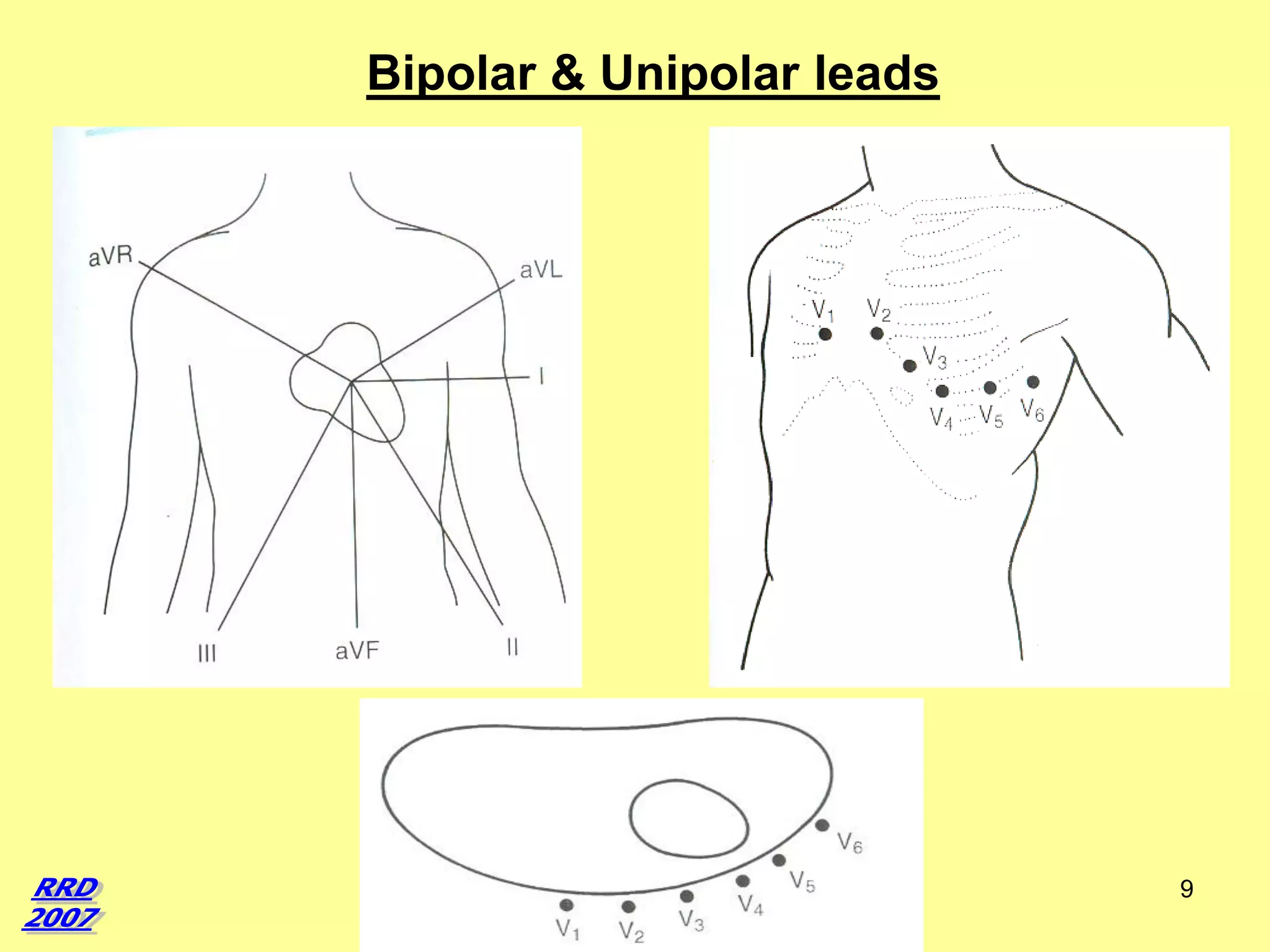
i) Bipolar or standard LeadsTwo leads are used positive & Negative electrodes.
Leads – I, II, III
ii) Unipolar LeadOnly one electrode is used, other is earthed.
2 Typesa)Unipolar chest Leads (V1 to V6)
b)Unipolar Limb leads (aVR aVL, aVF)

5
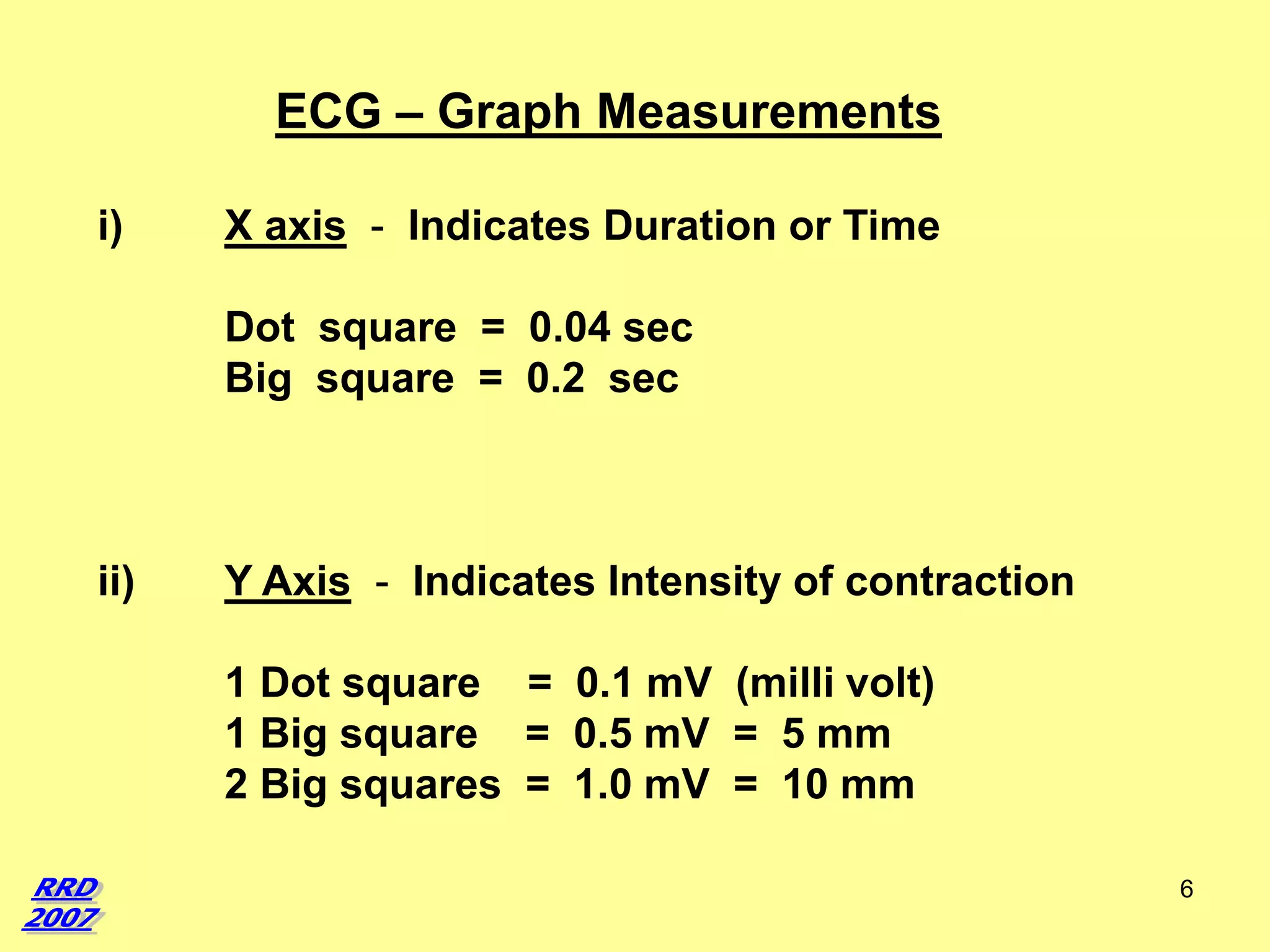
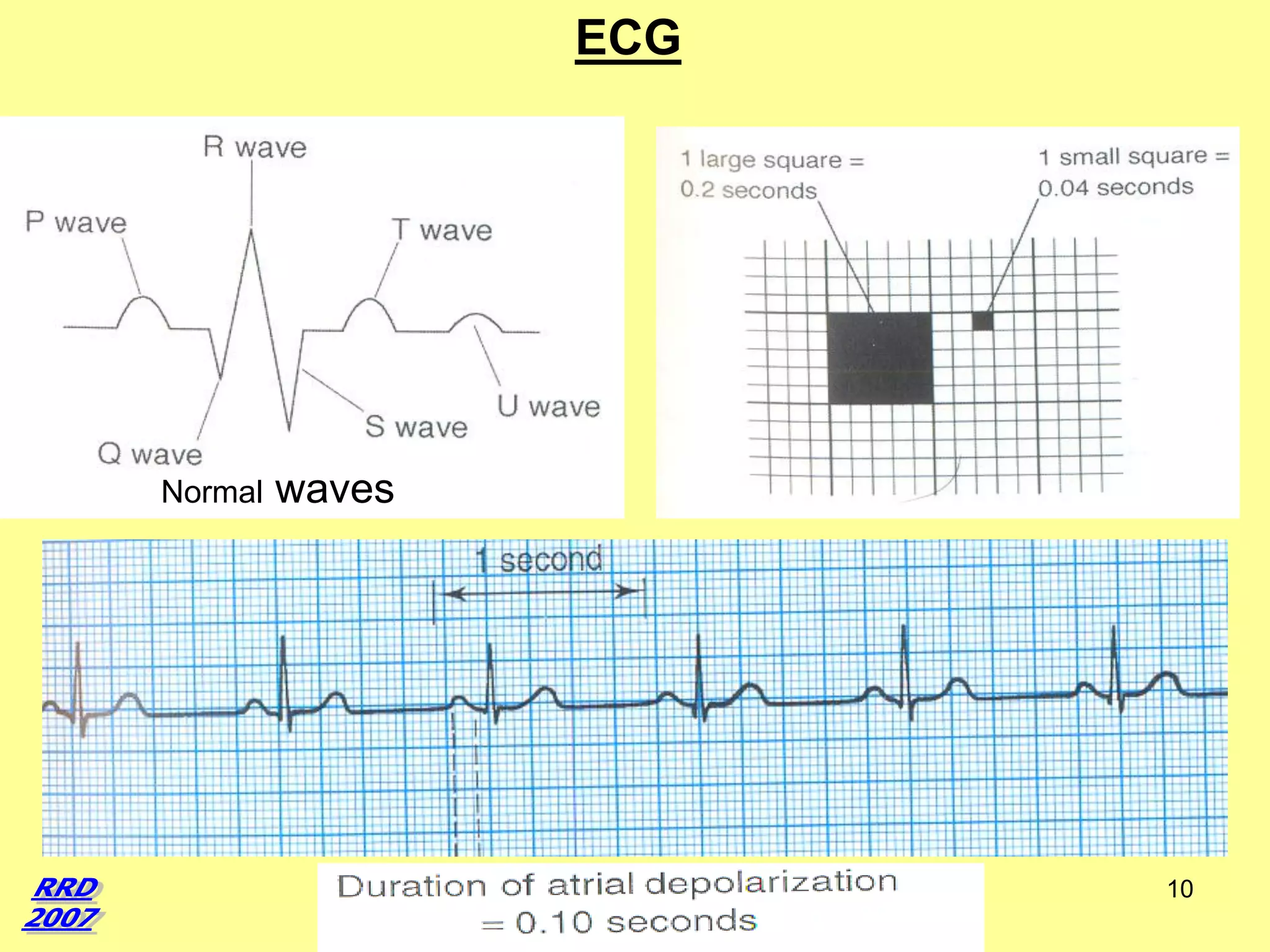
ECG – Graph Measurements
i)

X axis - Indicates Duration or Time
Dot square = 0.04 sec
Big square = 0.2 sec

ii)

Y Axis - Indicates Intensity of contraction
1 Dot square = 0.1 mV (milli volt)
1 Big square = 0.5 mV = 5 mm
2 Big squares = 1.0 mV = 10 mm
6
1)

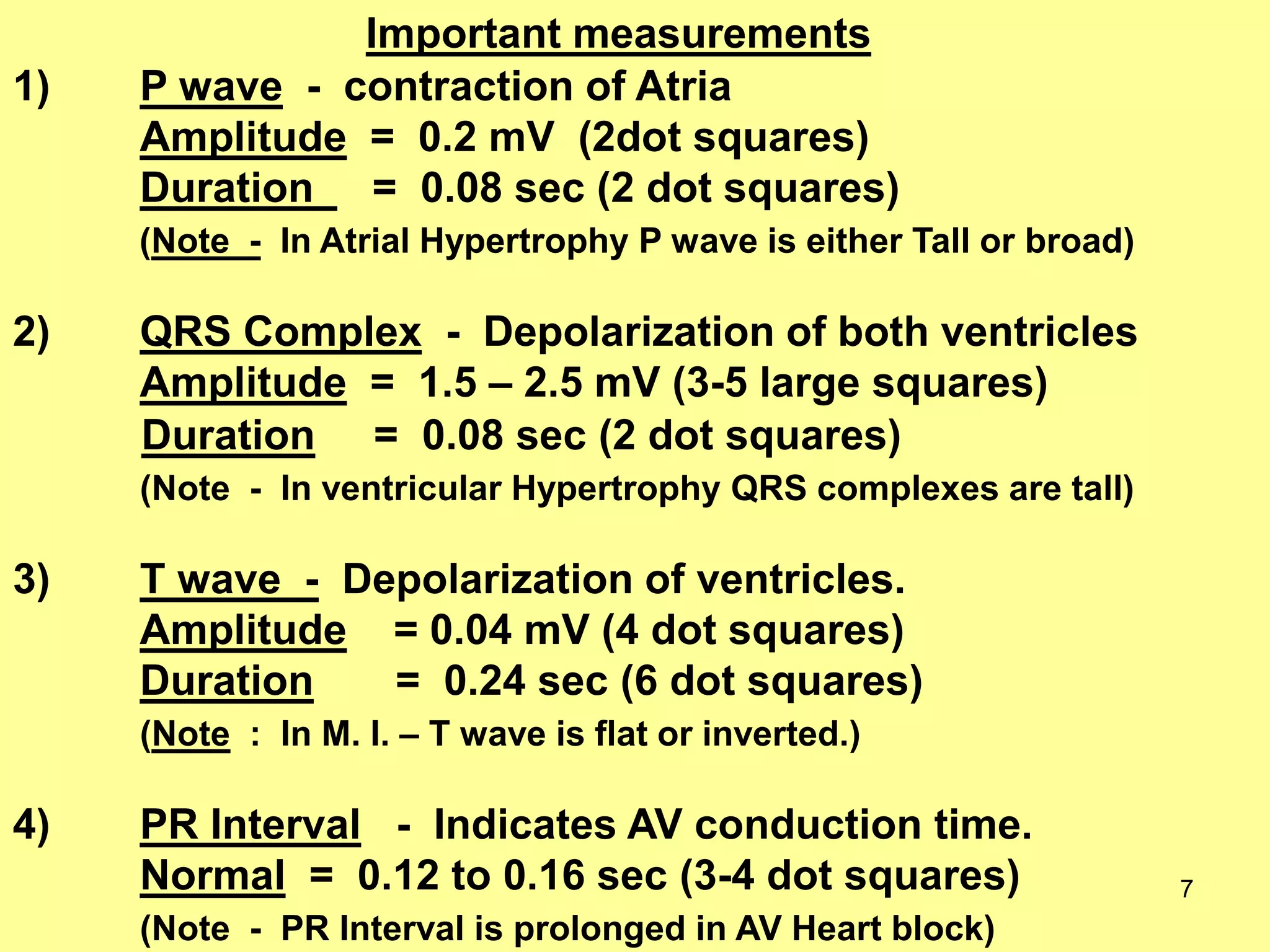
Important measurements
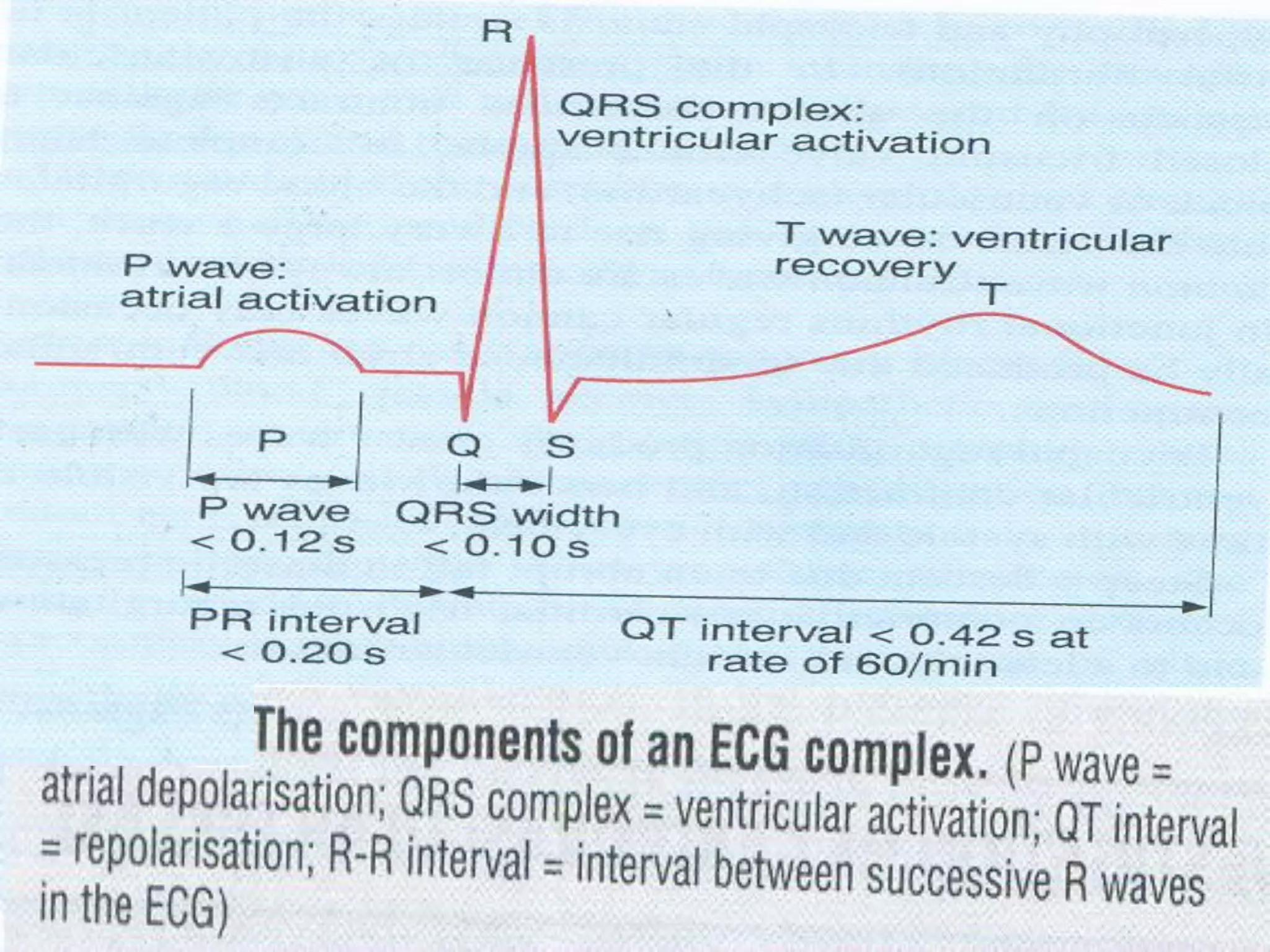
P wave - contraction of Atria
Amplitude = 0.2 mV (2dot squares)
Duration = 0.08 sec (2 dot squares)
(Note - In Atrial Hypertrophy P wave is either Tall or broad)

2)

QRS Complex - Depolarization of both ventricles
Amplitude = 1.5 – 2.5 mV (3-5 large squares)
Duration = 0.08 sec (2 dot squares)
(Note - In ventricular Hypertrophy QRS complexes are tall)

3)

T wave - Depolarization of ventricles.
Amplitude = 0.04 mV (4 dot squares)
Duration
= 0.24 sec (6 dot squares)
(Note : In M. I. – T wave is flat or inverted.)

4)

PR Interval - Indicates AV conduction time.
Normal = 0.12 to 0.16 sec (3-4 dot squares)
(Note - PR Interval is prolonged in AV Heart block)

7
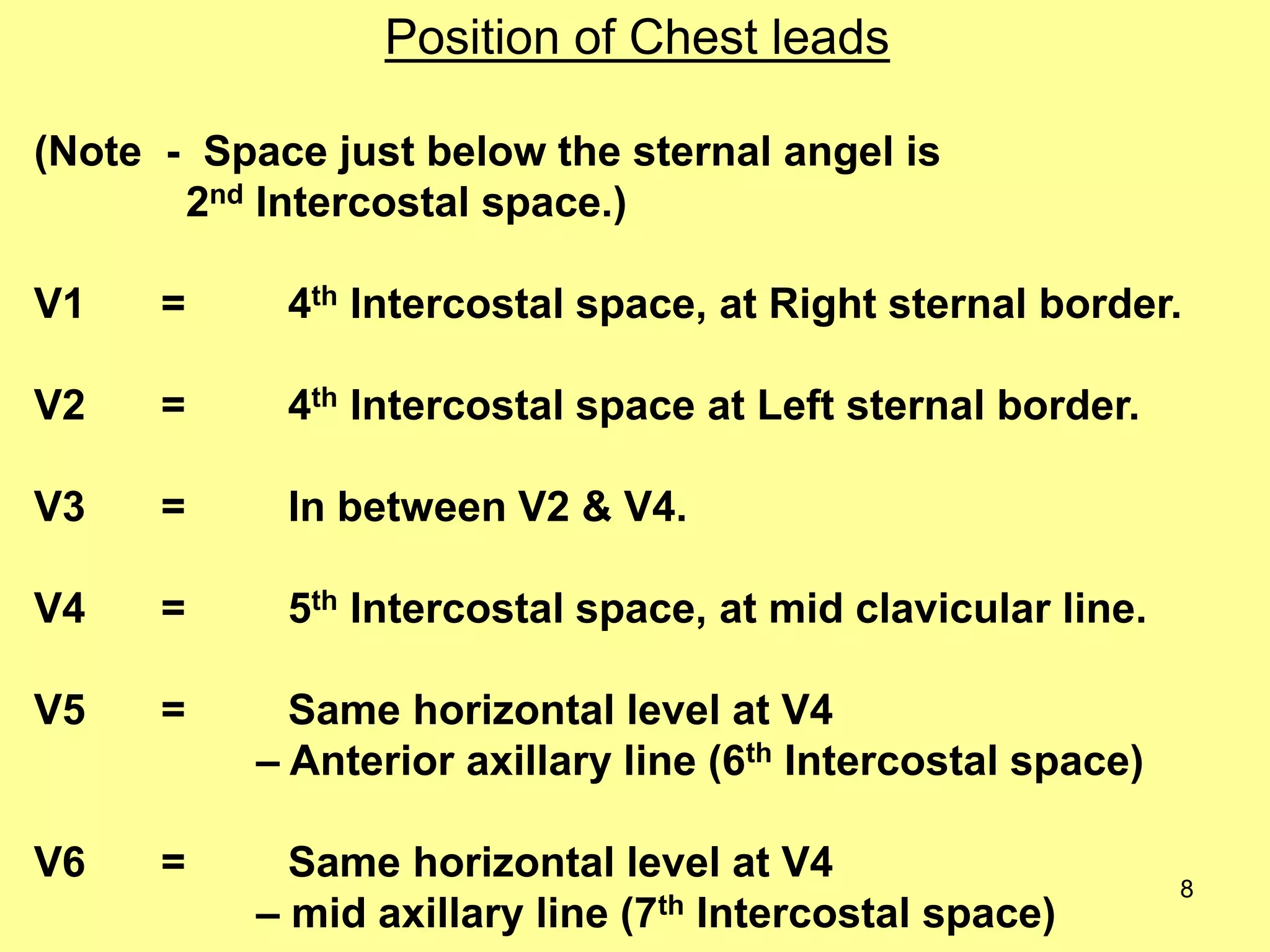
Position of Chest leads
(Note - Space just below the sternal angel is
2nd Intercostal space.)

V1

=

4th Intercostal space, at Right sternal border.

V2

=

4th Intercostal space at Left sternal border.

V3

=

In between V2 & V4.

V4

=

5th Intercostal space, at mid clavicular line.

V5

=

Same horizontal level at V4
– Anterior axillary line (6th Intercostal space)

V6

=

Same horizontal level at V4
– mid axillary line (7th Intercostal space)

8
Bipolar & Unipolar leads

9
ECG

Normal

waves

10
11
12
13
14
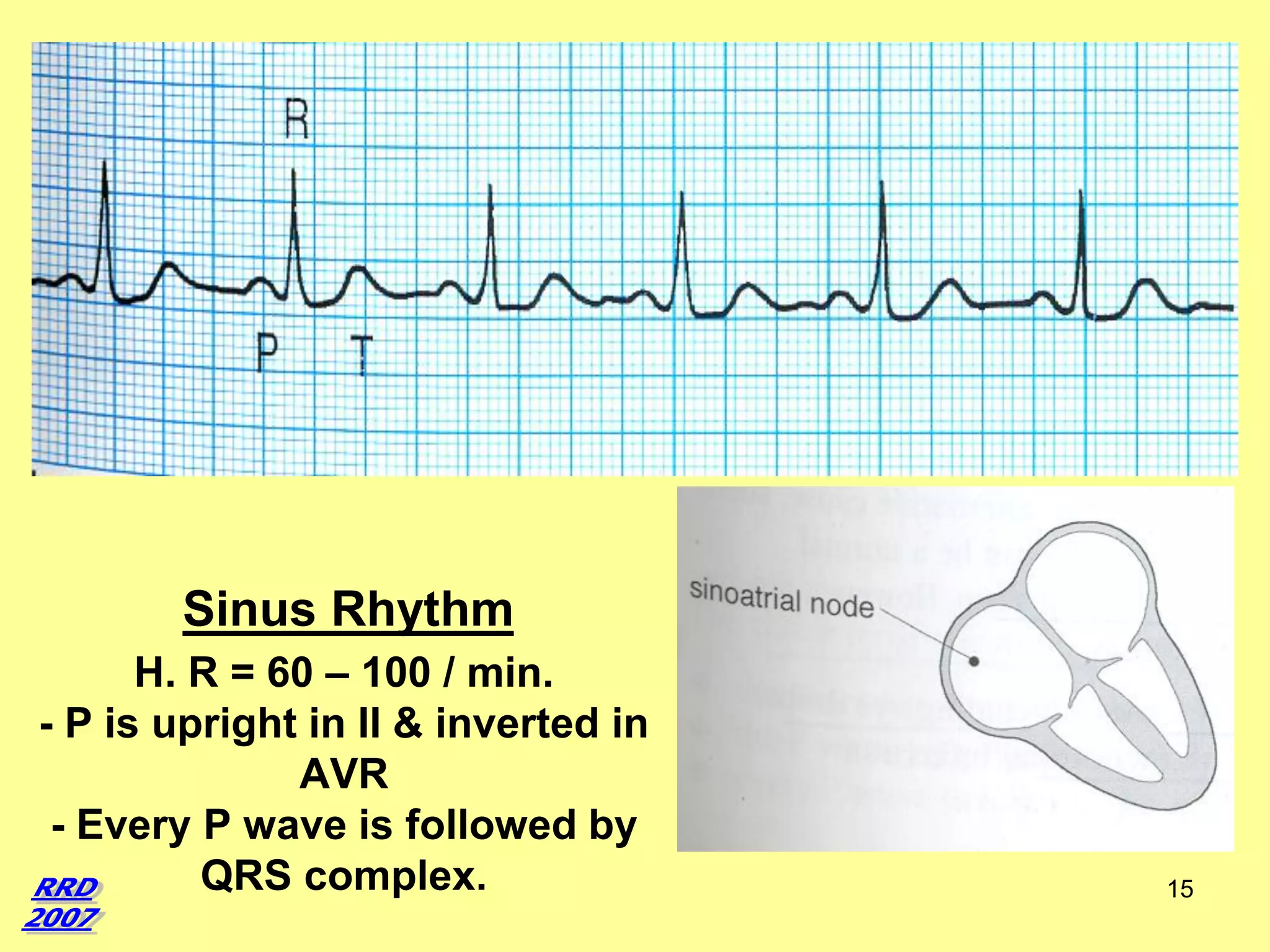
Sinus Rhythm
H. R = 60 – 100 / min.
- P is upright in II & inverted in
AVR
- Every P wave is followed by
QRS complex.

15
Sinus Rhythm
- Normal cardiac Rhythm in which SA Node acts as
Natural Pacemaker, discharging 60 – 100 times / min.
- H.R. - 60 – 100 / min.

- P is upright in II & inverted in aVR
- Every P wave is followed by QRS complex.

16
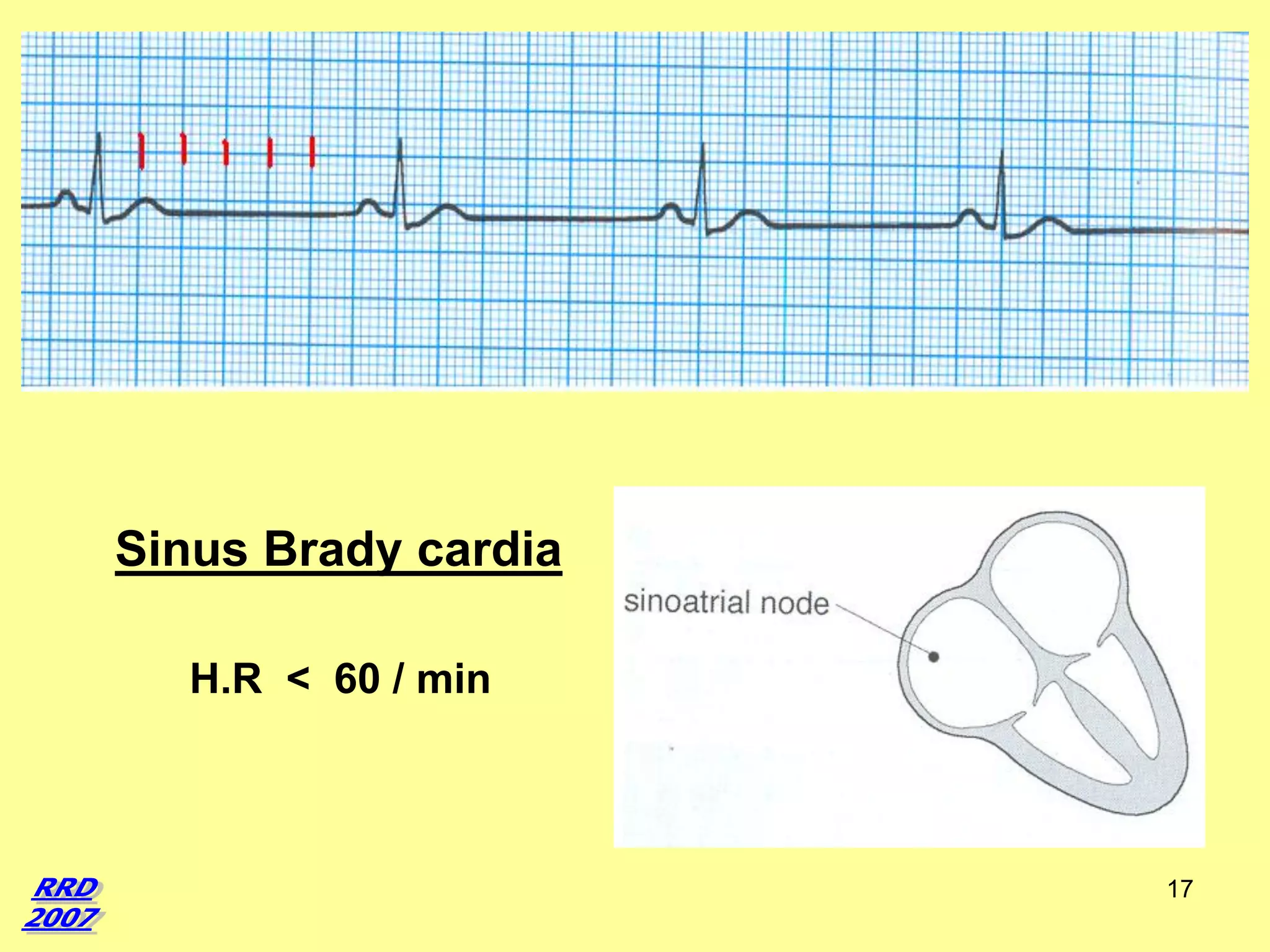
Sinus Brady cardia
H.R < 60 / min

17
-

Sinus Bradycardia
H. R. < 60/min.
P is upright in II & inverted in aVR
Every P wave is followed by QRS.
Unusual - sinus Bradycardia < 40/min.
( Consider – Heart Block)
Normal in athletes or during sleep.

-

Other causes –

-

Drugs - Digoxin, Beta blockers (Including Eye drops)
IHD or M.I.
Hypothyroidism.
Hypothermia
Electrolyte abnormalities.
Obstructive Jaundice
Uraemia
Raised Intracranial pressure
18
Sick sinus syndrome.

-
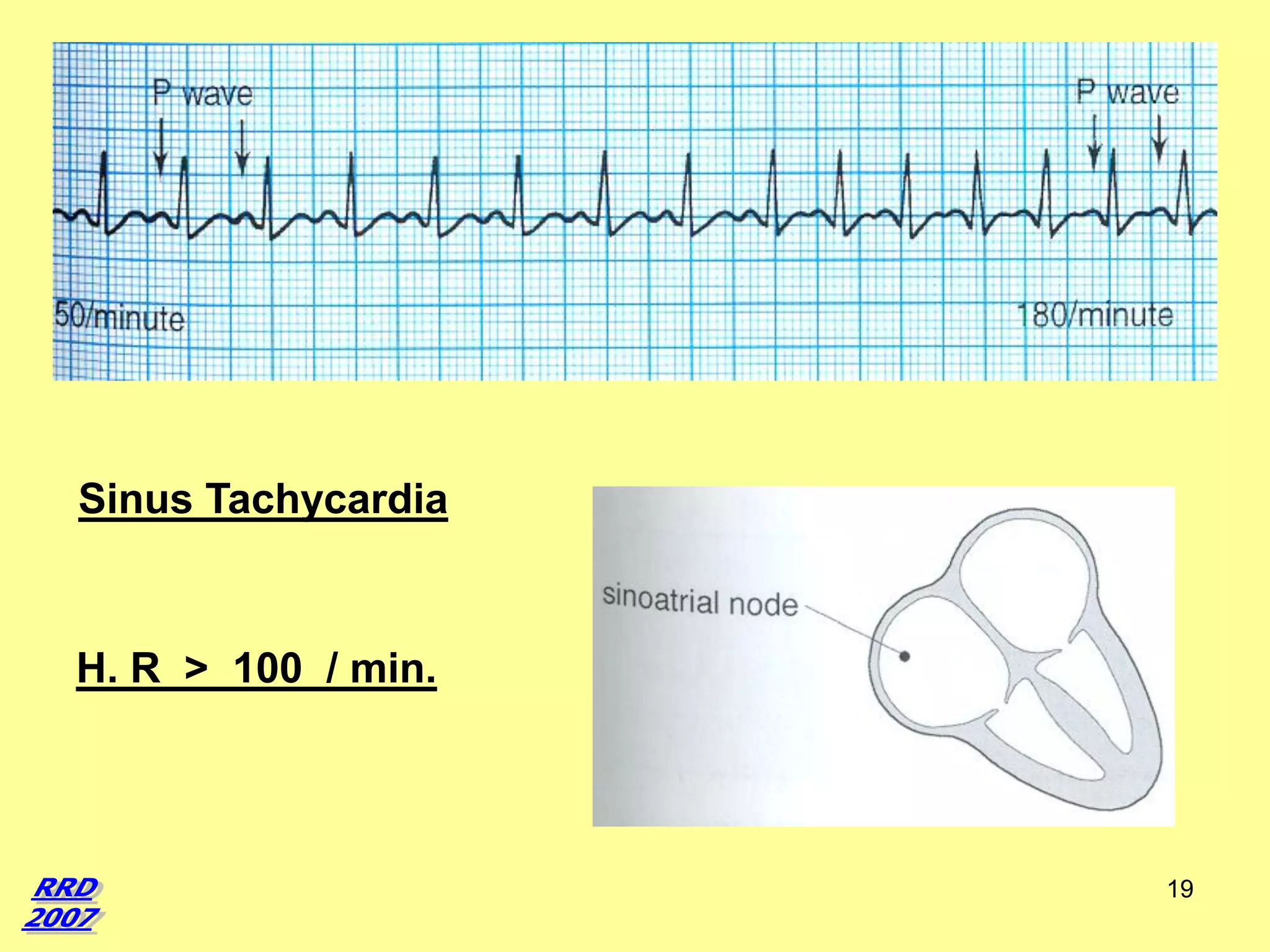
Sinus Tachycardia

H. R > 100 / min.

19
Sinus Tachycardia
-H. R. > 100 / min.
-P upright in II & Inverted in aVR
-Every P wave is followed by QRS.
 Rare, that sinus Tachycardia > 180 / min.
(Difficult to differentiate P wave from T waves –
Rhythm can be mistaken for AV nodal Re-entry Tachycardia.)

 Physiological causes:
(Anything which stimulate sympathetic N. S. –
Anxiety, Pain, Fever, Exercise.)
 Other causes
- Drugs - Adrenaline, Atropine, Salbutamol (Inhalers & Nebulizers),
Caffeins & Alcohol.
- IHD or Acute M. I.
- Heart failure
- Fluid Loss
- Anemia
- Hyperthyroidism.

20
If Appropriate Tachycardia • (Compensating for Low Bp e.g. Fluid Loss / Anemia) –
• with β blockers is Dangerous.
But,
•If sinus Tachycardia is
Inappropriate (Anxiety or Hyperthyroidism) –
with β blocker is O. K.
•Warning :
•In sinus Tachycardia
• - Never use β blocker to slow the Heart Rate unless you establish the cause.

21
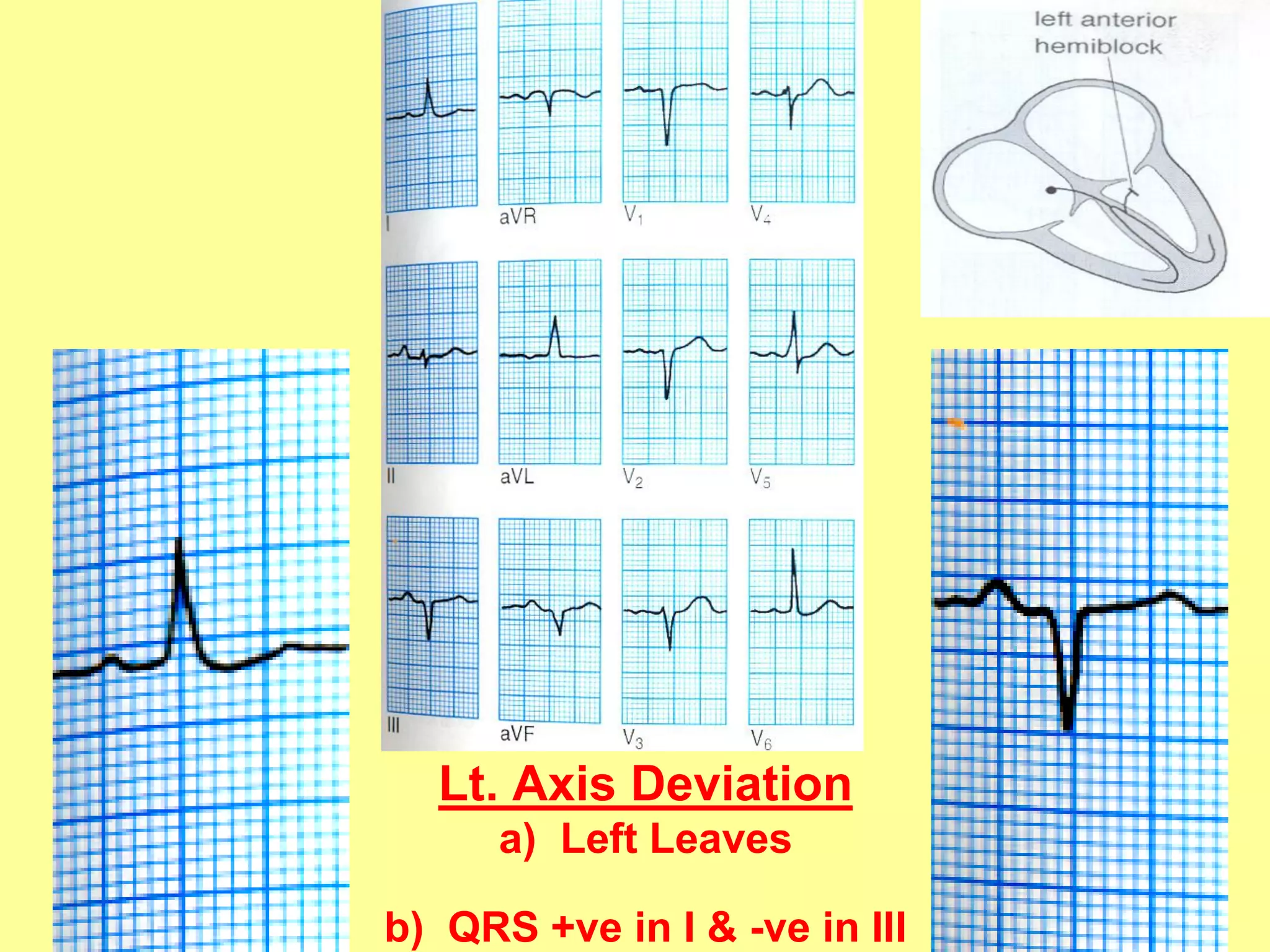
Lt. Axis Deviation
a) Left Leaves
22

b) QRS +ve in I & -ve in III
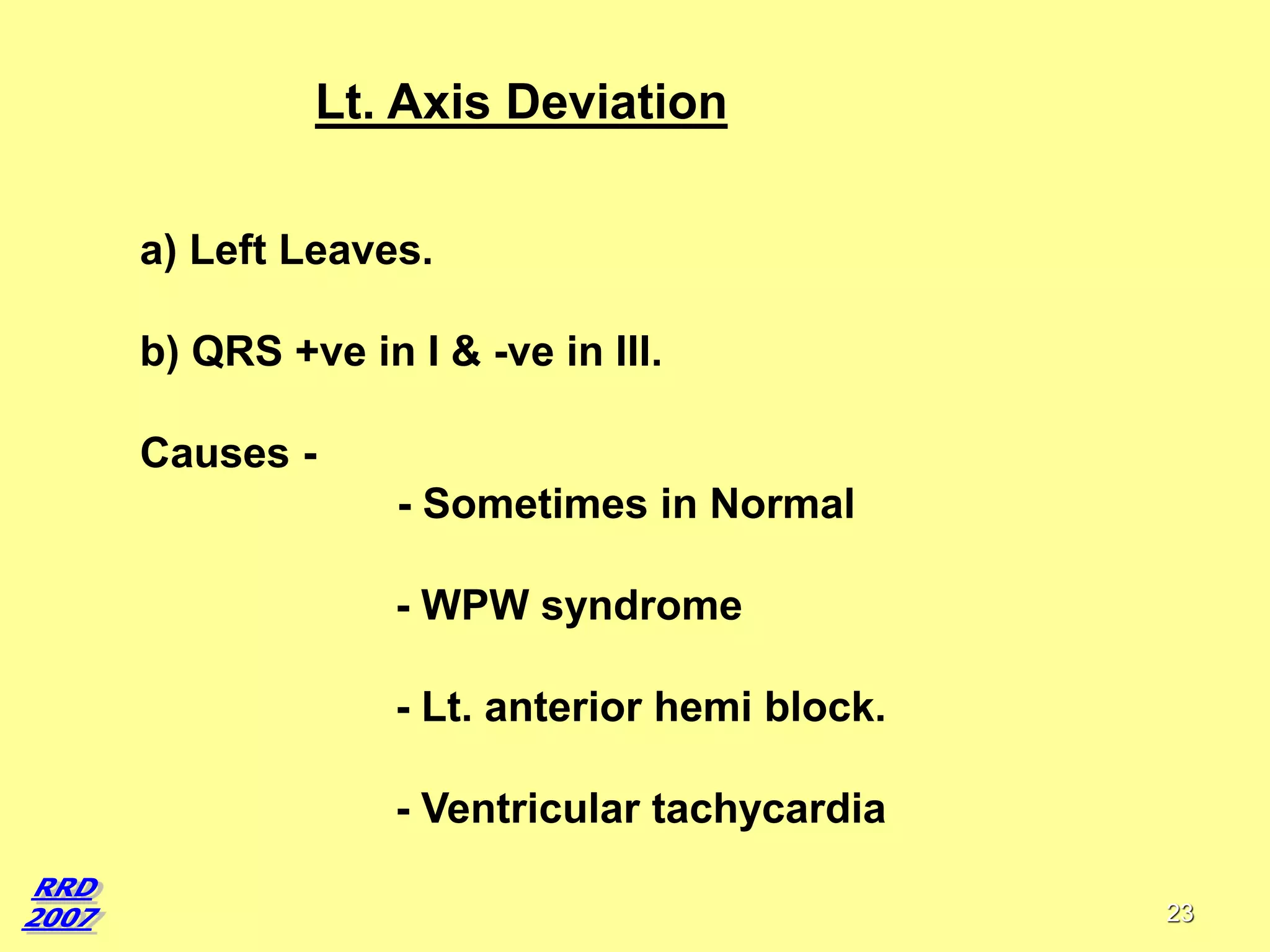
Lt. Axis Deviation
a) Left Leaves.
b) QRS +ve in I & -ve in III.

Causes - Sometimes in Normal
- WPW syndrome
- Lt. anterior hemi block.
- Ventricular tachycardia
23
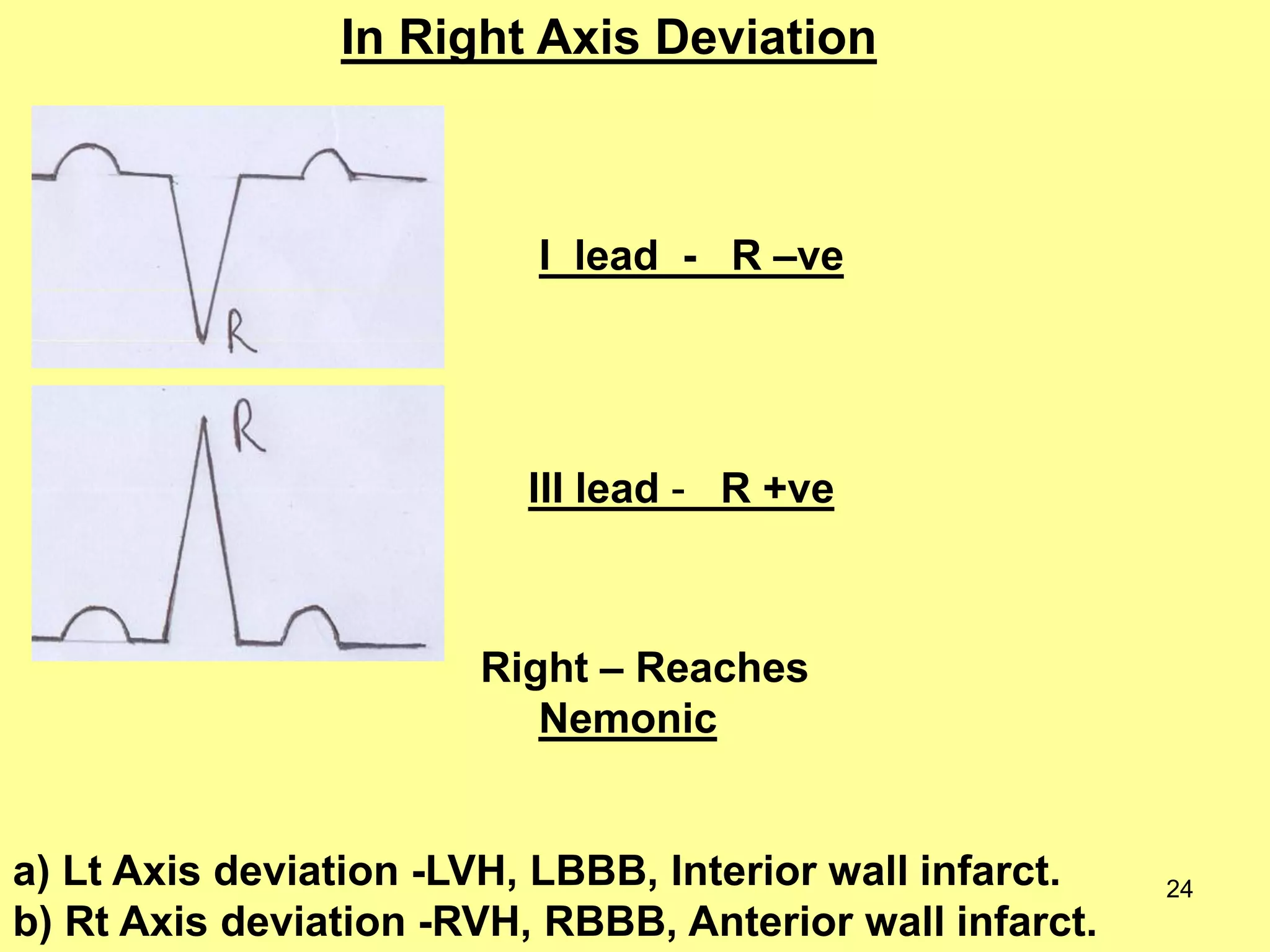
In Right Axis Deviation

I lead - R –ve

III lead - R +ve

Right – Reaches
Nemonic

a) Lt Axis deviation -LVH, LBBB, Interior wall infarct.
b) Rt Axis deviation -RVH, RBBB, Anterior wall infarct.

24
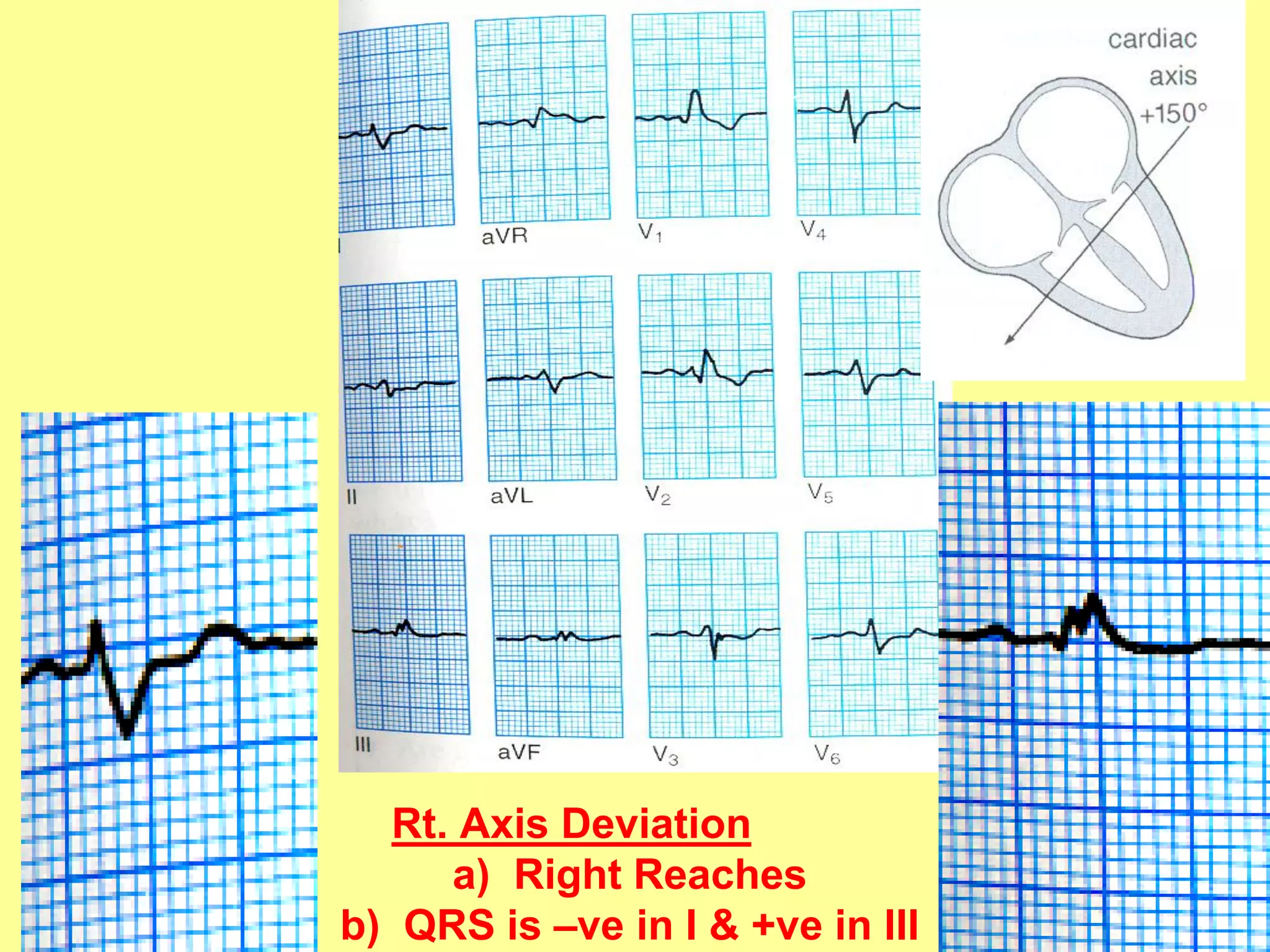
Rt. Axis Deviation
a) Right Reaches
b) QRS is –ve in I & +ve in III

25
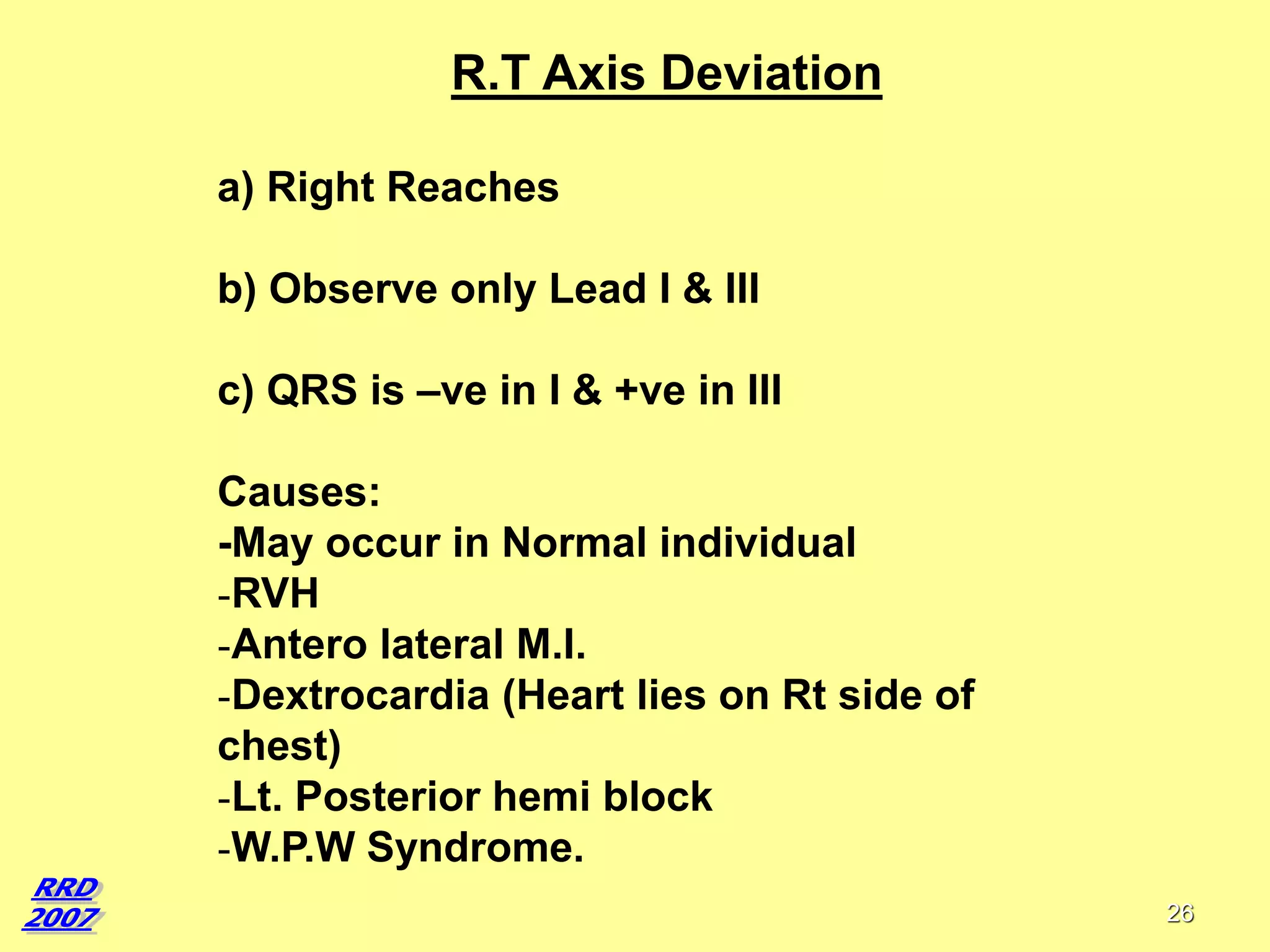
R.T Axis Deviation
a) Right Reaches
b) Observe only Lead I & III
c) QRS is –ve in I & +ve in III
Causes:
-May occur in Normal individual
-RVH
-Antero lateral M.I.
-Dextrocardia (Heart lies on Rt side of
chest)
-Lt. Posterior hemi block
-W.P.W Syndrome.
26
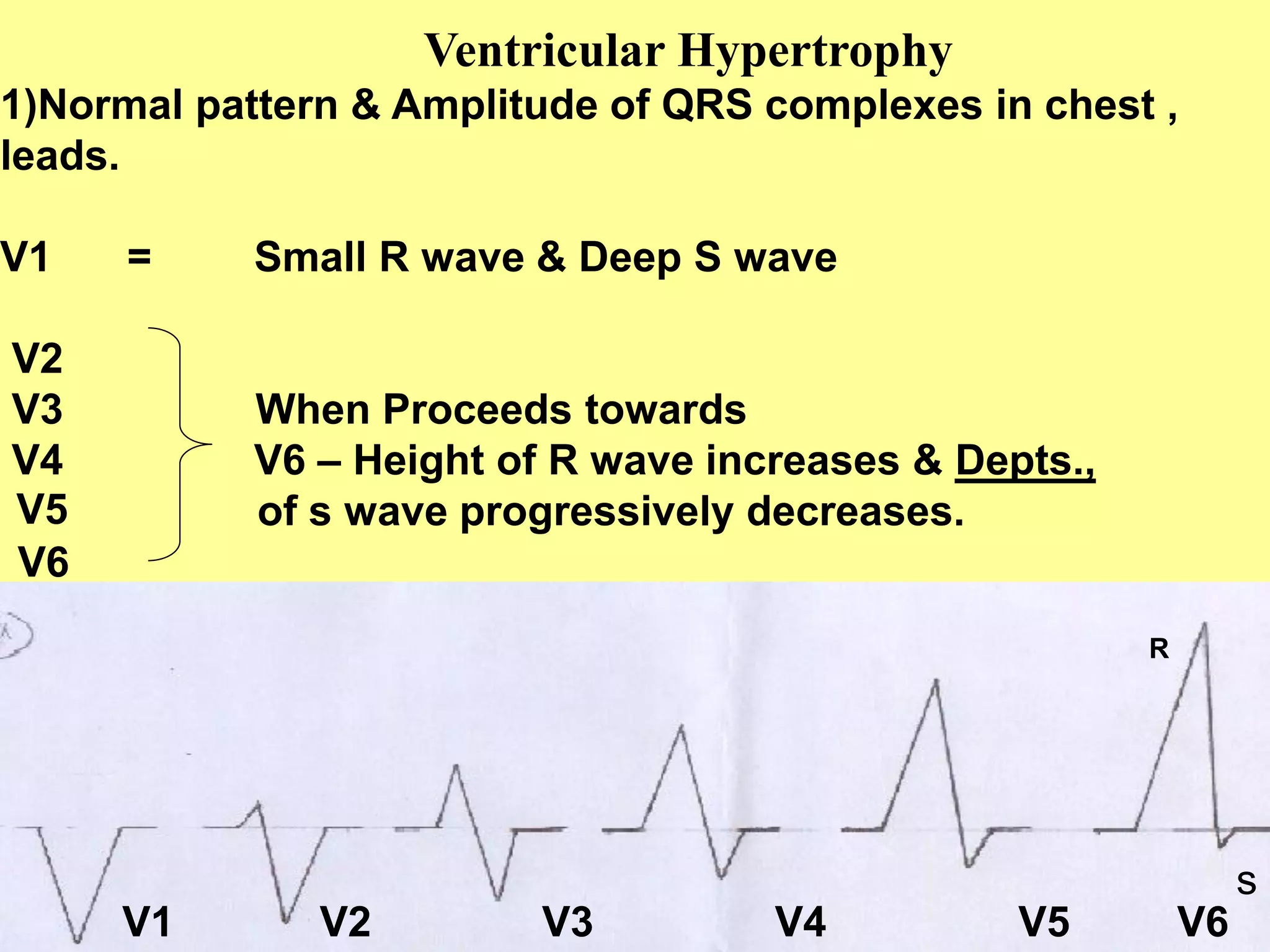
Ventricular Hypertrophy
1)Normal pattern & Amplitude of QRS complexes in chest ,
leads.
V1

=

V2
V3
V4
V5
V6

Small R wave & Deep S wave

When Proceeds towards
V6 – Height of R wave increases & Depts.,
of s wave progressively decreases.
R

27

V1

V2

V3

V4

V5

V6

s
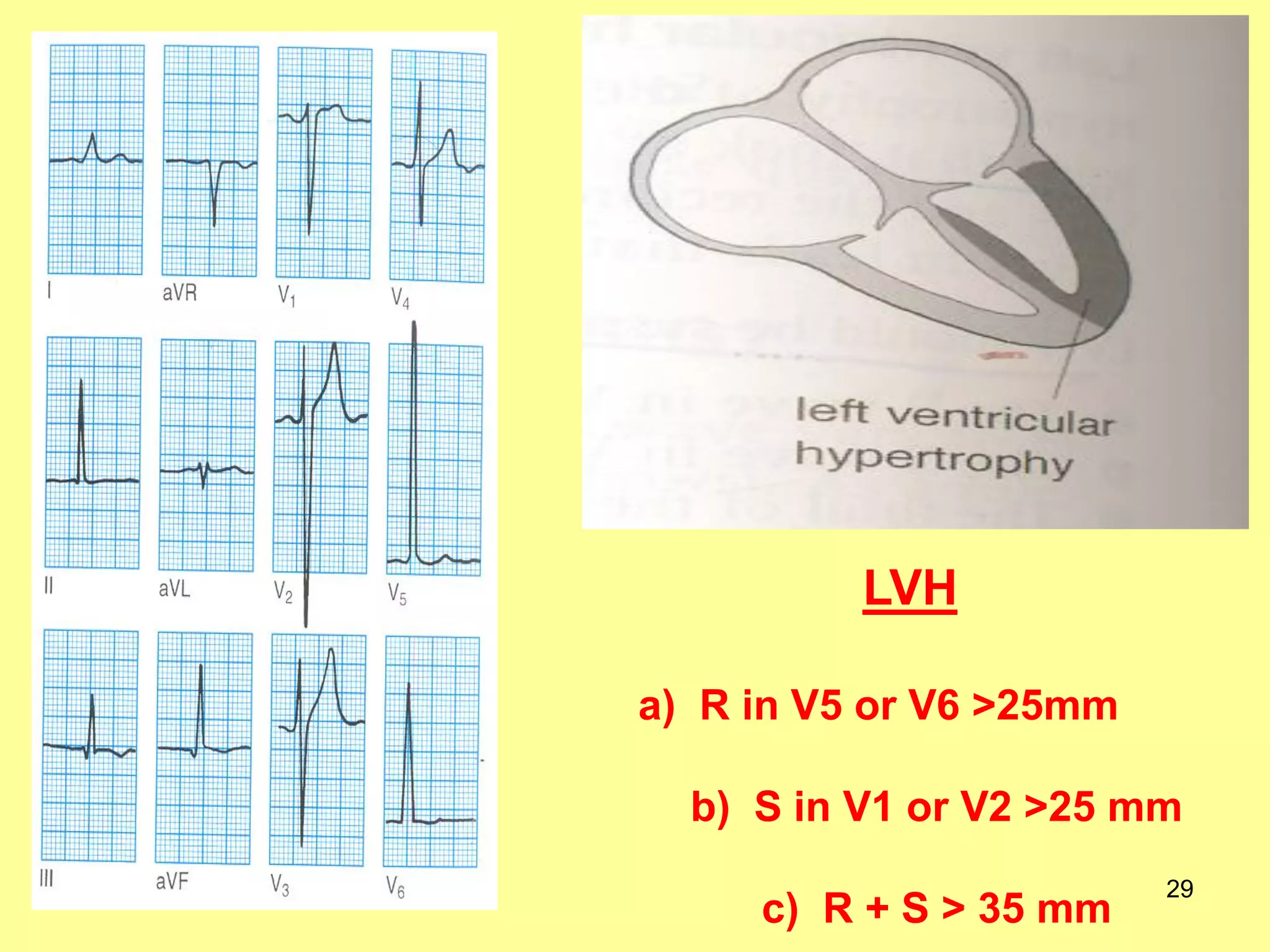
LVH

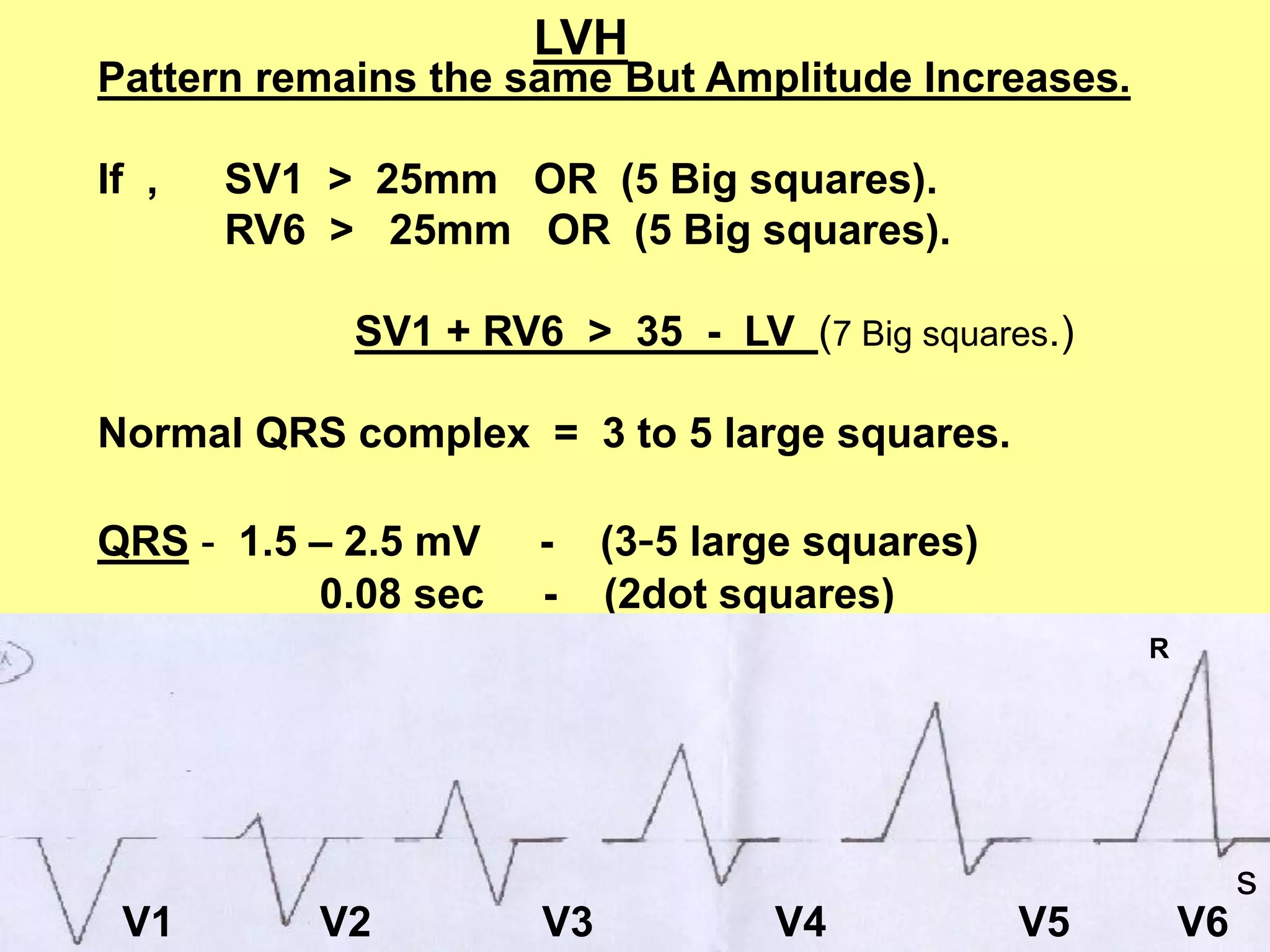
Pattern remains the same But Amplitude Increases.
If ,

SV1 > 25mm OR (5 Big squares).
RV6 > 25mm OR (5 Big squares).
SV1 + RV6 > 35 - LV (7 Big squares.)

Normal QRS complex = 3 to 5 large squares.
QRS - 1.5 – 2.5 mV
0.08 sec

-

(3-5 large squares)
(2dot squares)
R

28

V1

V2

V3

V4

V5

V6

s
LVH
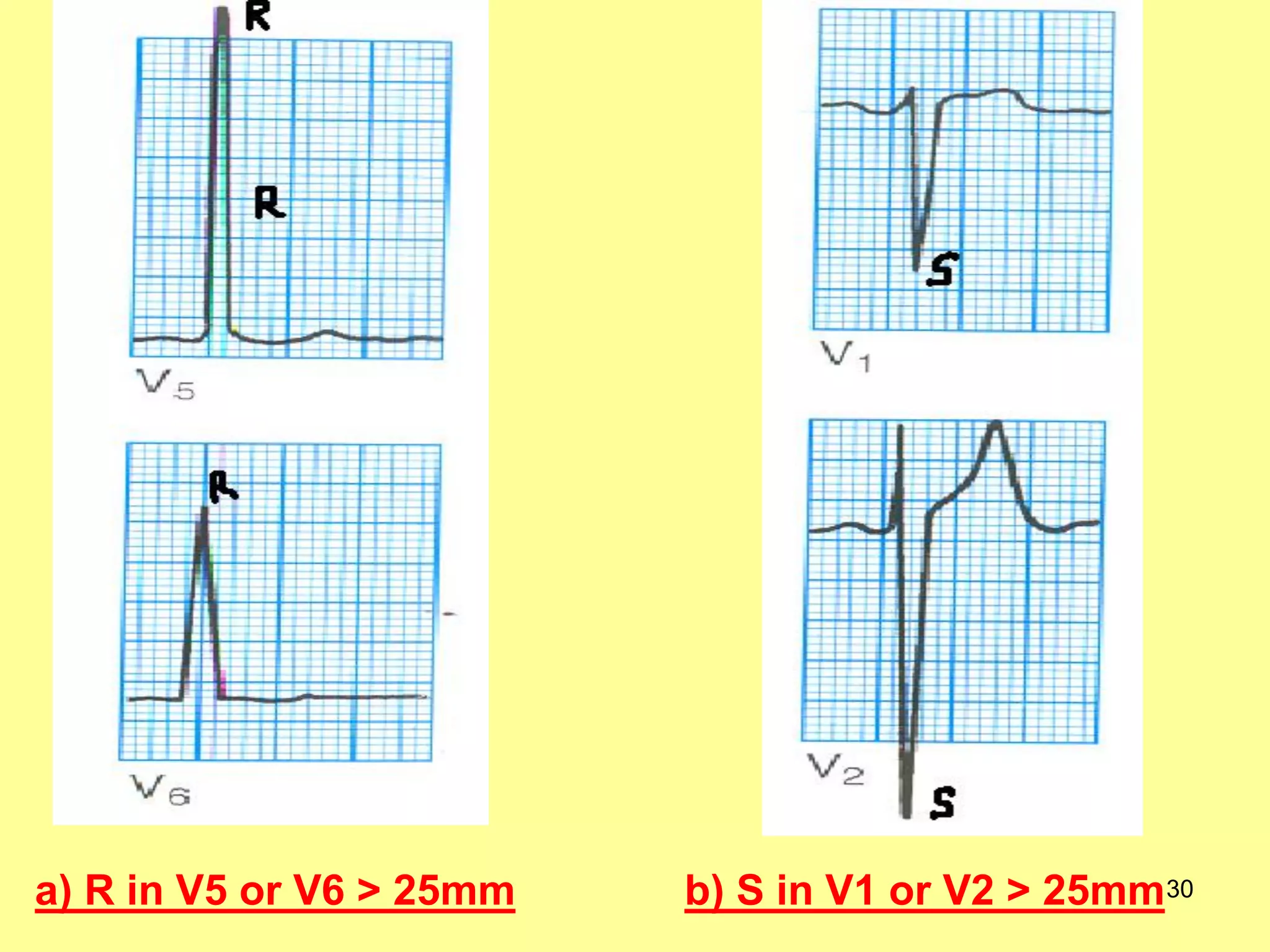
a) R in V5 or V6 >25mm
b) S in V1 or V2 >25 mm
c) R + S > 35 mm

29
a) R in V5 or V6 > 25mm

b) S in V1 or V2 > 25mm30
LVH
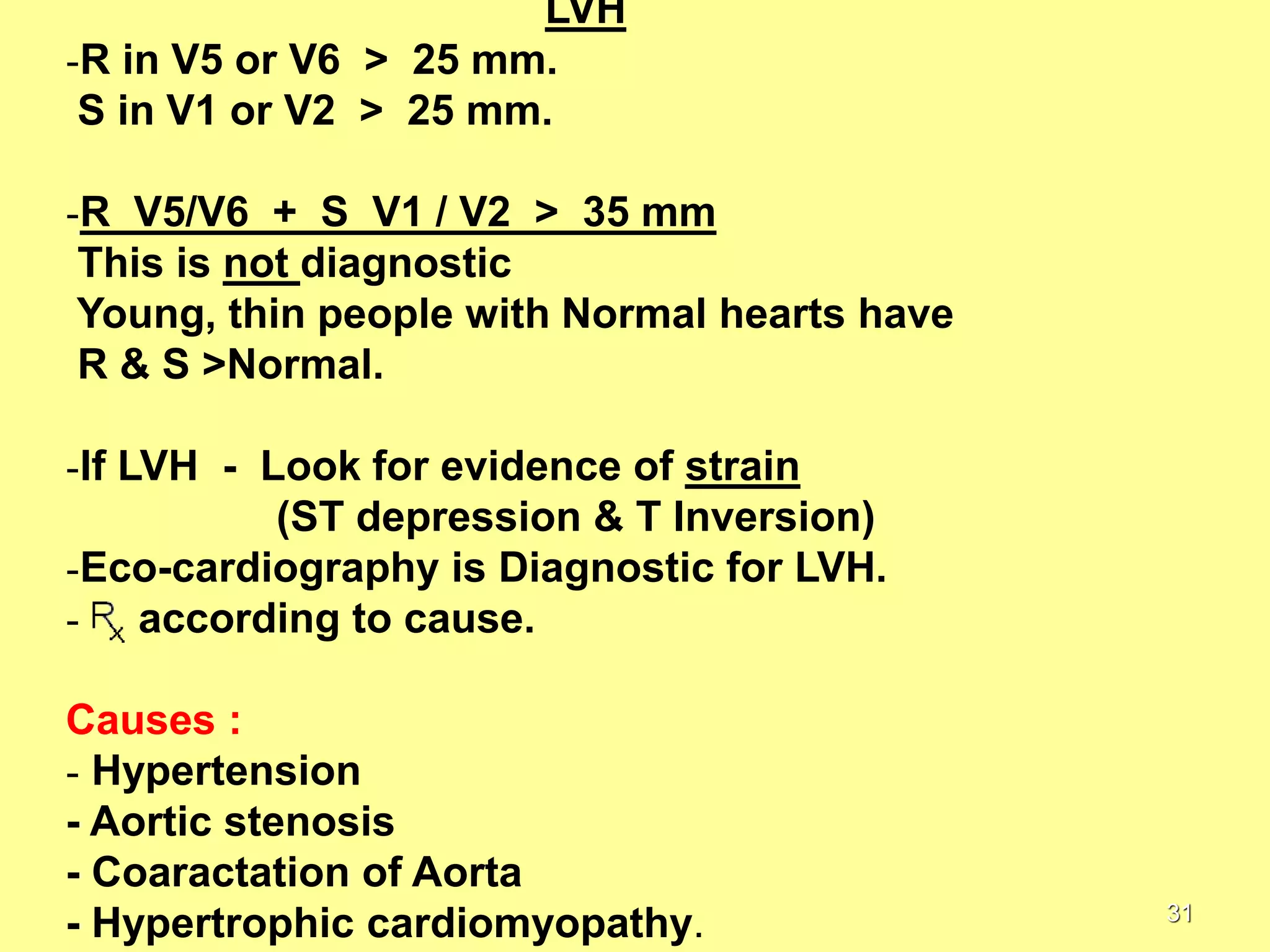
-R in V5 or V6 > 25 mm.
S in V1 or V2 > 25 mm.
-R V5/V6 + S V1 / V2 > 35 mm
This is not diagnostic
Young, thin people with Normal hearts have
R & S >Normal.
-If LVH - Look for evidence of strain
(ST depression & T Inversion)
-Eco-cardiography is Diagnostic for LVH.
- according to cause.
Causes :
- Hypertension
- Aortic stenosis
- Coaractation of Aorta
- Hypertrophic cardiomyopathy.

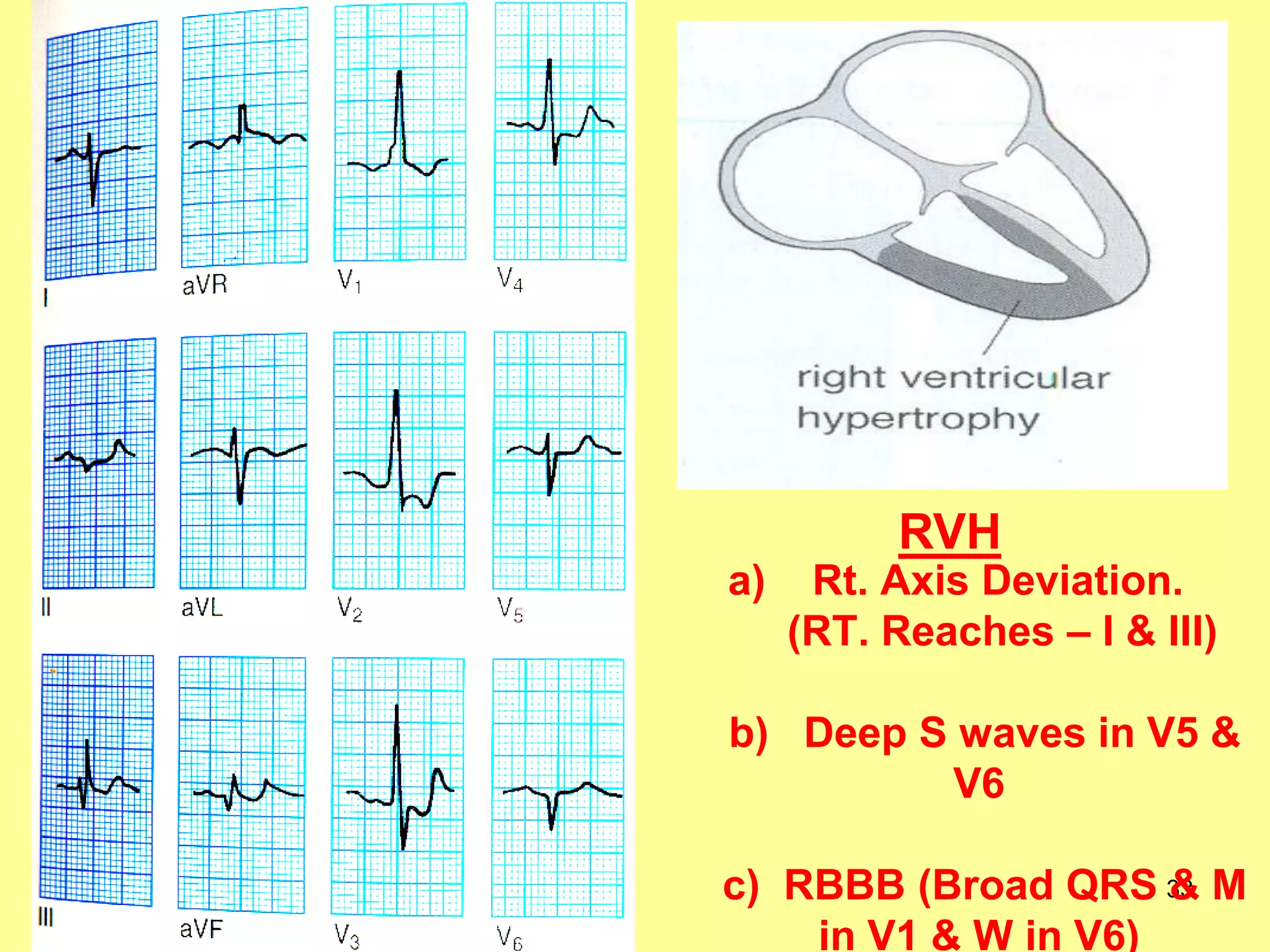
31
RVH
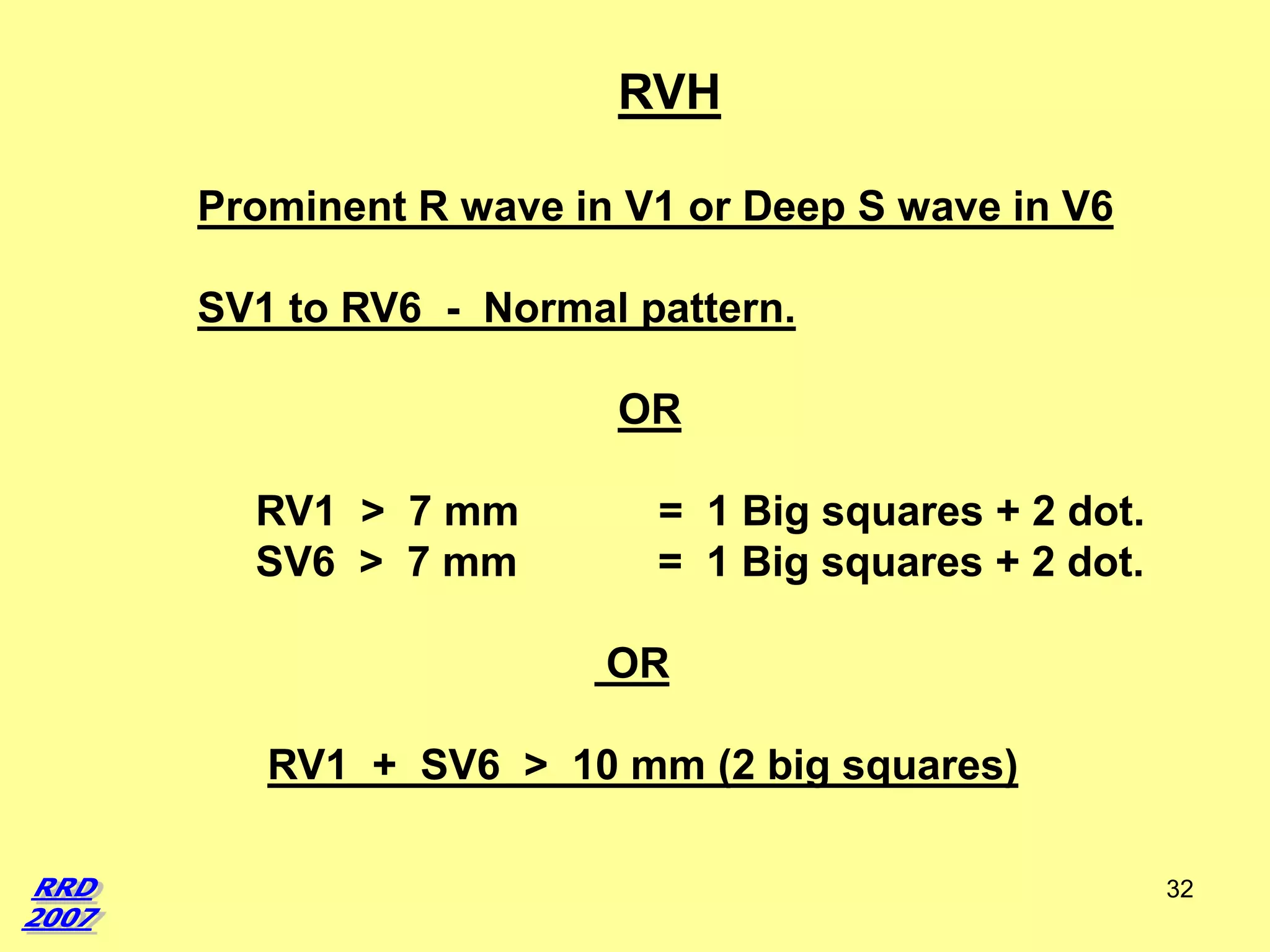
Prominent R wave in V1 or Deep S wave in V6
SV1 to RV6 - Normal pattern.
OR
RV1 > 7 mm
SV6 > 7 mm

= 1 Big squares + 2 dot.

OR
RV1 + SV6 > 10 mm (2 big squares)
32
RVH
a)

Rt. Axis Deviation.
(RT. Reaches – I & III)

b) Deep S waves in V5 &
V6
c) RBBB (Broad QRS 33 M
&
in V1 & W in V6)
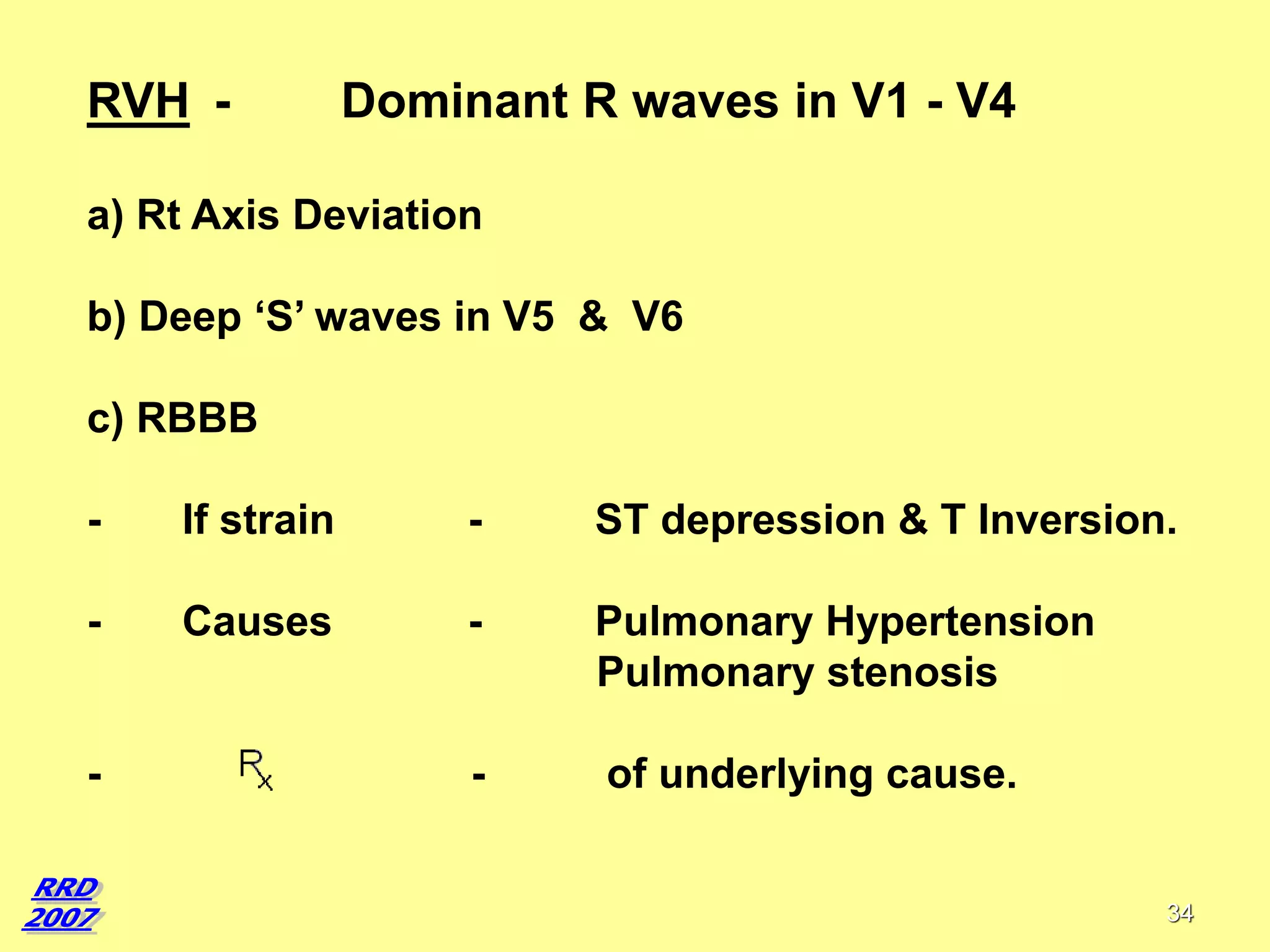
RVH -

Dominant R waves in V1 - V4

a) Rt Axis Deviation
b) Deep ‘S’ waves in V5 & V6
c) RBBB
-

If strain

-

ST depression & T Inversion.

-

Causes

-

Pulmonary Hypertension
Pulmonary stenosis

-

of underlying cause.

-

34
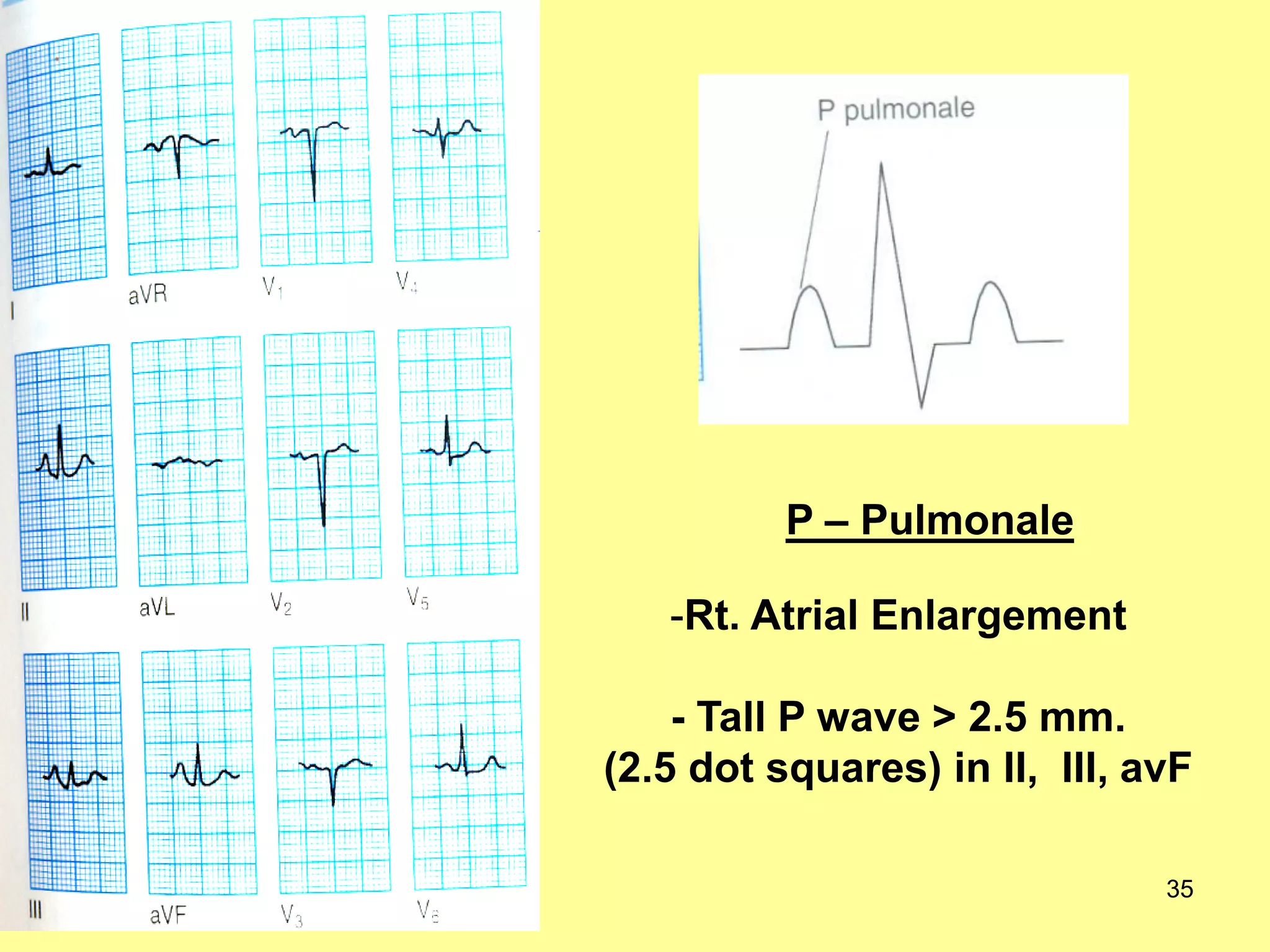
P – Pulmonale
-Rt. Atrial Enlargement
- Tall P wave > 2.5 mm.
(2.5 dot squares) in II, III, avF
35
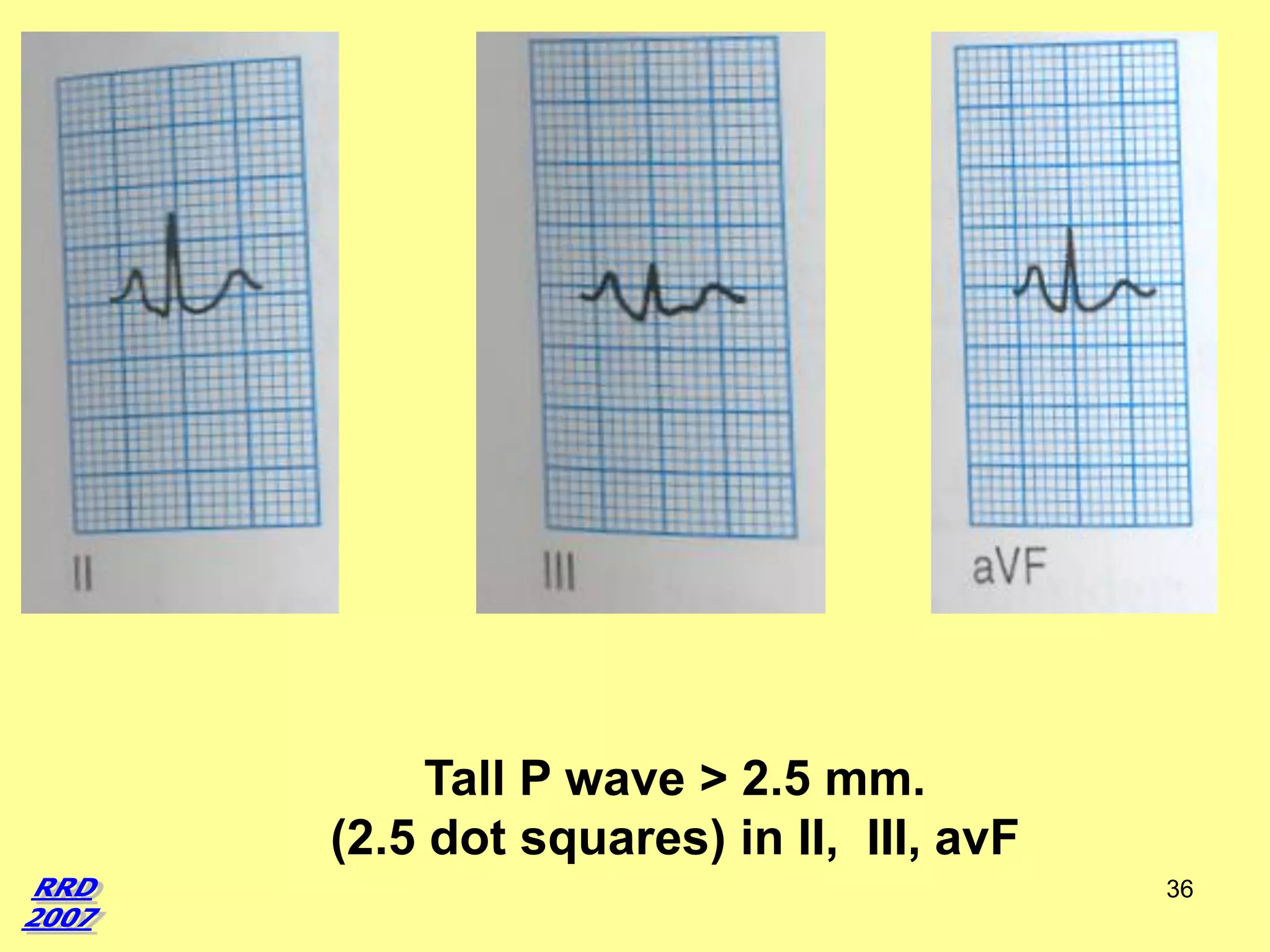
Tall P wave > 2.5 mm.
(2.5 dot squares) in II, III, avF
36
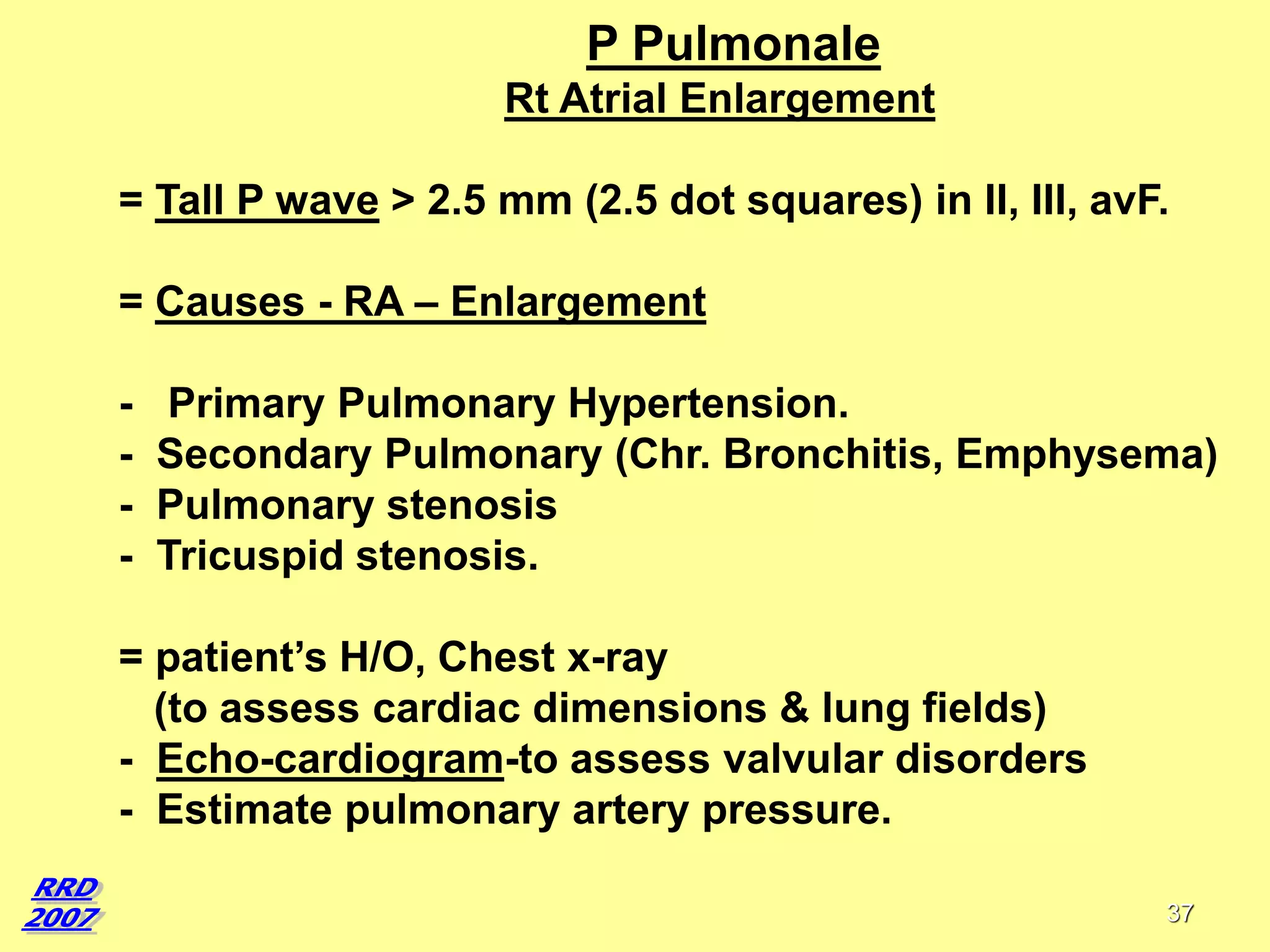
P Pulmonale
Rt Atrial Enlargement
= Tall P wave > 2.5 mm (2.5 dot squares) in II, III, avF.

= Causes - RA – Enlargement
-

Primary Pulmonary Hypertension.
Secondary Pulmonary (Chr. Bronchitis, Emphysema)
Pulmonary stenosis
Tricuspid stenosis.

= patient’s H/O, Chest x-ray
(to assess cardiac dimensions & lung fields)
- Echo-cardiogram-to assess valvular disorders
- Estimate pulmonary artery pressure.
37
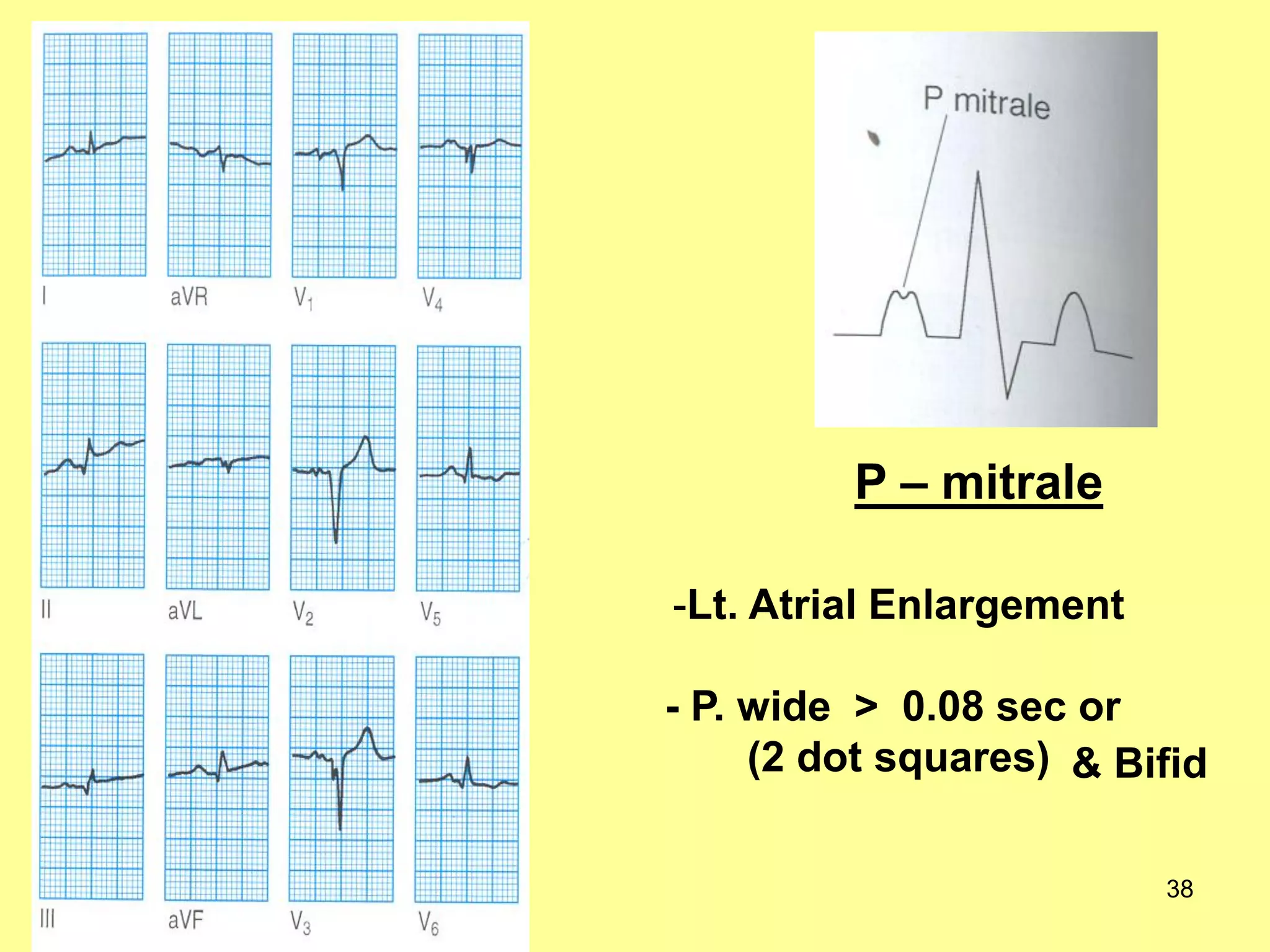
P – mitrale
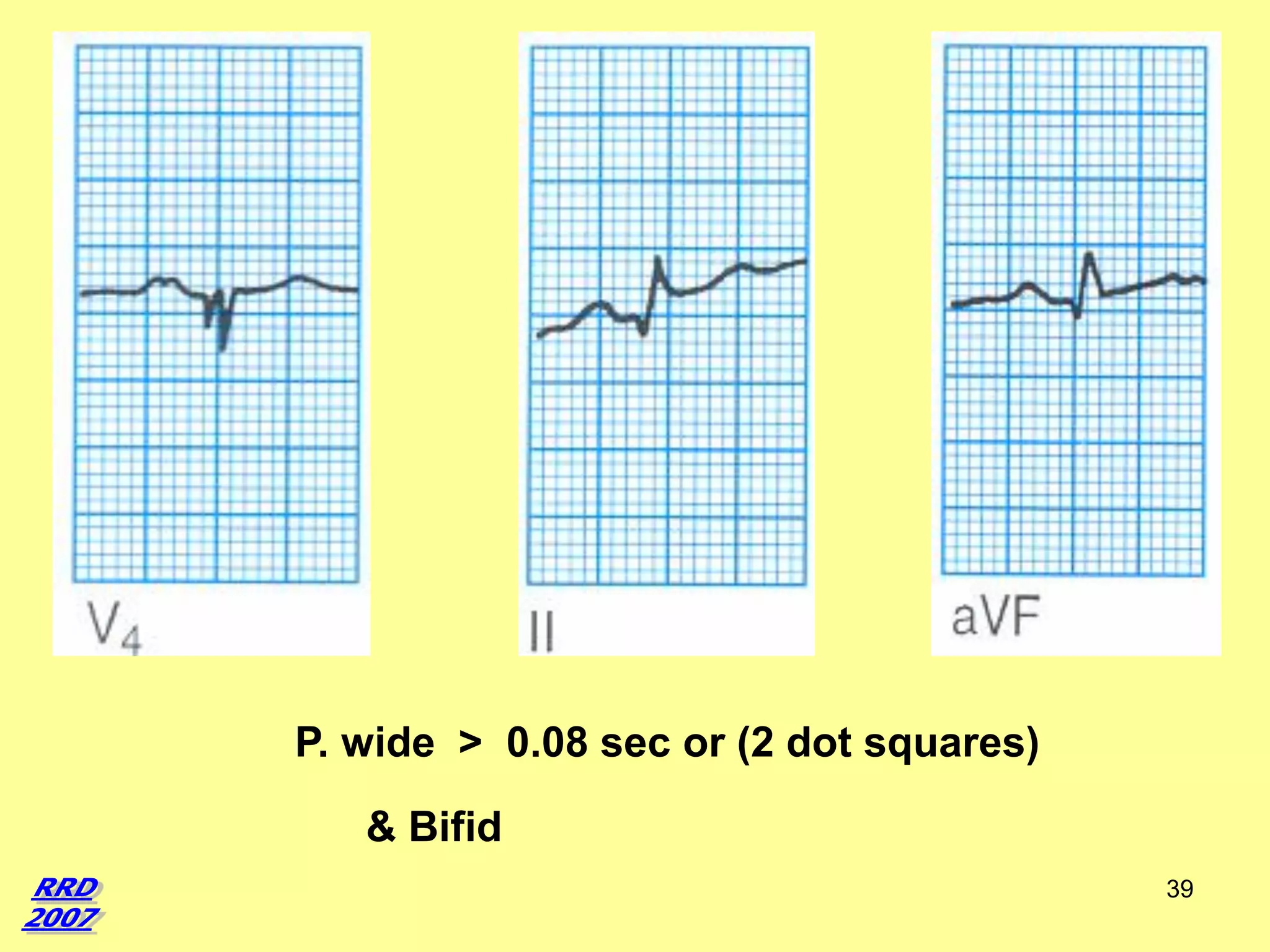
-Lt. Atrial Enlargement
- P. wide > 0.08 sec or
(2 dot squares) & Bifid
38
P. wide > 0.08 sec or (2 dot squares)

& Bifid
39
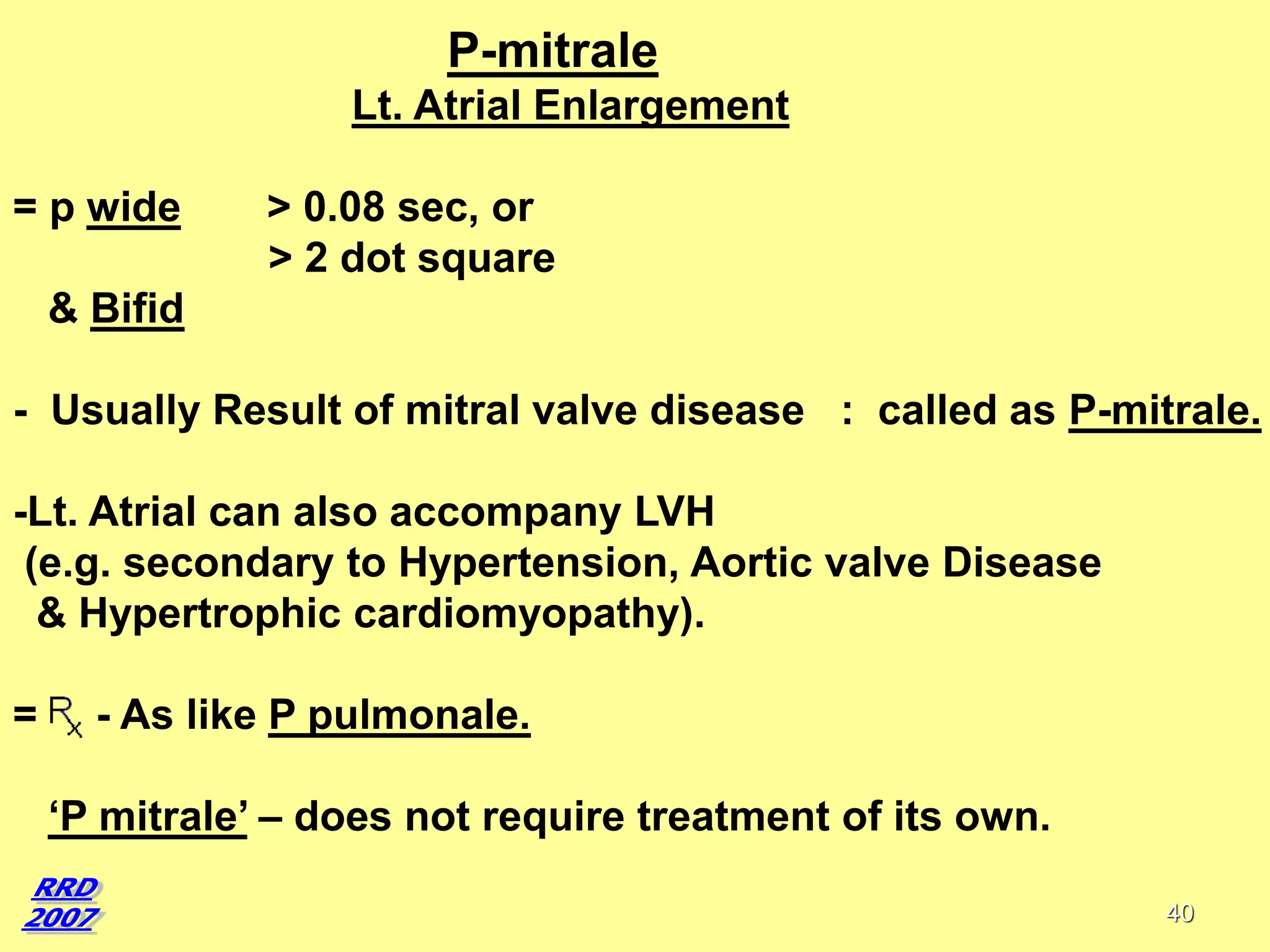
P-mitrale
Lt. Atrial Enlargement

= p wide

> 0.08 sec, or
> 2 dot square

& Bifid

- Usually Result of mitral valve disease : called as P-mitrale.
-Lt. Atrial can also accompany LVH
(e.g. secondary to Hypertension, Aortic valve Disease
& Hypertrophic cardiomyopathy).
=

- As like P pulmonale.
‘P mitrale’ – does not require treatment of its own.
40
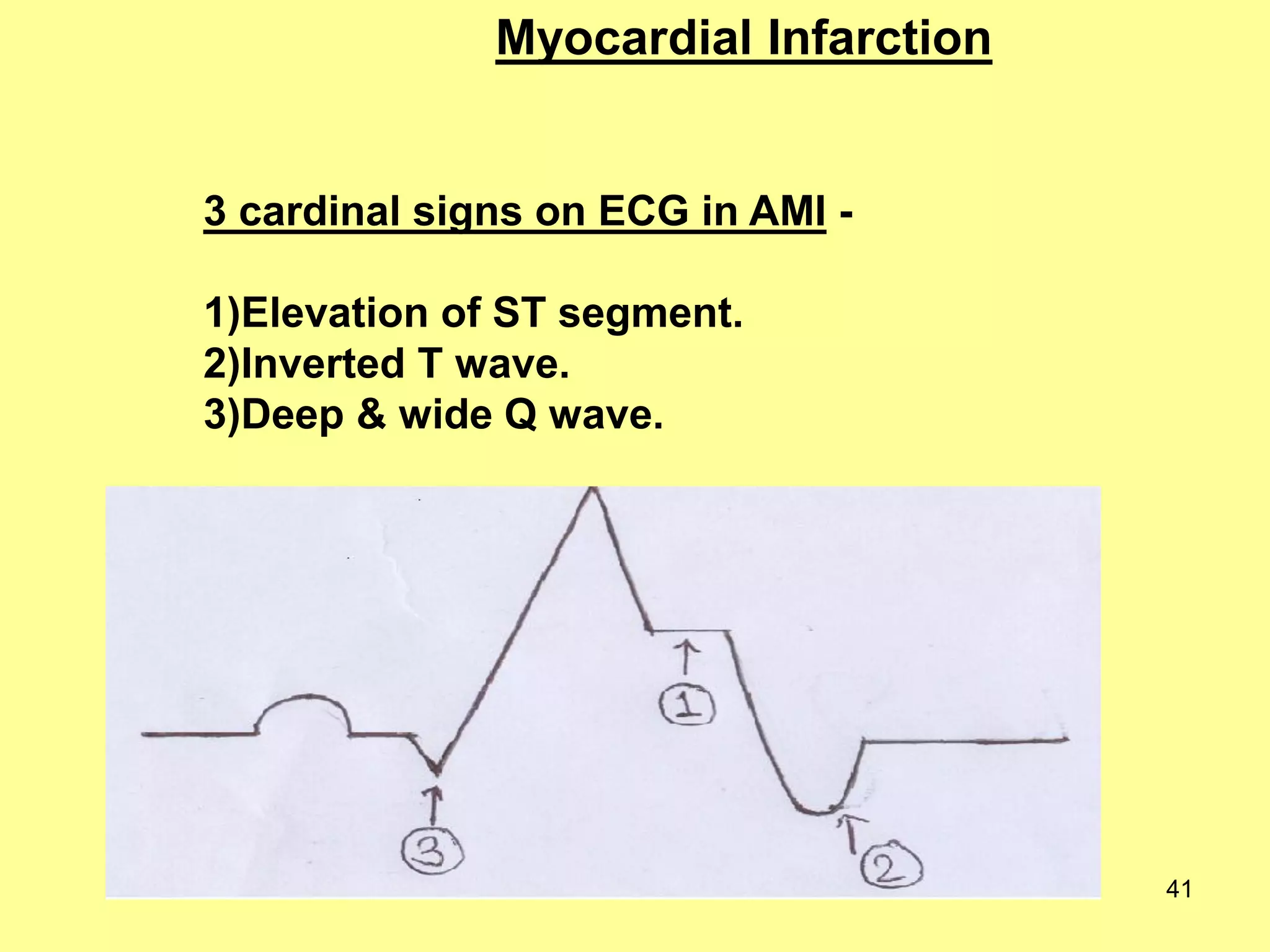
Myocardial Infarction

3 cardinal signs on ECG in AMI -

1)Elevation of ST segment.
2)Inverted T wave.
3)Deep & wide Q wave.

41
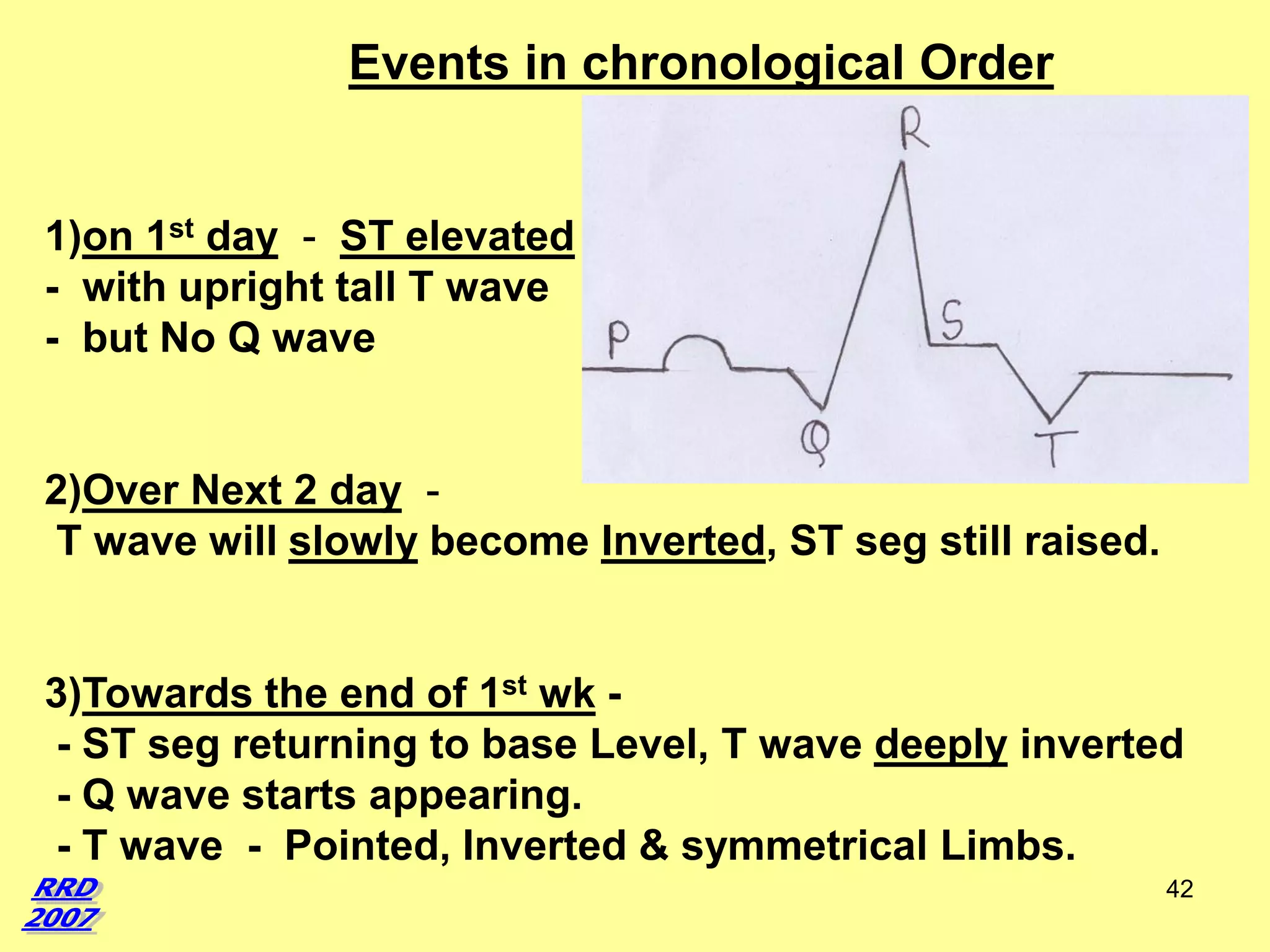
Events in chronological Order

1)on 1st day - ST elevated
- with upright tall T wave
- but No Q wave

2)Over Next 2 day T wave will slowly become Inverted, ST seg still raised.

3)Towards the end of 1st wk - ST seg returning to base Level, T wave deeply inverted
- Q wave starts appearing.
- T wave - Pointed, Inverted & symmetrical Limbs.
42
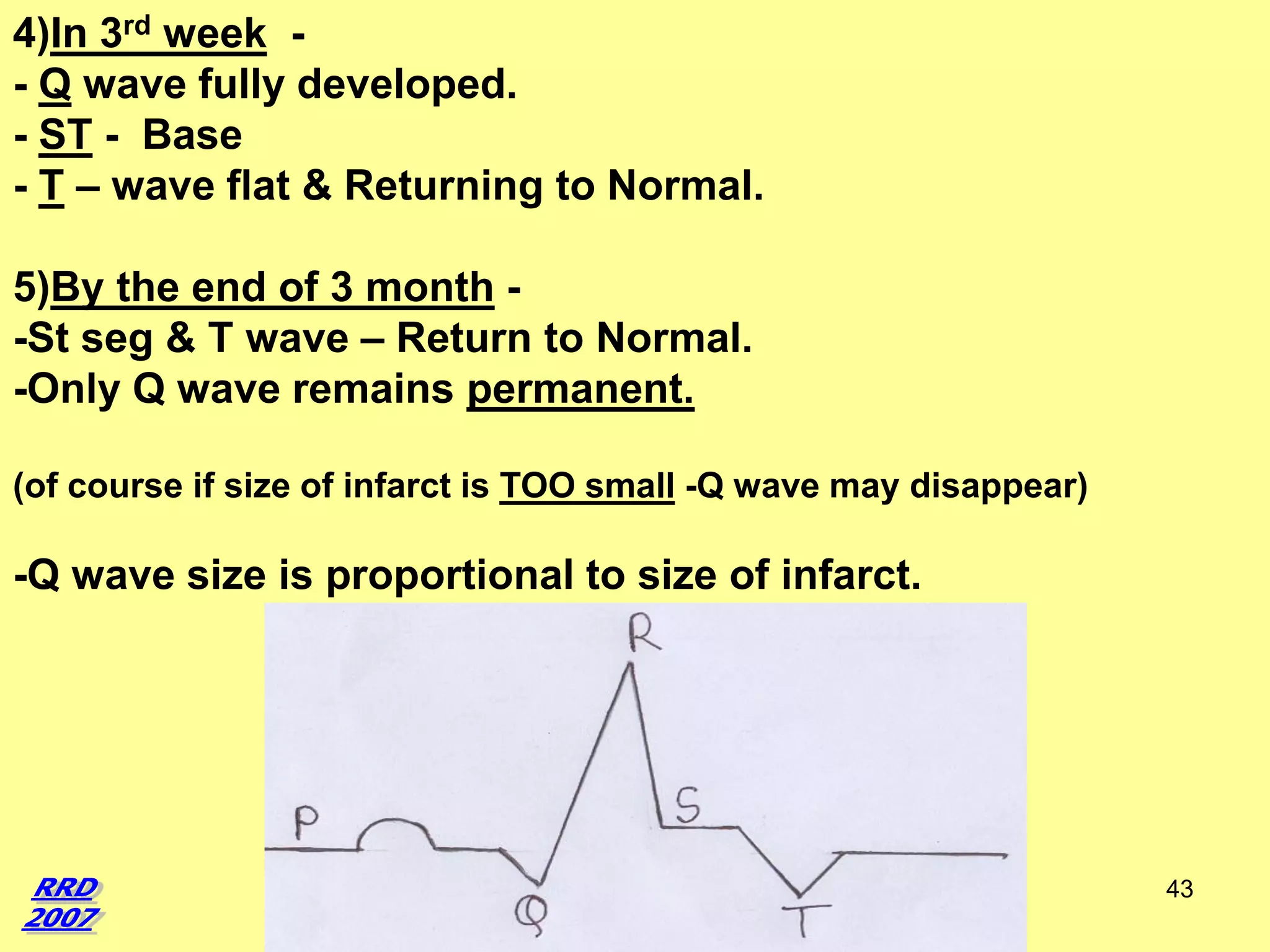
4)In 3rd week - Q wave fully developed.
- ST - Base
- T – wave flat & Returning to Normal.
5)By the end of 3 month -St seg & T wave – Return to Normal.
-Only Q wave remains permanent.
(of course if size of infarct is TOO small -Q wave may disappear)

-Q wave size is proportional to size of infarct.

43
Acute myocardial Ischemia
Angina = I cry
-Atherosclerotic Narrowing of coronary vessels.
-Pt. is comfortable at rest but anginal pain after exertion.
-After exercise, myocardium demand increases but sufficient
blood flow can not occur due to,
partially occluded coronary artery.
-Anginal pain disappears after Rest when demand decreases.

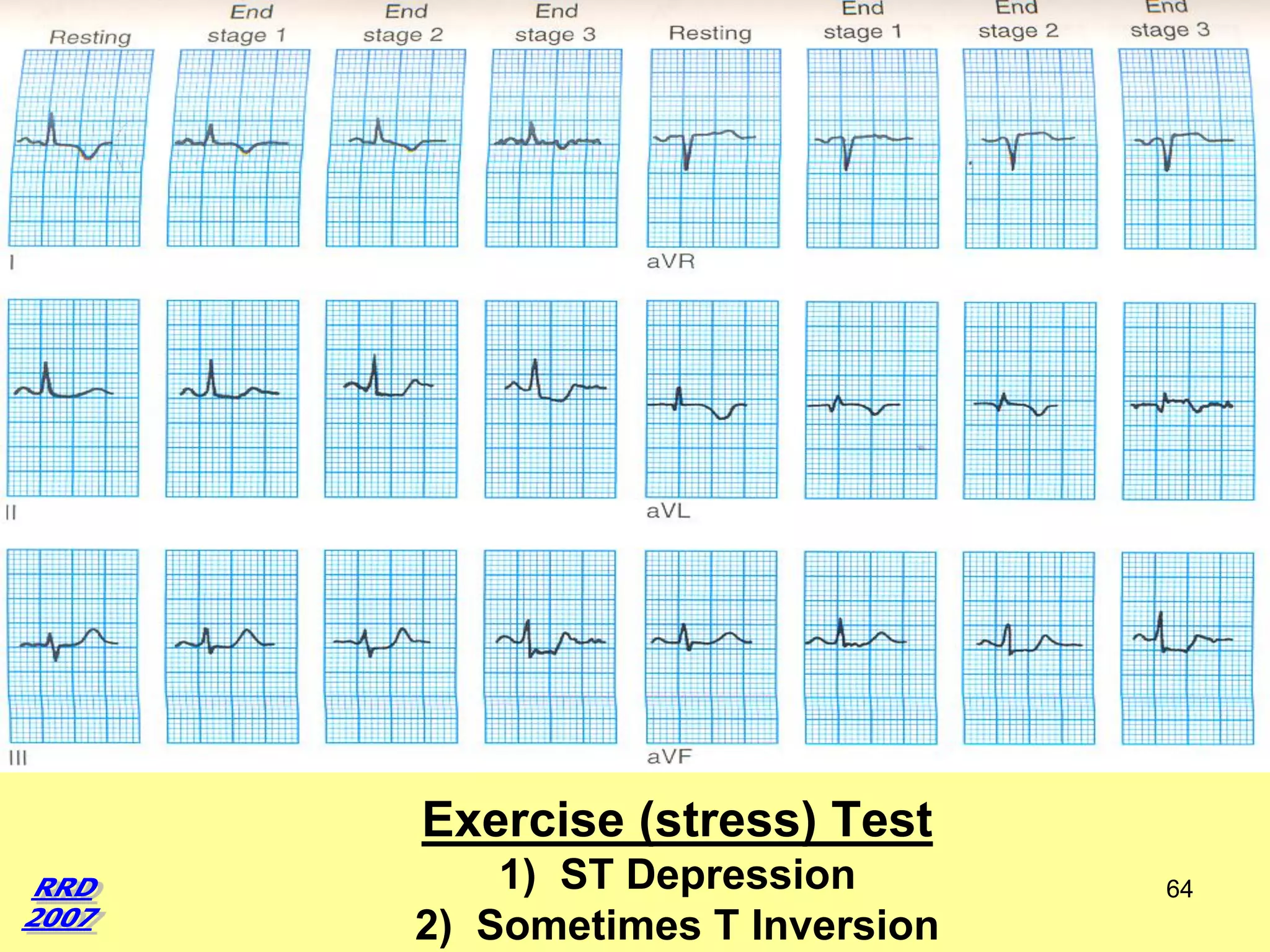
-Acute myocardial ischemia can be seen during stress test.
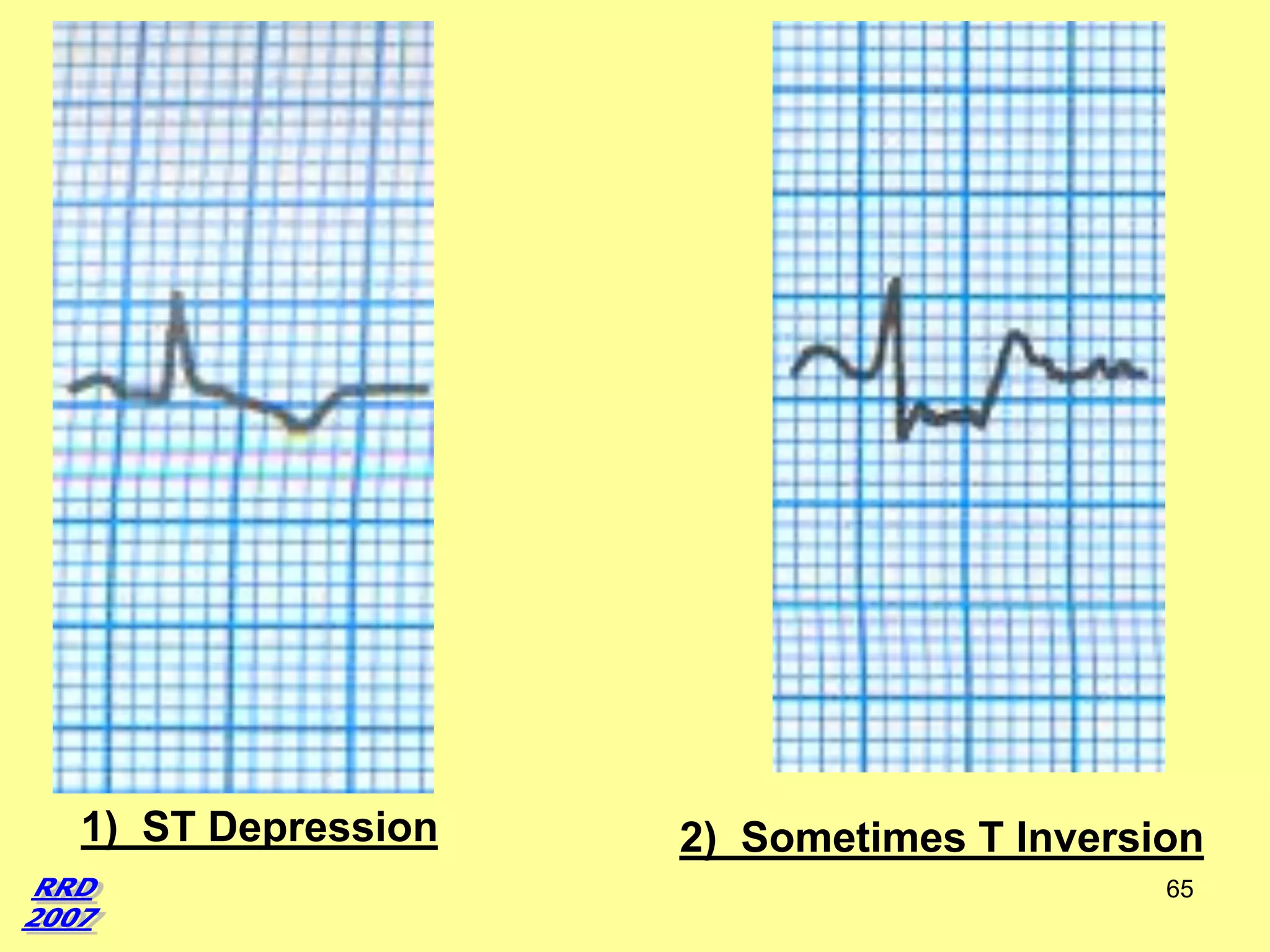
-Positive stress test - ST Depression.

44
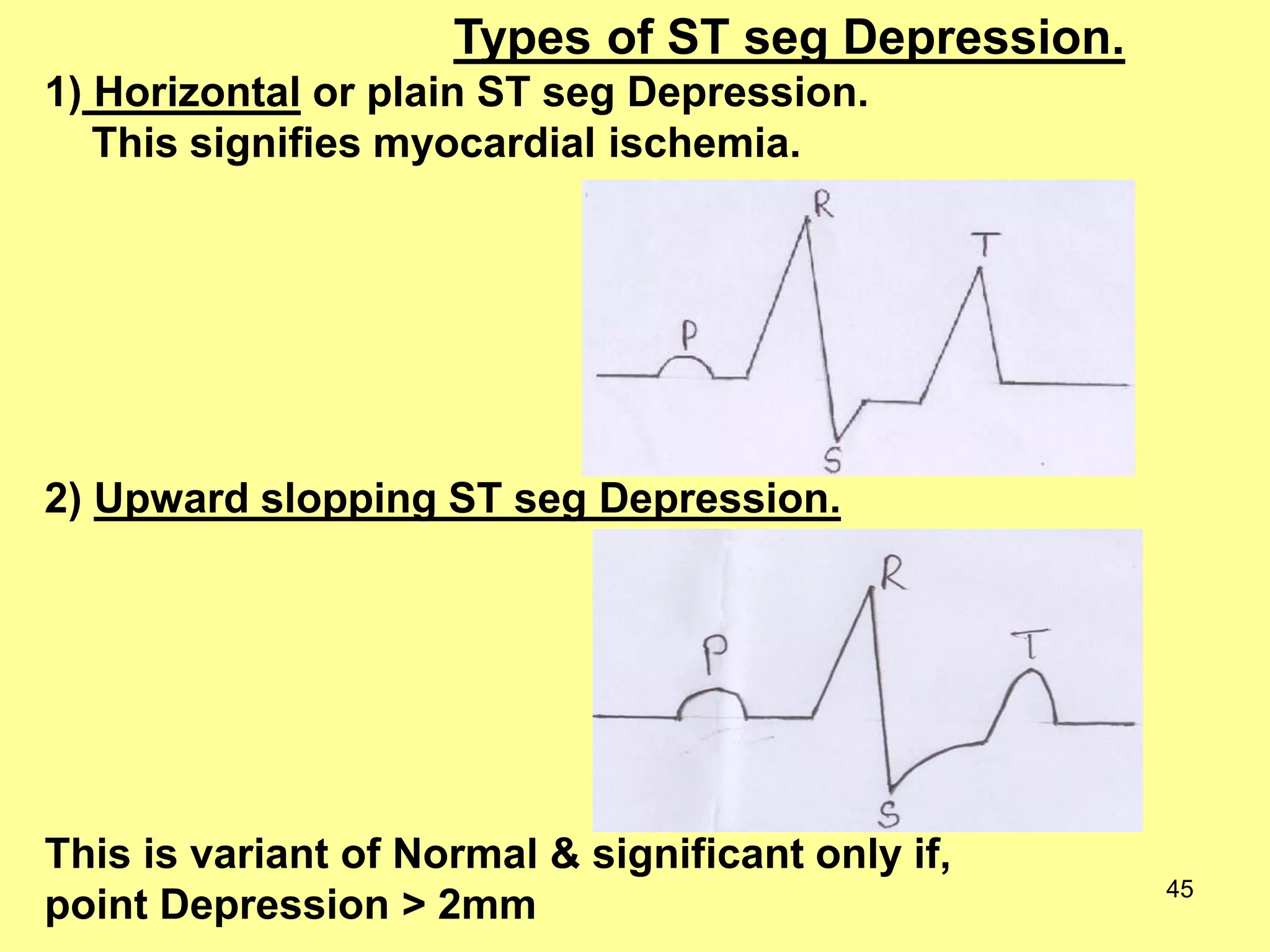
Types of ST seg Depression.
1) Horizontal or plain ST seg Depression.
This signifies myocardial ischemia.

2) Upward slopping ST seg Depression.

This is variant of Normal & significant only if,
point Depression > 2mm

45
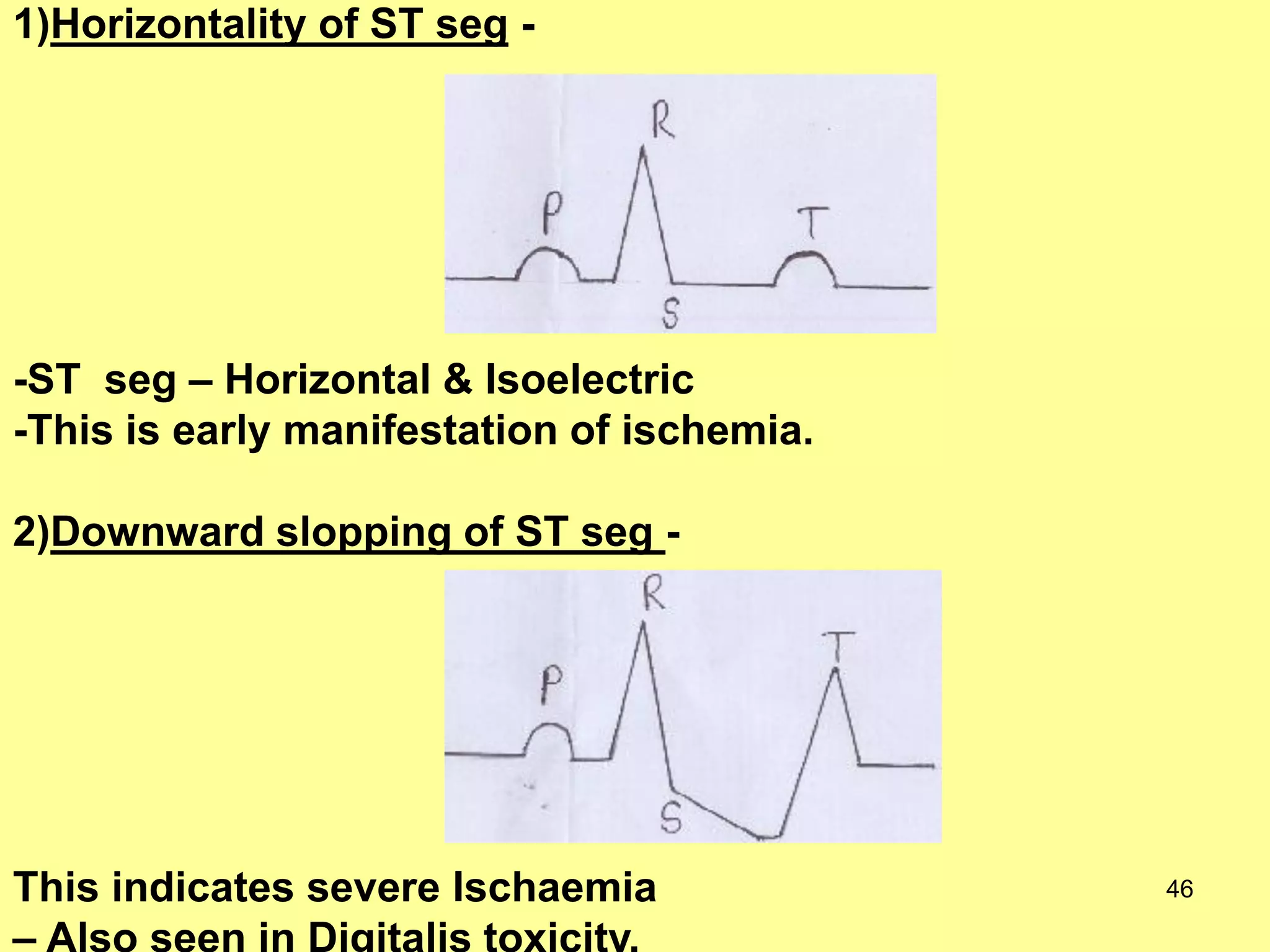
1)Horizontality of ST seg -

-ST seg – Horizontal & Isoelectric
-This is early manifestation of ischemia.
2)Downward slopping of ST seg -

This indicates severe Ischaemia

46
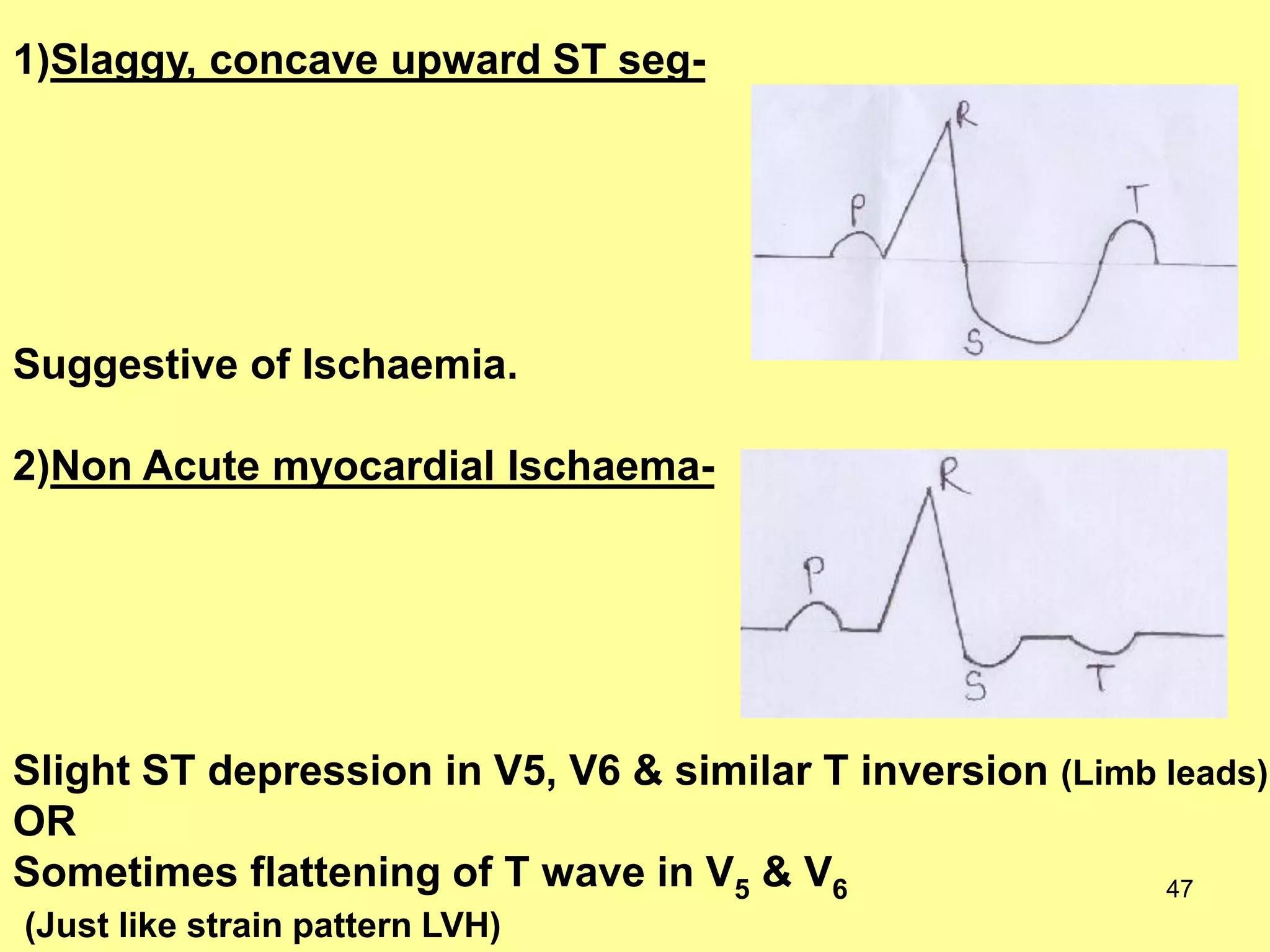
1)Slaggy, concave upward ST seg-

Suggestive of Ischaemia.
2)Non Acute myocardial Ischaema-

Slight ST depression in V5, V6 & similar T inversion (Limb leads)
OR
Sometimes flattening of T wave in V5 & V6
47
(Just like strain pattern LVH)
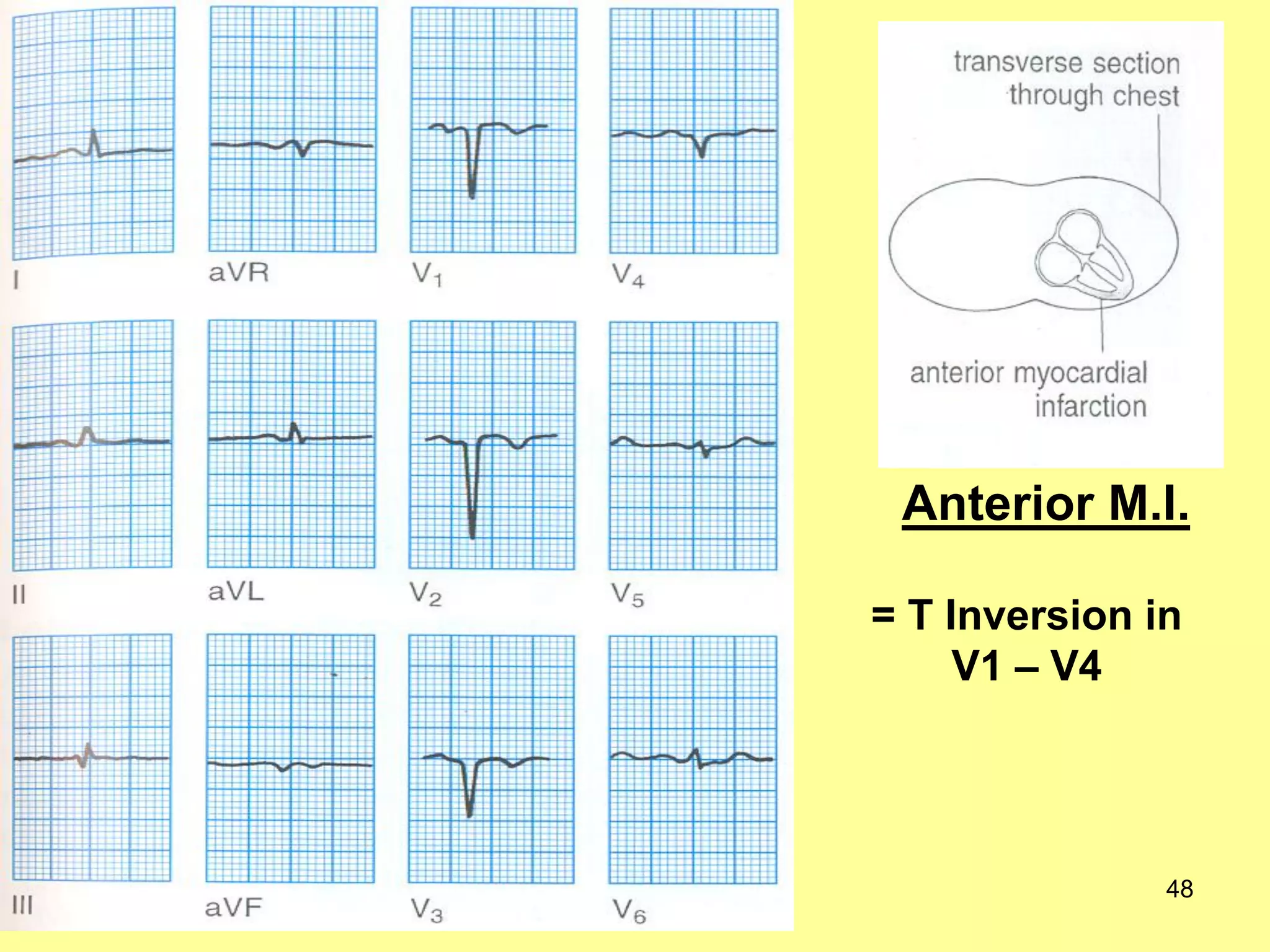
Anterior M.I.
= T Inversion in
V1 – V4

48
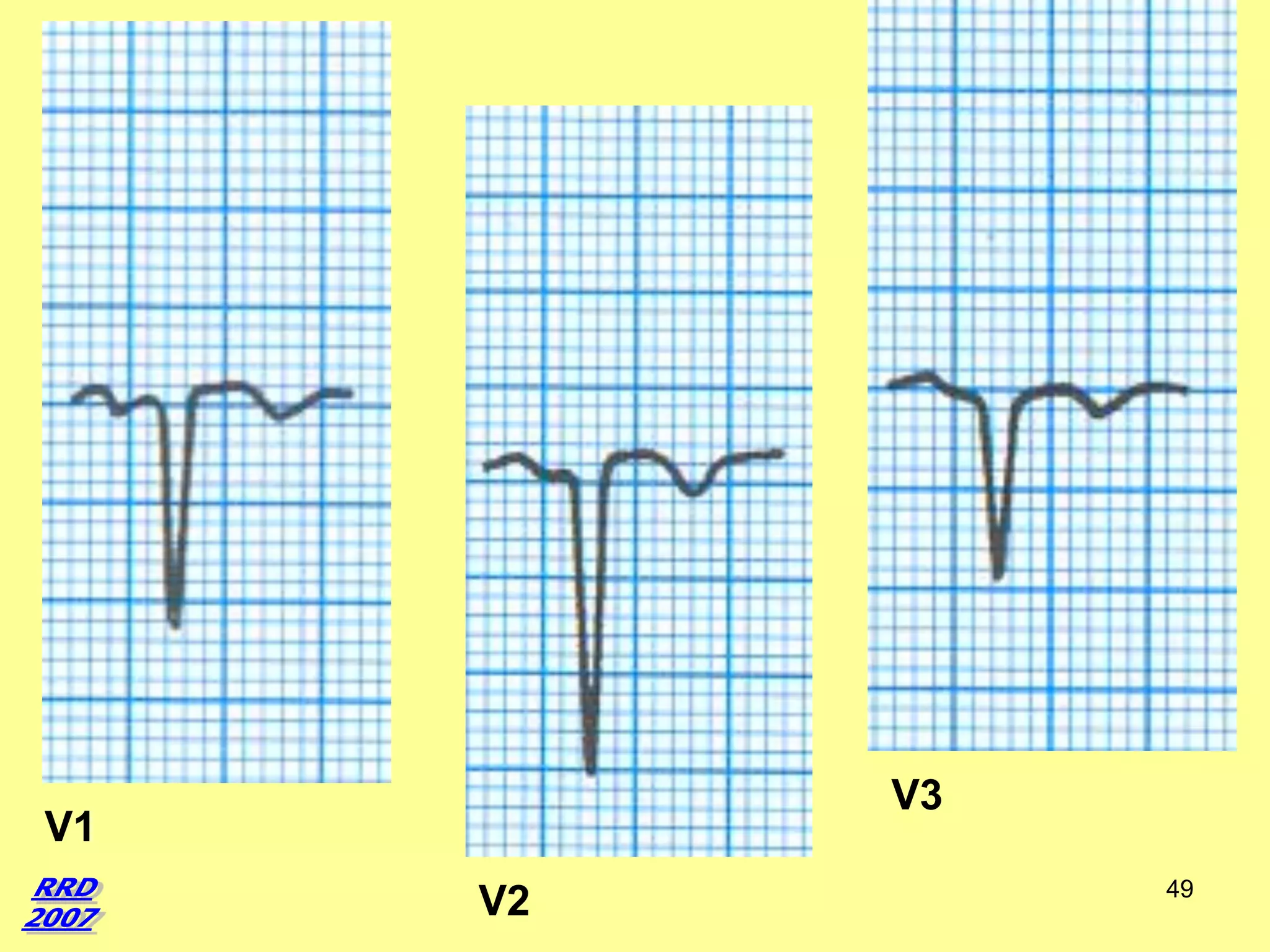
V3

V1
V2

49
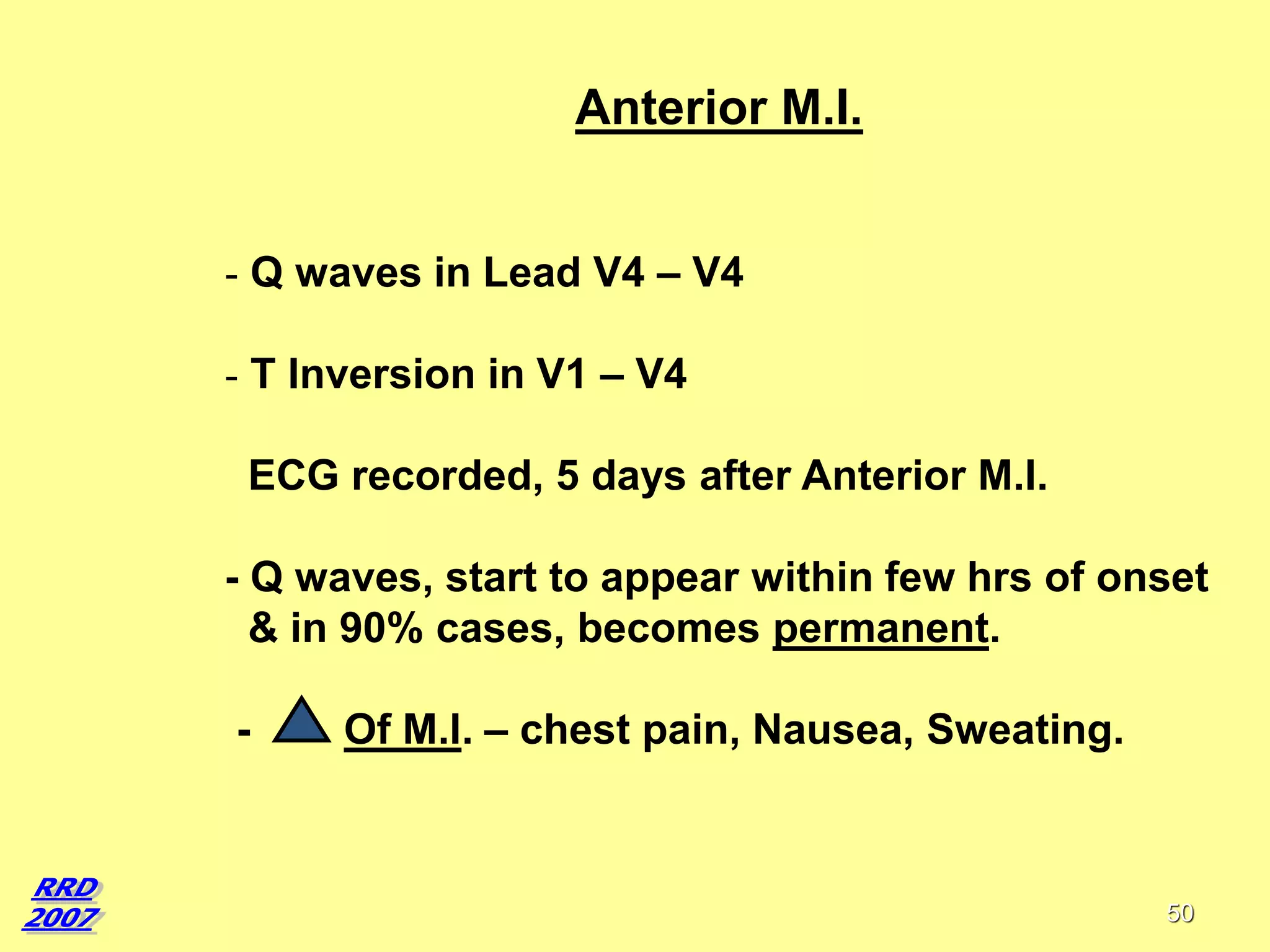
Anterior M.I.
- Q waves in Lead V4 – V4
- T Inversion in V1 – V4
ECG recorded, 5 days after Anterior M.I.
- Q waves, start to appear within few hrs of onset
& in 90% cases, becomes permanent.
-

Of M.I. – chest pain, Nausea, Sweating.

50
Anterior M.I.
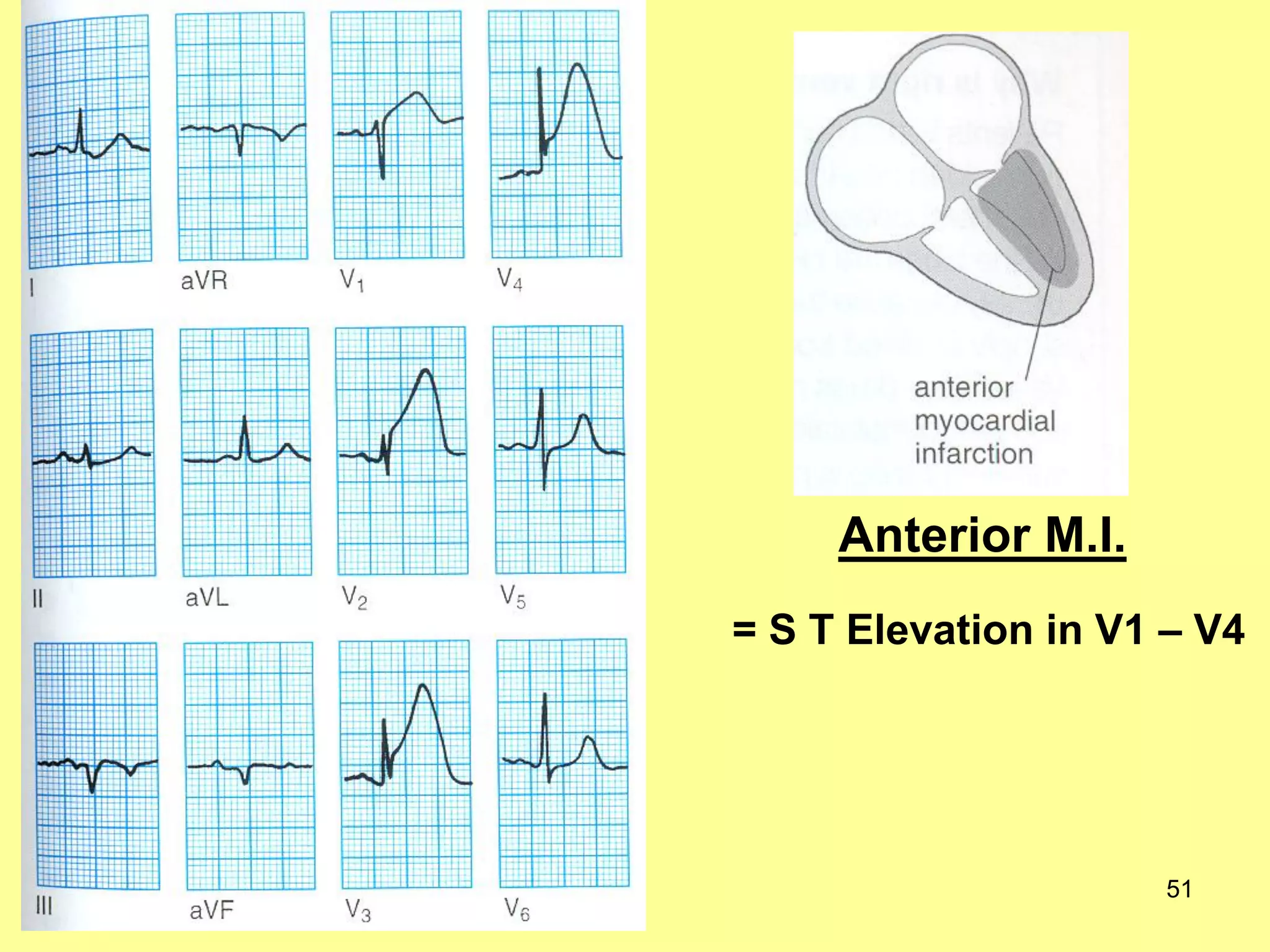
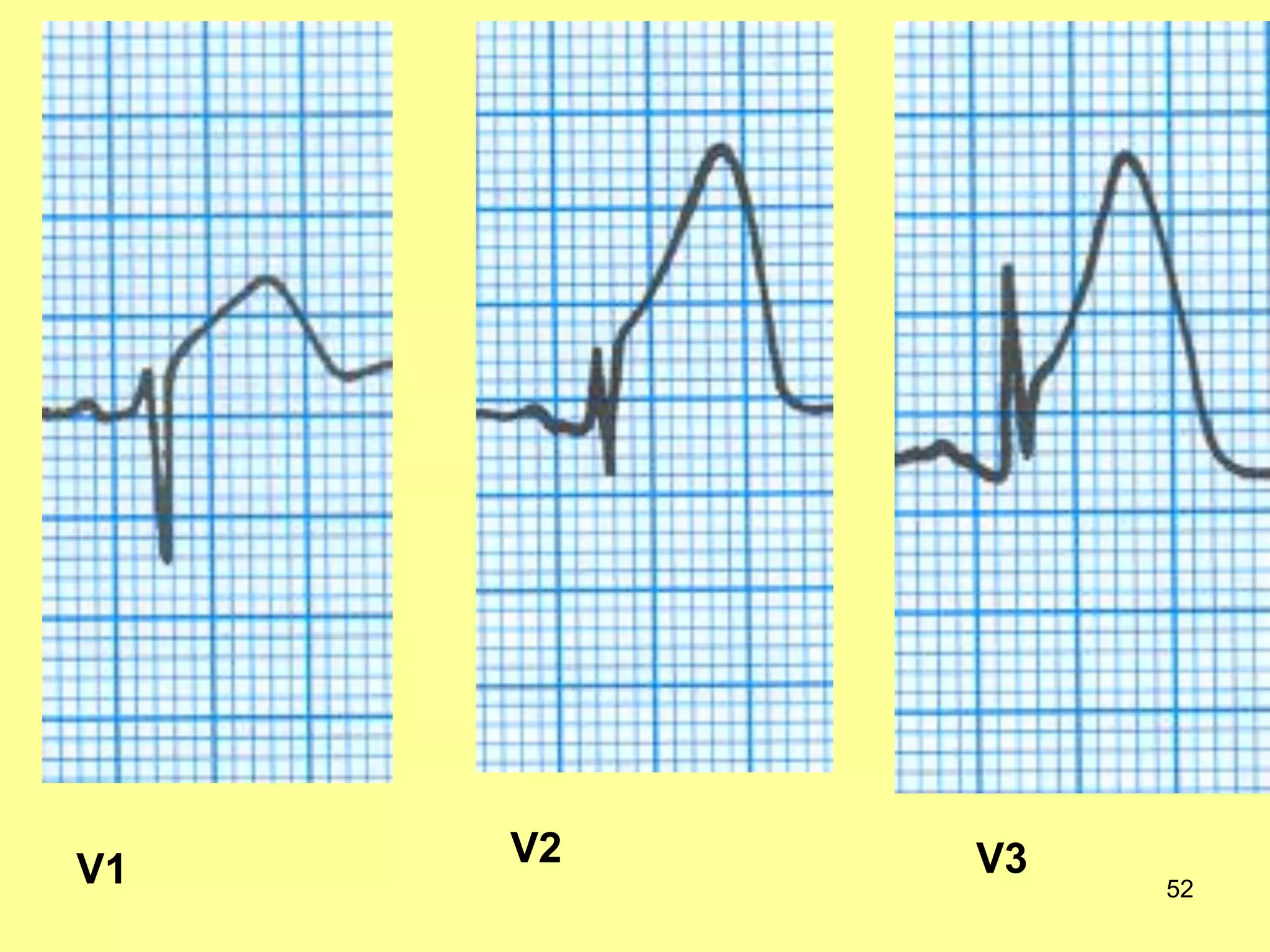
= S T Elevation in V1 – V4

51
V1

V2

V3

52
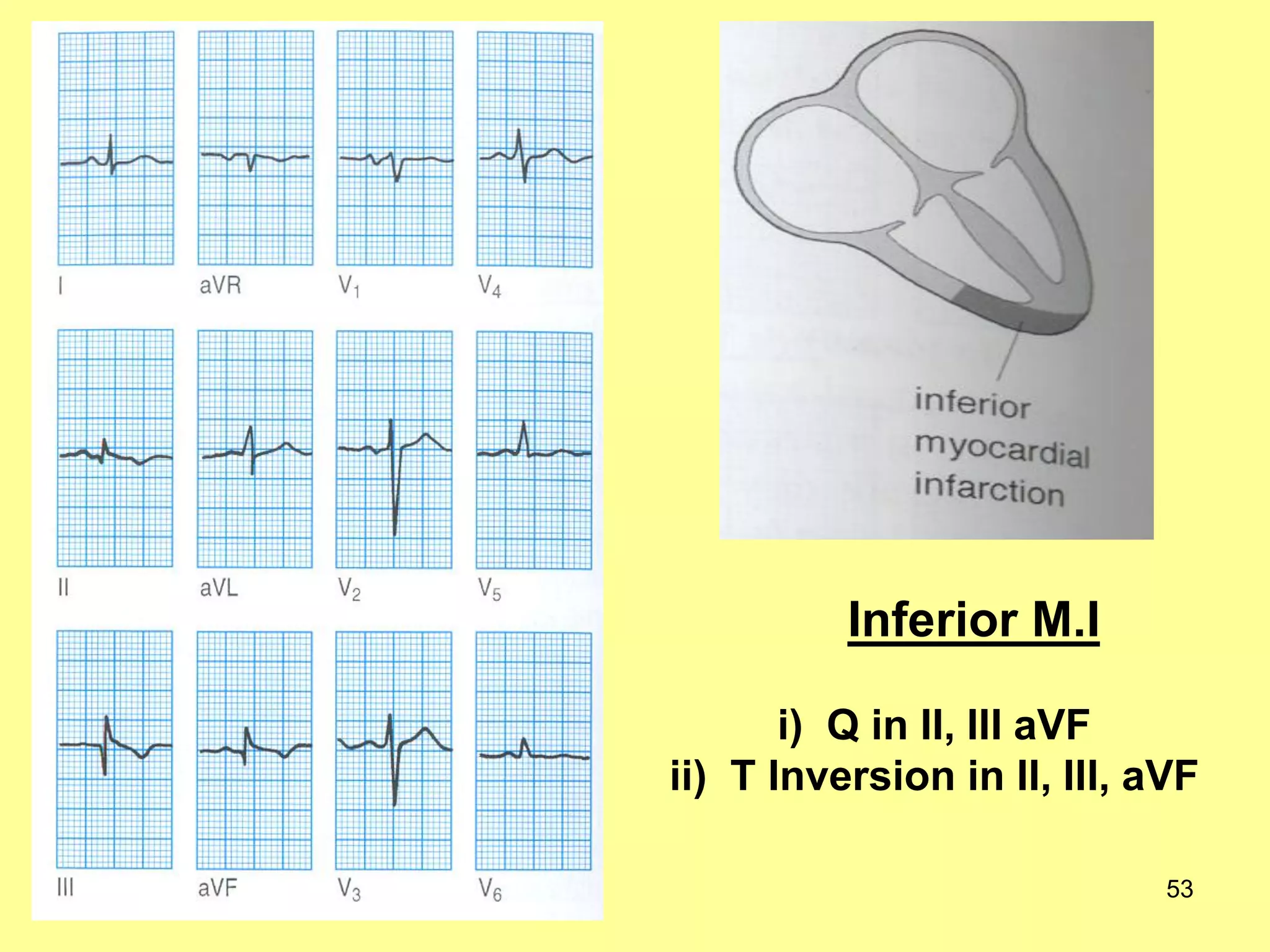
Inferior M.I
i) Q in II, III aVF
ii) T Inversion in II, III, aVF
53
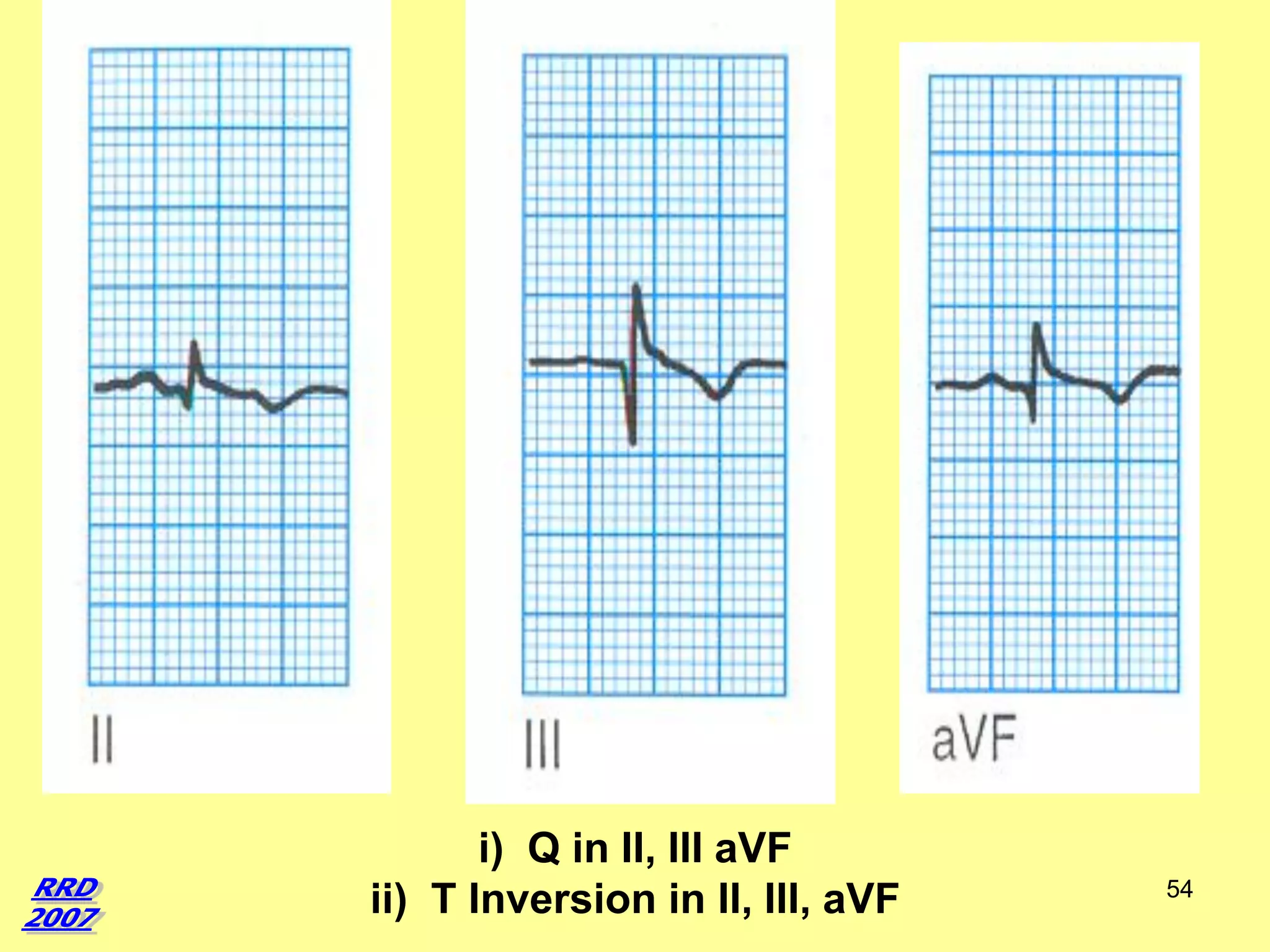
i) Q in II, III aVF
ii) T Inversion in II, III, aVF

54
Inferior M.I.

1. Q in II, III, aVF

2.T Inversion in II, III & aVF
(2 yrs. previously attack.)

55
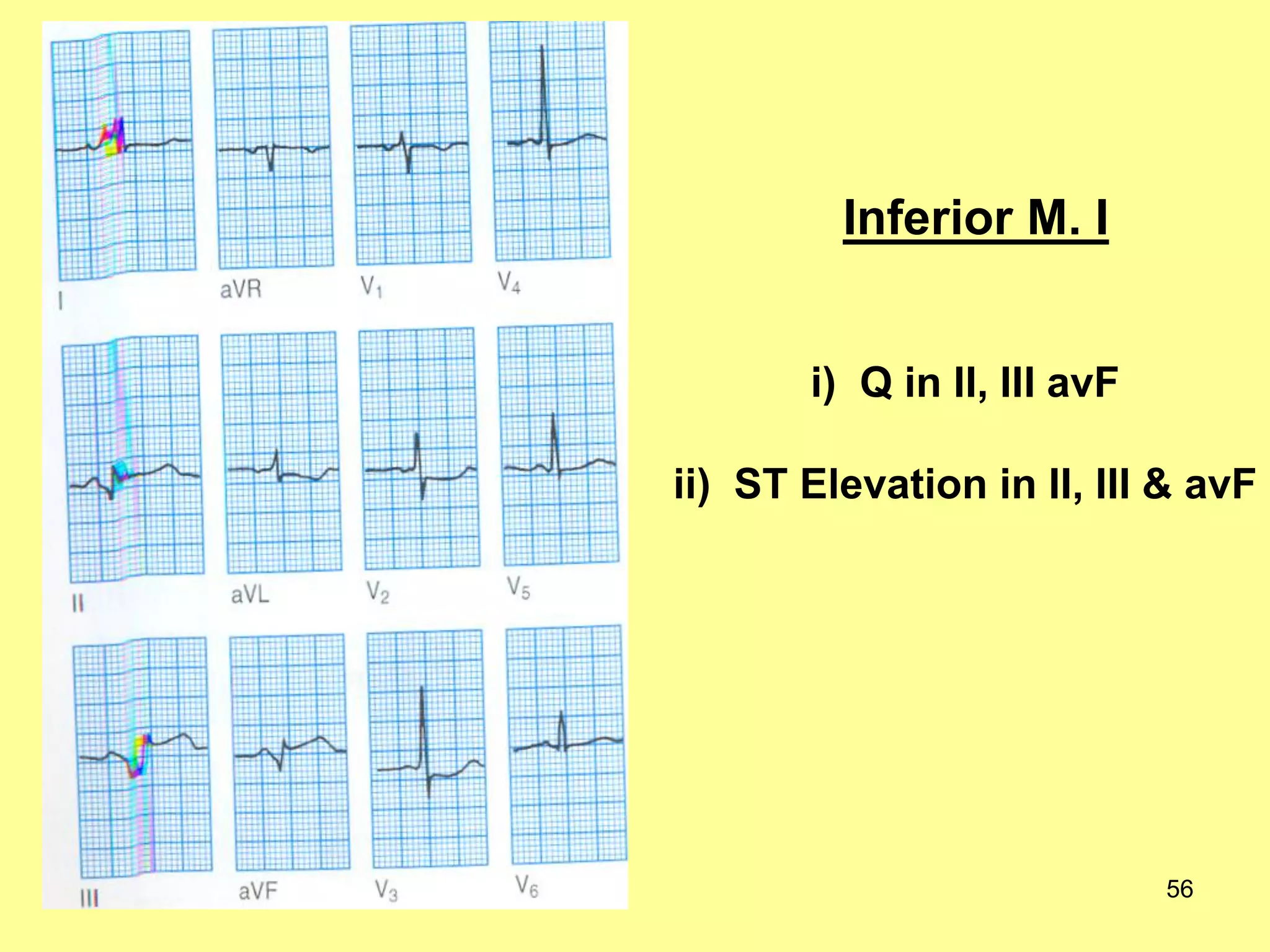
Inferior M. I
i) Q in II, III avF

ii) ST Elevation in II, III & avF

56
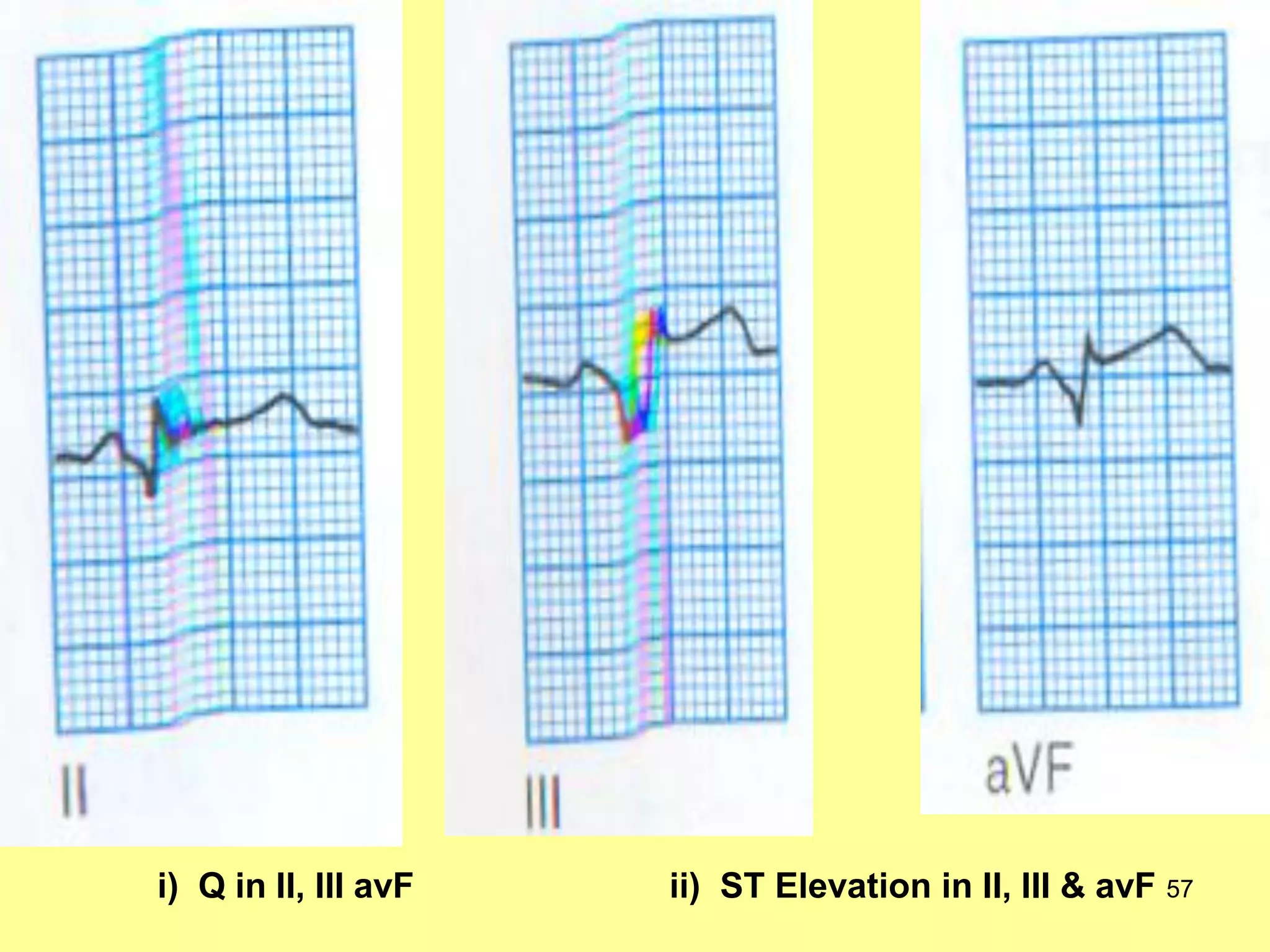
i) Q in II, III avF

ii) ST Elevation in II, III & avF 57
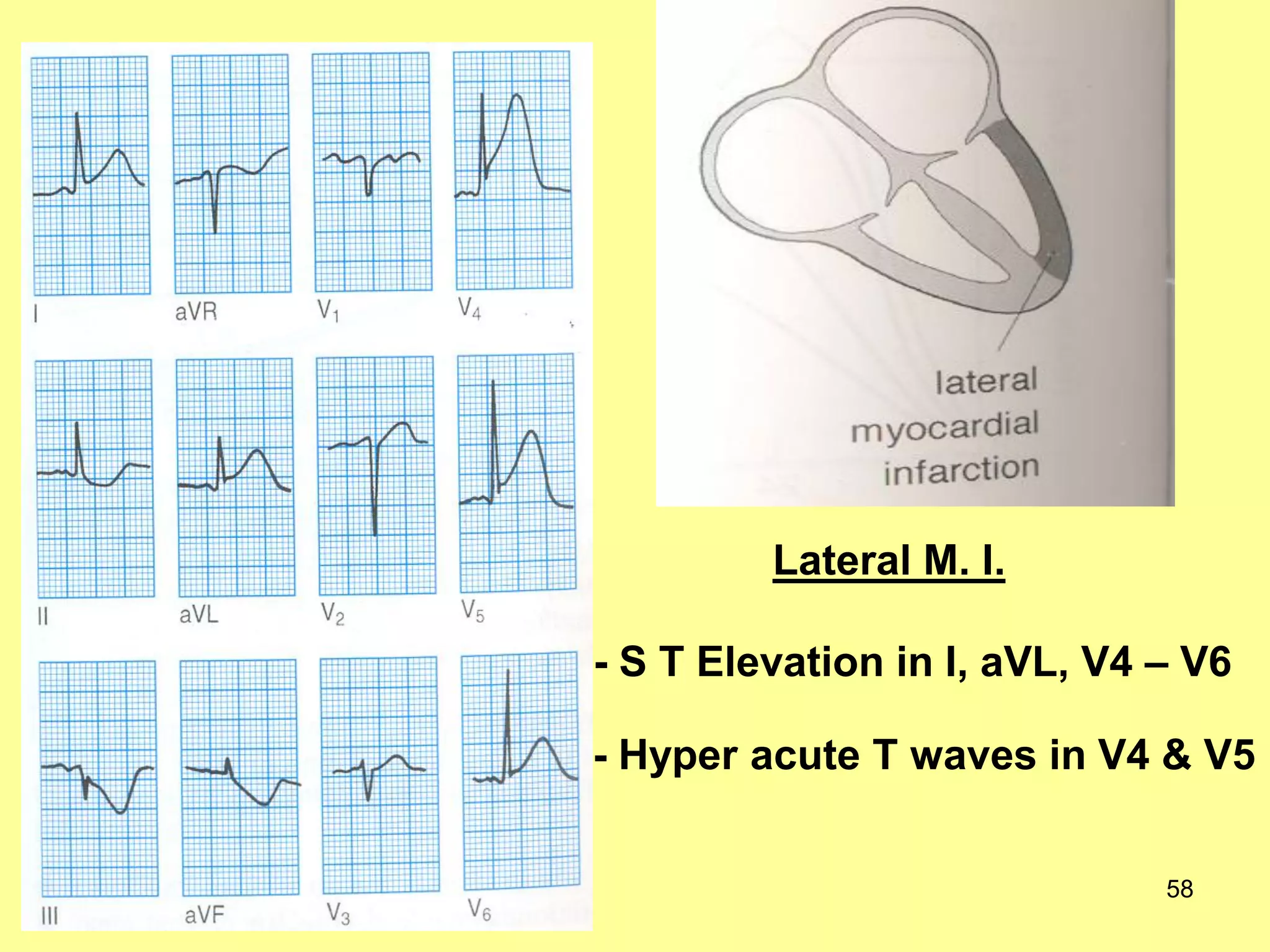
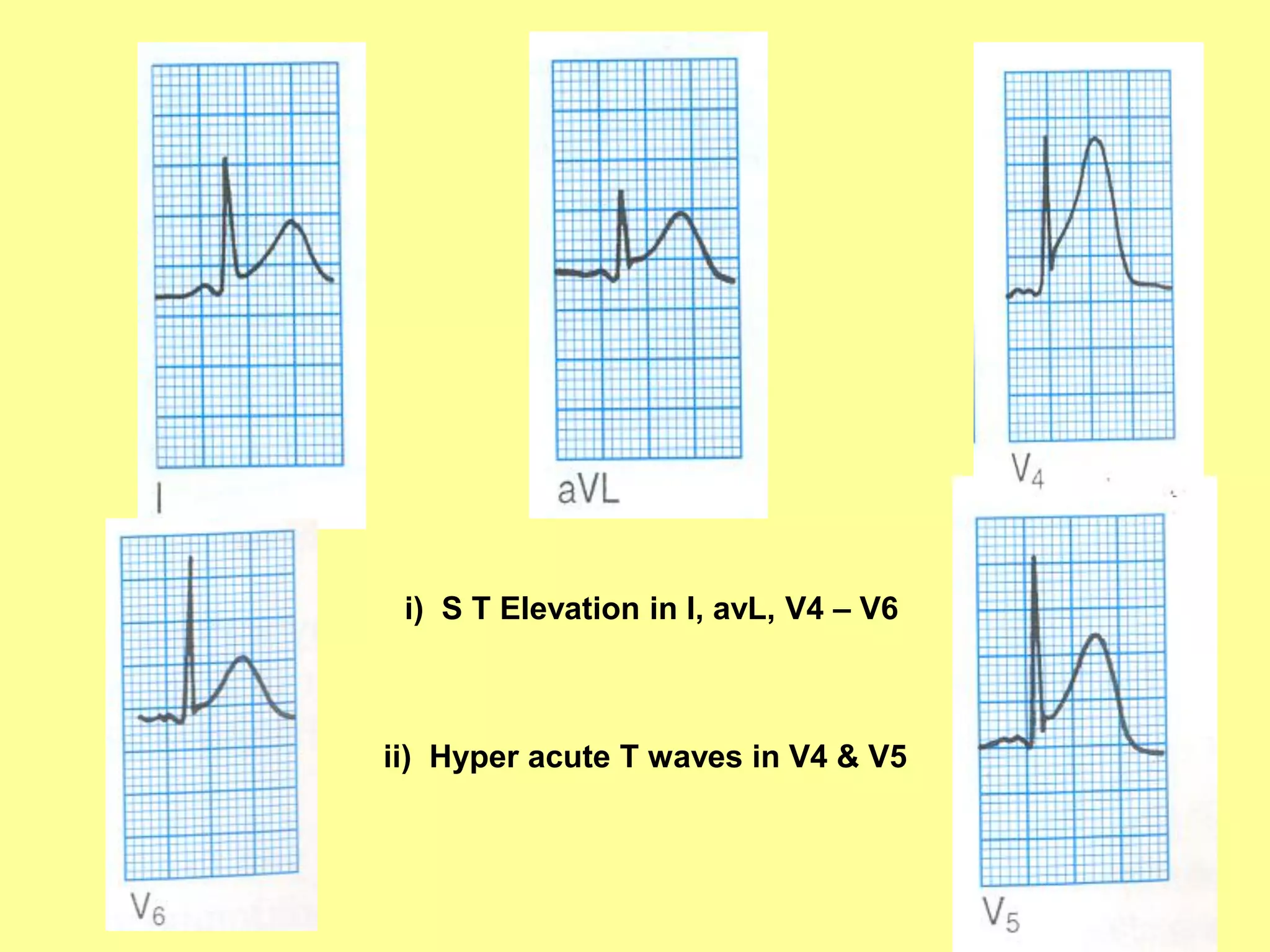
Lateral M. I.

- S T Elevation in I, aVL, V4 – V6
- Hyper acute T waves in V4 & V5
58
i) S T Elevation in I, avL, V4 – V6

ii) Hyper acute T waves in V4 & V5
59
Lateral M. I.

-ST elevation in I, aVL, V4-V6.

-Hyper – acute T waves in Leads V4 & V5.
-R in V1-V3
-ST depression in V1-V3
-Upright Tall T waves in V2 & V3
60
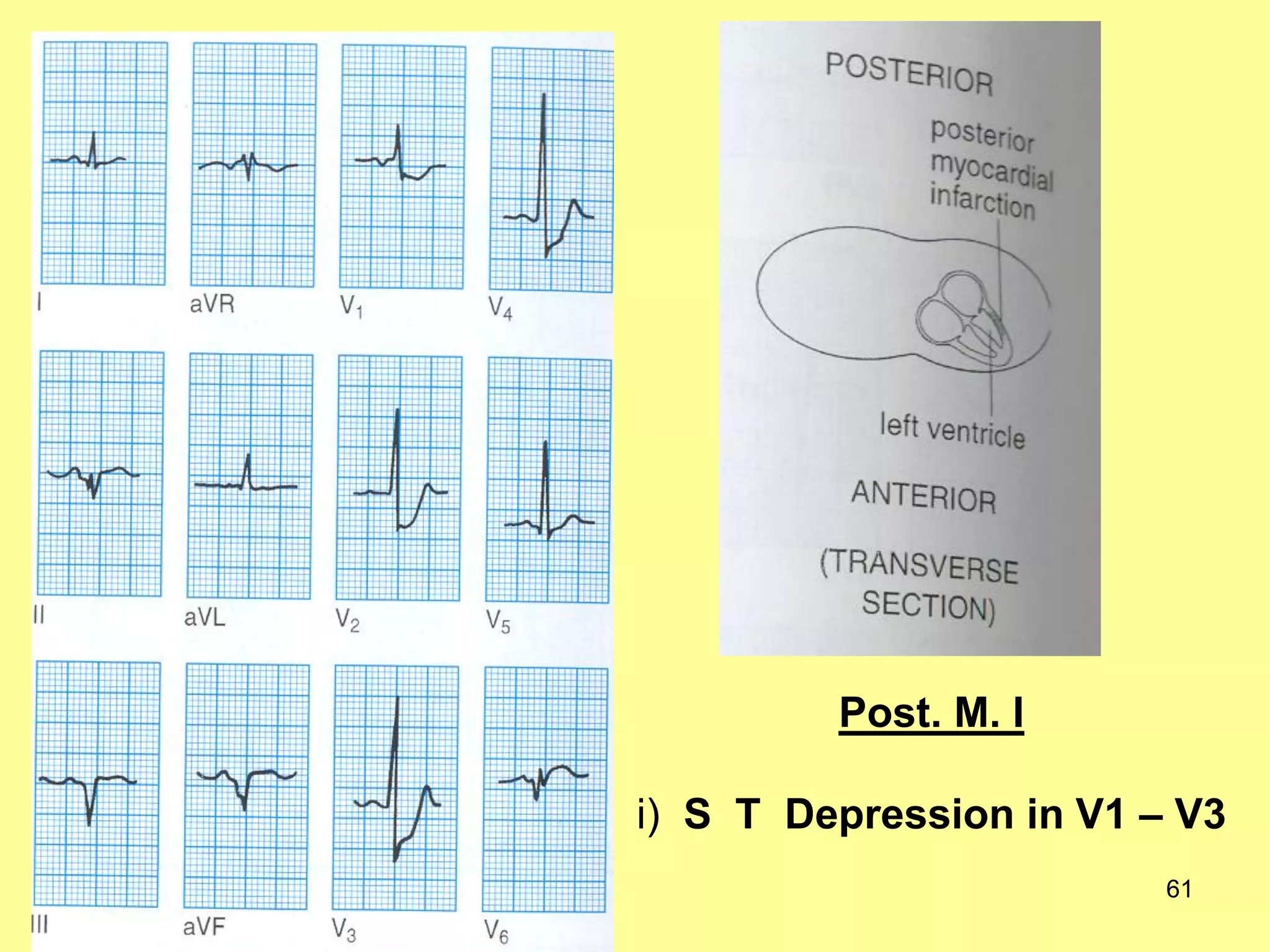
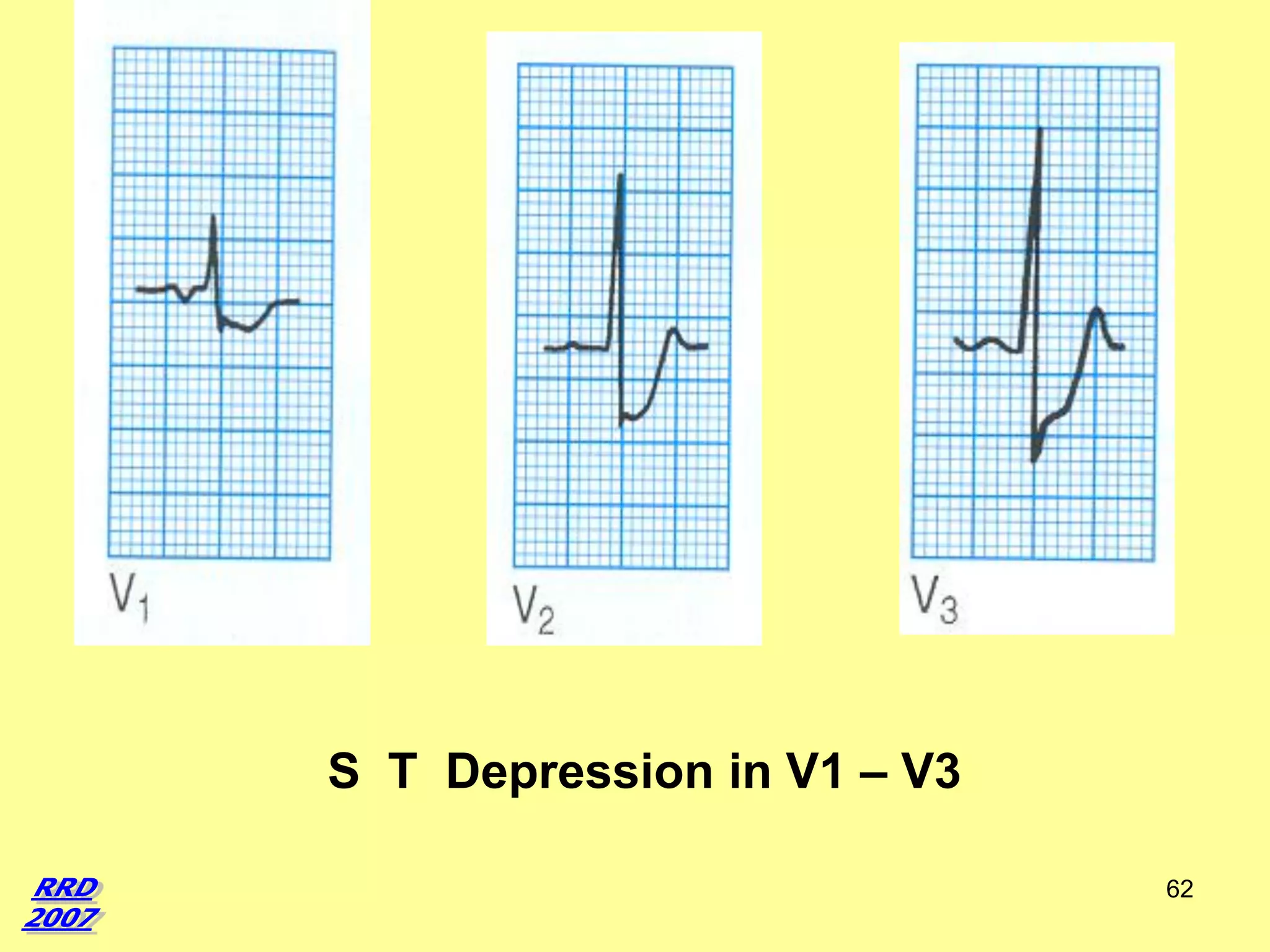
Post. M. I
i) S T Depression in V1 – V3
61
S T Depression in V1 – V3
62
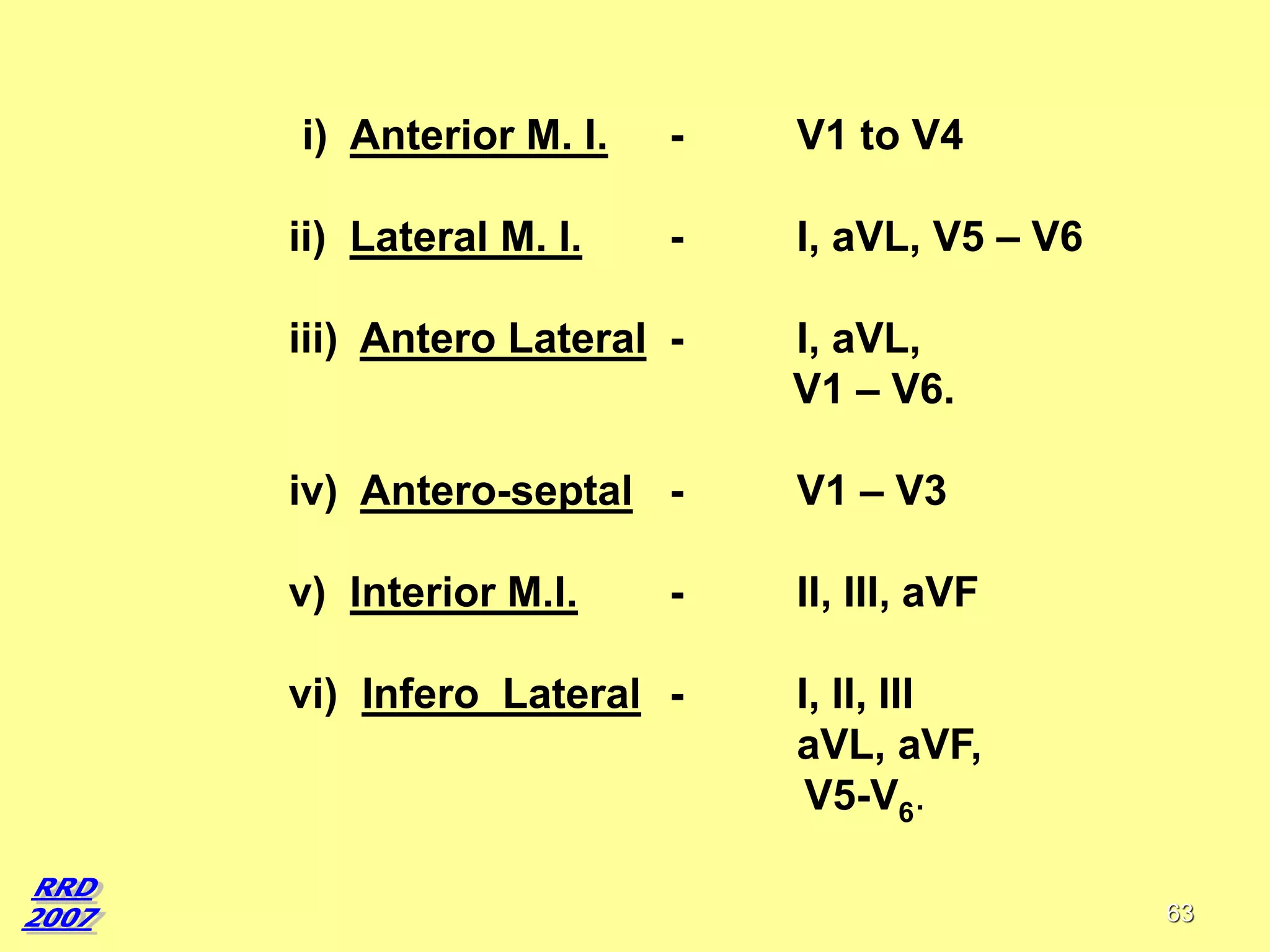
i) Anterior M. I.
ii) Lateral M. I.

-

V1 to V4

-

I, aVL, V5 – V6

iii) Antero Lateral -

I, aVL,
V1 – V6.

iv) Antero-septal -

V1 – V3

v) Interior M.I.

-

II, III, aVF

vi) Infero Lateral -

I, II, III
aVL, aVF,
V5-V6.
63
Exercise (stress) Test
1) ST Depression
2) Sometimes T Inversion

64
1) ST Depression

2) Sometimes T Inversion
65
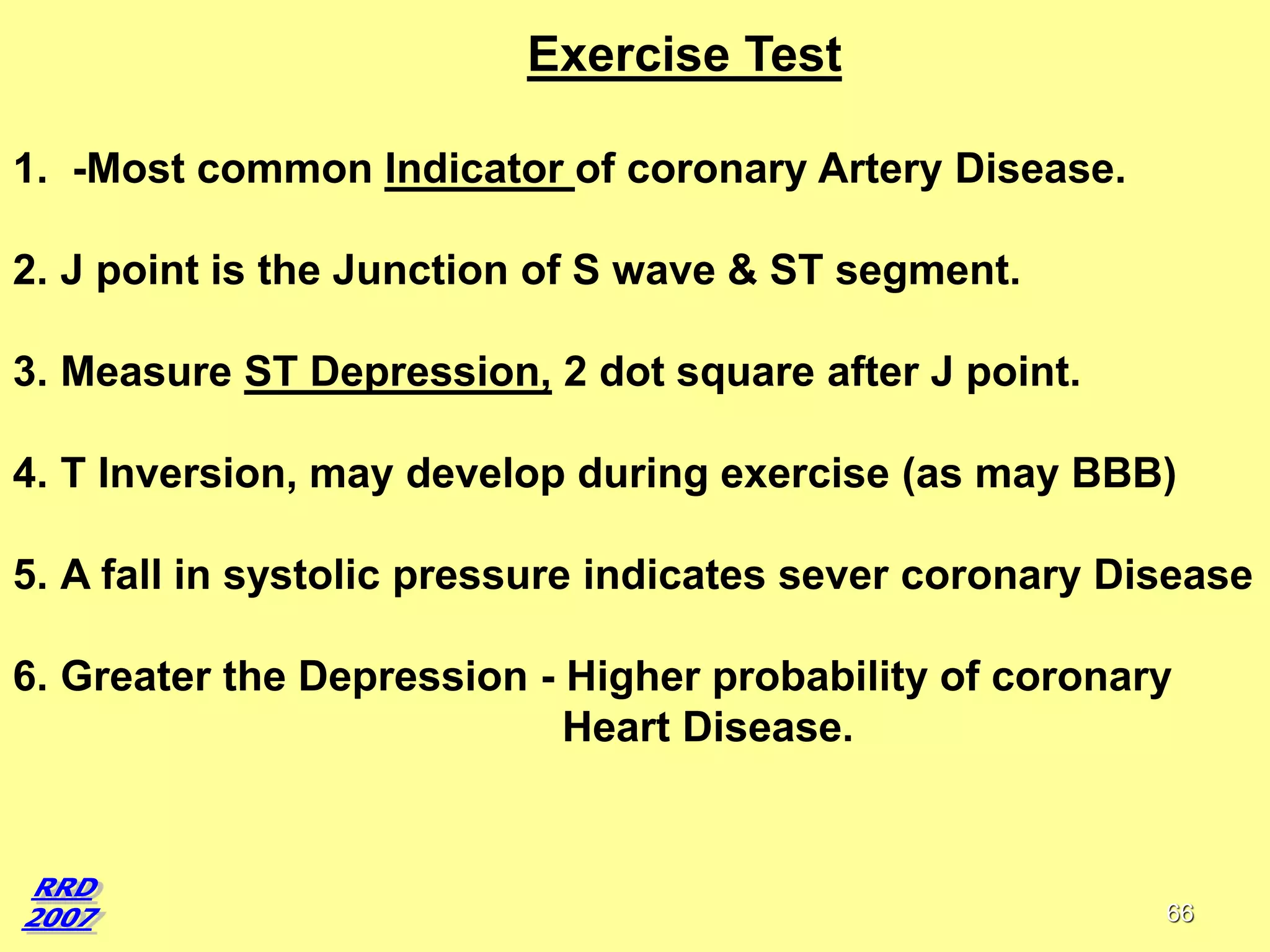
Exercise Test
1. -Most common Indicator of coronary Artery Disease.
2. J point is the Junction of S wave & ST segment.

3. Measure ST Depression, 2 dot square after J point.
4. T Inversion, may develop during exercise (as may BBB)
5. A fall in systolic pressure indicates sever coronary Disease
6. Greater the Depression - Higher probability of coronary
Heart Disease.

66
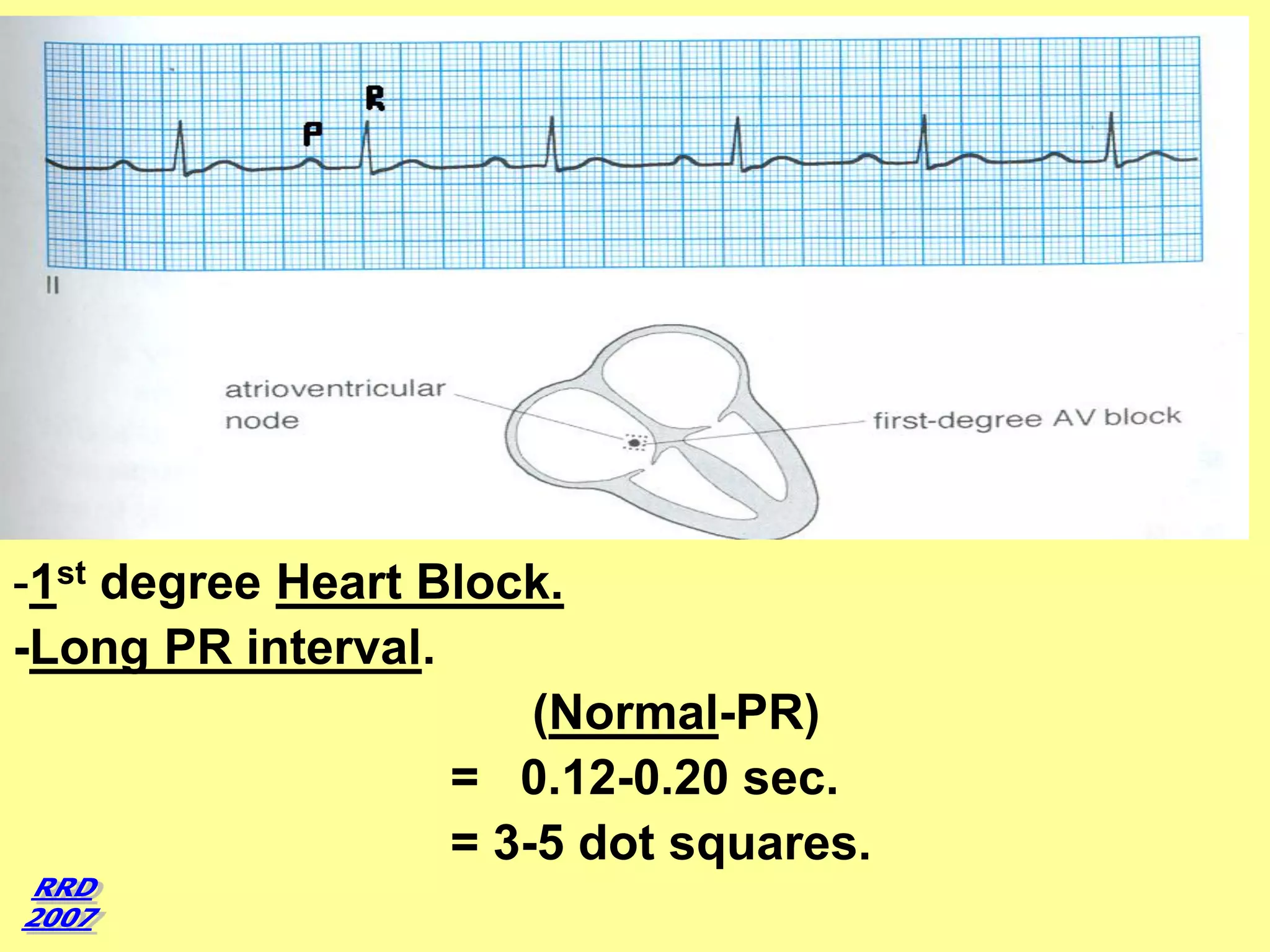
-1st degree Heart Block.
-Long PR interval.
(Normal-PR)
= 0.12-0.20 sec.
= 3-5 dot squares.
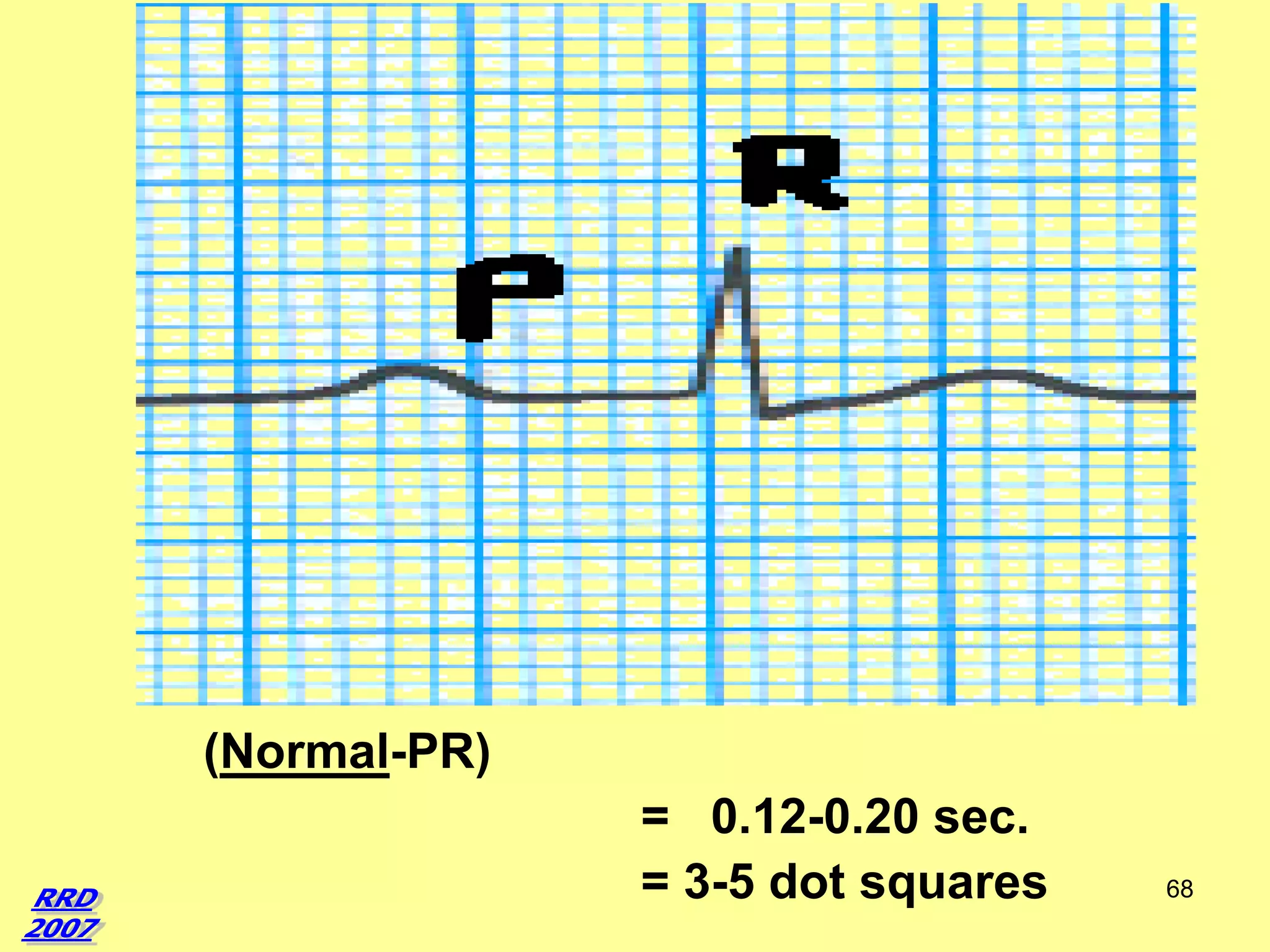
(Normal-PR)
= 0.12-0.20 sec.
= 3-5 dot squares

68
1st Degree Heart block
Long PR Interval
0.12
3 small sq. Causes

=
=

0.2 sec
5 small sq.

-IHD
-Hypokalaemia
(Low potassium, due to Diver tics)
-Acute Rheumatic myocarditis,
-Drugs (Digoxin ,B blockers,
Ca+ channel blocks)
Asymptomatic.
No specific Rx
69
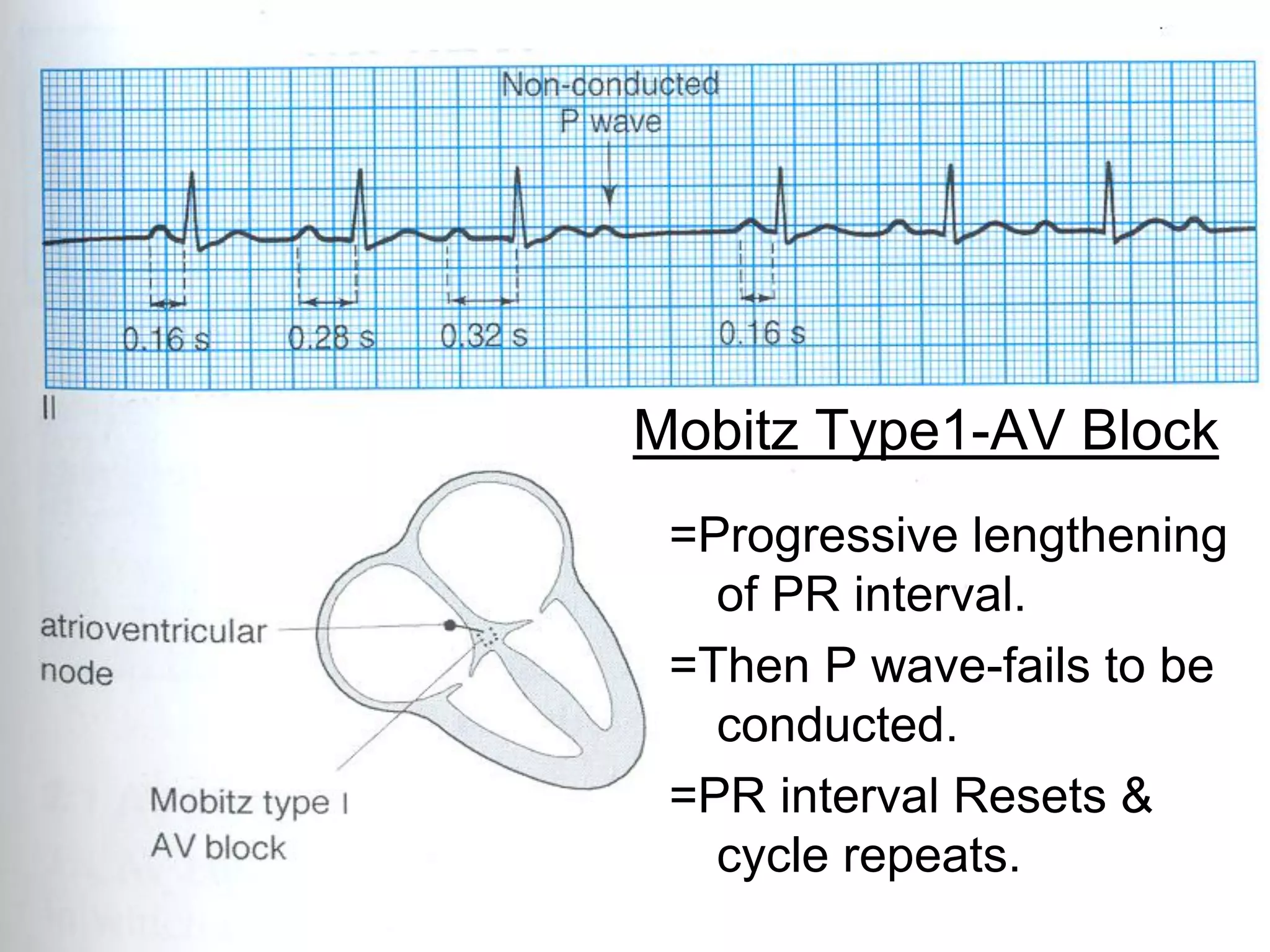
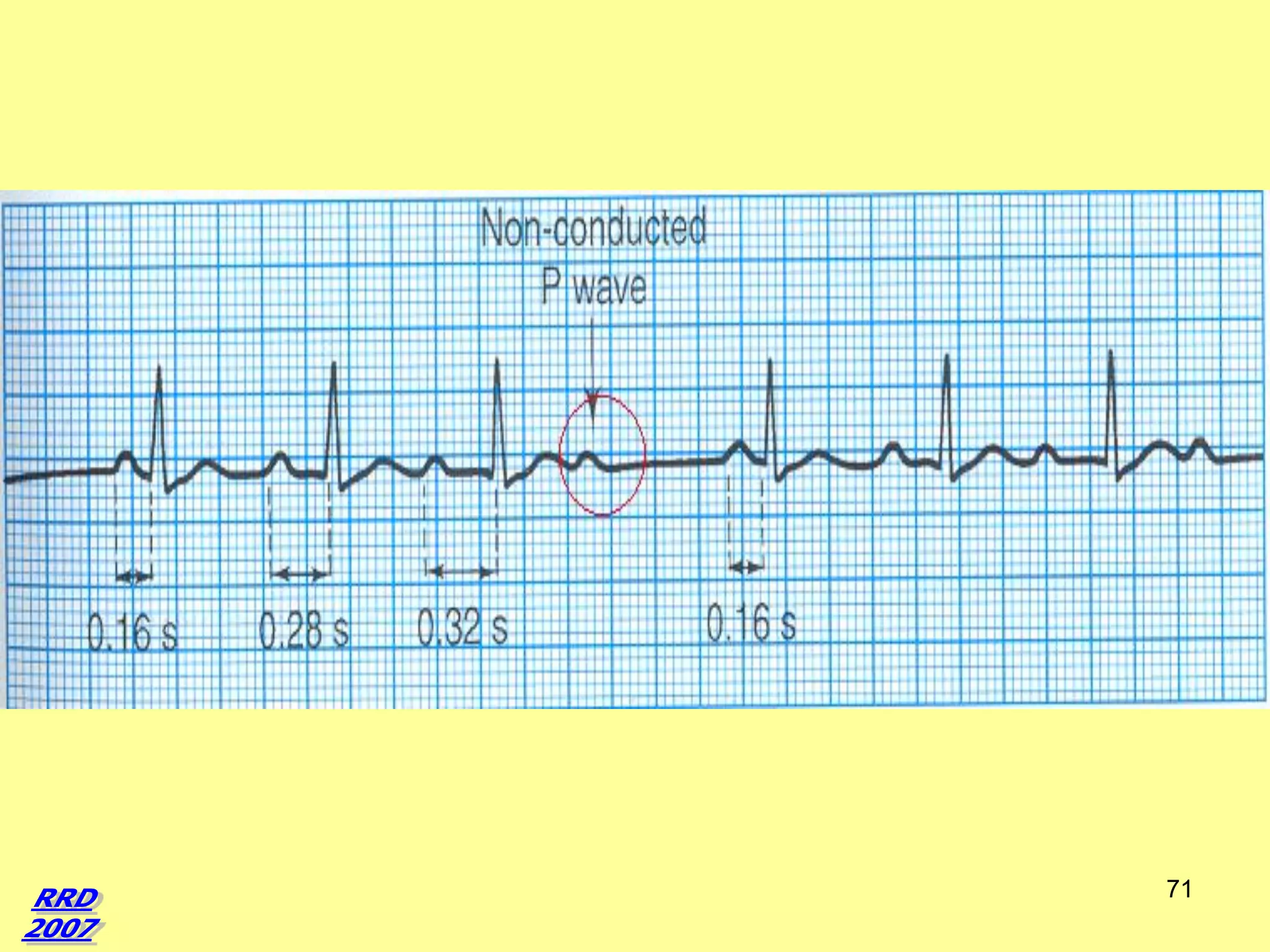
Mobitz Type1-AV Block
=Progressive lengthening
of PR interval.
=Then P wave-fails to be
conducted.
=PR interval Resets &
cycle repeats.
70
71
Mobitz Type I - AV Block
One of the types of 2nd degree
Heart block – Also known as “Wenckebach
phenomenon”.
a)
b)
c)

Progressive Lengthening of PR Interval
Then p wave – fails to be conducted
PR Interval resets 7 cycle repeats

=

Abnormal conducting, through AV node
(during High vagal activity – some times
during sleep.)
=
In Generalized disease of conducting
tissues.
=
Benign form of AV block .
(permanent pace maker not required)
– Temporary pacing before surgery.

72
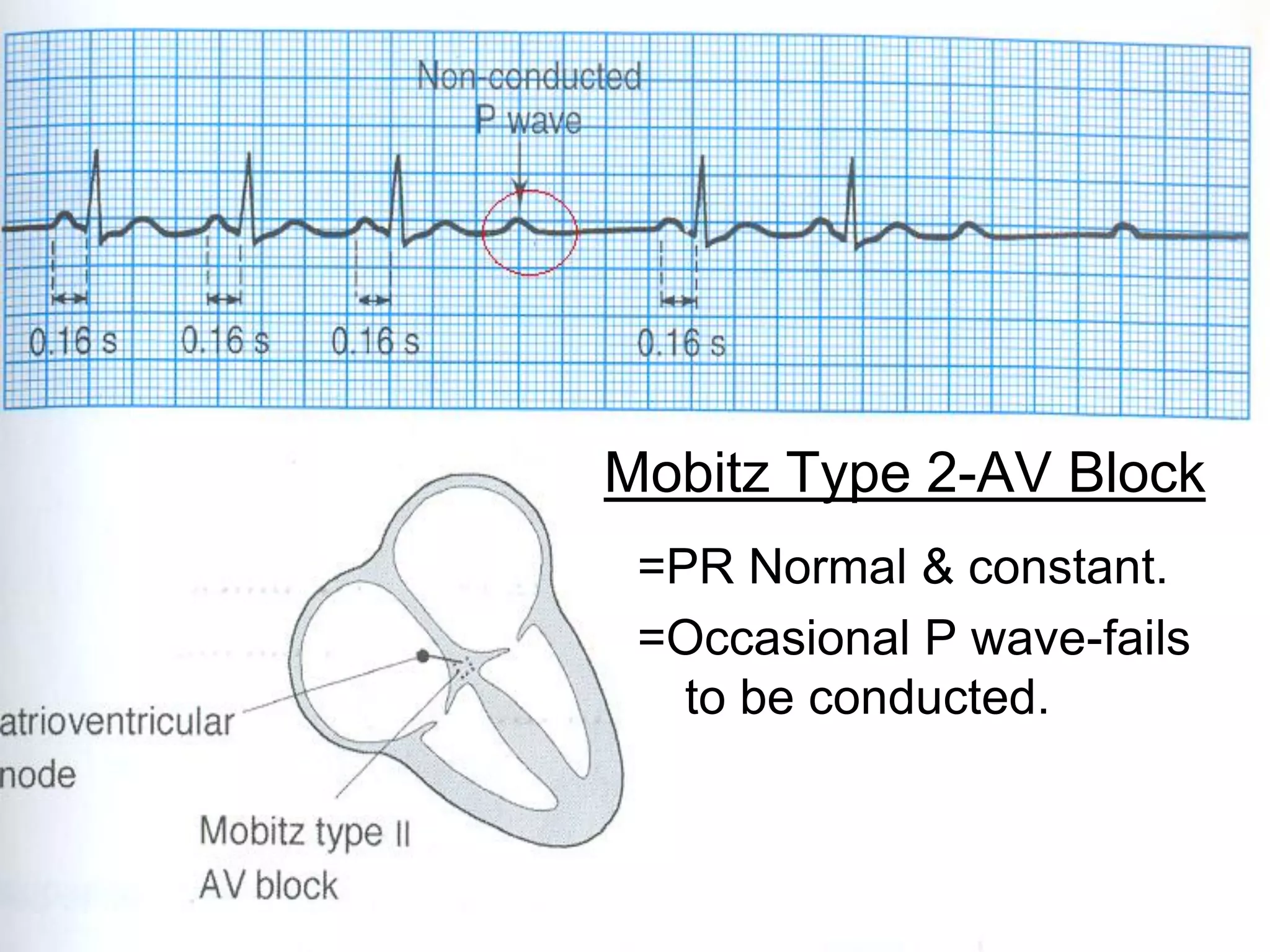
Mobitz Type 2-AV Block
=PR Normal & constant.
=Occasional P wave-fails
to be conducted.

73
Mobitz Type II - AV Block

a) PR - Normal & Constant
b)Occasional P wave – fails to be conducted.
= Result from abnormal conduction,
below AV node (in Bundle of His)
= More serious than type I
= Refer to cardiologist: Pacemaker may be
needed
= Indications for pacing – Acute M.I or
pre-operatively.
75
Third-degree AV block

3rd degrees Heart Block
a)
b)
c)
d)

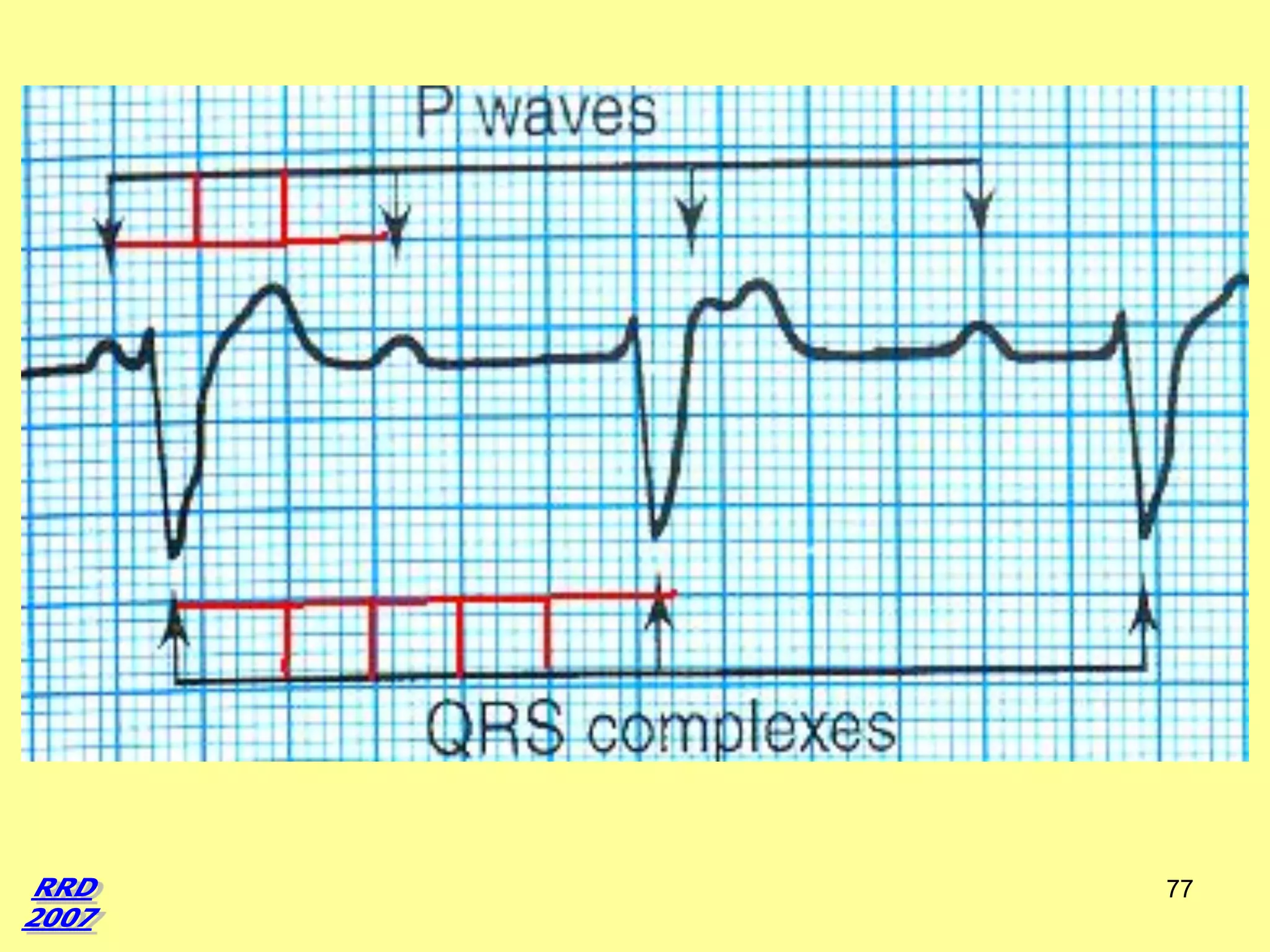
P wave (atrial) Rate = 85 / min
QRS complex (ventricular) rate = 54 / min
Broad QRS complexes
No Relation between – P waves & QRS complexes

76
77
3rd degree Heart Block
Complete Heart Block
Complete Interruption of conduction between,
Atria & ventricles & two are working Independently.

- In Acute inferior M.I. - 3rd deg. AV Block – Pacing.
- Acute Anterior wall M.I – 3rd degree heart Block.
Indicates extensive infarct & poor prognosis.
- Temporary pacing – pri-operatively
- If due to 3rd degree Block
Heart failure, Dizziness, fall, loss of
consciousness-Permanent pacing is indicated.
a) P wave (atrial) rate = 85 / min.
b) QRS complex (ventricular) rate = 54 / min.
c) Broad QRS complexes.
d) No Relation between – P waves & QRS complexes
78
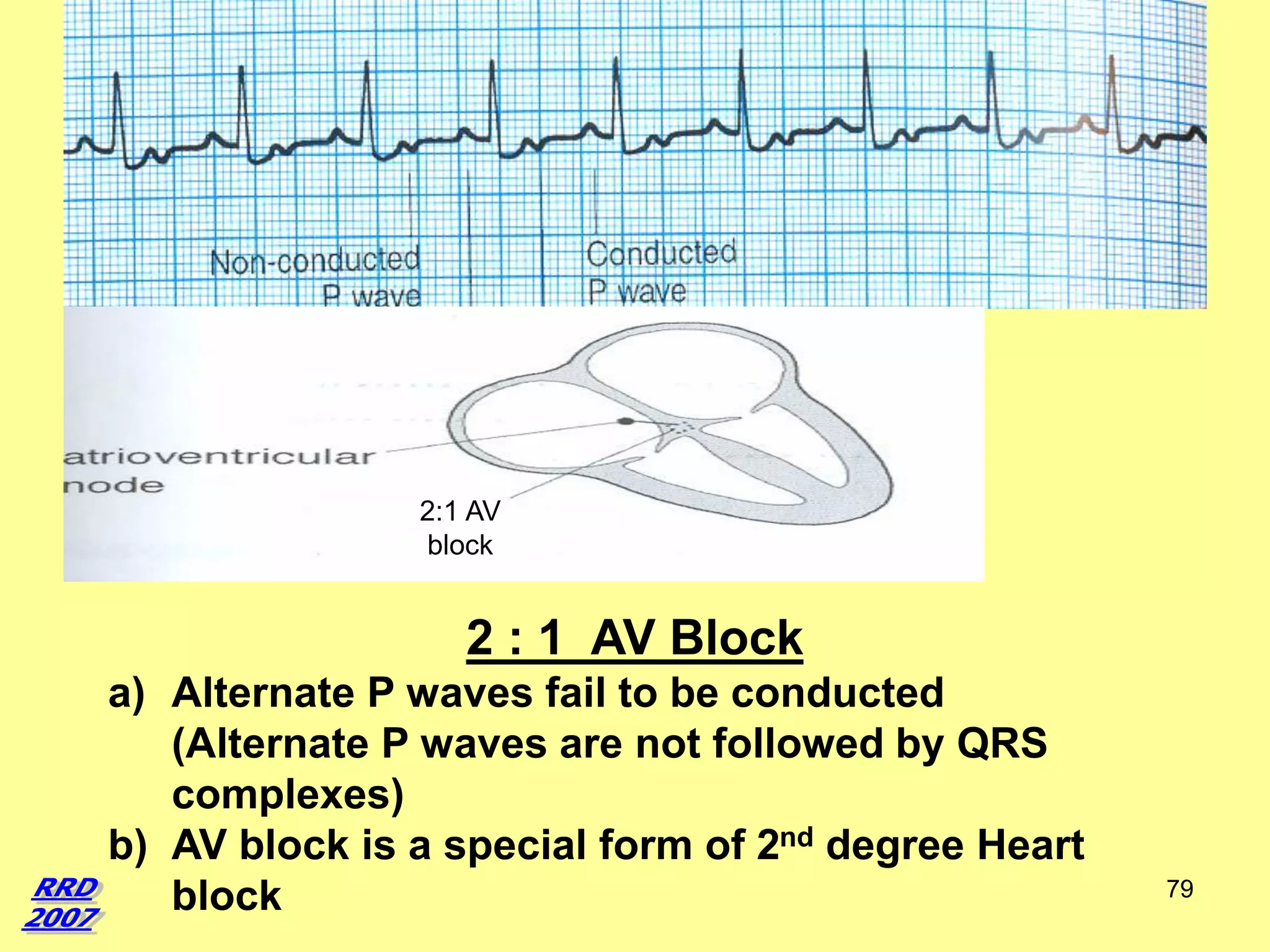
2:1 AV
block

2 : 1 AV Block
a) Alternate P waves fail to be conducted
(Alternate P waves are not followed by QRS
complexes)
b) AV block is a special form of 2nd degree Heart
block

79
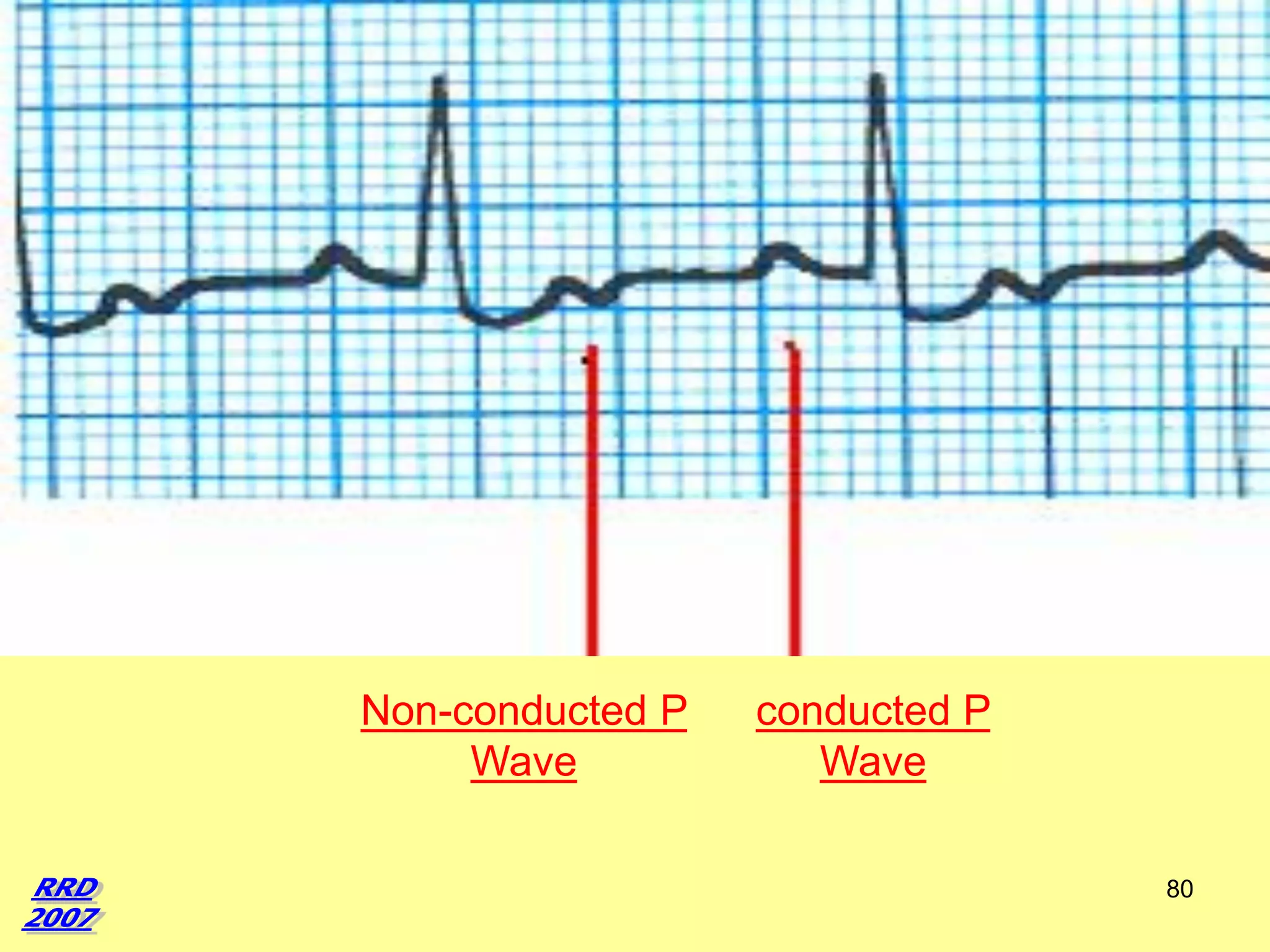
Non-conducted P
Wave

conducted P
Wave
80
2: 1 AV Block
- Alternate P waves fail to be conducted .
(Alternate P waves are not followed by
QRS complexes)

- AV block is a special form of 2nd degree
Heart Block.

81
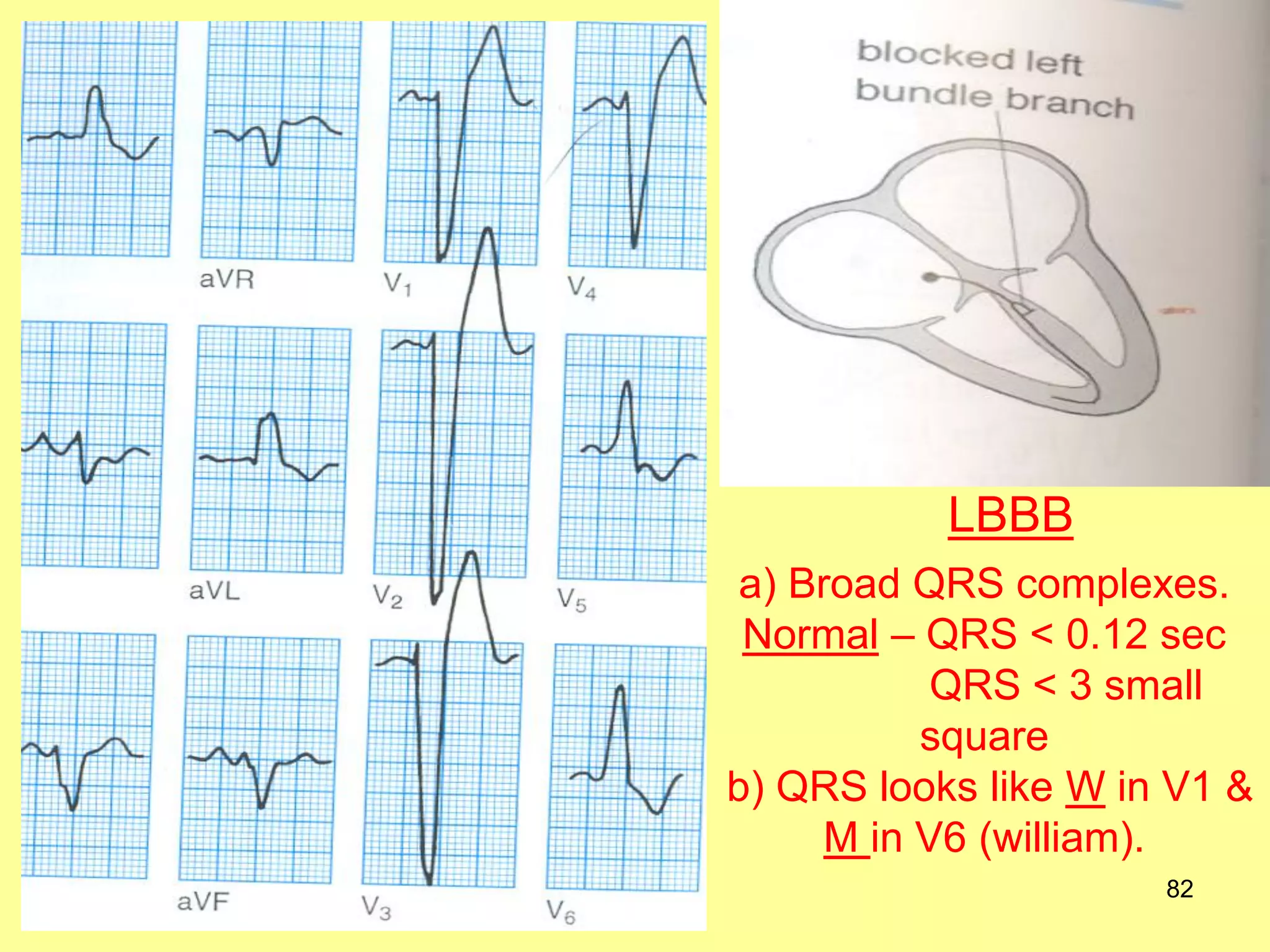
LBBB
a) Broad QRS complexes.
Normal – QRS < 0.12 sec
QRS < 3 small
square
b) QRS looks like W in V1 &
M in V6 (william).
82
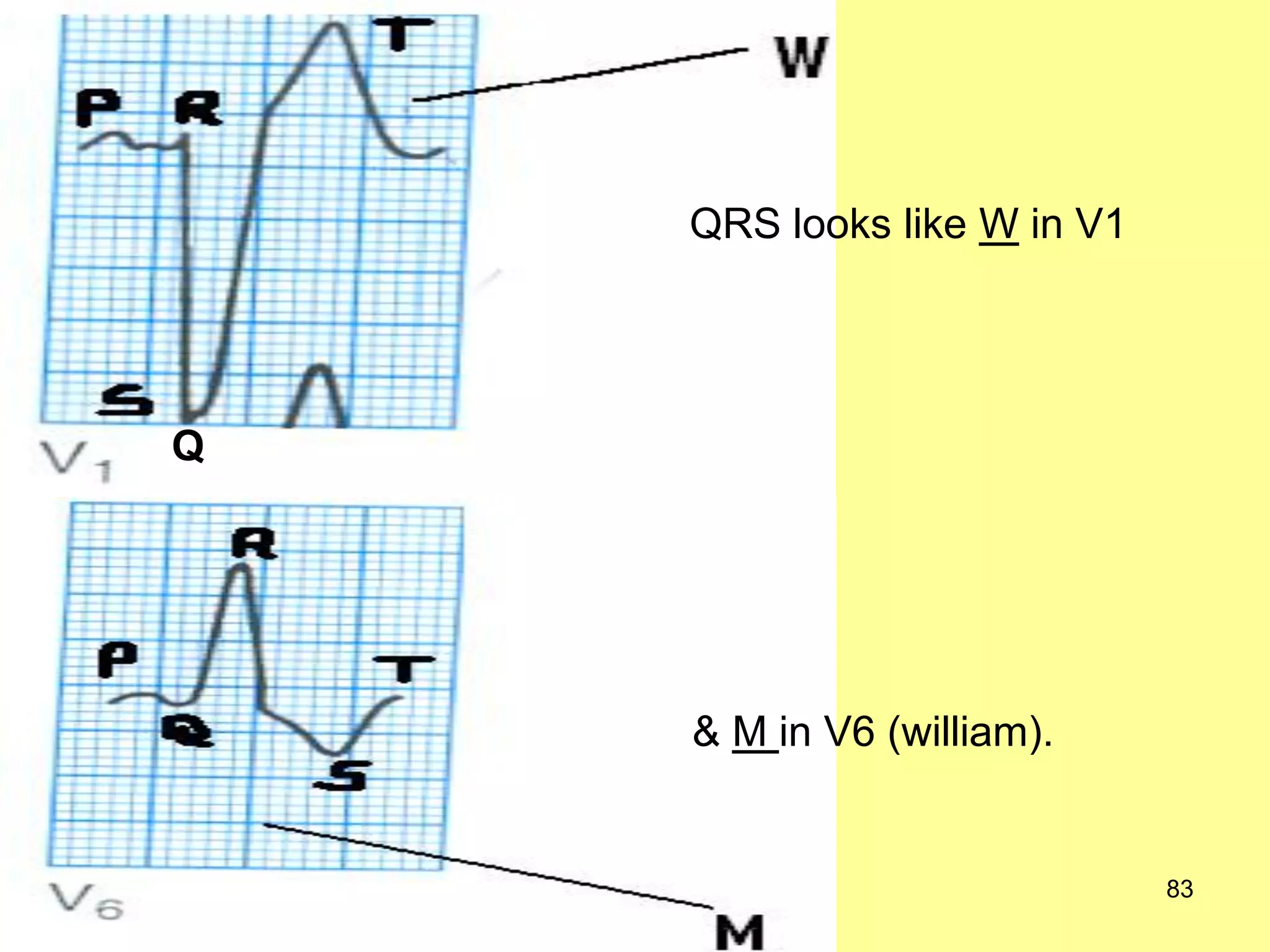
QRS looks like W in V1

Q

& M in V6 (william).

83
B.B.B
LBBB
a)
b)

Broad QRS complexes
QRS morphology – as explained in Text.
Normal:
QRS <
0.12 sec
QRS <
3.5 small squares
QRS looks like W in V1 & M in V6 (William)

Causes- IHD
- LVH (Hypertension, aortic stenosis),
- Fibrosis of conduction system.
Asymptomatic & do not required
right.

of their own
84
RBBB
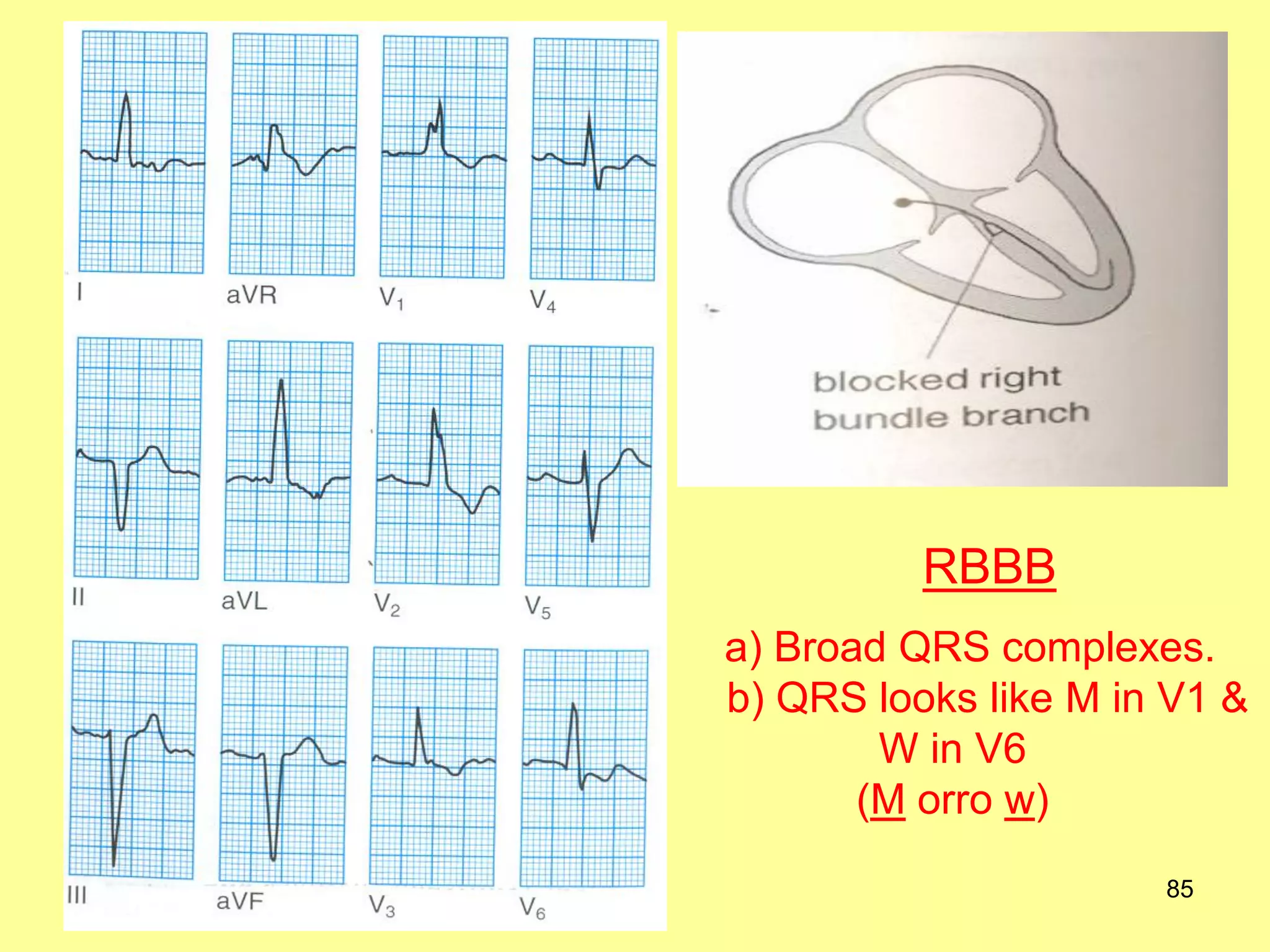
a) Broad QRS complexes.
b) QRS looks like M in V1 &
W in V6
(M orro w)
85
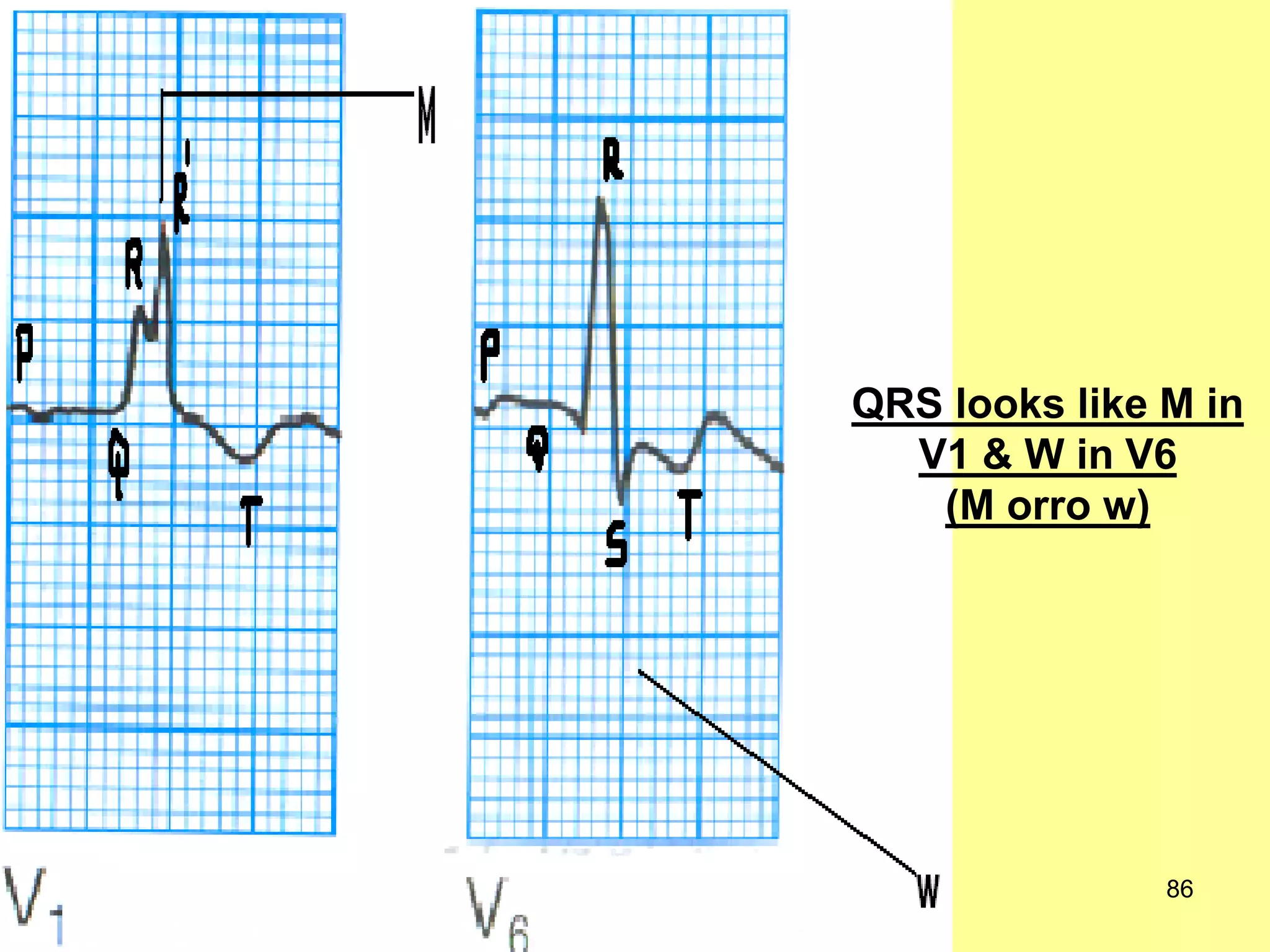
QRS looks like M in
V1 & W in V6
(M orro w)

86
RBBB
a)Broad QRS complexes
b)QRS morphology as explained in Text.
Normal
QRS <
0.12 sec.
QRS <
3 dot squares.
QRS Looks like ‘M’ in Lead V1 & ‘w’ in lead V6 (morrow).
Causes - IHD,
- Cardiomyopathy,
- Atrial septal defects,
- Massive pulmonary embolism.
-RBBB is relatively common finding in otherwise normal
hearts.
-Both LBBB & RBBB are asymptomatic in themselves
& do not require treatment in their own right.

87
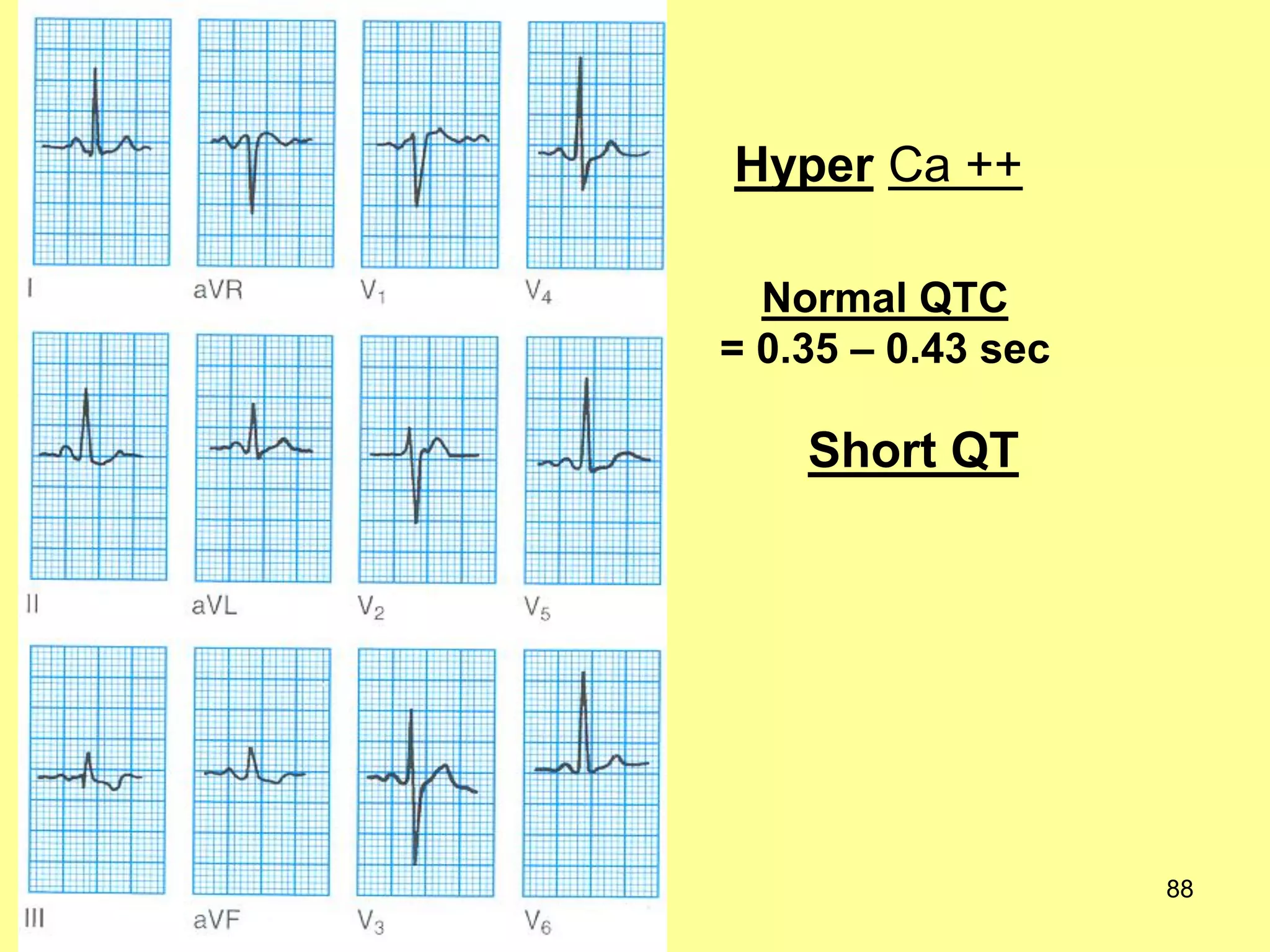
Hyper Ca ++
Normal QTC
= 0.35 – 0.43 sec

Short QT

88
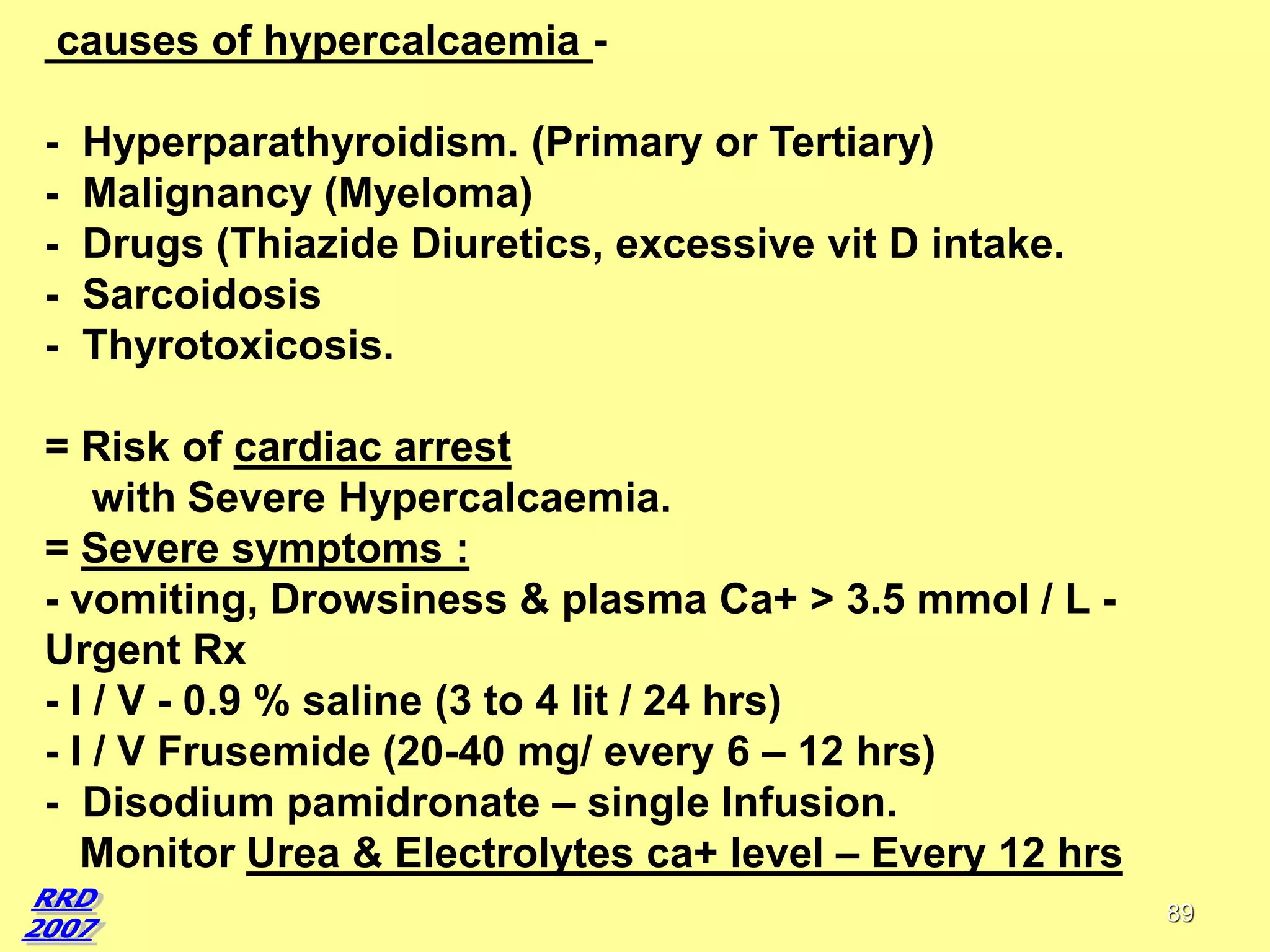
causes of hypercalcaemia -

Hyperparathyroidism. (Primary or Tertiary)
Malignancy (Myeloma)
Drugs (Thiazide Diuretics, excessive vit D intake.
Sarcoidosis
Thyrotoxicosis.

= Risk of cardiac arrest
with Severe Hypercalcaemia.
= Severe symptoms :
- vomiting, Drowsiness & plasma Ca+ > 3.5 mmol / L Urgent Rx
- I / V - 0.9 % saline (3 to 4 lit / 24 hrs)
- I / V Frusemide (20-40 mg/ every 6 – 12 hrs)
- Disodium pamidronate – single Infusion.
Monitor Urea & Electrolytes ca+ level – Every 12 hrs
89
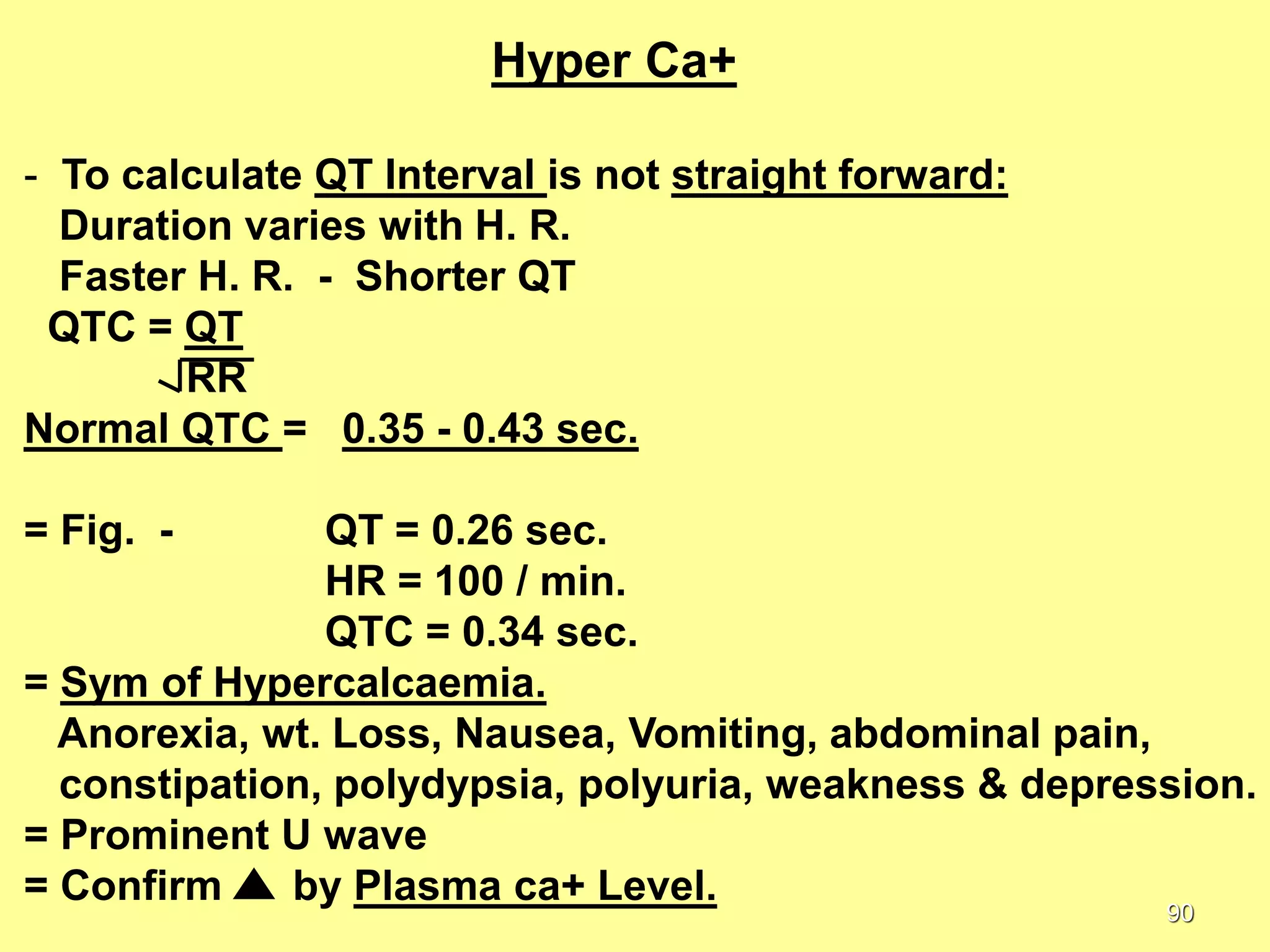
Hyper Ca+
- To calculate QT Interval is not straight forward:
Duration varies with H. R.
Faster H. R. - Shorter QT
QTC = QT
RR
Normal QTC = 0.35 - 0.43 sec.
= Fig. -

QT = 0.26 sec.
HR = 100 / min.
QTC = 0.34 sec.
= Sym of Hypercalcaemia.
Anorexia, wt. Loss, Nausea, Vomiting, abdominal pain,
constipation, polydypsia, polyuria, weakness & depression.
= Prominent U wave
= Confirm
by Plasma ca+ Level.
90
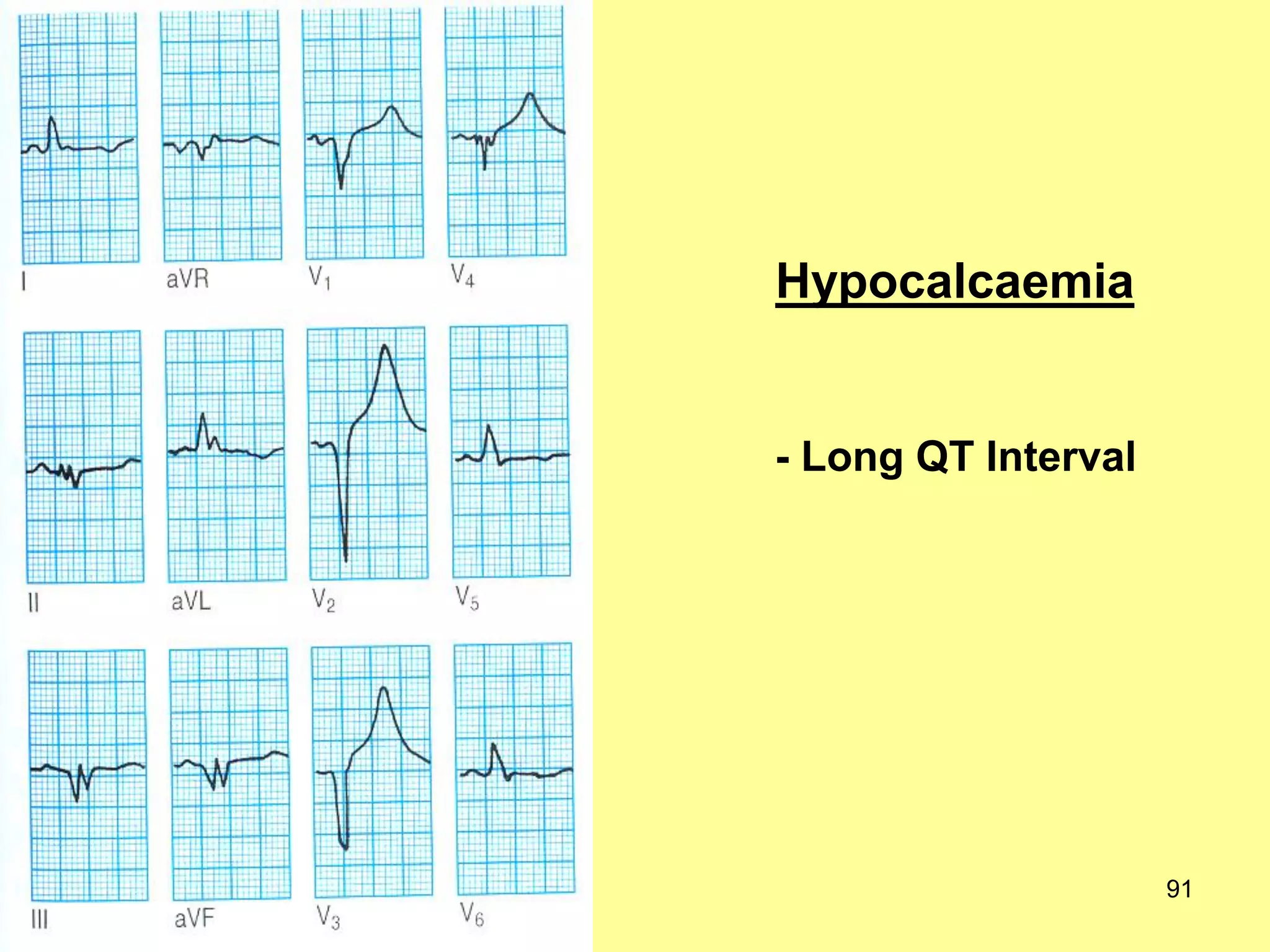
Hypocalcaemia

- Long QT Interval

91
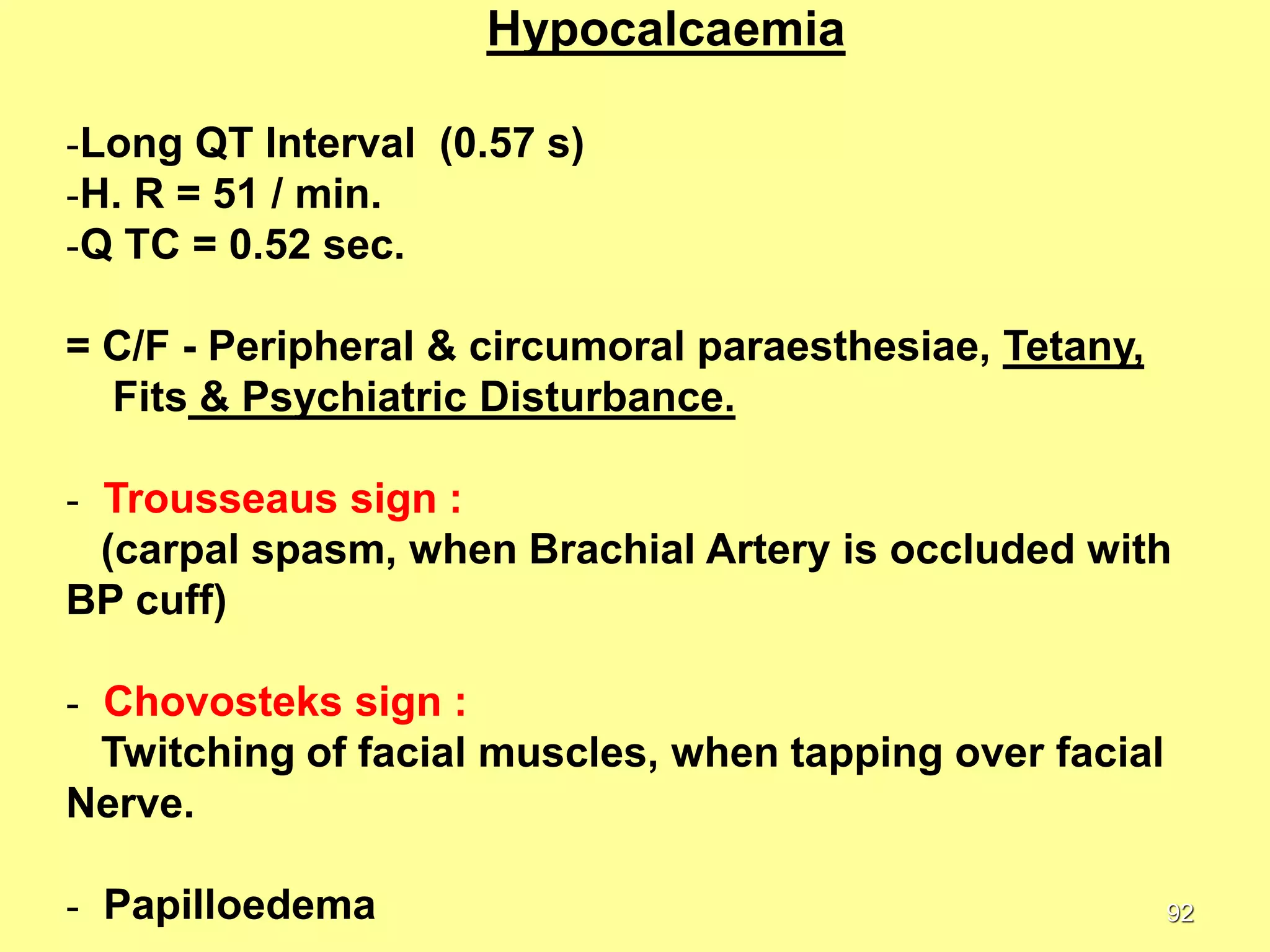
Hypocalcaemia
-Long QT Interval (0.57 s)
-H. R = 51 / min.
-Q TC = 0.52 sec.
= C/F - Peripheral & circumoral paraesthesiae, Tetany,
Fits & Psychiatric Disturbance.
- Trousseaus sign :
(carpal spasm, when Brachial Artery is occluded with
BP cuff)
- Chovosteks sign :
Twitching of facial muscles, when tapping over facial
Nerve.
- Papilloedema

92
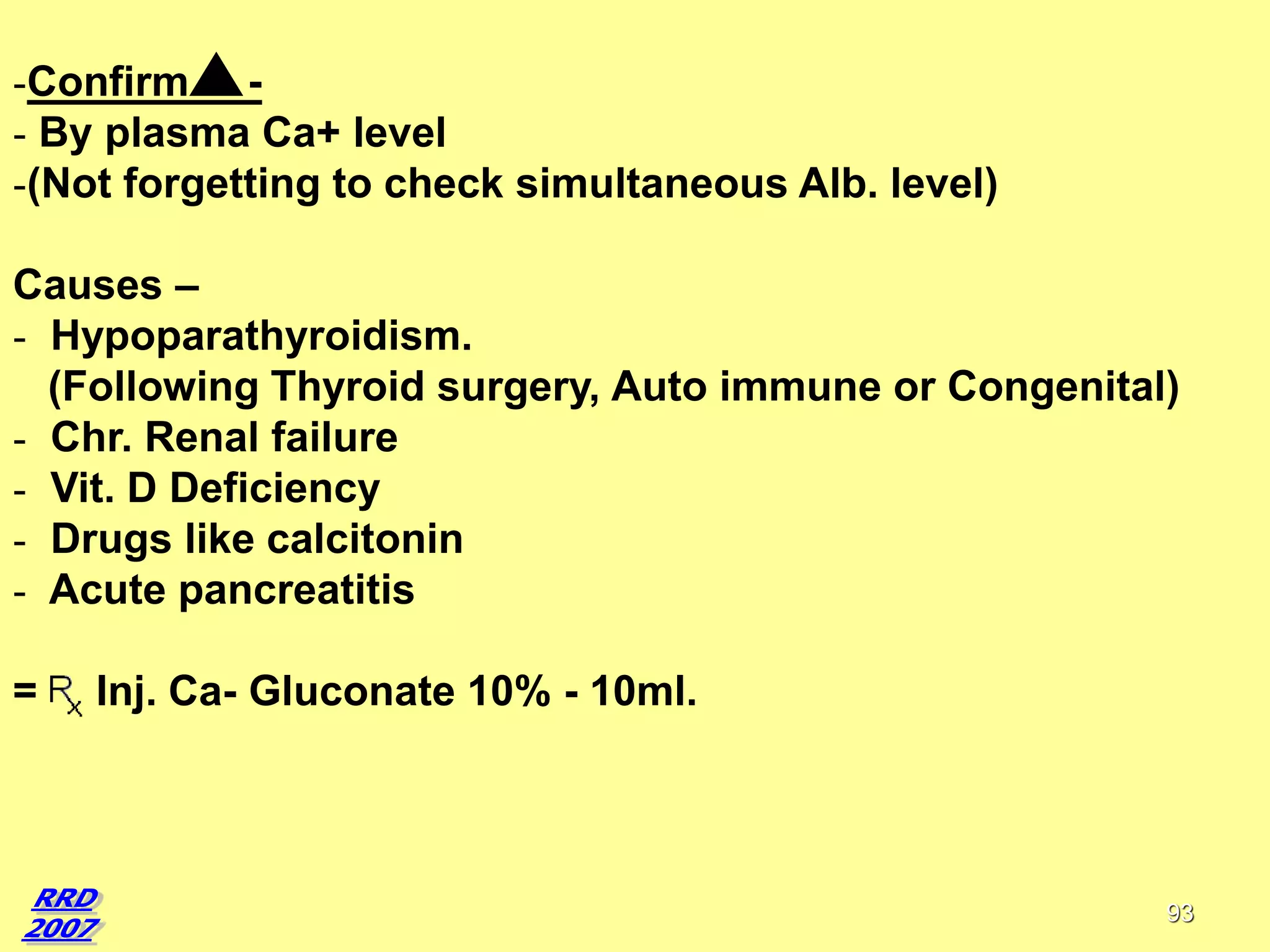
-Confirm - By plasma Ca+ level
-(Not forgetting to check simultaneous Alb. level)
Causes –
- Hypoparathyroidism.
(Following Thyroid surgery, Auto immune or Congenital)
- Chr. Renal failure
- Vit. D Deficiency
- Drugs like calcitonin
- Acute pancreatitis
=

Inj. Ca- Gluconate 10% - 10ml.

93
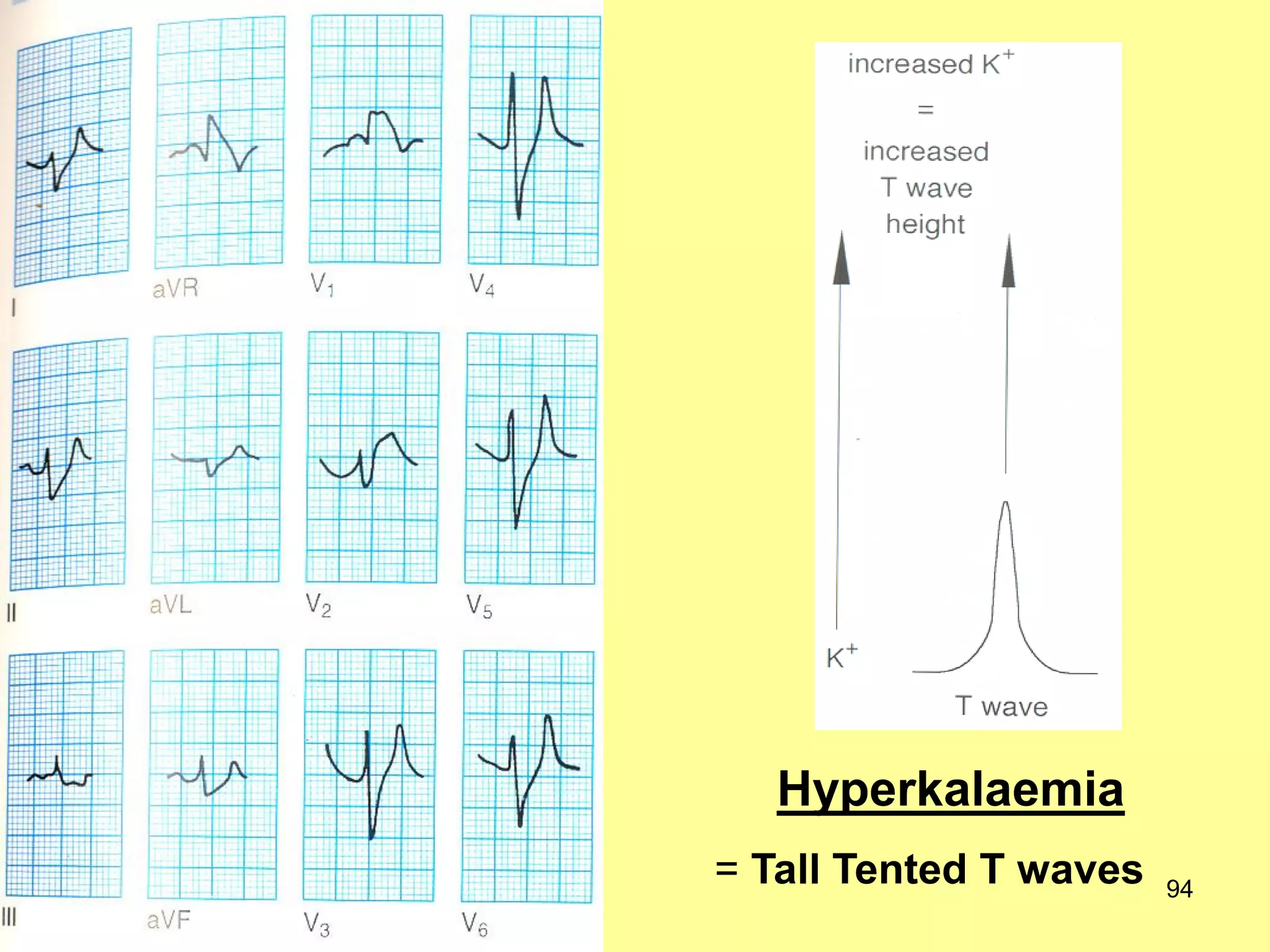
Hyperkalaemia
= Tall Tented T waves

94
Hyperkalaemia
= Tall ‘Tented’ T wave
Hyperkalaemia also cause:

-Flattening & even loss of P wave.
-Lengthening of PR
-Widening of QRS complex.
-Arrhythmias.
-

Confirmed by - Elevated plasma potassium level.

-Underlying cause - Renal Failure.
-Complete Drug H/O is Essential in any pt. with abnormal ECG.
95
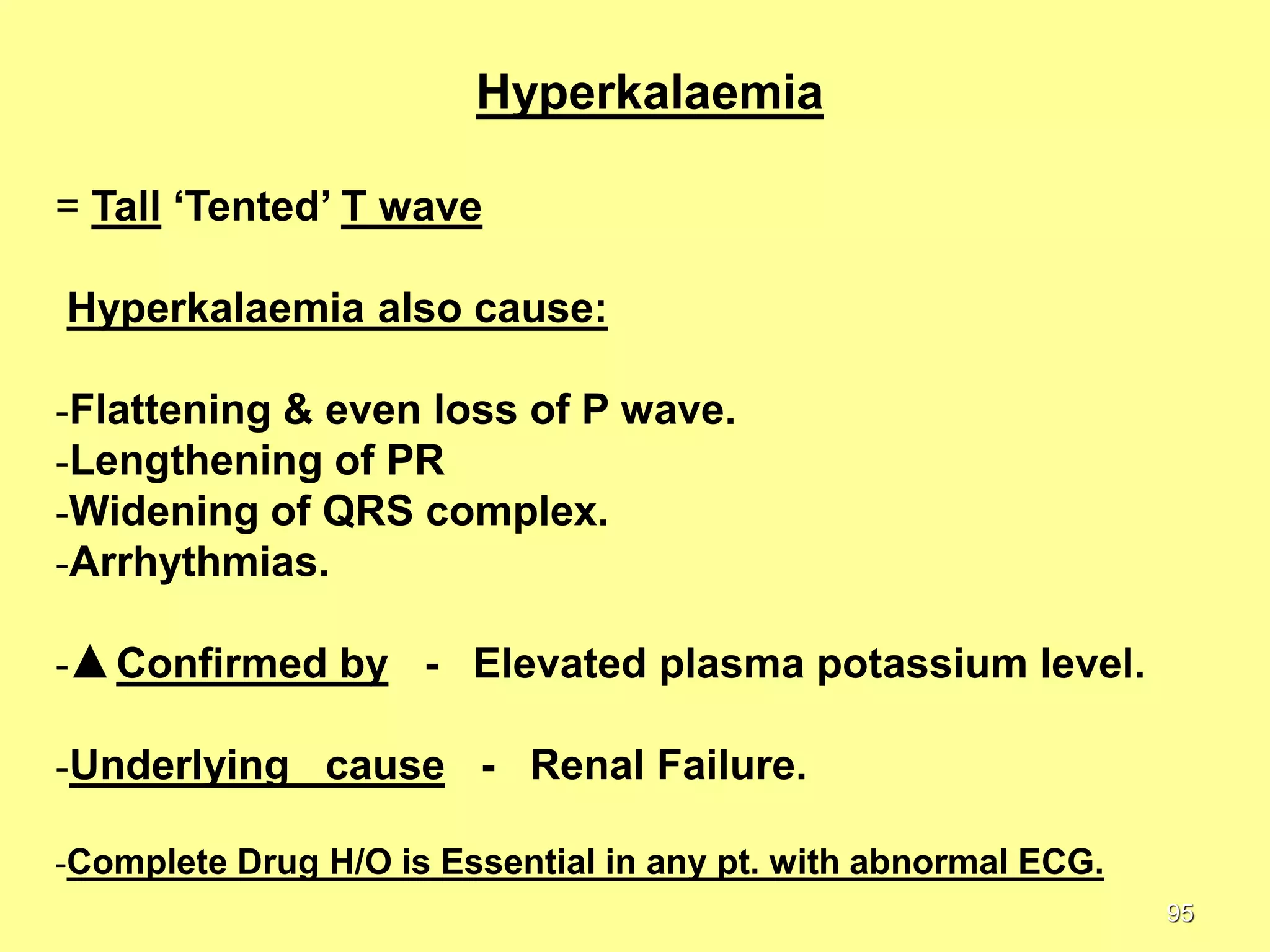
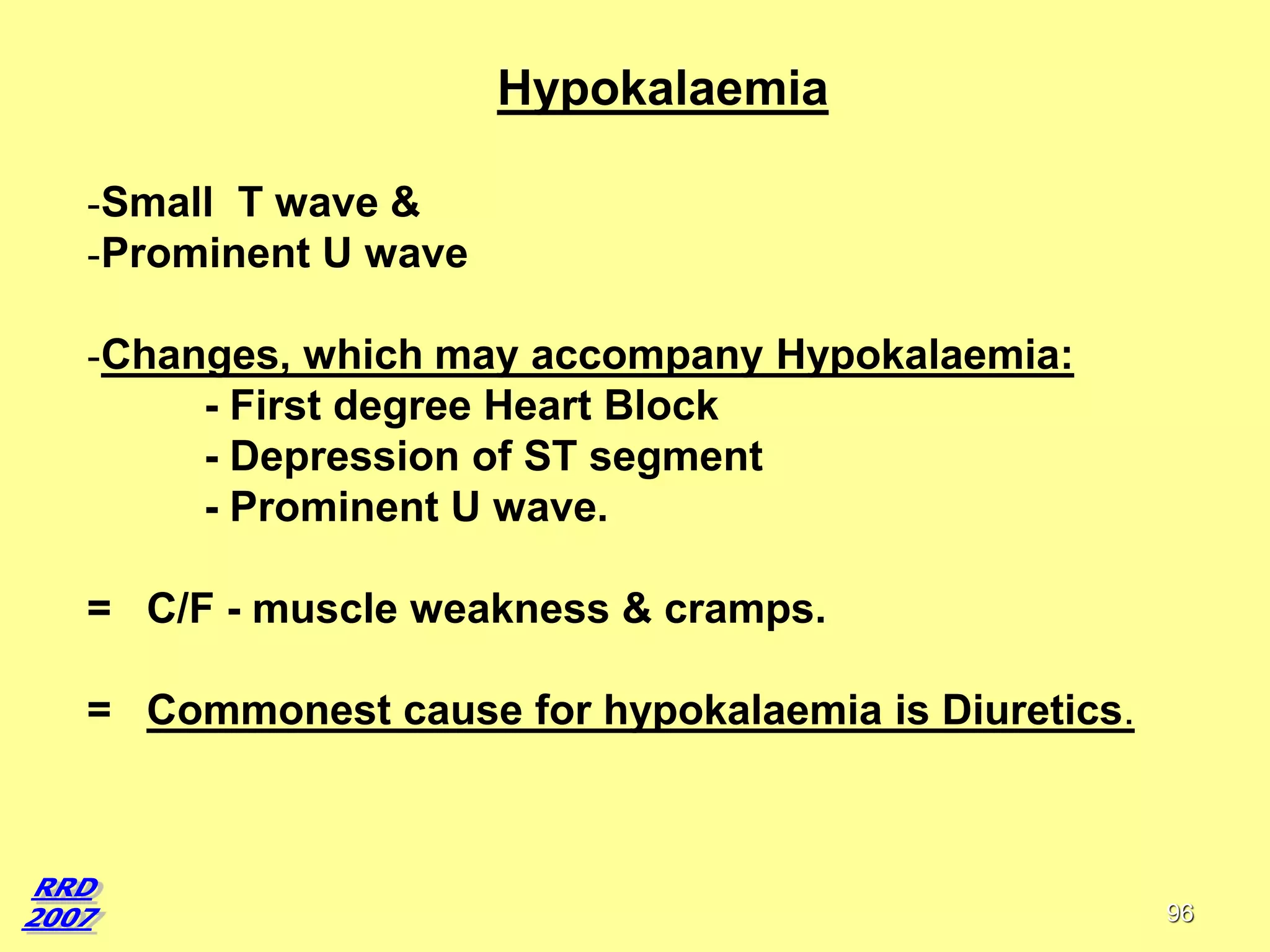
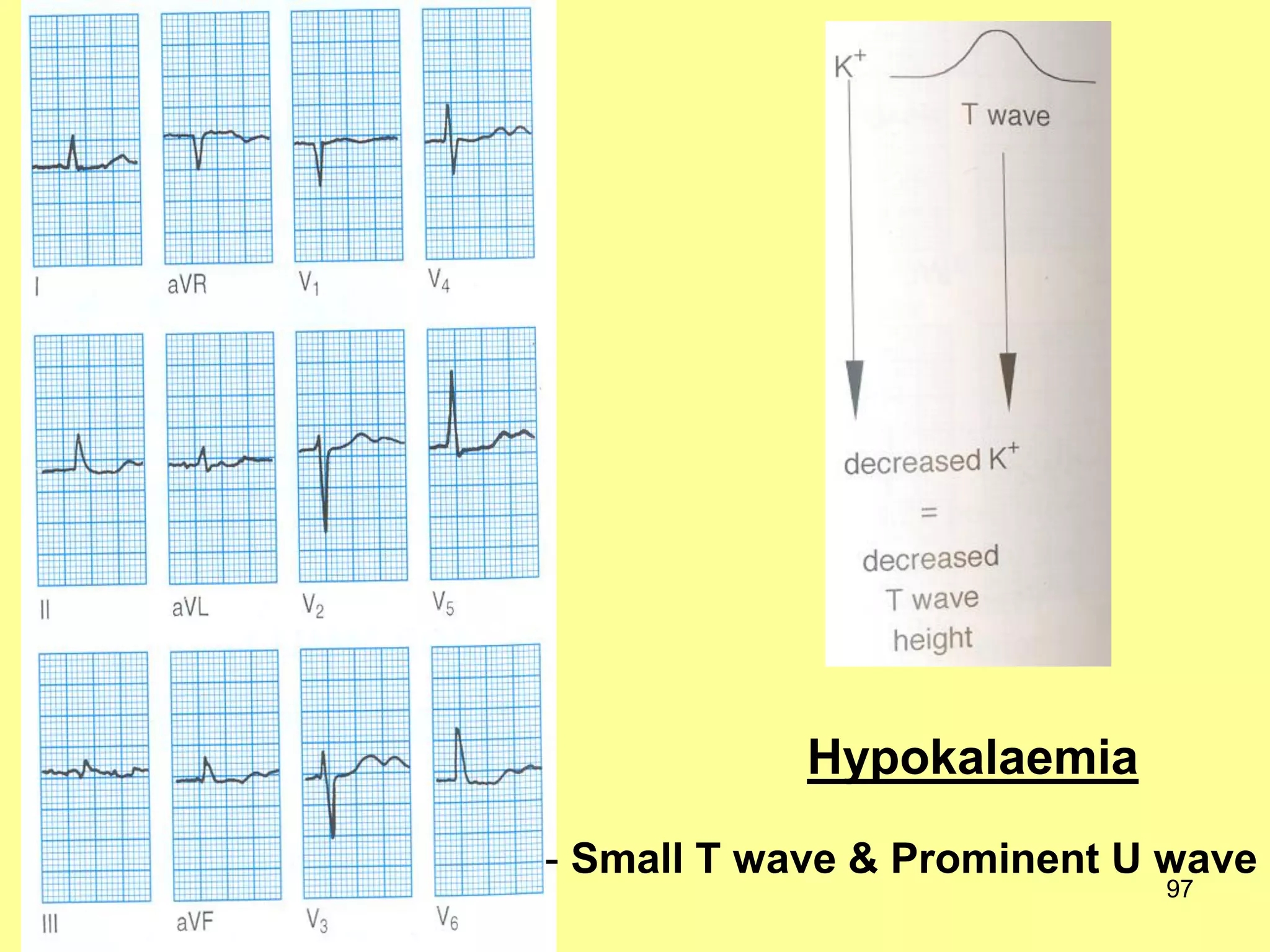
Hypokalaemia
-Small T wave &
-Prominent U wave

-Changes, which may accompany Hypokalaemia:
- First degree Heart Block
- Depression of ST segment
- Prominent U wave.
= C/F - muscle weakness & cramps.
= Commonest cause for hypokalaemia is Diuretics.

96
Hypokalaemia
- Small T wave & Prominent U wave
97
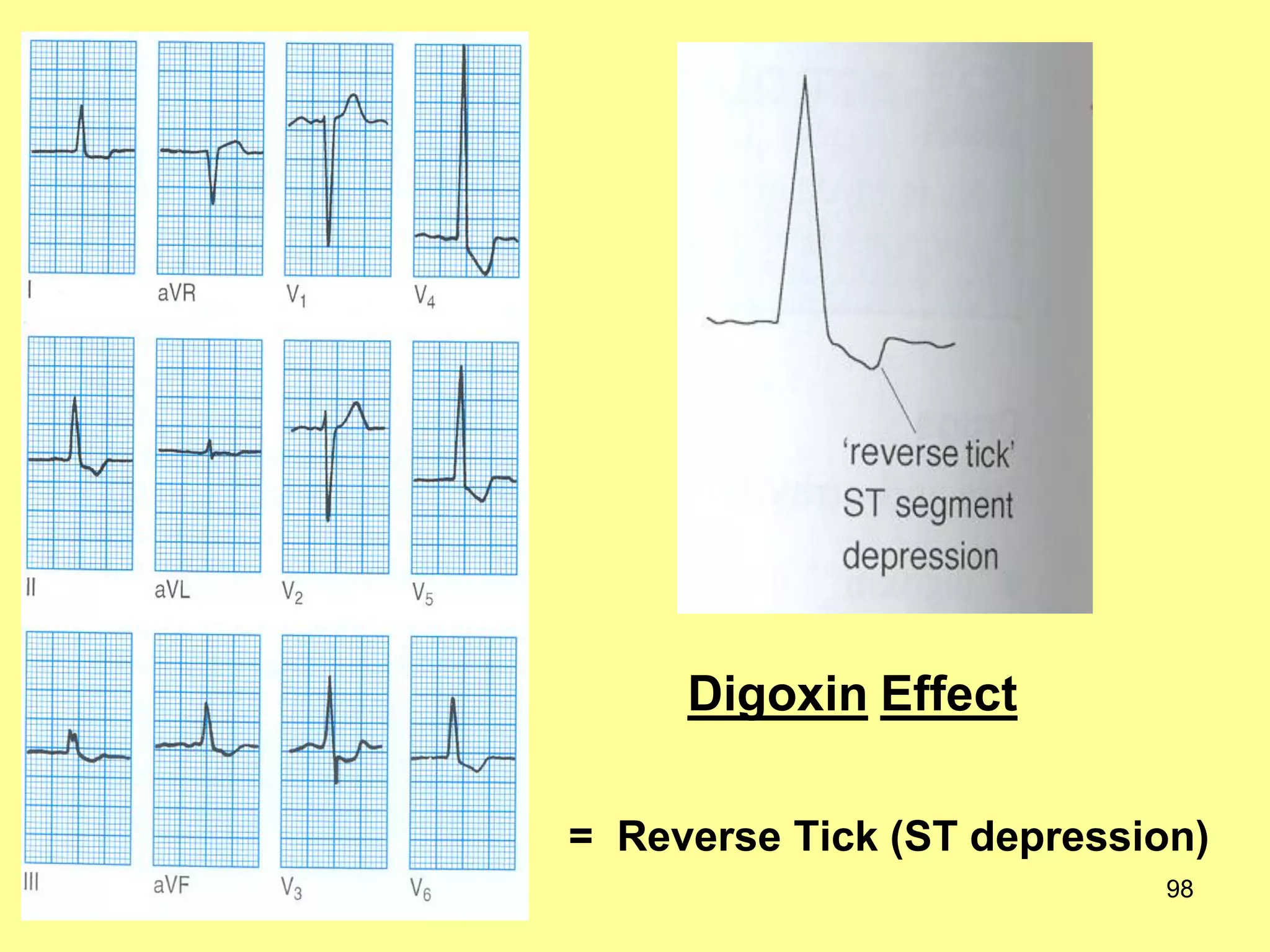
Digoxin Effect
= Reverse Tick (ST depression)
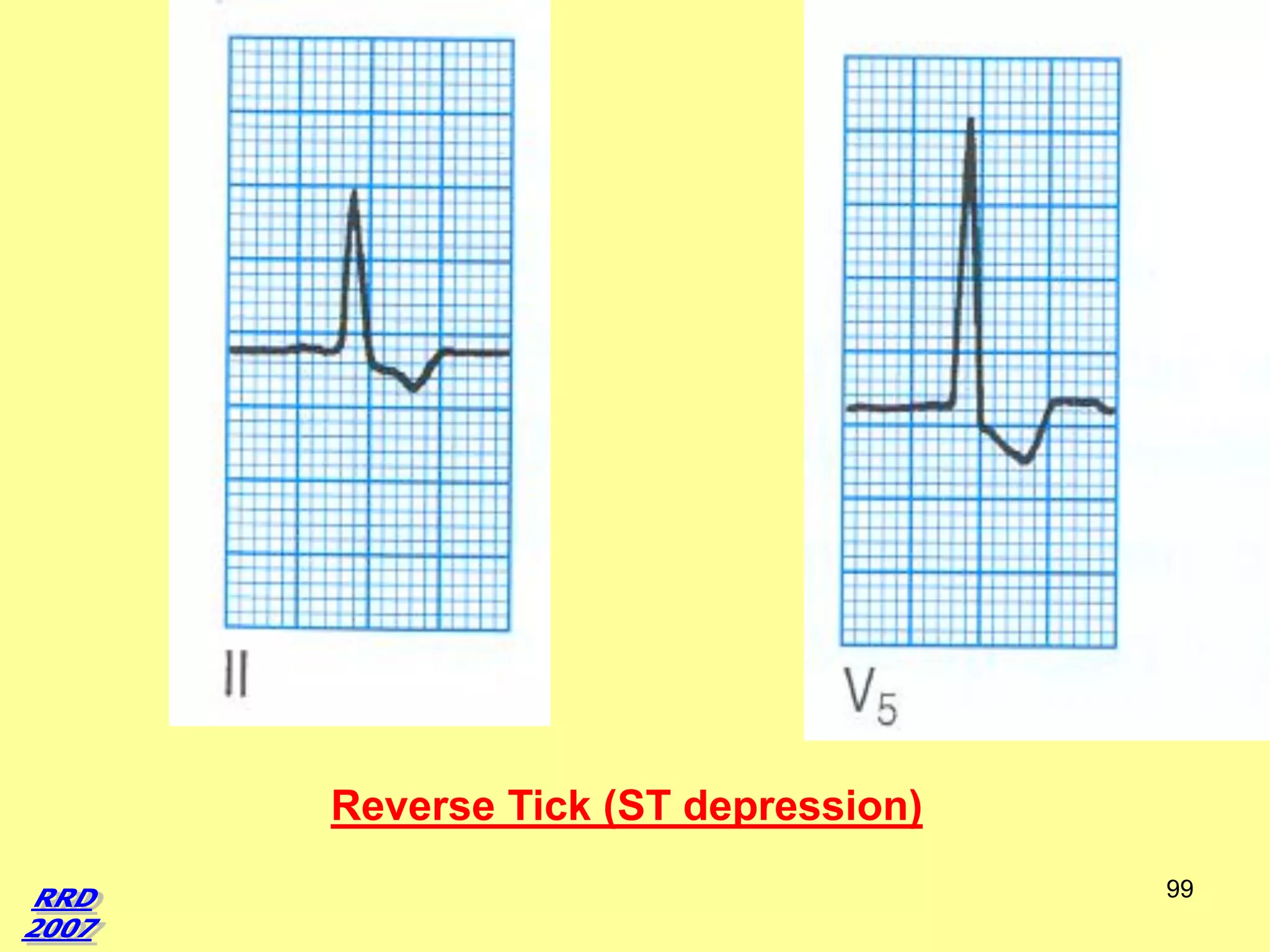
98
Reverse Tick (ST depression)
99
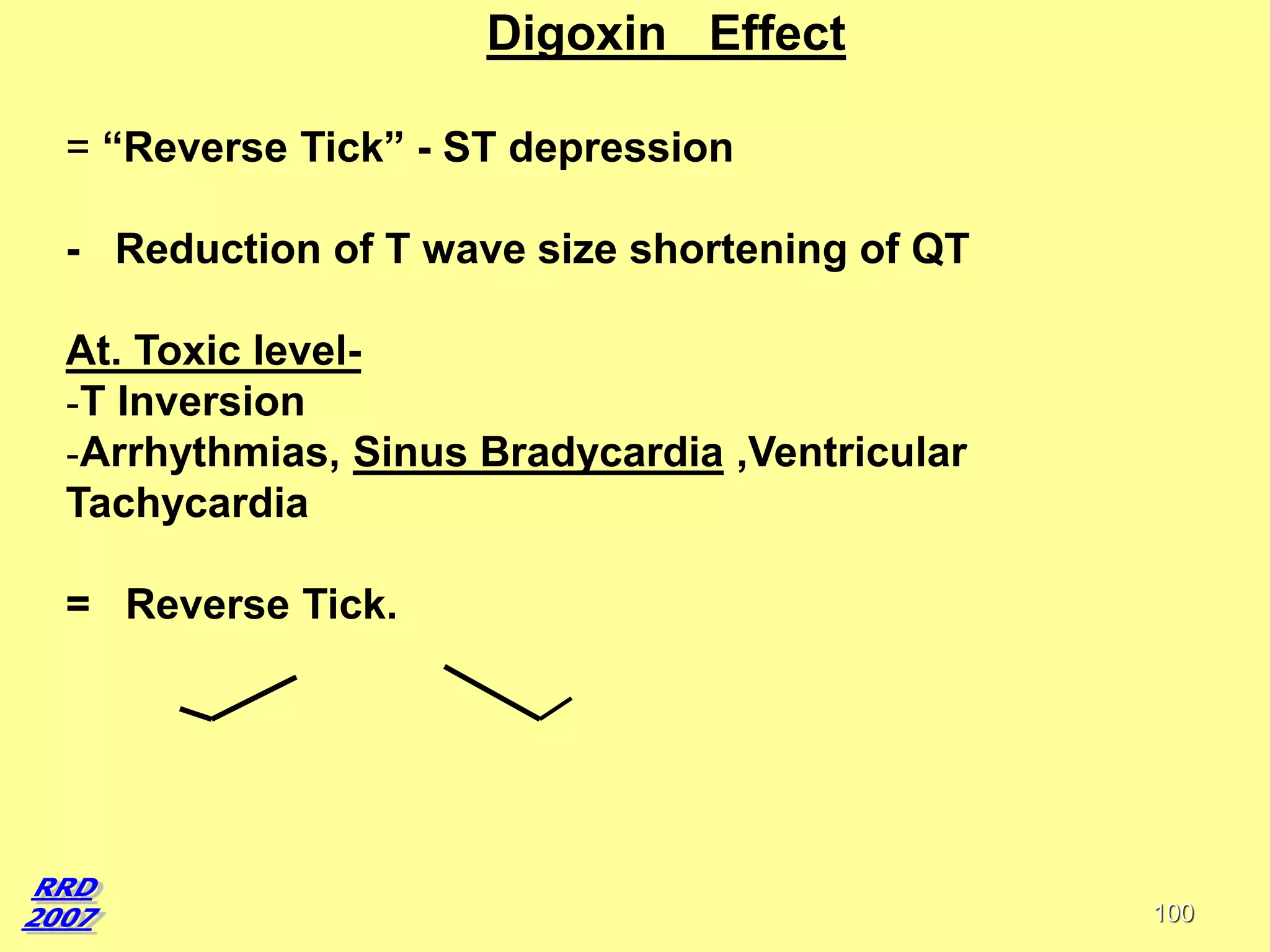
Digoxin Effect
= “Reverse Tick” - ST depression
- Reduction of T wave size shortening of QT

At. Toxic level-T Inversion
-Arrhythmias, Sinus Bradycardia ,Ventricular
Tachycardia
= Reverse Tick.

100
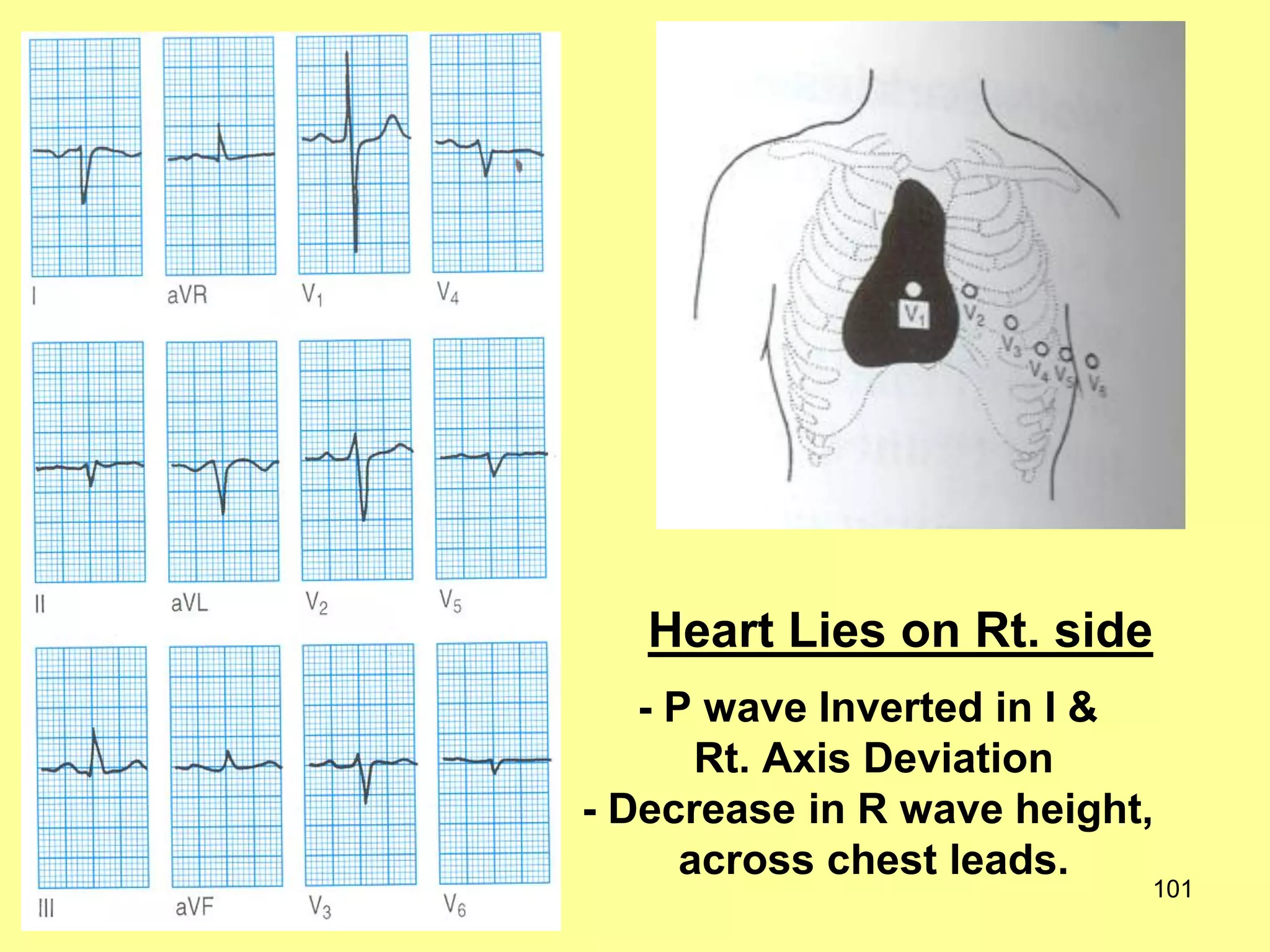
Heart Lies on Rt. side
- P wave Inverted in I &
Rt. Axis Deviation
- Decrease in R wave height,
across chest leads.

101
Heart lies on Rt. side
-Decrease in R wave height across chest leads.
-Heart lies on RT side.
-P wave Inverted in I & Rt Axis Deviation.
-For - Location of Apex beat, do the chest x-ray
Kartagener’s syndrome:
-Dextrocardia + Bronachiectasis + sinusitis.
-No. specific

.

102
1. Introduction

5 to 10

2. Electric circuit of heart

11

3. Waves of ECG

12

4. Normal ECG of chest leads

13

5. ECG of I,II,III,aVR,aVL,aVF leads

14

6. Sinus Rhythm

15 & 16

7. Sinus Bradycardia

17 & 18

8. Sinus Tachycardia

19 to 21

9. Left Axis Deviation

22 & 23

10. Right Axis Deviation

24 to 26
103
11. Normal pattern of QRS complex

12. LVH
13. RVH
14. RAH
15. LAH
16. M.I

17. Angina
18. M.I
19. Stress Test
20. 1st Degree Heart block
21. Mobitz type 1 AV block
22. Mobitz type 2 AV block

27
28 to 31
32 to 34
35 to 37
38 to 40
41 to 43
44 to 47
48 to 63
64 to 66
67 to 69
70 to 72
73 to 75
104
23. 3rd Degree Heart block

24. 2:1 AV Block
25. LBBB
26. RBBB
27. Hyper Ca++
28. Hypo Ca++

29. Hyper Kalaemia
30. Hypo Kalaemia
31. Digoxin effect
32. Dextrocardia

76 to 78
79 to 81
82 to 84
85 to 87
88 to 90
91 to 93
94 & 95
96 & 97
98 to 100
101 & 102

105
106

ECG in GP By Prof.Dr.R.R.Deshpande

  • 2.
    TITLE 1. Introduction Slide Number 5to 10 2. Electric circuit of heart 11 3. Waves of ECG 12 4. Normal ECG of chest leads 13 5. ECG of I,II,III,aVR,aVL,aVF leads 14 6. Sinus Rhythm 15 & 16 7. Sinus Bradycardia 17 & 18 8. Sinus Tachycardia 19 to 21 9. Left Axis Deviation 22 & 23 10. Right Axis Deviation 24 to 26 2
  • 3.
    11. Normal patternof QRS complex 12. LVH 13. RVH 14. RAH 15. LAH 16. M.I 17. Angina 18. M.I 19. Stress Test 20. 1st Degree Heart block 21. Mobitz type 1 AV block 22. Mobitz type 2 AV block 27 28 to 31 32 to 34 35 to 37 38 to 40 41 to 43 44 to 47 48 to 63 64 to 66 67 to 69 70 to 72 73 to 75 3
  • 4.
    23. 3rd DegreeHeart block 24. 2:1 AV Block 25. LBBB 26. RBBB 27. Hyper Ca++ 28. Hypo Ca++ 29. Hyper Kalaemia 30. Hypo Kalaemia 31. Digoxin effect 32. Dextrocardia 76 to 78 79 to 81 82 to 84 85 to 87 88 to 90 91 to 93 94 & 95 96 & 97 98 to 100 101 & 102 4
  • 5.
    Important definitions 1) ECG(Electro Cardio Gram) : It is the Graphical record of Electrical Activity of Heart. 2) What are Leads? - Potentials produced in heart are conducted all over body. These potentials are picked by electrodes, amplified & recorded on paper. Electrodes are called as leads. 3) Classification of Leads : i) Bipolar or standard LeadsTwo leads are used positive & Negative electrodes. Leads – I, II, III ii) Unipolar LeadOnly one electrode is used, other is earthed. 2 Typesa)Unipolar chest Leads (V1 to V6) b)Unipolar Limb leads (aVR aVL, aVF) 5
  • 6.
    ECG – GraphMeasurements i) X axis - Indicates Duration or Time Dot square = 0.04 sec Big square = 0.2 sec ii) Y Axis - Indicates Intensity of contraction 1 Dot square = 0.1 mV (milli volt) 1 Big square = 0.5 mV = 5 mm 2 Big squares = 1.0 mV = 10 mm 6
  • 7.
    1) Important measurements P wave- contraction of Atria Amplitude = 0.2 mV (2dot squares) Duration = 0.08 sec (2 dot squares) (Note - In Atrial Hypertrophy P wave is either Tall or broad) 2) QRS Complex - Depolarization of both ventricles Amplitude = 1.5 – 2.5 mV (3-5 large squares) Duration = 0.08 sec (2 dot squares) (Note - In ventricular Hypertrophy QRS complexes are tall) 3) T wave - Depolarization of ventricles. Amplitude = 0.04 mV (4 dot squares) Duration = 0.24 sec (6 dot squares) (Note : In M. I. – T wave is flat or inverted.) 4) PR Interval - Indicates AV conduction time. Normal = 0.12 to 0.16 sec (3-4 dot squares) (Note - PR Interval is prolonged in AV Heart block) 7
  • 8.
    Position of Chestleads (Note - Space just below the sternal angel is 2nd Intercostal space.) V1 = 4th Intercostal space, at Right sternal border. V2 = 4th Intercostal space at Left sternal border. V3 = In between V2 & V4. V4 = 5th Intercostal space, at mid clavicular line. V5 = Same horizontal level at V4 – Anterior axillary line (6th Intercostal space) V6 = Same horizontal level at V4 – mid axillary line (7th Intercostal space) 8
  • 9.
  • 10.
  • 11.
  • 12.
  • 13.
  • 14.
  • 15.
    Sinus Rhythm H. R= 60 – 100 / min. - P is upright in II & inverted in AVR - Every P wave is followed by QRS complex. 15
  • 16.
    Sinus Rhythm - Normalcardiac Rhythm in which SA Node acts as Natural Pacemaker, discharging 60 – 100 times / min. - H.R. - 60 – 100 / min. - P is upright in II & inverted in aVR - Every P wave is followed by QRS complex. 16
  • 17.
  • 18.
    - Sinus Bradycardia H. R.< 60/min. P is upright in II & inverted in aVR Every P wave is followed by QRS. Unusual - sinus Bradycardia < 40/min. ( Consider – Heart Block) Normal in athletes or during sleep. - Other causes – - Drugs - Digoxin, Beta blockers (Including Eye drops) IHD or M.I. Hypothyroidism. Hypothermia Electrolyte abnormalities. Obstructive Jaundice Uraemia Raised Intracranial pressure 18 Sick sinus syndrome. -
  • 19.
    Sinus Tachycardia H. R> 100 / min. 19
  • 20.
    Sinus Tachycardia -H. R.> 100 / min. -P upright in II & Inverted in aVR -Every P wave is followed by QRS.  Rare, that sinus Tachycardia > 180 / min. (Difficult to differentiate P wave from T waves – Rhythm can be mistaken for AV nodal Re-entry Tachycardia.)  Physiological causes: (Anything which stimulate sympathetic N. S. – Anxiety, Pain, Fever, Exercise.)  Other causes - Drugs - Adrenaline, Atropine, Salbutamol (Inhalers & Nebulizers), Caffeins & Alcohol. - IHD or Acute M. I. - Heart failure - Fluid Loss - Anemia - Hyperthyroidism. 20
  • 21.
    If Appropriate Tachycardia• (Compensating for Low Bp e.g. Fluid Loss / Anemia) – • with β blockers is Dangerous. But, •If sinus Tachycardia is Inappropriate (Anxiety or Hyperthyroidism) – with β blocker is O. K. •Warning : •In sinus Tachycardia • - Never use β blocker to slow the Heart Rate unless you establish the cause. 21
  • 22.
    Lt. Axis Deviation a)Left Leaves 22 b) QRS +ve in I & -ve in III
  • 23.
    Lt. Axis Deviation a)Left Leaves. b) QRS +ve in I & -ve in III. Causes - Sometimes in Normal - WPW syndrome - Lt. anterior hemi block. - Ventricular tachycardia 23
  • 24.
    In Right AxisDeviation I lead - R –ve III lead - R +ve Right – Reaches Nemonic a) Lt Axis deviation -LVH, LBBB, Interior wall infarct. b) Rt Axis deviation -RVH, RBBB, Anterior wall infarct. 24
  • 25.
    Rt. Axis Deviation a)Right Reaches b) QRS is –ve in I & +ve in III 25
  • 26.
    R.T Axis Deviation a)Right Reaches b) Observe only Lead I & III c) QRS is –ve in I & +ve in III Causes: -May occur in Normal individual -RVH -Antero lateral M.I. -Dextrocardia (Heart lies on Rt side of chest) -Lt. Posterior hemi block -W.P.W Syndrome. 26
  • 27.
    Ventricular Hypertrophy 1)Normal pattern& Amplitude of QRS complexes in chest , leads. V1 = V2 V3 V4 V5 V6 Small R wave & Deep S wave When Proceeds towards V6 – Height of R wave increases & Depts., of s wave progressively decreases. R 27 V1 V2 V3 V4 V5 V6 s
  • 28.
    LVH Pattern remains thesame But Amplitude Increases. If , SV1 > 25mm OR (5 Big squares). RV6 > 25mm OR (5 Big squares). SV1 + RV6 > 35 - LV (7 Big squares.) Normal QRS complex = 3 to 5 large squares. QRS - 1.5 – 2.5 mV 0.08 sec - (3-5 large squares) (2dot squares) R 28 V1 V2 V3 V4 V5 V6 s
  • 29.
    LVH a) R inV5 or V6 >25mm b) S in V1 or V2 >25 mm c) R + S > 35 mm 29
  • 30.
    a) R inV5 or V6 > 25mm b) S in V1 or V2 > 25mm30
  • 31.
    LVH -R in V5or V6 > 25 mm. S in V1 or V2 > 25 mm. -R V5/V6 + S V1 / V2 > 35 mm This is not diagnostic Young, thin people with Normal hearts have R & S >Normal. -If LVH - Look for evidence of strain (ST depression & T Inversion) -Eco-cardiography is Diagnostic for LVH. - according to cause. Causes : - Hypertension - Aortic stenosis - Coaractation of Aorta - Hypertrophic cardiomyopathy. 31
  • 32.
    RVH Prominent R wavein V1 or Deep S wave in V6 SV1 to RV6 - Normal pattern. OR RV1 > 7 mm SV6 > 7 mm = 1 Big squares + 2 dot. = 1 Big squares + 2 dot. OR RV1 + SV6 > 10 mm (2 big squares) 32
  • 33.
    RVH a) Rt. Axis Deviation. (RT.Reaches – I & III) b) Deep S waves in V5 & V6 c) RBBB (Broad QRS 33 M & in V1 & W in V6)
  • 34.
    RVH - Dominant Rwaves in V1 - V4 a) Rt Axis Deviation b) Deep ‘S’ waves in V5 & V6 c) RBBB - If strain - ST depression & T Inversion. - Causes - Pulmonary Hypertension Pulmonary stenosis - of underlying cause. - 34
  • 35.
    P – Pulmonale -Rt.Atrial Enlargement - Tall P wave > 2.5 mm. (2.5 dot squares) in II, III, avF 35
  • 36.
    Tall P wave> 2.5 mm. (2.5 dot squares) in II, III, avF 36
  • 37.
    P Pulmonale Rt AtrialEnlargement = Tall P wave > 2.5 mm (2.5 dot squares) in II, III, avF. = Causes - RA – Enlargement - Primary Pulmonary Hypertension. Secondary Pulmonary (Chr. Bronchitis, Emphysema) Pulmonary stenosis Tricuspid stenosis. = patient’s H/O, Chest x-ray (to assess cardiac dimensions & lung fields) - Echo-cardiogram-to assess valvular disorders - Estimate pulmonary artery pressure. 37
  • 38.
    P – mitrale -Lt.Atrial Enlargement - P. wide > 0.08 sec or (2 dot squares) & Bifid 38
  • 39.
    P. wide >0.08 sec or (2 dot squares) & Bifid 39
  • 40.
    P-mitrale Lt. Atrial Enlargement =p wide > 0.08 sec, or > 2 dot square & Bifid - Usually Result of mitral valve disease : called as P-mitrale. -Lt. Atrial can also accompany LVH (e.g. secondary to Hypertension, Aortic valve Disease & Hypertrophic cardiomyopathy). = - As like P pulmonale. ‘P mitrale’ – does not require treatment of its own. 40
  • 41.
    Myocardial Infarction 3 cardinalsigns on ECG in AMI - 1)Elevation of ST segment. 2)Inverted T wave. 3)Deep & wide Q wave. 41
  • 42.
    Events in chronologicalOrder 1)on 1st day - ST elevated - with upright tall T wave - but No Q wave 2)Over Next 2 day T wave will slowly become Inverted, ST seg still raised. 3)Towards the end of 1st wk - ST seg returning to base Level, T wave deeply inverted - Q wave starts appearing. - T wave - Pointed, Inverted & symmetrical Limbs. 42
  • 43.
    4)In 3rd week- Q wave fully developed. - ST - Base - T – wave flat & Returning to Normal. 5)By the end of 3 month -St seg & T wave – Return to Normal. -Only Q wave remains permanent. (of course if size of infarct is TOO small -Q wave may disappear) -Q wave size is proportional to size of infarct. 43
  • 44.
    Acute myocardial Ischemia Angina= I cry -Atherosclerotic Narrowing of coronary vessels. -Pt. is comfortable at rest but anginal pain after exertion. -After exercise, myocardium demand increases but sufficient blood flow can not occur due to, partially occluded coronary artery. -Anginal pain disappears after Rest when demand decreases. -Acute myocardial ischemia can be seen during stress test. -Positive stress test - ST Depression. 44
  • 45.
    Types of STseg Depression. 1) Horizontal or plain ST seg Depression. This signifies myocardial ischemia. 2) Upward slopping ST seg Depression. This is variant of Normal & significant only if, point Depression > 2mm 45
  • 46.
    1)Horizontality of STseg - -ST seg – Horizontal & Isoelectric -This is early manifestation of ischemia. 2)Downward slopping of ST seg - This indicates severe Ischaemia 46
  • 47.
    1)Slaggy, concave upwardST seg- Suggestive of Ischaemia. 2)Non Acute myocardial Ischaema- Slight ST depression in V5, V6 & similar T inversion (Limb leads) OR Sometimes flattening of T wave in V5 & V6 47 (Just like strain pattern LVH)
  • 48.
    Anterior M.I. = TInversion in V1 – V4 48
  • 49.
  • 50.
    Anterior M.I. - Qwaves in Lead V4 – V4 - T Inversion in V1 – V4 ECG recorded, 5 days after Anterior M.I. - Q waves, start to appear within few hrs of onset & in 90% cases, becomes permanent. - Of M.I. – chest pain, Nausea, Sweating. 50
  • 51.
    Anterior M.I. = ST Elevation in V1 – V4 51
  • 52.
  • 53.
    Inferior M.I i) Qin II, III aVF ii) T Inversion in II, III, aVF 53
  • 54.
    i) Q inII, III aVF ii) T Inversion in II, III, aVF 54
  • 55.
    Inferior M.I. 1. Qin II, III, aVF 2.T Inversion in II, III & aVF (2 yrs. previously attack.) 55
  • 56.
    Inferior M. I i)Q in II, III avF ii) ST Elevation in II, III & avF 56
  • 57.
    i) Q inII, III avF ii) ST Elevation in II, III & avF 57
  • 58.
    Lateral M. I. -S T Elevation in I, aVL, V4 – V6 - Hyper acute T waves in V4 & V5 58
  • 59.
    i) S TElevation in I, avL, V4 – V6 ii) Hyper acute T waves in V4 & V5 59
  • 60.
    Lateral M. I. -STelevation in I, aVL, V4-V6. -Hyper – acute T waves in Leads V4 & V5. -R in V1-V3 -ST depression in V1-V3 -Upright Tall T waves in V2 & V3 60
  • 61.
    Post. M. I i)S T Depression in V1 – V3 61
  • 62.
    S T Depressionin V1 – V3 62
  • 63.
    i) Anterior M.I. ii) Lateral M. I. - V1 to V4 - I, aVL, V5 – V6 iii) Antero Lateral - I, aVL, V1 – V6. iv) Antero-septal - V1 – V3 v) Interior M.I. - II, III, aVF vi) Infero Lateral - I, II, III aVL, aVF, V5-V6. 63
  • 64.
    Exercise (stress) Test 1)ST Depression 2) Sometimes T Inversion 64
  • 65.
    1) ST Depression 2)Sometimes T Inversion 65
  • 66.
    Exercise Test 1. -Mostcommon Indicator of coronary Artery Disease. 2. J point is the Junction of S wave & ST segment. 3. Measure ST Depression, 2 dot square after J point. 4. T Inversion, may develop during exercise (as may BBB) 5. A fall in systolic pressure indicates sever coronary Disease 6. Greater the Depression - Higher probability of coronary Heart Disease. 66
  • 67.
    -1st degree HeartBlock. -Long PR interval. (Normal-PR) = 0.12-0.20 sec. = 3-5 dot squares.
  • 68.
  • 69.
    1st Degree Heartblock Long PR Interval 0.12 3 small sq. Causes = = 0.2 sec 5 small sq. -IHD -Hypokalaemia (Low potassium, due to Diver tics) -Acute Rheumatic myocarditis, -Drugs (Digoxin ,B blockers, Ca+ channel blocks) Asymptomatic. No specific Rx 69
  • 70.
    Mobitz Type1-AV Block =Progressivelengthening of PR interval. =Then P wave-fails to be conducted. =PR interval Resets & cycle repeats. 70
  • 71.
  • 72.
    Mobitz Type I- AV Block One of the types of 2nd degree Heart block – Also known as “Wenckebach phenomenon”. a) b) c) Progressive Lengthening of PR Interval Then p wave – fails to be conducted PR Interval resets 7 cycle repeats = Abnormal conducting, through AV node (during High vagal activity – some times during sleep.) = In Generalized disease of conducting tissues. = Benign form of AV block . (permanent pace maker not required) – Temporary pacing before surgery. 72
  • 73.
    Mobitz Type 2-AVBlock =PR Normal & constant. =Occasional P wave-fails to be conducted. 73
  • 74.
    Mobitz Type II- AV Block a) PR - Normal & Constant b)Occasional P wave – fails to be conducted. = Result from abnormal conduction, below AV node (in Bundle of His) = More serious than type I = Refer to cardiologist: Pacemaker may be needed = Indications for pacing – Acute M.I or pre-operatively. 75
  • 75.
    Third-degree AV block 3rddegrees Heart Block a) b) c) d) P wave (atrial) Rate = 85 / min QRS complex (ventricular) rate = 54 / min Broad QRS complexes No Relation between – P waves & QRS complexes 76
  • 76.
  • 77.
    3rd degree HeartBlock Complete Heart Block Complete Interruption of conduction between, Atria & ventricles & two are working Independently. - In Acute inferior M.I. - 3rd deg. AV Block – Pacing. - Acute Anterior wall M.I – 3rd degree heart Block. Indicates extensive infarct & poor prognosis. - Temporary pacing – pri-operatively - If due to 3rd degree Block Heart failure, Dizziness, fall, loss of consciousness-Permanent pacing is indicated. a) P wave (atrial) rate = 85 / min. b) QRS complex (ventricular) rate = 54 / min. c) Broad QRS complexes. d) No Relation between – P waves & QRS complexes 78
  • 78.
    2:1 AV block 2 :1 AV Block a) Alternate P waves fail to be conducted (Alternate P waves are not followed by QRS complexes) b) AV block is a special form of 2nd degree Heart block 79
  • 79.
  • 80.
    2: 1 AVBlock - Alternate P waves fail to be conducted . (Alternate P waves are not followed by QRS complexes) - AV block is a special form of 2nd degree Heart Block. 81
  • 81.
    LBBB a) Broad QRScomplexes. Normal – QRS < 0.12 sec QRS < 3 small square b) QRS looks like W in V1 & M in V6 (william). 82
  • 82.
    QRS looks likeW in V1 Q & M in V6 (william). 83
  • 83.
    B.B.B LBBB a) b) Broad QRS complexes QRSmorphology – as explained in Text. Normal: QRS < 0.12 sec QRS < 3.5 small squares QRS looks like W in V1 & M in V6 (William) Causes- IHD - LVH (Hypertension, aortic stenosis), - Fibrosis of conduction system. Asymptomatic & do not required right. of their own 84
  • 84.
    RBBB a) Broad QRScomplexes. b) QRS looks like M in V1 & W in V6 (M orro w) 85
  • 85.
    QRS looks likeM in V1 & W in V6 (M orro w) 86
  • 86.
    RBBB a)Broad QRS complexes b)QRSmorphology as explained in Text. Normal QRS < 0.12 sec. QRS < 3 dot squares. QRS Looks like ‘M’ in Lead V1 & ‘w’ in lead V6 (morrow). Causes - IHD, - Cardiomyopathy, - Atrial septal defects, - Massive pulmonary embolism. -RBBB is relatively common finding in otherwise normal hearts. -Both LBBB & RBBB are asymptomatic in themselves & do not require treatment in their own right. 87
  • 87.
    Hyper Ca ++ NormalQTC = 0.35 – 0.43 sec Short QT 88
  • 88.
    causes of hypercalcaemia- Hyperparathyroidism. (Primary or Tertiary) Malignancy (Myeloma) Drugs (Thiazide Diuretics, excessive vit D intake. Sarcoidosis Thyrotoxicosis. = Risk of cardiac arrest with Severe Hypercalcaemia. = Severe symptoms : - vomiting, Drowsiness & plasma Ca+ > 3.5 mmol / L Urgent Rx - I / V - 0.9 % saline (3 to 4 lit / 24 hrs) - I / V Frusemide (20-40 mg/ every 6 – 12 hrs) - Disodium pamidronate – single Infusion. Monitor Urea & Electrolytes ca+ level – Every 12 hrs 89
  • 89.
    Hyper Ca+ - Tocalculate QT Interval is not straight forward: Duration varies with H. R. Faster H. R. - Shorter QT QTC = QT RR Normal QTC = 0.35 - 0.43 sec. = Fig. - QT = 0.26 sec. HR = 100 / min. QTC = 0.34 sec. = Sym of Hypercalcaemia. Anorexia, wt. Loss, Nausea, Vomiting, abdominal pain, constipation, polydypsia, polyuria, weakness & depression. = Prominent U wave = Confirm by Plasma ca+ Level. 90
  • 90.
  • 91.
    Hypocalcaemia -Long QT Interval(0.57 s) -H. R = 51 / min. -Q TC = 0.52 sec. = C/F - Peripheral & circumoral paraesthesiae, Tetany, Fits & Psychiatric Disturbance. - Trousseaus sign : (carpal spasm, when Brachial Artery is occluded with BP cuff) - Chovosteks sign : Twitching of facial muscles, when tapping over facial Nerve. - Papilloedema 92
  • 92.
    -Confirm - Byplasma Ca+ level -(Not forgetting to check simultaneous Alb. level) Causes – - Hypoparathyroidism. (Following Thyroid surgery, Auto immune or Congenital) - Chr. Renal failure - Vit. D Deficiency - Drugs like calcitonin - Acute pancreatitis = Inj. Ca- Gluconate 10% - 10ml. 93
  • 93.
  • 94.
    Hyperkalaemia = Tall ‘Tented’T wave Hyperkalaemia also cause: -Flattening & even loss of P wave. -Lengthening of PR -Widening of QRS complex. -Arrhythmias. - Confirmed by - Elevated plasma potassium level. -Underlying cause - Renal Failure. -Complete Drug H/O is Essential in any pt. with abnormal ECG. 95
  • 95.
    Hypokalaemia -Small T wave& -Prominent U wave -Changes, which may accompany Hypokalaemia: - First degree Heart Block - Depression of ST segment - Prominent U wave. = C/F - muscle weakness & cramps. = Commonest cause for hypokalaemia is Diuretics. 96
  • 96.
    Hypokalaemia - Small Twave & Prominent U wave 97
  • 97.
    Digoxin Effect = ReverseTick (ST depression) 98
  • 98.
    Reverse Tick (STdepression) 99
  • 99.
    Digoxin Effect = “ReverseTick” - ST depression - Reduction of T wave size shortening of QT At. Toxic level-T Inversion -Arrhythmias, Sinus Bradycardia ,Ventricular Tachycardia = Reverse Tick. 100
  • 100.
    Heart Lies onRt. side - P wave Inverted in I & Rt. Axis Deviation - Decrease in R wave height, across chest leads. 101
  • 101.
    Heart lies onRt. side -Decrease in R wave height across chest leads. -Heart lies on RT side. -P wave Inverted in I & Rt Axis Deviation. -For - Location of Apex beat, do the chest x-ray Kartagener’s syndrome: -Dextrocardia + Bronachiectasis + sinusitis. -No. specific . 102
  • 102.
    1. Introduction 5 to10 2. Electric circuit of heart 11 3. Waves of ECG 12 4. Normal ECG of chest leads 13 5. ECG of I,II,III,aVR,aVL,aVF leads 14 6. Sinus Rhythm 15 & 16 7. Sinus Bradycardia 17 & 18 8. Sinus Tachycardia 19 to 21 9. Left Axis Deviation 22 & 23 10. Right Axis Deviation 24 to 26 103
  • 103.
    11. Normal patternof QRS complex 12. LVH 13. RVH 14. RAH 15. LAH 16. M.I 17. Angina 18. M.I 19. Stress Test 20. 1st Degree Heart block 21. Mobitz type 1 AV block 22. Mobitz type 2 AV block 27 28 to 31 32 to 34 35 to 37 38 to 40 41 to 43 44 to 47 48 to 63 64 to 66 67 to 69 70 to 72 73 to 75 104
  • 104.
    23. 3rd DegreeHeart block 24. 2:1 AV Block 25. LBBB 26. RBBB 27. Hyper Ca++ 28. Hypo Ca++ 29. Hyper Kalaemia 30. Hypo Kalaemia 31. Digoxin effect 32. Dextrocardia 76 to 78 79 to 81 82 to 84 85 to 87 88 to 90 91 to 93 94 & 95 96 & 97 98 to 100 101 & 102 105
  • 105.