2 |Making Simple & Easy to Research Methodology for Ayurveda MD/MS
Dr Robin bhusal, Resident Surgeon @ Dept. of P.G Studies in Shalyatantra, SDMCA UDUPI.
INDEX
S.No CHAPTERS PAGE
NO
1. INTRODUCTION TO RESEARCH
3
2. GENERAL GUIDELINES & STEPS IN THE RESEARCH
PROCESS
12
3. PREPARATION OF RESEARCH PROPOSALS
56
4. SCIENTIFIC WRITINGS & PUBLICATION SKILLS
59
5. CLASSICAL METHODS OF RESEARCH
67
6. COMPARISON BETWEEN MEHTODS OF RESEARCH
72
7. DIFFERENT FIELDS OF RESEARCH IN AYURVEDA
74
8. LITERARY RESEARCH
75
9. DRUG RESEARCH
77
10. SAFETY ASPECT
109
11. INTRODUCTION TO LATEST TRENDS IN DRUG
DISCOVERY & DRUG DEVELOPMENT
115
12. CLINICAL RESEARCH
117
13. PHARMACOVIGILANCE FOR ASU DRUGS
126
14. INTRODUCTION TO BIOINFORMATION
134
15. INTELLECTUAL PROPERTY RIGHT
140
3 |Making Simple & Easy to Research Methodology for Ayurveda MD/MS
Dr Robin bhusal, Resident Surgeon @ Dept. of P.G Studies in Shalyatantra, SDMCA UDUPI.
DEDICATED TO ‘’LALTERN’’
1. INTRODUCTION TO RESEARCH
A. DEFINITION OF THE TERM RESEARCH
The word research
Re = means, once more, afresh, anew
OR
Back; with return to a previous state
Search = look thorough or go over thoroughly to look something)
OR
Examine to find anything concealed
Research is composed of two syllables “re” and “search”.
“Re ” is a prefix meaning again or over again.
“Search ” is a verb meaning to examine, to test and try or to probe closely and carefully.
= Together they form a noun describing a careful, systematic, patient study and investigation in
some field of knowledge, undertaken to establish facts or principles.
- (Grinnell 1993).
Who always
Enlightened &
Motivated
Me, to the path of
success.
4 |Making Simple & Easy to Research Methodology for Ayurveda MD/MS
Dr Robin bhusal, Resident Surgeon @ Dept. of P.G Studies in Shalyatantra, SDMCA UDUPI.
 Research is a voyage of discovery or a journey from the known to
unknown.
 According to Goddard & Melville (2004), answering unanswered questions
or exploring which currently not exist is a research.
 The Advanced Learner’s Dictionary of current English lays down the
meaning of research as a careful investigation or inquiry especially through
search for new facts in any branch of knowledge.
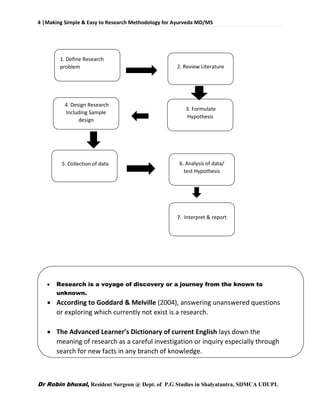
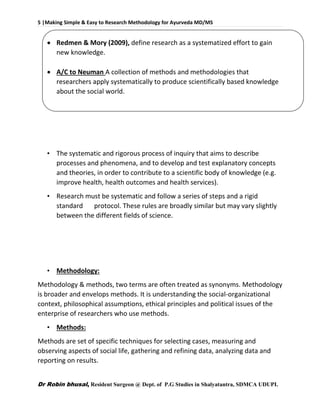
1. Define Research
problem 2. Review Literature
3. Formulate
Hypothesis
4. Design Research
Including Sample
design
6. Analysis of data/
test Hypothesis
5. Collection of data
7. Interpret & report
5 |Making Simple & Easy to Research Methodology for Ayurveda MD/MS
Dr Robin bhusal, Resident Surgeon @ Dept. of P.G Studies in Shalyatantra, SDMCA UDUPI.
 Redmen & Mory (2009), define research as a systematized effort to gain
new knowledge.
 A/C to Neuman A collection of methods and methodologies that
researchers apply systematically to produce scientifically based knowledge
about the social world.
• The systematic and rigorous process of inquiry that aims to describe
processes and phenomena, and to develop and test explanatory concepts
and theories, in order to contribute to a scientific body of knowledge (e.g.
improve health, health outcomes and health services).
• Research must be systematic and follow a series of steps and a rigid
standard protocol. These rules are broadly similar but may vary slightly
between the different fields of science.
• Methodology:
Methodology & methods, two terms are often treated as synonyms. Methodology
is broader and envelops methods. It is understanding the social-organizational
context, philosophical assumptions, ethical principles and political issues of the
enterprise of researchers who use methods.
• Methods:
Methods are set of specific techniques for selecting cases, measuring and
observing aspects of social life, gathering and refining data, analyzing data and
reporting on results.
6 |Making Simple & Easy to Research Methodology for Ayurveda MD/MS
Dr Robin bhusal, Resident Surgeon @ Dept. of P.G Studies in Shalyatantra, SDMCA UDUPI.
To summarize
Research is an ORGANIZED and SYSTEMATIC way of FINDING ANSWERS to
QUESTIONS.
SYSTEMATIC
Because there is a definite set of procedures and steps which you will
follow. There are certain things in the research process which are always
done in order to get the most accurate results.
ORGANIZED
In that there is a structure or method in going about doing research. It is a
planned procedure, not a spontaneous one. It is focused and limited to a
specific scope.
FINDING ANSWERS
Is the end of all research? Whether it is the answer to a hypothesis or even
a simple question, research is successful when we find answers. Sometimes
the answer is no, but it is still an answer.
QUESTIONS
Are central to research. If there is no question, then the answer is of no
use. Research is focused on relevant, useful, and important questions.
Without a question, research has no focus, drive, or purpose.
7 |Making Simple & Easy to Research Methodology for Ayurveda MD/MS
Dr Robin bhusal, Resident Surgeon @ Dept. of P.G Studies in Shalyatantra, SDMCA UDUPI.
Definition of health research
• The process for obtaining systematic knowledge and technology which
can be used for the improvement of the health of individual and groups.
• Descriptive investigations of the experience of illness and people’s
perceptions of health and ill health.
• It focuses on the basic information on the state of health and disease of
the population.
Health Services Research
• It focuses on the evaluations of relationship between the
appropriateness, effectiveness and efficiency of health services and the
health needs of the population.
• It investigates the outcome of health services or medical interventions
from psychological, physical, economic and social perspectives.
• Health services research is a multidisciplinary field of inquiry, both basic
and applied, that examines how social factors, financing systems,
organizational structures and processes, health technologies, and
personal beliefs and behaviors affect access to and utilization of
healthcare, the quality and cost of healthcare, and in the end our health
and well-being. Ultimately, the goals of health services research are to
identify the most effective ways to organize, manage, finance, and deliver
high quality care.
Alternative to Research
• Authority
When you accept something as true just because someone in a position of
authority says it is true or it is an authoritative publication, you are using
authority as basis of knowledge eg. Parents, Teachers, Books.
8 |Making Simple & Easy to Research Methodology for Ayurveda MD/MS
Dr Robin bhusal, Resident Surgeon @ Dept. of P.G Studies in Shalyatantra, SDMCA UDUPI.
• Tradition
Tradition is a special case of authority-the authority of the past. It means
you accept something as being true because “it’s the way things have
always been.
• Common sense
You rely on what everyone knows and what “just makes sense”.
It is about ordinary reasoning. It can originate from tradition
• Media myths
Media tends to perpetuate the myths of a culture.
• Personal experience
If something happens to you, if you personally experience it or see
it, you accept it as true.
9 |Making Simple & Easy to Research Methodology for Ayurveda MD/MS
Dr Robin bhusal, Resident Surgeon @ Dept. of P.G Studies in Shalyatantra, SDMCA UDUPI.
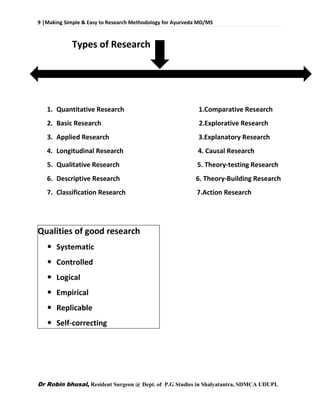
Types of Research
1. Quantitative Research 1.Comparative Research
2. Basic Research 2.Explorative Research
3. Applied Research 3.Explanatory Research
4. Longitudinal Research 4. Causal Research
5. Qualitative Research 5. Theory-testing Research
6. Descriptive Research 6. Theory-Building Research
7. Classification Research 7.Action Research
Qualities of good research
 Systematic
 Controlled
 Logical
 Empirical
 Replicable
 Self-correcting
10 |Making Simple & Easy to Research Methodology for Ayurveda MD/MS
Dr Robin bhusal, Resident Surgeon @ Dept. of P.G Studies in Shalyatantra, SDMCA UDUPI.
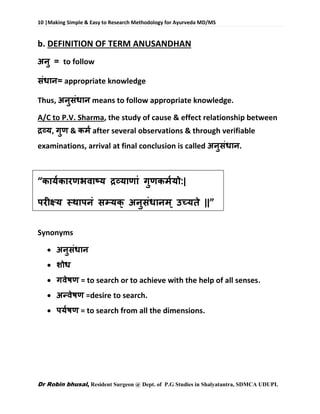
b. DEFINITION OF TERM ANUSANDHAN
अनु = to follow
संधान= appropriate knowledge
Thus, अनुसंधान means to follow appropriate knowledge.
A/C to P.V. Sharma, the study of cause & effect relationship between
द्रव्य, गुण & कर्म after several observations & through verifiable
examinations, arrival at final conclusion is called अनुसंधान.
“कायमकारणभवाष्य द्रव्याणां गुणकर्मयो:|
परीक्ष्य स्थापनं सम्यक् अनुसंधानर्् उच्यते ||”
Synonyms
 अनुसंधान
 शोध
 गवेषण = to search or to achieve with the help of all senses.
 अन्वेषण =desire to search.
 पयमषण = to search from all the dimensions.
11 |Making Simple & Easy to Research Methodology for Ayurveda MD/MS
Dr Robin bhusal, Resident Surgeon @ Dept. of P.G Studies in Shalyatantra, SDMCA UDUPI.
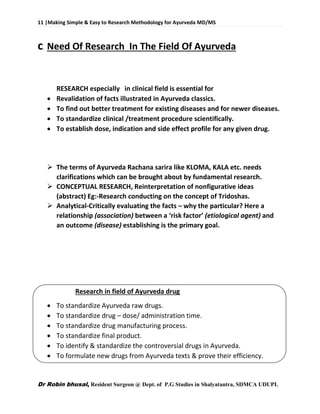
c. Need Of Research In The Field Of Ayurveda
RESEARCH especially in clinical field is essential for
 Revalidation of facts illustrated in Ayurveda classics.
 To find out better treatment for existing diseases and for newer diseases.
 To standardize clinical /treatment procedure scientifically.
 To establish dose, indication and side effect profile for any given drug.
 The terms of Ayurveda Rachana sarira like KLOMA, KALA etc. needs
clarifications which can be brought about by fundamental research.
 CONCEPTUAL RESEARCH, Reinterpretation of nonfigurative ideas
(abstract) Eg:-Research conducting on the concept of Tridoshas.
 Analytical-Critically evaluating the facts – why the particular? Here a
relationship (association) between a ‘risk factor’ (etiological agent) and
an outcome (disease) establishing is the primary goal.
Research in field of Ayurveda drug
 To standardize Ayurveda raw drugs.
 To standardize drug – dose/ administration time.
 To standardize drug manufacturing process.
 To standardize final product.
 To identify & standardize the controversial drugs in Ayurveda.
 To formulate new drugs from Ayurveda texts & prove their efficiency.
12 |Making Simple & Easy to Research Methodology for Ayurveda MD/MS
Dr Robin bhusal, Resident Surgeon @ Dept. of P.G Studies in Shalyatantra, SDMCA UDUPI.
Research in field of Ayurveda Literary
 Collection of critical revised edition of available manuscripts.
 Cataloguing of original manuscripts related to Ayurveda.
 Classification of the available ancient Sanskrit literature related to
Ayurveda.
 The traditional facts & theories can be re- examined & re-evaluated .Their
validity should be re- stabilized scientifically.
 To put forth practical applications of basic principles.
Research in field of clinical research in Ayurveda
 To assess the results of different types of Ayurveda treatments given
in classical texts.
 To search etiological factors with Ayurveda perspective for various
disease.
 Evaluation of Ayurveda therapies on basis of their effects & side
effects.
 Conducting clinical trials with integral approach.
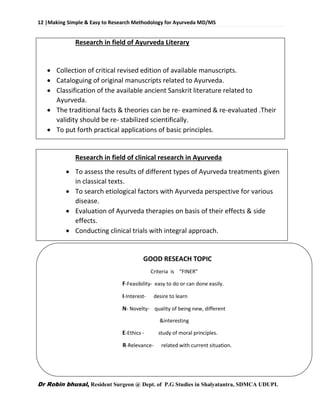
GOOD RESEACH TOPIC
Criteria is “FINER”
F-Feasibility- easy to do or can done easily.
I-Interest- desire to learn
N- Novelty- quality of being new, different
&interesting
E-Ethics - study of moral principles.
R-Relevance- related with current situation.
13 |Making Simple & Easy to Research Methodology for Ayurveda MD/MS
Dr Robin bhusal, Resident Surgeon @ Dept. of P.G Studies in Shalyatantra, SDMCA UDUPI.
2. GENERAL GUIDELINES & STEPS IN THE RESEARCH PROCESS
a. Selection of the Research Problem
DEFINITION
According to Kerlinger, ‘A problem is an interrogative sentence or statement that
asks what relation exists between two or more variable. The answer to question
will provide what is having sought in the research.
R.S. Woodworth defines problem as ‘a situation for which we have no ready and
successful response by instinct or by previous acquired habit. We must find out
what to do’, i.e. the solution can be found out only after an investigation.
Wipro CEO wants to launch its company in Mysore?
He is in a process of Decision Making
Decision making Needs…
Conviction
There should be Knowledge to Goal achievement
No doubts? Justify your decision
14 |Making Simple & Easy to Research Methodology for Ayurveda MD/MS
Dr Robin bhusal, Resident Surgeon @ Dept. of P.G Studies in Shalyatantra, SDMCA UDUPI.
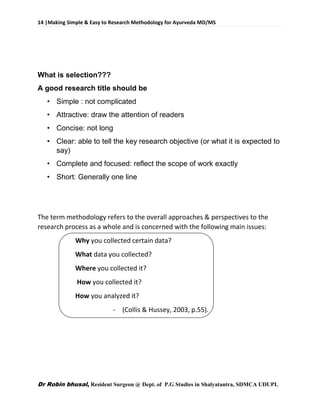
What is selection???
A good research title should be
• Simple : not complicated
• Attractive: draw the attention of readers
• Concise: not long
• Clear: able to tell the key research objective (or what it is expected to
say)
• Complete and focused: reflect the scope of work exactly
• Short: Generally one line
The term methodology refers to the overall approaches & perspectives to the
research process as a whole and is concerned with the following main issues:
Why you collected certain data?
What data you collected?
Where you collected it?
How you collected it?
How you analyzed it?
- (Collis & Hussey, 2003, p.55).
15 |Making Simple & Easy to Research Methodology for Ayurveda MD/MS
Dr Robin bhusal, Resident Surgeon @ Dept. of P.G Studies in Shalyatantra, SDMCA UDUPI.
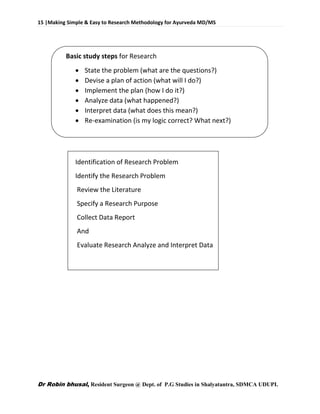
Basic study steps for Research
 State the problem (what are the questions?)
 Devise a plan of action (what will I do?)
 Implement the plan (how I do it?)
 Analyze data (what happened?)
 Interpret data (what does this mean?)
 Re-examination (is my logic correct? What next?)
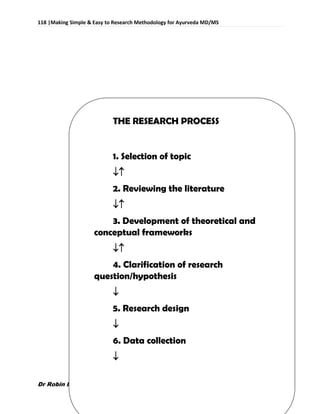
Identification of Research Problem
Identify the Research Problem
Review the Literature
Specify a Research Purpose
Collect Data Report
And
Evaluate Research Analyze and Interpret Data
16 |Making Simple & Easy to Research Methodology for Ayurveda MD/MS
Dr Robin bhusal, Resident Surgeon @ Dept. of P.G Studies in Shalyatantra, SDMCA UDUPI.
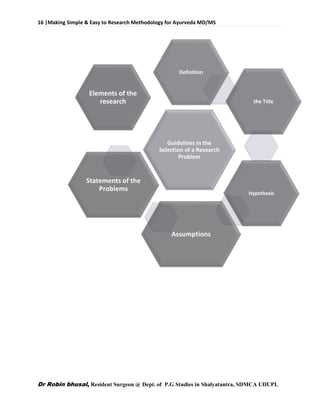
Guidelines in the
Selection of a Research
Problem
Definition
the Title
Hypothesis
Assumptions
Statements of the
Problems
Elements of the
research
17 |Making Simple & Easy to Research Methodology for Ayurveda MD/MS
Dr Robin bhusal, Resident Surgeon @ Dept. of P.G Studies in Shalyatantra, SDMCA UDUPI.
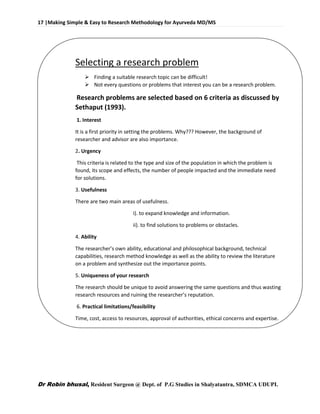
Selecting a research problem
 Finding a suitable research topic can be difficult!
 Not every questions or problems that interest you can be a research problem.
Research problems are selected based on 6 criteria as discussed by
Sethaput (1993).
1. Interest
It is a first priority in setting the problems. Why??? However, the background of
researcher and advisor are also importance.
2. Urgency
This criteria is related to the type and size of the population in which the problem is
found, its scope and effects, the number of people impacted and the immediate need
for solutions.
3. Usefulness
There are two main areas of usefulness.
i). to expand knowledge and information.
ii). to find solutions to problems or obstacles.
4. Ability
The researcher’s own ability, educational and philosophical background, technical
capabilities, research method knowledge as well as the ability to review the literature
on a problem and synthesize out the importance points.
5. Uniqueness of your research
The research should be unique to avoid answering the same questions and thus wasting
research resources and ruining the researcher’s reputation.
6. Practical limitations/feasibility
Time, cost, access to resources, approval of authorities, ethical concerns and expertise.
18 |Making Simple & Easy to Research Methodology for Ayurveda MD/MS
Dr Robin bhusal, Resident Surgeon @ Dept. of P.G Studies in Shalyatantra, SDMCA UDUPI.
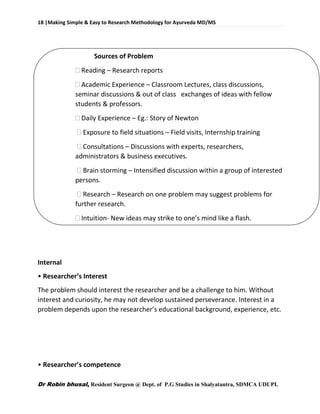
Sources of Problem
 Reading – Research reports
 Academic Experience – Classroom Lectures, class discussions,
seminar discussions & out of class exchanges of ideas with fellow
students & professors.
 Daily Experience – Eg.: Story of Newton
 Exposure to field situations – Field visits, Internship training
 Consultations – Discussions with experts, researchers,
administrators & business executives.
 Brain storming – Intensified discussion within a group of interested
persons.
 Research – Research on one problem may suggest problems for
further research.
 Intuition- New ideas may strike to one’s mind like a flash.
Internal
• Researcher’s Interest
The problem should interest the researcher and be a challenge to him. Without
interest and curiosity, he may not develop sustained perseverance. Interest in a
problem depends upon the researcher’s educational background, experience, etc.
• Researcher’s competence
19 |Making Simple & Easy to Research Methodology for Ayurveda MD/MS
Dr Robin bhusal, Resident Surgeon @ Dept. of P.G Studies in Shalyatantra, SDMCA UDUPI.
The researcher must be competent to plan and carry out a study of the problem.
He must have the ability to grasp and deal with it. He must possess adequate
knowledge of the subject matter, relevant methodology and statistical
procedures.
• Researcher’s own resource: finance & time.
Financial resource & Time resource
External
• Research ability of the problem
• Importance & Urgency
• Novelty of the problem
• Feasibility
• Facilities
• Usefulness & Social Relevance
• Research Personnel
Feasibility –
 A problem may be a new one and also important, but if research on it is
not feasible, it cannot be selected.
 Some of the questions that should be considered in examining the
feasibility are: Are suitable research techniques such as measurement
devices and techniques of analysis available?
 Are accurate and reliable data available?
 Reliability depends upon quality of data. Will the authorities of the
concerned institutions extend the required data or permit to access to
records?
 Will the respondents be willing to be interviewed?  Can the study be
completed within the time available?
Facilities –
20 |Making Simple & Easy to Research Methodology for Ayurveda MD/MS
Dr Robin bhusal, Resident Surgeon @ Dept. of P.G Studies in Shalyatantra, SDMCA UDUPI.
 Researcher requires certain facilities such as well-equipped library facility,
suitable and competent guidance, data analysis facility, etc.
 Usefulness & social relevance – The study of the problem should make
significant contribution to the concerned body of knowledge or to the
solution of some significant practical problem.
 Research Personnel – Research undertaken by professors and by research
organizations require the services of investigators and research officers.
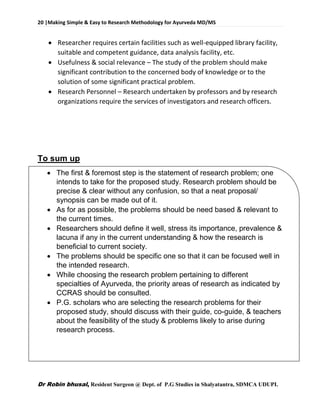
To sum up
 The first & foremost step is the statement of research problem; one
intends to take for the proposed study. Research problem should be
precise & clear without any confusion, so that a neat proposal/
synopsis can be made out of it.
 As for as possible, the problems should be need based & relevant to
the current times.
 Researchers should define it well, stress its importance, prevalence &
lacuna if any in the current understanding & how the research is
beneficial to current society.
 The problems should be specific one so that it can be focused well in
the intended research.
 While choosing the research problem pertaining to different
specialties of Ayurveda, the priority areas of research as indicated by
CCRAS should be consulted.
 P.G. scholars who are selecting the research problems for their
proposed study, should discuss with their guide, co-guide, & teachers
about the feasibility of the study & problems likely to arise during
research process.
21 |Making Simple & Easy to Research Methodology for Ayurveda MD/MS
Dr Robin bhusal, Resident Surgeon @ Dept. of P.G Studies in Shalyatantra, SDMCA UDUPI.
b. Literature review: different methods (including computer
database) with their advantages & limitations.
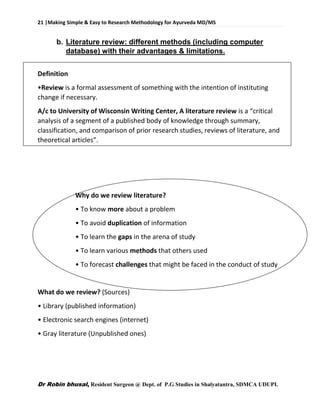
Definition
•Review is a formal assessment of something with the intention of instituting
change if necessary.
A/c to University of Wisconsin Writing Center, A literature review is a “critical
analysis of a segment of a published body of knowledge through summary,
classification, and comparison of prior research studies, reviews of literature, and
theoretical articles”.
Why do we review literature?
• To know more about a problem
• To avoid duplication of information
• To learn the gaps in the arena of study
• To learn various methods that others used
• To forecast challenges that might be faced in the conduct of study
What do we review? (Sources)
• Library (published information)
• Electronic search engines (internet)
• Gray literature (Unpublished ones)
22 |Making Simple & Easy to Research Methodology for Ayurveda MD/MS
Dr Robin bhusal, Resident Surgeon @ Dept. of P.G Studies in Shalyatantra, SDMCA UDUPI.
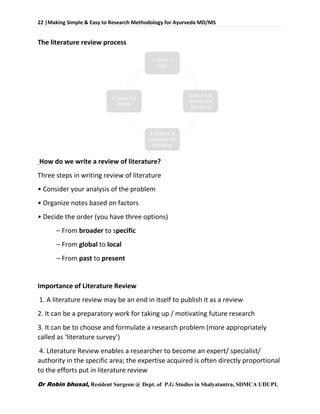
The literature review process
How do we write a review of literature?
Three steps in writing review of literature
• Consider your analysis of the problem
• Organize notes based on factors
• Decide the order (you have three options)
– From broader to specific
– From global to local
– From past to present
Importance of Literature Review
1. A literature review may be an end in itself to publish it as a review
2. It can be a preparatory work for taking up / motivating future research
3. It can be to choose and formulate a research problem (more appropriately
called as ‘literature survey’)
4. Literature Review enables a researcher to become an expert/ specialist/
authority in the specific area; the expertise acquired is often directly proportional
to the efforts put in literature review
1.Select a
topic
2.Search &
choose the
literature
3.Analyse &
interpret the
literature
4. write the
review
23 |Making Simple & Easy to Research Methodology for Ayurveda MD/MS
Dr Robin bhusal, Resident Surgeon @ Dept. of P.G Studies in Shalyatantra, SDMCA UDUPI.
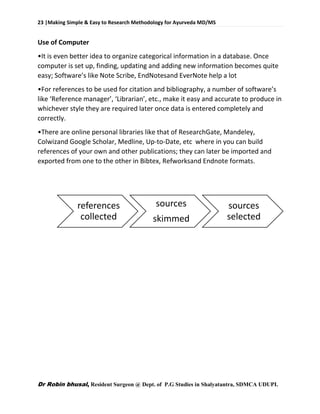
Use of Computer
•It is even better idea to organize categorical information in a database. Once
computer is set up, finding, updating and adding new information becomes quite
easy; Software’s like Note Scribe, EndNotesand EverNote help a lot
•For references to be used for citation and bibliography, a number of software’s
like ‘Reference manager’, ‘Librarian’, etc., make it easy and accurate to produce in
whichever style they are required later once data is entered completely and
correctly.
•There are online personal libraries like that of ResearchGate, Mandeley,
Colwizand Google Scholar, Medline, Up-to-Date, etc where in you can build
references of your own and other publications; they can later be imported and
exported from one to the other in Bibtex, Refworksand Endnote formats.
references
collected
sources
skimmed
sources
selected
24 |Making Simple & Easy to Research Methodology for Ayurveda MD/MS
Dr Robin bhusal, Resident Surgeon @ Dept. of P.G Studies in Shalyatantra, SDMCA UDUPI.
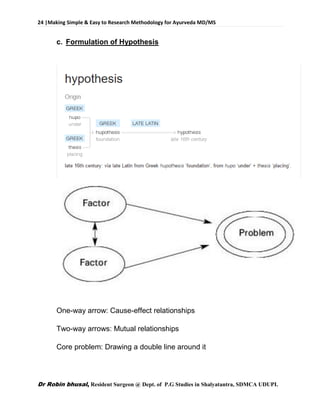
c. Formulation of Hypothesis
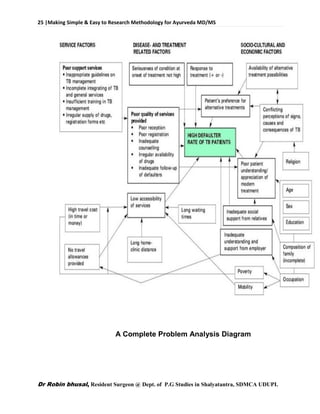
One-way arrow: Cause-effect relationships
Two-way arrows: Mutual relationships
Core problem: Drawing a double line around it
25 |Making Simple & Easy to Research Methodology for Ayurveda MD/MS
Dr Robin bhusal, Resident Surgeon @ Dept. of P.G Studies in Shalyatantra, SDMCA UDUPI.
A Complete Problem Analysis Diagram
26 |Making Simple & Easy to Research Methodology for Ayurveda MD/MS
Dr Robin bhusal, Resident Surgeon @ Dept. of P.G Studies in Shalyatantra, SDMCA UDUPI.
Role of hypothesis
 It serves as a chain between theory and investigation
 It helps in holistic study as its links facts and information together.
 It prevents blind research.
Types of Hypothesis
1. Descriptive hypothesis
2. Relational hypothesis
3. Null hypothesis
Formulating a hypothesis
1. There should not be any haphazard guesses but it should reflect
the depth of knowledge, imagination and experience of researcher.
2. We construct hypothesis by exact observation of available data
and suggestions from expert.
3. A useful hypothesis is a testable statement, which may include a
prediction.
(Testable - By means of test, how two variables might be related
should be find out.)
4. The originality and logic –with which hypothesis are formulated are
important.
5. A hypothesis is based on some previous observation.
Eg. In November many trees undergo color changes in their leaves
and the average daily temperatures are dropping.
(Are these two events connected? How to formulate a hypothesis?)
27 |Making Simple & Easy to Research Methodology for Ayurveda MD/MS
Dr Robin bhusal, Resident Surgeon @ Dept. of P.G Studies in Shalyatantra, SDMCA UDUPI.
d. Defining General & Specific Objectives.
General Objectives
 They are broad goals to be achieved
 It explains what the researcher expects to achieve by the study in
general terms.
 They are usually less in no.
 General objectives are met through accomplishing all specific
objectives.
Eg. To assess the effects of ginger on morning sickness among
pregnant women
Specific objectives
 They are short term and narrow in focus.
 Specific objectives are more in no.
 They systematically addresses various aspects of the problem as
defined under the “STATEMENT OF THE PROBLEM”.
It also address the key factor that is assumed to influence or cause
the problem.
Eg. 1. To compare the effect of ginger in primi and multi gravidae.
2. To compare the effectiveness of ginger on morning sickness in
working women and non-working women.
Criteria for setting research objectives
Research objectives should be
• Focused, each covering a single point
• Ordered in a logical sequence
• Realistic and feasible to answer
• Operational using action-verbs
• Measurable in terms of outcomes at the end
28 |Making Simple & Easy to Research Methodology for Ayurveda MD/MS
Dr Robin bhusal, Resident Surgeon @ Dept. of P.G Studies in Shalyatantra, SDMCA UDUPI.
Action-verbs Vs non-action verbs
Action-verbs
To determine To compare To verify
To calculate To describe To asses
To explore To test To establish
To identify
Non-action verbs
To appreciate To understand To show
To share To believe to study
Short Objectives must be SMART
Specific
Measurable
Achievable
Realistic
Time-bound
e. Research design:
Definition
Research design can be defined as a blue print to conduct a research
study which involves the description of research approach, study
setting, sampling size, sampling technique, tools and methods of data
29 |Making Simple & Easy to Research Methodology for Ayurveda MD/MS
Dr Robin bhusal, Resident Surgeon @ Dept. of P.G Studies in Shalyatantra, SDMCA UDUPI.
collection and analysis to answer a specific research question or for
testing research hypotheses.
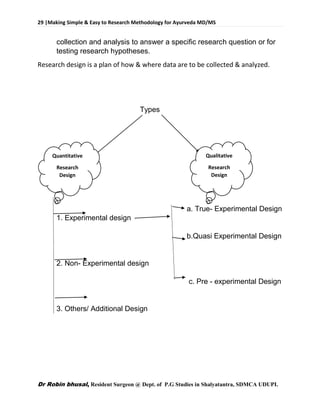
Research design is a plan of how & where data are to be collected & analyzed.
Types
a. True- Experimental Design
1. Experimental design
b.Quasi Experimental Design
2. Non- Experimental design
c. Pre - experimental Design
3. Others/ Additional Design
Quantitative
Research
Design
Qualitative
Research
Design
30 |Making Simple & Easy to Research Methodology for Ayurveda MD/MS
Dr Robin bhusal, Resident Surgeon @ Dept. of P.G Studies in Shalyatantra, SDMCA UDUPI.
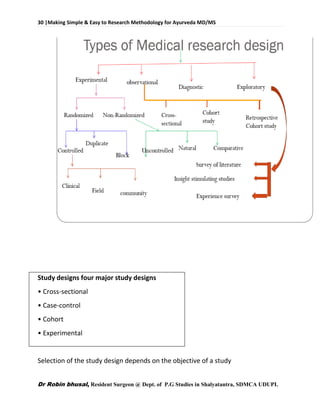
Study designs four major study designs
• Cross-sectional
• Case-control
• Cohort
• Experimental
Selection of the study design depends on the objective of a study
31 |Making Simple & Easy to Research Methodology for Ayurveda MD/MS
Dr Robin bhusal, Resident Surgeon @ Dept. of P.G Studies in Shalyatantra, SDMCA UDUPI.
f. Sample Design
 A sample design is a definite plan for obtaining a sample from a
sample frame or given population.
 Sample design is determined before data is collected.
 There are many sample designs from which the researcher can
choose which is apt for his/ her study.
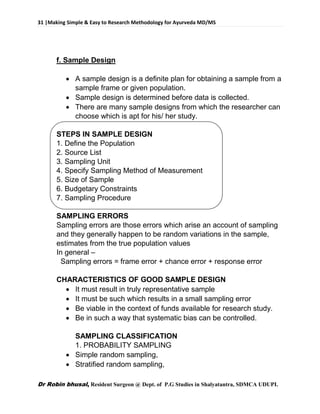
STEPS IN SAMPLE DESIGN
1. Define the Population
2. Source List
3. Sampling Unit
4. Specify Sampling Method of Measurement
5. Size of Sample
6. Budgetary Constraints
7. Sampling Procedure
SAMPLING ERRORS
Sampling errors are those errors which arise an account of sampling
and they generally happen to be random variations in the sample,
estimates from the true population values
In general –
Sampling errors = frame error + chance error + response error
CHARACTERISTICS OF GOOD SAMPLE DESIGN
 It must result in truly representative sample
 It must be such which results in a small sampling error
 Be viable in the context of funds available for research study.
 Be in such a way that systematic bias can be controlled.
SAMPLING CLASSIFICATION
1. PROBABILITY SAMPLING
 Simple random sampling,
 Stratified random sampling,
32 |Making Simple & Easy to Research Methodology for Ayurveda MD/MS
Dr Robin bhusal, Resident Surgeon @ Dept. of P.G Studies in Shalyatantra, SDMCA UDUPI.
 systematic random sampling,
 Cluster random sampling,
 Multi stage and
 Multi phase sampling.
2. NON –PROBABILITY SAMPLING
 sampling,
 quota sampling
 snowball sampling, theoretical sampling,
 Voluntary sampling etc.
g. Collection of the data
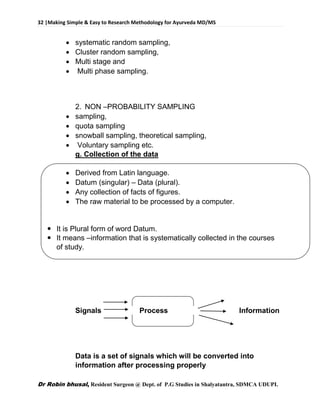
 Derived from Latin language.
 Datum (singular) – Data (plural).
 Any collection of facts of figures.
 The raw material to be processed by a computer.
 It is Plural form of word Datum.
 It means –information that is systematically collected in the courses
of study.
Signals Process Information
Data is a set of signals which will be converted into
information after processing properly
33 |Making Simple & Easy to Research Methodology for Ayurveda MD/MS
Dr Robin bhusal, Resident Surgeon @ Dept. of P.G Studies in Shalyatantra, SDMCA UDUPI.
Need of Data
 It serve as the bases or raw materials for analysis.
 Without analysis of actual data no specific inferences can be drawn
on the research question
 The relevance, adequacy and reliability of data determine the quality
of the findings of the study.
 It forms the basis for testing the hypotheses formulated in the study.
 Data provides facts and figures required for the analysis using
statistical techniques.
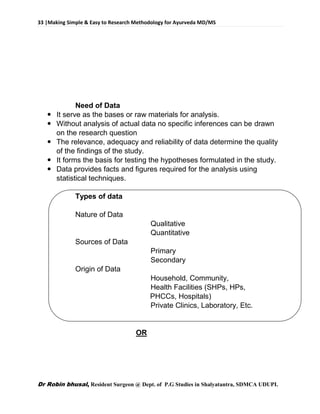
Types of data
Nature of Data
Qualitative
Quantitative
Sources of Data
Primary
Secondary
Origin of Data
Household, Community,
Health Facilities (SHPs, HPs,
PHCCs, Hospitals)
Private Clinics, Laboratory, Etc.
OR
34 |Making Simple & Easy to Research Methodology for Ayurveda MD/MS
Dr Robin bhusal, Resident Surgeon @ Dept. of P.G Studies in Shalyatantra, SDMCA UDUPI.
Types of data
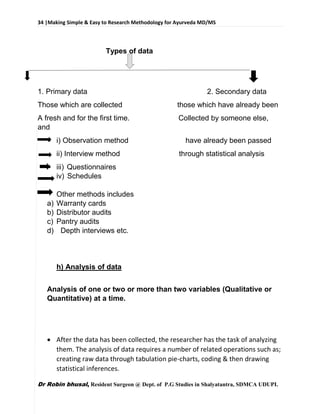
1. Primary data 2. Secondary data
Those which are collected those which have already been
A fresh and for the first time. Collected by someone else,
and
 i) Observation method have already been passed
ii) Interview method through statistical analysis
 iii) Questionnaires
iv) Schedules
Other methods includes
a) Warranty cards
b) Distributor audits
c) Pantry audits
d) Depth interviews etc.
h) Analysis of data
Analysis of one or two or more than two variables (Qualitative or
Quantitative) at a time.
 After the data has been collected, the researcher has the task of analyzing
them. The analysis of data requires a number of related operations such as;
creating raw data through tabulation pie-charts, coding & then drawing
statistical inferences.
35 |Making Simple & Easy to Research Methodology for Ayurveda MD/MS
Dr Robin bhusal, Resident Surgeon @ Dept. of P.G Studies in Shalyatantra, SDMCA UDUPI.
 The term analysis refers, to the computation of certain measures along
with searching of patterns of relationships that exist among data groups.
 Types of Analysis – 2
» Descriptive analysis
» Inferential analysis.
Purpose of Data Analysis
• To convert the Data into usable information
• To remove the effects of Confounding variables
• To test hypothesis that allow the investigator to draw conclusions
• To measure the size of the differences between groups or the strengths of
the relationship between variables found in the study
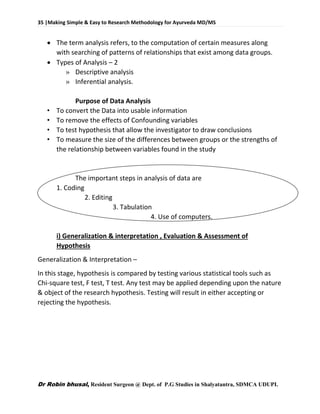
The important steps in analysis of data are
1. Coding
2. Editing
3. Tabulation
4. Use of computers.
i) Generalization & interpretation , Evaluation & Assessment of
Hypothesis
Generalization & Interpretation –
In this stage, hypothesis is compared by testing various statistical tools such as
Chi-square test, F test, T test. Any test may be applied depending upon the nature
& object of the research hypothesis. Testing will result in either accepting or
rejecting the hypothesis.
36 |Making Simple & Easy to Research Methodology for Ayurveda MD/MS
Dr Robin bhusal, Resident Surgeon @ Dept. of P.G Studies in Shalyatantra, SDMCA UDUPI.
INTERPRETATION IN RESEARCH METHODOLOGY
INTRODUCTION
Data interpretation is part of daily life for most people. Interpretation is the process
of making sense of numerical data that has been collected, analyzed, and presented.
A common method of assessing numerical data is known as statistical analysis, and
the activity of analyzing and interpreting data in order to make predictions is
known as inferential statistics .
After collecting and analyzing the data, the researcher has to accomplish the task
of drawing inferences followed by report writing. Only through interpretation that
the researcher can expose relations and processes that underlie his findings. All this
analytical information and consequential inference(s) may well be communicated,
preferably through research report, to the consult of research results who may be
either an individual or a group of individuals or some public private organization.
MEANING OF INTERPRETATION:
MEANING OF INTERPRETATION refers to the task of drawing inferences from
the collected facts after an analytical and or experimental study. In fact, it is a
search for broader meaning of research findings. The task of interpretation has two
major aspects viz., the effort to establish continuity in research through linking the
results of a given study with those of another, and the establishment of some
extraordinary concepts.
“In one sense, interpretation is concerned with relationships within the collected
data, partially overlapping analysis. Interpretation also extends beyond the data of
the study to inch the results of other research, theory and hypotheses. ”
37 |Making Simple & Easy to Research Methodology for Ayurveda MD/MS
Dr Robin bhusal, Resident Surgeon @ Dept. of P.G Studies in Shalyatantra, SDMCA UDUPI.
Technique of Interpretation:
Technique of Interpretation often involves the following
steps:
(i) Researcher must give reasonable explanations of the
relations which he has found and he must interpret the lines
of relationship in terms of the underlying processes and must
try to find out the thread of uniformity that lies under the
surface layer of his diversified research findings.
(ii) Extraneous information, if collected during the study,
must be considered while interpreting the final results of
research study, for it may prove to be a key factor in
understanding the problem under consideration.
(iii) Consultation will result in correct interpretation and, thus,
will enhance the utility of research results.
(iv) Researcher must accomplish the task of interpretation
only after considering all relevant factors affecting the
problem to avoid false generalization.
EVALUATION & ASSESSMENT OF HYPOTHESIS
Hypothesis testing is a procedure used to obtain an answer,
on basis of information from sample observation.
In simple words hypothesis testing is a process of deciding
statistically whether the findings of an investigation reflects
chance or real affect at given level of probability.
Thus hypothesis is testing is based on the application of
probability theory & sampling.
38 |Making Simple & Easy to Research Methodology for Ayurveda MD/MS
Dr Robin bhusal, Resident Surgeon @ Dept. of P.G Studies in Shalyatantra, SDMCA UDUPI.
PROCEDURE FOR TESTING HYPOTHESIS
 Set up the null hypothesis (Ho)
 Check any necessary assumptions and write null and alternative hypotheses.
 Calculate an appropriate test statistic.
 Determine a p-value associated with the test statistic.
 Decide between the null and alternative hypotheses.
 State a "real world" conclusion.
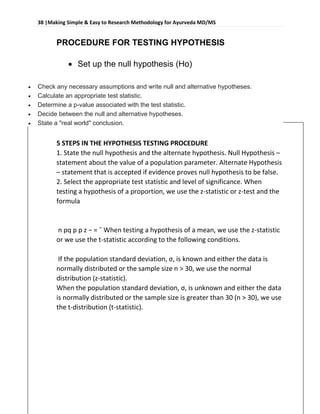
5 STEPS IN THE HYPOTHESIS TESTING PROCEDURE
1. State the null hypothesis and the alternate hypothesis. Null Hypothesis –
statement about the value of a population parameter. Alternate Hypothesis
– statement that is accepted if evidence proves null hypothesis to be false.
2. Select the appropriate test statistic and level of significance. When
testing a hypothesis of a proportion, we use the z-statistic or z-test and the
formula
n pq p p z − = ˆ When testing a hypothesis of a mean, we use the z-statistic
or we use the t-statistic according to the following conditions.
If the population standard deviation, σ, is known and either the data is
normally distributed or the sample size n > 30, we use the normal
distribution (z-statistic).
When the population standard deviation, σ, is unknown and either the data
is normally distributed or the sample size is greater than 30 (n > 30), we use
the t-distribution (t-statistic).
39 |Making Simple & Easy to Research Methodology for Ayurveda MD/MS
Dr Robin bhusal, Resident Surgeon @ Dept. of P.G Studies in Shalyatantra, SDMCA UDUPI.
A traditional guideline for choosing the level of significance is as follows:
(a) the 0.10 level for political polling, (b) the 0.05 level for consumer
research projects, and (c) the 0.01 level for quality assurance work.
3. State the decision rules. The decision rules state the conditions under
which the null hypothesis will be accepted or rejected. The critical value for
the test-statistic is determined by the level of significance. The critical value
is the value that divides the non-reject region from the reject region.
4. Compute the appropriate test statistic and make the decision. When we
use the z-statistic, we use the formula n x z σ − µ = When we use the t-
statistic, we use the formula n s x t − µ = Compare the computed test
statistic with critical value. If the computed value is within the rejection
region(s), we reject the null hypothesis; otherwise, we do not reject the null
hypothesis.
5. Interpret the decision. Based on the decision in Step 4, we state a
conclusion in the context of the original problem.
40 |Making Simple & Easy to Research Methodology for Ayurveda MD/MS
Dr Robin bhusal, Resident Surgeon @ Dept. of P.G Studies in Shalyatantra, SDMCA UDUPI.
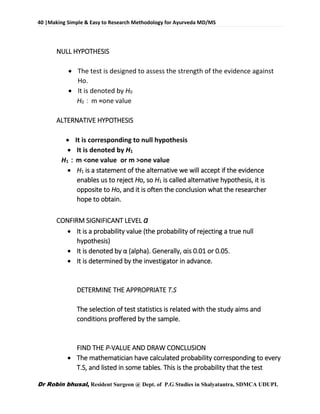
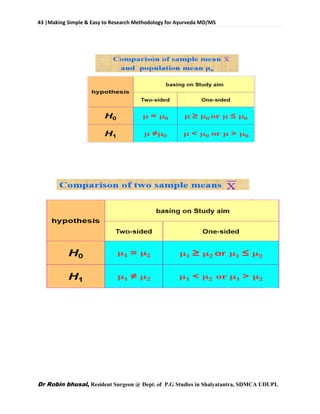
NULL HYPOTHESIS
 The test is designed to assess the strength of the evidence against
Ho.
 It is denoted by H0
H0:m =one value
ALTERNATIVE HYPOTHESIS
 It is corresponding to null hypothesis
 It is denoted by H1
H1:m <one value or m >one value
 H1 is a statement of the alternative we will accept if the evidence
enables us to reject Ho, so H1 is called alternative hypothesis, it is
opposite to Ho, and it is often the conclusion what the researcher
hope to obtain.
CONFIRM SIGNIFICANT LEVEL a
 It is a probability value (the probability of rejecting a true null
hypothesis)
 It is denoted by α (alpha). Generally, αis 0.01 or 0.05.
 It is determined by the investigator in advance.
DETERMINE THE APPROPRIATE T.S
The selection of test statistics is related with the study aims and
conditions proffered by the sample.
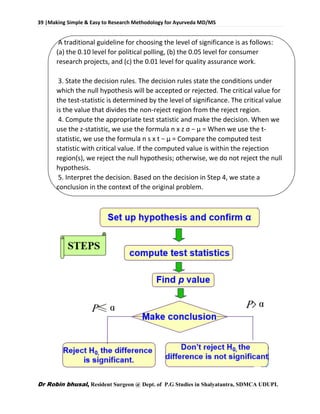
FIND THE P-VALUE AND DRAW CONCLUSION
 The mathematician have calculated probability corresponding to every
T.S, and listed in some tables. This is the probability that the test
41 |Making Simple & Easy to Research Methodology for Ayurveda MD/MS
Dr Robin bhusal, Resident Surgeon @ Dept. of P.G Studies in Shalyatantra, SDMCA UDUPI.
statistic would weigh against Ho at least as strongly as it does for these
data.
FIND THE P-VALUE AND DRAW CONCLUSION
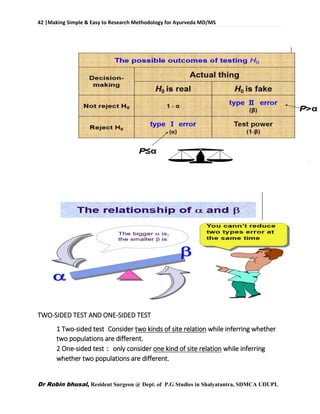
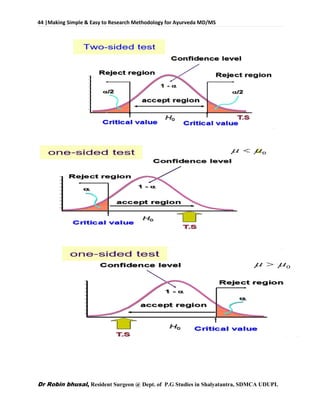
 If P≤α, we reject Ho in favor of H1 at significant level α, We may
think that the two populations are different;
 If P>α, we don`t reject Ho at significant level α. We may think
that two populations are same.
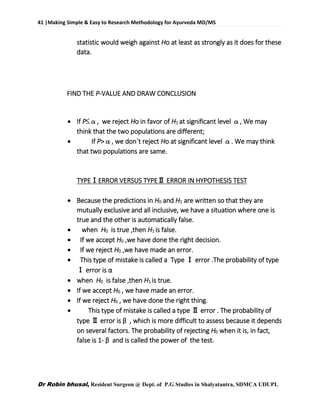
TYPEⅠERROR VERSUS TYPEⅡ ERROR IN HYPOTHESIS TEST
 Because the predictions in H0 and H1 are written so that they are
mutually exclusive and all inclusive, we have a situation where one is
true and the other is automatically false.
 when H0 is true ,then H1 is false.
 If we accept H0 ,we have done the right decision.
 If we reject H0 ,we have made an error.
 This type of mistake is called a Type Ⅰ error .The probability of type
Ⅰ error is α
 when H0 is false ,then H1 is true.
 If we accept H0 , we have made an error.
 If we reject H0 , we have done the right thing.
 This type of mistake is called a type Ⅱ error . The probability of
type Ⅱ error is β , which is more difficult to assess because it depends
on several factors. The probability of rejecting H0 when it is, in fact,
false is 1- β and is called the power of the test.
42 |Making Simple & Easy to Research Methodology for Ayurveda MD/MS
Dr Robin bhusal, Resident Surgeon @ Dept. of P.G Studies in Shalyatantra, SDMCA UDUPI.
TWO-SIDED TEST AND ONE-SIDED TEST
1 Two-sided test Consider two kinds of site relation while inferring whether
two populations are different.
2 One-sided test: only consider one kind of site relation while inferring
whether two populations are different.
43 |Making Simple & Easy to Research Methodology for Ayurveda MD/MS
Dr Robin bhusal, Resident Surgeon @ Dept. of P.G Studies in Shalyatantra, SDMCA UDUPI.
44 |Making Simple & Easy to Research Methodology for Ayurveda MD/MS
Dr Robin bhusal, Resident Surgeon @ Dept. of P.G Studies in Shalyatantra, SDMCA UDUPI.
45 |Making Simple & Easy to Research Methodology for Ayurveda MD/MS
Dr Robin bhusal, Resident Surgeon @ Dept. of P.G Studies in Shalyatantra, SDMCA UDUPI.
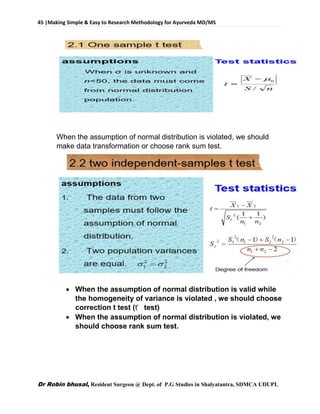
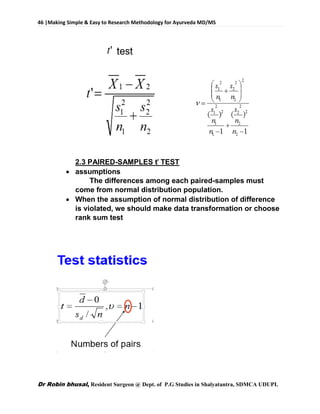
When the assumption of normal distribution is violated, we should
make data transformation or choose rank sum test.
 When the assumption of normal distribution is valid while
the homogeneity of variance is violated , we should choose
correction t test (ť test)
 When the assumption of normal distribution is violated, we
should choose rank sum test.
46 |Making Simple & Easy to Research Methodology for Ayurveda MD/MS
Dr Robin bhusal, Resident Surgeon @ Dept. of P.G Studies in Shalyatantra, SDMCA UDUPI.
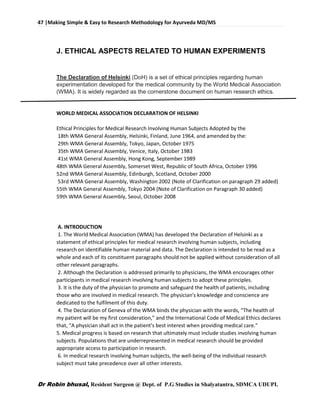
2.3 PAIRED-SAMPLES ť TEST
 assumptions
The differences among each paired-samples must
come from normal distribution population.
 When the assumption of normal distribution of difference
is violated, we should make data transformation or choose
rank sum test
47 |Making Simple & Easy to Research Methodology for Ayurveda MD/MS
Dr Robin bhusal, Resident Surgeon @ Dept. of P.G Studies in Shalyatantra, SDMCA UDUPI.
J. ETHICAL ASPECTS RELATED TO HUMAN EXPERIMENTS
The Declaration of Helsinki (DoH) is a set of ethical principles regarding human
experimentation developed for the medical community by the World Medical Association
(WMA). It is widely regarded as the cornerstone document on human research ethics.
WORLD MEDICAL ASSOCIATION DECLARATION OF HELSINKI
Ethical Principles for Medical Research Involving Human Subjects Adopted by the
18th WMA General Assembly, Helsinki, Finland, June 1964, and amended by the:
29th WMA General Assembly, Tokyo, Japan, October 1975
35th WMA General Assembly, Venice, Italy, October 1983
41st WMA General Assembly, Hong Kong, September 1989
48th WMA General Assembly, Somerset West, Republic of South Africa, October 1996
52nd WMA General Assembly, Edinburgh, Scotland, October 2000
53rd WMA General Assembly, Washington 2002 (Note of Clarification on paragraph 29 added)
55th WMA General Assembly, Tokyo 2004 (Note of Clarification on Paragraph 30 added)
59th WMA General Assembly, Seoul, October 2008
A. INTRODUCTION
1. The World Medical Association (WMA) has developed the Declaration of Helsinki as a
statement of ethical principles for medical research involving human subjects, including
research on identifiable human material and data. The Declaration is intended to be read as a
whole and each of its constituent paragraphs should not be applied without consideration of all
other relevant paragraphs.
2. Although the Declaration is addressed primarily to physicians, the WMA encourages other
participants in medical research involving human subjects to adopt these principles.
3. It is the duty of the physician to promote and safeguard the health of patients, including
those who are involved in medical research. The physician's knowledge and conscience are
dedicated to the fulfilment of this duty.
4. The Declaration of Geneva of the WMA binds the physician with the words, “The health of
my patient will be my first consideration,” and the International Code of Medical Ethics declares
that, “A physician shall act in the patient's best interest when providing medical care.”
5. Medical progress is based on research that ultimately must include studies involving human
subjects. Populations that are underrepresented in medical research should be provided
appropriate access to participation in research.
6. In medical research involving human subjects, the well-being of the individual research
subject must take precedence over all other interests.
48 |Making Simple & Easy to Research Methodology for Ayurveda MD/MS
Dr Robin bhusal, Resident Surgeon @ Dept. of P.G Studies in Shalyatantra, SDMCA UDUPI.
7. The primary purpose of medical research involving human subjects is to understand the
causes, development and effects of diseases and improve preventive, diagnostic and
therapeutic interventions (methods, procedures and treatments). Even the best current
interventions must be evaluated continually through research for their safety, effectiveness,
efficiency, accessibility and quality.
8. In medical practice and in medical research, most interventions involve risks and burdens.
9. Medical research is subject to ethical standards that promote respect for all human subjects
and protect their health and rights. Some research populations are particularly vulnerable and
need special protection. These include those who cannot give or refuse consent for themselves
and those who may be vulnerable to coercion or undue influence.
10. Physicians should consider the ethical, legal and regulatory norms and standards for
research involving human subjects in their own countries as well as applicable international
norms and standards. No national or international ethical, legal or regulatory requirement
should reduce or eliminate any of the protections for research subjects set forth in this
Declaration.
B. PRINCIPLES FOR ALL MEDICAL RESEARCH
11. It is the duty of physicians who participate in medical research to protect the life, health,
dignity, integrity, right to self-determination, privacy, and confidentiality of personal
information of research subjects.
12. Medical research involving human subjects must conform to generally accepted scientific
principles, be based on a thorough knowledge of the scientific literature, other relevant sources
of information, and adequate laboratory and, as appropriate, animal experimentation. The
welfare of animals used for research must be respected.
13. Appropriate caution must be exercised in the conduct of medical research that may harm
the environment.
14. The design and performance of each research study involving human subjects must be
clearly described in a research protocol. The protocol should contain a statement of the ethical
considerations involved and should indicate how the principles in this Declaration have been
addressed. The protocol should include information regarding funding, sponsors, institutional
affiliations, other potential conflicts of interest, incentives for subjects and provisions for
treating and/or compensating subjects who are harmed as a consequence of participation in the
research study. The protocol should describe arrangements for post-study access by study
subjects to interventions identified as beneficial in the study or access to other appropriate care
or benefits.
15. The research protocol must be submitted for consideration, comment, guidance and
approval to a research ethics committee before the study begins. This committee must be
independent of the researcher, the sponsor and any other undue influence. It must take into
consideration the laws and regulations of the country or countries in which the research is to be
performed as well as applicable international norms and standards but these must not be
allowed to reduce or eliminate any of the protections for research subjects set forth in this
Declaration. The committee must have the right to monitor ongoing studies. The researcher
must provide monitoring information to the committee, especially information about any
49 |Making Simple & Easy to Research Methodology for Ayurveda MD/MS
Dr Robin bhusal, Resident Surgeon @ Dept. of P.G Studies in Shalyatantra, SDMCA UDUPI.
serious adverse events. No change to the protocol may be made without consideration and
approval by the committee.
16. Medical research involving human subjects must be conducted only by individuals with the
appropriate scientific training and qualifications. Research on patients or healthy volunteers
requires the supervision of a competent and appropriately qualified physician or other health
care professional. The responsibility for the protection of research subjects must always rest
with the physician or other health care professional and never the research subjects, even
though they have given consent.
17. Medical research involving a disadvantaged or vulnerable population or community is only
justified if the research is responsive to the health needs and priorities of this population or
community and if there is a reasonable likelihood that this population or community stands to
benefit from the results of the research.
18. Every medical research study involving human subjects must be preceded by careful
assessment of predictable risks and burdens to the individuals and communities involved in the
research in comparison with foreseeable benefits to them and to other individuals or
communities affected by the condition under investigation.
19. Every clinical trial must be registered in a publicly accessible database before recruitment of
the first subject.
20. Physicians may not participate in a research study involving human subjects unless they are
confident that the risks involved have been adequately assessed and can be satisfactorily
managed. Physicians must immediately stop a study when the risks are found to outweigh the
potential benefits or when there is conclusive proof of positive and beneficial results.
21. Medical research involving human subjects may only be conducted if the importance of the
objective outweighs the inherent risks and burdens to the research subjects.
22. Participation by competent individuals as subjects in medical research must be voluntary.
Although it may be appropriate to consult family members or community leaders, no competent
individual may be enrolled in a research study unless he or she freely agrees.
23. Every precaution must be taken to protect the privacy of research subjects and the
confidentiality of their personal information and to minimize the impact of the study on their
physical, mental and social integrity.
24. In medical research involving competent human subjects, each potential subject must be
adequately informed of the aims, methods, sources of funding, any possible conflicts of interest,
institutional affiliations of the researcher, the anticipated benefits and potential risks of the
study and the discomfort it may entail, and any other relevant aspects of the study. The
potential subject must be informed of the right to refuse to participate in the study or to
withdraw consent to participate at any time without reprisal. Special attention should be given
to the specific information needs of individual potential subjects as well as to the methods used
to deliver the information. After ensuring that the potential subject has understood the
information, the physician or another appropriately qualified individual must then seek the
potential subject’s freely-given informed consent, preferably in writing. If the consent cannot be
expressed in writing, the non-written consent must be formally documented and witnessed.
25. For medical research using identifiable human material or data, physicians must normally
seek consent for the collection, analysis, storage and/or reuse. There may be situations where
50 |Making Simple & Easy to Research Methodology for Ayurveda MD/MS
Dr Robin bhusal, Resident Surgeon @ Dept. of P.G Studies in Shalyatantra, SDMCA UDUPI.
consent would be impossible or impractical to obtain for such research or would pose a threat
to the validity of the research. In such situations the research may be done only after
consideration and approval of a research ethics committee.
26. When seeking informed consent for participation in a research study the physician should be
particularly cautious if the potential subject is in a dependent relationship with the physician or
may consent under duress. In such situations the informed consent should be sought by an
appropriately qualified individual who is completely independent of this relationship.
27. For a potential research subject who is incompetent, the physician must seek informed
consent from the legally authorized representative. These individuals must not be included in a
research study that has no likelihood of benefit for them unless it is intended to promote the
health of the population represented by the potential subject, the research cannot instead be
performed with competent persons, and the research entails only minimal risk and minimal
burden.
28. When a potential research subject who is deemed incompetent is able to give assent to
decisions about participation in research, the physician must seek that assent in addition to the
consent of the legally authorized representative. The potential subject’s dissent should be
respected.
29. Research involving subjects who are physically or mentally incapable of giving consent, for
example, unconscious patients, may be done only if the physical or mental condition that
prevents giving informed consent is a necessary characteristic of the research population. In
such circumstances the physician should seek informed consent from the legally authorized
representative. If no such representative is available and if the research cannot be delayed, the
study may proceed without informed consent provided that the specific reasons for involving
subjects with a condition that renders them unable to give informed consent have been stated
in the research protocol and the study has been approved by a research ethics committee.
Consent to remain in the research should be obtained as soon as possible from the subject or a
legally authorized representative. 30. Authors, editors and publishers all have ethical obligations
with regard to the publication of the results of research. Authors have a duty to make publicly
available the results of their research on human subjects and are accountable for the
completeness and accuracy of their reports. They should adhere to accepted guidelines for
ethical reporting. Negative and inconclusive as well as positive results should be published or
otherwise made publicly available. Sources of funding, institutional affiliations and conflicts of
interest should be declared in the publication. Reports of research not in accordance with the
principles of this Declaration should not be accepted for publication.
C. ADDITIONAL PRINCIPLES FOR MEDICAL RESEARCH COMBINED WITH MEDICAL CARE
31. The physician may combine medical research with medical care only to the extent that the
research is justified by its potential preventive, diagnostic or therapeutic value and if the
physician has good reason to believe that participation in the research study will not adversely
affect the health of the patients who serve as research subjects.
32. The benefits, risks, burdens and effectiveness of a new intervention must be tested against
those of the best current proven intervention, except in the following circumstances:
51 |Making Simple & Easy to Research Methodology for Ayurveda MD/MS
Dr Robin bhusal, Resident Surgeon @ Dept. of P.G Studies in Shalyatantra, SDMCA UDUPI.
• The use of placebo, or no treatment, is acceptable in studies where no current proven
intervention exists; or
• Where for compelling and scientifically sound methodological reasons the use of placebo is
necessary to determine the efficacy or safety of an intervention and the patients who receive
placebo or no treatment will not be subject to any risk of serious or irreversible harm. Extreme
care must be taken to avoid abuse of this option.
33. At the conclusion of the study, patients entered into the study are entitled to be informed
about the outcome of the study and to share any benefits that result from it, for example,
access to interventions identified as beneficial in the study or to other appropriate care or
benefits.
34. The physician must fully inform the patient which aspects of the care are related to the
research. The refusal of a patient to participate in a study or the patient’s decision to withdraw
from the study must never interfere with the patient-physician relationship.
35. In the treatment of a patient, where proven interventions do not exist or have been
ineffective, the physician, after seeking expert advice, with informed consent from the patient
or a legally authorized representative, may use an unproven intervention if in the physician's
judgement it offers hope of saving life, re-establishing health or alleviating suffering. Where
possible, this intervention should be made the object of research, designed to evaluate its safety
and efficacy. In all cases, new information should be recorded and, where appropriate, made
publicly available.
ETHICAL ASPECTS OF ANIMAL ETHICS (AEC)
Experimentation on animals in course of medical research and education is covered
by provisions of the Prevention of Cruelty to Animals Act, 1960 and Breeding of and
Experiments on Animals (Control & Supervision) Rules of 1998, 2001 and 2006 framed
under the Act.
These are enforced by the Committee for the Purpose of Control and Supervision of
Experiments on Animals (CPCSEA), a statutory body under the Prevention of Cruelty
to Animals Act, 1960.
Institutional Animals Ethics committee- 8 members
1. A biological scientist,
2. Two scientists from different biological disciplines,
3. A veterinarian involved in the care of animal,
4. Scientist in charge of animals facility of the establishment
concerned,
5. A scientist from, outside the institute,
6. A non-scientific socially aware member and
7. A nominee of CPCSEA
52 |Making Simple & Easy to Research Methodology for Ayurveda MD/MS
Dr Robin bhusal, Resident Surgeon @ Dept. of P.G Studies in Shalyatantra, SDMCA UDUPI.
 Specialist may be co-opted while reviewing special project using
hazardous agents such as radio-active substance and deadly micro
organisms
 The Chairperson of the Committee and Member Secretary would
be nominated by the Institution from amongst the eight members
 Members against Serial number 5,6 and 7 will be nominated by
CPCSEA, with a provision of a Link
Nominee for CPCSEA nominee
» The duration of appointment is for a period of 3 years
Objectives :
To take all such measures as may be necessary to ensure that animals are not
subjected to unnecessary pain or suffering before, during or after the
performance of experiments on them
Animal experiments used to develop new medicines and to test the safety of other
product.
The 3 R’s are set of principles that scientist are encouraging to follow in order to
reduce the impact of research on animals.
 Reduction
Reducing the number of animals used in experiments by
» Improving experimental technique
» Improving techniques of data analysis
» Sharing information with other researchers.
 Refinement: the way the animals are cared for so as to reduce their sufferings
» Using less invasive techniques
» Better medical care
» Better living condition
 Replacement: with alternative techniques
» Experimenting on cell cultures instead of whole animals
» Using computers models
» Studying human volunteers
» Using epidemiological studies
53 |Making Simple & Easy to Research Methodology for Ayurveda MD/MS
Dr Robin bhusal, Resident Surgeon @ Dept. of P.G Studies in Shalyatantra, SDMCA UDUPI.
The following ethical principles suggested by WHO- European
union forum.
 to considerably improve the welfare of animals used in scientific
procedures
Refer: http://www.wma.net/en/30publications/10policies/b3/17c.pdf
INSTITUTIONAL ETHICS COMMMITTEE (IEC)
 A formally designated group that oversees research involving human
subjects. Approves and disapproves human subject research.
 According to the standards of the community or the institution, the
IRB/IEC may require modifications to a protocol to ensure patient
safety. 17
Function
•The primary function of an IRB/IEC is to safe guard the rights, safety ,and
wellbeing of all trial subjects. This is accomplished by initial, continuing and
annual review.
•An IRB should consist of members who collectively have the qualifications and
experience to review and evaluate the science, medical aspects, and ethics of the
proposed trial.
.
 All studies must be approved prior to recruiting participants.
 IRB must review all documents given to participants.
 Reporting AEs and Deviations from protocol to the IRB.
 Maintenance of Records.
54 |Making Simple & Easy to Research Methodology for Ayurveda MD/MS
Dr Robin bhusal, Resident Surgeon @ Dept. of P.G Studies in Shalyatantra, SDMCA UDUPI.
Primary objective:
 Right
 Dignity
 Safety
 Well-being of participants
Secondary objective
 GCP compatibility
 Publishing
 Regulatory authority
 Data exchange & acceptability between countries
 Standard uniformity
IRB Members
1. A minimum of five (5) members.
2. One member whose concern is not scientific.
3. One member who has no personal or familial relationship to the
institution or trial site.
4. Any member with a conflict of interest may not participate in any part of
the review or vote (except to provide requested information).
5. Individuals with special expertise may be invited to assist with areas of
unique or complex nature. These will not be voting members.
6. A list of IRB/IEC members and their qualifications 19should be
maintained
OR
Composition of IEC –
7 members minimum & maximum 7-12
Quorum of 5
Chairperson from outside
 Chairperson
 Clinical pharmacologist
 One clinician
 One layer/ judge
55 |Making Simple & Easy to Research Methodology for Ayurveda MD/MS
Dr Robin bhusal, Resident Surgeon @ Dept. of P.G Studies in Shalyatantra, SDMCA UDUPI.
 One philosopher
 One lay person
 Members secretary
Functioning
 Justification & objective: if the prospect is to discover new ways of
benefiting people’s health.
 Scientific design: control arm, sample size, statically methods,
criteria, benefits Vs Risk
 Informed consent
 Community consideration
QUESTION’S???
1. Discuss about declaration of Helsinki?
56 |Making Simple & Easy to Research Methodology for Ayurveda MD/MS
Dr Robin bhusal, Resident Surgeon @ Dept. of P.G Studies in Shalyatantra, SDMCA UDUPI.
3. PREPARATION OF RESERCH PROPOSALS IN DIFFERENT
DISCIPLINES FOR SUBMISSION TO FUNDING AGENCIES
TAKING EMR-AYUSH SCHEME AS MODEL
AYURVEDA and SIDDHA Standardization of Ayurveda and Siddha Drugs, safety/toxicity studies,
pharmacological studies, clinical trials, etc. under following priority areas/diseases:
Clinical Research
First priority
 Life style related disorders
 Metabolic disorders
 Peptic ulcer
 Psoriasis
 Malnutrition
 Reproductive Child Health (RCH) including infertility and contraceptives
 Benign prostate enlargement
 Preventive cardiology-hypertension, obesity
 Urolithiasis
 General Health Promotion Rasayana/Medhya Rasayana
 Mental Health/memory relating disorders
 Sports Medicine
 Liver Disorders (Hepatitis B)
 Primary health care relating issues
 Malaria
 Filarial
 Rheumatoid arthritis
 Menstrual disorder
Reproductive tract infection
 Cancer
 Bronchial asthma, Upper respiratory tract infection
 Neurological disorders
Second priority:
 Musculoskeletal disorders
 Fever
 Diarrhea (including dysentery)
 Indigestion and anorexia
 Skin Diseases
 Eye and ENT Diseases
 Secondary/tertiary health care relating issues
Research on fundamental principles of AYUSH:
 Pancha Mahabhutas – Tridosa
57 |Making Simple & Easy to Research Methodology for Ayurveda MD/MS
Dr Robin bhusal, Resident Surgeon @ Dept. of P.G Studies in Shalyatantra, SDMCA UDUPI.
 Prakriti, Agni, Srotas, Saptadhatu, Ojas, Ama etc.
 Studies related to Pharmaco-dynamics kinetics e.g. Rasa, Guna, Virya, Vipaka
and Prabhava
 Surgical and para-surgical procedures
 Similar areas of Siddha
 Molecular Pharmacology
 Genetics
Identification and evaluation of promising and widely accepted practices and skills of
traditional healers in rural and tribal areas Research on the preventive and promote aspects
AYUSH practices and therapies
Revival of ancient literature–Survey, collection, transcription / translation, editing and
Publication of classical literature and text books, Medico-historical investigations of AYUSH
Sample survey of contemporary requirements of AYUSH
Issues relating to the use of Modern Technology to develop the Drugs of AYUSH and Efficacy,
Safety, Standards etc.
PROPOSAL
• A research proposal is a document written by a researcher that
provides a detailed description of the proposed program
• Proposal is a marketing document to an funder
• It is a legal and binding contract between PI, and funder
 short term
 definite objectives
 well defined inputs and outputs
 specifies objective realization within specified costs and quality
1. Title
 Summary (Not more than 500 words)
58 |Making Simple & Easy to Research Methodology for Ayurveda MD/MS
Dr Robin bhusal, Resident Surgeon @ Dept. of P.G Studies in Shalyatantra, SDMCA UDUPI.
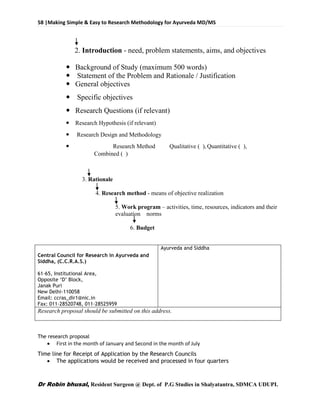
2. Introduction - need, problem statements, aims, and objectives
 Background of Study (maximum 500 words)
 Statement of the Problem and Rationale / Justification
 General objectives
 Specific objectives
 Research Questions (if relevant)
 Research Hypothesis (if relevant)
 Research Design and Methodology
 Research Method Qualitative ( ), Quantitative ( ),
Combined ( )
3. Rationale
4. Research method - means of objective realization
5. Work program – activities, time, resources, indicators and their
evaluation norms
6. Budget
Central Council for Research in Ayurveda and
Siddha, (C.C.R.A.S.)
61-65, Institutional Area,
Opposite ‘D’ Block,
Janak Puri
New Delhi-110058
Email: ccras_dir1@nic.in
Fax: 011-28520748, 011-28525959
Ayurveda and Siddha
Research proposal should be submitted on this address.
The research proposal
 First in the month of January and Second in the month of July
Time line for Receipt of Application by the Research Councils
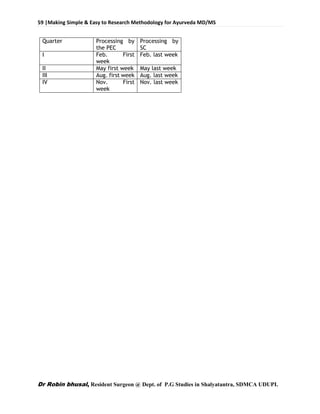
 The applications would be received and processed in four quarters
59 |Making Simple & Easy to Research Methodology for Ayurveda MD/MS
Dr Robin bhusal, Resident Surgeon @ Dept. of P.G Studies in Shalyatantra, SDMCA UDUPI.
Quarter Processing by
the PEC
Processing by
SC
I Feb. First
week
Feb. last week
II May first week May last week
III Aug. first week Aug. last week
IV Nov. First
week
Nov. last week
60 |Making Simple & Easy to Research Methodology for Ayurveda MD/MS
Dr Robin bhusal, Resident Surgeon @ Dept. of P.G Studies in Shalyatantra, SDMCA UDUPI.
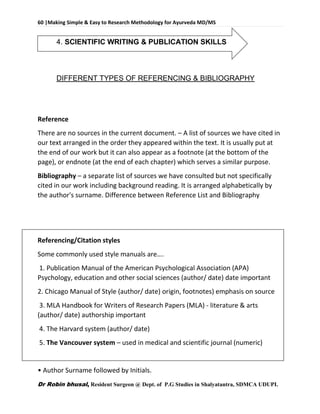
4. SCIENTIFIC WRITING & PUBLICATION SKILLS
DIFFERENT TYPES OF REFERENCING & BIBLIOGRAPHY
Reference
There are no sources in the current document. – A list of sources we have cited in
our text arranged in the order they appeared within the text. It is usually put at
the end of our work but it can also appear as a footnote (at the bottom of the
page), or endnote (at the end of each chapter) which serves a similar purpose.
Bibliography – a separate list of sources we have consulted but not specifically
cited in our work including background reading. It is arranged alphabetically by
the author's surname. Difference between Reference List and Bibliography
Referencing/Citation styles
Some commonly used style manuals are….
1. Publication Manual of the American Psychological Association (APA)
Psychology, education and other social sciences (author/ date) date important
2. Chicago Manual of Style (author/ date) origin, footnotes) emphasis on source
3. MLA Handbook for Writers of Research Papers (MLA) - literature & arts
(author/ date) authorship important
4. The Harvard system (author/ date)
5. The Vancouver system – used in medical and scientific journal (numeric)
• Author Surname followed by Initials.
61 |Making Simple & Easy to Research Methodology for Ayurveda MD/MS
Dr Robin bhusal, Resident Surgeon @ Dept. of P.G Studies in Shalyatantra, SDMCA UDUPI.
• Title of article followed by double quotation.
• Title of journal (abbreviated).
• Date of Publication followed by double quotation.
• Volume Number.
• Issue Number in bracket.
• Page Number.
Example
1. Haas AN, Susin C, Albandar JM, et al. Azithromycin as a adjunctive treatment of
aggressive periodontitis: 12-months randomized clinical trial. N Engl J Med. 2008
Aug; 35(8):696-704.
Vancouver Style does not use the full journal name, only the commonly- used
abbreviation: “New England Journal of Medicine” is cited as “N Engl J Med”
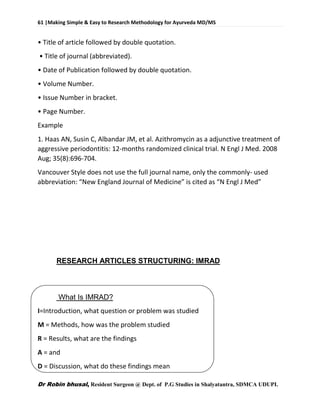
RESEARCH ARTICLES STRUCTURING: IMRAD
What Is IMRAD?
I=Introduction, what question or problem was studied
M = Methods, how was the problem studied
R = Results, what are the findings
A = and
D = Discussion, what do these findings mean
62 |Making Simple & Easy to Research Methodology for Ayurveda MD/MS
Dr Robin bhusal, Resident Surgeon @ Dept. of P.G Studies in Shalyatantra, SDMCA UDUPI.
Organization of a scientific paper
 The most common is the IMRAD If a number of methods were used to
achieve directly related results
M + R = Experimental section
 The results are so complex that they need to be immediately discussed:
R + D = Results and Discussion section
IMRAD (Introduction, Methods, Research [and] Discussion)
• is a mnemonic for a common format used for academic ['scientific'] research
papers. While used primarily in the hard sciences, like physics and biology, it is
also widely used in the social and behavioral sciences. The IMRAD format is also
known as the APA format, as the American Psychological Association uses the
IMRAD headings in its APA style sheet. IMRAD is simply a more 'defined' version
of the "IBC" [Introduction, Body, and Conclusion] format used for all academic
writing.
IMRAD format slowly progressed in the latter half of the 19 th century.
Essential Parts of a scientific paper
 Title: Describe concisely the core contents of the paper
 Contact info
 Abstract, keywords : Summarize the major elements of the
 Body of paper:
 Introduction: : provide context & rationale for the study
 Materials : Describe the experimental design so it is reproducible
 Methods: Describe the experimental procedures
 Results : Summarize the findings without interpretation
 Discussion: Interpret the findings of the study
 Acknowledgements: Give credit to those who helped
63 |Making Simple & Easy to Research Methodology for Ayurveda MD/MS
Dr Robin bhusal, Resident Surgeon @ Dept. of P.G Studies in Shalyatantra, SDMCA UDUPI.
 Literature Cited: List all scientific papers, books and websites that you
cited
Why it is used?
 Allows experts to rapidly scan through thousands of journal articles to
find relevant material.
 Allows readers to quickly find what interests them.
The title
A good title is defined as the fewest possible words that adequately describe the
contents of the paper.
The title is extremely important and must be chosen with great care as it will be
read by thousands, whereas few will read the entire paper Indexing and
abstracting of the paper depends on the accuracy of the title.
An improperly titled paper will get lost and will never be read.
How to Prepare the Title
 Make a list of the most important keywords.
 Think of a title that contains these words.
 The title could state the conclusion of the paper.
 The title never contains abbreviations.
 Think, rethink of the title before submitting the paper.
 Be very careful of the grammatical errors due to faulty word order.
 Avoid the use of the word “using”.
ABSTRACT
64 |Making Simple & Easy to Research Methodology for Ayurveda MD/MS
Dr Robin bhusal, Resident Surgeon @ Dept. of P.G Studies in Shalyatantra, SDMCA UDUPI.
An abstract can be defined as a summary of the information in a document.
The standard word limit of abstract according to APA is 75 to 120 words.
Abstract must be-
1. Accurate: which correctly reflects the purpose & content of manuscript.
2. Self-contained-
3. Conise & specific- to make sentence informative & as possible as brief.
4. Non- evaluative- to report information objectively.
INTRODUCTION
 It should present the nature, details and scope of the problem investigated.
 Review the pertinent literature.
 State the method of investigation.
 State the principal results of the investigation.
 State the principal conclusion suggested by the results.
 State the purpose – state the Hypothesis explain the purpose behind the Hypothesis.
MATERIAL
 The source of subjects studied, number of individuals in each group used,
their sex, age, and weight must be clearly stated.
 If human subjects are used, the criteria for selection should be described,
and consent.
 For chemicals used, include exact technical specifications and source or
method of preparation.
 Avoid the use of trade names of chemicals, generic or chemical names are
preferred.
METHOD
 Describe the research & include all the details on how the research was
conducted.
65 |Making Simple & Easy to Research Methodology for Ayurveda MD/MS
Dr Robin bhusal, Resident Surgeon @ Dept. of P.G Studies in Shalyatantra, SDMCA UDUPI.
 Identify sub –sections
i. Participants: it describe no. & demographics of participants.
ii. Measures: it explains tests or surveys used for the assessments.
iii. Procedure: It gives the details on the way of assessment was conducted.
RESULTS
 Results section is written in the past tense.
 It is the core or heart of the paper.
 It needs to be clearly and simply stated since it constitutes the new
knowledge contributed to the world.
TABLES & FIGURES
 Tables are appropriate for large or complicated data sets that would be
difficult to explain clearly in text. .
 Figures are appropriate for data sets that exhibit trends, patterns, or
relationships that are best conveyed visually.
 Any table or figure must be sufficiently described by its title and caption or
legend, to be understandable without reading the main text of the results
section.
 Do not include both a table and a figure showing the same information.
DISCUSSION
 Discuss the results of experiment.
 Analyze data & interpret the implications of data with respect to original
Hypothesis.
 Compare the results of current study to work of previous research that was
discussed sin introduction.
 Recommend what should be done next in regard to future research.
66 |Making Simple & Easy to Research Methodology for Ayurveda MD/MS
Dr Robin bhusal, Resident Surgeon @ Dept. of P.G Studies in Shalyatantra, SDMCA UDUPI.
REFERENCES
 Any papers not cited in the text should not be included.
 Reference lists allow readers to investigate the subject in greater depth.
 A reference list contains only the books, articles, and web pages etc. that
are cited in the text of the document.
 While a bibliography includes all sources consulted for background or
further reading
APPENDICES
67 |Making Simple & Easy to Research Methodology for Ayurveda MD/MS
Dr Robin bhusal, Resident Surgeon @ Dept. of P.G Studies in Shalyatantra, SDMCA UDUPI.
5. CLASSICIAL METHODS OF RESEARCH
 Pramana can be considered as one of the ancient method of research in
developing research methodology in Ayurveda.
 According to Charakacharya, the things of this universe such as SAT
(existent) or ASAT (non-existent ) can be investigated by these 4 Pramanas
& the same are helpful in Swastharakshana, Roga- pariksha, Rogi- Pariksha,
Dravya prakshya, & Chikitsa.they are:-
1. Aaptopadesh Pramana
2. Pratyaksha Pramana
3. Anumana Pramana
4. Yukti Pramana
 These 4 Pramanas are very much useful at all steps of research such as
planning of research work, executing the plan of research & finding a
conclusion.
 Research is the search for knowledge, it si nothing but a planned program
which is used to solve problems & creates a generally applicable new
knowledge.
 In Ayurveda, the word Praman is derived from from Prama = valid or
correct knowledge i.e. the knowledge of science which is explored by
various scientific methods.
 The critical scientific approach of Ayurveda is evident from its Pramana
Vidnyan. Thus, Pramanas are the scientific methods to acquire valid
knowledge.
 Among all Pramanas, Aaptodesh gives existing knowledge of science , while
pratyakshya & anumana gives knowledge after examination.
 Aaptodesha is considered as the primary one, as it forms the first source of
information about Ayurveda or any other science. It also forms a firm basis
for all theorectical knowledge in all aspects.
68 |Making Simple & Easy to Research Methodology for Ayurveda MD/MS
Dr Robin bhusal, Resident Surgeon @ Dept. of P.G Studies in Shalyatantra, SDMCA UDUPI.
1. AAPROPADESHA PRAMANA
 It is base of all pramanas.
 The term Aaptopadesha is generally confined only with the individual or
personality. Aapta, is not merely an individual but also it includes written
documents like Vedas, Samhitas, different manuscripts etc. Now a day
various research journals, different scientific websites can be taken or
considered as Aapta.
 Before any research or proposed study, we follow the step i.e. review of
the literature which can be correlated with Aaptopadesh. It helps to avoid
repetition of work or research.
QUALITIES OF AAPTA
 Those who were free from RAJA & TAMA i.e. Manasika Doshas.
 They have knowledge of 3 Kalas- i.e. past, present & future.
IMPORTANCE
 In Roga pariksha.
 It becomes a base for pratyakshya & Anumana Pramana.
 Nidana, roopa & chikitsa of any disease is known by Aaptopadesha.
 Without the knowledge of Aaptopadehsa- pariksha or chikitsa is impossible.
2. PRATYAKSHYA PRAMANA
 The knowledge which is perceived by sense organs & mind is called as
Pratyakshya & the medium of it is called as Pratyaksha Pramana.
 It is the best method of knowledge because it is obtained by direct contact
of sense organs with the object.
 Achayara Charak in Vimanasthana 7/4 has explained that except Rasa
(Taste) all other senses can be used for examination of patients, because
they are perceived directly.
 Nowadays we can increase the capacity of different sense organs with the
help of mechanical aids. E.g.
» Eyes can be supported or aatisukshma (minute) particles are not are
not see by eyes, so here an obstacles comes for Pratyaksha
knowledge .so to overcome this microscope is used & for Avarana
69 |Making Simple & Easy to Research Methodology for Ayurveda MD/MS
Dr Robin bhusal, Resident Surgeon @ Dept. of P.G Studies in Shalyatantra, SDMCA UDUPI.
i.e. due to coverings one can’t get directly knowledge of that
structure so to overcome this X-ray, USG scan, MRI, endoscope, like
visual aids are used.
» Tactile sensation can be supported by instruments like thermometer.
IMPORTANCE
 It helps in Roga & rogi pariksha .
 For Darshana, Sparshana, Prashan Parikshya- it is is the best for the
diagnosis & prognosis of disease.
 To check the improvement in a patient Pratyaksha is compulsory.
 Ashtavidha pariksha, Dashavidha pariksha, Sthanika parikshan need most
the support of Pratyaaksha.
 It gives reliable information about physical & mental changes in patient.
3. ANUMANA PRAMANA
 It is indirect knowledge which is based on reasoning (Tarka), or Inference &
the inference is based on prior perception.
 Medha or grasping capacity or smruti (memory) can be accessed by
anumana. In today’s research also most of the psychological experiments
are based on questionnaire & conclusion is drawn by anumana or logical
inference.
 It can be further classified into 3
i. Sheshavata : It means inference of cause (Karana) from effect (Karya
)which is related to past. E.g. the undigested food vomiting can imagine as
Adhyashana as its cause.
In terms of research this can be co-related with Case control study
design & said to be retrospective study.
ii. Poorvavata: It means inference of effect (Karya) from cause (Karana) & it
is related to future. Eg. Hrullasa in Chardi & jrumbha in Jwara disease.
In terms of research this can be correlated with Cohort study
design & said to be prospective study.
It
70 |Making Simple & Easy to Research Methodology for Ayurveda MD/MS
Dr Robin bhusal, Resident Surgeon @ Dept. of P.G Studies in Shalyatantra, SDMCA UDUPI.
iii. Samanyoatodrushta: This type of anumana is related to present .Eg.
inference of Agni by Jarana-shakti , Bala by Vyayama-shakti, etc.
in terms of research this can be correlated with Cross Sectional Study.
IMPORTANCE
 It is highly useful in areas of unavailability of sufficient information. In such
case, the physician is required to observe the available links & arrive at a
conclusion.
 Anumana spans over 3 periods of time- past, present & future.
 Charaka elaborates further with discreet examples. This refers to an
inference of the present situation based on available clue.
 Anumana plays a major role in decoding the etiology of a disease & in
diagnosis.
4. YUKTI PRAMANA
 It means intellectually planning on the basis of Pratyksha & anumana.
 The knowledge which sees the things produced by the combination of
multiple causative factors is known as YUKTI.
 We can get the knowledge of 3 kalas ad also tri-varga- Dharma, Artha &
Kama.
 Yukti proves to be important tool of diagnosis & treatment when there is
involvement of multiple doshas , presence of confusing symptoms, &
availability of few treatments options due to contradiction’s in the disease
& constitution of the patient.
 Yukti helps physician to take decision based on his medical knowledge,
practical experience, intelligence, observation & analytical skill to formulate
an effective treatment.
e.g. If Dr. knows which drug can be effective for the particular disease or
according to formulation action then the treatment becomes easy & effective.
IMPORTANCE
 It plays an important role in Nidana & Chikitsa .
71 |Making Simple & Easy to Research Methodology for Ayurveda MD/MS
Dr Robin bhusal, Resident Surgeon @ Dept. of P.G Studies in Shalyatantra, SDMCA UDUPI.
 Kriyakala, Agni, Aushadhi sebvana kala, matra ,etc. are known by
yukti pramana.
 To confirm, evaluate & treat a disease, physician need to perform
clinical examinations of patients where aaptopadesha , pratyaksha &
anumana are all very important components.
DRAVYA- GUNA- KARMA PARIKSHANA PADDATI
 The imbalance is occurred through hyper-condition (Vruddhi), Hypo-
condition (Kshya), incorrect condition (Dushti) of body constituents.
 This conditions can be examined by the changes in body elements
Dravyatah (Quantitatively), Gunataha (Qualitatively) & Functionally
(Karmatah).
1. Dravyatah Pariksha – Quantitative examinations:-
e.g. – if we want to examine Raktadhatu, then Drayataha examination is to
examine the exact quantity of Raktadhatu in body by doing investigations
like Hemoglobin estimation or Raktadhatu can be examined directly by
inspection etc.
2. Gunataha Pariksha – Qualitative examination
e.g.- to examine Rakta guna i.e Ushna, Drava properties of Raktadhatu we
can examine body temperature or feeling of hotness or coldness through
question and liquidity through bleeding time calculation.
3. Karmatah Pariksha – Functional analysis
e.g.- Functionally Raktadhatu can be examined by aliveness, proper
nourishment to the body parts or bright , soft texture & color of skin, etc.
72 |Making Simple & Easy to Research Methodology for Ayurveda MD/MS
Dr Robin bhusal, Resident Surgeon @ Dept. of P.G Studies in Shalyatantra, SDMCA UDUPI.
6. COMPARISION BETWEEN METHODS OF RESEARCH IN AYURVEDA
प्रतिज्ञा स्थापना हेिु उदारण उपनय तनगमन
पञ्चअवयव वाक्य, he 5 ancient steps for establishment of fact i.e. प्रतिज्ञा
स्थापना हेिु उदारण उपनय & Nigamana is the methodology adopted by ancient
Acharayas to establish any principle or fact through correct validation by various
examinations & investigations.
 The objectives of investigation is to understand things in their correct form
– which is called Pratipattidnyanam.
 The पञ्चअवयव वाक्य are
1. प्रतिज्ञा: Proposition/ Hypothesis , Ch.Vi.8/30
It is the statement of problem or what to be proved.
e.g. पुरुष is eternal.
2. स्थापना : consolidation
Confirmation or establishment of Hypothesis.
That means establishment of the same proposition firmly on the
basis of Hetu, Drushtanta (instant), upanaya (co-relation) and
Nigamana (conclusion).
3. हेिु : logical reason
It is the cause of knowledge.
 हेिु & दृष्ाांि plays important role for arriving the conclusion.
 While giving reason or giving possible cause to explain any
fact, means & methods of investigation i.e. Pratakshya,
73 |Making Simple & Easy to Research Methodology for Ayurveda MD/MS
Dr Robin bhusal, Resident Surgeon @ Dept. of P.G Studies in Shalyatantra, SDMCA UDUPI.
Anumana, Aptopadesha, Upaman etc all these pramanas help
to verify & to validate that reasons.
4. उदारण / दृष्ाांि: example / instance
Cha.Vi 8/31, 34
Eg. Instance- as sky. If presents resemblance or image of the
things to be proved.
Eg. Sky is eternal or fire is hot, etc.
Such example or illustrations support the validity of statements.
5. उपनय: co- relation/ Comparison
Cha.Vi.8
Co- relation – as sky is uncreated & is eternal so is sky.
Comparison or co-relation helps to illustrate the problems and gives
logical sequence to previous steps.
6. तनगमन: conclusion
Conclusion – self is eternal.
Conclusion is drawn from the results of such experiments or
observations.
74 |Making Simple & Easy to Research Methodology for Ayurveda MD/MS
Dr Robin bhusal, Resident Surgeon @ Dept. of P.G Studies in Shalyatantra, SDMCA UDUPI.
7. DIFFERENT FIELDS OF RESEARCH IN AYURVEDA
Refer samhitas
1. panchamahabhuta & tridosha
2. concepts of rasa, guna, virya, vipaka,
prabhav & karma
3.concept of Prakriti- saradi bhava, ojas, srotas,
agni, aama & kostha.
75 |Making Simple & Easy to Research Methodology for Ayurveda MD/MS
Dr Robin bhusal, Resident Surgeon @ Dept. of P.G Studies in Shalyatantra, SDMCA UDUPI.
8. LITERARY RESEARCH
Definition
 The process of discovering meaningful new correlations, patterns and
trends by sifting through large amounts of data stored in repositories, using
pattern recognition technologies as well as statically and mathematics
techniques.
 Extraction of implicit, previously unknown and potentially useful
information from data.
 Exploration & analysis, by automatic or semi-automatic means, of large
quantities of data in order to discover meaningful patterns.
 Extraction of interesting (non-trivial, implicit, previously unknown and
potentially useful) information or patterns from data in large databases.
Alternative names:
 Knowledge discovery(mining) in databases (KDD),
 knowledge extraction,
 data/pattern analysis,
 data archeology,
 data dredging,
 information harvesting,
 Business intelligence, etc.
Data Mining Tasks
 Prediction Tasks
Use some variables to predict unknown or future values of other variables
 Description Tasks
 Find human-interpretable patterns that describe the data.
76 |Making Simple & Easy to Research Methodology for Ayurveda MD/MS
Dr Robin bhusal, Resident Surgeon @ Dept. of P.G Studies in Shalyatantra, SDMCA UDUPI.
Common data mining tasks
1. Classification [Predictive Tasks]
2. Clustering [Descriptive Tasks]
3. Association Rule Discovery [Descriptive Tasks]
4. Sequential Pattern Discovery [Descriptive Tasks]
5. Regression [Predictive Tasks]
6. Deviation Detection [Predictive Tasks]
1. Classification
It can be used to built up idea of type of patients, diseases, or features of
patients or diagnosis.
2. Clustering
It is useful to identify different information because it co-relates with
other examples so you can see where the similarities and ranges agrees.
3. Association Rule Discovery
It is used to make a simple correlation between two or more items, often
of the same type of identify patterns.
4. Sequential Pattern Discovery
Often used over longer-term data, sequential patterns are a useful method
for identifying trends or regular occurrences of similar events.
5. Regression
To make quantitative predictions of one variable from the values of
another.
6. Deviation Detection
The difference between an observed values and expected value of a
variable or functions.
77 |Making Simple & Easy to Research Methodology for Ayurveda MD/MS
Dr Robin bhusal, Resident Surgeon @ Dept. of P.G Studies in Shalyatantra, SDMCA UDUPI.
9. PHARMACOPOEIAL STANDARDSS & PARAMETERS AS SET BY AYURVEDIC
PHARMACOPOEIA OF INDIA.
Introduction
 India has Drugs and Cosmetics Act, 1940 and Drugs and Cosmetics Rules of
1945 for drug regulation. Also Dangerous Drug Act, 1930 and Poisons Act
1919 define drug related policies.
 These acts and related rules regulate export, manufacture, distribution
and sale of drugs and cosmetics.
 Considering increase in demand, use and export of drugs from Ayurvedic
and other systems included in AYUSH; Government of India has specified
the rules and notifications related manufacturing, standardization and other
aspects of drug usage.
 Ayurvedic, Unani and Homoeopathic Pharmacopoeias published by the
Govt. of India have prescribed various standards to be followed for ISM &
Homoeopathic drugs.
 In 2002 Govt. of India published Good Laboratory Practices (GLP)
guidelines to guide the drug analysts in maintaining high scientific and
professional standards for ensuring only drugs of the highest quality
are produced and marketed. In 2003, government issued notification of
Good Manufacturing Practices (GMP) to ensure authentic,
contamination free quality raw material, manufacturing process and
product with desired quality standards.
Guidelines for Quality Control
Standards for quality control are based on pharmacognostic, physicochemical, phytochemical
and biological parameters. General process and parameters employed in present
standardization of herbal drugs is described below.
1. Sample collection as per suitable sampling plan
78 |Making Simple & Easy to Research Methodology for Ayurveda MD/MS
Dr Robin bhusal, Resident Surgeon @ Dept. of P.G Studies in Shalyatantra, SDMCA UDUPI.
2. Identification
2.1. Organoleptic characterization
2.2. Specific chemical tests (wherever available)
2.3. Microscopic analysis
2.4. Powder microscopy
2.5. TLC comparison with authentic reference standard
3. Physico-chemical Analysis
3.1. Moisture content
3.2. Volatile / fixed oil determination
3.3. Ash value (total, sulphated, acid insoluble, ash etc.)
3.4. PH of 5 % w/v suspension
3.5. Extractive values (with various solvents like alcohol, water etc.)
3.6. Identity tests (like T.L.C., HPLC etc)
4. Phytochemical analysis
4.1. Quantification of bioactive/marker compounds
4.2. Quantification of characteristic category compounds (like flavonoids, alkaloids,
terpenoids, glycosides etc.)
5. Microbiological analysis
5.1. Total viable aerobic count
5.2. Total enterobacteriaceae
5.3. Total fungal count
5.4. Test of specific pathogens (S. aurus, E. coli, P. aeruginosa etc.)
6. Residual analysis
6.1. Foreign matter
6.2. Heavy metals residues (Pb, Cd, Hg, As etc.)
6.3. Pesticide residues (organochloro, organophosperous etc.)
6.4. Mycotoxin residues (Aflatoxins B1, b2, G1, G2, Sterigatocistin, Ochratoxin etc.)
6.5. Radioactive residues
6.6. Solvent residues (volatile organic impurities)
7. Biological activities
7.1. Dose response curve
7.2. Dose and duration
7.3. Limits of desired bioactivity
8. Toxicity or Safety profile
8.1. Acute toxicity (including LD 50 value)
8.2. Sub-acute toxicity
79 |Making Simple & Easy to Research Methodology for Ayurveda MD/MS
Dr Robin bhusal, Resident Surgeon @ Dept. of P.G Studies in Shalyatantra, SDMCA UDUPI.
9. Other documentation
9.1. Rasa (Taste), Veerya (Predominant action), Vipaka (Metabolic action)
9.2. Guna (Properties), Karma (Pharmacological action)
9.3. Authentic/Textual References
9.4. Important Formulations, Dose etc.
9.5. Therapeutic Uses
10. Processing specifications
10.1. Details of manufacturing process
10.2. Bhaavanaa, Mardana, Put`a etc.
10.3. Shelf life, storage
Standards for classical dosage forms
I Protocol of testing Kvaatha (Decoction)
1. Name of preparation:
2. Reference
3. Organoleptic Characters (Color /Odor etc.)
4. PH
5. Total solids
6. Specific Gravity
7. Test for heavy/toxic metals
a. Lead
b. Cadmium
c. Test for Arsenic
d. Mercury
8. Microbial Contamination
a. Total viable aerobic count
b. Enterobacterciaceae
c. Total fungal count
9. Test for specific Pathogens
a. E. Coli
b. Salmonella Spp.
c. S. aureus
d. Pseudomonas aeruginosa
10. Test for Aflatoxins
a. B1
b. B2
c. G1
d. G2
11. TLC/HPTLC- with marker (wherever possible)
12. Pesticide residue
a. Organochlorine pesticides
b. Organophosphorous pesticides
c. Pyrethroids
13. Dosage
14. Shelf life
80 |Making Simple & Easy to Research Methodology for Ayurveda MD/MS
Dr Robin bhusal, Resident Surgeon @ Dept. of P.G Studies in Shalyatantra, SDMCA UDUPI.
a. Normal
b. Accelerated
II Protocol of testing Avaleha (Leha and Paaka)
1. Name of preparation
2. Reference
3. Description:
a. Macroscopic
b. Microscopic
4. Color
5. Odor
6. Taste
7. Consistency
8. Total sugar
9. Reducing sugar
10. TLC/HPTLC
11. Extractive value
a. Hexane voluble
b. Alcohol soluble
c. Water soluble
12. Fat content
13. Loss on drying at 105C
14. Total solid content
15. PH
16. Specific gravity at 25C
17. Ash value:
a. Total ash value
b. Acid insoluble ash
c. Sulphated ash
18. Assay of main ingredients
19. Crude fibre content (in case of Prakshepa Dravya)
20. Test for heavy metals
a. Lead
b. Cadmium
c. Arsenic
d. Mercury
21. Microbial contamination.
a. Total Bacterial count
b. Total fungal count
c. Enterobacterciaceae
d. Salmonella Spp.
22. Ayurvedic specification
81 |Making Simple & Easy to Research Methodology for Ayurveda MD/MS
Dr Robin bhusal, Resident Surgeon @ Dept. of P.G Studies in Shalyatantra, SDMCA UDUPI.
a. Supakvam
b. Tantumatatvam
c. Apsumajati
d. Karatvam Pidite mudra
e. Gandha Varn`a Rasaodbhavam
23. Therapeutic indications
24. Dose
25. Shelf life
a. Normal
b. Accelerated
III Protocol of testing Taila / Ghrita
1. Name of preparation
2. Reference
3. Description
4. Colour (RYB value)
5. Odour
6. Rancidity
7. Coagulation point
8. Specific gravity (wt. /ml.) at room temperature
9. Refractive index at 25C
10. Viscosity
11. Specific tests
a. Saponification value
b. Acid value
c. Iodine value
d. Peroxide value (residue)
e. Free Fatty acids
f. Qualitative test (For particular oil)
g. Total fatty matter
12. Test for mineral oil (ISI method)
13. TLC /HPTLC Profile of unsaponifiable matter
a. Assay for main ingredients
14. Therapeutic use
15. Dosage
16. Congealing point (for Ghrita only)
17. Shelf Life study
a. Normal
b. Accelerated.
IV Protocol of testing Guggulu (Guggulu based formulations)
1. Name of preparation:
82 |Making Simple & Easy to Research Methodology for Ayurveda MD/MS
Dr Robin bhusal, Resident Surgeon @ Dept. of P.G Studies in Shalyatantra, SDMCA UDUPI.
2. Reference
3. Description
a. Identification
b. Macroscopic
c. Microscopic
d. Uniformity by weight
4. PH
5. Extractives
a. Alcohol soluble extract
b. Water extract
6. Loss on drying on 105C
7. TLC
8. Ash value:
a. Total ash
b. Acid insoluble ash
9. Description: general, including colour, odour, taste etc
5. Odour
6. Rancidity
7. Coagulation point
8. Specific gravity (wt. /ml.) at room temperature
9. Refractive index at 25C
10. Viscosity
11. Specific tests
a. Saponification value
b. Acid value
c. Iodine value
d. Peroxide value (residue)
e. Free Fatty acids
f. Qualitative test (For particular oil)
g. Total fatty matter
12. Test for mineral oil (ISI method)
13. TLC /HPTLC Profile of unsaponifiable matter
a. Assay for main ingredients
14. Therapeutic use
15. Dosage
16. Congealing point (for Ghrita only)
17. Shelf Life study
a. Normal
b. Accelerated.
18. Test for Aflatoxins
a. B1
b. B2
c. G1
d. G2
19. Pesticide residue
83 |Making Simple & Easy to Research Methodology for Ayurveda MD/MS
Dr Robin bhusal, Resident Surgeon @ Dept. of P.G Studies in Shalyatantra, SDMCA UDUPI.
a. Organ chlorine pesticides
b. Organophosphorus pesticides
c. Pyrethroids
20. Therapeutic indications
21. Dose
22. Shelf Life study
a. Normal
b. Accelerated.
V Protocol of testing Bhasma
1. Name of preparation
2. Reference
3. Method of preparation
a. Method of S`hodhana (purification) with reference
b. Method of Bhasma formation with reference
c. Types & No. of Put`a (Incunation)
d. Bhavana Dravya Used (Trituration material used)
4. Description (colour & texture)
5. Particle size
6. Loss on drying
7. Acid insoluble ash
8. Water solubility.
9. Organoleptic characters: general, including colour, odour, taste etc.
10. Heavy metal test
a. Lead
b. Cadmium
c. Arsenic
d. Mercury
11. Assay (of main ingredients)
12. Namburi Spot Test
13. Ayurvedic specifications
a. Lusterless (Nis`hchandrikaa)
b. Fineness (fine enough to enter in lines of finger - Rekhaapoorn`atva)
c. Floats on water (Vaaritara)
d. Smokeless (Nirdhooma)
e. Tasteless (Nisvaadu)
f. Irreversible (Apunarbhava)
14. Dose
15. Method of administration
16. Toxicity report
17. Shelf Life study
a. Normal
b. Accelerated.
(In the final product Bhasma, metals are the compounds forms which are not toxic.)
84 |Making Simple & Easy to Research Methodology for Ayurveda MD/MS
Dr Robin bhusal, Resident Surgeon @ Dept. of P.G Studies in Shalyatantra, SDMCA UDUPI.
VI Protocol of testing Vat`i / Gut`ikaa (pills & tablets)
1. Name of preparation:
2. Reference
3. Description
4. Physical characteristics
a. Colour
b. Odour
c. Taste
d. Macroscopic characteristics
e. Microscopic characteristics
f. Texture
g. Size
5. TLC, HPTLC profile
6. Loss on drying at 110 0 C
7
. Ash value:
a. Total ash
b. Acid insoluble ash
c. Sulphated ash
8. Study of extractives
a. Alcohol soluble extracts
b. Water soluble extracts
9. Test for heavy metals
a. Lead
b. Cadmium
c. Arsenic
d. Mercury
10. Microbial contamination
a. Total viable aerobic count
b. Enterobacteriaceae
c. Total fungal count
11. Test for specific pathogen
a. E. coli
b. Salmonella spp
c. S. aureus
d. Pseudomonas aeruginosa
12. Test for Aflatoxins
a. B1
b. B2
c. G1
d. G2
13. Pesticide residue
a. Organochlorine pesticides
b. Organophosphorus pesticides
c. Pyrethroids
85 |Making Simple & Easy to Research Methodology for Ayurveda MD/MS
Dr Robin bhusal, Resident Surgeon @ Dept. of P.G Studies in Shalyatantra, SDMCA UDUPI.
14. Shelf life study
a. Normal
b. Accelerated
15. Average weight
16. Disintegration time
17. Hardness
18. Friability
19. Content uniformity
20. Metal content
21. Weight variation
22. Usual dose
23. Therapeutic indications
VII Protocol of testing Lauha / Man`d`oora (Preparations of iron prominence)
1. Name of preparation
2. Reference
3. Description
4. Physical characteristics
a. Macroscopic characteristics
b. Microscopic characteristics
5. Particle size
6. Loss on drying at 105 0 C
7. Ash value:
a. Total ash
b. Acid insoluble ash
8. Study of extractives
a. Alcohol soluble extracts
b. Water soluble extracts
9. Test for heavy metals
a. Lead
b. Cadmium
c. Arsenic
d. Mercury
10. Microbial contamination
a. Total viable aerobic count
b. Enterobacteriaceae
c. Total fungal count
11. Test for specific pathogen
a. E. coli
b. Salmonella spp
c. S. aureus
d. Pseudomonas aeruginosa
12. Test for Aflatoxins
a. B1
86 |Making Simple & Easy to Research Methodology for Ayurveda MD/MS
Dr Robin bhusal, Resident Surgeon @ Dept. of P.G Studies in Shalyatantra, SDMCA UDUPI.
b. B2
c. G1
d. G2
13. TLC, HPTLC profile
14. Ayurvedic specifications
a. Lusterless (Nis`hchandrikaa)
b. Fineness (fine enough to enter in lines of finger - Rekhaapoorn`atva)
c. Floats on water (Vaaritara)
d. Smokeless (Nirdhooma)
e. Tasteless (Nisvaadu)
f. Irreversible (Apunarbhava)
15. Shelf life study
a. Normal
b. Accelerated
VIII Protocol of testing Kshaara / Lavan`a (compounds of salts)
1. Name of preparation
2. Reference
3. Description
a. Colour
b. Odour
c. Taste
d. Texture
4. Identification: chemical test applicable to identify major
5. Loss on drying at 105 0 C
6. pH
7. Acid insoluble ash
8. Solubility in water
9. Assay for specific salt
10. Therapeutic indications
11. Dose and method of administration
IX Protocol of testing Choorn`a (powders)
1. Name of preparation
2. Reference
3. Description
4. Particle size
5. Identification:
a. Macroscopic
b. Microscopic
c. Phyto-chemical tests assay wherever possible
d. TLC
6. Study of extractives
a. Hexane soluble extracts
87 |Making Simple & Easy to Research Methodology for Ayurveda MD/MS
Dr Robin bhusal, Resident Surgeon @ Dept. of P.G Studies in Shalyatantra, SDMCA UDUPI.
b. Alcohol soluble extracts
c. Water soluble extracts
7. PH
8. Loss on drying at 105 degree C.
9. Ash value
a. Total ash
b. Acid insoluble ash
10. Test for heavy metals
a. Lead
b. Cadmium
c. Arsenic
d. Mercury
11. Microbial contamination
a. Total viable aerobic count
b. Enterobacteriaceae
c. Total fungal count
12. Test for specific pathogen
a. E. coli
b. Salmonella spp
c. S. aureus
d. Pseudomonas aeruginosa
13. Test for Aflatoxins
a. B1
b. B2
c. G1
d. G2
14. TLC / HPTLC with marker
15. Pesticide residue
a. Organochlorine pesticides
b. Organophosphorus pesticides
c. Pyrethroids
16. Therapeutic indication (Ref. to AFI)
17. Method of application to be specified.
18. Shelf life study
a. Normal
b. Accelerated
X Protocol of testing Aasava / Aristha
1. Name of preparation:
2. Reference
2. Description
a. Macroscopic
b. Microscopic
3. Colour (RYB Value)
4. Odour
88 |Making Simple & Easy to Research Methodology for Ayurveda MD/MS
Dr Robin bhusal, Resident Surgeon @ Dept. of P.G Studies in Shalyatantra, SDMCA UDUPI.
5. PH
6. Specific Gravity at 25º C
7. Total Solids
8. Alcohol Contents
9. Non reducing sugars
10. Reducing sugars
11. TLC/HPTLC
12. Test for methanol
13. Total acidity
14. Safety profile
15. Test for heavy metals
Lead
Cadmium
Arsenic
Mercury
16. Dosage
17. Shelf life study
a. Normal
b. Accelerated
XI Protocol of testing Arka
1. Name of preparation:
2. Reference
3. Description
4. Colour
5. Odour
6. PH
7. Volatile Matter
8. Specific Gravity at 25º C
9. Clarity Test /Suspended Particles
10. Sterility Test
11. Assay
12. TLC /HPTLC/GLC
13. Dosage
14. Shelf Life study
a. Normal
b. Accelerated
15. Microbial contamination
XII Protocol of testing Parpat`e
1. Name of preparation
2. Reference
3. Colour
4. Touch
89 |Making Simple & Easy to Research Methodology for Ayurveda MD/MS
Dr Robin bhusal, Resident Surgeon @ Dept. of P.G Studies in Shalyatantra, SDMCA UDUPI.
5. Particle size
6. Lusterless (Nis`hchandrikaa)
7. Loss on drying at 105 º C
8. Assay of Mercury and Sulphur
9. Dosage
10. Shelf Life study
a. Normal
b. Accelerated
XIII Protocol of testing Kupipakva Rasaayana (Mercurial compounds)
1. Name of preparation
2. Reference
3. Organoleptic characters (Colour, taste etc.)
4. Ash value:
a. Total ash
b. Acid insoluble ash
5. Test for heavy metals
a. Lead
b. Cadmium
c. Arsenic
d. Mercury
6. Microbial contamination
a. Total viable aerobic count
b. Enterobacteriaceae
c. Total fungal count
7. Test for specific pathogen
a. E. coli
b. Salmonella spp
c. S. aureus
d. Pseudomonas aeruginosa
8. Test for Aflatoxins
a. B1
b. B2
c. G1
d. G2
9. TLC / HPTLC with marker
10. Dosage
11. Shelf Life study
a. Normal b. Accelerated
90 |Making Simple & Easy to Research Methodology for Ayurveda MD/MS
Dr Robin bhusal, Resident Surgeon @ Dept. of P.G Studies in Shalyatantra, SDMCA UDUPI.
XIV Protocol of testing Khalvi Rasaayana (Organo mineral / mineral preparations)
1. Name of preparation
2. Reference
3. Organoleptic characters (Colour, taste etc.)
4. Ash value:
a. Total ash
b. Acid insoluble ash
XIV Protocol of testing Khalvi Rasaayana (Organo mineral / mineral preparations)
1. Name of preparation
2. Reference
3. Organoleptic characters (Colour, taste etc.)
4. Ash value:
a. Total ash
b. Acid insoluble ash
5. Test for heavy metals
a. Lead
b. Cadmium
c. Arsenic
d. Mercury
6. Nambudri Spot Test
7. Dosage
8. Shelf Life study
a. Normal
b. Accelerated
Standards for other herbal dosage forms
Minimum assessment for other herbal dosage forms
Suspension
1. Appearance
2. Sedimentation volume
3. Redispersibility
4. Particle size distribution
Emulsions
1. Appearance
2. Sedimentation volume
3. Redispersibility
4. Particle size distribution
5. Microbial count
6. Coalescence (photomicrograph)
Capsules (hard / soft)
1. Weight variation
91 |Making Simple & Easy to Research Methodology for Ayurveda MD/MS
Dr Robin bhusal, Resident Surgeon @ Dept. of P.G Studies in Shalyatantra, SDMCA UDUPI.
2. Content uniformityW
3. Disintegration time
Ointments
1. Appearance
2. Colour
3. Homogeneity 4. PH 5. Metal particles
WHO GUIDELINES FOR STANDARDIZATION OF HERBAL PREPARATION
Introduction
Medicinal plants have been used therapeutically all around the world, being an
important aspect of various traditional medicine systems. From Ayurveda to
Chinese traditional medicine, from Unani to Tibetan Medicine, from Amazonian to
African Medicine, all systems of traditional medicine, although based on different
theoretical and cultural models, integrate phytotherapy into their doctrine
92 |Making Simple & Easy to Research Methodology for Ayurveda MD/MS
Dr Robin bhusal, Resident Surgeon @ Dept. of P.G Studies in Shalyatantra, SDMCA UDUPI.
Analytical, Chemical, & Biological Methodology of Validation/Standardization
 Analytical methods should be scientifically sound (e.g., specific, sensitive,
and accurate) and provide results that are reliable and reproducible
 Standardization of drug means confirmation of its identity, quality and
purity throughout all phases of its cycle ie shelf-life, storage, distribution &
use by various parameters.
 Different techniques involved in standardization of crude drugs –
I. Macroscopic methods
93 |Making Simple & Easy to Research Methodology for Ayurveda MD/MS
Dr Robin bhusal, Resident Surgeon @ Dept. of P.G Studies in Shalyatantra, SDMCA UDUPI.
II. Microscopic methods
III. Physical methods
IV. Chemical methods
V. Biological methods
PHYSICAL METHODS STANDARDIZATION OF HERBAL DRUGS
 Viscosity Melting point
 Solubility Moisture content and volatile matter
 Specific gravity Density
 Optical rotation Refractive index
 Particle size determination Bulk density
 Bitterness value Hemolytic activity
 Swelling index Foaming index
 Ash value Astringency
 Organoleptic testing Determination of Ash value
 pH estimation Estimation of foreign materials
CHEMICAL METHODS OF STANDARDIZATION- HERBAL DRUGS
 Detection of carbohydrates and glycosides
 Detection of fixed oils and fats
 Detection of protein and free amino acids Detection of alkaloids
 Detection of phytosterols
 Detection of saponins
 Detection of phenolic compounds and tannins
 Detection of gums and mucilage
 Detection of volatile oils
 Chemical Assays
 Limit test for heavy metals
 Determination of Acid Value, Saponification value, & Iodine value
94 |Making Simple & Easy to Research Methodology for Ayurveda MD/MS
Dr Robin bhusal, Resident Surgeon @ Dept. of P.G Studies in Shalyatantra, SDMCA UDUPI.
BIOLOGIAL/ MICROBIOLOGICAL /TOXICOLOGIAL STANDARDIZATION
Bio Assays
-Matching bioassay
-Interpolation Method
-Bracketing Method
-Multiple point
TOXICOLOGICAL STANDARDIZATION
-Determination of pesticides.
-Determination of arsenic and heavy metals
-Determination radioactive contamination
-Determination of aflatoxins.
PESTICIDES
-Fungicides
-Herbicides
-Insecticides
-Acarcicides
-Nematocides
-Rodenticides
-Bactericides
BIOLOGIAL/ MICROBIOLOGICAL /TOXICOLOGIAL STANDARDIZATION
 Toxic residues may arise in crude drugs, foods, spices and cosmetics as a
result of pesticide application and fumigation during cultivation and
storage.
 TLC and GC are available for determination of organochlorine and urea
derivatives, enzymatic methods for organophosporus compounds,
95 |Making Simple & Easy to Research Methodology for Ayurveda MD/MS
Dr Robin bhusal, Resident Surgeon @ Dept. of P.G Studies in Shalyatantra, SDMCA UDUPI.
colorimetric methods for urea derivatives and spectroscopic techniques for
paraquat, triazines and heavy metals.
 Toxic residues may be substantially removed or reduced by infusion
process of the dried plant material and storage at 30 has been seenᶿ to
reduce rapidly the ethylene oxide residues in senna pods.
 In certain instances, necessary test for aflatoxins (poisonous substance in
the spores of the fungus Aspergillus flavors induces cancer) , and
radioactive impurities.
 Acceptable residue level (ARL) : ARL =
𝑨𝑫𝑰∗𝑬∗𝟔𝟎
𝑴𝑼𝑰∗𝟏𝟎𝟎
Where,
ADI=maximum acceptable daily intake of pesticides (mg/kg of body
weight),
E= extraction factor, which determines the transition rate of the pesticides
from the plant material into the dosage form,
MDI=Mean Daily Intake of medicinal plant products,
60 in numerator=adult body weight,
100 in denominator=consumption factor.
GMP
Definition
 WHO defines Good Manufacturing Practices (GMP) as “that part of quality
assurance which ensures that products are consistently produced and
controlled to the quality standards appropriate to their intended use and as
required by the marketing authorization”.
96 |Making Simple & Easy to Research Methodology for Ayurveda MD/MS
Dr Robin bhusal, Resident Surgeon @ Dept. of P.G Studies in Shalyatantra, SDMCA UDUPI.
Building Blocks of GMP
Controlling Controlling processes
Quality + Quality Assure (QA)
Quality Control well trained staff is about
(QC) is about + testing processes
Testing materials Documentation
+
Good premises & equipment
High Quality product
GMP HERBAL MEDICINES NORMS
1. Quality assurance in the manufacture of herbal medicines
 Quality assurance”- is a wide-ranging concept covering all matters that
individually or collectively influence the quality of a product
2. Good manufacturing practice for herbal medicines
 First step- cultivation and collection of medicinal plants.
97 |Making Simple & Easy to Research Methodology for Ayurveda MD/MS
Dr Robin bhusal, Resident Surgeon @ Dept. of P.G Studies in Shalyatantra, SDMCA UDUPI.
• This ensures the quality, safety and efficacy of the complex products of
biological origin.
3. Sanitation and hygiene
 A high level of sanitation and hygiene during manufacture is necessary
because herbal products are prone to contamination.
4. Qualification and validation
 Qualification of critical equipment process validation are particularly
important in the production of herbal medicines with unknown
therapeutically active constituents
5. Complaints
 Complaints product quality
 Complaint adverse reaction.
6. Product recalls
There should be a system to recall from the market, promptly and
effectively, products known or suspected to be defective.
7. Contract production and analysis
 Contract production and analysis must be correctly defined, agreed and
controlled in order to avoid misunderstandings that could result in a
product or work or analysis of unsatisfactory quality.
8. Self-inspection
 The purpose of self-inspection is to evaluate the manufacturer’s
compliance with GMP in all aspects of production and quality control.
9. Personnel
98 |Making Simple & Easy to Research Methodology for Ayurveda MD/MS
Dr Robin bhusal, Resident Surgeon @ Dept. of P.G Studies in Shalyatantra, SDMCA UDUPI.
 The manufacturer should have an adequate number of personnel
with the necessary qualifications and practical experience.
• All personnel should be aware of the principles of GMP that affect
them and receive initial and continuing training, including hygiene
instructions, relevant to their needs.
• All personnel should be motivated to support the establishment and
maintenance of high quality standards
10. Training
 The personnel should have adequate training in appropriate fields such as
pharmaceutical technology, taxon microbotany, Phytochemistry,
pharmacognosy, hygiene, microbiology and related subjects
11. Personal hygiene
 Personnel must be protected from contact with toxic irritants and
potentially allergenic plant materials by means of adequate protective
clothing.
 • They should wear suitable gloves, caps, masks, work suits and shoes
throughout the whole procedure from plant processing to product
manufacture.
12. Premises
 Storage areas should be well organized and tidy.
• Herbal materials, including raw herbal materials, should be kept in a
dry area protected from moisture and processed following the principle
of “first in, first out” (FIFO).
13. Equipment’s
 Processing of herbal materials may generate dust or material which
is susceptible to pest infestation or microbiological contamination
and cross contamination.
• Vacuum or wet-cleaning methods are preferred.
99 |Making Simple & Easy to Research Methodology for Ayurveda MD/MS
Dr Robin bhusal, Resident Surgeon @ Dept. of P.G Studies in Shalyatantra, SDMCA UDUPI.
• Non-wooden equipment should be used unless tradition demands
wooden material.
14. Materials
 All incoming herbal materials should be quarantined and stored
under appropriate conditions.
• Only permitted substances should be used for fumigation.
• Reference samples and standards.
15. Documentation
• Herbal materials.
• The family and botanical name of the plant used according to the binomial
system.
• The vernacular name and the therapeutic use in the country or region of origin
of the plant.
16. Good practices in production
 Collection/cultivation and /or harvesting of medicinal plants should
follow the WHO Guideline on good agriculture and collection
practices (GACP) for medicinal plants.
17. Good practices in quality control
The personnel of quality control units should have the necessary
expertise in herbal medicines to enable them to carry out identification tests and
recognize adulteration, the presence of fungal growth or infestations and lack of
uniformity in a consignment of herbal materials.
18. Adverse reaction
 Quality complaints causes – faulty manufacture, product defects or
deterioration, adulteration of the herbal material.
 The complaints should be recorded in detail and the causes thoroughly
investigated (e.g. by comparison with the reference samples kept from the
same batch) There should be written procedures to describe the action to
be taken.
100 |Making Simple & Easy to Research Methodology for Ayurveda MD/MS
Dr Robin bhusal, Resident Surgeon @ Dept. of P.G Studies in Shalyatantra, SDMCA UDUPI.
19. Finished herbal products
• Tests for microbiological contamination and tests for other toxicants.
• Uniformity of weight, disintegration time, hardness and friability, viscosity,
consistency and dissolution should be documented.
• Physical appearance such as color, odour, form, shape, size and texture.
• Identity tests, qualitative determination of relevant substances of the plant.
20. LABELING AND PACKING
All finished drug products should be identified by labeling bears at least the
following information;
 The name of the drug product; a list of the active ingredients showing the
amount of each present and a statement of the net contents.
 The batch number assigned by the manufacturer; the expiry date.
 Any special storage conditions or handling precautions that may be
necessary.
 directions for use, and warnings and precautions that may be necessary; 
 The name and address of the manufacturer or the company or the person
responsible for placing the product on the market.
GOOD LABORATORY PRACTICES (GLP)
Definition
GLP embodies a set of principles that provides a framework within which
laboratory studies are planned, performed, monitored, reported and archived.
Good Laboratory Practice standards help to assure the quality and integrity of
studies submitted in support of FDA regulated products.
Scope of GLP
101 |Making Simple & Easy to Research Methodology for Ayurveda MD/MS
Dr Robin bhusal, Resident Surgeon @ Dept. of P.G Studies in Shalyatantra, SDMCA UDUPI.
• GLP should be applied to the non-clinical safety testing of test items:
» Pharmaceutical product
» Pesticides product
» Cosmetic product
» Food additives
» Feed additives
» Industrial chemical in the Laboratory, in greenhouses or in the field.
MISSION OF GLP
 Test systems archiving of records and materials.
 Apparatus, material and reagent facilities.
 Quality assurance programs. Performance of the study.
 Standard operating procedures (SOP) Reporting of study results.
 Personnel and test facility organization
CHROMATOGRAPHY
 Laboratory technique for the Separation of mixtures.
 Word chromatography derived from Greek word
Chroma -"color" and graphein/ graphy - "to write”.
Colour bands - separation of individual compounds
 Measured or analysed.
HISTORY
 Chromatography, literally "color writing", was first employed by Russian scientist Mikhail Tsvet
in 1900.
102 |Making Simple & Easy to Research Methodology for Ayurveda MD/MS
Dr Robin bhusal, Resident Surgeon @ Dept. of P.G Studies in Shalyatantra, SDMCA UDUPI.
 He continued to work with chromatography in the first decade of the 20th century, primarily for
the separation of plant pigments such as chlorophyll, carotenes, and xanthophylls. Since these
components have different colors (green, orange, and yellow, respectively) they gave the
technique its name.
DEFINITION
 Chromatography is a method of separation in which the components to be separated are
distributed between two phases, one of these is called a stationary phase and the other is a
mobile phase which moves on stationary phase in a definite direction. The component of the
mixture redistribute themselves between two phases by a process which may be adsorption,
partition, ion exchange or size exclusion.
 The stationary phase can be solid or a liquid and the mobile phase can be liquid, gas or a
supercritical fluid.
PRINCIPLE
• Separation of a solute between stationary and mobile phases.
• Solutes in the mixture will have different solubility or partition coefficient
between the two phases.
• The solute to be separated is selectively retarded by stationary phase by
adsorption or partition.
On the basis of interaction of solute to the stationary phase
1. Adsorption Chromatography
2. Partition Chromatography
3. Ion Exchange Chromatography
4. Size Exclusion Chromatography
103 |Making Simple & Easy to Research Methodology for Ayurveda MD/MS
Dr Robin bhusal, Resident Surgeon @ Dept. of P.G Studies in Shalyatantra, SDMCA UDUPI.
104 |Making Simple & Easy to Research Methodology for Ayurveda MD/MS
Dr Robin bhusal, Resident Surgeon @ Dept. of P.G Studies in Shalyatantra, SDMCA UDUPI.
APPLICATIONS OF CHROMATOGRAPHY
 The chromatographic technique is used for the separation of amino acids,
proteins & carbohydrates.
 It is also used for the analysis of drugs, hormones, vitamins.
 Helpful for the qualitative & quantitative analysis of complex mixtures.
 The technique is also useful for the determination of molecular weight of
proteins.
105 |Making Simple & Easy to Research Methodology for Ayurveda MD/MS
Dr Robin bhusal, Resident Surgeon @ Dept. of P.G Studies in Shalyatantra, SDMCA UDUPI.
Thin layer chromatography
 Thin layer chromatography (TLC) is a widely employed laboratory technique
and is similar to paper chromatography. However, instead of using a
stationary phase of paper, it involves a stationary phase of a thin layer of
adsorbent like silica gel, alumina, or cellulose . Compared to paper, it has
the advantage of faster runs, better separations, and the choice between
different adsorbents.
 The retention factor, or Rf, is defined as the distance traveled by the
compound divided by the distance traveled by the solvent.
 For example, if a compound travels 2.1 cm and the solvent front travels 2.8
cm, the Rf is 0.75:
106 |Making Simple & Easy to Research Methodology for Ayurveda MD/MS
Dr Robin bhusal, Resident Surgeon @ Dept. of P.G Studies in Shalyatantra, SDMCA UDUPI.
HIGH PERFORMANCE LIQUID CHROMATOGRAPHY (HPLC )
 Liquid chromatography (LC) is a separation technique in which the mobile
phase is a liquid. Liquid chromatography can be carried out either in a
column or a plane. Present day liquid chromatography that generally
utilizes very small packing particles and a relatively high pressure is referred
to as high performance liquid chromatography (HPLC).
 Since the chromatographic techniques are slow & time consuming, hence
the separation can be greatly improved by using high pressure in the range
of 5000-10000 psi(pounds per square inch),hence this technique is also
referred to as high pressure liquid chromatography.
 In HPLC the sample is forced by a liquid at high pressure (the mobile phase)
through a column that is packed with a stationary phase composed of
irregularly or spherically shaped particles.
 The interaction between the mobile and the
stationary phase leads to the separation of the mixture.
107 |Making Simple & Easy to Research Methodology for Ayurveda MD/MS
Dr Robin bhusal, Resident Surgeon @ Dept. of P.G Studies in Shalyatantra, SDMCA UDUPI.
108 |Making Simple & Easy to Research Methodology for Ayurveda MD/MS
Dr Robin bhusal, Resident Surgeon @ Dept. of P.G Studies in Shalyatantra, SDMCA UDUPI.
SAMPLE AND STANDARD PREPARATION
SELECTION OF PLATES
LAYER PRE-WASHING
LAYER PRE-CONDITIONING
APPLICATION OF SAMPLE
CHROMATOGRAPIC DEVELOPMENT
DETECTION OF SPOTS
SCANNING AND DOCUMENTATION OF CHROMOPLATE
USING PC CATS SOFTWARE
109 |Making Simple & Easy to Research Methodology for Ayurveda MD/MS
Dr Robin bhusal, Resident Surgeon @ Dept. of P.G Studies in Shalyatantra, SDMCA UDUPI.
10. SAFETY ASPECTS
Pharmacology
 The word pharmacology comes from Greek:
Pharmacon = (an active principle or equivalent to drug, medicine or poison)
Logos= (study).
 Pharmacology means “The Science of Drugs”
 Pharmacology is the study of drugs and their interaction at any cellular level
with the body’s components.
TOXICOLOGY
 Greek, toxikon = "arrow poison"
 Paracelsus (Father of Toxicology):
Determined specific chemicals responsible for the toxicity of plants and
animals (dose-response relationship).
 Toxicology deals with noxious (hurtful) effects of drugs including toxic
symptoms, diagnosis and their treatment. It is not only concerned with the
therapeutic agents but also with many other chemicals that might be
responsible for household (carbon monoxide poisoning) environmental
(gases, tobacco smoking) and industrial intoxication (industry waste).
110 |Making Simple & Easy to Research Methodology for Ayurveda MD/MS
Dr Robin bhusal, Resident Surgeon @ Dept. of P.G Studies in Shalyatantra, SDMCA UDUPI.
POISON
 All substances are poisons; there is none that is not a poison.
 The right dose differentiates a poison and a remedy.
- Paracelsus
WHO definition of DRUGS
Drug is any substance or product that is used or is
intended to be used to modify or explore physiological
systems or pathological states for the benefit of the recipient.
Guidelines
AYUSH (Rule 170)
Types of toxicity studies
1. Acute toxicity
2. Sub-acute toxicity
3. Chronic toxicity
4. Special studies
1. Acute toxicity
Objectives:-Studies which comprise of
a. Determination of LD50 in rats and mice.
b. Single dose studies in dogs.
c. Local effects of drug.
111 |Making Simple & Easy to Research Methodology for Ayurveda MD/MS
Dr Robin bhusal, Resident Surgeon @ Dept. of P.G Studies in Shalyatantra, SDMCA UDUPI.
Acute toxicity testing-
Study the effect of a single dose on a particular animal species.
• ANIMAL SYSTEM: Acute toxicity testing be carried out with two different animal
species (one rodent and one non-rodent).
DURATION:
• In acute toxicological testing, the investigational product is administered at
different dose levels, and the effect is observed for 14 days.
All mortalities caused by the investigational product during the experimental
period are recorded and morphological, biochemical, pathological, and
histological changes in the dead animals are investigated.
2. Sub acute toxicity studies namely
a. Multiple dose level studies on rats and dogs.
b. Drug under study is administrated daily to rats for 6 - 13 weeks and
adverse effects noted.
In dogs the drug is administered continuously for 4 - 13 weeks.
 In Sub acute tests (daily doses), animals (usually rats and dogs) are
dosed daily starting at around expected therapeutic levels, and
increasing stepwise every two to three days until toxic signs are
observed.
 Hematological and bio chemical monitoring is carried out, and blood
level of the compound checked to ensure its absorption.
 The animals are maintained at the maximum tolerated dose for a
period of two or three weeks to allow development of any
112 |Making Simple & Easy to Research Methodology for Ayurveda MD/MS
Dr Robin bhusal, Resident Surgeon @ Dept. of P.G Studies in Shalyatantra, SDMCA UDUPI.
pathological changes, and then killed and subjected to full
pathological and histological examinations.
 The purpose of this test is to determine the maximum tolerated
dose, and to indicate the nature of toxic reactions, so that suitable
chronic toxicity studies can be designed to evaluate fully the toxic
potential of the compound.
 Inhibition of growth rate in young male rats (21 days old weighing 40
to 50 g) is a simple but sensitive test for evidence of some toxicities
of the compound.
3. Chronic toxicity studies.
These are carried out in following manner:
a. Drug under study is given at three dose levels for at least 1 year to rats.
b. Drug under study is administered for 6 months to dogs.
c. A third species is always included and the 3 dose level studies conducted
for 1 year on this species.
d. Experiments pertaining to reproductive system in rats and rabbits form
essential part of this exercise.
In Chronic tests (daily doses), two species, one rodent (usually rat) and one non
rodent (usually dog or a primate) are dosed daily for six months.
Three dose levels are chosen so that
1.The high dose will produce significant retardation of growth or some
pathological changes
2.The low dose is about twice the expected maximum clinical dose
3.The third dose is fixed midway between the high and the low dose. The high
113 |Making Simple & Easy to Research Methodology for Ayurveda MD/MS
Dr Robin bhusal, Resident Surgeon @ Dept. of P.G Studies in Shalyatantra, SDMCA UDUPI.
dose level should also ideally be at least 10 times the expected maximum clinical
dose.
 During the course of the test the following parameters are measured at
regular intervals (at least every 14 days).
 Body weight, food intake, renal function, hepatic function, haematology,
pulse rate and blood pressure, and blood level.
 At the end of the test, all animals are sacrificed and autopsy performed,
vital organs weighed and examined for gross changes as well as or any
histological changes.
 Long - term treatment in man must be preceded by 3 to 12 months of
chronic toxicity studies in animals.
4. Special studies
a. Effects on physiological parameters such as blood pressure, cardiac output,
respiration, renal function, CNS activity and hormonal profile are specially
studied.
b. Pharmacokinetic parameters of drug are studied such as absorption, blood
and tissue concentrations, its distribution and excretion.
c. Histochemical studies are also done.
d. If the drug is to be used in women of child - bearing age, its effect on
fertility as well as its teratogenic potential must be investigated.
Drugs that are to be used for chronic treatment should be tested for
carcinogenicity.
Following laboratory investigations are carried out to elucidate functioning of
different organs under the influence of the drug.
These studies form part of sub-acute and chronic toxicity studies.
A. Blood picture
114 |Making Simple & Easy to Research Methodology for Ayurveda MD/MS
Dr Robin bhusal, Resident Surgeon @ Dept. of P.G Studies in Shalyatantra, SDMCA UDUPI.
B. Liver function tests
C. Kidney function
D. Urine analysis
E. Microscopic examination of urine
115 |Making Simple & Easy to Research Methodology for Ayurveda MD/MS
Dr Robin bhusal, Resident Surgeon @ Dept. of P.G Studies in Shalyatantra, SDMCA UDUPI.
11. the process of drug development
116 |Making Simple & Easy to Research Methodology for Ayurveda MD/MS
Dr Robin bhusal, Resident Surgeon @ Dept. of P.G Studies in Shalyatantra, SDMCA UDUPI.
Major Stages of Drug Development
Preclinical Testing IND Application Clinical Testing
Phase I Clinical Testing
Phase II Clinical Testing
Phase III New Drug Application
Clinical Testing–Phase IV
117 |Making Simple & Easy to Research Methodology for Ayurveda MD/MS
Dr Robin bhusal, Resident Surgeon @ Dept. of P.G Studies in Shalyatantra, SDMCA UDUPI.
12. CLINICAL RESEARCH
118 |Making Simple & Easy to Research Methodology for Ayurveda MD/MS
Dr Robin bhusal, Resident Surgeon @ Dept. of P.G Studies in Shalyatantra, SDMCA UDUPI.
THE RESEARCH PROCESS
1. Selection of topic

2. Reviewing the literature

3. Development of theoretical and
conceptual frameworks

4. Clarification of research
question/hypothesis

5. Research design

6. Data collection

119 |Making Simple & Easy to Research Methodology for Ayurveda MD/MS
Dr Robin bhusal, Resident Surgeon @ Dept. of P.G Studies in Shalyatantra, SDMCA UDUPI.
7. Data analysis

8. Drawing conclusions
Experimental (Interventional)
 To determine whether one or more variables (e.g. a
 program or treatment variable) causes or affects one or
 more outcome variables
 Test the hypothesis
o To provide "scientific proof”
o To test the effectiveness and efficiency of on-going / new health
services / programs for improving the health of the community
o To study the efficacy of drugs/vaccines for the treatment and
prevention of diseases or health problems
Basics
 Intervene / Manipulate
 Control
 Randomization
Broadly categorized into three types
 Pre-Experimental (PE)
 Quasi Experimental (QE)
 True Experiment (TE)
120 |Making Simple & Easy to Research Methodology for Ayurveda MD/MS
Dr Robin bhusal, Resident Surgeon @ Dept. of P.G Studies in Shalyatantra, SDMCA UDUPI.
Analytical Research
 Aims to establish cause and effect relationship between variables
or
 risk factors for certain problems
 Comparing two or more groups some of which have or develop the
problem and some of which do not have or do not develop
 Test one or more specific Research hypothesis
Hypothetical Research Question
• Our mission:
Reduce the incidence of Cardiovascular Diseases (CVDs)
• Our belief:
Garlic Consumption is the key to good health
• Our hypothesis
Garlic intake decreases the risk of CVDs
121 |Making Simple & Easy to Research Methodology for Ayurveda MD/MS
Dr Robin bhusal, Resident Surgeon @ Dept. of P.G Studies in Shalyatantra, SDMCA UDUPI.
Types of Analytical study
Observational Experimental/interentional
Cross-sectional Longitudinal
122 |Making Simple & Easy to Research Methodology for Ayurveda MD/MS
Dr Robin bhusal, Resident Surgeon @ Dept. of P.G Studies in Shalyatantra, SDMCA UDUPI.
GOOD CLINICAL PRACTICE (GCP)
Good Agricultural and Cultivation Practices (GACP)
Good Manufacturing Practices (GMP)
Good Laboratory Practices (GLP)
Good clinical practices (GCP)
123 |Making Simple & Easy to Research Methodology for Ayurveda MD/MS
Dr Robin bhusal, Resident Surgeon @ Dept. of P.G Studies in Shalyatantra, SDMCA UDUPI.
Definition
A standard for the
 Design Auditing
 Recording Conduct
 Analyses Performance
 Reporting Monitoring
Of clinical trials that provide assurance that the data and the reported
results are CREDIBLE, ACCURATE and that the RIGHTS, INTEGRITY and
CONFIDENTIALITY of trial subjects are protected.
 Good Clinical Practice (GCP) is an international ethical and scientific quality
standard for designing, conducting, recording, and reporting trials that
involve the participation of human patients.
 Compliance with this standard provides public assurance that the rights,
safety and well-being of trial patients are protected and clinical trial data
are credible.
Principles of ICH (International Conference on Harmonization) GCP
1. Clinical trials should be conducted in accordance with the ethical principles that
have their origin in the Declaration of Helsinki, and that are consistent with GCP
and the applicable regulatory requirements.
2. Before a trial is initiated, foreseeable risks and inconveniences should be
Benefits RISK S weighed against the anticipated benefit for the individual trial
subject & society. A trial should be initiated and continued only if the anticipated
benefits justify the risks.
124 |Making Simple & Easy to Research Methodology for Ayurveda MD/MS
Dr Robin bhusal, Resident Surgeon @ Dept. of P.G Studies in Shalyatantra, SDMCA UDUPI.
3. The rights, safety, and well-being of the trial subjects are the most important
considerations and should prevail over interests of science & society.
4. The available non-clinical & clinical information on an investigational product
should be adequate to support the proposed clinical trial.
5. Clinical trials should be scientifically sound, and describe in a clear, detailed
protocol.
6. A trial should be conducted in compliance with the protocol that has received
prior IRB (or IEC) approval.
7. The medical care given to, and medical decisions made on behalf of, subjects
should always be the responsibility of a qualified physician or, when appropriate,
of a qualified dentist.
8. Each individual involved in conducting a trial should be qualified by education,
training and experience to perform his or her respective tasks.
9. Freely given informed consent should be obtained from every subject prior to
clinical trial participation.
10. All clinical trial information should be recorded, handled, and stored in a way
that allows its accurate reporting, interpretation, and verification.
11. The confidentiality of records that could identify subjects should be protected,
respecting the privacy and confidentiality rules in accordance with the applicable
regulatory compliance.
12. Investigational products should be manufactured, handled, and stored in
accordance with applicable good manufacturing practice (GMP). They should be
used in accordance with the approved protocol
13. Systems with procedures that assure the quality of every aspects of the trial
should be implemented.
The summary of the principles
1. Conduct trials according to GCP
125 |Making Simple & Easy to Research Methodology for Ayurveda MD/MS
Dr Robin bhusal, Resident Surgeon @ Dept. of P.G Studies in Shalyatantra, SDMCA UDUPI.
2. Weigh risks vs. benefits
3. Subjects wellbeing exceed the science
4. Have adequate information to justify trial
5. Write a sound protocol
6. Receive IRB/IEC approval
7. Use qualified physicians
8. Use qualified & trained support staff
9. Obtain informed consent
10. Record information appropriately
11. Confidentiality & data protection
12. Handle investigational products appropriately
13. Quality assurance
Descriptive vs. Analytical: Descriptive research includes surveys and fact-finding enquiries of different
kinds. The major purpose of descriptive research is description of the state of affairs as it exists at
present. In social science and business research we quite often use Research Methodology: An
Introduction 3 the term Ex post facto research for descriptive research studies. The main characteristic
of this method is that the researcher has no control over the variables; he can only report what has
happened or what is happening. Most ex post facto research projects are used for descriptive studies in
which the researcher seeks to measure such items as, for example, frequency of shopping, preferences
of people, or similar data. Ex post facto studies also include attempts by researchers to discover causes
even when they cannot control the variables. The methods of research utilized in descriptive research
are survey methods of all kinds, including comparative and correlational methods. In analytical research,
on the other hand, the researcher has to use facts or information already available, and analyze these to
make a critical evaluation of the material.
126 |Making Simple & Easy to Research Methodology for Ayurveda MD/MS
Dr Robin bhusal, Resident Surgeon @ Dept. of P.G Studies in Shalyatantra, SDMCA UDUPI.
13. PHARMACOVIGILENCE
Etymology
 pharmakon (Greek )= drugs
 vigilare (Latin) = to keep watch
Definition
 It is the science of collecting, monitoring, researching, assessing and
evaluating information from healthcare providers and patients on the
adverse effects of medications, biologicals, herbal and traditional medicines
with a view to Identify new information about hazards associated with
medicines and preventing harm to the patients.
 Pharmacovigilance or Adverse Drug Reactions (ADRs) is the
pharmacological science related to the collection, detection, assessment,
monitoring, and prevention of adverse effects or any other drug related
problem.
 WHO definition of pharmacovigilance ,Pharmacovigilance is the science
and activities relating to the detection, assessment, understanding and
prevention of adverse effects or any other medicine-related problem.
Side Effect (SE) Vs Adverse Drug Reaction (ADR) Vs Adverse Event (AE)
 SE: Response to a drug which is unintended and which occurs at doses
normally used in man for prophylaxis, diagnosis or therapy of disease.
 AE Any untoward medical occurrence in a patient or clinical investigation
subject administered a medicinal product and which does not necessarily
have to have a causal relationship with this treatment.
127 |Making Simple & Easy to Research Methodology for Ayurveda MD/MS
Dr Robin bhusal, Resident Surgeon @ Dept. of P.G Studies in Shalyatantra, SDMCA UDUPI.
 ADR Response to a drug which is noxious and unintended and which occurs
at doses normally used in man for prophylaxis, diagnosis or therapy of
disease a causal relationship between the drug and the occurrence is
suspect.
Aim of Pharmacovigilance
• To improve patient care and safety in relation to the use of medicines, and all
medical and paramedical interventions
• To improve public health and safety in relation to the use of medicines
• To contribute to the assessment of benefit, harm, effectiveness and risk of
medicines, encouraging their safe, rational and more effective use
• To promote understanding, education and clinical training in pharmacovigilance
and its effective communication to health professionals and the public
128 |Making Simple & Easy to Research Methodology for Ayurveda MD/MS
Dr Robin bhusal, Resident Surgeon @ Dept. of P.G Studies in Shalyatantra, SDMCA UDUPI.
Learning from History
Thalidomide Disaster: Thalidomide developed by German pharmaceutical
company Grunenthal in Stolberg (Rhineland). Suspected to be developed by Nazis
in 1944 as anti-dote to Sarin- nerve gas)
•Tranquilizer launched - 1957
• First reports of birth defects – 1959
• 13 reports of birth defects - 1961
•Withdrawn shortly afterward
•10000 infants affected by Phocomelia.
• No teratogenicity detected in testis during clinical trials and prior to launch.
PHARMACOVIGILANCE
Assessment &
understanding
Prevention of
adverse effect
Detection
129 |Making Simple & Easy to Research Methodology for Ayurveda MD/MS
Dr Robin bhusal, Resident Surgeon @ Dept. of P.G Studies in Shalyatantra, SDMCA UDUPI.
 ADRs were 4th-6th commonest cause of death in the US in 1994 (Lazarou
et al, 1998 USA )
• It has been suggested that ADRs may cause 5700 deaths per year in UK.
(Pirmohamed et al, 2004 UK)
Who program for international drug monitoring
• Started 1968 • Located in Uppsala, Sweden • Collaborating centre for
maintaining global ADR database – Vigibase
Pharmacovigilance starts from the clinical stage and continues throughout the
product life cycle of the drug, mainly divided as Pharmacovigilance during pre-
marketing (that is clinical phase) and post-marketing. The process of collection of
such information about a drug begins in phase I of the clinical trial, before approval
of the drug, and continues even after approval; several post-market safety studies
are conducted, with many made mandatory by drug regulatory agencies around
the world.
130 |Making Simple & Easy to Research Methodology for Ayurveda MD/MS
Dr Robin bhusal, Resident Surgeon @ Dept. of P.G Studies in Shalyatantra, SDMCA UDUPI.
The pharmacovigilance process can be considered to have the following phases-
apart from collection of information during pre-clinical stages:
1- Signal generation
2- Signal analysis including hypothesis testing
3- Causality assessment
4-Risk/benefit ratio assessment
5-Communication of the results to different stake holders in the field.
WHO Definition of Signal
• Reported information on a possible causal association between an Adverse
Event and a drug, the relationship being unclear or incompletely documented
previously.
131 |Making Simple & Easy to Research Methodology for Ayurveda MD/MS
Dr Robin bhusal, Resident Surgeon @ Dept. of P.G Studies in Shalyatantra, SDMCA UDUPI.
 In giving an estimate of the frequency of ADRs the following standard
categories are Recommended :
1. Very common (>1/10 patients)
2. Common (>1/100)
3. Uncommon (>1/1000)
4. Rare (>1/10,000)
5. Very rare (<1/100,000)
NATIONAL SCENARIO
 1986 - formal adverse drug reaction (ADR) monitoring system
consisting of 12 regional centers, each covering a population of 50
million, proposed for India
 Became functional only in 1997, When India joined the World
Health Organization (WHO) Monitoring Programmed based in
Uppsala, Sweden
 Three centers established :
National Pharmacovigilance Centre located in the Department of Pharmacology
at AIIMS
WHO special centers in Mumbai (KEM Hospital) and Aligarh (JLN Hospital,
Aligarh Muslim University)
 The effort was unsuccessful – Launching of WHO-sponsored and World
Bank-funded National Pharmacovigilance Program for India - 1st
of
January 2005
 In July 2010 Ministry of Health & Family Welfare, Govt. of India has initiated
a nationwide programme known as Pharmacovigilence Programme of India
( PvPI). The responsibility has been given to India Pharmacopoeia
Commission to function as National Co-ordination Centre and it reports
CDSCO- New Delhi. It has a steering committee, working groups and three
panels – 1- signal review 2- core training and 3-quality review. It has four
132 |Making Simple & Easy to Research Methodology for Ayurveda MD/MS
Dr Robin bhusal, Resident Surgeon @ Dept. of P.G Studies in Shalyatantra, SDMCA UDUPI.
zones located in North, South, West and East of the country. Many ADR
monitoring centres (> 24 states and UTs) have been established under these
zones. This exercise has yielded much better results by collecting over 24,000
signals in 2013 September.
National Pharmacovigilance Programme for ASU drugs. Prof M.S.Baghel
 Since centuries Ayurveda and other traditional systems of medicine are
practiced in this continent. They are regarded as the safest medical systems.
However with the scientific ethos everything is rejected or accepted in the
light of available clinical data only. Hence, to create pharmacovigilance
program for ASU drugs become essential for giving them credibility.
AIMS & OBJECTIVES
 Prevent the adverse drug reaction that may be due to any medical
intervention primarily proposed to cure, treat or diagnose the prevailing
morbidity.
 Adapting internationally acceptable mechanism, in this regards, shall create
an impression that these systems are scientific.
 One of the important present day tasks is the necessity to prove to the world
that ASU systems, which are existing since thousands of years, are not only
safe but also scientific.
133 |Making Simple & Easy to Research Methodology for Ayurveda MD/MS
Dr Robin bhusal, Resident Surgeon @ Dept. of P.G Studies in Shalyatantra, SDMCA UDUPI.
134 |Making Simple & Easy to Research Methodology for Ayurveda MD/MS
Dr Robin bhusal, Resident Surgeon @ Dept. of P.G Studies in Shalyatantra, SDMCA UDUPI.
14. BIOINFORMATICS
Computers + Biology = BIOINFORMATICS
 Bioinformatics: biology using computational and mathematical tools.
 The analysis of biological information using computers and statistical
techniques; the science of developing and utilizing computer databases
and algorithms to accelerate and enhance biological research.

 Bioinformatics is an interdisciplinary research field that combines biology,
computer science, mathematics and statistics into a broad-based field that
will have profound impacts on all fields of biology.
 Bioinformatics is the application of statistics and computer science to the
field of molecular biology.
HISTORY
 1859 – The “On the Origin of Species”, published by Charles Darwin that
introduced theory of genetic evolution – allows adaptation over time to
produce organisms best suited to the environment.
• 1869 - The DNA from nuclei of white blood cells was first isolated by
Friedrich Meischer.
• 1951 – Linus Pauling and Corey propose the structure for the alpha- helix
and beta-sheet.
135 |Making Simple & Easy to Research Methodology for Ayurveda MD/MS
Dr Robin bhusal, Resident Surgeon @ Dept. of P.G Studies in Shalyatantra, SDMCA UDUPI.
• 1953 - Watson and Crick propose the double helix model for DNA based
on x-ray data obtained by Franklin and Wilkins.
• 1955 - The sequence of the first protein to be analyzed, bovine insulin, is
announced by F. Sanger.
• 1958 - The Advanced Research Projects Agency (ARPA) is formed in the US.
SCOPE:
The scope for bio-informatics is very wide as explained above - encompassing
almost all the fields of biology and medicine. It is used in the following fields of
study- to name few : Computation genomics, functional genomics, personalized
medicine, genetics and genomics, multi-dimensional data integration, next
generation sequencing analysis, microarray based data analysis, biomedical data
analysis, bio-molecular and phylogenetic databases, bio-languages,
interoperability in bio-databases, bio-ontology and data mining, identification and
classification of genes, sequence search and alignment, protein structure
prediction and molecular simulation, molecular evolution and phylogeny,
proteomics, drug discovery, drug design, bioinformatics engineering, bio-data
visualization, algorithms, modeling and simulation of bio-datasets, biomarker
discovery, bio-imaging, signaling and computation. Creation of bio- informatics
databases – e.g. Bio-grid/; biomedical image processing (including
segmentation/registration and fusion), computational intelligence, computational
structural biology, molecular modeling and simulation, molecular sequence
analysis, neural network characterization, Telemedicine, Systems biology,
molecular epidemiology, drug discovery etc.
Roles of computers in Biology
 Collecting and processing signals detected by laboratory equipment:
DNA sequencers, CCD devices, spectrophotometers, and just about
136 |Making Simple & Easy to Research Methodology for Ayurveda MD/MS
Dr Robin bhusal, Resident Surgeon @ Dept. of P.G Studies in Shalyatantra, SDMCA UDUPI.
any other device that can be connected to a computer via an analog
to digital converter.
 Tracking samples and managing experiments in industrial-style
laboratories (e.g., in gene sequencing centers). Smaller labs don't
have the resources to invest in automated laboratory management,
but using software to manually maintain lab-notebook-style electronic
records is rapidly becoming more common.
 Storing data in public databases, and more importantly, public access
to the database via sophisticated Web searches and deposition
mechanisms. NCIB home of Genbank, PubMed, and other public
databases, is the premier example of the kind of information services
that can be built onto a public biological database.
 Extracting patterns and rules from large data collections and using
these observed patterns to characterize and predict features in new
data. This is the core of bioinformatics: developing tools which can
recognize pattern matches and feature signatures within an otherwise
inscrutable data set.
 Annotation: using automatic computational methods to assign
functional meaning to uncharacterized data and to create informative
links between different data collections. For example, many
annotation systems use automated sequence comparison searches
to identify potential genes in new genome data.
 Simulation: using known information about a system, along with a
mathematical or physicochemical model, to simulate properties of the
system. This category is incredibly diverse, from simulating the
motions of interacting protein molecules to modeling the flow of
chemicals through biochemical pathways.
PUBMED
 PubMed is a free resource that provides access to MEDLINE, the National
Library of Medicine database of citations and abstracts in the fields of
medicine, nursing, dentistry, veterinary medicine, health care systems, and
preclinical sciences.
 PubMed, first released in January 1996, ushered in the era of private, free,
home- and office-based MEDLINE searching.
137 |Making Simple & Easy to Research Methodology for Ayurveda MD/MS
Dr Robin bhusal, Resident Surgeon @ Dept. of P.G Studies in Shalyatantra, SDMCA UDUPI.
 PubMed Central is an archive of free journal publication in life sciences
field. It allows searching number of journals thereby providing the list of
publications and their full text content without copyright violation.
 PubMed is one of the databases in NCBI and it contains about 22 million
records of articles published from MEDLINE and various other biomedical,
life science journals. Online books containing links to full text from PubMed
Central and links to other NCBI molecular biology resources are also
present in PubMed database.
MEDLAR
 MEDLINE (Medical Literature Analysis and Retrieval System Online, or
MEDLARS Online) is a bibliographic database of life sciences and biomedical
information.
 It includes
Bibliographic,informationforarticlesfrom academicjournals covering medici
ne, nursing,pharmacy, dentistry, veterinary medicine, and health care.
MEDLINE also covers much of the literature in biology and biochemistry, as
well as fields such as molecular evolution.
 Compiled by the United States National Library of Medicine (NLM),
MEDLINE is freely available on the Internet and searchable via PubMed and
NLM's National Center for Biotechnology Information's Entrez system.
 MEDLARS (Medical Literature Analysis and Retrieval System) is a
computerized biomedical bibliographic retrieval system. It was launched by
the National Library of Medicine in 1964 and was the first large scale,
computer based, retrospective search service available to the general
public.
138 |Making Simple & Easy to Research Methodology for Ayurveda MD/MS
Dr Robin bhusal, Resident Surgeon @ Dept. of P.G Studies in Shalyatantra, SDMCA UDUPI.
SCOPUS
 Scopus is a bibliographic
database containing abstracts and citations for academic journal articles. It
covers nearly 22,000 titles from over 5,000 publishers, of which 20,000
are peer-reviewed journals in the scientific, technical, medical, and social
sciences (including arts and humanities).[1]
It is owned by Elsevier and is
available online by subscription. Searches in Scopus also incorporate
searches of patent databases.
 Since Elsevier is the owner of Scopus and is also one of the main
international publishers of scientific journals, an independent and
international Scopus Content Selection and Advisory Board was established
to prevent a potential conflict of interest in the choice of journals to be
included in the database and to maintain an open and transparent content
coverage policy, regardless of publisher. The board consists of scientists
and subject librarians.
139 |Making Simple & Easy to Research Methodology for Ayurveda MD/MS
Dr Robin bhusal, Resident Surgeon @ Dept. of P.G Studies in Shalyatantra, SDMCA UDUPI.
National
Pharmacovigila
nce Programme
for Ayurveda,
Siddha & Unani
(NPP - ASU)
140 |Making Simple & Easy to Research Methodology for Ayurveda MD/MS
Dr Robin bhusal, Resident Surgeon @ Dept. of P.G Studies in Shalyatantra, SDMCA UDUPI.
15. INTELLECTUAL PROPERTY RIGHTS
Definition
 Intellectual Property refers to creation of mind (i.e. inventions, industrial
designs for article, literary & artistic work, symbols etc.) used in
commerce.
141 |Making Simple & Easy to Research Methodology for Ayurveda MD/MS
Dr Robin bhusal, Resident Surgeon @ Dept. of P.G Studies in Shalyatantra, SDMCA UDUPI.
142 |Making Simple & Easy to Research Methodology for Ayurveda MD/MS
Dr Robin bhusal, Resident Surgeon @ Dept. of P.G Studies in Shalyatantra, SDMCA UDUPI.
Introduction
WIPO (World Intellectual Property Organization ) was established by the WIPO
Convention in 1967.
 The WIPO is a specialized agency of the United Nations.
 It promote the protection of IP throughout the world.
 Its headquarters are in Geneva, Switzerland.
World intellectual Property day celebrated on 26 April.
 Intellectual Property is a property that arises from the human intellect.
 It is a product of human creation.
TYPES
• i. Patents
• ii. Copyrights
• iii. Trademarks
• iv. Industrial designs
• v. Protection of Integrated Circuits layout design
• vi. Geographical indications of goods
• vii. Biological diversity
• viii. Plant varieties and farmers rights
• ix. Undisclosed information
 Intellectual Property comprises 2 distinct forms:
1. Literary & Artistic Works
2. Industrial Property
143 |Making Simple & Easy to Research Methodology for Ayurveda MD/MS
Dr Robin bhusal, Resident Surgeon @ Dept. of P.G Studies in Shalyatantra, SDMCA UDUPI.
1. “Literary & Artistic Works
They are
» books,
» paintings,
» musical compositions,
» plays,
» movies,
» radio/tv programs,
» performances, &
» Other artistic works.
Protected by “COPYRIGHT”
2. “Industrial Property”
Industrial Property describes physical matter that is the product of an idea or
concept for commercial purposes.
By Patented objects
By Trademarks
By Industrial Designs
By Trade Secrets
By Layout-designs
By Geographical Indications
144 |Making Simple & Easy to Research Methodology for Ayurveda MD/MS
Dr Robin bhusal, Resident Surgeon @ Dept. of P.G Studies in Shalyatantra, SDMCA UDUPI.
PATENT
 Patent is a grant for an invention by the Government to the inventor in
exchange for full disclosure of the invention.
 A patent is an exclusive right granted by law to applicants / assignees to
make use of and exploit their inventions for a limited period of time
(generally 20 years from filing). PHARMA MANAGEMENT & REGULATORY
AFFAIRS
PATENT
• A Legal Right
• Conferred by the state
• To an applicant / inventor
• For Disclosing a New invention
• To make, use, sell or license the invention
• For a limited period Pharmaceutical Management & Regulatory Affairs
145 |Making Simple & Easy to Research Methodology for Ayurveda MD/MS
Dr Robin bhusal, Resident Surgeon @ Dept. of P.G Studies in Shalyatantra, SDMCA UDUPI.
CRITERIA FOR GRANTING A PATENT
• New (Novelty) i.e. invention must be new and not known earlier.
• Useful (Capable of Industrial application) i.e. invention must work and should
not be only theoretical
• Unobvious (Involve an inventive step) i.e. must involve some effort on part of
inventor PHARMA MANAGEMENT & REGULATORY AFFAIRS
The Government fee for filing a
 Patent application in India is Rs.750/- for individuals and Rs.3, 000/- for
legal entities.
 No fee for 1st and 2nd year
 Renewal fee, on yearly basis, is required to be paid for 3rd to 20th for
keeping the patent in force.
 Patent lapses if renewal fee is not paid within the prescribed period.
The documents required for filling a patent application:-
Step 1: Filing of Patent Application
• Step 2: Publication
• Step 3: Opposition (if any)
Pre grant Opposition; Post grant Opposition
• Step 4: Request for Examination
• Step 5: First Examination Report
• Step 6: Amendment of objections by the applicant
• Step 7: Grant of Patent
• Step 8: Renewal fees PHARMA MANAGEMENT & REGULATORY AFFAIRS
146 |Making Simple & Easy to Research Methodology for Ayurveda MD/MS
Dr Robin bhusal, Resident Surgeon @ Dept. of P.G Studies in Shalyatantra, SDMCA UDUPI.
A patent application has the following information:
1. Bibliographic: It is in structure format. It contains the title of the invention,
date of filing, country of filing, inventor's name etc.
2. Background of the invention or State of the art: In this the inventor lists
the state of the art available on the date of filing his invention.
Here the inventor lists the shortcomings/drawbacks found in the state of
the art and defines his problem.
3. Description of the invention: In this the inventor describes his invention duly
supported by a series of workable examples along with diagrams/charts, if
needed. The invention has to be described in complete details, so that
Any person, who is skilled in the art can work out the invention.
4. Claims: In the last, the inventor has to bring out a series of claims
establishing his rights over the state of the art. It is this portion, upon which
the protection is granted and not on the description of the invention. This
has to be carefully drafted.
147 |Making Simple & Easy to Research Methodology for Ayurveda MD/MS
Dr Robin bhusal, Resident Surgeon @ Dept. of P.G Studies in Shalyatantra, SDMCA UDUPI.
148 |Making Simple & Easy to Research Methodology for Ayurveda MD/MS
Dr Robin bhusal, Resident Surgeon @ Dept. of P.G Studies in Shalyatantra, SDMCA UDUPI.
Patent Term
A patent can expire in the following ways:
1. The patent has lived its full term i.e. the term specified by the patent
act of the country. Generally it is 20 years from the date of filing.
2. The patentee has failed to pay the renewal fee. A patent once
granted by the Government has to be maintained by paying annual
renewal fee.
3. The validity of the patent has been successfully challenged by an
opponent by filing an opposition either with the patent office or with
the courts.
Specifications are of two kinds
1. Provisional: A provisional specification discloses incomplete
invention or inventions requiring time to develop further. The
provisional specification is filed to claim the priority date of an
invention.
2. Complete: The document, containing the detailed description of
invention along with the drawings and claims is called as the
complete specification. Also the description regarding prior art is
included in the complete specification.
3.
WHAT CANNOT BE PATENTED
• According to Indian Patent Act 1970, following inventions are not patentable
• Invention which is contrary to well established natural laws
• Primary use of invention is injurious to public health
• Mere discovery of scientific principle or the formulation of an abstract theory
PHARMA MANAGEMENT & REGULATORY AFFAIRS
 Arrangement or rearrangement or duplication of known devices a method
of agriculture or horticulture.
 Any process for the medicinal, surgical, curative, prophylactic or other
treatment of human beings or any process for similar treatment of animals
or plants.
149 |Making Simple & Easy to Research Methodology for Ayurveda MD/MS
Dr Robin bhusal, Resident Surgeon @ Dept. of P.G Studies in Shalyatantra, SDMCA UDUPI.
 A presentation of information.
 A mathematical or business method or a computer programme or
algorithms PHARMA MANAGEMENT & REGULATORY AFFAIRS WHAT
CANNOT BE PATENTED.
TRADEMARK
 A symbol, logo, word, sound, color, design, or other device that is used to
identify a business or a product in commerce.
 Different Symbols are :
 ™ Intent to use application filed for product
 SM
Intent to use application filed for services
 ®Registered trademark
 Application for search.
 Application for registration.
 Examination of trademark.
 Advertisement of trademark.
 Filing of opposition.
 Certificate issued.
DURATION & FEE
 Trademark is valid for 10 years from the date of application which may be
renewed for further period of 10 years on payment of prescribed fees.
 Service mark Rights are reserved exclusively for owners for 17 year & it can
also be renewed.
 The Govt. fees is Rs. 2,500 for each class of goods or services.
150 |Making Simple & Easy to Research Methodology for Ayurveda MD/MS
Dr Robin bhusal, Resident Surgeon @ Dept. of P.G Studies in Shalyatantra, SDMCA UDUPI.
COPYRIGHT
The Indian CopyrightAct, 1957 governs the system of copyrights in India.
[Amended in 1982, 1984, 1992, 1994 & 1999]
Meaning: It is a right which Grants protection to the unique expression of Ideas.
Covered by copyrights
 Literary
 Films
 Dramatic
 Musical
 Artistic
 Sound Recording
151 |Making Simple & Easy to Research Methodology for Ayurveda MD/MS
Dr Robin bhusal, Resident Surgeon @ Dept. of P.G Studies in Shalyatantra, SDMCA UDUPI.
DURATION OF COPYRIGHTS
 Author’s lifetime + 50 years from the end of the calendar year in which the
author dies,
 50 years for films and sound recordings,
 25 years for typographical arrangements of a published edition,
 Copyright protection always expires on December 31 of the last calendar year
of protection.
152 |Making Simple & Easy to Research Methodology for Ayurveda MD/MS
Dr Robin bhusal, Resident Surgeon @ Dept. of P.G Studies in Shalyatantra, SDMCA UDUPI.
INFORMATION ON TRADITIONAL KNOWLEDGE DIGITAL LIBRARY (TKDL)
INTRODUCTION
 TKDL uses the tools of information technology and a novel classification
system to make available traditional medical knowledge in digital form.
 TKDL Country India Type Digital library Scope traditional knowledge
Established 2001 Website www.tkdl.res.in
 Vinod Kumar Gupta, who set up TKDL, devised a modern classification
based on the structure of International Patent Classification (IPC) for India’s
traditional systems: Ayurveda, Unani, Siddha & Yoga.
 Set up in 2001, as a collaboration between the Council of Scientific and
Industrial Research (CSIR) and the Department of Ayurveda, Yoga, and
Naturopathy, Unani, Siddha, and Homeopathy (Dept. of AYUSH), Ministry of
Health & Family Welfare.
FORMATION
 As of 2010, it had transcribed 148 books on Ayurveda, Unani, Siddha and
Yoga in public domain, into 34 million pages of information, translated into
five languages
English
German
French
Spanish
Japanese.
 Data on 80,000 formulations in Ayurveda, 1,000,000 in Unani and 12,000 in
Siddha had already been put in the TKDL. 
 It has signed agreements with leading international patent office’s such as
European Patent Office (EPO), United Kingdom Trademark & Patent Office
(UKPTO) and the United States Patent and Trademark Office to protect
153 |Making Simple & Easy to Research Methodology for Ayurveda MD/MS
Dr Robin bhusal, Resident Surgeon @ Dept. of P.G Studies in Shalyatantra, SDMCA UDUPI.
traditional knowledge from bio piracy, by giving patent examiners at
international patent office’s access to the TKDL database for patent search
and examination.
IMPORTANCE OF TKDL
 The Objective of the library is to protect the ancient and traditional
knowledge of the country from exploitation through bio-piracy and
unethical patent, by documenting it electronically and classifying it as per
international patent classification systems.
 Apart from that, non-patent database also serves to foster modern
research based on traditional knowledge, as it simplifies access to this vast
knowledge, be it of traditional remedies, or practices.
 It has also signed agreements with leading international patent office’s
such as European Patent Office (EPO) United Kingdom Trademark & Patent
Office (UKTPO) and the United States Patent and Trade mark Office to
protect traditional knowledge from bio piracy, by giving patent examiners
at International Patent Offices to access To the TKDL database for patent
search and examinations purposes.
 TKDL provides information on traditional knowledge existing in the
country, in languages and format understandable by patent examiners at
International Patent Offices (IPOs), so as to prevent the grant of wrong
patents. TKDL thus acts as a bridge between the traditional knowledge
information existing in local languages and the Patent Examiners at IPOs.
 The Project TKDL involves documentation of the traditional knowledge
available in public domain in the form of existing literature related to
Ayurveda, Unani, Siddha and Yoga, in digitalized format in 5 International
Languages such as English, German, French, Japanese and Spanish.
•The knowledge obtained from ancient Indian texts is stored in 34 million A4 size
pages and translated into five foreign languages – in Japanese, English, Spanish,
German and French.
•It is not a transliteration; rather it is a knowledge-based conversion, where data
abstracted once is converted into several languages by using Unicode, Metadata
methodology.
154 |Making Simple & Easy to Research Methodology for Ayurveda MD/MS
Dr Robin bhusal, Resident Surgeon @ Dept. of P.G Studies in Shalyatantra, SDMCA UDUPI.
•TKDL has signed access and non-disclosure agreements with the Indian and
seven other global patent offices.
•This ensures near-foolproof security for our invaluable bio resources against
piracy. All of this required not just high-end technology but also skills of a high
technical order.
Research is best learnt by actually conducting
the research project rather than reading or
attending lecture!!!!!
155 |Making Simple & Easy to Research Methodology for Ayurveda MD/MS
Dr Robin bhusal, Resident Surgeon @ Dept. of P.G Studies in Shalyatantra, SDMCA UDUPI.
1. Comprehensive Research Methodology For Ayurvedic Scholars by Prof. S.
Suresh Babu.
2.https://muhammadchoirulrosiqin.wordpress.com/
3. Industrial Research Institute (2010) Research management. Michigan: Industrial
Research Institute
4. Goddard, W & Melville, S. (2004). Research Methodology: An Introduction.
Lansdowne: Juta and Company Ltd.
5. Redman, L. V & Mory, A. V. H. (2009). The Romance of Research. Baltimore:
TheWilliams & Wilkins Co .
6. Research Methodology & Medical Statistics By Dr Subhash Ranade &
co.(2013).

Research methodology for ayurveda MD/MS

  • 2.
    2 |Making Simple& Easy to Research Methodology for Ayurveda MD/MS Dr Robin bhusal, Resident Surgeon @ Dept. of P.G Studies in Shalyatantra, SDMCA UDUPI. INDEX S.No CHAPTERS PAGE NO 1. INTRODUCTION TO RESEARCH 3 2. GENERAL GUIDELINES & STEPS IN THE RESEARCH PROCESS 12 3. PREPARATION OF RESEARCH PROPOSALS 56 4. SCIENTIFIC WRITINGS & PUBLICATION SKILLS 59 5. CLASSICAL METHODS OF RESEARCH 67 6. COMPARISON BETWEEN MEHTODS OF RESEARCH 72 7. DIFFERENT FIELDS OF RESEARCH IN AYURVEDA 74 8. LITERARY RESEARCH 75 9. DRUG RESEARCH 77 10. SAFETY ASPECT 109 11. INTRODUCTION TO LATEST TRENDS IN DRUG DISCOVERY & DRUG DEVELOPMENT 115 12. CLINICAL RESEARCH 117 13. PHARMACOVIGILANCE FOR ASU DRUGS 126 14. INTRODUCTION TO BIOINFORMATION 134 15. INTELLECTUAL PROPERTY RIGHT 140
  • 3.
    3 |Making Simple& Easy to Research Methodology for Ayurveda MD/MS Dr Robin bhusal, Resident Surgeon @ Dept. of P.G Studies in Shalyatantra, SDMCA UDUPI. DEDICATED TO ‘’LALTERN’’ 1. INTRODUCTION TO RESEARCH A. DEFINITION OF THE TERM RESEARCH The word research Re = means, once more, afresh, anew OR Back; with return to a previous state Search = look thorough or go over thoroughly to look something) OR Examine to find anything concealed Research is composed of two syllables “re” and “search”. “Re ” is a prefix meaning again or over again. “Search ” is a verb meaning to examine, to test and try or to probe closely and carefully. = Together they form a noun describing a careful, systematic, patient study and investigation in some field of knowledge, undertaken to establish facts or principles. - (Grinnell 1993). Who always Enlightened & Motivated Me, to the path of success.
  • 4.
    4 |Making Simple& Easy to Research Methodology for Ayurveda MD/MS Dr Robin bhusal, Resident Surgeon @ Dept. of P.G Studies in Shalyatantra, SDMCA UDUPI.  Research is a voyage of discovery or a journey from the known to unknown.  According to Goddard & Melville (2004), answering unanswered questions or exploring which currently not exist is a research.  The Advanced Learner’s Dictionary of current English lays down the meaning of research as a careful investigation or inquiry especially through search for new facts in any branch of knowledge. 1. Define Research problem 2. Review Literature 3. Formulate Hypothesis 4. Design Research Including Sample design 6. Analysis of data/ test Hypothesis 5. Collection of data 7. Interpret & report
  • 5.
    5 |Making Simple& Easy to Research Methodology for Ayurveda MD/MS Dr Robin bhusal, Resident Surgeon @ Dept. of P.G Studies in Shalyatantra, SDMCA UDUPI.  Redmen & Mory (2009), define research as a systematized effort to gain new knowledge.  A/C to Neuman A collection of methods and methodologies that researchers apply systematically to produce scientifically based knowledge about the social world. • The systematic and rigorous process of inquiry that aims to describe processes and phenomena, and to develop and test explanatory concepts and theories, in order to contribute to a scientific body of knowledge (e.g. improve health, health outcomes and health services). • Research must be systematic and follow a series of steps and a rigid standard protocol. These rules are broadly similar but may vary slightly between the different fields of science. • Methodology: Methodology & methods, two terms are often treated as synonyms. Methodology is broader and envelops methods. It is understanding the social-organizational context, philosophical assumptions, ethical principles and political issues of the enterprise of researchers who use methods. • Methods: Methods are set of specific techniques for selecting cases, measuring and observing aspects of social life, gathering and refining data, analyzing data and reporting on results.
  • 6.
    6 |Making Simple& Easy to Research Methodology for Ayurveda MD/MS Dr Robin bhusal, Resident Surgeon @ Dept. of P.G Studies in Shalyatantra, SDMCA UDUPI. To summarize Research is an ORGANIZED and SYSTEMATIC way of FINDING ANSWERS to QUESTIONS. SYSTEMATIC Because there is a definite set of procedures and steps which you will follow. There are certain things in the research process which are always done in order to get the most accurate results. ORGANIZED In that there is a structure or method in going about doing research. It is a planned procedure, not a spontaneous one. It is focused and limited to a specific scope. FINDING ANSWERS Is the end of all research? Whether it is the answer to a hypothesis or even a simple question, research is successful when we find answers. Sometimes the answer is no, but it is still an answer. QUESTIONS Are central to research. If there is no question, then the answer is of no use. Research is focused on relevant, useful, and important questions. Without a question, research has no focus, drive, or purpose.
  • 7.
    7 |Making Simple& Easy to Research Methodology for Ayurveda MD/MS Dr Robin bhusal, Resident Surgeon @ Dept. of P.G Studies in Shalyatantra, SDMCA UDUPI. Definition of health research • The process for obtaining systematic knowledge and technology which can be used for the improvement of the health of individual and groups. • Descriptive investigations of the experience of illness and people’s perceptions of health and ill health. • It focuses on the basic information on the state of health and disease of the population. Health Services Research • It focuses on the evaluations of relationship between the appropriateness, effectiveness and efficiency of health services and the health needs of the population. • It investigates the outcome of health services or medical interventions from psychological, physical, economic and social perspectives. • Health services research is a multidisciplinary field of inquiry, both basic and applied, that examines how social factors, financing systems, organizational structures and processes, health technologies, and personal beliefs and behaviors affect access to and utilization of healthcare, the quality and cost of healthcare, and in the end our health and well-being. Ultimately, the goals of health services research are to identify the most effective ways to organize, manage, finance, and deliver high quality care. Alternative to Research • Authority When you accept something as true just because someone in a position of authority says it is true or it is an authoritative publication, you are using authority as basis of knowledge eg. Parents, Teachers, Books.
  • 8.
    8 |Making Simple& Easy to Research Methodology for Ayurveda MD/MS Dr Robin bhusal, Resident Surgeon @ Dept. of P.G Studies in Shalyatantra, SDMCA UDUPI. • Tradition Tradition is a special case of authority-the authority of the past. It means you accept something as being true because “it’s the way things have always been. • Common sense You rely on what everyone knows and what “just makes sense”. It is about ordinary reasoning. It can originate from tradition • Media myths Media tends to perpetuate the myths of a culture. • Personal experience If something happens to you, if you personally experience it or see it, you accept it as true.
  • 9.
    9 |Making Simple& Easy to Research Methodology for Ayurveda MD/MS Dr Robin bhusal, Resident Surgeon @ Dept. of P.G Studies in Shalyatantra, SDMCA UDUPI. Types of Research 1. Quantitative Research 1.Comparative Research 2. Basic Research 2.Explorative Research 3. Applied Research 3.Explanatory Research 4. Longitudinal Research 4. Causal Research 5. Qualitative Research 5. Theory-testing Research 6. Descriptive Research 6. Theory-Building Research 7. Classification Research 7.Action Research Qualities of good research  Systematic  Controlled  Logical  Empirical  Replicable  Self-correcting
  • 10.
    10 |Making Simple& Easy to Research Methodology for Ayurveda MD/MS Dr Robin bhusal, Resident Surgeon @ Dept. of P.G Studies in Shalyatantra, SDMCA UDUPI. b. DEFINITION OF TERM ANUSANDHAN अनु = to follow संधान= appropriate knowledge Thus, अनुसंधान means to follow appropriate knowledge. A/C to P.V. Sharma, the study of cause & effect relationship between द्रव्य, गुण & कर्म after several observations & through verifiable examinations, arrival at final conclusion is called अनुसंधान. “कायमकारणभवाष्य द्रव्याणां गुणकर्मयो:| परीक्ष्य स्थापनं सम्यक् अनुसंधानर्् उच्यते ||” Synonyms  अनुसंधान  शोध  गवेषण = to search or to achieve with the help of all senses.  अन्वेषण =desire to search.  पयमषण = to search from all the dimensions.
  • 11.
    11 |Making Simple& Easy to Research Methodology for Ayurveda MD/MS Dr Robin bhusal, Resident Surgeon @ Dept. of P.G Studies in Shalyatantra, SDMCA UDUPI. c. Need Of Research In The Field Of Ayurveda RESEARCH especially in clinical field is essential for  Revalidation of facts illustrated in Ayurveda classics.  To find out better treatment for existing diseases and for newer diseases.  To standardize clinical /treatment procedure scientifically.  To establish dose, indication and side effect profile for any given drug.  The terms of Ayurveda Rachana sarira like KLOMA, KALA etc. needs clarifications which can be brought about by fundamental research.  CONCEPTUAL RESEARCH, Reinterpretation of nonfigurative ideas (abstract) Eg:-Research conducting on the concept of Tridoshas.  Analytical-Critically evaluating the facts – why the particular? Here a relationship (association) between a ‘risk factor’ (etiological agent) and an outcome (disease) establishing is the primary goal. Research in field of Ayurveda drug  To standardize Ayurveda raw drugs.  To standardize drug – dose/ administration time.  To standardize drug manufacturing process.  To standardize final product.  To identify & standardize the controversial drugs in Ayurveda.  To formulate new drugs from Ayurveda texts & prove their efficiency.
  • 12.
    12 |Making Simple& Easy to Research Methodology for Ayurveda MD/MS Dr Robin bhusal, Resident Surgeon @ Dept. of P.G Studies in Shalyatantra, SDMCA UDUPI. Research in field of Ayurveda Literary  Collection of critical revised edition of available manuscripts.  Cataloguing of original manuscripts related to Ayurveda.  Classification of the available ancient Sanskrit literature related to Ayurveda.  The traditional facts & theories can be re- examined & re-evaluated .Their validity should be re- stabilized scientifically.  To put forth practical applications of basic principles. Research in field of clinical research in Ayurveda  To assess the results of different types of Ayurveda treatments given in classical texts.  To search etiological factors with Ayurveda perspective for various disease.  Evaluation of Ayurveda therapies on basis of their effects & side effects.  Conducting clinical trials with integral approach. GOOD RESEACH TOPIC Criteria is “FINER” F-Feasibility- easy to do or can done easily. I-Interest- desire to learn N- Novelty- quality of being new, different &interesting E-Ethics - study of moral principles. R-Relevance- related with current situation.
  • 13.
    13 |Making Simple& Easy to Research Methodology for Ayurveda MD/MS Dr Robin bhusal, Resident Surgeon @ Dept. of P.G Studies in Shalyatantra, SDMCA UDUPI. 2. GENERAL GUIDELINES & STEPS IN THE RESEARCH PROCESS a. Selection of the Research Problem DEFINITION According to Kerlinger, ‘A problem is an interrogative sentence or statement that asks what relation exists between two or more variable. The answer to question will provide what is having sought in the research. R.S. Woodworth defines problem as ‘a situation for which we have no ready and successful response by instinct or by previous acquired habit. We must find out what to do’, i.e. the solution can be found out only after an investigation. Wipro CEO wants to launch its company in Mysore? He is in a process of Decision Making Decision making Needs… Conviction There should be Knowledge to Goal achievement No doubts? Justify your decision
  • 14.
    14 |Making Simple& Easy to Research Methodology for Ayurveda MD/MS Dr Robin bhusal, Resident Surgeon @ Dept. of P.G Studies in Shalyatantra, SDMCA UDUPI. What is selection??? A good research title should be • Simple : not complicated • Attractive: draw the attention of readers • Concise: not long • Clear: able to tell the key research objective (or what it is expected to say) • Complete and focused: reflect the scope of work exactly • Short: Generally one line The term methodology refers to the overall approaches & perspectives to the research process as a whole and is concerned with the following main issues: Why you collected certain data? What data you collected? Where you collected it? How you collected it? How you analyzed it? - (Collis & Hussey, 2003, p.55).
  • 15.
    15 |Making Simple& Easy to Research Methodology for Ayurveda MD/MS Dr Robin bhusal, Resident Surgeon @ Dept. of P.G Studies in Shalyatantra, SDMCA UDUPI. Basic study steps for Research  State the problem (what are the questions?)  Devise a plan of action (what will I do?)  Implement the plan (how I do it?)  Analyze data (what happened?)  Interpret data (what does this mean?)  Re-examination (is my logic correct? What next?) Identification of Research Problem Identify the Research Problem Review the Literature Specify a Research Purpose Collect Data Report And Evaluate Research Analyze and Interpret Data
  • 16.
    16 |Making Simple& Easy to Research Methodology for Ayurveda MD/MS Dr Robin bhusal, Resident Surgeon @ Dept. of P.G Studies in Shalyatantra, SDMCA UDUPI. Guidelines in the Selection of a Research Problem Definition the Title Hypothesis Assumptions Statements of the Problems Elements of the research
  • 17.
    17 |Making Simple& Easy to Research Methodology for Ayurveda MD/MS Dr Robin bhusal, Resident Surgeon @ Dept. of P.G Studies in Shalyatantra, SDMCA UDUPI. Selecting a research problem  Finding a suitable research topic can be difficult!  Not every questions or problems that interest you can be a research problem. Research problems are selected based on 6 criteria as discussed by Sethaput (1993). 1. Interest It is a first priority in setting the problems. Why??? However, the background of researcher and advisor are also importance. 2. Urgency This criteria is related to the type and size of the population in which the problem is found, its scope and effects, the number of people impacted and the immediate need for solutions. 3. Usefulness There are two main areas of usefulness. i). to expand knowledge and information. ii). to find solutions to problems or obstacles. 4. Ability The researcher’s own ability, educational and philosophical background, technical capabilities, research method knowledge as well as the ability to review the literature on a problem and synthesize out the importance points. 5. Uniqueness of your research The research should be unique to avoid answering the same questions and thus wasting research resources and ruining the researcher’s reputation. 6. Practical limitations/feasibility Time, cost, access to resources, approval of authorities, ethical concerns and expertise.
  • 18.
    18 |Making Simple& Easy to Research Methodology for Ayurveda MD/MS Dr Robin bhusal, Resident Surgeon @ Dept. of P.G Studies in Shalyatantra, SDMCA UDUPI. Sources of Problem  Reading – Research reports  Academic Experience – Classroom Lectures, class discussions, seminar discussions & out of class exchanges of ideas with fellow students & professors.  Daily Experience – Eg.: Story of Newton  Exposure to field situations – Field visits, Internship training  Consultations – Discussions with experts, researchers, administrators & business executives.  Brain storming – Intensified discussion within a group of interested persons.  Research – Research on one problem may suggest problems for further research.  Intuition- New ideas may strike to one’s mind like a flash. Internal • Researcher’s Interest The problem should interest the researcher and be a challenge to him. Without interest and curiosity, he may not develop sustained perseverance. Interest in a problem depends upon the researcher’s educational background, experience, etc. • Researcher’s competence
  • 19.
    19 |Making Simple& Easy to Research Methodology for Ayurveda MD/MS Dr Robin bhusal, Resident Surgeon @ Dept. of P.G Studies in Shalyatantra, SDMCA UDUPI. The researcher must be competent to plan and carry out a study of the problem. He must have the ability to grasp and deal with it. He must possess adequate knowledge of the subject matter, relevant methodology and statistical procedures. • Researcher’s own resource: finance & time. Financial resource & Time resource External • Research ability of the problem • Importance & Urgency • Novelty of the problem • Feasibility • Facilities • Usefulness & Social Relevance • Research Personnel Feasibility –  A problem may be a new one and also important, but if research on it is not feasible, it cannot be selected.  Some of the questions that should be considered in examining the feasibility are: Are suitable research techniques such as measurement devices and techniques of analysis available?  Are accurate and reliable data available?  Reliability depends upon quality of data. Will the authorities of the concerned institutions extend the required data or permit to access to records?  Will the respondents be willing to be interviewed?  Can the study be completed within the time available? Facilities –
  • 20.
    20 |Making Simple& Easy to Research Methodology for Ayurveda MD/MS Dr Robin bhusal, Resident Surgeon @ Dept. of P.G Studies in Shalyatantra, SDMCA UDUPI.  Researcher requires certain facilities such as well-equipped library facility, suitable and competent guidance, data analysis facility, etc.  Usefulness & social relevance – The study of the problem should make significant contribution to the concerned body of knowledge or to the solution of some significant practical problem.  Research Personnel – Research undertaken by professors and by research organizations require the services of investigators and research officers. To sum up  The first & foremost step is the statement of research problem; one intends to take for the proposed study. Research problem should be precise & clear without any confusion, so that a neat proposal/ synopsis can be made out of it.  As for as possible, the problems should be need based & relevant to the current times.  Researchers should define it well, stress its importance, prevalence & lacuna if any in the current understanding & how the research is beneficial to current society.  The problems should be specific one so that it can be focused well in the intended research.  While choosing the research problem pertaining to different specialties of Ayurveda, the priority areas of research as indicated by CCRAS should be consulted.  P.G. scholars who are selecting the research problems for their proposed study, should discuss with their guide, co-guide, & teachers about the feasibility of the study & problems likely to arise during research process.
  • 21.
    21 |Making Simple& Easy to Research Methodology for Ayurveda MD/MS Dr Robin bhusal, Resident Surgeon @ Dept. of P.G Studies in Shalyatantra, SDMCA UDUPI. b. Literature review: different methods (including computer database) with their advantages & limitations. Definition •Review is a formal assessment of something with the intention of instituting change if necessary. A/c to University of Wisconsin Writing Center, A literature review is a “critical analysis of a segment of a published body of knowledge through summary, classification, and comparison of prior research studies, reviews of literature, and theoretical articles”. Why do we review literature? • To know more about a problem • To avoid duplication of information • To learn the gaps in the arena of study • To learn various methods that others used • To forecast challenges that might be faced in the conduct of study What do we review? (Sources) • Library (published information) • Electronic search engines (internet) • Gray literature (Unpublished ones)
  • 22.
    22 |Making Simple& Easy to Research Methodology for Ayurveda MD/MS Dr Robin bhusal, Resident Surgeon @ Dept. of P.G Studies in Shalyatantra, SDMCA UDUPI. The literature review process How do we write a review of literature? Three steps in writing review of literature • Consider your analysis of the problem • Organize notes based on factors • Decide the order (you have three options) – From broader to specific – From global to local – From past to present Importance of Literature Review 1. A literature review may be an end in itself to publish it as a review 2. It can be a preparatory work for taking up / motivating future research 3. It can be to choose and formulate a research problem (more appropriately called as ‘literature survey’) 4. Literature Review enables a researcher to become an expert/ specialist/ authority in the specific area; the expertise acquired is often directly proportional to the efforts put in literature review 1.Select a topic 2.Search & choose the literature 3.Analyse & interpret the literature 4. write the review
  • 23.
    23 |Making Simple& Easy to Research Methodology for Ayurveda MD/MS Dr Robin bhusal, Resident Surgeon @ Dept. of P.G Studies in Shalyatantra, SDMCA UDUPI. Use of Computer •It is even better idea to organize categorical information in a database. Once computer is set up, finding, updating and adding new information becomes quite easy; Software’s like Note Scribe, EndNotesand EverNote help a lot •For references to be used for citation and bibliography, a number of software’s like ‘Reference manager’, ‘Librarian’, etc., make it easy and accurate to produce in whichever style they are required later once data is entered completely and correctly. •There are online personal libraries like that of ResearchGate, Mandeley, Colwizand Google Scholar, Medline, Up-to-Date, etc where in you can build references of your own and other publications; they can later be imported and exported from one to the other in Bibtex, Refworksand Endnote formats. references collected sources skimmed sources selected
  • 24.
    24 |Making Simple& Easy to Research Methodology for Ayurveda MD/MS Dr Robin bhusal, Resident Surgeon @ Dept. of P.G Studies in Shalyatantra, SDMCA UDUPI. c. Formulation of Hypothesis One-way arrow: Cause-effect relationships Two-way arrows: Mutual relationships Core problem: Drawing a double line around it
  • 25.
    25 |Making Simple& Easy to Research Methodology for Ayurveda MD/MS Dr Robin bhusal, Resident Surgeon @ Dept. of P.G Studies in Shalyatantra, SDMCA UDUPI. A Complete Problem Analysis Diagram
  • 26.
    26 |Making Simple& Easy to Research Methodology for Ayurveda MD/MS Dr Robin bhusal, Resident Surgeon @ Dept. of P.G Studies in Shalyatantra, SDMCA UDUPI. Role of hypothesis  It serves as a chain between theory and investigation  It helps in holistic study as its links facts and information together.  It prevents blind research. Types of Hypothesis 1. Descriptive hypothesis 2. Relational hypothesis 3. Null hypothesis Formulating a hypothesis 1. There should not be any haphazard guesses but it should reflect the depth of knowledge, imagination and experience of researcher. 2. We construct hypothesis by exact observation of available data and suggestions from expert. 3. A useful hypothesis is a testable statement, which may include a prediction. (Testable - By means of test, how two variables might be related should be find out.) 4. The originality and logic –with which hypothesis are formulated are important. 5. A hypothesis is based on some previous observation. Eg. In November many trees undergo color changes in their leaves and the average daily temperatures are dropping. (Are these two events connected? How to formulate a hypothesis?)
  • 27.
    27 |Making Simple& Easy to Research Methodology for Ayurveda MD/MS Dr Robin bhusal, Resident Surgeon @ Dept. of P.G Studies in Shalyatantra, SDMCA UDUPI. d. Defining General & Specific Objectives. General Objectives  They are broad goals to be achieved  It explains what the researcher expects to achieve by the study in general terms.  They are usually less in no.  General objectives are met through accomplishing all specific objectives. Eg. To assess the effects of ginger on morning sickness among pregnant women Specific objectives  They are short term and narrow in focus.  Specific objectives are more in no.  They systematically addresses various aspects of the problem as defined under the “STATEMENT OF THE PROBLEM”. It also address the key factor that is assumed to influence or cause the problem. Eg. 1. To compare the effect of ginger in primi and multi gravidae. 2. To compare the effectiveness of ginger on morning sickness in working women and non-working women. Criteria for setting research objectives Research objectives should be • Focused, each covering a single point • Ordered in a logical sequence • Realistic and feasible to answer • Operational using action-verbs • Measurable in terms of outcomes at the end
  • 28.
    28 |Making Simple& Easy to Research Methodology for Ayurveda MD/MS Dr Robin bhusal, Resident Surgeon @ Dept. of P.G Studies in Shalyatantra, SDMCA UDUPI. Action-verbs Vs non-action verbs Action-verbs To determine To compare To verify To calculate To describe To asses To explore To test To establish To identify Non-action verbs To appreciate To understand To show To share To believe to study Short Objectives must be SMART Specific Measurable Achievable Realistic Time-bound e. Research design: Definition Research design can be defined as a blue print to conduct a research study which involves the description of research approach, study setting, sampling size, sampling technique, tools and methods of data
  • 29.
    29 |Making Simple& Easy to Research Methodology for Ayurveda MD/MS Dr Robin bhusal, Resident Surgeon @ Dept. of P.G Studies in Shalyatantra, SDMCA UDUPI. collection and analysis to answer a specific research question or for testing research hypotheses. Research design is a plan of how & where data are to be collected & analyzed. Types a. True- Experimental Design 1. Experimental design b.Quasi Experimental Design 2. Non- Experimental design c. Pre - experimental Design 3. Others/ Additional Design Quantitative Research Design Qualitative Research Design
  • 30.
    30 |Making Simple& Easy to Research Methodology for Ayurveda MD/MS Dr Robin bhusal, Resident Surgeon @ Dept. of P.G Studies in Shalyatantra, SDMCA UDUPI. Study designs four major study designs • Cross-sectional • Case-control • Cohort • Experimental Selection of the study design depends on the objective of a study
  • 31.
    31 |Making Simple& Easy to Research Methodology for Ayurveda MD/MS Dr Robin bhusal, Resident Surgeon @ Dept. of P.G Studies in Shalyatantra, SDMCA UDUPI. f. Sample Design  A sample design is a definite plan for obtaining a sample from a sample frame or given population.  Sample design is determined before data is collected.  There are many sample designs from which the researcher can choose which is apt for his/ her study. STEPS IN SAMPLE DESIGN 1. Define the Population 2. Source List 3. Sampling Unit 4. Specify Sampling Method of Measurement 5. Size of Sample 6. Budgetary Constraints 7. Sampling Procedure SAMPLING ERRORS Sampling errors are those errors which arise an account of sampling and they generally happen to be random variations in the sample, estimates from the true population values In general – Sampling errors = frame error + chance error + response error CHARACTERISTICS OF GOOD SAMPLE DESIGN  It must result in truly representative sample  It must be such which results in a small sampling error  Be viable in the context of funds available for research study.  Be in such a way that systematic bias can be controlled. SAMPLING CLASSIFICATION 1. PROBABILITY SAMPLING  Simple random sampling,  Stratified random sampling,
  • 32.
    32 |Making Simple& Easy to Research Methodology for Ayurveda MD/MS Dr Robin bhusal, Resident Surgeon @ Dept. of P.G Studies in Shalyatantra, SDMCA UDUPI.  systematic random sampling,  Cluster random sampling,  Multi stage and  Multi phase sampling. 2. NON –PROBABILITY SAMPLING  sampling,  quota sampling  snowball sampling, theoretical sampling,  Voluntary sampling etc. g. Collection of the data  Derived from Latin language.  Datum (singular) – Data (plural).  Any collection of facts of figures.  The raw material to be processed by a computer.  It is Plural form of word Datum.  It means –information that is systematically collected in the courses of study. Signals Process Information Data is a set of signals which will be converted into information after processing properly
  • 33.
    33 |Making Simple& Easy to Research Methodology for Ayurveda MD/MS Dr Robin bhusal, Resident Surgeon @ Dept. of P.G Studies in Shalyatantra, SDMCA UDUPI. Need of Data  It serve as the bases or raw materials for analysis.  Without analysis of actual data no specific inferences can be drawn on the research question  The relevance, adequacy and reliability of data determine the quality of the findings of the study.  It forms the basis for testing the hypotheses formulated in the study.  Data provides facts and figures required for the analysis using statistical techniques. Types of data Nature of Data Qualitative Quantitative Sources of Data Primary Secondary Origin of Data Household, Community, Health Facilities (SHPs, HPs, PHCCs, Hospitals) Private Clinics, Laboratory, Etc. OR
  • 34.
    34 |Making Simple& Easy to Research Methodology for Ayurveda MD/MS Dr Robin bhusal, Resident Surgeon @ Dept. of P.G Studies in Shalyatantra, SDMCA UDUPI. Types of data 1. Primary data 2. Secondary data Those which are collected those which have already been A fresh and for the first time. Collected by someone else, and  i) Observation method have already been passed ii) Interview method through statistical analysis  iii) Questionnaires iv) Schedules Other methods includes a) Warranty cards b) Distributor audits c) Pantry audits d) Depth interviews etc. h) Analysis of data Analysis of one or two or more than two variables (Qualitative or Quantitative) at a time.  After the data has been collected, the researcher has the task of analyzing them. The analysis of data requires a number of related operations such as; creating raw data through tabulation pie-charts, coding & then drawing statistical inferences.
  • 35.
    35 |Making Simple& Easy to Research Methodology for Ayurveda MD/MS Dr Robin bhusal, Resident Surgeon @ Dept. of P.G Studies in Shalyatantra, SDMCA UDUPI.  The term analysis refers, to the computation of certain measures along with searching of patterns of relationships that exist among data groups.  Types of Analysis – 2 » Descriptive analysis » Inferential analysis. Purpose of Data Analysis • To convert the Data into usable information • To remove the effects of Confounding variables • To test hypothesis that allow the investigator to draw conclusions • To measure the size of the differences between groups or the strengths of the relationship between variables found in the study The important steps in analysis of data are 1. Coding 2. Editing 3. Tabulation 4. Use of computers. i) Generalization & interpretation , Evaluation & Assessment of Hypothesis Generalization & Interpretation – In this stage, hypothesis is compared by testing various statistical tools such as Chi-square test, F test, T test. Any test may be applied depending upon the nature & object of the research hypothesis. Testing will result in either accepting or rejecting the hypothesis.
  • 36.
    36 |Making Simple& Easy to Research Methodology for Ayurveda MD/MS Dr Robin bhusal, Resident Surgeon @ Dept. of P.G Studies in Shalyatantra, SDMCA UDUPI. INTERPRETATION IN RESEARCH METHODOLOGY INTRODUCTION Data interpretation is part of daily life for most people. Interpretation is the process of making sense of numerical data that has been collected, analyzed, and presented. A common method of assessing numerical data is known as statistical analysis, and the activity of analyzing and interpreting data in order to make predictions is known as inferential statistics . After collecting and analyzing the data, the researcher has to accomplish the task of drawing inferences followed by report writing. Only through interpretation that the researcher can expose relations and processes that underlie his findings. All this analytical information and consequential inference(s) may well be communicated, preferably through research report, to the consult of research results who may be either an individual or a group of individuals or some public private organization. MEANING OF INTERPRETATION: MEANING OF INTERPRETATION refers to the task of drawing inferences from the collected facts after an analytical and or experimental study. In fact, it is a search for broader meaning of research findings. The task of interpretation has two major aspects viz., the effort to establish continuity in research through linking the results of a given study with those of another, and the establishment of some extraordinary concepts. “In one sense, interpretation is concerned with relationships within the collected data, partially overlapping analysis. Interpretation also extends beyond the data of the study to inch the results of other research, theory and hypotheses. ”
  • 37.
    37 |Making Simple& Easy to Research Methodology for Ayurveda MD/MS Dr Robin bhusal, Resident Surgeon @ Dept. of P.G Studies in Shalyatantra, SDMCA UDUPI. Technique of Interpretation: Technique of Interpretation often involves the following steps: (i) Researcher must give reasonable explanations of the relations which he has found and he must interpret the lines of relationship in terms of the underlying processes and must try to find out the thread of uniformity that lies under the surface layer of his diversified research findings. (ii) Extraneous information, if collected during the study, must be considered while interpreting the final results of research study, for it may prove to be a key factor in understanding the problem under consideration. (iii) Consultation will result in correct interpretation and, thus, will enhance the utility of research results. (iv) Researcher must accomplish the task of interpretation only after considering all relevant factors affecting the problem to avoid false generalization. EVALUATION & ASSESSMENT OF HYPOTHESIS Hypothesis testing is a procedure used to obtain an answer, on basis of information from sample observation. In simple words hypothesis testing is a process of deciding statistically whether the findings of an investigation reflects chance or real affect at given level of probability. Thus hypothesis is testing is based on the application of probability theory & sampling.
  • 38.
    38 |Making Simple& Easy to Research Methodology for Ayurveda MD/MS Dr Robin bhusal, Resident Surgeon @ Dept. of P.G Studies in Shalyatantra, SDMCA UDUPI. PROCEDURE FOR TESTING HYPOTHESIS  Set up the null hypothesis (Ho)  Check any necessary assumptions and write null and alternative hypotheses.  Calculate an appropriate test statistic.  Determine a p-value associated with the test statistic.  Decide between the null and alternative hypotheses.  State a "real world" conclusion. 5 STEPS IN THE HYPOTHESIS TESTING PROCEDURE 1. State the null hypothesis and the alternate hypothesis. Null Hypothesis – statement about the value of a population parameter. Alternate Hypothesis – statement that is accepted if evidence proves null hypothesis to be false. 2. Select the appropriate test statistic and level of significance. When testing a hypothesis of a proportion, we use the z-statistic or z-test and the formula n pq p p z − = ˆ When testing a hypothesis of a mean, we use the z-statistic or we use the t-statistic according to the following conditions. If the population standard deviation, σ, is known and either the data is normally distributed or the sample size n > 30, we use the normal distribution (z-statistic). When the population standard deviation, σ, is unknown and either the data is normally distributed or the sample size is greater than 30 (n > 30), we use the t-distribution (t-statistic).
  • 39.
    39 |Making Simple& Easy to Research Methodology for Ayurveda MD/MS Dr Robin bhusal, Resident Surgeon @ Dept. of P.G Studies in Shalyatantra, SDMCA UDUPI. A traditional guideline for choosing the level of significance is as follows: (a) the 0.10 level for political polling, (b) the 0.05 level for consumer research projects, and (c) the 0.01 level for quality assurance work. 3. State the decision rules. The decision rules state the conditions under which the null hypothesis will be accepted or rejected. The critical value for the test-statistic is determined by the level of significance. The critical value is the value that divides the non-reject region from the reject region. 4. Compute the appropriate test statistic and make the decision. When we use the z-statistic, we use the formula n x z σ − µ = When we use the t- statistic, we use the formula n s x t − µ = Compare the computed test statistic with critical value. If the computed value is within the rejection region(s), we reject the null hypothesis; otherwise, we do not reject the null hypothesis. 5. Interpret the decision. Based on the decision in Step 4, we state a conclusion in the context of the original problem.
  • 40.
    40 |Making Simple& Easy to Research Methodology for Ayurveda MD/MS Dr Robin bhusal, Resident Surgeon @ Dept. of P.G Studies in Shalyatantra, SDMCA UDUPI. NULL HYPOTHESIS  The test is designed to assess the strength of the evidence against Ho.  It is denoted by H0 H0:m =one value ALTERNATIVE HYPOTHESIS  It is corresponding to null hypothesis  It is denoted by H1 H1:m <one value or m >one value  H1 is a statement of the alternative we will accept if the evidence enables us to reject Ho, so H1 is called alternative hypothesis, it is opposite to Ho, and it is often the conclusion what the researcher hope to obtain. CONFIRM SIGNIFICANT LEVEL a  It is a probability value (the probability of rejecting a true null hypothesis)  It is denoted by α (alpha). Generally, αis 0.01 or 0.05.  It is determined by the investigator in advance. DETERMINE THE APPROPRIATE T.S The selection of test statistics is related with the study aims and conditions proffered by the sample. FIND THE P-VALUE AND DRAW CONCLUSION  The mathematician have calculated probability corresponding to every T.S, and listed in some tables. This is the probability that the test
  • 41.
    41 |Making Simple& Easy to Research Methodology for Ayurveda MD/MS Dr Robin bhusal, Resident Surgeon @ Dept. of P.G Studies in Shalyatantra, SDMCA UDUPI. statistic would weigh against Ho at least as strongly as it does for these data. FIND THE P-VALUE AND DRAW CONCLUSION  If P≤α, we reject Ho in favor of H1 at significant level α, We may think that the two populations are different;  If P>α, we don`t reject Ho at significant level α. We may think that two populations are same. TYPEⅠERROR VERSUS TYPEⅡ ERROR IN HYPOTHESIS TEST  Because the predictions in H0 and H1 are written so that they are mutually exclusive and all inclusive, we have a situation where one is true and the other is automatically false.  when H0 is true ,then H1 is false.  If we accept H0 ,we have done the right decision.  If we reject H0 ,we have made an error.  This type of mistake is called a Type Ⅰ error .The probability of type Ⅰ error is α  when H0 is false ,then H1 is true.  If we accept H0 , we have made an error.  If we reject H0 , we have done the right thing.  This type of mistake is called a type Ⅱ error . The probability of type Ⅱ error is β , which is more difficult to assess because it depends on several factors. The probability of rejecting H0 when it is, in fact, false is 1- β and is called the power of the test.
  • 42.
    42 |Making Simple& Easy to Research Methodology for Ayurveda MD/MS Dr Robin bhusal, Resident Surgeon @ Dept. of P.G Studies in Shalyatantra, SDMCA UDUPI. TWO-SIDED TEST AND ONE-SIDED TEST 1 Two-sided test Consider two kinds of site relation while inferring whether two populations are different. 2 One-sided test: only consider one kind of site relation while inferring whether two populations are different.
  • 43.
    43 |Making Simple& Easy to Research Methodology for Ayurveda MD/MS Dr Robin bhusal, Resident Surgeon @ Dept. of P.G Studies in Shalyatantra, SDMCA UDUPI.
  • 44.
    44 |Making Simple& Easy to Research Methodology for Ayurveda MD/MS Dr Robin bhusal, Resident Surgeon @ Dept. of P.G Studies in Shalyatantra, SDMCA UDUPI.
  • 45.
    45 |Making Simple& Easy to Research Methodology for Ayurveda MD/MS Dr Robin bhusal, Resident Surgeon @ Dept. of P.G Studies in Shalyatantra, SDMCA UDUPI. When the assumption of normal distribution is violated, we should make data transformation or choose rank sum test.  When the assumption of normal distribution is valid while the homogeneity of variance is violated , we should choose correction t test (ť test)  When the assumption of normal distribution is violated, we should choose rank sum test.
  • 46.
    46 |Making Simple& Easy to Research Methodology for Ayurveda MD/MS Dr Robin bhusal, Resident Surgeon @ Dept. of P.G Studies in Shalyatantra, SDMCA UDUPI. 2.3 PAIRED-SAMPLES ť TEST  assumptions The differences among each paired-samples must come from normal distribution population.  When the assumption of normal distribution of difference is violated, we should make data transformation or choose rank sum test
  • 47.
    47 |Making Simple& Easy to Research Methodology for Ayurveda MD/MS Dr Robin bhusal, Resident Surgeon @ Dept. of P.G Studies in Shalyatantra, SDMCA UDUPI. J. ETHICAL ASPECTS RELATED TO HUMAN EXPERIMENTS The Declaration of Helsinki (DoH) is a set of ethical principles regarding human experimentation developed for the medical community by the World Medical Association (WMA). It is widely regarded as the cornerstone document on human research ethics. WORLD MEDICAL ASSOCIATION DECLARATION OF HELSINKI Ethical Principles for Medical Research Involving Human Subjects Adopted by the 18th WMA General Assembly, Helsinki, Finland, June 1964, and amended by the: 29th WMA General Assembly, Tokyo, Japan, October 1975 35th WMA General Assembly, Venice, Italy, October 1983 41st WMA General Assembly, Hong Kong, September 1989 48th WMA General Assembly, Somerset West, Republic of South Africa, October 1996 52nd WMA General Assembly, Edinburgh, Scotland, October 2000 53rd WMA General Assembly, Washington 2002 (Note of Clarification on paragraph 29 added) 55th WMA General Assembly, Tokyo 2004 (Note of Clarification on Paragraph 30 added) 59th WMA General Assembly, Seoul, October 2008 A. INTRODUCTION 1. The World Medical Association (WMA) has developed the Declaration of Helsinki as a statement of ethical principles for medical research involving human subjects, including research on identifiable human material and data. The Declaration is intended to be read as a whole and each of its constituent paragraphs should not be applied without consideration of all other relevant paragraphs. 2. Although the Declaration is addressed primarily to physicians, the WMA encourages other participants in medical research involving human subjects to adopt these principles. 3. It is the duty of the physician to promote and safeguard the health of patients, including those who are involved in medical research. The physician's knowledge and conscience are dedicated to the fulfilment of this duty. 4. The Declaration of Geneva of the WMA binds the physician with the words, “The health of my patient will be my first consideration,” and the International Code of Medical Ethics declares that, “A physician shall act in the patient's best interest when providing medical care.” 5. Medical progress is based on research that ultimately must include studies involving human subjects. Populations that are underrepresented in medical research should be provided appropriate access to participation in research. 6. In medical research involving human subjects, the well-being of the individual research subject must take precedence over all other interests.
  • 48.
    48 |Making Simple& Easy to Research Methodology for Ayurveda MD/MS Dr Robin bhusal, Resident Surgeon @ Dept. of P.G Studies in Shalyatantra, SDMCA UDUPI. 7. The primary purpose of medical research involving human subjects is to understand the causes, development and effects of diseases and improve preventive, diagnostic and therapeutic interventions (methods, procedures and treatments). Even the best current interventions must be evaluated continually through research for their safety, effectiveness, efficiency, accessibility and quality. 8. In medical practice and in medical research, most interventions involve risks and burdens. 9. Medical research is subject to ethical standards that promote respect for all human subjects and protect their health and rights. Some research populations are particularly vulnerable and need special protection. These include those who cannot give or refuse consent for themselves and those who may be vulnerable to coercion or undue influence. 10. Physicians should consider the ethical, legal and regulatory norms and standards for research involving human subjects in their own countries as well as applicable international norms and standards. No national or international ethical, legal or regulatory requirement should reduce or eliminate any of the protections for research subjects set forth in this Declaration. B. PRINCIPLES FOR ALL MEDICAL RESEARCH 11. It is the duty of physicians who participate in medical research to protect the life, health, dignity, integrity, right to self-determination, privacy, and confidentiality of personal information of research subjects. 12. Medical research involving human subjects must conform to generally accepted scientific principles, be based on a thorough knowledge of the scientific literature, other relevant sources of information, and adequate laboratory and, as appropriate, animal experimentation. The welfare of animals used for research must be respected. 13. Appropriate caution must be exercised in the conduct of medical research that may harm the environment. 14. The design and performance of each research study involving human subjects must be clearly described in a research protocol. The protocol should contain a statement of the ethical considerations involved and should indicate how the principles in this Declaration have been addressed. The protocol should include information regarding funding, sponsors, institutional affiliations, other potential conflicts of interest, incentives for subjects and provisions for treating and/or compensating subjects who are harmed as a consequence of participation in the research study. The protocol should describe arrangements for post-study access by study subjects to interventions identified as beneficial in the study or access to other appropriate care or benefits. 15. The research protocol must be submitted for consideration, comment, guidance and approval to a research ethics committee before the study begins. This committee must be independent of the researcher, the sponsor and any other undue influence. It must take into consideration the laws and regulations of the country or countries in which the research is to be performed as well as applicable international norms and standards but these must not be allowed to reduce or eliminate any of the protections for research subjects set forth in this Declaration. The committee must have the right to monitor ongoing studies. The researcher must provide monitoring information to the committee, especially information about any
  • 49.
    49 |Making Simple& Easy to Research Methodology for Ayurveda MD/MS Dr Robin bhusal, Resident Surgeon @ Dept. of P.G Studies in Shalyatantra, SDMCA UDUPI. serious adverse events. No change to the protocol may be made without consideration and approval by the committee. 16. Medical research involving human subjects must be conducted only by individuals with the appropriate scientific training and qualifications. Research on patients or healthy volunteers requires the supervision of a competent and appropriately qualified physician or other health care professional. The responsibility for the protection of research subjects must always rest with the physician or other health care professional and never the research subjects, even though they have given consent. 17. Medical research involving a disadvantaged or vulnerable population or community is only justified if the research is responsive to the health needs and priorities of this population or community and if there is a reasonable likelihood that this population or community stands to benefit from the results of the research. 18. Every medical research study involving human subjects must be preceded by careful assessment of predictable risks and burdens to the individuals and communities involved in the research in comparison with foreseeable benefits to them and to other individuals or communities affected by the condition under investigation. 19. Every clinical trial must be registered in a publicly accessible database before recruitment of the first subject. 20. Physicians may not participate in a research study involving human subjects unless they are confident that the risks involved have been adequately assessed and can be satisfactorily managed. Physicians must immediately stop a study when the risks are found to outweigh the potential benefits or when there is conclusive proof of positive and beneficial results. 21. Medical research involving human subjects may only be conducted if the importance of the objective outweighs the inherent risks and burdens to the research subjects. 22. Participation by competent individuals as subjects in medical research must be voluntary. Although it may be appropriate to consult family members or community leaders, no competent individual may be enrolled in a research study unless he or she freely agrees. 23. Every precaution must be taken to protect the privacy of research subjects and the confidentiality of their personal information and to minimize the impact of the study on their physical, mental and social integrity. 24. In medical research involving competent human subjects, each potential subject must be adequately informed of the aims, methods, sources of funding, any possible conflicts of interest, institutional affiliations of the researcher, the anticipated benefits and potential risks of the study and the discomfort it may entail, and any other relevant aspects of the study. The potential subject must be informed of the right to refuse to participate in the study or to withdraw consent to participate at any time without reprisal. Special attention should be given to the specific information needs of individual potential subjects as well as to the methods used to deliver the information. After ensuring that the potential subject has understood the information, the physician or another appropriately qualified individual must then seek the potential subject’s freely-given informed consent, preferably in writing. If the consent cannot be expressed in writing, the non-written consent must be formally documented and witnessed. 25. For medical research using identifiable human material or data, physicians must normally seek consent for the collection, analysis, storage and/or reuse. There may be situations where
  • 50.
    50 |Making Simple& Easy to Research Methodology for Ayurveda MD/MS Dr Robin bhusal, Resident Surgeon @ Dept. of P.G Studies in Shalyatantra, SDMCA UDUPI. consent would be impossible or impractical to obtain for such research or would pose a threat to the validity of the research. In such situations the research may be done only after consideration and approval of a research ethics committee. 26. When seeking informed consent for participation in a research study the physician should be particularly cautious if the potential subject is in a dependent relationship with the physician or may consent under duress. In such situations the informed consent should be sought by an appropriately qualified individual who is completely independent of this relationship. 27. For a potential research subject who is incompetent, the physician must seek informed consent from the legally authorized representative. These individuals must not be included in a research study that has no likelihood of benefit for them unless it is intended to promote the health of the population represented by the potential subject, the research cannot instead be performed with competent persons, and the research entails only minimal risk and minimal burden. 28. When a potential research subject who is deemed incompetent is able to give assent to decisions about participation in research, the physician must seek that assent in addition to the consent of the legally authorized representative. The potential subject’s dissent should be respected. 29. Research involving subjects who are physically or mentally incapable of giving consent, for example, unconscious patients, may be done only if the physical or mental condition that prevents giving informed consent is a necessary characteristic of the research population. In such circumstances the physician should seek informed consent from the legally authorized representative. If no such representative is available and if the research cannot be delayed, the study may proceed without informed consent provided that the specific reasons for involving subjects with a condition that renders them unable to give informed consent have been stated in the research protocol and the study has been approved by a research ethics committee. Consent to remain in the research should be obtained as soon as possible from the subject or a legally authorized representative. 30. Authors, editors and publishers all have ethical obligations with regard to the publication of the results of research. Authors have a duty to make publicly available the results of their research on human subjects and are accountable for the completeness and accuracy of their reports. They should adhere to accepted guidelines for ethical reporting. Negative and inconclusive as well as positive results should be published or otherwise made publicly available. Sources of funding, institutional affiliations and conflicts of interest should be declared in the publication. Reports of research not in accordance with the principles of this Declaration should not be accepted for publication. C. ADDITIONAL PRINCIPLES FOR MEDICAL RESEARCH COMBINED WITH MEDICAL CARE 31. The physician may combine medical research with medical care only to the extent that the research is justified by its potential preventive, diagnostic or therapeutic value and if the physician has good reason to believe that participation in the research study will not adversely affect the health of the patients who serve as research subjects. 32. The benefits, risks, burdens and effectiveness of a new intervention must be tested against those of the best current proven intervention, except in the following circumstances:
  • 51.
    51 |Making Simple& Easy to Research Methodology for Ayurveda MD/MS Dr Robin bhusal, Resident Surgeon @ Dept. of P.G Studies in Shalyatantra, SDMCA UDUPI. • The use of placebo, or no treatment, is acceptable in studies where no current proven intervention exists; or • Where for compelling and scientifically sound methodological reasons the use of placebo is necessary to determine the efficacy or safety of an intervention and the patients who receive placebo or no treatment will not be subject to any risk of serious or irreversible harm. Extreme care must be taken to avoid abuse of this option. 33. At the conclusion of the study, patients entered into the study are entitled to be informed about the outcome of the study and to share any benefits that result from it, for example, access to interventions identified as beneficial in the study or to other appropriate care or benefits. 34. The physician must fully inform the patient which aspects of the care are related to the research. The refusal of a patient to participate in a study or the patient’s decision to withdraw from the study must never interfere with the patient-physician relationship. 35. In the treatment of a patient, where proven interventions do not exist or have been ineffective, the physician, after seeking expert advice, with informed consent from the patient or a legally authorized representative, may use an unproven intervention if in the physician's judgement it offers hope of saving life, re-establishing health or alleviating suffering. Where possible, this intervention should be made the object of research, designed to evaluate its safety and efficacy. In all cases, new information should be recorded and, where appropriate, made publicly available. ETHICAL ASPECTS OF ANIMAL ETHICS (AEC) Experimentation on animals in course of medical research and education is covered by provisions of the Prevention of Cruelty to Animals Act, 1960 and Breeding of and Experiments on Animals (Control & Supervision) Rules of 1998, 2001 and 2006 framed under the Act. These are enforced by the Committee for the Purpose of Control and Supervision of Experiments on Animals (CPCSEA), a statutory body under the Prevention of Cruelty to Animals Act, 1960. Institutional Animals Ethics committee- 8 members 1. A biological scientist, 2. Two scientists from different biological disciplines, 3. A veterinarian involved in the care of animal, 4. Scientist in charge of animals facility of the establishment concerned, 5. A scientist from, outside the institute, 6. A non-scientific socially aware member and 7. A nominee of CPCSEA
  • 52.
    52 |Making Simple& Easy to Research Methodology for Ayurveda MD/MS Dr Robin bhusal, Resident Surgeon @ Dept. of P.G Studies in Shalyatantra, SDMCA UDUPI.  Specialist may be co-opted while reviewing special project using hazardous agents such as radio-active substance and deadly micro organisms  The Chairperson of the Committee and Member Secretary would be nominated by the Institution from amongst the eight members  Members against Serial number 5,6 and 7 will be nominated by CPCSEA, with a provision of a Link Nominee for CPCSEA nominee » The duration of appointment is for a period of 3 years Objectives : To take all such measures as may be necessary to ensure that animals are not subjected to unnecessary pain or suffering before, during or after the performance of experiments on them Animal experiments used to develop new medicines and to test the safety of other product. The 3 R’s are set of principles that scientist are encouraging to follow in order to reduce the impact of research on animals.  Reduction Reducing the number of animals used in experiments by » Improving experimental technique » Improving techniques of data analysis » Sharing information with other researchers.  Refinement: the way the animals are cared for so as to reduce their sufferings » Using less invasive techniques » Better medical care » Better living condition  Replacement: with alternative techniques » Experimenting on cell cultures instead of whole animals » Using computers models » Studying human volunteers » Using epidemiological studies
  • 53.
    53 |Making Simple& Easy to Research Methodology for Ayurveda MD/MS Dr Robin bhusal, Resident Surgeon @ Dept. of P.G Studies in Shalyatantra, SDMCA UDUPI. The following ethical principles suggested by WHO- European union forum.  to considerably improve the welfare of animals used in scientific procedures Refer: http://www.wma.net/en/30publications/10policies/b3/17c.pdf INSTITUTIONAL ETHICS COMMMITTEE (IEC)  A formally designated group that oversees research involving human subjects. Approves and disapproves human subject research.  According to the standards of the community or the institution, the IRB/IEC may require modifications to a protocol to ensure patient safety. 17 Function •The primary function of an IRB/IEC is to safe guard the rights, safety ,and wellbeing of all trial subjects. This is accomplished by initial, continuing and annual review. •An IRB should consist of members who collectively have the qualifications and experience to review and evaluate the science, medical aspects, and ethics of the proposed trial. .  All studies must be approved prior to recruiting participants.  IRB must review all documents given to participants.  Reporting AEs and Deviations from protocol to the IRB.  Maintenance of Records.
  • 54.
    54 |Making Simple& Easy to Research Methodology for Ayurveda MD/MS Dr Robin bhusal, Resident Surgeon @ Dept. of P.G Studies in Shalyatantra, SDMCA UDUPI. Primary objective:  Right  Dignity  Safety  Well-being of participants Secondary objective  GCP compatibility  Publishing  Regulatory authority  Data exchange & acceptability between countries  Standard uniformity IRB Members 1. A minimum of five (5) members. 2. One member whose concern is not scientific. 3. One member who has no personal or familial relationship to the institution or trial site. 4. Any member with a conflict of interest may not participate in any part of the review or vote (except to provide requested information). 5. Individuals with special expertise may be invited to assist with areas of unique or complex nature. These will not be voting members. 6. A list of IRB/IEC members and their qualifications 19should be maintained OR Composition of IEC – 7 members minimum & maximum 7-12 Quorum of 5 Chairperson from outside  Chairperson  Clinical pharmacologist  One clinician  One layer/ judge
  • 55.
    55 |Making Simple& Easy to Research Methodology for Ayurveda MD/MS Dr Robin bhusal, Resident Surgeon @ Dept. of P.G Studies in Shalyatantra, SDMCA UDUPI.  One philosopher  One lay person  Members secretary Functioning  Justification & objective: if the prospect is to discover new ways of benefiting people’s health.  Scientific design: control arm, sample size, statically methods, criteria, benefits Vs Risk  Informed consent  Community consideration QUESTION’S??? 1. Discuss about declaration of Helsinki?
  • 56.
    56 |Making Simple& Easy to Research Methodology for Ayurveda MD/MS Dr Robin bhusal, Resident Surgeon @ Dept. of P.G Studies in Shalyatantra, SDMCA UDUPI. 3. PREPARATION OF RESERCH PROPOSALS IN DIFFERENT DISCIPLINES FOR SUBMISSION TO FUNDING AGENCIES TAKING EMR-AYUSH SCHEME AS MODEL AYURVEDA and SIDDHA Standardization of Ayurveda and Siddha Drugs, safety/toxicity studies, pharmacological studies, clinical trials, etc. under following priority areas/diseases: Clinical Research First priority  Life style related disorders  Metabolic disorders  Peptic ulcer  Psoriasis  Malnutrition  Reproductive Child Health (RCH) including infertility and contraceptives  Benign prostate enlargement  Preventive cardiology-hypertension, obesity  Urolithiasis  General Health Promotion Rasayana/Medhya Rasayana  Mental Health/memory relating disorders  Sports Medicine  Liver Disorders (Hepatitis B)  Primary health care relating issues  Malaria  Filarial  Rheumatoid arthritis  Menstrual disorder Reproductive tract infection  Cancer  Bronchial asthma, Upper respiratory tract infection  Neurological disorders Second priority:  Musculoskeletal disorders  Fever  Diarrhea (including dysentery)  Indigestion and anorexia  Skin Diseases  Eye and ENT Diseases  Secondary/tertiary health care relating issues Research on fundamental principles of AYUSH:  Pancha Mahabhutas – Tridosa
  • 57.
    57 |Making Simple& Easy to Research Methodology for Ayurveda MD/MS Dr Robin bhusal, Resident Surgeon @ Dept. of P.G Studies in Shalyatantra, SDMCA UDUPI.  Prakriti, Agni, Srotas, Saptadhatu, Ojas, Ama etc.  Studies related to Pharmaco-dynamics kinetics e.g. Rasa, Guna, Virya, Vipaka and Prabhava  Surgical and para-surgical procedures  Similar areas of Siddha  Molecular Pharmacology  Genetics Identification and evaluation of promising and widely accepted practices and skills of traditional healers in rural and tribal areas Research on the preventive and promote aspects AYUSH practices and therapies Revival of ancient literature–Survey, collection, transcription / translation, editing and Publication of classical literature and text books, Medico-historical investigations of AYUSH Sample survey of contemporary requirements of AYUSH Issues relating to the use of Modern Technology to develop the Drugs of AYUSH and Efficacy, Safety, Standards etc. PROPOSAL • A research proposal is a document written by a researcher that provides a detailed description of the proposed program • Proposal is a marketing document to an funder • It is a legal and binding contract between PI, and funder  short term  definite objectives  well defined inputs and outputs  specifies objective realization within specified costs and quality 1. Title  Summary (Not more than 500 words)
  • 58.
    58 |Making Simple& Easy to Research Methodology for Ayurveda MD/MS Dr Robin bhusal, Resident Surgeon @ Dept. of P.G Studies in Shalyatantra, SDMCA UDUPI. 2. Introduction - need, problem statements, aims, and objectives  Background of Study (maximum 500 words)  Statement of the Problem and Rationale / Justification  General objectives  Specific objectives  Research Questions (if relevant)  Research Hypothesis (if relevant)  Research Design and Methodology  Research Method Qualitative ( ), Quantitative ( ), Combined ( ) 3. Rationale 4. Research method - means of objective realization 5. Work program – activities, time, resources, indicators and their evaluation norms 6. Budget Central Council for Research in Ayurveda and Siddha, (C.C.R.A.S.) 61-65, Institutional Area, Opposite ‘D’ Block, Janak Puri New Delhi-110058 Email: ccras_dir1@nic.in Fax: 011-28520748, 011-28525959 Ayurveda and Siddha Research proposal should be submitted on this address. The research proposal  First in the month of January and Second in the month of July Time line for Receipt of Application by the Research Councils  The applications would be received and processed in four quarters
  • 59.
    59 |Making Simple& Easy to Research Methodology for Ayurveda MD/MS Dr Robin bhusal, Resident Surgeon @ Dept. of P.G Studies in Shalyatantra, SDMCA UDUPI. Quarter Processing by the PEC Processing by SC I Feb. First week Feb. last week II May first week May last week III Aug. first week Aug. last week IV Nov. First week Nov. last week
  • 60.
    60 |Making Simple& Easy to Research Methodology for Ayurveda MD/MS Dr Robin bhusal, Resident Surgeon @ Dept. of P.G Studies in Shalyatantra, SDMCA UDUPI. 4. SCIENTIFIC WRITING & PUBLICATION SKILLS DIFFERENT TYPES OF REFERENCING & BIBLIOGRAPHY Reference There are no sources in the current document. – A list of sources we have cited in our text arranged in the order they appeared within the text. It is usually put at the end of our work but it can also appear as a footnote (at the bottom of the page), or endnote (at the end of each chapter) which serves a similar purpose. Bibliography – a separate list of sources we have consulted but not specifically cited in our work including background reading. It is arranged alphabetically by the author's surname. Difference between Reference List and Bibliography Referencing/Citation styles Some commonly used style manuals are…. 1. Publication Manual of the American Psychological Association (APA) Psychology, education and other social sciences (author/ date) date important 2. Chicago Manual of Style (author/ date) origin, footnotes) emphasis on source 3. MLA Handbook for Writers of Research Papers (MLA) - literature & arts (author/ date) authorship important 4. The Harvard system (author/ date) 5. The Vancouver system – used in medical and scientific journal (numeric) • Author Surname followed by Initials.
  • 61.
    61 |Making Simple& Easy to Research Methodology for Ayurveda MD/MS Dr Robin bhusal, Resident Surgeon @ Dept. of P.G Studies in Shalyatantra, SDMCA UDUPI. • Title of article followed by double quotation. • Title of journal (abbreviated). • Date of Publication followed by double quotation. • Volume Number. • Issue Number in bracket. • Page Number. Example 1. Haas AN, Susin C, Albandar JM, et al. Azithromycin as a adjunctive treatment of aggressive periodontitis: 12-months randomized clinical trial. N Engl J Med. 2008 Aug; 35(8):696-704. Vancouver Style does not use the full journal name, only the commonly- used abbreviation: “New England Journal of Medicine” is cited as “N Engl J Med” RESEARCH ARTICLES STRUCTURING: IMRAD What Is IMRAD? I=Introduction, what question or problem was studied M = Methods, how was the problem studied R = Results, what are the findings A = and D = Discussion, what do these findings mean
  • 62.
    62 |Making Simple& Easy to Research Methodology for Ayurveda MD/MS Dr Robin bhusal, Resident Surgeon @ Dept. of P.G Studies in Shalyatantra, SDMCA UDUPI. Organization of a scientific paper  The most common is the IMRAD If a number of methods were used to achieve directly related results M + R = Experimental section  The results are so complex that they need to be immediately discussed: R + D = Results and Discussion section IMRAD (Introduction, Methods, Research [and] Discussion) • is a mnemonic for a common format used for academic ['scientific'] research papers. While used primarily in the hard sciences, like physics and biology, it is also widely used in the social and behavioral sciences. The IMRAD format is also known as the APA format, as the American Psychological Association uses the IMRAD headings in its APA style sheet. IMRAD is simply a more 'defined' version of the "IBC" [Introduction, Body, and Conclusion] format used for all academic writing. IMRAD format slowly progressed in the latter half of the 19 th century. Essential Parts of a scientific paper  Title: Describe concisely the core contents of the paper  Contact info  Abstract, keywords : Summarize the major elements of the  Body of paper:  Introduction: : provide context & rationale for the study  Materials : Describe the experimental design so it is reproducible  Methods: Describe the experimental procedures  Results : Summarize the findings without interpretation  Discussion: Interpret the findings of the study  Acknowledgements: Give credit to those who helped
  • 63.
    63 |Making Simple& Easy to Research Methodology for Ayurveda MD/MS Dr Robin bhusal, Resident Surgeon @ Dept. of P.G Studies in Shalyatantra, SDMCA UDUPI.  Literature Cited: List all scientific papers, books and websites that you cited Why it is used?  Allows experts to rapidly scan through thousands of journal articles to find relevant material.  Allows readers to quickly find what interests them. The title A good title is defined as the fewest possible words that adequately describe the contents of the paper. The title is extremely important and must be chosen with great care as it will be read by thousands, whereas few will read the entire paper Indexing and abstracting of the paper depends on the accuracy of the title. An improperly titled paper will get lost and will never be read. How to Prepare the Title  Make a list of the most important keywords.  Think of a title that contains these words.  The title could state the conclusion of the paper.  The title never contains abbreviations.  Think, rethink of the title before submitting the paper.  Be very careful of the grammatical errors due to faulty word order.  Avoid the use of the word “using”. ABSTRACT
  • 64.
    64 |Making Simple& Easy to Research Methodology for Ayurveda MD/MS Dr Robin bhusal, Resident Surgeon @ Dept. of P.G Studies in Shalyatantra, SDMCA UDUPI. An abstract can be defined as a summary of the information in a document. The standard word limit of abstract according to APA is 75 to 120 words. Abstract must be- 1. Accurate: which correctly reflects the purpose & content of manuscript. 2. Self-contained- 3. Conise & specific- to make sentence informative & as possible as brief. 4. Non- evaluative- to report information objectively. INTRODUCTION  It should present the nature, details and scope of the problem investigated.  Review the pertinent literature.  State the method of investigation.  State the principal results of the investigation.  State the principal conclusion suggested by the results.  State the purpose – state the Hypothesis explain the purpose behind the Hypothesis. MATERIAL  The source of subjects studied, number of individuals in each group used, their sex, age, and weight must be clearly stated.  If human subjects are used, the criteria for selection should be described, and consent.  For chemicals used, include exact technical specifications and source or method of preparation.  Avoid the use of trade names of chemicals, generic or chemical names are preferred. METHOD  Describe the research & include all the details on how the research was conducted.
  • 65.
    65 |Making Simple& Easy to Research Methodology for Ayurveda MD/MS Dr Robin bhusal, Resident Surgeon @ Dept. of P.G Studies in Shalyatantra, SDMCA UDUPI.  Identify sub –sections i. Participants: it describe no. & demographics of participants. ii. Measures: it explains tests or surveys used for the assessments. iii. Procedure: It gives the details on the way of assessment was conducted. RESULTS  Results section is written in the past tense.  It is the core or heart of the paper.  It needs to be clearly and simply stated since it constitutes the new knowledge contributed to the world. TABLES & FIGURES  Tables are appropriate for large or complicated data sets that would be difficult to explain clearly in text. .  Figures are appropriate for data sets that exhibit trends, patterns, or relationships that are best conveyed visually.  Any table or figure must be sufficiently described by its title and caption or legend, to be understandable without reading the main text of the results section.  Do not include both a table and a figure showing the same information. DISCUSSION  Discuss the results of experiment.  Analyze data & interpret the implications of data with respect to original Hypothesis.  Compare the results of current study to work of previous research that was discussed sin introduction.  Recommend what should be done next in regard to future research.
  • 66.
    66 |Making Simple& Easy to Research Methodology for Ayurveda MD/MS Dr Robin bhusal, Resident Surgeon @ Dept. of P.G Studies in Shalyatantra, SDMCA UDUPI. REFERENCES  Any papers not cited in the text should not be included.  Reference lists allow readers to investigate the subject in greater depth.  A reference list contains only the books, articles, and web pages etc. that are cited in the text of the document.  While a bibliography includes all sources consulted for background or further reading APPENDICES
  • 67.
    67 |Making Simple& Easy to Research Methodology for Ayurveda MD/MS Dr Robin bhusal, Resident Surgeon @ Dept. of P.G Studies in Shalyatantra, SDMCA UDUPI. 5. CLASSICIAL METHODS OF RESEARCH  Pramana can be considered as one of the ancient method of research in developing research methodology in Ayurveda.  According to Charakacharya, the things of this universe such as SAT (existent) or ASAT (non-existent ) can be investigated by these 4 Pramanas & the same are helpful in Swastharakshana, Roga- pariksha, Rogi- Pariksha, Dravya prakshya, & Chikitsa.they are:- 1. Aaptopadesh Pramana 2. Pratyaksha Pramana 3. Anumana Pramana 4. Yukti Pramana  These 4 Pramanas are very much useful at all steps of research such as planning of research work, executing the plan of research & finding a conclusion.  Research is the search for knowledge, it si nothing but a planned program which is used to solve problems & creates a generally applicable new knowledge.  In Ayurveda, the word Praman is derived from from Prama = valid or correct knowledge i.e. the knowledge of science which is explored by various scientific methods.  The critical scientific approach of Ayurveda is evident from its Pramana Vidnyan. Thus, Pramanas are the scientific methods to acquire valid knowledge.  Among all Pramanas, Aaptodesh gives existing knowledge of science , while pratyakshya & anumana gives knowledge after examination.  Aaptodesha is considered as the primary one, as it forms the first source of information about Ayurveda or any other science. It also forms a firm basis for all theorectical knowledge in all aspects.
  • 68.
    68 |Making Simple& Easy to Research Methodology for Ayurveda MD/MS Dr Robin bhusal, Resident Surgeon @ Dept. of P.G Studies in Shalyatantra, SDMCA UDUPI. 1. AAPROPADESHA PRAMANA  It is base of all pramanas.  The term Aaptopadesha is generally confined only with the individual or personality. Aapta, is not merely an individual but also it includes written documents like Vedas, Samhitas, different manuscripts etc. Now a day various research journals, different scientific websites can be taken or considered as Aapta.  Before any research or proposed study, we follow the step i.e. review of the literature which can be correlated with Aaptopadesh. It helps to avoid repetition of work or research. QUALITIES OF AAPTA  Those who were free from RAJA & TAMA i.e. Manasika Doshas.  They have knowledge of 3 Kalas- i.e. past, present & future. IMPORTANCE  In Roga pariksha.  It becomes a base for pratyakshya & Anumana Pramana.  Nidana, roopa & chikitsa of any disease is known by Aaptopadesha.  Without the knowledge of Aaptopadehsa- pariksha or chikitsa is impossible. 2. PRATYAKSHYA PRAMANA  The knowledge which is perceived by sense organs & mind is called as Pratyakshya & the medium of it is called as Pratyaksha Pramana.  It is the best method of knowledge because it is obtained by direct contact of sense organs with the object.  Achayara Charak in Vimanasthana 7/4 has explained that except Rasa (Taste) all other senses can be used for examination of patients, because they are perceived directly.  Nowadays we can increase the capacity of different sense organs with the help of mechanical aids. E.g. » Eyes can be supported or aatisukshma (minute) particles are not are not see by eyes, so here an obstacles comes for Pratyaksha knowledge .so to overcome this microscope is used & for Avarana
  • 69.
    69 |Making Simple& Easy to Research Methodology for Ayurveda MD/MS Dr Robin bhusal, Resident Surgeon @ Dept. of P.G Studies in Shalyatantra, SDMCA UDUPI. i.e. due to coverings one can’t get directly knowledge of that structure so to overcome this X-ray, USG scan, MRI, endoscope, like visual aids are used. » Tactile sensation can be supported by instruments like thermometer. IMPORTANCE  It helps in Roga & rogi pariksha .  For Darshana, Sparshana, Prashan Parikshya- it is is the best for the diagnosis & prognosis of disease.  To check the improvement in a patient Pratyaksha is compulsory.  Ashtavidha pariksha, Dashavidha pariksha, Sthanika parikshan need most the support of Pratyaaksha.  It gives reliable information about physical & mental changes in patient. 3. ANUMANA PRAMANA  It is indirect knowledge which is based on reasoning (Tarka), or Inference & the inference is based on prior perception.  Medha or grasping capacity or smruti (memory) can be accessed by anumana. In today’s research also most of the psychological experiments are based on questionnaire & conclusion is drawn by anumana or logical inference.  It can be further classified into 3 i. Sheshavata : It means inference of cause (Karana) from effect (Karya )which is related to past. E.g. the undigested food vomiting can imagine as Adhyashana as its cause. In terms of research this can be co-related with Case control study design & said to be retrospective study. ii. Poorvavata: It means inference of effect (Karya) from cause (Karana) & it is related to future. Eg. Hrullasa in Chardi & jrumbha in Jwara disease. In terms of research this can be correlated with Cohort study design & said to be prospective study. It
  • 70.
    70 |Making Simple& Easy to Research Methodology for Ayurveda MD/MS Dr Robin bhusal, Resident Surgeon @ Dept. of P.G Studies in Shalyatantra, SDMCA UDUPI. iii. Samanyoatodrushta: This type of anumana is related to present .Eg. inference of Agni by Jarana-shakti , Bala by Vyayama-shakti, etc. in terms of research this can be correlated with Cross Sectional Study. IMPORTANCE  It is highly useful in areas of unavailability of sufficient information. In such case, the physician is required to observe the available links & arrive at a conclusion.  Anumana spans over 3 periods of time- past, present & future.  Charaka elaborates further with discreet examples. This refers to an inference of the present situation based on available clue.  Anumana plays a major role in decoding the etiology of a disease & in diagnosis. 4. YUKTI PRAMANA  It means intellectually planning on the basis of Pratyksha & anumana.  The knowledge which sees the things produced by the combination of multiple causative factors is known as YUKTI.  We can get the knowledge of 3 kalas ad also tri-varga- Dharma, Artha & Kama.  Yukti proves to be important tool of diagnosis & treatment when there is involvement of multiple doshas , presence of confusing symptoms, & availability of few treatments options due to contradiction’s in the disease & constitution of the patient.  Yukti helps physician to take decision based on his medical knowledge, practical experience, intelligence, observation & analytical skill to formulate an effective treatment. e.g. If Dr. knows which drug can be effective for the particular disease or according to formulation action then the treatment becomes easy & effective. IMPORTANCE  It plays an important role in Nidana & Chikitsa .
  • 71.
    71 |Making Simple& Easy to Research Methodology for Ayurveda MD/MS Dr Robin bhusal, Resident Surgeon @ Dept. of P.G Studies in Shalyatantra, SDMCA UDUPI.  Kriyakala, Agni, Aushadhi sebvana kala, matra ,etc. are known by yukti pramana.  To confirm, evaluate & treat a disease, physician need to perform clinical examinations of patients where aaptopadesha , pratyaksha & anumana are all very important components. DRAVYA- GUNA- KARMA PARIKSHANA PADDATI  The imbalance is occurred through hyper-condition (Vruddhi), Hypo- condition (Kshya), incorrect condition (Dushti) of body constituents.  This conditions can be examined by the changes in body elements Dravyatah (Quantitatively), Gunataha (Qualitatively) & Functionally (Karmatah). 1. Dravyatah Pariksha – Quantitative examinations:- e.g. – if we want to examine Raktadhatu, then Drayataha examination is to examine the exact quantity of Raktadhatu in body by doing investigations like Hemoglobin estimation or Raktadhatu can be examined directly by inspection etc. 2. Gunataha Pariksha – Qualitative examination e.g.- to examine Rakta guna i.e Ushna, Drava properties of Raktadhatu we can examine body temperature or feeling of hotness or coldness through question and liquidity through bleeding time calculation. 3. Karmatah Pariksha – Functional analysis e.g.- Functionally Raktadhatu can be examined by aliveness, proper nourishment to the body parts or bright , soft texture & color of skin, etc.
  • 72.
    72 |Making Simple& Easy to Research Methodology for Ayurveda MD/MS Dr Robin bhusal, Resident Surgeon @ Dept. of P.G Studies in Shalyatantra, SDMCA UDUPI. 6. COMPARISION BETWEEN METHODS OF RESEARCH IN AYURVEDA प्रतिज्ञा स्थापना हेिु उदारण उपनय तनगमन पञ्चअवयव वाक्य, he 5 ancient steps for establishment of fact i.e. प्रतिज्ञा स्थापना हेिु उदारण उपनय & Nigamana is the methodology adopted by ancient Acharayas to establish any principle or fact through correct validation by various examinations & investigations.  The objectives of investigation is to understand things in their correct form – which is called Pratipattidnyanam.  The पञ्चअवयव वाक्य are 1. प्रतिज्ञा: Proposition/ Hypothesis , Ch.Vi.8/30 It is the statement of problem or what to be proved. e.g. पुरुष is eternal. 2. स्थापना : consolidation Confirmation or establishment of Hypothesis. That means establishment of the same proposition firmly on the basis of Hetu, Drushtanta (instant), upanaya (co-relation) and Nigamana (conclusion). 3. हेिु : logical reason It is the cause of knowledge.  हेिु & दृष्ाांि plays important role for arriving the conclusion.  While giving reason or giving possible cause to explain any fact, means & methods of investigation i.e. Pratakshya,
  • 73.
    73 |Making Simple& Easy to Research Methodology for Ayurveda MD/MS Dr Robin bhusal, Resident Surgeon @ Dept. of P.G Studies in Shalyatantra, SDMCA UDUPI. Anumana, Aptopadesha, Upaman etc all these pramanas help to verify & to validate that reasons. 4. उदारण / दृष्ाांि: example / instance Cha.Vi 8/31, 34 Eg. Instance- as sky. If presents resemblance or image of the things to be proved. Eg. Sky is eternal or fire is hot, etc. Such example or illustrations support the validity of statements. 5. उपनय: co- relation/ Comparison Cha.Vi.8 Co- relation – as sky is uncreated & is eternal so is sky. Comparison or co-relation helps to illustrate the problems and gives logical sequence to previous steps. 6. तनगमन: conclusion Conclusion – self is eternal. Conclusion is drawn from the results of such experiments or observations.
  • 74.
    74 |Making Simple& Easy to Research Methodology for Ayurveda MD/MS Dr Robin bhusal, Resident Surgeon @ Dept. of P.G Studies in Shalyatantra, SDMCA UDUPI. 7. DIFFERENT FIELDS OF RESEARCH IN AYURVEDA Refer samhitas 1. panchamahabhuta & tridosha 2. concepts of rasa, guna, virya, vipaka, prabhav & karma 3.concept of Prakriti- saradi bhava, ojas, srotas, agni, aama & kostha.
  • 75.
    75 |Making Simple& Easy to Research Methodology for Ayurveda MD/MS Dr Robin bhusal, Resident Surgeon @ Dept. of P.G Studies in Shalyatantra, SDMCA UDUPI. 8. LITERARY RESEARCH Definition  The process of discovering meaningful new correlations, patterns and trends by sifting through large amounts of data stored in repositories, using pattern recognition technologies as well as statically and mathematics techniques.  Extraction of implicit, previously unknown and potentially useful information from data.  Exploration & analysis, by automatic or semi-automatic means, of large quantities of data in order to discover meaningful patterns.  Extraction of interesting (non-trivial, implicit, previously unknown and potentially useful) information or patterns from data in large databases. Alternative names:  Knowledge discovery(mining) in databases (KDD),  knowledge extraction,  data/pattern analysis,  data archeology,  data dredging,  information harvesting,  Business intelligence, etc. Data Mining Tasks  Prediction Tasks Use some variables to predict unknown or future values of other variables  Description Tasks  Find human-interpretable patterns that describe the data.
  • 76.
    76 |Making Simple& Easy to Research Methodology for Ayurveda MD/MS Dr Robin bhusal, Resident Surgeon @ Dept. of P.G Studies in Shalyatantra, SDMCA UDUPI. Common data mining tasks 1. Classification [Predictive Tasks] 2. Clustering [Descriptive Tasks] 3. Association Rule Discovery [Descriptive Tasks] 4. Sequential Pattern Discovery [Descriptive Tasks] 5. Regression [Predictive Tasks] 6. Deviation Detection [Predictive Tasks] 1. Classification It can be used to built up idea of type of patients, diseases, or features of patients or diagnosis. 2. Clustering It is useful to identify different information because it co-relates with other examples so you can see where the similarities and ranges agrees. 3. Association Rule Discovery It is used to make a simple correlation between two or more items, often of the same type of identify patterns. 4. Sequential Pattern Discovery Often used over longer-term data, sequential patterns are a useful method for identifying trends or regular occurrences of similar events. 5. Regression To make quantitative predictions of one variable from the values of another. 6. Deviation Detection The difference between an observed values and expected value of a variable or functions.
  • 77.
    77 |Making Simple& Easy to Research Methodology for Ayurveda MD/MS Dr Robin bhusal, Resident Surgeon @ Dept. of P.G Studies in Shalyatantra, SDMCA UDUPI. 9. PHARMACOPOEIAL STANDARDSS & PARAMETERS AS SET BY AYURVEDIC PHARMACOPOEIA OF INDIA. Introduction  India has Drugs and Cosmetics Act, 1940 and Drugs and Cosmetics Rules of 1945 for drug regulation. Also Dangerous Drug Act, 1930 and Poisons Act 1919 define drug related policies.  These acts and related rules regulate export, manufacture, distribution and sale of drugs and cosmetics.  Considering increase in demand, use and export of drugs from Ayurvedic and other systems included in AYUSH; Government of India has specified the rules and notifications related manufacturing, standardization and other aspects of drug usage.  Ayurvedic, Unani and Homoeopathic Pharmacopoeias published by the Govt. of India have prescribed various standards to be followed for ISM & Homoeopathic drugs.  In 2002 Govt. of India published Good Laboratory Practices (GLP) guidelines to guide the drug analysts in maintaining high scientific and professional standards for ensuring only drugs of the highest quality are produced and marketed. In 2003, government issued notification of Good Manufacturing Practices (GMP) to ensure authentic, contamination free quality raw material, manufacturing process and product with desired quality standards. Guidelines for Quality Control Standards for quality control are based on pharmacognostic, physicochemical, phytochemical and biological parameters. General process and parameters employed in present standardization of herbal drugs is described below. 1. Sample collection as per suitable sampling plan
  • 78.
    78 |Making Simple& Easy to Research Methodology for Ayurveda MD/MS Dr Robin bhusal, Resident Surgeon @ Dept. of P.G Studies in Shalyatantra, SDMCA UDUPI. 2. Identification 2.1. Organoleptic characterization 2.2. Specific chemical tests (wherever available) 2.3. Microscopic analysis 2.4. Powder microscopy 2.5. TLC comparison with authentic reference standard 3. Physico-chemical Analysis 3.1. Moisture content 3.2. Volatile / fixed oil determination 3.3. Ash value (total, sulphated, acid insoluble, ash etc.) 3.4. PH of 5 % w/v suspension 3.5. Extractive values (with various solvents like alcohol, water etc.) 3.6. Identity tests (like T.L.C., HPLC etc) 4. Phytochemical analysis 4.1. Quantification of bioactive/marker compounds 4.2. Quantification of characteristic category compounds (like flavonoids, alkaloids, terpenoids, glycosides etc.) 5. Microbiological analysis 5.1. Total viable aerobic count 5.2. Total enterobacteriaceae 5.3. Total fungal count 5.4. Test of specific pathogens (S. aurus, E. coli, P. aeruginosa etc.) 6. Residual analysis 6.1. Foreign matter 6.2. Heavy metals residues (Pb, Cd, Hg, As etc.) 6.3. Pesticide residues (organochloro, organophosperous etc.) 6.4. Mycotoxin residues (Aflatoxins B1, b2, G1, G2, Sterigatocistin, Ochratoxin etc.) 6.5. Radioactive residues 6.6. Solvent residues (volatile organic impurities) 7. Biological activities 7.1. Dose response curve 7.2. Dose and duration 7.3. Limits of desired bioactivity 8. Toxicity or Safety profile 8.1. Acute toxicity (including LD 50 value) 8.2. Sub-acute toxicity
  • 79.
    79 |Making Simple& Easy to Research Methodology for Ayurveda MD/MS Dr Robin bhusal, Resident Surgeon @ Dept. of P.G Studies in Shalyatantra, SDMCA UDUPI. 9. Other documentation 9.1. Rasa (Taste), Veerya (Predominant action), Vipaka (Metabolic action) 9.2. Guna (Properties), Karma (Pharmacological action) 9.3. Authentic/Textual References 9.4. Important Formulations, Dose etc. 9.5. Therapeutic Uses 10. Processing specifications 10.1. Details of manufacturing process 10.2. Bhaavanaa, Mardana, Put`a etc. 10.3. Shelf life, storage Standards for classical dosage forms I Protocol of testing Kvaatha (Decoction) 1. Name of preparation: 2. Reference 3. Organoleptic Characters (Color /Odor etc.) 4. PH 5. Total solids 6. Specific Gravity 7. Test for heavy/toxic metals a. Lead b. Cadmium c. Test for Arsenic d. Mercury 8. Microbial Contamination a. Total viable aerobic count b. Enterobacterciaceae c. Total fungal count 9. Test for specific Pathogens a. E. Coli b. Salmonella Spp. c. S. aureus d. Pseudomonas aeruginosa 10. Test for Aflatoxins a. B1 b. B2 c. G1 d. G2 11. TLC/HPTLC- with marker (wherever possible) 12. Pesticide residue a. Organochlorine pesticides b. Organophosphorous pesticides c. Pyrethroids 13. Dosage 14. Shelf life
  • 80.
    80 |Making Simple& Easy to Research Methodology for Ayurveda MD/MS Dr Robin bhusal, Resident Surgeon @ Dept. of P.G Studies in Shalyatantra, SDMCA UDUPI. a. Normal b. Accelerated II Protocol of testing Avaleha (Leha and Paaka) 1. Name of preparation 2. Reference 3. Description: a. Macroscopic b. Microscopic 4. Color 5. Odor 6. Taste 7. Consistency 8. Total sugar 9. Reducing sugar 10. TLC/HPTLC 11. Extractive value a. Hexane voluble b. Alcohol soluble c. Water soluble 12. Fat content 13. Loss on drying at 105C 14. Total solid content 15. PH 16. Specific gravity at 25C 17. Ash value: a. Total ash value b. Acid insoluble ash c. Sulphated ash 18. Assay of main ingredients 19. Crude fibre content (in case of Prakshepa Dravya) 20. Test for heavy metals a. Lead b. Cadmium c. Arsenic d. Mercury 21. Microbial contamination. a. Total Bacterial count b. Total fungal count c. Enterobacterciaceae d. Salmonella Spp. 22. Ayurvedic specification
  • 81.
    81 |Making Simple& Easy to Research Methodology for Ayurveda MD/MS Dr Robin bhusal, Resident Surgeon @ Dept. of P.G Studies in Shalyatantra, SDMCA UDUPI. a. Supakvam b. Tantumatatvam c. Apsumajati d. Karatvam Pidite mudra e. Gandha Varn`a Rasaodbhavam 23. Therapeutic indications 24. Dose 25. Shelf life a. Normal b. Accelerated III Protocol of testing Taila / Ghrita 1. Name of preparation 2. Reference 3. Description 4. Colour (RYB value) 5. Odour 6. Rancidity 7. Coagulation point 8. Specific gravity (wt. /ml.) at room temperature 9. Refractive index at 25C 10. Viscosity 11. Specific tests a. Saponification value b. Acid value c. Iodine value d. Peroxide value (residue) e. Free Fatty acids f. Qualitative test (For particular oil) g. Total fatty matter 12. Test for mineral oil (ISI method) 13. TLC /HPTLC Profile of unsaponifiable matter a. Assay for main ingredients 14. Therapeutic use 15. Dosage 16. Congealing point (for Ghrita only) 17. Shelf Life study a. Normal b. Accelerated. IV Protocol of testing Guggulu (Guggulu based formulations) 1. Name of preparation:
  • 82.
    82 |Making Simple& Easy to Research Methodology for Ayurveda MD/MS Dr Robin bhusal, Resident Surgeon @ Dept. of P.G Studies in Shalyatantra, SDMCA UDUPI. 2. Reference 3. Description a. Identification b. Macroscopic c. Microscopic d. Uniformity by weight 4. PH 5. Extractives a. Alcohol soluble extract b. Water extract 6. Loss on drying on 105C 7. TLC 8. Ash value: a. Total ash b. Acid insoluble ash 9. Description: general, including colour, odour, taste etc 5. Odour 6. Rancidity 7. Coagulation point 8. Specific gravity (wt. /ml.) at room temperature 9. Refractive index at 25C 10. Viscosity 11. Specific tests a. Saponification value b. Acid value c. Iodine value d. Peroxide value (residue) e. Free Fatty acids f. Qualitative test (For particular oil) g. Total fatty matter 12. Test for mineral oil (ISI method) 13. TLC /HPTLC Profile of unsaponifiable matter a. Assay for main ingredients 14. Therapeutic use 15. Dosage 16. Congealing point (for Ghrita only) 17. Shelf Life study a. Normal b. Accelerated. 18. Test for Aflatoxins a. B1 b. B2 c. G1 d. G2 19. Pesticide residue
  • 83.
    83 |Making Simple& Easy to Research Methodology for Ayurveda MD/MS Dr Robin bhusal, Resident Surgeon @ Dept. of P.G Studies in Shalyatantra, SDMCA UDUPI. a. Organ chlorine pesticides b. Organophosphorus pesticides c. Pyrethroids 20. Therapeutic indications 21. Dose 22. Shelf Life study a. Normal b. Accelerated. V Protocol of testing Bhasma 1. Name of preparation 2. Reference 3. Method of preparation a. Method of S`hodhana (purification) with reference b. Method of Bhasma formation with reference c. Types & No. of Put`a (Incunation) d. Bhavana Dravya Used (Trituration material used) 4. Description (colour & texture) 5. Particle size 6. Loss on drying 7. Acid insoluble ash 8. Water solubility. 9. Organoleptic characters: general, including colour, odour, taste etc. 10. Heavy metal test a. Lead b. Cadmium c. Arsenic d. Mercury 11. Assay (of main ingredients) 12. Namburi Spot Test 13. Ayurvedic specifications a. Lusterless (Nis`hchandrikaa) b. Fineness (fine enough to enter in lines of finger - Rekhaapoorn`atva) c. Floats on water (Vaaritara) d. Smokeless (Nirdhooma) e. Tasteless (Nisvaadu) f. Irreversible (Apunarbhava) 14. Dose 15. Method of administration 16. Toxicity report 17. Shelf Life study a. Normal b. Accelerated. (In the final product Bhasma, metals are the compounds forms which are not toxic.)
  • 84.
    84 |Making Simple& Easy to Research Methodology for Ayurveda MD/MS Dr Robin bhusal, Resident Surgeon @ Dept. of P.G Studies in Shalyatantra, SDMCA UDUPI. VI Protocol of testing Vat`i / Gut`ikaa (pills & tablets) 1. Name of preparation: 2. Reference 3. Description 4. Physical characteristics a. Colour b. Odour c. Taste d. Macroscopic characteristics e. Microscopic characteristics f. Texture g. Size 5. TLC, HPTLC profile 6. Loss on drying at 110 0 C 7 . Ash value: a. Total ash b. Acid insoluble ash c. Sulphated ash 8. Study of extractives a. Alcohol soluble extracts b. Water soluble extracts 9. Test for heavy metals a. Lead b. Cadmium c. Arsenic d. Mercury 10. Microbial contamination a. Total viable aerobic count b. Enterobacteriaceae c. Total fungal count 11. Test for specific pathogen a. E. coli b. Salmonella spp c. S. aureus d. Pseudomonas aeruginosa 12. Test for Aflatoxins a. B1 b. B2 c. G1 d. G2 13. Pesticide residue a. Organochlorine pesticides b. Organophosphorus pesticides c. Pyrethroids
  • 85.
    85 |Making Simple& Easy to Research Methodology for Ayurveda MD/MS Dr Robin bhusal, Resident Surgeon @ Dept. of P.G Studies in Shalyatantra, SDMCA UDUPI. 14. Shelf life study a. Normal b. Accelerated 15. Average weight 16. Disintegration time 17. Hardness 18. Friability 19. Content uniformity 20. Metal content 21. Weight variation 22. Usual dose 23. Therapeutic indications VII Protocol of testing Lauha / Man`d`oora (Preparations of iron prominence) 1. Name of preparation 2. Reference 3. Description 4. Physical characteristics a. Macroscopic characteristics b. Microscopic characteristics 5. Particle size 6. Loss on drying at 105 0 C 7. Ash value: a. Total ash b. Acid insoluble ash 8. Study of extractives a. Alcohol soluble extracts b. Water soluble extracts 9. Test for heavy metals a. Lead b. Cadmium c. Arsenic d. Mercury 10. Microbial contamination a. Total viable aerobic count b. Enterobacteriaceae c. Total fungal count 11. Test for specific pathogen a. E. coli b. Salmonella spp c. S. aureus d. Pseudomonas aeruginosa 12. Test for Aflatoxins a. B1
  • 86.
    86 |Making Simple& Easy to Research Methodology for Ayurveda MD/MS Dr Robin bhusal, Resident Surgeon @ Dept. of P.G Studies in Shalyatantra, SDMCA UDUPI. b. B2 c. G1 d. G2 13. TLC, HPTLC profile 14. Ayurvedic specifications a. Lusterless (Nis`hchandrikaa) b. Fineness (fine enough to enter in lines of finger - Rekhaapoorn`atva) c. Floats on water (Vaaritara) d. Smokeless (Nirdhooma) e. Tasteless (Nisvaadu) f. Irreversible (Apunarbhava) 15. Shelf life study a. Normal b. Accelerated VIII Protocol of testing Kshaara / Lavan`a (compounds of salts) 1. Name of preparation 2. Reference 3. Description a. Colour b. Odour c. Taste d. Texture 4. Identification: chemical test applicable to identify major 5. Loss on drying at 105 0 C 6. pH 7. Acid insoluble ash 8. Solubility in water 9. Assay for specific salt 10. Therapeutic indications 11. Dose and method of administration IX Protocol of testing Choorn`a (powders) 1. Name of preparation 2. Reference 3. Description 4. Particle size 5. Identification: a. Macroscopic b. Microscopic c. Phyto-chemical tests assay wherever possible d. TLC 6. Study of extractives a. Hexane soluble extracts
  • 87.
    87 |Making Simple& Easy to Research Methodology for Ayurveda MD/MS Dr Robin bhusal, Resident Surgeon @ Dept. of P.G Studies in Shalyatantra, SDMCA UDUPI. b. Alcohol soluble extracts c. Water soluble extracts 7. PH 8. Loss on drying at 105 degree C. 9. Ash value a. Total ash b. Acid insoluble ash 10. Test for heavy metals a. Lead b. Cadmium c. Arsenic d. Mercury 11. Microbial contamination a. Total viable aerobic count b. Enterobacteriaceae c. Total fungal count 12. Test for specific pathogen a. E. coli b. Salmonella spp c. S. aureus d. Pseudomonas aeruginosa 13. Test for Aflatoxins a. B1 b. B2 c. G1 d. G2 14. TLC / HPTLC with marker 15. Pesticide residue a. Organochlorine pesticides b. Organophosphorus pesticides c. Pyrethroids 16. Therapeutic indication (Ref. to AFI) 17. Method of application to be specified. 18. Shelf life study a. Normal b. Accelerated X Protocol of testing Aasava / Aristha 1. Name of preparation: 2. Reference 2. Description a. Macroscopic b. Microscopic 3. Colour (RYB Value) 4. Odour
  • 88.
    88 |Making Simple& Easy to Research Methodology for Ayurveda MD/MS Dr Robin bhusal, Resident Surgeon @ Dept. of P.G Studies in Shalyatantra, SDMCA UDUPI. 5. PH 6. Specific Gravity at 25º C 7. Total Solids 8. Alcohol Contents 9. Non reducing sugars 10. Reducing sugars 11. TLC/HPTLC 12. Test for methanol 13. Total acidity 14. Safety profile 15. Test for heavy metals Lead Cadmium Arsenic Mercury 16. Dosage 17. Shelf life study a. Normal b. Accelerated XI Protocol of testing Arka 1. Name of preparation: 2. Reference 3. Description 4. Colour 5. Odour 6. PH 7. Volatile Matter 8. Specific Gravity at 25º C 9. Clarity Test /Suspended Particles 10. Sterility Test 11. Assay 12. TLC /HPTLC/GLC 13. Dosage 14. Shelf Life study a. Normal b. Accelerated 15. Microbial contamination XII Protocol of testing Parpat`e 1. Name of preparation 2. Reference 3. Colour 4. Touch
  • 89.
    89 |Making Simple& Easy to Research Methodology for Ayurveda MD/MS Dr Robin bhusal, Resident Surgeon @ Dept. of P.G Studies in Shalyatantra, SDMCA UDUPI. 5. Particle size 6. Lusterless (Nis`hchandrikaa) 7. Loss on drying at 105 º C 8. Assay of Mercury and Sulphur 9. Dosage 10. Shelf Life study a. Normal b. Accelerated XIII Protocol of testing Kupipakva Rasaayana (Mercurial compounds) 1. Name of preparation 2. Reference 3. Organoleptic characters (Colour, taste etc.) 4. Ash value: a. Total ash b. Acid insoluble ash 5. Test for heavy metals a. Lead b. Cadmium c. Arsenic d. Mercury 6. Microbial contamination a. Total viable aerobic count b. Enterobacteriaceae c. Total fungal count 7. Test for specific pathogen a. E. coli b. Salmonella spp c. S. aureus d. Pseudomonas aeruginosa 8. Test for Aflatoxins a. B1 b. B2 c. G1 d. G2 9. TLC / HPTLC with marker 10. Dosage 11. Shelf Life study a. Normal b. Accelerated
  • 90.
    90 |Making Simple& Easy to Research Methodology for Ayurveda MD/MS Dr Robin bhusal, Resident Surgeon @ Dept. of P.G Studies in Shalyatantra, SDMCA UDUPI. XIV Protocol of testing Khalvi Rasaayana (Organo mineral / mineral preparations) 1. Name of preparation 2. Reference 3. Organoleptic characters (Colour, taste etc.) 4. Ash value: a. Total ash b. Acid insoluble ash XIV Protocol of testing Khalvi Rasaayana (Organo mineral / mineral preparations) 1. Name of preparation 2. Reference 3. Organoleptic characters (Colour, taste etc.) 4. Ash value: a. Total ash b. Acid insoluble ash 5. Test for heavy metals a. Lead b. Cadmium c. Arsenic d. Mercury 6. Nambudri Spot Test 7. Dosage 8. Shelf Life study a. Normal b. Accelerated Standards for other herbal dosage forms Minimum assessment for other herbal dosage forms Suspension 1. Appearance 2. Sedimentation volume 3. Redispersibility 4. Particle size distribution Emulsions 1. Appearance 2. Sedimentation volume 3. Redispersibility 4. Particle size distribution 5. Microbial count 6. Coalescence (photomicrograph) Capsules (hard / soft) 1. Weight variation
  • 91.
    91 |Making Simple& Easy to Research Methodology for Ayurveda MD/MS Dr Robin bhusal, Resident Surgeon @ Dept. of P.G Studies in Shalyatantra, SDMCA UDUPI. 2. Content uniformityW 3. Disintegration time Ointments 1. Appearance 2. Colour 3. Homogeneity 4. PH 5. Metal particles WHO GUIDELINES FOR STANDARDIZATION OF HERBAL PREPARATION Introduction Medicinal plants have been used therapeutically all around the world, being an important aspect of various traditional medicine systems. From Ayurveda to Chinese traditional medicine, from Unani to Tibetan Medicine, from Amazonian to African Medicine, all systems of traditional medicine, although based on different theoretical and cultural models, integrate phytotherapy into their doctrine
  • 92.
    92 |Making Simple& Easy to Research Methodology for Ayurveda MD/MS Dr Robin bhusal, Resident Surgeon @ Dept. of P.G Studies in Shalyatantra, SDMCA UDUPI. Analytical, Chemical, & Biological Methodology of Validation/Standardization  Analytical methods should be scientifically sound (e.g., specific, sensitive, and accurate) and provide results that are reliable and reproducible  Standardization of drug means confirmation of its identity, quality and purity throughout all phases of its cycle ie shelf-life, storage, distribution & use by various parameters.  Different techniques involved in standardization of crude drugs – I. Macroscopic methods
  • 93.
    93 |Making Simple& Easy to Research Methodology for Ayurveda MD/MS Dr Robin bhusal, Resident Surgeon @ Dept. of P.G Studies in Shalyatantra, SDMCA UDUPI. II. Microscopic methods III. Physical methods IV. Chemical methods V. Biological methods PHYSICAL METHODS STANDARDIZATION OF HERBAL DRUGS  Viscosity Melting point  Solubility Moisture content and volatile matter  Specific gravity Density  Optical rotation Refractive index  Particle size determination Bulk density  Bitterness value Hemolytic activity  Swelling index Foaming index  Ash value Astringency  Organoleptic testing Determination of Ash value  pH estimation Estimation of foreign materials CHEMICAL METHODS OF STANDARDIZATION- HERBAL DRUGS  Detection of carbohydrates and glycosides  Detection of fixed oils and fats  Detection of protein and free amino acids Detection of alkaloids  Detection of phytosterols  Detection of saponins  Detection of phenolic compounds and tannins  Detection of gums and mucilage  Detection of volatile oils  Chemical Assays  Limit test for heavy metals  Determination of Acid Value, Saponification value, & Iodine value
  • 94.
    94 |Making Simple& Easy to Research Methodology for Ayurveda MD/MS Dr Robin bhusal, Resident Surgeon @ Dept. of P.G Studies in Shalyatantra, SDMCA UDUPI. BIOLOGIAL/ MICROBIOLOGICAL /TOXICOLOGIAL STANDARDIZATION Bio Assays -Matching bioassay -Interpolation Method -Bracketing Method -Multiple point TOXICOLOGICAL STANDARDIZATION -Determination of pesticides. -Determination of arsenic and heavy metals -Determination radioactive contamination -Determination of aflatoxins. PESTICIDES -Fungicides -Herbicides -Insecticides -Acarcicides -Nematocides -Rodenticides -Bactericides BIOLOGIAL/ MICROBIOLOGICAL /TOXICOLOGIAL STANDARDIZATION  Toxic residues may arise in crude drugs, foods, spices and cosmetics as a result of pesticide application and fumigation during cultivation and storage.  TLC and GC are available for determination of organochlorine and urea derivatives, enzymatic methods for organophosporus compounds,
  • 95.
    95 |Making Simple& Easy to Research Methodology for Ayurveda MD/MS Dr Robin bhusal, Resident Surgeon @ Dept. of P.G Studies in Shalyatantra, SDMCA UDUPI. colorimetric methods for urea derivatives and spectroscopic techniques for paraquat, triazines and heavy metals.  Toxic residues may be substantially removed or reduced by infusion process of the dried plant material and storage at 30 has been seenᶿ to reduce rapidly the ethylene oxide residues in senna pods.  In certain instances, necessary test for aflatoxins (poisonous substance in the spores of the fungus Aspergillus flavors induces cancer) , and radioactive impurities.  Acceptable residue level (ARL) : ARL = 𝑨𝑫𝑰∗𝑬∗𝟔𝟎 𝑴𝑼𝑰∗𝟏𝟎𝟎 Where, ADI=maximum acceptable daily intake of pesticides (mg/kg of body weight), E= extraction factor, which determines the transition rate of the pesticides from the plant material into the dosage form, MDI=Mean Daily Intake of medicinal plant products, 60 in numerator=adult body weight, 100 in denominator=consumption factor. GMP Definition  WHO defines Good Manufacturing Practices (GMP) as “that part of quality assurance which ensures that products are consistently produced and controlled to the quality standards appropriate to their intended use and as required by the marketing authorization”.
  • 96.
    96 |Making Simple& Easy to Research Methodology for Ayurveda MD/MS Dr Robin bhusal, Resident Surgeon @ Dept. of P.G Studies in Shalyatantra, SDMCA UDUPI. Building Blocks of GMP Controlling Controlling processes Quality + Quality Assure (QA) Quality Control well trained staff is about (QC) is about + testing processes Testing materials Documentation + Good premises & equipment High Quality product GMP HERBAL MEDICINES NORMS 1. Quality assurance in the manufacture of herbal medicines  Quality assurance”- is a wide-ranging concept covering all matters that individually or collectively influence the quality of a product 2. Good manufacturing practice for herbal medicines  First step- cultivation and collection of medicinal plants.
  • 97.
    97 |Making Simple& Easy to Research Methodology for Ayurveda MD/MS Dr Robin bhusal, Resident Surgeon @ Dept. of P.G Studies in Shalyatantra, SDMCA UDUPI. • This ensures the quality, safety and efficacy of the complex products of biological origin. 3. Sanitation and hygiene  A high level of sanitation and hygiene during manufacture is necessary because herbal products are prone to contamination. 4. Qualification and validation  Qualification of critical equipment process validation are particularly important in the production of herbal medicines with unknown therapeutically active constituents 5. Complaints  Complaints product quality  Complaint adverse reaction. 6. Product recalls There should be a system to recall from the market, promptly and effectively, products known or suspected to be defective. 7. Contract production and analysis  Contract production and analysis must be correctly defined, agreed and controlled in order to avoid misunderstandings that could result in a product or work or analysis of unsatisfactory quality. 8. Self-inspection  The purpose of self-inspection is to evaluate the manufacturer’s compliance with GMP in all aspects of production and quality control. 9. Personnel
  • 98.
    98 |Making Simple& Easy to Research Methodology for Ayurveda MD/MS Dr Robin bhusal, Resident Surgeon @ Dept. of P.G Studies in Shalyatantra, SDMCA UDUPI.  The manufacturer should have an adequate number of personnel with the necessary qualifications and practical experience. • All personnel should be aware of the principles of GMP that affect them and receive initial and continuing training, including hygiene instructions, relevant to their needs. • All personnel should be motivated to support the establishment and maintenance of high quality standards 10. Training  The personnel should have adequate training in appropriate fields such as pharmaceutical technology, taxon microbotany, Phytochemistry, pharmacognosy, hygiene, microbiology and related subjects 11. Personal hygiene  Personnel must be protected from contact with toxic irritants and potentially allergenic plant materials by means of adequate protective clothing.  • They should wear suitable gloves, caps, masks, work suits and shoes throughout the whole procedure from plant processing to product manufacture. 12. Premises  Storage areas should be well organized and tidy. • Herbal materials, including raw herbal materials, should be kept in a dry area protected from moisture and processed following the principle of “first in, first out” (FIFO). 13. Equipment’s  Processing of herbal materials may generate dust or material which is susceptible to pest infestation or microbiological contamination and cross contamination. • Vacuum or wet-cleaning methods are preferred.
  • 99.
    99 |Making Simple& Easy to Research Methodology for Ayurveda MD/MS Dr Robin bhusal, Resident Surgeon @ Dept. of P.G Studies in Shalyatantra, SDMCA UDUPI. • Non-wooden equipment should be used unless tradition demands wooden material. 14. Materials  All incoming herbal materials should be quarantined and stored under appropriate conditions. • Only permitted substances should be used for fumigation. • Reference samples and standards. 15. Documentation • Herbal materials. • The family and botanical name of the plant used according to the binomial system. • The vernacular name and the therapeutic use in the country or region of origin of the plant. 16. Good practices in production  Collection/cultivation and /or harvesting of medicinal plants should follow the WHO Guideline on good agriculture and collection practices (GACP) for medicinal plants. 17. Good practices in quality control The personnel of quality control units should have the necessary expertise in herbal medicines to enable them to carry out identification tests and recognize adulteration, the presence of fungal growth or infestations and lack of uniformity in a consignment of herbal materials. 18. Adverse reaction  Quality complaints causes – faulty manufacture, product defects or deterioration, adulteration of the herbal material.  The complaints should be recorded in detail and the causes thoroughly investigated (e.g. by comparison with the reference samples kept from the same batch) There should be written procedures to describe the action to be taken.
  • 100.
    100 |Making Simple& Easy to Research Methodology for Ayurveda MD/MS Dr Robin bhusal, Resident Surgeon @ Dept. of P.G Studies in Shalyatantra, SDMCA UDUPI. 19. Finished herbal products • Tests for microbiological contamination and tests for other toxicants. • Uniformity of weight, disintegration time, hardness and friability, viscosity, consistency and dissolution should be documented. • Physical appearance such as color, odour, form, shape, size and texture. • Identity tests, qualitative determination of relevant substances of the plant. 20. LABELING AND PACKING All finished drug products should be identified by labeling bears at least the following information;  The name of the drug product; a list of the active ingredients showing the amount of each present and a statement of the net contents.  The batch number assigned by the manufacturer; the expiry date.  Any special storage conditions or handling precautions that may be necessary.  directions for use, and warnings and precautions that may be necessary;   The name and address of the manufacturer or the company or the person responsible for placing the product on the market. GOOD LABORATORY PRACTICES (GLP) Definition GLP embodies a set of principles that provides a framework within which laboratory studies are planned, performed, monitored, reported and archived. Good Laboratory Practice standards help to assure the quality and integrity of studies submitted in support of FDA regulated products. Scope of GLP
  • 101.
    101 |Making Simple& Easy to Research Methodology for Ayurveda MD/MS Dr Robin bhusal, Resident Surgeon @ Dept. of P.G Studies in Shalyatantra, SDMCA UDUPI. • GLP should be applied to the non-clinical safety testing of test items: » Pharmaceutical product » Pesticides product » Cosmetic product » Food additives » Feed additives » Industrial chemical in the Laboratory, in greenhouses or in the field. MISSION OF GLP  Test systems archiving of records and materials.  Apparatus, material and reagent facilities.  Quality assurance programs. Performance of the study.  Standard operating procedures (SOP) Reporting of study results.  Personnel and test facility organization CHROMATOGRAPHY  Laboratory technique for the Separation of mixtures.  Word chromatography derived from Greek word Chroma -"color" and graphein/ graphy - "to write”. Colour bands - separation of individual compounds  Measured or analysed. HISTORY  Chromatography, literally "color writing", was first employed by Russian scientist Mikhail Tsvet in 1900.
  • 102.
    102 |Making Simple& Easy to Research Methodology for Ayurveda MD/MS Dr Robin bhusal, Resident Surgeon @ Dept. of P.G Studies in Shalyatantra, SDMCA UDUPI.  He continued to work with chromatography in the first decade of the 20th century, primarily for the separation of plant pigments such as chlorophyll, carotenes, and xanthophylls. Since these components have different colors (green, orange, and yellow, respectively) they gave the technique its name. DEFINITION  Chromatography is a method of separation in which the components to be separated are distributed between two phases, one of these is called a stationary phase and the other is a mobile phase which moves on stationary phase in a definite direction. The component of the mixture redistribute themselves between two phases by a process which may be adsorption, partition, ion exchange or size exclusion.  The stationary phase can be solid or a liquid and the mobile phase can be liquid, gas or a supercritical fluid. PRINCIPLE • Separation of a solute between stationary and mobile phases. • Solutes in the mixture will have different solubility or partition coefficient between the two phases. • The solute to be separated is selectively retarded by stationary phase by adsorption or partition. On the basis of interaction of solute to the stationary phase 1. Adsorption Chromatography 2. Partition Chromatography 3. Ion Exchange Chromatography 4. Size Exclusion Chromatography
  • 103.
    103 |Making Simple& Easy to Research Methodology for Ayurveda MD/MS Dr Robin bhusal, Resident Surgeon @ Dept. of P.G Studies in Shalyatantra, SDMCA UDUPI.
  • 104.
    104 |Making Simple& Easy to Research Methodology for Ayurveda MD/MS Dr Robin bhusal, Resident Surgeon @ Dept. of P.G Studies in Shalyatantra, SDMCA UDUPI. APPLICATIONS OF CHROMATOGRAPHY  The chromatographic technique is used for the separation of amino acids, proteins & carbohydrates.  It is also used for the analysis of drugs, hormones, vitamins.  Helpful for the qualitative & quantitative analysis of complex mixtures.  The technique is also useful for the determination of molecular weight of proteins.
  • 105.
    105 |Making Simple& Easy to Research Methodology for Ayurveda MD/MS Dr Robin bhusal, Resident Surgeon @ Dept. of P.G Studies in Shalyatantra, SDMCA UDUPI. Thin layer chromatography  Thin layer chromatography (TLC) is a widely employed laboratory technique and is similar to paper chromatography. However, instead of using a stationary phase of paper, it involves a stationary phase of a thin layer of adsorbent like silica gel, alumina, or cellulose . Compared to paper, it has the advantage of faster runs, better separations, and the choice between different adsorbents.  The retention factor, or Rf, is defined as the distance traveled by the compound divided by the distance traveled by the solvent.  For example, if a compound travels 2.1 cm and the solvent front travels 2.8 cm, the Rf is 0.75:
  • 106.
    106 |Making Simple& Easy to Research Methodology for Ayurveda MD/MS Dr Robin bhusal, Resident Surgeon @ Dept. of P.G Studies in Shalyatantra, SDMCA UDUPI. HIGH PERFORMANCE LIQUID CHROMATOGRAPHY (HPLC )  Liquid chromatography (LC) is a separation technique in which the mobile phase is a liquid. Liquid chromatography can be carried out either in a column or a plane. Present day liquid chromatography that generally utilizes very small packing particles and a relatively high pressure is referred to as high performance liquid chromatography (HPLC).  Since the chromatographic techniques are slow & time consuming, hence the separation can be greatly improved by using high pressure in the range of 5000-10000 psi(pounds per square inch),hence this technique is also referred to as high pressure liquid chromatography.  In HPLC the sample is forced by a liquid at high pressure (the mobile phase) through a column that is packed with a stationary phase composed of irregularly or spherically shaped particles.  The interaction between the mobile and the stationary phase leads to the separation of the mixture.
  • 107.
    107 |Making Simple& Easy to Research Methodology for Ayurveda MD/MS Dr Robin bhusal, Resident Surgeon @ Dept. of P.G Studies in Shalyatantra, SDMCA UDUPI.
  • 108.
    108 |Making Simple& Easy to Research Methodology for Ayurveda MD/MS Dr Robin bhusal, Resident Surgeon @ Dept. of P.G Studies in Shalyatantra, SDMCA UDUPI. SAMPLE AND STANDARD PREPARATION SELECTION OF PLATES LAYER PRE-WASHING LAYER PRE-CONDITIONING APPLICATION OF SAMPLE CHROMATOGRAPIC DEVELOPMENT DETECTION OF SPOTS SCANNING AND DOCUMENTATION OF CHROMOPLATE USING PC CATS SOFTWARE
  • 109.
    109 |Making Simple& Easy to Research Methodology for Ayurveda MD/MS Dr Robin bhusal, Resident Surgeon @ Dept. of P.G Studies in Shalyatantra, SDMCA UDUPI. 10. SAFETY ASPECTS Pharmacology  The word pharmacology comes from Greek: Pharmacon = (an active principle or equivalent to drug, medicine or poison) Logos= (study).  Pharmacology means “The Science of Drugs”  Pharmacology is the study of drugs and their interaction at any cellular level with the body’s components. TOXICOLOGY  Greek, toxikon = "arrow poison"  Paracelsus (Father of Toxicology): Determined specific chemicals responsible for the toxicity of plants and animals (dose-response relationship).  Toxicology deals with noxious (hurtful) effects of drugs including toxic symptoms, diagnosis and their treatment. It is not only concerned with the therapeutic agents but also with many other chemicals that might be responsible for household (carbon monoxide poisoning) environmental (gases, tobacco smoking) and industrial intoxication (industry waste).
  • 110.
    110 |Making Simple& Easy to Research Methodology for Ayurveda MD/MS Dr Robin bhusal, Resident Surgeon @ Dept. of P.G Studies in Shalyatantra, SDMCA UDUPI. POISON  All substances are poisons; there is none that is not a poison.  The right dose differentiates a poison and a remedy. - Paracelsus WHO definition of DRUGS Drug is any substance or product that is used or is intended to be used to modify or explore physiological systems or pathological states for the benefit of the recipient. Guidelines AYUSH (Rule 170) Types of toxicity studies 1. Acute toxicity 2. Sub-acute toxicity 3. Chronic toxicity 4. Special studies 1. Acute toxicity Objectives:-Studies which comprise of a. Determination of LD50 in rats and mice. b. Single dose studies in dogs. c. Local effects of drug.
  • 111.
    111 |Making Simple& Easy to Research Methodology for Ayurveda MD/MS Dr Robin bhusal, Resident Surgeon @ Dept. of P.G Studies in Shalyatantra, SDMCA UDUPI. Acute toxicity testing- Study the effect of a single dose on a particular animal species. • ANIMAL SYSTEM: Acute toxicity testing be carried out with two different animal species (one rodent and one non-rodent). DURATION: • In acute toxicological testing, the investigational product is administered at different dose levels, and the effect is observed for 14 days. All mortalities caused by the investigational product during the experimental period are recorded and morphological, biochemical, pathological, and histological changes in the dead animals are investigated. 2. Sub acute toxicity studies namely a. Multiple dose level studies on rats and dogs. b. Drug under study is administrated daily to rats for 6 - 13 weeks and adverse effects noted. In dogs the drug is administered continuously for 4 - 13 weeks.  In Sub acute tests (daily doses), animals (usually rats and dogs) are dosed daily starting at around expected therapeutic levels, and increasing stepwise every two to three days until toxic signs are observed.  Hematological and bio chemical monitoring is carried out, and blood level of the compound checked to ensure its absorption.  The animals are maintained at the maximum tolerated dose for a period of two or three weeks to allow development of any
  • 112.
    112 |Making Simple& Easy to Research Methodology for Ayurveda MD/MS Dr Robin bhusal, Resident Surgeon @ Dept. of P.G Studies in Shalyatantra, SDMCA UDUPI. pathological changes, and then killed and subjected to full pathological and histological examinations.  The purpose of this test is to determine the maximum tolerated dose, and to indicate the nature of toxic reactions, so that suitable chronic toxicity studies can be designed to evaluate fully the toxic potential of the compound.  Inhibition of growth rate in young male rats (21 days old weighing 40 to 50 g) is a simple but sensitive test for evidence of some toxicities of the compound. 3. Chronic toxicity studies. These are carried out in following manner: a. Drug under study is given at three dose levels for at least 1 year to rats. b. Drug under study is administered for 6 months to dogs. c. A third species is always included and the 3 dose level studies conducted for 1 year on this species. d. Experiments pertaining to reproductive system in rats and rabbits form essential part of this exercise. In Chronic tests (daily doses), two species, one rodent (usually rat) and one non rodent (usually dog or a primate) are dosed daily for six months. Three dose levels are chosen so that 1.The high dose will produce significant retardation of growth or some pathological changes 2.The low dose is about twice the expected maximum clinical dose 3.The third dose is fixed midway between the high and the low dose. The high
  • 113.
    113 |Making Simple& Easy to Research Methodology for Ayurveda MD/MS Dr Robin bhusal, Resident Surgeon @ Dept. of P.G Studies in Shalyatantra, SDMCA UDUPI. dose level should also ideally be at least 10 times the expected maximum clinical dose.  During the course of the test the following parameters are measured at regular intervals (at least every 14 days).  Body weight, food intake, renal function, hepatic function, haematology, pulse rate and blood pressure, and blood level.  At the end of the test, all animals are sacrificed and autopsy performed, vital organs weighed and examined for gross changes as well as or any histological changes.  Long - term treatment in man must be preceded by 3 to 12 months of chronic toxicity studies in animals. 4. Special studies a. Effects on physiological parameters such as blood pressure, cardiac output, respiration, renal function, CNS activity and hormonal profile are specially studied. b. Pharmacokinetic parameters of drug are studied such as absorption, blood and tissue concentrations, its distribution and excretion. c. Histochemical studies are also done. d. If the drug is to be used in women of child - bearing age, its effect on fertility as well as its teratogenic potential must be investigated. Drugs that are to be used for chronic treatment should be tested for carcinogenicity. Following laboratory investigations are carried out to elucidate functioning of different organs under the influence of the drug. These studies form part of sub-acute and chronic toxicity studies. A. Blood picture
  • 114.
    114 |Making Simple& Easy to Research Methodology for Ayurveda MD/MS Dr Robin bhusal, Resident Surgeon @ Dept. of P.G Studies in Shalyatantra, SDMCA UDUPI. B. Liver function tests C. Kidney function D. Urine analysis E. Microscopic examination of urine
  • 115.
    115 |Making Simple& Easy to Research Methodology for Ayurveda MD/MS Dr Robin bhusal, Resident Surgeon @ Dept. of P.G Studies in Shalyatantra, SDMCA UDUPI. 11. the process of drug development
  • 116.
    116 |Making Simple& Easy to Research Methodology for Ayurveda MD/MS Dr Robin bhusal, Resident Surgeon @ Dept. of P.G Studies in Shalyatantra, SDMCA UDUPI. Major Stages of Drug Development Preclinical Testing IND Application Clinical Testing Phase I Clinical Testing Phase II Clinical Testing Phase III New Drug Application Clinical Testing–Phase IV
  • 117.
    117 |Making Simple& Easy to Research Methodology for Ayurveda MD/MS Dr Robin bhusal, Resident Surgeon @ Dept. of P.G Studies in Shalyatantra, SDMCA UDUPI. 12. CLINICAL RESEARCH
  • 118.
    118 |Making Simple& Easy to Research Methodology for Ayurveda MD/MS Dr Robin bhusal, Resident Surgeon @ Dept. of P.G Studies in Shalyatantra, SDMCA UDUPI. THE RESEARCH PROCESS 1. Selection of topic  2. Reviewing the literature  3. Development of theoretical and conceptual frameworks  4. Clarification of research question/hypothesis  5. Research design  6. Data collection 
  • 119.
    119 |Making Simple& Easy to Research Methodology for Ayurveda MD/MS Dr Robin bhusal, Resident Surgeon @ Dept. of P.G Studies in Shalyatantra, SDMCA UDUPI. 7. Data analysis  8. Drawing conclusions Experimental (Interventional)  To determine whether one or more variables (e.g. a  program or treatment variable) causes or affects one or  more outcome variables  Test the hypothesis o To provide "scientific proof” o To test the effectiveness and efficiency of on-going / new health services / programs for improving the health of the community o To study the efficacy of drugs/vaccines for the treatment and prevention of diseases or health problems Basics  Intervene / Manipulate  Control  Randomization Broadly categorized into three types  Pre-Experimental (PE)  Quasi Experimental (QE)  True Experiment (TE)
  • 120.
    120 |Making Simple& Easy to Research Methodology for Ayurveda MD/MS Dr Robin bhusal, Resident Surgeon @ Dept. of P.G Studies in Shalyatantra, SDMCA UDUPI. Analytical Research  Aims to establish cause and effect relationship between variables or  risk factors for certain problems  Comparing two or more groups some of which have or develop the problem and some of which do not have or do not develop  Test one or more specific Research hypothesis Hypothetical Research Question • Our mission: Reduce the incidence of Cardiovascular Diseases (CVDs) • Our belief: Garlic Consumption is the key to good health • Our hypothesis Garlic intake decreases the risk of CVDs
  • 121.
    121 |Making Simple& Easy to Research Methodology for Ayurveda MD/MS Dr Robin bhusal, Resident Surgeon @ Dept. of P.G Studies in Shalyatantra, SDMCA UDUPI. Types of Analytical study Observational Experimental/interentional Cross-sectional Longitudinal
  • 122.
    122 |Making Simple& Easy to Research Methodology for Ayurveda MD/MS Dr Robin bhusal, Resident Surgeon @ Dept. of P.G Studies in Shalyatantra, SDMCA UDUPI. GOOD CLINICAL PRACTICE (GCP) Good Agricultural and Cultivation Practices (GACP) Good Manufacturing Practices (GMP) Good Laboratory Practices (GLP) Good clinical practices (GCP)
  • 123.
    123 |Making Simple& Easy to Research Methodology for Ayurveda MD/MS Dr Robin bhusal, Resident Surgeon @ Dept. of P.G Studies in Shalyatantra, SDMCA UDUPI. Definition A standard for the  Design Auditing  Recording Conduct  Analyses Performance  Reporting Monitoring Of clinical trials that provide assurance that the data and the reported results are CREDIBLE, ACCURATE and that the RIGHTS, INTEGRITY and CONFIDENTIALITY of trial subjects are protected.  Good Clinical Practice (GCP) is an international ethical and scientific quality standard for designing, conducting, recording, and reporting trials that involve the participation of human patients.  Compliance with this standard provides public assurance that the rights, safety and well-being of trial patients are protected and clinical trial data are credible. Principles of ICH (International Conference on Harmonization) GCP 1. Clinical trials should be conducted in accordance with the ethical principles that have their origin in the Declaration of Helsinki, and that are consistent with GCP and the applicable regulatory requirements. 2. Before a trial is initiated, foreseeable risks and inconveniences should be Benefits RISK S weighed against the anticipated benefit for the individual trial subject & society. A trial should be initiated and continued only if the anticipated benefits justify the risks.
  • 124.
    124 |Making Simple& Easy to Research Methodology for Ayurveda MD/MS Dr Robin bhusal, Resident Surgeon @ Dept. of P.G Studies in Shalyatantra, SDMCA UDUPI. 3. The rights, safety, and well-being of the trial subjects are the most important considerations and should prevail over interests of science & society. 4. The available non-clinical & clinical information on an investigational product should be adequate to support the proposed clinical trial. 5. Clinical trials should be scientifically sound, and describe in a clear, detailed protocol. 6. A trial should be conducted in compliance with the protocol that has received prior IRB (or IEC) approval. 7. The medical care given to, and medical decisions made on behalf of, subjects should always be the responsibility of a qualified physician or, when appropriate, of a qualified dentist. 8. Each individual involved in conducting a trial should be qualified by education, training and experience to perform his or her respective tasks. 9. Freely given informed consent should be obtained from every subject prior to clinical trial participation. 10. All clinical trial information should be recorded, handled, and stored in a way that allows its accurate reporting, interpretation, and verification. 11. The confidentiality of records that could identify subjects should be protected, respecting the privacy and confidentiality rules in accordance with the applicable regulatory compliance. 12. Investigational products should be manufactured, handled, and stored in accordance with applicable good manufacturing practice (GMP). They should be used in accordance with the approved protocol 13. Systems with procedures that assure the quality of every aspects of the trial should be implemented. The summary of the principles 1. Conduct trials according to GCP
  • 125.
    125 |Making Simple& Easy to Research Methodology for Ayurveda MD/MS Dr Robin bhusal, Resident Surgeon @ Dept. of P.G Studies in Shalyatantra, SDMCA UDUPI. 2. Weigh risks vs. benefits 3. Subjects wellbeing exceed the science 4. Have adequate information to justify trial 5. Write a sound protocol 6. Receive IRB/IEC approval 7. Use qualified physicians 8. Use qualified & trained support staff 9. Obtain informed consent 10. Record information appropriately 11. Confidentiality & data protection 12. Handle investigational products appropriately 13. Quality assurance Descriptive vs. Analytical: Descriptive research includes surveys and fact-finding enquiries of different kinds. The major purpose of descriptive research is description of the state of affairs as it exists at present. In social science and business research we quite often use Research Methodology: An Introduction 3 the term Ex post facto research for descriptive research studies. The main characteristic of this method is that the researcher has no control over the variables; he can only report what has happened or what is happening. Most ex post facto research projects are used for descriptive studies in which the researcher seeks to measure such items as, for example, frequency of shopping, preferences of people, or similar data. Ex post facto studies also include attempts by researchers to discover causes even when they cannot control the variables. The methods of research utilized in descriptive research are survey methods of all kinds, including comparative and correlational methods. In analytical research, on the other hand, the researcher has to use facts or information already available, and analyze these to make a critical evaluation of the material.
  • 126.
    126 |Making Simple& Easy to Research Methodology for Ayurveda MD/MS Dr Robin bhusal, Resident Surgeon @ Dept. of P.G Studies in Shalyatantra, SDMCA UDUPI. 13. PHARMACOVIGILENCE Etymology  pharmakon (Greek )= drugs  vigilare (Latin) = to keep watch Definition  It is the science of collecting, monitoring, researching, assessing and evaluating information from healthcare providers and patients on the adverse effects of medications, biologicals, herbal and traditional medicines with a view to Identify new information about hazards associated with medicines and preventing harm to the patients.  Pharmacovigilance or Adverse Drug Reactions (ADRs) is the pharmacological science related to the collection, detection, assessment, monitoring, and prevention of adverse effects or any other drug related problem.  WHO definition of pharmacovigilance ,Pharmacovigilance is the science and activities relating to the detection, assessment, understanding and prevention of adverse effects or any other medicine-related problem. Side Effect (SE) Vs Adverse Drug Reaction (ADR) Vs Adverse Event (AE)  SE: Response to a drug which is unintended and which occurs at doses normally used in man for prophylaxis, diagnosis or therapy of disease.  AE Any untoward medical occurrence in a patient or clinical investigation subject administered a medicinal product and which does not necessarily have to have a causal relationship with this treatment.
  • 127.
    127 |Making Simple& Easy to Research Methodology for Ayurveda MD/MS Dr Robin bhusal, Resident Surgeon @ Dept. of P.G Studies in Shalyatantra, SDMCA UDUPI.  ADR Response to a drug which is noxious and unintended and which occurs at doses normally used in man for prophylaxis, diagnosis or therapy of disease a causal relationship between the drug and the occurrence is suspect. Aim of Pharmacovigilance • To improve patient care and safety in relation to the use of medicines, and all medical and paramedical interventions • To improve public health and safety in relation to the use of medicines • To contribute to the assessment of benefit, harm, effectiveness and risk of medicines, encouraging their safe, rational and more effective use • To promote understanding, education and clinical training in pharmacovigilance and its effective communication to health professionals and the public
  • 128.
    128 |Making Simple& Easy to Research Methodology for Ayurveda MD/MS Dr Robin bhusal, Resident Surgeon @ Dept. of P.G Studies in Shalyatantra, SDMCA UDUPI. Learning from History Thalidomide Disaster: Thalidomide developed by German pharmaceutical company Grunenthal in Stolberg (Rhineland). Suspected to be developed by Nazis in 1944 as anti-dote to Sarin- nerve gas) •Tranquilizer launched - 1957 • First reports of birth defects – 1959 • 13 reports of birth defects - 1961 •Withdrawn shortly afterward •10000 infants affected by Phocomelia. • No teratogenicity detected in testis during clinical trials and prior to launch. PHARMACOVIGILANCE Assessment & understanding Prevention of adverse effect Detection
  • 129.
    129 |Making Simple& Easy to Research Methodology for Ayurveda MD/MS Dr Robin bhusal, Resident Surgeon @ Dept. of P.G Studies in Shalyatantra, SDMCA UDUPI.  ADRs were 4th-6th commonest cause of death in the US in 1994 (Lazarou et al, 1998 USA ) • It has been suggested that ADRs may cause 5700 deaths per year in UK. (Pirmohamed et al, 2004 UK) Who program for international drug monitoring • Started 1968 • Located in Uppsala, Sweden • Collaborating centre for maintaining global ADR database – Vigibase Pharmacovigilance starts from the clinical stage and continues throughout the product life cycle of the drug, mainly divided as Pharmacovigilance during pre- marketing (that is clinical phase) and post-marketing. The process of collection of such information about a drug begins in phase I of the clinical trial, before approval of the drug, and continues even after approval; several post-market safety studies are conducted, with many made mandatory by drug regulatory agencies around the world.
  • 130.
    130 |Making Simple& Easy to Research Methodology for Ayurveda MD/MS Dr Robin bhusal, Resident Surgeon @ Dept. of P.G Studies in Shalyatantra, SDMCA UDUPI. The pharmacovigilance process can be considered to have the following phases- apart from collection of information during pre-clinical stages: 1- Signal generation 2- Signal analysis including hypothesis testing 3- Causality assessment 4-Risk/benefit ratio assessment 5-Communication of the results to different stake holders in the field. WHO Definition of Signal • Reported information on a possible causal association between an Adverse Event and a drug, the relationship being unclear or incompletely documented previously.
  • 131.
    131 |Making Simple& Easy to Research Methodology for Ayurveda MD/MS Dr Robin bhusal, Resident Surgeon @ Dept. of P.G Studies in Shalyatantra, SDMCA UDUPI.  In giving an estimate of the frequency of ADRs the following standard categories are Recommended : 1. Very common (>1/10 patients) 2. Common (>1/100) 3. Uncommon (>1/1000) 4. Rare (>1/10,000) 5. Very rare (<1/100,000) NATIONAL SCENARIO  1986 - formal adverse drug reaction (ADR) monitoring system consisting of 12 regional centers, each covering a population of 50 million, proposed for India  Became functional only in 1997, When India joined the World Health Organization (WHO) Monitoring Programmed based in Uppsala, Sweden  Three centers established : National Pharmacovigilance Centre located in the Department of Pharmacology at AIIMS WHO special centers in Mumbai (KEM Hospital) and Aligarh (JLN Hospital, Aligarh Muslim University)  The effort was unsuccessful – Launching of WHO-sponsored and World Bank-funded National Pharmacovigilance Program for India - 1st of January 2005  In July 2010 Ministry of Health & Family Welfare, Govt. of India has initiated a nationwide programme known as Pharmacovigilence Programme of India ( PvPI). The responsibility has been given to India Pharmacopoeia Commission to function as National Co-ordination Centre and it reports CDSCO- New Delhi. It has a steering committee, working groups and three panels – 1- signal review 2- core training and 3-quality review. It has four
  • 132.
    132 |Making Simple& Easy to Research Methodology for Ayurveda MD/MS Dr Robin bhusal, Resident Surgeon @ Dept. of P.G Studies in Shalyatantra, SDMCA UDUPI. zones located in North, South, West and East of the country. Many ADR monitoring centres (> 24 states and UTs) have been established under these zones. This exercise has yielded much better results by collecting over 24,000 signals in 2013 September. National Pharmacovigilance Programme for ASU drugs. Prof M.S.Baghel  Since centuries Ayurveda and other traditional systems of medicine are practiced in this continent. They are regarded as the safest medical systems. However with the scientific ethos everything is rejected or accepted in the light of available clinical data only. Hence, to create pharmacovigilance program for ASU drugs become essential for giving them credibility. AIMS & OBJECTIVES  Prevent the adverse drug reaction that may be due to any medical intervention primarily proposed to cure, treat or diagnose the prevailing morbidity.  Adapting internationally acceptable mechanism, in this regards, shall create an impression that these systems are scientific.  One of the important present day tasks is the necessity to prove to the world that ASU systems, which are existing since thousands of years, are not only safe but also scientific.
  • 133.
    133 |Making Simple& Easy to Research Methodology for Ayurveda MD/MS Dr Robin bhusal, Resident Surgeon @ Dept. of P.G Studies in Shalyatantra, SDMCA UDUPI.
  • 134.
    134 |Making Simple& Easy to Research Methodology for Ayurveda MD/MS Dr Robin bhusal, Resident Surgeon @ Dept. of P.G Studies in Shalyatantra, SDMCA UDUPI. 14. BIOINFORMATICS Computers + Biology = BIOINFORMATICS  Bioinformatics: biology using computational and mathematical tools.  The analysis of biological information using computers and statistical techniques; the science of developing and utilizing computer databases and algorithms to accelerate and enhance biological research.   Bioinformatics is an interdisciplinary research field that combines biology, computer science, mathematics and statistics into a broad-based field that will have profound impacts on all fields of biology.  Bioinformatics is the application of statistics and computer science to the field of molecular biology. HISTORY  1859 – The “On the Origin of Species”, published by Charles Darwin that introduced theory of genetic evolution – allows adaptation over time to produce organisms best suited to the environment. • 1869 - The DNA from nuclei of white blood cells was first isolated by Friedrich Meischer. • 1951 – Linus Pauling and Corey propose the structure for the alpha- helix and beta-sheet.
  • 135.
    135 |Making Simple& Easy to Research Methodology for Ayurveda MD/MS Dr Robin bhusal, Resident Surgeon @ Dept. of P.G Studies in Shalyatantra, SDMCA UDUPI. • 1953 - Watson and Crick propose the double helix model for DNA based on x-ray data obtained by Franklin and Wilkins. • 1955 - The sequence of the first protein to be analyzed, bovine insulin, is announced by F. Sanger. • 1958 - The Advanced Research Projects Agency (ARPA) is formed in the US. SCOPE: The scope for bio-informatics is very wide as explained above - encompassing almost all the fields of biology and medicine. It is used in the following fields of study- to name few : Computation genomics, functional genomics, personalized medicine, genetics and genomics, multi-dimensional data integration, next generation sequencing analysis, microarray based data analysis, biomedical data analysis, bio-molecular and phylogenetic databases, bio-languages, interoperability in bio-databases, bio-ontology and data mining, identification and classification of genes, sequence search and alignment, protein structure prediction and molecular simulation, molecular evolution and phylogeny, proteomics, drug discovery, drug design, bioinformatics engineering, bio-data visualization, algorithms, modeling and simulation of bio-datasets, biomarker discovery, bio-imaging, signaling and computation. Creation of bio- informatics databases – e.g. Bio-grid/; biomedical image processing (including segmentation/registration and fusion), computational intelligence, computational structural biology, molecular modeling and simulation, molecular sequence analysis, neural network characterization, Telemedicine, Systems biology, molecular epidemiology, drug discovery etc. Roles of computers in Biology  Collecting and processing signals detected by laboratory equipment: DNA sequencers, CCD devices, spectrophotometers, and just about
  • 136.
    136 |Making Simple& Easy to Research Methodology for Ayurveda MD/MS Dr Robin bhusal, Resident Surgeon @ Dept. of P.G Studies in Shalyatantra, SDMCA UDUPI. any other device that can be connected to a computer via an analog to digital converter.  Tracking samples and managing experiments in industrial-style laboratories (e.g., in gene sequencing centers). Smaller labs don't have the resources to invest in automated laboratory management, but using software to manually maintain lab-notebook-style electronic records is rapidly becoming more common.  Storing data in public databases, and more importantly, public access to the database via sophisticated Web searches and deposition mechanisms. NCIB home of Genbank, PubMed, and other public databases, is the premier example of the kind of information services that can be built onto a public biological database.  Extracting patterns and rules from large data collections and using these observed patterns to characterize and predict features in new data. This is the core of bioinformatics: developing tools which can recognize pattern matches and feature signatures within an otherwise inscrutable data set.  Annotation: using automatic computational methods to assign functional meaning to uncharacterized data and to create informative links between different data collections. For example, many annotation systems use automated sequence comparison searches to identify potential genes in new genome data.  Simulation: using known information about a system, along with a mathematical or physicochemical model, to simulate properties of the system. This category is incredibly diverse, from simulating the motions of interacting protein molecules to modeling the flow of chemicals through biochemical pathways. PUBMED  PubMed is a free resource that provides access to MEDLINE, the National Library of Medicine database of citations and abstracts in the fields of medicine, nursing, dentistry, veterinary medicine, health care systems, and preclinical sciences.  PubMed, first released in January 1996, ushered in the era of private, free, home- and office-based MEDLINE searching.
  • 137.
    137 |Making Simple& Easy to Research Methodology for Ayurveda MD/MS Dr Robin bhusal, Resident Surgeon @ Dept. of P.G Studies in Shalyatantra, SDMCA UDUPI.  PubMed Central is an archive of free journal publication in life sciences field. It allows searching number of journals thereby providing the list of publications and their full text content without copyright violation.  PubMed is one of the databases in NCBI and it contains about 22 million records of articles published from MEDLINE and various other biomedical, life science journals. Online books containing links to full text from PubMed Central and links to other NCBI molecular biology resources are also present in PubMed database. MEDLAR  MEDLINE (Medical Literature Analysis and Retrieval System Online, or MEDLARS Online) is a bibliographic database of life sciences and biomedical information.  It includes Bibliographic,informationforarticlesfrom academicjournals covering medici ne, nursing,pharmacy, dentistry, veterinary medicine, and health care. MEDLINE also covers much of the literature in biology and biochemistry, as well as fields such as molecular evolution.  Compiled by the United States National Library of Medicine (NLM), MEDLINE is freely available on the Internet and searchable via PubMed and NLM's National Center for Biotechnology Information's Entrez system.  MEDLARS (Medical Literature Analysis and Retrieval System) is a computerized biomedical bibliographic retrieval system. It was launched by the National Library of Medicine in 1964 and was the first large scale, computer based, retrospective search service available to the general public.
  • 138.
    138 |Making Simple& Easy to Research Methodology for Ayurveda MD/MS Dr Robin bhusal, Resident Surgeon @ Dept. of P.G Studies in Shalyatantra, SDMCA UDUPI. SCOPUS  Scopus is a bibliographic database containing abstracts and citations for academic journal articles. It covers nearly 22,000 titles from over 5,000 publishers, of which 20,000 are peer-reviewed journals in the scientific, technical, medical, and social sciences (including arts and humanities).[1] It is owned by Elsevier and is available online by subscription. Searches in Scopus also incorporate searches of patent databases.  Since Elsevier is the owner of Scopus and is also one of the main international publishers of scientific journals, an independent and international Scopus Content Selection and Advisory Board was established to prevent a potential conflict of interest in the choice of journals to be included in the database and to maintain an open and transparent content coverage policy, regardless of publisher. The board consists of scientists and subject librarians.
  • 139.
    139 |Making Simple& Easy to Research Methodology for Ayurveda MD/MS Dr Robin bhusal, Resident Surgeon @ Dept. of P.G Studies in Shalyatantra, SDMCA UDUPI. National Pharmacovigila nce Programme for Ayurveda, Siddha & Unani (NPP - ASU)
  • 140.
    140 |Making Simple& Easy to Research Methodology for Ayurveda MD/MS Dr Robin bhusal, Resident Surgeon @ Dept. of P.G Studies in Shalyatantra, SDMCA UDUPI. 15. INTELLECTUAL PROPERTY RIGHTS Definition  Intellectual Property refers to creation of mind (i.e. inventions, industrial designs for article, literary & artistic work, symbols etc.) used in commerce.
  • 141.
    141 |Making Simple& Easy to Research Methodology for Ayurveda MD/MS Dr Robin bhusal, Resident Surgeon @ Dept. of P.G Studies in Shalyatantra, SDMCA UDUPI.
  • 142.
    142 |Making Simple& Easy to Research Methodology for Ayurveda MD/MS Dr Robin bhusal, Resident Surgeon @ Dept. of P.G Studies in Shalyatantra, SDMCA UDUPI. Introduction WIPO (World Intellectual Property Organization ) was established by the WIPO Convention in 1967.  The WIPO is a specialized agency of the United Nations.  It promote the protection of IP throughout the world.  Its headquarters are in Geneva, Switzerland. World intellectual Property day celebrated on 26 April.  Intellectual Property is a property that arises from the human intellect.  It is a product of human creation. TYPES • i. Patents • ii. Copyrights • iii. Trademarks • iv. Industrial designs • v. Protection of Integrated Circuits layout design • vi. Geographical indications of goods • vii. Biological diversity • viii. Plant varieties and farmers rights • ix. Undisclosed information  Intellectual Property comprises 2 distinct forms: 1. Literary & Artistic Works 2. Industrial Property
  • 143.
    143 |Making Simple& Easy to Research Methodology for Ayurveda MD/MS Dr Robin bhusal, Resident Surgeon @ Dept. of P.G Studies in Shalyatantra, SDMCA UDUPI. 1. “Literary & Artistic Works They are » books, » paintings, » musical compositions, » plays, » movies, » radio/tv programs, » performances, & » Other artistic works. Protected by “COPYRIGHT” 2. “Industrial Property” Industrial Property describes physical matter that is the product of an idea or concept for commercial purposes. By Patented objects By Trademarks By Industrial Designs By Trade Secrets By Layout-designs By Geographical Indications
  • 144.
    144 |Making Simple& Easy to Research Methodology for Ayurveda MD/MS Dr Robin bhusal, Resident Surgeon @ Dept. of P.G Studies in Shalyatantra, SDMCA UDUPI. PATENT  Patent is a grant for an invention by the Government to the inventor in exchange for full disclosure of the invention.  A patent is an exclusive right granted by law to applicants / assignees to make use of and exploit their inventions for a limited period of time (generally 20 years from filing). PHARMA MANAGEMENT & REGULATORY AFFAIRS PATENT • A Legal Right • Conferred by the state • To an applicant / inventor • For Disclosing a New invention • To make, use, sell or license the invention • For a limited period Pharmaceutical Management & Regulatory Affairs
  • 145.
    145 |Making Simple& Easy to Research Methodology for Ayurveda MD/MS Dr Robin bhusal, Resident Surgeon @ Dept. of P.G Studies in Shalyatantra, SDMCA UDUPI. CRITERIA FOR GRANTING A PATENT • New (Novelty) i.e. invention must be new and not known earlier. • Useful (Capable of Industrial application) i.e. invention must work and should not be only theoretical • Unobvious (Involve an inventive step) i.e. must involve some effort on part of inventor PHARMA MANAGEMENT & REGULATORY AFFAIRS The Government fee for filing a  Patent application in India is Rs.750/- for individuals and Rs.3, 000/- for legal entities.  No fee for 1st and 2nd year  Renewal fee, on yearly basis, is required to be paid for 3rd to 20th for keeping the patent in force.  Patent lapses if renewal fee is not paid within the prescribed period. The documents required for filling a patent application:- Step 1: Filing of Patent Application • Step 2: Publication • Step 3: Opposition (if any) Pre grant Opposition; Post grant Opposition • Step 4: Request for Examination • Step 5: First Examination Report • Step 6: Amendment of objections by the applicant • Step 7: Grant of Patent • Step 8: Renewal fees PHARMA MANAGEMENT & REGULATORY AFFAIRS
  • 146.
    146 |Making Simple& Easy to Research Methodology for Ayurveda MD/MS Dr Robin bhusal, Resident Surgeon @ Dept. of P.G Studies in Shalyatantra, SDMCA UDUPI. A patent application has the following information: 1. Bibliographic: It is in structure format. It contains the title of the invention, date of filing, country of filing, inventor's name etc. 2. Background of the invention or State of the art: In this the inventor lists the state of the art available on the date of filing his invention. Here the inventor lists the shortcomings/drawbacks found in the state of the art and defines his problem. 3. Description of the invention: In this the inventor describes his invention duly supported by a series of workable examples along with diagrams/charts, if needed. The invention has to be described in complete details, so that Any person, who is skilled in the art can work out the invention. 4. Claims: In the last, the inventor has to bring out a series of claims establishing his rights over the state of the art. It is this portion, upon which the protection is granted and not on the description of the invention. This has to be carefully drafted.
  • 147.
    147 |Making Simple& Easy to Research Methodology for Ayurveda MD/MS Dr Robin bhusal, Resident Surgeon @ Dept. of P.G Studies in Shalyatantra, SDMCA UDUPI.
  • 148.
    148 |Making Simple& Easy to Research Methodology for Ayurveda MD/MS Dr Robin bhusal, Resident Surgeon @ Dept. of P.G Studies in Shalyatantra, SDMCA UDUPI. Patent Term A patent can expire in the following ways: 1. The patent has lived its full term i.e. the term specified by the patent act of the country. Generally it is 20 years from the date of filing. 2. The patentee has failed to pay the renewal fee. A patent once granted by the Government has to be maintained by paying annual renewal fee. 3. The validity of the patent has been successfully challenged by an opponent by filing an opposition either with the patent office or with the courts. Specifications are of two kinds 1. Provisional: A provisional specification discloses incomplete invention or inventions requiring time to develop further. The provisional specification is filed to claim the priority date of an invention. 2. Complete: The document, containing the detailed description of invention along with the drawings and claims is called as the complete specification. Also the description regarding prior art is included in the complete specification. 3. WHAT CANNOT BE PATENTED • According to Indian Patent Act 1970, following inventions are not patentable • Invention which is contrary to well established natural laws • Primary use of invention is injurious to public health • Mere discovery of scientific principle or the formulation of an abstract theory PHARMA MANAGEMENT & REGULATORY AFFAIRS  Arrangement or rearrangement or duplication of known devices a method of agriculture or horticulture.  Any process for the medicinal, surgical, curative, prophylactic or other treatment of human beings or any process for similar treatment of animals or plants.
  • 149.
    149 |Making Simple& Easy to Research Methodology for Ayurveda MD/MS Dr Robin bhusal, Resident Surgeon @ Dept. of P.G Studies in Shalyatantra, SDMCA UDUPI.  A presentation of information.  A mathematical or business method or a computer programme or algorithms PHARMA MANAGEMENT & REGULATORY AFFAIRS WHAT CANNOT BE PATENTED. TRADEMARK  A symbol, logo, word, sound, color, design, or other device that is used to identify a business or a product in commerce.  Different Symbols are :  ™ Intent to use application filed for product  SM Intent to use application filed for services  ®Registered trademark  Application for search.  Application for registration.  Examination of trademark.  Advertisement of trademark.  Filing of opposition.  Certificate issued. DURATION & FEE  Trademark is valid for 10 years from the date of application which may be renewed for further period of 10 years on payment of prescribed fees.  Service mark Rights are reserved exclusively for owners for 17 year & it can also be renewed.  The Govt. fees is Rs. 2,500 for each class of goods or services.
  • 150.
    150 |Making Simple& Easy to Research Methodology for Ayurveda MD/MS Dr Robin bhusal, Resident Surgeon @ Dept. of P.G Studies in Shalyatantra, SDMCA UDUPI. COPYRIGHT The Indian CopyrightAct, 1957 governs the system of copyrights in India. [Amended in 1982, 1984, 1992, 1994 & 1999] Meaning: It is a right which Grants protection to the unique expression of Ideas. Covered by copyrights  Literary  Films  Dramatic  Musical  Artistic  Sound Recording
  • 151.
    151 |Making Simple& Easy to Research Methodology for Ayurveda MD/MS Dr Robin bhusal, Resident Surgeon @ Dept. of P.G Studies in Shalyatantra, SDMCA UDUPI. DURATION OF COPYRIGHTS  Author’s lifetime + 50 years from the end of the calendar year in which the author dies,  50 years for films and sound recordings,  25 years for typographical arrangements of a published edition,  Copyright protection always expires on December 31 of the last calendar year of protection.
  • 152.
    152 |Making Simple& Easy to Research Methodology for Ayurveda MD/MS Dr Robin bhusal, Resident Surgeon @ Dept. of P.G Studies in Shalyatantra, SDMCA UDUPI. INFORMATION ON TRADITIONAL KNOWLEDGE DIGITAL LIBRARY (TKDL) INTRODUCTION  TKDL uses the tools of information technology and a novel classification system to make available traditional medical knowledge in digital form.  TKDL Country India Type Digital library Scope traditional knowledge Established 2001 Website www.tkdl.res.in  Vinod Kumar Gupta, who set up TKDL, devised a modern classification based on the structure of International Patent Classification (IPC) for India’s traditional systems: Ayurveda, Unani, Siddha & Yoga.  Set up in 2001, as a collaboration between the Council of Scientific and Industrial Research (CSIR) and the Department of Ayurveda, Yoga, and Naturopathy, Unani, Siddha, and Homeopathy (Dept. of AYUSH), Ministry of Health & Family Welfare. FORMATION  As of 2010, it had transcribed 148 books on Ayurveda, Unani, Siddha and Yoga in public domain, into 34 million pages of information, translated into five languages English German French Spanish Japanese.  Data on 80,000 formulations in Ayurveda, 1,000,000 in Unani and 12,000 in Siddha had already been put in the TKDL.   It has signed agreements with leading international patent office’s such as European Patent Office (EPO), United Kingdom Trademark & Patent Office (UKPTO) and the United States Patent and Trademark Office to protect
  • 153.
    153 |Making Simple& Easy to Research Methodology for Ayurveda MD/MS Dr Robin bhusal, Resident Surgeon @ Dept. of P.G Studies in Shalyatantra, SDMCA UDUPI. traditional knowledge from bio piracy, by giving patent examiners at international patent office’s access to the TKDL database for patent search and examination. IMPORTANCE OF TKDL  The Objective of the library is to protect the ancient and traditional knowledge of the country from exploitation through bio-piracy and unethical patent, by documenting it electronically and classifying it as per international patent classification systems.  Apart from that, non-patent database also serves to foster modern research based on traditional knowledge, as it simplifies access to this vast knowledge, be it of traditional remedies, or practices.  It has also signed agreements with leading international patent office’s such as European Patent Office (EPO) United Kingdom Trademark & Patent Office (UKTPO) and the United States Patent and Trade mark Office to protect traditional knowledge from bio piracy, by giving patent examiners at International Patent Offices to access To the TKDL database for patent search and examinations purposes.  TKDL provides information on traditional knowledge existing in the country, in languages and format understandable by patent examiners at International Patent Offices (IPOs), so as to prevent the grant of wrong patents. TKDL thus acts as a bridge between the traditional knowledge information existing in local languages and the Patent Examiners at IPOs.  The Project TKDL involves documentation of the traditional knowledge available in public domain in the form of existing literature related to Ayurveda, Unani, Siddha and Yoga, in digitalized format in 5 International Languages such as English, German, French, Japanese and Spanish. •The knowledge obtained from ancient Indian texts is stored in 34 million A4 size pages and translated into five foreign languages – in Japanese, English, Spanish, German and French. •It is not a transliteration; rather it is a knowledge-based conversion, where data abstracted once is converted into several languages by using Unicode, Metadata methodology.
  • 154.
    154 |Making Simple& Easy to Research Methodology for Ayurveda MD/MS Dr Robin bhusal, Resident Surgeon @ Dept. of P.G Studies in Shalyatantra, SDMCA UDUPI. •TKDL has signed access and non-disclosure agreements with the Indian and seven other global patent offices. •This ensures near-foolproof security for our invaluable bio resources against piracy. All of this required not just high-end technology but also skills of a high technical order. Research is best learnt by actually conducting the research project rather than reading or attending lecture!!!!!
  • 155.
    155 |Making Simple& Easy to Research Methodology for Ayurveda MD/MS Dr Robin bhusal, Resident Surgeon @ Dept. of P.G Studies in Shalyatantra, SDMCA UDUPI. 1. Comprehensive Research Methodology For Ayurvedic Scholars by Prof. S. Suresh Babu. 2.https://muhammadchoirulrosiqin.wordpress.com/ 3. Industrial Research Institute (2010) Research management. Michigan: Industrial Research Institute 4. Goddard, W & Melville, S. (2004). Research Methodology: An Introduction. Lansdowne: Juta and Company Ltd. 5. Redman, L. V & Mory, A. V. H. (2009). The Romance of Research. Baltimore: TheWilliams & Wilkins Co . 6. Research Methodology & Medical Statistics By Dr Subhash Ranade & co.(2013).