Shalya Tantra(Surgery) –Part 1- A
• Presented By –
• Prof.Dr.R.R.Deshpande (M.D in Ayurvdic
Medicine & M.D. in Ayurvedic Physiology)
• www.ayurvedicfriend.com
• Mobile – 922 68 10 630
• professordeshpande@gmail.com
8/4/2018 Prof.Dr.R.R.Deshpande 1
Shalya – Introduction
• Surgery -- French term Chirurgien
• Cheir = hand & ergon = Work
• Surgery = hand-work.
• Modern surgery origin -- Greece
• Anesthesia -- Robert Lister & Sequire in 1846
• Penicillin - Alexander Flemming - 1928
8/4/2018 2Prof.Dr.R.R.Deshpande
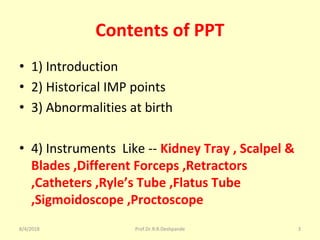
Contents of PPT
• 1) Introduction
• 2) Historical IMP points
• 3) Abnormalities at birth
• 4) Instruments Like -- Kidney Tray , Scalpel &
Blades ,Different Forceps ,Retractors
,Catheters ,Ryle’s Tube ,Flatus Tube
,Sigmoidoscope ,Proctoscope
8/4/2018 Prof.Dr.R.R.Deshpande 3
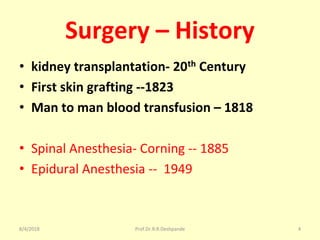
Surgery – History
• kidney transplantation- 20th Century
• First skin grafting --1823
• Man to man blood transfusion – 1818
• Spinal Anesthesia- Corning -- 1885
• Epidural Anesthesia -- 1949
8/4/2018 4Prof.Dr.R.R.Deshpande
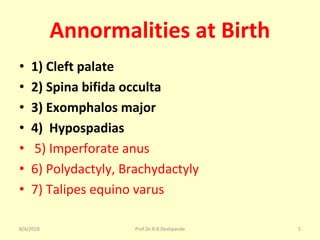
Annormalities at Birth
• 1) Cleft palate
• 2) Spina bifida occulta
• 3) Exomphalos major
• 4) Hypospadias
• 5) Imperforate anus
• 6) Polydactyly, Brachydactyly
• 7) Talipes equino varus
8/4/2018 5Prof.Dr.R.R.Deshpande
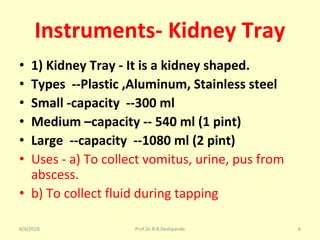
Instruments- Kidney Tray
• 1) Kidney Tray - It is a kidney shaped.
• Types --Plastic ,Aluminum, Stainless steel
• Small -capacity --300 ml
• Medium –capacity -- 540 ml (1 pint)
• Large --capacity --1080 ml (2 pint)
• Uses - a) To collect vomitus, urine, pus from
abscess.
• b) To collect fluid during tapping
8/4/2018 6Prof.Dr.R.R.Deshpande
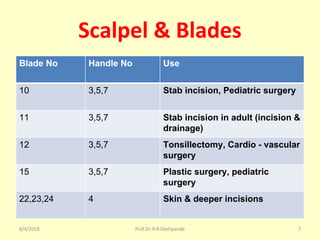
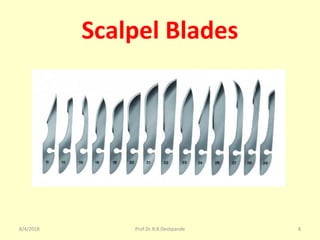
Scalpel & Blades
Blade No Handle No Use
10 3,5,7 Stab incision, Pediatric surgery
11 3,5,7 Stab incision in adult (incision &
drainage)
12 3,5,7 Tonsillectomy, Cardio - vascular
surgery
15 3,5,7 Plastic surgery, pediatric
surgery
22,23,24 4 Skin & deeper incisions
8/4/2018 7Prof.Dr.R.R.Deshpande
Scalpel Blades
8/4/2018 8Prof.Dr.R.R.Deshpande
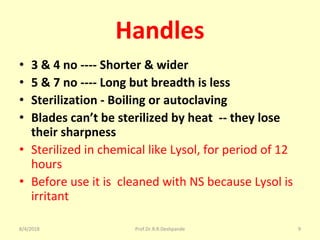
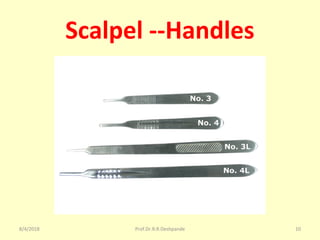
Handles
• 3 & 4 no ---- Shorter & wider
• 5 & 7 no ---- Long but breadth is less
• Sterilization - Boiling or autoclaving
• Blades can’t be sterilized by heat -- they lose
their sharpness
• Sterilized in chemical like Lysol, for period of 12
hours
• Before use it is cleaned with NS because Lysol is
irritant
8/4/2018 9Prof.Dr.R.R.Deshpande
Scalpel --Handles
8/4/2018 10Prof.Dr.R.R.Deshpande
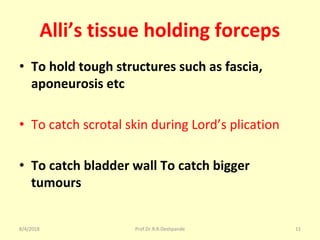
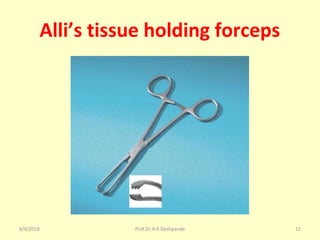
Alli’s tissue holding forceps
• To hold tough structures such as fascia,
aponeurosis etc
• To catch scrotal skin during Lord’s plication
• To catch bladder wall To catch bigger
tumours
8/4/2018 11Prof.Dr.R.R.Deshpande
Alli’s tissue holding forceps
8/4/2018 12Prof.Dr.R.R.Deshpande
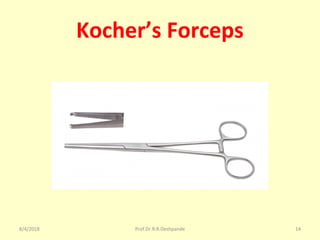
Kocher’s Forceps
• To secure haemostasis in scalp, palm & sole
• To catch bleeders to crush muscles
• To hold pedicles of piles
8/4/2018 13Prof.Dr.R.R.Deshpande
Kocher’s Forceps
8/4/2018 14Prof.Dr.R.R.Deshpande
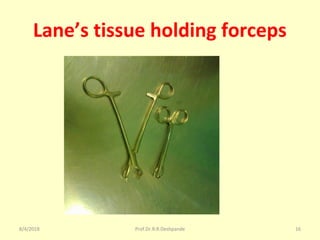
Lane’s tissue holding forceps
• To hold bulk of tissue
• To hold spermatic cord
• To catch lymph node, lipoma, cyst etc
• To catch glandular structure
8/4/2018 15Prof.Dr.R.R.Deshpande
Lane’s tissue holding forceps
8/4/2018 16Prof.Dr.R.R.Deshpande
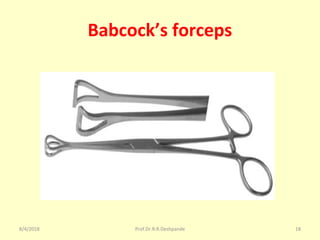
Babcock’s forceps
• To hold appendix to hold stomach or
intestine
• To hold tubular structure like ureter, fallopian
tube & vas deferens
8/4/2018 17Prof.Dr.R.R.Deshpande
Babcock’s forceps
8/4/2018 18Prof.Dr.R.R.Deshpande
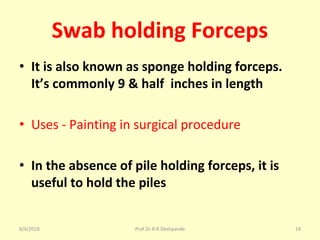
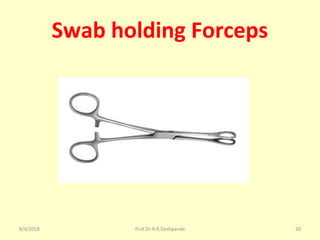
Swab holding Forceps
• It is also known as sponge holding forceps.
It’s commonly 9 & half inches in length
• Uses - Painting in surgical procedure
• In the absence of pile holding forceps, it is
useful to hold the piles
8/4/2018 19Prof.Dr.R.R.Deshpande
Swab holding Forceps
8/4/2018 20Prof.Dr.R.R.Deshpande
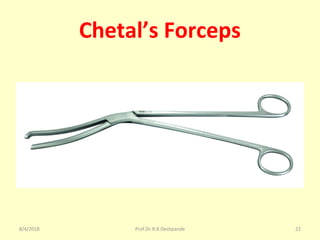
Chetal’s Forceps
• Called as Sister Forceps because it is
routinely handled by the sister’s
• Sterilized in autoclaving or savlon
• kept in a Savlon filled infusion bottle
• Useful to hold cotton, gauze & any other
instrument which is useful for the surgical
procedure
8/4/2018 21Prof.Dr.R.R.Deshpande
Chetal’s Forceps
8/4/2018 22Prof.Dr.R.R.Deshpande
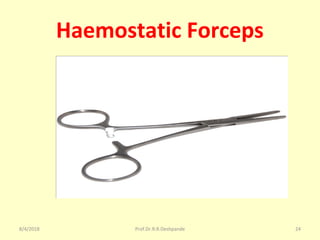
Haemostatic Forceps
• To catch the bleeder point
• In absence of sinus forceps to open the
abscess cavity by Hilton’s method
• To crush the base of appendix before excision
• To catch the peritoneal margin during
abdominal surgery
8/4/2018 23Prof.Dr.R.R.Deshpande
Haemostatic Forceps
8/4/2018 24Prof.Dr.R.R.Deshpande
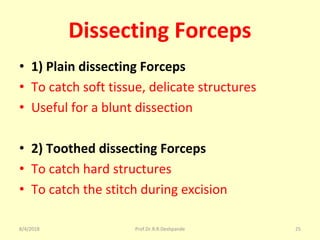
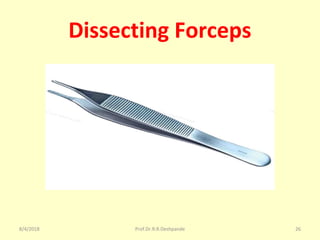
Dissecting Forceps
• 1) Plain dissecting Forceps
• To catch soft tissue, delicate structures
• Useful for a blunt dissection
• 2) Toothed dissecting Forceps
• To catch hard structures
• To catch the stitch during excision
8/4/2018 25Prof.Dr.R.R.Deshpande
Dissecting Forceps
8/4/2018 26Prof.Dr.R.R.Deshpande
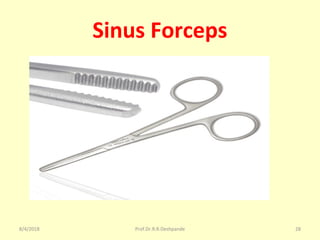
Sinus Forceps
• Similar to the artery or Haemostatic forceps
• Useful for drain the abscess cavity by Hilton’s
method
• In incision & drainage to break the loculi
8/4/2018 27Prof.Dr.R.R.Deshpande
Sinus Forceps
8/4/2018 28Prof.Dr.R.R.Deshpande
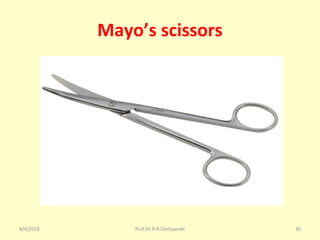
Mayo’s scissors
• Known as dissecting scissors
• Used to cut the tough tissue hence it is also
called tissue scissor
• Used to excise the skin in circumcision,
episiotomy & skin graft
8/4/2018 29Prof.Dr.R.R.Deshpande
Mayo’s scissors
8/4/2018 30Prof.Dr.R.R.Deshpande
Retractors
• L retractors
• Single blade retractor
• Useful during operation to exposure the
operation part
• C retractors
• 2 blades on both sides
• Useful during operation to expose the
operative part
8/4/2018 31Prof.Dr.R.R.Deshpande
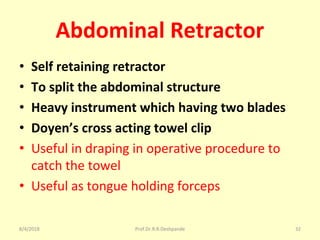
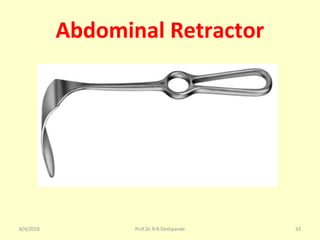
Abdominal Retractor
• Self retaining retractor
• To split the abdominal structure
• Heavy instrument which having two blades
• Doyen’s cross acting towel clip
• Useful in draping in operative procedure to
catch the towel
• Useful as tongue holding forceps
8/4/2018 32Prof.Dr.R.R.Deshpande
Abdominal Retractor
8/4/2018 33Prof.Dr.R.R.Deshpande
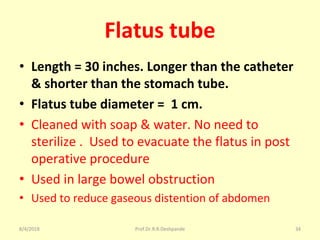
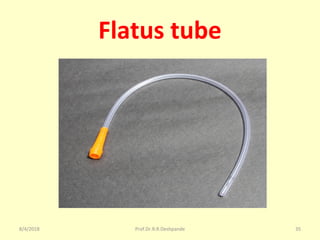
Flatus tube
• Length = 30 inches. Longer than the catheter
& shorter than the stomach tube.
• Flatus tube diameter = 1 cm.
• Cleaned with soap & water. No need to
sterilize . Used to evacuate the flatus in post
operative procedure
• Used in large bowel obstruction
• Used to reduce gaseous distention of abdomen
8/4/2018 34Prof.Dr.R.R.Deshpande
Flatus tube
8/4/2018 35Prof.Dr.R.R.Deshpande
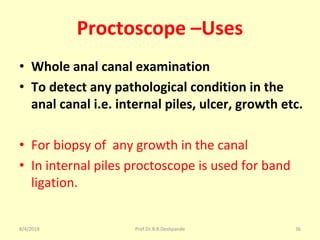
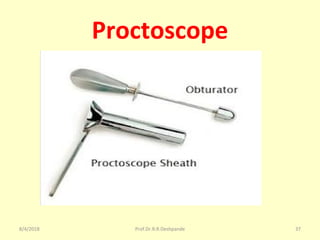
Proctoscope –Uses
• Whole anal canal examination
• To detect any pathological condition in the
anal canal i.e. internal piles, ulcer, growth etc.
• For biopsy of any growth in the canal
• In internal piles proctoscope is used for band
ligation.
8/4/2018 36Prof.Dr.R.R.Deshpande
Proctoscope
8/4/2018 37Prof.Dr.R.R.Deshpande
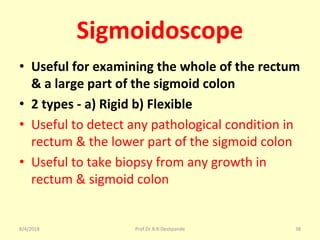
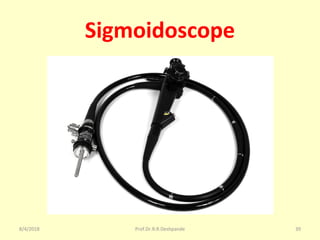
Sigmoidoscope
• Useful for examining the whole of the rectum
& a large part of the sigmoid colon
• 2 types - a) Rigid b) Flexible
• Useful to detect any pathological condition in
rectum & the lower part of the sigmoid colon
• Useful to take biopsy from any growth in
rectum & sigmoid colon
8/4/2018 38Prof.Dr.R.R.Deshpande
Sigmoidoscope
8/4/2018 39Prof.Dr.R.R.Deshpande
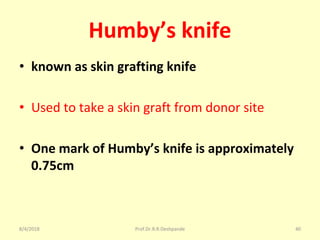
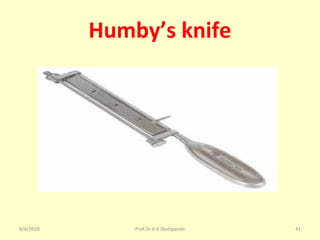
Humby’s knife
• known as skin grafting knife
• Used to take a skin graft from donor site
• One mark of Humby’s knife is approximately
0.75cm
8/4/2018 40Prof.Dr.R.R.Deshpande
Humby’s knife
8/4/2018 41Prof.Dr.R.R.Deshpande
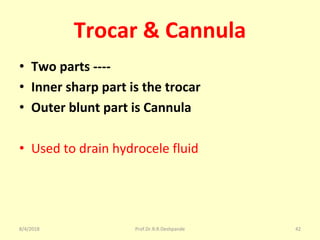
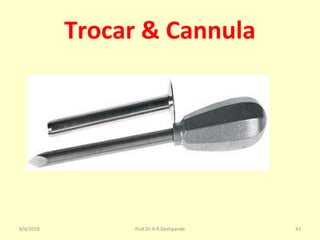
Trocar & Cannula
• Two parts ----
• Inner sharp part is the trocar
• Outer blunt part is Cannula
• Used to drain hydrocele fluid
8/4/2018 42Prof.Dr.R.R.Deshpande
Trocar & Cannula
8/4/2018 43Prof.Dr.R.R.Deshpande
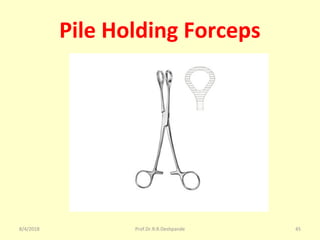
Pile Holding Forceps
• Similar to the sponge holding
forceps
• Provide good grip to catch the pile
during haemorrhoidectomy
operation.
8/4/2018 44Prof.Dr.R.R.Deshpande
Pile Holding Forceps
8/4/2018 45Prof.Dr.R.R.Deshpande
Catheters –Types
• Catheter is a hallow tube usually flexible with
openings at both ends
• Types 1) According to Mode of Working
• A) Simple (Non-Retaining) eg. Red Rubber
• B) Self Retaining eg. Foley’s
• 2) According to use
• A) Nasal Catheter B) Endo - tracheal.
• C) Supra - pubic D) Urethral.
8/4/2018 46Prof.Dr.R.R.Deshpande
Catheters –Types
• 3) According to Material
• A) Plastic
• B) Rubber
• C) Silicone
• D) Elastic
• E) Metal (Not in working now a days)
8/4/2018 47Prof.Dr.R.R.Deshpande
Supra Pubic Catheters
• A) Ordinary Catheter - a) Simple Rubber
Catheter
• b) Condom Catheter
• c) K - 90
• B) Self Retaining Catheter - a) Foley’s
Catheter
• b) Malecot’s Catheter
• C) Metallic Catheter
8/4/2018 48Prof.Dr.R.R.Deshpande
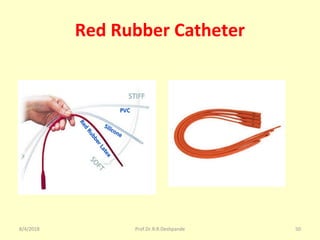
Red Rubber Catheter
• It is made up of Red Rubber (Indian Rubber)
& radio opaque (X-rays don’t pass) due to
Lead oxide contain
• This catheter is available in 3-12 size
• No-8 & No-10 are most frequently used
• Average length = 37.5 cm
8/4/2018 49Prof.Dr.R.R.Deshpande
Red Rubber Catheter
8/4/2018 50Prof.Dr.R.R.Deshpande
Red Rubber Catheter
• Advantages –
• 1) More Flexible 2) Cheap
• 3) Easily available
• Disadvantages –
• 1) Repeated sterilization makes it hard.
• 2) Can’t pass through stricture.
• 3) Irritant 4) Infection 5) Catheter fever
8/4/2018 51Prof.Dr.R.R.Deshpande
Red Rubber Catheter
• Indications
• A) Diagnostic
• 1) To collect uncontaminated urine.
• 2) To measure residual urine.
• 3) To difference between retention of urine
from suppression.
• 4) Before pelvic examination in female to
empty the bladder
8/4/2018 52Prof.Dr.R.R.Deshpande
Red Rubber Catheter
• B) Therapeutics
• 1) Irrigation of bladder
• 2) In acute condition of retention of urine in
post operative condition
8/4/2018 53Prof.Dr.R.R.Deshpande
Red Rubber Catheter
• C) Others
• 1) Tourniquet for finger, varicose vein of lower
limb.
• 2) As a suction tube 3) As a flatus tube.
• 4) As a O2 tube 5) As a rectal catheter for
enema.
• 6) Tension suture in case of burst abdomen.
8/4/2018 54Prof.Dr.R.R.Deshpande
Self-Retaining Catheter
• 1) Ballooned Catheter
• A) Foley’s catheter - 2 way or 3 way.
• B) Hematuria Foley’s catheter - used in
Hematuria
• 2) Non- Ballooned Catheter –
• eg. - Malecot’s catheter
8/4/2018 55Prof.Dr.R.R.Deshpande
Foley’s Catheter
• Purpose of balloon - Self retaining &
haemostatic.
• Advantages –
• 1) It is soft & less irritant.
• 2) It can be used for prolonged period.
• Disadvantages –
• Sometime softness causes collapse of catheter
8/4/2018 56Prof.Dr.R.R.Deshpande
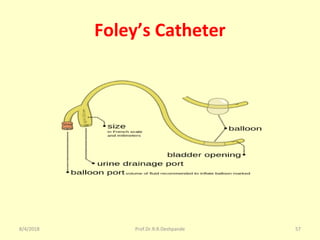
Foley’s Catheter
8/4/2018 57Prof.Dr.R.R.Deshpande
Foley’s Catheter -Indications
• 1) Same as simple rubber catheter.
• 2) To empty bladder in acute or chronic
condition & to maintain for prolonged period.
• 3) In pre-operative period to prevent post
operative retention like in Hysterectomy
• 4) In patient of burn management to calculate
urine output.
8/4/2018 58Prof.Dr.R.R.Deshpande
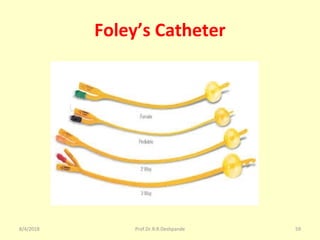
Foley’s Catheter
8/4/2018 59Prof.Dr.R.R.Deshpande
Foley’s Catheter -Indications
• 5) Urinary incontinence
• 6) For draining purpose
• 7) Haemostatic after prostatectomy
• 8) Irrigation of bladder
• 9) Treatment of partially ruptured urethra
8/4/2018 60Prof.Dr.R.R.Deshpande
Selection of size of Catheter
• 1) Clear urine drainage - 12 - 14 F
• 2) Cloudy urine drainage - 16 - 18 F
• 3) Clots & debris containing urine - 18 -
22 F
8/4/2018 61Prof.Dr.R.R.Deshpande
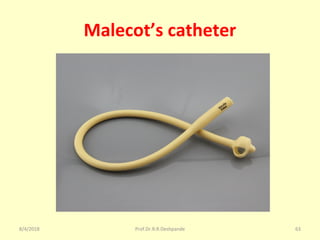
Malecot’s catheter
• Non ballooned, self retaining catheter made
up of Red Rubber
• It’s tip has 4 flanks (Filaments)
• Two are long & two are short remain bulged &
provide self retaining device.
8/4/2018 62Prof.Dr.R.R.Deshpande
Malecot’s catheter
8/4/2018 63Prof.Dr.R.R.Deshpande
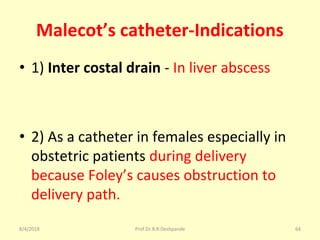
Malecot’s catheter-Indications
• 1) Inter costal drain - In liver abscess
• 2) As a catheter in females especially in
obstetric patients during delivery
because Foley’s causes obstruction to
delivery path.
8/4/2018 64Prof.Dr.R.R.Deshpande
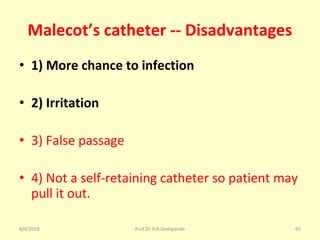
Malecot’s catheter -- Disadvantages
• 1) More chance to infection
• 2) Irritation
• 3) False passage
• 4) Not a self-retaining catheter so patient may
pull it out.
8/4/2018 65Prof.Dr.R.R.Deshpande
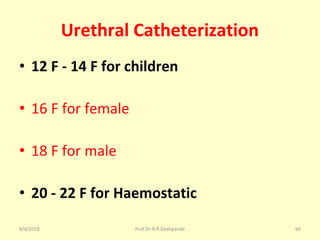
Urethral Catheterization
• 12 F - 14 F for children
• 16 F for female
• 18 F for male
• 20 - 22 F for Haemostatic
8/4/2018 66Prof.Dr.R.R.Deshpande
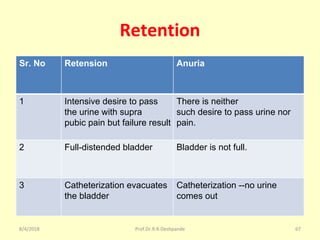
Retention
Sr. No Retension Anuria
1 Intensive desire to pass
the urine with supra
pubic pain but failure result
There is neither
such desire to pass urine nor
pain.
2 Full-distended bladder Bladder is not full.
3 Catheterization evacuates
the bladder
Catheterization --no urine
comes out
8/4/2018 67Prof.Dr.R.R.Deshpande
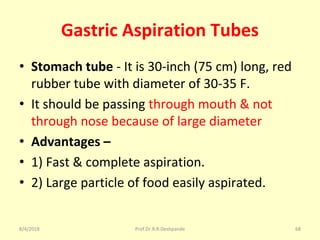
Gastric Aspiration Tubes
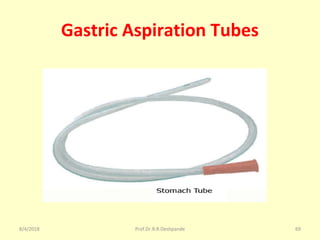
• Stomach tube - It is 30-inch (75 cm) long, red
rubber tube with diameter of 30-35 F.
• It should be passing through mouth & not
through nose because of large diameter
• Advantages –
• 1) Fast & complete aspiration.
• 2) Large particle of food easily aspirated.
8/4/2018 68Prof.Dr.R.R.Deshpande
Gastric Aspiration Tubes
8/4/2018 69Prof.Dr.R.R.Deshpande
Gastric Aspiration Tubes
• Indications -- 1) Stomach wash in poisoning
(OPP) 2) Alcohol poisoning.3) Food poisoning.
4) Antiseptic wash.
• Contra Indications -1) Acute corrosive poisons
(H2SO4) 2) Esophageal varices. 3) CVS
problem 4) RS problem
• Universal Antidote of poison - 1) Charcoal 2
parts +2) Chalks 1 part + 3) Coffee 1 part.
8/4/2018 70Prof.Dr.R.R.Deshpande
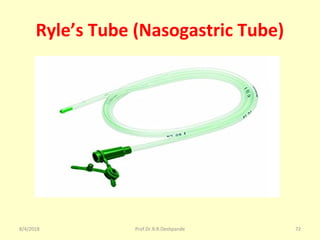
Ryle’s Tube (Nasogastric Tube)
• Old Ryle’s tube was a Red Rubber tube. New
Ryle’s tubes are made up of polyvinyl chloride
(PVC)
• Size from 10 - 20 F
• Length - 110 cm to 120 cm . Old Ryle’s Tube =
75 cm
• Tip - It is blunt to avoid trauma & having 3
metal beads
8/4/2018 71Prof.Dr.R.R.Deshpande
Ryle’s Tube (Nasogastric Tube)
8/4/2018 72Prof.Dr.R.R.Deshpande
Ryle’s Tube (Nasogastric Tube)
• Metal is radio-opaque so that X -Ray can find
them. It facilitates swallowing due to their
weight
• Sterilization - Ethylene oxide Gas or Gamma
Rays Irradiation.
• Boil - Ideally RT should be cleaned with water
it is not necessary to sterilize it.
8/4/2018 73Prof.Dr.R.R.Deshpande
Ryle’s Tube (Nasogastric Tube)
• Body - T here are 4 markings.
• 1 st 40 cm from tip to mark cardio-
oesophageal junction.
• 2nd 50 cm from tip shows tip in stomach.
• 3rd 57 cm from tip shows at pylorus.
• 4th 65 cm from up show tip in duodenum.
• Base - Provide with one cork or cap, size of its
lumen is just adopting the nozzle of syringe.
8/4/2018 74Prof.Dr.R.R.Deshpande
Ryle’s Tube-Indications
• 1) Stomach aspiration for gastric content like acid
peptic diseases, gastric juice analysis, acute dilation
of stomach, post operative vomiting.
• 2) Feeding in comatose patient.
• 3) If RT aspiration with bloodstain it indicates injury
to stomach.
• 4) In alcohol poison condition.
• 5) Pseudo pancreatic cyst (Baid’s sign)
8/4/2018 75Prof.Dr.R.R.Deshpande
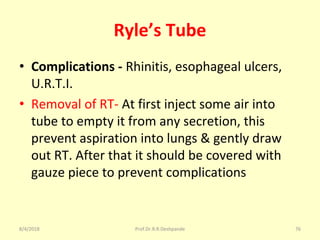
Ryle’s Tube
• Complications - Rhinitis, esophageal ulcers,
U.R.T.I.
• Removal of RT- At first inject some air into
tube to empty it from any secretion, this
prevent aspiration into lungs & gently draw
out RT. After that it should be covered with
gauze piece to prevent complications
8/4/2018 76Prof.Dr.R.R.Deshpande
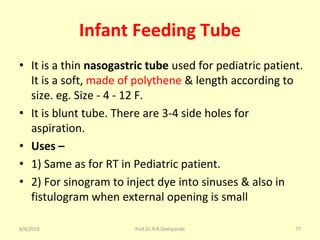
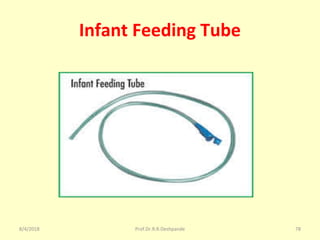
Infant Feeding Tube
• It is a thin nasogastric tube used for pediatric patient.
It is a soft, made of polythene & length according to
size. eg. Size - 4 - 12 F.
• It is blunt tube. There are 3-4 side holes for
aspiration.
• Uses –
• 1) Same as for RT in Pediatric patient.
• 2) For sinogram to inject dye into sinuses & also in
fistulogram when external opening is small
8/4/2018 77Prof.Dr.R.R.Deshpande
Infant Feeding Tube
8/4/2018 78Prof.Dr.R.R.Deshpande
Prof.Dr.R.R.Deshpande
• Sharing of Knowledge
• FOR
• Propagating Ayurved
8/4/2018 79Prof.Dr.R.R.Deshpande

Shalya part 1 A

  • 1.
    Shalya Tantra(Surgery) –Part1- A • Presented By – • Prof.Dr.R.R.Deshpande (M.D in Ayurvdic Medicine & M.D. in Ayurvedic Physiology) • www.ayurvedicfriend.com • Mobile – 922 68 10 630 • professordeshpande@gmail.com 8/4/2018 Prof.Dr.R.R.Deshpande 1
  • 2.
    Shalya – Introduction •Surgery -- French term Chirurgien • Cheir = hand & ergon = Work • Surgery = hand-work. • Modern surgery origin -- Greece • Anesthesia -- Robert Lister & Sequire in 1846 • Penicillin - Alexander Flemming - 1928 8/4/2018 2Prof.Dr.R.R.Deshpande
  • 3.
    Contents of PPT •1) Introduction • 2) Historical IMP points • 3) Abnormalities at birth • 4) Instruments Like -- Kidney Tray , Scalpel & Blades ,Different Forceps ,Retractors ,Catheters ,Ryle’s Tube ,Flatus Tube ,Sigmoidoscope ,Proctoscope 8/4/2018 Prof.Dr.R.R.Deshpande 3
  • 4.
    Surgery – History •kidney transplantation- 20th Century • First skin grafting --1823 • Man to man blood transfusion – 1818 • Spinal Anesthesia- Corning -- 1885 • Epidural Anesthesia -- 1949 8/4/2018 4Prof.Dr.R.R.Deshpande
  • 5.
    Annormalities at Birth •1) Cleft palate • 2) Spina bifida occulta • 3) Exomphalos major • 4) Hypospadias • 5) Imperforate anus • 6) Polydactyly, Brachydactyly • 7) Talipes equino varus 8/4/2018 5Prof.Dr.R.R.Deshpande
  • 6.
    Instruments- Kidney Tray •1) Kidney Tray - It is a kidney shaped. • Types --Plastic ,Aluminum, Stainless steel • Small -capacity --300 ml • Medium –capacity -- 540 ml (1 pint) • Large --capacity --1080 ml (2 pint) • Uses - a) To collect vomitus, urine, pus from abscess. • b) To collect fluid during tapping 8/4/2018 6Prof.Dr.R.R.Deshpande
  • 7.
    Scalpel & Blades BladeNo Handle No Use 10 3,5,7 Stab incision, Pediatric surgery 11 3,5,7 Stab incision in adult (incision & drainage) 12 3,5,7 Tonsillectomy, Cardio - vascular surgery 15 3,5,7 Plastic surgery, pediatric surgery 22,23,24 4 Skin & deeper incisions 8/4/2018 7Prof.Dr.R.R.Deshpande
  • 8.
  • 9.
    Handles • 3 &4 no ---- Shorter & wider • 5 & 7 no ---- Long but breadth is less • Sterilization - Boiling or autoclaving • Blades can’t be sterilized by heat -- they lose their sharpness • Sterilized in chemical like Lysol, for period of 12 hours • Before use it is cleaned with NS because Lysol is irritant 8/4/2018 9Prof.Dr.R.R.Deshpande
  • 10.
  • 11.
    Alli’s tissue holdingforceps • To hold tough structures such as fascia, aponeurosis etc • To catch scrotal skin during Lord’s plication • To catch bladder wall To catch bigger tumours 8/4/2018 11Prof.Dr.R.R.Deshpande
  • 12.
    Alli’s tissue holdingforceps 8/4/2018 12Prof.Dr.R.R.Deshpande
  • 13.
    Kocher’s Forceps • Tosecure haemostasis in scalp, palm & sole • To catch bleeders to crush muscles • To hold pedicles of piles 8/4/2018 13Prof.Dr.R.R.Deshpande
  • 14.
  • 15.
    Lane’s tissue holdingforceps • To hold bulk of tissue • To hold spermatic cord • To catch lymph node, lipoma, cyst etc • To catch glandular structure 8/4/2018 15Prof.Dr.R.R.Deshpande
  • 16.
    Lane’s tissue holdingforceps 8/4/2018 16Prof.Dr.R.R.Deshpande
  • 17.
    Babcock’s forceps • Tohold appendix to hold stomach or intestine • To hold tubular structure like ureter, fallopian tube & vas deferens 8/4/2018 17Prof.Dr.R.R.Deshpande
  • 18.
  • 19.
    Swab holding Forceps •It is also known as sponge holding forceps. It’s commonly 9 & half inches in length • Uses - Painting in surgical procedure • In the absence of pile holding forceps, it is useful to hold the piles 8/4/2018 19Prof.Dr.R.R.Deshpande
  • 20.
    Swab holding Forceps 8/4/201820Prof.Dr.R.R.Deshpande
  • 21.
    Chetal’s Forceps • Calledas Sister Forceps because it is routinely handled by the sister’s • Sterilized in autoclaving or savlon • kept in a Savlon filled infusion bottle • Useful to hold cotton, gauze & any other instrument which is useful for the surgical procedure 8/4/2018 21Prof.Dr.R.R.Deshpande
  • 22.
  • 23.
    Haemostatic Forceps • Tocatch the bleeder point • In absence of sinus forceps to open the abscess cavity by Hilton’s method • To crush the base of appendix before excision • To catch the peritoneal margin during abdominal surgery 8/4/2018 23Prof.Dr.R.R.Deshpande
  • 24.
  • 25.
    Dissecting Forceps • 1)Plain dissecting Forceps • To catch soft tissue, delicate structures • Useful for a blunt dissection • 2) Toothed dissecting Forceps • To catch hard structures • To catch the stitch during excision 8/4/2018 25Prof.Dr.R.R.Deshpande
  • 26.
  • 27.
    Sinus Forceps • Similarto the artery or Haemostatic forceps • Useful for drain the abscess cavity by Hilton’s method • In incision & drainage to break the loculi 8/4/2018 27Prof.Dr.R.R.Deshpande
  • 28.
  • 29.
    Mayo’s scissors • Knownas dissecting scissors • Used to cut the tough tissue hence it is also called tissue scissor • Used to excise the skin in circumcision, episiotomy & skin graft 8/4/2018 29Prof.Dr.R.R.Deshpande
  • 30.
  • 31.
    Retractors • L retractors •Single blade retractor • Useful during operation to exposure the operation part • C retractors • 2 blades on both sides • Useful during operation to expose the operative part 8/4/2018 31Prof.Dr.R.R.Deshpande
  • 32.
    Abdominal Retractor • Selfretaining retractor • To split the abdominal structure • Heavy instrument which having two blades • Doyen’s cross acting towel clip • Useful in draping in operative procedure to catch the towel • Useful as tongue holding forceps 8/4/2018 32Prof.Dr.R.R.Deshpande
  • 33.
  • 34.
    Flatus tube • Length= 30 inches. Longer than the catheter & shorter than the stomach tube. • Flatus tube diameter = 1 cm. • Cleaned with soap & water. No need to sterilize . Used to evacuate the flatus in post operative procedure • Used in large bowel obstruction • Used to reduce gaseous distention of abdomen 8/4/2018 34Prof.Dr.R.R.Deshpande
  • 35.
  • 36.
    Proctoscope –Uses • Wholeanal canal examination • To detect any pathological condition in the anal canal i.e. internal piles, ulcer, growth etc. • For biopsy of any growth in the canal • In internal piles proctoscope is used for band ligation. 8/4/2018 36Prof.Dr.R.R.Deshpande
  • 37.
  • 38.
    Sigmoidoscope • Useful forexamining the whole of the rectum & a large part of the sigmoid colon • 2 types - a) Rigid b) Flexible • Useful to detect any pathological condition in rectum & the lower part of the sigmoid colon • Useful to take biopsy from any growth in rectum & sigmoid colon 8/4/2018 38Prof.Dr.R.R.Deshpande
  • 39.
  • 40.
    Humby’s knife • knownas skin grafting knife • Used to take a skin graft from donor site • One mark of Humby’s knife is approximately 0.75cm 8/4/2018 40Prof.Dr.R.R.Deshpande
  • 41.
  • 42.
    Trocar & Cannula •Two parts ---- • Inner sharp part is the trocar • Outer blunt part is Cannula • Used to drain hydrocele fluid 8/4/2018 42Prof.Dr.R.R.Deshpande
  • 43.
    Trocar & Cannula 8/4/201843Prof.Dr.R.R.Deshpande
  • 44.
    Pile Holding Forceps •Similar to the sponge holding forceps • Provide good grip to catch the pile during haemorrhoidectomy operation. 8/4/2018 44Prof.Dr.R.R.Deshpande
  • 45.
    Pile Holding Forceps 8/4/201845Prof.Dr.R.R.Deshpande
  • 46.
    Catheters –Types • Catheteris a hallow tube usually flexible with openings at both ends • Types 1) According to Mode of Working • A) Simple (Non-Retaining) eg. Red Rubber • B) Self Retaining eg. Foley’s • 2) According to use • A) Nasal Catheter B) Endo - tracheal. • C) Supra - pubic D) Urethral. 8/4/2018 46Prof.Dr.R.R.Deshpande
  • 47.
    Catheters –Types • 3)According to Material • A) Plastic • B) Rubber • C) Silicone • D) Elastic • E) Metal (Not in working now a days) 8/4/2018 47Prof.Dr.R.R.Deshpande
  • 48.
    Supra Pubic Catheters •A) Ordinary Catheter - a) Simple Rubber Catheter • b) Condom Catheter • c) K - 90 • B) Self Retaining Catheter - a) Foley’s Catheter • b) Malecot’s Catheter • C) Metallic Catheter 8/4/2018 48Prof.Dr.R.R.Deshpande
  • 49.
    Red Rubber Catheter •It is made up of Red Rubber (Indian Rubber) & radio opaque (X-rays don’t pass) due to Lead oxide contain • This catheter is available in 3-12 size • No-8 & No-10 are most frequently used • Average length = 37.5 cm 8/4/2018 49Prof.Dr.R.R.Deshpande
  • 50.
    Red Rubber Catheter 8/4/201850Prof.Dr.R.R.Deshpande
  • 51.
    Red Rubber Catheter •Advantages – • 1) More Flexible 2) Cheap • 3) Easily available • Disadvantages – • 1) Repeated sterilization makes it hard. • 2) Can’t pass through stricture. • 3) Irritant 4) Infection 5) Catheter fever 8/4/2018 51Prof.Dr.R.R.Deshpande
  • 52.
    Red Rubber Catheter •Indications • A) Diagnostic • 1) To collect uncontaminated urine. • 2) To measure residual urine. • 3) To difference between retention of urine from suppression. • 4) Before pelvic examination in female to empty the bladder 8/4/2018 52Prof.Dr.R.R.Deshpande
  • 53.
    Red Rubber Catheter •B) Therapeutics • 1) Irrigation of bladder • 2) In acute condition of retention of urine in post operative condition 8/4/2018 53Prof.Dr.R.R.Deshpande
  • 54.
    Red Rubber Catheter •C) Others • 1) Tourniquet for finger, varicose vein of lower limb. • 2) As a suction tube 3) As a flatus tube. • 4) As a O2 tube 5) As a rectal catheter for enema. • 6) Tension suture in case of burst abdomen. 8/4/2018 54Prof.Dr.R.R.Deshpande
  • 55.
    Self-Retaining Catheter • 1)Ballooned Catheter • A) Foley’s catheter - 2 way or 3 way. • B) Hematuria Foley’s catheter - used in Hematuria • 2) Non- Ballooned Catheter – • eg. - Malecot’s catheter 8/4/2018 55Prof.Dr.R.R.Deshpande
  • 56.
    Foley’s Catheter • Purposeof balloon - Self retaining & haemostatic. • Advantages – • 1) It is soft & less irritant. • 2) It can be used for prolonged period. • Disadvantages – • Sometime softness causes collapse of catheter 8/4/2018 56Prof.Dr.R.R.Deshpande
  • 57.
  • 58.
    Foley’s Catheter -Indications •1) Same as simple rubber catheter. • 2) To empty bladder in acute or chronic condition & to maintain for prolonged period. • 3) In pre-operative period to prevent post operative retention like in Hysterectomy • 4) In patient of burn management to calculate urine output. 8/4/2018 58Prof.Dr.R.R.Deshpande
  • 59.
  • 60.
    Foley’s Catheter -Indications •5) Urinary incontinence • 6) For draining purpose • 7) Haemostatic after prostatectomy • 8) Irrigation of bladder • 9) Treatment of partially ruptured urethra 8/4/2018 60Prof.Dr.R.R.Deshpande
  • 61.
    Selection of sizeof Catheter • 1) Clear urine drainage - 12 - 14 F • 2) Cloudy urine drainage - 16 - 18 F • 3) Clots & debris containing urine - 18 - 22 F 8/4/2018 61Prof.Dr.R.R.Deshpande
  • 62.
    Malecot’s catheter • Nonballooned, self retaining catheter made up of Red Rubber • It’s tip has 4 flanks (Filaments) • Two are long & two are short remain bulged & provide self retaining device. 8/4/2018 62Prof.Dr.R.R.Deshpande
  • 63.
  • 64.
    Malecot’s catheter-Indications • 1)Inter costal drain - In liver abscess • 2) As a catheter in females especially in obstetric patients during delivery because Foley’s causes obstruction to delivery path. 8/4/2018 64Prof.Dr.R.R.Deshpande
  • 65.
    Malecot’s catheter --Disadvantages • 1) More chance to infection • 2) Irritation • 3) False passage • 4) Not a self-retaining catheter so patient may pull it out. 8/4/2018 65Prof.Dr.R.R.Deshpande
  • 66.
    Urethral Catheterization • 12F - 14 F for children • 16 F for female • 18 F for male • 20 - 22 F for Haemostatic 8/4/2018 66Prof.Dr.R.R.Deshpande
  • 67.
    Retention Sr. No RetensionAnuria 1 Intensive desire to pass the urine with supra pubic pain but failure result There is neither such desire to pass urine nor pain. 2 Full-distended bladder Bladder is not full. 3 Catheterization evacuates the bladder Catheterization --no urine comes out 8/4/2018 67Prof.Dr.R.R.Deshpande
  • 68.
    Gastric Aspiration Tubes •Stomach tube - It is 30-inch (75 cm) long, red rubber tube with diameter of 30-35 F. • It should be passing through mouth & not through nose because of large diameter • Advantages – • 1) Fast & complete aspiration. • 2) Large particle of food easily aspirated. 8/4/2018 68Prof.Dr.R.R.Deshpande
  • 69.
    Gastric Aspiration Tubes 8/4/201869Prof.Dr.R.R.Deshpande
  • 70.
    Gastric Aspiration Tubes •Indications -- 1) Stomach wash in poisoning (OPP) 2) Alcohol poisoning.3) Food poisoning. 4) Antiseptic wash. • Contra Indications -1) Acute corrosive poisons (H2SO4) 2) Esophageal varices. 3) CVS problem 4) RS problem • Universal Antidote of poison - 1) Charcoal 2 parts +2) Chalks 1 part + 3) Coffee 1 part. 8/4/2018 70Prof.Dr.R.R.Deshpande
  • 71.
    Ryle’s Tube (NasogastricTube) • Old Ryle’s tube was a Red Rubber tube. New Ryle’s tubes are made up of polyvinyl chloride (PVC) • Size from 10 - 20 F • Length - 110 cm to 120 cm . Old Ryle’s Tube = 75 cm • Tip - It is blunt to avoid trauma & having 3 metal beads 8/4/2018 71Prof.Dr.R.R.Deshpande
  • 72.
    Ryle’s Tube (NasogastricTube) 8/4/2018 72Prof.Dr.R.R.Deshpande
  • 73.
    Ryle’s Tube (NasogastricTube) • Metal is radio-opaque so that X -Ray can find them. It facilitates swallowing due to their weight • Sterilization - Ethylene oxide Gas or Gamma Rays Irradiation. • Boil - Ideally RT should be cleaned with water it is not necessary to sterilize it. 8/4/2018 73Prof.Dr.R.R.Deshpande
  • 74.
    Ryle’s Tube (NasogastricTube) • Body - T here are 4 markings. • 1 st 40 cm from tip to mark cardio- oesophageal junction. • 2nd 50 cm from tip shows tip in stomach. • 3rd 57 cm from tip shows at pylorus. • 4th 65 cm from up show tip in duodenum. • Base - Provide with one cork or cap, size of its lumen is just adopting the nozzle of syringe. 8/4/2018 74Prof.Dr.R.R.Deshpande
  • 75.
    Ryle’s Tube-Indications • 1)Stomach aspiration for gastric content like acid peptic diseases, gastric juice analysis, acute dilation of stomach, post operative vomiting. • 2) Feeding in comatose patient. • 3) If RT aspiration with bloodstain it indicates injury to stomach. • 4) In alcohol poison condition. • 5) Pseudo pancreatic cyst (Baid’s sign) 8/4/2018 75Prof.Dr.R.R.Deshpande
  • 76.
    Ryle’s Tube • Complications- Rhinitis, esophageal ulcers, U.R.T.I. • Removal of RT- At first inject some air into tube to empty it from any secretion, this prevent aspiration into lungs & gently draw out RT. After that it should be covered with gauze piece to prevent complications 8/4/2018 76Prof.Dr.R.R.Deshpande
  • 77.
    Infant Feeding Tube •It is a thin nasogastric tube used for pediatric patient. It is a soft, made of polythene & length according to size. eg. Size - 4 - 12 F. • It is blunt tube. There are 3-4 side holes for aspiration. • Uses – • 1) Same as for RT in Pediatric patient. • 2) For sinogram to inject dye into sinuses & also in fistulogram when external opening is small 8/4/2018 77Prof.Dr.R.R.Deshpande
  • 78.
    Infant Feeding Tube 8/4/201878Prof.Dr.R.R.Deshpande
  • 79.
    Prof.Dr.R.R.Deshpande • Sharing ofKnowledge • FOR • Propagating Ayurved 8/4/2018 79Prof.Dr.R.R.Deshpande