Attitude which represent ones belief, feeling
and ideas ,action,tedency towards object and
ideas.
When a person feels about something ,about a
place, commodity and a situation or an idea is
called attitude.
Nature of Attitude
•Attitude are learned
•It is the feeling ,Beliefs of individual and
groups.
•These feelings and beliefs are defined ones
Predispositions towards given aspects of the
world.
•It is not permanent it changed
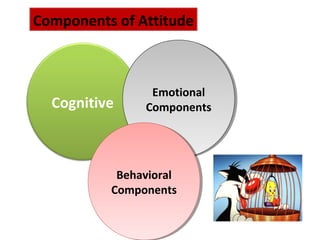
Cognitive
Emotional
Components
Emotional
Components
Behavioral
Components
Behavioral
Components
Components of Attitude
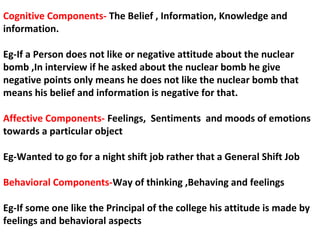
Cognitive Components- The Belief , Information, Knowledge and
information.
Eg-If a Person does not like or negative attitude about the nuclear
bomb ,In interview if he asked about the nuclear bomb he give
negative points only means he does not like the nuclear bomb that
means his belief and information is negative for that.
Affective Components- Feelings, Sentiments and moods of emotions
towards a particular object
Eg-Wanted to go for a night shift job rather that a General Shift Job
Behavioral Components-Way of thinking ,Behaving and feelings
Eg-If some one like the Principal of the college his attitude is made by
feelings and behavioral aspects
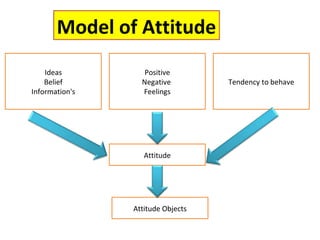
Model of Attitude
Ideas
Belief
Information's
Positive
Negative
Feelings
Tendency to behave
Attitude
Attitude Objects
Functions of attitude-
1.Attitude is a determine function-Attitude determine the meaning of what is seen in the
environment may be good or bad means favorable attitude has good meaning and
unfavorable attitudes are bad meaning.
2.Attitude is a contradictions –means some time they give two meaning words and diplomatic
opinions about the same things.
3.Attitude is a adjustment function-Attitude is provides a function to adjust in the proper
environment to adjust themselves in that environment. Treated them badly negative attitude
and treated them good a positive attitude.
4.Ego Defense Function- Employees in organization want to protect their own image and
some negative attitude for the new comers and they have ego defencsive function when may
not be changed.
5.Expressive Function-
It provides someone values and self identity of a person
A Manager is belief in ethics so his attitude shows the voice of a quality of work.
6.Attitude is a knowledge function- Maintain stable ,Organized and meaningful structure of a
person not bluff anything.
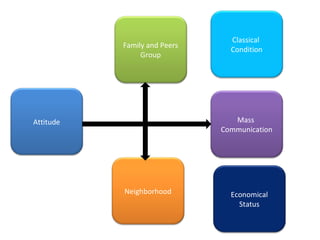
Family and Peers
Group
Neighborhood
Attitude
Classical
Condition
Economical
Status
Mass
Communication
Family and peer group-If the parents has a positive attitude or
negative attitude for a object the children's will follow the same
attitude.
Neighborhood-The Cultural Facilities,Relegious group possible ethnic
which is affect the attitude.
Economical Status-The economical status of an individual change the
attitude and belief towards the Trade Unions and Workers and
Manager is different.
Mass Communication-The Medias like TV,Radio,News Paper from
which they got the information's can changed the attitude.
Classical Conditions- When we belief that the condition of the
environment is good rather is bad but we belief that it is good.
Eg- Sale a Sachines bat with Rs.2000000000 But is has no meaning only
Sachine use it that is the condition
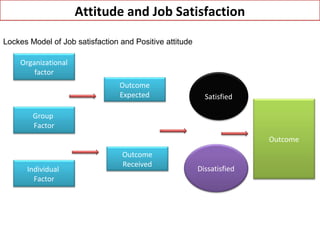
Attitude and Job Satisfaction
Lockes Model of Job satisfaction and Positive attitude
Organizational
factor
Group
Factor
Individual
Factor
Outcome
Expected
Outcome
Received
Satisfied
Dissatisfied
Outcome
Organizational Factor for Positive attitude
Employees satisfaction-Provide them right salary
right Beahaviour.
Promotion and Fringe Benefits-Provide them benefits
for particular situation ,Incentives, Allowances
Welfare-Provide them education, Good working
Condition to make a good belief.
HRD-Provide them Training and development and
Rights .
Flexible working Condition-Working culture ,Job
Profile must be good for make a positive attitude
Group factor-
•Size of the Group-Make Minimum member to avoid conflict and
maximize the positive attitude for the organization
•Supervision-The head of the group must good administrative
skills and adequate behaviour is most important.
Individual Factor-
•Self-esteem-Means treat them as partner do not as workers and
their attitude is definitely positive.
•Morale Improvement by giving them status no only Salary.
•Make them interest in job to perform and a good positive
attitude
Cause dissatisfaction and Negative
attitude-
1.No Promotion and security of job
2.Less Salary and Unfair reduction.
3.Working Condition is poor.
4.Behavioural aspects are bad .
5.No Support from Management.
6.No welfare in Organization
Which Cause a Dissatisfaction and a Negative
attitude for the Organization
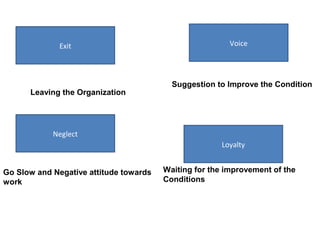
Exit
Neglect
Loyalty
Voice
Leaving the Organization
Suggestion to Improve the Condition
Waiting for the improvement of the
Conditions
Go Slow and Negative attitude towards
work
Channing attitude of self-
1.Employee has to make positive attitude (Belief, Proper
Information and Ego)
2.Think about yourself and develop your own attitude.
3.Listen others and develop the positive attitude.
4.Get in to continuous development and communication
program
5.Build a self esteem and prestige
6.Stay away from negative influences.
Changing the attitude of Employees
1.Give feedback-Employees are told about their negative attitude and
if it is harmful and manager needs to offer alternative attitude.
2.Good Working Condition to work in the culture.
3.Positive Role Model means if the Manager is the positive attitude
and the role model the workers provides the positive attitude.
4.Providing new information's means updated information and do not
ignore the information's.
5.Use of fear to change some unethical negative attitude.
6.Providing coopering some situations to change their attitude .
7.Degree of commitment on target means morale development.
Function of Positive attitude
1.Maximize the Productivity.
2.Team Work.
3.Self Management and Problem Solving.
4.Improve quality.
5.Reduce Stress.
6.Loayl to Organizations
Barriers to Changing an Attitude
Cognitive Dissonance- When a person behaves in a
fashion that is inconsistent with his or her attitude,
Means he or she knows it is wrong but steal continue
to inconsistency .
Prior Commitment-Means the belief is unchanged
and unwilling to change.
Insufficient Information-Two Way Communication
is not possible from TOP Management and Workers
which creates a negative attitude.
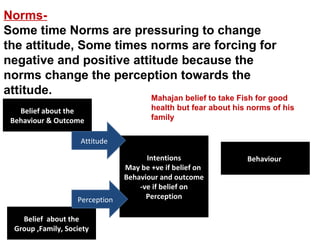
Norms-
Some time Norms are pressuring to change
the attitude, Some times norms are forcing for
negative and positive attitude because the
norms change the perception towards the
attitude.
Belief about the
Behaviour & Outcome
BehaviourIntentions
May be +ve if belief on
Behaviour and outcome
-ve if belief on
Perception
Belief about the
Group ,Family, Society
Attitude
Perception
Mahajan belief to take Fish for good
health but fear about his norms of his
family
Values & Attitude & Norms
These are stable and long lasting which can be changed but not so easily
and its influence life
Values are divided in to two types
Terminal Value- Comfirt,Wisdom,Excellent are the terminal value
Instrumental Value-It is the steps to achieving the terminal Value Like ambition,
courage etc.
Some other values are
Theoretical Values-Discover of truth, Rational Approach to Problems.
Economical Values-The Standard of Living
Aesthetic-Value of Grace
Social-Value of Loving People
Political-Value of Power and Position
Relegious-Value to the Universe.
Measurement of attitude
Thurstone Scale-In this method the first data collected from the respondent and the Next
data Collected from the Others and Compare the whole process to find out the attitude .
Likert scale-It is provide 5 parameters for the attitude measurement
•Strongly Approved
•Approved
•Undecided
•Disapproved
•Strongly Disapproved.
•To measure the Attitude very clearly.
Guattams Scale-In this scale the employee of the organization give 6 number of
dissatisfaction that to higher degree to understand and develop the attitude by satisfy
him.
Bogardus Scale-Seven Point Scale raising from Most Favorable Picture.
Opinion Survey-By Give Questionnaires to individual and groups to find out the result
and measure the attitude accordingly.
Interview-By asking him yes and no questions about a particular objective to understand
the attitude.
Projective Survey-Provide him a particular situation and handle it alone to understand
Attitude
Attitude

Attitude

  • 2.
    Attitude which representones belief, feeling and ideas ,action,tedency towards object and ideas. When a person feels about something ,about a place, commodity and a situation or an idea is called attitude.
  • 3.
    Nature of Attitude •Attitudeare learned •It is the feeling ,Beliefs of individual and groups. •These feelings and beliefs are defined ones Predispositions towards given aspects of the world. •It is not permanent it changed
  • 4.
  • 5.
    Cognitive Components- TheBelief , Information, Knowledge and information. Eg-If a Person does not like or negative attitude about the nuclear bomb ,In interview if he asked about the nuclear bomb he give negative points only means he does not like the nuclear bomb that means his belief and information is negative for that. Affective Components- Feelings, Sentiments and moods of emotions towards a particular object Eg-Wanted to go for a night shift job rather that a General Shift Job Behavioral Components-Way of thinking ,Behaving and feelings Eg-If some one like the Principal of the college his attitude is made by feelings and behavioral aspects
  • 6.
  • 7.
    Functions of attitude- 1.Attitudeis a determine function-Attitude determine the meaning of what is seen in the environment may be good or bad means favorable attitude has good meaning and unfavorable attitudes are bad meaning. 2.Attitude is a contradictions –means some time they give two meaning words and diplomatic opinions about the same things. 3.Attitude is a adjustment function-Attitude is provides a function to adjust in the proper environment to adjust themselves in that environment. Treated them badly negative attitude and treated them good a positive attitude. 4.Ego Defense Function- Employees in organization want to protect their own image and some negative attitude for the new comers and they have ego defencsive function when may not be changed. 5.Expressive Function- It provides someone values and self identity of a person A Manager is belief in ethics so his attitude shows the voice of a quality of work. 6.Attitude is a knowledge function- Maintain stable ,Organized and meaningful structure of a person not bluff anything.
  • 8.
  • 9.
    Family and peergroup-If the parents has a positive attitude or negative attitude for a object the children's will follow the same attitude. Neighborhood-The Cultural Facilities,Relegious group possible ethnic which is affect the attitude. Economical Status-The economical status of an individual change the attitude and belief towards the Trade Unions and Workers and Manager is different. Mass Communication-The Medias like TV,Radio,News Paper from which they got the information's can changed the attitude. Classical Conditions- When we belief that the condition of the environment is good rather is bad but we belief that it is good. Eg- Sale a Sachines bat with Rs.2000000000 But is has no meaning only Sachine use it that is the condition
  • 10.
    Attitude and JobSatisfaction Lockes Model of Job satisfaction and Positive attitude Organizational factor Group Factor Individual Factor Outcome Expected Outcome Received Satisfied Dissatisfied Outcome
  • 11.
    Organizational Factor forPositive attitude Employees satisfaction-Provide them right salary right Beahaviour. Promotion and Fringe Benefits-Provide them benefits for particular situation ,Incentives, Allowances Welfare-Provide them education, Good working Condition to make a good belief. HRD-Provide them Training and development and Rights . Flexible working Condition-Working culture ,Job Profile must be good for make a positive attitude
  • 12.
    Group factor- •Size ofthe Group-Make Minimum member to avoid conflict and maximize the positive attitude for the organization •Supervision-The head of the group must good administrative skills and adequate behaviour is most important. Individual Factor- •Self-esteem-Means treat them as partner do not as workers and their attitude is definitely positive. •Morale Improvement by giving them status no only Salary. •Make them interest in job to perform and a good positive attitude
  • 13.
    Cause dissatisfaction andNegative attitude- 1.No Promotion and security of job 2.Less Salary and Unfair reduction. 3.Working Condition is poor. 4.Behavioural aspects are bad . 5.No Support from Management. 6.No welfare in Organization Which Cause a Dissatisfaction and a Negative attitude for the Organization
  • 14.
    Exit Neglect Loyalty Voice Leaving the Organization Suggestionto Improve the Condition Waiting for the improvement of the Conditions Go Slow and Negative attitude towards work
  • 16.
    Channing attitude ofself- 1.Employee has to make positive attitude (Belief, Proper Information and Ego) 2.Think about yourself and develop your own attitude. 3.Listen others and develop the positive attitude. 4.Get in to continuous development and communication program 5.Build a self esteem and prestige 6.Stay away from negative influences.
  • 17.
    Changing the attitudeof Employees 1.Give feedback-Employees are told about their negative attitude and if it is harmful and manager needs to offer alternative attitude. 2.Good Working Condition to work in the culture. 3.Positive Role Model means if the Manager is the positive attitude and the role model the workers provides the positive attitude. 4.Providing new information's means updated information and do not ignore the information's. 5.Use of fear to change some unethical negative attitude. 6.Providing coopering some situations to change their attitude . 7.Degree of commitment on target means morale development.
  • 19.
    Function of Positiveattitude 1.Maximize the Productivity. 2.Team Work. 3.Self Management and Problem Solving. 4.Improve quality. 5.Reduce Stress. 6.Loayl to Organizations
  • 20.
    Barriers to Changingan Attitude Cognitive Dissonance- When a person behaves in a fashion that is inconsistent with his or her attitude, Means he or she knows it is wrong but steal continue to inconsistency . Prior Commitment-Means the belief is unchanged and unwilling to change. Insufficient Information-Two Way Communication is not possible from TOP Management and Workers which creates a negative attitude.
  • 21.
    Norms- Some time Normsare pressuring to change the attitude, Some times norms are forcing for negative and positive attitude because the norms change the perception towards the attitude. Belief about the Behaviour & Outcome BehaviourIntentions May be +ve if belief on Behaviour and outcome -ve if belief on Perception Belief about the Group ,Family, Society Attitude Perception Mahajan belief to take Fish for good health but fear about his norms of his family
  • 23.
    Values & Attitude& Norms These are stable and long lasting which can be changed but not so easily and its influence life Values are divided in to two types Terminal Value- Comfirt,Wisdom,Excellent are the terminal value Instrumental Value-It is the steps to achieving the terminal Value Like ambition, courage etc. Some other values are Theoretical Values-Discover of truth, Rational Approach to Problems. Economical Values-The Standard of Living Aesthetic-Value of Grace Social-Value of Loving People Political-Value of Power and Position Relegious-Value to the Universe.
  • 24.
    Measurement of attitude ThurstoneScale-In this method the first data collected from the respondent and the Next data Collected from the Others and Compare the whole process to find out the attitude . Likert scale-It is provide 5 parameters for the attitude measurement •Strongly Approved •Approved •Undecided •Disapproved •Strongly Disapproved. •To measure the Attitude very clearly. Guattams Scale-In this scale the employee of the organization give 6 number of dissatisfaction that to higher degree to understand and develop the attitude by satisfy him. Bogardus Scale-Seven Point Scale raising from Most Favorable Picture. Opinion Survey-By Give Questionnaires to individual and groups to find out the result and measure the attitude accordingly. Interview-By asking him yes and no questions about a particular objective to understand the attitude. Projective Survey-Provide him a particular situation and handle it alone to understand