Membrane Physiology
Dr. A. R. Joshi
Professor of Physiology,
Bharati Vidyapeeth Medical College,
Pune.
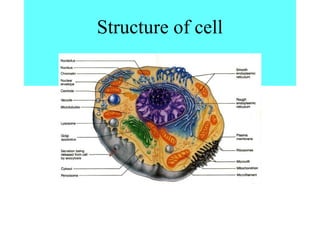
Structure of cell
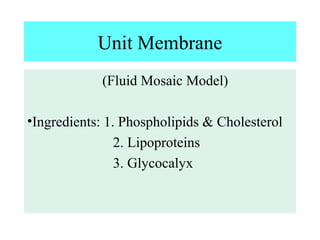
Unit Membrane
(Fluid Mosaic Model)
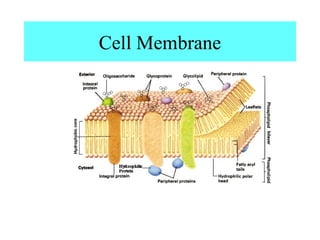
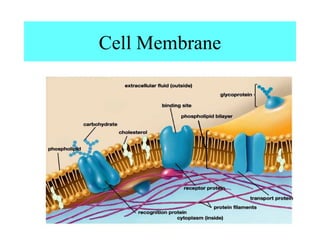
•Ingredients: 1. Phospholipids & Cholesterol
2. Lipoproteins
3. Glycocalyx
Cell Membrane
Cell Membrane
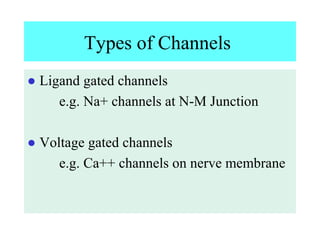
Types of Channels
● Ligand gated channels
e.g. Na+ channels at N-M Junction
● Voltage gated channels
e.g. Ca++ channels on nerve membrane
Functions of cell membrane
• Protection
• Electrical property
• Transports across membrane
(Semipermeable )
• Cell to cell communication
• Movement and phagocytosis
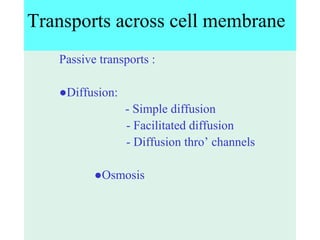
Transports across cell membrane
Passive transports :
●Diffusion:
- Simple diffusion
- Facilitated diffusion
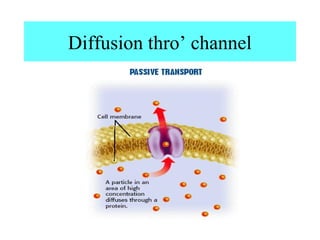
- Diffusion thro’ channels
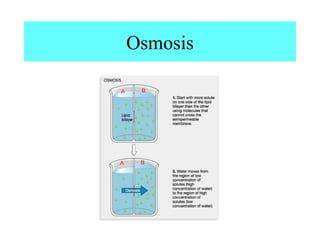
●Osmosis
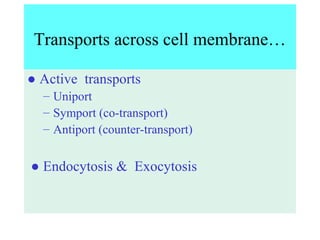
Transports across cell membrane…
● Active transports
– Uniport
– Symport (co-transport)
– Antiport (counter-transport)
● Endocytosis & Exocytosis
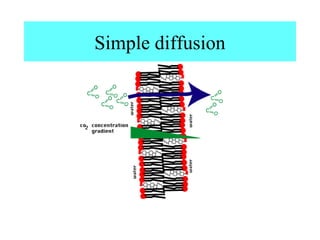
Simple diffusion
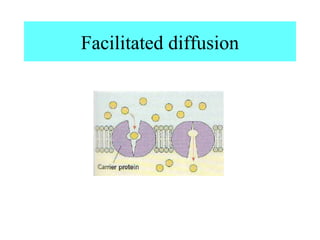
Facilitated diffusion
Diffusion thro’ channel
Osmosis
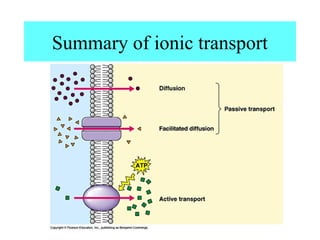
Summary of ionic transport
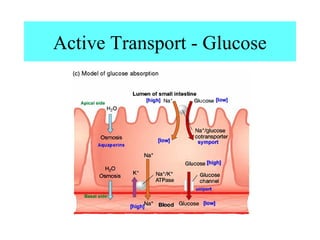
Active Transport - Glucose
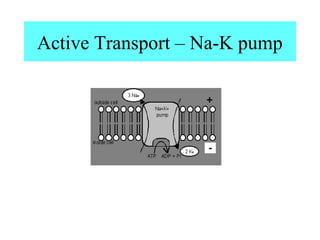
Active Transport – Na-K pump
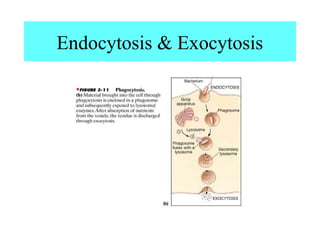
Endocytosis & Exocytosis
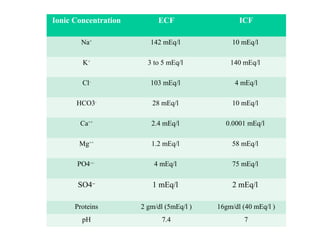
Ionic Concentration ECF ICF
Na+
142 mEq/l 10 mEq/l
K+
3 to 5 mEq/l 140 mEq/l
Cl-
103 mEq/l 4 mEq/l
HCO3-
28 mEq/l 10 mEq/l
Ca++
2.4 mEq/l 0.0001 mEq/l
Mg++
1.2 mEq/l 58 mEq/l
PO4---
4 mEq/l 75 mEq/l
SO4--
1 mEq/l 2 mEq/l
Proteins 2 gm/dl (5mEq/l ) 16gm/dl (40 mEq/l )
pH 7.4 7
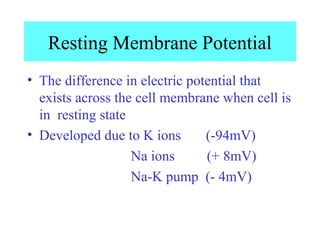
Resting Membrane Potential
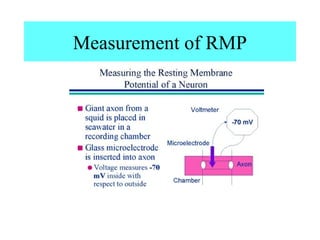
• The difference in electric potential that
exists across the cell membrane when cell is
in resting state
• Developed due to K ions (-94mV)
Na ions (+ 8mV)
Na-K pump (- 4mV)
Measurement of RMP
Resting Membrane Potential
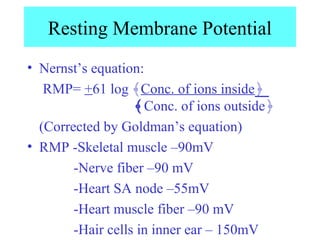
• Nernst’s equation:
RMP= +61 log ﴾Conc. of ions inside﴿
﴾Conc. of ions outside﴿
(Corrected by Goldman’s equation)
• RMP -Skeletal muscle –90mV
-Nerve fiber –90 mV
-Heart SA node –55mV
-Heart muscle fiber –90 mV
-Hair cells in inner ear – 150mV
Action potential
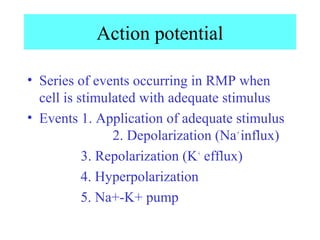
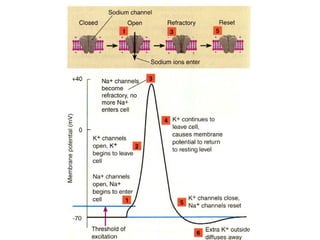
• Series of events occurring in RMP when
cell is stimulated with adequate stimulus
• Events 1. Application of adequate stimulus
2. Depolarization (Na+
influx)
3. Repolarization (K+
efflux)
4. Hyperpolarization
5. Na+-K+ pump
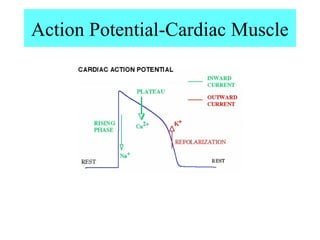
Action Potential-Cardiac Muscle
Properties of action potential
• Propagation
(Impulse- self propagatory A.P.)
• All or none law
• Refractory period
(Short R.P. for skeletal muscle and nerve
Long R.P. for cardiac muscle)
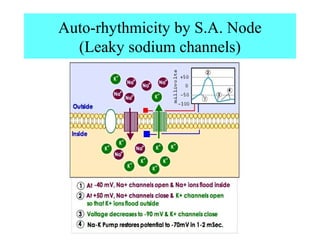
Auto-rhythmicity by S.A. Node
(Leaky sodium channels)
Cell to cell communication
• Mediators
– Neurotransmitter
– Local hormone
(either excitatory or inhibitory)
e.g. Neuromuscular transmission
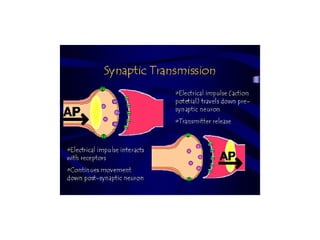
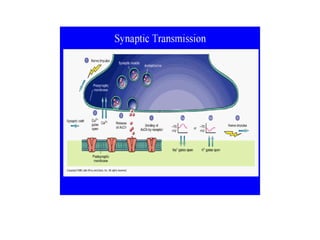
Synaptic transmission
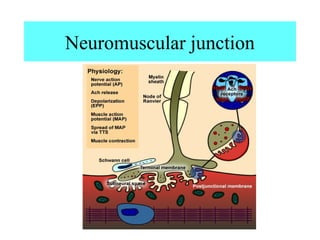
Neuromuscular junction
Drugs acting at Neuro-muscular Junction
● Cholinomimatic drugs- e.g. Pilocarpine
● Anti-cholinergic drugs-e.g.Atropine
● Competitive inhibitors- e.g. Scholine
● Anticholinesterases -e.g.Neostigmine
● Drugs regenerating cholinesterase- e.g.PAM
For Assistance in Physiology
• Dr. A.R. Joshi
Professor of Physiology
(mobile : 9423523322)
email:
aniruddharj@hotmail.com

Membrane physiology

  • 1.
    Membrane Physiology Dr. A.R. Joshi Professor of Physiology, Bharati Vidyapeeth Medical College, Pune.
  • 2.
  • 3.
    Unit Membrane (Fluid MosaicModel) •Ingredients: 1. Phospholipids & Cholesterol 2. Lipoproteins 3. Glycocalyx
  • 4.
  • 5.
  • 6.
    Types of Channels ●Ligand gated channels e.g. Na+ channels at N-M Junction ● Voltage gated channels e.g. Ca++ channels on nerve membrane
  • 7.
    Functions of cellmembrane • Protection • Electrical property • Transports across membrane (Semipermeable ) • Cell to cell communication • Movement and phagocytosis
  • 8.
    Transports across cellmembrane Passive transports : ●Diffusion: - Simple diffusion - Facilitated diffusion - Diffusion thro’ channels ●Osmosis
  • 9.
    Transports across cellmembrane… ● Active transports – Uniport – Symport (co-transport) – Antiport (counter-transport) ● Endocytosis & Exocytosis
  • 10.
  • 11.
  • 12.
  • 13.
  • 14.
  • 15.
  • 16.
  • 17.
  • 18.
    Ionic Concentration ECFICF Na+ 142 mEq/l 10 mEq/l K+ 3 to 5 mEq/l 140 mEq/l Cl- 103 mEq/l 4 mEq/l HCO3- 28 mEq/l 10 mEq/l Ca++ 2.4 mEq/l 0.0001 mEq/l Mg++ 1.2 mEq/l 58 mEq/l PO4--- 4 mEq/l 75 mEq/l SO4-- 1 mEq/l 2 mEq/l Proteins 2 gm/dl (5mEq/l ) 16gm/dl (40 mEq/l ) pH 7.4 7
  • 19.
    Resting Membrane Potential •The difference in electric potential that exists across the cell membrane when cell is in resting state • Developed due to K ions (-94mV) Na ions (+ 8mV) Na-K pump (- 4mV)
  • 20.
  • 21.
    Resting Membrane Potential •Nernst’s equation: RMP= +61 log ﴾Conc. of ions inside﴿ ﴾Conc. of ions outside﴿ (Corrected by Goldman’s equation) • RMP -Skeletal muscle –90mV -Nerve fiber –90 mV -Heart SA node –55mV -Heart muscle fiber –90 mV -Hair cells in inner ear – 150mV
  • 22.
    Action potential • Seriesof events occurring in RMP when cell is stimulated with adequate stimulus • Events 1. Application of adequate stimulus 2. Depolarization (Na+ influx) 3. Repolarization (K+ efflux) 4. Hyperpolarization 5. Na+-K+ pump
  • 24.
  • 25.
    Properties of actionpotential • Propagation (Impulse- self propagatory A.P.) • All or none law • Refractory period (Short R.P. for skeletal muscle and nerve Long R.P. for cardiac muscle)
  • 26.
    Auto-rhythmicity by S.A.Node (Leaky sodium channels)
  • 27.
    Cell to cellcommunication • Mediators – Neurotransmitter – Local hormone (either excitatory or inhibitory) e.g. Neuromuscular transmission Synaptic transmission
  • 30.
  • 31.
    Drugs acting atNeuro-muscular Junction ● Cholinomimatic drugs- e.g. Pilocarpine ● Anti-cholinergic drugs-e.g.Atropine ● Competitive inhibitors- e.g. Scholine ● Anticholinesterases -e.g.Neostigmine ● Drugs regenerating cholinesterase- e.g.PAM
  • 32.
    For Assistance inPhysiology • Dr. A.R. Joshi Professor of Physiology (mobile : 9423523322) email: aniruddharj@hotmail.com