The ARM Cortex-M4 Embedded Systems:
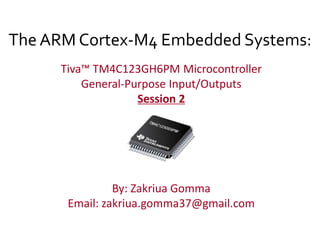
Tiva™ TM4C123GH6PM Microcontroller
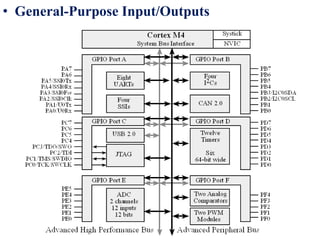
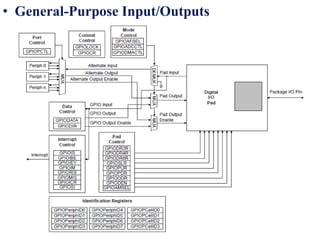
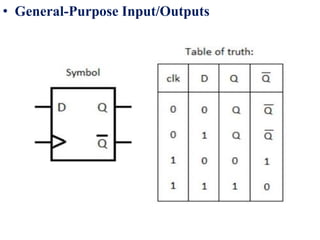
General-Purpose Input/Outputs
Session 2
By: Zakriua Gomma
Email: zakriua.gomma37@gmail.com
Agenda
 TM4C123 Overview
 General-Purpose Input/Outputs
 Bitwise operators
 System Timer (SysTick)
 Delay Library
 Interface 74595
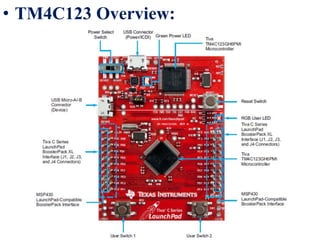
• TM4C123 Overview:
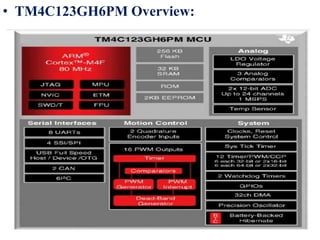
• TM4C123GH6PM Overview:
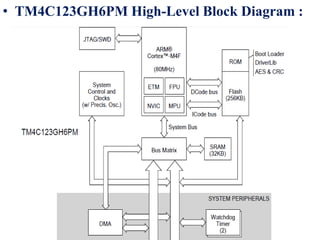
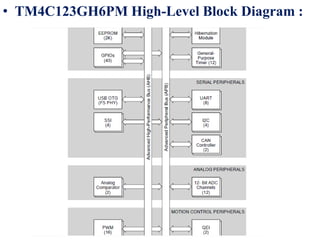
• TM4C123GH6PM High-Level Block Diagram :
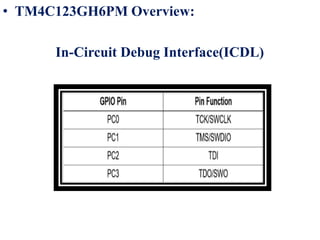
• TM4C123GH6PM Overview:
In-Circuit Debug Interface(ICDL)
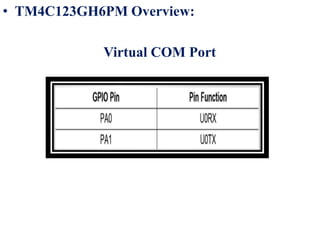
• TM4C123GH6PM Overview:
Virtual COM Port
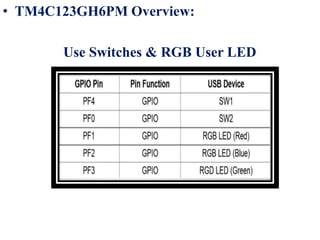
• TM4C123GH6PM Overview:
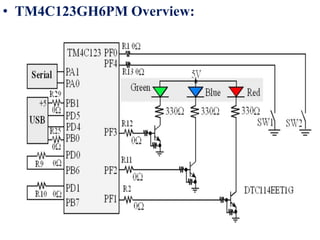
Use Switches & RGB User LED
Agenda
 TM4C123 Overview
 General-Purpose Input/Outputs
 Bitwise operators
 System Timer (SysTick)
 Delay Library
 Interface 74595
• General-Purpose Input/Outputs
• TM4C123GH6PM Overview:
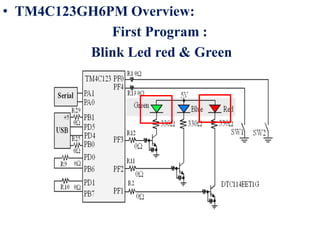
First Program :
Blink Led red & Green
• General-Purpose Input/Outputs
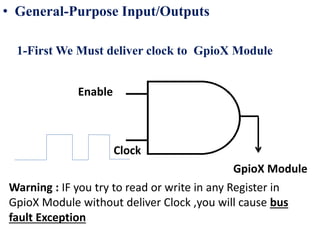
1-First We Must deliver clock to GpioX Module
GpioX Module
Clock
Enable
Warning : IF you try to read or write in any Register in
GpioX Module without deliver Clock ,you will cause bus
fault Exception
• General-Purpose Input/Outputs
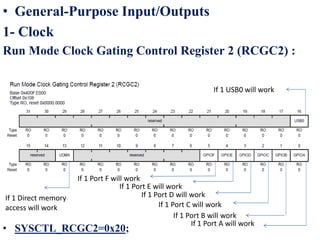
1- Clock
Run Mode Clock Gating Control Register 2 (RCGC2) :
• SYSCTL_RCGC2=0x20;
If 1 Port A will work
If 1 Port B will work
If 1 Port C will work
If 1 Port D will work
If 1 Port E will work
If 1 Port F will work
If 1 USB0 will work
If 1 Direct memory
access will work
• General-Purpose Input/Outputs
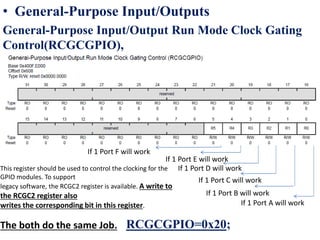
General-Purpose Input/Output Run Mode Clock Gating
Control(RCGCGPIO),
RCGCGPIO=0x20;
If 1 Port A will work
If 1 Port B will work
If 1 Port C will work
If 1 Port D will work
If 1 Port E will work
If 1 Port F will work
If 1 USB0 will work
This register should be used to control the clocking for the
GPIO modules. To support
legacy software, the RCGC2 register is available. A write to
the RCGC2 register also
writes the corresponding bit in this register.
The both do the same Job.
• General-Purpose Input/Outputs
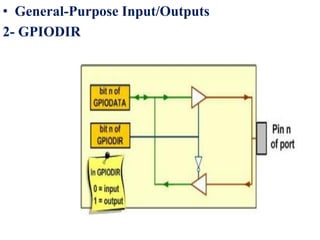
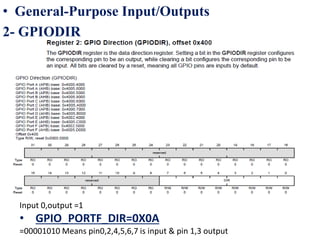
2- GPIODIR
• General-Purpose Input/Outputs
2- GPIODIR
Input 0,output =1
• GPIO_PORTF_DIR=0X0A
=00001010 Means pin0,2,4,5,6,7 is input & pin 1,3 output
• General-Purpose Input/Outputs
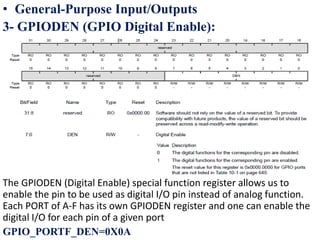
3- GPIODEN (GPIO Digital Enable):
The GPIODEN (Digital Enable) special function register allows us to
enable the pin to be used as digital I/O pin instead of analog function.
Each PORT of A-F has its own GPIODEN register and one can enable the
digital I/O for each pin of a given port
GPIO_PORTF_DEN=0X0A
• General-Purpose Input/Outputs
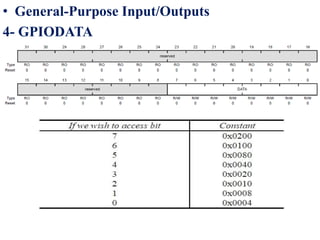
4- GPIODATA
• General-Purpose Input/Outputs
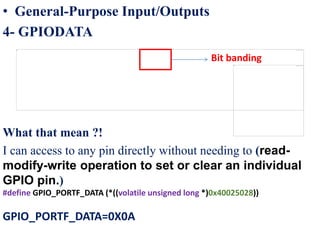
4- GPIODATA
What that mean ?!
I can access to any pin directly without needing to (read-
modify-write operation to set or clear an individual
GPIO pin.)
#define GPIO_PORTF_DATA (*((volatile unsigned long *)0x40025028))
GPIO_PORTF_DATA=0X0A
Bit banding
• TM4C123GH6PM Overview:
Second Program :
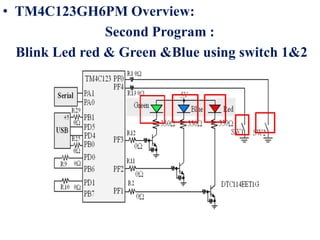
Blink Led red & Green &Blue using switch 1&2
• TM4C123GH6PM Overview:
Second Program :
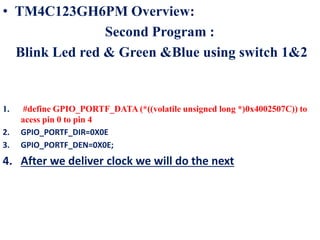
Blink Led red & Green &Blue using switch 1&2
1. #define GPIO_PORTF_DATA (*((volatile unsigned long *)0x4002507C)) to
acess pin 0 to pin 4
2. GPIO_PORTF_DIR=0X0E
3. GPIO_PORTF_DEN=0X0E;
4. After we deliver clock we will do the next
• General-Purpose Input/Outputs
2- GPIOLOCK
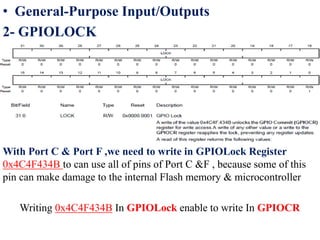
With Port C & Port F ,we need to write in GPIOLock Register
0x4C4F434B to can use all of pins of Port C &F , because some of this
pin can make damage to the internal Flash memory & microcontroller
Writing 0x4C4F434B In GPIOLock enable to write In GPIOCR
• General-Purpose Input/Outputs
3- GPIOCR
This register is designed to prevent accidental programming
of the registers that control connectivity to the NMI and
JTAG/SWD debug hardware. By initializing the bits of the
GPIOCR register to 0 for PD7, PF0, and PC[3:0].
• General-Purpose Input/Outputs
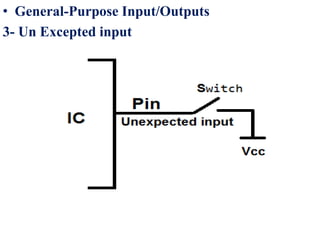
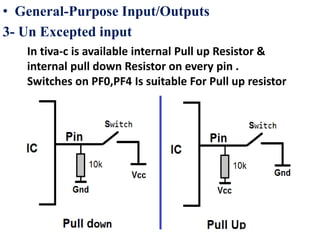
3- Un Excepted input
• General-Purpose Input/Outputs
3- Un Excepted input
In tiva-c is available internal Pull up Resistor &
internal pull down Resistor on every pin .
Switches on PF0,PF4 Is suitable For Pull up resistor
• General-Purpose Input/Outputs
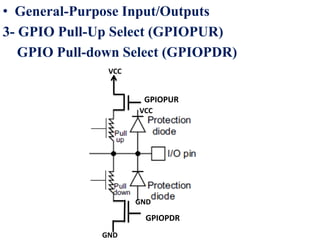
3- GPIO Pull-Up Select (GPIOPUR)
GPIO Pull-down Select (GPIOPDR)
VCC
VCC
GND
GND
GPIOPUR
GPIOPDR
Agenda
 TM4C123 Overview
 General-Purpose Input/Outputs
 Bitwise operators
 System Timer (SysTick)
 Delay Library
 Interface 74595
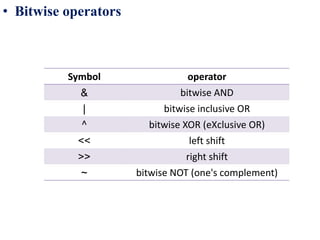
• Bitwise operators
operatorSymbol
bitwise AND&
bitwise inclusive OR|
bitwise XOR (eXclusive OR)^
left shift>>
right shift<<
bitwise NOT (one's complement)~
• Bitwise operators
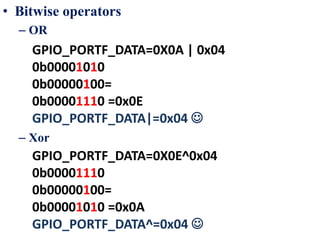
– OR
– Xor
GPIO_PORTF_DATA=0X0A | 0x04
0b00001010
0b00000100=
0b00001110 =0x0E
GPIO_PORTF_DATA|=0x04 
GPIO_PORTF_DATA=0X0E^0x04
0b00001110
0b00000100=
0b00001010 =0x0A
GPIO_PORTF_DATA^=0x04 
• Bitwise operators
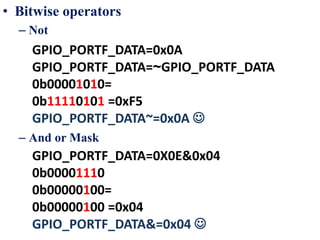
– Not
– And or Mask
GPIO_PORTF_DATA=0x0A
GPIO_PORTF_DATA=~GPIO_PORTF_DATA
0b00001010=
0b11110101 =0xF5
GPIO_PORTF_DATA~=0x0A 
GPIO_PORTF_DATA=0X0E&0x04
0b00001110
0b00000100=
0b00000100 =0x04
GPIO_PORTF_DATA&=0x04 
• Bitwise operators
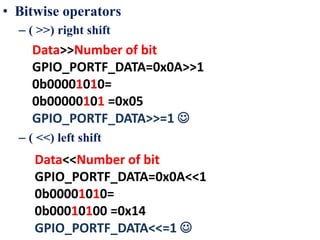
– ( >>) right shift
– ( <<) left shift
Data>>Number of bit
GPIO_PORTF_DATA=0x0A>>1
0b00001010=
0b00000101 =0x05
GPIO_PORTF_DATA>>=1 
Data<<Number of bit
GPIO_PORTF_DATA=0x0A<<1
0b00001010=
0b00010100 =0x14
GPIO_PORTF_DATA<<=1 
• Bitwise operators
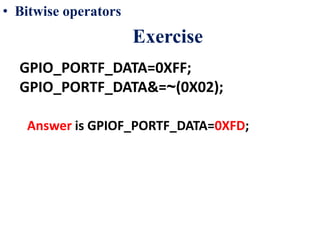
Exercise
GPIO_PORTF_DATA=0XFF;
GPIO_PORTF_DATA&=~(0X02);
Answer is GPIOF_PORTF_DATA=0XFD;
Agenda
 TM4C123 Overview
 General-Purpose Input/Outputs
 Bitwise operators
 System Timer (SysTick)
 Delay Library
 Interface 74595
• System Timer (SysTick)
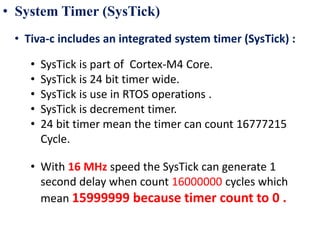
• Tiva-c includes an integrated system timer (SysTick) :
• SysTick is part of Cortex-M4 Core.
• SysTick is 24 bit timer wide.
• SysTick is use in RTOS operations .
• SysTick is decrement timer.
• 24 bit timer mean the timer can count 16777215
Cycle.
• With 16 MHz speed the SysTick can generate 1
second delay when count 16000000 cycles which
mean 15999999 because timer count to 0 .
• System Timer (SysTick)
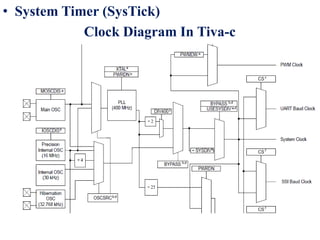
Clock Diagram In Tiva-c
• System Timer (SysTick)
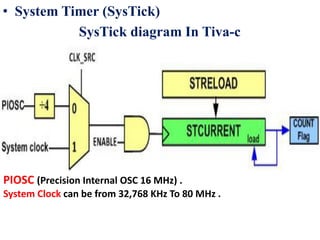
SysTick diagram In Tiva-c
PIOSC (Precision Internal OSC 16 MHz) .
System Clock can be from 32,768 KHz To 80 MHz .
• System Timer (SysTick)
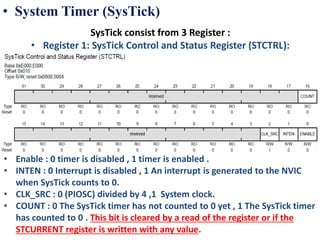
SysTick consist from 3 Register :
• Register 1: SysTick Control and Status Register (STCTRL):
• Enable : 0 timer is disabled , 1 timer is enabled .
• INTEN : 0 Interrupt is disabled , 1 An interrupt is generated to the NVIC
when SysTick counts to 0.
• CLK_SRC : 0 (PIOSC) divided by 4 ,1 System clock.
• COUNT : 0 The SysTick timer has not counted to 0 yet , 1 The SysTick timer
has counted to 0 . This bit is cleared by a read of the register or if the
STCURRENT register is written with any value.
• System Timer (SysTick)
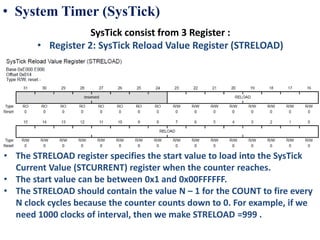
SysTick consist from 3 Register :
• Register 2: SysTick Reload Value Register (STRELOAD)
• The STRELOAD register specifies the start value to load into the SysTick
Current Value (STCURRENT) register when the counter reaches.
• The start value can be between 0x1 and 0x00FFFFFF.
• The STRELOAD should contain the value N – 1 for the COUNT to fire every
N clock cycles because the counter counts down to 0. For example, if we
need 1000 clocks of interval, then we make STRELOAD =999 .
• System Timer (SysTick)
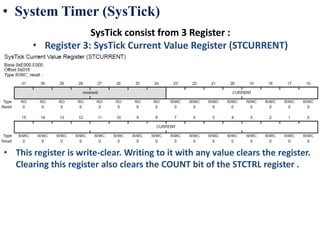
SysTick consist from 3 Register :
• Register 3: SysTick Current Value Register (STCURRENT)
• The STRELOAD register specifies the start value to load into the SysTick
• This register is write-clear. Writing to it with any value clears the register.
Clearing this register also clears the COUNT bit of the STCTRL register .
• System Timer (SysTick)
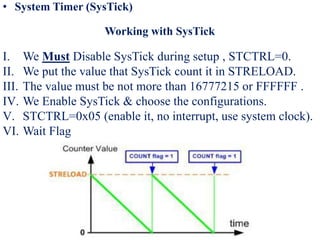
Working with SysTick
I. We Must Disable SysTick during setup , STCTRL=0.
II. We put the value that SysTick count it in STRELOAD.
III. The value must be not more than 16777215 or FFFFFF .
IV. We Enable SysTick & choose the configurations.
V. STCTRL=0x05 (enable it, no interrupt, use system clock).
VI. Wait Flag
Agenda
 TM4C123 Overview
 General-Purpose Input/Outputs
 Bitwise operators
 System Timer (SysTick)
 Delay Library
 Interface 74595
Agenda
 TM4C123 Overview
 General-Purpose Input/Outputs
 Bitwise operators
 System Timer (SysTick)
 Delay Library
 Interface 74595
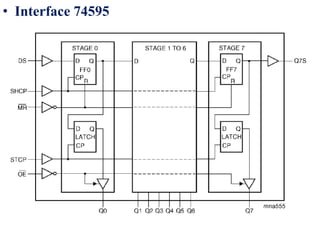
• Interface 74595

GPIO In Arm cortex-m4 tiva-c

  • 1.
    The ARM Cortex-M4Embedded Systems: Tiva™ TM4C123GH6PM Microcontroller General-Purpose Input/Outputs Session 2 By: Zakriua Gomma Email: zakriua.gomma37@gmail.com
  • 2.
    Agenda  TM4C123 Overview General-Purpose Input/Outputs  Bitwise operators  System Timer (SysTick)  Delay Library  Interface 74595
  • 3.
  • 4.
  • 5.
  • 6.
  • 7.
  • 8.
  • 9.
  • 10.
    • TM4C123GH6PM Overview: UseSwitches & RGB User LED
  • 11.
    Agenda  TM4C123 Overview General-Purpose Input/Outputs  Bitwise operators  System Timer (SysTick)  Delay Library  Interface 74595
  • 12.
  • 13.
  • 14.
    • TM4C123GH6PM Overview: FirstProgram : Blink Led red & Green
  • 15.
  • 16.
    • General-Purpose Input/Outputs 1-FirstWe Must deliver clock to GpioX Module GpioX Module Clock Enable Warning : IF you try to read or write in any Register in GpioX Module without deliver Clock ,you will cause bus fault Exception
  • 17.
    • General-Purpose Input/Outputs 1-Clock Run Mode Clock Gating Control Register 2 (RCGC2) : • SYSCTL_RCGC2=0x20; If 1 Port A will work If 1 Port B will work If 1 Port C will work If 1 Port D will work If 1 Port E will work If 1 Port F will work If 1 USB0 will work If 1 Direct memory access will work
  • 18.
    • General-Purpose Input/Outputs General-PurposeInput/Output Run Mode Clock Gating Control(RCGCGPIO), RCGCGPIO=0x20; If 1 Port A will work If 1 Port B will work If 1 Port C will work If 1 Port D will work If 1 Port E will work If 1 Port F will work If 1 USB0 will work This register should be used to control the clocking for the GPIO modules. To support legacy software, the RCGC2 register is available. A write to the RCGC2 register also writes the corresponding bit in this register. The both do the same Job.
  • 19.
  • 20.
    • General-Purpose Input/Outputs 2-GPIODIR Input 0,output =1 • GPIO_PORTF_DIR=0X0A =00001010 Means pin0,2,4,5,6,7 is input & pin 1,3 output
  • 21.
    • General-Purpose Input/Outputs 3-GPIODEN (GPIO Digital Enable): The GPIODEN (Digital Enable) special function register allows us to enable the pin to be used as digital I/O pin instead of analog function. Each PORT of A-F has its own GPIODEN register and one can enable the digital I/O for each pin of a given port GPIO_PORTF_DEN=0X0A
  • 22.
  • 23.
    • General-Purpose Input/Outputs 4-GPIODATA What that mean ?! I can access to any pin directly without needing to (read- modify-write operation to set or clear an individual GPIO pin.) #define GPIO_PORTF_DATA (*((volatile unsigned long *)0x40025028)) GPIO_PORTF_DATA=0X0A Bit banding
  • 24.
    • TM4C123GH6PM Overview: SecondProgram : Blink Led red & Green &Blue using switch 1&2
  • 25.
    • TM4C123GH6PM Overview: SecondProgram : Blink Led red & Green &Blue using switch 1&2 1. #define GPIO_PORTF_DATA (*((volatile unsigned long *)0x4002507C)) to acess pin 0 to pin 4 2. GPIO_PORTF_DIR=0X0E 3. GPIO_PORTF_DEN=0X0E; 4. After we deliver clock we will do the next
  • 26.
    • General-Purpose Input/Outputs 2-GPIOLOCK With Port C & Port F ,we need to write in GPIOLock Register 0x4C4F434B to can use all of pins of Port C &F , because some of this pin can make damage to the internal Flash memory & microcontroller Writing 0x4C4F434B In GPIOLock enable to write In GPIOCR
  • 27.
    • General-Purpose Input/Outputs 3-GPIOCR This register is designed to prevent accidental programming of the registers that control connectivity to the NMI and JTAG/SWD debug hardware. By initializing the bits of the GPIOCR register to 0 for PD7, PF0, and PC[3:0].
  • 28.
  • 29.
    • General-Purpose Input/Outputs 3-Un Excepted input In tiva-c is available internal Pull up Resistor & internal pull down Resistor on every pin . Switches on PF0,PF4 Is suitable For Pull up resistor
  • 30.
    • General-Purpose Input/Outputs 3-GPIO Pull-Up Select (GPIOPUR) GPIO Pull-down Select (GPIOPDR) VCC VCC GND GND GPIOPUR GPIOPDR
  • 31.
    Agenda  TM4C123 Overview General-Purpose Input/Outputs  Bitwise operators  System Timer (SysTick)  Delay Library  Interface 74595
  • 32.
    • Bitwise operators operatorSymbol bitwiseAND& bitwise inclusive OR| bitwise XOR (eXclusive OR)^ left shift>> right shift<< bitwise NOT (one's complement)~
  • 33.
    • Bitwise operators –OR – Xor GPIO_PORTF_DATA=0X0A | 0x04 0b00001010 0b00000100= 0b00001110 =0x0E GPIO_PORTF_DATA|=0x04  GPIO_PORTF_DATA=0X0E^0x04 0b00001110 0b00000100= 0b00001010 =0x0A GPIO_PORTF_DATA^=0x04 
  • 34.
    • Bitwise operators –Not – And or Mask GPIO_PORTF_DATA=0x0A GPIO_PORTF_DATA=~GPIO_PORTF_DATA 0b00001010= 0b11110101 =0xF5 GPIO_PORTF_DATA~=0x0A  GPIO_PORTF_DATA=0X0E&0x04 0b00001110 0b00000100= 0b00000100 =0x04 GPIO_PORTF_DATA&=0x04 
  • 35.
    • Bitwise operators –( >>) right shift – ( <<) left shift Data>>Number of bit GPIO_PORTF_DATA=0x0A>>1 0b00001010= 0b00000101 =0x05 GPIO_PORTF_DATA>>=1  Data<<Number of bit GPIO_PORTF_DATA=0x0A<<1 0b00001010= 0b00010100 =0x14 GPIO_PORTF_DATA<<=1 
  • 36.
  • 37.
    Agenda  TM4C123 Overview General-Purpose Input/Outputs  Bitwise operators  System Timer (SysTick)  Delay Library  Interface 74595
  • 38.
    • System Timer(SysTick) • Tiva-c includes an integrated system timer (SysTick) : • SysTick is part of Cortex-M4 Core. • SysTick is 24 bit timer wide. • SysTick is use in RTOS operations . • SysTick is decrement timer. • 24 bit timer mean the timer can count 16777215 Cycle. • With 16 MHz speed the SysTick can generate 1 second delay when count 16000000 cycles which mean 15999999 because timer count to 0 .
  • 39.
    • System Timer(SysTick) Clock Diagram In Tiva-c
  • 40.
    • System Timer(SysTick) SysTick diagram In Tiva-c PIOSC (Precision Internal OSC 16 MHz) . System Clock can be from 32,768 KHz To 80 MHz .
  • 41.
    • System Timer(SysTick) SysTick consist from 3 Register : • Register 1: SysTick Control and Status Register (STCTRL): • Enable : 0 timer is disabled , 1 timer is enabled . • INTEN : 0 Interrupt is disabled , 1 An interrupt is generated to the NVIC when SysTick counts to 0. • CLK_SRC : 0 (PIOSC) divided by 4 ,1 System clock. • COUNT : 0 The SysTick timer has not counted to 0 yet , 1 The SysTick timer has counted to 0 . This bit is cleared by a read of the register or if the STCURRENT register is written with any value.
  • 42.
    • System Timer(SysTick) SysTick consist from 3 Register : • Register 2: SysTick Reload Value Register (STRELOAD) • The STRELOAD register specifies the start value to load into the SysTick Current Value (STCURRENT) register when the counter reaches. • The start value can be between 0x1 and 0x00FFFFFF. • The STRELOAD should contain the value N – 1 for the COUNT to fire every N clock cycles because the counter counts down to 0. For example, if we need 1000 clocks of interval, then we make STRELOAD =999 .
  • 43.
    • System Timer(SysTick) SysTick consist from 3 Register : • Register 3: SysTick Current Value Register (STCURRENT) • The STRELOAD register specifies the start value to load into the SysTick • This register is write-clear. Writing to it with any value clears the register. Clearing this register also clears the COUNT bit of the STCTRL register .
  • 44.
    • System Timer(SysTick) Working with SysTick I. We Must Disable SysTick during setup , STCTRL=0. II. We put the value that SysTick count it in STRELOAD. III. The value must be not more than 16777215 or FFFFFF . IV. We Enable SysTick & choose the configurations. V. STCTRL=0x05 (enable it, no interrupt, use system clock). VI. Wait Flag
  • 45.
    Agenda  TM4C123 Overview General-Purpose Input/Outputs  Bitwise operators  System Timer (SysTick)  Delay Library  Interface 74595
  • 46.
    Agenda  TM4C123 Overview General-Purpose Input/Outputs  Bitwise operators  System Timer (SysTick)  Delay Library  Interface 74595
  • 47.