Chapter 7 – Counters and Registers
Copyright © 2011, 2007, 2004, 2001, 1998 by Pearson Education, Inc.
Upper Saddle River, New Jersey 07458 • All rights reserved
Digital Systems: Principles and Applications, 11/e
Ronald J. Tocci, Neal S. Widmer, Gregory L. Moss
• Selected areas covered in this chapter:
– Operation & characteristics of synchronous and
asynchronous counters.
– Analyzing and evaluating various types of counters.
– Schemes used to decode different types of counters.
– Counter circuits using different levels of abstraction
in HDL.
– Operation of various types of IC registers.
– Shift registers and shift register counters using HDL.
– Troubleshooting techniques used for combinational
logic systems to troubleshoot sequential logic
systems.
Chapter 7 Objectives
Copyright © 2011, 2007, 2004, 2001, 1998 by Pearson Education, Inc.
Upper Saddle River, New Jersey 07458 • All rights reserved
Digital Systems: Principles and Applications, 11/e
Ronald J. Tocci, Neal S. Widmer, Gregory L. Moss
7-1 Asynchronous (Ripple) Counters
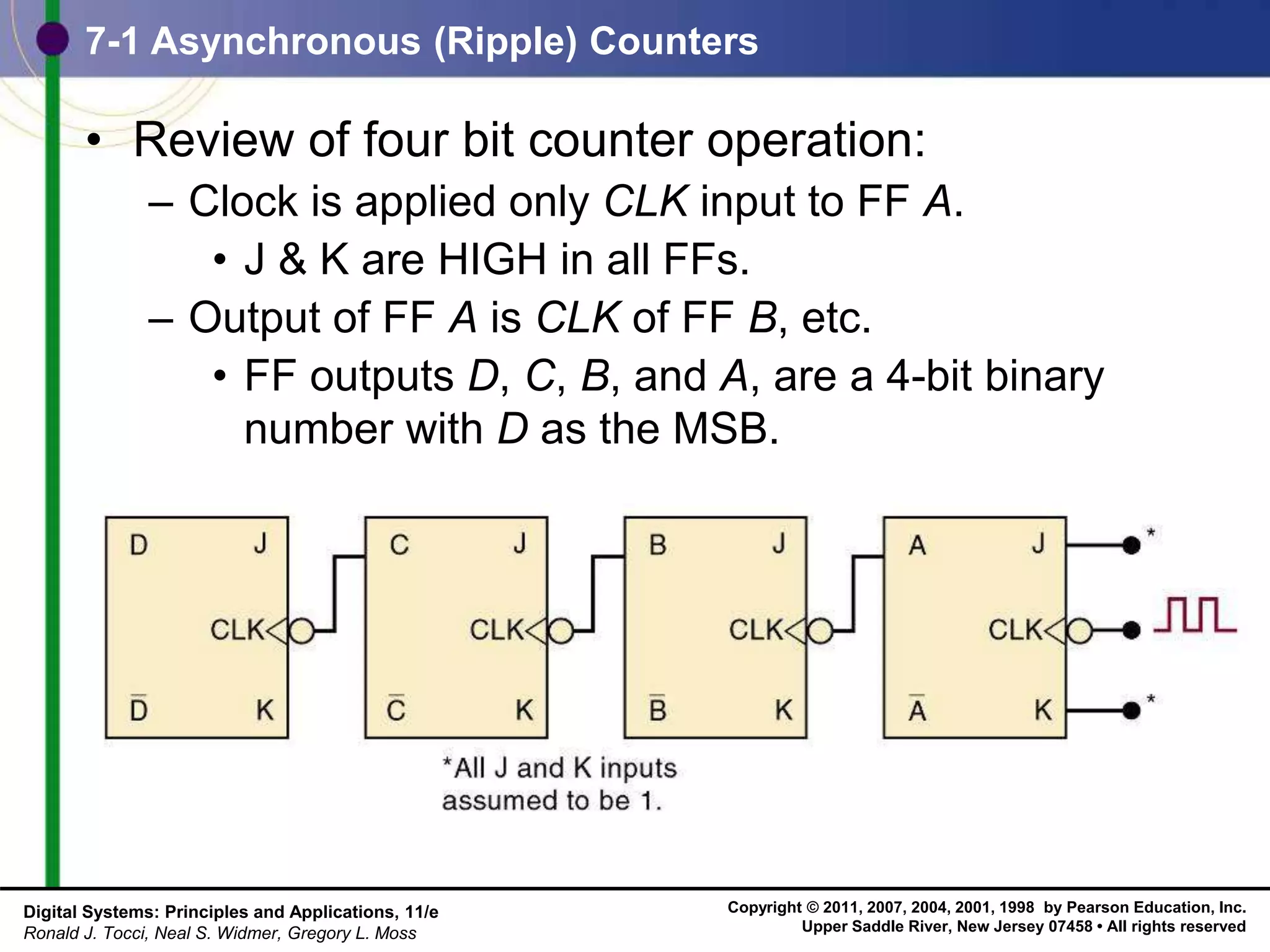
• Review of four bit counter operation:
– Clock is applied only CLK input to FF A.
• J & K are HIGH in all FFs.
– Output of FF A is CLK of FF B, etc.
• FF outputs D, C, B, and A, are a 4-bit binary
number with D as the MSB.
Copyright © 2011, 2007, 2004, 2001, 1998 by Pearson Education, Inc.
Upper Saddle River, New Jersey 07458 • All rights reserved
Digital Systems: Principles and Applications, 11/e
Ronald J. Tocci, Neal S. Widmer, Gregory L. Moss
7-1 Asynchronous (Ripple) Counters
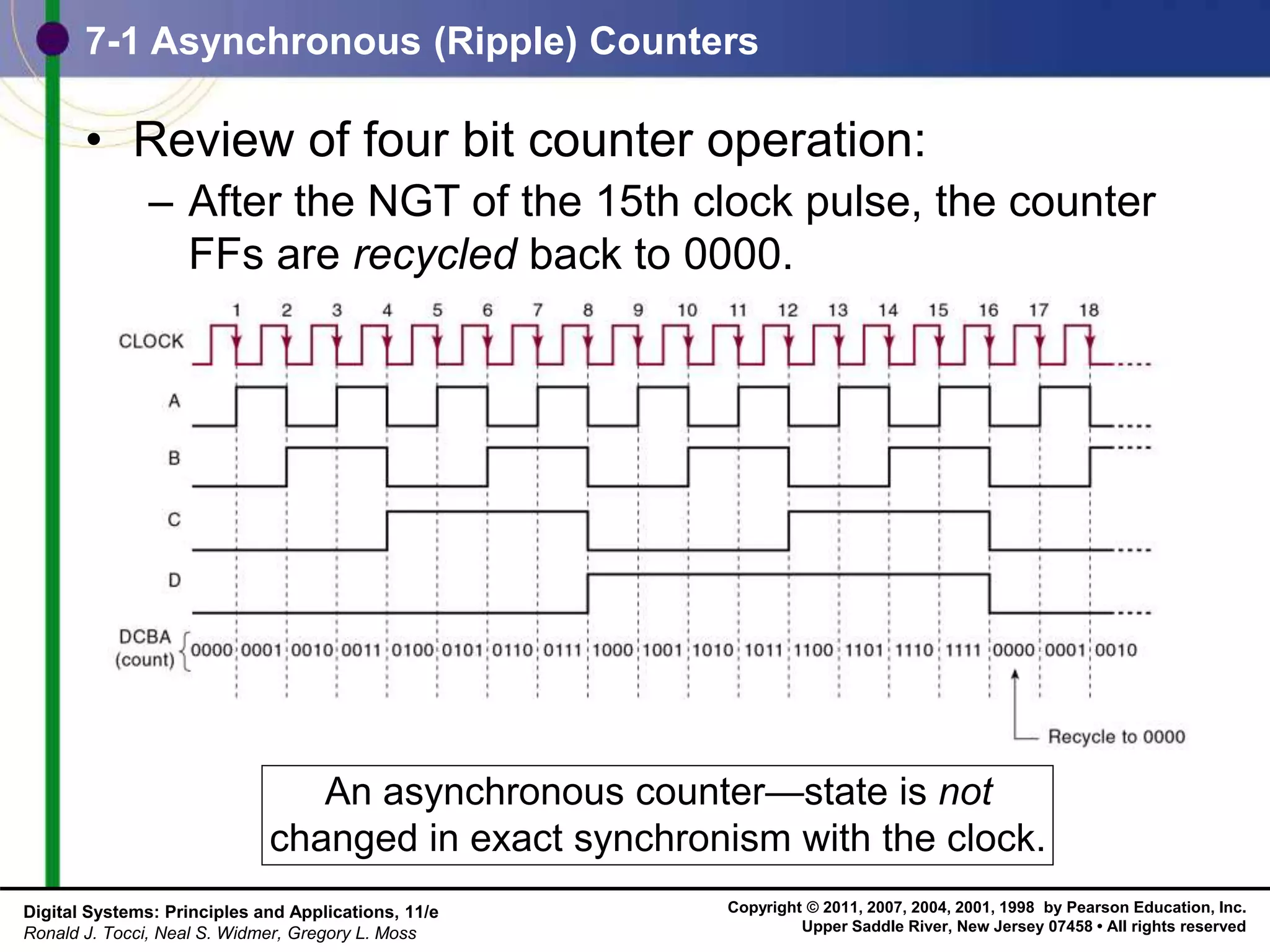
An asynchronous counter—state is not
changed in exact synchronism with the clock.
• Review of four bit counter operation:
– After the NGT of the 15th clock pulse, the counter
FFs are recycled back to 0000.
Copyright © 2011, 2007, 2004, 2001, 1998 by Pearson Education, Inc.
Upper Saddle River, New Jersey 07458 • All rights reserved
Digital Systems: Principles and Applications, 11/e
Ronald J. Tocci, Neal S. Widmer, Gregory L. Moss
7-1 Asynchronous (Ripple) Counters – MOD Number
• MOD number is equal to the number of states
the counter goes through before recycling.
Adding FFs will increase the MOD number.
Copyright © 2011, 2007, 2004, 2001, 1998 by Pearson Education, Inc.
Upper Saddle River, New Jersey 07458 • All rights reserved
Digital Systems: Principles and Applications, 11/e
Ronald J. Tocci, Neal S. Widmer, Gregory L. Moss
7-1 Asynchronous (Ripple) Counters – MOD Number
• Frequency division – each FF will have an output
frequency of 1/2 the input.
Output frequency of the last counter FF will be
clock frequency divided by MOD of the counter.
Copyright © 2011, 2007, 2004, 2001, 1998 by Pearson Education, Inc.
Upper Saddle River, New Jersey 07458 • All rights reserved
Digital Systems: Principles and Applications, 11/e
Ronald J. Tocci, Neal S. Widmer, Gregory L. Moss
7-1 Asynchronous (Ripple) Counters – Signal Flow
• Schematics are normally drawn from left to right.
– Counters will be drawn from right to left so that the
MSB and LSB appear in the appropriate positions.
Copyright © 2011, 2007, 2004, 2001, 1998 by Pearson Education, Inc.
Upper Saddle River, New Jersey 07458 • All rights reserved
Digital Systems: Principles and Applications, 11/e
Ronald J. Tocci, Neal S. Widmer, Gregory L. Moss
7-2 Propagation Delay in Ripple Counters
• Ripple counters are simple—requiring the fewest
components to produce a given operation.
– Cumulative propagation delay can cause problems
at high frequencies.
• If the period between input pulses is made longer
than the total propagation delay of the counter,
problems can be avoided
– For proper operation: Tclock  N x tpd
– Maximum frequency: Fmax=1/N x tpd
Copyright © 2011, 2007, 2004, 2001, 1998 by Pearson Education, Inc.
Upper Saddle River, New Jersey 07458 • All rights reserved
Digital Systems: Principles and Applications, 11/e
Ronald J. Tocci, Neal S. Widmer, Gregory L. Moss
7-2 Propagation Delay in Ripple Counters
• Asynchronous counters are not useful at very high
frequencies—especially for counters with large
numbers of bits.
– Erroneous count patterns can generate glitches
• Signals produced by systems using asynchronous
counters.
Copyright © 2011, 2007, 2004, 2001, 1998 by Pearson Education, Inc.
Upper Saddle River, New Jersey 07458 • All rights reserved
Digital Systems: Principles and Applications, 11/e
Ronald J. Tocci, Neal S. Widmer, Gregory L. Moss
7-3 Synchronous (Parallel) Counters
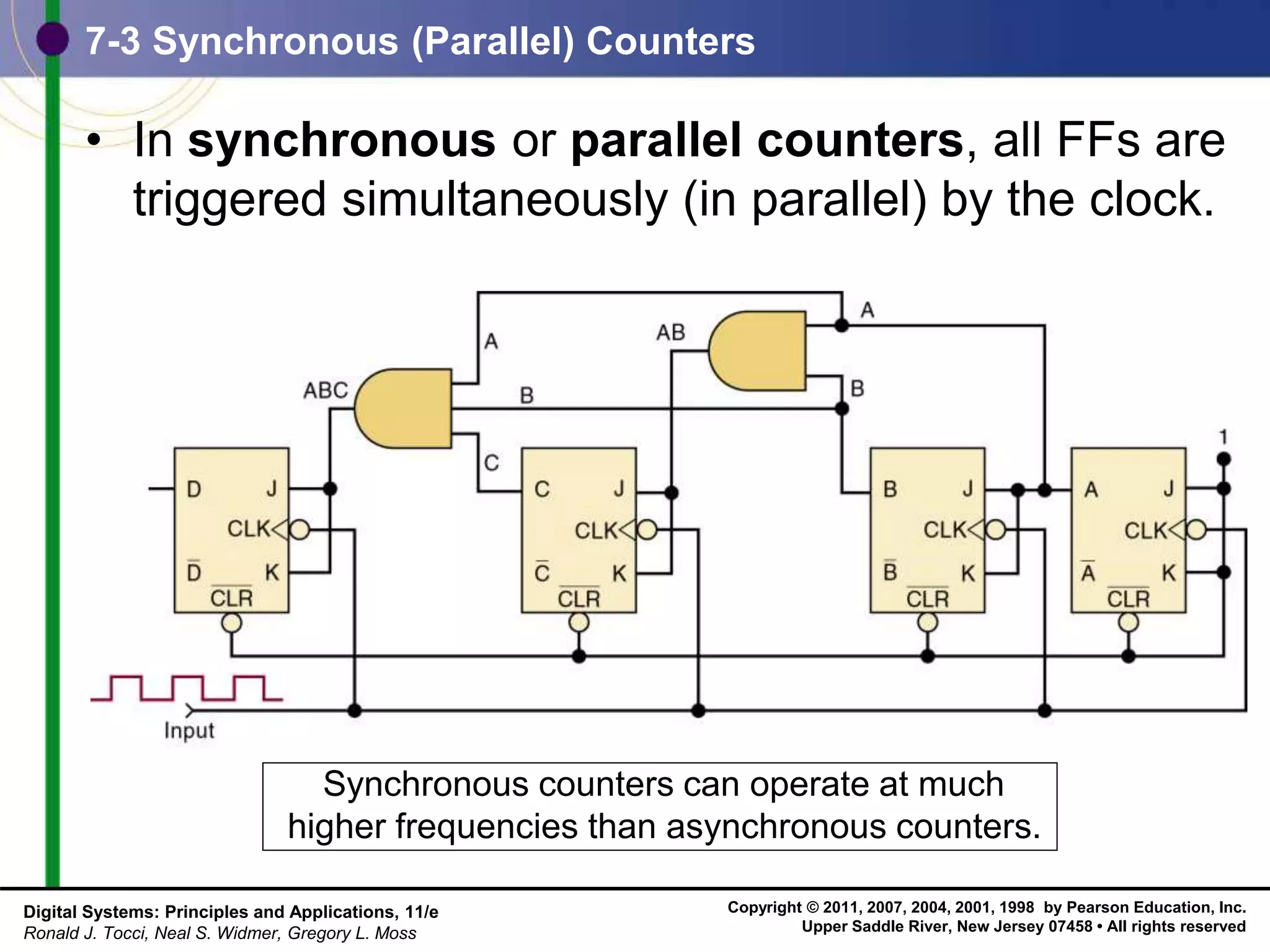
• In synchronous or parallel counters, all FFs are
triggered simultaneously (in parallel) by the clock.
Synchronous counters can operate at much
higher frequencies than asynchronous counters.
Copyright © 2011, 2007, 2004, 2001, 1998 by Pearson Education, Inc.
Upper Saddle River, New Jersey 07458 • All rights reserved
Digital Systems: Principles and Applications, 11/e
Ronald J. Tocci, Neal S. Widmer, Gregory L. Moss
7-3 Synchronous (Parallel) Counters
• Each FF has J & K inputs which are HIGH only
when outputs of all lower-order FFs are HIGH.
The total propagation delay will be
the same for any number of FFs.
Copyright © 2011, 2007, 2004, 2001, 1998 by Pearson Education, Inc.
Upper Saddle River, New Jersey 07458 • All rights reserved
Digital Systems: Principles and Applications, 11/e
Ronald J. Tocci, Neal S. Widmer, Gregory L. Moss
7-3 Synchronous (Parallel) Counters
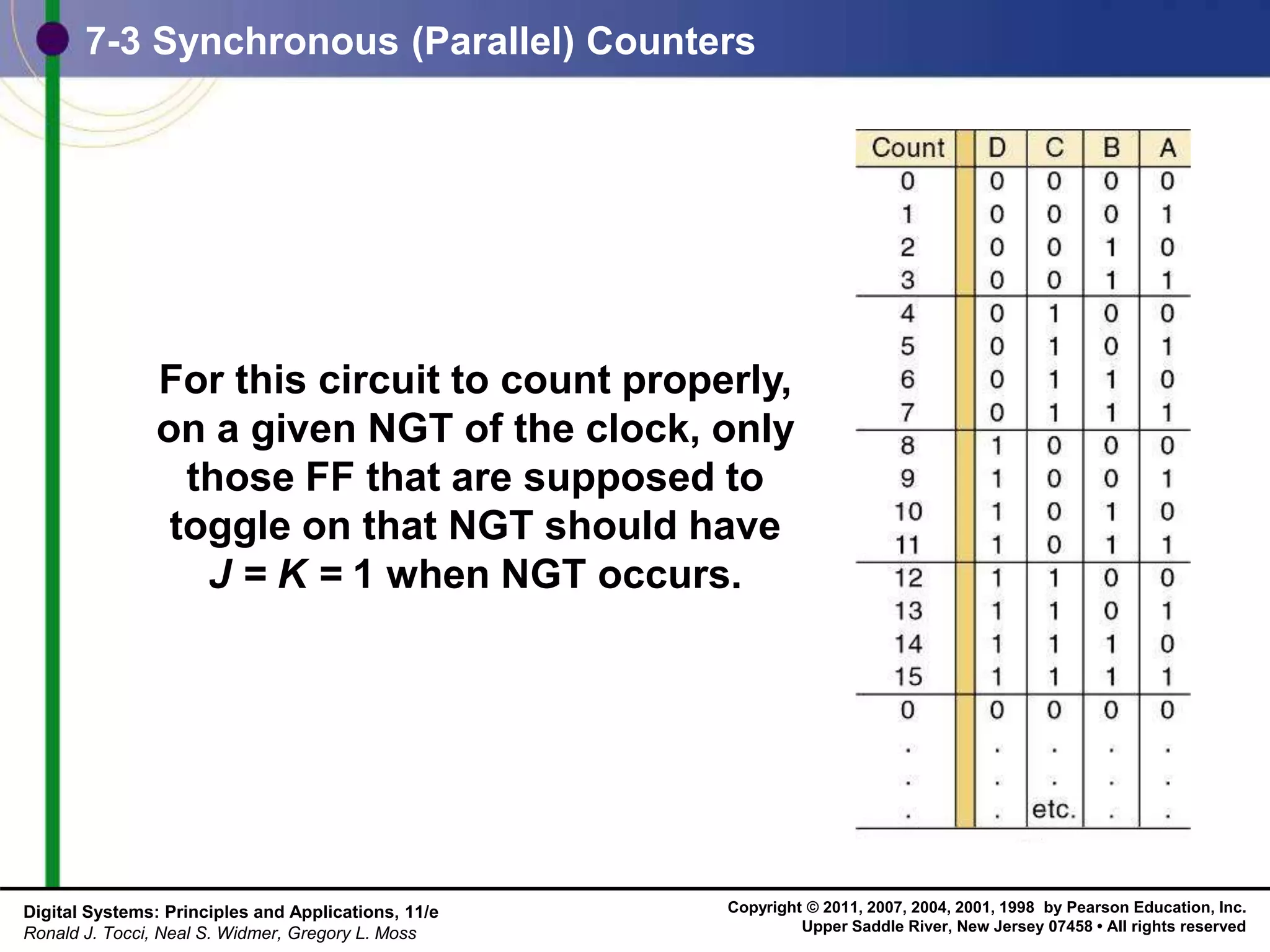
For this circuit to count properly,
on a given NGT of the clock, only
those FF that are supposed to
toggle on that NGT should have
J = K = 1 when NGT occurs.
Copyright © 2011, 2007, 2004, 2001, 1998 by Pearson Education, Inc.
Upper Saddle River, New Jersey 07458 • All rights reserved
Digital Systems: Principles and Applications, 11/e
Ronald J. Tocci, Neal S. Widmer, Gregory L. Moss
• The basic synchronous counter shown is limited
to MOD numbers that are equal to 2N.
– Where N is the number of FFs.
7-4 Counters with MOD Number <2N
Copyright © 2011, 2007, 2004, 2001, 1998 by Pearson Education, Inc.
Upper Saddle River, New Jersey 07458 • All rights reserved
Digital Systems: Principles and Applications, 11/e
Ronald J. Tocci, Neal S. Widmer, Gregory L. Moss
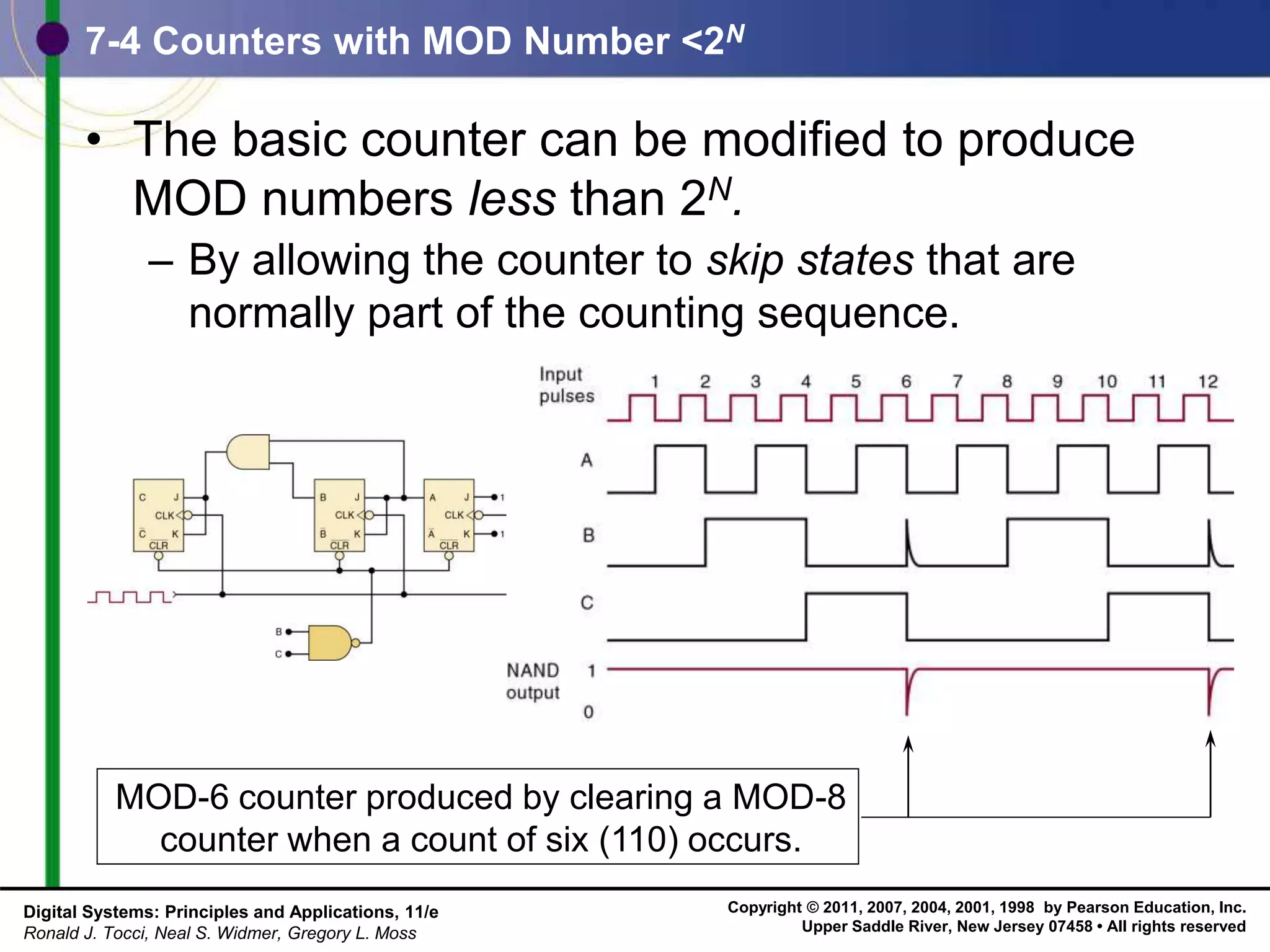
MOD-6 counter produced by clearing a MOD-8
counter when a count of six (110) occurs.
7-4 Counters with MOD Number <2N
• The basic counter can be modified to produce
MOD numbers less than 2N.
– By allowing the counter to skip states that are
normally part of the counting sequence.
7-4 Counters with MOD Number <2N
Copyright © 2011, 2007, 2004, 2001, 1998 by Pearson Education, Inc.
Upper Saddle River, New Jersey 07458 • All rights reserved
Digital Systems: Principles and Applications, 11/e
Ronald J. Tocci, Neal S. Widmer, Gregory L. Moss
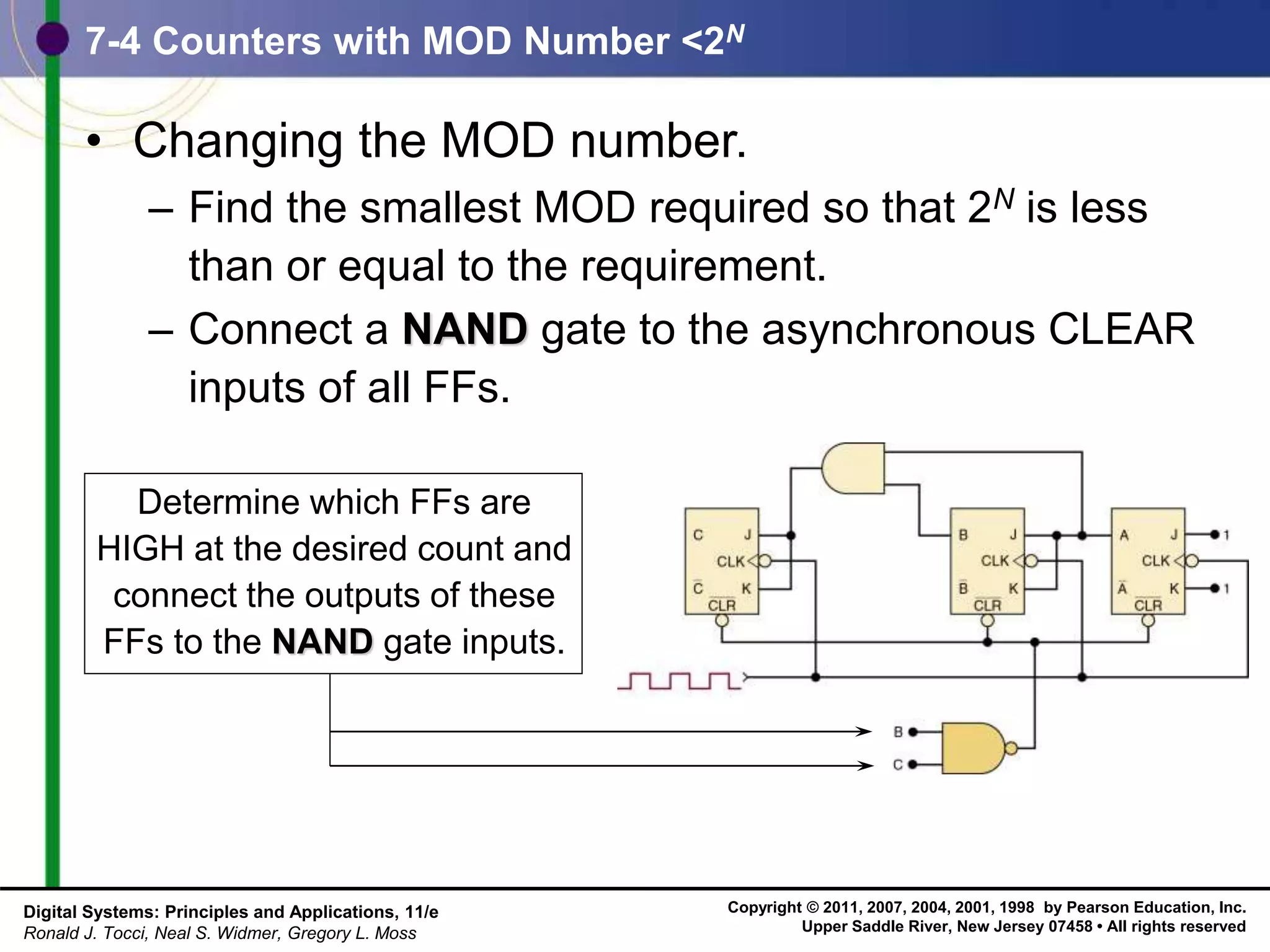
• Changing the MOD number.
– Find the smallest MOD required so that 2N is less
than or equal to the requirement.
– Connect a NAND gate to the asynchronous CLEAR
inputs of all FFs.
7-4 Counters with MOD Number <2N
Determine which FFs are
HIGH at the desired count and
connect the outputs of these
FFs to the NAND gate inputs.
Copyright © 2011, 2007, 2004, 2001, 1998 by Pearson Education, Inc.
Upper Saddle River, New Jersey 07458 • All rights reserved
Digital Systems: Principles and Applications, 11/e
Ronald J. Tocci, Neal S. Widmer, Gregory L. Moss
7-4 Counters with MOD Number < 2N
State transition diagram for the MOD-6 counter
7-4 Counters with MOD Number <2N
Each circle represents one of
the possible counter states.
Arrows indicate how one state
changes to another—in response
to an input clock pulse.
There is no arrow to the 111
state as the counter can never
advance to that state.
The 111 state can occur
on power-up when the FFs
come up in random states.
Copyright © 2011, 2007, 2004, 2001, 1998 by Pearson Education, Inc.
Upper Saddle River, New Jersey 07458 • All rights reserved
Digital Systems: Principles and Applications, 11/e
Ronald J. Tocci, Neal S. Widmer, Gregory L. Moss
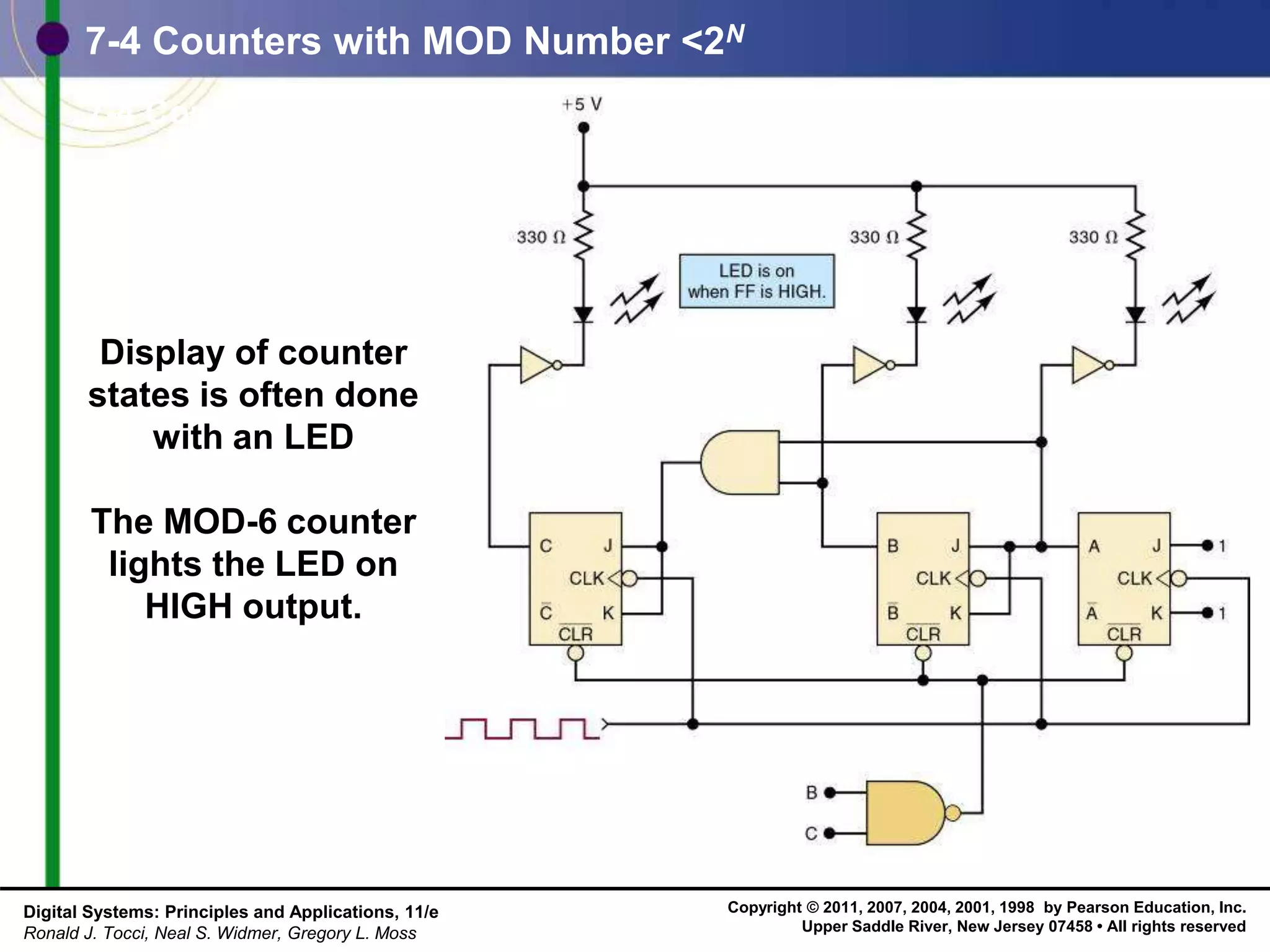
7-4 Counters with MOD Number < 2N
Display of counter
states is often done
with an LED
The MOD-6 counter
lights the LED on
HIGH output.
7-4 Counters with MOD Number <2N
Copyright © 2011, 2007, 2004, 2001, 1998 by Pearson Education, Inc.
Upper Saddle River, New Jersey 07458 • All rights reserved
Digital Systems: Principles and Applications, 11/e
Ronald J. Tocci, Neal S. Widmer, Gregory L. Moss
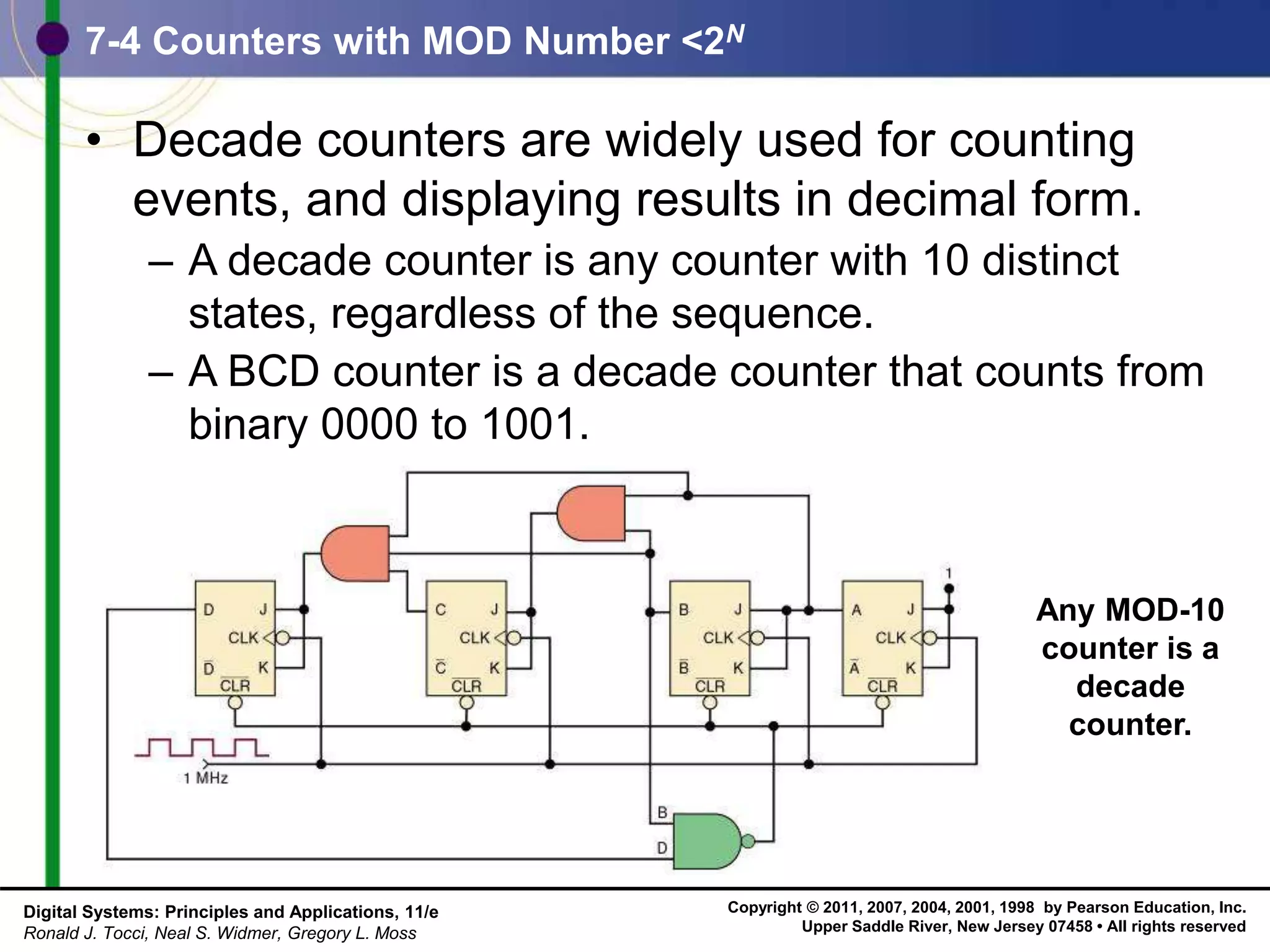
• Decade counters are widely used for counting
events, and displaying results in decimal form.
– A decade counter is any counter with 10 distinct
states, regardless of the sequence.
– A BCD counter is a decade counter that counts from
binary 0000 to 1001.
7-4 Counters with MOD Number <2N
Any MOD-10
counter is a
decade
counter.
Copyright © 2011, 2007, 2004, 2001, 1998 by Pearson Education, Inc.
Upper Saddle River, New Jersey 07458 • All rights reserved
Digital Systems: Principles and Applications, 11/e
Ronald J. Tocci, Neal S. Widmer, Gregory L. Moss
Mod-60 Counter
7-4 Counters with MOD Number <2N
Copyright © 2011, 2007, 2004, 2001, 1998 by Pearson Education, Inc.
Upper Saddle River, New Jersey 07458 • All rights reserved
Digital Systems: Principles and Applications, 11/e
Ronald J. Tocci, Neal S. Widmer, Gregory L. Moss
7-5 Synchronous Down and Up/Down Counters
• A synchronous down counter is constructed in a
similar manner to an up counter.
– It uses the inverted FF outputs to control the higher-
order J, K inputs.
Synchronous, MOD-16,
down counter and
output waveforms.
Copyright © 2011, 2007, 2004, 2001, 1998 by Pearson Education, Inc.
Upper Saddle River, New Jersey 07458 • All rights reserved
Digital Systems: Principles and Applications, 11/e
Ronald J. Tocci, Neal S. Widmer, Gregory L. Moss
7-5 Synchronous Down and Up/Down Counters
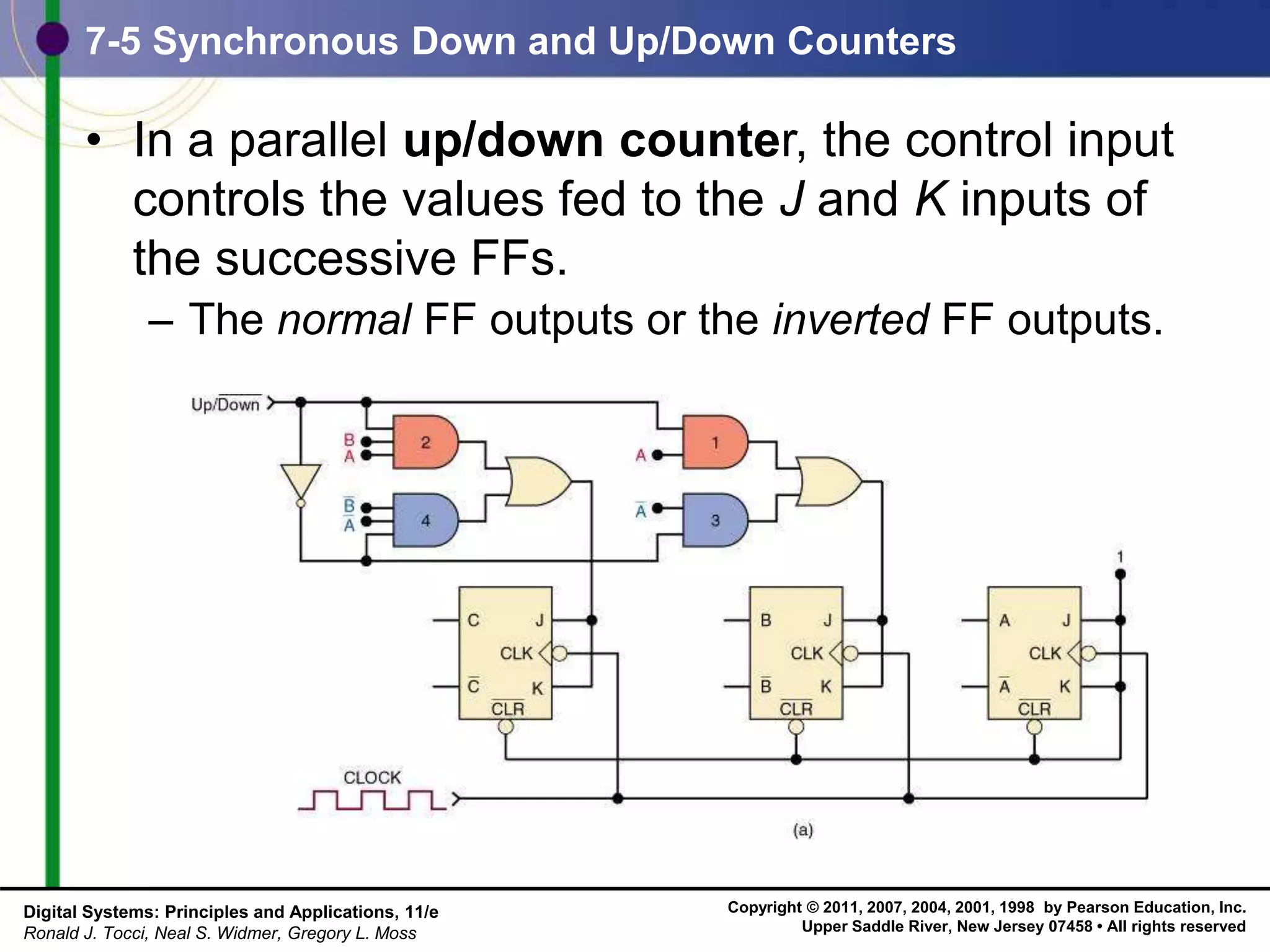
• In a parallel up/down counter, the control input
controls the values fed to the J and K inputs of
the successive FFs.
– The normal FF outputs or the inverted FF outputs.
Copyright © 2011, 2007, 2004, 2001, 1998 by Pearson Education, Inc.
Upper Saddle River, New Jersey 07458 • All rights reserved
Digital Systems: Principles and Applications, 11/e
Ronald J. Tocci, Neal S. Widmer, Gregory L. Moss
• For the first five clock pulses,
– The counter counts up.
Up/Down = 1.
7-5 Synchronous Down and Up/Down Counters
• For the last five pulses,
– The counter counts down.
Up/Down = 0.
Copyright © 2011, 2007, 2004, 2001, 1998 by Pearson Education, Inc.
Upper Saddle River, New Jersey 07458 • All rights reserved
Digital Systems: Principles and Applications, 11/e
Ronald J. Tocci, Neal S. Widmer, Gregory L. Moss
7-5 Synchronous Down and Up/Down Counters
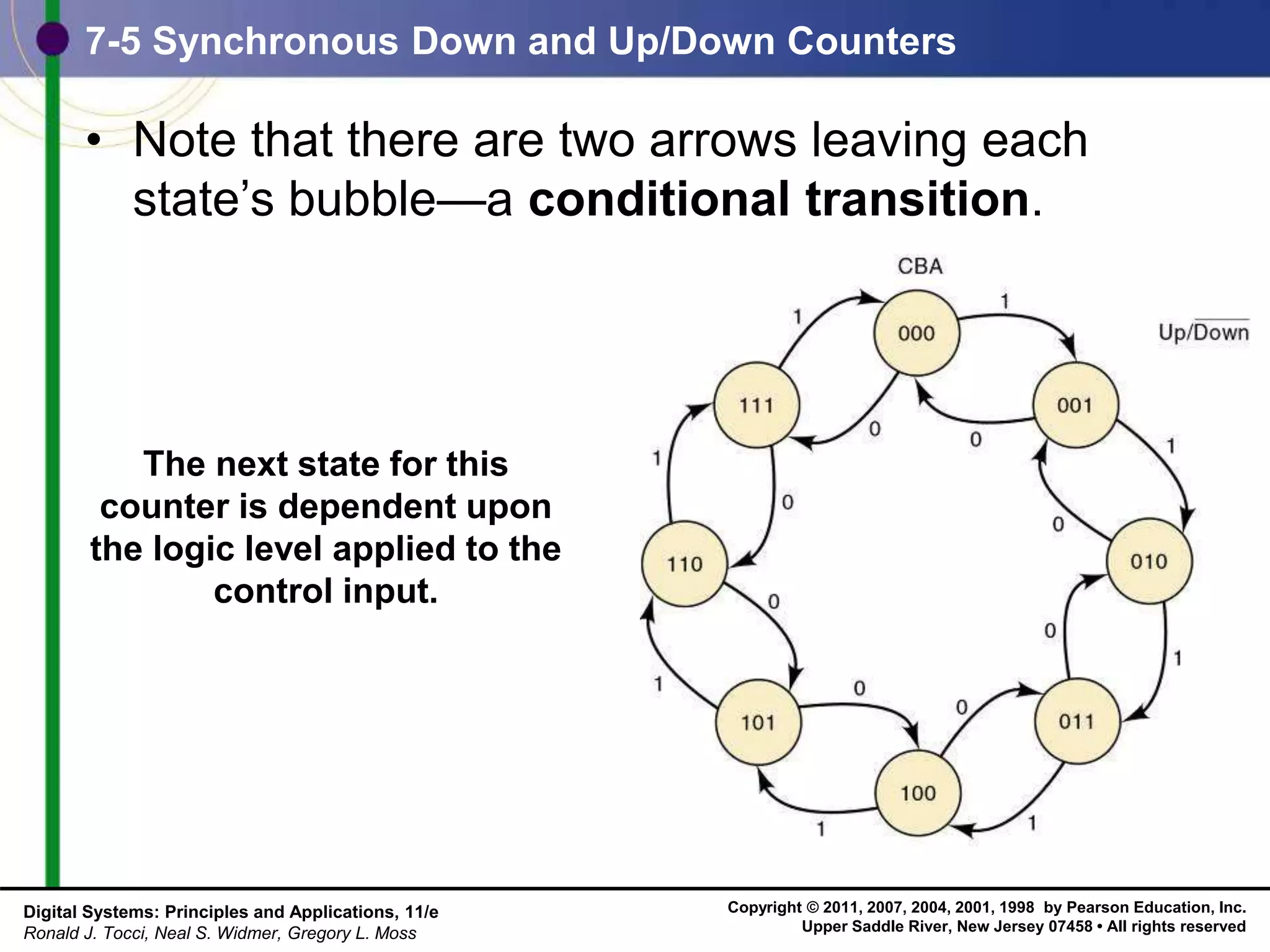
• Note that there are two arrows leaving each
state’s bubble—a conditional transition.
The next state for this
counter is dependent upon
the logic level applied to the
control input.
Copyright © 2011, 2007, 2004, 2001, 1998 by Pearson Education, Inc.
Upper Saddle River, New Jersey 07458 • All rights reserved
Digital Systems: Principles and Applications, 11/e
Ronald J. Tocci, Neal S. Widmer, Gregory L. Moss
7-6 Presettable Counters
• A presettable counter can be set to any desired
starting point—synchronously or asynchronously.
– Preset is also called parallel loading the counter.
Synchronous
counter with
asynchronous
parallel load.
Parallel data inputs
Copyright © 2011, 2007, 2004, 2001, 1998 by Pearson Education, Inc.
Upper Saddle River, New Jersey 07458 • All rights reserved
Digital Systems: Principles and Applications, 11/e
Ronald J. Tocci, Neal S. Widmer, Gregory L. Moss
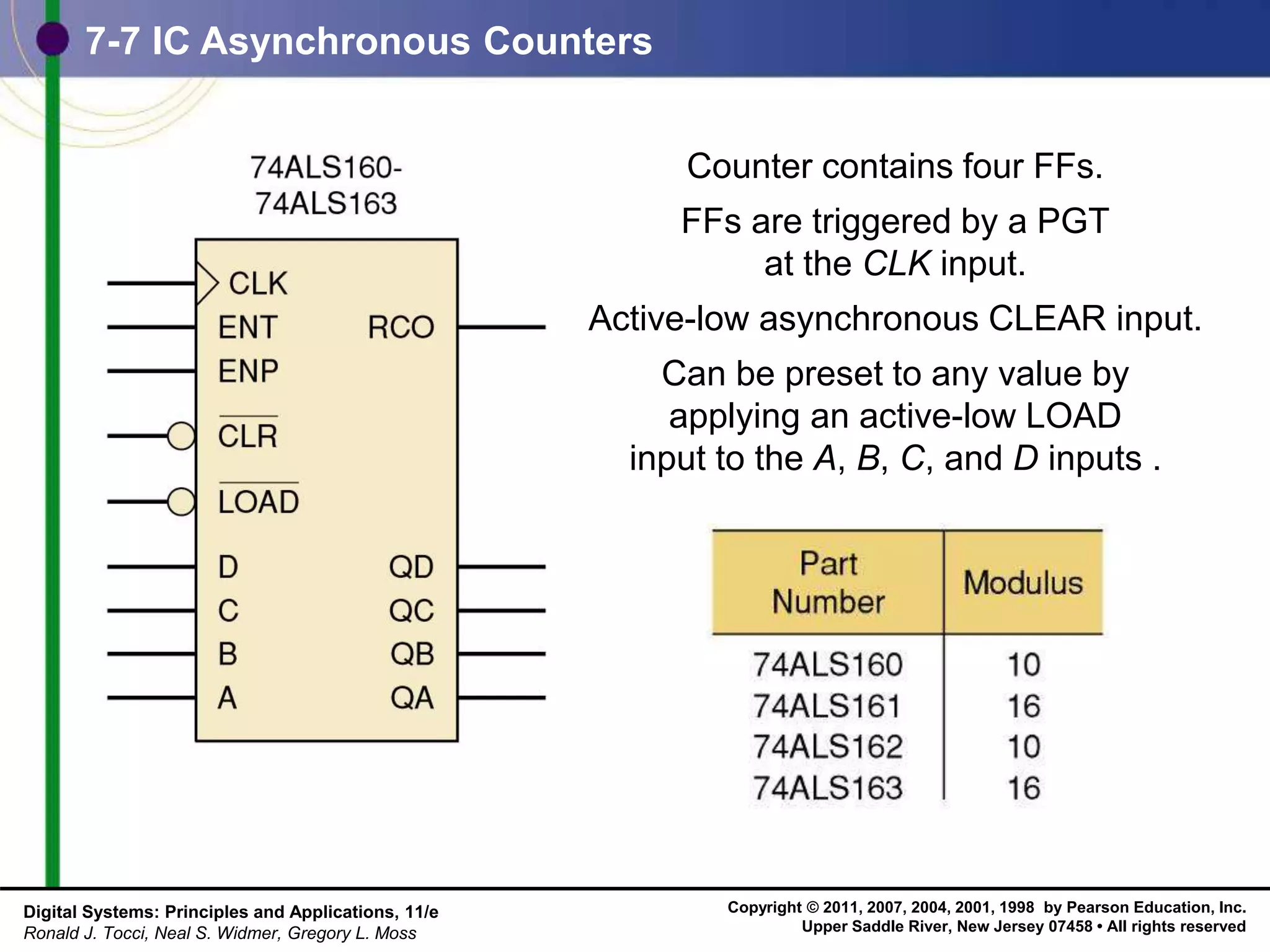
7-7 IC Asynchronous Counters
Counter contains four FFs.
FFs are triggered by a PGT
at the CLK input.
Active-low asynchronous CLEAR input.
Can be preset to any value by
applying an active-low LOAD
input to the A, B, C, and D inputs .
Copyright © 2011, 2007, 2004, 2001, 1998 by Pearson Education, Inc.
Upper Saddle River, New Jersey 07458 • All rights reserved
Digital Systems: Principles and Applications, 11/e
Ronald J. Tocci, Neal S. Widmer, Gregory L. Moss
7-7 IC Asynchronous Counters
This series of IC counter chips has
one more output pin—RCO—an
active-HIGH output is to detect
(decode) the last or terminal
state of the counter.
Very useful in connecting two
or more counter chips in a
multistage arrangement to
create larger counters.
Copyright © 2011, 2007, 2004, 2001, 1998 by Pearson Education, Inc.
Upper Saddle River, New Jersey 07458 • All rights reserved
Digital Systems: Principles and Applications, 11/e
Ronald J. Tocci, Neal S. Widmer, Gregory L. Moss
7-7 IC Asynchronous Counters
TTL 74ALS160 – 74ALS163 Function Table
Copyright © 2011, 2007, 2004, 2001, 1998 by Pearson Education, Inc.
Upper Saddle River, New Jersey 07458 • All rights reserved
Digital Systems: Principles and Applications, 11/e
Ronald J. Tocci, Neal S. Widmer, Gregory L. Moss
7-7 IC Asynchronous Counters
74ALS190 and 74ALS191 series ICs
are recycling, four-bit counters.
Copyright © 2011, 2007, 2004, 2001, 1998 by Pearson Education, Inc.
Upper Saddle River, New Jersey 07458 • All rights reserved
Digital Systems: Principles and Applications, 11/e
Ronald J. Tocci, Neal S. Widmer, Gregory L. Moss
7-7 IC Asynchronous Counters
• Many standard IC counters have been designed to
make it easy to connect multiple chips to create
circuits with a higher counting range.
– A multistage or cascading arrangement.
74ALS163s in a two-stage arrangement to extend the maximum counting range.
Copyright © 2011, 2007, 2004, 2001, 1998 by Pearson Education, Inc.
Upper Saddle River, New Jersey 07458 • All rights reserved
Digital Systems: Principles and Applications, 11/e
Ronald J. Tocci, Neal S. Widmer, Gregory L. Moss
• Digital counters are often used in applications
where the count represented by FF states must
somehow be determined or displayed.
– One of the simplest means for displaying contents
of a counter is connecting the FF output to an LED.
7-8 Decoding a Counter
Active-HIGH
decoder output.
The LED method becomes inconvenient as the
size (number of bits) of the counter increases.
It is much harder to decode the display mentally.
Copyright © 2011, 2007, 2004, 2001, 1998 by Pearson Education, Inc.
Upper Saddle River, New Jersey 07458 • All rights reserved
Digital Systems: Principles and Applications, 11/e
Ronald J. Tocci, Neal S. Widmer, Gregory L. Moss
• Decoding is the conversion of a binary output to
a decimal value—a form immediately recognized.
– The active-HIGH decoder shown can be used to light
an LED representing each decimal number 0 to 7.
7-8 Decoding a Counter
Copyright © 2011, 2007, 2004, 2001, 1998 by Pearson Education, Inc.
Upper Saddle River, New Jersey 07458 • All rights reserved
Digital Systems: Principles and Applications, 11/e
Ronald J. Tocci, Neal S. Widmer, Gregory L. Moss
7-8 Decoding a Counter
MOD-8
Active-HIGH
decoder output.
• Decoding is the conversion of a binary output to
a decimal value—a form immediately recognized.
Copyright © 2011, 2007, 2004, 2001, 1998 by Pearson Education, Inc.
Upper Saddle River, New Jersey 07458 • All rights reserved
Digital Systems: Principles and Applications, 11/e
Ronald J. Tocci, Neal S. Widmer, Gregory L. Moss
The active-HIGH decoder shown can
be changed to an active-LOW type.
7-8 Decoding a Counter
Active-LOW decoding is obtained by
replacing the AND gates with NAND gates.
The decoder outputs now produce a normally
HIGH signal, which goes LOW only when
the number being decoded occurs.
Copyright © 2011, 2007, 2004, 2001, 1998 by Pearson Education, Inc.
Upper Saddle River, New Jersey 07458 • All rights reserved
Digital Systems: Principles and Applications, 11/e
Ronald J. Tocci, Neal S. Widmer, Gregory L. Moss
7-8 Decoding a Counter
• A BCD counter has 10 states, decoded to provide
10 outputs corresponding to decimal digits 0 – 9.
– Represented by the states of the counter FFs.
Instead of 10 separate LEDs,
BCD counters usually have
their count displayed on
a single display device.
– The 10 outputs can control 10 individual indicator
LEDs for a visual display.
Copyright © 2011, 2007, 2004, 2001, 1998 by Pearson Education, Inc.
Upper Saddle River, New Jersey 07458 • All rights reserved
Digital Systems: Principles and Applications, 11/e
Ronald J. Tocci, Neal S. Widmer, Gregory L. Moss
7-9 Analyzing Synchronous Counters
Synchronous up counter.
Control input
expressions.
Copyright © 2011, 2007, 2004, 2001, 1998 by Pearson Education, Inc.
Upper Saddle River, New Jersey 07458 • All rights reserved
Digital Systems: Principles and Applications, 11/e
Ronald J. Tocci, Neal S. Widmer, Gregory L. Moss
7-9 Analyzing Synchronous Counters
• Synchronous counters can be custom-designed
to generate any desired count sequence.
Synchronous
up-counter.
Control input
expressions.
Copyright © 2011, 2007, 2004, 2001, 1998 by Pearson Education, Inc.
Upper Saddle River, New Jersey 07458 • All rights reserved
Digital Systems: Principles and Applications, 11/e
Ronald J. Tocci, Neal S. Widmer, Gregory L. Moss
7-9 Analyzing Synchronous Counters
• Analyze counter designs of this type by predicting
FF control inputs for each state of the counter.
– A PRESENT state/NEXT state table is very useful
for this purpose.
Copyright © 2011, 2007, 2004, 2001, 1998 by Pearson Education, Inc.
Upper Saddle River, New Jersey 07458 • All rights reserved
Digital Systems: Principles and Applications, 11/e
Ronald J. Tocci, Neal S. Widmer, Gregory L. Moss
7-9 Analyzing Synchronous Counters
Synchronous up counter state
transition diagram and waveform.
Highlighted information
indicates this counter
design is self-correcting.
Copyright © 2011, 2007, 2004, 2001, 1998 by Pearson Education, Inc.
Upper Saddle River, New Jersey 07458 • All rights reserved
Digital Systems: Principles and Applications, 11/e
Ronald J. Tocci, Neal S. Widmer, Gregory L. Moss
7-9 Analyzing Synchronous Counters
Synchronous counter built using D-type FFs.
Control circuitry will typically
be more complex than an
equivalent JK-type counter,
The number of
synchronous
inputs to control
is reduced by half
Copyright © 2011, 2007, 2004, 2001, 1998 by Pearson Education, Inc.
Upper Saddle River, New Jersey 07458 • All rights reserved
Digital Systems: Principles and Applications, 11/e
Ronald J. Tocci, Neal S. Widmer, Gregory L. Moss
7-10 Synchronous Counter Design
• Common design method using J-K flip-flops in
a synchronous counter configuration.
– Determine the desired number of bits (FFs) and the
desired counting sequence.
– Draw the state transition diagram showing all possible
states—including those not part of the desired
counting sequence.
– Use the state transition diagram to set up a table that
lists all PRESENT states and their NEXT states.
– Add a column for each J and K input & indicate levels
required to produce transition to the NEXT state.
– Design the logic circuits to generate levels required at
each input, and implement the final expressions.
Copyright © 2011, 2007, 2004, 2001, 1998 by Pearson Education, Inc.
Upper Saddle River, New Jersey 07458 • All rights reserved
Digital Systems: Principles and Applications, 11/e
Ronald J. Tocci, Neal S. Widmer, Gregory L. Moss
7-10 Synchronous Counter Design
• A stepper motor rotates in steps, not continuous
motion—typically 15 degrees per step.
– A practical application of synchronous counter design.
• Reversible, depending on output level.
Copyright © 2011, 2007, 2004, 2001, 1998 by Pearson Education, Inc.
Upper Saddle River, New Jersey 07458 • All rights reserved
Digital Systems: Principles and Applications, 11/e
Ronald J. Tocci, Neal S. Widmer, Gregory L. Moss
7-10 Synchronous Counter Design
• A stepper motor rotates in steps, not continuous
motion—typically 15 degrees per step.
– A practical application of synchronous counter design.
• Reversible, depending on output level.
Copyright © 2011, 2007, 2004, 2001, 1998 by Pearson Education, Inc.
Upper Saddle River, New Jersey 07458 • All rights reserved
Digital Systems: Principles and Applications, 11/e
Ronald J. Tocci, Neal S. Widmer, Gregory L. Moss
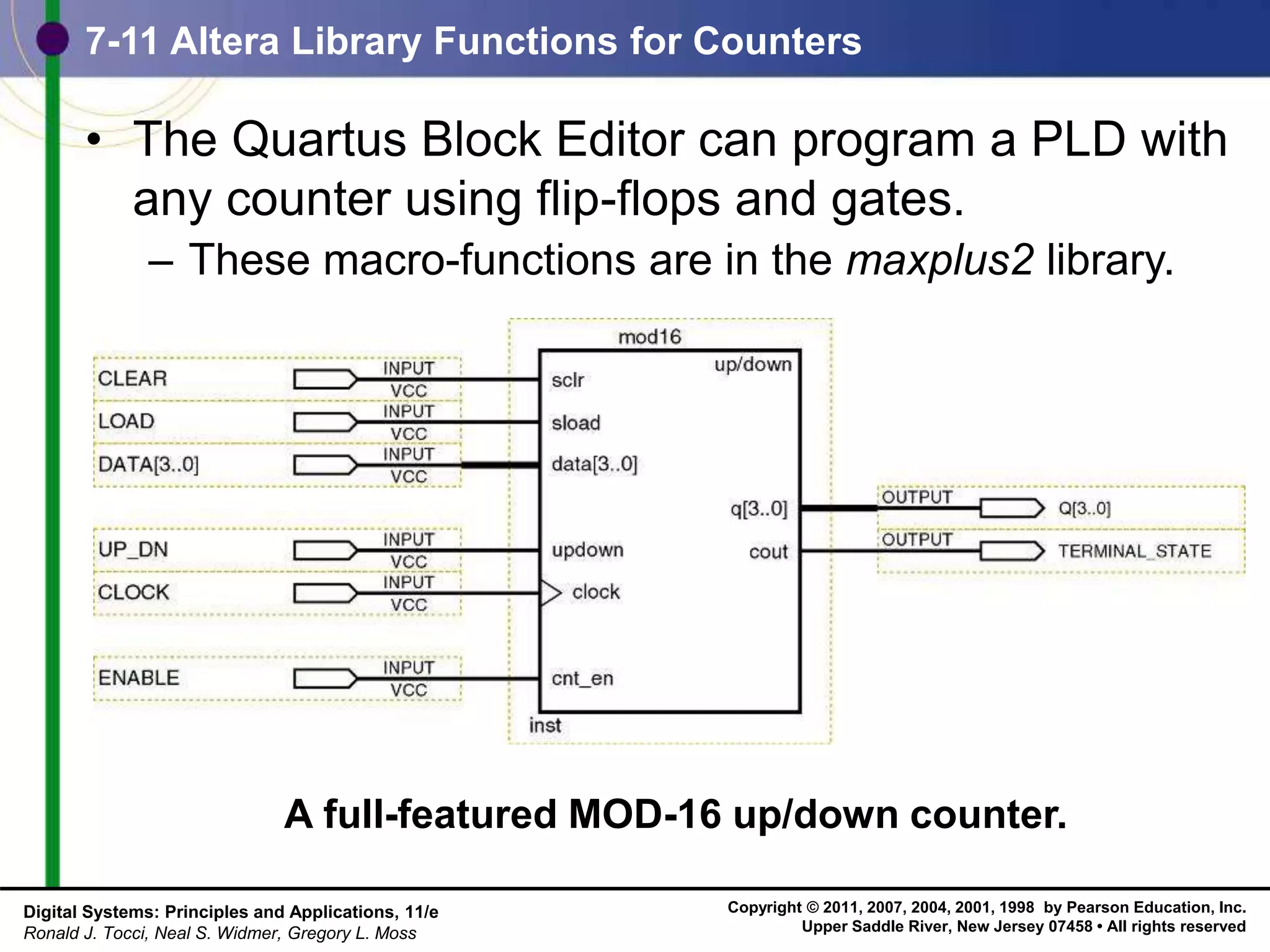
7-11 Altera Library Functions for Counters
• The Quartus Block Editor can program a PLD with
any counter using flip-flops and gates.
– These macro-functions are in the maxplus2 library.
A full-featured MOD-16 up/down counter.
Copyright © 2011, 2007, 2004, 2001, 1998 by Pearson Education, Inc.
Upper Saddle River, New Jersey 07458 • All rights reserved
Digital Systems: Principles and Applications, 11/e
Ronald J. Tocci, Neal S. Widmer, Gregory L. Moss
7-11 Altera Library Functions for Counters
Digital clock hours counter—block diagram,
MegaWizard settings & simulation results.
Copyright © 2011, 2007, 2004, 2001, 1998 by Pearson Education, Inc.
Upper Saddle River, New Jersey 07458 • All rights reserved
Digital Systems: Principles and Applications, 11/e
Ronald J. Tocci, Neal S. Widmer, Gregory L. Moss
7-12 HDL Counters
• Methods to describe counter circuits using HDL
primarily use synchronous techniques.
– All flip-flops update simultaneously in response to
the same clock event.
– All bits in a count sequence go from their PRESENT
state to their prescribed NEXT state simultaneously,
• State Transition Description Methods
– The PRESENTstate/NEXT state table is the
equivalent of the truth table.
Copyright © 2011, 2007, 2004, 2001, 1998 by Pearson Education, Inc.
Upper Saddle River, New Jersey 07458 • All rights reserved
Digital Systems: Principles and Applications, 11/e
Ronald J. Tocci, Neal S. Widmer, Gregory L. Moss
7-12 HDL Counters
• State descriptions in AHDL
– The first important step is to declare the counter
output pins properly— as a bit array.
Copyright © 2011, 2007, 2004, 2001, 1998 by Pearson Education, Inc.
Upper Saddle River, New Jersey 07458 • All rights reserved
Digital Systems: Principles and Applications, 11/e
Ronald J. Tocci, Neal S. Widmer, Gregory L. Moss
7-12 HDL Counters
• State descriptions in AHDL
The current state of the counter is evaluated (count[ ].q)
on line 11, and if it is less than the highest desired count
value, it uses the description count[ ].d count.q + 1 (line 12).
Copyright © 2011, 2007, 2004, 2001, 1998 by Pearson Education, Inc.
Upper Saddle River, New Jersey 07458 • All rights reserved
Digital Systems: Principles and Applications, 11/e
Ronald J. Tocci, Neal S. Widmer, Gregory L. Moss
7-12 HDL Counters
• State descriptions in AHDL
When the counter has reached the highest desired state
(or higher), the IF statement test will be false, resulting in a
NEXT-state input value of zero, which recycles the counter.
Copyright © 2011, 2007, 2004, 2001, 1998 by Pearson Education, Inc.
Upper Saddle River, New Jersey 07458 • All rights reserved
Digital Systems: Principles and Applications, 11/e
Ronald J. Tocci, Neal S. Widmer, Gregory L. Moss
7-13 Wiring HDL Modules Together
• Designing large digital systems is much easier if
the system is subdivided into smaller, manageable
modules that are interconnected.
– The essence of the concept of hierarchical design.
• Consider a recycling, MOD-100 BCD counter
with a synchronous clear.
– Creating a MOD-10 BCD counter module, cascading
synchronously two of thesein a higher-level design
file is the easiest way to do this.
Copyright © 2011, 2007, 2004, 2001, 1998 by Pearson Education, Inc.
Upper Saddle River, New Jersey 07458 • All rights reserved
Digital Systems: Principles and Applications, 11/e
Ronald J. Tocci, Neal S. Widmer, Gregory L. Moss
7-13 Wiring HDL Modules Together
Block diagram design and simulation
results for MOD-100 BCD counter design.
Copyright © 2011, 2007, 2004, 2001, 1998 by Pearson Education, Inc.
Upper Saddle River, New Jersey 07458 • All rights reserved
Digital Systems: Principles and Applications, 11/e
Ronald J. Tocci, Neal S. Widmer, Gregory L. Moss
7-13 Wiring HDL Modules Together
• Decoding the AHDL MOD-5 counter
Copyright © 2011, 2007, 2004, 2001, 1998 by Pearson Education, Inc.
Upper Saddle River, New Jersey 07458 • All rights reserved
Digital Systems: Principles and Applications, 11/e
Ronald J. Tocci, Neal S. Widmer, Gregory L. Moss
7-14 State Machines
• The term state machine refers to a circuit that
sequences through a set of predetermined states.
– Controlled by a clock and other input signals.
• The term counter is used for sequential circuits
that have a regular numeric count sequence.
– The things that are counted are actually clock pulses.
• But the pulses may represent many kinds of events.
• The general distinction between the two terms:
– A counter is commonly used to count events,
– A state machine is commonly used to control events.
Copyright © 2011, 2007, 2004, 2001, 1998 by Pearson Education, Inc.
Upper Saddle River, New Jersey 07458 • All rights reserved
Digital Systems: Principles and Applications, 11/e
Ronald J. Tocci, Neal S. Widmer, Gregory L. Moss
7-14 State Machines
Block diagram for counters and state machines.
Copyright © 2011, 2007, 2004, 2001, 1998 by Pearson Education, Inc.
Upper Saddle River, New Jersey 07458 • All rights reserved
Digital Systems: Principles and Applications, 11/e
Ronald J. Tocci, Neal S. Widmer, Gregory L. Moss
7-14 State Machines
Traffic light controller state machine.
Copyright © 2011, 2007, 2004, 2001, 1998 by Pearson Education, Inc.
Upper Saddle River, New Jersey 07458 • All rights reserved
Digital Systems: Principles and Applications, 11/e
Ronald J. Tocci, Neal S. Widmer, Gregory L. Moss
7-15 Register Data Transfer
• The various types of registers can be classified
according to…
– The manner in which data can be entered into the
register for storage.
– The manner in which data are outputted from the
register.
• Serial data flow through a register is generally
called shifting—either to the left or to the right.
– Serial output data fed back to the input of the same
register is called a data rotate.
• Parallel inputting of data is often described as a
register load.
Copyright © 2011, 2007, 2004, 2001, 1998 by Pearson Education, Inc.
Upper Saddle River, New Jersey 07458 • All rights reserved
Digital Systems: Principles and Applications, 11/e
Ronald J. Tocci, Neal S. Widmer, Gregory L. Moss
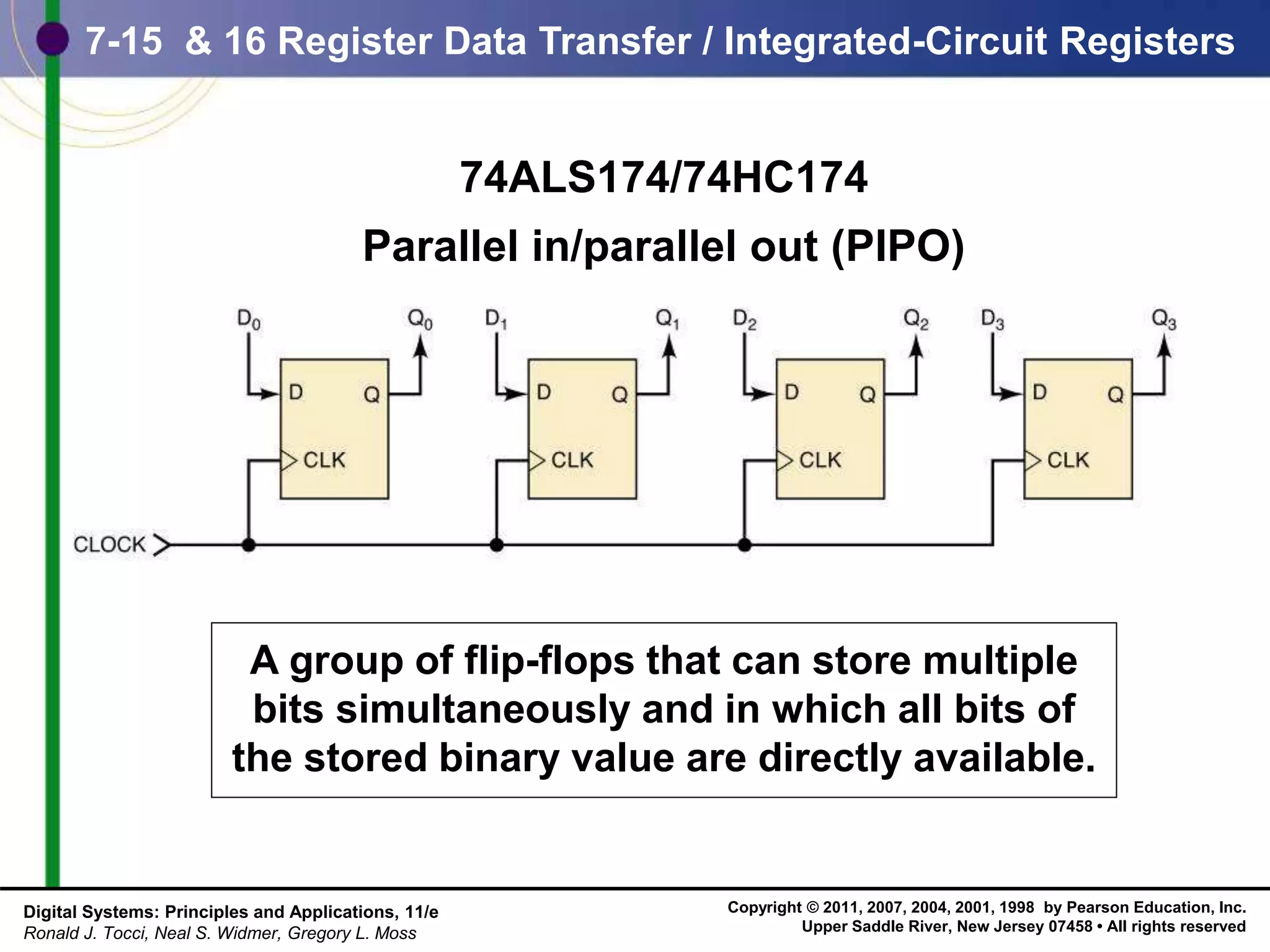
7-15 & 16 Register Data Transfer / Integrated-Circuit Registers
74ALS174/74HC174
Parallel in/parallel out (PIPO)
A group of flip-flops that can store multiple
bits simultaneously and in which all bits of
the stored binary value are directly available.
Copyright © 2011, 2007, 2004, 2001, 1998 by Pearson Education, Inc.
Upper Saddle River, New Jersey 07458 • All rights reserved
Digital Systems: Principles and Applications, 11/e
Ronald J. Tocci, Neal S. Widmer, Gregory L. Moss
7-15 & 16 Register Data Transfer / Integrated-Circuit Registers
74ALS174/74HC174
Copyright © 2011, 2007, 2004, 2001, 1998 by Pearson Education, Inc.
Upper Saddle River, New Jersey 07458 • All rights reserved
Digital Systems: Principles and Applications, 11/e
Ronald J. Tocci, Neal S. Widmer, Gregory L. Moss
7-15 & 16 Register Data Transfer / Integrated-Circuit Registers
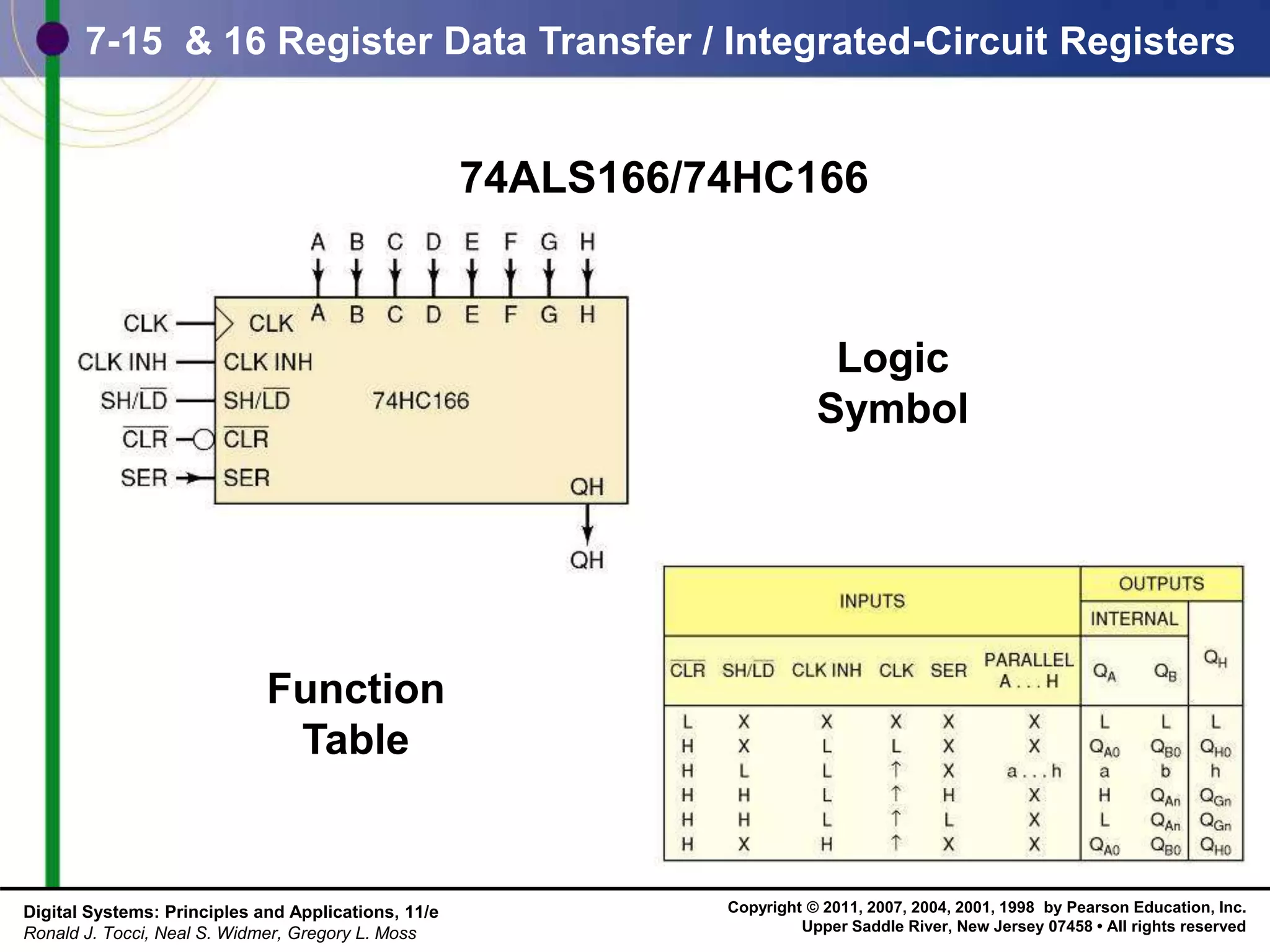
74ALS166/74HC166
Serial in/serial out (SISO)
Data loaded one bit at a time moves one bit at a time,
with each clock pulse through the flip-flops toward
the other end of the register, and exit one bit at
a time in the same order as originally loaded.
Copyright © 2011, 2007, 2004, 2001, 1998 by Pearson Education, Inc.
Upper Saddle River, New Jersey 07458 • All rights reserved
Digital Systems: Principles and Applications, 11/e
Ronald J. Tocci, Neal S. Widmer, Gregory L. Moss
7-15 & 16 Register Data Transfer / Integrated-Circuit Registers
74ALS166/74HC166
Circuit Diagram
Copyright © 2011, 2007, 2004, 2001, 1998 by Pearson Education, Inc.
Upper Saddle River, New Jersey 07458 • All rights reserved
Digital Systems: Principles and Applications, 11/e
Ronald J. Tocci, Neal S. Widmer, Gregory L. Moss
7-15 & 16 Register Data Transfer / Integrated-Circuit Registers
74ALS166/74HC166
Logic
Symbol
Function
Table
Copyright © 2011, 2007, 2004, 2001, 1998 by Pearson Education, Inc.
Upper Saddle River, New Jersey 07458 • All rights reserved
Digital Systems: Principles and Applications, 11/e
Ronald J. Tocci, Neal S. Widmer, Gregory L. Moss
7-15 & 16 Register Data Transfer / Integrated-Circuit Registers
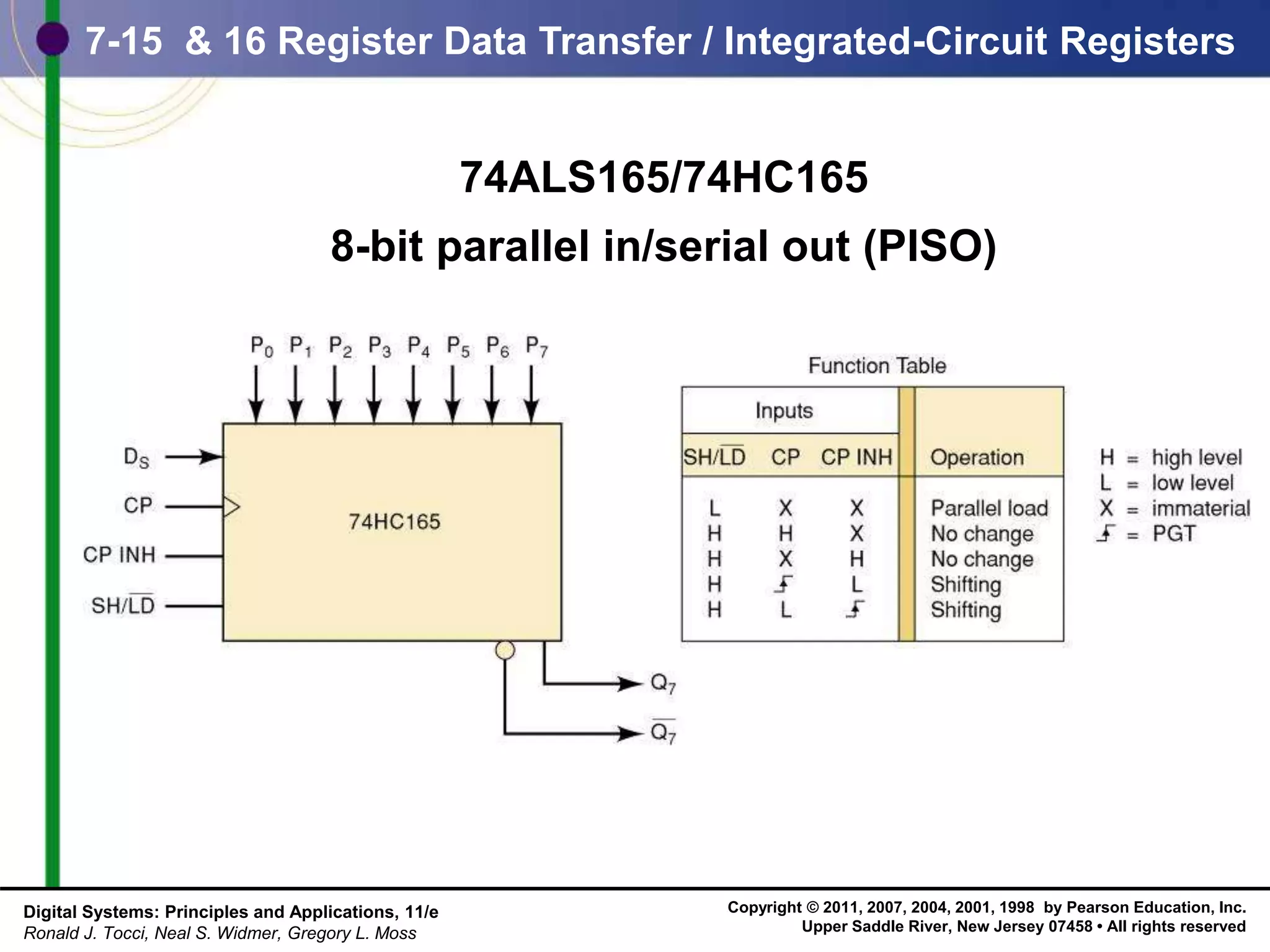
74ALS165/74HC165
8-bit parallel in/serial out (PISO)
Serial shifting is always synchronous, as the clock is
required to ensure the input data moves only one
bit at a time with each appropriate clocking edge.
Copyright © 2011, 2007, 2004, 2001, 1998 by Pearson Education, Inc.
Upper Saddle River, New Jersey 07458 • All rights reserved
Digital Systems: Principles and Applications, 11/e
Ronald J. Tocci, Neal S. Widmer, Gregory L. Moss
7-15 & 16 Register Data Transfer / Integrated-Circuit Registers
74ALS165/74HC165
8-bit parallel in/serial out (PISO)
Copyright © 2011, 2007, 2004, 2001, 1998 by Pearson Education, Inc.
Upper Saddle River, New Jersey 07458 • All rights reserved
Digital Systems: Principles and Applications, 11/e
Ronald J. Tocci, Neal S. Widmer, Gregory L. Moss
7-15 & 16 Register Data Transfer / Integrated-Circuit Registers
74ALS164/74HC164
8-bit serial in/parallel out (SIPO)
Copyright © 2011, 2007, 2004, 2001, 1998 by Pearson Education, Inc.
Upper Saddle River, New Jersey 07458 • All rights reserved
Digital Systems: Principles and Applications, 11/e
Ronald J. Tocci, Neal S. Widmer, Gregory L. Moss
7-15 & 16 Register Data Transfer / Integrated-Circuit Registers
74ALS164/74HC164
8-bit serial in/parallel out (SIPO)
Copyright © 2011, 2007, 2004, 2001, 1998 by Pearson Education, Inc.
Upper Saddle River, New Jersey 07458 • All rights reserved
Digital Systems: Principles and Applications, 11/e
Ronald J. Tocci, Neal S. Widmer, Gregory L. Moss
7-17 Shift Register Counters
• Shift-register counters use feedback—the output
of the last FF in the register is connected back to
the first FF in some way.
Copyright © 2011, 2007, 2004, 2001, 1998 by Pearson Education, Inc.
Upper Saddle River, New Jersey 07458 • All rights reserved
Digital Systems: Principles and Applications, 11/e
Ronald J. Tocci, Neal S. Widmer, Gregory L. Moss
7-17 Shift Register Counters
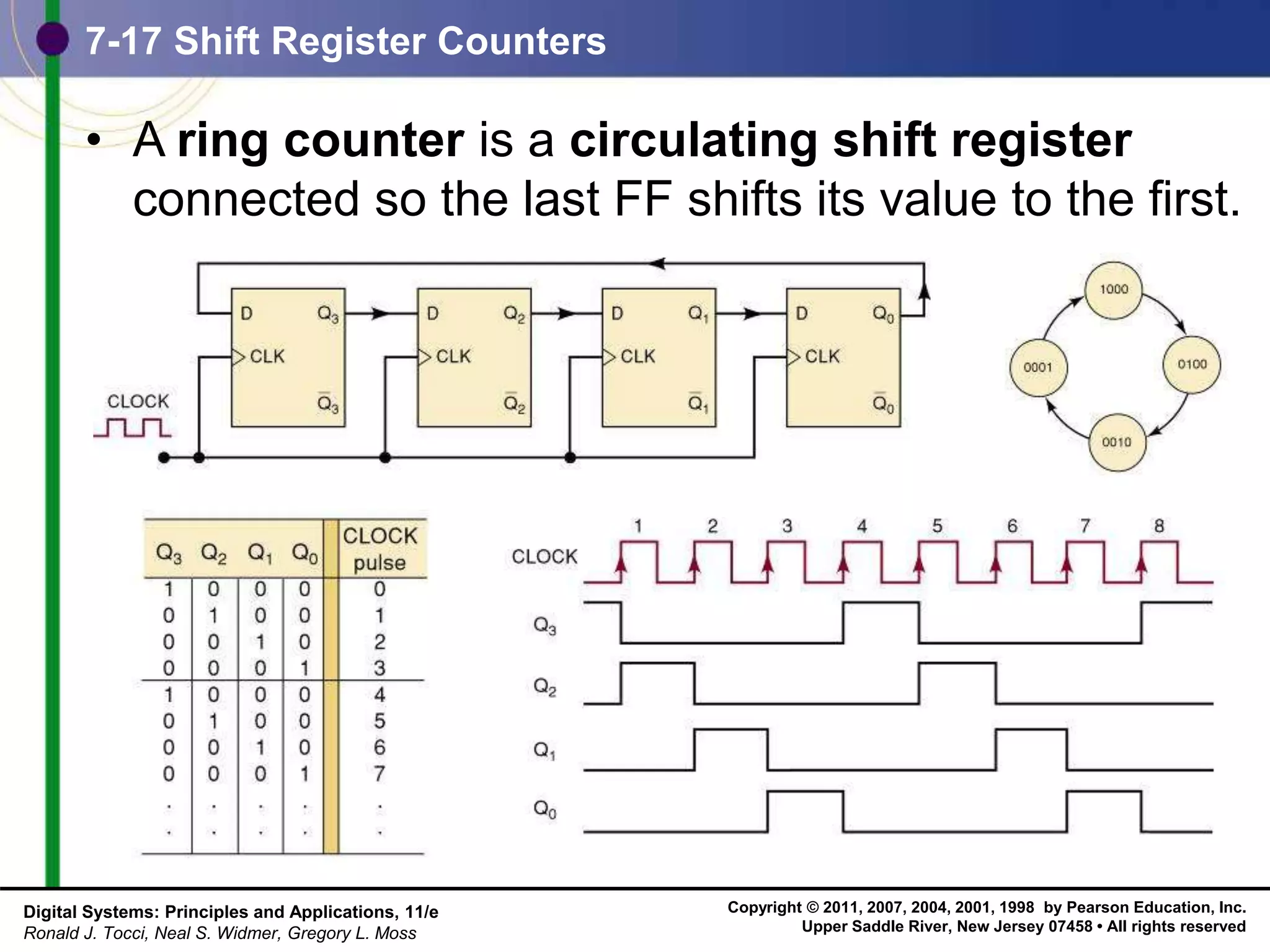
• A ring counter is a circulating shift register
connected so the last FF shifts its value to the first.
Copyright © 2011, 2007, 2004, 2001, 1998 by Pearson Education, Inc.
Upper Saddle River, New Jersey 07458 • All rights reserved
Digital Systems: Principles and Applications, 11/e
Ronald J. Tocci, Neal S. Widmer, Gregory L. Moss
7-17 Shift Register Counters
• To operate properly, a ring counter must start off
with only one FF in the 1 state and all the others in
the 0 state.
– As power-up starting states will be unpredictable, the
counter is preset before clock pulses are applied.
Circuit for ensuring the
ring counter starts in the
1000 state on power-up.
Copyright © 2011, 2007, 2004, 2001, 1998 by Pearson Education, Inc.
Upper Saddle River, New Jersey 07458 • All rights reserved
Digital Systems: Principles and Applications, 11/e
Ronald J. Tocci, Neal S. Widmer, Gregory L. Moss
7-17 Shift Register Counters
• In the Johnson or twisted-ring counter inverted
output of the last FF is connected to the input of
the first FF.
Copyright © 2011, 2007, 2004, 2001, 1998 by Pearson Education, Inc.
Upper Saddle River, New Jersey 07458 • All rights reserved
Digital Systems: Principles and Applications, 11/e
Ronald J. Tocci, Neal S. Widmer, Gregory L. Moss
7-17 Shift Register Counters
• For a given MOD number, a Johnson counter
requires only half the FFs a ring counter requires.
– It requires decoding gates—a ring counter does not.
• A Johnson counter uses one logic gate to decode
for each count.
– Each gate requires only two inputs, regardless of
the number of FFs in the counter.
Copyright © 2011, 2007, 2004, 2001, 1998 by Pearson Education, Inc.
Upper Saddle River, New Jersey 07458 • All rights reserved
Digital Systems: Principles and Applications, 11/e
Ronald J. Tocci, Neal S. Widmer, Gregory L. Moss
7-17 Shift Register Counters
• Very few ring counters or Johnson counters are
available as ICs.
– It is relatively simple to wire a shift-register IC as
either a ring counter or a Johnson counter.
• Some of the CMOS Johnson-counter ICs include
the complete decoding circuitry on the same chip
as the counter.
– (74HC4017, 74HC4022)
Copyright © 2011, 2007, 2004, 2001, 1998 by Pearson Education, Inc.
Upper Saddle River, New Jersey 07458 • All rights reserved
Digital Systems: Principles and Applications, 11/e
Ronald J. Tocci, Neal S. Widmer, Gregory L. Moss
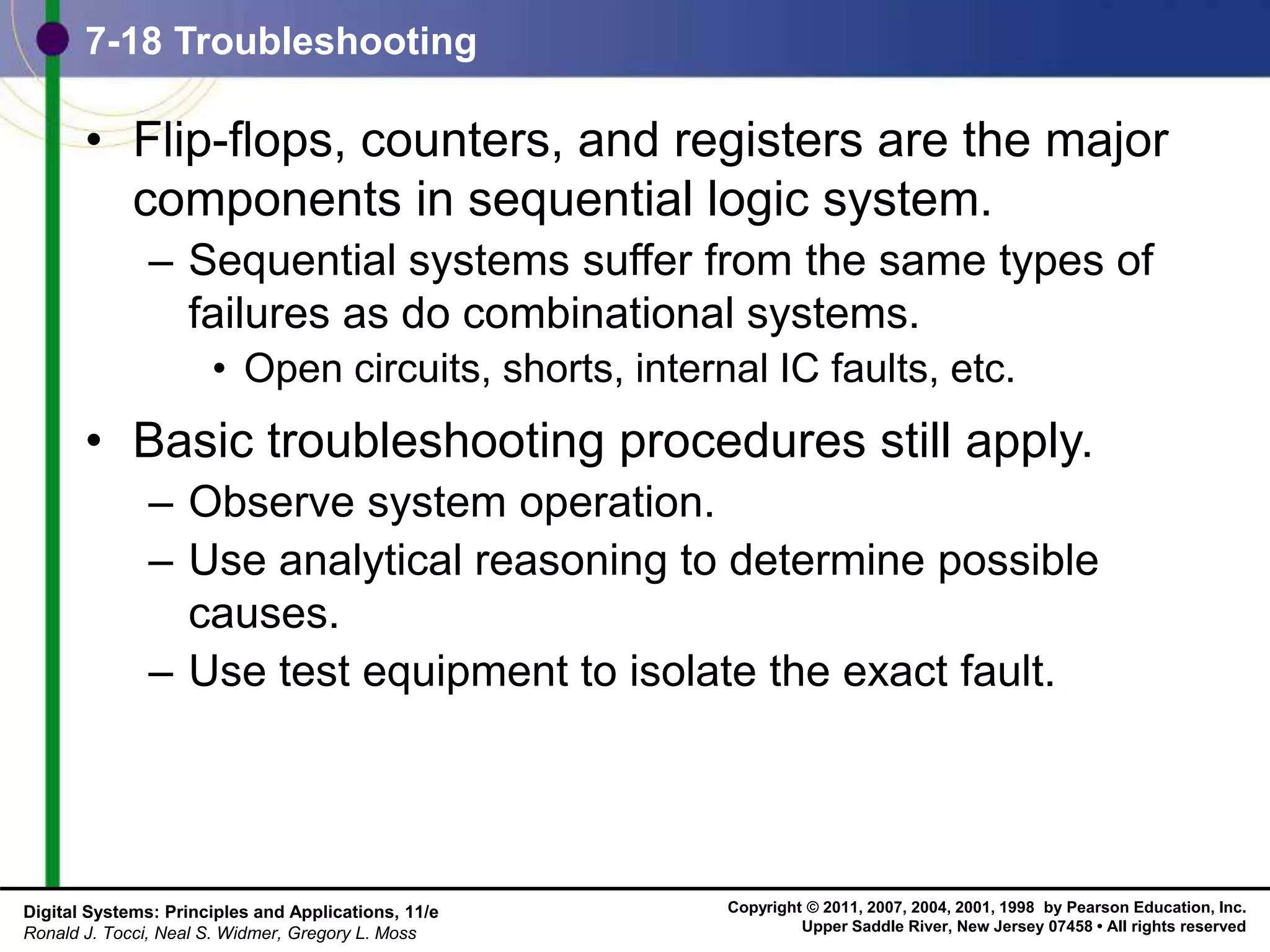
7-18 Troubleshooting
• Flip-flops, counters, and registers are the major
components in sequential logic system.
– Sequential systems suffer from the same types of
failures as do combinational systems.
• Open circuits, shorts, internal IC faults, etc.
• Basic troubleshooting procedures still apply.
– Observe system operation.
– Use analytical reasoning to determine possible
causes.
– Use test equipment to isolate the exact fault.
Copyright © 2011, 2007, 2004, 2001, 1998 by Pearson Education, Inc.
Upper Saddle River, New Jersey 07458 • All rights reserved
Digital Systems: Principles and Applications, 11/e
Ronald J. Tocci, Neal S. Widmer, Gregory L. Moss
7-20 HDL Registers
• HDL techniques use bit arrays to describe register
data & transfer the data in parallel or serial format.
• Concatenation—grouping together in a specific
sequence—of desired set of data bits can be used
to describe data movement for serial shifting.
Copyright © 2011, 2007, 2004, 2001, 1998 by Pearson Education, Inc.
Upper Saddle River, New Jersey 07458 • All rights reserved
Digital Systems: Principles and Applications, 11/e
Ronald J. Tocci, Neal S. Widmer, Gregory L. Moss
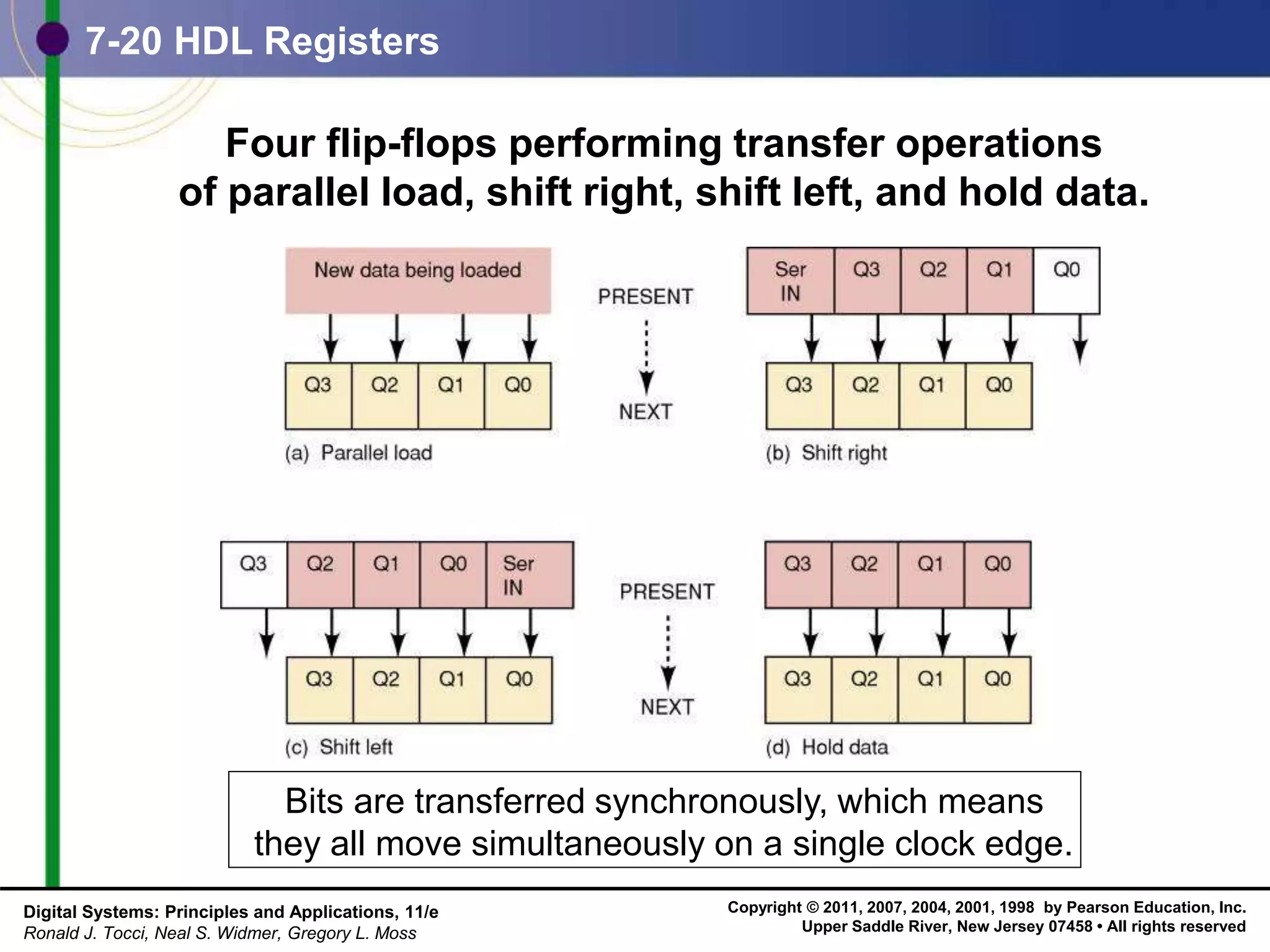
7-20 HDL Registers
Four flip-flops performing transfer operations
of parallel load, shift right, shift left, and hold data.
Bits are transferred synchronously, which means
they all move simultaneously on a single clock edge.
Copyright © 2011, 2007, 2004, 2001, 1998 by Pearson Education, Inc.
Upper Saddle River, New Jersey 07458 • All rights reserved
Digital Systems: Principles and Applications, 11/e
Ronald J. Tocci, Neal S. Widmer, Gregory L. Moss
7-21 HDL Ring Counters
• A ring counter is a shift register that circulates
a single active logic level through all its FFs.
– Modulus is equal to the number of FFS in the register.
• There are always many unused and invalid states.
• With planning, we can ensure the counter reaches
the desired sequence—no matter the initial state.
– Regardless of the state to which the counter initializes,
it eventually fills with zeros.
• At which time, logic shifts in a HIGH to start the ring
sequence.
Copyright © 2011, 2007, 2004, 2001, 1998 by Pearson Education, Inc.
Upper Saddle River, New Jersey 07458 • All rights reserved
Digital Systems: Principles and Applications, 11/e
Ronald J. Tocci, Neal S. Widmer, Gregory L. Moss
7-21 HDL Ring Counters
• In the AHDL code shown, lines 11 & 12 control
the serial input using the strategy just described.
– The (==) operator evaluates whether the expressions
on each side are equal or not.
Copyright © 2011, 2007, 2004, 2001, 1998 by Pearson Education, Inc.
Upper Saddle River, New Jersey 07458 • All rights reserved
Digital Systems: Principles and Applications, 11/e
Ronald J. Tocci, Neal S. Widmer, Gregory L. Moss
7-22 HDL One-Shots
• The concept of a counter can be applied to
implement a digital one-shot using HDL.
– A nonretriggerable one-shot ignores the trigger
input pulse output is still active.
– A retriggerable one-shot starts a pulse in response
to a trigger.
• Internal pulse timer restarts each time a subsequent
trigger edge occurs before the pulse is complete.
END

7Counters_registers.ppt

  • 2.
    Chapter 7 –Counters and Registers
  • 3.
    Copyright © 2011,2007, 2004, 2001, 1998 by Pearson Education, Inc. Upper Saddle River, New Jersey 07458 • All rights reserved Digital Systems: Principles and Applications, 11/e Ronald J. Tocci, Neal S. Widmer, Gregory L. Moss • Selected areas covered in this chapter: – Operation & characteristics of synchronous and asynchronous counters. – Analyzing and evaluating various types of counters. – Schemes used to decode different types of counters. – Counter circuits using different levels of abstraction in HDL. – Operation of various types of IC registers. – Shift registers and shift register counters using HDL. – Troubleshooting techniques used for combinational logic systems to troubleshoot sequential logic systems. Chapter 7 Objectives
  • 4.
    Copyright © 2011,2007, 2004, 2001, 1998 by Pearson Education, Inc. Upper Saddle River, New Jersey 07458 • All rights reserved Digital Systems: Principles and Applications, 11/e Ronald J. Tocci, Neal S. Widmer, Gregory L. Moss 7-1 Asynchronous (Ripple) Counters • Review of four bit counter operation: – Clock is applied only CLK input to FF A. • J & K are HIGH in all FFs. – Output of FF A is CLK of FF B, etc. • FF outputs D, C, B, and A, are a 4-bit binary number with D as the MSB.
  • 5.
    Copyright © 2011,2007, 2004, 2001, 1998 by Pearson Education, Inc. Upper Saddle River, New Jersey 07458 • All rights reserved Digital Systems: Principles and Applications, 11/e Ronald J. Tocci, Neal S. Widmer, Gregory L. Moss 7-1 Asynchronous (Ripple) Counters An asynchronous counter—state is not changed in exact synchronism with the clock. • Review of four bit counter operation: – After the NGT of the 15th clock pulse, the counter FFs are recycled back to 0000.
  • 6.
    Copyright © 2011,2007, 2004, 2001, 1998 by Pearson Education, Inc. Upper Saddle River, New Jersey 07458 • All rights reserved Digital Systems: Principles and Applications, 11/e Ronald J. Tocci, Neal S. Widmer, Gregory L. Moss 7-1 Asynchronous (Ripple) Counters – MOD Number • MOD number is equal to the number of states the counter goes through before recycling. Adding FFs will increase the MOD number.
  • 7.
    Copyright © 2011,2007, 2004, 2001, 1998 by Pearson Education, Inc. Upper Saddle River, New Jersey 07458 • All rights reserved Digital Systems: Principles and Applications, 11/e Ronald J. Tocci, Neal S. Widmer, Gregory L. Moss 7-1 Asynchronous (Ripple) Counters – MOD Number • Frequency division – each FF will have an output frequency of 1/2 the input. Output frequency of the last counter FF will be clock frequency divided by MOD of the counter.
  • 8.
    Copyright © 2011,2007, 2004, 2001, 1998 by Pearson Education, Inc. Upper Saddle River, New Jersey 07458 • All rights reserved Digital Systems: Principles and Applications, 11/e Ronald J. Tocci, Neal S. Widmer, Gregory L. Moss 7-1 Asynchronous (Ripple) Counters – Signal Flow • Schematics are normally drawn from left to right. – Counters will be drawn from right to left so that the MSB and LSB appear in the appropriate positions.
  • 9.
    Copyright © 2011,2007, 2004, 2001, 1998 by Pearson Education, Inc. Upper Saddle River, New Jersey 07458 • All rights reserved Digital Systems: Principles and Applications, 11/e Ronald J. Tocci, Neal S. Widmer, Gregory L. Moss 7-2 Propagation Delay in Ripple Counters • Ripple counters are simple—requiring the fewest components to produce a given operation. – Cumulative propagation delay can cause problems at high frequencies. • If the period between input pulses is made longer than the total propagation delay of the counter, problems can be avoided – For proper operation: Tclock  N x tpd – Maximum frequency: Fmax=1/N x tpd
  • 10.
    Copyright © 2011,2007, 2004, 2001, 1998 by Pearson Education, Inc. Upper Saddle River, New Jersey 07458 • All rights reserved Digital Systems: Principles and Applications, 11/e Ronald J. Tocci, Neal S. Widmer, Gregory L. Moss 7-2 Propagation Delay in Ripple Counters • Asynchronous counters are not useful at very high frequencies—especially for counters with large numbers of bits. – Erroneous count patterns can generate glitches • Signals produced by systems using asynchronous counters.
  • 11.
    Copyright © 2011,2007, 2004, 2001, 1998 by Pearson Education, Inc. Upper Saddle River, New Jersey 07458 • All rights reserved Digital Systems: Principles and Applications, 11/e Ronald J. Tocci, Neal S. Widmer, Gregory L. Moss 7-3 Synchronous (Parallel) Counters • In synchronous or parallel counters, all FFs are triggered simultaneously (in parallel) by the clock. Synchronous counters can operate at much higher frequencies than asynchronous counters.
  • 12.
    Copyright © 2011,2007, 2004, 2001, 1998 by Pearson Education, Inc. Upper Saddle River, New Jersey 07458 • All rights reserved Digital Systems: Principles and Applications, 11/e Ronald J. Tocci, Neal S. Widmer, Gregory L. Moss 7-3 Synchronous (Parallel) Counters • Each FF has J & K inputs which are HIGH only when outputs of all lower-order FFs are HIGH. The total propagation delay will be the same for any number of FFs.
  • 13.
    Copyright © 2011,2007, 2004, 2001, 1998 by Pearson Education, Inc. Upper Saddle River, New Jersey 07458 • All rights reserved Digital Systems: Principles and Applications, 11/e Ronald J. Tocci, Neal S. Widmer, Gregory L. Moss 7-3 Synchronous (Parallel) Counters For this circuit to count properly, on a given NGT of the clock, only those FF that are supposed to toggle on that NGT should have J = K = 1 when NGT occurs.
  • 14.
    Copyright © 2011,2007, 2004, 2001, 1998 by Pearson Education, Inc. Upper Saddle River, New Jersey 07458 • All rights reserved Digital Systems: Principles and Applications, 11/e Ronald J. Tocci, Neal S. Widmer, Gregory L. Moss • The basic synchronous counter shown is limited to MOD numbers that are equal to 2N. – Where N is the number of FFs. 7-4 Counters with MOD Number <2N
  • 15.
    Copyright © 2011,2007, 2004, 2001, 1998 by Pearson Education, Inc. Upper Saddle River, New Jersey 07458 • All rights reserved Digital Systems: Principles and Applications, 11/e Ronald J. Tocci, Neal S. Widmer, Gregory L. Moss MOD-6 counter produced by clearing a MOD-8 counter when a count of six (110) occurs. 7-4 Counters with MOD Number <2N • The basic counter can be modified to produce MOD numbers less than 2N. – By allowing the counter to skip states that are normally part of the counting sequence. 7-4 Counters with MOD Number <2N
  • 16.
    Copyright © 2011,2007, 2004, 2001, 1998 by Pearson Education, Inc. Upper Saddle River, New Jersey 07458 • All rights reserved Digital Systems: Principles and Applications, 11/e Ronald J. Tocci, Neal S. Widmer, Gregory L. Moss • Changing the MOD number. – Find the smallest MOD required so that 2N is less than or equal to the requirement. – Connect a NAND gate to the asynchronous CLEAR inputs of all FFs. 7-4 Counters with MOD Number <2N Determine which FFs are HIGH at the desired count and connect the outputs of these FFs to the NAND gate inputs.
  • 17.
    Copyright © 2011,2007, 2004, 2001, 1998 by Pearson Education, Inc. Upper Saddle River, New Jersey 07458 • All rights reserved Digital Systems: Principles and Applications, 11/e Ronald J. Tocci, Neal S. Widmer, Gregory L. Moss 7-4 Counters with MOD Number < 2N State transition diagram for the MOD-6 counter 7-4 Counters with MOD Number <2N Each circle represents one of the possible counter states. Arrows indicate how one state changes to another—in response to an input clock pulse. There is no arrow to the 111 state as the counter can never advance to that state. The 111 state can occur on power-up when the FFs come up in random states.
  • 18.
    Copyright © 2011,2007, 2004, 2001, 1998 by Pearson Education, Inc. Upper Saddle River, New Jersey 07458 • All rights reserved Digital Systems: Principles and Applications, 11/e Ronald J. Tocci, Neal S. Widmer, Gregory L. Moss 7-4 Counters with MOD Number < 2N Display of counter states is often done with an LED The MOD-6 counter lights the LED on HIGH output. 7-4 Counters with MOD Number <2N
  • 19.
    Copyright © 2011,2007, 2004, 2001, 1998 by Pearson Education, Inc. Upper Saddle River, New Jersey 07458 • All rights reserved Digital Systems: Principles and Applications, 11/e Ronald J. Tocci, Neal S. Widmer, Gregory L. Moss • Decade counters are widely used for counting events, and displaying results in decimal form. – A decade counter is any counter with 10 distinct states, regardless of the sequence. – A BCD counter is a decade counter that counts from binary 0000 to 1001. 7-4 Counters with MOD Number <2N Any MOD-10 counter is a decade counter.
  • 20.
    Copyright © 2011,2007, 2004, 2001, 1998 by Pearson Education, Inc. Upper Saddle River, New Jersey 07458 • All rights reserved Digital Systems: Principles and Applications, 11/e Ronald J. Tocci, Neal S. Widmer, Gregory L. Moss Mod-60 Counter 7-4 Counters with MOD Number <2N
  • 21.
    Copyright © 2011,2007, 2004, 2001, 1998 by Pearson Education, Inc. Upper Saddle River, New Jersey 07458 • All rights reserved Digital Systems: Principles and Applications, 11/e Ronald J. Tocci, Neal S. Widmer, Gregory L. Moss 7-5 Synchronous Down and Up/Down Counters • A synchronous down counter is constructed in a similar manner to an up counter. – It uses the inverted FF outputs to control the higher- order J, K inputs. Synchronous, MOD-16, down counter and output waveforms.
  • 22.
    Copyright © 2011,2007, 2004, 2001, 1998 by Pearson Education, Inc. Upper Saddle River, New Jersey 07458 • All rights reserved Digital Systems: Principles and Applications, 11/e Ronald J. Tocci, Neal S. Widmer, Gregory L. Moss 7-5 Synchronous Down and Up/Down Counters • In a parallel up/down counter, the control input controls the values fed to the J and K inputs of the successive FFs. – The normal FF outputs or the inverted FF outputs.
  • 23.
    Copyright © 2011,2007, 2004, 2001, 1998 by Pearson Education, Inc. Upper Saddle River, New Jersey 07458 • All rights reserved Digital Systems: Principles and Applications, 11/e Ronald J. Tocci, Neal S. Widmer, Gregory L. Moss • For the first five clock pulses, – The counter counts up. Up/Down = 1. 7-5 Synchronous Down and Up/Down Counters • For the last five pulses, – The counter counts down. Up/Down = 0.
  • 24.
    Copyright © 2011,2007, 2004, 2001, 1998 by Pearson Education, Inc. Upper Saddle River, New Jersey 07458 • All rights reserved Digital Systems: Principles and Applications, 11/e Ronald J. Tocci, Neal S. Widmer, Gregory L. Moss 7-5 Synchronous Down and Up/Down Counters • Note that there are two arrows leaving each state’s bubble—a conditional transition. The next state for this counter is dependent upon the logic level applied to the control input.
  • 25.
    Copyright © 2011,2007, 2004, 2001, 1998 by Pearson Education, Inc. Upper Saddle River, New Jersey 07458 • All rights reserved Digital Systems: Principles and Applications, 11/e Ronald J. Tocci, Neal S. Widmer, Gregory L. Moss 7-6 Presettable Counters • A presettable counter can be set to any desired starting point—synchronously or asynchronously. – Preset is also called parallel loading the counter. Synchronous counter with asynchronous parallel load. Parallel data inputs
  • 26.
    Copyright © 2011,2007, 2004, 2001, 1998 by Pearson Education, Inc. Upper Saddle River, New Jersey 07458 • All rights reserved Digital Systems: Principles and Applications, 11/e Ronald J. Tocci, Neal S. Widmer, Gregory L. Moss 7-7 IC Asynchronous Counters Counter contains four FFs. FFs are triggered by a PGT at the CLK input. Active-low asynchronous CLEAR input. Can be preset to any value by applying an active-low LOAD input to the A, B, C, and D inputs .
  • 27.
    Copyright © 2011,2007, 2004, 2001, 1998 by Pearson Education, Inc. Upper Saddle River, New Jersey 07458 • All rights reserved Digital Systems: Principles and Applications, 11/e Ronald J. Tocci, Neal S. Widmer, Gregory L. Moss 7-7 IC Asynchronous Counters This series of IC counter chips has one more output pin—RCO—an active-HIGH output is to detect (decode) the last or terminal state of the counter. Very useful in connecting two or more counter chips in a multistage arrangement to create larger counters.
  • 28.
    Copyright © 2011,2007, 2004, 2001, 1998 by Pearson Education, Inc. Upper Saddle River, New Jersey 07458 • All rights reserved Digital Systems: Principles and Applications, 11/e Ronald J. Tocci, Neal S. Widmer, Gregory L. Moss 7-7 IC Asynchronous Counters TTL 74ALS160 – 74ALS163 Function Table
  • 29.
    Copyright © 2011,2007, 2004, 2001, 1998 by Pearson Education, Inc. Upper Saddle River, New Jersey 07458 • All rights reserved Digital Systems: Principles and Applications, 11/e Ronald J. Tocci, Neal S. Widmer, Gregory L. Moss 7-7 IC Asynchronous Counters 74ALS190 and 74ALS191 series ICs are recycling, four-bit counters.
  • 30.
    Copyright © 2011,2007, 2004, 2001, 1998 by Pearson Education, Inc. Upper Saddle River, New Jersey 07458 • All rights reserved Digital Systems: Principles and Applications, 11/e Ronald J. Tocci, Neal S. Widmer, Gregory L. Moss 7-7 IC Asynchronous Counters • Many standard IC counters have been designed to make it easy to connect multiple chips to create circuits with a higher counting range. – A multistage or cascading arrangement. 74ALS163s in a two-stage arrangement to extend the maximum counting range.
  • 31.
    Copyright © 2011,2007, 2004, 2001, 1998 by Pearson Education, Inc. Upper Saddle River, New Jersey 07458 • All rights reserved Digital Systems: Principles and Applications, 11/e Ronald J. Tocci, Neal S. Widmer, Gregory L. Moss • Digital counters are often used in applications where the count represented by FF states must somehow be determined or displayed. – One of the simplest means for displaying contents of a counter is connecting the FF output to an LED. 7-8 Decoding a Counter Active-HIGH decoder output. The LED method becomes inconvenient as the size (number of bits) of the counter increases. It is much harder to decode the display mentally.
  • 32.
    Copyright © 2011,2007, 2004, 2001, 1998 by Pearson Education, Inc. Upper Saddle River, New Jersey 07458 • All rights reserved Digital Systems: Principles and Applications, 11/e Ronald J. Tocci, Neal S. Widmer, Gregory L. Moss • Decoding is the conversion of a binary output to a decimal value—a form immediately recognized. – The active-HIGH decoder shown can be used to light an LED representing each decimal number 0 to 7. 7-8 Decoding a Counter
  • 33.
    Copyright © 2011,2007, 2004, 2001, 1998 by Pearson Education, Inc. Upper Saddle River, New Jersey 07458 • All rights reserved Digital Systems: Principles and Applications, 11/e Ronald J. Tocci, Neal S. Widmer, Gregory L. Moss 7-8 Decoding a Counter MOD-8 Active-HIGH decoder output. • Decoding is the conversion of a binary output to a decimal value—a form immediately recognized.
  • 34.
    Copyright © 2011,2007, 2004, 2001, 1998 by Pearson Education, Inc. Upper Saddle River, New Jersey 07458 • All rights reserved Digital Systems: Principles and Applications, 11/e Ronald J. Tocci, Neal S. Widmer, Gregory L. Moss The active-HIGH decoder shown can be changed to an active-LOW type. 7-8 Decoding a Counter Active-LOW decoding is obtained by replacing the AND gates with NAND gates. The decoder outputs now produce a normally HIGH signal, which goes LOW only when the number being decoded occurs.
  • 35.
    Copyright © 2011,2007, 2004, 2001, 1998 by Pearson Education, Inc. Upper Saddle River, New Jersey 07458 • All rights reserved Digital Systems: Principles and Applications, 11/e Ronald J. Tocci, Neal S. Widmer, Gregory L. Moss 7-8 Decoding a Counter • A BCD counter has 10 states, decoded to provide 10 outputs corresponding to decimal digits 0 – 9. – Represented by the states of the counter FFs. Instead of 10 separate LEDs, BCD counters usually have their count displayed on a single display device. – The 10 outputs can control 10 individual indicator LEDs for a visual display.
  • 36.
    Copyright © 2011,2007, 2004, 2001, 1998 by Pearson Education, Inc. Upper Saddle River, New Jersey 07458 • All rights reserved Digital Systems: Principles and Applications, 11/e Ronald J. Tocci, Neal S. Widmer, Gregory L. Moss 7-9 Analyzing Synchronous Counters Synchronous up counter. Control input expressions.
  • 37.
    Copyright © 2011,2007, 2004, 2001, 1998 by Pearson Education, Inc. Upper Saddle River, New Jersey 07458 • All rights reserved Digital Systems: Principles and Applications, 11/e Ronald J. Tocci, Neal S. Widmer, Gregory L. Moss 7-9 Analyzing Synchronous Counters • Synchronous counters can be custom-designed to generate any desired count sequence. Synchronous up-counter. Control input expressions.
  • 38.
    Copyright © 2011,2007, 2004, 2001, 1998 by Pearson Education, Inc. Upper Saddle River, New Jersey 07458 • All rights reserved Digital Systems: Principles and Applications, 11/e Ronald J. Tocci, Neal S. Widmer, Gregory L. Moss 7-9 Analyzing Synchronous Counters • Analyze counter designs of this type by predicting FF control inputs for each state of the counter. – A PRESENT state/NEXT state table is very useful for this purpose.
  • 39.
    Copyright © 2011,2007, 2004, 2001, 1998 by Pearson Education, Inc. Upper Saddle River, New Jersey 07458 • All rights reserved Digital Systems: Principles and Applications, 11/e Ronald J. Tocci, Neal S. Widmer, Gregory L. Moss 7-9 Analyzing Synchronous Counters Synchronous up counter state transition diagram and waveform. Highlighted information indicates this counter design is self-correcting.
  • 40.
    Copyright © 2011,2007, 2004, 2001, 1998 by Pearson Education, Inc. Upper Saddle River, New Jersey 07458 • All rights reserved Digital Systems: Principles and Applications, 11/e Ronald J. Tocci, Neal S. Widmer, Gregory L. Moss 7-9 Analyzing Synchronous Counters Synchronous counter built using D-type FFs. Control circuitry will typically be more complex than an equivalent JK-type counter, The number of synchronous inputs to control is reduced by half
  • 41.
    Copyright © 2011,2007, 2004, 2001, 1998 by Pearson Education, Inc. Upper Saddle River, New Jersey 07458 • All rights reserved Digital Systems: Principles and Applications, 11/e Ronald J. Tocci, Neal S. Widmer, Gregory L. Moss 7-10 Synchronous Counter Design • Common design method using J-K flip-flops in a synchronous counter configuration. – Determine the desired number of bits (FFs) and the desired counting sequence. – Draw the state transition diagram showing all possible states—including those not part of the desired counting sequence. – Use the state transition diagram to set up a table that lists all PRESENT states and their NEXT states. – Add a column for each J and K input & indicate levels required to produce transition to the NEXT state. – Design the logic circuits to generate levels required at each input, and implement the final expressions.
  • 42.
    Copyright © 2011,2007, 2004, 2001, 1998 by Pearson Education, Inc. Upper Saddle River, New Jersey 07458 • All rights reserved Digital Systems: Principles and Applications, 11/e Ronald J. Tocci, Neal S. Widmer, Gregory L. Moss 7-10 Synchronous Counter Design • A stepper motor rotates in steps, not continuous motion—typically 15 degrees per step. – A practical application of synchronous counter design. • Reversible, depending on output level.
  • 43.
    Copyright © 2011,2007, 2004, 2001, 1998 by Pearson Education, Inc. Upper Saddle River, New Jersey 07458 • All rights reserved Digital Systems: Principles and Applications, 11/e Ronald J. Tocci, Neal S. Widmer, Gregory L. Moss 7-10 Synchronous Counter Design • A stepper motor rotates in steps, not continuous motion—typically 15 degrees per step. – A practical application of synchronous counter design. • Reversible, depending on output level.
  • 44.
    Copyright © 2011,2007, 2004, 2001, 1998 by Pearson Education, Inc. Upper Saddle River, New Jersey 07458 • All rights reserved Digital Systems: Principles and Applications, 11/e Ronald J. Tocci, Neal S. Widmer, Gregory L. Moss 7-11 Altera Library Functions for Counters • The Quartus Block Editor can program a PLD with any counter using flip-flops and gates. – These macro-functions are in the maxplus2 library. A full-featured MOD-16 up/down counter.
  • 45.
    Copyright © 2011,2007, 2004, 2001, 1998 by Pearson Education, Inc. Upper Saddle River, New Jersey 07458 • All rights reserved Digital Systems: Principles and Applications, 11/e Ronald J. Tocci, Neal S. Widmer, Gregory L. Moss 7-11 Altera Library Functions for Counters Digital clock hours counter—block diagram, MegaWizard settings & simulation results.
  • 46.
    Copyright © 2011,2007, 2004, 2001, 1998 by Pearson Education, Inc. Upper Saddle River, New Jersey 07458 • All rights reserved Digital Systems: Principles and Applications, 11/e Ronald J. Tocci, Neal S. Widmer, Gregory L. Moss 7-12 HDL Counters • Methods to describe counter circuits using HDL primarily use synchronous techniques. – All flip-flops update simultaneously in response to the same clock event. – All bits in a count sequence go from their PRESENT state to their prescribed NEXT state simultaneously, • State Transition Description Methods – The PRESENTstate/NEXT state table is the equivalent of the truth table.
  • 47.
    Copyright © 2011,2007, 2004, 2001, 1998 by Pearson Education, Inc. Upper Saddle River, New Jersey 07458 • All rights reserved Digital Systems: Principles and Applications, 11/e Ronald J. Tocci, Neal S. Widmer, Gregory L. Moss 7-12 HDL Counters • State descriptions in AHDL – The first important step is to declare the counter output pins properly— as a bit array.
  • 48.
    Copyright © 2011,2007, 2004, 2001, 1998 by Pearson Education, Inc. Upper Saddle River, New Jersey 07458 • All rights reserved Digital Systems: Principles and Applications, 11/e Ronald J. Tocci, Neal S. Widmer, Gregory L. Moss 7-12 HDL Counters • State descriptions in AHDL The current state of the counter is evaluated (count[ ].q) on line 11, and if it is less than the highest desired count value, it uses the description count[ ].d count.q + 1 (line 12).
  • 49.
    Copyright © 2011,2007, 2004, 2001, 1998 by Pearson Education, Inc. Upper Saddle River, New Jersey 07458 • All rights reserved Digital Systems: Principles and Applications, 11/e Ronald J. Tocci, Neal S. Widmer, Gregory L. Moss 7-12 HDL Counters • State descriptions in AHDL When the counter has reached the highest desired state (or higher), the IF statement test will be false, resulting in a NEXT-state input value of zero, which recycles the counter.
  • 50.
    Copyright © 2011,2007, 2004, 2001, 1998 by Pearson Education, Inc. Upper Saddle River, New Jersey 07458 • All rights reserved Digital Systems: Principles and Applications, 11/e Ronald J. Tocci, Neal S. Widmer, Gregory L. Moss 7-13 Wiring HDL Modules Together • Designing large digital systems is much easier if the system is subdivided into smaller, manageable modules that are interconnected. – The essence of the concept of hierarchical design. • Consider a recycling, MOD-100 BCD counter with a synchronous clear. – Creating a MOD-10 BCD counter module, cascading synchronously two of thesein a higher-level design file is the easiest way to do this.
  • 51.
    Copyright © 2011,2007, 2004, 2001, 1998 by Pearson Education, Inc. Upper Saddle River, New Jersey 07458 • All rights reserved Digital Systems: Principles and Applications, 11/e Ronald J. Tocci, Neal S. Widmer, Gregory L. Moss 7-13 Wiring HDL Modules Together Block diagram design and simulation results for MOD-100 BCD counter design.
  • 52.
    Copyright © 2011,2007, 2004, 2001, 1998 by Pearson Education, Inc. Upper Saddle River, New Jersey 07458 • All rights reserved Digital Systems: Principles and Applications, 11/e Ronald J. Tocci, Neal S. Widmer, Gregory L. Moss 7-13 Wiring HDL Modules Together • Decoding the AHDL MOD-5 counter
  • 53.
    Copyright © 2011,2007, 2004, 2001, 1998 by Pearson Education, Inc. Upper Saddle River, New Jersey 07458 • All rights reserved Digital Systems: Principles and Applications, 11/e Ronald J. Tocci, Neal S. Widmer, Gregory L. Moss 7-14 State Machines • The term state machine refers to a circuit that sequences through a set of predetermined states. – Controlled by a clock and other input signals. • The term counter is used for sequential circuits that have a regular numeric count sequence. – The things that are counted are actually clock pulses. • But the pulses may represent many kinds of events. • The general distinction between the two terms: – A counter is commonly used to count events, – A state machine is commonly used to control events.
  • 54.
    Copyright © 2011,2007, 2004, 2001, 1998 by Pearson Education, Inc. Upper Saddle River, New Jersey 07458 • All rights reserved Digital Systems: Principles and Applications, 11/e Ronald J. Tocci, Neal S. Widmer, Gregory L. Moss 7-14 State Machines Block diagram for counters and state machines.
  • 55.
    Copyright © 2011,2007, 2004, 2001, 1998 by Pearson Education, Inc. Upper Saddle River, New Jersey 07458 • All rights reserved Digital Systems: Principles and Applications, 11/e Ronald J. Tocci, Neal S. Widmer, Gregory L. Moss 7-14 State Machines Traffic light controller state machine.
  • 56.
    Copyright © 2011,2007, 2004, 2001, 1998 by Pearson Education, Inc. Upper Saddle River, New Jersey 07458 • All rights reserved Digital Systems: Principles and Applications, 11/e Ronald J. Tocci, Neal S. Widmer, Gregory L. Moss 7-15 Register Data Transfer • The various types of registers can be classified according to… – The manner in which data can be entered into the register for storage. – The manner in which data are outputted from the register. • Serial data flow through a register is generally called shifting—either to the left or to the right. – Serial output data fed back to the input of the same register is called a data rotate. • Parallel inputting of data is often described as a register load.
  • 57.
    Copyright © 2011,2007, 2004, 2001, 1998 by Pearson Education, Inc. Upper Saddle River, New Jersey 07458 • All rights reserved Digital Systems: Principles and Applications, 11/e Ronald J. Tocci, Neal S. Widmer, Gregory L. Moss 7-15 & 16 Register Data Transfer / Integrated-Circuit Registers 74ALS174/74HC174 Parallel in/parallel out (PIPO) A group of flip-flops that can store multiple bits simultaneously and in which all bits of the stored binary value are directly available.
  • 58.
    Copyright © 2011,2007, 2004, 2001, 1998 by Pearson Education, Inc. Upper Saddle River, New Jersey 07458 • All rights reserved Digital Systems: Principles and Applications, 11/e Ronald J. Tocci, Neal S. Widmer, Gregory L. Moss 7-15 & 16 Register Data Transfer / Integrated-Circuit Registers 74ALS174/74HC174
  • 59.
    Copyright © 2011,2007, 2004, 2001, 1998 by Pearson Education, Inc. Upper Saddle River, New Jersey 07458 • All rights reserved Digital Systems: Principles and Applications, 11/e Ronald J. Tocci, Neal S. Widmer, Gregory L. Moss 7-15 & 16 Register Data Transfer / Integrated-Circuit Registers 74ALS166/74HC166 Serial in/serial out (SISO) Data loaded one bit at a time moves one bit at a time, with each clock pulse through the flip-flops toward the other end of the register, and exit one bit at a time in the same order as originally loaded.
  • 60.
    Copyright © 2011,2007, 2004, 2001, 1998 by Pearson Education, Inc. Upper Saddle River, New Jersey 07458 • All rights reserved Digital Systems: Principles and Applications, 11/e Ronald J. Tocci, Neal S. Widmer, Gregory L. Moss 7-15 & 16 Register Data Transfer / Integrated-Circuit Registers 74ALS166/74HC166 Circuit Diagram
  • 61.
    Copyright © 2011,2007, 2004, 2001, 1998 by Pearson Education, Inc. Upper Saddle River, New Jersey 07458 • All rights reserved Digital Systems: Principles and Applications, 11/e Ronald J. Tocci, Neal S. Widmer, Gregory L. Moss 7-15 & 16 Register Data Transfer / Integrated-Circuit Registers 74ALS166/74HC166 Logic Symbol Function Table
  • 62.
    Copyright © 2011,2007, 2004, 2001, 1998 by Pearson Education, Inc. Upper Saddle River, New Jersey 07458 • All rights reserved Digital Systems: Principles and Applications, 11/e Ronald J. Tocci, Neal S. Widmer, Gregory L. Moss 7-15 & 16 Register Data Transfer / Integrated-Circuit Registers 74ALS165/74HC165 8-bit parallel in/serial out (PISO) Serial shifting is always synchronous, as the clock is required to ensure the input data moves only one bit at a time with each appropriate clocking edge.
  • 63.
    Copyright © 2011,2007, 2004, 2001, 1998 by Pearson Education, Inc. Upper Saddle River, New Jersey 07458 • All rights reserved Digital Systems: Principles and Applications, 11/e Ronald J. Tocci, Neal S. Widmer, Gregory L. Moss 7-15 & 16 Register Data Transfer / Integrated-Circuit Registers 74ALS165/74HC165 8-bit parallel in/serial out (PISO)
  • 64.
    Copyright © 2011,2007, 2004, 2001, 1998 by Pearson Education, Inc. Upper Saddle River, New Jersey 07458 • All rights reserved Digital Systems: Principles and Applications, 11/e Ronald J. Tocci, Neal S. Widmer, Gregory L. Moss 7-15 & 16 Register Data Transfer / Integrated-Circuit Registers 74ALS164/74HC164 8-bit serial in/parallel out (SIPO)
  • 65.
    Copyright © 2011,2007, 2004, 2001, 1998 by Pearson Education, Inc. Upper Saddle River, New Jersey 07458 • All rights reserved Digital Systems: Principles and Applications, 11/e Ronald J. Tocci, Neal S. Widmer, Gregory L. Moss 7-15 & 16 Register Data Transfer / Integrated-Circuit Registers 74ALS164/74HC164 8-bit serial in/parallel out (SIPO)
  • 66.
    Copyright © 2011,2007, 2004, 2001, 1998 by Pearson Education, Inc. Upper Saddle River, New Jersey 07458 • All rights reserved Digital Systems: Principles and Applications, 11/e Ronald J. Tocci, Neal S. Widmer, Gregory L. Moss 7-17 Shift Register Counters • Shift-register counters use feedback—the output of the last FF in the register is connected back to the first FF in some way.
  • 67.
    Copyright © 2011,2007, 2004, 2001, 1998 by Pearson Education, Inc. Upper Saddle River, New Jersey 07458 • All rights reserved Digital Systems: Principles and Applications, 11/e Ronald J. Tocci, Neal S. Widmer, Gregory L. Moss 7-17 Shift Register Counters • A ring counter is a circulating shift register connected so the last FF shifts its value to the first.
  • 68.
    Copyright © 2011,2007, 2004, 2001, 1998 by Pearson Education, Inc. Upper Saddle River, New Jersey 07458 • All rights reserved Digital Systems: Principles and Applications, 11/e Ronald J. Tocci, Neal S. Widmer, Gregory L. Moss 7-17 Shift Register Counters • To operate properly, a ring counter must start off with only one FF in the 1 state and all the others in the 0 state. – As power-up starting states will be unpredictable, the counter is preset before clock pulses are applied. Circuit for ensuring the ring counter starts in the 1000 state on power-up.
  • 69.
    Copyright © 2011,2007, 2004, 2001, 1998 by Pearson Education, Inc. Upper Saddle River, New Jersey 07458 • All rights reserved Digital Systems: Principles and Applications, 11/e Ronald J. Tocci, Neal S. Widmer, Gregory L. Moss 7-17 Shift Register Counters • In the Johnson or twisted-ring counter inverted output of the last FF is connected to the input of the first FF.
  • 70.
    Copyright © 2011,2007, 2004, 2001, 1998 by Pearson Education, Inc. Upper Saddle River, New Jersey 07458 • All rights reserved Digital Systems: Principles and Applications, 11/e Ronald J. Tocci, Neal S. Widmer, Gregory L. Moss 7-17 Shift Register Counters • For a given MOD number, a Johnson counter requires only half the FFs a ring counter requires. – It requires decoding gates—a ring counter does not. • A Johnson counter uses one logic gate to decode for each count. – Each gate requires only two inputs, regardless of the number of FFs in the counter.
  • 71.
    Copyright © 2011,2007, 2004, 2001, 1998 by Pearson Education, Inc. Upper Saddle River, New Jersey 07458 • All rights reserved Digital Systems: Principles and Applications, 11/e Ronald J. Tocci, Neal S. Widmer, Gregory L. Moss 7-17 Shift Register Counters • Very few ring counters or Johnson counters are available as ICs. – It is relatively simple to wire a shift-register IC as either a ring counter or a Johnson counter. • Some of the CMOS Johnson-counter ICs include the complete decoding circuitry on the same chip as the counter. – (74HC4017, 74HC4022)
  • 72.
    Copyright © 2011,2007, 2004, 2001, 1998 by Pearson Education, Inc. Upper Saddle River, New Jersey 07458 • All rights reserved Digital Systems: Principles and Applications, 11/e Ronald J. Tocci, Neal S. Widmer, Gregory L. Moss 7-18 Troubleshooting • Flip-flops, counters, and registers are the major components in sequential logic system. – Sequential systems suffer from the same types of failures as do combinational systems. • Open circuits, shorts, internal IC faults, etc. • Basic troubleshooting procedures still apply. – Observe system operation. – Use analytical reasoning to determine possible causes. – Use test equipment to isolate the exact fault.
  • 73.
    Copyright © 2011,2007, 2004, 2001, 1998 by Pearson Education, Inc. Upper Saddle River, New Jersey 07458 • All rights reserved Digital Systems: Principles and Applications, 11/e Ronald J. Tocci, Neal S. Widmer, Gregory L. Moss 7-20 HDL Registers • HDL techniques use bit arrays to describe register data & transfer the data in parallel or serial format. • Concatenation—grouping together in a specific sequence—of desired set of data bits can be used to describe data movement for serial shifting.
  • 74.
    Copyright © 2011,2007, 2004, 2001, 1998 by Pearson Education, Inc. Upper Saddle River, New Jersey 07458 • All rights reserved Digital Systems: Principles and Applications, 11/e Ronald J. Tocci, Neal S. Widmer, Gregory L. Moss 7-20 HDL Registers Four flip-flops performing transfer operations of parallel load, shift right, shift left, and hold data. Bits are transferred synchronously, which means they all move simultaneously on a single clock edge.
  • 75.
    Copyright © 2011,2007, 2004, 2001, 1998 by Pearson Education, Inc. Upper Saddle River, New Jersey 07458 • All rights reserved Digital Systems: Principles and Applications, 11/e Ronald J. Tocci, Neal S. Widmer, Gregory L. Moss 7-21 HDL Ring Counters • A ring counter is a shift register that circulates a single active logic level through all its FFs. – Modulus is equal to the number of FFS in the register. • There are always many unused and invalid states. • With planning, we can ensure the counter reaches the desired sequence—no matter the initial state. – Regardless of the state to which the counter initializes, it eventually fills with zeros. • At which time, logic shifts in a HIGH to start the ring sequence.
  • 76.
    Copyright © 2011,2007, 2004, 2001, 1998 by Pearson Education, Inc. Upper Saddle River, New Jersey 07458 • All rights reserved Digital Systems: Principles and Applications, 11/e Ronald J. Tocci, Neal S. Widmer, Gregory L. Moss 7-21 HDL Ring Counters • In the AHDL code shown, lines 11 & 12 control the serial input using the strategy just described. – The (==) operator evaluates whether the expressions on each side are equal or not.
  • 77.
    Copyright © 2011,2007, 2004, 2001, 1998 by Pearson Education, Inc. Upper Saddle River, New Jersey 07458 • All rights reserved Digital Systems: Principles and Applications, 11/e Ronald J. Tocci, Neal S. Widmer, Gregory L. Moss 7-22 HDL One-Shots • The concept of a counter can be applied to implement a digital one-shot using HDL. – A nonretriggerable one-shot ignores the trigger input pulse output is still active. – A retriggerable one-shot starts a pulse in response to a trigger. • Internal pulse timer restarts each time a subsequent trigger edge occurs before the pulse is complete.
  • 78.