The document discusses key concepts related to energy and heat transfer. It defines energy as the ability to do work, and describes different types of energy including potential, kinetic, thermal, and radiation. It explains how energy can be transferred through conduction, convection, and radiation. Key terms are introduced like blackbody, greenhouse effect, atmospheric windows, and albedo. Fundamental principles like the conservation of energy and heat transfer via conduction, convection and radiation are explained in the context of understanding Earth's climate and heat budget.
Energy isthe ability or capacity to do work on some
form of matter.
Work is the measure of a quantity that is capable of
accomplishing macroscopic motion of a system due to
the action of a Force over a Distance.
◦ Force is the agent of change, and Work is a measure of the
change.
Matter is anything that has mass and occupies space.
Three most important ideas of the model:
◦ All substances are made of particles too small to see
◦ The particles are always in motion
◦ The particles have space between them
3.
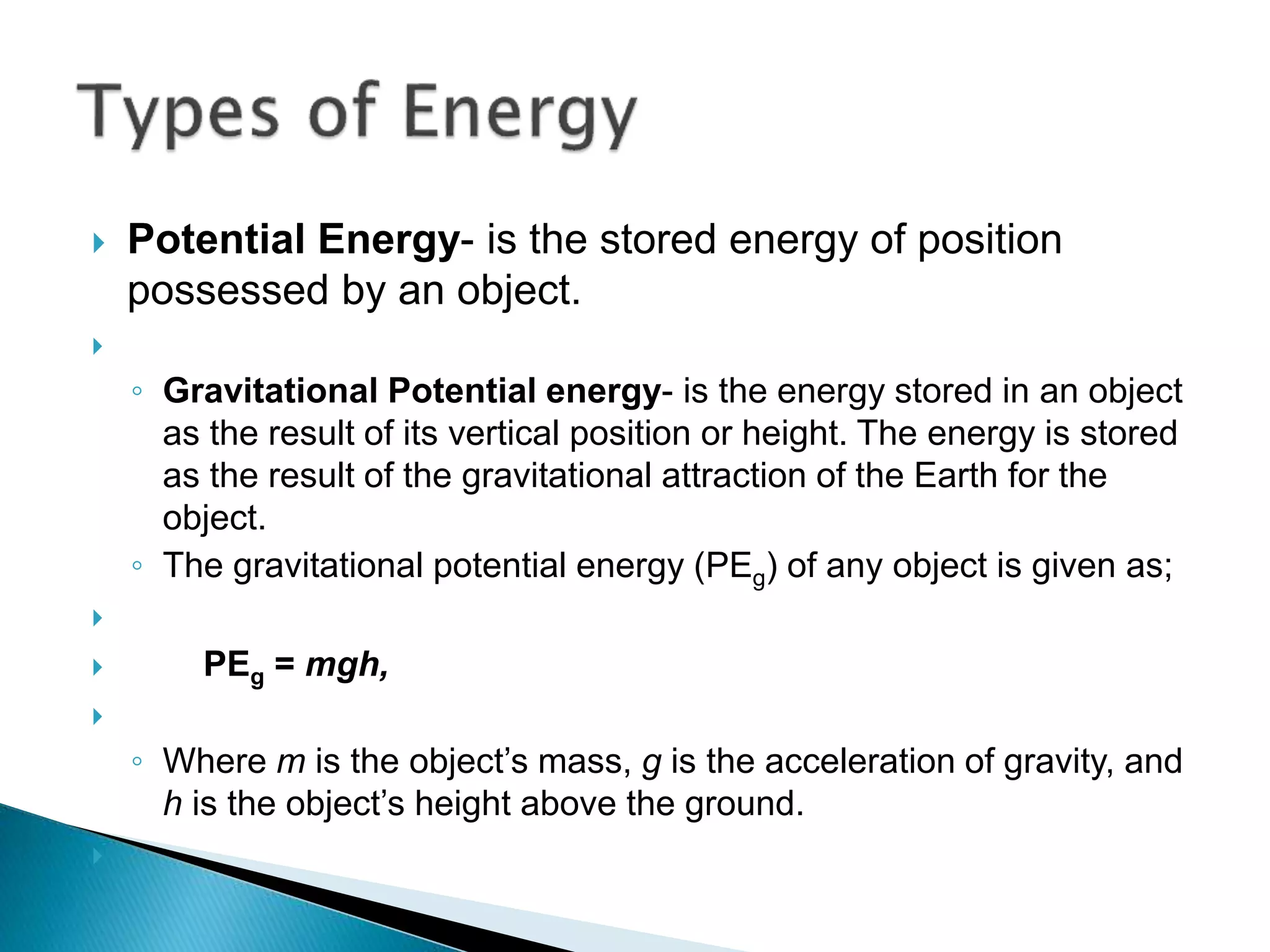
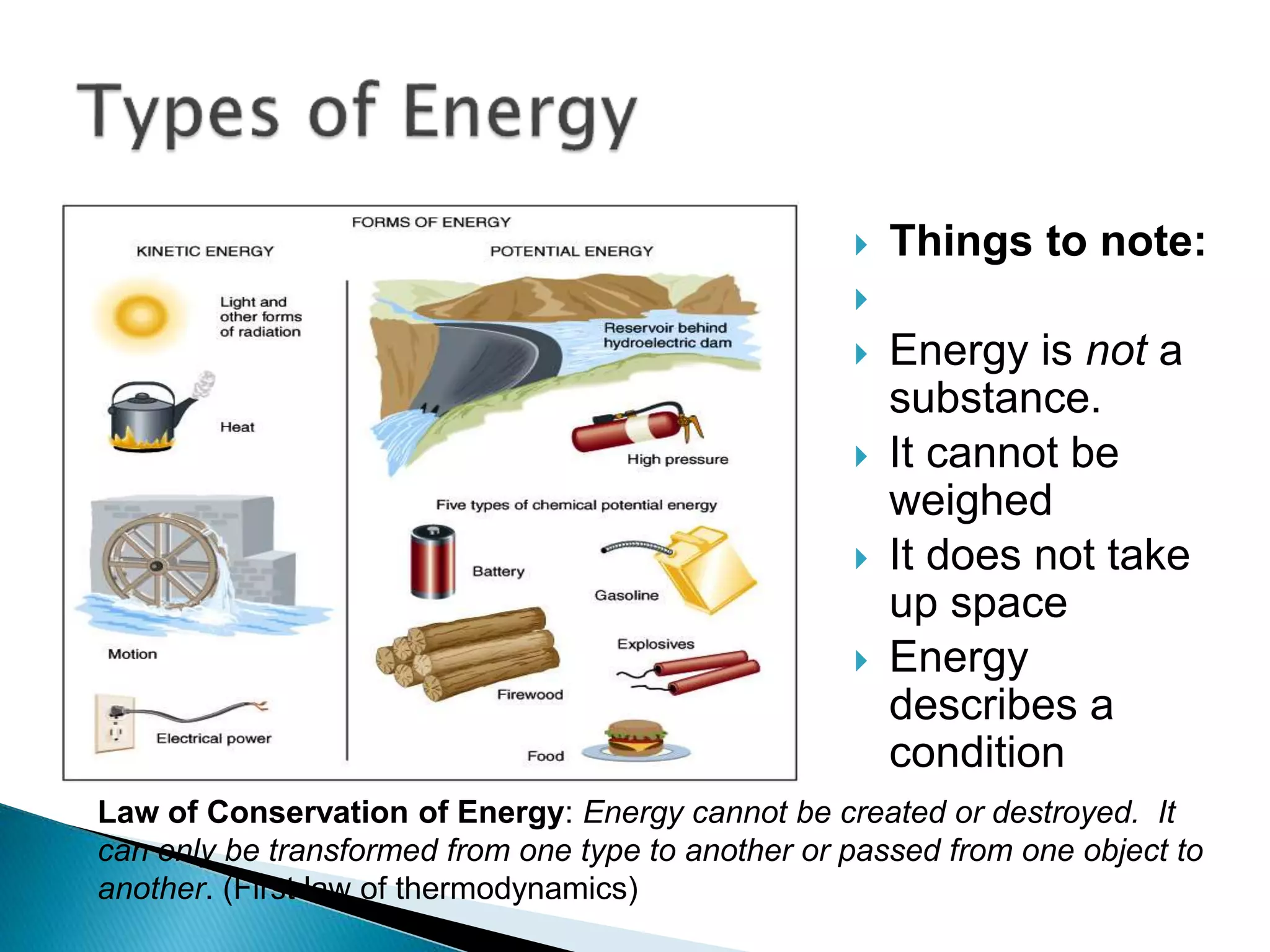
Potential Energy-is the stored energy of position
possessed by an object.
◦ Gravitational Potential energy- is the energy stored in an object
as the result of its vertical position or height. The energy is stored
as the result of the gravitational attraction of the Earth for the
object.
◦ The gravitational potential energy (PEg) of any object is given as;
PEg = mgh,
◦ Where m is the object’s mass, g is the acceleration of gravity, and
h is the object’s height above the ground.
4.
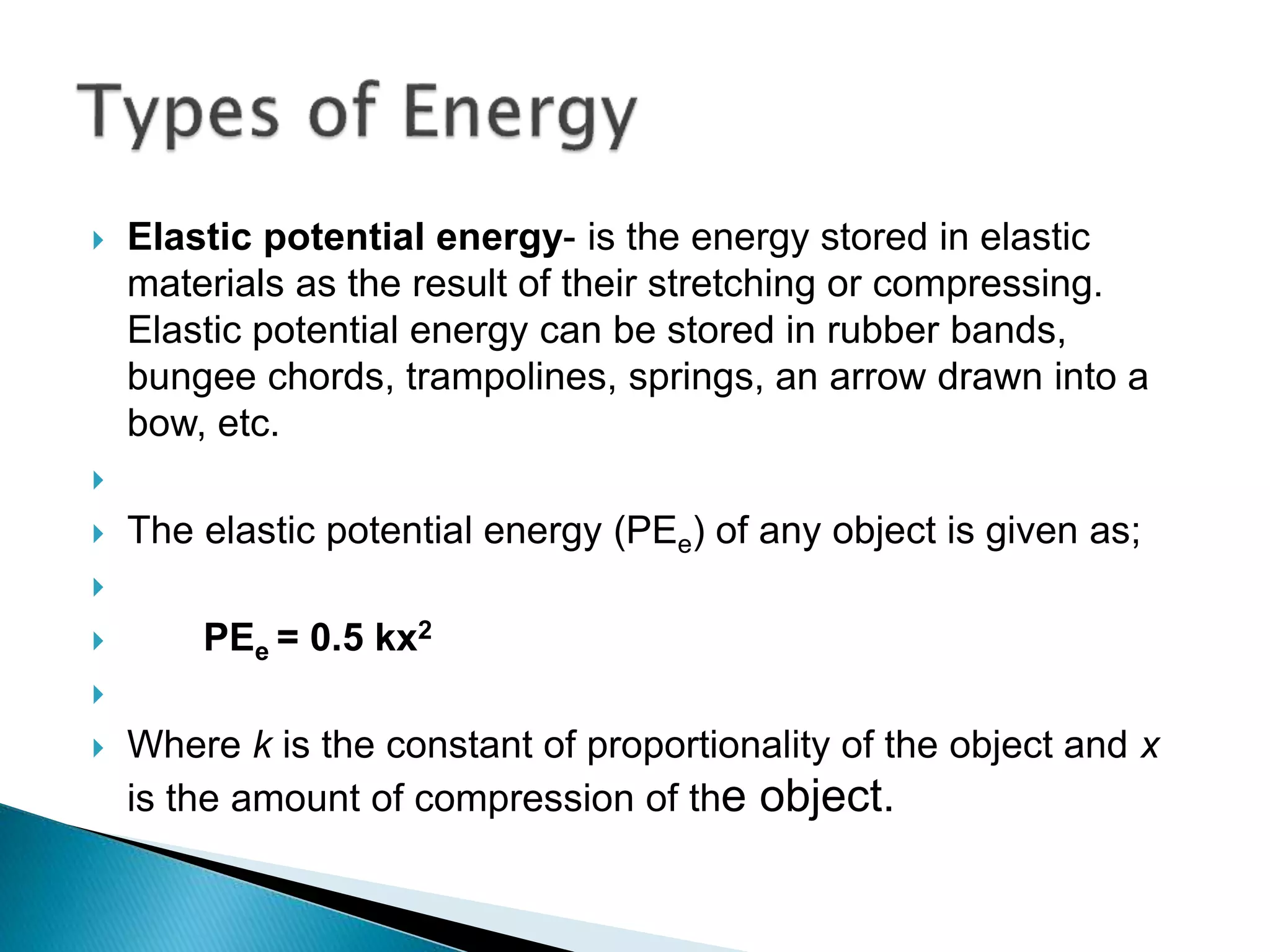
Elastic potentialenergy- is the energy stored in elastic
materials as the result of their stretching or compressing.
Elastic potential energy can be stored in rubber bands,
bungee chords, trampolines, springs, an arrow drawn into a
bow, etc.
The elastic potential energy (PEe) of any object is given as;
PEe = 0.5 kx2
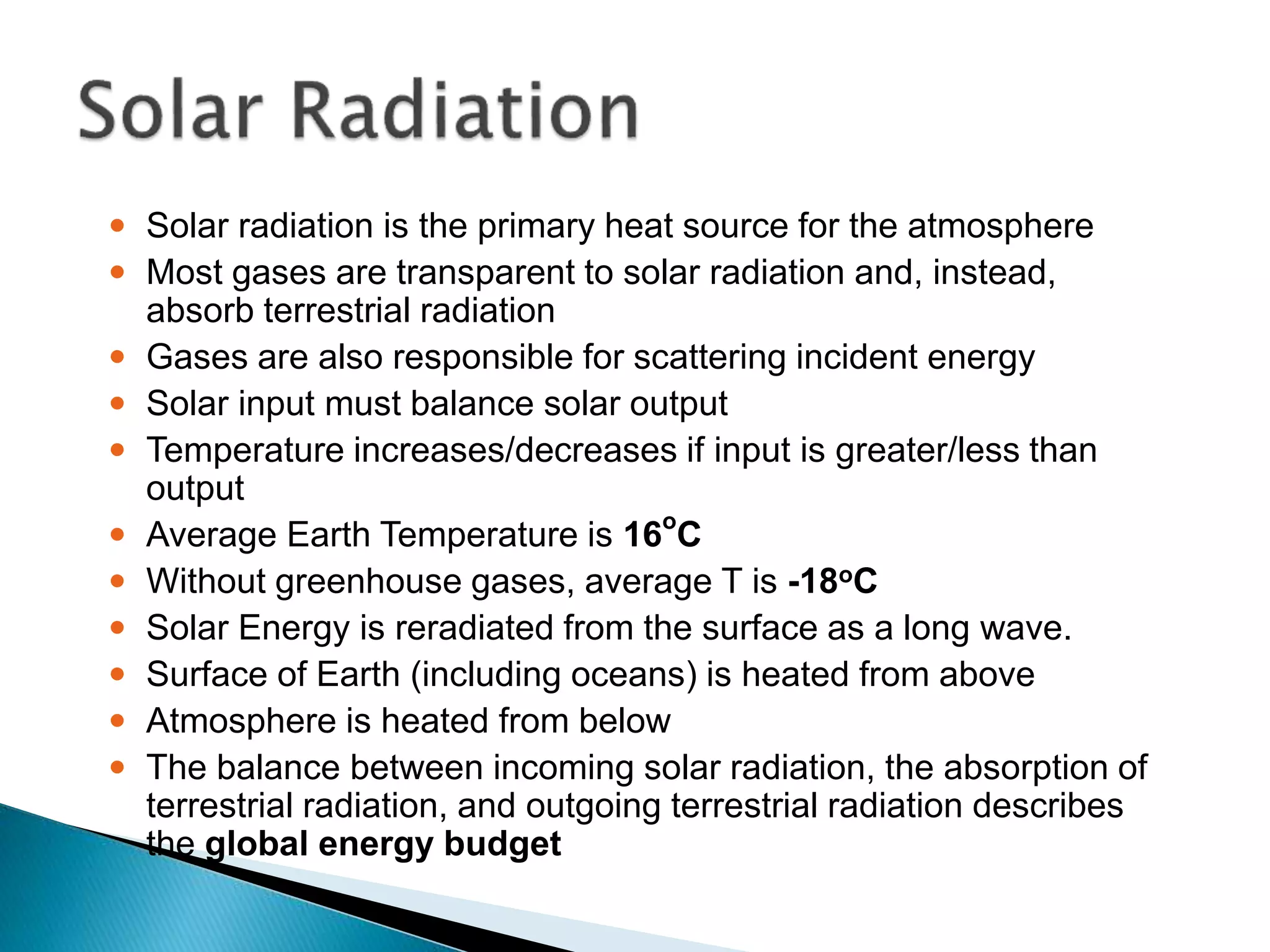
Where k is the constant of proportionality of the object and x
is the amount of compression of the object.
5.
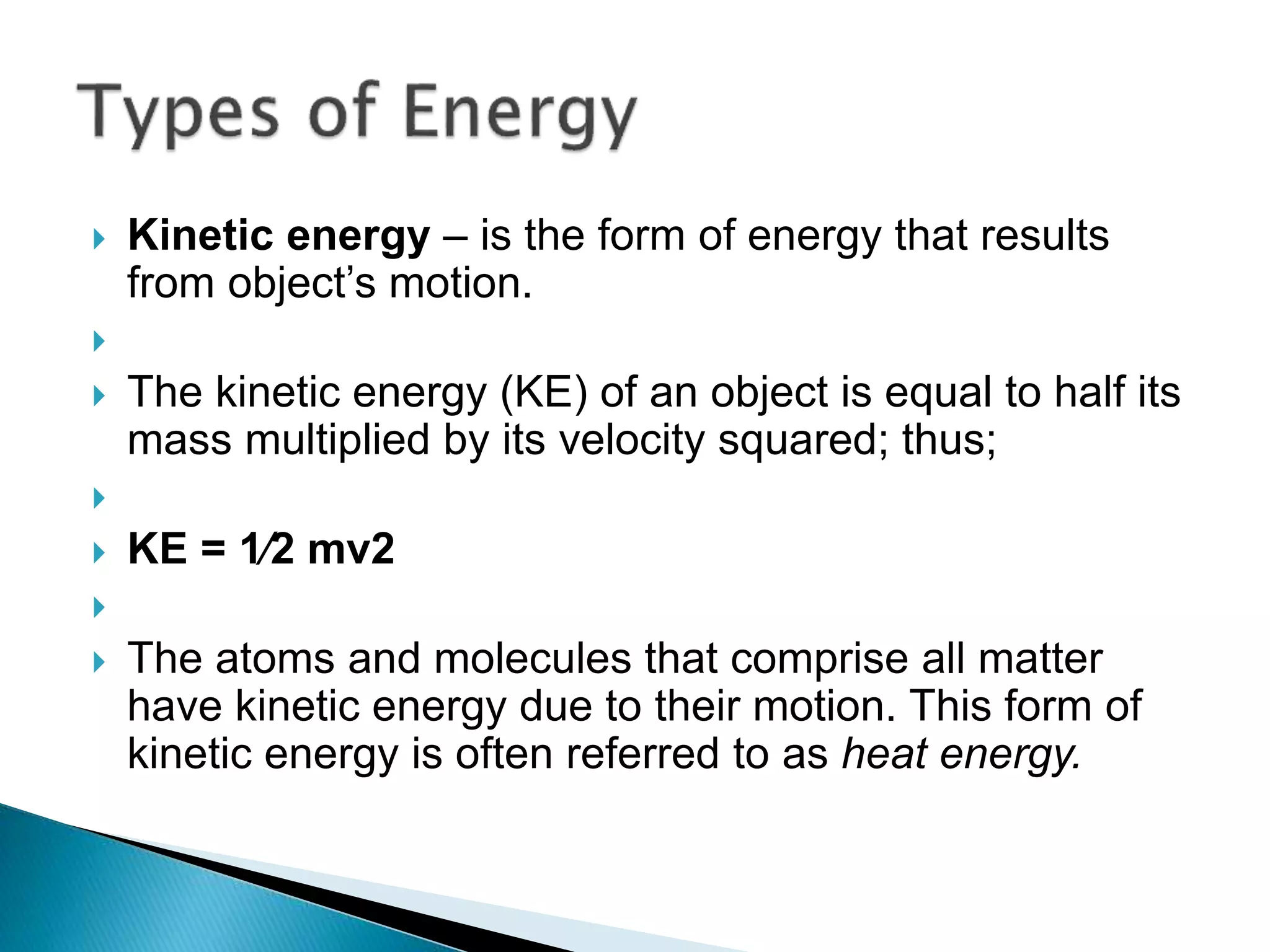
Kinetic energy– is the form of energy that results
from object’s motion.
The kinetic energy (KE) of an object is equal to half its
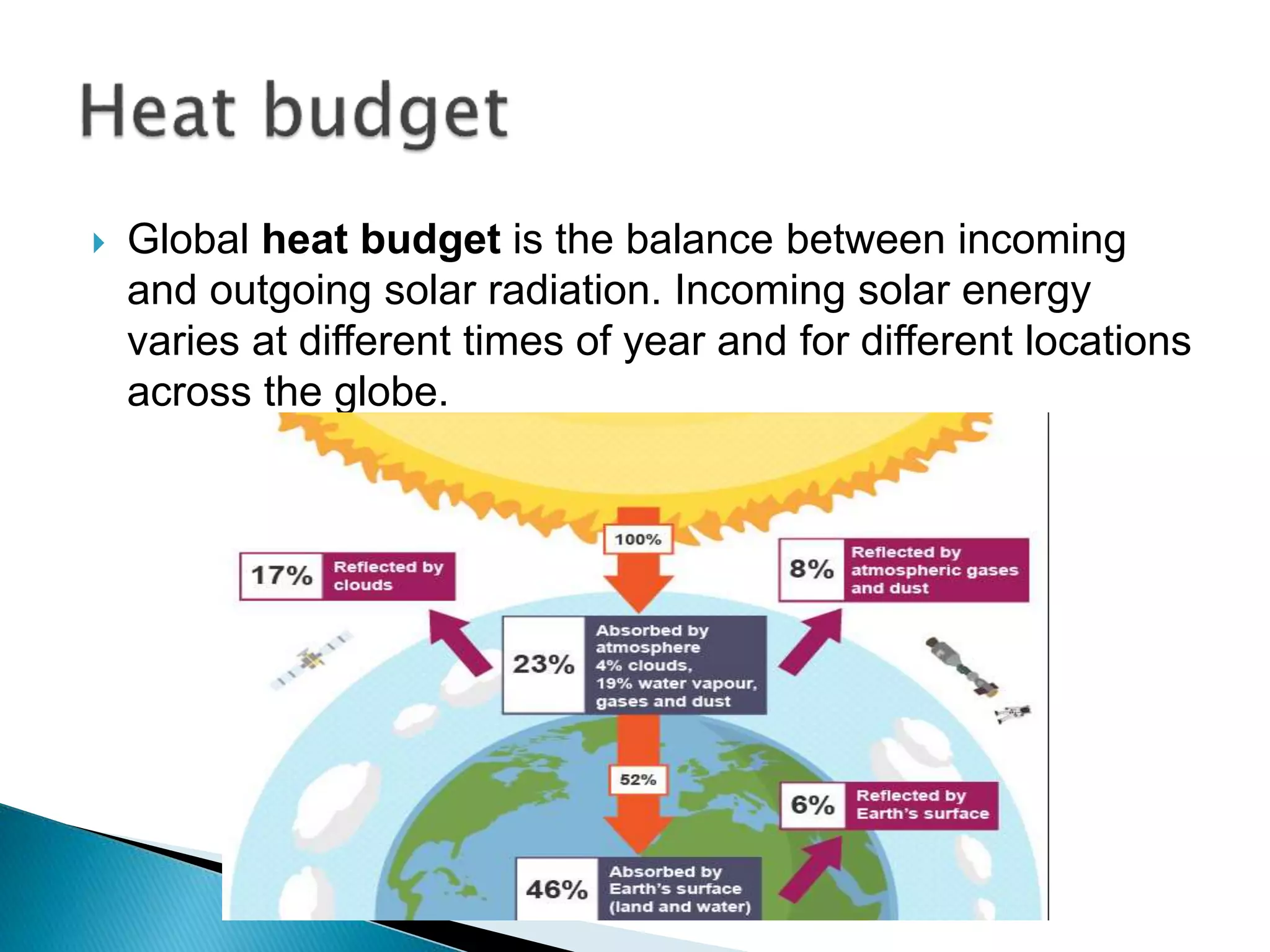
mass multiplied by its velocity squared; thus;
KE = 1⁄2 mv2
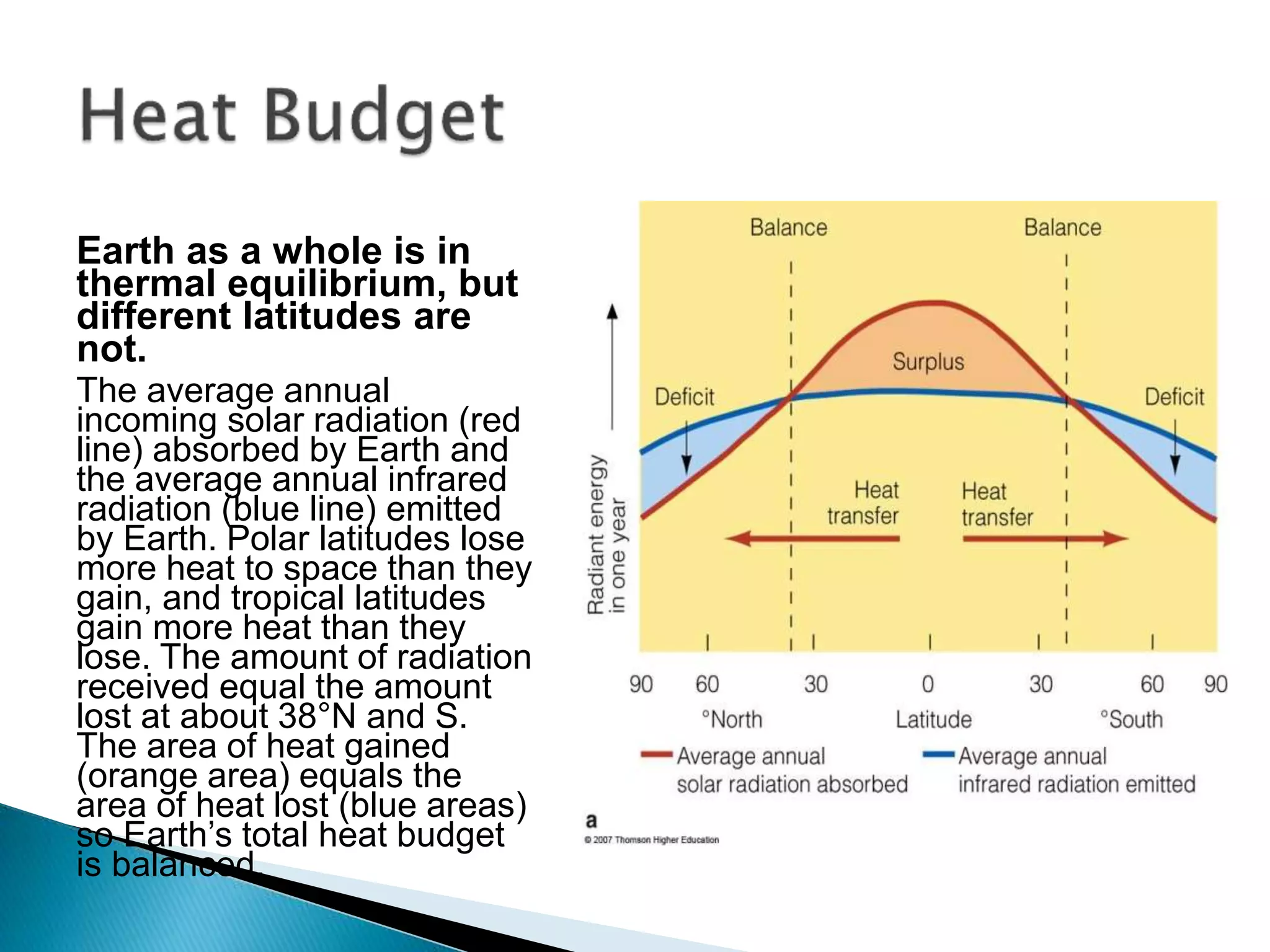
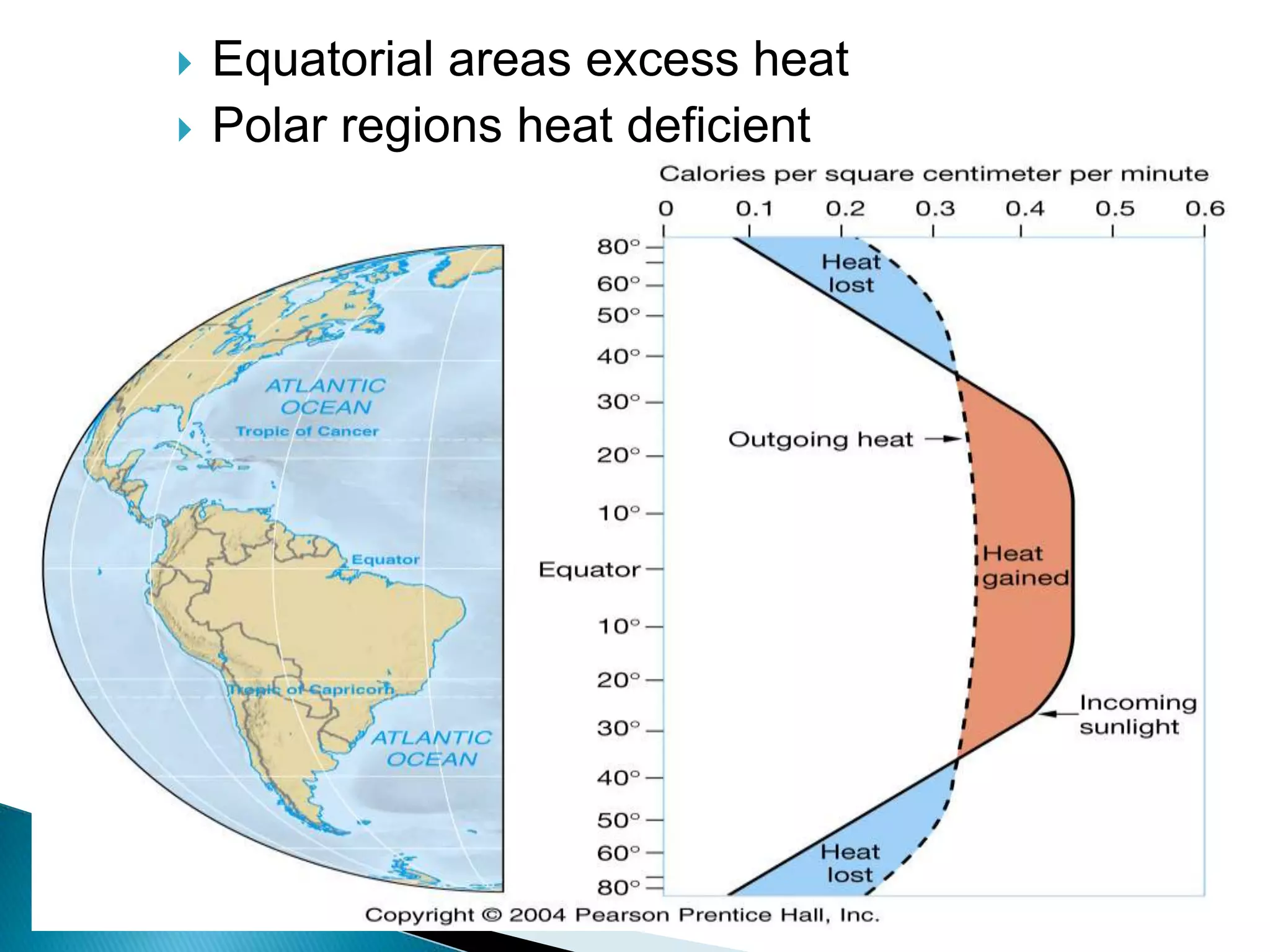
The atoms and molecules that comprise all matter
have kinetic energy due to their motion. This form of
kinetic energy is often referred to as heat energy.
6.
Things tonote:
Energy is not a
substance.
It cannot be
weighed
It does not take
up space
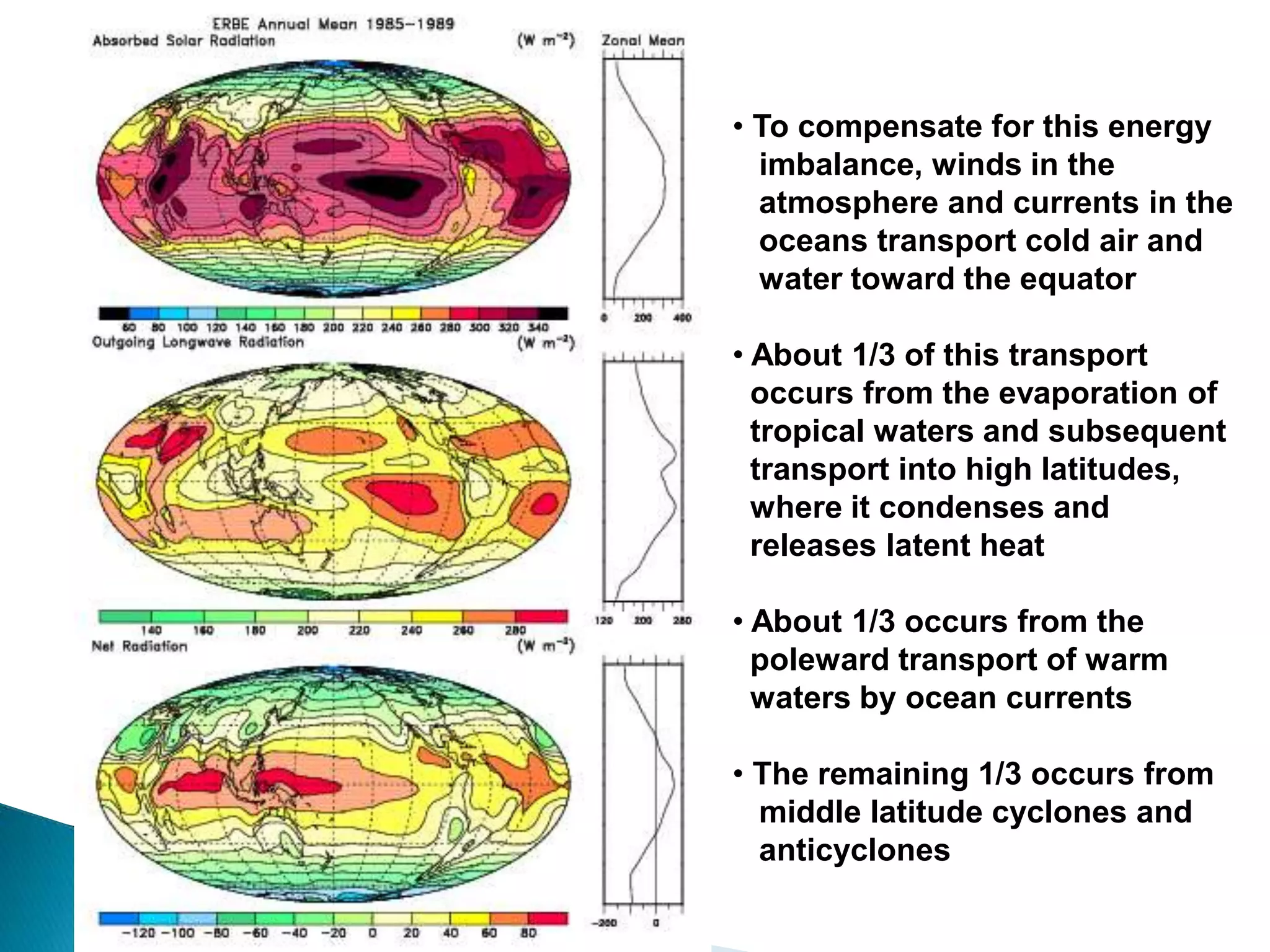
Energy
describes a
condition
Law of Conservation of Energy: Energy cannot be created or destroyed. It
can only be transformed from one type to another or passed from one object to
another. (First law of thermodynamics)
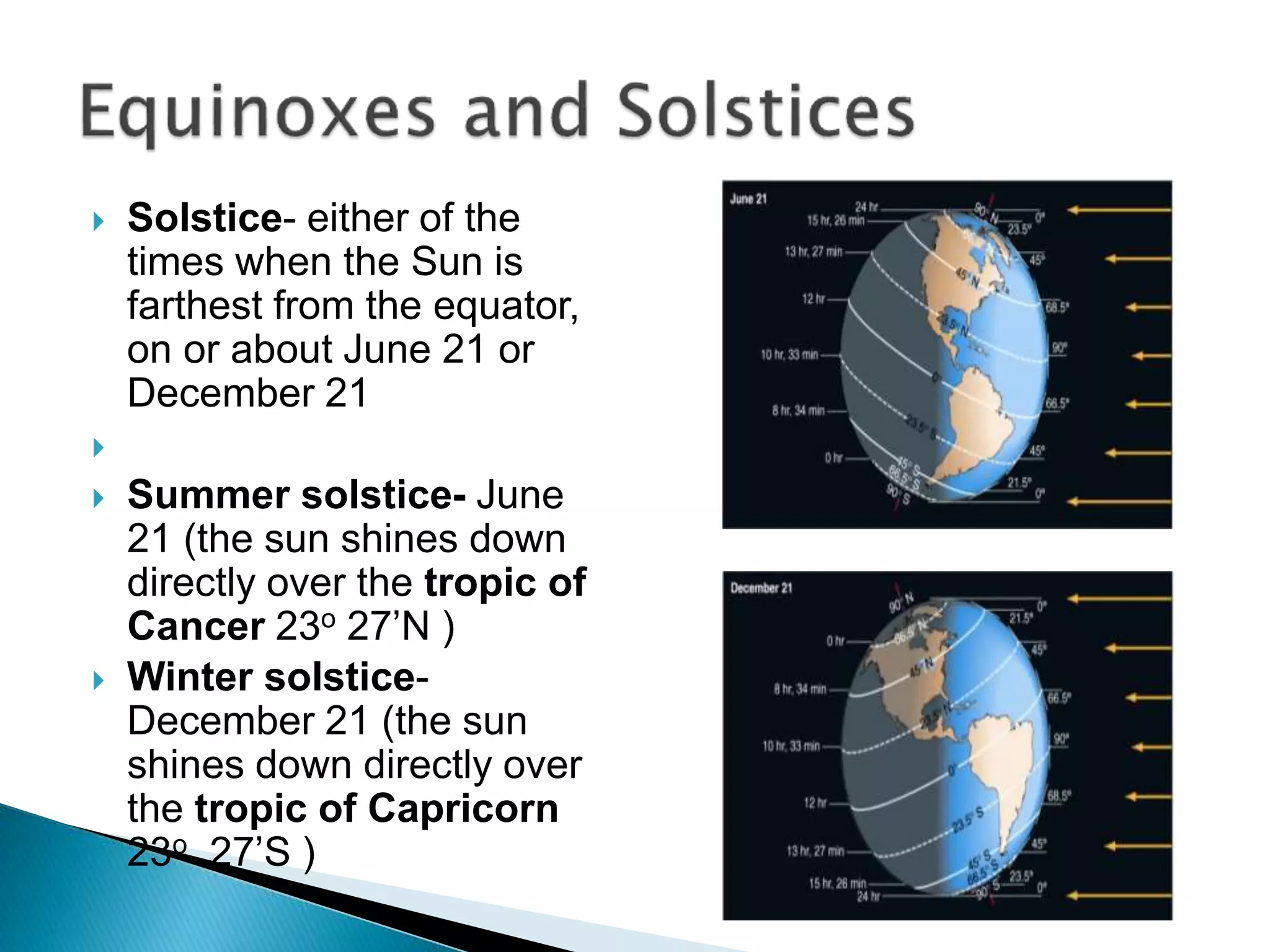
7.
Temperature- isa measure of the average speed of the
atoms and molecules, where higher temperatures
correspond to faster average speeds.
Thermal Energy - The total energy of all the particles in
a material.
The total potential and kinetic energy in an object. It
depends on mass, temperature, and phase of an object.
Thermal energy is synonymous to Internal energy
The atmosphere and oceans contain internal energy.
8.
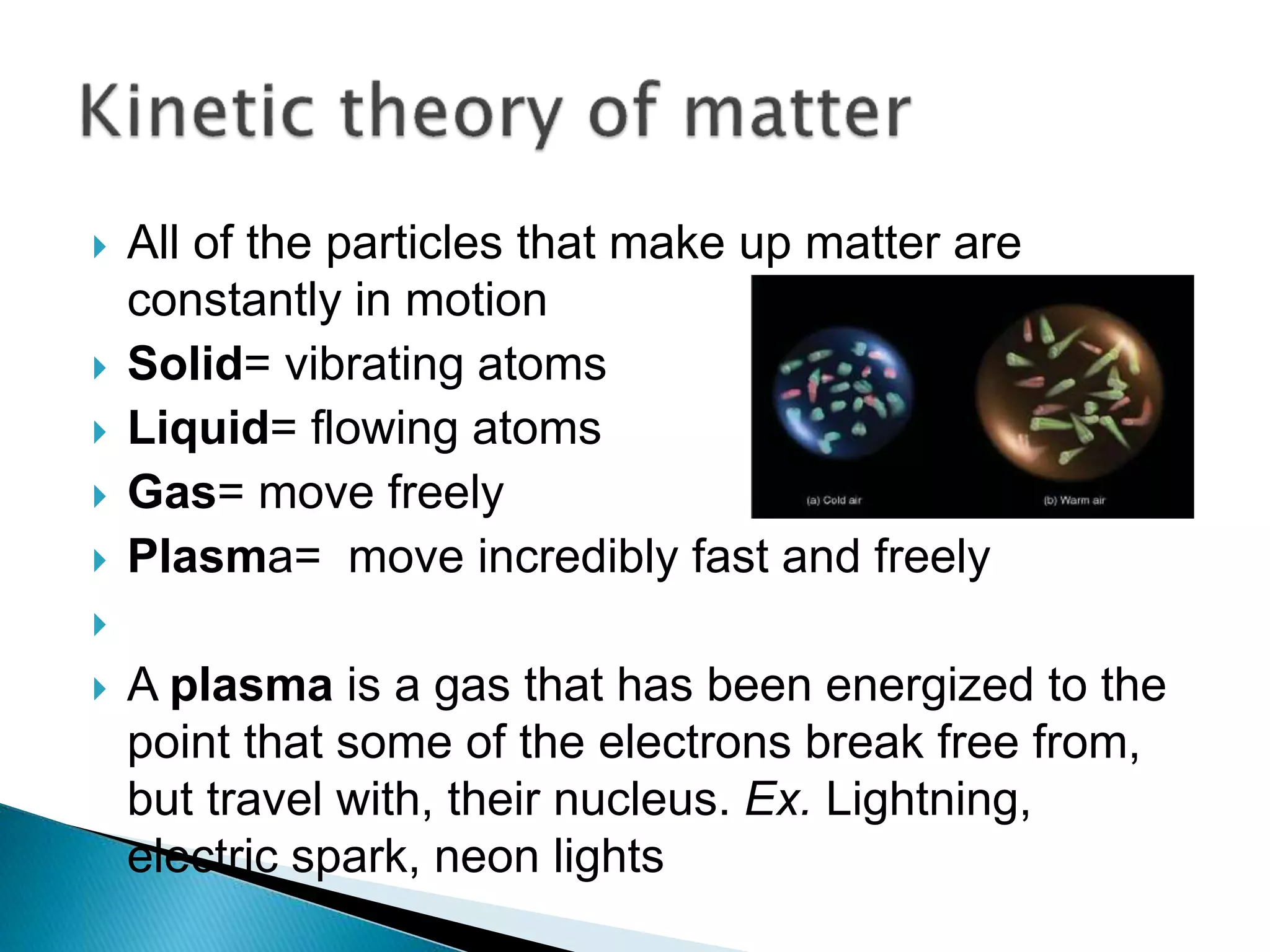
All ofthe particles that make up matter are
constantly in motion
Solid= vibrating atoms
Liquid= flowing atoms
Gas= move freely
Plasma= move incredibly fast and freely
A plasma is a gas that has been energized to the
point that some of the electrons break free from,
but travel with, their nucleus. Ex. Lightning,
electric spark, neon lights
9.
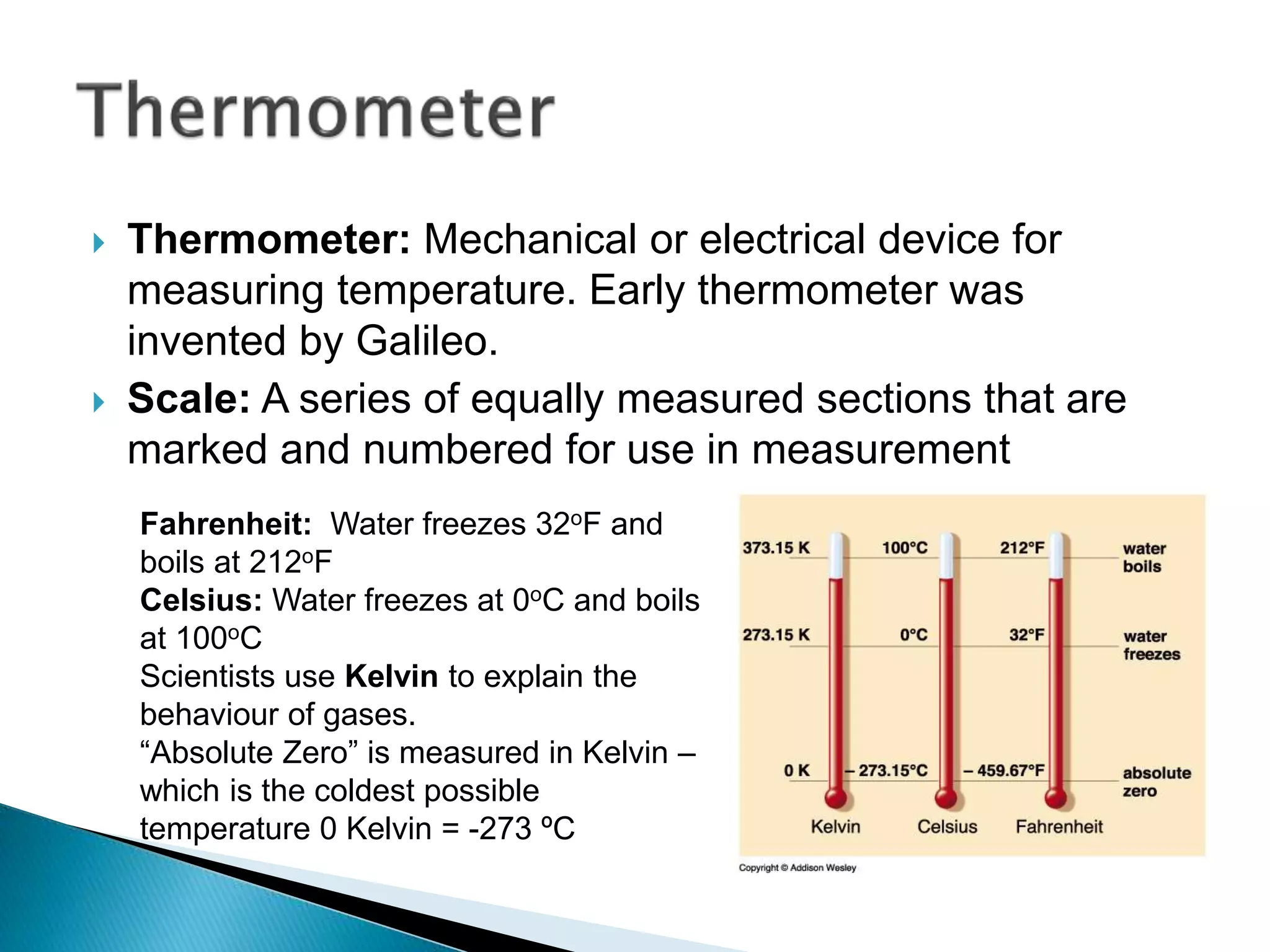
Thermometer: Mechanicalor electrical device for
measuring temperature. Early thermometer was
invented by Galileo.
Scale: A series of equally measured sections that are
marked and numbered for use in measurement
Fahrenheit: Water freezes 32oF and
boils at 212oF
Celsius: Water freezes at 0oC and boils
at 100oC
Scientists use Kelvin to explain the
behaviour of gases.
“Absolute Zero” is measured in Kelvin –
which is the coldest possible
temperature 0 Kelvin = -273 ºC
10.
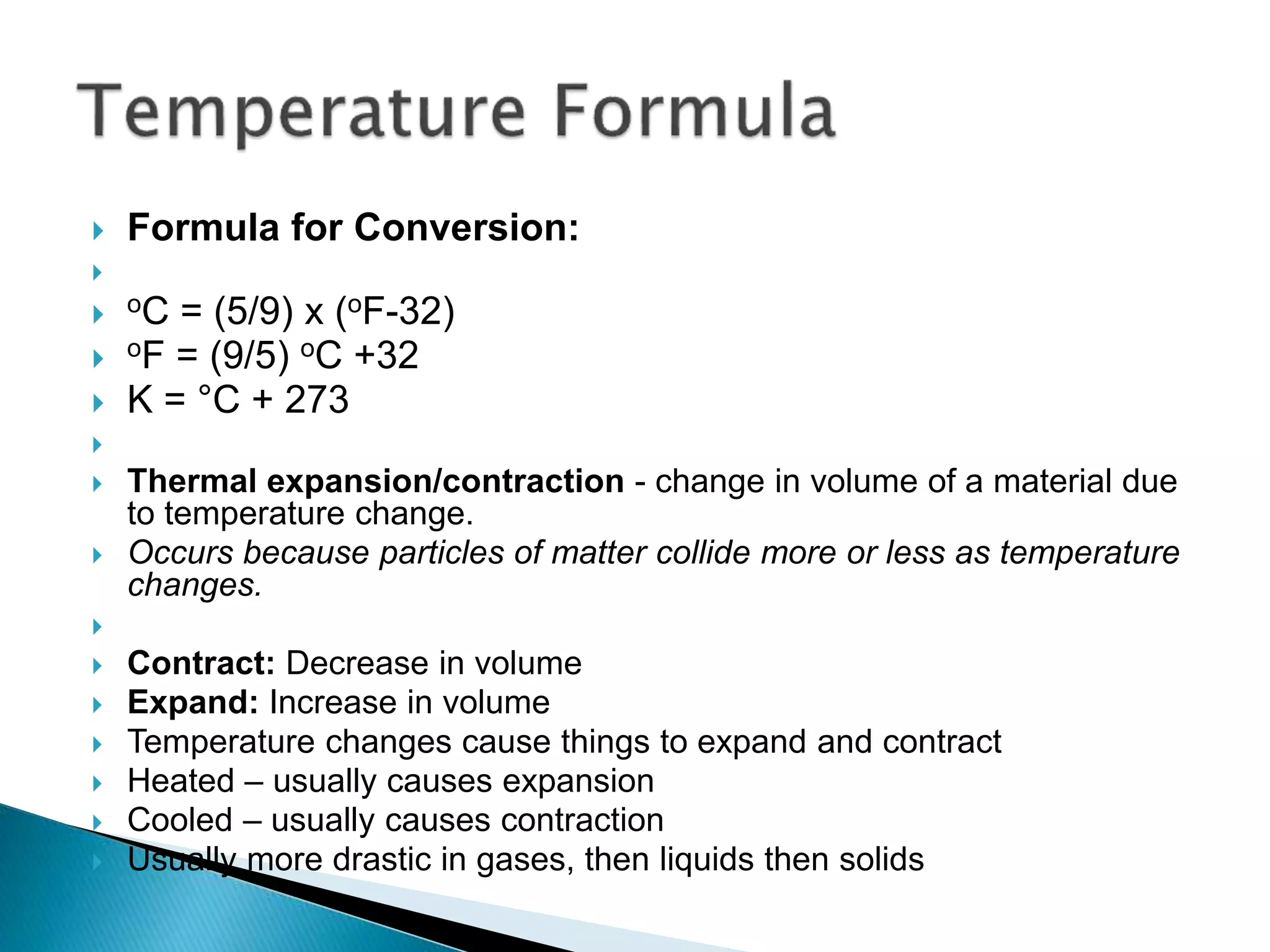
Formula forConversion:
oC = (5/9) x (oF-32)
oF = (9/5) oC +32
K = °C + 273
Thermal expansion/contraction - change in volume of a material due
to temperature change.
Occurs because particles of matter collide more or less as temperature
changes.
Contract: Decrease in volume
Expand: Increase in volume
Temperature changes cause things to expand and contract
Heated – usually causes expansion
Cooled – usually causes contraction
Usually more drastic in gases, then liquids then solids
11.
Heat- isenergy in transfer other than as work or
by transfer of matter.
◦ When there is a suitable physical pathway, heat flows
from a hotter body to a colder one
Heat Capacity: Amount of thermal energy that
warms or cools the object by one degree Celsius.
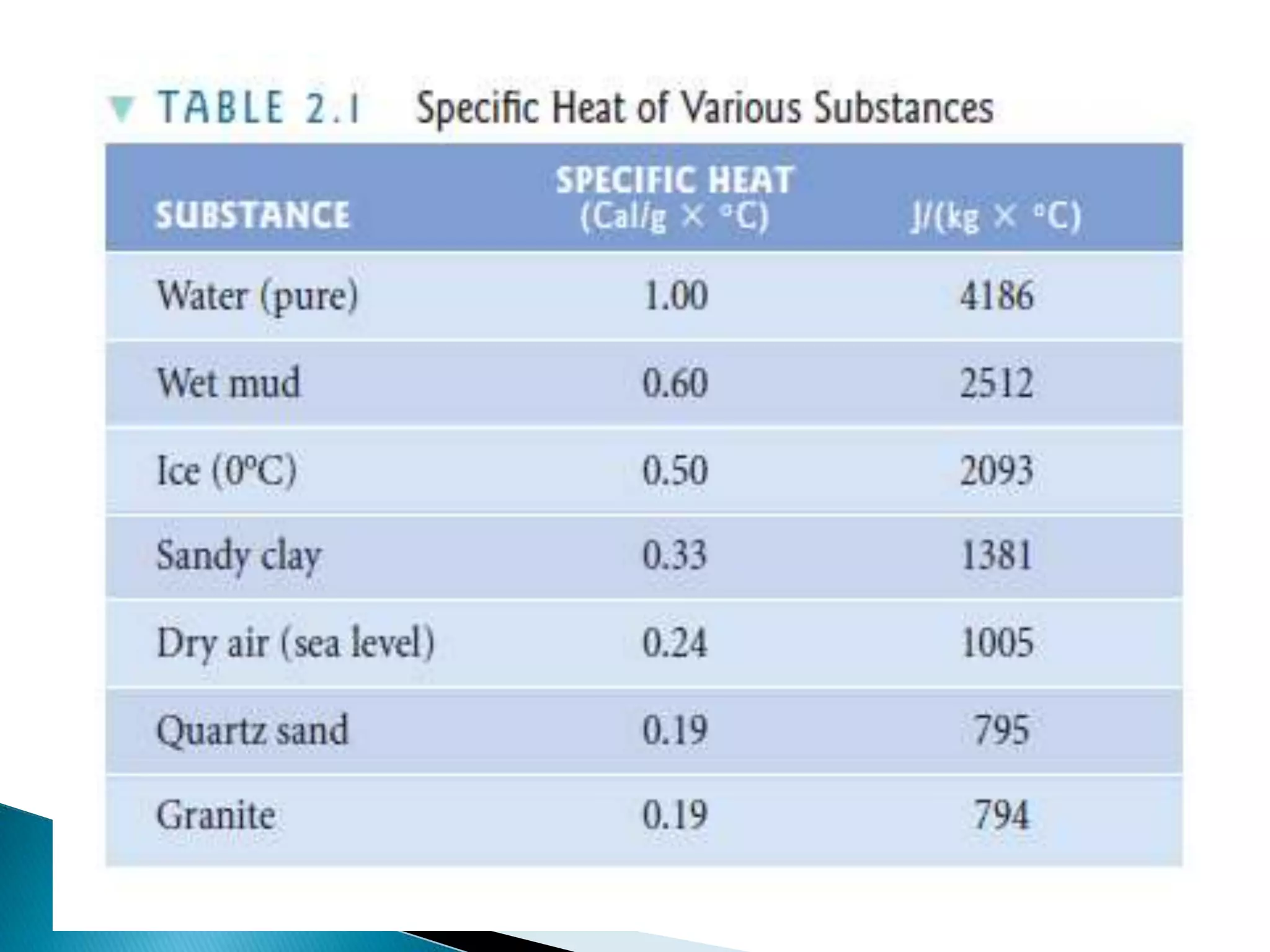
Specific Heat: the amount of energy required to
raise the temperature of 1 gram of a substance by
1oC
Calorie is the unit used for the amount of energy
13.
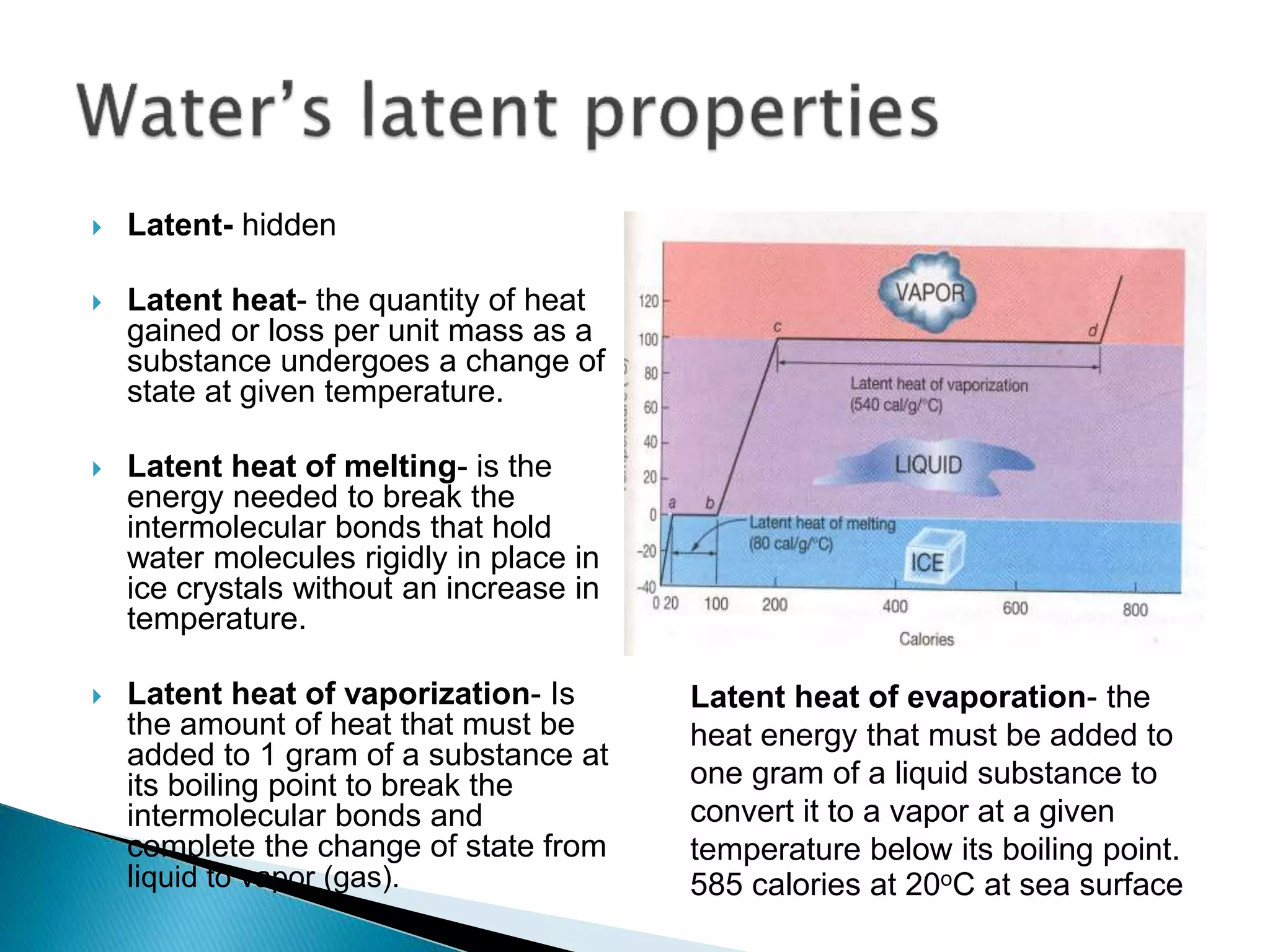
Latent- hidden
Latent heat- the quantity of heat
gained or loss per unit mass as a
substance undergoes a change of
state at given temperature.
Latent heat of melting- is the
energy needed to break the
intermolecular bonds that hold
water molecules rigidly in place in
ice crystals without an increase in
temperature.
Latent heat of vaporization- Is
the amount of heat that must be
added to 1 gram of a substance at
its boiling point to break the
intermolecular bonds and
complete the change of state from
liquid to vapor (gas).
Latent heat of evaporation- the
heat energy that must be added to
one gram of a liquid substance to
convert it to a vapor at a given
temperature below its boiling point.
585 calories at 20oC at sea surface
14.
Latent heatis the energy absorbed by or released
from a substance during a phase change from a gas
to a liquid or a solid or vice versa.
All pure substances in nature are able to change their state. Solids
can become liquids (ice to water) and liquids can become gases
(water to vapor) but changes such as these require the addition or
removal of heat. Heat that causes a change of state with no change
in temperature is called latent heat.
Sensible heat is the energy required to change the
temperature of a substance with no phase change
When an object is heated, its temperature rises as heat is added. The
increase in heat is called sensible heat. Similarly, when heat is removed
from an object and its temperature falls, the heat removed is also called
sensible heat. Heat that causes a change in temperature in an object is
called sensible heat
15.
Evaporation fromlakes, oceans, rivers, etc. occurs for
temperatures lower than 100 oC
But it requires more
energy to do so
16.
Energy movesheat
in three ways
Conduction
Convection
Radiation
17.
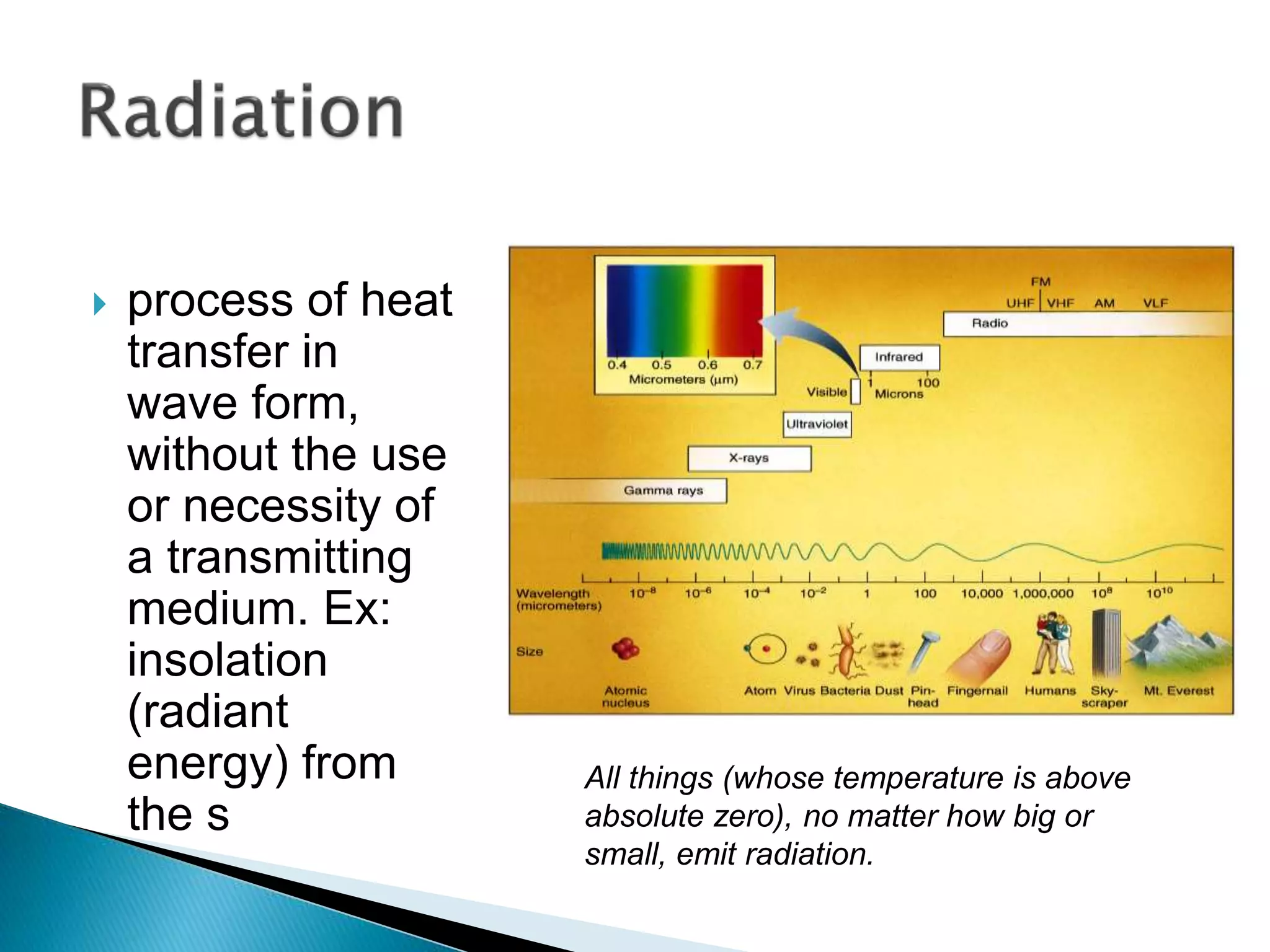
process ofheat
transfer in
wave form,
without the use
or necessity of
a transmitting
medium. Ex:
insolation
(radiant
energy) from
the s
All things (whose temperature is above
absolute zero), no matter how big or
small, emit radiation.
18.
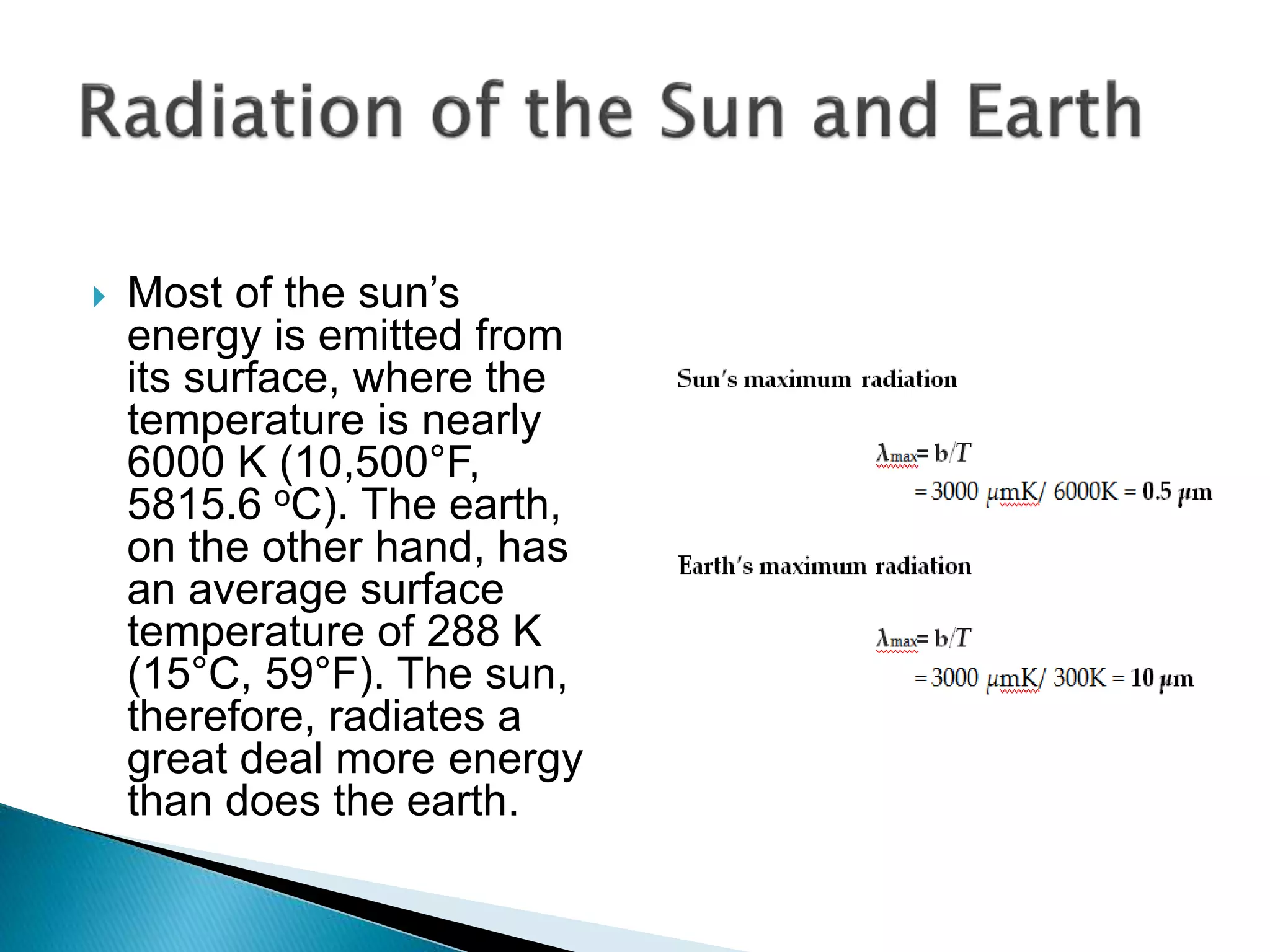
Most ofthe sun’s
energy is emitted from
its surface, where the
temperature is nearly
6000 K (10,500°F,
5815.6 oC). The earth,
on the other hand, has
an average surface
temperature of 288 K
(15°C, 59°F). The sun,
therefore, radiates a
great deal more energy
than does the earth.
19.
States thatthe amount of energy emitted by an object is
proportional to the object’s temperature.
◦ Stefan-Boltzmann Law describes this mathematically as;
I =T4
I is the intensity of the radiation in watts/m2, is the Stefan-
Boltzmann constant (5.67 x 10⁻⁸ watts/m2/K4) and T is the
temperature of the body in K
◦ Hotter objects emit more energy than cooler ones
◦ Graybodies denote objects which emit some percentage of the
maximum amount of radiation possible at a given temperature
Most solids and liquids
◦ True radiation emitted is a percentage relative to a blackbody and
reflects the emissivity of the object
20.
The earthemits most of its radiation at longer wavelengths between
about 5 and 25 μm, while the sun emits the majority of its radiation at
wavelengths less than 2 μm. For this reason, the earth’s radiation
(terrestrial radiation) is often called longwave radiation, whereas the
sun’s energy (solar radiation) is referred to as shortwave radiation
21.
The transferof heat by the mass movement of a fluid
(such as water and air)
The temperature gradients in the laminar boundary layer
induce energy transfer upward through convection
◦ This occurs any time the surface temperature exceeds
the air temperature
◦ Normally, this occurs during the middle of the day
◦ At night, the surface typically cools more rapidly than
air and energy is transferred downward
22.
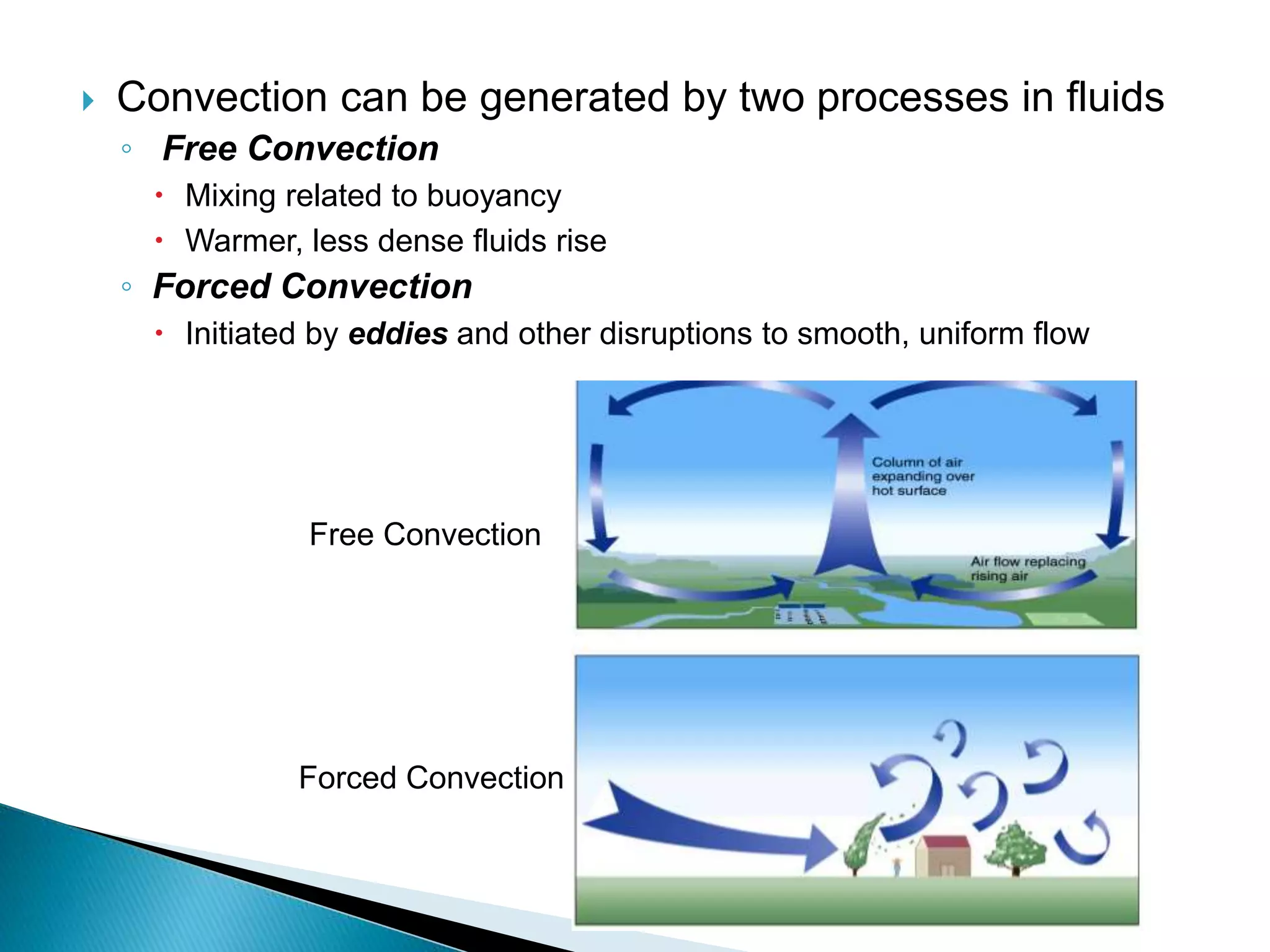
Convection canbe generated by two processes in fluids
◦ Free Convection
Mixing related to buoyancy
Warmer, less dense fluids rise
◦ Forced Convection
Initiated by eddies and other disruptions to smooth, uniform flow
Free Convection
Forced Convection
23.
The transferof heat from molecule to molecule within a
substance
As the surface warms, a temperature gradient (rate of
change of temperature over distance) develops in the
upper few cm of the ground
Temperatures are greater at the surface than below
◦ This transfers energy downward
◦ Surface warming also causes a temperature gradient
within a very thin sliver of adjacent air called the
laminar boundary layer
◦ Air is an extremely poor conductor of heat
25.
◦ Nearly two(2) calories on each square centimeter
each minute or 1367 W/m2
◦ Insolation annually varies by 7%
◦ Useful to think of a constant supply of radiation at the
top of the atmosphere
◦ Need to account for the relative amount of radiation
that is transmitted through the atmosphere, absorbed
by the atmosphere and surface, and scattered back to
space
26.
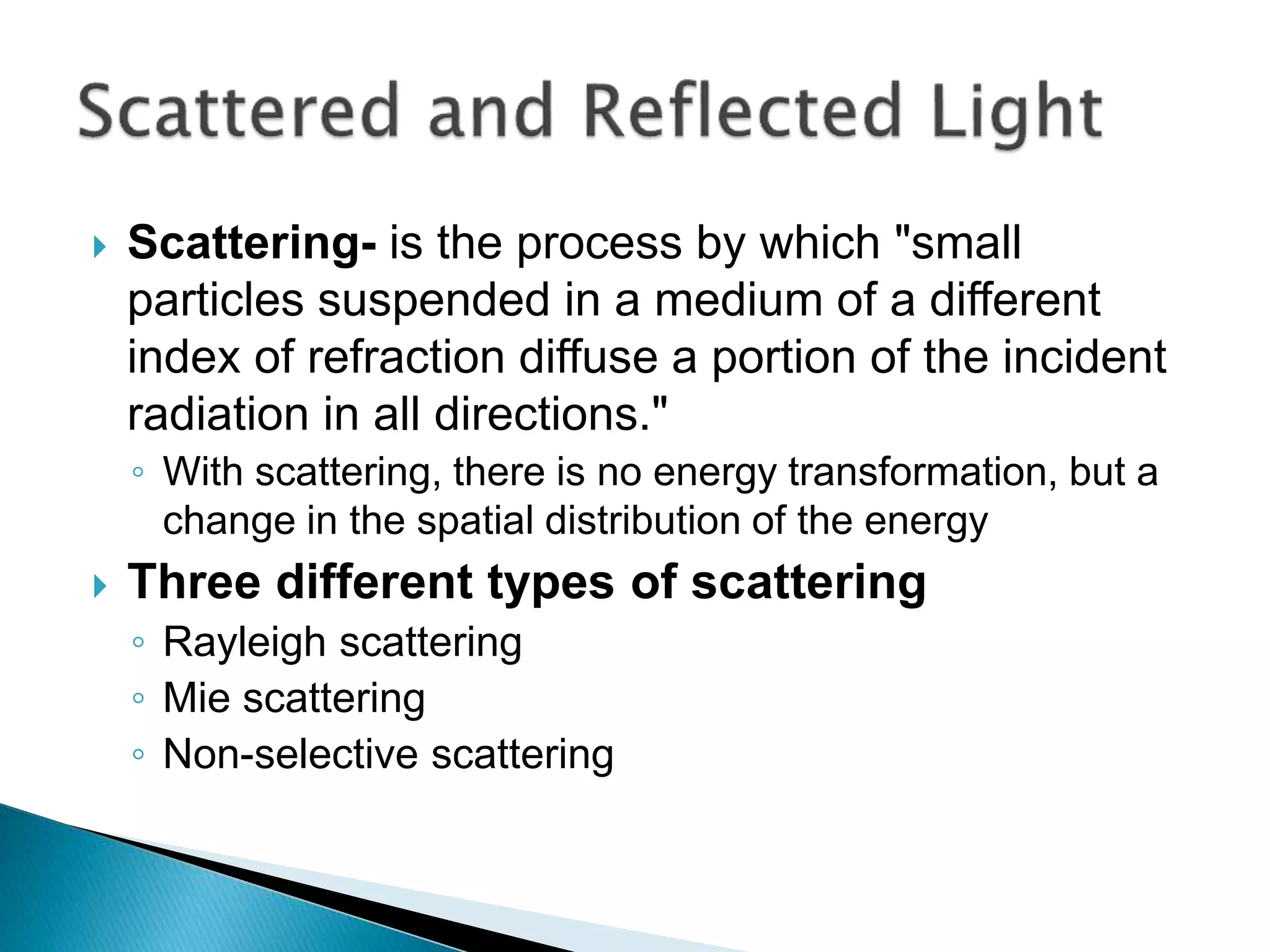
Scattering- isthe process by which "small
particles suspended in a medium of a different
index of refraction diffuse a portion of the incident
radiation in all directions."
◦ With scattering, there is no energy transformation, but a
change in the spatial distribution of the energy
Three different types of scattering
◦ Rayleigh scattering
◦ Mie scattering
◦ Non-selective scattering
27.
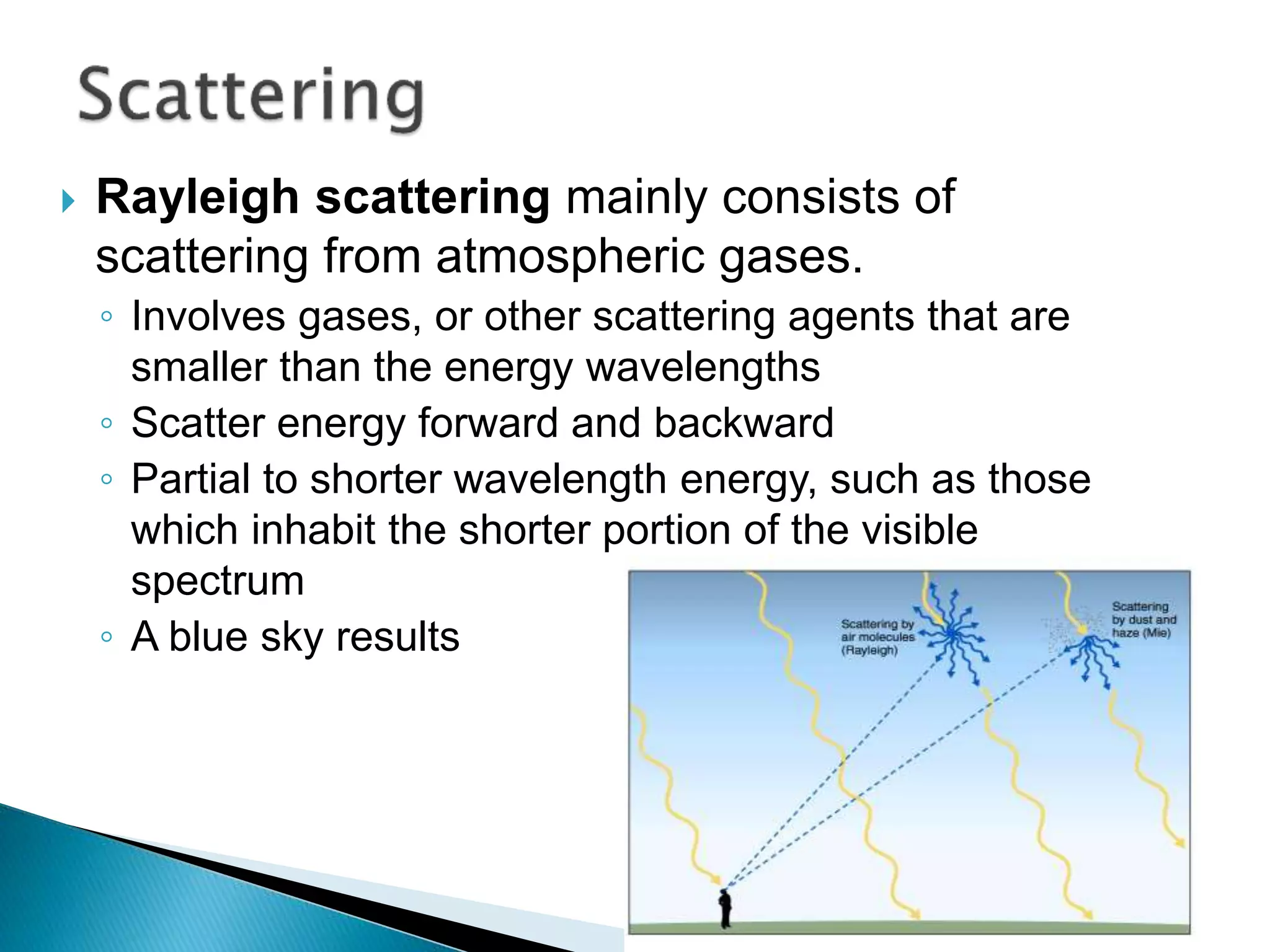
Rayleigh scatteringmainly consists of
scattering from atmospheric gases.
◦ Involves gases, or other scattering agents that are
smaller than the energy wavelengths
◦ Scatter energy forward and backward
◦ Partial to shorter wavelength energy, such as those
which inhabit the shorter portion of the visible
spectrum
◦ A blue sky results
28.
Mie scatteringis caused by pollen, dust, smoke, water
droplets, and other particles in the lower portion of the
atmosphere.
oLarger scattering agents, such as
suspended aerosols, scatter energy
only in a forward manner
oLarger particles interact with
wavelengths across the visible
spectrum
oProduces hazy or grayish skies
oResponsible for the white
appearance of the clouds
oEnhances longer wavelengths
during sunrises and sunsets,
indicative of a rather aerosol laden
atmosphere Longer radiation path lengths lead to
an increase in Mie Scattering and
reddish skies
29.
Non-selective scattering-It occurs in the lower
portion of the atmosphere when the particles are
much larger than the incident radiation. This
type of scattering is not wavelength dependent
and is the primary cause of haze.
◦ Water droplets, typically larger than energy
wavelengths, equally scatter wavelengths along the
visible portion of the spectrum
◦ Produces a white or gray appearance
◦ No wavelength is especially affected
30.
is thechange in direction of
a wave front at
an interface between two
different media so that the
wave front returns into the
medium from which it
originated.
◦ Process does not increase
heat in the reflector as
energy is not absorbed
◦ In most instances, only a
portion of incident energy is
reflected
◦ Albedo = the percentage of
reflected energy
◦ Specular reflection is
reflection of energy as an
equally intense energy
beam
31.
Albedo- isthe percent of radiation returning from a given surface
compared to the amount of radiation initially striking that surface.
Albedo, then, represents the reflectivity of the surface
32.
Solar radiationis the primary heat source for the atmosphere
Most gases are transparent to solar radiation and, instead,
absorb terrestrial radiation
Gases are also responsible for scattering incident energy
Solar input must balance solar output
Temperature increases/decreases if input is greater/less than
output
Average Earth Temperature is 16o
C
Without greenhouse gases, average T is -18oC
Solar Energy is reradiated from the surface as a long wave.
Surface of Earth (including oceans) is heated from above
Atmosphere is heated from below
The balance between incoming solar radiation, the absorption of
terrestrial radiation, and outgoing terrestrial radiation describes
the global energy budget
33.
Atmospheric Influenceson Insolation
Radiant energy incident upon the Earth-atmosphere system
is either absorbed, reflected, or transmitted by atmospheric
gases and/or the Earth’s surface
Energy reflected and/or transmitted (scattered) does not
contribute to heating
Absorbed energy encourages direct heating
Absorption
Particular gases, liquids, and solids in the atmosphere absorb
radiant energy
Heat increases in the absorber while less energy is
transferred to the surface
Although atmospheric gases are rather selective in the
wavelengths they absorb, they are overall poor absorbers of
energy
34.
Blackbody- anyobject that is a perfect absorber
(that is, absorbs all the radiation that strikes it) and
a perfect emitter (emits the maximum radiation
possible at its given temperature).
Blackbodies do not have to be colored black;
they simply must absorb and emit all possible
radiation.
Earth’s surface and Sun are blackbodies
Selective absorbers- Objects that selectively
absorb and emit radiation, such as gases in our
atmosphere.
35.
States thatgood
absorbers are good
emitters at a
particular
wavelength, and
poor absorbers are
poor emitters at the
same wavelength.
Atmospheric
Window- range of
wavelengths not
absorbed
36.
is theoverall dynamic property of the earth's atmosphere,
taken as a whole at each place and occasion of interest,
that lets some infrared radiation from the cloud tops and
land-sea surface pass directly to space without
intermediate absorption and re-emission, and thus without
heating the atmosphere.
As the main part of the 'window'
spectrum, a clear electromagnetic
spectral transmission 'window' can
be seen between 8 and 14 µm. A
fragmented part of the 'window'
spectrum (one might say a
louvred part of the 'window') can
also be seen in the visible to mid-
wavelength infrared between 0.2
and 5.5 µm.
37.
There are2 so-called atmospheric windows
Solar window: lets in almost all visible light and shortwave infrared
light from the Sun
Thermal window (confusingly also called the atmospheric window):
allows out some of the longwave infrared from the Earth
These energy flows balance to maintain the Earth's temperature.
38.
Global heatbudget is the balance between incoming
and outgoing solar radiation. Incoming solar energy
varies at different times of year and for different locations
across the globe.
39.
An estimate ofthe heat budget for Earth. On an average day, about half of the
solar energy arriving at the upper atmosphere is absorbed at Earth’s surface.
Light (short-wave) energy absorbed at the surface is converted into heat. Heat
leaves Earth as infrared (long-wave) radiation. Since input equals output over
long periods of time, the heat budget is balanced.
40.
Earth as awhole is in
thermal equilibrium, but
different latitudes are
not.
The average annual
incoming solar radiation (red
line) absorbed by Earth and
the average annual infrared
radiation (blue line) emitted
by Earth. Polar latitudes lose
more heat to space than they
gain, and tropical latitudes
gain more heat than they
lose. The amount of radiation
received equal the amount
lost at about 38°N and S.
The area of heat gained
(orange area) equals the
area of heat lost (blue areas)
so Earth’s total heat budget
is balanced.
41.
Energy imbalance– more energy comes in at
the equator than at the poles
51% of the short-wave radiation (light) striking
land is converted to longer-wave radiation (heat)
and transferred into the atmosphere by
conduction, radiation and evaporation.
Eventually, atmosphere, land and ocean radiate
heat back to space as long-wave radiation
(heat)
Input and outflow of heat comprise the earth’s
heat budget
42.
Qs= Qr+ Qe + Qh
Where:
Qs = solar radiation (100%)
Qr = radiation (41%)
Qe = evaporation (53%)
Qh = conduction (6%)
Example: If we have 2500 units of Qs, compute for the
Qr, Qe and Qh.
Qs= 1025 + 1325 + 150
43.
How solar energyinput varies
with latitude.
Equal amounts of sunlight are
spread over a greater surface
area near the poles than in the
tropics.
Ice near the poles reflects much
of the energy that reaches the
surface there.
The atmosphere reflects, scatters and absorbs solar radiation. At high
latitudes solar radiation travels a longer path through atmosphere.
44.
Uneven Solar EnergyInputs: Earth is heated
unevenly by the sun due to different angles of
incidence between the horizon and Sun.
This angle of incidence is
affected two factors:
1) Latitude: solar inputs are
most dense when the
sun is overhead in the
tropics; reflection is low.
The reverse holds true in
polar regions.
2) Season: Due to Earth’s
annual orbit around the
Sun on an axis tilted by
23.5º.
Heat budgetfor particular latitudes is NOT
balanced
Sunlight reaching polar latitudes is spread over a
greater area (less radiation per unit area)
At poles, light goes through more atmosphere so
approaches surface at a low angle favoring
reflection
Tropical latitudes get greater radiation per unit
area and light passes through less atmosphere
so they get more solar energy than polar areas
47.
Atmosphere andocean one interconnected
system
Change in atmosphere affects ocean
Change in ocean affects atmosphere
Warm equatorial waterflows to higher latitudes
Cool Polar water flow to lower latitudes
Re-distribution of heat
• Heat gained at Equatorial latitudes
• Heat lost at higher latitudes
• Winds and ocean currents redistribute heat around the
Earth
Oceans do not boil away near the equator or freeze solid near the
poles because heat is transferred by winds and ocean currents
from equatorial to polar regions.
51.
• To compensatefor this energy
imbalance, winds in the
atmosphere and currents in the
oceans transport cold air and
water toward the equator
• About 1/3 of this transport
occurs from the evaporation of
tropical waters and subsequent
transport into high latitudes,
where it condenses and
releases latent heat
• About 1/3 occurs from the
poleward transport of warm
waters by ocean currents
• The remaining 1/3 occurs from
middle latitude cyclones and
anticyclones
52.
►Due to Energytransfer we get form solar energy
and other forms we get different weathers.
►The Effects of the energy transfers in the future
could result in melting Ice caps, higher sea
levels , flooding, and warmer climate .
► The Polar Ice Caps absorb a lot of the CO2
and solar radiation.
►If these melt then there will be nothing to reflect
the harmful radiation and to absorb CO2 .
53.
◦ Earth revolvesabout the Sun along an ecliptic plane
◦ Distance varies
Perihelion (Jan 3; 148 mil km, 91 mil mi)
Aphelion (July 4; 152 mil km, 94 mil mi)
◦ Total variation is about 3%
◦ Using the inverse square law, radiation intensity varies
by about 7% between perihelion and aphelion
54.
Aphelion- thepoint in the orbit of an object in
the solar system that is farthest away from the
sun.
◦ 152,200,000 km distance
◦ July 4
◦ 1.88 cal
Perihelion- point nearest the sun in the orbit of
a planet
◦ 148,500,000 km distance
◦ January 3
◦ 2.01 cal
55.
◦ Earth rotateson its axis once
every 24 hours
◦ Axis of rotation is offset 23.5o
from a perpendicular plane
through the ecliptic plane
◦ Because the axis of rotation is
never changing, the northern
axis aligns with the star Polaris
◦ Hemispheric orientation
changes as the Earth orbits the
Sun
◦ A particular hemisphere will
either align toward or away from
the Sun, or occupy a position
between the extremes
56.
Equinox- eitherof the two
annual crossings of the
equator by the Sun, once
in each direction, when the
length of day and night are
approximately equal
everywhere on Earth.
The equinoxes occur
around March 21 and
September 23
Vernal equinox- March 21
(the sun shines directly
above the equator)
Autumnal equinox –
September 21 (the sun
shines directly above the
equator)
57.
Solstice- eitherof the
times when the Sun is
farthest from the equator,
on or about June 21 or
December 21
Summer solstice- June
21 (the sun shines down
directly over the tropic of
Cancer 23o 27’N )
Winter solstice-
December 21 (the sun
shines down directly over
the tropic of Capricorn
23o 27’S )
58.
Seasons doNOT arise from the distance the Earth is from the
Sun but rather as a result of the Earth’s annual motion and axial
inclination – the tip of our planet with respect to its orbital plane.
As we move around the Sun, the orientation of our planet gives
us seasons.