

22 March is World Water Day


           Presented by
        Dr. B. Victor., Ph. D
Email : bonfiliusvictor@gmail.com
 Blog: bonvictor.blogspot.com
   Introduction                 Chemical structure
   Life – supporting            Global water cycle
    functions of water.          Kinds and sources of
   Water is vital to human       water pollution
    life                         Health impacts of water
   Global water issues           pollution
   Global distribution of       Water footprint
    water                        Water pollution episodes
   Properties of water          Remedial measures
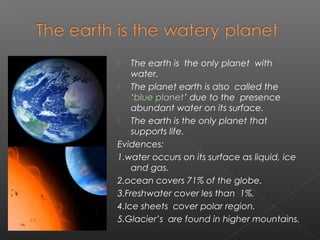
   The earth is the only planet with
    water.
   The planet earth is also called the
    ‘blue planet’ due to the presence
    abundant water on its surface.
   The earth is the only planet that
    supports life.
Evidences:
1.water occurs on its surface as liquid, ice
    and gas.
2.ocean covers 71% of the globe.
3.Freshwater cover les than 1%.
4.Ice sheets cover polar region.
5.Glacier’s are found in higher mountains.
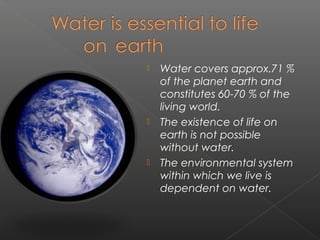
   Water covers approx.71 %
    of the planet earth and
    constitutes 60-70 % of the
    living world.
   The existence of life on
    earth is not possible
    without water.
   The environmental system
    within which we live is
    dependent on water.
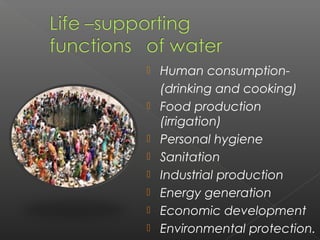
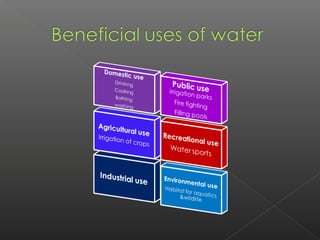
   Human consumption-
    (drinking and cooking)
   Food production
    (irrigation)
   Personal hygiene
   Sanitation
   Industrial production
   Energy generation
   Economic development
   Environmental protection.
   An average adult human body contains
    42 liters of water.
   Water is required for digestion and
    absorption of food.
   Water transfers oxygen and nutrients to
    the cells.
   Water carries metabolic wastes.
   Water act as a natural cooling system.
 Water shortage - levels of available water
  do not meet minimum requirements.
 Water scarcity – the relationship between
  demand for water and its availability.
 Water stress – decline in water quality.
 Water security – access to adequate
  quantity and safe quality.
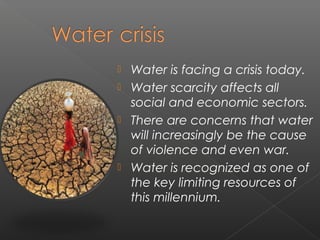
   Water is facing a crisis today.
   Water scarcity affects all
    social and economic sectors.
   There are concerns that water
    will increasingly be the cause
    of violence and even war.
   Water is recognized as one of
    the key limiting resources of
    this millennium.
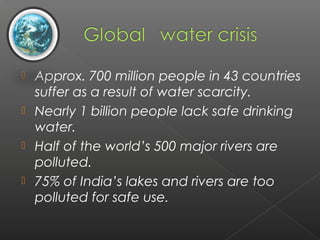
 Approx. 700 million people in 43 countries
  suffer as a result of water scarcity.
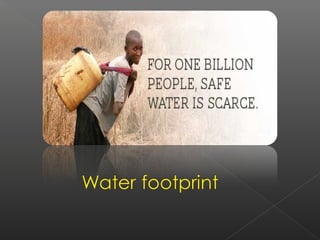
 Nearly 1 billion people lack safe drinking
  water.
 Half of the world’s 500 major rivers are
  polluted.
 75% of India’s lakes and rivers are too
  polluted for safe use.
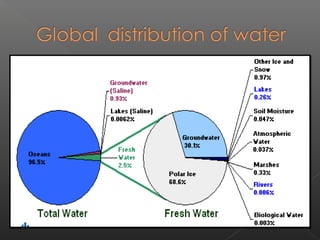
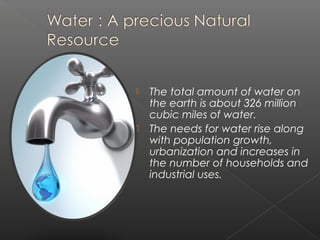
   The total amount of water on
    the earth is about 326 million
    cubic miles of water.
   The needs for water rise along
    with population growth,
    urbanization and increases in
    the number of households and
    industrial uses.
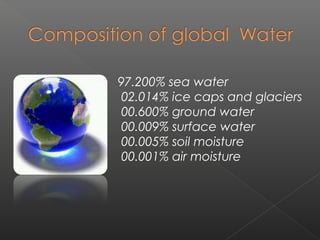
97.200% sea water
 02.014% ice caps and glaciers
 00.600% ground water
 00.009% surface water
 00.005% soil moisture
 00.001% air moisture
 Solids: when water becomes very cold
  and freezes it will change from a liquid
  to a solid. It has a definite form and
  shape.
 Liquids: in liquid form, water takes the
  shape of its container.
 Gases: in vapor form water has no
  definite size.
 Ocean Water: salt water is found in the
  oceans and seas.
 Fresh Surface Water: fresh water is found
  in rivers, streams, lakes and ponds.
 Ground water: Ground water is stored in
  underground aquifers. Water in aquifer
  remains there for an average of 1,400
  years!
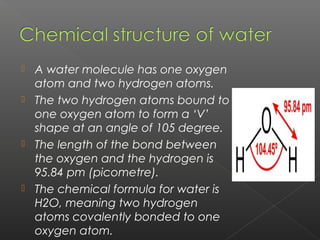
 A water molecule has one oxygen
  atom and two hydrogen atoms.
 The two hydrogen atoms bound to
  one oxygen atom to form a ‘V’
  shape at an angle of 105 degree.
 The length of the bond between
  the oxygen and the hydrogen is
  95.84 pm (picometre).
 The chemical formula for water is
  H2O, meaning two hydrogen
  atoms covalently bonded to one
  oxygen atom.
   Water is colorless, tasteless and odorless.
   Water is a great solvent.
   Water exists as a liquid, in rivers and seas,
    a solid, as snow and ice, and as a gas, as
    clouds or steam. 
   Water can absorb a large amount
    heat(high specific heat capacity).
   Water can stick together into beads and
    drops( surface tension).
   Water flows and erodes the surface of the
    earth.
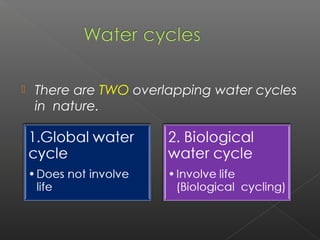
   There are TWO overlapping water cycles
    in nature.
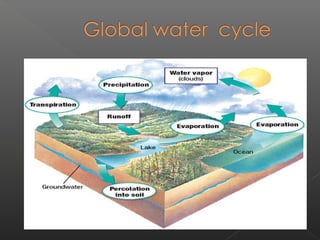
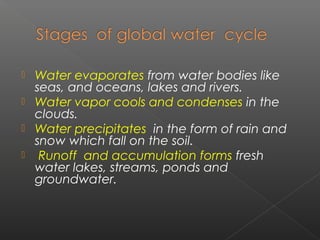
   Water evaporates from water bodies like
    seas, and oceans, lakes and rivers.
   Water vapor cools and condenses in the
    clouds.
   Water precipitates in the form of rain and
    snow which fall on the soil.
    Runoff and accumulation forms fresh
    water lakes, streams, ponds and
    groundwater.
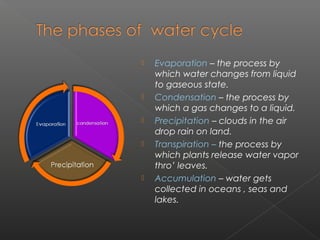
   Evaporation – the process by
    which water changes from liquid
    to gaseous state.
   Condensation – the process by
    which a gas changes to a liquid.
   Precipitation – clouds in the air
    drop rain on land.
   Transpiration – the process by
    which plants release water vapor
    thro’ leaves.
   Accumulation – water gets
    collected in oceans , seas and
    lakes.
   This cycle refers to volume of water content in the
    body of an organism.
   Aquatic plants and freshwater animals absorb
    water from the surrounding medium by osmosis.
   Trees absorb water from the moist soil thro’ roots.
   Land animals receive water by feeding and
    drinking.
   Plants loose water by transpiration thro’ leaves.
   Animals loose water by sweating and elimination.
   After death water returned to the environment by
    bacterial decomposition.
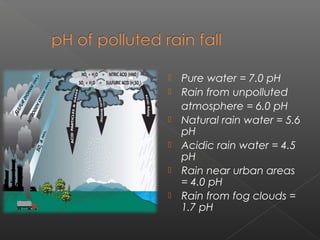
   Pure water = 7.0 pH
   Rain from unpolluted
    atmosphere = 6.0 pH
   Natural rain water = 5.6
    pH
   Acidic rain water = 4.5
    pH
   Rain near urban areas
    = 4.0 pH
   Rain from fog clouds =
    1.7 pH
   Surface water pollution - pollution of lakes, rivers and
    oceans
   Groundwater pollution - pollution of aquifers below soil.
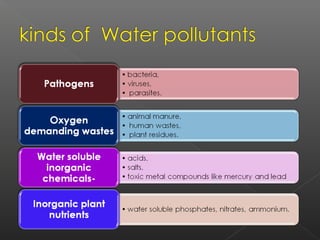
   Microbial pollution – pollution by bacteria, viruses, protozoa
    and parasitic worms.
   Oxygen depletion pollution – pollution by biodegradable
    organics.
   Nutrient pollution – pollution by plant nutrients (nitrates,
    phosphates)
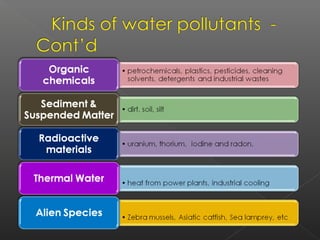
   Suspended matter pollution – pollution by soil, silt
   Chemical pollution - pollution by pesticides, fertilizers,
    industrial solvents, oil
   Thermal pollution- pollution by warm water, waste heat
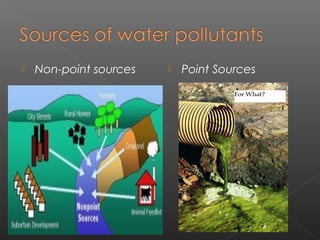
   Point Sources – A single definable source
    of the pollution, e.g. a factory, a sewage
    plant, etc.- pollution is easy to monitor
    and control,
   Non-point sources – No one single
    source, but a wide range of sources, e.g.
    runoff from urban areas, or farmland.
-Pollution is more difficult to monitor and
    control.
   Non-point sources      Point Sources
 Non-persistent pollutants can be broken
  down by natural chemical reactions or
  by natural bacteria into simple, non-
  polluting substances such as carbon
  dioxide and nitrogen. e.g. wood, paper,
  biological wastes
 More load of degradable pollutants can
  lead to low oxygen levels and
  eutrophication.
 But this damage is reversible.
   Organic chemical substances are
    persistent that degrade very slowly or
    cannot be broken down at all.
   They may remain in the aquatic
    environment for longer periods of time.
   The damage is irreversible and is the most
    rapidly growing type of pollution.
   Pesticides - DDT, dieldrin
   Leachate components from landfill sites
    (municipal, industrial)
   Petroleum and petroleum products
   PCBs, dioxins, polycyclic aromatic
    hydrocarbons (PAHs)
   Radioactive materials- strontium-90,
    cesium-137, radium-226, and uranium
   Metals - lead, mercury, cadmium
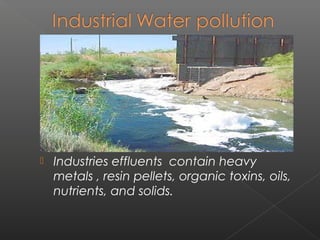
   Industries effluents contain heavy
    metals , resin pellets, organic toxins, oils,
    nutrients, and solids.
Impact of
     Microbial water pollution
   No. of people lack access to safe drinking water = Over
    1 billion.
   No. of people lack adequate sanitation = 2.6 billion . This
    has led to widespread microbial contamination of
    drinking water.
   Deaths due to water-associated infectious diseases =up
    to 3.2 million people per year. (approx. 6% of all deaths
    globally).
   Deaths due to diseases caused by inadequate water,
    sanitation, and hygiene = 1.8 million people.
   excessive amounts of plant
    nutrients=P,N,C.
   Excessive growth or ‘blooms of algae’
   Algal blooms leads to oxygen depletion.
   Hypoxia leads to mass fish kills.
   Degradation of water and habitat
    quality.
   Drought causes more damage and
    suffering than any other natural disaster.
   80 countries experience droughts lasting
    more than 1 year.
   According to the UN, almost 500 million
    people, in 31 countries (~40% of the world’s
    population) experience chronic water
    scarcity.
   Water scarcity is already a problem in many
    countries.
    50% of the world’s population lives on or
    within 160 miles of shore.
   Fourteen billion pounds of garbage, mostly
    plastic, is dumped into the ocean every
    year.
   For every 1 million tons of oil that is shipped,
    about 1 ton is spilled.
   More oil is seeped into the ocean each
    year as a result of leaking cars and other
    non-point sources
 Asian rivers are the most polluted in the
  world.
 River Ganges in India is one of the most
  polluted rivers in the world.
 Approximately 46% of the lakes in
  America are too polluted for fishing,
  aquatic life, or swimming.
 The amount of plastic waste has been
  increasing about 10% each year for the
  past 20 years.
 Over 1 million seabirds are killed by
  plastic waste per year.
 Over 100,000 sea mammals and
  countless fish are killed per year due to
  pollution.
“Water contributes much to health”
     - Hippocrates ( 460 – 377 B.C )
 Neurotoxins – destroying nervous tissue.
 Carcinogens – inducing cancers
 Mutagens – altering genetic characteristics
 Teratogens – causing non-hereditary birth
              defects.
   Pesticides - damage nervous system and also
    cause cancer.
   Lead – affects central nervous system .
   Fluorides – damage teeth and the skeleton.
   Nitrates – cause blue – baby syndrome in infants.
   Petrochemicals – cause cancer.
   Arsenic – damage liver and nervous system, skin
    cancer.
   Heavy metals – damage nervous system and
    kidneys.
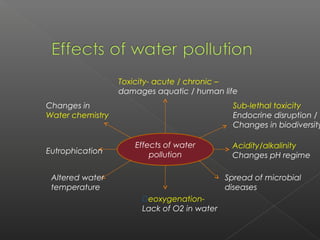
Toxicity- acute / chronic –
                  damages aquatic / human life
Changes in                                     Sub-lethal toxicity
Water chemistry                                Endocrine disruption /
                                               Changes in biodiversity

                     Effects of water         Acidity/alkalinity
Eutrophication           pollution            Changes pH regime

 Altered water                               Spread of microbial
 temperature                                 diseases
                       Deoxygenation-
                       Lack of O2 in water
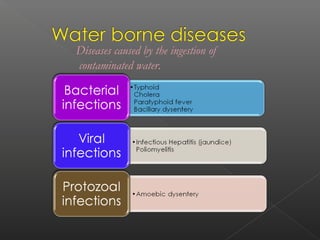
Diseases caused by the ingestion of
contaminated water.
Water – scarce       Water- related vector
(water –washed)        diseases
    diseases         Vectors : Mosquitoes,
                       tsetse flies
   Trachoma
                      Malaria
   Leprosy
                      Yellow fever
   Tuberculosis
                      Dengue fever
   Whooping cough
                      Sleeping sickness
   Tetanus
                      filariasis
   diphtheria
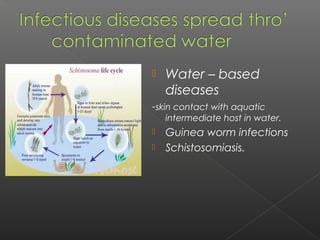
   Water – based
    diseases
-skin contact with aquatic
    intermediate host in water.
   Guinea worm infections
   Schistosomiasis.
 Each year, there are about 250 million
  cases of water- related diseases.
 It is estimated that at least 1.5 million
  children under the age of 12 die
  annually due to water pollution.
 1.4 million people die each year in India
  from water pollution.
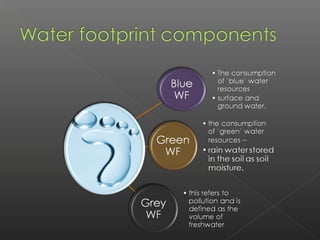
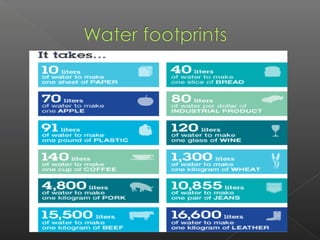
 Water footprint measures the
  consumption and contamination
  of freshwater resources.
 It was first introduced by Hoekstra
  in 2002 to provide a consumption-
  based indicator of water use.
 Water footprint differs around the
  world and depends on climate,
  soil types, irrigation methods and
  crop genetics. 
 Your water footprint extends
  beyond the average 80-100
  gallons of water you use
  everyday.
 A product water footprint is
  the total volume of
  freshwater consumed,
  directly and indirectly, to
  produce a product. 
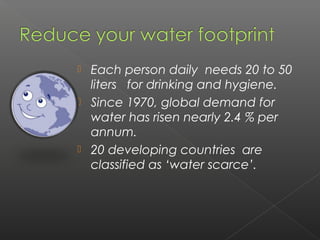
   Each person daily needs 20 to 50
    liters for drinking and hygiene.
   Since 1970, global demand for
    water has risen nearly 2.4 % per
    annum.
   20 developing countries are
    classified as ‘water scarce’.
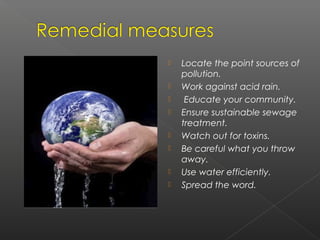
   Locate the point sources of
    pollution.
   Work against acid rain.
    Educate your community.
   Ensure sustainable sewage
    treatment.
   Watch out for toxins.
   Be careful what you throw
    away.
   Use water efficiently.
   Spread the word.
“ Water has the power to move millions of
people – let it move us in the direction of
peace”.
                -Mikhail Gorbachev, president,
                Green Cross International.
   Dr.B.Victor is a highly experienced postgraduate
    professor from the reputed educational institution- St.
    Xavier’ s College(autonomous), Palayamkottai,
    India-627001.
   He had been the dean of sciences and assistant
    controller of examinations.
   He has more than 32 years of teaching and research
    experience
   He has taught a diversity of courses ranging from
    pre- university to post graduate classes.
   He retired from service on 2008.
   Send your comments to : bonfiliusvictor@gmail.com
Human impact on global water

Human impact on global water

  • 1.
    22 March isWorld Water Day Presented by Dr. B. Victor., Ph. D Email : bonfiliusvictor@gmail.com Blog: bonvictor.blogspot.com
  • 2.
    Introduction  Chemical structure  Life – supporting  Global water cycle functions of water.  Kinds and sources of  Water is vital to human water pollution life  Health impacts of water  Global water issues pollution  Global distribution of  Water footprint water  Water pollution episodes  Properties of water  Remedial measures
  • 3.
    The earth is the only planet with water.  The planet earth is also called the ‘blue planet’ due to the presence abundant water on its surface.  The earth is the only planet that supports life. Evidences: 1.water occurs on its surface as liquid, ice and gas. 2.ocean covers 71% of the globe. 3.Freshwater cover les than 1%. 4.Ice sheets cover polar region. 5.Glacier’s are found in higher mountains.
  • 4.
    Water covers approx.71 % of the planet earth and constitutes 60-70 % of the living world.  The existence of life on earth is not possible without water.  The environmental system within which we live is dependent on water.
  • 5.
    Human consumption- (drinking and cooking)  Food production (irrigation)  Personal hygiene  Sanitation  Industrial production  Energy generation  Economic development  Environmental protection.
  • 6.
    An average adult human body contains 42 liters of water.  Water is required for digestion and absorption of food.  Water transfers oxygen and nutrients to the cells.  Water carries metabolic wastes.  Water act as a natural cooling system.
  • 7.
     Water shortage- levels of available water do not meet minimum requirements.  Water scarcity – the relationship between demand for water and its availability.  Water stress – decline in water quality.  Water security – access to adequate quantity and safe quality.
  • 8.
    Water is facing a crisis today.  Water scarcity affects all social and economic sectors.  There are concerns that water will increasingly be the cause of violence and even war.  Water is recognized as one of the key limiting resources of this millennium.
  • 9.
     Approx. 700million people in 43 countries suffer as a result of water scarcity.  Nearly 1 billion people lack safe drinking water.  Half of the world’s 500 major rivers are polluted.  75% of India’s lakes and rivers are too polluted for safe use.
  • 13.
    The total amount of water on the earth is about 326 million cubic miles of water.  The needs for water rise along with population growth, urbanization and increases in the number of households and industrial uses.
  • 14.
    97.200% sea water 02.014% ice caps and glaciers 00.600% ground water 00.009% surface water 00.005% soil moisture 00.001% air moisture
  • 15.
     Solids: whenwater becomes very cold and freezes it will change from a liquid to a solid. It has a definite form and shape.  Liquids: in liquid form, water takes the shape of its container.  Gases: in vapor form water has no definite size.
  • 16.
     Ocean Water:salt water is found in the oceans and seas.  Fresh Surface Water: fresh water is found in rivers, streams, lakes and ponds.  Ground water: Ground water is stored in underground aquifers. Water in aquifer remains there for an average of 1,400 years!
  • 17.
     A watermolecule has one oxygen atom and two hydrogen atoms.  The two hydrogen atoms bound to one oxygen atom to form a ‘V’ shape at an angle of 105 degree.  The length of the bond between the oxygen and the hydrogen is 95.84 pm (picometre).  The chemical formula for water is H2O, meaning two hydrogen atoms covalently bonded to one oxygen atom.
  • 18.
    Water is colorless, tasteless and odorless.  Water is a great solvent.  Water exists as a liquid, in rivers and seas, a solid, as snow and ice, and as a gas, as clouds or steam.   Water can absorb a large amount heat(high specific heat capacity).  Water can stick together into beads and drops( surface tension).  Water flows and erodes the surface of the earth.
  • 19.
    There are TWO overlapping water cycles in nature.
  • 21.
    Water evaporates from water bodies like seas, and oceans, lakes and rivers.  Water vapor cools and condenses in the clouds.  Water precipitates in the form of rain and snow which fall on the soil.  Runoff and accumulation forms fresh water lakes, streams, ponds and groundwater.
  • 22.
    Evaporation – the process by which water changes from liquid to gaseous state.  Condensation – the process by which a gas changes to a liquid.  Precipitation – clouds in the air drop rain on land.  Transpiration – the process by which plants release water vapor thro’ leaves.  Accumulation – water gets collected in oceans , seas and lakes.
  • 23.
    This cycle refers to volume of water content in the body of an organism.  Aquatic plants and freshwater animals absorb water from the surrounding medium by osmosis.  Trees absorb water from the moist soil thro’ roots.  Land animals receive water by feeding and drinking.  Plants loose water by transpiration thro’ leaves.  Animals loose water by sweating and elimination.  After death water returned to the environment by bacterial decomposition.
  • 24.
    Pure water = 7.0 pH  Rain from unpolluted atmosphere = 6.0 pH  Natural rain water = 5.6 pH  Acidic rain water = 4.5 pH  Rain near urban areas = 4.0 pH  Rain from fog clouds = 1.7 pH
  • 29.
    Surface water pollution - pollution of lakes, rivers and oceans  Groundwater pollution - pollution of aquifers below soil.  Microbial pollution – pollution by bacteria, viruses, protozoa and parasitic worms.  Oxygen depletion pollution – pollution by biodegradable organics.  Nutrient pollution – pollution by plant nutrients (nitrates, phosphates)  Suspended matter pollution – pollution by soil, silt  Chemical pollution - pollution by pesticides, fertilizers, industrial solvents, oil  Thermal pollution- pollution by warm water, waste heat
  • 30.
    Point Sources – A single definable source of the pollution, e.g. a factory, a sewage plant, etc.- pollution is easy to monitor and control,  Non-point sources – No one single source, but a wide range of sources, e.g. runoff from urban areas, or farmland. -Pollution is more difficult to monitor and control.
  • 31.
    Non-point sources  Point Sources
  • 32.
     Non-persistent pollutantscan be broken down by natural chemical reactions or by natural bacteria into simple, non- polluting substances such as carbon dioxide and nitrogen. e.g. wood, paper, biological wastes  More load of degradable pollutants can lead to low oxygen levels and eutrophication.  But this damage is reversible.
  • 33.
    Organic chemical substances are persistent that degrade very slowly or cannot be broken down at all.  They may remain in the aquatic environment for longer periods of time.  The damage is irreversible and is the most rapidly growing type of pollution.
  • 34.
    Pesticides - DDT, dieldrin  Leachate components from landfill sites (municipal, industrial)  Petroleum and petroleum products  PCBs, dioxins, polycyclic aromatic hydrocarbons (PAHs)  Radioactive materials- strontium-90, cesium-137, radium-226, and uranium  Metals - lead, mercury, cadmium
  • 37.
    Industries effluents contain heavy metals , resin pellets, organic toxins, oils, nutrients, and solids.
  • 38.
    Impact of Microbial water pollution  No. of people lack access to safe drinking water = Over 1 billion.  No. of people lack adequate sanitation = 2.6 billion . This has led to widespread microbial contamination of drinking water.  Deaths due to water-associated infectious diseases =up to 3.2 million people per year. (approx. 6% of all deaths globally).  Deaths due to diseases caused by inadequate water, sanitation, and hygiene = 1.8 million people.
  • 39.
    excessive amounts of plant nutrients=P,N,C.  Excessive growth or ‘blooms of algae’  Algal blooms leads to oxygen depletion.  Hypoxia leads to mass fish kills.  Degradation of water and habitat quality.
  • 40.
    Drought causes more damage and suffering than any other natural disaster.  80 countries experience droughts lasting more than 1 year.  According to the UN, almost 500 million people, in 31 countries (~40% of the world’s population) experience chronic water scarcity.  Water scarcity is already a problem in many countries.
  • 41.
     50% of the world’s population lives on or within 160 miles of shore.  Fourteen billion pounds of garbage, mostly plastic, is dumped into the ocean every year.  For every 1 million tons of oil that is shipped, about 1 ton is spilled.  More oil is seeped into the ocean each year as a result of leaking cars and other non-point sources
  • 42.
     Asian riversare the most polluted in the world.  River Ganges in India is one of the most polluted rivers in the world.  Approximately 46% of the lakes in America are too polluted for fishing, aquatic life, or swimming.
  • 43.
     The amountof plastic waste has been increasing about 10% each year for the past 20 years.  Over 1 million seabirds are killed by plastic waste per year.  Over 100,000 sea mammals and countless fish are killed per year due to pollution.
  • 44.
    “Water contributes muchto health” - Hippocrates ( 460 – 377 B.C )
  • 45.
     Neurotoxins –destroying nervous tissue.  Carcinogens – inducing cancers  Mutagens – altering genetic characteristics  Teratogens – causing non-hereditary birth defects.
  • 46.
    Pesticides - damage nervous system and also cause cancer.  Lead – affects central nervous system .  Fluorides – damage teeth and the skeleton.  Nitrates – cause blue – baby syndrome in infants.  Petrochemicals – cause cancer.  Arsenic – damage liver and nervous system, skin cancer.  Heavy metals – damage nervous system and kidneys.
  • 47.
    Toxicity- acute /chronic – damages aquatic / human life Changes in Sub-lethal toxicity Water chemistry Endocrine disruption / Changes in biodiversity Effects of water Acidity/alkalinity Eutrophication pollution Changes pH regime Altered water Spread of microbial temperature diseases Deoxygenation- Lack of O2 in water
  • 48.
    Diseases caused bythe ingestion of contaminated water.
  • 49.
    Water – scarce Water- related vector (water –washed) diseases diseases Vectors : Mosquitoes, tsetse flies  Trachoma  Malaria  Leprosy  Yellow fever  Tuberculosis  Dengue fever  Whooping cough  Sleeping sickness  Tetanus  filariasis  diphtheria
  • 50.
    Water – based diseases -skin contact with aquatic intermediate host in water.  Guinea worm infections  Schistosomiasis.
  • 51.
     Each year,there are about 250 million cases of water- related diseases.  It is estimated that at least 1.5 million children under the age of 12 die annually due to water pollution.  1.4 million people die each year in India from water pollution.
  • 53.
     Water footprintmeasures the consumption and contamination of freshwater resources.  It was first introduced by Hoekstra in 2002 to provide a consumption- based indicator of water use.  Water footprint differs around the world and depends on climate, soil types, irrigation methods and crop genetics. 
  • 55.
     Your waterfootprint extends beyond the average 80-100 gallons of water you use everyday.  A product water footprint is the total volume of freshwater consumed, directly and indirectly, to produce a product. 
  • 57.
    Each person daily needs 20 to 50 liters for drinking and hygiene.  Since 1970, global demand for water has risen nearly 2.4 % per annum.  20 developing countries are classified as ‘water scarce’.
  • 59.
    Locate the point sources of pollution.  Work against acid rain.  Educate your community.  Ensure sustainable sewage treatment.  Watch out for toxins.  Be careful what you throw away.  Use water efficiently.  Spread the word.
  • 60.
    “ Water hasthe power to move millions of people – let it move us in the direction of peace”. -Mikhail Gorbachev, president, Green Cross International.
  • 61.
    Dr.B.Victor is a highly experienced postgraduate professor from the reputed educational institution- St. Xavier’ s College(autonomous), Palayamkottai, India-627001.  He had been the dean of sciences and assistant controller of examinations.  He has more than 32 years of teaching and research experience  He has taught a diversity of courses ranging from pre- university to post graduate classes.  He retired from service on 2008.  Send your comments to : bonfiliusvictor@gmail.com