Geronimo R. Rosario
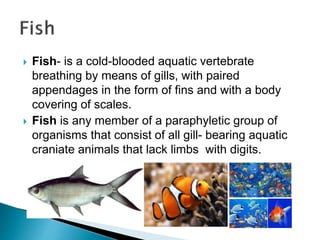
 Fish- is a cold-blooded aquatic vertebrate
breathing by means of gills, with paired
appendages in the form of fins and with a body
covering of scales.
 Fish is any member of a paraphyletic group of
organisms that consist of all gill- bearing aquatic
craniate animals that lack limbs with digits.
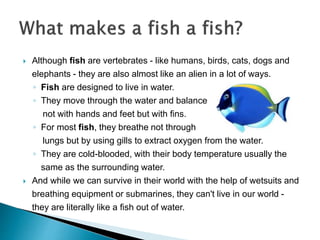
 Although fish are vertebrates - like humans, birds, cats, dogs and
elephants - they are also almost like an alien in a lot of ways.
◦ Fish are designed to live in water.
◦ They move through the water and balance
not with hands and feet but with fins.
◦ For most fish, they breathe not through
lungs but by using gills to extract oxygen from the water.
◦ They are cold-blooded, with their body temperature usually the
same as the surrounding water.
 And while we can survive in their world with the help of wetsuits and
breathing equipment or submarines, they can't live in our world -
they are literally like a fish out of water.
 Ectothermic
 Vertebrates
 Have scales
 Swim with fins
 Almost all exclusively aquatic
 Filter oxygen from water over gills
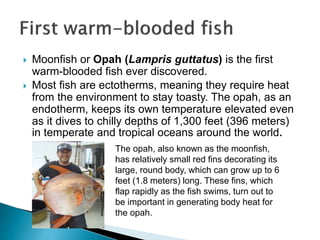
 Moonfish or Opah (Lampris guttatus) is the first
warm-blooded fish ever discovered.
 Most fish are ectotherms, meaning they require heat
from the environment to stay toasty. The opah, as an
endotherm, keeps its own temperature elevated even
as it dives to chilly depths of 1,300 feet (396 meters)
in temperate and tropical oceans around the world.
The opah, also known as the moonfish,
has relatively small red fins decorating its
large, round body, which can grow up to 6
feet (1.8 meters) long. These fins, which
flap rapidly as the fish swims, turn out to
be important in generating body heat for
the opah.
 Ichthyology – study of fishes
 Also known as Fish Science, is the branch
of biology devoted to the study of fish.
 This includes bony fishes (Osteichthyes),
cartilaginous fish (Chondrichthyes), and jawless
fish (Agnatha).
 While a large number of species have been
discovered and described, approximately 250 new
species are officially described by science each
year.
 According to Fishbase, 34,300 species of fish had
been described as of October 2015
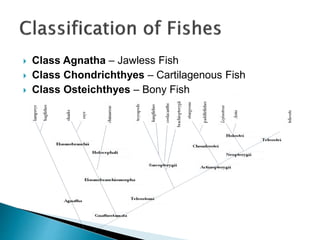
 Class Agnatha – Jawless Fish
 Class Chondrichthyes – Cartilagenous Fish
 Class Osteichthyes – Bony Fish
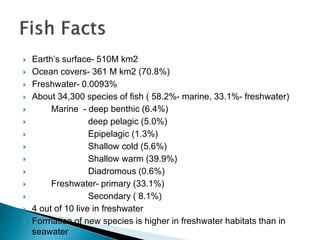
 Earth’s surface- 510M km2
 Ocean covers- 361 M km2 (70.8%)
 Freshwater- 0.0093%
 About 34,300 species of fish ( 58.2%- marine, 33.1%- freshwater)
 Marine - deep benthic (6.4%)
 deep pelagic (5.0%)
 Epipelagic (1.3%)
 Shallow cold (5.6%)
 Shallow warm (39.9%)
 Diadromous (0.6%)
 Freshwater- primary (33.1%)
 Secondary ( 8.1%)
 4 out of 10 live in freshwater
 Formation of new species is higher in freshwater habitats than in
seawater
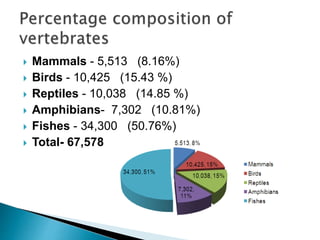
 Mammals - 5,513 (8.16%)
 Birds - 10,425 (15.43 %)
 Reptiles - 10,038 (14.85 %)
 Amphibians- 7,302 (10.81%)
 Fishes - 34,300 (50.76%)
 Total- 67,578
 Lake Titicaca (South America) –3812 m. world’s
highest lake
 Marianas Trench- 11 km
 Desert springs
 Caves
 Thermal vents
 Under antartic ice
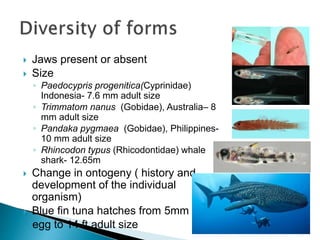
 Jaws present or absent
 Size
◦ Paedocypris progenitica(Cyprinidae)
Indonesia- 7.6 mm adult size
◦ Trimmatom nanus (Gobidae), Australia– 8
mm adult size
◦ Pandaka pygmaea (Gobidae), Philippines-
10 mm adult size
◦ Rhincodon typus (Rhicodontidae) whale
shark- 12.65m
 Change in ontogeny ( history and
development of the individual
organism)
 Blue fin tuna hatches from 5mm
egg to 14 ft adult size

Fish

  • 1.
  • 2.
     Fish- isa cold-blooded aquatic vertebrate breathing by means of gills, with paired appendages in the form of fins and with a body covering of scales.  Fish is any member of a paraphyletic group of organisms that consist of all gill- bearing aquatic craniate animals that lack limbs with digits.
  • 3.
     Although fishare vertebrates - like humans, birds, cats, dogs and elephants - they are also almost like an alien in a lot of ways. ◦ Fish are designed to live in water. ◦ They move through the water and balance not with hands and feet but with fins. ◦ For most fish, they breathe not through lungs but by using gills to extract oxygen from the water. ◦ They are cold-blooded, with their body temperature usually the same as the surrounding water.  And while we can survive in their world with the help of wetsuits and breathing equipment or submarines, they can't live in our world - they are literally like a fish out of water.
  • 4.
     Ectothermic  Vertebrates Have scales  Swim with fins  Almost all exclusively aquatic  Filter oxygen from water over gills
  • 5.
     Moonfish orOpah (Lampris guttatus) is the first warm-blooded fish ever discovered.  Most fish are ectotherms, meaning they require heat from the environment to stay toasty. The opah, as an endotherm, keeps its own temperature elevated even as it dives to chilly depths of 1,300 feet (396 meters) in temperate and tropical oceans around the world. The opah, also known as the moonfish, has relatively small red fins decorating its large, round body, which can grow up to 6 feet (1.8 meters) long. These fins, which flap rapidly as the fish swims, turn out to be important in generating body heat for the opah.
  • 6.
     Ichthyology –study of fishes  Also known as Fish Science, is the branch of biology devoted to the study of fish.  This includes bony fishes (Osteichthyes), cartilaginous fish (Chondrichthyes), and jawless fish (Agnatha).  While a large number of species have been discovered and described, approximately 250 new species are officially described by science each year.  According to Fishbase, 34,300 species of fish had been described as of October 2015
  • 7.
     Class Agnatha– Jawless Fish  Class Chondrichthyes – Cartilagenous Fish  Class Osteichthyes – Bony Fish
  • 8.
     Earth’s surface-510M km2  Ocean covers- 361 M km2 (70.8%)  Freshwater- 0.0093%  About 34,300 species of fish ( 58.2%- marine, 33.1%- freshwater)  Marine - deep benthic (6.4%)  deep pelagic (5.0%)  Epipelagic (1.3%)  Shallow cold (5.6%)  Shallow warm (39.9%)  Diadromous (0.6%)  Freshwater- primary (33.1%)  Secondary ( 8.1%)  4 out of 10 live in freshwater  Formation of new species is higher in freshwater habitats than in seawater
  • 9.
     Mammals -5,513 (8.16%)  Birds - 10,425 (15.43 %)  Reptiles - 10,038 (14.85 %)  Amphibians- 7,302 (10.81%)  Fishes - 34,300 (50.76%)  Total- 67,578
  • 10.
     Lake Titicaca(South America) –3812 m. world’s highest lake  Marianas Trench- 11 km  Desert springs  Caves  Thermal vents  Under antartic ice
  • 11.
     Jaws presentor absent  Size ◦ Paedocypris progenitica(Cyprinidae) Indonesia- 7.6 mm adult size ◦ Trimmatom nanus (Gobidae), Australia– 8 mm adult size ◦ Pandaka pygmaea (Gobidae), Philippines- 10 mm adult size ◦ Rhincodon typus (Rhicodontidae) whale shark- 12.65m  Change in ontogeny ( history and development of the individual organism)  Blue fin tuna hatches from 5mm egg to 14 ft adult size