The document discusses global climate models, describing them as mathematical representations of Earth's climate system that incorporate physical, biological, and chemical principles. It covers the types of climate models, their components, how they function, input data requirements, uncertainties, and their importance in predicting climate changes. Additionally, it emphasizes the complexity of modeling climate due to intricate interactions between various Earth's systems and human influences on future predictions.
The presentation introduces Prof. Balsubramanian and the focus on global climate models at the University of Mysore.
Definitions of models, including physical, statistical, and numerical models; schematic descriptions of systems.
Mathematical models analyze Earth's processes, including air and water circulations and global climate models encompassing physical, biological, and chemical principles.
Complex interactions in climate necessitate mathematical models describing various Earth systems, including biosphere, hydrosphere, cryosphere, atmosphere, and geosphere.
Global Climate Models (GCMs) use equations to simulate processes like wind and ocean currents, assessing the climate system accurately.
Equations for heat storage, illustrating thermodynamic principles and interactions with Earth's climate.
Models require input data from observations; they simulate using grids, high-resolution computations, and convert data into visualizations.
Acknowledgment of uncertainties in climate modeling due to unknown processes, pollution, and factors influencing predictions.
Models are tested against actual climate data to validate their accuracy and improve equations for better predictions.
Climate models consist of various components such as atmosphere, ocean, cryosphere, and land surface models, reflecting interconnectedness.
Different types of models, including General Circulation Models (GCMs) and simple Zero Dimensional models, used for climate predictions.
Climate models are crucial for forecasting future climate changes, including impacts on temperatures, ocean behavior, and carbon cycles.
2
Definition of aModel:
A model is a prototype form of a larger system.
It may be a physical one , if it is scaled down
into a small size replication the major system.
A model may be a statistical model, it uses a
statistical formula for prediction.
A model may be numerical or mathematical
model if it uses a mathematical equation.
3.
3
A model isdefined as "a schematic description
of a system, theory, or phenomenon that
accounts for its known or inferred properties
and may be used for further studies of its
characteristics."
Models are classified into physical models and
Numerical models.
Numerical models use mathematical formulas
or statistical methods.
4.
4
Mathematical models:
Earth's processesare analysed using
mathematical formulas and equations. The
formulas vary from place to place and from one
altitude to the other. The equations vary from
air masses to water masses. Some are specific
for air circulations. some are specific for water
circulation in oceans. Some are specific to water
circulations on land.
5.
5
Some are Specificto hydrologic cycle. some are
specific to biogeochemical cycles.
Some have influencing factors from biosphere.
If all factors are included in a mathematical
equation to predict global climatic variables,
then they are called as Global climate models.
In general terms, a climate model could be
defined as a mathematical representation of the
climate system based on physical, biological
and chemical principles.
6.
6
The equations derivedfrom the process laws are
so complex that they must be solved
numerically.
Climate is complex:
To aid in understanding many complex
interactions scientists often build mathematical
models that represent simple climate systems.
7.
7
We gain anunderstanding of the importance of
a certain parameter (for example, cloud cover)
by changing that variable in the simple climate
model and observing the changes in the model
predictions (for example, changes in surface
temperature).
Climate models usually try to take into account
all the parts of the Earth system, its processes
and constituents, including their properties.
8.
8
These include theanimals and plants
(the biosphere), the oceans, lakes, and rivers
(the hydrosphere), icebergs, glaciers and ice
sheets (the cryosphere),
air (the atmosphere), Volcanoes and moving
continents (the geosphere).
Mathematics is also used to describe how the
Earth processes are related to each other,
through numerical approximations.
9.
9
How Climate ModelsWork:
A global climate model (GCM) uses hundreds
of mathematical equations to describe processes
that happen on our planet, processes like wind,
ocean currents, and plant growth.
Global climate models (GCMs) use
mathematical equations to describe how the
atmosphere, the oceans, the land, living things,
ice, and energy from the Sun affect each other
and Earth's climate.
10.
10
When employed correctly,all the model types
can produce useful information on the
behaviour of the climate system.
For example : an energy balance models
estimate the changes in the climate system from
an analysis of the energy budget of the Earth. In
their simplest form, they do not include any
explicit spatial dimension, providing only
globally averaged values for the computed
variables.
11.
11
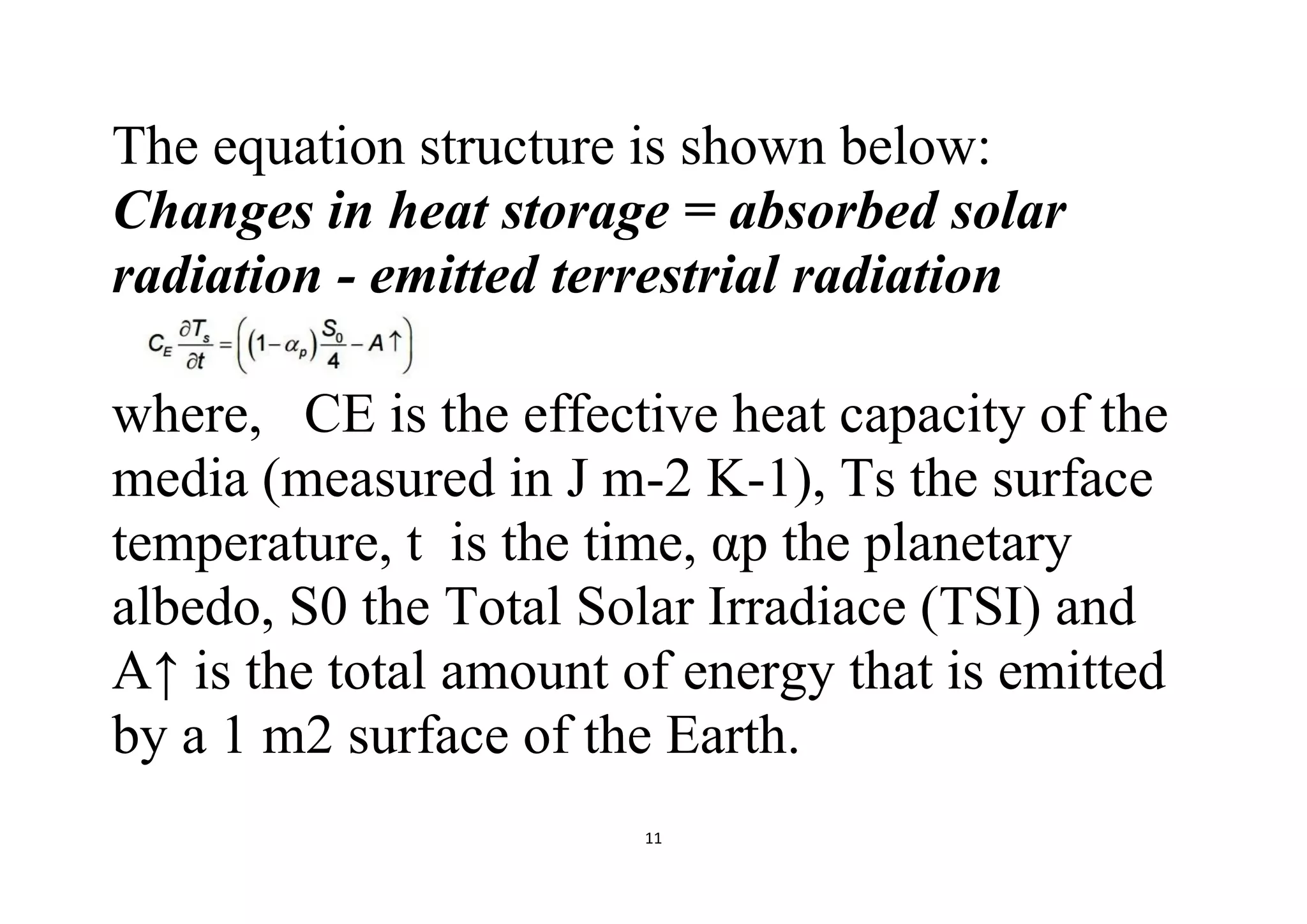
The equation structureis shown below:
Changes in heat storage = absorbed solar
radiation - emitted terrestrial radiation
where, CE is the effective heat capacity of the
media (measured in J m-2 K-1), Ts the surface
temperature, t is the time, αp the planetary
albedo, S0 the Total Solar Irradiace (TSI) and
A↑ is the total amount of energy that is emitted
by a 1 m2 surface of the Earth.
12.
12
A↑ could berepresented on the basis of the
Stefan-Boltzmann law, using a factor τa to
represent the infrared transmissivity of the
atmosphere (including the greenhouse gas
effect), as.
where ε is the emissivity of the surface.
13.
13
Using an albedoof 0.3, an emissivity of 0.97,
and a value of τa of 0.64 leads to an equilibrium
temperature Ts=287K, which is close to the
observed one.
Climate Models use the principles of
Thermodynamics: Thermodynamics is the
study of the relationships between work, heat,
and the different forms of energy.
14.
14
Input data requirements:In addition to the
physical, biological and chemical knowledge
included in the model equations, climate models
require some input from observations or other
model studies.
Using a Grid network:
Global climate models represent how natural
processes of our planet work using an
imaginary three-dimensional grid.
15.
15
It covers thesurface of the modeled Earth and
extends upward in layers through the modeled
atmosphere.
At every intersection in the model’s grid the
model makes its calculations.
Small processes that happen between a model’s
grid points cannot be “seen” in the model
results.
16.
16
Data processing :
Scientistsfeed input files into the model, which
contain the values of certain parameters,
particularly agents that can cause climate
change.
These include the concentration of greenhouse
gases, the intensity of sunlight, the amount of
deforestation, and volcanoes that should erupt
during the simulation.
17.
17
It’s also possibleto give the model a different
map to change the arrangement of continents.
Models use fastest supercomputers:
The highest resolution GCMs, on the fastest
supercomputers, can simulate about 1 year for
every day of real time.
The model can average these variables based on
space and time, and calculate changes in the
data.
18.
18
When the modelis finished running,
visualization software converts the rows and
columns of numbers into more digestible maps
and graphs.
Accuracy and Uncertainty in Climate
Models:
Global climate models are used to predict what
will happen to Earth’s climate in the future.
19.
19
Some uncertainty aboutour future climate is
because there are processes and feedbacks
between different parts of the Earth that are not
fully understood.
These are difficult to include in the models until
we understand them better. Most of the
uncertainty in these predictions of future
climate is not related to natural processes.
20.
20
Instead, it isuncertain how much pollution
humans will be adding to the atmosphere in the
future.
To deal with this, climate models are often run
several times, each time with different amounts
of pollution and development by humans.
A forecasting model or method attempts to
predict what actually happens on the basis of
information known before it happens.
21.
21
A projection, onthe other hand, says what will
happen under a set of assumptions.
Some of the factors complicating model
projections involve: Scale and resolution,
Clouds, Pollution particles and Natural
variability. Clouds are a major source of
uncertainty. Pollution particles can affect both
temperature and precipitation in ways that are
difficult to model, increasing the uncertainty in
climate projections.
22.
22
Past climates havea greater range of variability,
but reconstructions of past climate from natural
archives like tree-rings and ice cores contain
more uncertainty .
Testing the model: To find out whether
a climate model is doing a good job or not ,
scientists give it a test. The model is run
through a time period for which we have actual
measurements of Earth’s climate, the past 100
years for example.
23.
23
The results fromthe model are compared with
the actual measurements of real climate. If the
model and the actual measurements are similar,
then the math equations in the model that are
used to describe how Earth works are probably
quite accurate.
If the model results are very different from our
records of what actually happened, then the
model needs some more data collection work
and modification the equations.
24.
24
Components of aclimate model:
The climate system and its components:
1. The atmosphere- Composition and
temperature; General circulation of the
atmosphere; Precipitation
2. The ocean= a). Composition and properties;
b) Oceanic circulation;
3. Temperature and salinity= a) Surface layer,
b) Intermediate and deep layers
25.
25
3. The cryosphere=Components of the
cryosphere; Properties of the cryosphere
4. The land surface
A climate model is actually a collection of
models – typically an atmosphere model, an
ocean model, a land model, and a sea ice model.
Some GCMs split up the sub-models (let’s call
them components) a bit differently, but that’s
the most common arrangement.
26.
26
Each component representsa staggering amount
of complex, specialized processes.
Each component is developed independently,
and as a result, they are highly encapsulated
(bundled separately in the source code).
However, the real world is not encapsulated –
the land and ocean and air are very
interconnected.
27.
27
Atmosphere: The basicequations that govern
the atmosphere can be formulated as a set with
some unknowns.
Ocean: The major equations that govern the
ocean dynamics are based on the same
principles as the equations for the atmosphere.
The only significant difference is that the
equation for the specific humidity is not
required for the ocean, while a new equation for
the salinity needs to be introduced.
28.
28
The heat balanceat the surface allows the
computation of the surface temperature and of
the snow or ice melting. temperature.
Land surface:
Land surface models are used here, The soil
temperature can then be computed from the
energy balance at the surface.
A land surface model also simulates the water
content of the soil.
29.
29
Marine biogeochemistry: Modelsof
biogeochemical cycles in the oceans are based
on a set of equations.
Types of Climate Models:
1. General Circulation Models (GCMs)
General circulation models provide the most
precise and complex description of the climate
system.
2. Currently, their grid resolution is typically of
the order of 100 to 200 km.
30.
30
3. Atmospheric GeneralCirculation Models
(AGCMs)
4. Ocean General Circulation Models
(OGCMs)
5. Energy Balance Models, or EBMs(Changes
in heat storage = absorbed solar radiation -
emitted terrestrial radiation) . As indicated by
their name, energy balance models estimate
the changes in the climate system from an
analysis of the energy budget of the Earth.
31.
31
6. EMICs (EarthModels of Intermediate
Complexity)
Simple Climate Models
This is a simple climate model: T = [(1-
α)S/(4εσ)]1/4
(T is temperature, α is the albedo, S is the
incoming solar radiation, ε is the emissivity,
and σ is the Stefan-Boltzmann constant).
32.
32
It is anextremely simplified climate model. It’s
one line long, and is at the heart of every
computer model of global warming.
Using basic thermodynamics, it calculates the
temperature of the Earth based on incoming
sunlight and the reflectivity of the surface.
The model is zero-dimensional, treating the
Earth as a point mass at a fixed time. It doesn’t
consider the greenhouse effect, ocean currents,
nutrient cycles, volcanoes, or pollution.
33.
33
Zero Dimensional EBM:
Thezero dimensional ('0d') EBM simply
models the balance between incoming and
outgoing radiation at the Earth's surface.
We will assume that the amount of short wave
radiation absorbed by the Earth is simply
(1−α)S/4(1−α)S/4, where S is the Solar Constant
(roughly 1370 W /m2 but potentially variable
over time) and α is the average reflectivity of
Earth's surface looking down from space, i.e.,
34.
34
the 'planetary albedo',accounting for reflection
by clouds and the atmosphere as well as
reflective surface of Earth including ice (value
of roughly 0.32 but also somewhat variable over
time).
Emission Temperature model:
The simplest climate model is the planet
emission temperature model.
35.
35
In this modelthe solar absorption is defined as a
function of the solar energy output from the sun
and the planet's albedo.
Use of climate models:
Climate models are important tools utilized to
advance our understanding of current and past
climate. They also provide qualitative and
quantitative information about potential future
climate.
36.
36
Models help Predictingthe Future climate
changes:
Emission scenarios;
Climate projections for the 21st century
Changes in global mean surface temperature.
The spatial distribution of surface temperature
and precipitation changes;
Changes in the ocean and sea ice;
Changes in the carbon cycle and climate-carbon
feedbacks;