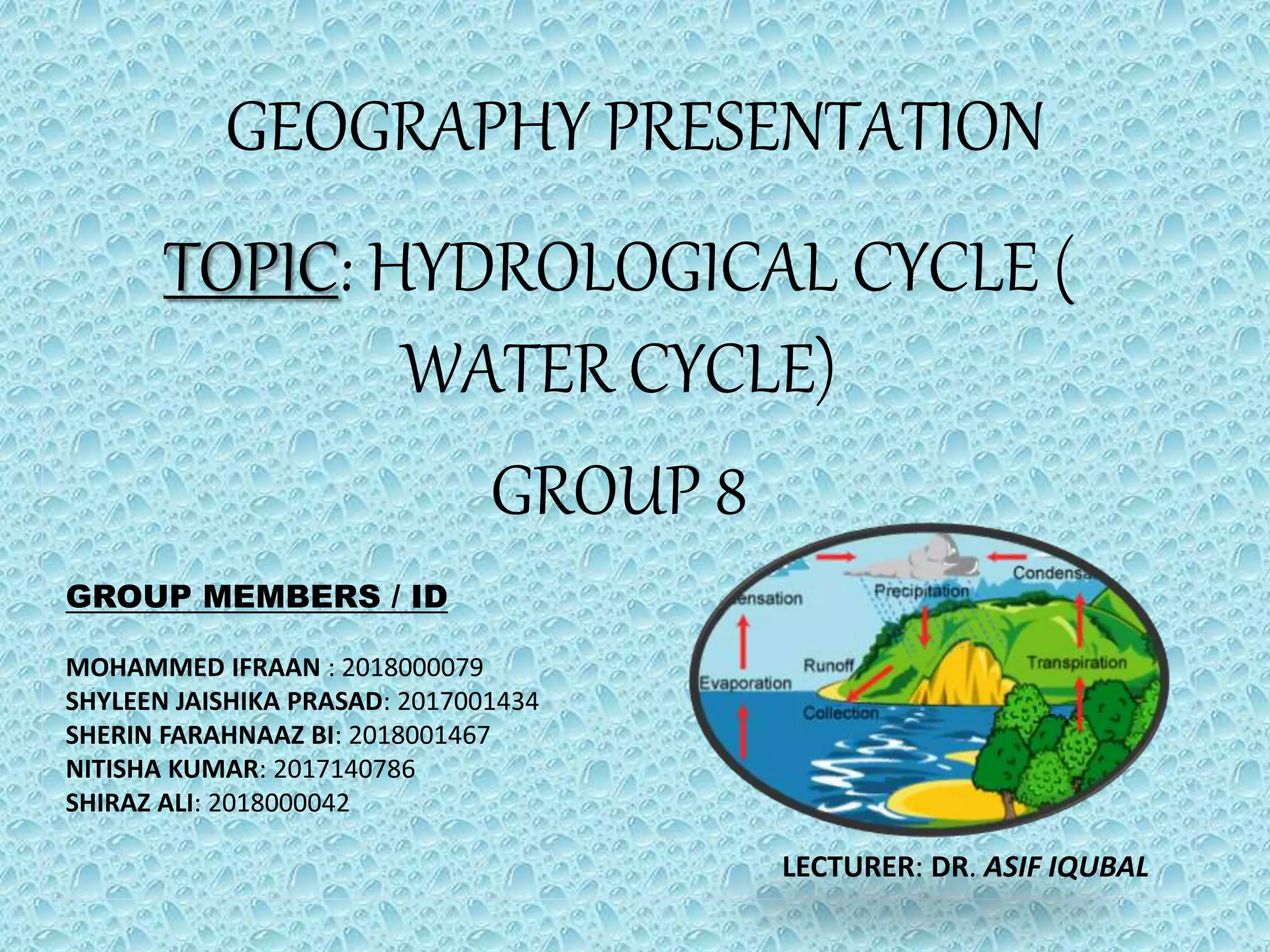
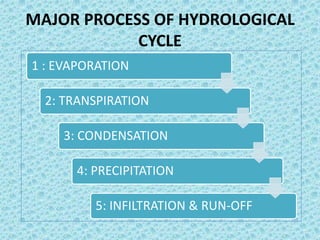
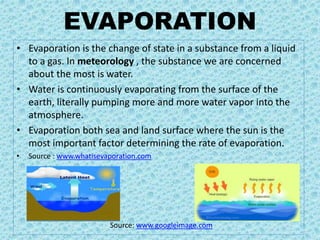
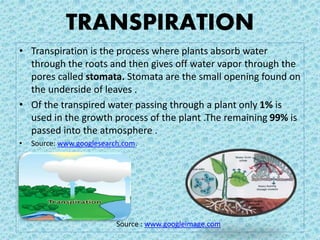
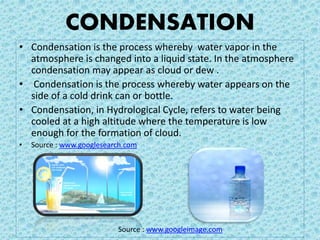
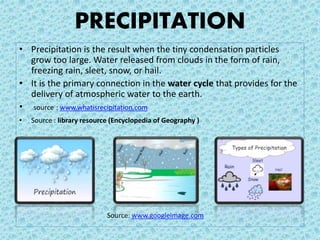
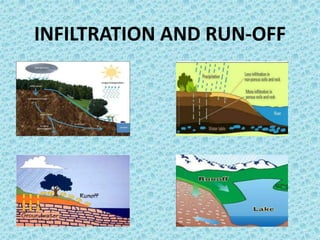
The hydrological cycle describes the continuous movement of water on, above, and below the Earth's surface. It involves evaporation of water from oceans, rivers, and land into water vapor in the atmosphere, followed by condensation of water vapor into clouds and precipitation as rain or snow back onto land and oceans, where some infiltrates soil and becomes groundwater, and some runs off into rivers and lakes or returns to the oceans, completing the cycle. The major processes are evaporation, transpiration, condensation, precipitation, infiltration, and runoff, driven primarily by energy from the sun.
![WHAT IS HYDROLOGICAL CYCLE
• The hydrological cycle is the system which describes and
movement of water between the earth and its atmosphere.
• Water cycle describes how water is exchange through earths
land ,ocean and atmosphere .
• It also describes the continuous movement of all forms of
water [ vapour, liquid and solid ]on , in and above earths
surface.
source : www.googlesearch.com](https://image.slidesharecdn.com/geopowerpointpresentation1-180826004332/85/Hydrological-cycle-powerpoint-presentation-2-320.jpg)
![REFERENCES
• Rast , M . Johannessen , J . Mauser ,W .,2014. Surveys in
Geophysics Journal. 35, pp . 491-513.
• Wrighton , B. A . Marchington , T ., 1984 . Encyclopedia
of Geography . Hong Kong: Purnell Publishers Limited.
• URL :http://water . Usgs . /edu/watercycle . Html>
[Accessed 20/02/2818].
• http ://www.eschooltoday .com /water-cycle/what-is-
evaporation-of-water .html>[Accessed 23/02/2018].
• http:/www.google.com/search?q=what+is+hydrological+
cycle&oq.html>[Accessed 23/02/2018].](https://image.slidesharecdn.com/geopowerpointpresentation1-180826004332/85/Hydrological-cycle-powerpoint-presentation-11-320.jpg)