Bellringer
 What is the tragedy of the commons?
 In the food pyramid 10% of the of the energy is
send to the _______trophic level and the 90%
lost in the form of ______
Autotrophs obtain energy from :
a) Their food
b) The sun
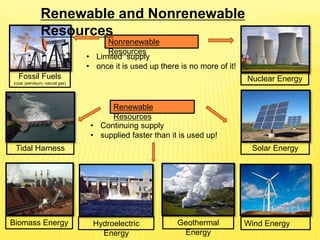
• Continuing supply
• supplied faster than it is used up!
• Limited supply
• once it is used up there is no more of it!
Renewable
Resources
Nonrenewable
Resources
Wind Energy
Geothermal
Energy
Biomass Energy
Tidal Harness Solar Energy
Nuclear Energy
Fossil Fuels
(coal, petroleum, natural gas)
Renewable and Nonrenewable
Resources
Hydroelectric
Energy
Which Energy Sources
are considered
renewable?
Which Energy Sources are
considered
nonrenewable?
• Fossil Fuels (coal, petroleum, natural
gas)
• Nuclear Energy
• Biomass
• Geothermal
• Hydroelectric
• Solar
• Tidal Harness
• Wind Energy
Energy
Sources
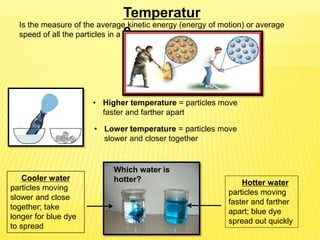
Temperatur
e
Is the measure of the average kinetic energy (energy of motion) or average
speed of all the particles in a material.
• Higher temperature = particles move
faster and farther apart
• Lower temperature = particles move
slower and closer together
Which water is
hotter? Hotter water
particles moving
faster and farther
apart; blue dye
spread out quickly
Cooler water
particles moving
slower and close
together; take
longer for blue dye
to spread
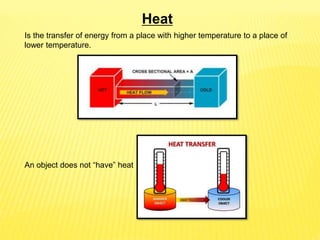
An object does not “have” heat
Is the transfer of energy from a place with higher temperature to a place of
lower temperature.
Heat
HEAT TRANSFER
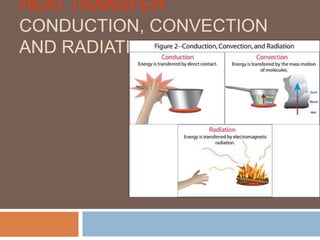
CONDUCTION, CONVECTION
AND RADIATION
Thermal
Energy
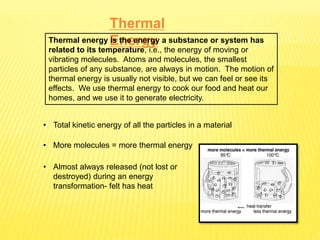
Thermal energy is the energy a substance or system has
related to its temperature, i.e., the energy of moving or
vibrating molecules. Atoms and molecules, the smallest
particles of any substance, are always in motion. The motion of

thermal energy is usually not visible, but we can feel or see its
effects. We use thermal energy to cook our food and heat our
homes, and we use it to generate electricity.
• Total kinetic energy of all the particles in a material
• More molecules = more thermal energy
• Almost always released (not lost or
destroyed) during an energy
transformation- felt has heat
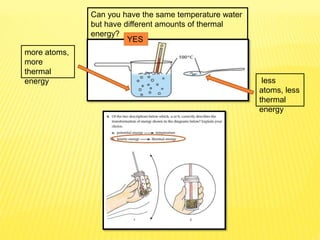
Can you have the same temperature water
but have different amounts of thermal
energy?
YES
more atoms,
more
thermal
energy less
atoms, less
thermal
energy
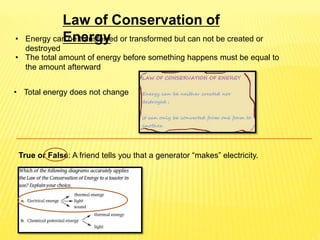
Law of Conservation of
Energy
• The total amount of energy before something happens must be equal to
the amount afterward
• Energy can be transferred or transformed but can not be created or
destroyed
• Total energy does not change
True or False: A friend tells you that a generator “makes” electricity.
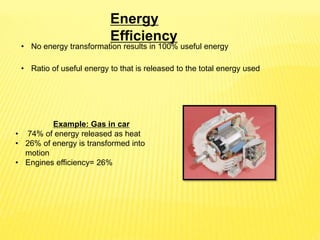
Energy
Efficiency
• No energy transformation results in 100% useful energy
• Ratio of useful energy to that is released to the total energy used
Example: Gas in car
• 74% of energy released as heat
• 26% of energy is transformed into
motion
• Engines efficiency= 26%
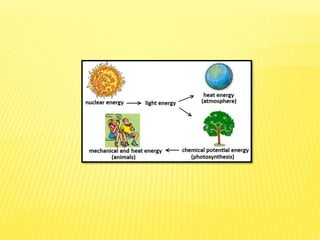
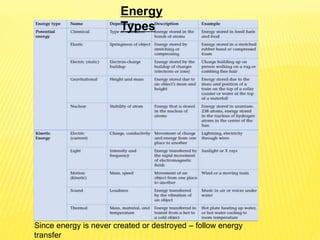
Since energy is never created or destroyed – follow energy
transfer
Energy
Types
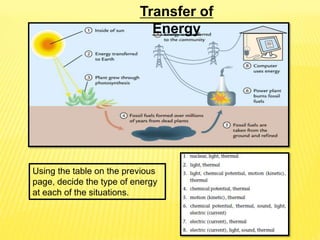
Transfer of
Energy
Using the table on the previous
page, decide the type of energy
at each of the situations.
Conducti
on
Transfer of
Energy
When two objects touch each other and transfer
energy from the hotter one to the colder one - gases,
solids, liquids – due to the collision of atoms and
molecules.
Conducto
r
Materials that allow energy to transfer
easily.
Insulators
• Less collision of atoms and molecules
When conduction is slowed down, insulation
occurs.
• Gases poor conductors (vacuum)
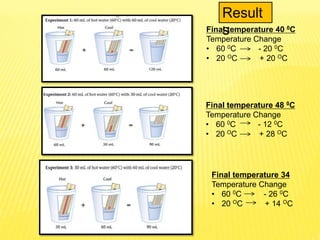
Result
s
Final temperature 40 0C
Temperature Change
• 60 0C - 20 0C
• 20 OC + 20 OC
Final temperature 48 0C
Temperature Change
• 60 0C - 12 0C
• 20 OC + 28 OC
Final temperature 34
Temperature Change
• 60 0C - 26 0C
• 20 OC + 14 OC
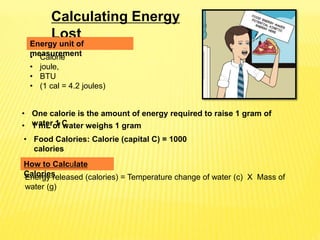
Calculating Energy
Lost
Energy released (calories) = Temperature change of water (c) X Mass of
water (g)
Energy unit of
measurement
• One calorie is the amount of energy required to raise 1 gram of
water 1 C
• Calorie
• joule,
• BTU
• (1 cal = 4.2 joules)
How to Calculate
Calories
• 1 mL of water weighs 1 gram
• Food Calories: Calorie (capital C) = 1000
calories
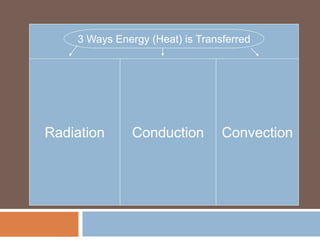
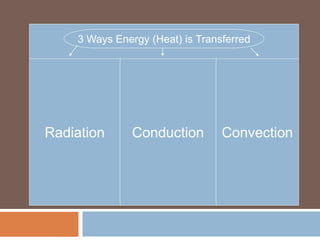
Radiation Conduction
3 Ways Energy (Heat) is Transferred
Convection
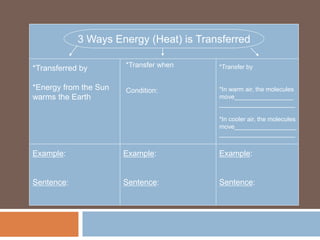
3 Ways Energy (Heat) is Transferred
*Transferred by
*Energy from the Sun
warms the Earth
Example:
Sentence:
Example:
Sentence:
Example:
Sentence:
*Transfer when
Condition:
*Transfer by
*In warm air, the molecules
move_________________
______________________
*In cooler air, the molecules
move__________________
______________________
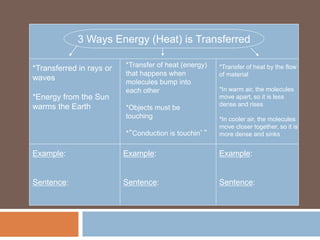
3 Ways Energy (Heat) is Transferred
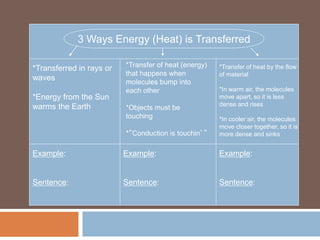
*Transferred in rays or
waves
*Energy from the Sun
warms the Earth
Example:
Sentence:
Example:
Sentence:
Example:
Sentence:
*Transfer of heat (energy)
that happens when
molecules bump into
each other
*Objects must be
touching
*”Conduction is touchin’”
*Transfer of heat by the flow
of material
*In warm air, the molecules
move apart, so it is less
dense and rises
*In cooler air, the molecules
move closer together, so it is
more dense and sinks
Radiation Conduction
3 Ways Energy (Heat) is Transferred
Convection
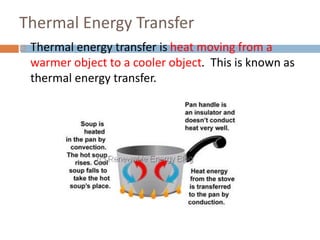
Thermal Energy Transfer
 Thermal energy transfer is heat moving from a
warmer object to a cooler object. This is known as
thermal energy transfer.
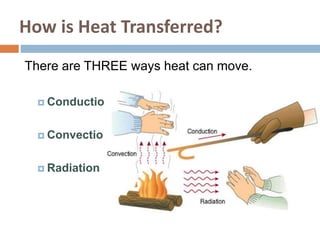
How is Heat Transferred?
There are THREE ways heat can move.
 Conduction
 Convection
 Radiation
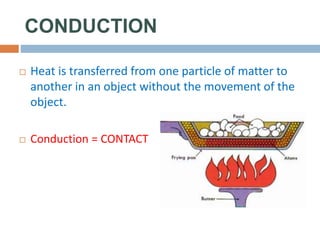
CONDUCTION
 Heat is transferred from one particle of matter to
another in an object without the movement of the
object.
 Conduction = CONTACT
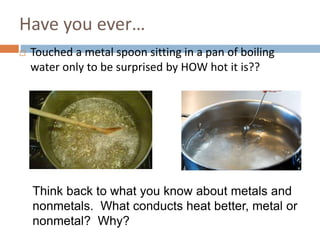
Have you ever…
 Touched a metal spoon sitting in a pan of boiling
water only to be surprised by HOW hot it is??
Think back to what you know about metals and
nonmetals. What conducts heat better, metal or
nonmetal? Why?
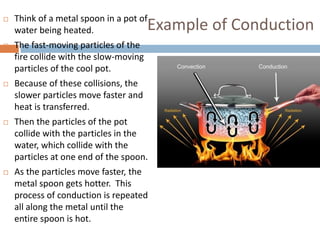
Example of Conduction
 Think of a metal spoon in a pot of
water being heated.
 The fast-moving particles of the
fire collide with the slow-moving
particles of the cool pot.
 Because of these collisions, the
slower particles move faster and
heat is transferred.
 Then the particles of the pot
collide with the particles in the
water, which collide with the
particles at one end of the spoon.
 As the particles move faster, the
metal spoon gets hotter. This
process of conduction is repeated
all along the metal until the
entire spoon is hot.
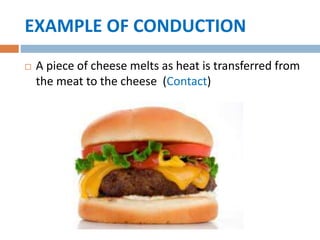
EXAMPLE OF CONDUCTION
 A piece of cheese melts as heat is transferred from
the meat to the cheese (Contact)
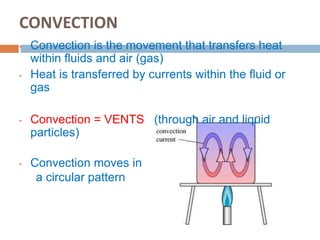
CONVECTION
• Convection is the movement that transfers heat
within fluids and air (gas)
• Heat is transferred by currents within the fluid or
gas
• Convection = VENTS (through air and liquid
particles)
• Convection moves in
a circular pattern
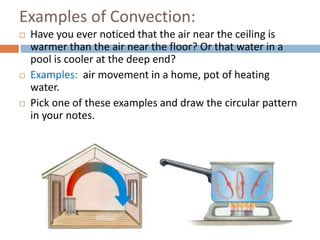
Examples of Convection:
 Have you ever noticed that the air near the ceiling is
warmer than the air near the floor? Or that water in a
pool is cooler at the deep end?
 Examples: air movement in a home, pot of heating
water.
 Pick one of these examples and draw the circular pattern
in your notes.
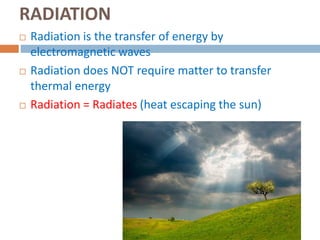
RADIATION
 Radiation is the transfer of energy by
electromagnetic waves
 Radiation does NOT require matter to transfer
thermal energy
 Radiation = Radiates (heat escaping the sun)
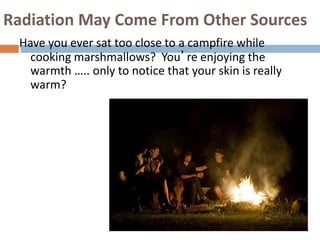
Radiation May Come From Other Sources
Have you ever sat too close to a campfire while
cooking marshmallows? You’re enjoying the
warmth ….. only to notice that your skin is really
warm?
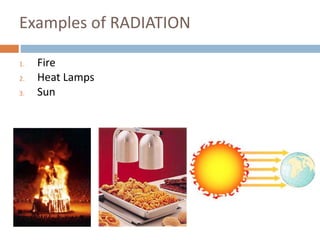
Examples of RADIATION
1. Fire
2. Heat Lamps
3. Sun
3 Ways Energy (Heat) is Transferred
*Transferred in rays or
waves
*Energy from the Sun
warms the Earth
Example:
Sentence:
Example:
Sentence:
Example:
Sentence:
*Transfer of heat (energy)
that happens when
molecules bump into
each other
*Objects must be
touching
*”Conduction is touchin’”
*Transfer of heat by the flow
of material
*In warm air, the molecules
move apart, so it is less
dense and rises
*In cooler air, the molecules
move closer together, so it is
more dense and sinks
DOL
 https://tinyurl.com/HeatDOL

Energy-transfer-conductionconvectionradiation.ppt

  • 1.
    Bellringer  What isthe tragedy of the commons?  In the food pyramid 10% of the of the energy is send to the _______trophic level and the 90% lost in the form of ______ Autotrophs obtain energy from : a) Their food b) The sun
  • 2.
    • Continuing supply •supplied faster than it is used up! • Limited supply • once it is used up there is no more of it! Renewable Resources Nonrenewable Resources Wind Energy Geothermal Energy Biomass Energy Tidal Harness Solar Energy Nuclear Energy Fossil Fuels (coal, petroleum, natural gas) Renewable and Nonrenewable Resources Hydroelectric Energy
  • 3.
    Which Energy Sources areconsidered renewable? Which Energy Sources are considered nonrenewable? • Fossil Fuels (coal, petroleum, natural gas) • Nuclear Energy • Biomass • Geothermal • Hydroelectric • Solar • Tidal Harness • Wind Energy Energy Sources
  • 4.
    Temperatur e Is the measureof the average kinetic energy (energy of motion) or average speed of all the particles in a material. • Higher temperature = particles move faster and farther apart • Lower temperature = particles move slower and closer together Which water is hotter? Hotter water particles moving faster and farther apart; blue dye spread out quickly Cooler water particles moving slower and close together; take longer for blue dye to spread
  • 5.
    An object doesnot “have” heat Is the transfer of energy from a place with higher temperature to a place of lower temperature. Heat
  • 6.
  • 7.
    Thermal Energy Thermal energy isthe energy a substance or system has related to its temperature, i.e., the energy of moving or vibrating molecules. Atoms and molecules, the smallest particles of any substance, are always in motion. The motion of thermal energy is usually not visible, but we can feel or see its effects. We use thermal energy to cook our food and heat our homes, and we use it to generate electricity. • Total kinetic energy of all the particles in a material • More molecules = more thermal energy • Almost always released (not lost or destroyed) during an energy transformation- felt has heat
  • 8.
    Can you havethe same temperature water but have different amounts of thermal energy? YES more atoms, more thermal energy less atoms, less thermal energy
  • 9.
    Law of Conservationof Energy • The total amount of energy before something happens must be equal to the amount afterward • Energy can be transferred or transformed but can not be created or destroyed • Total energy does not change True or False: A friend tells you that a generator “makes” electricity.
  • 10.
    Energy Efficiency • No energytransformation results in 100% useful energy • Ratio of useful energy to that is released to the total energy used Example: Gas in car • 74% of energy released as heat • 26% of energy is transformed into motion • Engines efficiency= 26%
  • 12.
    Since energy isnever created or destroyed – follow energy transfer Energy Types
  • 13.
    Transfer of Energy Using thetable on the previous page, decide the type of energy at each of the situations.
  • 14.
    Conducti on Transfer of Energy When twoobjects touch each other and transfer energy from the hotter one to the colder one - gases, solids, liquids – due to the collision of atoms and molecules. Conducto r Materials that allow energy to transfer easily.
  • 15.
    Insulators • Less collisionof atoms and molecules When conduction is slowed down, insulation occurs. • Gases poor conductors (vacuum)
  • 16.
    Result s Final temperature 400C Temperature Change • 60 0C - 20 0C • 20 OC + 20 OC Final temperature 48 0C Temperature Change • 60 0C - 12 0C • 20 OC + 28 OC Final temperature 34 Temperature Change • 60 0C - 26 0C • 20 OC + 14 OC
  • 17.
    Calculating Energy Lost Energy released(calories) = Temperature change of water (c) X Mass of water (g) Energy unit of measurement • One calorie is the amount of energy required to raise 1 gram of water 1 C • Calorie • joule, • BTU • (1 cal = 4.2 joules) How to Calculate Calories • 1 mL of water weighs 1 gram • Food Calories: Calorie (capital C) = 1000 calories
  • 18.
    Radiation Conduction 3 WaysEnergy (Heat) is Transferred Convection
  • 19.
    3 Ways Energy(Heat) is Transferred *Transferred by *Energy from the Sun warms the Earth Example: Sentence: Example: Sentence: Example: Sentence: *Transfer when Condition: *Transfer by *In warm air, the molecules move_________________ ______________________ *In cooler air, the molecules move__________________ ______________________
  • 20.
    3 Ways Energy(Heat) is Transferred *Transferred in rays or waves *Energy from the Sun warms the Earth Example: Sentence: Example: Sentence: Example: Sentence: *Transfer of heat (energy) that happens when molecules bump into each other *Objects must be touching *”Conduction is touchin’” *Transfer of heat by the flow of material *In warm air, the molecules move apart, so it is less dense and rises *In cooler air, the molecules move closer together, so it is more dense and sinks
  • 21.
    Radiation Conduction 3 WaysEnergy (Heat) is Transferred Convection
  • 22.
    Thermal Energy Transfer Thermal energy transfer is heat moving from a warmer object to a cooler object. This is known as thermal energy transfer.
  • 23.
    How is HeatTransferred? There are THREE ways heat can move.  Conduction  Convection  Radiation
  • 24.
    CONDUCTION  Heat istransferred from one particle of matter to another in an object without the movement of the object.  Conduction = CONTACT
  • 25.
    Have you ever… Touched a metal spoon sitting in a pan of boiling water only to be surprised by HOW hot it is?? Think back to what you know about metals and nonmetals. What conducts heat better, metal or nonmetal? Why?
  • 26.
    Example of Conduction Think of a metal spoon in a pot of water being heated.  The fast-moving particles of the fire collide with the slow-moving particles of the cool pot.  Because of these collisions, the slower particles move faster and heat is transferred.  Then the particles of the pot collide with the particles in the water, which collide with the particles at one end of the spoon.  As the particles move faster, the metal spoon gets hotter. This process of conduction is repeated all along the metal until the entire spoon is hot.
  • 27.
    EXAMPLE OF CONDUCTION A piece of cheese melts as heat is transferred from the meat to the cheese (Contact)
  • 28.
    CONVECTION • Convection isthe movement that transfers heat within fluids and air (gas) • Heat is transferred by currents within the fluid or gas • Convection = VENTS (through air and liquid particles) • Convection moves in a circular pattern
  • 29.
    Examples of Convection: Have you ever noticed that the air near the ceiling is warmer than the air near the floor? Or that water in a pool is cooler at the deep end?  Examples: air movement in a home, pot of heating water.  Pick one of these examples and draw the circular pattern in your notes.
  • 30.
    RADIATION  Radiation isthe transfer of energy by electromagnetic waves  Radiation does NOT require matter to transfer thermal energy  Radiation = Radiates (heat escaping the sun)
  • 31.
    Radiation May ComeFrom Other Sources Have you ever sat too close to a campfire while cooking marshmallows? You’re enjoying the warmth ….. only to notice that your skin is really warm?
  • 32.
    Examples of RADIATION 1.Fire 2. Heat Lamps 3. Sun
  • 33.
    3 Ways Energy(Heat) is Transferred *Transferred in rays or waves *Energy from the Sun warms the Earth Example: Sentence: Example: Sentence: Example: Sentence: *Transfer of heat (energy) that happens when molecules bump into each other *Objects must be touching *”Conduction is touchin’” *Transfer of heat by the flow of material *In warm air, the molecules move apart, so it is less dense and rises *In cooler air, the molecules move closer together, so it is more dense and sinks
  • 34.

Editor's Notes

  • #27 Have an example sitting in front on the lab table (doesn’t need to be on); a visual.
  • #30 When the water at the bottom of a pot is heated, its particles move faster, and they also move farther apart. As a result, the heated water becomes less dense. A less dense fluid will float on top of a more dense one. Therefore, the heated water rises in the pot. The surrounding cooler water flows into its place. This flow creates the circular motion as seen on the next page, which is known as convection currents.