Geronimo R. Rosario
Pangasinan State University
Binmaley Campus
Binmaley, Pangasinan
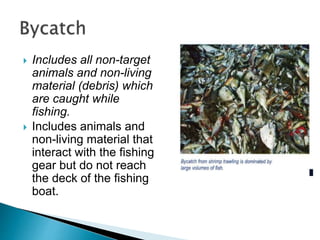
 Includes all non-target
animals and non-living
material (debris) which
are caught while
fishing.
 Includes animals and
non-living material that
interact with the fishing
gear but do not reach
the deck of the fishing
boat.
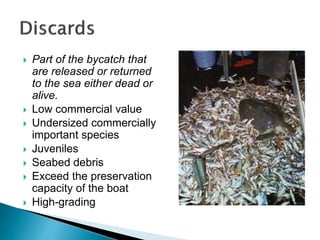
 Part of the bycatch that
are released or returned
to the sea either dead or
alive.
 Low commercial value
 Undersized commercially
important species
 Juveniles
 Seabed debris
 Exceed the preservation
capacity of the boat
 High-grading
 Applies to small,
undersized fish and other
animals that were
traditionally discarded
overboard because they
have no economic value.
 The term trash fish is
misleading because it
suggests this part of the
catch has no ecological or
commercial value.
 Sold as fish meal or food
for cultured species
 May generate over one-
third of their income
 Accidental catch- A reference to non-target animals
and non-living material captured by the fishing gear. This
term is synonymous with bycatch.
 Incidental catch- the same meaning as accidental or
non-target catch.
 Non-target species- Species for which the fishing gear
is not specifically deployed or set, but may have
immediate commercial value and be a desirable
component of the catch. Includes bycatch and
byproduct.
 Byproduct- Any part of the catch which is kept or sold
by the fisherman but which is not the target species.
 Undersized- Fish (caught) at a size smaller than the
minimum size limit established by regulation.
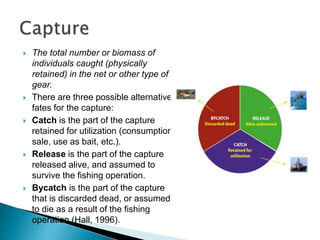
 The total number or biomass of
individuals caught (physically
retained) in the net or other type of
gear.
 There are three possible alternative
fates for the capture:
 Catch is the part of the capture
retained for utilization (consumption,
sale, use as bait, etc.).
 Release is the part of the capture
released alive, and assumed to
survive the fishing operation.
 Bycatch is the part of the capture
that is discarded dead, or assumed
to die as a result of the fishing
operation (Hall, 1996).
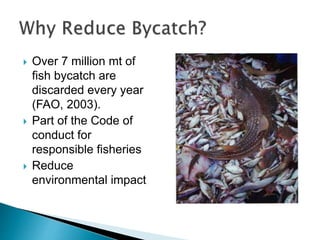
 Over 7 million mt of
fish bycatch are
discarded every year
(FAO, 2003).
 Part of the Code of
conduct for
responsible fisheries
 Reduce
environmental impact
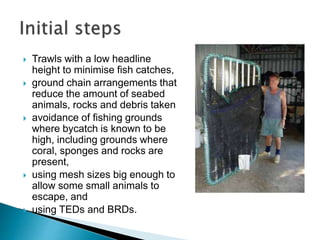
 Trawls with a low headline
height to minimise fish catches,
 ground chain arrangements that
reduce the amount of seabed
animals, rocks and debris taken
 avoidance of fishing grounds
where bycatch is known to be
high, including grounds where
coral, sponges and rocks are
present,
 using mesh sizes big enough to
allow some small animals to
escape, and
 using TEDs and BRDs.
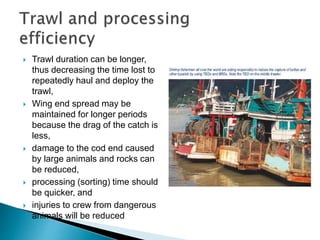
 Trawl duration can be longer,
thus decreasing the time lost to
repeatedly haul and deploy the
trawl,
 Wing end spread may be
maintained for longer periods
because the drag of the catch is
less,
 damage to the cod end caused
by large animals and rocks can
be reduced,
 processing (sorting) time should
be quicker, and
 injuries to crew from dangerous
animals will be reduced
 ensure the health,
diversity and
integrity of the
environment,
 protect fish stocks
by keeping
juvenile and adult
fishes out of the
catch.
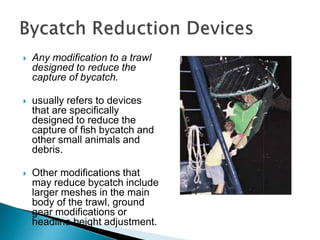
 Any modification to a trawl
designed to reduce the
capture of bycatch.
 usually refers to devices
that are specifically
designed to reduce the
capture of fish bycatch and
other small animals and
debris.
 Other modifications that
may reduce bycatch include
larger meshes in the main
body of the trawl, ground
gear modifications or
headline height adjustment.
 Separate the catch
by size.
These devices use
inclined grids or
panels of netting to
physically block the
passage of bycatch
into the codend and
guide it toward an
escape opening.
Ex. JTED, square-
mesh codend ,
TEDs
 Exploit behavioural
differences between
target catch and
bycatch.
Most fish can swim in
a moving net,
orientate to the
direction of tow, and
swim out through an
escape opening.
Examples of this type
of BRD are the
fisheye, square-mesh
window, Jones-Davis
BRD and RES.
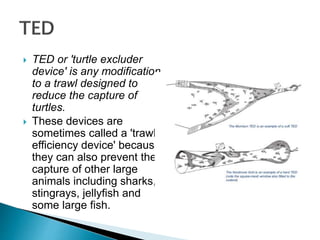
 TED or 'turtle excluder
device' is any modification
to a trawl designed to
reduce the capture of
turtles.
 These devices are
sometimes called a 'trawl
efficiency device' because
they can also prevent the
capture of other large
animals including sharks,
stingrays, jellyfish and
some large fish.
 Soft TEDs use a
non-rigid inclined
panel of netting to
guide bycatch
towards the
escape opening in
the top of the trawl.
 Hard TEDs
typically uses a
rigid grid made of
aluminium, steel or
plastic.
 Very large escape opening
may allow large leatherback
turtles and other large animals
to be rapidly excluded
 Exclude some seabed
animals (sponges, corals etc.)
and rocks (downward-
excluding TEDs only)
 May increase shrimp catch
due to longer towing time
(less drag and fewer hauls)
 May reduce sorting time
 May improve shrimp quality by
reducing contact with large
animals
 Reduce hazard to crews from
large,dangerous animals
 Damage, fouling or
clogging of the guiding
panel or funnel by large
animals and debris could
lead to shrimp loss
 Fouling of escape
opening by large animals
and debris could lead to
shrimp loss (a.k.a
TEDed)
 A little more difficult to
handle than a standard
codend
 Rigid grid may be a
safety hazard to crew
(depends on location in
codend)
 Very large escape
opening may allow large
leatherback turtles and
other large animals to be
rapidly excluded
 May increase shrimp
catch due to longer towing
time (less drag and fewer
hauls)
 May reduce sorting time
 May improve shrimp
quality by reducing
contact with large animals
 Reduce hazard to crews
from large dangerous
animals
 Poor installation may
affect trawl performance
 Damage, fouling or
clogging of the guiding
panel by large animals
and debris could lead to
shrimp loss
 Effectiveness depends
on trawl spread
 More difficult to repair
than a standard trawl
 Less effective than hard
TEDs at excluding
heavy items such as
rocks and sponges
 JTED stands for 'juvenile
and trash excluder
device'.
 This device is designed to
exclude small fish –
usually juvenile or trash
fish - from the trawl and
maintain the catch of large
fish.
 The JTED consists of
three sections hinged
together; the first two
sections are metal grids
and the third section is a
metal frame supporting a
panel of fine-mesh netting.
 Exclude small fish and trash
fish
 May increase towing time
(less drag and fewer hauls)
 May reduce sorting time
 Bar spacing can be reduced if
grid is attached to an outer
frame
 Rope spacing can be easily
adjusted (rope JTED only)
 Relatively simple design and
easy to use (rope JTED only)
 May increase catch due to
longer towing time
 Complex design compared to other
devices (grid-style JTED only)
 High construction cost (grid-style JTED
only)
 Hinges may become clogged with mud
and other debris and affect grid
orientation (gridstyle JTED only)
 Relies on small fish having the ability
to swim forward and upward through
the escape openings (rope JTED only)
 May allow large, valuable fish to push
ropes aside and escape (rope JTED
only)
 Ropes may stretch and become slack
(rope JTED only)
 The square-mesh codend
is designed to exclude
small fish from a shrimp
trawl.
 The mesh openings of a
traditional diamond-mesh
codend collapse as it fills
with catch and prevents
the escape of small fish.
 In contrast, the mesh
openings of a square-
mesh codend retain their
shape as it fills with catch
and are available for fish
to escape
 Small fish bycatch may
escape
 May reduce sorting times
 May increase towing time
(less drag and fewer
hauls)
 May increase shrimp catch
due to longer towing time
 Less reliant on behaviour
and swimming ability to
exclude small fish and
animals
 May exclude small seabed
animals and debris
 Shape of fish affects escape
rates, so some species are
more likely to escape than
others
 Relatively difficult to
construct, particularly a
combined diamond- and
square-mesh codend
 Square-meshes may distort
if not correctly attached to a
diamond-mesh netting
 More difficult to repair than
traditional diamond-mesh
 Material wastage and knot
slippage, if constructed from
diamond-mesh
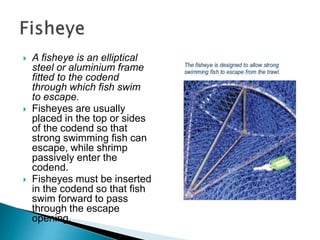
 A fisheye is an elliptical
steel or aluminium frame
fitted to the codend
through which fish swim
to escape.
 Fisheyes are usually
placed in the top or sides
of the codend so that
strong swimming fish can
escape, while shrimp
passively enter the
codend.
 Fisheyes must be inserted
in the codend so that fish
swim forward to pass
through the escape
opening.
 Simpler design and
cheaper than many other
BRDs
 Lower maintenance than
other BRDs
 Easily moved to different
positions in the codend
 May increase shrimp
catch due to longer towing
time (less drag and fewer
hauls)
 May reduce sorting times
 Easy to handle
 Will not exclude
seabed animals and
debris
 Poor escape for
species that behave in
the same way as
shrimp
 Optimal position
difficult to determine
 May foul on the side
of the vessel during
hauling
 RES stands for
“radial escape
section”, designed
to allow fish to
voluntarily swim from
the trawl.
 The Jones-Davis
BRD is similar to the
RES but the escape
openings are simply
large holes cut into
the codend netting.
 Large escape
openings allow large
fish to escape
 May increase shrimp
catch due to longer
towing time (less
drag and fewer
hauls)
 May reduce sorting
time
 Will not exclude
seabed animals and
debris
 Funnel may become
clogged
 More complicated
design than most other
fish excluders
 May foul on the side of
the vessel during
hauling
 More difficult to handle
than a standard
codend
 A square-mesh
window is usually a
panel of square mesh
netting located in the
top panel of the
codend or trawl body.
 As fish pass through
the trawl they
orientate directionally
toward the device and
swim through the
square escape
openings.
 Small fish bycatch
may escape
 Relatively simple
design and easy to
use
 May reduce sorting
times
 May increase towing
time (less drag and
fewer hauls)
 May increase shrimp
catch due to
longertowing time
 Shape of fish affects
escape rates, so some
species are more likely
to escape than others
 Square-meshes may
distort if not correctly
fitted
 Performance (if located
in the codend) linked to
catch volume
 More difficult to repair
than traditional diamond
mesh
 Will not exclude seabed
animals and debris
 A fishbox is designed
to alter the movement
of water in the codend.
 It is a box-like device
fitted to the top or
bottom of the codend
with an opening
through which fish can
swim and escape.
 A plastic or metal plate
(foil) is installed to the
front of fishbox frame
and another to the top
of the frame.
 Easily installed
 Large opening
allows large fish to
escape
 May increase
shrimp catch due to
longer towing time
(less drag and
fewer hauls)
 May reduce sorting
time
 Poor escape for species
that behave in the same
way as shrimp
 Limited knowledge of
fish behaviour and
influence of foil design
and orientation on fish
exclusion rates
 May foul on the side of
the boat during hauling
 Will not exclude seabed
animals and debris
 A triangular or
diamond-shaped cut
into the top of the
codend. This is a very
simple modification that
can reduce the capture
of strong swimming fish.
 Changes to ground
chain settings. This
modification may reduce
the capture of large
sponges and seabed
debris
 Longer sweeps between the
otter board and trawl. This can
be used to reduce the capture of
small sea urchins such as 'sea
eggs', other benthic animals and
seabed debris, although
sometimes this may increase fish
catches.
 Headline height reduction. By
reducing headline height some
fish will escape capture by
swimming over the headline of the
trawl.
 This modification could reduce
catches of schooling or large
swimming fish. By reducing
headline height, the wing end
spread of the trawl may increase
and potentially increase catches of
bottom dwelling shrimp (and offset
any loss of swimming shrimp).
 A length of twine stretched
between the otter boards to
frighten fish away from the trawl.
The twine will vibrate as it is towed
through the water, warning fish of
the approaching trawl and giving
them time to escape.
 A horizontal separator panel. This
is a panel of net that divides the
trawl into two compartments, each
leading to separate codends. This
panel allows rocks, shell, crabs and
other bottom-dwelling animals to be
kept separate from the remainder of
the catch. Either codend can be left
open if desired or made of larger
mesh so that small animals can
escape.
 Large mesh barrier across
the trawl mouth. The barrier
is fitted between the headline
and footrope of the trawl to
prevent large animals from
entering the codend. Fouling
by large animals or debris is
likely to reduce wingend
spread and catching
performance.
 Large cuts in the top panel
of the net ahead of the
codend. This modification
has successfully reduced
bycatch in daylight fisheries
but been less successful
during the night.
 Square-mesh netting
adjacent the footrope of
the trawl. This modification
has been successfully
used in some fish-trawl
fisheries to reduce the
capture of less mobile
seabed animals such as
sea urchins and starfish.
 Reducing the size of
codend covers and
chaffing gear. This
modification will allow more
codend meshes to be
available for small animals
to escape.
 Increased codend mesh
size. This will allow more
small animals to escape. It is
one of the simplest BRDs to
implement but interestingly
one of the least favoured
options, particularly where
small fish are retained for
sale.
 Altering the joining
(hanging) ratio of codend
meshes to trawl meshes. By
reducing the joining ratio the
codend meshes are unable to
close under load. This may
allow more small fish to
escape near the front of the
codend.
 Last ridge ropes 'hung'
along the length of the
codend. This can allow
codend meshes to remain
open and small fish to
escape. Usually at least four
ropes are required, and they
must be about 5% shorter
than the stretched length of
the codend. This modification
is used mainly for diamond-
mesh codends and prevents
meshes closing under load
from the catch
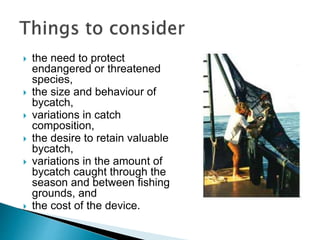
 the need to protect
endangered or threatened
species,
 the size and behaviour of
bycatch,
 variations in catch
composition,
 the desire to retain valuable
bycatch,
 variations in the amount of
bycatch caught through the
season and between fishing
grounds, and
 the cost of the device.

Bycatch Reduction Devices

  • 1.
    Geronimo R. Rosario PangasinanState University Binmaley Campus Binmaley, Pangasinan
  • 2.
     Includes allnon-target animals and non-living material (debris) which are caught while fishing.  Includes animals and non-living material that interact with the fishing gear but do not reach the deck of the fishing boat.
  • 3.
     Part ofthe bycatch that are released or returned to the sea either dead or alive.  Low commercial value  Undersized commercially important species  Juveniles  Seabed debris  Exceed the preservation capacity of the boat  High-grading
  • 4.
     Applies tosmall, undersized fish and other animals that were traditionally discarded overboard because they have no economic value.  The term trash fish is misleading because it suggests this part of the catch has no ecological or commercial value.  Sold as fish meal or food for cultured species  May generate over one- third of their income
  • 5.
     Accidental catch-A reference to non-target animals and non-living material captured by the fishing gear. This term is synonymous with bycatch.  Incidental catch- the same meaning as accidental or non-target catch.  Non-target species- Species for which the fishing gear is not specifically deployed or set, but may have immediate commercial value and be a desirable component of the catch. Includes bycatch and byproduct.  Byproduct- Any part of the catch which is kept or sold by the fisherman but which is not the target species.  Undersized- Fish (caught) at a size smaller than the minimum size limit established by regulation.
  • 6.
     The totalnumber or biomass of individuals caught (physically retained) in the net or other type of gear.  There are three possible alternative fates for the capture:  Catch is the part of the capture retained for utilization (consumption, sale, use as bait, etc.).  Release is the part of the capture released alive, and assumed to survive the fishing operation.  Bycatch is the part of the capture that is discarded dead, or assumed to die as a result of the fishing operation (Hall, 1996).
  • 7.
     Over 7million mt of fish bycatch are discarded every year (FAO, 2003).  Part of the Code of conduct for responsible fisheries  Reduce environmental impact
  • 8.
     Trawls witha low headline height to minimise fish catches,  ground chain arrangements that reduce the amount of seabed animals, rocks and debris taken  avoidance of fishing grounds where bycatch is known to be high, including grounds where coral, sponges and rocks are present,  using mesh sizes big enough to allow some small animals to escape, and  using TEDs and BRDs.
  • 9.
     Trawl durationcan be longer, thus decreasing the time lost to repeatedly haul and deploy the trawl,  Wing end spread may be maintained for longer periods because the drag of the catch is less,  damage to the cod end caused by large animals and rocks can be reduced,  processing (sorting) time should be quicker, and  injuries to crew from dangerous animals will be reduced
  • 10.
     ensure thehealth, diversity and integrity of the environment,  protect fish stocks by keeping juvenile and adult fishes out of the catch.
  • 11.
     Any modificationto a trawl designed to reduce the capture of bycatch.  usually refers to devices that are specifically designed to reduce the capture of fish bycatch and other small animals and debris.  Other modifications that may reduce bycatch include larger meshes in the main body of the trawl, ground gear modifications or headline height adjustment.
  • 12.
     Separate thecatch by size. These devices use inclined grids or panels of netting to physically block the passage of bycatch into the codend and guide it toward an escape opening. Ex. JTED, square- mesh codend , TEDs  Exploit behavioural differences between target catch and bycatch. Most fish can swim in a moving net, orientate to the direction of tow, and swim out through an escape opening. Examples of this type of BRD are the fisheye, square-mesh window, Jones-Davis BRD and RES.
  • 13.
     TED or'turtle excluder device' is any modification to a trawl designed to reduce the capture of turtles.  These devices are sometimes called a 'trawl efficiency device' because they can also prevent the capture of other large animals including sharks, stingrays, jellyfish and some large fish.
  • 14.
     Soft TEDsuse a non-rigid inclined panel of netting to guide bycatch towards the escape opening in the top of the trawl.  Hard TEDs typically uses a rigid grid made of aluminium, steel or plastic.
  • 15.
     Very largeescape opening may allow large leatherback turtles and other large animals to be rapidly excluded  Exclude some seabed animals (sponges, corals etc.) and rocks (downward- excluding TEDs only)  May increase shrimp catch due to longer towing time (less drag and fewer hauls)  May reduce sorting time  May improve shrimp quality by reducing contact with large animals  Reduce hazard to crews from large,dangerous animals
  • 16.
     Damage, foulingor clogging of the guiding panel or funnel by large animals and debris could lead to shrimp loss  Fouling of escape opening by large animals and debris could lead to shrimp loss (a.k.a TEDed)  A little more difficult to handle than a standard codend  Rigid grid may be a safety hazard to crew (depends on location in codend)
  • 17.
     Very largeescape opening may allow large leatherback turtles and other large animals to be rapidly excluded  May increase shrimp catch due to longer towing time (less drag and fewer hauls)  May reduce sorting time  May improve shrimp quality by reducing contact with large animals  Reduce hazard to crews from large dangerous animals
  • 18.
     Poor installationmay affect trawl performance  Damage, fouling or clogging of the guiding panel by large animals and debris could lead to shrimp loss  Effectiveness depends on trawl spread  More difficult to repair than a standard trawl  Less effective than hard TEDs at excluding heavy items such as rocks and sponges
  • 19.
     JTED standsfor 'juvenile and trash excluder device'.  This device is designed to exclude small fish – usually juvenile or trash fish - from the trawl and maintain the catch of large fish.  The JTED consists of three sections hinged together; the first two sections are metal grids and the third section is a metal frame supporting a panel of fine-mesh netting.
  • 20.
     Exclude smallfish and trash fish  May increase towing time (less drag and fewer hauls)  May reduce sorting time  Bar spacing can be reduced if grid is attached to an outer frame  Rope spacing can be easily adjusted (rope JTED only)  Relatively simple design and easy to use (rope JTED only)  May increase catch due to longer towing time
  • 21.
     Complex designcompared to other devices (grid-style JTED only)  High construction cost (grid-style JTED only)  Hinges may become clogged with mud and other debris and affect grid orientation (gridstyle JTED only)  Relies on small fish having the ability to swim forward and upward through the escape openings (rope JTED only)  May allow large, valuable fish to push ropes aside and escape (rope JTED only)  Ropes may stretch and become slack (rope JTED only)
  • 22.
     The square-meshcodend is designed to exclude small fish from a shrimp trawl.  The mesh openings of a traditional diamond-mesh codend collapse as it fills with catch and prevents the escape of small fish.  In contrast, the mesh openings of a square- mesh codend retain their shape as it fills with catch and are available for fish to escape
  • 23.
     Small fishbycatch may escape  May reduce sorting times  May increase towing time (less drag and fewer hauls)  May increase shrimp catch due to longer towing time  Less reliant on behaviour and swimming ability to exclude small fish and animals  May exclude small seabed animals and debris
  • 24.
     Shape offish affects escape rates, so some species are more likely to escape than others  Relatively difficult to construct, particularly a combined diamond- and square-mesh codend  Square-meshes may distort if not correctly attached to a diamond-mesh netting  More difficult to repair than traditional diamond-mesh  Material wastage and knot slippage, if constructed from diamond-mesh
  • 25.
     A fisheyeis an elliptical steel or aluminium frame fitted to the codend through which fish swim to escape.  Fisheyes are usually placed in the top or sides of the codend so that strong swimming fish can escape, while shrimp passively enter the codend.  Fisheyes must be inserted in the codend so that fish swim forward to pass through the escape opening.
  • 26.
     Simpler designand cheaper than many other BRDs  Lower maintenance than other BRDs  Easily moved to different positions in the codend  May increase shrimp catch due to longer towing time (less drag and fewer hauls)  May reduce sorting times  Easy to handle
  • 27.
     Will notexclude seabed animals and debris  Poor escape for species that behave in the same way as shrimp  Optimal position difficult to determine  May foul on the side of the vessel during hauling
  • 28.
     RES standsfor “radial escape section”, designed to allow fish to voluntarily swim from the trawl.  The Jones-Davis BRD is similar to the RES but the escape openings are simply large holes cut into the codend netting.
  • 29.
     Large escape openingsallow large fish to escape  May increase shrimp catch due to longer towing time (less drag and fewer hauls)  May reduce sorting time
  • 30.
     Will notexclude seabed animals and debris  Funnel may become clogged  More complicated design than most other fish excluders  May foul on the side of the vessel during hauling  More difficult to handle than a standard codend
  • 31.
     A square-mesh windowis usually a panel of square mesh netting located in the top panel of the codend or trawl body.  As fish pass through the trawl they orientate directionally toward the device and swim through the square escape openings.
  • 32.
     Small fishbycatch may escape  Relatively simple design and easy to use  May reduce sorting times  May increase towing time (less drag and fewer hauls)  May increase shrimp catch due to longertowing time
  • 33.
     Shape offish affects escape rates, so some species are more likely to escape than others  Square-meshes may distort if not correctly fitted  Performance (if located in the codend) linked to catch volume  More difficult to repair than traditional diamond mesh  Will not exclude seabed animals and debris
  • 34.
     A fishboxis designed to alter the movement of water in the codend.  It is a box-like device fitted to the top or bottom of the codend with an opening through which fish can swim and escape.  A plastic or metal plate (foil) is installed to the front of fishbox frame and another to the top of the frame.
  • 35.
     Easily installed Large opening allows large fish to escape  May increase shrimp catch due to longer towing time (less drag and fewer hauls)  May reduce sorting time
  • 36.
     Poor escapefor species that behave in the same way as shrimp  Limited knowledge of fish behaviour and influence of foil design and orientation on fish exclusion rates  May foul on the side of the boat during hauling  Will not exclude seabed animals and debris
  • 37.
     A triangularor diamond-shaped cut into the top of the codend. This is a very simple modification that can reduce the capture of strong swimming fish.  Changes to ground chain settings. This modification may reduce the capture of large sponges and seabed debris
  • 38.
     Longer sweepsbetween the otter board and trawl. This can be used to reduce the capture of small sea urchins such as 'sea eggs', other benthic animals and seabed debris, although sometimes this may increase fish catches.  Headline height reduction. By reducing headline height some fish will escape capture by swimming over the headline of the trawl.  This modification could reduce catches of schooling or large swimming fish. By reducing headline height, the wing end spread of the trawl may increase and potentially increase catches of bottom dwelling shrimp (and offset any loss of swimming shrimp).
  • 39.
     A lengthof twine stretched between the otter boards to frighten fish away from the trawl. The twine will vibrate as it is towed through the water, warning fish of the approaching trawl and giving them time to escape.  A horizontal separator panel. This is a panel of net that divides the trawl into two compartments, each leading to separate codends. This panel allows rocks, shell, crabs and other bottom-dwelling animals to be kept separate from the remainder of the catch. Either codend can be left open if desired or made of larger mesh so that small animals can escape.
  • 40.
     Large meshbarrier across the trawl mouth. The barrier is fitted between the headline and footrope of the trawl to prevent large animals from entering the codend. Fouling by large animals or debris is likely to reduce wingend spread and catching performance.  Large cuts in the top panel of the net ahead of the codend. This modification has successfully reduced bycatch in daylight fisheries but been less successful during the night.
  • 41.
     Square-mesh netting adjacentthe footrope of the trawl. This modification has been successfully used in some fish-trawl fisheries to reduce the capture of less mobile seabed animals such as sea urchins and starfish.  Reducing the size of codend covers and chaffing gear. This modification will allow more codend meshes to be available for small animals to escape.
  • 42.
     Increased codendmesh size. This will allow more small animals to escape. It is one of the simplest BRDs to implement but interestingly one of the least favoured options, particularly where small fish are retained for sale.  Altering the joining (hanging) ratio of codend meshes to trawl meshes. By reducing the joining ratio the codend meshes are unable to close under load. This may allow more small fish to escape near the front of the codend.
  • 43.
     Last ridgeropes 'hung' along the length of the codend. This can allow codend meshes to remain open and small fish to escape. Usually at least four ropes are required, and they must be about 5% shorter than the stretched length of the codend. This modification is used mainly for diamond- mesh codends and prevents meshes closing under load from the catch
  • 45.
     the needto protect endangered or threatened species,  the size and behaviour of bycatch,  variations in catch composition,  the desire to retain valuable bycatch,  variations in the amount of bycatch caught through the season and between fishing grounds, and  the cost of the device.