earth supports
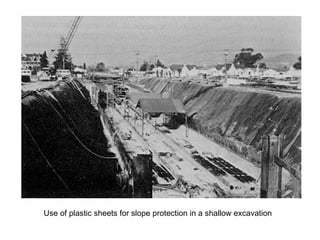
Use of plastic sheets for slope protection in a shallow excavation
 
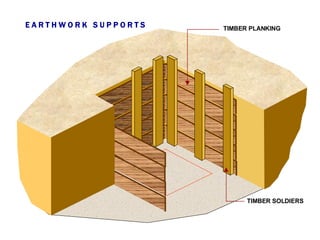
E A R T H W O R K  S U P P O R T S TIMBER PLANKING TIMBER SOLDIERS
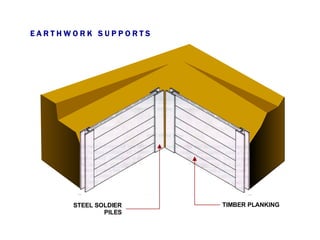
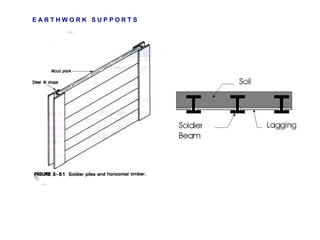
E A R T H W O R K  S U P P O R T S STEEL SOLDIER PILES TIMBER PLANKING
E A R T H W O R K  S U P P O R T S
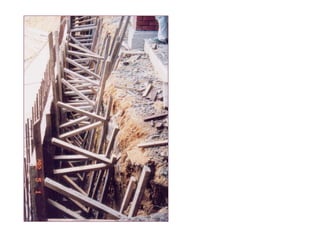
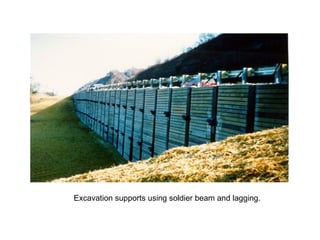
Excavation supports using soldier beam and lagging.
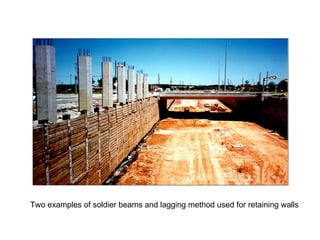
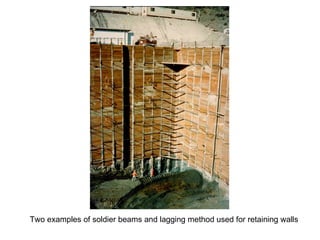
Two examples of soldier beams and lagging method used for retaining walls
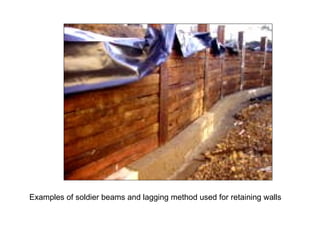
Examples of soldier beams and lagging method used for retaining walls
STEEL SHEET PILING
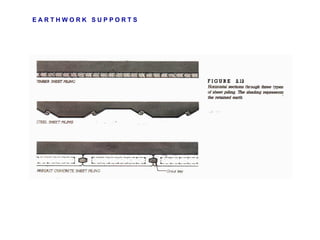
E A R T H W O R K  S U P P O R T S
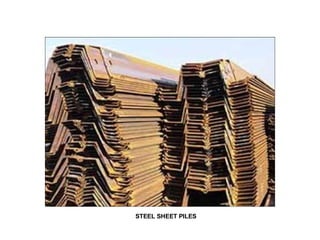
STEEL SHEET PILES
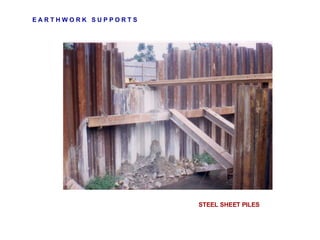
E A R T H W O R K  S U P P O R T S STEEL SHEET PILES
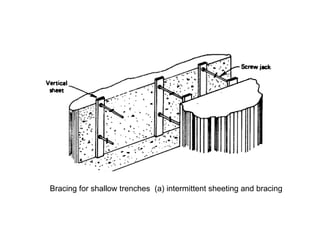
Bracing for shallow trenches  (a) intermittent sheeting and bracing
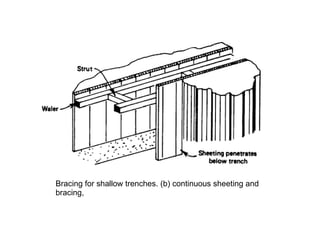
Bracing for shallow trenches. (b) continuous sheeting and bracing,
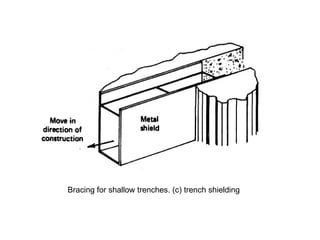
Bracing for shallow trenches. (c) trench shielding
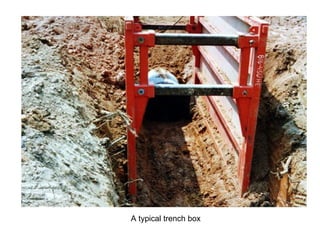
A typical trench box
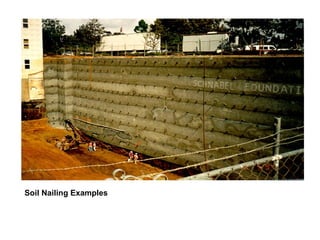
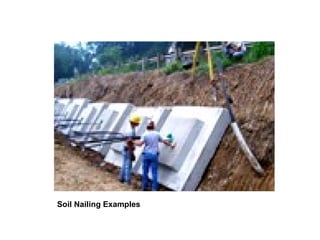
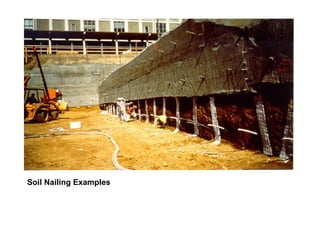
Soil Nailing Examples
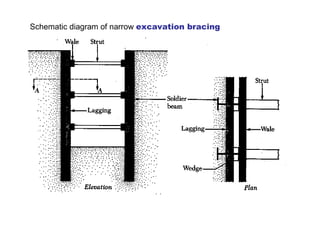
Schematic diagram of narrow  excavation bracing
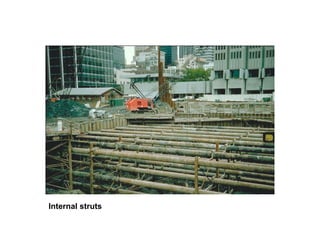
Internal struts
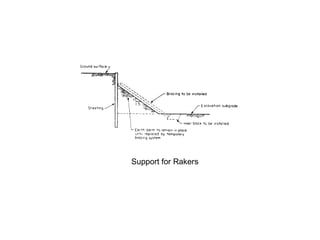
Support for Rakers
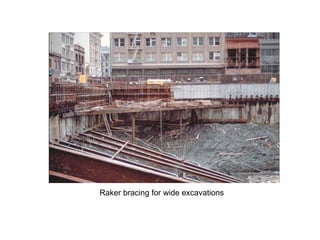
Raker bracing for wide excavations
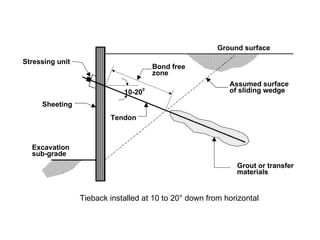
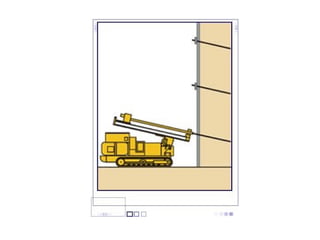
Excavation sub-grade Ground surface Grout or transfer  materials Stressing unit Sheeting Tendon 10-20 0 Bond free zone Assumed surface  of sliding wedge Tieback installed at 10 to 20° down from horizontal
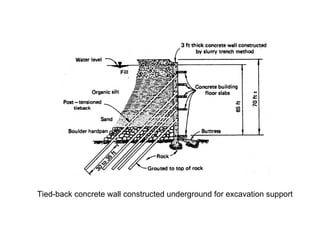
Tied-back concrete wall constructed underground for excavation support
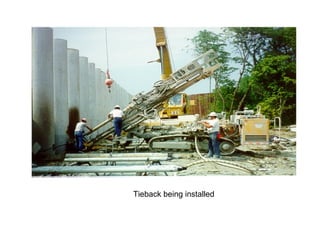
Tieback being installed
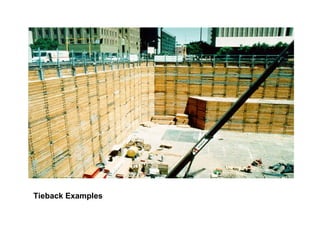
Tieback Examples
 
GROUND FREEZING
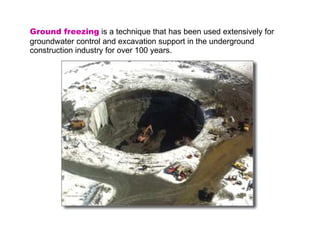
Ground freezing  is a technique that has been used extensively for groundwater control and excavation support in the underground construction industry for over 100 years.
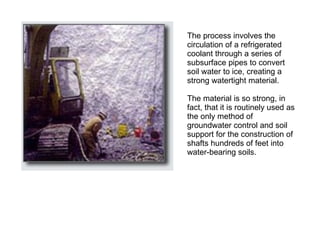
The process involves the circulation of a refrigerated coolant through a series of subsurface pipes to convert soil water to ice, creating a strong watertight material.  The material is so strong, in fact, that it is routinely used as the only method of groundwater control and soil support for the construction of shafts hundreds of feet into water-bearing soils.
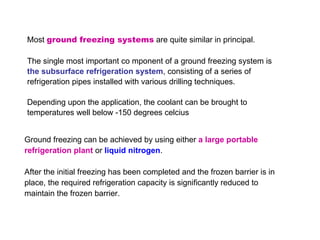
Most  ground freezing systems  are quite similar in principal.  The single most important co mponent of a ground freezing system is  the subsurface refrigeration system , consisting of a series of refrigeration pipes installed with various drilling techniques.  Depending upon the application, the coolant can be brought to temperatures well below -150 degrees celcius  Ground freezing can be achieved by using either  a large portable refrigeration plant  or  liquid nitrogen .  After the initial freezing has been completed and the frozen barrier is in place, the required refrigeration capacity is significantly reduced to maintain the frozen barrier.

earth support

  • 1.
  • 2.
    Use of plasticsheets for slope protection in a shallow excavation
  • 3.
  • 4.
    E A RT H W O R K S U P P O R T S TIMBER PLANKING TIMBER SOLDIERS
  • 5.
    E A RT H W O R K S U P P O R T S STEEL SOLDIER PILES TIMBER PLANKING
  • 6.
    E A RT H W O R K S U P P O R T S
  • 7.
    Excavation supports usingsoldier beam and lagging.
  • 8.
    Two examples ofsoldier beams and lagging method used for retaining walls
  • 9.
    Two examples ofsoldier beams and lagging method used for retaining walls
  • 10.
    Examples of soldierbeams and lagging method used for retaining walls
  • 11.
  • 12.
    E A RT H W O R K S U P P O R T S
  • 13.
  • 14.
    E A RT H W O R K S U P P O R T S STEEL SHEET PILES
  • 15.
    Bracing for shallowtrenches (a) intermittent sheeting and bracing
  • 16.
    Bracing for shallowtrenches. (b) continuous sheeting and bracing,
  • 17.
    Bracing for shallowtrenches. (c) trench shielding
  • 18.
  • 19.
  • 20.
  • 21.
  • 22.
    Schematic diagram ofnarrow excavation bracing
  • 23.
  • 24.
  • 25.
    Raker bracing forwide excavations
  • 26.
    Excavation sub-grade Groundsurface Grout or transfer materials Stressing unit Sheeting Tendon 10-20 0 Bond free zone Assumed surface of sliding wedge Tieback installed at 10 to 20° down from horizontal
  • 27.
    Tied-back concrete wallconstructed underground for excavation support
  • 28.
  • 29.
  • 30.
  • 31.
  • 32.
    Ground freezing is a technique that has been used extensively for groundwater control and excavation support in the underground construction industry for over 100 years.
  • 33.
    The process involvesthe circulation of a refrigerated coolant through a series of subsurface pipes to convert soil water to ice, creating a strong watertight material. The material is so strong, in fact, that it is routinely used as the only method of groundwater control and soil support for the construction of shafts hundreds of feet into water-bearing soils.
  • 34.
    Most groundfreezing systems are quite similar in principal. The single most important co mponent of a ground freezing system is the subsurface refrigeration system , consisting of a series of refrigeration pipes installed with various drilling techniques. Depending upon the application, the coolant can be brought to temperatures well below -150 degrees celcius Ground freezing can be achieved by using either a large portable refrigeration plant or liquid nitrogen . After the initial freezing has been completed and the frozen barrier is in place, the required refrigeration capacity is significantly reduced to maintain the frozen barrier.