CVL 776
CONSTRUCTION PRACTICES AND EQUIPMENT
SUBMITTED TO:-
PROF. A.K. JAIN
(DEPT. OF CIVIL
ENGINEERING, IIT
DELHI)
SUBMITTED BY :-
SHASHANK NAMDEO
2015CET2152
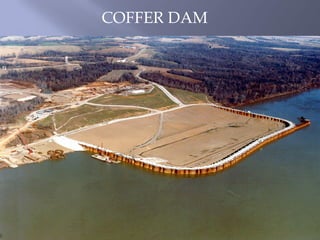
COFFERDAM
COFFER DAM
A cofferdam is a temporary structure designed to
keep water and/or soil out of the excavation in which a
bridge pier or other structure is built.
When construction must take place below the water
level, a cofferdam is built to give workers a dry work
environment. Sheet piling is driven around the work
site, seal concrete is placed into the bottom to prevent
water from seeping in from underneath the sheet piling,
and the water is pumped out
The word "cofferdam" comes from "coffer" meaning
box, in other words a dam in the shape of a box.
DEFINITION
• Braced
• Earth-Type
• Timber Crib
• Double-Walled Sheet Pile
• Cellular
TYPES
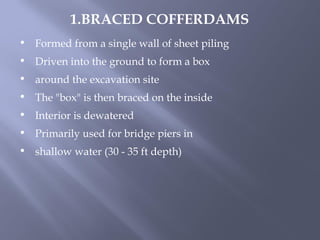
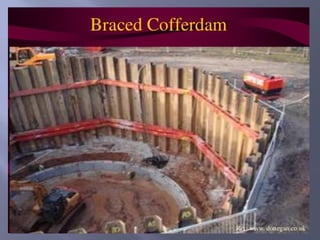
• Formed from a single wall of sheet piling
• Driven into the ground to form a box
• around the excavation site
• The "box" is then braced on the inside
• Interior is dewatered
• Primarily used for bridge piers in
• shallow water (30 - 35 ft depth)
1.BRACED COFFERDAMS
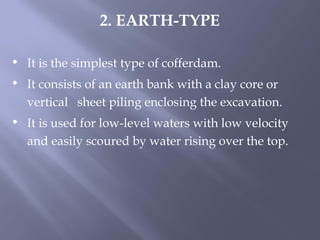
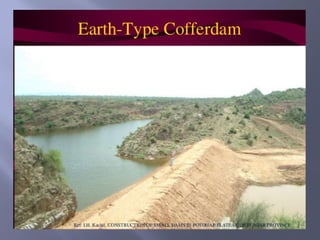
• It is the simplest type of cofferdam.
• It consists of an earth bank with a clay core or
vertical sheet piling enclosing the excavation.
• It is used for low-level waters with low velocity
and easily scoured by water rising over the top.
2. EARTH-TYPE
• Constructed on land and floated into place.
• Lower portion of each cell is matched with
contour of river bed.
• It uses rock ballast and soil to decrease seepage
and sink into place, also known as “Gravity
Dam”.
• It usually consists of 12’x12’ cells and is used in
rapid currents or on rocky river beds.
• It must be properly designed to resist lateral
forces such as tipping / overturning and sliding
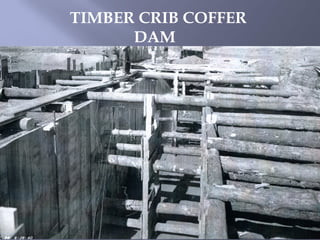
3. TIMBER CRIB
TIMBER CRIB COFFER
DAM
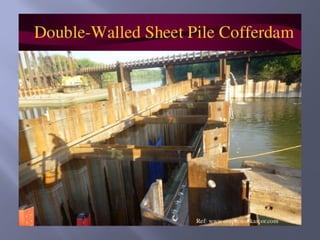
• They are double wall cofferdams
comprising two parallel rows of sheet
piles driven into the ground and
connected together by a system of tie rods
at one or more levels.
• The space between the walls is generally
filled with granular material such as
sand, gravel or broken rock.
4. DOUBLE-WALLED SHEET PILE
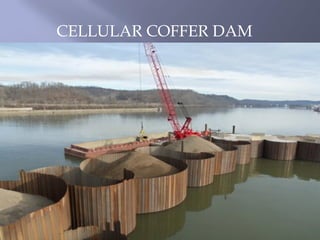
• Cellular cofferdams are used only in
those circumstances where the excavation
size precludes the use of cross-excavation
bracing.
• In this case, the cofferdam must be stable
by virtue of its own resistance to lateral
forces.
5. CELLULAR
CELLULAR COFFER DAM
• Scouring or undermining by rapidly
• flowing water
• Stability against overturning or tilting
• Upward forces on outside edge due to
tilting
• Stability against vertical shear
• Effects of forces resulting from:
• Ice, Wave, Water, Active Earth and
• Passive Earth Pressures
DESIGN CONSIDERATIONS
• Allow excavation and construction of structures
in otherwise poor environment .
• Provides safe environment to work
• Contractors typically have design responsibility
• Steel sheet piles are easily installed and
removed
• Materials can typically be reused on
• other projects
ADVANTAGES
Items needed for installation:
•Pile driving hammer
•Vibratory or Impact
•Crane of sufficient size
•Steel sheet piles are typically used
•H-piles and/or wide-flange beams for wales and
stringers
•Barges may be required
INSTALLATION
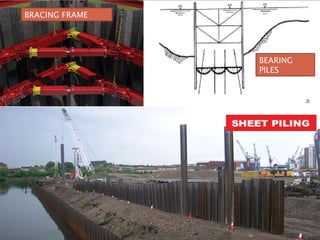
•Sheet piling
•Bracing frame
•Concrete seal
•Bearing piles
COMPONENTS
BRACING FRAME
BEARING
PILES
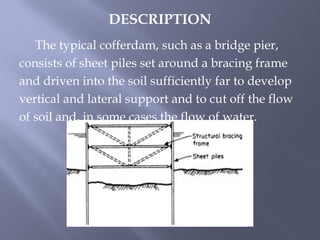
The typical cofferdam, such as a bridge pier,
consists of sheet piles set around a bracing frame
and driven into the soil sufficiently far to develop
vertical and lateral support and to cut off the flow
of soil and, in some cases the flow of water.
DESCRIPTION
The structure inside may be founded directly on
rock or firm soil or may require pile foundations.
In the latter case, these generally extend well
below the cofferdam.
In order to dewater the cofferdam, the bottom
must be stable and able to resist hydrostatic uplift.
Placement of an underwater concrete seal course is
the fastest and most common method.
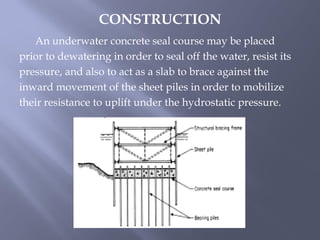
DESCRIPTION
An underwater concrete seal course may be placed
prior to dewatering in order to seal off the water, resist its
pressure, and also to act as a slab to brace against the
inward movement of the sheet piles in order to mobilize
their resistance to uplift under the hydrostatic pressure.
CONSTRUCTION
For a typical cofferdam, such as for a bridge
pier, the construction procedure follow the listed
pattern.
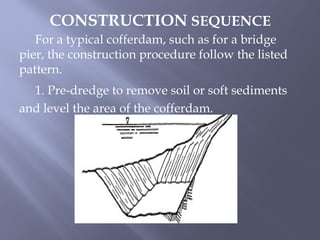
1. Pre-dredge to remove soil or soft sediments
and level the area of the cofferdam.
CONSTRUCTION SEQUENCE
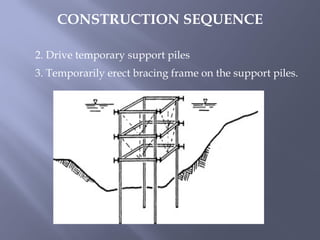
2. Drive temporary support piles
3. Temporarily erect bracing frame on the support piles.
CONSTRUCTION SEQUENCE
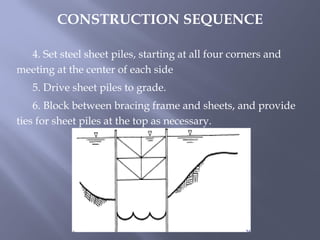
4. Set steel sheet piles, starting at all four corners and
meeting at the center of each side
5. Drive sheet piles to grade.
6. Block between bracing frame and sheets, and provide
ties for sheet piles at the top as necessary.
CONSTRUCTION SEQUENCE
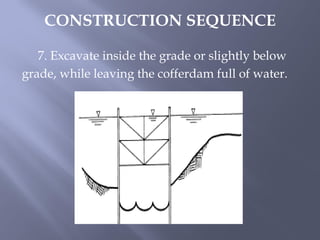
7. Excavate inside the grade or slightly below
grade, while leaving the cofferdam full of water.
CONSTRUCTION SEQUENCE
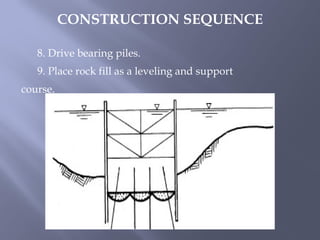
8. Drive bearing piles.
9. Place rock fill as a leveling and support
course.
CONSTRUCTION SEQUENCE
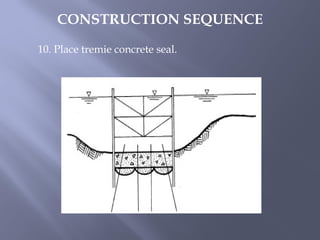
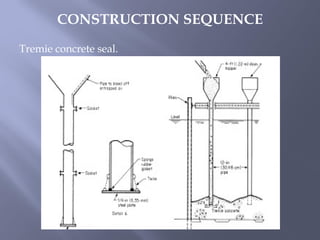
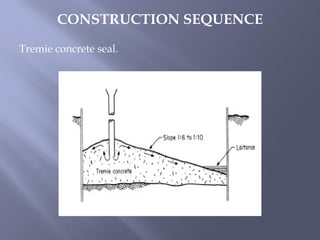
10. Place tremie concrete seal.
CONSTRUCTION SEQUENCE
Tremie concrete seal.
CONSTRUCTION SEQUENCE
Tremie concrete seal.
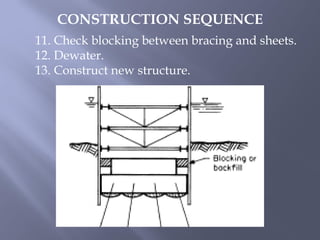
11. Check blocking between bracing and sheets.
12. Dewater.
13. Construct new structure.
CONSTRUCTION SEQUENCE
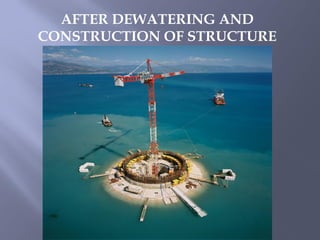
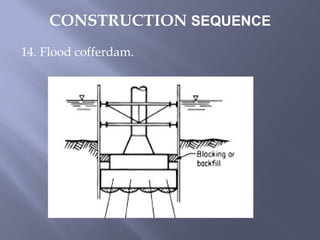
AFTER DEWATERING AND
CONSTRUCTION OF STRUCTURE
14. Flood cofferdam.
CONSTRUCTION SEQUENCE
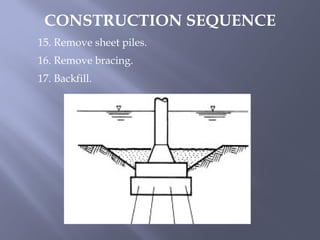
15. Remove sheet piles.
16. Remove bracing.
17. Backfill.
CONSTRUCTION SEQUENCE
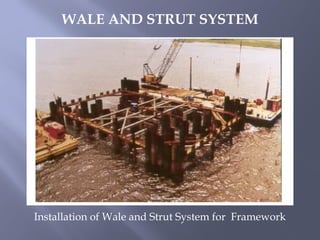
Installation of Wale and Strut System for Framework
WALE AND STRUT SYSTEM
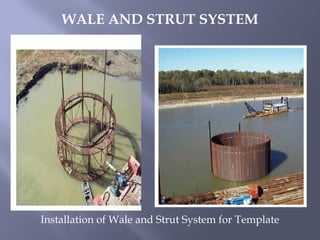
Installation of Wale and Strut System for Template
WALE AND STRUT SYSTEM
In cofferdam construction, safety is a paramount
concern, since workers will be exposed to the hazard of
flooding and collapse. Safety requirements are:
• Good design
• Proper construction
• Verification that structure is constructed as per plan
• Monitoring the behavior of cofferdam and its
surrounding
• Provision of adequate access
• Light and ventilation
• Attention to safe practices on the part of all workers and
supervisors
SAFETY REQUIREMENTS
Principal hazards and risks
1. Falls from height from dam walls into
excavation or into water
2. Health hazards from contaminated water,
hazardous gases in confined spaces, noise and
vibration from piling operations
3. Hazards from services such as cables in river
bed, temporary power cables in water etc.
4. Contact with moving equipment such as
collisions between boats, pontoons, crane barges
and cofferdam. moving plant and slewed
equipment in confined space
5. Flooding caused by failure of cofferdam walls
Some design options to reduce
hazards
1.Consider a temporary causeway instead of
floating rigs
2. Prefabricated caissons towed into place be used
instead of driven piled cofferdams to lessen the
work in the water and reduce the noise.
3. Consider the level of the working platform or
causeway with respect to high tide and flood
levels.
5. Plan the shape of the cofferdam to suit working
space and construction plant as well as final
structure.
6. Consider the use of different construction or of
remotely controlled techniques to design out the
need for underwater working.
7. Incorporate lugs and holes in design to aid
fixing of equipment
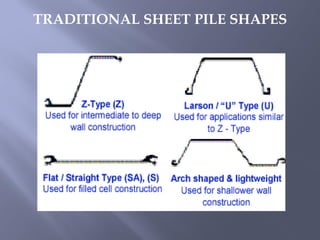
TRADITIONAL SHEET PILE SHAPES
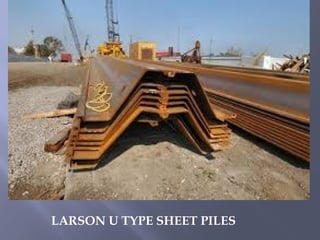
LARSON U TYPE SHEET PILES
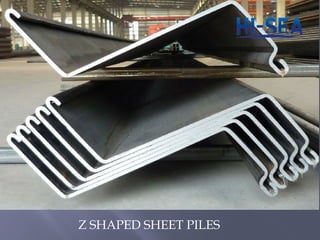
Z SHAPED SHEET PILES
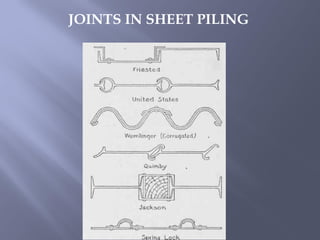
JOINTS IN SHEET PILING
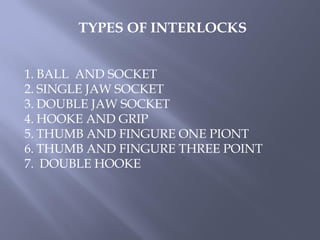
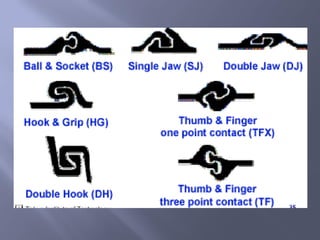
TYPES OF INTERLOCKS
1. BALL AND SOCKET
2. SINGLE JAW SOCKET
3. DOUBLE JAW SOCKET
4. HOOKE AND GRIP
5. THUMB AND FINGURE ONE PIONT
6. THUMB AND FINGURE THREE POINT
7. DOUBLE HOOKE
THANK YOU

Cofferdam

  • 1.
    CVL 776 CONSTRUCTION PRACTICESAND EQUIPMENT SUBMITTED TO:- PROF. A.K. JAIN (DEPT. OF CIVIL ENGINEERING, IIT DELHI) SUBMITTED BY :- SHASHANK NAMDEO 2015CET2152
  • 2.
  • 3.
    A cofferdam isa temporary structure designed to keep water and/or soil out of the excavation in which a bridge pier or other structure is built. When construction must take place below the water level, a cofferdam is built to give workers a dry work environment. Sheet piling is driven around the work site, seal concrete is placed into the bottom to prevent water from seeping in from underneath the sheet piling, and the water is pumped out The word "cofferdam" comes from "coffer" meaning box, in other words a dam in the shape of a box. DEFINITION
  • 4.
    • Braced • Earth-Type •Timber Crib • Double-Walled Sheet Pile • Cellular TYPES
  • 5.
    • Formed froma single wall of sheet piling • Driven into the ground to form a box • around the excavation site • The "box" is then braced on the inside • Interior is dewatered • Primarily used for bridge piers in • shallow water (30 - 35 ft depth) 1.BRACED COFFERDAMS
  • 7.
    • It isthe simplest type of cofferdam. • It consists of an earth bank with a clay core or vertical sheet piling enclosing the excavation. • It is used for low-level waters with low velocity and easily scoured by water rising over the top. 2. EARTH-TYPE
  • 9.
    • Constructed onland and floated into place. • Lower portion of each cell is matched with contour of river bed. • It uses rock ballast and soil to decrease seepage and sink into place, also known as “Gravity Dam”. • It usually consists of 12’x12’ cells and is used in rapid currents or on rocky river beds. • It must be properly designed to resist lateral forces such as tipping / overturning and sliding 3. TIMBER CRIB
  • 10.
  • 11.
    • They aredouble wall cofferdams comprising two parallel rows of sheet piles driven into the ground and connected together by a system of tie rods at one or more levels. • The space between the walls is generally filled with granular material such as sand, gravel or broken rock. 4. DOUBLE-WALLED SHEET PILE
  • 13.
    • Cellular cofferdamsare used only in those circumstances where the excavation size precludes the use of cross-excavation bracing. • In this case, the cofferdam must be stable by virtue of its own resistance to lateral forces. 5. CELLULAR
  • 14.
  • 15.
    • Scouring orundermining by rapidly • flowing water • Stability against overturning or tilting • Upward forces on outside edge due to tilting • Stability against vertical shear • Effects of forces resulting from: • Ice, Wave, Water, Active Earth and • Passive Earth Pressures DESIGN CONSIDERATIONS
  • 16.
    • Allow excavationand construction of structures in otherwise poor environment . • Provides safe environment to work • Contractors typically have design responsibility • Steel sheet piles are easily installed and removed • Materials can typically be reused on • other projects ADVANTAGES
  • 17.
    Items needed forinstallation: •Pile driving hammer •Vibratory or Impact •Crane of sufficient size •Steel sheet piles are typically used •H-piles and/or wide-flange beams for wales and stringers •Barges may be required INSTALLATION
  • 18.
    •Sheet piling •Bracing frame •Concreteseal •Bearing piles COMPONENTS
  • 19.
  • 20.
    The typical cofferdam,such as a bridge pier, consists of sheet piles set around a bracing frame and driven into the soil sufficiently far to develop vertical and lateral support and to cut off the flow of soil and, in some cases the flow of water. DESCRIPTION
  • 21.
    The structure insidemay be founded directly on rock or firm soil or may require pile foundations. In the latter case, these generally extend well below the cofferdam. In order to dewater the cofferdam, the bottom must be stable and able to resist hydrostatic uplift. Placement of an underwater concrete seal course is the fastest and most common method. DESCRIPTION
  • 22.
    An underwater concreteseal course may be placed prior to dewatering in order to seal off the water, resist its pressure, and also to act as a slab to brace against the inward movement of the sheet piles in order to mobilize their resistance to uplift under the hydrostatic pressure. CONSTRUCTION
  • 23.
    For a typicalcofferdam, such as for a bridge pier, the construction procedure follow the listed pattern. 1. Pre-dredge to remove soil or soft sediments and level the area of the cofferdam. CONSTRUCTION SEQUENCE
  • 24.
    2. Drive temporarysupport piles 3. Temporarily erect bracing frame on the support piles. CONSTRUCTION SEQUENCE
  • 25.
    4. Set steelsheet piles, starting at all four corners and meeting at the center of each side 5. Drive sheet piles to grade. 6. Block between bracing frame and sheets, and provide ties for sheet piles at the top as necessary. CONSTRUCTION SEQUENCE
  • 26.
    7. Excavate insidethe grade or slightly below grade, while leaving the cofferdam full of water. CONSTRUCTION SEQUENCE
  • 27.
    8. Drive bearingpiles. 9. Place rock fill as a leveling and support course. CONSTRUCTION SEQUENCE
  • 28.
    10. Place tremieconcrete seal. CONSTRUCTION SEQUENCE
  • 29.
  • 30.
  • 31.
    11. Check blockingbetween bracing and sheets. 12. Dewater. 13. Construct new structure. CONSTRUCTION SEQUENCE
  • 32.
  • 33.
  • 34.
    15. Remove sheetpiles. 16. Remove bracing. 17. Backfill. CONSTRUCTION SEQUENCE
  • 35.
    Installation of Waleand Strut System for Framework WALE AND STRUT SYSTEM
  • 36.
    Installation of Waleand Strut System for Template WALE AND STRUT SYSTEM
  • 37.
    In cofferdam construction,safety is a paramount concern, since workers will be exposed to the hazard of flooding and collapse. Safety requirements are: • Good design • Proper construction • Verification that structure is constructed as per plan • Monitoring the behavior of cofferdam and its surrounding • Provision of adequate access • Light and ventilation • Attention to safe practices on the part of all workers and supervisors SAFETY REQUIREMENTS
  • 38.
    Principal hazards andrisks 1. Falls from height from dam walls into excavation or into water 2. Health hazards from contaminated water, hazardous gases in confined spaces, noise and vibration from piling operations 3. Hazards from services such as cables in river bed, temporary power cables in water etc.
  • 39.
    4. Contact withmoving equipment such as collisions between boats, pontoons, crane barges and cofferdam. moving plant and slewed equipment in confined space 5. Flooding caused by failure of cofferdam walls
  • 40.
    Some design optionsto reduce hazards 1.Consider a temporary causeway instead of floating rigs 2. Prefabricated caissons towed into place be used instead of driven piled cofferdams to lessen the work in the water and reduce the noise. 3. Consider the level of the working platform or causeway with respect to high tide and flood levels.
  • 41.
    5. Plan theshape of the cofferdam to suit working space and construction plant as well as final structure. 6. Consider the use of different construction or of remotely controlled techniques to design out the need for underwater working. 7. Incorporate lugs and holes in design to aid fixing of equipment
  • 42.
  • 43.
    LARSON U TYPESHEET PILES
  • 44.
  • 45.
  • 46.
    TYPES OF INTERLOCKS 1.BALL AND SOCKET 2. SINGLE JAW SOCKET 3. DOUBLE JAW SOCKET 4. HOOKE AND GRIP 5. THUMB AND FINGURE ONE PIONT 6. THUMB AND FINGURE THREE POINT 7. DOUBLE HOOKE
  • 48.