GROUNDWATER CONTROL FOR 
www.preene.com 
CONSTRUCTION 
Dr Martin Preene 
Preene Groundwater Consulting 
June 2014
www.preene.com 
GROUNDWATER CONTROL 
Definition 
Groundwater Control 
“The process of temporarily dealing with groundwater, to allow excavations to be 
made in dry and stable conditions below natural groundwater level” 
May be known as Dewatering or Construction Dewatering or Groundwater 
Lowering 
Additional definition: 
Permeability = coefficient of permeability = hydraulic conductivity (expressed 
in m/s)
www.preene.com 
GROUNDWATER CONTROL 
Synopsis 
• Definitions 
• Approaches to groundwater control: 
– by exclusion 
– by pumping 
• Approaches to design 
• A bit of history and dewatering philosophy
www.preene.com 
PRACTICE PROFILE 
Preene Groundwater Consulting is the Professional Practice 
of Dr Martin Preene and provides specialist advice and design 
services in the fields of dewatering, groundwater engineering 
and hydrogeology to clients worldwide 
Dr Martin Preene has more than 25 years’ experience on 
projects worldwide in the investigation, design, installation 
and operation of groundwater control and dewatering 
systems. He is widely published on dewatering and 
groundwater control and is the author of the UK industry 
guidance on dewatering (CIRIA Report C515 Groundwater 
Control Design and Practice) as well as a dewatering text book 
(Groundwater Lowering in Construction: A Practical Guide to 
Dewatering)
HOW DO WE GET GOOD DESIGN? 
www.preene.com 
Data 
Information 
Knowledge 
Wisdom
HOW DO WE GET GOOD DESIGN? 
www.preene.com 
Data 
Information 
Knowledge 
Wisdom 
Theory 
Projects 
Screw ups 
Good dewatering design
www.preene.com 
GROUNDWATER
www.preene.com 
GROUNDWATER CONTROL 
Two main philosophies of groundwater control 
• Exclusion: Physical cut-off walls 
• Pumping: Arrays of wells or sumps (construction 
dewatering)
EXCLUSION: VERTICAL CUT-OFF WALLS 
www.preene.com 
Cut-off walls penetrate 
into underlying low 
permeability stratum
EXCLUSION: CUT-OFF WALLS AND PUMPED WELLS 
www.preene.com 
Cut-off walls do not reach deep 
impermeable stratum: dewatering 
wells are needed
EXCLUSION: VERTICAL CUT-OFF AND HORIZONTAL BARRIERS 
www.preene.com 
Cut-off walls do not reach deep 
impermeable stratum: 
horizontal barrier is used to exclude 
groundwater from base
www.preene.com 
EXCLUSION TECHNIQUES 
• Displacement barriers 
– Steel sheet-piles 
• Excavated barriers 
– Concrete diaphragm walls 
– Bored pile walls (secant pile walls and contiguous pile walls) 
– Bentonite slurry walls and trenches 
• Injected barriers 
– Permeation grouting 
– Rock grouting 
– Jet grouting 
– Mix-in-place methods 
• Artificial ground freezing 
• Compressed air (for tunnels and shafts)
www.preene.com 
STEEL SHEET-PILING 
Circular sheet-pile 
cofferdam 
with concrete 
walings
CONCRETE DIAPHRAGM WALLS 
www.preene.com 
Circular 
concrete 
diaphragm 
wall
CONCRETE DIAPHRAGM WALLS 
www.preene.com 
Rope operated 
diaphragm wall grab 
Construction sequence for diaphragm walls 
from Woodward (2005): An Introduction to 
Geotechnical Processes 
Source: Bachy Soletanche 
Rockmill diaphragm 
wall cutter 
Source: Cementation Skanska
www.preene.com 
BORED PILE WALLS 
Secant pile wall exposed showing unreinforced 
female piles and reinforced male piles 
(Source: Bachy Soletanche)
www.preene.com 
BENTONITE SLURRY WALLS 
Bentonite 
slurry wall 
constructed 
by long 
reach 
excavator 
Source: Arup
www.preene.com 
BENTONITE SLURRY WALLS 
Bentonite-cement slurry wall 
constructed by long reach 
excavator 
Common European practice 
Soil-bentonite slurry wall 
constructed by long reach 
excavator 
Common North American 
practice
www.preene.com 
PERMEATION GROUTING 
• Cement-based grouts in 
coarse soils and fissured 
rocks 
• Micro-fine cement grouts 
and chemical grouts (gels) in 
lower permeability soils
www.preene.com 
JET GROUTING
ARTIFICIAL GROUND FREEZING 
www.preene.com
ARTIFICIAL GROUND FREEZING 
Artificial ground 
freezing system around 
a shaft 
Source: British 
Drilling and 
Freezing Co. Ltd 
www.preene.com
ARTIFICIAL GROUND FREEZING (BRINE) 
www.preene.com 
AGF using brine circulation Brine freeze plant 
Source: British Drilling and Freezing Co. Ltd
ARTIFICIAL GROUND FREEZING (LN) 
Schematic diagram of 
liquid nitrogen (LN) freezing 
system 
www.preene.com
GROUNDWATER CONTROL BY PUMPING 
www.preene.com
www.preene.com 
SURFACE WATER CONTROL 
Groundwater control alone cannot keep an excavation dry. Surface water must 
also be controlled 
Poor control of surface water
www.preene.com 
SURFACE WATER CONTROL 
Groundwater control alone cannot keep an excavation dry. Surface water must 
also be controlled 
Poor control of surface water Adequate control of surface water
SURFACE WATER CONTROL METHODS 
www.preene.com 
• Source control 
- intercept run-off before it reaches the excavation 
- prevent unnecessary generation of water in the excavation 
- collect water as soon as it reaches the work area (or before!) 
• Water collection 
- French drains to intercept run off 
- collector drains and sumps 
- pumping systems (keep it simple!) 
• Water treatment 
- solids removal (settlement tanks, Siltbusters)
GROUNDWATER CONTROL BY PUMPING 
www.preene.com 
Available Techniques 
• Sump pumping 
• Wellpoints 
• Deepwells 
• Ejector wells
www.preene.com 
SUMPING APPLICATIONS 
Drainage trench used to 
feed water to sump 
formed from concrete 
manhole ring 
Source: WJ Groundwater
www.preene.com 
WELLPOINTS 
Excavation in sand 
using wellpoint 
dewatering 
Source: WJ Groundwater
www.preene.com 
DEEPWELLS 
From CIRIA Report 
C515 (2000): 
Groundwater Control: 
Design and Practice
www.preene.com 
EJECTOR WELLS 
From CIRIA Report 
C515 (2000): 
Groundwater Control: 
Design and Practice
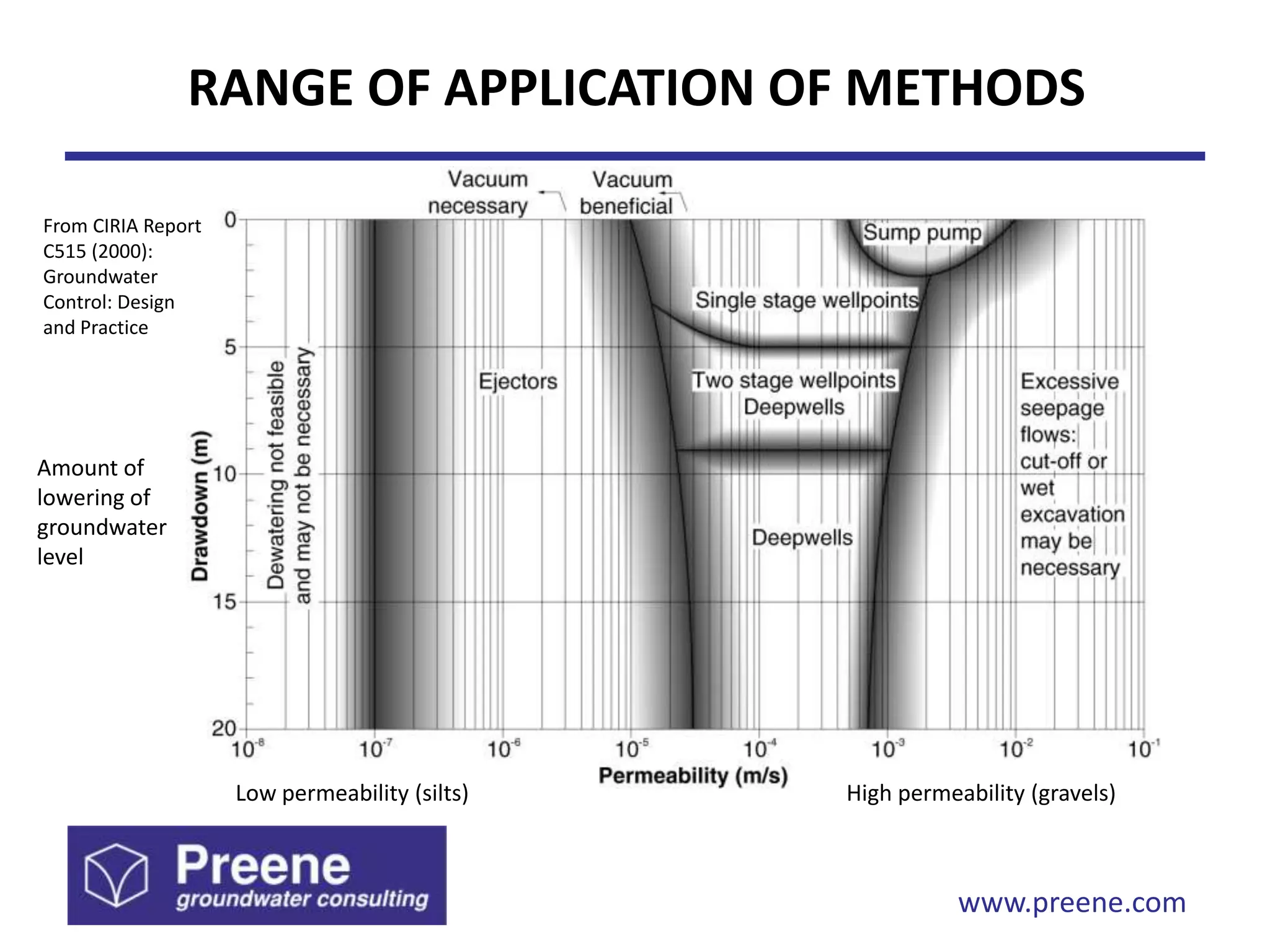
RANGE OF APPLICATION OF METHODS 
www.preene.com 
Amount of 
lowering of 
groundwater 
level 
Low permeability (silts) High permeability (gravels) 
From CIRIA Report 
C515 (2000): 
Groundwater 
Control: Design 
and Practice
WHAT IS DEWATERING DESIGN? 
www.preene.com 
Dewatering design is NOT about: 
• Developing excessively complex models and concepts 
• Trying to ‘simulate’ reality 
The objective of design should be to: 
• Allow engineering and commercial decisions to be made 
• Focus on appropriate level of detail relevant to key issues for 
your problem (e.g. technology selection, flow rate estimate, 
environmental impacts)
UNDERSTANDING THE PROBLEM 
www.preene.com 
• Site investigation (field and desk studies) 
• Why is groundwater control required – what are the 
objectives? 
• What are the aquifer conditions? 
• What is the likely range of permeability? 
• What are the practical and environmental constraints?
DEFINING PERFORMANCE TARGETS 
• Are we trying to reduce groundwater levels or to reduce 
www.preene.com 
pore water pressures? 
• What are the target groundwater levels or pressures, and 
where (plan location and stratum) do we need to achieve 
these effects? 
• Required timescale? 
• Need for standby/back up systems? 
• Any specified environmental mitigation? 
• Flow rate is NOT normally a performance target
www.preene.com 
SELECTING TECHNOLOGIES 
Technologies may not be interchangeable 
Amount of 
lowering of 
groundwater 
level 
Low permeability (silts) High permeability (gravels) 
From CIRIA Report 
C515 (2000): 
Groundwater 
Control: Design 
and Practice
www.preene.com 
ESTIMATING FLOW RATE 
• The pumped flow rate from a dewatering system is 
often the key parameter to be estimated 
• It will influence the capacity of the dewatering 
system 
• It may control selection of the technology
www.preene.com 
ACCURACY OF DESIGN
www.preene.com 
APPROACHES TO DESIGN 
• Empirical 
• Analytical 
• Numerical 
• Observational
www.preene.com 
EMPIRICAL METHODS 
• A great many dewatering systems are not 
‘designed’ in the formal sense 
• They are selected based on established ‘rules of 
thumb’ 
• A key issue is that site conditions must appropriate 
to the assumptions behind the rule of thumb 
• Problems occur if the rules of thumb are applied 
(knowingly or unknowingly) in inappropriate 
conditions
www.preene.com 
ANALYTICAL METHODS 
• Use of ‘textbook’ equations on paper or by 
spreadsheet 
• A wide variety of analytical equations are available. 
It is important that the appropriate one(s) are 
selected for site conditions 
• Need to have a conceptual model FIRST in order to 
be able to select the appropriate analytical method 
• Use of inappropriate analytical equations will give 
gross errors
www.preene.com 
NUMERICAL METHODS 
• Use of numerical models (e.g. finite difference and 
finite element models) 
• Two-dimensional or three-dimensional models 
• Steady state or transient models can be 
constructed 
• Proprietary software packages are used 
(MODFLOW, FEFLOW, SEEP/W, etc) 
• Need a conceptual model first 
• Used when there is very good (or sometimes very 
bad!) data
OBSERVATIONAL METHODS 
• An application of the established geotechnical 
Observational Method which is sometimes called 
‘design as you go’ 
• Is a formalised, step by step approach 
• Develop a conceptual model and make design 
predictions (by analytical or numerical methods) 
• Have defined monitoring programme with ‘trigger 
levels’ 
• If trigger levels are reached, defined additional 
dewatering measures are put into place 
www.preene.com
www.preene.com 
KEY FACTORS IN DESIGN 
• Good design is all about getting the right 
conceptual model at an early stage 
• This will allow better selection of appropriate 
design methods 
• And allow the selection of appropriate methods 
and technologies
A BIT OF HISTORY AND PHILOSOPHY 
• Some of the basic theory used in dewatering design pre-dates the 
birth of soil mechanics theory 
– Darcy’s law (1856) – dynamics of laminar groundwater flow 
– Dupuit equations (1863) – well equations 
– Hazen’s rule (1892) – hydraulic conductivity of uniform sands 
• An understanding of the theory of groundwater flow is essential, 
www.preene.com 
but is not enough 
• Getting the conceptual model right is fundamental 
• An understanding of the capability and limitations of pumping and 
exclusion technologies is also required – you have to get the 
technology right 
• A little bit of local experience goes a long way
A BIT OF HISTORY AND PHILOSOPHY 
• In general dewatering design is not ‘codified’ 
• There are few prescriptive design and practice rules to be followed 
• Eurocode 7 (BS EN 1997-1: 2004) includes a short (1 page) section 
on dewatering, but this is not prescriptive, and only gives generic 
guidance on good practice. 
• I am not aware of any English language prescriptive dewatering 
www.preene.com 
design codes (those that exist are generic) 
• One of the main existing design documents is CIRIA Report C515 
Groundwater Control: Design and Practice (2000). The original 
document was written in 1997 and is currently being updated by 
CIRIA for 2014
www.preene.com 
AND FINALLY…. 
Hugh Golder on dewatering 
“The limitations of the different systems 
which are available are practical rather 
than theoretical and the design of a system 
is no task for an optimist. A sound engineer 
with a melancholy outlook, whose life has 
been a series of unhappy trials, is the best 
man to plan a water-lowering system.” 
H. Q. Golder and J. L. Seychuk 
“Soil Problems in Subway Construction” 
3rd Pan-American Conference on Soil Mechanics and Foundation Engineering, Caracas, Venezuela, July 
1967, pp. 203-240.
GROUNDWATER CONTROL FOR 
www.preene.com 
CONSTRUCTION 
Dr Martin Preene 
Preene Groundwater Consulting 
June 2014

Groundwater Control for Construction

  • 1.
    GROUNDWATER CONTROL FOR www.preene.com CONSTRUCTION Dr Martin Preene Preene Groundwater Consulting June 2014
  • 2.
    www.preene.com GROUNDWATER CONTROL Definition Groundwater Control “The process of temporarily dealing with groundwater, to allow excavations to be made in dry and stable conditions below natural groundwater level” May be known as Dewatering or Construction Dewatering or Groundwater Lowering Additional definition: Permeability = coefficient of permeability = hydraulic conductivity (expressed in m/s)
  • 3.
    www.preene.com GROUNDWATER CONTROL Synopsis • Definitions • Approaches to groundwater control: – by exclusion – by pumping • Approaches to design • A bit of history and dewatering philosophy
  • 4.
    www.preene.com PRACTICE PROFILE Preene Groundwater Consulting is the Professional Practice of Dr Martin Preene and provides specialist advice and design services in the fields of dewatering, groundwater engineering and hydrogeology to clients worldwide Dr Martin Preene has more than 25 years’ experience on projects worldwide in the investigation, design, installation and operation of groundwater control and dewatering systems. He is widely published on dewatering and groundwater control and is the author of the UK industry guidance on dewatering (CIRIA Report C515 Groundwater Control Design and Practice) as well as a dewatering text book (Groundwater Lowering in Construction: A Practical Guide to Dewatering)
  • 5.
    HOW DO WEGET GOOD DESIGN? www.preene.com Data Information Knowledge Wisdom
  • 6.
    HOW DO WEGET GOOD DESIGN? www.preene.com Data Information Knowledge Wisdom Theory Projects Screw ups Good dewatering design
  • 7.
  • 8.
    www.preene.com GROUNDWATER CONTROL Two main philosophies of groundwater control • Exclusion: Physical cut-off walls • Pumping: Arrays of wells or sumps (construction dewatering)
  • 9.
    EXCLUSION: VERTICAL CUT-OFFWALLS www.preene.com Cut-off walls penetrate into underlying low permeability stratum
  • 10.
    EXCLUSION: CUT-OFF WALLSAND PUMPED WELLS www.preene.com Cut-off walls do not reach deep impermeable stratum: dewatering wells are needed
  • 11.
    EXCLUSION: VERTICAL CUT-OFFAND HORIZONTAL BARRIERS www.preene.com Cut-off walls do not reach deep impermeable stratum: horizontal barrier is used to exclude groundwater from base
  • 12.
    www.preene.com EXCLUSION TECHNIQUES • Displacement barriers – Steel sheet-piles • Excavated barriers – Concrete diaphragm walls – Bored pile walls (secant pile walls and contiguous pile walls) – Bentonite slurry walls and trenches • Injected barriers – Permeation grouting – Rock grouting – Jet grouting – Mix-in-place methods • Artificial ground freezing • Compressed air (for tunnels and shafts)
  • 13.
    www.preene.com STEEL SHEET-PILING Circular sheet-pile cofferdam with concrete walings
  • 14.
    CONCRETE DIAPHRAGM WALLS www.preene.com Circular concrete diaphragm wall
  • 15.
    CONCRETE DIAPHRAGM WALLS www.preene.com Rope operated diaphragm wall grab Construction sequence for diaphragm walls from Woodward (2005): An Introduction to Geotechnical Processes Source: Bachy Soletanche Rockmill diaphragm wall cutter Source: Cementation Skanska
  • 16.
    www.preene.com BORED PILEWALLS Secant pile wall exposed showing unreinforced female piles and reinforced male piles (Source: Bachy Soletanche)
  • 17.
    www.preene.com BENTONITE SLURRYWALLS Bentonite slurry wall constructed by long reach excavator Source: Arup
  • 18.
    www.preene.com BENTONITE SLURRYWALLS Bentonite-cement slurry wall constructed by long reach excavator Common European practice Soil-bentonite slurry wall constructed by long reach excavator Common North American practice
  • 19.
    www.preene.com PERMEATION GROUTING • Cement-based grouts in coarse soils and fissured rocks • Micro-fine cement grouts and chemical grouts (gels) in lower permeability soils
  • 20.
  • 21.
  • 22.
    ARTIFICIAL GROUND FREEZING Artificial ground freezing system around a shaft Source: British Drilling and Freezing Co. Ltd www.preene.com
  • 23.
    ARTIFICIAL GROUND FREEZING(BRINE) www.preene.com AGF using brine circulation Brine freeze plant Source: British Drilling and Freezing Co. Ltd
  • 24.
    ARTIFICIAL GROUND FREEZING(LN) Schematic diagram of liquid nitrogen (LN) freezing system www.preene.com
  • 25.
    GROUNDWATER CONTROL BYPUMPING www.preene.com
  • 26.
    www.preene.com SURFACE WATERCONTROL Groundwater control alone cannot keep an excavation dry. Surface water must also be controlled Poor control of surface water
  • 27.
    www.preene.com SURFACE WATERCONTROL Groundwater control alone cannot keep an excavation dry. Surface water must also be controlled Poor control of surface water Adequate control of surface water
  • 28.
    SURFACE WATER CONTROLMETHODS www.preene.com • Source control - intercept run-off before it reaches the excavation - prevent unnecessary generation of water in the excavation - collect water as soon as it reaches the work area (or before!) • Water collection - French drains to intercept run off - collector drains and sumps - pumping systems (keep it simple!) • Water treatment - solids removal (settlement tanks, Siltbusters)
  • 29.
    GROUNDWATER CONTROL BYPUMPING www.preene.com Available Techniques • Sump pumping • Wellpoints • Deepwells • Ejector wells
  • 30.
    www.preene.com SUMPING APPLICATIONS Drainage trench used to feed water to sump formed from concrete manhole ring Source: WJ Groundwater
  • 31.
    www.preene.com WELLPOINTS Excavationin sand using wellpoint dewatering Source: WJ Groundwater
  • 32.
    www.preene.com DEEPWELLS FromCIRIA Report C515 (2000): Groundwater Control: Design and Practice
  • 33.
    www.preene.com EJECTOR WELLS From CIRIA Report C515 (2000): Groundwater Control: Design and Practice
  • 34.
    RANGE OF APPLICATIONOF METHODS www.preene.com Amount of lowering of groundwater level Low permeability (silts) High permeability (gravels) From CIRIA Report C515 (2000): Groundwater Control: Design and Practice
  • 35.
    WHAT IS DEWATERINGDESIGN? www.preene.com Dewatering design is NOT about: • Developing excessively complex models and concepts • Trying to ‘simulate’ reality The objective of design should be to: • Allow engineering and commercial decisions to be made • Focus on appropriate level of detail relevant to key issues for your problem (e.g. technology selection, flow rate estimate, environmental impacts)
  • 36.
    UNDERSTANDING THE PROBLEM www.preene.com • Site investigation (field and desk studies) • Why is groundwater control required – what are the objectives? • What are the aquifer conditions? • What is the likely range of permeability? • What are the practical and environmental constraints?
  • 37.
    DEFINING PERFORMANCE TARGETS • Are we trying to reduce groundwater levels or to reduce www.preene.com pore water pressures? • What are the target groundwater levels or pressures, and where (plan location and stratum) do we need to achieve these effects? • Required timescale? • Need for standby/back up systems? • Any specified environmental mitigation? • Flow rate is NOT normally a performance target
  • 38.
    www.preene.com SELECTING TECHNOLOGIES Technologies may not be interchangeable Amount of lowering of groundwater level Low permeability (silts) High permeability (gravels) From CIRIA Report C515 (2000): Groundwater Control: Design and Practice
  • 39.
    www.preene.com ESTIMATING FLOWRATE • The pumped flow rate from a dewatering system is often the key parameter to be estimated • It will influence the capacity of the dewatering system • It may control selection of the technology
  • 40.
  • 41.
    www.preene.com APPROACHES TODESIGN • Empirical • Analytical • Numerical • Observational
  • 42.
    www.preene.com EMPIRICAL METHODS • A great many dewatering systems are not ‘designed’ in the formal sense • They are selected based on established ‘rules of thumb’ • A key issue is that site conditions must appropriate to the assumptions behind the rule of thumb • Problems occur if the rules of thumb are applied (knowingly or unknowingly) in inappropriate conditions
  • 43.
    www.preene.com ANALYTICAL METHODS • Use of ‘textbook’ equations on paper or by spreadsheet • A wide variety of analytical equations are available. It is important that the appropriate one(s) are selected for site conditions • Need to have a conceptual model FIRST in order to be able to select the appropriate analytical method • Use of inappropriate analytical equations will give gross errors
  • 44.
    www.preene.com NUMERICAL METHODS • Use of numerical models (e.g. finite difference and finite element models) • Two-dimensional or three-dimensional models • Steady state or transient models can be constructed • Proprietary software packages are used (MODFLOW, FEFLOW, SEEP/W, etc) • Need a conceptual model first • Used when there is very good (or sometimes very bad!) data
  • 45.
    OBSERVATIONAL METHODS •An application of the established geotechnical Observational Method which is sometimes called ‘design as you go’ • Is a formalised, step by step approach • Develop a conceptual model and make design predictions (by analytical or numerical methods) • Have defined monitoring programme with ‘trigger levels’ • If trigger levels are reached, defined additional dewatering measures are put into place www.preene.com
  • 46.
    www.preene.com KEY FACTORSIN DESIGN • Good design is all about getting the right conceptual model at an early stage • This will allow better selection of appropriate design methods • And allow the selection of appropriate methods and technologies
  • 47.
    A BIT OFHISTORY AND PHILOSOPHY • Some of the basic theory used in dewatering design pre-dates the birth of soil mechanics theory – Darcy’s law (1856) – dynamics of laminar groundwater flow – Dupuit equations (1863) – well equations – Hazen’s rule (1892) – hydraulic conductivity of uniform sands • An understanding of the theory of groundwater flow is essential, www.preene.com but is not enough • Getting the conceptual model right is fundamental • An understanding of the capability and limitations of pumping and exclusion technologies is also required – you have to get the technology right • A little bit of local experience goes a long way
  • 48.
    A BIT OFHISTORY AND PHILOSOPHY • In general dewatering design is not ‘codified’ • There are few prescriptive design and practice rules to be followed • Eurocode 7 (BS EN 1997-1: 2004) includes a short (1 page) section on dewatering, but this is not prescriptive, and only gives generic guidance on good practice. • I am not aware of any English language prescriptive dewatering www.preene.com design codes (those that exist are generic) • One of the main existing design documents is CIRIA Report C515 Groundwater Control: Design and Practice (2000). The original document was written in 1997 and is currently being updated by CIRIA for 2014
  • 49.
    www.preene.com AND FINALLY…. Hugh Golder on dewatering “The limitations of the different systems which are available are practical rather than theoretical and the design of a system is no task for an optimist. A sound engineer with a melancholy outlook, whose life has been a series of unhappy trials, is the best man to plan a water-lowering system.” H. Q. Golder and J. L. Seychuk “Soil Problems in Subway Construction” 3rd Pan-American Conference on Soil Mechanics and Foundation Engineering, Caracas, Venezuela, July 1967, pp. 203-240.
  • 50.
    GROUNDWATER CONTROL FOR www.preene.com CONSTRUCTION Dr Martin Preene Preene Groundwater Consulting June 2014